




Abstract
Most studies of public opinion towards the European Union focus on attitudes regarding the past and present of the European Union. This study fills a gap by addressing attitudes towards the European Union's future. We expand on a recently developed approach measuring preferences for eight concrete future European Union scenarios that represent the ongoing political and public debate, employing original survey data collected in 2019 in 10 European Union countries. We assess cross-national differences in the distribution of future European Union preferences, as well as in citizens’ motivations to prefer different variants of Europe in the future. The findings show citizens’ fine-grained future European Union preferences, which are meaningfully related to common explanations of European Union support. We also find cross-national differences linked to countries’ structural position within the European Union.
Introduction
One of the major challenges for the European Union (EU) today is how to reconcile the differences in public opinion regarding the future direction of European integration. Not only does the degree of enthusiasm or scepticism towards the European project vary widely between citizens as well as between countries, recent work has also shown that member states differ in the types of Euroscepticism that are most prevalent (De Vries, 2018). Little research exists, however, on citizens’ preferences for the future of the EU, which is surprising given the fact that it is precisely the future trajectory of the Union that currently looms largest. What do European citizens want for the EU's future and their country's role in it? And to what extent do such future preferences vary between countries? The aftermath of the UK's Brexit referendum has shown that the future of Europe is not simply a choice between integration and disintegration, but there are many substantively different paths to take. As the UK case has shown, it already proves hard to align people behind one preferred future scenario within a single country. This becomes vastly more complicated when trying to align citizens of countries with widely different trajectories, experiences and positions within the EU, which is the challenge faced by the remaining 27 member states. Importantly, unlike the fear to see a Brexit ‘contagion’, public support for the EU in the remaining 27 member states has rather gone up since the Brexit vote (De Vries, 2017; Van Kessel et al., 2020), which signals potential public support for scenarios that develop the EU in the direction of ‘more’ Europe.
In contrast to the focus on public opinion about the current EU, we explicitly address future preferences by covering a wide range of preferences that are part of the ongoing political and public debate about the Union's future. Contributing to the scarce literature that looks at citizens’ attitudes about the future of Europe is an important endeavour given the crucial difference between people's support of the present EU and their desire for future levels of integration (Hobolt, 2014; Malang, 2017; Ray, 2003). In a recent study, we provide a first attempt to study citizens’ future preferences in detail (Goldberg et al., 2021). In this article, we build and expand on our previous finding that citizens have nuanced preferences about the future of Europe that cannot be reduced to simply preferring more or less integration. By tailoring the possible future scenarios to the ongoing debate about the EU's future, we go beyond the common one-dimensional approach of EU support by allowing future EU preferences to vary not only in the intensity of integration, but also in terms of the type of integration (e.g. focusing on the economy, enhancing democracy or allowing for different speeds) they propose. This allows us to open the black box of what citizens want for the future.
We crucially expand on our previous approach (Goldberg et al., 2021) – developed to map degrees of Euroscepticism in the aftermath of Brexit – by refining the measure to create a symmetry between pro- and anti-integration scenarios. Not only does this do justice to the differentiation that exists between several ‘more Europe’ scenarios, but it also allows us to assess whether explanations for such scenarios differ from those of ‘less Europe’ scenarios. Furthermore, while the previously used scenarios were partly tailored to the Netherlands (Goldberg et al., 2021), the refined scenarios presented here are applicable to study preferences in a comparative setup, which we do across 10 EU member states. We then explain the uncovered cross-national variation by a country's viability of exiting the EU based on a member state's institutional quality and economic conditions (De Vries, 2018). Finally, to explain individual scenario preferences, we rely on the main models of EU support, i.e. cost/benefit calculations, ideology and values. The applicability of common EU support theories to explain preferences towards the future of Europe also reveals how meaningful citizens’ future EU preferences actually are.
Our study employs novel survey data from a 10-country study conducted in May and June 2019 representing the internal diversity of the Union (Czech Republic, Denmark, France, Germany, Greece, Hungary, Poland, Spain, Sweden and the Netherlands). The elapsed time of three years since the Brexit referendum allowed citizens to form an opinion about the advantages and disadvantages of different scenarios. Offering the survey respondents eight substantively different future EU scenarios and asking respondents to rank their top-three allows to assess not only citizens’ most preferred scenario, but also how these preferences are structured.
Three key findings can be taken from this study. First, citizens across the EU hold fine-grained attitudes towards the EU's future, which cannot be reduced to a simple pro-/anti-EU dimension. Second, the between-country differences suggest that the perceived viability of an exit from the EU (De Vries, 2018) is an important factor in citizens’ preferences for the EU's future. Third, future preferences are meaningfully related to the common explanatory models of EU support. From a scientific perspective, this speaks to studies on the ambivalent, multidimensional and structured nature of EU attitudes (e.g. Boomgaarden et al., 2011; Stöckel, 2013). From a policy perspective, this implies that a more nuanced political debate about the future of Europe is possible – and needed – to reflect the concerns of European citizens.
The future of the EU
State of affairs
The various challenges the EU faced over the last decade, ranging from the sovereign debt crisis to the refugee crisis and the Brexit referendum, have uncovered the EU's need for novel and forward-looking strategies. Already in the early 2000s, the EU itself recognised this necessity by calling for a new debate about the future of Europe at the Laeken European Council meeting (December 2001). Such plans are especially needed to cope with challenges to EU legitimacy as a result of rising Euroscepticism and populism. One important problem that particularly the Brexit vote has demonstrated is that there is no evident link between what people think about the current EU and what they prefer for the future of the EU. Even if the vote in the UK to leave the EU demonstrates large-scale dissatisfaction with the status quo, it does not prescribe what alternative future trajectory would be preferred. In an attempt to guide the debate about Europe's future, the European Commission has published a ‘White paper on the future of Europe’ that outlines five future scenarios for the EU (European Commission, 2017). However, we know little about what EU citizens think about these or possible other scenarios for the EU's future (Meyer, 2018).
Research on EU public opinion (e.g. De Vries and Edwards, 2009; Gabel, 1998; Hooghe and Marks, 2005; McLaren, 2006) has abounded in the past few decades and has generated systematic knowledge of levels and explanations of EU support in different countries and over time. The vast majority of studies inventories the public's attitudes towards the current EU and the integration process as it is currently unfolding. There are notable exceptions that highlight the crucial difference between people's support of the present EU and desire for further integration (e.g. Malang, 2017; Ray, 2003). One explanation put forward in these studies is that people who profit from the current EU – in political or economic terms – prefer to keep the status quo as future changes such as more integration may threaten their favourable positions. The resulting differences in attitudes between the present and future EU thus show the difficulty to extrapolate from current levels of support/criticism to whether and which changes people would like to see in the future.
Public preferences for the EU's future are, in other words, to a large extent still a black box – which is crucial to open to understand the implications of current opposition and enthusiasm towards the EU. It might reveal, for example, that citizens with negative EU attitudes do not necessarily want to abolish it altogether, but strive for a different institutional setup; similarly, citizens with positive EU attitudes may want to continue European integration in a specific direction – while maintaining the EU's status quo may lead to a loss of support due to the lack of progress. Uncovering the presence – or absence – of such detailed future preferences not only shows us how unified or diverse EU attitudes actually are, but also has more general implications for the structuring of EU attitudes and the aptness of existing survey measures of EU support.
Opening the black box of public preferences
Karp and Bowler (2006) and Hobolt (2014) took first steps in this direction by examining differences in attitudes towards deepening and widening of the EU. In both studies, public support for widening is larger than for deepening, which means that citizens actually differentiate between possible future trajectories of the EU and do not perceive it as a simple ‘more’ versus ‘less’ EU decision. Still, these studies offer only limited information on distinct institutional set-ups or trajectories. In contrast, notwithstanding complexity of the issue of European integration for ordinary citizens, a survey-based report by Raines et al. (2017) shows that the public has broad and diverse opinions towards the EU that go beyond the common binary discussion between more or less integration.
In a recent study, we examine future EU preferences in the Netherlands (Goldberg et al., 2021). The study's approach borrows from methods such as information-and-choice questionnaires or deliberative polling (e.g. Luskin et al., 2002; Neijens et al., 1992) the use of concrete scenarios which offer alternative options the respondents can choose from. Asking survey respondents for their preferences for concrete future scenarios is an advancement over existing measures in two ways. First, extant measures that refer to the future of the EU presume the existence of a gradual scale with clear end points, neglecting the substantive variation that lies between different types of integration (cf. Karp and Bowler, 2006; Hobolt, 2014). Second, common measures usually remain abstract without linking the expressed opinions for more or less integration to real-world options. This results in a mismatch between scientific findings and the political/societal debate. For instance, while the political Brexit debate was clearly about varieties of Brexit, survey questions typically covered the general position towards Brexit as such.
Our previous findings show that citizens do hold well-founded opinions about the EU's future – in contrast to being indifferent – without these preferences being drawn to the extremes (Goldberg et al., 2021). Yet, this previous study was conducted only among the Dutch public and in the direct aftermath of Brexit, and therefore focused mainly on scenarios reflecting less integration. This present study follows the used scenario-based approach by presenting respondents with scenarios that vary both in the intensity of integration (from full disintegration to full integration) and in terms of the type of integration (e.g. focusing on economy, enhancing democracy or allowing for different speeds), but also differs in two important aspects. A first important advancement is the symmetrical representation of the whole spectrum of future EU scenarios. Given the stable or even increasing EU public support among the EU-27 after Brexit, and cross-country variation in levels of EU support, the offered scenarios should balance the options representing ‘more’ and ‘less’ Europe. By varying both the intensity and the type of integration, though, a first analytical step needs to examine whether the scenarios are ordered along one or several dimensions. A second advancement is that we consider various future options out of the ongoing political debate and adapted the scenarios accordingly to make them applicable across the EU. Our 10-country study allows us to assess the cross-national generalisability of the scenarios, but also to address cross-national differences that may follow from different political, economical and institutional circumstances of EU member states.
Next to comparing public preferences across countries, we aim to examine the underlying reasons why citizens prefer certain scenarios over others. While we take the common models of EU support as our starting point, our expectations differ in one crucial respect from the extant literature. EU support is usually conceptualised as symmetric and one-dimensional (i.e. ranging from complete support to complete opposition). This forces explanations to matter symmetrically as well, with higher values on an explanatory variable leading to incrementally more opposition or support. In contrast, and building on results of studies that analyse EU support in a multidimensional way (e.g. Boomgaarden et al., 2011; Van Elsas et al., 2016), the option to choose among a set of concrete scenarios allows citizens to express strong preferences for an intermediate scenario (e.g. keeping the status quo or a ‘Europe of different speeds’) over more extreme scenarios on either side. Specific variables may explain these moderate preferences, while other variables explain the more extreme (dis)integrationist scenarios. The treatment of the dependent variable as nominal, with future scenarios as unordered categories, thus allows common explanations to matter only for particular scenarios.
Linking common models of EU support to future EU preferences
We organise our explanations of citizens’ preferences for future EU scenarios along the two main explanatory models of EU public opinion: cost/benefit calculations and ideology/values. First, according to the cost/benefit model, citizens assess the benefits they expect to derive from their country's EU membership and weigh them against the downsides. One common source of such cost/benefit calculations are evaluations of the economy. Indeed, several studies found that citizens’ EU evaluations are influenced by objective economic positions (based on income, occupation and educational level) (Gabel, 1998; Gabel and Palmer, 1995) as well as subjective economic evaluations (Gabel and Whitten, 1997), arguing that the more people (perceive to) profit from the EU, the more they support further integration (but see Malang, 2017). De Vries (2018) advances and refines the cost/benefit model by arguing that citizens, when evaluating their country's EU membership, actually compare the status quo (EU membership) with the alternative option (exiting the EU), and opt for the one which is perceived to provide higher benefits. De Vries (2018) operationalises these comparisons through the ‘EU differential’, that is, the difference between national evaluations and EU evaluations regarding both policies and regime quality. This EU differential explains not only variations between individuals but is particularly useful to understand between-country differences. De Vries (2018) classifies countries based on the country's viability of an exit option, that is, the strength of each country in terms of institutional quality (based on the Gothenburg Quality of Government (QoG) score) and economic performance (based on unemployment levels). For countries with above EU average economic performance and above-average government quality, exiting the EU is seen as a ‘viable exit option’, whereas countries scoring below respective EU averages tend to see no alternative to EU membership. Indeed, De Vries (2018: 91) demonstrates that loyal support for the EU is much stronger in countries without such a viable exit option, whereas scepticism of the EU – in terms of supporting to leave the EU or at least reform the current institutional setup of the EU – is stronger in countries with a viable exit option. The studies by Karp and Bowler (2006) and Hobolt (2014) further demonstrate the relevance of contextual (economic) indicators for citizens’ preferences for a future deepening or widening of the EU.
We follow these studies in analysing the effect of cost/benefit calculations on future EU preferences. In a first step at the aggregate level, we assess whether there are systematic differences between citizens from countries with or without (perceived) viable exit options (using the classification by De Vries, 2018). While the analysis of only 10 countries limits the possibility to test contextual explanations, we use this simplified classification of countries to detect general (descriptive) patterns across types of countries. For our first hypothesis, we use the classification of (not) having a viable exit option as representing the countries’ dependency on the EU, that is, how successful citizens might expect their country to be without its current (strong) bonds to the EU. H1: In countries with a viable exit option, preferences for disintegrative scenarios such as reducing the size of the EU or its competencies up to a full dissolving of the EU are higher, whereas in countries without a viable exit option, there is more support for scenarios that include further integration up to the EU becoming one state.
Next, we test this ‘EU differential’ approach at the micro-level, following the approach of De Vries (2018). Mirroring the country-level classification based on economic performance and institutional quality, we directly test whether citizens compare their national conditions with those of the EU when choosing their preferred scenario. For the economy, this means comparing one's domestic economic situation to that of the EU as a whole; if the EU economy is assessed more positively, citizens will expect to derive benefits from their EU membership in the future. Yet, to secure such benefits, people may be hesitant to broaden the EU – as their country may face expansion costs – but rather prefer to intensify the existing relations (Karp and Bowler, 2006; Hobolt, 2014). For institutional quality, we compare trust in national and EU institutions. Research has shown that citizens from countries with poorer institutional quality tend to trust the EU more, as those citizens perceive higher benefits from transferring sovereignty to the EU level (Muñoz et al., 2011). Hence, we derive our second hypothesis. H2: Both people who perceive the economic situation of the EU better than the national one (H2a) and people with higher trust in the EU than in national politics (H2b) prefer scenarios that continue the integration process, whereas comparatively lower EU evaluations should result in the preference for disintegration scenarios that may include the full dissolution of the EU. In turn, this implies that people with equal evaluations of the national and EU level have no strong preferences to strengthen either of the two levels, that is, they prefer the status quo (H2c).
On the basis of the second explanatory model, exclusively examined at the individual level, we expect individual ideology and values to impact preferences for the future EU. The ‘horseshoe’ model argues that EU opposition is stronger among parties and voters at the extremes of the left–right spectrum (Hooghe et al., 2002; Van Elsas and Van der Brug, 2015). Yet, this simplified model masks very different ideological motivations between the left and the right (De Vries and Edwards, 2009; Hobolt, 2015), which in turn result in different kinds of EU opposition (Goldberg et al., 2021; Van Elsas et al., 2016). Among right-wing citizens, Eurosceptic attitudes are rooted in concerns with national sovereignty and identity, which can lead to opposition to any form of EU integration that goes beyond basic economic cooperation – while the economic advantages of integration are appreciated (Van Elsas et al., 2016). Among left-wing citizens, criticism mostly focuses on the existing EU political system and its ‘neoliberal’ setup (Gomez et al., 2016), while the left is at the same time characterised by a fundamentally internationalist outlook (March and Mudde, 2005). This is visible in the party programmes of many radical left parties that envision some kind of ‘different Europe’ (i.e. more social and more egalitarian) that could remedy its current deficiencies (March and Rommerskirchen, 2012), but also in public opinion research that shows that left-wing citizens combine a critical attitude towards the EU as it currently functions with a more positive attitude towards further integration (Van Elsas et al., 2016). Karp and Bowler (2006) and Hobolt (2014) provide evidence for the relevance of left–right ideology for specific future EU preferences with right voters especially unfavourable of broadening, and when given the choice rather opting for deepening than broadening. Therefore, the type of future scenario is crucial for the effect of left–right ideology in our third hypothesis. H3: Scenarios that entail a reduction or ending of the EU are more preferred by right-wing than by left-wing citizens (H3a), whereas scenarios focused on pursuing democratic reforms or further integration are more preferred by left-wing than by right-wing citizens (H3b). Furthermore, we expect that a scenario focusing on the economic union is more preferred by right-wing citizens than by left-wing citizens (H3c).
In terms of values, we refer to the identity model focusing on the perceived threat that European integration poses to national identity, culture and sovereignty (Hooghe and Marks, 2005; McLaren, 2006). Central to this model are in-group/out-group orientations, for instance regarding anti-immigrant sentiments (De Vreese and Boomgaarden, 2006) or anti-globalisation attitudes (Teney et al., 2014). In our fourth hypothesis, we argue that people with strong in-group orientations prefer to stay among like-minded people and dislike a strong integration of their country in an international context – be it in terms of migration or a more international trade system. H4: Both attitudes against immigration (H4a) and globalisation (H4b) result in higher preferences for scenarios that reduce or dissolve the EU. Reducing the EU to an economic union may particularly appeal to citizens with anti-immigrant attitudes, but not to those with anti-globalisation attitudes (who are more hostile to international trade specifically) (H4c). On the opposite end, pro-globalisation attitudes may lead to preferences for a European state (H4d), which represents the ultimate globalised model of the EU.
Notwithstanding the mentioned limitations to conduct an extensive contextual analysis, we further examine the robustness of the individual-level explanations across member states. We link the aggregate and individual-level explanations by interacting the viable/non-viable categorisation with each of the individual-level explanatory variables. Although we refrain from formally testing cross-level interaction hypotheses, we do have theoretical reasons why explanatory models may differ in strength depending on exit viability. Namely, in countries without a viable exit option, cost/benefit calculations could play a more prominent role with materialist variables being a more salient driver of EU attitudes. In contrast, citizens in countries with a viable exit option may afford the ‘luxury’ of considering more cultural issues, as materialist concerns are less pressing. A more detailed theorising about different effect sizes or directions across contexts is beyond the scope of this study. The separate analysis across the two country clusters serves primarily as a robustness check, and to gain more insights about the generalisability of the effects across contexts.
Data and method
Data
We use original survey data collected in the context of the European Parliament elections in May and June 2019 (Goldberg et al., 2019) across 10 EU member states (Czech Republic, Denmark, France, Germany, Greece, Hungary, Poland, Spain, Sweden and the Netherlands). These countries represent a variety of smaller and larger EU member states, geographically spread across Europe and comprising EU founding member states along with countries that joined during the enlargement rounds. They furthermore differ in their experiences and positions in the EU, as well as their economic and institutional conditions – which means they are diverse in the extent to which exiting the EU is a viable option. All surveys were conducted using Computer Assisted Web Interviewing by Kantar. The databases from which the country samples were drawn stem from Kantar or partner panels such as Lightspeed. Light quotas were enforced in sampling from these databases to ensure representative samples according to age, gender, region and education. The data collection followed a panel logic with at least two waves collected in each country. The most relevant variables for our study, questions regarding the future EU preferences, were asked in the post-election wave running from 27 May to 10 June 2019. Our explanatory and control variables were partly asked in previous waves (see the Online appendix). The final numbers of respondents per country are: NCZ = 1179, NDE = 1140, NDK = 1232, NES = 1172, NFR = 1507, NGR = 1404, NHU = 881, NNL = 1299, NPL = 1603 and NSE = 971.
Operationalisation
The dependent variable measures eight future scenarios of the EU. We took the scenarios developed in Goldberg et al. (2021) as a starting point. These original scenarios were motivated by the public debate ensuing the Brexit vote and developed on the basis of qualitative survey data, in which respondents freely described their preferred future path of Europe (i.e. spontaneous responses to the question of how the EU should develop prospectively). These open survey responses ensured that a comparatively complex topic such as the future setup of the EU is sufficiently salient and respondents have sufficient knowledge to report their preferences about it in a general population survey. Unlike the focus on more Eurosceptic scenarios in the aftermath of Brexit, in this study, we additionally considered recent options put forward in the public or political debate such as the European Commission's White paper on the future of Europe. In detail, we added the two scenarios of the EU of different speeds (‘those who want more do more’) and of continuing the process of further integration (‘doing much more together’). As a result, we capture scenarios in a more symmetric way equally representing preferences for ‘more’ or ‘less’ Europe.
To reduce the number of Eurosceptic scenarios that we used in Goldberg et al. (2021), we considered the previously found preference distributions including scenarios that did not really differ among the public. For instance, the two most Eurosceptic scenarios of leaving the EU or dissolving it did not only receive very little support, but also clustered together when analysing the underlying structure. Hence, we kept only the dissolving of the EU. To keep the survey task manageable, we restricted the total number of scenarios to eight and developed the following scenarios to reflect a symmetrical variety of preferences (italic labels not displayed to respondents):
The EU should dissolve into completely independent countries. (EUdissolve) [COUNTRY] should pursue a smaller union with a select number of countries. (smallunion) The EU should focus on being an economic union only. (economy) The EU should allow member states to choose how much more integration they want, resulting in an EU at different speeds. (diffspeeds) The EU should stay as it is, neither integrating further nor less. (statusquo) The EU needs democratic reforms (such as more power to the European Parliament) before its integration process can continue. (demreform) The EU should continue the integration process in a wide range of areas. (integration) The EU should become a European state with a central government. (EUstate)
In line with the scenario planning literature and respective criteria for workable scenarios for quantitative analysis (Schoemaker, 1995), our scenarios are relevant (regardless of how realistic they are), internally consistent, differentiated by covering the entire spectrum of potential options and represent potentially stable states in which the EU could remain for a longer period of time (including long-term further integration in scenarios 6 and 7). In terms of symmetry, the first three scenarios (1 to 3) are examples of ‘less’ Europe in various degrees and types. The last three scenarios (6 to 8) are examples of ‘more’ Europe, again to different degrees and partly with pre-conditions (6). The remaining two scenarios cover a preference for the status quo (5) and the scenario of an EU at different speeds (4), which depending on the country's chosen ‘speed’ can mean ‘more’ or ‘less’ Europe.
The respective survey question asked respondents to choose and rank order three of the eight scenarios in line with their personal preferences. In detail, we asked ‘Recently there has been discussion about the future of the EU. When you consider the different possible scenarios, which ones would you prefer? Please indicate your first three preferences out of the following options:’. We randomised the eight scenario options. Due to having three preferences, respondents could opt for scenarios representing either exclusively more or exclusively less Europe, but also more varied preferences. Importantly, and without knowing the empirical structure underlying the developed scenarios, asking for the first, second and third – instead of only one – preferred scenarios enables us to analyse how the different future EU preferences are interrelated. For the analysis examining the reasons for citizen's preferences, we focus on the first preference only.
As independent variables, we use three variables for the ideology/values explanations. This is first a self-positioning on the left–right scale included in a simple and squared term to capture both effects of extremity and direction. Secondly, we use an (anti-)immigration measure comprising five Likert-scale items (combined 7-point scale). Thirdly, we rely on an (anti-)globalisation measure comprising four Likert-scale items (combined 7-point scale). The exact wordings and all operationalisations can be found in the Online appendix.
For the cost/benefit calculations, we rely on two concepts, namely economic evaluations and trust. The concepts relate to economic evaluations of the EU in a retrospective way (past 12 months) and trust in the EU (both measured on a 7-point scale). Specifically, we include them in relative terms calculated as simple differences between the EU and the national level of economic evaluation and trust, respectively. This is possible as the same 7-point answer options were applied at respective national level questions (retrospective national economic evaluations and trust in the national government). We recoded the resulting scores into nominal measures representing negative differences (EU < national), no difference between the two levels (EU = national) and positive differences (EU > national). This recoding serves to easily spot non-linear effects of the two variables. These relative measures are included alongside the absolute EU measures, to control for the baseline value.
As socio-demographic controls, we include age (linear), education (seven ordinal levels according to the ES-ISCED coding) and a dummy for female respondents. We further include country dummies to control for country-fixed effects in scenario preferences.
Method
We first present preference distributions across countries in a descriptive way at the aggregate level (considering the first choice of respondents). Before we (can) move on to the analysis of the underlying explanations of individual preferences, we use multidimensional unfolding (MDU) to assess the dimensionality of our eight scenarios (including all three scenario preferences; method developed by Busing, 2010). This method creates (graphic) configurations between respondents and EU scenarios, with the final (graphical) solution representing the smallest distances possible between the preferred items. We used the procedure of preference scaling (‘prefscal’ in SPSS) and ran one- and two-dimensional solutions to our data. This analytical step mainly serves to establish that our scenarios indeed represent more than a unidimensional pro-/anti-EU. A more detailed explanation of the method can be found in the Online appendix.
In the following step, we examine the underlying reasons for citizens’ future EU preferences by running a multinomial logistic regression model with clustered standard errors (by country). We use the respondent's first preference for a given future scenario as dependent variable and include all explanatory variables, controls and country-fixed effects. In a final step, and to examine the potentially different relevance of the explanatory factors across contexts, we run a multinomial logistic regression model in which we interact each of the explanatory factors with a context dummy, distinguishing countries with and without a viable exit option (excluding country-fixed effects).
Results
Citizens’ future EU preferences across countries
We begin with the descriptive analysis of citizens’ preference distributions across the eight future scenarios (focusing on the first scenario choice only). On average across countries, the economic union (17%) is the most popular scenario, shortly followed by further integration, the status quo and an EU at different speeds (all 15%). The two most extreme options of a European state (9%) and a dissolving of the EU (8%) are the least preferred scenarios. Hence, overall, more moderate scenarios are preferred, which means that few respondents question the EU as such, but differ in their preferred setup of it. The rather equal spread across scenarios shows high diversity in the kind of preferred EU future that citizens envision (see the Online appendix for country-specific preferences). 1
Figure 1 displays the first choice of respondents grouped by countries with and without viable exit options (based on the classification by De Vries, 2018). This helps us to inspect our first expectation that citizens in countries with a viable exit option prefer disintegrative scenarios such as reducing the size or competencies of the EU or even dissolving the EU, whereas citizens in countries without a viable exit option more strongly support scenarios such as further integration up to the EU becoming one state (H1). Indeed, countries without a viable exit option score relatively higher on pro-integration scenarios, especially on the ‘EU state’ and ‘Democratic reform’ scenarios. In contrast, the scenario of further integration is preferred equally strong in both country groups. Citizens in countries with a viable exit option particularly prefer the status quo. Against expectations, the ‘viable exit countries’ are not disproportionally drawn towards the more drastic disintegrative scenarios of a smaller union or dissolution of the EU. Finally, the economic union is among the most popular scenarios for all countries. Our first hypothesis is thus only partly supported regarding the relatively higher preferences for two of the pro-integrative scenarios among countries without a viable exit option, whereas we see none or very little of the expected (significant) differences for disintegrative scenarios.
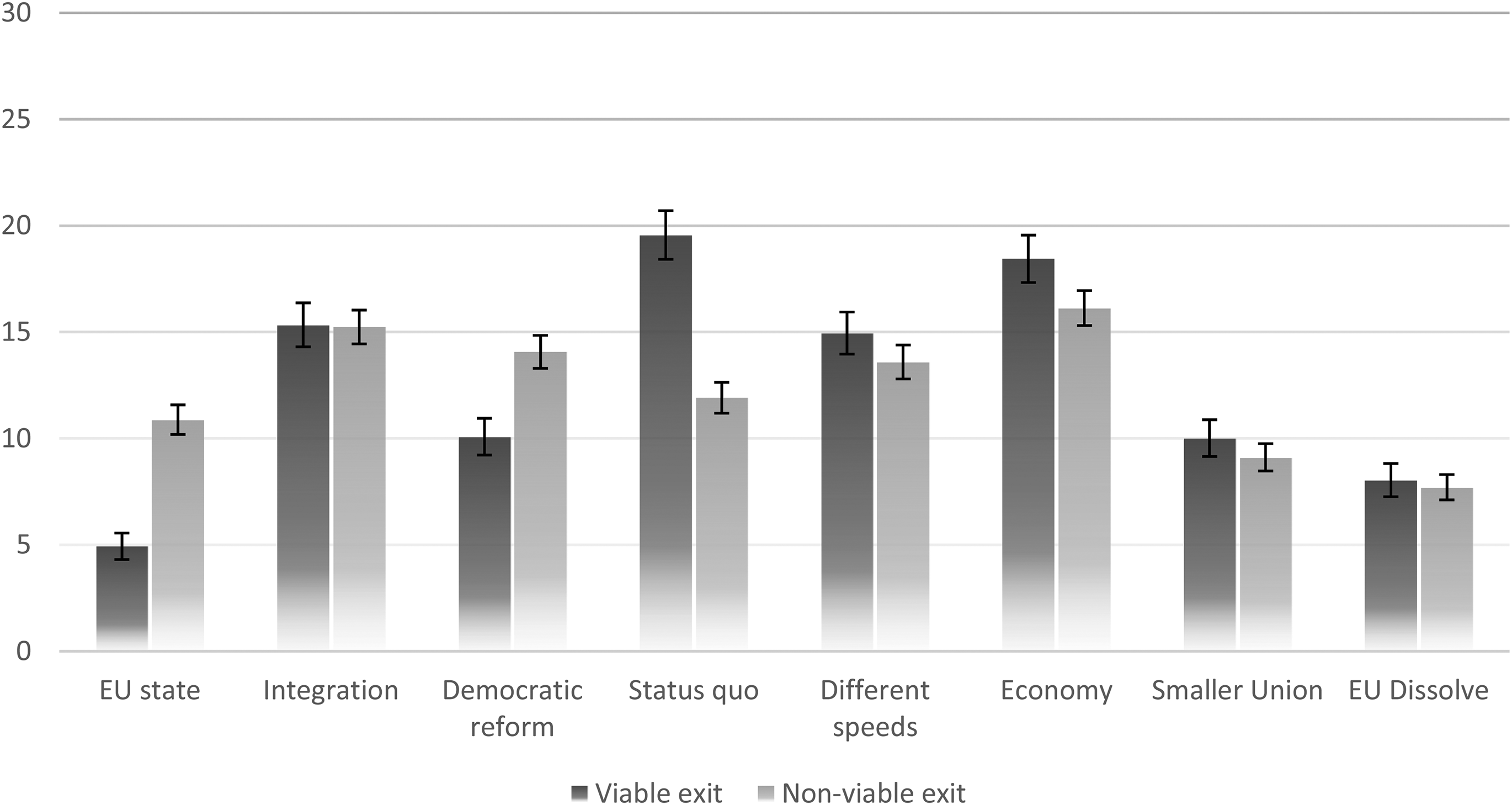
First scenario choice in countries with/without viable exit option (%); including 95% confidence intervals.
The subsequent MDU analysis helps to assess to what extent the scenarios are substantively distinct in the eyes of citizens, and whether they represent more than a simple pro-/anti-EU dimension. In the Online appendix, we display the configurations of one- and two-dimensional solutions for the pooled sample. As the key result, we can conclude that the two-dimensional solution provides a better model fit than the one-dimensional solution and that the eight scenarios represent distinct answer options. This means that the eight scenarios cannot be reduced to a one-dimensional EU support measure, which speaks in favour of treating the scenarios in a nominal way for the following analysis of their underlying reasons (see a more detailed discussion in the Online appendix).
Linking common models of EU support to future preferences
In a second analytical step, we examine the individual determinants of future EU preferences. To ease interpretation, we focus on marginal effects and adjusted prediction plots (but see complete regression results in the Online appendix). Figure 2 shows the marginal effects of cost/benefit evaluations. The two graphs each show changes in predicted probabilities (y-axis) to prefer a given scenario for respondents with no difference (EU = national; left) or a positive difference (EU > national; middle) in their evaluations (compared with respondents with a negative difference EU < national) and for a one-point increase on the evaluation of the absolute EU level (right).
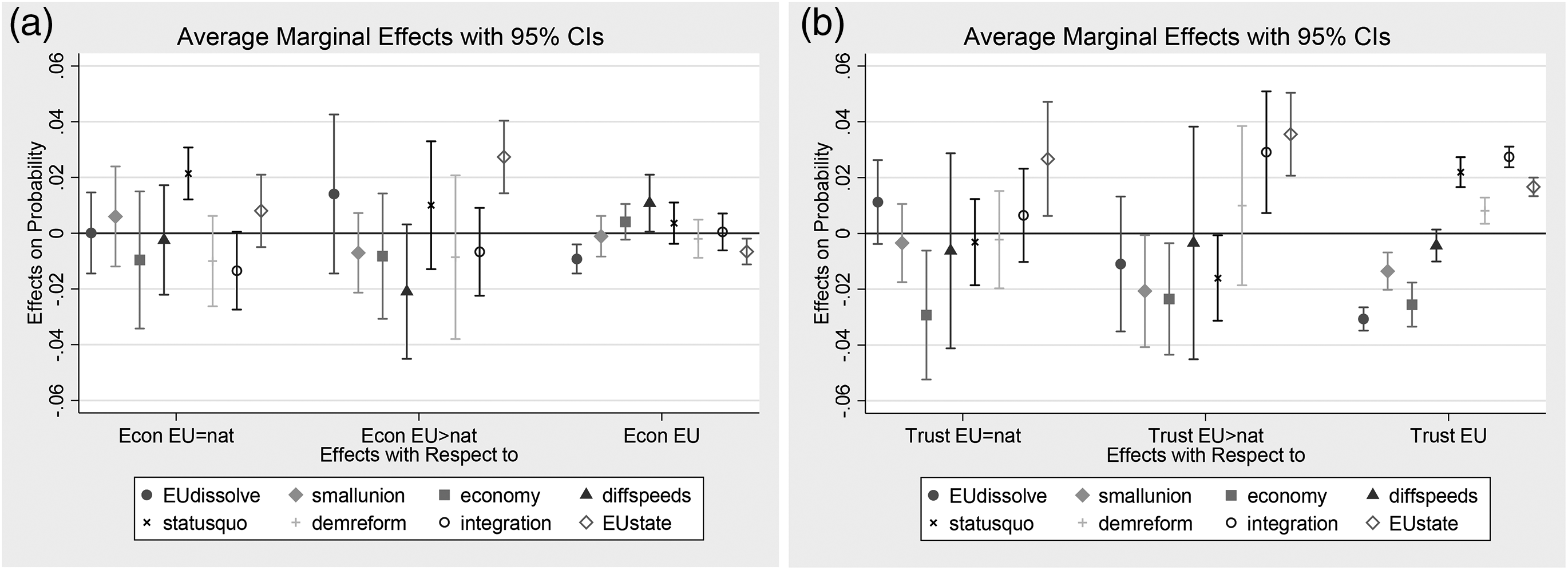
Average marginal effects for economic evaluations (a) and trust (b).
Our expectations included a preference to continue the integration process among people with a positive EU differential regarding both the economic evaluation (H2a) and the perceived level of trust (H2b). Related, we expected stronger preferences for disintegrative scenarios up to dissolving the EU for people with lower EU evaluations on both aspects (which equals negative preferences for these scenarios among citizens with a positive EU differential). For citizens with equal evaluations of the national and EU level, we expected a preference for the status quo (H2c). Starting with the economy (Figure 2(a)), respondents evaluating the EU economy more positively than the national economy (compared with those evaluating the EU economy less positively) show a significantly higher preference only for a European state, but we find none of the expected opposite negative preferences for the disintegrative scenarios. While H2a is thus only supported for one specific scenario, we find strong support for H2c as people with equal evaluations of the EU and national economy display the expected preference for the status quo. Overall, relative economic calculations have little effect on preferences for the EU's future. Interestingly, the intended baseline measure of evaluating the EU economy positively (independent of national evaluations) displays negative effects on both extreme scenarios and a positive effect for the EU at different speeds. 2
The effects of trust are more in line with our expectations and generally stronger (Figure 2(b)). A ‘positive EU differential’, i.e. trusting the EU more than one's national government, results in higher preferences for further integration or an EU state (compared with those trusting the EU less). Similarly, a positive differential has a negative effect on the disintegrative scenarios of a smaller union or focusing on an economic union. These findings support H2b. The same pattern is partly present for respondents evaluating both levels equally, which contradicts H2c and the expected status quo preference. Interesting is again that the absolute EU trust measure fits even better with expectations. People with higher EU trust clearly prefer each of the pro-integration scenarios, while opposing any reduction of the current EU. This means that citizens’ future preferences depend both on how they evaluate the EU in itself, and on how they compare it with their national institutions.
Figure 3 (split in two to ease readability) shows the scenario preferences according to the left–right ideology in terms of adjusted predictions, that is, the probability to prefer a scenario (y-axis and different lines) depending on the left–right positioning of a respondent (x-axis). We expected right-wing citizens to prefer scenarios that entail a reduction or ending of the EU (H3a) or the scenario of an economic union (H3c), and left-wing citizens to prefer scenarios focused on pursuing democratic reforms or further integration (H3b). We find support for H3c as right-wing citizens prefer an economic union much more than left-wing citizens do (first differences in predicted probabilities Δ0.08, p < 0.001). An EU of different speeds is also more popular on the (centre-)right than on the left (Δ0.06, p < 0.01). In contrast, and also supporting our expectations (H3b), left-wing citizens have stronger preferences for the more pro-integrationist scenarios – particularly for democratic reforms (Δ0.05, p < 0.001) and for continuing the integration process (Δ0.07, p < 0.001). For the EU state scenario, the effect is less pronounced, but we still find that strongly left-wing citizens support this option more compared with moderate citizens (Δ0.03, p < 0.01), which might represent the ideal of a more equal EU for everyone among left-wing citizens. The results are in line with the literature (Van Elsas and Van der Brug, 2015) that (radical) left-wing citizens do not necessarily want less EU, but rather a thoroughly reformed EU. That said, dissolving the EU is preferred by both extreme left and extreme right respondents compared with moderate citizens (Δ0.02, p < 0.05), though overall this preference is rather low (not supporting H3a). Accordingly, moderate citizens significantly prefer the status quo compared with both more left- or right-wing citizens (Δ0.04, p < 0.05).
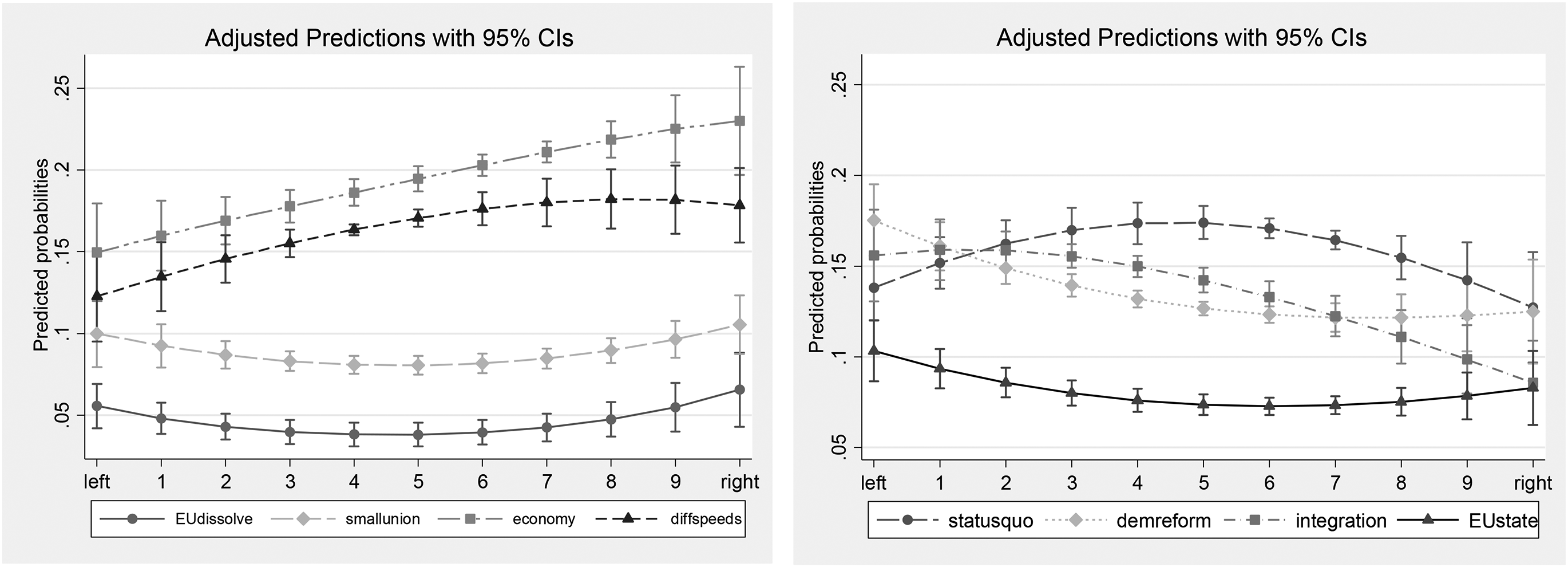
Adjusted predictions for left–right ideology.
Figure 4 shows the effects of anti-immigrant and anti-globalisation attitudes. We expected that anti-immigration (H4a) and anti-globalisation attitudes (H4b) result in stronger preferences for scenarios that reduce or dissolve the EU. Citizens with anti-immigrant attitudes may further prefer the economic union scenario, but not citizens with anti-globalisation attitudes (H4c). In contrast, pro-globalisation attitudes may lead to preferences for a European state (H4d). We find strong support for H4a with anti-immigrant attitudes leading to higher preferences for all of the ‘less’ Europe scenarios (and the status quo). The effects of anti-globalisation attitudes partly mirror this pattern, with higher preferences for almost all of the ‘less’ Europe scenarios, and for dissolving the EU in particular, thus lending support to H4b. Interestingly, the effect on the economic union scenario is not significant. This shows that it is mainly anti-immigrant attitudes and not anti-globalisation attitudes that drive support for the economic union, thus supporting H4c. Another – unanticipated – difference between anti-immigrant and anti-globalisation attitudes is their effect on the status quo scenario. Among those disliking immigration, the status quo scenario is relatively popular, whereas it is among the least favoured scenarios among those opposing globalisation. This suggests that those opposing immigration mainly fear a further opening up of borders, whereas for anti-globalists the current EU setup is already too much. Finally, and against expectations (H4d), anti-globalisation attitudes do not significantly predict opposition to an EU state.
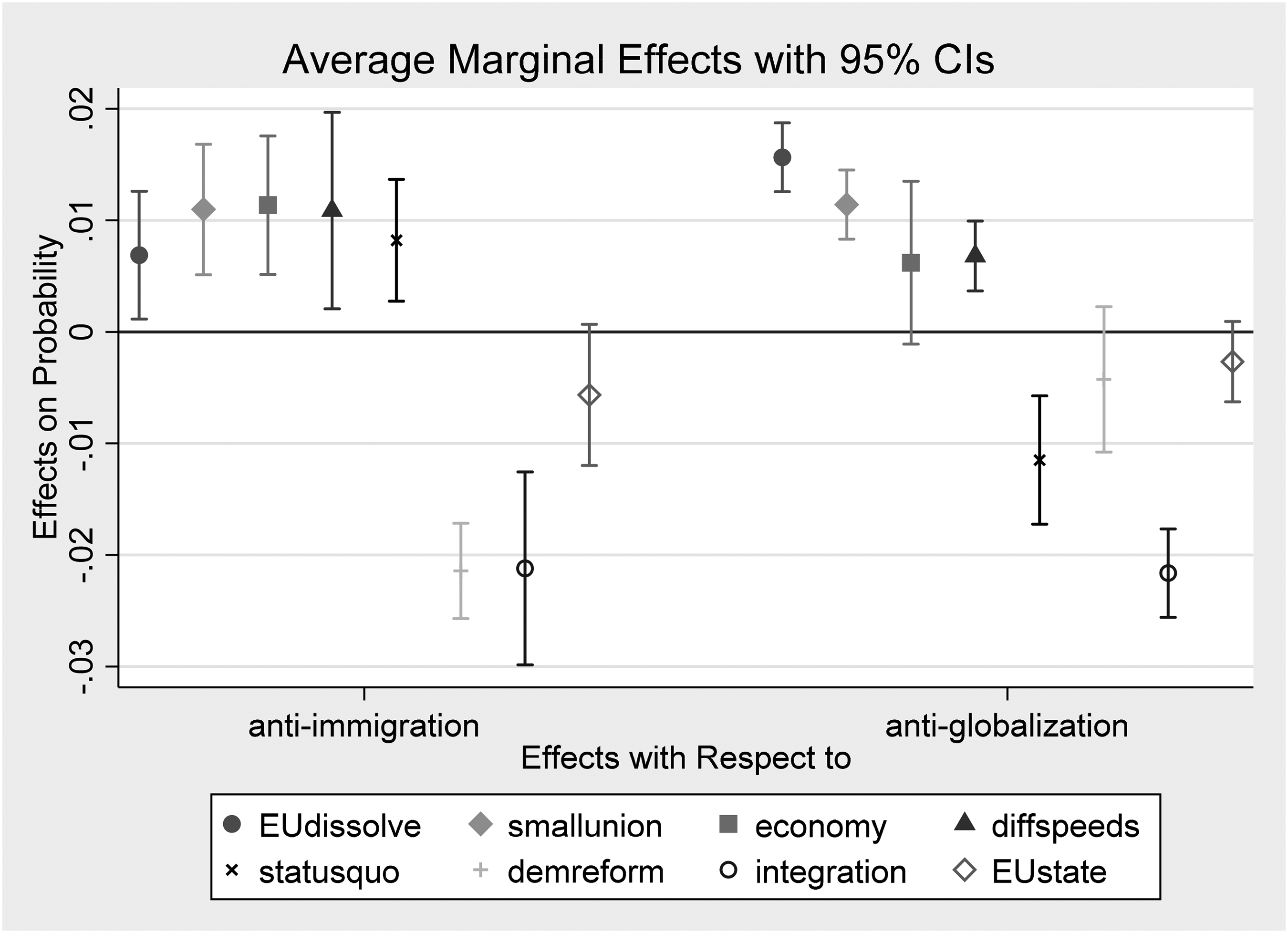
Average marginal effects for anti-immigration and anti-globalisation attitudes.
Putting all tested theories into perspective, the found effect sizes are small to moderate by increasing the likelihood of selecting a given scenario with a few percentage points (between 1 and 8). However, all explanatory models have a similar substantive impact, suggesting that scenario preferences depend on a variety of considerations rather than one specific explanatory model alone. In addition to the here tested main models of EU support – and considering the amount of unexplained variance in future preferences (see the Online appendix) – there may be several more factors that drive citizens’ future preferences, e.g. multidimensional EU attitudes or risk-taking attitudes.
Finally, we test the robustness of the results across contexts, distinguishing countries with and without a viable EU exit option. The respective results in the Online appendix do not lend support for the expected stronger influences of materialist explanations in countries without a viable EU exit option and of cultural explanations in countries with a viable exit option. Rather, the effects of the economic, immigration and globalisation factors are equally strong across contexts. However, we find differences in institutional trust, and particularly the positive EU differential, which matters more in countries without an exit option, thus confirming our expectation; second, there are striking differences in ideology, mostly when it comes to the ‘more EU’ scenarios. While left-wing citizens are more supportive of the status quo, democratic reform and more integration scenarios in countries with a viable exit option, left–right alignment does not matter for these scenarios in the non-viable exit countries. In the latter, in contrast, left-leaning respondents are clearly more in favour of the EU state scenario compared with right-leaning respondents. The general effect we found for this scenario in the main model thus stems from respondents living in countries without a viable exit option.
Discussion
Summarising the findings of our cross-national investigation into public preferences for the future of the EU, three key conclusions emerge. First, preferences for future EU scenarios are heterogeneous both within and between countries. Citizens’ preferences are spread rather equally across the different scenarios, with the least preferred options being the extreme options of having one EU state or dissolving the EU. Second, there is considerable between-country variation in preferences, which can to some extent be explained by structural conditions – related to the economic performance and quality of government (QoG) (De Vries, 2018). Third, at the individual level, future EU preferences are associated with common attitudinal factors found in the EU literature. Regarding cost/benefit evaluations, mainly institutional evaluations related to political trust in national and EU institutions matter – while economic calculations are less relevant. Furthermore, ideological left–right self-placement, anti-immigration and anti-globalisation attitudes are important correlates of future EU preferences. Our findings corroborate recent studies that call into question the common ‘horseshoe’ understanding of left–right and Euroscepticism (Hobolt, 2015; Van Elsas et al., 2016). Overall, citizens positioned towards the left have a more positive attitude towards further integration and democratic reform, while opposing scenarios that dismantle the EU. This means that left-wing citizens mostly want a ‘different’, but not a reduced, EU.
A robustness check showed that most explanations hold equally in countries with and without a viable exit option. There are, however, some differences: Institutional trust is more important in countries without a viable exit option, which aligns with the idea that in such countries institutional quality is a more pressing issue. The differential effects for left–right ideology between the two groups of countries corroborate studies showing that the ideological basis of EU attitudes differs across EU regions (Otjes and Katsanidou, 2017).
These key findings have implications for both research and policy. Starting with the scientific implications and in line with works on the multidimensionality of EU attitudes (e.g. Boomgaarden et al., 2011), we find that citizens’ EU attitudes are more complex and diverse than reflected by simple pro-/anti-EU measures. Citizens have a rather nuanced outlook on the EU, disliking specific aspects of integration while supporting others – which ties into studies on attitudinal ambivalence (Stöckel, 2013). Furthermore, it suggests that attitudes towards the future of European integration are meaningful. Not only are citizens’ preferences spread across the eight scenarios, but they also relate to the core explanations of EU support, indicating that such preferences are the outcome of evaluative judgment. Citizens are thus able to operate with more complex EU attitude questions than the simple pro-/anti-EU measures commonly employed in surveys (cf. Goldberg et al., 2021). Moreover, binary survey items might lead to important misinterpretations. As a case in point, where conventional survey items interpret status quo support as a sign of support for EU integration, we find that this option is actually highly preferred among citizens with anti-immigrant attitudes, as well as in countries with a viable exit option. Supporting the status quo may thus just as well mean putting a brake on the integration process as wanting it to continue (see also Malang, 2017).
In line with the idea that citizens make an informed comparison between their status quo and an alternative state (De Vries, 2018), we found differences in the future preferences between citizens in countries with or without viable exit options. As expected, citizens of countries where an EU exit is less likely to be perceived as beneficial or viable tend to be more supportive of pro-integration scenarios, while such scenarios are less popular among citizens whose country might be perceived as having a viable future outside the EU. Evidence at the individual level corroborates this mechanism. We find that citizens’ comparative evaluations of the EU's and their own country's institutional quality impact future EU preferences, particularly in the non-viable exit countries.
Our findings show that binary measures of EU support may lead to misleading conclusions. Behind EU opposition lie highly different preferences for its future development, only a few of which aspire to the extreme of dissolving the EU – and the same applies to EU support. This variety of opinions is not only important for EU scholars, but also has implications for the broader literature on an emerging pro-/anti-globalisation cleavage (Kriesi et al., 2012). While this cleavage is typically presented as a sharp contrast between ‘winners’ and ‘losers’, our findings show that citizens with anti-immigration and anti-globalisation attitudes have highly varied preferences – and not necessarily for the most extreme scenarios.
The collection of rich and novel comparative data allowed us to give a broad picture of future EU preferences across the Union. Our eight scenarios successfully represented distinct preferences, albeit some scenarios present more similarities than others. The proposed set of scenarios might be improved further, by constantly taking into account developments in the political debate. Ideally, the next step would expand the analysis to all 27 member states. As a start, in this study, we compared the effects across countries with and without an EU exit option. Especially the different impact of the left–right ideology asks for a more detailed analysis of cross-level effects. One important contextual moderator to include is party supply (especially the presence of Eurosceptic challenger parties), as previous research has shown how radical parties shape the views on Europe's future among left-wing and right-wing citizens (De Vries and Edwards, 2009).
Given the constraints of large-scale cross-national surveys in terms of mental effort and space, we are aware that the here presented scenario measure might be too complex for standard survey research on EU support. We recommend, however, researchers to consider including survey items that explicitly address the EU's future development. While our proposed measure could be included in more specialised surveys, a more parsimonious alternative might be to select some scenarios and let respondents evaluate them separately on a 0 to 10 scale (similar logic as for propensity to vote measures (PTVs)).
For policy makers and political parties, the heterogeneous future preferences among the public call for a broader, more nuanced policy contestation about the EU's future. Citizens are not at the extremes, and a political debate framed along the lines of pro-EU progressives wanting ever closer union versus nationalist-populists aiming for a total EU breakup does not reflect preferences among the EU population. This means, on a positive note, that there are ample opportunities for an informed debate that involves and engages citizens. Arguably, though, the variety of preferences also poses a challenge as to find a common way forward that a majority of EU citizens supports and that secures the future for the European project.
Supplemental Material
sj-docx-1-eup-10.1177_14651165211034150 - Supplemental material for One union, different futures? Public preferences for the EU's future and their explanations in 10 EU countries
Supplemental material, sj-docx-1-eup-10.1177_14651165211034150 for One union, different futures? Public preferences for the EU's future and their explanations in 10 EU countries by Andreas C Goldberg, Erika J van Elsas and Claes H de Vreese in European Union Politics
Supplemental Material
sj-zip-1-eup-10.1177_14651165211034150 - Supplemental material for One union, different futures? Public preferences for the EU's future and their explanations in 10 EU countries
Supplemental material, sj-zip-1-eup-10.1177_14651165211034150 for One union, different futures? Public preferences for the EU's future and their explanations in 10 EU countries by Andreas C Goldberg, Erika J van Elsas and Claes H de Vreese in European Union Politics
Footnotes
Funding
The authors disclosed receipt of the following financial support for the research, authorship and/or publication of this article: This work was supported by the H2020 European Research Council (grant number 647316).

Supplemental material
Supplemental material for this article is available online.
Notes
References
Supplementary Material
Please find the following supplemental material available below.
For Open Access articles published under a Creative Commons License, all supplemental material carries the same license as the article it is associated with.
For non-Open Access articles published, all supplemental material carries a non-exclusive license, and permission requests for re-use of supplemental material or any part of supplemental material shall be sent directly to the copyright owner as specified in the copyright notice associated with the article.
