




Abstract
Previous studies predicted European Union attitudes using anti-immigrant attitudes, but without explicitly accounting for attitudes toward different out-groups. We propose that group-specific attitudes independently predict attitudes toward the European Union, but only when the out-group is linked to the European Union issue in question. We additionally argue that realistic or symbolic threat associated with specific out-groups determines whether utilitarian or identity considerations are more important in predicting European Union attitudes. Using a nationally representative Dutch sample (N = 2347), we focus on attitudes toward Polish and Muslim immigrants to predict strengthening of European Union integration and Turkey’s potential accession and find support for our hypotheses. The findings indicate the need to rethink the relationship between out-group perceptions and European Union attitudes.
The debates regarding the stability, size and cohesion of the European Union (EU) have been increasingly visible in recent years. For instance, the strengthening of EU integration (e.g. increasing the cooperation and harmonisation between member states and the transferral of power to the EU level) has been challenged by the influx of refugees and by the rise of populist parties, which has shown that substantial parts of the European electorate rally behind anti-EU platforms and support nationalistic policies. At the same time, the EU enlargement has been another hot topic of the discussions, with the majority of the European opposing Turkey’s membership (McLaren, 2007).
Given that public opinion about Europe is central to the development of the EU (see e.g. Carrubba, 2001; Gabel, 1998; Norris, 1997), it is essential to study the factors that affect citizens’ attitudes toward the strengthening and the enlargement of the EU. Above and beyond such oft-studied factors as the economic and political contexts, group identities emerge as increasingly important in understanding EU-related attitudes (e.g. Carey, 2002; Van Klingeren et al., 2013) and especially citizens’ anti-immigrant attitudes. Simply put, those citizens who oppose immigrants also largely oppose the EU (Azrout et al., 2011; De Vreese and Boomgaarden, 2005; McLaren, 2002).
Some scholars have argued that anti-immigrant attitudes stem from citizens’ individual tendency to categorize others as out-groups (Sniderman et al., 2000). If so, anti-immigrant attitudes in general should translate into negative EU attitudes. After all, EU integration involves integration with groups which can be easily defined as out-groups (see Azrout et al., 2011).
This general argument, however, does not take into account the differentiation between various immigrant groups and the attitudes citizens hold toward these groups. Not all immigrant groups are created equal, and various groups are associated with different types of threat (Stephan et al., 1999). For instance, immigrants from Eastern Europe are often seen as a competition to jobs and economic resources (i.e. realistic threat, Engbersen et al., 2010), whereas immigrants from majority Muslim countries are seen as threatening the European values and culture (i.e. symbolic threat; Allen and Nielsen, 2002; Velasco Gonzáles et al., 2008). Thus, the considerations salient in people’s minds when thinking about different immigrant groups should also vary.
Here, we attend to these consequential nuances and extend existing research in several important ways. Theoretically, people distinguish between immigrant groups and these groups trigger different considerations, for instance as related to the economic utility or identity threats. Furthermore, these attitudes toward various out-groups differently predict support for or opposition to specific policies related to the EU, depending on whether the out-group is associated with the policy in question. In other words, attitudes toward immigrants not only indicate mere individual readiness to categorize others as belonging to out-groups but also depend on the specific immigrant group, and these group-specific attitudes powerfully structure different types of EU attitudes.
Unlike most prior work that focuses on immigrants in general, we examine attitudes toward two specific groups, Polish and Muslim immigrants in the Netherlands, and test how these attitudes relate to individual support for strengthening of the EU integration and support for the EU enlargement by Turkey’s membership. We also examine whether these relationships are mediated by economic utilitarian versus identity considerations triggered by each group. Specifically, Polish and Muslim immigrants are associated with economic versus symbolic threat (Engbersen et al., 2010), respectively. Consequently attitudes toward Poles should weigh in more strongly when people express support for (or opposition to) further integration of countries already in the EU, and this effect should be mediated through economic utilitarian considerations evoked by the Poles. In turn, attitudes toward Muslim immigrants should more strongly predict individual support for (or opposition to) EU enlargement by Turkey’s membership, through identity considerations triggered by this specific immigrant group. In so doing, we extend prior scholarship by using cross-sectional survey data (N = 2347) to show how citizens give meaning to different EU policies, depending on the out-group associated with the particular policy.
Theory
Since the turn of the century, scholars recognize that identity-related factors are among the strongest predictors of attitudes toward the European Union (e.g. Carey, 2002; Hooghe and Marks, 2004, 2005; Van Klingeren et al., 2013). Among these factors, anti-immigrant attitudes are the strongest predictor (e.g. Azrout et al., 2011; De Vreese et al., 2008; McLaren, 2007). 1 Azrout et al. (2011) explain why these attitudes predict EU attitudes in a two-step argument. The first step builds on Sniderman et al. (2000: 52), who argue that the degree to which an individual negatively evaluates immigrants does not depend on any specific immigrant group, but is mainly the result of an attribute of that individual, namely the readiness to categorize others as belonging to groups other than one’s own, i.e. as out-groups. The second step of Azrout et al.’s (2011) argument builds on a premise from social identity theory, namely that individuals tend to show a favourable bias toward in-group members and (in some circumstances) a negative bias toward out-group members (for an overview see Brown, 2000; Tajfel, 1982).
Applying these steps to EU affairs, individuals who readily categorize others as an out-group are more likely to see other Europeans as an out-group for the sole reason of differences in language, nationality, culture and/or ethnicity. And by the very virtue of defining other Europeans as an out-group, those individuals may also show negative out-group bias, the emergence of which is especially likely when group membership is salient (e.g. as it is during the debates surrounding terrorist attacks, the influx of refugees, or the Greek economic crisis). This negative bias may manifest itself as opposing further integration with countries already in the EU or rejecting EU membership of an applicant country. Azrout et al. (2011) empirically test this argument and find that people with anti-immigrant attitudes indeed opposed Turkey’s EU membership because they defined Turks as an out-group.
Using similar arguments, several scholars focus on how the ways people perceive ‘the other’ in their country are linked to EU attitudes (De Vreese and Boomgaarden, 2005; De Master and Le Roy, 2000; Diez Medrano, 2003; Garry and Tilley, 2009; McLaren, 2002) and EU enlargement (De Vreese et al., 2008; Gerhards and Hans, 2011; McLaren, 2007). For instance, McLaren (2002) notes that cultural threat negatively predicts the support for the EU. De Vreese and Boomgaarden (2005) more specifically show that it is people’s out-group bias, namely anti-immigration sentiments, that explains opposition to European integration both in terms of attitudes and individual propensity to vote against the EU enlargement.
Interestingly, almost none of these studies test attitudes toward a specific out-group (i.e. most refer to either immigrants or minority groups in general), let alone a specific out-group related to concrete EU policies under investigation (for exceptions, see discussion below of Hobolt et al., 2011; Yavçan, 2013). Furthermore, to our knowledge, virtually no research contrasts two distinct out-groups in this context. If the effect of anti-immigrant attitudes is driven by the general tendency to categorise others as an out-group, looking at specific out-groups would not be necessary. However, this explanation heavily relies on the idea that the main systematic variance in the measurement of anti-immigrant attitudes is due to individual’s readiness to categorise, and thus would expect similar predictions from distinct groups.
Our core argument is markedly different. We argue that even though negative out-group evaluations are partly due to an individual’s readiness to categorise others as out-groups, people are able to differentiate between out-groups. This should lead to different attitudes toward distinct EU policies. As we further contend, group-specific attitudes should weigh in more heavily on individual support for those policies that relate to the particular out-group in question.
With regard to the point that people do differentiate between immigrants, several studies show that various groups are associated with different types of threat perceptions (e.g. Hainmueller and Hiscox, 2007; Riek et al., 2006). Most central is the distinction between realistic and symbolic threat. The former concerns threats to scarce resources such as territory, wealth or natural resources, whereas symbolic threat focuses on the clash of values and norms and threats to the in-group’s worldview (Stephan et al., 1999). In general, in the media and the public debate in Europe, immigrants from ‘younger’ EU countries, such as Poland, are often seen as a taking jobs and other economic assets from the native populations (e.g. Engbersen et al., 2010), whereas Muslims are often presented as a threat to European values, identity and culture (see Verkuyten et al., 2014). Thus, notwithstanding the premise from Sniderman et al. (2000) that the main variance in anti-immigrant attitudes is due to the general tendency to categorise others as an out-group, and notwithstanding the argument in the EU public opinion literature that this general tendency is what drives EU attitudes, if the public distinguishes between out-groups and the threats they pose, it is reasonable to expect that distinct threats associated with particular groups predict support for the EU differently, and independent of the general tendency to categorise.
Indeed, several scholars have found that group-specific attitudes differently affect attitudes towards the EU depending on the applicability of the out-group to the EU policy. For instance, Hobolt et al. (2011) find that anti-Muslim sentiment predicts both Euroscepticism and opposition to Turkey’s membership. However, when controlling for general negative feelings toward immigrants, the effect of anti-Muslim sentiment on Euroscepticism disappears. Yet the significant effect of anti-Muslim sentiment remains when explaining opposition to Turkey’s membership in the EU, even after controlling for anti-immigrant feelings (Hobolt et al., 2011). In other words, when evaluating the potential EU membership of a Muslim-majority country, Muslim-specific evaluations play a role above and beyond the categorisation as an out-group. 2 This is further supported by Azrout et al. (2012), who show that religious threat perceptions have a relatively strong effect on support for Turkey’s potential EU membership, but much less so when membership of Croatia is evaluated, and no effect on the support of a potential membership of Switzerland. Also, Yavçan (2013) finds that the effects of anti-immigrant attitudes on support for EU enlargement are stronger when respondents are primed with Turkish instead of Italian immigrants, but there are no differences when predicting Eurosceptic attitudes. In a similar vein, Van Spanje et al. (2010) find that religious threat seems to matter when subjects evaluate the potential EU membership of Bosnia-Herzegovina, and that such threat matters even more when subjects are informed that half the population is Muslim.
We take this idea further, and argue that group-specific attitudes should be relevant to different considerations used to understand public support for the EU. Scholars have advanced two main explanations: utility and identity. First, because European cooperation started as primarily economic, some have argued that it is the economic situation that should matter to citizens’ EU attitudes (e.g. Gabel, 1998; Gabel and Palmer, 1995). Second, as the EU has been exceeding the boundaries of economic cooperation and moving toward increased political integration, scholars have also focused on identity-related issues to understand what (political) community citizens feel they belong to and how that relates to their EU attitudes (e.g. Carey, 2002; Hooghe and Marks, 2004; McLaren, 2002).
Building on these explanations, Azrout (2013) proposes a framework in which utilitarian and identity considerations mediate the effects of different factors. He argues that, when scholars find that economic conditions affect support for Turkey’s membership, they assume citizens interpret this issue in economic (i.e. utilitarian) terms, which in turn affects their attitudes. In turn, when researchers discuss the effect of national identity or anti-immigrant attitudes, they assume that citizens use identity considerations to make sense of the issue and to form their EU attitudes. In other words, economic- and identity-related factors activate utilitarian and identity considerations, which in turn predict attitudes toward the EU.
However where Azrout (2013) predicts the use of these considerations with general economic- and identity-related attitudes, we propose that these considerations and their effects can be induced by specific out-groups related to a specific EU policy. To link out-group perceptions to these considerations, we align utilitarian and identity considerations with realistic and symbolic threat. When realistic threat to in-group’s resources is salient, it should translate into (negative) utilitarian considerations which influence EU attitudes (Gabel, 1998; Hooghe and Marks, 2005). In turn, if symbolic threat to in-group’s values, culture and identity is triggered, it should translate into (negative) identity considerations and lead to more Eurosceptic attitudes (Carey, 2002; Hooghe and Marks, 2005). Combining these arguments with the premise that different out-groups are associated with realistic and symbolic threats, we propose that specific immigrant groups should differently affect – depending on their association with symbolic and realistic threat – utilitarian or identity considerations, which in turn should predict the position people take on a specific EU policy at hand. Overall, our model reveals how, depending on a specific out-group considered, citizens give meaning to the EU.
Context and hypotheses
We focus on public opinion in the Netherlands toward two EU policies: strengthening of EU integration and its enlargement by Turkey’s potential EU membership. 3 Utilitarian and identity considerations have been shown to be of importance to both the strengthening of EU integration (e.g. Hooghe and Marks, 2005) as well as Turkey’s potential EU membership (Azrout, 2013; De Vreese et al., 2008; McLaren, 2007).
As noted, different out-groups should be applicable to these two policies and these two considerations. Important in choosing the out-groups is that the essential attribute (Allport, 1954), which guides the group categorisation, is applicable to the EU policy at hand. With regard to strengthening, as EU integration is about integration with countries already in the EU, the relevant essential attribute should mark other nationalities within the EU. We focus on Polish immigrants, one of the largest immigrant groups from Central-Eastern Europe, and one that has been subject to some controversy in the Netherlands. When it comes to EU enlargement, because Turkey is a Muslim-Majority country, religion is an important attribute. And thus, Muslims are the out-group relevant for people’s evaluation of Turkey’s membership (see also Hobolt et al., 2011). Also, in the Netherlands Poles are associated with realistic threats (e.g. Engbersen et al., 2010) whereas Muslims are more often associated with symbolic threats (Allen and Nielsen, 2002; Velasco Gonzáles et al., 2008). We recognize that Poles are a group defined by nationality, whereas Muslims are a religious category and – in that sense – the two out-groups are quite distinct. However, because our theoretical assumptions are not concerned with the grounds on which the groups are categorised, but with the categorisation being relevant to the EU policy in question, selecting these two out-groups is appropriate for our purposes.
Based on the theoretical considerations discussed, we formulate our hypotheses. First, following the arguments about the general tendency to categorize immigrants as out-groups, we hypothesize that anti-immigrant attitudes negatively predict support for both strengthening of EU integration (H1a) and Turkey’s accession (H1b). Although prior studies have shown these relationships and, thus, these hypotheses are not new, it is beneficial to first replicate previous findings (and establish their applicability to different countries and years) before nuancing them in our subsequent hypotheses.
Second, we argue that group-specific attitudes also predict EU attitudes, controlling for anti-immigrant attitudes. With regard to strengthening of EU integration, we hypothesize that attitudes toward Polish immigrants are a predictor independently of anti-immigrant attitudes, with those individuals who are negative toward Poles also being negative toward EU strengthening (H2a). With regard to Turkey’s membership, we hypothesize that attitudes toward Muslims are a predictor independently of anti-immigrant attitudes, with individuals who are negative toward Muslims also being negative toward Turkey’s membership (H2b). Vice versa, in the absence of a link between the out-group and the EU policy, we explicitly hypothesize that attitudes toward Poles do not predict support for Turkey’s EU membership (H3a) and attitudes toward Muslims do not predict support for EU strengthening (H3b).
Third, we expect all the hypothesized paths from anti-immigrant and group-specific attitudes on the support for EU strengthening and EU enlargement to be mediated by utilitarian and identity considerations (H4). As Polish immigrants are associated with realistic threat, the path through utility considerations should be stronger than the mediated path through identity considerations (H5a). On the other hand, because Muslims are seen as a symbolic threat, the path through identity considerations should be stronger than the mediated path through utilitarian considerations (H5b).
Methods
To test our hypotheses, we rely on data collected within the framework of the 2014 European Election Campaign Study (see De Vreese et al., 2014). The study included a four-wave public opinion panel survey in the Netherlands, of which the second wave contained all the variables of interest to our analyses. Fieldwork of the second wave took place from 20 March until the 30 March 2014 and was conducted by TNS NIPO, a research institute that complies with the World Association for Market, Social and Opinion Research guidelines for survey research. A random sample was drawn from the TNS NIPO database (which consists of 200,000 nationally representative individuals recruited through multiple recruitment strategies, including telephone, face-to-face and online recruitment), with quota’s enforced on age, gender and education. This led to a net sample of 2347, from which we have full data on all relevant variables. 4
Operationalisation
Out-group attitudes
We are interested in three concepts related to immigrants: general anti-immigrant attitudes and two group-specific measures. We follow Sniderman et al. (2000) to measure anti-immigrant attitudes as a selection of negative evaluations concerning immigrants and abuse of the Netherlands’ social welfare system, security and crime. These evaluations did not mention any immigrant group, and so we assume they are a proxy for the tendency to categorise others as an out-group.
In addition, we also tap attitudes toward Poles and Muslims using social distance measures, often used to assess intolerance toward a specific group (Bogardus, 1925; Brinkerhoff and Mackie, 1986; Golebiowska, 2004; Hobolt et al., 2011). Respondents indicated how comfortable they would feel with a Pole or Muslim as a neighbour, co-worker and physician. These questions were asked after the general anti-immigrant items, as not to prime the respondents to think about a specific group when answering the general anti-immigrant questions.
Dependent variables
To measure support for strengthening of EU integration and support for Turkey’s EU membership, we asked about a preferred future state regarding these topics. For strengthening, building on Boomgaarden et al. (2011), respondents were asked to indicate whether the EU should become one country and whether they are in favour of the efforts to unify Europe. For Turkey’s membership, we asked about respondents’ support for or opposition toward this membership and about conditional support if Turkey would meet all the criteria set for EU membership.
Mediators
For both EU strengthening and EU enlargement, we assessed both identity and utilitarian considerations, which have been shown to form separate constructs of EU-related considerations (Azrout, 2013; Boomgaarden et al., 2011). For EU strengthening, we measured identity considerations, asking whether respondents feel proud to be a European citizen and whether the European flag and being a European citizen means a lot to them. EU-related utilitarian considerations were assessed by asking whether the Netherlands’ membership was a good thing, whether the Netherlands benefitted from being a member and whether respondents perceive the EU to foster peace and stability.
Another set of items captured similar identity and utilitarian considerations as related to Turkey’s membership. To tap the former, respondents indicated whether they perceived Turkey to be part of Europe in geographical, cultural and economic terms. For Turkey-related utilitarian considerations, respondents evaluated whether Turkey’s membership would have more negative than positive consequences for the EU, the Netherlands and the respondent him/herself.
All items were (re-)scaled before the analyses such that higher values represent positive attitudes toward out-groups, positive evaluations of identity and utility considerations and support for EU strengthening and enlargement. 5
Data analysis
To test our hypotheses, we rely on structural equation modelling (see Kline, 2011). The added value of using this method is twofold. First, by modelling our theoretical concepts as latent factors, we reduce the systematic and random measurement error, improving our model quality. Second, this technique allows us to assess the indirect relationships between our concepts, which are central to our hypotheses.
We first assess the measurement of our theoretical concepts using confirmatory factor analysis. We build two separate but parallel measurement models: one for strengthening of EU integration and the other for EU enlargement. 6 In both cases, we model identity and utilitarian considerations as well as support to be separate constructs. The strengthening model focuses on EU-related identity considerations, EU-related utilitarian considerations and support for EU strengthening. The enlargement model models Turkey-related identity and utilitarian considerations and support for Turkey’s membership. Also, in both cases, we add three immigrant factors to the measurement model: general anti-immigrant attitudes, social distance toward Poles and social distance toward Muslims. Since identically worded items measured social distance toward both groups, we assume that error correlations between these indicators are necessary.
After establishing the measurement model, we focus on the structural part of the model. We hypothesized that anti-immigrant attitudes and social distance toward Poles predict support for EU strengthening (H1 and H2a). However, we also posited the paths from anti-immigrant attitudes and social distance toward Poles to be mediated through the considerations related to EU identity and EU utility (H4). Accordingly, we build a strengthening structural regression model with indirect paths from anti-immigrant attitudes and social distance toward Poles, through EU identity and EU utility, to support for EU strengthening. Because we hypothesized social distance toward Muslims not to predict this support (H3a), we do not add paths from social distance toward Muslims to either support or the mediators. Because we do expect that EU identity and EU utility-related considerations may contain some common variation that is not explained by the exogenous variables, we also include a correlation between the error terms of these factors.
With regard to support for Turkey’s membership, we predicted that social distance toward Muslims and not toward Poles would predict support (H2b and H3b). Thus, in the enlargement structural regression model, we specify paths from social distance toward Muslims to the considerations related to Turkey’s identity and Turkey’s utility to support for Turkey’s membership, and we do not specify paths from social distance toward Poles.
Resulting structural regression models are nested under the measurement models. To assess the structural regression models, we thus compare them to the measurement models using the chi-square difference. After achieving a structural regression models with sufficient fit, we interpret the model structure and the estimates to test our hypotheses.
In all models, we add theoretically relevant control variables. Because we rely on cross-sectional data, including these variables guards against the possibility that the tested relationships are spurious and due to some external factors that predict our independent variables, the mediators and the outcomes. As demographics, we control for age, gender and education. Also, we add the most important predictors of EU attitudes, which are known to correlate with anti-immigrant attitudes: economic evaluations (e.g. Gabel, 1998; Karp and Bowler, 2006), government satisfaction (e.g. Crum, 2007; Franklin et al., 1995; Hix, 2007) and national identity (e.g. Carey, 2002; Hooghe and Marks, 2004). We enter the demographics as observed variables, and model economic evaluations, government satisfaction and national identity as latent constructs. As the models with controls are very complex, for clarity we do not present the results for the control variables but only for the variables of substantive interest (question wording, descriptive statistics, factor loadings of the control variables as well as the full SEM results are presented in the Online Appendix).
Results
Establishing the measurement model
Factor loadings.
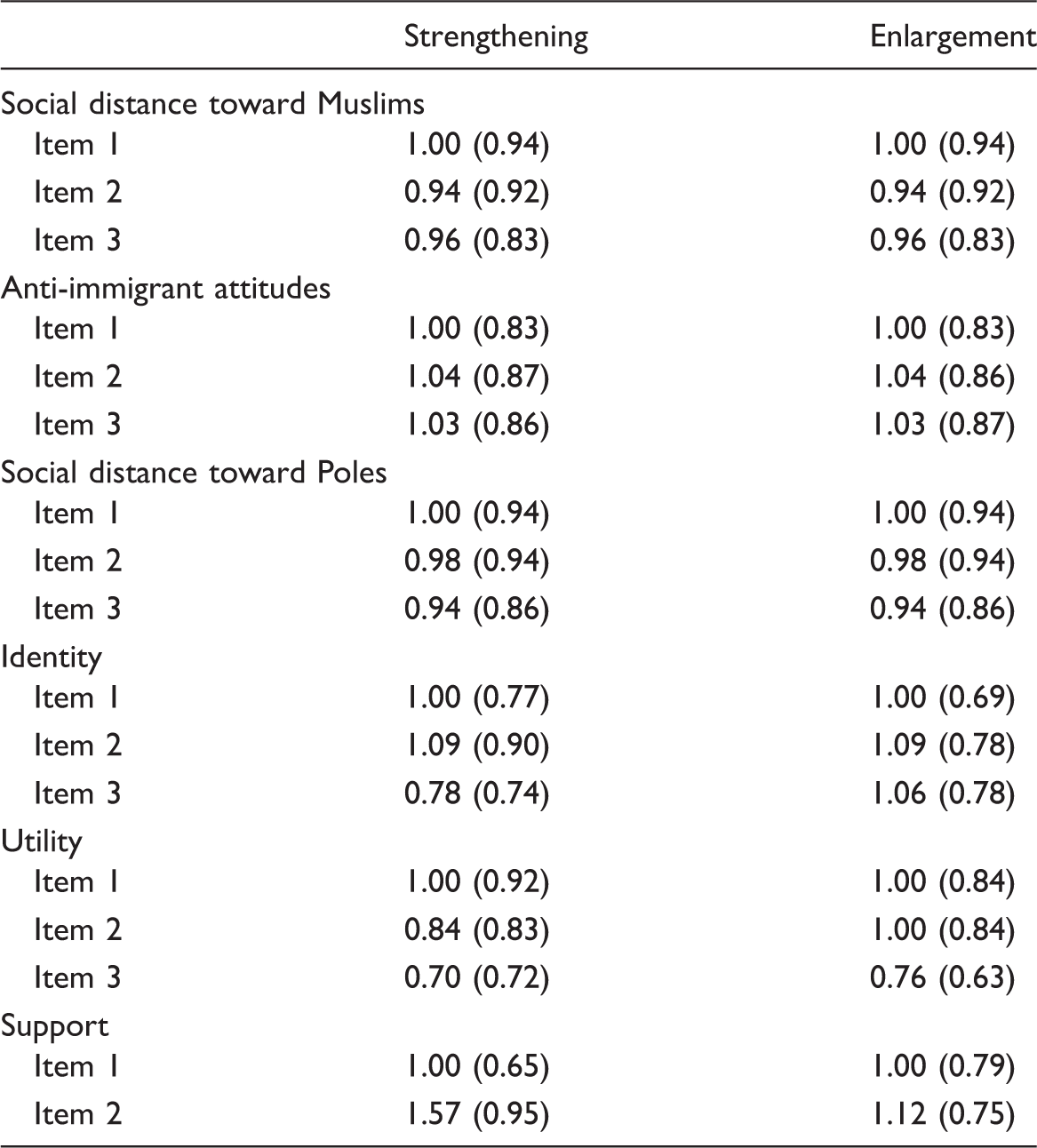
Note: Entries are unstandardized factor loadings, with standardized loadings between parentheses. Only factor loadings of the constructs of substantial interest are shown. Factor loadings of the control variables are found in the Online Appendix.
Next, we turn to the measurement model for Turkey’s membership, with the factors for anti-immigrant attitudes, social distance toward Poles, social distance toward Muslims, the considerations related to Turkey’s identity and Turkey’s utility as well as support for Turkey’s membership and the controls. This model has a good fit (Compartive Fit Index: CFI = .96; Root Mean Square Error of Approcimation: RMSEA = .044, 90%, confidence intercal (CI) [.042, .046]). Also, the error correlations between the individual social distance items are necessary for adequate model fit (between neighbour items: χ2df=1 = 164.17, p < .001; between co-worker items: χ2df=1 = 227.52, p < .001; between physician items: χ2df=1 = 742.26, p < .001; removing all three: χ2df=3 = 947.86, p < .001). Between the factors, we find again a high correlation between social distance toward Poles and social distance toward Muslims (r = .80), and an even stronger correlation between the Turkey identity and support (r = .90). We again test the discriminant validity and merging the constructs significantly decreases model fit (merging the social distance measures: χ2df=1 = 2451.06, p < .001; merging Turkey identity and support: χ2df=1 = 69.11, p < .001). We are thus able to empirically distinguish between these related measures, despite some conceptual overlaps between these constructs.
Establishing the structural model
Next, we turn to the structural regression models. Turning first to EU strengthening, we test a model where general anti-immigrant attitudes and social distance toward Poles have paths to support for EU strengthening, which are mediated through the EU identity and EU utility considerations, and without any paths from social distance toward Muslims. This model is nested under the measurement model, and so with a chi-square difference test we can evaluate whether the structural part has sufficient fit. And with a non-significant chi-square of the difference (χ2df=5 = 8.75, p = .119), the structural part fits well. All hypothesized effects are significant and removing any one of them significantly decreases model fit. Our final strengthening model is shown in Figure 1 (see also Table 2).
Final structural model for strengthening, with standardized path coefficients. Note: Model fit: χ2df=402 = 2192.95, p < .001; CFI = .96; RMSEA = .044, 90%CI [.042, .045]. Decrease in model fit between measurement model and final SR model: χ2df=5 = 8.75, p = .119. In the model we controlled for age, gender, education, economic evaluations, government satisfaction and national identity (not shown for reasons of clarity). Unstandardized path coefficients. Note: Entries are unstandardized path coefficients, with standard errors in parentheses. In the models we control for age, gender, education, economic evaluations, government satisfaction and national identity (the latter three as latent constructs). All presented paths are significant at .001, except for the path from social distance toward Poles to identity in the deepening model (p = .032).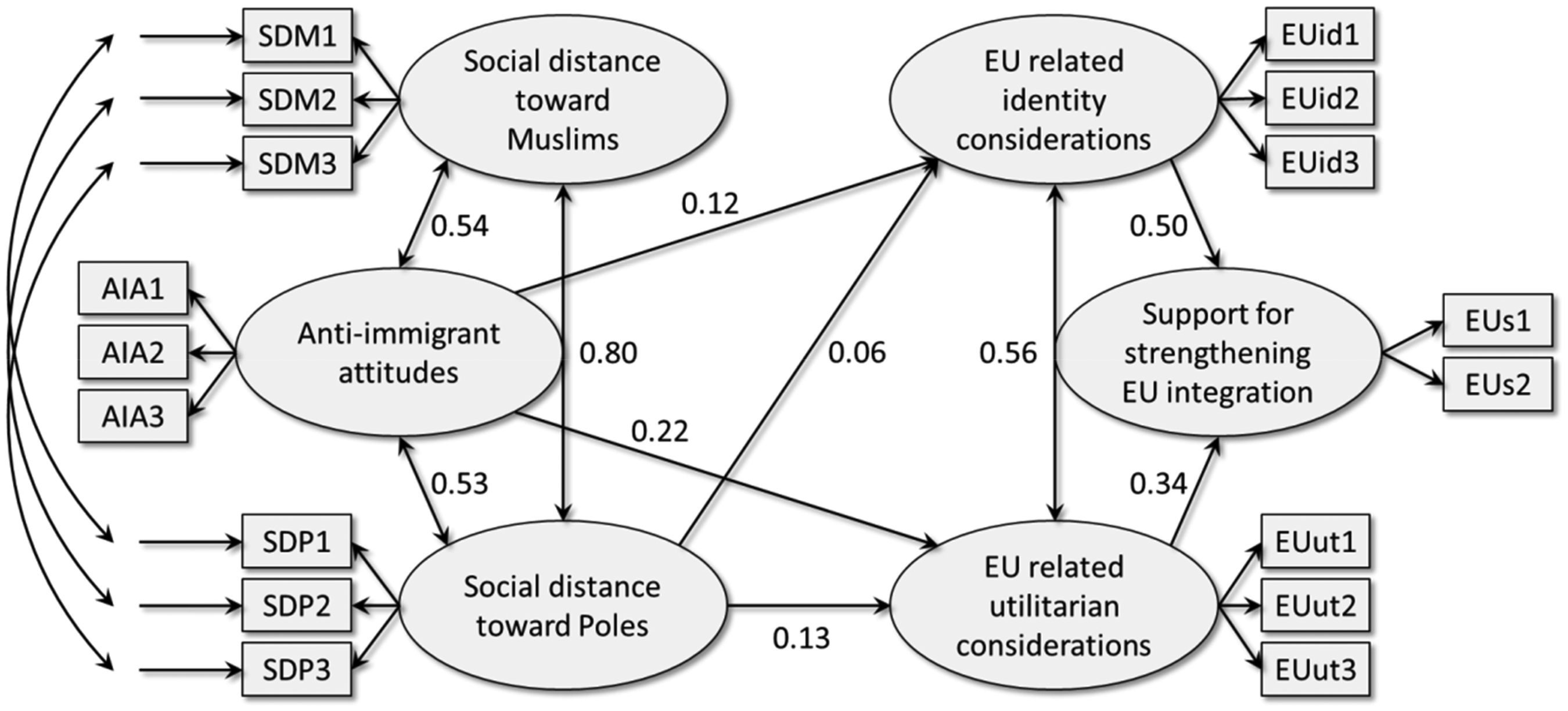
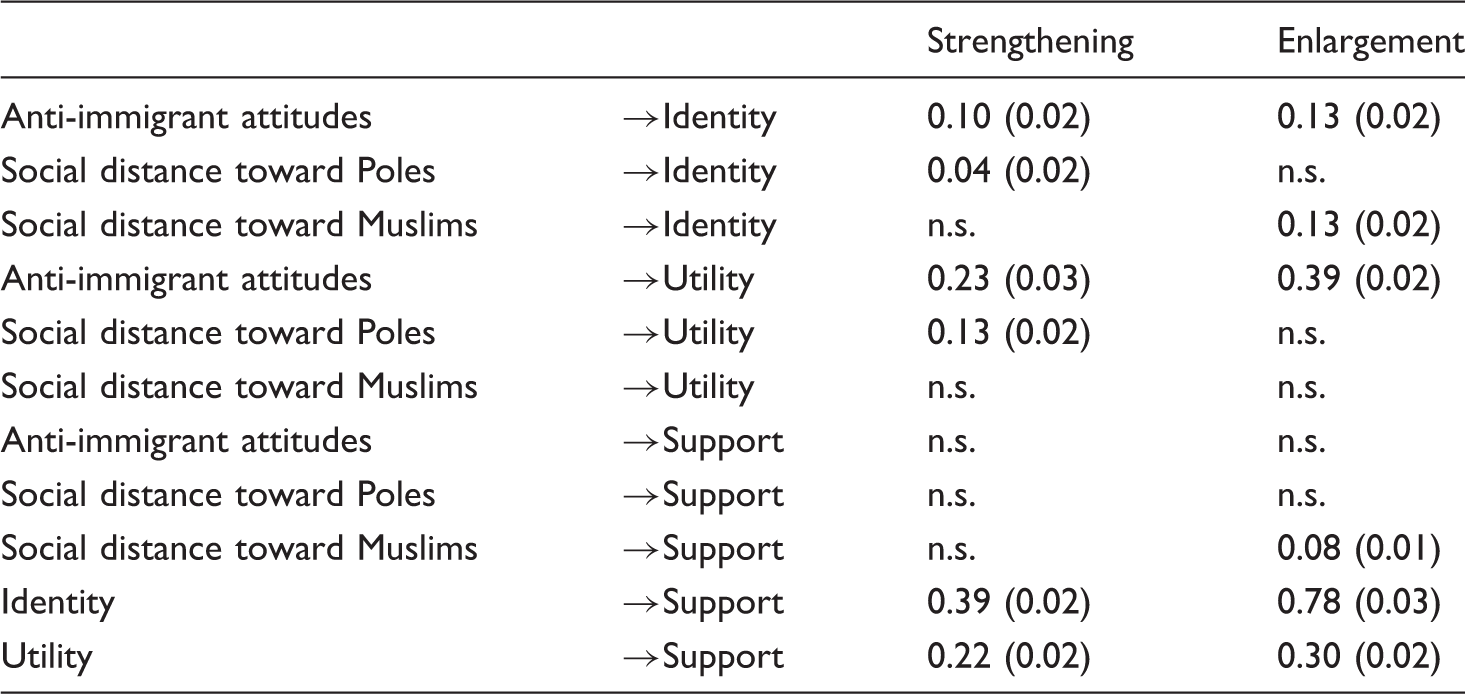
Turning to the structural regression model for enlargement, we find that compared to the measurement model we have a significant loss of model fit (χ2df=5 = 39.23, p < .001), indicating that extra paths are needed for the model to acquire sufficient fit. We add a direct path from social distance toward Muslims to support for Turkey’s membership in the EU, which substantially improves model fit (χ2df=1 = 33.45, p < .001). Also, compared to the measurement model this new model has no significant loss of model fit (χ2df=4 = 5.78, p < .216).
In the model with this extra path, the path between social distance toward Muslims and the considerations related to Turkey’s utility is non-significant and dropping the effect does not decrease the model fit (χ2df=1 = 3.44, p < .064). We thus present the final enlargement model in Figure 2 and Table 2. Compared to the measurement model, the final model does not have a significant loss of model fit (χ2df=5 = 9.22, p < .101) which indicates a good fit of the structural part of the model.
Final structural model for enlargement, with standardized path coefficients. Note: Model fit: χ2df=402 = 1912.96, p < .001; CFI = .97; RMSEA = .040, 90%CI [.038, .042]. Decrease in model fit between measurement model and final SR model: χ2df=5 = 9.22, p = .101. In the model we controlled for age, gender, education, economic evaluations, government satisfaction and national identity (not shown for reasons of clarity).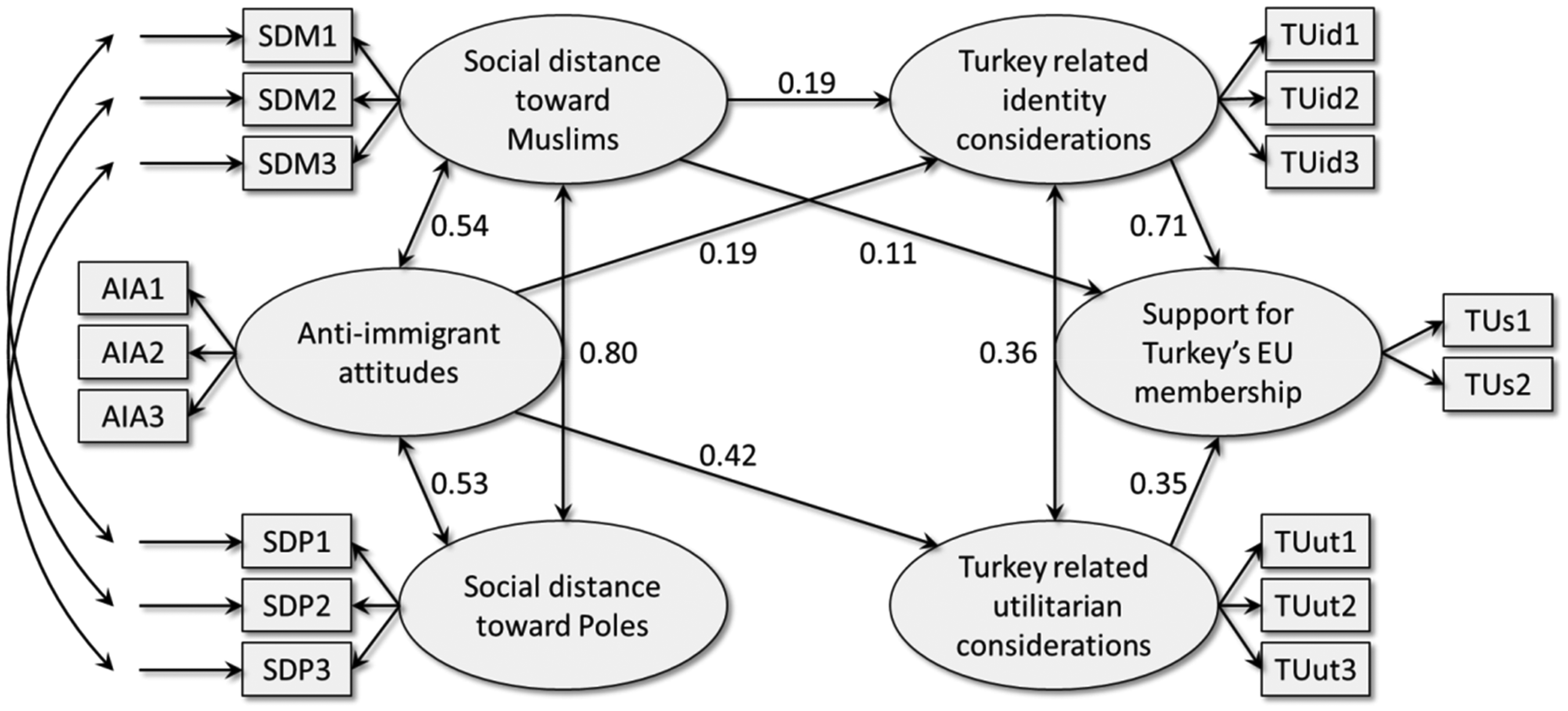
Testing the hypotheses
With our final models, we now turn to testing our hypotheses. In the strengthening model, the standardised total effect of anti-immigrant attitudes on support for EU strengthening is estimated at b* = 0.14, which supports H1a. The standardized total effect of social distance toward Poles on support for EU strengthening is estimated at b* = 0.07. That is, those respondents who are more favourable toward immigrants in general and those who feel more comfortable with Polish immigrants in particular are more favourable toward EU strengthening. Although the coefficient for the group-specific attitudes is smaller than the coefficient for the general anti-immigrant attitudes, it is nevertheless significant when controlling for the other factor. This indicates that social distance toward Poles independently predicts support for EU strengthening, which supports H2a. And with a good model fit without a path from social distance toward Muslim to support for strengthening of EU integration (either direct or indirect), we find that social distance does not predict support which also supports H3a.
Given the aforementioned high correlation between social distance toward Poles and social distance toward Muslims, one might argue that the role of both measures in the models is interchangeable (i.e. is it just the common variance that drives the prediction?). If it is, removing the paths from social distance toward Poles to EU identity and EU utility and keeping the paths from social distance toward Muslims would lead to equally well fitting models. This is not the case, however. The re-estimated models have a significant decrease of model fit when deleting the path from social distance toward Poles to EU identity (χ2df=1 = 7.77, p = .005), when deleting the path from social distance toward Poles to EU utility (χ2df=1 = 14.31, p < .001) and when deleting both paths simultaneously (χ2df=2 = 15.59, p < .001). Supporting the analyses presented above, these findings further imply that the social distance measures are not interchangeable. We thus conclude that it is indeed attitudes toward Poles specifically, and not toward Muslims, that play a role in attitudes toward EU strengthening, which further supports H3a.
With regard to EU enlargement, we find a parallel pattern, with mirrored effects from social distance toward Muslims, as expected. The model predicts a total standardised effect of anti-immigrant attitudes on support for Turkey’s membership of b* = 0.28, and a total standardised effect of social distance toward Muslims of b* = 0.24. Again, those more favourable toward immigrants and those more comfortable with Muslims are more supportive of Turkey’s membership, and the group-specific coefficient is not substantially smaller than the coefficient for the general anti-immigrant attitudes measure. However, the significant path for the group-specific measure indicates its unique contribution to attitudes toward Turkey’s membership. Furthermore, the finding that there are no paths from social distance toward Poles to these attitudes is consistent with our hypotheses. Namely, anti-immigrant attitudes predict support for Turkey’s EU membership (H1b), social distance toward Muslims has a unique contribution in explaining this support (H2b), and social distance toward Poles is not a significant predictor (H3b). As in the strengthening model, the social distance measures are not interchangeable. Keeping the paths from social distance toward Poles and deleting the paths from social distance toward Muslims leads to a significant decrease of model fit (when deleting the path to Turkey identity from social distance toward Muslims: χ2df=1 = 15.08, p < .001; when deleting the path to Turkey support from social distance toward Muslims: χ2df=1 = 9.35, p = .002; when deleting both paths: χ2df=2 = 30.72, p < .001). This shows that the unique variation in social distance toward Muslims is necessary to achieve better model fit, implying that attitudes toward this group, and not toward Poles, drive support for Turkey’s accession.
According to the last set of our hypotheses, the paths of both anti-immigrant attitudes and social distance toward Poles to attitudes toward EU strengthening should be indirect through EU identity and EU utility considerations. Mirroring this prediction for attitudes toward Turkey’s membership, the paths of anti-immigrant attitudes and social distance toward Muslims should be indirect through the considerations related to Turkey’s identity and utility. For strengthening, the model shows no direct paths from anti-immigrant attitudes and social distance toward Poles to support for EU strengthening, but only indirect paths through EU utility and EU identity considerations. This supports H4. The mediated path from social distance toward Poles through EU identity considerations is estimated at b* = 0.03, while the mediated path through EU utilitarian considerations is estimated at b* = 0.05. Importantly, the path through EU utility is stronger, indicating that social distance toward the group that is more often associated with realistic threat indeed more strongly predicts one’s support for EU strengthening through utilitarian considerations. This finding supports H5a.
Lastly, in the enlargement model, the paths from anti-immigrant attitudes are also mediated through the considerations related to Turkey’s identity and utility. However, to acquire a good model fit, we needed to add a direct path from social distance toward Muslims to support for Turkey’s membership. Also, the path from social distance toward Muslims to Turkey’s utility was not significant. We, therefore, do not find an indirect path through perceived Turkey’s utility. However, and perhaps more importantly, part of the total effect of social distance toward Muslims on support for Turkey’s membership is mediated by Turkey’s identity considerations (estimated at b* = 0.13), with a direct effect remaining (estimated at b* = 0.11). This partly supports H4. Given the absence of a mediated path through Turkey’s utility considerations, the indirect effect through identity is stronger, and thus we find support for H5b. 8
Discussion
In this article, we aimed to further develop our understanding of how anti-immigrant sentiments influence attitudes toward the European Union. We argued that attitudes toward EU policies should be predicted by attitudes toward the specific immigrant groups that are salient to these policies. In addition, given that various immigrant groups are associated with different threats (in particular realistic or symbolic threats), we expected that group-specific attitudes should predict EU attitudes through different underlying paths. Using structural equation modelling, we tested these predictions on Dutch attitudes toward two distinct immigrant groups, Muslims and Poles, in relation to two different EU policies, the strengthening of EU integration and also EU enlargement by Turkey’s membership.
We replicate previous findings, showing that anti-immigrant attitudes indeed predict opposition toward both further integration and Turkey’s membership. This baseline finding is consistent with arguments that people’s general tendency to categorize others as out-groups increases one’s opposition toward the EU (Sniderman et al., 2000). In other words, disliking immigrants in general makes people more likely to oppose both policies. Importantly, however, the addition of group-specific attitudes to our model decreased the effect of anti-immigrant attitudes. This finding has two implications. First, measures of anti-immigrant attitudes do carry some out-group specific variation. Second, although part of the effect of anti-immigrant attitudes may be explained by the general tendency to categorize (Sniderman et al., 2000), a substantial part is explained by group-specific attitudes.
Extending this idea, we show that group-specific attitudes have unique and independent contributions to predicting EU-related attitudes, but only if the group is applicable to the EU policy in question. First, attitudes toward Poles (but not toward Muslims) predict support for EU strengthening, but not for Turkey’s membership. In stark contrast, attitudes toward Muslims (but not toward Poles) predict support for Turkey’s membership, but not for EU strengthening. Practically, the fact that attitudes toward Muslims were unrelated to attitudes toward EU strengthening, and attitudes toward Poles were unrelated to one’s support for Turkey’s membership, could point to a rational citizenry able to differentiate between groups and policies. Theoretically, these findings show that although the general anti-immigrant attitudes matter, group-specific attitudes are also of importance, above and beyond the general attitudes and in ways consistent with our theoretical predictions.
Furthermore, our study speaks to the mechanisms through which group-specific attitudes predict EU attitudes. As predicted, attitudes toward Poles have a stronger impact on support for EU strengthening through utilitarian considerations, compared to the impact through identity-related considerations. Conversely, attitudes toward Muslims predict individual support for Turkey’s membership through identity, rather than utilitarian considerations. Linked to the idea that Poles present realistic threats and Muslims are a symbolic threat, these findings imply that it not only matters whether there is a link between the out-group and the EU attitude, but also that this link emerges through relevant considerations triggered by the out-group and thus the way citizens give meaning to the EU policy.
It is important to acknowledge that the design of our study leaves several questions open. Perhaps the most important limitation comes from our reliance on cross-sectional survey data. 9 We cannot offer strong conclusions regarding the causal ordering between variables. This is a problem for our arguments. For instance, anti-immigrant attitudes can predict utilitarian considerations, as we argued, or utilitarian considerations may predict anti-immigrant attitudes (e.g. Citrin et al., 1997; Quillian, 1995). Both options are possible. And does a general anti-immigrant attitude cause negative group-specific attitudes or do people use their beliefs about a particular out-group to categorise in general? To shed some light on this issue, we re-estimated our structural equation models to test which causal order fits the data better compared to the alternatives. We find that for both the strengthening and enlargement the alternatives were (near) equivalent, suggesting that different causal orderings are equally likely in our data. Relying on strong theoretical foundations (e.g. Carey, 2002; De Vreese and Boomgaarden, 2005; De Vreese et al., 2008; McLaren, 2002, 2007), we predict the causal ordering presented here. Also, we show that group-specific attitudes have unique variation that predicts EU attitudes but only if the out-group is applicable to the EU policy, regardless of the order between out-group attitudes, a correlational finding that is a contribution in its own right.
Furthermore, our reliance on cross-sectional data makes the results vulnerable to confounding effects. For instance, anti-immigrant attitudes, identity and utilitarian considerations and EU attitudes may be a function of general economic evaluations and national identity, among other factors. If so, the detected relationships would be spurious. However, because we controlled for a host of variables relevant to both anti-immigrant as well as EU-related attitudes, we are confident that the relationships hold (e.g. controlling for general economic evaluations and national identity). Because, however, some other factors may remain untested, we encourage future research using longitudinal and/or experimental designs to establish the causal order and clear relationships between the variables. Although our design suffers from low internal validity, as any cross-sectional survey design, it has the advantage of being externally valid. As the results are based on a nationally representative sample, we confidently maintain that they are generalizable to the Dutch population.
Another limitation of our study is that we focused solely on Polish and Muslim immigrants, whereas the number of potential out-groups may be endless. What mattered to our theoretical argument is that certain out-groups are associated with the specific EU policy under consideration, as were Poles and Muslim in our study. It is possible that similar relationships would have emerged had we focused on other groups with traits relevant to the tested EU policies, a notion open for future research.
With regard to the measurement of our dependent variables, we acknowledge that although the items tapping support for Turkey’s membership were very precise, the items measuring support for EU strengthening were less specific. This difference (and, perhaps, also the very minimal likelihood that the EU will become one country in the near future) does make it difficult to directly compare the strengthening and enlargement models. By themselves, however, the results are quite consistent, adding to the robustness of our findings. Future research should measure various EU attitudes in directly parallel ways when it comes to both item concreteness and likelihood to make formal comparisons possible.
Despite these limitations, our results encourage us to think more carefully about prior evidence regarding public opinion about the EU. For instance, we know that the media influence anti-immigrant attitudes (Boomgaarden and Vliegenthart, 2009) as well as moderate the effects of these attitudes on EU-relevant policies (Azrout, 2013). Do these attitudes emerge because people categorise others as out-groups or because they learn about specific out-groups? Given that – as we show – we need to differentiate between the tendency to categorise and group-specific attitudes, the answer to this question may have specific implications for public opinion: whereas citizens dividing the world into in- and out-groups are bound to lead to the public being negative toward the EU, the effects of learning about specific immigrant groups depend on the group. Thus, for instance perceiving Muslims as not integrating should decrease support for Turkey’s membership, but may not affect support for strengthening of EU integration. Or, as a perhaps cynical but hopeful note for Europhiles, a common ‘other’ may lead to perceiving other Europeans as being part of the in-group and thus increase the support for the EU in general. This and other questions are open to further scrutiny. It is research that systematically accounts for individual-level factors, differences between immigrant groups, the various considerations that matter to individual attitudes, as well as specific attitudinal, cognitive and/or behavioural outcomes that is best suited to revealing when citizens support the European Union, why they do so, and whether Islam has something to do with it.
Footnotes
Funding
The author(s) received no financial support for the research, authorship, and/or publication of this article.
Notes
References
Supplementary Material
Please find the following supplemental material available below.
For Open Access articles published under a Creative Commons License, all supplemental material carries the same license as the article it is associated with.
For non-Open Access articles published, all supplemental material carries a non-exclusive license, and permission requests for re-use of supplemental material or any part of supplemental material shall be sent directly to the copyright owner as specified in the copyright notice associated with the article.
