



Abstract
This article builds on a field theoretical analysis of collaborative investigative journalism across the U.S-Mexico (Global North-South) border. The article examines contents produced in investigative collaboration between Salvadoran, Guatemalan, Mexican, and U.S. journalists, exposing human rights violations, crime, and corruption. The article elaborates on the concept of psychological capital and argues for its relevance in the study of cross-border collaborative investigative journalism. A key finding resulting from this research is that in most collaborative projects, psychological and other capital of the Central American and Mexican journalists was outweighed by the capital of the U.S. journalists. The psychological, social, and cultural capital of the Southern journalistic fields were highly relevant for the successful implementation of the examined projects, but not explicitly recognized in most reporting. The article also suggests the Southern journalists did not feel safe enough to suggest critical perspectives challenging the position of their Northern partners, who funded and supervised the collaborations. However, three projects, in which Northern and Southern journalists worked in Central America and Mexico side by side, manifested exemplary solidarity and recognition of the psychological and other capital of the Southern fields. Hence, it seems that witnessing the dangers affecting the region’s journalists firsthand can enable Northern journalists to better understand and appreciate the circumstances in which their Southern partners are living and working, reflected in more genuine appreciation of their psychological, cultural, and social capital.
Keywords
Introduction
This article builds on an empirical field theoretical analysis of collaborative investigative journalism across the U.S-Mexico (Global North-South) border. The article examines contents produced in investigative collaboration between Salvadoran, Guatemalan, Mexican, and U.S. journalists, exposing human rights violations, crime, and corruption.
Central America and Mexico are exceptionally dangerous regions for journalists. This article is particularly concerned with U.S. collaboration with Central American and Mexican independent journalists, who rely on investigative reporting to expose abuses and to hold the powerful accountable (e.g., Mesquita and de Lima Santos, 2023). Central American and Mexican independent journalists have been increasingly affected by the region’s extraordinary violence and tradition of impunity. To enable their critical work, Central American and Mexican independent media rely heavily on funding from U.S. sources, including their collaborating partners as well as foundations (e.g., Mitchell, 2022; Palau-Sampio, 2020: 6105).
This article introduces the concept of psychological capital to the study of collaborative investigative journalism. Psychological capital refers to an individual’s psychological state characterized by perseverance and capacity of sustaining and bouncing back when beset by problems and adversity (e.g., Luthans et al., 2007). This is a relevant concept in this geopolitical context: Violence against journalists in Mexico and Central America includes both physical and psychological attacks (Mitchell, 2022). Moreover, journalists working in Mexico have had more extensive symptoms of psychological distress than a demographically similar group of war correspondents (Feinstein, 2013). At the same time, resilience among Mexican journalists manifests in the ability to continue to function professionally and to create, adapt, and resist in the face of trauma and violence (González de Bustamante and Relly, 2021: 7). Resilience is accentuated among independent journalists who continue to push for truth and accountability amidst dangers and hardships (Mitchell, 2022).
Dóci et al. (2023: 339) argue that psychological capital is the missing link to developing a comprehensive field theoretical (Bourdieu, 1987, 2005) framework for studying the reproduction of social inequalities. Paradoxically, the discussion by Dóci et al. (2023) is limited to the context of the Global North, as field theoretical approaches tend to be (see Benson, 2015). The concept of psychological capital has been used, for instance, in studies examining resilience among Mexican workers in service, trade, and education (Santana Cárdenas et al., 2018) as well as Mexican university students (Banda Castro, 2023).
Field theoretical analyses have also examined resilience of Central American and Mexican journalists, without using the term psychological capital in particular. Brambila Ramírez (2018: 87-91) extends her analysis of cultural, economic, social, and symbolic capital through the term “strategies for safety autonomy” to refer to “actors’ capacity to put their volumes and forms of capital to use in developing mental schemes aimed at enhancing professional practice while reducing work-related risks.” Palacio Montiel (2020: 203) examined resilience in her analysis of symbolic violence against Mexican journalists. Mar (2016) examined how violence against journalists in Veracruz transformed journalistic habitus and reporting.
While journalists and researchers are celebrating the emergence of new collaborations, the radical shift from competitive to collaborative journalism remains under-researched. Especially few studies have examined collaborations in the Global South and particularly Latin America (Mesquita and de Lima Santos, 2021: 546). There is also little research on the way in which the diffusion of global newsroom networks depends upon a U.S. investigative tradition, and the fact that the funding of these initiatives comes primarily from the U.S. (see Konow-Lund et al., 2019). Existing research has pointed to divisive and potentially discriminatory practices by the Northern collaborators affecting independent journalists in Central America and Mexico (Mitchell, 2022). Existing studies have mostly used interview and ethnographic methods.
The content analysis by Palacio Montiel (2020: 207), examining Mexican newspaper coverage concerning the killings of three Mexican independent journalists, found that the systemic violence and precariousness of the journalists’ working conditions was rendered invisible in the coverage, devaluing their important investigative work. Palacio Montiel’s and Mar’s (2016) examples show that content analysis can produce important insights as to the treatment of journalists by other journalists.
Inspired by such work, this field theoretical article analyzed whether and to what extent contents co-produced in investigative collaboration across the U.S.-Mexico border contained considerations of circumstances and threats in Mexico and Central America and appreciation of their local partner-journalists’ psychological capital. The article forms part of a broader study focused on collaborative investigative journalism. 1 Drawing from Buchholz’s (2022) global cultural fields approach, the article challenges field theory’s premise about borders of fields always being a site of struggles (e.g., Bourdieu, 1987), pushing field theory to better account for global collaboration and social change.
A key finding resulting from this research is that in most collaborative projects, capital of the Central American and Mexican journalists was outweighed by the capital of the U.S. journalists. A notable exception were three collaborative projects where the whole starting point was to continue the investigations of local journalists who had been threatened or killed. In such reporting, the valorization of the psychological capital of the Central American and Mexican journalistic field was much more explicit and consistent, along with higher appreciation of their cultural and social capital, than in other collaborative projects. The three projects were also conducted in in-person collaboration, in addition to analyzing data jointly online. Hence, this research concurs with Buchholz (2022: 54) on the relevance of direct personal and physical encounters for enabling the rise of global fields characterized by shared cultural conventions.
The study also suggests that while the collaborations supported the safety of the Central American and Mexican journalists in their own national contexts, reflected in highly critical contents concerning their own governments, journalists from these regions did not feel safe enough to publish investigations that are critical of the home country of their U.S. partners, except in the projects produced in in-person collaboration. Such feelings of unsafety could have been prompted by the fear of not gaining further funding from U.S. sources (see also Cheas, 2024). This finding underlines the general dominance of Northern economic capital in the global journalistic field.
Field theoretical framework
The notion of field is useful for considering symbolic domination and global convergences in media organizations (Benson 1999: 484). Field theory sees society as differentiated into hierarchically organized fields and subfields (e.g. politics, academics) governed by their own “rules of the game” and offering their own economy of exchange and reward. Fields can be differentiated according to the kinds of capital that are valued therein and by their degree of relative autonomy from each other and from the dominant economic and political fields (Benson, 1999: 464).
The unequal distribution of capital contributes to disparities between and within fields. The capital defined by Bourdieu include economic capital, meaning money or assets that can be turned into currency. Cultural capital is informational capital, such as technological and methodological skills needed in investigative journalism. Social capital implies connections and group membership. Symbolic capital is the form the different types of capital take when perceived as legitimate (Bourdieu, 1987: 4).
Psychological capital, not included in Bourdieu’s original typology, refers to an individual’s psychological state of development characterized by (1) self-efficacy to put in effort to succeed at challenging tasks, (2) making a positive attribution about succeeding; (3) persevering toward goals, and (4) resilience when beset by problems and adversity (Luthans et al., 2007: 3). Dóci et al. (2023: 337-38) lament that the group-level aspect of psychological capital is often disregarded in psychological theorizing, arguing for the integration of the notion into the field theoretical framework. According to Dóci et al. (2023: 341), the role of psychological capital in social reproduction is two-fold: it may form the foundations of an attitude that is necessary for advancing in the social hierarchy, and one of the ways through which people of higher classes symbolize their status and transmit that to their children.
Field theory is only beginning to be used in “non-Western” settings (Benson, 2015: 275). Despite their argument that psychological capital is the missing link to studying the reproduction of social inequalities, Dóci et al. (2023) also seem to lack a perspective beyond the Global North: In schools and workplaces alike, positive psychological qualities such as resilience, ambition, entrepreneurialism, proactiveness, and assertiveness are recognized as signifiers of high potential, talent, and leadership potential. (...) Because people with positive psychological qualities are seen to be deserving of success and status, it pays off to be well equipped with psychological capital which thus can be easily transferred to social and economic capital (…) The lack of psychological capital tends to be perceived as a ‘weakness’ and seen as an ‘inferior’ psychological profile that is undeserving of opportunities and recognition. (Dóci et al., 2023: 344)
Namely, in the context of Central America and Mexico, it is apparent that the more resilient, ambitious, proactive, and assertive a journalist is — especially if their ambition concerns investigation of corruption, crime, and violations of human rights —, the more likely they will be punished. This is because, according to the rules of the game, these kinds of topics are not to be touched on, due to the position of the journalistic field vis-a-vis the broader fields of political and economic power (see Benson, 1999, 2013). Quite the contrary, lacking such perseverance and resilience, and feeling satisfied with the kind of mainstream reporting that does not challenge the status quo, is likely to get rewarded and converted into economic and social capital in Central America and Mexico.
As captured by Hughes and Márquez Ramírez (2018: 544, 551) concerning the Mexican context: “The stronger a journalist’s expressed support for watchdog journalism or for the promotion of positive social change, the more likely the journalist is to have been threatened.” Journalists working for independent watchdog journalism are also struggling with income across the region (e.g., Mitchell, 2022). In other words, psychological capital is not likely to convert into economic capital in the Mexican and Central American journalistic fields.
Fair enough, Central American and Mexican independent journalists have likely gained psychological capital as part of their upbringing and/or education. Gangs and cartels are often successful in the recruitment of young people who have grown up amidst poverty and misery and see no other opportunities for success and survival (e.g. Martinez, 2016). To make the choice to become an independent investigative journalist implies an interest in education and society, coupled with a perception that one can make a positive difference — this kind of attitude suggests the kind of psychological capital transferred through family or education and related reproduction of inequalities that Dóci et al. (2023) describe. However, in this context of the Global South, the relationship between psychological, economic, and other forms of capital does not seem as straightforward as Dóci et al. (2023) assume.
Brambila Ramírez (2018: 92) finds that journalists use their volumes and forms of capital to develop strategies for safety autonomy, with those journalists who possess higher levels of capital more likely to adopt these strategies. Brambila Ramírez (2018: 216) observes that Mexican journalists who participated and collaborated in digital networks and collective initiatives were more likely to develop a set of networked strategies to continue reporting while ameliorating risk. This connects with collaborative investigative journalism, which helps to mitigate risk by offering international visibility and protection for the journalists involved (e.g., Konow-Lund et al., 2019). In other words, it can be said that independent journalists in Central America and Mexico use of their social capital to pursue collaborations with journalists in global fields where their psychological capital will be potentially more appreciated than in the Central American and Mexican fields. Buchholz (2022: 16) defines “global cultural field” as a space in which agents (individual and organizational) have extended their competition over resources and recognition to a trans-continental level. This space has developed its own infrastructures, discourses, and institutions for evaluation, without being completely independent of the influences of (sub)national or regional fields. The global cultural field approach was developed to explore possibilities for change regarding the recognition of artists from formerly marginalized countries, vis-a-vis ongoing struggle (Buchholz, 2022: xvi). This article intends to show that the approach is also useful for the study of cross-border collaboration in journalism — and that journalism studies can develop field theory to better count for cooperation and solidarity alongside competition.
The present article specifically examines ways in and extent to which psychological capital of Central American and Mexican investigative and independent journalists is valued in their collaborations with U.S. journalists in the global field of investigative journalism, vis-a-vis other types of capital and especially economic capital of the U.S. journalistic field. The research questions are as follows: 1. How and to what extent does the collaborative coverage across the North-South border reflect the psychological capital of the Southern journalistic fields involved? 2. What is the relative value of economic, social, cultural, and psychological capital invested and gained by the Northern and Southern journalistic fields in cross-border collaborations? 3. How does the valorization of different kinds of capital reflect power relations between the Northern and Southern fields involved?
Sample
The research began by collecting a sample of journalistic coverage produced in cross-border collaboration between Salvadoran, Guatemalan, Honduran, Mexican, and U.S. journalists, investigating human rights violations, corruption, and crime affecting Central American and Mexican people and migrants in different contexts across the region (see also Cheas, 2024). The time span of the search in digital archives was between January 2015 and December 2022; period during which numerous abuses against Central American underprivileged populations and reporters seeking to investigate this abuse took place across the region.
Sample of collaborative coverage.
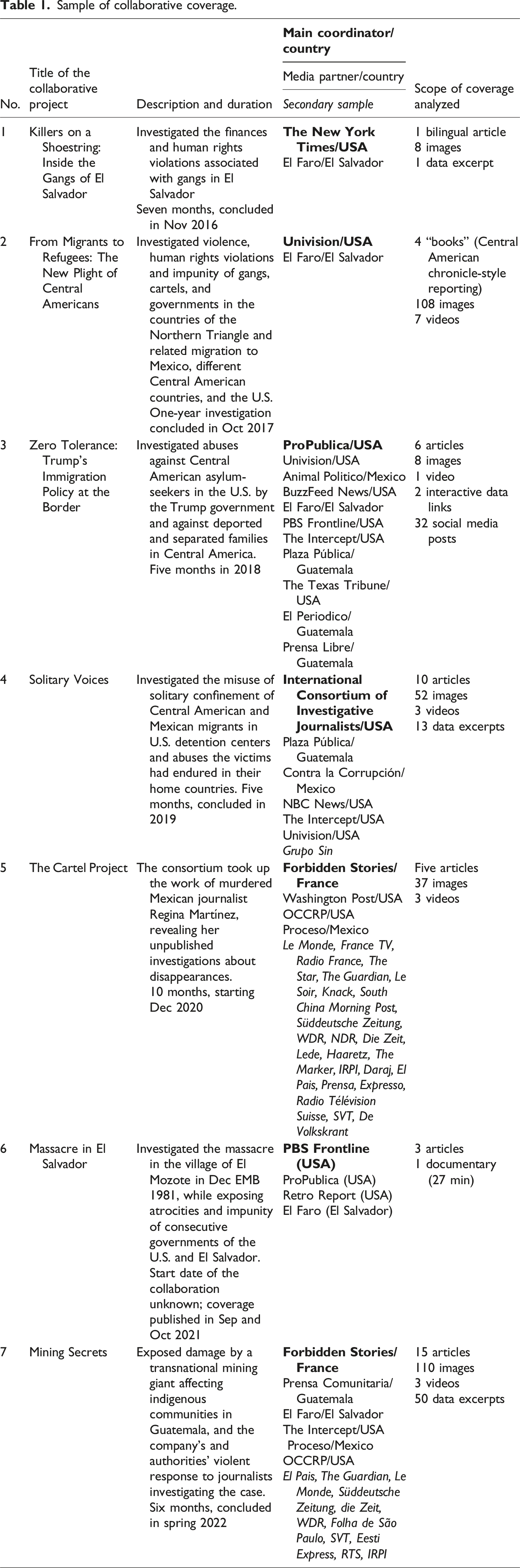
In most projects, the critical investigations mainly concerned Mexican or Central American authorities. In two projects — Zero Tolerance and Solitary Voices — the critical investigations mainly concerned U.S. authorities. However, given that U.S. hegemony and political and economic interventions have played a key role in the rooting of extreme violence and inequality in Central America, in connection with the militarization of the Mexico border (e.g. Andersen, 2020; Martinez, 2016), all the topics are essentially related to abuses of power on both sides of the border. The purpose of the heterogeneous sampling was to verify how psychological capital is addressed in different kinds of collaborative coverage and threats.
The coverage included in the sample was published in English, in Spanish, or both. All the multimedia elements ranging from text to images, videos, graphics, audio, and documentaries were analyzed equally. The sample includes both individual journalistic articles and broader projects featuring multiple articles and/or other formats. The main criterion was that each story/project involved partners from both sides of the U.S.-Mexico border. Honduran journalists were not involved in cross-border collaborations during the time span examined according to the sampling criteria. Some projects in the sample involved partnerships with media in other Latin American countries and in Europe. These contents were considered a secondary sample and examined in less detail.
Methodology
In the initial phase of analysis, the author collected relevant background information about each Central American, Mexican, and U.S. institution involved in the collaborations, including their ownership, funding models and supporting foundations, and affiliations with investigative journalism networks. Information was acquired from the websites of the investigative projects and metajournalistic discourse concerning the projects (e.g. Maslin, 2016). The author did not have access to detailed information concerning budgets of the projects or salaries of each journalist involved. However, the available information was helpful for detecting what kinds of economic, social, cultural, and psychological capital each collaborator would have at their disposal in general.
The author identified the range of relevant fields and subfields, drawing from previous field analyses (e.g. Benson, 1999, 2013; Buchholz, 2022) and the sample. In addition to the collaborating journalists’ institutions, the author formulated field categories to account for the institutions that were the objects of the critical investigations (e.g., the Trump government) as well as sources and/or objects of the abuses being investigated (e.g. Honduran environmental activists). This way, the field analysis helped to detect the ideological, cultural, and socioeconomic distance between the collaborating U.S., Mexican, and Central American fields, the victims of the abuses investigated, and institutions and agents whose abusive actions were examined, reflecting patterns of power and resistance at the micro, mezzo, and macro levels (see Benson, 2013).
For the identification and coding of psychological capital, this study drew from research discussing resilience, perseverance, ambition, proactiveness, and assertiveness of independent journalists in Central America and Mexico (e.g. Brambila Ramírez, 2018; Kahn, 2023; Mar, 2016; Martinez, 2016; Mitchell, 2022) and studies concerning psychological capital among Mexican laborers and students (Banda Castro, 2023; Santana Cárdenas et al., 2018), in addition to the sample itself. Codes were created for mentions of difficulties in the collaborative investigative process (e.g. receiving threats to stop investigating; being followed; being requested extortion money; being denied access onto important information of public relevance such as government archives; etc.). These codes were connected with codes denoting the field of the perpetrator (e.g., Bukele government) and the field experiencing the difficulty (e.g. Salvadoran independent journalists).
The author also created codes for identifying mentions and expressions of perseverance (e.g. pressuring government officials to give information despite denial; continuing investigative work from exile; etc.). Separate codes were created for Northern journalists’ description of their Southern peers’ resistance; self-reflection by the Southern journalists concerning their own resistance, and collective recognition of resilience in the collaborative investigative process. A specific code was designated to those situations where it was clear that the data being presented had been difficult to acquire (e.g. interview with a member of a cartel) but the coverage did not mention any challenges or need for perseverance. This code signaled that the working conditions of the journalists were rendered invisible in the coverage (as in Palacio Montiel, 2020).
To consider the relative value of psychological capital, the author also looked for recognition of economic, social, and cultural capital in the sample. The coding was guided by questions such as: What kinds of capital was needed to enable a specific coverage and which field(s) is this capital attributed to? The author would examine, for instance, the relative proportion of local knowledge and connections vis-a-vis data or technological tools that required substantial financial investment, along with mentions of the fields sponsoring this cultural and economic capital. Those spaces which were not attributed to any particular journalistic field were examined as global collaborative spaces, reflecting jointly produced findings or shared capital. When the coding was completed, the author(s) systematically examined interconnections between fields, data, and attributions and relative value of each capital.
The coding did not attempt to capture any implicit, underlying meanings. In other words, psychological capital was coded only based on explicit mentions of specific challenges and/or resilience, or as lack of mention of resilience when it had been clearly needed to create the coverage. By keeping the analysis at the level of manifest expressions, the study aimed to minimize the risk of over-interpretation (see Benson, 2013: 5). The consistency of the coding was maximized through the technique of constant comparison and retrieving text from codes throughout the codebook development and coding process. With the help of the Atlas.ti software, the codes were accompanied by memos from the start to enhance consistency (see Gibbs, 2021). After the codebook’s completion and systematic coding of the whole sample, the first three projects were coded for a second time. Due to some inconsistencies in the coding concerning lack of mention of resistance needed in the coverage, the whole sample was coded for a second time, followed by a third round of coding of the first three projects, compared to coding on the second round. By this time, significant inconsistencies were cleared.
Obvious limitations of this study include the lack of the voice of the journalists themselves beyond the explicit mentions about their struggles and resilience in the collaborative contents. Interviews with journalists would enhance our understanding about whether and how they felt that their challenges and efforts were considered and valued in the cross-border collaborations with Northern partners. In the future, psychological capital in collaborative investigative journalism should be further examined through different methods in different geopolitical and topical contexts.
Findings
Perhaps not surprisingly, the psychological capital of Mexican and Central American journalists is most abundantly and explicitly addressed and valued in the two projects where the original investigation and reporting by the Central American and Mexican journalists was interrupted and continued by the international collaborators, coordinated by Forbidden Stories. One of these projects is Mining Secrets, which continued the work of Guatemalan journalist Carlos Choc, reporting for Prensa Comunitaria. Choc was forced into hiding after he took a photo of a fisherman killed by the police during a peaceful protest against a transnational mining conglomerate accused of polluting Lake Izabal, affecting the lives and health of local indigenous villages. The project exposes violent and corrupt behavior by the mining company and local authorities. In the Cartel Project, an international consortium of journalists took up the work of Regina Martínez, a journalist for the Mexican magazine Proceso murdered in 2012 while investigating the disappearances of thousands of individuals. The following is a brief excerpt from the Cartel project, illustrating the description of the psychological capital of the local journalists in the collaborative reporting: In 2006 (…) Martínez covered the horrible sanitary conditions of pig farms in La Gloria, the tiny village in Veracruz (…). A year later, she accused the Mexican Army of raping and killing a 72-year-old indigenous woman. Her doggedness and determination led her to investigate the excesses of power and corruption ravaging Veracruz. (…) Despite the danger, Martínez started to look for the bodies of the disappeared. (…). She asked (…) to speak with police sources. ‘It was like going into a lion’s den,’ he thought. ‘I told her that neither myself nor anyone else wanted to go there with her.’ Martínez didn’t stop there. (Dupont de Dinechin, 2020)
Another project which demonstrates a high valorization of the psychological capital of Central American journalists is Massacre in El Salvador. In this case, the psychological capital of the U.S. journalists is underlined as well: the documentary by PBS Frontline and featuring reporting by El Faro begins with a description of the challenges and resilience of former New York Times correspondent Raymond Bonner and photojournalist Susan Meiselas, as they were investigating the massacre in El Mozote amidst the country’s civil war in early 1982. In El Mozote, nearly 1000 people - mostly children, women, and elderly people - were brutally murdered by Salvadoran elite armed forces trained by the CIA. As Meiselas and Bonner describe in the documentary: We were walking in a terrain that was completely unknown to us. (...) But because we felt compelled, we just had to dig deeper. (...) It was eerie. (…) I remember their bodies lying in the cornfield. (Frontline, 2021).
The documentary features Bonner describing how his original reporting was attacked in the U.S. as “communist propaganda” by the Reagan administration. The project contains even more discussion about the perseverance of El Faro’s journalists, whose reporting is constantly attacked. The following is an excerpt from an article that forms part of the project, authored by El Faro reporter Nelson Rauda (2021) and published by Pro Publica: The threats we have received (...) included mentions of setting fire to our headquarters, using a car bomb against journalists from El Faro, and an anonymous threat from someone who wanted to ‘put three bullets’ in my head after I clashed with [President] Bukele at a press conference in May 2020 (...) My wife and I have prepared a list of things to do if I’m detained. (...) We are still recovering from the wounds inflicted by a civil war that tore our country apart, and our democracy is again under threat. That’s why I am committed to telling the truth about our history and shedding light on the horrific events of three or four decades ago — even if the president doesn’t like it….
Moreover, Rauda makes a point to appreciate the perseverance of journalists doing similar work in even much more severe circumstances: While you read this, keep in mind: I’m privileged. Although I have to deal with the threats and danger brought by public tiffs with the president, I received a college education, I speak English, I have a job with full benefits, I don’t live in a gang-controlled community. That is not the case for hundreds of Salvadoran journalists and for millions of citizens who have to deal with this government and these hard realities.
Rauda’s observation affirms that psychological capital cannot be easily transferred to social and economic capital in the Central American context, contra Dóci et al.’s (2023: 344) claim based on different realities in the Global North.
Domination of Northern capital
Other projects in the sample contain barely any mention of the Central American and Mexican journalists’ struggles and perseverance. This is the case, for instance, in El Faro’s collaboration with the New York Times, exposing finances of violent Salvadoran gangs. The collaborative reporting published in the Times (Martinez et al., 2016) mentions that “El Salvador is experiencing a level of deadly violence unparalleled outside war zones.” Hence, the Times journalists knew that circumstances were dangerous for their Southern partners. In her Columbia Journalism Review article about the collaboration, Maslin (2016) cites the editor of the Times stating that “El Faro seemed like a natural partner: fearless journalists, high standards, and an immense network of sources in a country where the Times doesn’t have a bureau.”
However, the reporting itself does not make any mention of the persistence required to pursue and publish this kind of investigative work in El Salvador. Maslin (2016) mentions that El Faro journalists did all the groundwork, while the Times investigative reporters supervised the project. In other words, if the psychological capital of Salvadoran journalists was recognized in the process of planning and describing the collaboration, it was neither pronounced in the coverage itself nor reflected in its leadership.
The social and cultural capital of Salvadoran journalists was also recognized only implicitly in the coverage, as the article mentions that “during the truce [between the Salvadoran government and the gangs], a team from El Faro was allowed to interview gang leaders in the Ciudad Barrios jail, which was dominated by MS-13” (Martinez et al., 2016). The danger and difficulty of forming journalistic connections and trust with gang leaders and the value of such connections for investigative journalism is not addressed in the reporting. Moreover, the Times dismissed El Faro’s original reporting style based on the crónica (see Martinez, 2016) as inadequate, expecting El Faro to meet its own standards of the pyramid model instead (Maslin, 2016).
Maslin (2016) also mentions that the Times paid El Faro “nearly $15,000” for the seven-month project. Based on the recent data acquired by Business Insider (Salao et al., 2022), the Times’s annual base salaries ranged from $53,392 to $306,000. Even considering inflation between the year of the project (2016) and this data, “nearly $15,000” in exchange for three journalists pursuing highly dangerous investigative work for 7 months does not seem to place their cultural, social, and psychological capital at a high economic value. Given that El Faro is dependent on funding from foreign sources (e.g., Palau-Sampio, 2020), it is likely that it was in a subordinate position throughout the project. In this case, the lack of the sufficient valorization of the Southern field’s psychological, cultural, and social capital by the Northern field seems to correlate with the reproduction of social inequalities in the global journalistic field (see Dóci et al., 2023).
In its collaboration with Univision, titled “From Migrants to Refugees,” El Faro’s cultural capital was legitimized more, given Univision’s appreciation of its traditional reporting style, manifested in the publication of four crónica-style “books” with multiple chapters in each. This provided the El Faro with plenty of space to elaborate on the violence affecting innocent Central Americans and Mexicans, and the extraordinary resilience characterizing these civilians. El Faro’s journalists also engaged in self-reflection concerning the challenges they had to face, and their motives to pursue the investigative work in such difficult and dangerous circumstances. But in this project too, the capital of the Northern journalistic field was deemed more valuable than that of their Southern partner. This was reflected in Univision’s leadership of the project and the appearance of its logo before El Faro’s throughout the reporting, even though El Faro’’s journalists did the demanding and dangerous investigative reporting and enabled the proper realization of the project through their connections, struggles, and resilience.
The rest of the collaborative coverage emphasizes the resilience of the victims of abuse investigated by the Central American and Mexican journalists, who themselves remained on the sidelines, reporting their findings without elaborating on any hardships, challenges, or resistance of their own. The Zero Tolerance project led by Pro Publica celebrates the cultural, social, and psychological capital of its own journalist Ginger Thompson for exposing a tape which revealed desperate cries of Central American children forcefully separated from their parents by the Trump administration. This awarded reporting pressured the Trump government to reverse its abusive family separation policy a few days after its publishing. Clearly, in this case the main perpetrator is the U.S. government, so it is logical that the coverage would address the resilience of the U.S. journalist behind such a major revelation.
As the Zero Tolerance investigation progressed, however, Central American and Mexican partners played a major role investigating the circumstances from which the separated families were fleeing and where the parents had been deported. Likewise, in the Solitary Voices project, which investigated the suffering of migrants maintained in solitary confinement in the U.S., Central American and Mexican journalists used their networks and resilience to learn and report about the abusive environments forcing the migrants to flee from their home region. In short, the psychological, social, and cultural capital of the Southern journalistic fields were highly relevant for the successful implementation of all these projects, but not addressed in the reporting. All the projects were funded and supervised by Global North, pointing to the supreme value of the economic capital in the global journalistic field along with reproduction, rather than reduction, of inequalities.
Limited reporting of U.S. abuses
When looking at the objects of the critical reporting, the collaborative coverage as a whole is very critical towards the Central American and Mexican governments and atrocities committed by them. Same is true for the Trump government: his abusive policies are investigated and exposed in almost all of the projects. However, discussion or investigation as to the U.S. government’s historical role in the rooting of violence in Central America and Mexico through economic and political interventions is completely lacking from most projects (see also Cheas, 2024).
For instance, while the Killers in a Shoestring and From Migrants to Refugees projects mention that the deportation of gang members from the U.S. to El Salvador in the late 20th century caused the violence to spread in El Salvador, a country devastated by the civil war, neither project makes any mention of the fact that the greatest atrocities during this civil war which tore the country apart were supported by the U.S. government (e.g. Andersen, 2020). The Solitary Voices project tells the story of a Honduran man named Silvio, who supported the ousted president Manuel Zelaya and became a political prisoner in his country, then fleeing to the U.S. However, there is no explanation about how Zelaya was reducing equality in the country and how the U.S. government supported the coup.
The Central American and Mexican independent journalists had included this critical historical information abundantly in their independent reporting produced and published prior to their collaborations with U.S. partners. For instance, Guatemalan Plaza Pública – which was involved in the Solitary Voices project – has previously reported that “the forced migration from Honduras cannot be understood without the continuity of the political crisis generated by the 2009 coup and the political support of the US to the post-coup regime” (Mejía Rivera and González Cerdeira, 2018; see also Martinez, 2016, for similar mentions in El Faro’s reporting).
The only collaborative projects which did include this critical context are the same ones that most abundantly legitimize the psychological capital of the Central American and Mexican journalists: The two projects coordinated by Forbidden Stories, and Massacre in El Salvador. This points to a possible correlation: when the capital of journalists from the South are not sufficiently valued in the cross-border collaboration, they may not feel safe enough to suggest critical perspectives challenging the position of their Northern partners. These vulnerable independent media in Central America and Mexico may fear losing future funding and opportunities for collaborations if disappointing their Northern partners. Thus, they may make compromises as to formatting, scope of criticism, and so forth; continuing self-censorship even while working in the supposed haven of cross-border collaboration.
Another thing that these three projects have in common, that differentiate them from the rest of the analyzed projects, is that the journalists from the North worked side by side with their Southern partners in Mexico and Central America, conducting interviews and observing the circumstances, in addition to examining data jointly online (see also Cheas, 2024). These findings echo the observation by Buchholz (2022: 19): “Even in an age of enhanced communication, direct personal encounters and physical gatherings seem crucial for enabling the rise of global networks and shared cultural conventions in the arts or media production.” In other words, it seems that firsthand exposure to the dangers affecting the region’s journalists enable the Northern journalists to better understand and appreciate the circumstances in which their Southern partners are living and working, reflected in more appreciation of their psychological, cultural, and social capital. In those projects limited to virtual spaces, the journalists in the North are not forced to leave their comfortable offices and witness the horror that their Central American and Mexican partners must go through every day. Hence, they are not prompted to make any meaningful change.
Conclusion
This article aimed to elaborate on the concept of psychological capital and its relevance to the study of cross-border collaborative investigative journalism. The study drew from Dóci et al. (2023) who argued that psychological capital is the missing link to developing a comprehensive field theoretical framework for studying the reproduction of social inequalities. The study found that the psychological, social, and cultural capital of the Southern journalistic fields were highly relevant for the successful implementation of the empirically examined projects, but not explicitly recognized in most reporting. All the projects were funded and supervised by institutions in the Global North, pointing to the supreme value of the economic capital in the global journalistic field along with reproduction, rather than reduction, of inequalities.
However, three projects, in which Northern and Southern journalists worked in Central America and Mexico side by side investigating atrocities, manifested exemplary consideration of the capital of the Southern fields. These three projects also included critical context concerning U.S. involvement in Central America in the reporting, lacking in the other projects. This points to a possible correlation: when the capital of journalists from the South are not sufficiently valued in the cross-border collaboration, they may not feel safe enough to suggest critical perspectives challenging the position of their Northern partners. Instead, they make compromises as to formatting, scope of criticism, and so forth; continuing self-censorship even while working in the supposed safe haven of cross-border collaboration.
At the same time, journalistic collaboration across the North and South, enabled by new technological tools, is increasingly celebrated by journalists and academics alike. This study shows that collaborations alone are not going to reduce global inequalities, unless the journalists leading these projects are willing to critically examine the rules of the game and transform existing disparities in the distribution and value of different capital. It may be necessary for them to travel to the South and witness the circumstances of their Southern peers firsthand to truly appreciate their perseverance and investigative reporting skills.
However, it would be too simplistic to conclude that all exchanges between fields and their capital are based on struggle and competition. Namely, this empirical study also showed that some collaborations, involving in-person collaboration in Mexico and Central America, are clearly paving the way for more solidarity and equality. For this reason, it is important to examine collaborative investigative journalism through a theoretical framework that does not assume neither struggle nor solidarity as the outcome but rather, allows for a nuanced examination of coexisting forms of reproduction and reduction of inequalities; competition and collaboration. This article suggests that Buchholz’s (2022) global cultural fields approach contains such potential.
Out of the Central American independent media examined in this study, El Faro had to move its legal operations to Costa Rica due to increasing harassment by president Bukele, while El Periódico, a Guatemalan independent newspaper involved in the Zero Tolerance collaboration, was shut down completely following the imprisonment of its founder and editor, Rubén Zamora, in spring 2023 (Kahn, 2023). These circumstances highlight the importance of learning how cross-border collaboration can guarantee the safety of journalists. This field theoretical study of collaborative contents is far from being enough to fill wide gaps in research. Rather than aiming to provide comprehensive answers, the article hopes to pave the way for further research with different methods, diverse samples, and extended usage of the concepts of psychological capital and global cultural fields.
Footnotes
Declaration of conflicting interests
The author(s) declared no potential conflicts of interest with respect to the research, authorship, and/ or publication of this article.
Funding
The author(s) disclosed receipt of the following financial support for this article: The Research Council of Finland (decision no. 338834), University of Vaasa, and Kone Foundation.
