




Abstract
The Covid-19 pandemic illustrated that today's political control mechanisms of global risks demand international collaboration on various levels and between various actors. Journalism has a pivotal role to play for global governance as an early warning system in the knowledge society. The paper provides a qualification of potentials and ambivalences of global media interdependence in global crisis by analysing if and how the German press treated other countries as better practice models. A special emphasis is given to a comparison between the coverage of global actors (WHO), European (Portugal, Italy) and Asian countries (South Korea, Taiwan), which developed successful practices during the Covid-19 pandemic, which deserved to be considered as best-practice models. The paper reveals moments of reflexive media interdependence but also highlights the limits, which are pronounced in a gap between North-North and North-South relations in both amount and depth of policy coverage and stereotypical constructions in lifeworld coverage.
Keywords
Introduction
The Covid-19 pandemic has made it utterly clear that we live in ‘one world’. The anticipated ‘world risk society’ (Beck, 1999) has materialized in the pandemic and has once again made us aware that today's political control mechanisms of global risks demand international collaboration on various levels and between various actors, ideally heading towards a ‘new policy dimension of equal interdependence across societies’ (Volkmer and Sharif, 2018: 1f.).
Global issues and answers must be recognized and negotiated by all interdependent actors and thus be mediated. Journalism has a pivotal role to play for global governance since it provides crucial resources for worldwide co-orientation and learning processes. Risk and crisis communication therefore need to be combined with a theory of global media interdependence. Such theoretical view focuses on the constructivist links, which can be conceptualized as communicative couplings between systems and actors that are connected on a local or global level through information exchange. Journalism in this sense is at the crossroads as risk interpreter and can build a bridge between human knowledge, which is embedded in often separated national contexts.
In reality, the global public sphere is still porous, fragile and global interdependence of the media, despite all the achievements of digital networking, often lags behind and is subject to imbalances of global co-orientations (Hafez and Grüne, 2022). To provide a qualification of the potentials and ambivalences of global media interdependence in times of global risk, the present paper analyses if and how the German leading press treated other countries as better practice models of which Germany could learn. The discussion is a theoretically guided large-scale empirical study reflecting on the German press coverage of the WHO as a global actor and European (Portugal and Italy) and Asian countries (South Korea and Taiwan), which developed a number of seemingly successful practices during the Covid-19 pandemic, which deserved to be considered as best-practice models.
Interdependence and governance are not confined to the policy level, but the paper also seeks to understand whether European and Asian countries were treated as cultural role models when describing everyday practices. On all levels, the North-South divides in global risk communication in Europe or beyond are under scrutiny.
The paradox of global expertise: Communicative interdependence in times of crisis
German Sociologist Straßheim (2021) argues that two trends collide in the contemporary world: On the one hand, there is a strong tendency towards evidence-basing across borders in a well-connected, global academic world, including Think Tanks, NGOs, the United Nations’ organizations like the WHO, which seek to set the randomized and comparative ‘gold standards’ of ideal type policy-making. On the other hand, there is the persistence of nation states and the primacy of domestic politics, promoted by a multitude of locally attuned politicians and experts. This situation results in a central paradox: ‘It is precisely the effort for indisputable expertise beyond political influences, which creates mistrust and conflicts and triggers a spiral of self-reinforcing political dynamics’ (Straßheim, 2021: 70).
In a similar vein, the theory of global communicative interdependence has pointed to the fact that horizontal global interdependences (between same systems and actors, e.g., politics/politics) and vertical ones (between different systems and actors, e.g., politics/media) are hardly ever equally developed (Hafez and Grüne, 2022: 242ff.). In essence, systems can be horizontally connected on a global scale (global community of experts and academics), while at the same time, all sorts of vertical relations – between the academic system and politics, the media and lifeworlds – remain local in character and help to prevail a trend of ‘domestication’.
The system of classical mass media in particular is one of the least vertically connected to systems outside its own country since it is still primarily organized along national parameters. Neither audiences nor production or output have reached a level of global integration so far. Cohen (2013) put it concisely years ago, when he asked, ‘Where in the world is the global village?’ If we consider the mass media to have an ideal role as an interlocuting system in global governance, missing or fragile cross-border links between media and political systems as well as non-organized lifeworlds (e.g., citizenry in a foreign country) have a hindering effect and might add to explain the contemporary lack in global governance.
Despite this rather pessimistic outlook, Volkmer (2014) points to moments of ‘reflective interdependence’. Even though international crisis can lead to irrational introversion and closure of a system, which is overstrained with a crisis, the widening of global horizons and an orientation on other systems are equally potential effects. As we will argue later on, an opening of media systems seems more likely during low-intensity, long-term and low-involvement crises. Therefore, as a case example, the Covid-19 pandemic created ideal conditions for a journalistic reorientation since it affected the whole world for an extended period of approximately two years and offered every chance for global comparative news coverage.
Global interdependence in the media and global governance
Any social actor, be it the political system, social communities or the media, is embedded in various sets of global interdependencies (see Figure 1, Hafez and Grüne, 2022: 39ff., 61ff., 242ff., see also McQuail, 1994: 91; Beck, 2004: 122f.). On the one hand, horizontal and vertical interdependence describes interdependencies between the same or different systems. Diplomacy is an example for horizontal interdependence between political systems of different nations; media-policy relations are cases of vertical interdependence. On the other hand, structuralist and constructivist interdependence relates to interdependencies between the same or different systems. Structuralist links are realized through business merger or political influences, whereas constructivist links are communicative couplings whereby the same or different systems are connected either locally or globally through information exchanges, thereby synchronizing their agendas.
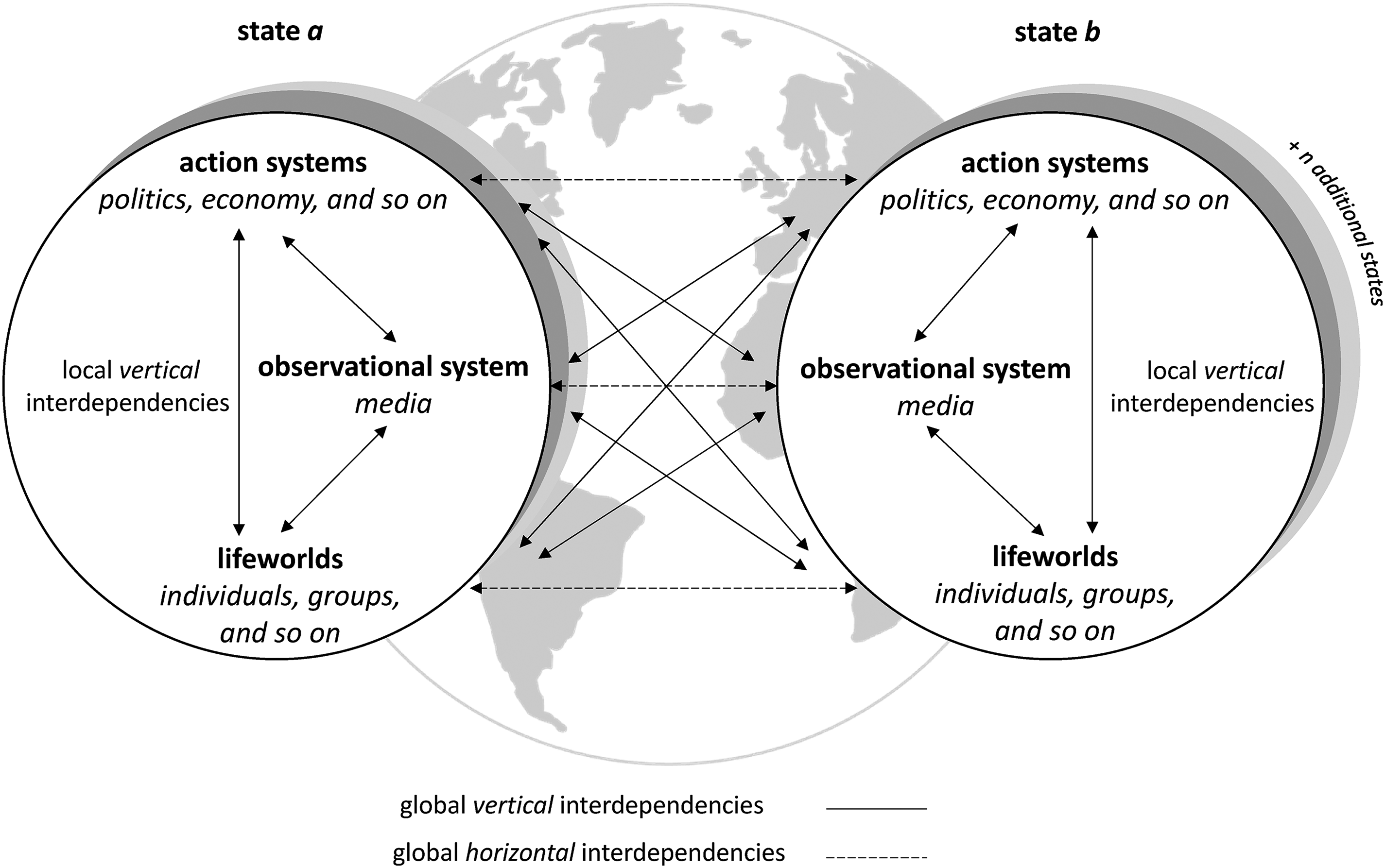
Global interdependence.
The problem is, however, that the different levels are hardly ever equally developed, which is the reason why governance is only partly based on integrated actors. In essence, we can say that systems can be horizontally connected on a global scale (as in the case of Straßheim's global community of experts and academics or global news exchanges in the media), while at the same time all sorts of vertical relations – between, for example, the media, politics and lifeworlds – remain local rather than global in character. As a result, local forces tend to have a greater impact on the content of their national media than foreign or international experts or even transnational organizations.
In sum, we can speak of the beforementioned prevailing trend of ‘domestication’ in the media, where local vertical interdependence clearly dominates over global vertical links. Transnational media, markets and audiences are rare and most media remain national in character and is linguistically strongly divided. As a result of this global structural disintegration, communicative (constructivist) interdependence remains fragile and global news coverage is often highly fragmented and ill-synchronized (see also Hafez, 2007; Stanton, 2007; Wu, 2000, 2003). This in turn leads to a lack in global governance, when cross-border links between media, politics and society remain fragile due to news domestication. The danger is imminent that the portrayal of the world is prone to influences by hegemonial local political, economic systems and lifeworlds and that the acceptance of global expertise and experiences by audiences and populations – global learning – is barred by an almost invisible insulation of nation state influences on public discourses in the media. Such phenomena are quite comparable to what Straßheim (2021) has described as the paradox of mistrust, for example, when war coverage is dominated by nationalist propaganda or even at regular times in spheres like the European Union, which never really developed a full-fledged transnational public sphere (e.g., Brüggemann et al., 2006).
Dynamics of crisis and risk communication
However, we also know that global interdependence in the media system is not static. Global horizontal interdependence of the media can increase the autonomy of the media against local vertical influences, for example, in rare cases of cross-border collaborations (Panama Papers, Alfter, 2019). Vertical global interdependence can be strengthened through multilateral integration of states, and this can in turn lead to so-called ‘extended indexing’ as in the case of NATO and to a lesser degree also the EU, where a growing influence of allied voices in cases of security, defence and economy is measurable (Krüger, 2013).
In theory, crisis and risk communication can also irritate regular news routines beyond ‘extended indexing’: When systems are overstrained with a crisis, this can either lead to irrational introversion and closure, as in the famous rally-round-the-flag-phenomena in wartime, when most media and people follow national governments regardless of their own views on the war (Mueller, 1970). Or, it can lead to new orientations and a widening of global horizons. This is especially true during types of crises that are not hot wars (Gilboa, 2007): Low-intensity crises like pandemics generate public opinion that is often less supportive of domestic governments and less prone to patriotic overreactions. Long-duration crises usually generate various phases in which the media and public opinion either support or criticize governments. Low-involvement crises are crisis that do not involve countries as a whole, but – unlike full-fledged wars – leave space for regular life.
While it seems amply clear that the Covid-19 pandemic of 2021/22 qualifies as such Triple-L crisis, the question remains whether Triple-L crises are also times of growing global interdependence of traditional news media.
Empirical evidence of risk communication behaviour of the media seems ambivalent. In 2007 Neverla (p. 715) wrote: ‘There is no European risk communication in the sense of consensual and synchronical debates across various countries’. As a result, research on risk communication during pandemics seems to highlight ‘local information’ as resources since they are considered to generate more trust (Hyvärinen and Vos, 2016: 103). However, some more optimistic studies indicate that hot topics like the climate issue manage to become firmly established in the mass media worldwide, even featuring similar sub-topics, which is probably due to the nature of environmental themes, which receive a similar degree of attention in different parts of the world (Ivanova, 2017).
Although we believe national domestication in classical media to be still strong, public communication in the media needs continuous scrutiny for potential changes in newsroom cultures. The Covid-19 pandemic was a massive, long-term event on a global scale, and it would have been the ideal framework for increased global vertical interdependence and for those obviously rare moments which Volkmer (2014) called global ‘reflective interdependence’, or in more simple terms, of heightened global curiosity and desire to learn from the world. Theoretically speaking, Corona created archetypal conditions for a reorientation from local to global interdependence. Has Corona coverage lived up to these promises?
Methodology
Based on the outlined theoretical underpinnings, the paper empirically validates the mediation of global interdependence in times of crisis. We have chosen the German print media Süddeutsche Zeitung (SZ) and Frankfurter Allgemeine Zeitung (FAZ) as a case study, which represent a rather liberal editorial policy (SZ) and a more conservative one (FAZ). Both daily newspapers can be considered quality leading media in the German media system with rather comprehensive editorial sections for foreign reporting. Despite a growth in the use of various online media, the traditional press still enjoys outstanding trust among German audiences (Hölig et al., 2020; van Eimeren et al., 2020). However, we are not only interested in the orientation function of the media outlets for general audiences but also for various actors involved in governance. In this respect, we can assume that both newspapers have an opinion leader status in general and for the journalistic system in particular (‘intermedia agenda setting’, Maurer, 2016; Weischenberg et al., 2006).
Research question
Looking at the foreign news coverage of
the WHO as an ideal representative of Straßheim's ‘controversial’ type of global expertise that potentially collides with national health regimes, two European countries (Italy and Portugal), which have developed better practices compared to the German experience (e.g., earlier experience, better vaccination etc.), and two Asian countries (South Korea and Taiwan), which are electoral democracies, have long-established practices when dealing with pandemics compared to Germany and should therefore be included into the mediated interdependence and governance scheme of the media,
in the period from 1 March 2020 to 31 March 2022, the paper investigates the following research questions:
Our research follows a quantitative study of policy links and an additional qualitative exploration of lifeworld links in the media.
Sample selection
For the quantitative part of the analysis, all relevant articles about the WHO and the respective countries with a meaningful connection to the Covid-19 crisis published by the two newspapers have been examined. The final sample consists of 3007 analysed articles. The operationalization of the research objective consists of searching the online archives of both newspapers, including the online and print content, on a monthly basis for articles that both mention the respective country or WHO and contain at least one of the terms ‘Corona’ or ‘Covid’. For the quantitative part, which focuses exclusively on possible policy links, this search has been limited to the ‘Politics’ section in each case.
Data analysis
On the basis of the data set obtained in this way, a topic frequency analysis (Früh, 2017) has then been carried out in order to be able to make concrete statements about the type and thematic frequency of the topics occurring. Results of the media analysis have then been correlated with extra-media data (Best, 2000; Rosengren, 1970) like infection numbers and policy measures, both in Germany and in the countries of reference, to assess the degrees of vertical global interdependence (between media and international policies) in various phases of the crisis.
The qualification of lifeworld links is based on the idea that the mass media's role as global interlocuter in crisis spans beyond the political realm of action. The pandemic has heavily affected the life of citizens around the world and required them to accept state-imposed constraints of private action, which were never experienced before in many democratic countries. We were therefore curious whether the media provided comprehensive orientation to audiences by including coverage about individual and collective reactions to the crisis at the level of everyday life in foreign societies. Given that links to lifeworld experiences are less pronounced in ‘Politics’ sections of the newspapers, a second evaluation of the coverage has been extended to all editorial sections, including, for example, the ‘Feuilleton’ or ‘Topic of the Day’. With an explorative qualitative content analysis (Mayring, 2010) we systematized the references made to foreign lifeworlds and in an open coding process identified patterns in an inductive way.
Media-policy interdependence: Results and discussion of the quantitative analysis
WHO
Data about German newspaper coverage during the Covid-19 crisis in the period March 2020 to March 2022 of the WHO and of European and Asian countries suggests that cross-border vertical media-policy links did exist, but that they were limited in shapes and mostly, but not always, restricted to short moments of peaks of the German crisis situations. Both aspects will be important for the later discussion of the results.
Figure 2 indicates that the WHO was mainly relevant for the German domestic news management of the pandemic at the beginning of the whole crisis: In spring 2020 two policy links occur (PL 1 and 2) when European policy makers lacked any orientation and the transnational organization provided basic information and guidelines how to handle the crisis. At all later peaks of crisis in Germany, especially during the winter periods 2020/21 and 2021/22, the WHO was still frequently mentioned, but the topical focus of the WHO-related news shifted from domestically to internationally relevant types of information, in particular news about the assumed Chinese origin of the crisis, which was investigated by the organization. In sum, the WHO played a very limited role in the print media, and even though one cannot speak of a complete national closure of the media's risk communication vis-à-vis the transnational organization, the WHO mainly served as a substitute for short-lived irritations of national indexing in the German news. On the whole, Straßheim's ‘paradox of global expertise’ seems to be confirmed, whereby national players seem to mistrust transnational organizations or show a closer affiliation towards national institutions despite the fact that transnational organizations deserve some credit for being global hubs of expertise.
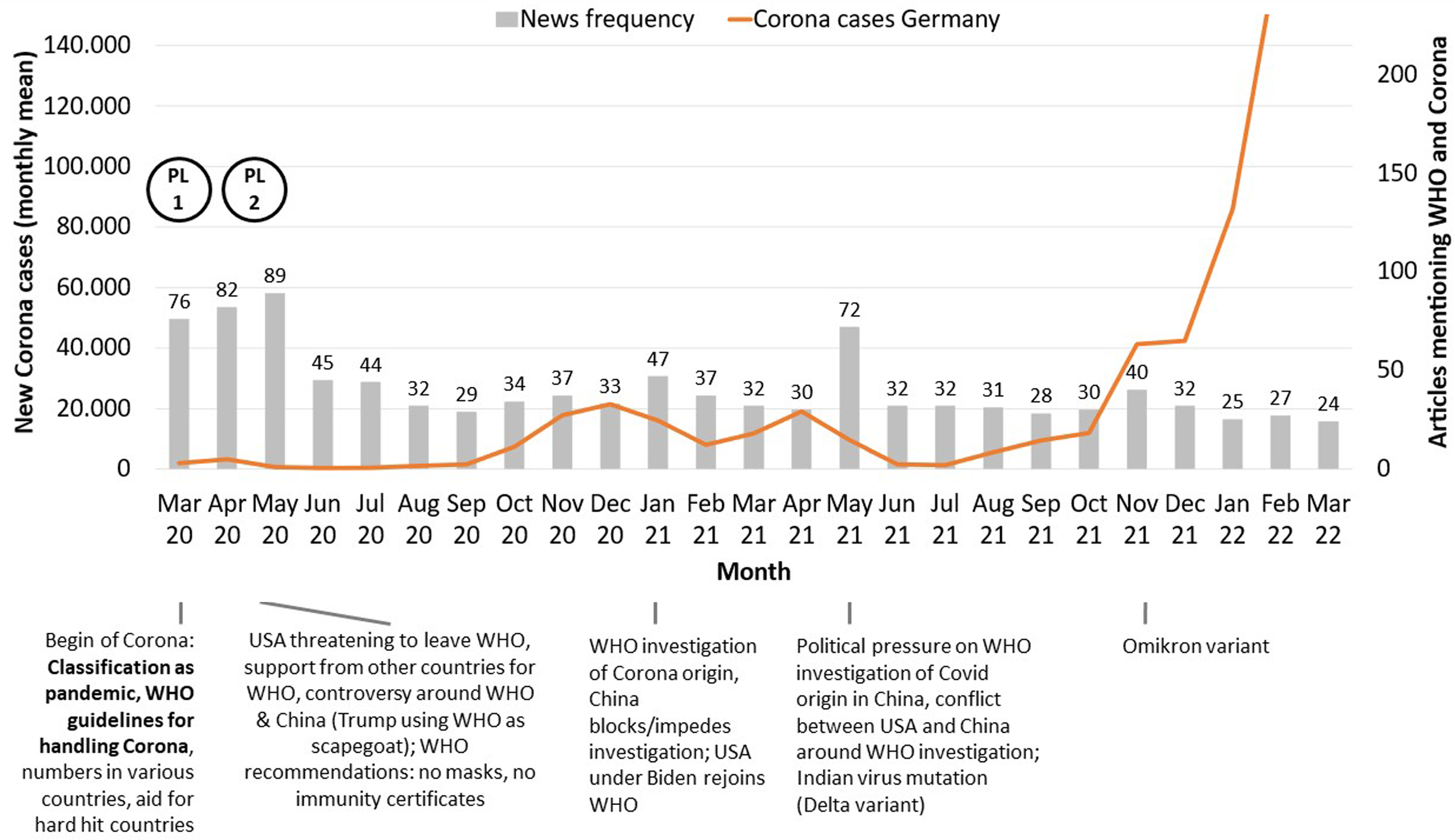
Global vertical interdependence – policy links WHO.
Portugal and Italy
Figure 3 on Portugal indicates that German Corona news about Portugal were often confined to crisis-oriented coverage of either high incidence, death tolls or specific variants of Corona, high-risk areas and the implications for German tourism. The EU wide closure of borders and travel restrictions were the most important topics in the time between March 2020 and May 2020. In June 2020, the infection numbers in Portugal and Spain began to rise significantly, thus shifting the focus of the coverage away from tourism. Portugal was declared a high-risk area in September 2020, leading to an increase in coverage in September and October 2020. In January 2021, Portugal took over the presidency of the EU council from Germany, explaining a significant portion of the coverage around December 2020 and January 2021. Even more important for the drastic upgrade was, however, the new British mutation of the Coronavirus that was overwhelming the Portuguese and Spanish health systems at that time. Most news about Portugal were concerned with new travel restrictions, entry bans and national measures taken by Portugal.
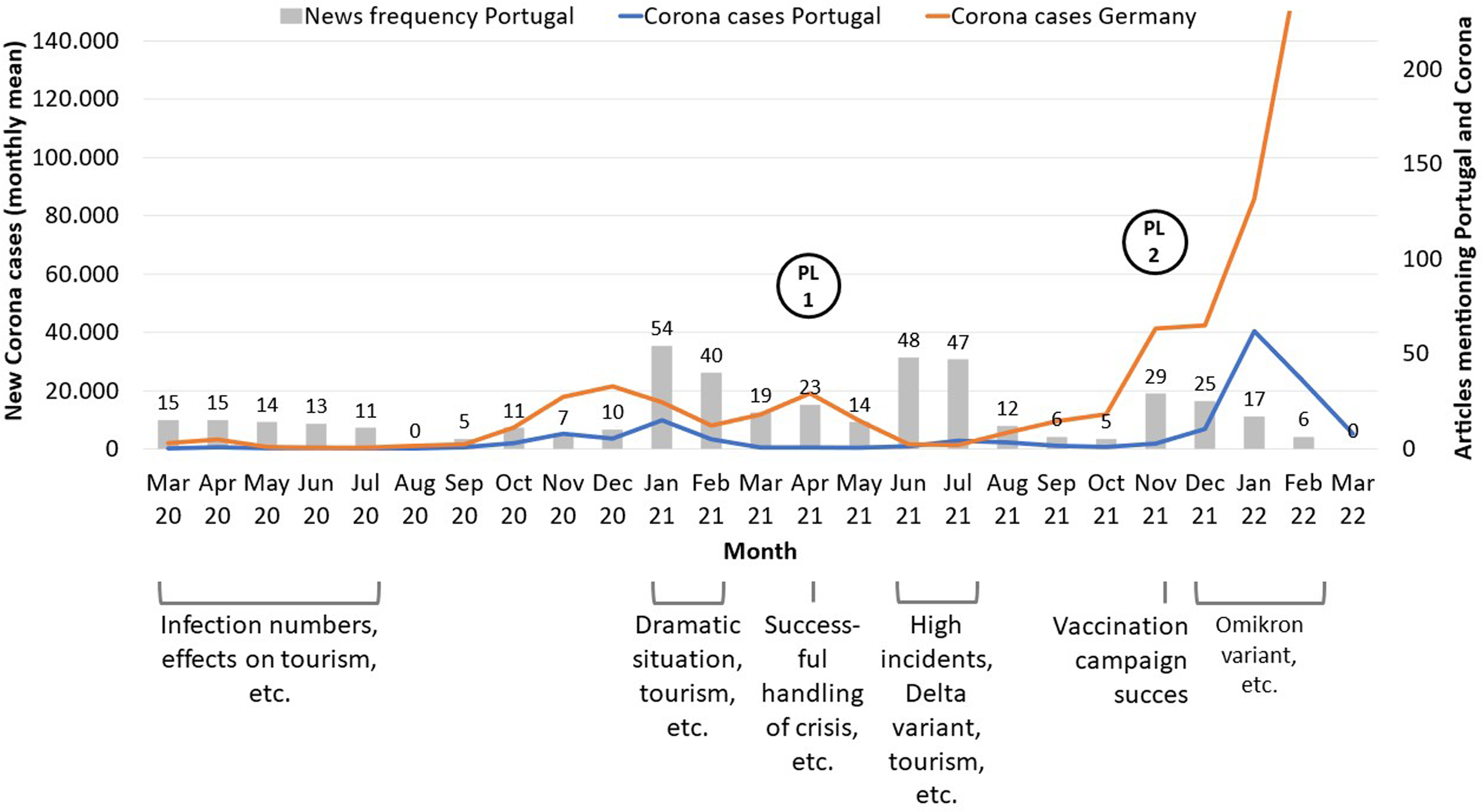
Global vertical interdependence – policy links Portugal.
It was merely under severe stress, when incidences were at its peak in Germany in April 2021 or sharply on the rise in November 2021, that the German media focused on policy issues in Portugal that were also relevant for Germany, namely the successful handling of the crisis in April 2021 and the vaccination campaign success in November 2021. It was around this time that the German media developed two short-lived policy links through extended news about Portuguese measures (PL 1 and 2). Vaccination success was covered occasionally in the months before, but only in November, when the crisis in Germany already escalated dramatically, the issue became bigger news in Germany and Portugal was mentioned occasionally as a role model for Germany (e.g., military organization of the campaign, much lower vaccination quota in Germany).
Figure 4 on Italy displays a slightly different behaviour. Due to the larger number of news items the flow of news from Italy had a higher density in German media, which might explain why there seems to have been more policy-related coverage. Early coverage about Italy in spring 2020 was, of course, dominated by the high death tolls in the country, which were unusual at the time since other European countries were still largely spared from the crisis. The coverage was mostly very visual and dramatic in tone, especially images of caskets being carried away by the Italian army in Bergamo were frequently used, not only in the beginning but throughout the whole analysis.
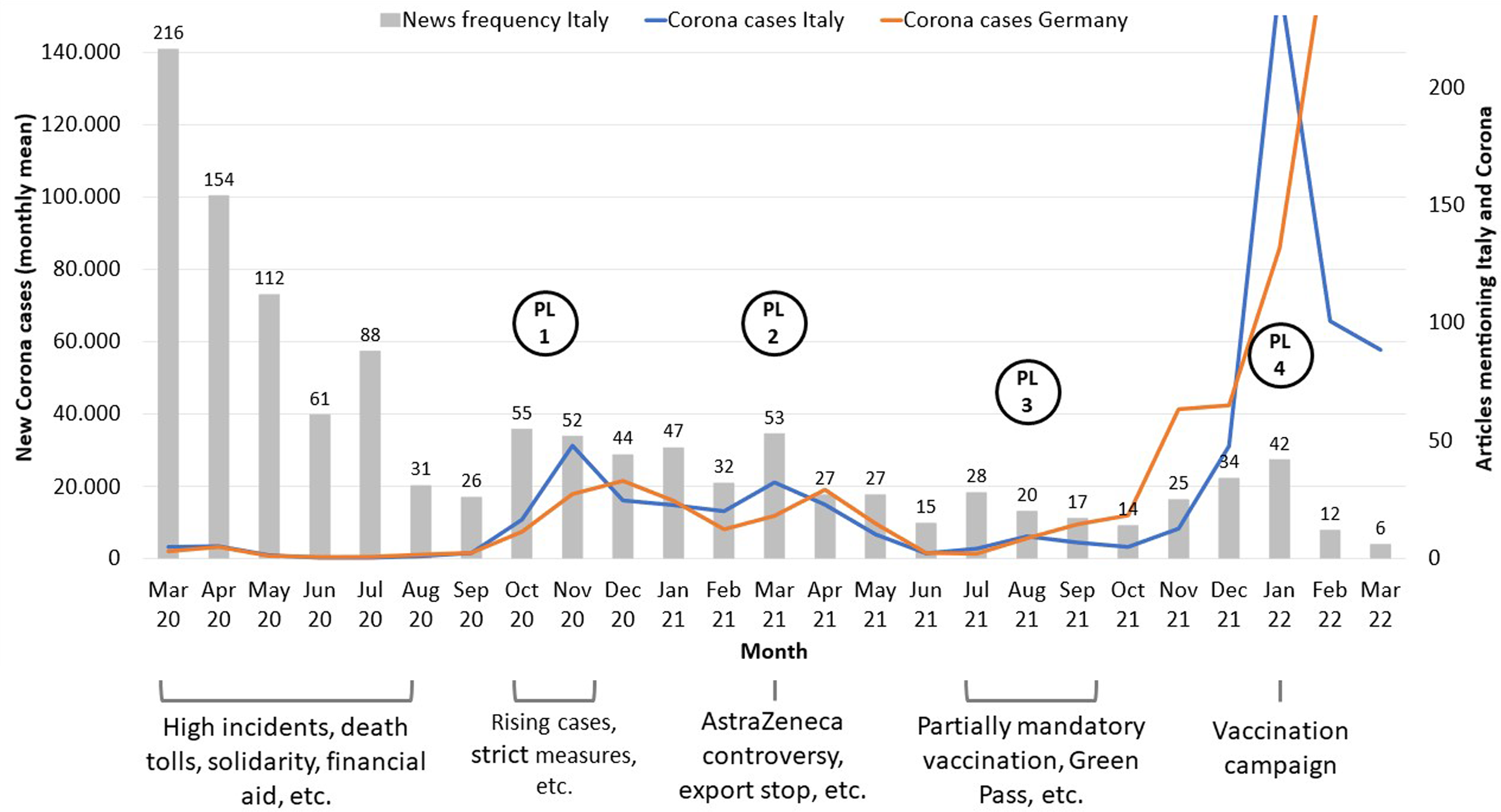
Global vertical interdependence – policy links Italy.
The first policy link (PL 1) occurred in October and November 2020 when Italy implemented stricter measures, namely strict lockdowns in hard-hit regions, again, which were frequently reported in the German news coverage, even before Germany was approaching its first peak of the Corona crisis in December 2020. In March 2021, another peak in coverage can be seen (PL 2), again one month before Germany reached its second all-time high of cases in April 2021, caused by the controversy around the vaccine AstraZeneca. The widely discussed side effects of the vaccination, the consequent vaccination stop in many EU countries and the shortage of vaccines and export stop from Italy were the dominating topics. Italy introduced stricter restrictions concerning the vaccination status relatively quickly compared to other EU countries.
In July 2021, a partial mandatory vaccination for health workers as well as the so-called Green Pass were implemented, causing another (small) peak in coverage (PL 3) and dominating the coverage over the summer 2021. In November and December 2021, Europe was hit by the Omikron variant, leading to drastically rising infection numbers but also to increased coverage. While already occurring in the coverage about Italy in winter 2021, mostly in January 2022, the vaccination campaign in Italy, including mandatory vaccinations for health workers and people over 50, were thematized and used for comparison in the German debate around vaccinations.
It is remarkable that while the first three policy links occurred considerably before crisis peaks in Germany, the fourth link (PL 4), covering the successful vaccination campaign in Italy (starting in summer 2021), came much too late to serve as an incentive for political governance in Germany.
The data analysis on media-policy interdependence with regard to Portugal and Italy reveals that so-called ‘extended indexing’ – comparative policy news from other countries in the EU – did exist, but came sometimes too late to serve as a policy role model for better informed German policies. While a concentration on either conflictual (victims, incidents etc.) or so-called ‘home news abroad’ (tourism etc.) seemed to dominate, policy learning effects were visible, but media governance was fragile and often reminded of panic reactions under severe stress when it is often already too late for corrective measures. In the European context, risk communication as practiced by the leading German newspapers, is sometimes more reactive than prospective and pro-active in nature. Existing news values need to be debated and transformed into a truly interdependent European journalistic ‘early warning system’ in times of crisis.
South Korea and Taiwan
The country analysis of German media coverage about South Korea and Taiwan shifts the debate from the European to the global level. Our analysis focuses on two democratic political systems in Asia to avoid a rejection of the countries’ experiences on the ground of differences of the political systems. As will be demonstrated, however, the above-mentioned trend towards fragility in interdependence is reinforced in North-South relations, because, despite one remarkable exception at the beginning of the Corona crisis, both countries were literally ignored as best-practice models. However, results need to be qualified in face of existing differences in the temporal dynamics of the crises in East Asia and in Europe.
Figure 5 indicates that German newspaper coverage of Taiwan in the context of Corona was considerably low and was predominantly embedded in articles on China. However, two policy links are visible. During the first months of the study period, Taiwan's successful Corona management was reported and referenced as a role model for the German Corona policies (PL 1). After the initial praise of Taiwan's national Corona handling, German newspaper coverage returned to mainly mentioning Taiwan as a passive actor in overarching political and diplomatic conflicts involving China. The only exception to this rule was a short-lived policy link (PL 2) during the preliminary peak of the contagion wave in Germany in December 2020. On that occasion, the successful Corona management of Taiwan (and other Asian countries such as South Korea) were again presented as positive role models. The remaining study period shows no further relevant coverage of Taiwan and its Corona policies. Overall, the article turnout on Taiwan was much smaller than on South Korea and Portugal and incomparable to that of Italy.
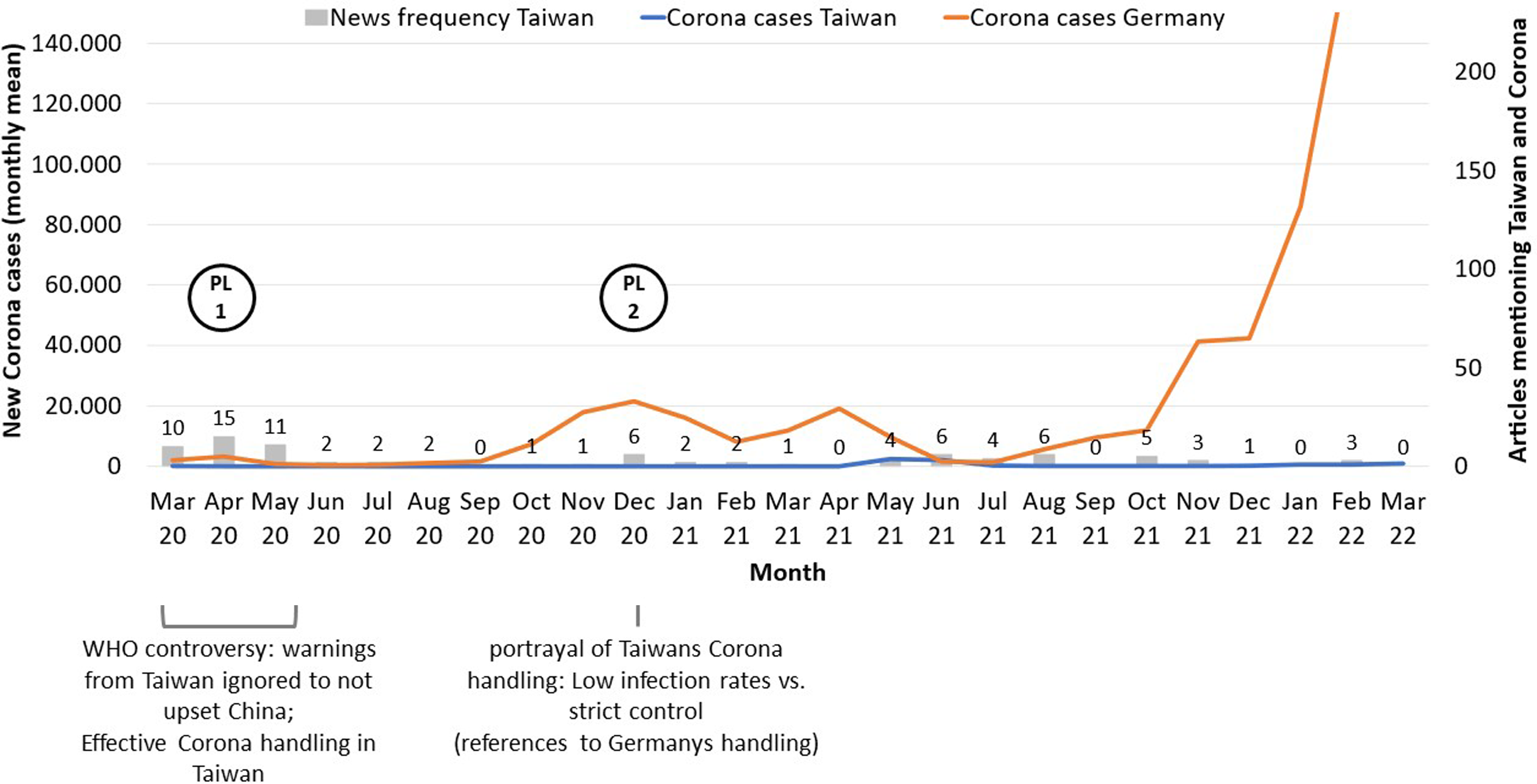
Global vertical interdependence – policy links Taiwan.
The coverage of South Korea peaks right at the beginning of the Corona pandemic in March, April and May 2020 (PL 1) and quickly decreases to a more or less steady and low turnout over the study period. In these first three months and especially in March 2020, however, a policy link can be seen as the swift and strict testing, tracking and quarantine strategy in South Korea was praised for being very effective to keep Corona infections low. After the initial phase, however, South Korea was no longer in the focus of the German coverage. The country only regained German public attention during two short-lived policy links on German crisis peaks in December 2020 (PL 2) and April 2021 (PL 3), when a small number of articles reflected on the country's rigid tracking and testing strategies. With the exception of the initial PL 1, the general turnout of articles on South Korea as an indicator of the intensity of policy links was much lower when compared to Portugal and Italy in particular (Figure 6).
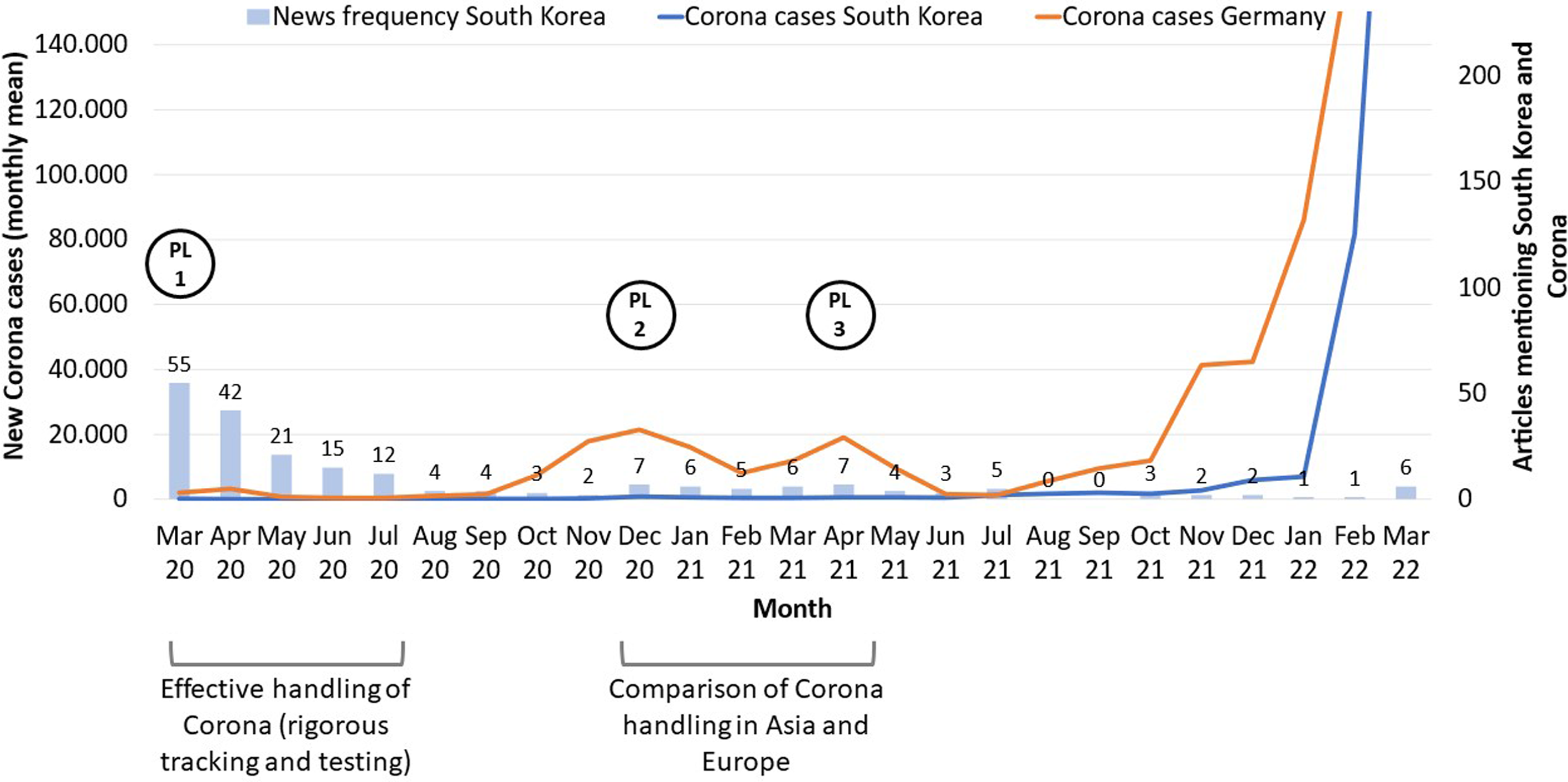
Global vertical interdependence – policy links South Korea.
In sum, the German newspaper agenda on Taiwan and South Korea resembled the one on the WHO. It was strong only during the early period of the pandemic, when disorientation on how to handle the crisis prevailed. The more Germany developed its own domestic policies, the more Asian countries became side-lined. Global governance beyond Europe clearly played the role of a ‘spare mechanism’ that was only applied when a national informational and policy vacuum occurred. While European reporting showed certain traits of ‘extended indexing’ in a larger European context, Asian countries, quite like the WHO, were largely ignored, despite of their long-term and sophisticated expertise in matters related to pandemic management.
Reasons for the marginalization must be debated on various levels, though. The crisis dynamics in Europe and South Korea/Taiwan differed considerably. Due to the immediate reactions like the closing of borders, the countries produced smaller numbers of incidents and could mostly avoid lockdowns. While crises dynamics in European countries soon became synchronized, the crisis in Asia followed a different rhythm, which might have minimized its role as a template for Germany. At the same time, the following qualitative analysis will reveal that persisting cultural stereotypes of presumed Asian ‘otherness’ must be considered to play a huge role in minimizing the drive for globally interdependent German news coverage.
Media-lifeworld links
Portugal and Italy: transnational communities in crisis?
As has been shown in the prior step of our analysis, Italy and Portugal generated a considerable amount of coverage during the pandemic. This trend can also be observed in the lifeworld links. Due to the fact that measures such as lockdowns, home-office-regulations or closure of schools echoed in the private realms of citizens, news coverage consequently included aspects of how the pandemic affected everyday life in Southern Europe.
Especially in the case of Italy the newspapers provided stories about how civilians struggled with the trauma of Bergamo in early 2020, when the virus hit the country heavily, how society stood together and how people sang and applauded on their balconies in solidarity with the nurses and doctors in hospital (e.g., ‘The song of the Italian soul’, FAZ 16-3-20). In contrast to all other countries analysed, the coverage of Italy included links to various social actors, from schoolchildren to imprisoned mafia criminals to pizza-chefs and fashion designers in Milan, not to forget several contributions from Italian guest authors. We can firmly argue that these reports provided secondary experiential resources likely to establish a feeling of a shared crisis if not a sense of transnational community. The latter is illustrated in reports on children's paintings of rainbows, music on balconies and supportive neighbourhoods, which were social practices that became part of solidary practices in Germany alike. Its mediation thus provided the basis for shared symbolic crisis management of the citizens in the given countries.
However, ambivalences and refractions in this kind of social orientation (media-lifeworld links) in the crisis cannot be overlooked. Firstly, the images of Italian and Portuguese civil publics in the crisis remained fragmented. Especially in the case of Portugal, references to social actors were erratic and journalistic interpretations often meandered between role model and worst-case scenario. On the one hand, ‘brave Portugal’, the success story of ‘effective and joint’ handling of the crisis and the disciplined people were mentioned (FAZ 27-12-2021, 28-4-2020, 4-5-2020). On the other hand, and in another period, one could also read about ‘hopelessly overcrowded hospitals’ or scenarios of tourists leaving the country ‘hastily’ in light of new pandemic restrictions (FAZ 28-6-2021). Similarly, Italy appeared both to tell a ‘devastating’, and ‘desperate’ story of ‘death zones’, ‘tragedy’ and ‘triage’ (FAZ 9-3-2020, 11-3-2020, 20-3-2020) as well as of successful collective management of the crisis, including the civil support of government measures such as testing, lockdowns and, later, vaccination.
Of course, the crisis in European countries was admittedly dynamic and the fractured images stem from traditional up-to-date oriented and event-centred news values. However, in a complex global crisis with partially shifted developments across countries, this pattern creates non-related experiences in contrast to forms of constructive journalism. In this sense, global social life experiences and actions in times of risk were not likely to serve as general templates for local orientation as insights from other countries’ pandemic struggle were rather transferred in a decontextualized manner of topicality. From a theoretical perspective, journalism got stuck in ad-hoc observations of complex realities without loose efforts to link the analysis of foreign realities with questions of governance in Germany.
Secondly, media-lifeworld links also reflected a rather pre-fabricated and socially detached domestic lens. For example, life in Portugal was described with reference to German tourism needs in the summer of 2020. The same is true in the case of Italy. Moreover, touristic places in Rome, Venice or Milan were illustrated and a three-page road reportage in the Süddeutsche Zeitung provided a world of thick imagination of the beloved travel destination especially from the perspective of the German audience. In these instances, print journalism acted more like a mediator of ‘tourism management’ rather than of risk-related governance.
Thirdly, Portugal and Italy were inconsistently treated as political as well as social role models for coping with the crisis and reports were partly permeated with stereotypical patterns. For example, the coverage of Portugal in the respective German press mentioned the ‘high costs’ of the success for people and country, called it an ‘Iberian wonder of vaccination’ and highlighted the ‘luck’ the country has had (FAZ 12-11-2021, 13-3-2021, SZ 13-5-2020). Such rhetoric is likely to undermine the narrative of social resilience and successful governance (e.g., by reported early adoption of measures, peoples’ trust in the health system, civic responsibility, solidarity with family members).
Other examples of the German media coverage on Portugal can be interpreted against the backdrop of selective representation, for example, when a theoretical worst-case scenario was suggested in headlines (‘Omicron-wave’ overrunning the country, FAZ 27-12-2021), while the stable situation in hospitals and possible explanations based on the high vaccination rate were not discussed comprehensively. In a similar vein, print journalism continuously referred to protests in Italy (e.g., ‘Riots of No-Pass’ SZ 26-7-21), which was a problem in Germany's stagnating vaccination campaign, but not a major trend in Italy given its considerably high vaccination rates. Stories about poverty and illegal employment also highlighted negative social side effects of the crisis in Italy, adding to a rather critical interpretation of the country's measures. These inconsistent frames of interpretation called into question Italy's and Portugal's position as role models, which, in turn, could result in disorientation among German audiences and difficulties in public opinion forming, transnational learning and legitimizing policies. The mix of praise and criticism calls into question whether the print media were able to empower its readers by providing reasonable comparative resources for handling the crisis.
South Korea and Taiwan: Role models with culturalist reservation
The coverage of Taiwan and South Korea, compared to that of Italy and Portugal, was much more oriented towards reproductive reports of Covid political measures than those of real-life effects. Even though Taiwan's handling of the crisis was reflected as a role model including an assumed exemplary behaviour of its citizens, only one German press article in two years shed light on everyday experiences in Taiwan during the pandemic (‘What Taiwan does feels right’, FAZ 5-4-20).
Similar to the reports about European countries, the coverage was permeated with contradictions. Although an early consensus in German media seemed to exist on Taiwan's successful handling of the crisis, interpretations soon turned to be ambivalent, portraying measures with underlying doubts and criticism. Taiwan was hailed as ‘being one step ahead’ of others, even providing a model for the German Ministry of the Interior as well as for Australia (SZ 28-3-20). Another article in the same newspaper (16-3-20), however, questioned the comparability and added a subliminal doubt why ‘ironically’ Chinas neighbours had succeeded in getting the crisis under control.
This trend became even more obvious in the case of South Korea, which was also praised for its elaborate testing system and experience-proven society. Later it became rhetorically mocked as ‘model country’ (the German word ‘Musterland’ implies a negative undertone of being nerdy), negative examples of suicides or the recurring story of a super spreader incidence in a special sect were highlighted (SZ 3-4-2020, 7-9-2020). Digital tracking measures were said to be ‘horror’ or ‘nightmare’ for the strict culture of data protection in Europe and citizens were said to be ‘transparently’ controlled and virtually ‘imprisoned’ (SZ 7-4-2020). The latter picture was, especially in the Süddeutsche Zeitung, emphasized by a metaphoric reference to a ‘Brave New World’ or ‘Big Brother’ thus triggering associations with a dystopic scenario of an immature society under totalitarian control (SZ 2-1-2020, 7-4-2020). Even more so, Taiwan and South Korea were also mentioned in line with authoritarian China, likely to blur the distinction between the different political systems in a generalized ‘Far East’ (SZ 2-1-2020, 7-4-2020).
This pattern was also reflected in visuals. News imagery was dominated by dystopian pictures, for example, of disinfection squads in Taipei or Seoul, a citizen wearing a Darth Vader-like facial mask, or a young man with his smartphone reflected in several mirrors. Many pictures related to an imaginary world of fictional catastrophes.
Against the background of stereotypical patterns, Asian countries were neither visually nor textually depicted as bluntly negative. Their early success was widely recognized. However, the two Asian societies of Taiwan and South Korea appeared as stereotypical disciplined conformist collectives, who were also heavily controlled by the political systems. When individuals within their lifeworld were given a voice, they appeared in rather critical scenarios, especially in South Korea – a mother, who did not want to send her child back to school, a psychologist critical of his own country, or homosexual people, who criticized the negative effects of digital tracking measures for the LGBTQ+-community in South Korea. These stories were likely to give valuable social insights, but they also represent selective media-lifeworld links, which, in turn, did not include in-depth stories about favourable experiences and opinions.
A German DJ living in South Korea was probably the most balancing mediator throughout the sample, when he described the dynamic situation for clubs and nightlife in a guest author piece. He added new perspectives on the criticized smartphone control as he highlighted that this did not only include tracking, but also valuable information campaigns for citizens. Another example from this foreign lifeworld referred to the first K-Pop concert after closure. It was illustrated, however, with a fan wearing a bunny K-Pop mask and added a sublime mocking tone to the story. Hence, life in the two democratic countries was less noticeable to Germany media and the reservations about their exemplary knowledge and handling of the crisis revealed stereotypical patterns.
These stereotypes were to a certain degree critically reflected in the newspapers themselves. In the Frankfurter Allgemeine Zeitung Feuilleton, Mark Siemons discussed the ‘arrogance’ of the West that seemed unable to learn from epidemic experiences of Southeast Asia (29-3-20). In a similar vein, Lea Deuber in the Süddeutsche Zeitung reflected on arrogance and cultural stereotypes in the German public discourse (12-12-20). Moreover, anti-Asian racism was openly discussed with the help of a portrayal of South Korean immigrant experiences in Germany during the pandemic (SZ 23-5-20). These critical pieces, however, did not translate into an anti-stereotypic and anti-cyclic coverage of the chosen Asian countries.
Comparative patterns
To conclude the explorative and qualifying part of the analysis, we can highlight the following consequences of our observations:
It is obvious that lifeworld experiences were scattered and fragmented parts of the pandemic media coverage. The possibility to support individual and social responses to a global crisis through better global information on a local level was not taken seriously by journalism. Lifeworld experiences of coping with high global risks were hardly portrayed in a comprehensive way. In short, the more distant the countries were, the less insightful the real-life coverage was. German journalism, it seems, is more likely to look for social orientation in neighbouring countries than in the global South.
In the field of lifeworld coverage, reflexive attempts to learn from others were mostly limited to Italy. Only Italian citizens served as imagined companions for German readers in the crisis. It is not surprising, therefore, that it was the Italian coloured rainbow and the applause on the balcony, which were adapted in Germany. The shared-mediated experiences follow an ironic logic: a subliminal cultural proximity ends up in a self-fulfilling prophecy of a central European community of destiny, in which the experiences of neighbouring countries resemble one another while cultural practices of effective self-regulatory behaviour in Asia are largely ignored.
Moreover, the lifeworld links in the media appeared to be rather indirect without any direct comparison with the German experience. They were reconstructive and not reflexive in character. The act of drawing comparisons was mainly left to the orientation-seeking audiences.
However, the interpretations in the context of global risk management diverged between experts, local actors, foreign correspondents and other editorial staff. Especially in the case of Asia, non-editorial authors appeared to be more open to learning attitudes and were less critical of the countries’ achievements. Therefore, global lifeworld interdependence in times of crisis should probably be based more on information by international staffs and experts.
Conclusion
To conclude, our investigation of the media's handling of the crisis reveals scattered moments of ‘reflexive interdependence’ especially in the earlier phases of Germany's disorientation. Except for rare moments, domestication of news-making seemed to prevail over transnational interdependence. The potentials for global governance and a global knowledge society were thus not realized to any considerable degree. A gap between North-North and North-South relations became obvious in both amount and depth of policy coverage, while media-lifeworld links were constrained by stereotypical constructions. Patterns of presumed cultural proximity prevailed over rational and informational behaviour, which are direly needed as orientation principles in crisis communication.
Ignorance has consequences. Rather than leading earlier debates about other countries’ good experiences, Germany, unlike a number of other countries, ordered strict closures of kindergartens, schools and universities during the pandemic. In retrospective, even German health minister, Karl Lauterbach, sees this as a mistake, because of the avoidable social, psychological and educational consequences for children and young adults (ZEIT ONLINE 2023). At no point, however, was there any apparent willingness to learn from other countries’ Corona measures and situate a real and consistent transnationally interdependent risk communication management that would include the mass media.
Footnotes
Declaration of conflicting interests
The authors declared no potential conflicts of interest with respect to the research, authorship, and/or publication of this article.
Funding
The authors received no financial support for the research, authorship, and/or publication of this article.