




Abstract
In the 21st century, sports have become a key soft power tool, with terms like “sportswashing” critiquing Gulf states such as Qatar and Saudi Arabia for using mega sports events (MSEs) to improve global reputations. This paper challenges dominant narratives to examine their distinct sports strategies: Doha integrates sports into its National Vision 2030 to promote economic diversification and modern Islamic identity contesting Western norms, demonstrated by the FIFA World Cup’s broad international support; Riyadh uses sports to assert regional leadership and support domestic reforms under its Vision 2030, reflecting Crown Prime Mohammed bin Salman’s call for a “modern Islam, open to the world.” The study argues that prevailing Global North framework like soft power and sportswashing inadequately capture the political and cultural complexities of Gulf sports diplomacy. The paper draws on non-Western geoeconomics perspectives while also providing space for thinkers such as Kautilya, and Ibn Khaldun, critiquing epistemic bias in international relations and advocates for a pluralistic, context-sensitive understanding that recognizes Gulf sports diplomacy as a culturally grounded assertion of Global South agency in shaping global narratives.
Introduction
In contemporary global politics, sports have evolved from mere entertainment or national pride into a central instrument of statecraft. States now use it to shape perceptions, bolster legitimacy and pursue strategic economic and geopolitical goals. This shift is often examined through Nye’s (2008) concept of soft power, which describes influencing others through attraction rather than coercion by projecting culture, values, and diplomacy to achieve political ends. Since 2010, international relations (IR) scholars and sports theorists have increasingly applied this lens to interpret the strategic use of mega sporting events (MSEs) such as the Olympics and FIFA World Cup (Grix and Houlihan, 2014).
Historically, dominated by Western liberal democracies, the post-Cold War global order has witnessed a new trend: non-Western states deploying sport diplomacy within alternative political logics. During the Cold War, events such as the 1960 Rome Olympics, and 1984 Los Angeles Olympics, and 1994 FIFA World Cup in the US served as arenas of ideological signaling, showcasing democratic stability, cultural sophistication and market openness as markers of Western supremacy (Boykoff, 2022). This approach was disrupted in the 21st century by the rise of non-Western actors especially states such as Qatar and Saudi Arabia, who now play a central role in global sport diplomacy.
The traditional soft power literature has since expanded to examine how it is now exercised beyond cultural appeal to include perception management, symbolic diplomacy, and forms of legitimation that straddle the line between attraction and manipulation (Brannagan and Giulianotti, 2023). A particularly influential concept from this discourse is “sportswashing”, coined in 2015 gained traction around the 2022 FIFA World Cup in Qatar (Sainz, 2025). Popularized by activists, journalists and scholars, the term refers to the strategic use of sports to obscure human rights abuses, authoritarianism, and geopolitical aggression (Amnesty International, 2022; Bergkvist and Skeiseid, 2024). While sportswashing is repeatedly presented as distinct form of soft power; recent scholarships have challenged this binary distinction, arguing that both operate within broader diplomatic and geopolitical agendas.
Despite this conceptual expansion, existing literature falls short in fully capturing the complexity and nuance of Gulf sports politics. Scholars like Boykoff (2022), and Ganji (2023) have argued that Gulf states, especially Qatar and Saudi Arabia, use sports to distract from domestic repression. However, such arguments tend to universalize Western assumptions about rationality and legitimacy onto fundamentally different governance structures. As Dorsey (2016) points out, this leads to reductive readings that neglect the role of tribal-patrimonial authority, dynastic governance and regional rivalries in shaping Gulf sports diplomacy.
This paper contends that a nuanced understanding of Gulf sport diplomacy requires moving beyond Western-centric paradigms. Qatar and Saudi Arabia provide a compelling comparative framework. Both have deployed sports aggressively and innovatively, but in divergent ways that reflect distinct historical legacies, governance models, and economic goals. Qatar’s strategy emphasizes cultural diplomacy, Islamic modernity, and long-term nation branding through institutions like Al Jazeera (2022) and global sports infrastructure investments. Saudi Arabia, by contrast, has pursued an assertive performative model of sports diplomacy characterized by headline-grabbing acquisitions and direct challenges to established institutions, such as launching LIV Golf and other global sports ventures through Public Investment Funds (PIF, 2023).
These differences are not cosmetic but structural, reflecting distinct trajectories of state formation, governance and strategic vision. While Qatar seeks to project legitimacy and stability through soft cultural capital, Saudi Arabia aims to reposition itself as a global economic and political hub through high-profile visibility and infrastructural spectacle. Understanding these divergent models complicates simplistic reading and reveals sport as a hybrid and flexible tool, intersecting with national identity, economic diversification and regional competition.
The success of Qatar’s 2022 World Cup illustrates this complexity. It won praise for its organizational capacity and technological sophistication but also drew intense scrutiny over migrant labor, gender norms, and political openness (Davis, 2023). Reducing this event to “sportswashing” erases decades of cultural and diplomatic investment. Similarly, casting Saudi Arabia’s investments as merely reputational deflects broader goals of transforming its global image and economic base (HRW, 2023).
This paper, therefore, proposes a geoeconomic framework, building on works of scholars such as Csurgai (2018), and Shahzad (2022), to understand sports diplomacy as a convergence of cultural projection, reputational management, and economic statecraft. In this view, sport is not merely a symbolic or reputational tool but a material asset used to attract foreign investment, negotiate trade relations, secure global media rights and embed national economies into transnational circuits of capital and influence. This approach broadens the analytical horizon by highlighting the hybrid, multi-scalar nature of Gulf sport diplomacy, where culture and capital coalesce within shifting structures of global structures. Notably, the paper draws on a post-Western geoeconomic lens which also accommodates indigenous knowledge system and non-Western examples to show how Gulf states do not simply mimic Western soft power but adapt global norms to their own strategic cultures. By engaging in a comparative and historically informed analysis, the paper highlights that the multiple logics such as economic, culture and strategic interest drives state behaviour in the Global South.
Conceptual framework
The strategic nuance of Gulf states’ sport diplomacy demands revisiting foundational concepts of power. Dahl’s (1957) coercion model – “A getting B to do what B would not otherwise do” – captures the logic of command and compliance but fails to account for how prestige, spectacle, and infrastructural dominance pre-shape the field of possible action without overt coercion. Dahl’s conception is useful for identifying direct instances of influence but less effective in explaining the anticipatory, agenda-setting, and norm-shaping effects that underpin Gulf sport diplomacy, where visibility itself is strategically curated to position states advantageously within the global political economy.
Barnett and Duvall’s (2005) typology expands this analytical scope by distinguishing institutional, structural, and productive forms of power. This framework helps to identify (i) institutional influence, such as agenda-setting in global sporting bodies like FIFA and the IOC; (ii) structural leverage through ownership of elite clubs, control over broadcasting rights, and the development of sports–tourism ecosystems; and (iii) productive power in crafting and circulating narratives of modernity, reform, and cultural prestige (QSI, 2025). However, while this typology usefully locates where power resides, it remains largely descriptive. It does not explain why specific instruments are prioritised over others, nor how these forms of power are strategically sequenced in ways tailored to the Gulf’s unique context—marked by authoritarian governance, hydrocarbon dependence, and intensifying intra-regional rivalry.
Foucault’s (1982) conception of power as diffuse, relational, and enacted through discourse adds further depth, especially in unpacking how rule is operationalised. In this light, sport in the Gulf can be read as a “technology of government”: mega-sporting events (MSEs), elite academies, and flagship stadiums organise public attention, discipline bodies, and generate forms of consent aligned with state priorities. Dean’s (2010) “analytics of government” and Lemke’s (2012) work on biopolitical rationality illuminate how sport is woven into governance, managing populations while advancing nation-branding objectives. Yet, governmentality under-specifies macro-purpose. It explains the mechanisms of subject formation but not the strategic calculus behind risking billions on bidding wars, exclusive broadcasting rights, or global club acquisitions. These activities, operating across transnational value chains, require an account of the economic–political logic that binds spectacle to capital accumulation and geopolitical influence—something absent from purely Foucauldian readings.
The next step in this theoretical lineage is Nye’s (2008) concept of soft power, which presupposes Western liberal norms as the benchmark of legitimacy. Gulf sports diplomacy does not fit this model: states such as Qatar and Saudi Arabia seek recognition not for liberal democratic values, but for state capacity, spectacle, and infrastructural modernity. As Acharya (2018) argues, conventional soft power frameworks often misread the strategic rationalities of non-Western states, remaining normatively biased towards liberal-democratic ideals. This paper contends that in the Gulf context, soft power is better understood as a secondary effect of a deeper geoeconomic strategy, rather than a primary diplomatic goal.
Geoeconomics, in its dominant Western articulation (Blackwill and Harris, 2016; Luttwak, 1990), is defined as the use of economic instruments to achieve geopolitical ends. While analytically valuable, this framing is historically narrow and overlooks long-standing traditions outside the West where material and symbolic capital have been mutually reinforcing. In Global South epistemologies, economic accumulation and symbolic projection are inseparable pillars of statecraft.
Historical sources reinforce this point. Kautilya’s Arthashastra (Chanakya, 1951) describes wealth, intelligence, and public display as interdependent foundations of political dominance. Ibn Khaldun’s (Sümer, 2012) analysis of asabiyya links prosperity, cultural vitality, and political stability, showing how infrastructure underpins governance and social cohesion. Across the Global South, sport has long been leveraged for political power, cultural expression, and strategic signalling. In South America, the Brazil–Argentina football rivalry sustains both national pride and regional identity. In South Asia, India–Pakistan cricket contests carry explicit diplomatic and security implications, serving as arenas for symbolic confrontation and occasional rapprochement (Choudhury, 2025; Tilghman, 2018). During apartheid, South Africa’s use of sport to project normalcy and the counter-mobilisation of global sports boycotts, illustrates how athletic platforms can become central to moral-political struggles. The Gulf’s sport diplomacy is a twenty-first-century adaptation of these principles: integrating physical infrastructure, global media visibility, and prestige into a coherent, long-term strategy of power.
This perspective also exposes the limits of the “sportswashing” narrative. While human rights critiques are legitimate, reducing Gulf sport diplomacy to reputation management oversimplifies its strategic intent. It treats visibility as camouflage rather than as an active mechanism of influence. In practice, Gulf spectacles are not merely concealing domestic tensions; they generate economic returns, attract foreign investment, and project state competence and modernity. As Gaffney (2010) argues, mega-events function as stages for performing capability, not simply curtains to hide political flaws.
Geoeconomics offers four critical advantages over soft power in analysing Gulf sports diplomacy. First, it explains why states commit vast capital to sport: stadiums, broadcasting rights, and hosting rights are seen as capital assets expected to deliver both financial and geopolitical dividends. Second, it accounts for institutional positioning in sports governance—where voting blocs, sponsorship rules, and scheduling power create structural advantages. Third, it situates labour migration regimes, construction sectors, and digital platforms as strategic assets, not incidental by-products. Fourth, it recognises that global audiences are monetised: “attraction” serves commercial as well as reputational goals.
Postcolonial scholarship deepens this geoeconomic reading. Amin (1989, 2014) and Mazrui (1990) stress that postcolonial states must cultivate both symbolic and material autonomy to resist Western dependency. Mazrui’s concept of “cultural engineering” aligns closely with Gulf practice, where investment in stadiums, clubs, and media operates as both cultural diplomacy and economic leverage. In this sense, soft power emerges as a structural effect of geoeconomic centrality—when other states and actors depend on Gulf infrastructure, schedules, and markets, attraction follows from embeddedness, not ideology.
Applying this to the Gulf reveals that Qatar and Saudi Arabia’s sports initiatives are not superficial branding exercises but integral to expansive national visions. Policies such as Vision 2030 explicitly position sport as a sovereign investment, a nation-branding tool, and a foreign policy instrument. Hosting mega-events, acquiring elite clubs, and building advanced sports infrastructure serve dual purposes: diversifying hydrocarbon economies and embedding these states within global networks of capital and cultural influence. This blend of infrastructural and symbolic investment reflects a distinctly Global South geoeconomic logic, mobilising economic and cultural capital in tandem to secure geopolitical leverage.
Moving beyond Western normative assumptions is thus essential to understanding Gulf strategies. The region’s distinct labour regimes, political systems, and economic priorities shape the contours of sports diplomacy. While human rights concerns over labour conditions and political freedoms highlight contradictions, dismissing Gulf sports investment as “reputation laundering” ignores the calculated trade-offs embedded in its strategic calculus.
On the global stage, Gulf sports diplomacy operates in an international marketplace of perception. Ticket sales, streaming subscriptions, sponsorships, and digital engagement convert audiences into revenue sources and carriers of symbolic capital. Yet, as Fanon et al. (1963) cautions, symbolic power is fragile when spectacle conceals unresolved contradictions between reform and repression, or inclusion and exclusion. These are not merely public relations risks but structural vulnerabilities in the Gulf’s postcolonial modernity project (Amin, 2014; Chatterjee, 2020).
Domestically, sport operates as an instrument of governance,cultivating national pride, fostering social cohesion, and legitimising ruling elites. Mbembe’s (2020) notion of necropolitics—the power over life and death—helps capture how Gulf regimes manage populations through aspirational development narratives. Mega-events, national teams, and iconic stadiums bind citizens to state-led visions of progress while reinforcing authoritarian political orders. Sport becomes part of the symbolic and affective infrastructure of state legitimacy.
Regionally, Gulf sport diplomacy is deeply entwined in the rivalry between Qatar and Saudi Arabia (Szalai, 2025). Following the decline of pan-Arabism, this “fraternal struggle” over cultural leadership and narrative control has been fought through aggressive bidding for mega-events, high-profile club acquisitions, and influence within global sports governance. Here, sport is not a neutral arena but a strategic weapon used to accumulate prestige, build alliances, and project power across West Asia and North Africa (WANA). This paper uses “WANA” instead of “MENA” to emphasize a decolonial framing and challenge Eurocentric terminology.
Ultimately, this analysis underscores the necessity of understanding Gulf sports diplomacy as a distinctly Global South geoeconomic practice rooted in historical, postcolonial statecraft and regional power dynamics.
Methodology
Given the emergent nature of sports diplomacy as research field, especially in non-Western contexts, empirical data are scattered and quantitative indicators are often lacking or insufficient. Therefore, this study adopts a qualitative content analysis approach, treating texts not simply as descriptive accounts but as performative act that construct narratives shaping domestic and foreign policy agendas. Primary sources were selected via purposive sampling, with inclusion criteria requiring that a text originate from official or semi-official state channels, directly address sports policy, MSEs or international sporting engagements, and falls within the 2014-2024 period (covering the lead-up to and aftermath of major sporting milestones such as the FIFIA World Cup and Saudi Arabia’s Vision, 2030 initiatives).
These were complemented by secondary sources such as scholarly literature, NGO reports, investigative journalism, and credible international media coverage to provide independent perspectives. Selection prioritized relevance, credibility, and the ability to challenge official narratives.
The study applies a thematic content analysis combining deductive and inductive coding. A preliminary coding frame was drawn from the following research questions such as. (1) What is each country’s legacy in international sports competitions, and how has this shaped their current diplomatic approach? (2) What are the primary objectives of each country’s power strategy, and how does sportswashing factor into these goals? (3) What motivates each country to host MSEs, and to what extent is this drive geoeconomic consideration?
Additional inductive codes emerged (e.g., regional rivalry, religio-cultural legitimacy and audience segmentation). The coding process paid particular attention to rhetorical devices, framing strategies and recurrent metaphors that signal underlying political rationalities.
Following Couldry’s (2012) narrative triangulation, official narratives were cross-reference with independent data from NGO’s, academic critiques and media reports to identify points of convergence, contradictions and omission. This enabled a systemic comparison of Qatar and Saudi Arabia, highlighting both shared strategies and divergent tactics in their use of mega events, club acquisitions and infrastructure projects. Media coverage and global public discourses are also examined to assess how international audience engage with, contest or legitimize the Gulf’s curated narratives.
However, several limitations must be acknowledged. While triangulation helps balance perspectives, the absence of primary fieldwork or interviews with key stakeholders (policymakers, athletes or laborers) limits empirical granularity. Additionally, despite efforts to include critical and independent sources, the study still relies heavily on publicly available material which may reflect institutional agendas. Therefore, findings should be understood not as definitive or universally generalizable, but as offering conceptual and thematic insights into the evolving role of sports in Gulf geoeconomics.
Qatar: Strategic sports diplomacy
Qatar’s engagement with sports has drawn widespread criticism and has been popularly framed as “sportswashing” in the West. However, the paper argues Doha’s sports diplomacy is ingrained in its broader ambition to expand the economy, elevate its international standing and forge a different national identity. This approach gained momentum in the aftermath of the Arab Spring - a transformative period in WANA that destabilized deep-rooted political order and highlighted the fragility of traditional Gulf power structures. In this context, Qatar diverged from its larger neighbors, (Saudi Arabia and the UAE) by embracing an outward-facing, image-conscious, and culturally assertive soft power model. This reflects Qatari leadership’s emphasis on culture and sports as central to national development and diplomacy, favoring a foundational and symbolic approach that seek to embed sports diplomacy into the long-term national narratives (QCO, 2022 ; QNA, 2023).
Qatar’s pursuit of sports diplomacy has been methodical and expansionist. From its initial hosting of the 2006 Asian Games, Doha progressively broadened its ambitions, using sports as a vehicle of global engagement and a site of geopolitical influence. These early ventures paved the base for Qatar’s successful bid to host the 2022 FIFA World Cup – a globally resonant event that resolutely recognized it as a central player in international sports diplomacy (QT, 2020).
Notably, Qatar’s sports strategy is bolstered by extensive infrastructure development, serving multiple purpose: to spur economic diversification, showcase technical and organizational prowess and promote a hybrid national identity that is both modern and distinctly Arab-Islamic (SCDL, 2022a). The 2022 World Cup was not only a spectacle but an intentional intervention in global discourse, with Doha presenting itself as a stable, forward-looking, yet culturally rooted state. In doing so, it directly challenged reductive, often Orientalist depictions of WANA as monolithic, volatile or inherently anti-modern.
This strategy also resonates domestically, particularly among youth. The globally connected and yet locally grounded, young Qataris witnessed in the World Cup an affirmation that national pride and global relevance need not be mutually exclusive. For example, initiatives such as Generation Amazing, (a World Cup legacy program) use football to promote education, inclusion and leadership among Qatari and international youth (SCDL, 2022b). The World Cup’s Volunteer Program engaged thousands of young Qataris, offering them not only logistical experience but also a sense of ownership and pride in shaping a world-class event (Inside FIFA, 2018). Moreover, institutions like Aspire Academy (2022) serve a training grounds for local talent, emphasizing both athletic excellence and civil responsibility. Sports diplomacy, in this context, serves as civic touchstone, bridging generational aspiration with the state’s strategic ambitions.
Perhaps most emblematic of this cultural intervention was the draping of footballer Lionel Messi in the Bisht (traditional cloak) during the post-final award ceremony (The New Arab, 2022). Celebrated in many parts of the Arab world as a moment of cultural pride, it was met with unease and even disdain in Western media, which cast the act as intrusive or politicized (Twaij, 2022). Yet this moment was anything but apolitical: it was a strategic assertion of regional identity, pushing back against the dominance of Western cultural norms in global sports. Qatari authorities underscored the cultural intention behind the act, aligning with broader efforts to promote Arab heritage internationally.
On other socially sensitive issues such as LGBTQI + rights, Qatar’s stance reflected a broader discomfort with what it perceived as Western cultural universalism – the imposition of liberal values without the regard local context (Campbell, 2022). While this position drew disapproval from the Western governments and activist communities, it highlights the contested nature of global norms and the negotiation modernity across diverse political and cultural systems. Critiques of Qatar often emerge from a liberal framework that while advocating human rights can inadvertently reproduce a “white savior” complex (Cole, 2016). Such narratives risk portraying non-Western societies as inherently regressive, ignoring the precolonial histories of pluralism and the impact of colonial interventions that imposed restrictive moral codes. In this light, Doha’s cultural conservatism can also be interpreted as a postcolonial assertion of self-determination – a claim to define its developmental and social trajectories on its own terms.
Viewed through this lens, Qatar’s sports diplomacy during the 2022 World Cup was not only about reorienting its global image but about projecting an alternative model of modernity rooted in Islamic and regional values. If Qatar’s primary goal had been reputational sanitization to mollify Western audiences, one would expect a more cautious and proactive stance on issues such as LGBTQ+, migrant labor rights – especially given their prominence in Western discourse. Instead, its willingness to withstand sustained international criticism suggests a deeper priority – asserting cultural and political autonomy, even it means at the expense of reputational friction in the West.
From a geoeconomics perspective, Qatar’s sports strategy aligns with its broader economic vision as outlined in National Vision (2030). Recognizing the peril of overdependence on hydrocarbon exports, Doha has used sports infrastructure and mega-events as catalyst for economic diversification. Massive investment in stadiums, transportations, tourism and hospitality are designed not only as symbols of prestige but also as functional asserts to stimulate foreign investment and embed Qatar within the global sports economy. Government budget reports and Vision 2030 strategy documents explicitly link these investments to long-term economic resilience and labor market reforms (SCDL, 2022a).
In essence, the message is clear: with sufficient financial capital and state control effectively mobilized, even global narratives around human rights and liberal values can be contested or circumvented. Doha’s posture suggests that in today’s world wealth can be a means not just of international integration, but of selective resistance – an assertion that alternative models of modernity can thrive without wholesale alignment with Western liberal norms.
This economic rationale is further evident in Qatar’s strategic acquisitions and sponsorships, such as its ownership of Paris Saint-Germain (PSG) and investment across elite European football (QSI, 2025). These moves embedded Doha within the commercial heart of global sports, offering not just prestige but both symbolic capital and material return. Thus, hosting the World Cup served not only as a landmark sporting event, but as a catalyst for broader economic transformation, redefining Qatar not as a rentier petrostate but as a diversified, strategically positioned global player. In this way, sports become a dual tool – nurturing economic sustainability while simultaneously enabling geopolitical autonomy.
Saudi Arabia: Competitive sports diplomacy
Saudi Arabia’s sports diplomacy has also faced the label of sportswashing for its attempt to reshape its global image through high-profile investment and event hosting. Critics argue that much like Qatar, Saudi Arabia uses sports as a tool to deflect attention from its human rights record including controversial involvement in the war in Yemen, restrictions on freedoms and the treatment of dissidents (Michaelson, 2023). However, the paper claims that Riyadh’s aggressive investment in high-profile sporting events such as the Formula E Grand Prix and its bid for the 2023 FIFA World Cup indicates a meticulously designed strategy under the broader “Vision 2030” framework (SPA, 2023). Ostensibly marked as a modernization effort to diversify the economy and attract global investment, Riyadh’s sport-centered initiatives operate on multiple deeper levels that reveal much more complex and competitive geopolitical calculations.
Saudi Arabia’s efforts are less about true international image rehabilitation-long tarnished by human rights violations and war atrocities, and are more about controlling global narratives while strengthening domestic legitimacy. Saudi Arabia’s leadership remains acutely aware that the West, despite public criticisms is entangled with the Kingdom through energy dependencies and other economic interests. Statements from the Saudi PIF (2022) and official Vision 2030 reports (2016), highlight a calculated confidence in leveraging these economic ties to withstand Western pressures. This strategic confidence was made evident in Saudi Arabia’s hostile response to Canada’s 2018 human rights accusations and its defiant posture towards the West following the Jamal Khashoggi killing (KSA, 2018, 2021). Thus, sportswashing here is not an act of vulnerability but a tool of aggressive image management – a performance of reform without substantive internal change.
In terms of sports diplomacy, Saudi Arabia’s approach is fundamentally a reaction to the success of Qatar’s independent diplomacy. Doha’s ability to create a distinct global identity, amplified by its hosting of the 2022 FIFA World Cup, posed an existential threat to Riyadh’s historical “big-brother” role within the GCC. The 2017 blockade of Qatar was meant to curb this ascendancy. It failed, forcing Riyadh into a reluctant rapprochement through the 2021 Al-Ula Agreement (GCC, 2021). Saudi Arabia’s subsequent media offensives, such as Al Arabiya (2022) relentless coverage of Qatar’s labor rights violations, further signaled an aggressive sports diplomacy tactic – not merely competition with Qatar but actively undermining its legitimacy. Saudi Arabia’s smoother management of events like the sustainability-focused Diriyah Formula E Grand Prix and its proactive investment in ventures such as the LIV Golf series demonstrate a focused intent to “outdo” Qatar’s achievements and reposition itself as the uncontested sports hub of the Gulf. (Gulf News, 2022; SPA, 2023). Both factors could be linked to the broader concept of geoeconomics, where sports are instrumentalized as platforms for power projection and economic diversification. By investing billions in sports infrastructure, Riyadh seeks not only to attract tourism and foreign direct investment but also reinforce its role as a central economic node in the WANA. The drive to modernize sports facilities, promote women’s participation – seen in initiatives like the Saudi Women Football League – and host high-profile competitions is emblematic of a wider geoeconomic strategy to signal stability, progress and “open for business” credentials without making significant political concessions. Official documents and public statements from Saudi sports ministry officials confirm this strategic pragmatism: reforms are implemented with clear economic objectives rather than ideological shift. Importantly, Riyadh’s willingness to embrace selectively modern practices (e.g., women driving and participating in sports) while maintaining an authoritarian core underscores a pragmatic and instrumental use of reforms as economic leverage rather than a genuine ideological transformation (SPA, 2017).
Moreover, these initiatives carry particular significance for the Kingdom’s youth, who comprise a majority of the population. Sports diplomacy and expanded access to sports are part of an effort to engage young Saudis, increasingly connected to global culture but also deeply influenced by local traditions — in a vision of national pride and modernization that feels inclusive yet controlled (ASDA’A BCW, 2022). Survey data indicate cautious optimism, with some youth embracing the new opportunities but acknowledging that these changes occur within the limits set by existing political and social norms (Atta, 2024). There is an understanding that reform is part of a carefully managed national project rather than a wholesale cultural transformation.
Sports and Power
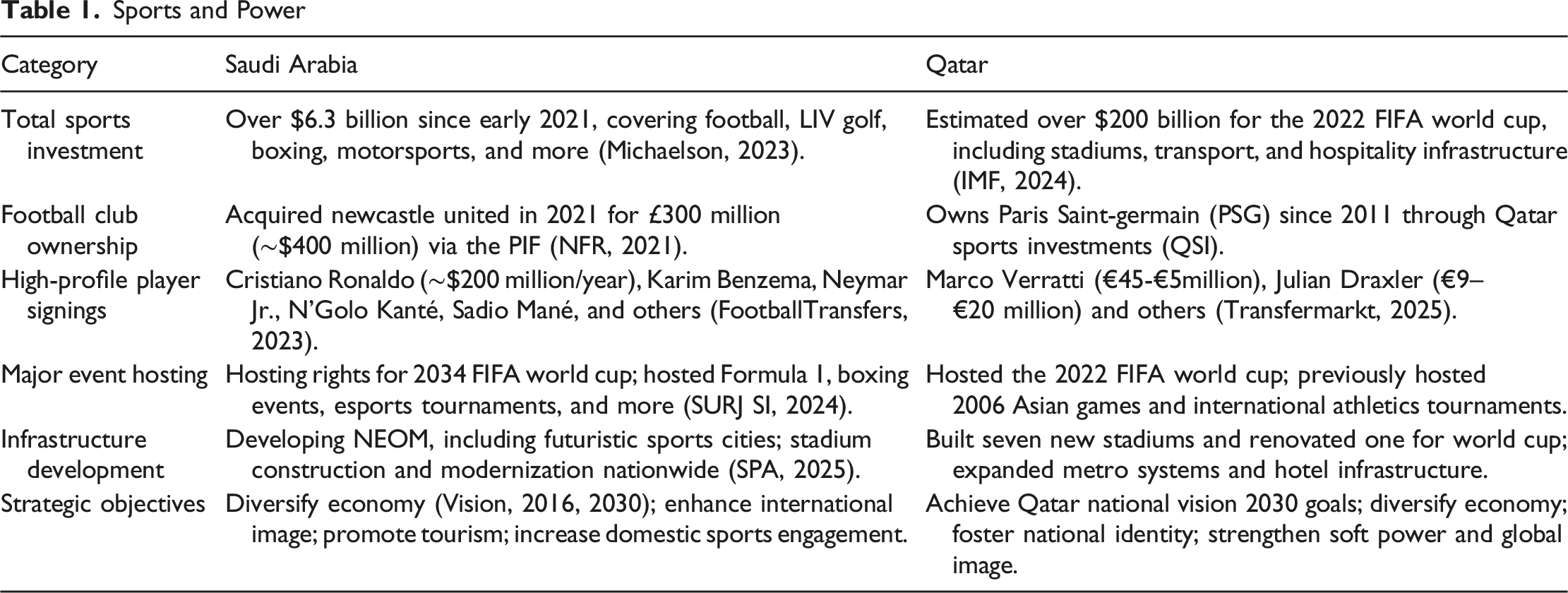
However, despite these strategic moves, Saudi Arabia’s sportswashing policy faces intrinsic contradictions. The image of openness and modernity it seeks to project stands at odds with ongoing repression of political dissidents, women’s rights activists, and journalists at home (Amnesty International, 2019). Furthermore, the intense criticism against Qatar faced over labor rights in the lead-up to the 2022 World Cup has primed global audiences to critically inspect Gulf mega-events. Thus, while Saudi Arabia’s sportswashing may secure a short-term geopolitical and economic advantages, it is unlikely to achieve lasting gains or significantly rehabilitate the Kingdom’s international reputation so long as these fundamental contradictions persist.
Qatar and Saudi Arabia’s sports diplomacy: Sports diplomacy and implication
Divergent strategic philosophies of sports diplomacy
Qatar engages in sports diplomacy as part of a broader national branding strategy, projecting an image of a progressive, confident Islamic state that leads conversations on development, global governance and cultural authenticity. This subtle, symbolic approach aligns carefully with global norms, positioning Qatar for long-term legitimacy and influence. In contrast, Saudi Arabia uses sports diplomacy as a fast-paced tool for regional reassertion, marked by aggressive spectacle and saturation. While Doha’s foundational strategy builds on sustainable soft power, Riyadh’s corrective and performative style risks being seen as superficial or short-term.
Youth as a site of political meaning and control
Qatar’s approach fosters a sense of inclusion and hybrid identity, using sports as tool for cultivating civic, pride, participation and loyalty. Its sports diplomacy supports education, volunteerism and national development narratives. This promotes stronger social cohesion and nurtures future engagement. Whereas, Saudi Arabia uses sports as a behavioral management tool, offering youth excitement and aspirational entertainment while maintaining clear limits on political participation. This top-down approach creates an illusion of transformation that my ultimately contain authentic youth empowerment and participation.
Cultural sovereignty vs hyper visibility
Qatar’s sports diplomacy is deeply rooted in symbolic cultural assertion. It uses key moments like the globally televised Bisht ceremony as subtle yet powerful expressions of its distinct identity. Saudi Arabia, on the other hand, pursues massive visibility through volume: owning football clubs, hosting multiple mega-events simultaneously, and masking itself unavoidable in global sports conversation. Qatar’s curated meaning enhances cultural sovereignty, while Saudi Arabia’s dominance in attention brings global recognition but risks superficial engagement and potential backlash.
Structural investment vs Tactical capital
Both states use sports as geoeconomic tools, not just soft power channels. However, Qatar’s investment is infrastructural and long-term – stadiums, logistics, educational initiatives and diplomatic forums designed to endure beyond individual events. Saudi Arabia’s spending is event-driven and personality-focused, relying on athlete purchases, global franchises and promotional media to yield immediate global visibility. One builds ecosystems; the other buys entry into existing ones.
Domestic governance reflected in sports diplomacy
Qatar’s sports diplomacy is aligned with a technocratic, consultative governance model – leveraging institutions, planning and public legitimacy to shape reforms. Its vision is widely disseminated and strategically integrated into national development. Saudi Arabia’s sports diplomacy reflects its centralized and hierarchical decision-making, where rapid reforms are frequently enacted without public debate or institutional cushioning. This approach enables speed but limits sustainability. This distinction affects how each state can maintain momentum and public trust in their sports diplomacy efforts.
Narrative building vs Message saturation
Doha employs discursive control, using state-funded media outlets and international partnerships to manage its image with sophistication, balancing global critique with measured responsiveness (e.g., labor reforms) (DN, 2023). Saudi Arabia focuses on media saturation, flooding the information space with promotional content, celebrity endorsement and high-budget campaigns that prioritizes volume over nuance. While Qatar’s approach fosters a credible narrative, Saudi Arabia’s strategy risks overwhelming audience and diluting message authenticity.
Institutionalization vs Opportunism
Qatar has built dedicated institutions around its sports diplomacy (e.g. Aspire Academy, Supreme Committee for Delivery and Legacy), entrenching sport into national education, health and foreign policy framework. Saudi Arabia’s model is less institutionalized and more ad hoc, focused on high-profile events and headline deals, without deep-rooted development programs or stakeholder investment. This difference suggests Doha is better positioned for sustained sports diplomacy impact, while Riyadh’s transactional approach may limit long-term benefits.
International alliance and global perceptions
Qatar operates through diplomatic subtlety and multilateral engagement, aligning itself with international organizations and presenting itself as a mediator in global forums. Its hosting of the World Cup was framed as a bridge between civilizations. In contradiction, Saudi Arabia leans into bilateralism and transactional diplomacy, using sports as an extension of broader foreign policy realignment. Contrary to assumptions that it seeks Western approval, its strategy is increasingly post-Western, targeting Asia, Africa and the Global South where strategic partnerships and investment flows matter more than normative acceptance (Mahmoud, 2023). This post-Western strategy reflects a pragmatic recalibration of alliance but may challenge perception of Saudi Arabia as a dialogic partner.
Legitimacy gaps and Reputational risk
Both states face ongoing global criticism, particularly over labor rights, freedom of expression and gender inequality. Yet Doha’s slower, more responsive reform process, although imperfect, has generated some institutional change. Saudi Arabia’s rapid pace and broader scope of reforms seem externally imposed and strategically timed, raising questions about authenticity and permanence. Sports diplomacy alone cannot shield either from criticism, but the depth and direction of reform matter immensely for long-term credibility.
Sustainability and post-event legacy
Qatar’s focus on legacy planning and international partnership (e.g., Stadium conversion for Global South nations, local club development, tourism expansion) indicates a long-term strategy that continues after the spotlight fades. Saudi Arabia’s challenges lie in avoiding post-event fatigue, where investment in visibility must be matched by tangible local benefits – jobs, grassroots participation, long-term health improvement – which remains less developed, undermining sustainability and social impact of its sports diplomacy (AlMarzooqi, 2023).
Theoretical implication
Understanding Gulf strategies requires historical epistemic contextualization. These practices resonate with a longer genealogy of non-Western symbolic statecraft, where sports and cultural spectacle have served as instruments of alliance-building, prestige and governance. For instance, precolonial Arabian falconry was not merely a sport but a diplomatic tool for forging alliances and asserting tribal prestige through symbolic gift exchange (Krawietz, 2016). During the Islamic Golden Age, rulers used horse racing, archery, and other sports as part of diplomatic rituals that linked leadership virtues with political legitimacy. Traditional pearl diving and maritime competitions along the Gulf coast were occasions for the tribal leaders to demonstrate wealth, bravery, and maritime prowess – fostering alliance and communal solidarity (Qatar National Museum, 2020). Camel racing, embedded in Arabian culture, functioned as a platform for showcasing status and political alliance, with prize-giving and patronage reinforcing tribal hierarchies (AI-Hajri, 2019).
These Gulf-specific practices amplify a historical continuity of symbolic statecraft, challenging reductive Western assumptions that frame contemporary sports diplomacy primarily constitutes image management. In fact, such strategic use of sports was not limited to the Gulf; it was a widespread practice across the Global South. Powerful empires like the Majapahit in Southeast Asia and the Mali Empire in West Africa utilized cultural festivals and athletic spectacles as vital tools of statecraft (Ensink, 1999). Similarly, Sultan Zain-Ul Abidin, the Sultan of Kashmir, strategically employed cultural diplomacy and arts patronage as deliberate mechanisms to promote social harmony and political stability across a diverse and multiethnic population (Akhter, 2017). In China, imperial courts hosted archery contests, horse racing, and martial arts demonstrations, integrating these sports into Confucian state rituals that accentuated discipline, virtue and hierarchical order, cultivate loyalty and strengthen social cohesion (Qian and Watson, 1993).
While innumerable examples abound, non-Western intellectual tradition offers an underappreciated genealogy of “soft power”. Indian strategist Kautilya’s Arthashastra systematically elaborated on reputation-building, alliance-making, and symbolic cultural engagement as core elements of statecraft, anticipating many principles akin to modern soft power theory. Tamil poet-philosopher Thiruvalluvar emphasized moral leadership and public virtue as essential foundations of diplomacy and governance (Thiruvalluvar, 1937). The Islamic scholar Ibn Khaldun linked social cohesion and public spectacle directly to dynastic legitimacy and power projection, framing cultural performance as critical to sustaining political authority (Sümer, 2012). Meanwhile, Chinese legalist philosophers such as Han Feizi (Han, 1998) recognized the central role of ritual, symbolic display, and public spectacles in governance, image management, and social control.
Adding to that, figures such as Al-Farabi (1986), who wrote on the ideal city and virtuous leadership; Al-Mawardi (1960), who detailed the political significance of ceremonial traditions in Islamic governance; and African Sage Ptahhotep (c.2400 BCE), who advocated wisdom and ethical rulership, further enrich this diverse corpus. Together, these thinkers establish a plural, non-Western theoretical foundation for understanding power, culture, and diplomacy – one that parallels, and in some respects predates or surpasses dominant Western soft power or sports diplomacy paradigms. Yet, Western scholarship has historically disregarded this knowledge as “ancient wisdom”, flattening the diversity and multiplicity of Global South thought into singular and monolithic motivations. A prevalent assumption is that states engage in cultural or sports diplomacy primarily to obscure unsavory realities. What such a perspective frequently fails to appreciate is that identical diplomatic mechanisms can serve vastly different purposes and yield diverse outcomes, contingent on local histories, political cultures, social structures, and moral economies.
While some scholars trace antecedents of cultural statecraft to classical Greek thoughts, these connections are best treated as thematic rather than linear. In the Republic, and the Laws, Plato discusses athletic as integral to paideia, the holistic cultivation of citizen’s moral and physical capacities, linking athletic competition to civic unity and the ideal polis (Plato, 1999). Aristotle, in Politics, similarly situates physical training within the broader aims of education for virtue and social harmony (Aristotle, 1957). Meanwhile, secondary notes that the athletics festivals and education in ancient Greece and Rome also functioned as display of elite status and civic identity (Van Nijif, 2004). Modern sport historians like Keys (2013) show that while echoes can be traced to antiquity, the strategic deployment of sports as an instrument of foreign policy is largely a modern phenomenon. In contrast, throughout Global South, both historically and today sport and spectacles have been deployed as explicitly outward-facing instruments, integrating cultural, economic and diplomatic objectives to enhance regional prestige and international standing.
This divergence highlights one of the most persistent epistemic injustices within Western (self-represented as Global) knowledge production: the “theory” vs “wisdom” bias. Global South intellectuals and their work are frequently relegated to the status of moral insight, anecdotal tradition, or folklore, while Western thinkers such as Plato and Aristotle are canonized as foundational theorists. This dichotomy is deeply rooted in colonial knowledge hierarchies that built academic disciplines around Western experiences and epistemologies, marginalizing non-Western thought as peripheral or primitive (Césaire, 1995). Non-Western strategic frameworks like Arthashastra are often stripped of context and repackaged within Euro-American constructs, erasing their originality and richness. Even as scholarship from the Global South gains visibility, selective translation and engagement distort these texts, perpetuating the West’s “naming power” – the ability to define, categorize, and legitimize key concepts such as geoeconomics and soft power as Western inventions (Mignolo, 2012).
This asymmetry is compounded by institutional gatekeeping mechanisms in academia that pressures Global South scholars to conform to Western paradigm for legitimacy and recognition. As a result, contemporary Global South practices – like the sophisticated sports diplomacy strategies of Gulf states are frequently misunderstood, misrepresented, or dismissed as derivative “sportswashing,” rather than acknowledged as continuations of a rich, indigenous strategic lineage.
Even though, renowned leaders have repeatedly demonstrated the versatility of sports. Nelson Mandela’s use of the 1995 Rugby World Cup as a symbol of national reconciliation in post-apartheid South Africa illustrated the profound geopolitical and symbolic utility of sport. Mandela’s actions not only advanced domestic harmony but repositioned South Africa in the global imagination, attracting investment and tourism while projecting a new national narrative (Ndlovu-Gatsheni, 2016). Similarly, Jawaharlal Nehru’s hosting of the 1951 Asian Games was a post-colonial assertion – utilizing sports to articulate India’s independent identity and signal a non-aligned international posture (Verma, 2025). Other leaders – including Fidel Castro (1970) (who leveraged Cuba’s athletic achievements to challenge U.S. hegemony during the Cold War), Perón (1996), and Lula da Silva (2010)– likewise harnessed sports as instruments of domestic legitimation and international strategy. Collectively, these examples demonstrate that the Global South has long employed sports diplomacy as a strategic asset.
Despite this rich historical and contemporary record, Western academic discourse often frames such strategies as recent anomalies or mere derivative adaptations of Western-origin soft power paradigms. This not only reflects a myopic and Eurocentric view of global strategic thought but also perpetuates a skewed epistemological order that privileges Western theoretical authorship while marginalizing the praxis and intellectual contributions of the Global South.
Conclusion
The evolving sports diplomacy strategies of the Gulf states signal a transformative moment in global political imagination, where states from the Global South actively shape – rather than merely respond to – the architecture of influence, visibility, and legitimacy. Departing from Western soft power (which privileges liberal cultural projection and moral appeal), these strategies articulate a distinct geoeconomic logic in which symbolic capital, infrastructural ambition, and state-led initiatives converge to produce influence on their own terms.
Doha’s and Riyadh’s approaches extend beyond reputational management. Qatar utilized MSEs like the 2022 FIFA World Cup to demonstrate a hybrid Arab-Islamic modernity, integrated into its National Vision 2030, and to challenge Orientalist narratives. Riyadh, in turn, has pursued high-profile acquisitions, mega-event hosting, and selective social reforms to counter Doha’s influence and position itself as the Gulf’s pre-eminent sports hub. These strategies are competitive and reactive, rooted in distinct governance models, regional leadership ambitions, and post-hydrocarbon development visions. The significance of this transformation lies in its historical and cultural continuity: Gulf sports diplomacy extends a lineage of indigenous symbolic statecraft, where performance and prestige have long served as tools of governance, alliance-making, and legitimacy. Contemporary sports investments and mega-events are not derivative imports but adaptive continuations of this repertoire, recalibrated for the dynamics of global economic circuits and multipolar politics.
Thus, dismissing these strategies as “sportswashing” obscures their geoeconomic depth and the broader geopolitical recalibrations underway. For the Gulf states, sport operates simultaneously as an economic catalyst and a platform for strategic influence, where legitimacy and power are generated through visibility, financial leverage, and sovereign agency rather than ideological alignment. Reconceptualized in this light, Gulf sports strategies exemplify a hybrid, forward-looking form of statecraft – one where spectacles help stage futures and show that political modernity can take multiple, historically grounded forms. Acknowledging this is not merely a scholarly correction but an epistemic act that opens space for a truly multipolar understanding of global statecraft, in which sports function as both economic catalysts and geopolitical instruments in the post-hydrocarbon era.
Footnotes

Funding
The author received no financial support for the research, authorship, and/or publication of this article.
Declaration of conflicting interests
The author declared no potential conflicts of interest with respect to the research, authorship, and/or publication of this article.