




Abstract
The research at hand centered around examining how news media manage their visibility, while navigating the challenges of invisibility posed by the platform economy. Platforms shape the visibility of news organizations and their content through algorithmic curation and moderation. In response, news organizations must exert considerable effort to maximize their visibility within these systems. The research identified and analyzed various deliberate promotional strategies aimed at enhancing an article’s visibility, including strategic posting across platforms, homepage placement, and extending content lifespan. By aggregating these strategies into a “promotion pressure” score, the study aims to unravel the circular relationship between news media’s content promotion strategies and audience engagement with news stories. Further analysis of the news articles with the highest promotion pressure shows that they are mostly related to major events, rely on news values such as conflict and personification, and frequently use clickbait headlines.
Keywords
Introduction
Today’s converged media environment has allowed news organizations to engage in practices of multi-platform distribution of news output, whereby a single news piece is being offered to the audience multiple times across different platforms throughout the news day (Boczkowski and Ferris, 2005; Erdal, 2009; Hanusch, 2017). However, not every news article goes through this process of cross-media distribution to the same extent and in the same way. The more an article is reproduced and promoted across media platforms, the more “visible” it becomes in the total news supply.
Yet, little is known so far on the implications of news media’s content promotion strategies (Hanusch, 2017) for both the visibility of and audience engagement with news stories, and whether or not it might be biased in favor of certain article types or topics. This study contends that due to the rising importance of audience engagement metrics in the editorial decision-making process, a better understanding is needed of the relationship between news story placement and promotion decisions, on the one hand, and user engagement metrics, on the other hand. It therefore seeks to unravel the relationship between the promotion of news stories across different media platforms and users’ engagement with these news stories. In addition, the study explores which types of news stories are more likely to receive high visibility across media platforms.
The remaining part of the paper proceeds as follows. It begins by laying out the theoretical dimensions for the research and looks at how visibility as an attention-grabbing practice for news outlets has become increasingly more important in the fragmented media environment. We argue that the use of analytics in newsrooms pressure journalists to continuously promote news stories and optimize their visibility across different platforms. The second section of the paper is concerned with the methodology used for this study. Here, we suggest ways of measuring ‘news content promotion pressure’ by exploring different factors such as story prominence, lifespan and cross-platform story posting. The third section presents the findings of the research, focusing on the article types and topics that achieve high promotion pressure. Finally, the fourth section discusses the findings from a broader perspective and ends by recognizing the limitations of the current study and making recommendations for further research work.
Content promotion pressure
We know from agenda-setting research that visibility of news matters. Issues that are prominent in media coverage are likely to be more salient in people’s minds, which may subsequently influence public opinion (McCombs and Valenzuela, 2020). Therefore, media scholars have shown much interest in studying the media agenda, that is, the news that is selected and promoted by journalists. To examine the media agenda, researchers tend to focus on the (accumulated) prominence and length of stories in mass media such as newspapers, television or news websites (e.g., Boukes et al., 2022; Salwen, 1988). However, most of these studies focus on newspaper content or television newscasts, but rarely do they take into account the cross-media nature of the current news landscape, where news stories circulate across different legacy, online and social media platforms.
With the rise of social media, Singer (2014) used the term “user-generated visibility” to highlight that journalists’ control over the visibility of the news they publish is being diluted in the digital news environment. Users on social media have now become ‘secondary gatekeepers’ who can, through their clicking, liking and sharing behavior, up- or downgrade the visibility of particular news items. However, whereas Singer’s (2014) notion of ‘user-generated visibility’ puts emphasis on how users participate in the sharing of news content, users’ engagement with news content also flows back to the newsrooms in the form of audience metrics, where it can directly influence the ‘primary gatekeeping’ process. Through real-time analytics and metrics, journalists are now acutely aware of how news consumption patterns differ depending on the time of the day and depending on the platform a story is published on. Journalists might respond to this metrics-instigated boost in visibility and select and package content differently to distribute and tailor it across different dayparts and different platforms (Hanusch, 2016; Tandoc, 2019).
Analytics monitor audience engagement with news content across various media platforms and provide insights and forecasts based on these data. News media organizations utilize these insights to inform editorial choices regarding the placement, packaging and promotion of news articles on their websites, in newsletters, and on their social media pages (Lamot and Paulussen, 2020; Tandoc, 2019). Consequently, the visibility and prominence of a news story hinge not solely on editorial decisions but also on the predictions and recommendations generated by analytics tools. Articles performing well on the website are more likely to be highlighted on other platforms and inspire subsequent coverage, whereas less popular stories might face deselection (Lee et al., 2014; Tandoc, 2014). Previous research has shown that journalists’ gatekeeping control has diminished due to increased platform dependency, especially when it comes to the distribution of news (Meese and Hurcombe, 2020; Myllylahti, 2018). News media organizations today not only promote their content on their proprietary platforms, including print outlets, websites and newsletters, but also on non-proprietary platforms such as Facebook and other social media (Dodds et al., 2023; Westlund and Ekström, 2018).
The repurposing of news articles has become common practice in news organizations. A single news item that is produced for the print edition of a newspaper can now be published on the outlet’s news website and app and can subsequently be included and promoted through the outlet’s newsletters and social media pages. However, we know that not all items have an equal chance to be selected for promotion on various platforms and on different parts of the day, since not every news item is considered apt for promotion on social media (Hanusch, 2017; Lamot, 2022). To account for and measure differences in the amount of promotion a news article is given, this study proposes the notion of ‘promotion pressure’: A news article’s promotion pressure is determined by the efforts made by digital news editors to place the news story on a prominent position on the website, extend the lifespan of the article, and redistribute it on proprietary (e.g., print outlet, newsletter) and non-proprietary (e.g., Facebook, X/Twitter) platforms.
In sum, in an age of information abundance, news media are constantly trying to make the news visible as widely as possible. However, given the different affordances of the platforms they use to distribute the news, not every news story is treated equally. Some news stories seem to become much more visible and salient than others. This study aims to examine differences in the promotion pressure for news stories, so as to better understand the relationship between the visibility of and engagement with the news stories across media platforms.
The remainder of this paper tries to answer the following research question:
What types of news content receive the highest levels of promotion pressure from news editors?
Quantitative content analysis
Data
This research was undertaken as part of a larger project. We carried out a partially automated quantitative content analysis of all news items published online by five market-leading Belgian news outlets. We included the news websites of four national newspapers: De Morgen and De Standaard are broadsheet newspapers, Het Laatste Nieuws and Het Nieuwsblad represent the popular newspaper press. These four sources are owned by one of the two major commercial media companies in Flanders, DPG Media (De Morgen and Het Laatste Nieuws) and Mediahuis (De Standaard and Het Nieuwsblad). We also incorporated the news website of the Flemish public service broadcaster VRT.
The content analysis was conducted for online news articles published within a period of four consecutive weeks (between January 13 and February 14 2020). An RSS-script and a crawler were developed to automatically collect and store all news articles in full-text, with their unique URL. The articles were automatically coded for the variables ‘article length’, ‘date/time of publication’, ‘media outlet’ and ‘paywall’. For the purpose of this study, we only included news in the formal sense of the word. Regional coverage, sports results, traffic reports, daily weather forecasts and concert/movie reviews did not meet this requirement and were therefore not used for the analyses in this article. They were either removed automatically on the basis of article URLs or by manually eliminating these articles if they made an explicit reference to these issues in the headline or first paragraph. The total sample eventually consisted of 10,071 news articles. In total, 1344 articles were coded from VRT, 1135 from De Standaard, 1100 from De Morgen, 3072 from Het Nieuwsblad and 3420 from Het Laatste Nieuws.
Measurements and reliability
At the end, inter-coder reliability was calculated again on a random sample of 300 articles. While this sample contains fewer cases than the traditional 10%–15% threshold, Lombard et al. (2002) have argued that the appropriate size of a sample for reliability analysis will rarely need to exceed the amount of 300 units. Overall, we find that the reliability of our measures, reported by Krippendorf’s alpha values, was generally acceptable. The reliability estimates of the various manually coded measures ranged from 0.71 up to 0.88. Analyses were carried out in StataSE 17.
Quantitative results
Building a measure of promotion pressure
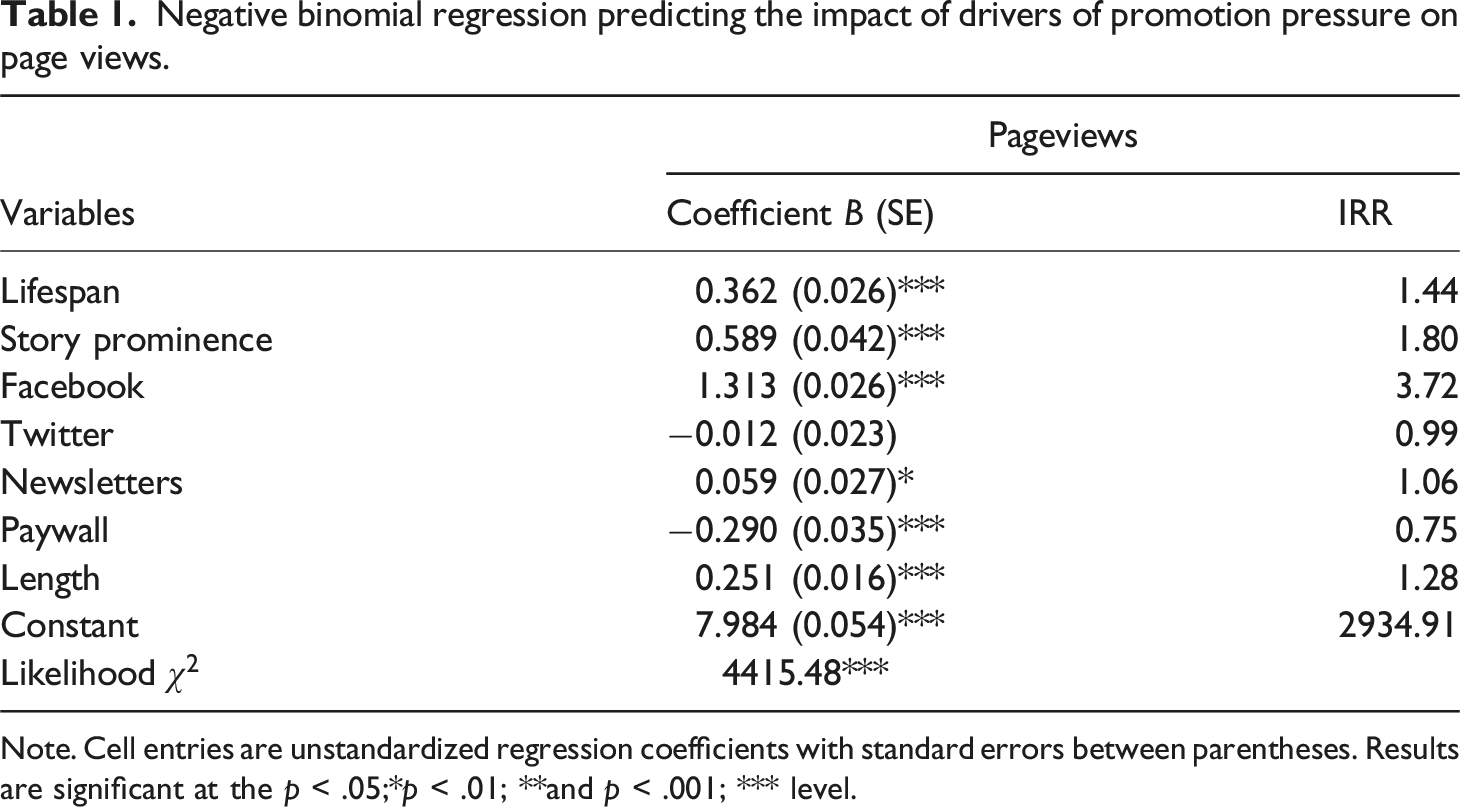
Negative binomial regression predicting the impact of drivers of promotion pressure on page views.
Note. Cell entries are unstandardized regression coefficients with standard errors between parentheses. Results are significant at the p < .05;*p < .01; **and p < .001; *** level.
It is apparent from Table 1 that almost all promotional efforts amount to the number of page views an article can generate. Firstly, story promotion on Facebook and in newsletters have a positive statistically significant association with the number of page views. Strong evidence was found that Facebook in particular is a clear accelerator for traffic to a news article. The IRR value shows that promotion on Facebook can result in a 272% increase in the number of page views, while promotion in the newsletter accounts for only an additional 6% traction to the news article in terms of pageviews. However, page views appear to be unaffected by promotion on Twitter, as no significant association was found. Secondly, there was a significant positive association between story prominence and page views. The IRR value indicates that placing an article prominently ‘above the fold’ on the homepage, would result in an 80% increase in the page views received. Thirdly, the lifespan of an article was found to be positively associated, this result is again significant at the p = .001 level. The IRR value means that showcasing a story for a longer duration on the website would result in 44% increase in the number of page views. Lastly, we also controlled for the length of a news article and whether a news article was placed behind a paywall. Generally, paywalled content tends to generate a lower number of page views, accounting for a decrease of approximately 25%. Article length proved to have a positive significant association with the amount of page views an article is likely to receive. Longer articles result in a 28% increase in the number of page views.
However, the actual aim of the study is to shed light on the proactive efforts and strategic decisions made by editors and journalists to increase an article’s visibility and performance across various media platforms. We coin this ‘promotion pressure’, as an indicator of ‘overpromotion’. To measure our main dependent variable, we used the following measurement:
The latter is based upon the story prominence of the article, which has a value of 2 if the article was above the fold and 1 if it was below the fold, the story distribution, which is the number of channels the article was promoted on (newsletter, Facebook or Twitter) and the lifespan of an article, which has a value of 2 if the article was displayed on the homepage during more than one daypart and 1 if it was only displayed for the span of one daypart. Hence, promotion pressure reflects the intensity and frequency of these actions, ranging from min = 1 to max = 16. As the score is more skewed to the right, we opted to perform a logarithmic transformation in our analysis.
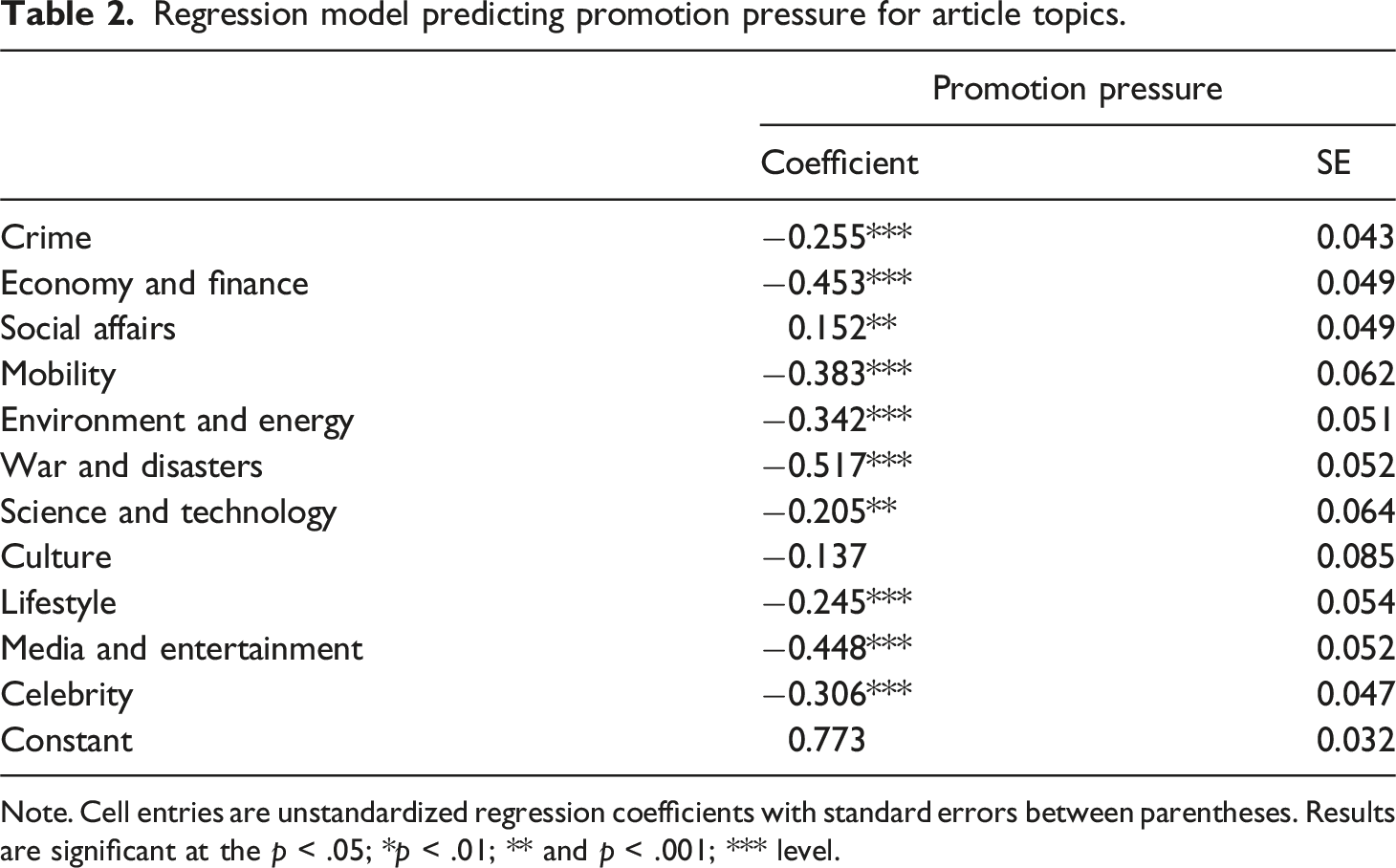
Regression model predicting promotion pressure for article topics.
Note. Cell entries are unstandardized regression coefficients with standard errors between parentheses. Results are significant at the p < .05; *p < .01; ** and p < .001; *** level.
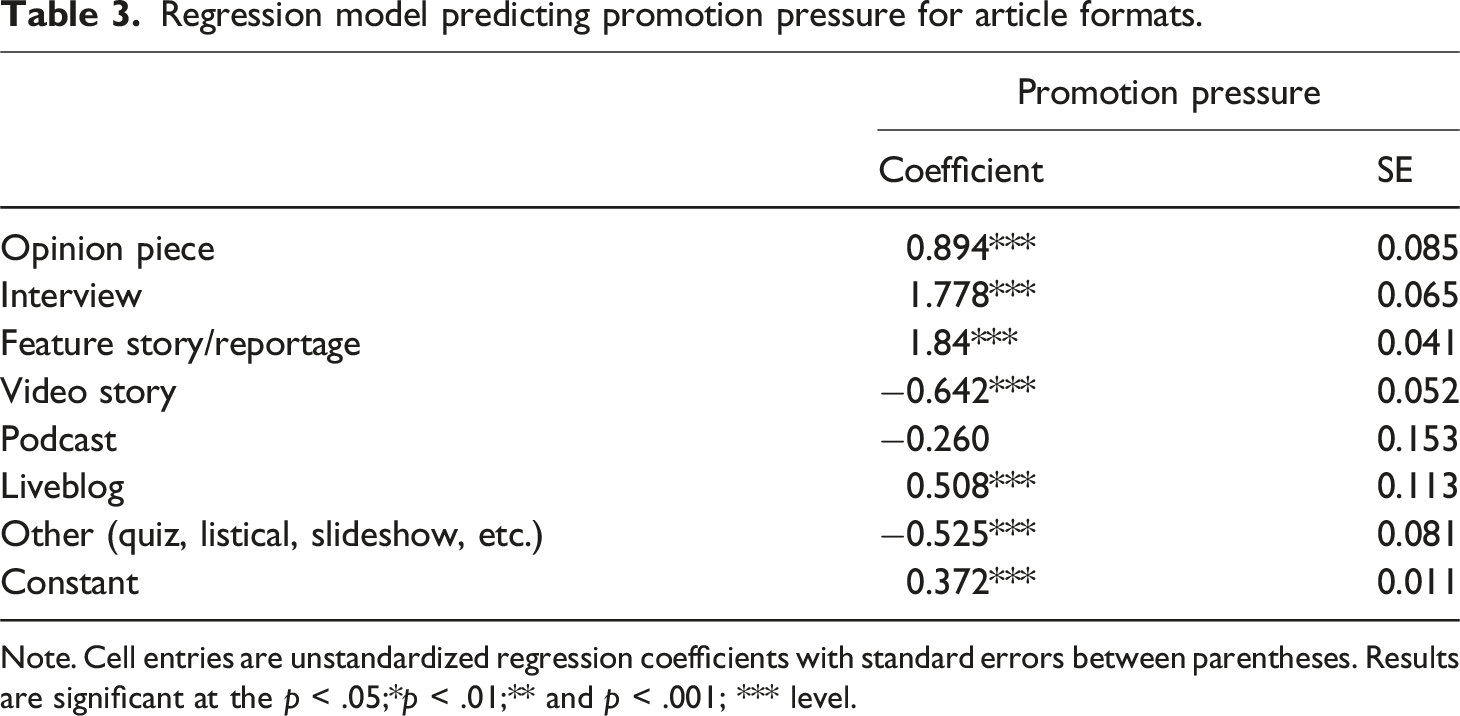
Regression model predicting promotion pressure for article formats.
Note. Cell entries are unstandardized regression coefficients with standard errors between parentheses. Results are significant at the p < .05;*p < .01;** and p < .001; *** level.
Qualitative content analysis
To complement the quantitative content analysis, the study also deploys a qualitative content analysis of all articles that achieved the maximum promotion score within our dataset. We choose to focus our qualitative analysis on these articles because they represent instances where the editorial staff employed the fullest extent of their promotional strategies. By examining this subset, we can more precisely isolate the outcomes associated with high levels of promotional support, offering clear insights into the relationship between editorial choices and article performance.
A first descriptive look at the articles bearing the highest promotion pressure score (n = 206) revealed that the majority of them consisted of articles published by the public service broadcaster VRT (50%), followed by quality newspapers De Standaard (23.3%) and De Morgen (14.1%). The share of the popular newspapers Het Nieuwsblad (6.8%) and Het Laatste Nieuws (5.8%) amongst the most promoted articles was smaller, considering each of these newspapers accounted for approximately a third of the total articles in the overall dataset. The vast majority of these highly visible articles (82.5%) was freely accessible, yet, 17.5% was locked behind the paywall. Since we could no longer retrieve all individual articles in full text because they were either part of a continuously updated liveblog or were no longer present on the outlet’s website, we were left with a selection of (n = 185) articles. We imported these units of analysis in ATLAS.ti, a qualitative data analysis software package.
The analytical process began with a meticulous initial reading of all collected articles to gain a comprehensive understanding of the content. Schreier (2014) noted how in qualitative content analysis the coding scheme is neither fully inductive or deductive, but rather mixes topics emerging from previous studies and convert them into main categories. This study likewise accomplishes qualitative data analysis while using inductive and deductive modes of reasoning concurrently. Deductive coding was applied using a pre-defined coding scheme based on previous scholarly work. It included categories such as ‘news softening’ (e.g., Reinemann et al., 2012; Otto et al., 2020), ‘user needs’ which were derived from existing literature and industry practice. However, the analysis still left room for new categories to be “inductively” created or emerged, when coded segments fell outside the scope of this imposed framework. As we progressed through the articles, recurrent themes that were not previously anticipated were noted and coded. For example, themes such as ‘story packaging’ surfaced were not initially considered in the deductive phase. The final step involved synthesizing the codes into broader themes that could address the research question whether specific types of news experience a higher amount of promotion pressure. The emerging themes were then discussed in relation to the existing literature and theoretical framework, providing both validation of known concepts and introduction of new insights. The coding scheme can be found in the Appendix.
Qualitative results
News stories as the result of positive feedback loops
A first finding is that more than half of the 185 articles that tend to be overtly promoted were about politics, social affairs or crime. A closer look at the subjects of the articles reveals that they dealt with some of the “key events/issues” during the period under study. As shown in Figure 1, 24 of the 185 most promoted articles reported on a highly mediated court case on euthanasia; 21 articles were about a mysterious lung disease in China claiming multiple deaths, 16 articles dealt with Belgium’s laborious government formation, 6 articles reported on Brexit Day and so on. Taking the euthanasia court case as an example, articles ranging from the hearings “Third day at Tine Nys euthanasia trial: specialists to take turn” to the conviction” (HNB, January 22), “Three accused doctors acquitted'” (DS, January 31) and the aftermath “Why the euthanasia process will resonate for a long time to come” (VRT, January 31) are all considered part of this highly promoted news story. Proportion of highly promoted news items per news story.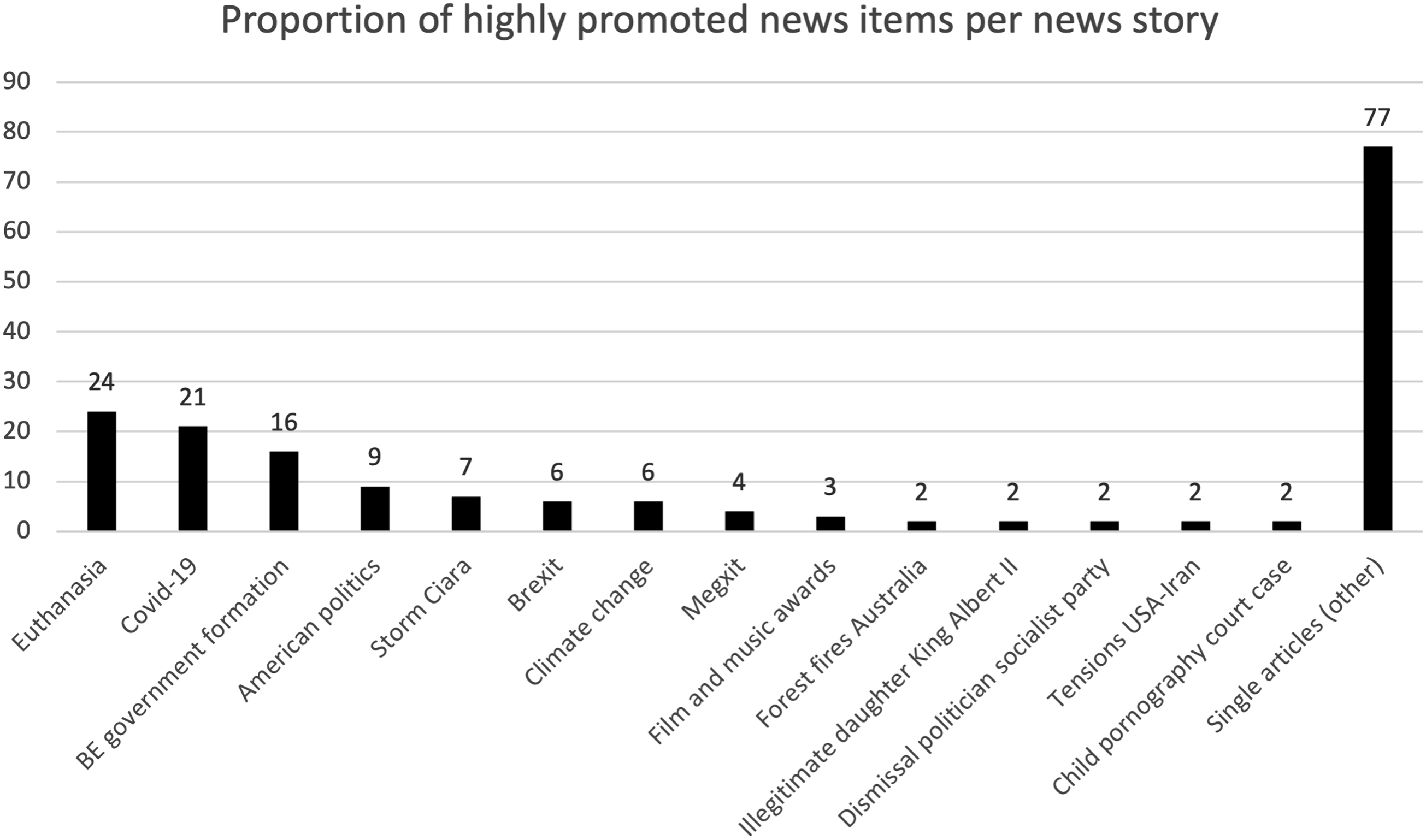
News stories with news values ‘conflict’ and ‘personification’
Besides the fact that the most promoted articles had to do with the major news events that month, a second observation is that they often contained conflict, accentuating conflict between individuals, institutions or groups (Galtung and Ruge, 1965; Harcup & O’Neill, 2017). This particularly seemed prevalent in political news stories such as Brexit, US politics (primaries, state of the union, impeachment procedure), the geopolitical tensions between the US and Iran and the Belgian government formation. Illustrative of this pattern is the article “Unseen: Nancy Pelosi rips Trump speech to pieces after State of the Union” (HLN, February 5, 2020) focusing largely on disagreement and differences in opinion between political actors. In the article, the journalist writes how “The evening [of the State of the Union] was already off to a bad start when Trump entered the House of Representatives, stepped to the speakership, gave Pelosi a copy of his speech and refused to shake her outstretched hand”, following up with Nancy Pelosi in turn trying to neutralize her opponent’s moves by “immediately retaliating and not using traditional terms like “honor” and “privilege” in her introduction of the president.” But also in other news beats, journalist tend to frame stories in terms of conflict, where two sides can be pitted against each other. For example, the “Megxit” news story, a play on the term ‘Brexit’ and reference to how Prince Harry and his wife Meghan Markle were stepping back as members of the British royal family centered largely within a discourse of family conflict. The Appendix presents an overview of how other promoted stories feature a similar conflict narrative.
Another observation was that a significant part of the promoted articles featured a human face or an emotional angle to the news story, focusing on the personal implications of the event portrayed (see also Galtung and Ruge, 1965; Otto et al., 2017). For example, a few days prior to the Brexit, VRT featured a piece “British Belgians on impending brexit: ‘I feel like my country has left me’” (January 28) in which they interviewed citizens with a dual nationality about “how they see the future of the United Kingdom” and “whether and how their feelings toward their motherland have changed”. Furthermore, De Morgen used the example of Rita (65) to illustrate and condemn the “bulging waiting lists, substandard quality of rental housing and too many people having to spend a lion’s share of their income on rent” (January, 22). These articles are all indicative for the classic journalistic resource of making use of an exemplar to make a complex event more comprehensible or accessible for an audience (Zillmann and Brosius, 2012).
“Give me perspective” and “educate me” function of the articles
The news value of conflict described in the section above is common in political and public affairs coverage because it in part allows to meet the journalistic standard of balance (Neuman et al., 1992). We also see this reflected in the function we detected for each article, for which we based ourselves on the conceptualization of the User Needs Model 2.0. While most promoted articles tend to be classic “‘who, when, where, what” types of articles, news stories answering to the ‘Give me perspective’ need were particularly promoted in the dataset. Ten Teije and Woudstra (2020) describe these articles as “articles that serve to give different perspectives on a particular subject, views pro and con, to help the reader form their own opinion on the topic and allow them to participate in the discussion”. An article of VRT (January 30) for example covers the day before Brexit, reporting how “the exit is accompanied by many emotions both among supporters and opponents” as they let conflicted Dover residents have their say in on-the-spot reportage. Similarly, a journalist of De Morgen reflects in a column on whether blasphemy is “inappropriate or healthy” (February 7) in the aftermath of a French girl Mila receiving online hatred and death threats after she made offensive remarks about Islam.
Other recurrent articles were “educate me” articles. The educational function mainly surfaced in relation to COVID-19 articles while the virus was not yet considered a pandemic, but “a mysterious lung disease” (DS, January 17). These articles attempted to explain the basics of the event and comprised important background information for the audience to consult. Apt examples is “Russia closes border with China, WHO warns: how long will coronavirus still spread and can disease be stopped” of Het Nieuwsblad (January 30) that contained a Q&A with questions like “How dangerous is this coronavirus?” and “What are the symptoms”.
Story packaging of the articles: Clickbait strategies
A final observation from our qualitative analysis is that promotion pressure of the news articles might not only be intrinsically bound to the content of news stories, but also potentially resulting from the ‘packaging’ of information in the headlines. More than half of the headlines seemed to recruit linguistic elements that have been linked to “a strategy of sensationalizing” (Molek-Kozakowska, 2013) or “clickbait headlines” (Kuiken et al., 2017; Lamot et al., 2022). The discursive strategies were not solely linked to more light-hearted topics, but to public affairs news as well. Firstly, many headlines in the corpus featured an interrogative structure. We noticed that these question-based headlines and question words surfaced mainly in relation to the “educate me” articles which are customary for VRT, like the article: “What changes now that brexit is a fact?” (February 1). Apart from that, promotion of ‘educate me’ articles can also strategically be achieved through compiling ‘listicles’ (Vijgen, 2014), as in the case of the following headline: “How Harry and Meghan’s “step aside” turned into “getting out with both feet”:
A third apparent theme, which we consider as an indicator of “clickbait” or “sensationalism” was related to the emotivity of a headline (Bednarek, 2006; Molek-Kozakowska, 2013). In the headline below negatively charged words as “tear apart” signalize some degree of sensationalism of the expression. Additionally, Molek-Kozakowska (2013) and Bednarek (2006) highlight how emotivity can also be strengthened by foregrounding the unexpectedness or by constructing it as extraordinary. In the case of the headline by HLN, unexpectedness is overtly marked with the specific word “Unseen”: “
A fourth prominent pattern in the headlines of well promoted articles was the use of forward-references (Blom and Hansen (2015). Those could either be proximal indicators of time and place (“here”) or personal and social deixis (“us” vs “them”), where the latter is used to reinforce dramatization or stereotypical representations (Molek-Kozakowska, 2013). Consider some of the examples in the dataset (emphasis added): • WhatsApp stops working on millions of smartphones. Check here to see if your phone is among them. (HLN, February 2). • ‘I had to wait for the noise of the first explosion and blow myself up in a subway car in the back’: They [convicted terrorists] did not blow themselves up in Brussels (DM, February 8).
Discussion and conclusion
The research at hand centered around examining how news media manage their visibility, while navigating the challenges of invisibility posed by the platform economy. Platforms shape the visibility of news organizations and their content through algorithmic curation and moderation (Bucher, 2012; Meese and Hurcombe, 2020). In response, news organizations must exert considerable effort to maximize their visibility within these systems and the attention economy. The research identified and analyzed various deliberate promotional strategies of news organizations aimed at enhancing an article’s visibility, including strategic posting across platforms, article placement, and extending an article’s lifespan. By aggregating these strategies into a “promotion pressure” score, the study aimed to explore which types of news receive the most promotional efforts.
In a first set of analyses, we validated our intuitive premise that promotion pressure strongly correlates with the numbers of pageviews a news item receives. The various drivers of promotion pressure all significantly contribute to an article’s performance. This is important given that platforms are designed to amplify content that already shows signs of high engagement, meaning that initial high page views can generate more secondary visibility across user feeds (Bucher, 2012; Singer, 2014). This dynamic might instigate some sort of a feedback loop (Trilling, 2024): news articles that attract significant attention can subsequently drive more promotional efforts, thereby drawing in even more views. This mutual influence between audience metrics and the editorial responses to these metrics may thus inflate the promotion pressure on certain news items.
Consequently, news organizations are incentivized to strategically enhance their content’s initial visibility and capitalize on platform algorithms that favor popular content (Dodds et al., 2023; Trilling, 2024). Therefore, our study also aimed to investigate which types of news receive more emphasis in journalists’ promotional activitities. Interestingly, our study’s findings challenge some of established notions about news promotion. While softer news topics such as Media and Entertainment, Celebrity and Lifestyle are generally expected to be advertised more prominently due to their high engagement metrics (Lamot, 2022), our data indicated that topics traditionally considered harder, such as social affairs news which deals with issues such as health, youth, social welfare, poverty and so on, received significant promotional efforts. This suggests that the outlets under scrutiny adopt a rather nuanced editorial approach where decisions about which news to promote do not strictly align with the expected popularity or “clickworthiness” of the content (Lagerwerf and Govaert, 2021). Editors seemed to demonstrate a balancing act between leveraging algorithmic visibility and adhering to journalistic standards to inform the public about relevant news. This may be taken to indicate that promotional activities have always been integral to journalistic practice, but that these activities – even in algorithmic times – do not automatically compromise journalists’ editorial autonomy.
Our qualitative analysis further supports that observation. Despite increasing audience influence through metrics, the traditional mechanisms of gatekeeping still seem to be prevalent with news outlets heavily relying on old-fashioned news values (Galtung and Ruge, 1965; Harcup & O’Neill, 2017). For instance, a significant proportion of the articles that received high promotion scores dealt with classic values such as timeliness, conflict and personification. Additionally, these articles typically addressed more sophisticated user needs such as ‘educate me’ and ‘give me perspective’, hence going beyond the basic ‘update me’ need of breaking news (Ten Teije and Woudstra, 2020). This type of content usually requires a higher level of journalistic effort. As a result, producing such content is inherently more ‘expensive’—both in terms of the time and resources invested, which might justify the promotional push. Yet, despite their substantive content, these articles were still often packaged with teasing headlines (Lamot et al., 2022), demonstrating a strategic blend of journalistic gut-feeling and marketing saviness (Tandoc and Vos, 2015). This approach indicates that while the article’s content was rooted in traditional newsworthiness, the promotional strategies at the article level were carefully crafted to catch the eye of the audience. Thus, also the method of ‘packaging’ plays a crucial role in enhancing the visibility of these articles.
An important caveat here is that our study stems from the assumption that editorial decisions directly translate into increased visibility of articles. While our research has focused on promotion pressure as an editorial strategy intended to enhance the visibility of certain news content, we acknowledge that the actual visibility of articles is not entirely within the control of news editors due to the influence of algorithms. Secondly, another significant limitation is our use of page views as primary metric. Page views are a raw measure indicating that an article has been accessed, but these metrics do not differentiate between a superficial glance and a qualitative, engaged read (Groot Kormelink and Costera Meijer, 2018). As a result, relying solely on page views might overestimate how effectively news content engages and retains its audience following promotional efforts. Thirdly, what we have presented here is the aggregated overview of which topics and formats were highly promoted in the Flemish context during the period of only a month. It is important to bear in mind the possible bias in the occurrence of certain topic categories. In the timeframe under study, some topics might just have been higher on the media agenda. Constructive week sampling would perhaps portray a different image of which topics are featured, however, without the consecutive days sampling we could not have measured visibility parameters such as the lifespan of an article. Lastly, another source of uncertainty is whether our measurement and operationalization of promotion pressure is exhaustive. There is abundant room for further progress in determining which other promotional aspects contribute to the (in)visibility of news items and we would encourage other researchers to explore this further.
In summary, our study illustrates that while the platform ecosystem might significantly influence news production and distribution, traditional values of newsworthiness and editorial judgment still weigh heavily in shaping online news content and distribution. This duality suggests that modern newsrooms are spaces where platform imperatives can coexist with longstanding journalistic norms, leading to a versatile approach to news gatekeeping and promotion.
Supplemental Material
Supplemental Material - News content promotion pressure: A content analysis of the cross-media visibility of and engagement with news stories
Supplemental Material for News content promotion pressure: A content analysis of the cross-media visibility of and engagement with news stories by Kenza Lamot and Steve Paulussen in Journalism
Footnotes
Acknowledgements
I would like to acknowledge the constructive and valuable feedback received from two anonymous reviewers and the Journalism Editorial Team. I’m also grateful for the help of dr. Tim Kreutz in collecting the data. At last, the author would like to thank the coders for their hard and meticulous work.
Declaration of conflicting interests
The author(s) declared no potential conflicts of interest with respect to the research, authorship, and/or publication of this article.
Funding
The author(s) disclosed receipt of the following financial support for the research, authorship, and/or publication of this article: This work was supported by the BOF GOA Fund of the University of Antwerp.

Supplemental Material
Supplemental material for this article is available online.
Notes
Author biographies
References
Supplementary Material
Please find the following supplemental material available below.
For Open Access articles published under a Creative Commons License, all supplemental material carries the same license as the article it is associated with.
For non-Open Access articles published, all supplemental material carries a non-exclusive license, and permission requests for re-use of supplemental material or any part of supplemental material shall be sent directly to the copyright owner as specified in the copyright notice associated with the article.
