



Abstract
In this article, we examine recent changes in Western media landscapes that witnessed the emergence of alternative conspiracy media critiquing the epistemic hegemony of legacy media, and explore ways to analyze whether they contribute to or hinder democratic discourse. This pressing question depends not only on the empirical manifestations of such media outlets, but also on the ideal conceptualization of media pluralism, which is contingent upon the preferred democratic theory. In this article, we draw from and build upon the work of Daniëlle Raeijmaekers and Pieter Maeseele, and develop a framework to systematically compare media practices against different democratic ideals/theories. We conceptualize a set of criteria that are crucial for the functioning of democracy given each democratic line of thought. Focusing on the three most important contemporary schools – liberal, deliberative, and agonistic – we argue that evaluations of media practices should consider three concepts especially important for media’s functioning in democracy: actor diversity, discursive diversity, and epistemological diversity. We have developed a comparative framework designed for systematic evaluations of media practices, assessing their contribution to media pluralism. This framework may be useful for scholars and media practitioners when assessing the democratic potential of new alternative (conspiracy) media.
Introduction
Alternative media associated with conspiracy culture are on the rise in many Western countries. These news outlets often position themselves as critical correctives to mainstream media, which they perceive as having an elitist, hegemonic, and left-leaning bias (Harambam, 2023; Rae, 2021; Rauch, 2021). In the US, channels like Infowars and Breitbart cater explicitly to a right-wing audience, providing a “hyperpartisan” interpretation of current events (Rae, 2021). In the European context, however, similar outlets do not necessarily or clearly align with a partisan perspective, but position themselves as an epistemic corrective to mainstream media. In the 2010s, online news channels on YouTube like Café Weltschmerz or the printed newspaper De Andere Krant (‘The Other Newspaper’; Dutch wordplay on ‘the other side’) emerged in the Netherlands. Enabled by the affordances of social media platforms, such news outlets gained additional momentum in the aftermath of 2020s COVID-19 crisis, which spurred the emergence of even more alternative news outlets such as the Belgian Tegenwind and BLCKBX. TV in the Netherlands (Harambam, 2023). Similar trends exist in the UK, with The Light, another newspaper associated with conspiracy culture, primarily distributed in physical form (Birchall and Knight, 2022). Instead of occupying a political niche, these media organizations claim to be “critical” and “independent” as (allegedly) opposed to the alignment with vested interests of mainstream media. Perhaps unsurprisingly, these alternative media outlets have been accused of spreading disinformation and conspiracy theories (Bennett and Livingston, 2018; Birchall and Knight, 2022; Harambam, 2023).
Although critics express concerns about the potential detrimental effects of these alternative media outlets on democratic public spheres (Bennett and Livingston, 2018; McIntyre, 2018), others see their potential for cultivating a genuinely pluralistic media debate (Harambam, 2023; Harcup, 2016). After all, citizens should be able to inform themselves from a number of different perspectives, but does that include conspiratorial ones? This issue raises pressing questions: what exactly about these media organizations and their practices threaten or uphold democracy? We argue that answers to that question depend not only on the media practices of such outlets, but also on the specific democratic ideals one upholds with regards to media. After all, what form of media pluralism is desired depends on one’s normative preference for a particular form of democracy: liberal, deliberative and agonistic. While various scholars have synthesized different expectations of media pluralism in light of different democratic theories (Helberger, 2019; Ihlebæk et al., 2022; Karppinen, 2013b; Raeijmaekers and Maeseele, 2015), we currently lack the analytical tools to comparatively evaluate media outlets along these different visions of democracy and media pluralism.
In this article, we therefore construct such an analytical framework by building on the insightful works of Maeseele and Raeijmaekers who in various articles took this challenge upon them (e.g. Maeseele and Raeijmaekers, 2020; Raeijmaekers and Maeseele, 2015). While these authors provide good discussions of the relation between different democratic theories and their subsequent approaches to media pluralism (Raeijmaekers and Maeseele, 2015) and construct a useful framework to analyse alternative media from an agonistic perspective (Maeseele and Raeijmaekers, 2020), we take their work one step further by developing a comparative framework that allows us to systematically compare whether, and how, these alternative media contribute to or threaten democracy according to different interpretations of media pluralism. Developing such a toolkit is highly urgent in an era where various alternative news media emerge which challenge not only hegemonic understandings of reality, but also question how the widely appreciated and institutionalized democratic ideal of media pluralism is actually enacted by mainstream media. With this framework we hope to help policymakers, media regulators, journalists, and citizens to assess the potential risks and benefits associated with these new media outlets in their efforts to understand and navigate the evolving information landscape in the digital age.
Our paper unfolds as follows: first, we discuss the role of media in democracy, and how new alternative media are blamed for the looming demise of democracy. We then relate these developments to ideals of media pluralism, and distinguish three main themes: actor diversity, discursive diversity, and epistemological diversity. The subsequent section operationalizes these concepts into empirical criteria, depending on the three most important theoretical schools of democracy: liberal, deliberative, and agonistic. Finally, we explain how media scholars and other stakeholders can apply this framework in their analyses of (alternative) media pluralism and democracy.
Media and democracy: the erosion of truth by alternative media?
Media pluralism is widely acknowledged as imperative to a healthy and well-functioning democracy (Ihlebæk et al., 2022; Karppinen, 2013a). The media informs citizens, provides critical commentary on current events, and serves as a soundboard for various publics, while maintaining a diversity of perspectives (Christians et al., 2014). There are, however, different understandings of what media pluralism should look like, depending on the ideal form of democracy one upholds (Ihlebæk et al., 2022; Karppinen, 2013a; Raeijmaekers and Maeseele, 2015). This means that claims about which form of media pluralism is desirable are inherently normative (Christians et al., 2014; Ferree et al., 2002; Joris et al., 2020). In other words, approaches to media pluralism are concerned with how media organizations should operate in a democratic society. Depending on which ideal typical representation of democracy one prefers, some media practices to foster pluralism are reason for celebration, while others might be viewed with suspicion.
Despite a pluralistic media landscape being commonly considered as one of the cornerstones of a healthy and well-functioning democracy, most discussions on media pluralism only focus on mainstream media and turn a blind eye to their alternative counterparts (Ihlebæk et al., 2022). While leftist progressive alternative media have been praised for their emancipatory agenda, the recently emerged alternative media are much more contested due to their populist, conspiratorial and extreme-right characteristics (Bennett and Livingston, 2018; Rae, 2021). In the United States, “hyper-partisan” (Rae, 2021) alternative media channels like Breitbart and Infowars, have challenged the dominance of mainstream and liberal news outlets by openly engaging with conspiracy theories (Bennett and Livingston, 2018; Birchall and Knight, 2022). These platforms are frequently excluded from debates on media pluralism, as they are considered illiberal and authoritarian, posing a threat to democratic values (Bennett and Livingston, 2018; De León et al., 2024).
While the association between right-wing outlets and conspiracy theories may apply to the polarized political landscape of the U.S. (Bennett and Livingston, 2018), in Europe similar outlets are harder to pin-down politically. During the COVID-19-pandemic several alternative media channels emerged in Europe that often lack an explicit party affiliation (Harambam, 2023; Harcup, 2016). For instance, Dutch alternative media channels such as BLCKBX. TV or De Andere Krant do not primarily contest the political leaning of legacy media but are questioning their epistemic hegemony. This fits the broader cultural trend of distrusting and challenging the knowledge of institutions once held in esteem, such as media and science (Harambam and Aupers, 2015; Urkens and Houtman, 2023; Ylä-Anttila, 2018). Alternative media outlets associated with conspiracy culture contest the epistemic rather than ideological hegemony of mainstream media, and in doing so constitute “counter-epistemic communities” (Waisbord, 2018: 1870). Indeed, they question common understanding of reality and propagate alternative explanations, which critics deem detrimental for the proper functioning of a healthy democracy (Bennett and Livingston, 2018; Ihlebæk et al., 2022; McIntyre, 2018). If people cannot agree on the simple facts anymore, such scholars warn, democracy as we understand may begin to unravel.
Whether these voices are considered legitimate alternative news media largely depends on how alternative media is defined. Some consider “ultra-right” media channels as legitimate alternatives (Downing, 2001), while others restrict the category to grassroots news organizations with an emancipatory agenda that denounce capitalistic market logics (Fuchs, 2010). Maria Rae, on the other hand, urges us to move beyond this alt-right or alt-left dichotomy when thinking about contemporary alternative news outlets, and regard these organizations as “hyper-partisan media” instead. They may be news sites, she argues, but because of their clear populist “us versus them” rhetoric, their strong ideological focus at the expense of objectivity, and their transgressive attacks on political adversaries, the concept of “hyper-partisan” fits their practice better (Rae, 2021: 1118). Moreover, since these channels are often backed by powerful financial actors, “alternative” seems odd to describe these rather hegemonic foundations of such media outlets. What is alternative actually about, then?
These definitional debates about what constitutes “proper” alternative media should not blind us from the fact that their audiences see them as “alternative media” nevertheless. More specifically, their alternative identification (or brand) is precisely the reason why they attract these crowds (Harambam, 2023). Indeed, such news consumers tend to adopt a much broader definition of what counts as alternative media (Rauch, 2015), and scholars should therefore simply analyze them as such (Rae, 2021). Moreover, these audiences, Harcup (2016) argues, may consist of precisely the publicly engaged citizens that are imperative to safeguard the functioning of democracies, contrary to people that otherwise do not engage with current affairs. In this article, we adopt a broader and less prescriptive approach, including all forms of news media that provide counter viewpoints in relation to traditional, mainstream, or “establishment” (De León et al., 2024) media outlets (Harcup, 2016; Holt et al., 2019; Ihlebæk et al., 2022).
Given the complexity of the matter, it is striking that these newly emerged alternative media outlets, such as De Andere Krant and The Light mentioned before, are gratuitously assumed to pose an unambiguous threat to liberal democracy. Such allegations should not be reproduced uncritically, but rather spark some pressing questions: what exactly is it that they do that threatens democracy? And to which democratic ideals do they pose a threat? We currently lack the means to address this issue systematically and need an analytical toolbox to evaluate media practices against different democratic ideals – particularly when considering alternative media channels that are commonly dismissed as illiberal or undemocratic.
Media pluralism and democracy
One notable exception to this lack of analytical tools is the work of Raeijmaekers and Maeseele (2015). Similar to other scholars (Helberger, 2019; Ihlebæk et al., 2022; Karppinen, 2013b), Raeijmaekers and Maeseele relate media pluralism to the three most prominently discussed forms of democracy: liberal democracy, rooted in the theories of thinkers like Lippmann and Hayek (see Harjuniemi, 2022); deliberative democracy, as developed by Habermas (1999) and supported by Benhabib (2021), and the relatively recent agonistic alternative, as popularized by Mouffe (1999). The framework of Raeijmaekers and Maeseele (2015) acknowledges the full complexity of the three democratic models of media and democracy as analytical perspectives that contradict and contest one another, since they are based on different ontologies, epistemologies, and ideas of human nature and social reality. As a result, the authors propose different methodological approaches, depending on the democratic model that is taken as point of departure. For example, they argue that a liberal form of media pluralism is more concerned with hard metrics, such as the number of different actors and their political affiliations, while an agonistic approach must pay attention to discursive elements, such as overall tone and whether and in what ways different perspectives are included or excluded. Comparing media practices from one of the different perspective of media pluralism is feasible (see for the agonistic perspective, Peeters and Maeseele, 2024), yet their framework is not designed for systematic comparisons of media practices across different democratic ideals.
Such a comparative approach is, however, crucial to better understand the rise of alternative conspiracy media outlets, and their position in discussions about media pluralism and democracy. Moreover, such a comparative framework makes it possible to be used by scholars and practitioners of different theoretical and ideological schools, instead of only one. To create such a comparative framework, we need to firstly develop criteria that fulfill important roles in all three democratic models. Obviously, this necessitates simplifying the philosophical complexities and nuances found in Raeijmaekers and Maeseele’s (2015) initial framework. But we need to extract key principles for media pluralism that, despite being potentially conflicting across different democratic contexts, share foundational values. This balance sacrifices some theoretical depth for practical applicability, prioritizing empirical utility. Consequently, we have developed an analytical framework that incorporates these unified parameters of pluralism, crucial for democracy, enabling systematic comparisons across diverse democratic ideals.
Conceptualizing comparable criteria
The disputes about the place of these media outlets in democracy can partially be explained by the versatility (or perhaps even ambiguity) of the complex concept that is media pluralism (for overviews, see Hendrickx et al., 2022; Joris et al., 2020; Karppinen, 2013a; Raeijmaekers and Maeseele, 2015; Verhoest and d’Haenens, 2021). First, it is important to note that most scholars differentiate between media pluralism and diversity. Diversity relates to the variety of actors, ideas, ideologies, claims present in certain media, while media pluralism is the ideological standpoint that diversity is desirable and important for the flourishing of democracy (Karppinen, 2013a). Diversity is empirically measurable in (meso) media and (micro) journalistic practices, while pluralism refers to state of the (macro) media landscape. Diversity can (but does not always) lead to a normatively pluralistic landscape (Hendrickx and Van Remoortere, 2021). In other works, media pluralism is not differentiated from diversity and points to a plethora of distinct aspects (Hendrickx et al., 2022; Joris et al., 2020; Verhoest and d’Haenens, 2021), ranging from internal to external media pluralism and from ideological to topic pluralism, with some more important than others when evaluating pluralism's contribution to the function of democracy. Given this ambiguity, it is important to clearly explain what we mean by media pluralism. We argue that whether a media outlet hinders or contributes to democracy depends on three main criteria: the media content conveyed, its presentation, and how that relates to the rest of the media landscape. More specifically: it asks who is included (actors); how the contents are discursively covered (discourse); and – given the recent epistemic changes – how journalistic knowledge is imagined and practiced (epistemology). Let us now discuss these three criteria in more detail.
First, actor diversity, which refers to the question of who should be covered and who is allowed to speak. When it comes to who is covered, this includes everyone of interest for the story at hand, ranging from people with relevant expertise to citizens providing experiential or anecdotal commentary. Actor diversity also refers to diversity in terms of demographics, such as, for example, occupation, ideological background, social-economic status, gender, and/or ethnicity. While scholars traditionally theorized that alternative media are ideologically more homogenous and therefore less inclined to present a wide range of actors, a study in the Flemish context found that they contributed to either internal or external actor diversity: whereas leftist alternative media had a higher internal actor diversity, mostly related to the extended length of their articles, rightist alternative media contributed to external diversity by giving voice to (far-)right politicians that are mostly excluded from mainstream news (Buyens and Van Aelst, 2022). Yet whether the latter contributes qualitatively to a pluralistic and democratic debate, remains an open question.
Discursive diversity, secondly, denotes the extent and ways in which topics are covered: it not only implies attention to the different perspectives but also their discursive practices (Ferree et al., 2002): the ways in which problems and solutions are presented (e.g., open-ended or closed). Contrary to the restricted interpretation of “discourse” and “discursive” associated with postmodern and cultural theory – that is, language that is inevitably tied to vested interests and power mechanisms (Foucault, 2020) – we use the term more broadly, merely referring to how ideas should ideally be presented. Concretely, discourse refers to which form and tone of language is preferred and hence seen as legitimate to participate in mediated public debates. We distinguish between whether the tone is expected to be either rationalistic, formal, and objective or whether emotional language is warranted for, too, encouraging informal and subjective participation in public debates. Discursive diversity by extent also encompasses the ways in which different actors, especially audiences, are incited or discouraged to actively partake in the public sphere (e.g., is the language inclusive and to whom?). Alternative media that voice aggressive and antagonistic opinions that delegitimize mainstream or counter-ideological voices can “fill a need in the market” but they can also weaken “democracy if they give a skewed and false picture of reality” (Ihlebæk et al., 2022: 1278). At the same time, they can incite democratic engagement, precisely because of their folkish nature (Harcup, 2016).
Third, epistemological diversity. As we argued in previous section, recently emerged alternative media present themselves as “counter-epistemic” (Waisbord, 2018) alternatives, and openly challenge the epistemic authority of mainstream media (Harambam, 2020). For example, by arguing how they are not as objective in their reporting as they are saying, but instead ideologically driven, or by giving preference to scientific knowledge over other forms of knowing, like experience or religion. Apart from traditional forms of diversity, it is thus important to also consider epistemological diversity, which relates to how journalists imagine and perform their journalistic knowledge and the extent to which contestations of that knowledge are seen as legitimate contributions to public debate. With the professionalization of journalism in the 20th century, “[j]ournalists adopted the scientific worldview of liberal–progressive reformers, moved away from partisan positions” (Harjuniemi, 2022: 6). Here “disciplined empiricism” led to an understanding of “objectivity with a capital O” (Ward, 2018: 9). While from the 1960s onward, more constructivist epistemologies are said to flourish in journalism (Raeijmaekers and Maeseele, 2017; Ward, 2018), the remnants of the scientific standards again seem to be present, as is exemplified by German journalists who scientistically aim to “let the facts speak for themselves” (Post, 2015) and the recent popularity of journalistic fact checks (Farkas and Schou, 2020; Graves, 2017). We will therefore differentiate between three forms of journalistic objectivity: objectivity in the scientific sense, meaning that the journalist is a neutral observer tasked with discovering the facts; objectivity as balance, meaning that the journalist is tasked with neutrally reporting all sides of a story; and situated objectivity, meaning that the journalist’s gaze is objective precisely because it is from a certain socio-cultural vantage point. These are, then, different understandings of objectivity that ideally correspond in greater and lesser extents with different theoretical approaches to democracy. While the epistemological stance of media organizations may be captured by examining their discourse, we can also derive their perspectives on truth based on the actors they include or even mission statements and other policy notes – highlighting the importance of treating it as a distinct category.
Combining the insights of previous sections - where we delineated our understanding of media pluralism and argued that approaching alternative media as countering epistemic hegemony can be fruitful in a European context - we propose that an analysis of alternative media’s contribution to media pluralism (at the content level) should focus on the following aspects: (1) actor diversity: the actors who (get to) sit at the table and their expected expertise; (2) discursive diversity: the different perspectives the actors bring to the table and how they are discussed, including their ideological framing; and (3) epistemological diversity: the ways in which journalistic objectivity is ideally realized, the different forms of knowledge on which reporting is based, the different kinds of expertise that are enrolled, and whether, and if so: which epistemic contestations of journalistic knowledge is seen as legitimate.
Analyzing media pluralism is thus concerned with the question of “who gets to talk, in what ways, about which topics, and based on what knowledge?”, and the answer consists of configurations which correspond to different normative ideals of democracy. Indeed, whether alternative media’s contribution to media pluralism is legitimate depends not only on the different aspects of media pluralism under scrutiny but also on how they relate to the preferred form of democracy with their own normative expectations (Ihlebæk et al., 2022; Raeijmaekers and Maeseele, 2015).
From agonism to agnosticism
As argued throughout this article, central in debates about alternative media is the question whether these alternative news outlets contribute to a healthy pluralistic media landscape. Following earlier arguments, we acknowledge that this question depends not only on the empirical manifestations of media outlets, but also on the ideal conceptualization of media pluralism, which is contingent upon the preferred democratic theory (Ihlebæk et al., 2022; Karppinen, 2013a; Raeijmaekers and Maeseele, 2015). Different democratic theories thus yield different, yet no less legitimate, ideal configurations of media pluralism. How we evaluate the rise of alternative media is thus different depending on those democratic theories.
Maeseele and Raeijmaekers make this point about media pluralism most pronounced, yet, in their works there appears a normative assumption that the agonistic model holds superiority over the liberal and deliberative models (Maeseele and Raeijmaekers, 2020; Raeijmaekers and Maeseele, 2015). Somewhat surprisingly, the authors argue that the other two models are overly normative and ideological, as they supposedly illegitimately sacralize objectivity and consensus, two concepts closely tied to liberal, post-political ideology (Raeijmaekers and Maeseele, 2017: 649). However, we argue that affording the agonistic frame a privileged position is not desirable when creating a comparative evaluative framework. Our intention here is different, as we aim to develop a framework that is independent of the democratic theory one upholds, and instead facilitates the assessment of whether media practices and outlets align with the criteria of media pluralism derived from one (or more) of these democratic theories.
Media pluralism according to different democratic theories.
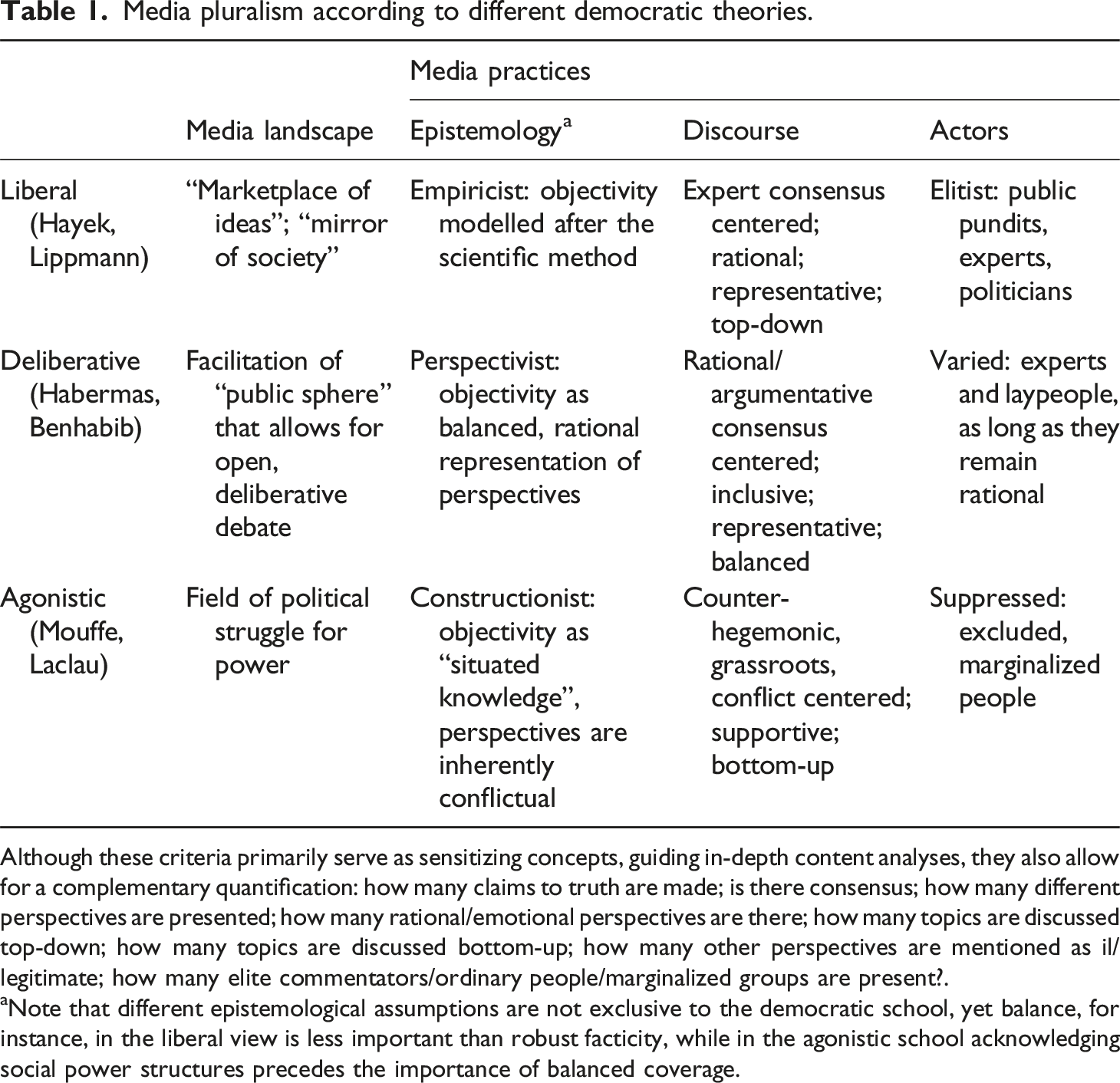
Although these criteria primarily serve as sensitizing concepts, guiding in-depth content analyses, they also allow for a complementary quantification: how many claims to truth are made; is there consensus; how many different perspectives are presented; how many rational/emotional perspectives are there; how many topics are discussed top-down; how many topics are discussed bottom-up; how many other perspectives are mentioned as il/legitimate; how many elite commentators/ordinary people/marginalized groups are present?.
aNote that different epistemological assumptions are not exclusive to the democratic school, yet balance, for instance, in the liberal view is less important than robust facticity, while in the agonistic school acknowledging social power structures precedes the importance of balanced coverage.
Liberal media pluralism
Liberal conceptions of democracy are characterized by the idea that the public does not have the necessary knowledge to directly take part in political governance. It is, indeed, assumed that they suffer an inherent information deficit (Ferree et al., 2002; Harjuniemi, 2022; Raeijmaekers and Maeseele, 2015: 1044). Therefore, this type of democracy is grounded in representation: through elections, citizens choose the representatives based on their party programs, and by doing so give them the authority to govern in their interests.
Elected officials thus govern in the public interest, which is assumed to reflect majority preferences – hence this model is often referred to as the liberal-aggregative model. Since citizens are not expected to actively participate in debates about public affairs, third parties, such as media organizations, are expected to reflect this aggregation of interests (Ferree et al., 2002; Helberger, 2019; Karppinen, 2013b; Raeijmaekers and Maeseele, 2015).
Media plays a paradoxical role, as they are on the one hand expected to authoritatively inform people on political issues of interest through voicing relevant experts (Harjuniemi, 2022: 274), while simultaneously allowing for the free flow of ideas, grounded in a liberal market logic (Karppinen, 2013a; Raeijmaekers and Maeseele, 2015). These roles relate to serving as a “mirror of society” and facilitating a “marketplace of ideas,” respectively (Harjuniemi, 2022; Raeijmaekers and Maeseele, 2015). Depending on whether one gives primacy to the economic or the political aspect of liberalism, different expectations of media arise. Lippmann, for instance, reserved a prominent role for experts in liberalism, while Hayek leans more toward the primacy of a capitalistic market logic to foster a free flow of ideas (Harjuniemi, 2022). Contradicting the traditional liberal aversion of monism in matters of truth (Karppinen, 2013a), media organizations in liberal democracies today put great effort in practices like factual reporting and fact checks, and thus arguably emphasize their responsibilities to authoritatively inform people on political and scientific matters more than that they cater to public demands (such as giving voice to, what Ylä-Anttila (2018) terms, “alternative experts”).
A liberal vision of media pluralism consists of the following criteria derived from the aforementioned considerations. In terms of actor diversity, there is a distinct focus on elite commentators, such as experts, politicians, or public pundits (Ferree et al., 2002; Raeijmaekers and Maeseele, 2015). Journalists can, if they are relevant to the story, include (balanced) opinions of laypeople in their reporting, but this is of a more testimonial nature. Expectedly, this elite-focus reflects itself in the discursive expectations of journalists and commentators. Information is neutrally presented so that the (as passive assumed) public can absorb the information to get well-informed. Experts are expected to provide authoritative interpretations on themes grounded in their expertise, using rational and formal language. The aim is to present a conclusive consensus on complex matters, which is, ideally, immune for legitimate contestation as these truths exists outside of human interpretation (Harjuniemi, 2022: 272). To come to conclusive and authoritative knowledge, epistemologically speaking, journalists follow a science-inspired form of objectivity (Waisbord, 2018). That means that journalists adhere to scientific realism and empiricism: facticity depends on whether empirical observations correspond to “reality as it really is”. Neutral and detached truth-finding trumps balanced or perspectival coverage. Of course, over the course of the last decades, journalists have increasingly acknowledged that their perspectives inevitably influence their observations and reporting (Ward, 2018), but the scientific ideal of objectivity nonetheless inspires their craft (Harjuniemi, 2022; Post, 2015; Waisbord, 2018; Ward, 2020). Holding on to the facts of experts is seen as one of the most important criteria for a functioning liberal media sphere.
Deliberative media pluralism
The democratic theory that is arguably most popular in communication studies is the Habermasian model of deliberative democracy (Karppinen, 2013a; 2013b). In his influential work on the public sphere, Habermas (1999) imagines a space that would mediate between the intimacy of people’s lifeworld and that of the “system” (the formal logic of state bureaucracies and corporations). In this public sphere, citizens are expected to debate politically relevant issues until they come to some sort of rationally deliberated consensus. To arrive at such a consensus, Benhabib (2021: 71) argues, some prerequisites need to be fulfilled: 1) participation in such deliberation is governed by the norms of equality and symmetry; all have the same chances to initiate speech acts, to question, to interrogate, and to open debate; 2) all have the right to question the assigned topics of conversation; 3) all have the right to initiate reflexive arguments about the very rules of the discourse procedure and the way in which they are applied or carried out.
Contrary to the liberal model, citizens ideally take part in the democratic deliberation process, and not just experts (Raeijmaekers and Maeseele, 2015). As such, experiential knowledge and expert knowledge come together, and ideally foster mutual learning.
The role of media in a deliberative democratic ideal is that facilitating public debates so that rational consensus can be formed (Raeijmaekers and Maeseele, 2015). The deliberative view shares with liberal conceptions of democracy the inclination for emphasizing the importance of intellectual elites: journalism specifically is entrusted with a gatekeeping function (Habermas, 2022). While Habermas develops the public sphere as a space in which citizens can rationally discuss opinions until they come to some sort of deliberative consensus, he also assigns journalistic media institutions with the task of qualitatively selecting and filtering the opinions that contribute to a constructive debate about politics (Habermas, 1999, 2022). Another difference with the liberal model is that while experts are allowed to identify and provide the topics of interest (Habermas, 1999, 2022), they should do so in a pluralistic (yet rational) way. In other words, journalists should report on a variety of perspectives instead of the expert consensus alone (if that even exists). To achieve such pluralism, public service, participatory and other small-scale (non-market dependent) media are most ideal, since large media corporations driven by a market logic and a capitalist ideology are, according to the deliberative view, prone to prioritize news benefiting vested interests, or sensational news that sells well. Social media serves as a case in point. While it is often assumed that user-generated content fostered by social media platforms is favorable from a deliberative democratic point of view because it gives a plurality of people opportunities to express themselves (Raeijmaekers and Maeseele, 2015), according to Habermas (2022: 160), they should be regarded with concern, since the political economy of platforms does not foster rational deliberation, but heated controversy instead. Habermas (2022) fears the (alleged) looming disintegration of the (digital) public sphere as a consequence of unregulated social media platforms, which are merely out for profit. Just like legacy media, social media platforms have to fulfill a gatekeeping function to filter polluted information out of the deliberative sphere. The role of media in the deliberative democratic model thus shares with the liberal view its emphasis on the role of journalists as gatekeepers but not as authoritative agents of knowledge.
A deliberative vision of media pluralism consists of the following criteria derived from the aforementioned considerations. In terms of actor diversity, media should not favor elite-actors over laypeople, but include a variety of actors relevant to the case. The aim of journalists is to provide a balanced coverage of all interests, meaning that actors of a wide array of backgrounds should be included. Everyone is encouraged to take part in the deliberative debate, yet their engagements should be rational. Discursively, topics are thus clear, informative, and argumentatively well-elaborated, so that citizens can rationally form their own well-informed opinion and settle upon a consensus (Helberger, 2019; Raeijmaekers and Maeseele, 2015). Journalists take part in and facilitate a rational and argumentative form of public discourse, that aims to be representative rather than putting more weight on a select group of elite commentators. Moreover, the determination of what is deemed rational and what is not, should be subject to open debate (see Benhabib, 2021). In practice, this focus on rationality, however, implicitly assumes a level of logical argumentation that may favor people with more education and greater cultural capital (Karppinen, 2013a), resulting in the exclusion of specific segments of society. Journalists, from the deliberative view, ideally pursue objectivity as balanced coverage with the goal of fostering a climate in which society can rationally reach a consensus (Raeijmaekers and Maeseele, 2017). The expected journalistic epistemology in deliberative democratic conceptions it that of perspectivism. A multitude of balanced, yet rational, representations of different perspectives on day-to-day events is the closest journalists can come to the truth. This means that they should treat all perspectives equally, as long as they remain rational. Indeed, the latter is a fundamental prerequisite in deliberative democratic theory.
Agonistic media pluralism
Against the liberal tendency to revere expert opinion and the deliberative tendency to sacralize rationality and consensus, Chantal Mouffe (1999) proposed an agonistic model of democracy. Agonism refers to the inherently conflictual nature of pluralistic societies and acknowledges the incommensurability of competing interpretations. This democratic perspective is in direct response to the dominance of liberalism in Western societies, which has led to what Mair (2013) labeled the ‘hollowing-out of western democracy’. Because politics became technocratic (and thus without political alternatives), people gradually withdrew from the political arena, while elites retreated into supranational (and often undemocratic) institutions. Expert- and evidence-based politics trumped democratic deliberation. There is, in other words, a tendency for depoliticization where “[p]olicies are taken out of the political (electoral) arena through privatization, through politically independent ‘expert’ committees and institutions (like most central banks), or by repudiating the political debate by saying that ‘there is no alternative’” (Mudde, 2021: 10–11).
As such, Mouffe’s (1999) argument to make space for conflict goes against the imperative of rational consensuses as it is forwarded in the liberal and deliberative model. In her view, it is unrealistic that in pluralist societies there can be rational agreement on basic “ethico-political principles”, simply because there are different societal groups with different (and often incommensurable) values and interests. Mouffe’s (1999) agonistic model thus argues for a re-politicization of an increasingly depoliticized public sphere, one that is said to be grounded in post-ideological liberal politics and the proliferation of technocratic measures that pretend to be detached from politics (Maeseele and Raeijmaekers, 2020; Mouffe, 1999). Statements in the public sphere that ignore societal power relations, and diverging values and interests, such as TINA (There Is No Alternative) political arguments, can therefore be no part of truly agonistic politics. Instead, the passions and powers at play need to be acknowledged and properly facilitated in the political domain. The central prerequisite, however, for contributing to the plurality of agonistic political debate, and contrary to the assumption that this leads to a form of “anything goes”-relativism, is that political opponents acknowledge each other as adversaries instead of enemies. For conflict to be truly agonistic (instead of antagonistic) both parties need to acknowledge the legitimacy of their opponents, and that their object of concern is distinctively political (Maeseele and Raeijmaekers, 2020). Without these basic rules of the game, there is no conflictual struggle possible, but an all-out war to destroy the opponent.
An agonistic media sphere is characterized by the facilitation of such a public space where conflict and counter-hegemonic contestation is celebrated (Budarick, 2020), and in which political struggle stands central and is given space (Raeijmaekers and Maeseele, 2015). Contrary to the gatekeeping role of journalism in deliberative models, journalists have a “gate-opening” function (Budarick, 2020: 193), so that different parties with competing worldviews and interests are heard. To assess whether media discursively contributes to an agonistic pluralist public sphere, Maeseele and Raeijmaekers (2020: 1598) developed a “framework of agonistic media pluralism”, and argue that evaluations of agonistic media practices must focus on whether their discourse opens or closes democratic debate. Since their framework already describes the discursive aspect of agonistic media pluralism (as discussed above), we will continue with actor diversity and epistemology.
Regarding actor diversity, special attention is reserved for grassroots groups and marginalized people that challenge the hegemonic status quo (re)produced by mainstream media (Maeseele and Raeijmaekers, 2020). In this model, there is no privileged space for experts, which is not to say that they cannot contribute to public debate – as long as they play by the same, discursive rules: discourse should be inclusive and open to political contestation (Maeseele and Raeijmaekers, 2020). Agonism allows for closed epistemic communities to serve as “free spaces” where “individuals may speak together supportively and develop their identities free of the conformity pressures of the mainstream” (Ferree et al., 2002: 309). Conversely it also “necessitates the maintenance of some remnant of commonality, a shared symbolic space upon which a plurality of positions can engage agonistically” (Budarick, 2020: 193). Media practices following agonism logically ground their epistemology in constructivism (Ferree et al., 2002; Raeijmaekers and Maeseele, 2017). This means that journalistic claims are inevitably perspectival and influenced by various interests, rendering the ideal of journalists as neutral and detached observers impossible (Budarick, 2020; Raeijmaekers and Maeseele, 2017; Sax, 2022). This, of course, reminds of postmodern understandings of knowledge as inevitably “situated” (Haraway, 1988) and influenced by particular “standpoints” (Harding, 1992).
Conclusion and discussion
This article has explored the role alternative conspiracy media may play in shaping a healthy democratic media landscape. The central question revolves around whether such outlets contribute to media pluralism, a central feature of modern democracies. But since what media pluralism entails is deeply dependent on the democratic theory one upholds (e.g., liberal, deliberative, or agonistic), there is not one answer to that matter (Ihlebæk et al., 2022). While various scholars have synthesized the literature on media pluralism and democracy (Helberger, 2019; Ihlebæk et al., 2022; Karppinen, 2013b; Raeijmaekers and Maeseele, 2015), an analytical framework that allows for a systematic evaluative comparison of media practices against these different democratic ideals was still lacking. In this article, we took up that task.
Unlike earlier efforts (Maeseele and Raeijmaekers, 2020; Raeijmaekers and Maeseele, 2015), our framework is not dependent on any specific democratic theory. This inclusivity avoids the requirement for varied empirical methods, enabling consistent, comparative analysis among diverse democratic models. We constructed an agnostic framework that facilitates the assessment of whether certain media practices contribute to media pluralism according to each democratic theory (liberal, deliberative, or agonistic). To do so, we developed a consistent set of criteria along which we can evaluate how media outlets contribute to the desired form of media pluralism according to each of these distinct theories. These criteria consist of actor diversity, discursive diversity, and epistemological diversity. These criteria yield different results for each ideal form of media pluralism, or more accurately, different expectations of media practices (see Table 1). This framework equips scholars and practitioners with the tools to evaluate the great variety of media practices out there today against the backdrop of the leading democratic paradigms of media pluralism simultaneously.
Our analysis provides concrete differences of what media pluralism should look like across the three democratic models (liberal, deliberative, and agonistic). For instance, in the liberal model, there are good reasons to exclude laypeople who may propagate various counter-hegemonic opinions from the media. However, including these voices is commendable from an agonistic point of view, for they may represent the societal conflicts of the moment. Similarly, the deliberative model may wish to facilitate rational, informed debate between different opinions on a certain topic, while the liberal model would only allow expert positions, and the agonistic model would include also those who express themselves emotionally. With regards to the rise of alternative media that contest the epistemic hegemony of legacy media, the starting point of our study, we can say that all models can allow them in the overall media landscape, but for different reasons. The liberal model would only be willing to include those voices when they are represented by experts in the field who base themselves on factual research, the deliberative model if they are able to convey their points rationally, while the agonistic model would allow, and even stimulate, the heated allegations of conspiracy theorists, as long as they regard their opponents not as enemies to be destroyed. Therefore, the question of whether conspiratorial alternative media belong in today’s pluralistic media landscape does not have a one-size-fits-all answer: it varies based on the democratic vision one subscribes to.
Our framework will be useful for academic scholars studying contemporary media practices, but maybe even more for journalists, news corporations and media regulators. To start with the first, academics can use our framework to qualitatively understand the variety of media practices out there. Quantitative scholars can make broader assessments of what (national) media landscapes look like and how they develop over time. Media practitioners and regulators may be more practically interested in: what to do about the various novel news organizations that position themselves against the mainstream? Our framework provides concrete criteria to such professionals when assessing the practices of these new media outlets. We hope that our framework will assist professionals in making substantive and fine-grained assessments, moving beyond broad rejections based on an outsider perspective and blanket opposition. This approach is crucial to navigate the complexities of today’s pluralist media landscape.
Footnotes
Declaration of conflicting interests
The author(s) declared no potential conflicts of interest with respect to the research, authorship, and/or publication of this article.
Funding
The author(s) disclosed receipt of the following financial support for the research, authorship, and/or publication of this article: This article is based on research funded by the European Commission, Marie Sklodowksa-Curie Action Individual Fellowship “Media and Conspiracy”, No: 799815.
