




Abstract
This study sought to investigate the prominence of U.S. birth control pioneer and eugenicist Margaret Sanger in social media discourse through a critical disinformation studies lens. Using computational and qualitative analysis techniques, 60 months of public Facebook posts and Google search data were analyzed to explore the scope, reach, and engagement with messages that reference Sanger and examine how injustice frames utilizing Sanger’s historical ties to eugenics are being used today to misinform and disinform on abortion and other issues. Injustice frames featuring Sanger were deployed to portray abortion as a method for Black genocide; vilify feminism as racist, anti-woman, and anti-motherhood; and depict the Black Lives Matter social justice movement and cancel culture as hypocritical. This analysis also captured a moment in time when Sanger’s legacy was being reconsidered by Planned Parenthood, the organization she founded, indicating that a long-sought-after reckoning with the racist roots of the early birth control movement in the United States may be underway—with both predictable and unpredictable rippling effects in disinformative spaces.
Introduction
In 2019, United States Supreme Court Justice Clarence Thomas wrote a concurring opinion for an abortion case that made headlines for its creative reinterpretation of history (de Vogue, 2019; Douthat, 2019; Rosenberg, 2019). Over the course of a dozen pages, he linked abortion with a kind of modern-day eugenics. Nearly half of those pages were devoted to the story of one woman—Margaret Sanger—a pioneer of the birth control movement, the founder of Planned Parenthood, and an ardent eugenicist, who had been dead more than 50 years (Box v. Planned Parenthood, 2019). Justice Thomas’s opinion later became a footnote in the 2022 Dobbs v. Jackson Women’s Health Organization decision that overturned women’s constitutionally protected right to abortion. Some fear that these arguments lay the groundwork to challenge women’s right to access contraception (Murray, 2022).
Sanger is rightfully vilified for supporting the inherently racist and ableist ideology of eugenics, which was founded in the science of human reproduction and aimed to apply theories of heredity to bring about “fitter” human life, with some lives deemed more valuable than others (Bashford & Levine, 2012). Yet her prominence in modern social media discourse belies what one would expect from a woman born in 1879. Her life and tarnished legacy continue to be resurrected, refashioned, and wielded into a tool for disinformation, the historical referent to accentuate the threat of any number of individuals and institutions, on topics new and old, from Planned Parenthood and abortion beginning in the 1970s (Cooper, 2023) to Bill Gates and the COVID-19 virus in 2020 (Collins-Dexter, 2020).
I argue that Sanger’s staying power, nearly a century after her heyday, lies in her ability to evoke the same emotions at work in Hochschild’s (2016) deep stories—a felt truth. Several emotions drive the resonance of deep stories: frustration, anger, resentment, and betrayal; at their core, these emotions derive from an underlying sense of fairness or justice that has been violated (Hochschild, 2016). Deep stories are inherently allusive, elide history for memory, and act to reinforce group values (Polletta & Callahan, 2017). The most powerful deep stories “can simply be referred to, often by way of their protagonist” (Polletta & Callahan, 2017, p. 58). Sanger’s role as antagonist or villain performs a similar function.
Eugenics and, by extension, Sanger, are useful disinformation storytelling devices in conjuring what Gamson (2013) calls injustice frames. Injustice frames, which Gamson positions within a broader collective action framework, require a concrete target and facilitate an adversarial stance toward some out-group who violate the in-group’s interests or values. Injustice framing often involves summoning historical grievances and refreshing them with current events (George, 2017), thus aligning with Entman’s (1993) conception of framing as foregrounding “a particular problem definition, causal interpretation, moral evaluation, and/or treatment recommendation” (p. 53). This conception of injustice frames also resembles how Fenster (1999/2008) conceives the collective, sense-making process of conspiracy theories, “a form of hyperactive semiosis in which history and politics serve as reservoirs of signs that demand (over)interpretation, and that signify, for the interpreter, far more than their original meaning” (p. 95).
As a woman whose legacy is fodder for both accurate, justified criticism as well as false or distorted rhetoric—spanning politics, religion, and human rights—Sanger is a tricky but compelling case study for injustice framing. However, I primarily aim to understand how Sanger is used as the historical referent to highlight a perceived “injustice” of today and to misinform and disinform on abortion and contraception. This case study is grounded in critical disinformation studies, an emerging research paradigm that positions disinformation within a broader historical, social, cultural, and political context and explores how race, class, gender, and other power structures drive disinformation dynamics (Freelon et al., 2022; Kreiss et al., 2020; Kuo & Marwick, 2021; Mejia et al., 2018; Ong, 2021). The case study unfolds in three parts: First, to quantitatively examine the scope, reach, and engagement with narratives about Margaret Sanger on social media; second, to quantitatively assess the most popular content and most frequent posters of Margaret Sanger content on social media; and third, to qualitatively analyze, among a subset of messages, how injustice frames are being applied.
Literature Review
Theoretical Framework
Because narratives about Sanger may include fact, fiction, or a combination of the two, for a variety of purposes, it is worth clarifying the definitions used here. Disinformation is defined by the High-Level Expert Group on Fake News and Online Disinformation (2018) of the European Commission as “all forms of false, inaccurate, or misleading information designed, presented and promoted to intentionally cause public harm or for profit” (p. 3). Misinformation is unintentionally inaccurate information (Jack, 2017). A separate but related category of misinformation, conspiracy theories, are “the conviction that a secret, omnipotent individual or group covertly controls the political and social order or some part thereof” (Fenster, 1999/2008, p. 1). Conspiracy theorists see the existing political and social order and knowledge from powerful individuals and institutions as disinformation (Fenster, 1999/2008). This case study does not aim to classify content about Margaret Sanger within these categories. Rather, it seeks to understand, across all three, how and to what extent she is used as a past symbol of injustice in present-day social media discourse.
A sense of injustice has long been seen as a critical component to collective action (McAdam, 1982; Moore, 1978; Turner & Killian, 1987). Gamson (2013) suggests that, when people link malicious acts of specific individuals or groups to undeserved suffering, “the emotional component of an injustice frame will almost certainly be there” (p. 1). George (2017) argues that injustice frames often call on national, ethnic, and religious identities. Stories about Sanger may draw upon all three, with misinformation and disinformation about her serving as both a kind of political (Freelon & Wells, 2020) and religious communication. Injustice frames come with “preinstalled symbols” such as flags or heroes (George, 2017, p. 161). Villains, then, may perform a similar role—and be an appropriate choice for an injustice frame analysis that may include conspiracy narratives, which by definition draw upon historical wrongs (Fenster, 1999/2008).
Gender and sexuality feature prominently in disinformation and conspiracy studies—with women sometimes cast as the villains, but more often as the victims of larger schemes (Thiem, 2020). Modern feminist disinformation scholarship on women as antagonists typically focus on narratives circulating about women who have or are seeking political power, such as Hillary Clinton, Nancy Pelosi, and Maxine Waters (Amarasingam & Argentino, 2020; Marwick & Lewis, 2017; Neville-Shepard & Nolan, 2019). This is the first, content-focused study of disinformation and Margaret Sanger. 1
Margaret Sanger, Eugenics, and the Seeds of Disinformation
Understanding the current narratives circulating about Sanger means delving into their origins. The next section briefly summarizes that history. The author’s intention is not to sanitize or contextualize Sanger’s beliefs, but rather to highlight the diverse and changing interpretations of her life and work. Sanger (1879–1966) has alternately been described as a fearless feminist crusader for sexual pleasure and reproductive autonomy (Eig, 2014); a radical socialist whose quest led her to become “a pawn of the conservative elite” (Engs, 2014, p. 326; Gordon, 1974); and a progressive if flawed woman whose fallacy lay in centering her feminism in White womanhood (Schuller, 2021). She was controversial even in her own time, arrested multiple times for violating censorship laws on contraception and targeted by the Catholic church for her beliefs (Cooper, 2023; Eig, 2014). She is credited with coining the term “birth control” and making it her personal mission to support discovery of a pill that could prevent pregnancy (Eig, 2014, p. 3). Sanger founded the American Birth Control League and Birth Control Clinical Research Bureau in 1921 and 1923, respectively, which later merged to become the Planned Parenthood Federation of America (Engs, 2014).
Sanger’s support for eugenics is clear—she wrote and spoke extensively on the subject. She advocated for fewer children from the “unfit,” a “wildly capacious category, comprising the physically and mentally disabled, impoverished, ill, queer, alcoholic, and criminal, among others” (Schuller, 2021, p. 118). This advocacy included promoting the use of forced sterilization. “We should here recognize the difficulties presented by the idea of ‘fit’ and ‘unfit,’” Sanger wrote. “Who is to decide this question? The grosser, the more obvious, the undeniably feeble-minded should, indeed, not only be discouraged but prevented from propagating their kind” (Sanger, 1922, p. 181). Even when eugenics fell out of favor in the public eye in the 1940s following the exposure of Nazi atrocities in the name of the science, Sanger continued to back forced sterilization efforts (Eig, 2014).
Without question, state-level governments in America preyed upon minority and marginalized populations using eugenics policies—by the 1930s, 26 states were implementing forced sterilization laws, leading to tens of thousands of procedures conducted on both men and women by the 1960s (Aptheker, 1974). Yet scholars continue to debate Sanger’s personal stance on race (Engs, 2014). There are no primary sources that cite Sanger’s support for race-based eugenics policies or for “positive” eugenics, the belief in increasing numbers of certain populations viewed superior, like White people (Eig, 2014; Engs, 2014). But neither is there evidence she saw Black people as equal partners in her efforts to establish the first Planned Parenthood clinic in the South, for example (Schuller, 2021). Her most notorious communique on the matter is a letter containing several badly phrased lines, in which she tries to argue for hiring Black doctors and spokespeople for the clinic: “It seems to me from my experience . . . in North Carolina, Georgia, Tennessee and Texas, that while the colored Negroes [sic] have great respect for white doctors, they can get closer to their own members and more or less lay their cards on the table, which means their ignorance, superstitions and doubts. They do not do this with the white people, and if we can train the Negro doctor at the clinic, he can go among them with enthusiasm and with knowledge, which, I believe, will have far-reaching results among the colored people. His work, in my opinion, should be entirely with the Negro profession and the nurses, hospital, social workers, as well as the County’s white doctors. His success will depend upon his personality and his training by us. The minister’s work is also important, and also he should be trained, perhaps by the Federation, as to our ideals and the goal that we hope to reach.
The letter ended up “assassinating . . . [Sanger’s] reputation via a shot fired by her own hand” (Schuller, 2021, p. 140). Most scholars agree Sanger’s seeming intention was, ironically, to prevent misinformation about birth control among the Black population the clinic sought to serve (Valenza, 1985; Eig, 2014; Schuller, 2021). To Roberts (1997/2017), the letter highlighted two issues: “Black people were suspicious of white-controlled birth control programs from the very beginning, and white-controlled programs had no intention of allowing Black people to take the reins” (p. 78). Sanger’s letter has since fueled discourse that the program was indeed a plan to commit Black genocide, a discourse that crosses racial and political lines, with activists like Dinesh D’Souza and Angela Davis citing the narrative (Davis, 1982; Schuller, 2021).
Weaponizing Sanger’s Legacy
A shift in the interpretation of Sanger and her legacy began in the 1960s, first with the Civil Rights Movement foregrounding racism in public discourse, and later when the Roe v. Wade decision of 1973 sparked the anti-abortion movement (Cooper, 2023; Engs, 2014). It was during the 1970s, especially, that “religious conservatives resurrected the figure of Margaret Sanger as the villain of the ecumenical right-to-life movement” (Cooper, 2023, para. 27). Coupling Sanger’s story with information on the demographics of abortion rates, anti-abortion groups could present themselves as “crusaders against racist eugenics” and try to make the case that legal abortion was “an irredeemably racist project” (Cooper, 2023, paras. 31 and 32). Even though she personally did not believe in abortion, Sanger’s story and affiliation with Planned Parenthood provided the connection (Cooper, 2023). It is likely this campaign that Justice Thomas draws from in the aforementioned Box v. Planned Parenthood opinion. In Killing the Black Body: Race, Reproduction, and the Meaning of Liberty, Roberts (1997/2017) describes the campaign as an exploitation of Black reproductive autonomy in service to the interests of White supremacy. Citing a specific example—a 2011 billboard in Times Square that called the womb the most dangerous place for Black Americans—she writes: “Far from grasping the dangers of the eugenics era, the abortion-as-black-genocide argument distorted that movement’s history and, in fact, promoted its racist ideology. . . . The antiabortion rhetoric diverted attention from the structural causes of racial disparities in abortion rates—poverty, lack of access to contraception, and inadequate sex education—that result in unwanted pregnancies. Instead, the campaign demonized Black women blaming them for ‘genocide’ against their own communities and by suggesting they are incapable of making their own reproductive decisions” (Roberts, 1997/2017, p. xv).
Previous scholarship has shown that disinformation often builds upon existing, race-related ideologies, and deep stories amplify racist and misogynistic tropes (Freelon et al., 2022; Ong, 2021; Phillips & Milner, 2021; Polletta & Callahan, 2017). In exploring why some characters such as “welfare queens” and “anchor babies” resonate in political storytelling, Polletta (2015) argues that it is their strong emotional charge and ability to call up multiple stories. She calls for a better understanding of how groups use these characters to advance their causes: “We should be able to assess just how ‘sticky’ collective memories of particular historical figures are” (Polletta, 2015, p. 36). Drawing on this theoretical framework and in answer to this appeal, this study seeks to examine the “stickiness” of the historical figure of Margaret Sanger in modern social media discourse using a mixed-methods approach, asking:
Research question 1 (RQ1). To what extent do messages mentioning Margaret Sanger appear on social media and in internet searches?
Research question 2 (RQ2). What is the most popular content, and who are the most prolific posters of Margaret Sanger content?
Research question 3 (RQ3). How are injustice frames applied in social media messages about Margaret Sanger, and how are they used to misinform and disinform on abortion or other issues?
Methodology
I used a mixed-methods approach to this study, applying both computational and qualitative content analysis techniques. First, 5 years of social media posts mentioning the name “Margaret Sanger” were collected from all public Facebook pages with more than 25,000 page likes or followers, all public Facebook groups with more than 95,000 members, all U.S.-based groups with at least 2,000 members, and all verified profiles, using the CrowdTangle research platform. Facebook was selected for this study because it is the largest and most-used social media platform in the world, with about two billion daily users (BBC News, 2023). The resulting dataset included 21,594 posts from 10,796 unique Facebook accounts that posted between April 12, 2018, through April 11, 2023, from at least 85 self-identified countries. Misinformative and disinformative messages and users who post such content on Facebook repeatedly have the potential to get removed or banned from platforms over time (Alison, 2020), leading to an issue called absent data (Freelon, 2021). Since data were collected in April 2023, issues of absent data may be present. However, given that most messages were anticipated to include semi-factual but distorted information, it was concluded that this limitation would present minimal challenges to the analysis.
Next, data were cleaned and analyzed using the software package R. Approximately 7,482 messages were posts that included hyperlinks only, without accompanying text, and these were excluded from the analysis. This left 14,112 messages, of which 75% (10,611) were unique messages, meaning they were not repeats of other messages. These 10,611 unique messages from 6,256 unique Facebook accounts comprise the core corpus analyzed for RQ1 and RQ2. To help answer RQ1, Google searches for the term “Margaret Sanger” were downloaded from the Google Trends platform for the same time period as the Facebook dataset. Google Trends provides global data on Google search terms, compiling a scaled (0–100) measure of search interest popularity of the terms compared to all searches on all topics. For RQ3, I conducted a qualitative review of 100 messages with the most Facebook interactions, the top three most-posted videos, and all 402 messages by 9 of the top 10 most frequent posters of Margaret Sanger content (the tenth was a Spanish-language account).
Issues of Ethics and Terminology
Ensuring anonymity from large social media datasets is challenging, and some research has demonstrated that even those following ethical best practices can unintentionally release information that leads to reidentification of individuals (Metcalf & Crawford, 2016; Zimmer, 2010). Using public pages and public groups from Facebook alleviates this risk somewhat; CrowdTangle does not capture information from private, individual Facebook accounts. Users in the dataset are either organizations or individuals who choose to make their identity known on public pages and in public groups. Given this and considering the importance of learning how disinformative narratives spread, especially on a topic as sensitive and crucial as abortion, the author has chosen to include the most prolific posters of disinformation on Margaret Sanger here. In addition, rather than using politicized terms like “anti-choice” or “pro-life,” unless it is part of a quotation or cited source, the terms “anti-abortion” and “pro-abortion” are used to describe particular groups and their interests.
Findings
Scope, Reach, and Interactions
In answering RQ1, quantitative findings indicate a modest but sustained presence of Margaret Sanger in social media discourse from April 2018 through April 2023. Across the 60-month timespan, the 10,611 unique messages mentioning Margaret Sanger netted about 81.7 million views and 2.1 million total interactions, calculated as the total number of likes, comments, shares, and expressions (love, haha, wow, sad, angry, and care). Her name appears in about 40 public messages per week on average on Facebook. However, this average masks sharp peaks that occurred at key, newsworthy moments (Figure 1).
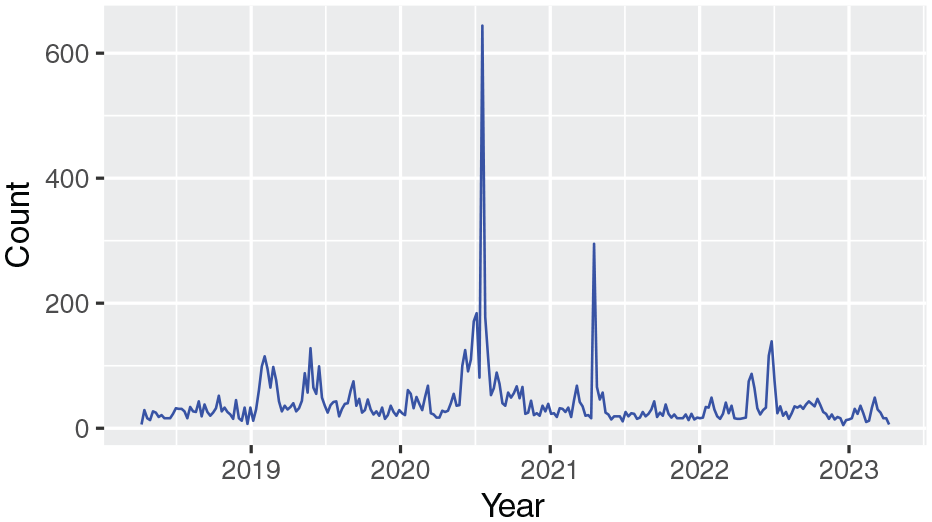
Facebook messages mentioning Margaret Sanger (April 2018—April 2023).
The most-messaged week (with 644 posts) was in July 2020, when Planned Parenthood of Greater New York (PPGNY) announced that they were removing Sanger’s name from their Manhattan Health Center. Indeed, this announcement and circumstances surrounding it drove interest in and messages about Margaret Sanger on Facebook over a number of weeks in mid-2020. About 15% of all unique messages were posted in the 8-week period between June 7, 2020, and August 1, 2020. In all, these posts had more than 3 million views and 510,000 interactions. Google Trends reveals smaller, but similar peaks during this period (see Figure 2).

Google search interest in Margaret Sanger (April 2018—April 2023).
Facebook messages about Sanger also spiked in April 2021 and over a period of two weeks in June 2022. The former likely corresponds to the Planned Parenthood Federation CEO’s public disavowal of Margaret Sanger in a New York Times op-ed (Johnson, 2021); the latter with the Supreme Court’s Dobbs v. Jackson Women’s Health decision that overturned Roe v. Wade. The greatest number of Google searches for Margaret Sanger appeared during June 2022 as well, reaching peak popularity the week the decision was announced.
Most Popular Content and Most Frequent Posters
For RQ2, to quantitatively assess the “stickiness” of Sanger from both content producers and consumers, the top 20 most viewed, most highly interacted with, and most shared messages and hyperlinks were reviewed in addition to the top 10 users who posted most frequently about Sanger. The most popular message in the dataset was posted by conservative commentator Dinesh D’Souza in July 2020, garnering more than 84,000 interactions, including about 38,000 shares. 2 Conservative commentators and anti-abortion advocates like D’Souza, Candace Owens, Glenn Beck, Lila Rose, and Ken Ham as well as conservative media outlets like Breitbart and Live Action News and the Standing for Freedom Center and Students for Life of America advocacy groups posted the most highly-interacted-with content about Sanger, in part due to their large Facebook followings. However, this group differs somewhat from the users who posted the most regularly about Sanger, included in Table 1. These users, some of whom posted more than 40 unique messages about Sanger, represent primarily anti-abortion advocacy groups.
Most Frequent Posters of Margaret Sanger Content.

Unique messages about Sanger often shared and commented on hyperlinks to external news stories and blog posts. Table 2 lists the top 10 most-posted hyperlinks. Much of this content shares news stories about Sanger in the popular press, in line with the previously mentioned news cycles, and some feature misattributed and out-of-context quotes to advance political messaging.
Top 10 Most-Posted Hyperlinks.

Injustice Frames
In addressing RQ3, the qualitative content analysis of 100 messages with the most Facebook interactions, the top three most-posted videos, and all 402 messages by 9 of the top 10 most-frequent posters of Margaret Sanger content revealed that injustice framing features prominently, in different forms and in ways that evolve as systemic racism enters the public discourse in the wake of George Floyd’s death in May 2020. By invoking Sanger, messages sought to highlight present-day “injustices” in three broad categories: (a) exposing abortion as Black genocide (e.g., Margaret Sanger’s extermination plans continue today); (b) depicting feminism as racist, anti-woman, and anti-motherhood; and (c) revealing the hypocrisy of the Black Lives Matter social justice movement and cancel culture. Many messages touch upon one or more categories. Only one video fits the definition of a conspiracy theory and misattributes quotes from Sanger in support of a claim that Planned Parenthood sells fetal tissue from the abortions it performs, a small part of a wide-ranging narrative that attempts to link the organization with a global depopulation program backed by the United Nations and Henry Kissinger (FallCabal, 2020).
Exposing Abortion as Black Genocide
The vast majority of messages, videos, and linked content allude to the abortion-as-Black-genocide narrative. They use Sanger’s support for eugenics; misattributed or out-of-context, factual quotes; and distorted information on the demographics of abortion to claim that Planned Parenthood strategically targets the Black community for abortions. For example, in the most widely shared YouTube link, after a 14-minute video about Sanger by the evangelical TV news program 700 Club, co-host Gordon Robertson walks viewers through this narrative and implies a nefarious connection: “If you doubt that there’s some eugenics behind it [Planned Parenthood], just take your own survey. In my hometown, when you go out and look for the Planned Parenthood, you have to go to a certain neighborhood to find those clinics. There’s a reason that they place them geographically there, so that they’re in walking distance. Do that same test in your hometown. Then you’ve got to start asking the question, ‘why?’” (700 Club Interactive, 2020).
Some Facebook messages are more explicit: “Margaret Sanger was a woman dictator of hatred who created Planned Parenthood with her idea of erasing the black race and creating her perfect race also by killing and torment [sic] upon living babies. . . . Planned Parenthood is still supported by these same people with the same ideas Sanger had when creating them” (National Black ProLife Coalition, 2019). “Unfortunately, the black race has always been the main target for abortion . . . Wake up black women stop buying into propaganda and lies, stop killing your future generations, and don’t be an experiment in a sick dead woman’s genocide project” (Stolen Voices, 2023a). “I do know that honestly the whole idea with Planned Parenthood and Sanger in the past was to exterminate blacks . . . And it’s kind of ironic that it’s working” (Rose, 2018).
Several messages drawing on the abortion-as-Black-genocide narrative go further in calling to defund Planned Parenthood clinics, seeing the present-day injustice in federal funding and taxpayer support for them
3
: “Margaret Sanger is the founder Planned Parenthood, an organization that kills more Americans than any other. This is who the Democrats want YOU to pay for with tax dollars” (Restoration of America, 2020). “Almost 80% of Planned Parenthood’s abortion facilities are located in minority neighborhoods. Ask President Trump to stop taxpayer-funded racism & defund Planned Parenthood!” (Students for Life of America, 2020). “So often the Left argues on behalf of Planned Parenthood, and makes the claim that conservatives that want to stop its federal funding are monsters. The following are a small collection of my favorite quotes from the Founder of Planned Parenthood, Margaret Sanger an avowed racist and eugenicist who wanted poor people, black people, and immigrants to stop having children . . .” (Owens, 2020).
A few messages in this category also connect Sanger’s legacy with specific individuals. This includes leading Democratic political figures like President Biden, Vice President Harris, Speaker Pelosi, Representative Ocasio-Cortez, and Senator Warnock, as well as the philanthropist MacKenzie Scott who has donated to Planned Parenthood. Messages include: “Sanger started Planned Parenthood desiring to erase the ‘black’ race from the earth by murdering every young baby before they could born [sic] under her Catholic faith. Joe Biden speaks as Sanger today” (National Black Prolife Coalition, 2022a). “Harris’ attempts mirror those of Margaret Sanger” (Live Action News, 2022). “MacKenzie Scott Gives Record-Breaking $275 Million To Planned Parenthood, Will Be Used To Help Black Women Get Abortions. The new #MARGARET #SANGER” (National Black Prolife Coalition, 2022b).
Messages in this category were shared by, among others, prominent conservative figures such as Candace Owens and Lila Rose, media outlets like Breitbart, and anti-abortion groups like Students for Life of America and the National Black Prolife Coalition.
Depicting Feminism as Racist, Anti-Woman, and Anti-Motherhood
Misogyny underlies many of the messages, and Sanger is often used as the historical evidence that the modern-day feminist movement is anti-Black, anti-womanhood, anti-motherhood, or a combination of the three. Several state plainly that feminism is evil or racist. Many messages center women’s rights in being anti-abortion: “Margaret Sanger the founder of Planned Parenthood had different views on what feminism should be. She hated babies and supported abortion, especially black babies . . . Modern day feminism is birthed from her views that Planned Parenthood continues to practice till [sic] today . . . Is abortion the modern day suffrage movement and are these women the voice and face for women’s right [sic]. I believe they cannot continue to speak for mothers and babies” (Stolen Voices, 2019). “If you understand Margaret Sanger’s push for Womanhood to trump even Motherhood and then some. [sic] Then you understand what the feminists and the progressives are seeking. Killing Preborn Babies, Elevates Women” (DNM’s World, 2019). “Never allow the Left to convince you that abortion is a reproductive right. That is how Sanger wanted it marketed so that they could murder the offspring of blacks and other ‘breeds’ they saw as unfit without it being perceived as a genocide” (Owens, 2019). “Sorry fake feminists. Don’t put your racism on us. The abortion industry was birthed in a vile racist pseudoscience and is now the leading killer of the most marginalized black lives . . . Pro-abortion ‘feminists’ calling pro-lifers ‘racist’ is like sex traffickers calling anti-human trafficking abolitionists ‘misogynists’” (The Radiance Foundation, 2020a).
One prominent poster of Sanger content, The Radiance Foundation, wrote Mother’s Day blog post that compares his own mother and her life choices to Sanger’s. In it, he writes that Sanger’s “birth control crusade was more important than her own children’s lives,” a reference to the early death of Sanger’s daughter (Bomberger, 2018, para. 12). This user in particular goes to creative lengths to satirize both Sanger and feminism, hosting a That’s So Eugenic!!! game show in which he reads a series of quotes as a “social justice warrior” named Candy G. misguesses them in a high-pitched, nasal voice. The quotes are later revealed to be by Sanger. A minority of messages in this category also invoke Sanger as a way to delegitimize birth control.
This category represents the smallest proportion of messages incorporating injustice frames. Nearly all messages were generated from the most prolific posters of Sanger content.
Revealing the “Hypocrisy” of Black Lives Matter Social Justice Movement and Cancel Culture
Although exposing the left’s hypocrisy is a theme that runs across all categories, it becomes supercharged in mid-2020 when George Floyd’s murder and the anti-racist protests that succeed it elevate systemic injustice and institutional racism in the public eye. Many posts in this category are among the most highly shared and highly interacted with content in the study sample. These discussions involved Sanger in three ways. First, as protestors call for the removal of racist historical figures, Sanger becomes a popular target for similar appeals from the right—a bust of Sanger is exhibited at the National Portrait Gallery, and a statue is on display in Boston. Second, as organizations began to re-evaluate their internal cultures and institutional management, a large group of staff members at PPGNY penned a public letter accusing the group’s chief executive, Laura McQuade, of verbal abuse and discriminatory promotional practices. They write, “Planned Parenthood was founded by a racist, white woman. That is a part of history that cannot be changed. While efforts have been made to undo some of the harm from institutional racism, many of these issues have worsened under McQuade’s tenure” (Save PPGNY, 2020). Shortly afterward, on June 23, 2020, McQuade was let go (Otterman, 2020). PPGNY announced it was removing Sanger’s name from the Manhattan Health Center just 1 month later on July 21, 2020 (Stewart, 2020). Third, the president and chief executive of Planned Parenthood Federation of America (PPFA), Alexis McGill Johnson, wrote a New York Times op-ed in April 2021 that publicly disavowed Sanger and described the organization’s efforts to reckon with her legacy and its impact (Johnson, 2021).
Before Sanger’s name is removed from the clinic, many messages use injustice frames to highlight the hypocrisy of whose statues are being targeted and whose are not. Examples include: “Planned Parenthood founder Margaret Sanger was a committed racist. Will the Cultural Marxists topple her statues, as well?” (Feminism is Evil, 2020a) “How about we tear down the statue of Planned Parenthood’s racist founder?” (We Can End Abortion, 2020) “One of 20th-century America’s most horrible historic figures has a statue in Boston. No critic of abortion or eugenics has touched it. No vandalism, no violence. But Lincoln statues have to come down . . .” (Bozell, 2020). “While the Left is tearing down statues, they keep building up one of the most racist and anti-human figures in history—Margaret Sanger. The nation’s $2 billion abortion chain defends their founder and tries to abort the facts about her eugenic supremacy . . .” (The Radiance Foundation, 2020b). “Now this statue is one that I could get behind tearing down! But, instead, I think we should let it stand as a reminder of the millions of innocent, unborn lives who were exterminated by the organization she founded” (Miller, 2020). “When will the Femocrats begin to tear down her statues?” (Feminism is Evil, 2020b) “Margaret Sanger was an avowed racist. I demand that BLM tear down all Planned Parenthoods NOW!” (Political Cowboy, 2020)
Once the decision to remove Sanger’s name is announced, some messages celebrate the decision as long overdue; others see hypocrisy in the removal, recentering the abortion-as-Black-genocide narrative: “Unfortunately, changing a name won’t end their racist eugenic ways” (Hoosiers for Life, 2020). “They’re removing the Margaret Sanger sign, but Planned Parenthood still exists to carry out her evil goals every single day. The cost is millions of babies’ lives” (Robertson, 2020).
Facebook posts about Sanger peak in popularity during this period.
At this time, messages begin to co-opt Black Lives Matter slogans and rephrase them to suit anti-abortion messaging, such as “all black lives matter” and “black preborn lives matter.” Groups begin to weave racial justice language into their narratives as well. For instance, the host for the 700 Club video said: “You look at the drive and it’s a just drive for equality in America. And, you know, look at this past story [about Sanger] . . . what would America look like today if 28 million African American babies had not been aborted. How far along would we be to racial equality?” (700 Club Interactive, 2020).
In these and other posts that continue until the end of the study timeframe of 2023, messages in this category also apply injustice frames to take aim at the left and cancel culture in ignoring Planned Parenthood as the White supremacist organization that needs dismantling and abortion as the ultimate form of racism: “Planned Parenthood was started by racist eugenicist Margaret Sanger, who admittedly wanted to ‘exterminate the negro population.’ To this day, black babies are disproportionately murdered by this satanic organization. Today’s cancel culture conveniently ignores this fact . . . For all their talk about dismantling ‘white supremacist’ systems, why don’t they want to dismantle Planned Parenthood? The reality is that there is still institutional racism in America today. It’s called @plannedparenthood” (Standing for Freedom Center, 2020). “The left cares nothing about black lives, especially the ones in the womb. They target us from conception to continue the Margaret Sanger legacy to exterminate the black race” (Stolen Voices, 2023b).
It is during this period that the second-highest surge of Facebook posts about Sanger appear—when Johnson, the new president and CEO of PPFA, publicly reckons with Sanger’s legacy in her op-ed. These messages feature similar injustice frames: “Planned Parenthood’s leadership won’t call Sanger a racist, won’t cancel the eugenicist, and, of course, won’t stop killing black lives” (The Radiance Foundation, 2021a). “‘We know that Planned Parenthood has a history and a present steeped in white supremacy . . .’ So. Yes. Let’s dismantle the ‘white supremacy’ of their founder and their present actions. Dismantle Planned Parenthood” (The Radiance Foundation, 2021b).
Sanger’s popularity briefly surges in social media posts and internet searches again in June 2022 when the Dobbs decision overturns Roe v. Wade, but these posts were less likely to feature injustice frames.
Discussion
This study sought to investigate the “stickiness” of the historical figure of Margaret Sanger on the internet and in social media discourse, in an effort to understand how her legacy is used as a tool for misinformation and disinformation. It unintentionally captured a moment in time when Sanger’s legacy was being reconsidered by Planned Parenthood, the organization she founded. The 2-month period around the announcement of her name’s removal from the Manhattan Health Center—inspired by national conversations on racial inequality and systemic injustice in the wake of George Floyd’s death—constituted a significant portion of the total discussion on Sanger among 60 months of data analyzed. I argued that Sanger’s name continues to be mentioned because she is a powerful antagonist for narratives that rely on deep stories and invoke injustice frames. This study at least partly succeeds on this front. However, external factors shaped the prominence of these narratives in the study timeframe. It makes sense that injustice frames are more frequently deployed when larger discussions of injustice are happening; Sanger is less “sticky” without them.
Sanger’s deep story, her feels-as-if truth, long precedes the existence of social media, but its affective charge—spanning race, religion, and human rights—makes it particularly well suited to discourse on a platform that elevates highly emotional content. As there is no set rubric to assess the “stickiness” of historical figures in political storytelling on social media, this analysis applied both computational and qualitative content analysis approaches. The 6,256 unique Facebook accounts that generated 10,611 unique messages mentioning Sanger were viewed more than 80 million times, with more than 2 million total interactions. Prominent conservative commentators posted the most popular messages about Sanger, defined as messages receiving the most total interactions, while anti-abortion advocacy groups posted most frequently about Sanger.
Injustice frames—which involve summoning historical grievances and refreshing them with current events—were prevalent in the qualitative review of 100 messages with the most Facebook interactions, three most-posted videos, and all 402 messages by 9 of the top 10 most frequent posters of Margaret Sanger. These frames were used to expose three types of present-day “injustice”: (a) abortion as a method for Black genocide; (b) feminism as racist, anti-woman, and anti-motherhood; and (c) the hypocrisy of the Black Lives Matter social justice movement and cancel culture. Messages summoned Sanger’s support for eugenics and drew upon the abortion-as-Black-genocide disinformative narrative as a strategy to delegitimize both abortion in general and Planned Parenthood in particular. As anticipated, these messages did include some misinformation and disinformation on abortion and contraception but more often were used to advance specific political causes—to defund Planned Parenthood; paint Democratic political figures as evil or untrustworthy; and undercut or re-appropriate feminism, the Black Lives Matter social justice movement, and a Planned Parenthood leader’s public disavowal of Sanger. Notably, when the Dobbs decision rolled back federally protected access to abortions in the United States, messages about Sanger were less likely to involve injustice frames, perhaps because users who most frequently post or engage with such content did not perceive the decision as an unjust one.
There is, of course, true injustice at the heart of American history, the pseudoscience of eugenics, and in Black women’s disproportionate need for abortions. When Gamson (2013) introduced the concept of injustice frames, he warned about an inherent danger. In focusing on concrete targets of injustice, people “may exaggerate the role of human actors, failing to understand the broader structural constraints, and misdirect their anger at easy and inappropriate targets or scapegoats” (p. 1). This is certainly the case with messages about Margaret Sanger that are shared by the social media users represented in this dataset. In 1982, Angela Davis wrote that “the failure of the abortion rights campaign to conduct a historical self-evaluation led to a dangerously superficial appraisal of Black people’s suspicious attitudes toward birth control in general” (p. 354). And as recently as 2017, Roberts, (1997/2017) made a similar argument—that even as the right falsely exploits the history of eugenics, “the left has yet to purge its advocacy of family planning of some of its racist and eugenicist roots, still promoting birth control as a way to save taxpayer money spent on unintended, welfare-dependent children, rather than as a way for women to have greater control over their lives” (p. xx). Planned Parenthood is just beginning to undertake that historical self-evaluation, and Sanger’s legacy casts a long shadow. This study indicates that Sanger’s name will continue to surface whenever the issue of abortion is salient. It further suggests that such conversations inherently include race.
Although this study was not constructed to identify the racial identity of Facebook group account owners or answer questions on who is driving the circulation of the abortion-as-Black-genocide narratives, previous research suggests that the roots of disinformation lie in people’s relationship with power. Black communities who circulate such narratives have historical reasons to distrust medical institutions, especially on reproductive health issues (Collins-Dexter, 2020; Cooper, 2023; Cooper Owens, 2017). Sanger’s 1939 letter demonstrates that this mistrust was present from the start of Planned Parenthood. White communities who circulate such narratives, in contrast, may be exhibiting some form of White saviorism—and, in so doing, reproduce whiteness (Kuo & Marwick, 2021). This could be an area for future study.
Interestingly, beginning in mid-2020, many messages about Sanger began to adopt racial justice slogans to advance anti-abortion messaging. Prior work suggests that conservative and far-right groups often reaffirm traditional gender roles, mock political correctness, and manipulate hashtag slogans to advance their cause (Marwick & Lewis, 2017). Noel (2022) calls slogans like “unborn lives matter” a type of deflective whiteness that co-opts Black and Latinx identity politics. White deflection “gains traction from attempts to take over countercultural movements to feed off their success and notoriety with the ultimate goal of destroying their ‘host’ movement” (Noel, 2022, p. 9). It is unclear whether posters of the “all black lives matter” and “black preborn lives matter” slogans are attempting to challenge Black Lives Matter or elevate anti-abortion as part of the social justice movement as they see it. Further study could also elucidate this.
Limitations
There were limitations to this study. First, while global data were available in this dataset on Margaret Sanger, the author is limited in only being able to read messages in English. Thus, while global data were analyzed for RQ1 and RQ2, only English content was analyzed for RQ3. It is possible that different themes and categories would emerge from narratives produced outside the United States. Second, this study did not and did not intend to ascertain who disinformative narratives on Sanger are intended to reach or whether they are particularly convincing. However, given that such narratives are implied in Supreme Court opinions, they could be part of a legislative and judicial decision-making calculus affecting abortion access and rights across the country. Further study is needed to untangle the complex connection between these narratives as they appear in conservative, anti-abortion campaigns and in official policy and legal documents.
Conclusion
As Roberts (1997/2017) wrote, “birth control in America was defined from the movement’s inception in terms of race and could never be properly understood apart from race again” (p. 80). This has certainly proved true in untangling the pervasiveness of Margaret Sanger on the internet and in social media discourse across the 60-month timespan analyzed for this study. The author’s enquiry began with questions about how Sanger’s historical ties to eugenics were being weaponized to further misinform and disinform on abortion and other issues, drawing on the historical injustices of reproductive health care in the United States that Sanger herself dealt with and perpetuated. As anticipated, injustice frames did emerge from qualitative analysis of a subsample of social media messages. However, this study inadvertently captured a driving factor for these frames—the prominence of injustice itself in the aftermath of George Floyd’s death and accompanying racial equality protests that contributed to the removal of Sanger’s name from a prominent Planned Parenthood health clinic. Reproductive justice advocates have long sought a reckoning with the racist roots of the birth control movement in the United States. This study suggests that such a reckoning, at least in terms of Sanger, is already underway—with both predictable and unpredictable rippling effects in disinformative spaces ranging from social media platforms to Supreme Court opinions.
Footnotes
Acknowledgements
The author thanks Alice Marwick, Deen Freelon, Deb Aikat, Dan Malmer, and two anonymous reviewers for their helpful comments that improved the manuscript.
Declaration of Conflicting Interests
The author declared no potential conflicts of interest with respect to the research, authorship, and/or publication of this article.
Funding
The author received no financial support for the research, authorship, and/or publication of this article.
