



Abstract
This article looks at two prominent news interviews by non-political actors; one an accountability interview and the other part of a panel discussion. It shows how the exchanges contest the conventions of the journalistic interview, deploying a range of unorthodox verbal and non-verbal tactics. The accountability interview, broadcast on Sky News and posted on X (Twitter), includes a heightened performative component, using a variety of techniques to foreground verbal and embodied incredulity. This attracted widespread public and journalistic comment, and produces a manner of engagement that evades conventional language analysis. Performance is a still more prominent factor in the second example, which analyses an appearance by a professional comedian on a BBC political discussion programme. This sustains a comedic persona based upon an enactment of mock-sincerity, contesting the conventional forms of mediated political talk and commentary. Together, these performances are assessed in the context of increasing hybridity in broadcast news, and the article suggests their significance extends beyond their status as sharable media spectacle, such that they show how popular forms of performance can challenge the institutional norms of neutralism.
Keywords
Introduction
Much research on the pursuit of accountability and the enactment of neutralism on broadcast news has centred on the interview and political discussion. What is, to use Goffman’s (1981) phrase, the “fresh talk” of the interview seems to present ideal conditions for an unrehearsed expression of truth and commitment, while at the same time imperilling the sanctities of journalistic reserve (Montgomery, 2001). In the main, however, the linguistic analysis of news interviews has retained a comparatively formulaic arrangement: setting the discursive position of the journalists conducting the interviews (Clayman, 2002b) against the various skills of evasion practiced by interviewees (Clayman and Heritage, 2002; Montgomery, 2007). In this assessment, interviewers claim – with varying levels of competence or good faith – a professional standpoint, to which interviewees are obliged to respond appropriately.
Many of these professional credentials rest on the interviewer’s claim to conduct the interview without malice or favour. Clayman and Heritage (2002) describe such “neutralism” as a set of practices designed to reconcile the interrogational and occasionally hostile forms of the news interview with the on-going professionalism of the journalist. Set aside are any political beliefs the journalist might happen to hold, committing them to the “management of a neutralistic stance” through the control and restraint of talk. For example, contrary to the norms of everyday conversation, neutralism avoids “vocal acknowledging actions” such as “uh huh”, “yes” and “really” which signal personal alignment with or disapproval of responses. It is essential to this enactment of media professionalism that the interviewer “decline to act as the primary recipient” of the interviewee’s address, and instead redirect this to the watching audience (Clayman and Heritage, 2002: 120).
Recent challenges to this neutralism come from what Hutchby (2017) identifies as the “hybridisation” of political interviews and discussion. In the drive to hybridity, new and more opinionated forms of agency and engagement are admitted to political discussion (Neveu, 2022). These range from mutated characterisations of the interviewers themselves (Higgins, 2010) to a wider pool of other participants with the scope of producing outrage, humour and satire (Higgie, 2017). Bringing this together, Rivers and Ross (2018) situate emotional expressiveness at the heart of hybridisation, often animated through non-verbal or kinesic performance. Indeed, Bucy (2010: 195) points to the “potency” that such non-verbal components enjoy in the expression and appraisal of political arguments. Stressing the role of format development in this hybridisation, Clayman (2002a) points to panel discussions as enabling a variety of performative styles to infiltrate mediated political talk, in ways that challenge and adapt practices of neutralism.
Methodology
This article looks at two prominent examples of political broadcast talk. Both are situated within discussions on the hybridisation of political interviewing (Hutchby, 2017) and have implications for how developing forms of engagement relate to processes of neutrality, authenticity and commitment. These interviews are salient examples because of the media comment they generated – inspired by the subversive qualities we discuss below – and their subsequent reposting and prominence on social media platforms such as Twitter (now X).
We use an adapted form of critical discourse analysis to look at the text of the exchanges, seeing language as invested in relations of power and instrumental in the construction of political and cultural legitimacy (Fairclough, 1995). In including “background information” in these broadcast talk practices – be this intertextual cues or the comedic potential of political reputation – we draw upon a “discourse historical” approach (Fairclough and Wodak, 1997: 266, Wodak, 2009) in revealing the deployment of established discursive practices in representation. However, in order to comprehend the tactical adaptability of interviews and political talk, we see critical discourse analysis as a pluralistic endeavour (Jenks, 2022: 62, Smith and Higgins, 2020; Wodak and Chilton, 2005). Thus, we seek to capture what Kress and Van Leeuwen (2001: 112-113) describe as the full “semiotic resource” of our texts by foregrounding the meta-language of embodied performance, including non-verbal performance, in the interactive dynamic of the interviews.
Especially useful to this aspect our analysis are Rivers and Ross’s (2018) adapted taxonomy of body and facial cues: • Emblems (expressions and gestures, such as nodding or eyebrow flashes, generally agreed within a “respective cultural group”); • Illustrators (such as deictic movements or pictographs) • manipulators (the use of external objects, such as hitting a desk or polishing spectacles); • Regulators (where either the listener or the floor holder can use non-verbal cues to regulate or elicit a response from other participants); • Emotional displays (where content is accompanied by a display of emotional sentiment, whether intended, unintended or performed).
It will become apparent that these categories can have significant overlap, such that emblems can include an element of emotional display. Moreover, non-verbal markers often invite an ambivalent interpretation (Rivers and Ross, 2018: 61). Raising or “flashing” the eyebrows, for example, can be interpreted as denoting approval or admonishment, or an ironic performance of either, but in either reading it betokens a keen focus on the interlocutor to whom the gesture is directed (Montgomery and Shen, 2017: 35).
We also draw upon the concept of “politeness” and facework in understanding the dynamic of mediated political talk. Hernández-Flores (2008: 689) describes two dominant types of face in political discussion: that directed to preserving “autonomy” (the speaker’s identity and credibility) and “affiliation” (their place in and contribution to the exchange). Both occupy roles within a “participation framework” (Goffman, 1981: 3), variously as interviewer, interviewee or panel member, with tacit rules and preferred norms of conduct and demeanour. In terms of the expected efforts to maintain face, Hernández-Flores (2008: 290) stresses the circumstances of interviews and panel discussions as “communicative genres” with contextual rules and obligations. One of these – the duty to account for and entertain or inform an overhearing audience – echoes Scannell’s (1991) description of broadcast talk as “doubly articulated”: producing conversation, debate, argument and conviviality to engage the conversant, while simultaneously discharging professional obligations and satisfying the expectations of the audience.
Finally, to enhance our discussion of authenticity, we will be drawing on the participants’ use of irony. We will be using the linguistic definition of this feature in understanding that the surface meaning is at odds with the underlying meaning, whereby the cooperation between participants relies of the listener knowing that there is an underlying meaning: in other words, in Grice’s terms (1989), the speaker flouts the maxim of quality/sincerity (Smith and Higgins, 2020).
They’re behind you: Performance and the accountability interview
The first interview we look at is by Sky News journalist Kay Burley (KB) with Mick Lynch (ML). Lynch is General Secretary and effective head of the National Union of Rail, Maritime and Transport Workers (the RMT), who have called a national rail strike. Where there is a potential for visible public inconvenience, particularly when the timing of any disruption corresponds with morning and evening news programming, broadcasters will often dispatch camera crews to gather material. On this occasion, the morning rush hour of 21 June 2022, KB has arranged an interview with strike leader ML, which is conducted via a live two-way link from separate rail stations; KB at the commuter station of Waterloo and ML outside the entrance to a station in Central London.
In this and the following interview, pauses are indicated by bracketed ellipses, emphasis by underlining and overlaps by an equal sign (=). Both transcripts also contain explanations of accompanying gestures, which are rendered in bold and contained in square brackets:
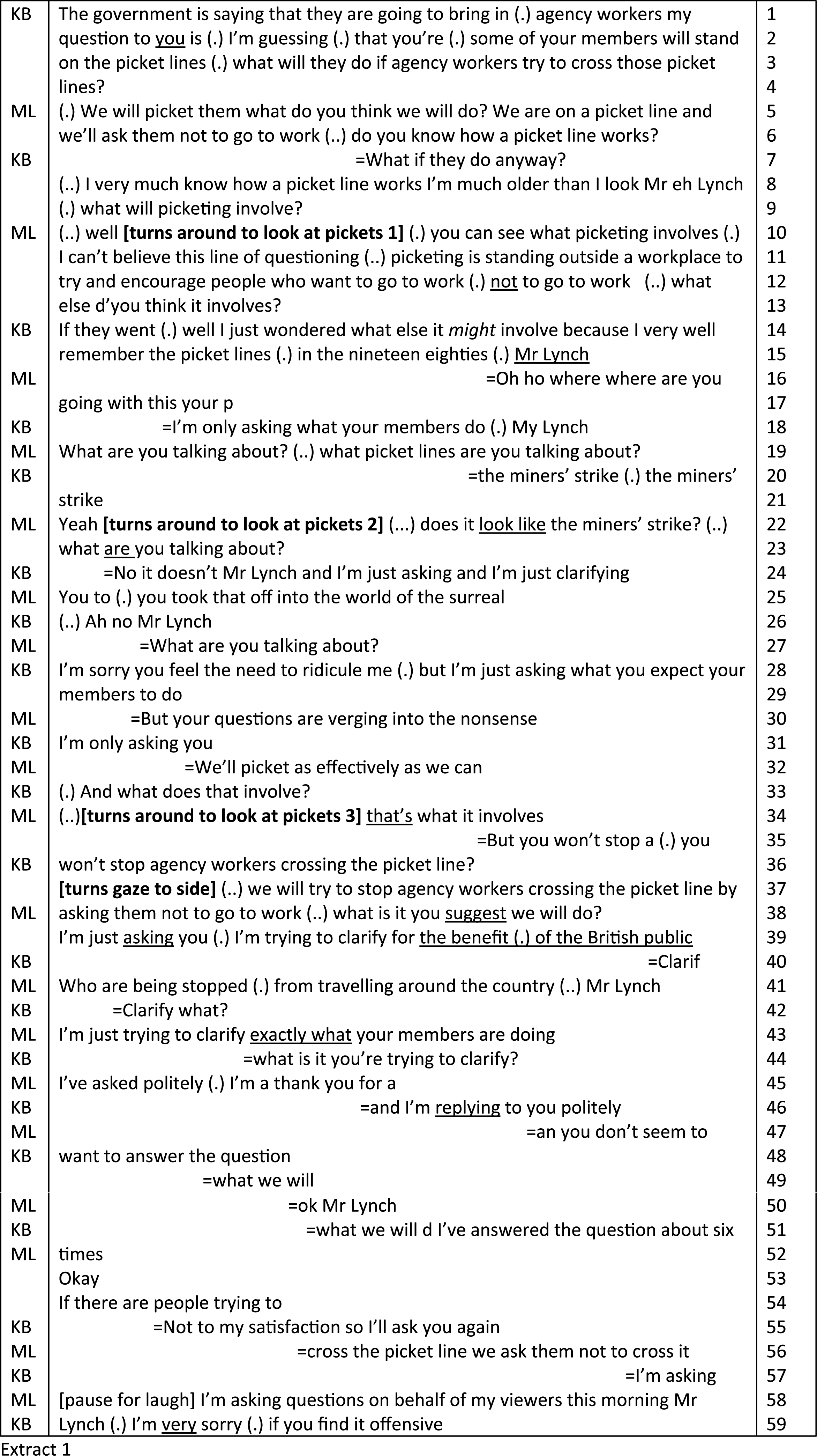
This exchange is intended as what Montgomery (2007: 148) calls an “accountability interview” in which ML is summoned to speak for the actions of his union and their consequences for passengers, with KB acting as “tribune of the people” to pursue passengers’ concerns on the public’s behalf (Clayman, 2002b). In the event, the manner of ML’s response to the questioning produced an exchange that was so newsworthy as a performative spectacle that the Daily Express coverage of the interview fell within “celebrity news” rather than economic or political content (Govan, 2022). In Glasgow’s the Herald, Harrison (2022) describes ML as “confused” by the direction of the questioning, but having “kept his cool”. The London Evening Standard called the interview a “fiery clash” (Keane, 2022), while the Mail Online (Terry, 2022) reported that ML “mocked” KB, displaying his contempt as he “chuckled and then spat” his responses. For their part, the Daily Express look to the X response of economics broadcaster Martin Lewis where, contrary to interviewer KB’s later account, he describes ML as “scarily unflustered” (Govan, 2022). In a manner that emphasises the news currency of unexpectedness, the descriptive modes – confusion, fluster, mocking – clash with the precision of expression and professional reserve appropriate to an accountability exchange.
The allure of this interview stems from its testy relationship with established conventions of accountability talk in current affairs reporting. Yet, the exchange has familiar characteristics. In asserting her standing as the “people’s tribune” (Clayman, 2002b), KB vindicates the hostile questions she puts to ML as the discharge of her journalistic obligation. This situates a series of first-person references in which KB defends her professional diligence: “I’m only asking what your members do” (line 18), I’m just clarifying (line 24). Her professional role also empowers KB to resist ML’s attempt to wrest control of the exchange with a first-person admonition and appeal “I’m sorry you feel the need to ridicule me (.) but I’m just asking” (line 28) – culminating in an explicit assertion of her public representativeness in “I’m just asking you (.) I’m trying to clarify for the benefit of the British public” (line 40). Notably, this line, underscored by KB’s subsequent claim to speak for the overhearing audience (“on behalf of my viewers this morning”, line 58) is quoted in subsequent newspaper commentary as warranting KB’s pursuit of a relentless line of questioning (Terry, 2022).
Interviewee ML also conventional tactics to rebut a hostile interrogation, by circumventing KB’s status as tribune and challenging her coherence and motivation. Indeed, while setting out a taxonomy of evasive responses in political interviews, Harris (1991: 94) also stresses the role of individual style in question response. Mustering his public renown as a pithy straight-talker, ML produces what is outwardly a form of direct speech act (“we will picket them”, line 5), which is immediately joined with a request for clarity on what might underlie the question (“what do you think we will do?”, line 5), thereby contesting the direction of KB’s questioning and her power as tribune. After KB confirming her concern lies in “what will picketing involve?” (line 9), ML’s implied and enthusiastically enacted suspicion of KB’s accompanying intentions is sustained through several turns: “where are you going with this? (lines 16-17) “what are you talking about (..) what picket lines are you talking about?” (line 19) “what are you talking about?” (line 27)
KB’s references to picketing call upon a cluster of historically constituted meanings (Wodak, 2009: 38), and it is these that ML is obliged to contest. As the exchange proceeds it becomes clear that the assumption is that picketing will involve threat or violence, which ML’s repeated formulations are dedicated to revealing and disputing. KB first offers this indirectly, implying a shared cultural memory that rehearses the details of the disputed discourse (“because I very well remember the picket lines (.) in the nineteen eighties”), before conceding the now-revealed implicature, stressed through repetition (“the miners’ strike (.) the miners’ strike”, lines 14-15; lines 20-21). This industrial dispute of the 1980s gathered sustained negative media coverage at the time and remains as emblematic of industrial disorder and violence (Hart, 2017). KB’s reference to the miners’ strike therefore presents an explicit association between picketing and lawless disorder. While obliged to respond to this historically constituted discourse, ML challenges it by temporarily subverting the convention of the interview and putting questions designed to draw out KB’s hostility to union action; a neutrality-contesting tactic associated with more renowned and confident interviewees (Greatbatch, 1998: 178). ML’s manner of engaging with the interview therefore exercises his own power over the exchange, performing bemusement and assuming the right to ask questions.
The performative turn
The response by ML to KB’s reference to the discourse of the miners’ strike transforms the interaction to one based mainly on verbal exchange to a combination of non-verbal and verbal performance. In response to KB’s repeated clarification referred to earlier (lines 20-21), ML shifts from requesting more information to a tactic of questioning KB’s assumption, beginning with “does it look like the miners’ strike” (line 22). This begins a sequence of three re-orientations of the body, momentarily disengaging ML from the verbal exchange so that he might perform a check of his surroundings (line 10, line 22, line 34; Illustration 1). In Rivers and Ross’s (2018) schema, these head turns combine illustrator and manipulator, producing a deictic movement that uses an external object as communicative sign. ML’s turn therefore serves as what Peirce (1998: 306) calls “index”; a sign that “forces attention to the object”. ML realigns his body to cite a conspicuously unthreatening picket line and cast into incredulity historically constituted associations with violence. Reorients body to look at pickets.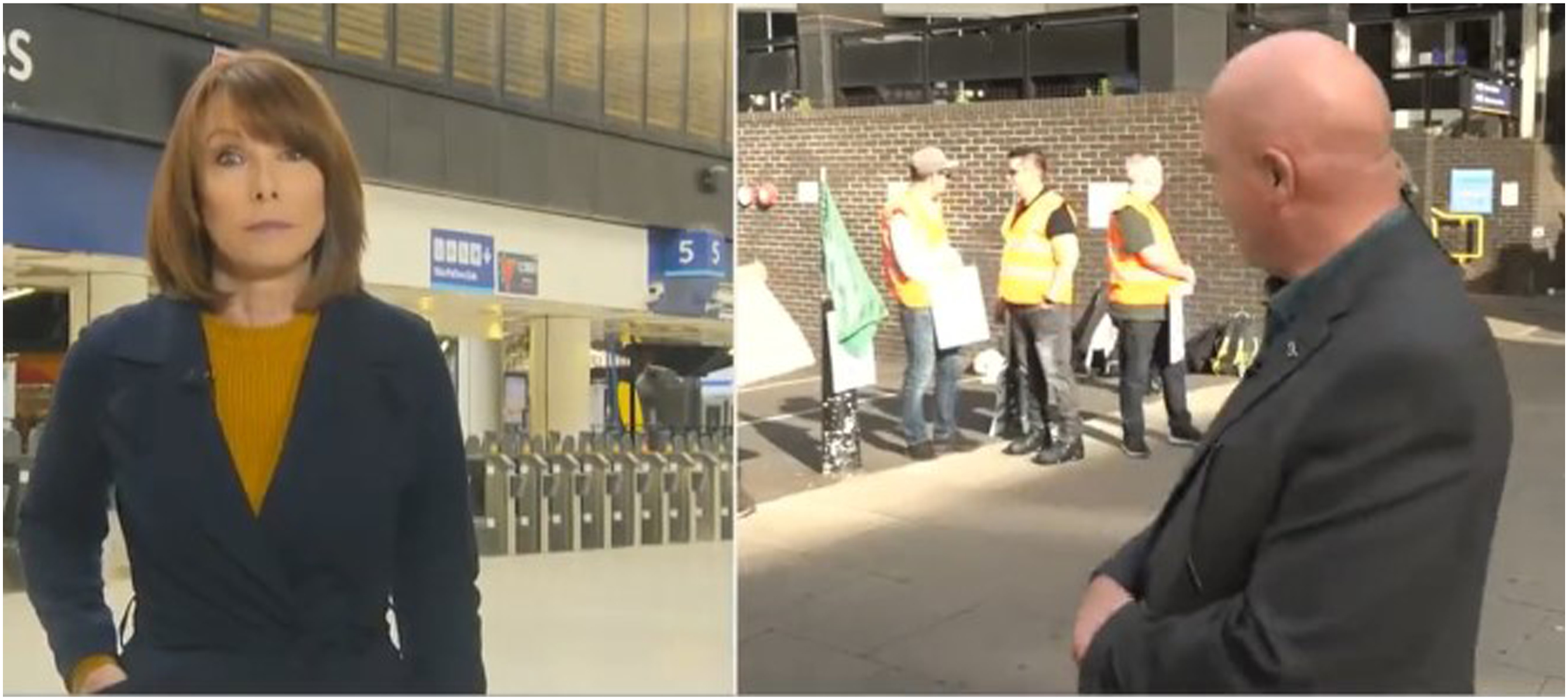
After the sequence of orientations away from the camera, ML responds to a follow up question, in which KB articulates a position for ML’s response (“you won’t stop agency workers crossing the picket line” (lines 35-36). ML’s verbal response is a contingent contradiction of the line that KB has put to him (“we will try to stop agency workers crossing the picket line”, line 37), but this is prefigured by another kinetic tactic of disengagement from the exchange, as ML enacts thoughtful reflection by breaking from the camera to direct his gaze to the side (Illustration 2). This threatens KB’s face by performing ironic bemusement at her seeming obliviousness to the purpose of a picket line. Turns gaze to side.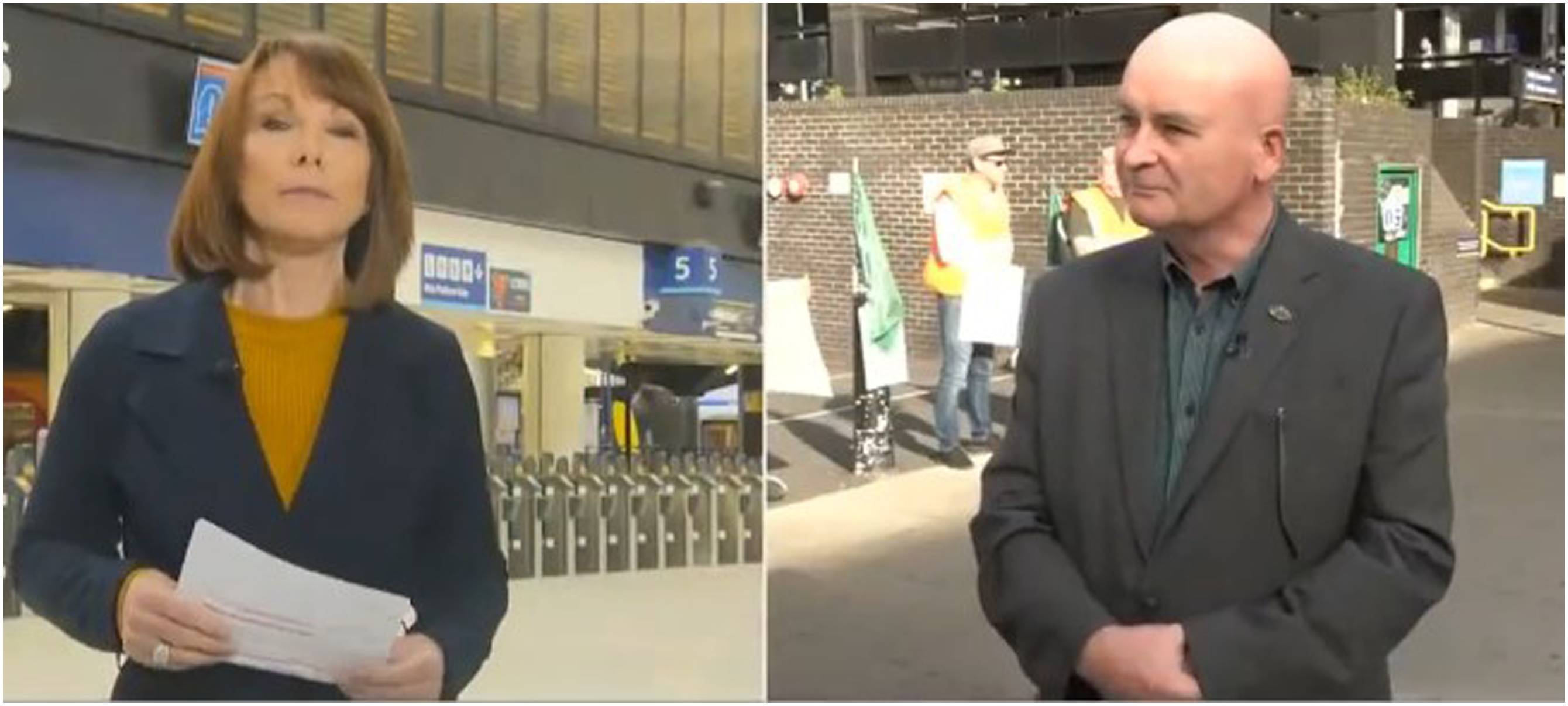
Giving fuller context to the insights available in analysing language alone (Greatbatch 1998), non-verbal language is used tactically to diminish the illocutionary force of the interviewer’s questions, and contest the discourses mobilised there. Rivers and Ross (2018: 59) point to a gathering research consensus that visual content is “more memorable to an audience” than speech content, on which basis it should be no surprise that ML’s performance attracted widespread comment (Govan 2022; Harrison 2022; Keane 2022; Terry 2022). It is clear that these embodied performances assist in avoiding answering potentially loaded questions. Specifically, we see ML enact verbal hesitancy in order to foreground what Rivers and Ross (2018: 60) describe as a non-verbal interview performance “oriented towards the aggressive actions of the interviewer” and intended to simultaneously refuse full engagement with the questions and ridicule their congruence within the live interview setting by making use of the proximity of available signs.
The discursive power of mischief: Lycett on Sunday with Laura Kuenssberg
The next extract we examine is taken from the first edition of what was marketed as a new style of politics interview and discussion show, Sunday with Laura Kuenssberg (BBC1). The programme encapsulates a hybrid format, mixing enactments of the “accountability interview” (Montgomery 2007) with a panel discussion (Clayman 2002a) deliberating on the preceding interview and the salient issues of the week. The studio arrangement reflects the distinction between the two activities, where the one-on-one interviews are conducted from facing chairs at one side of the studio, while the panel discussion takes place along a shared desk at the other side. This opening edition, from 4th September 2023, coincides with an election amongst party members for a new leader of the governing Conservative Party and Prime Minister, and the one-on-one interview immediately preceding our extract was with leading and ultimately victorious candidate Liz Truss MP.
The dynamic of the panel discussion depends upon gathering interviewees that are likely to oppose one another’s positions (Clayman 2002a). These panellists are therefore assembled to offer a diverse and critical perspective on the main story of the Conservative Leadership contest, and provide a contrast with the more conventional interview that comes before. Emily Thornberry (ET) serves as Shadow Attorney General on the Labour front bench, Cleo Watson (CW) worked as aide for both Theresa May and Boris Johnson and became critical of Johnson’s administration after leaving, and Joe Lycett (JL) is a professional comedian with a history of campaigning for left wing causes that are at odds with the policies of the Conservative interviewee Liz Truss. All are asked, to varying degrees, to draw upon personal experience and deliver subjective accounts. CW, for example, is a political novelist with experience of working with prime ministers, and JL represents those “woke” comedians said to occupy too much public discourse with their own political perspectives (which JL establishes for humorous effect on line 25 of the following transcript). While two of the panellists are associated with the parties of government and opposition, JL represents what Neveu (2022: 45-46) describes as the politically opinionated “clear-sighted outsider”.
This following extract concentrates on the first part of the discussion, which emphasises the contribution of comedian JL, and begins with studio noise caused by his off-camera clapping and whooping in response to the just-finished Truss interview:
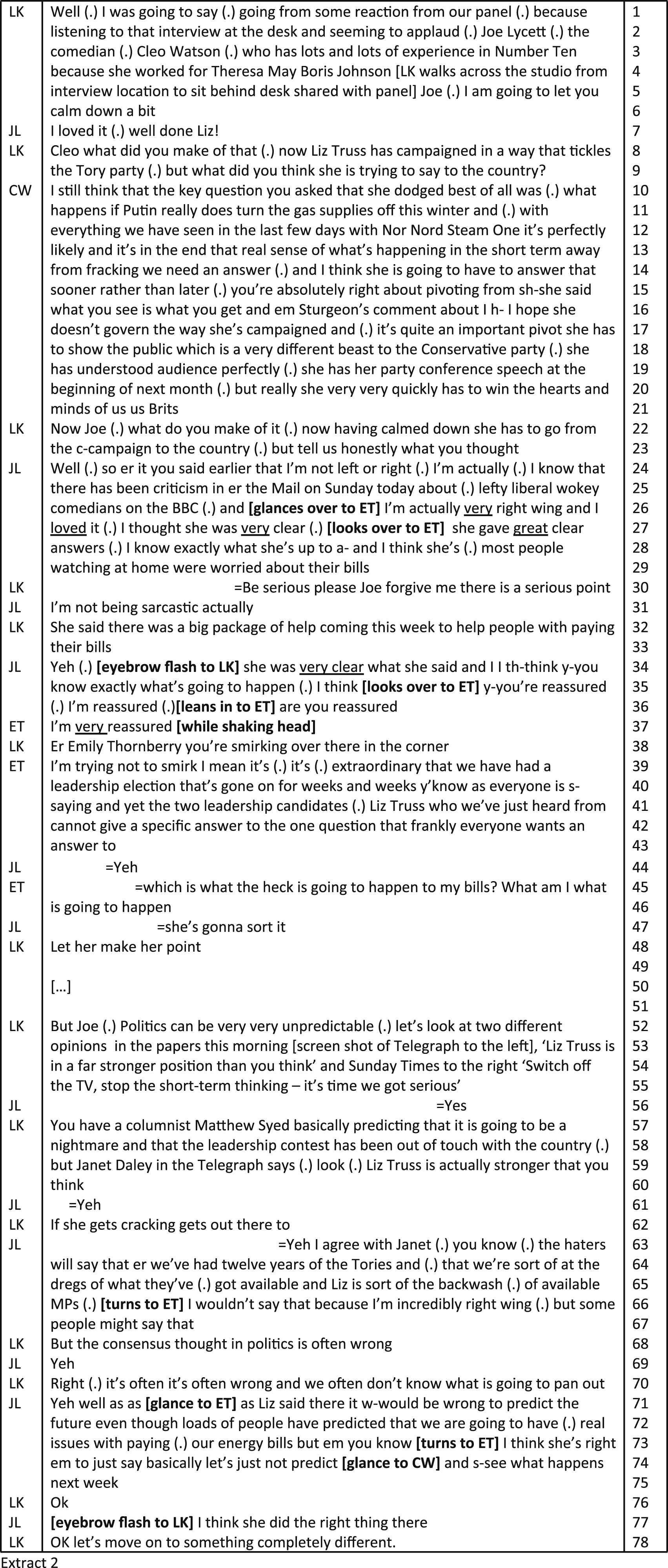
Compared with other forms of news interview and talk, the panel discussion favours a more relaxed attitude (Clayman 2002a: 1390), requiring from LK a transformation from tribune to facilitating host that is simultaneously narrated and enacted in “going from some reaction from our panel” (line 1). This includes more scope for LK to produce such non-verbal elements as facial expressions and even to offer supportive tokens and gestures (Clayman 2002a: 1388). This appropriate ease in subjectivity is accomplished by LK’s phrasing and demeanour, including the repeated question formulation “what did you make of that/it” (line 8, line 22), combining informality with the individual creative agency of “make”. In contributing to the congenial mood, these prompt what Montgomery (2007: 122) describes as “markers of propositional attitude/personal point of view” from interviewees, designed to prime responses such as “I think”.
For all that, the obligations to observe the decorousness and commitment of political talk remains in place, and LK engages a number of strategies to protect them. This begins with an indirect plea for JL to resist producing off-camera noise and act appropriately (“Joe (.) I am going to let you calm down a bit”, lines 5-6), before immediately asserting a more appropriate earnestness of expression by directing her next question to the orderly CW. Even here, LK’s question to CW invites a subjective response (“what did you think”, line 9), prompting CW to marks her contribution as an outcome of individual reflection (“I still think”, line 10). The combination of “you think” and “I … think” foregrounds the interviewee’s combination of the potentially distinct positions of “author” (the one composing or arranging the chosen words) and “principal” (the one whose viewpoint is being represented) (Clayman 1992: 165; Goffman 1981: 144). In her use and encouragement of a first person account – from speaking from “I am” (line 5) to asking what “you think” – LK sustains her position as “principle”, able to provide an example of encouraging sincerity.
Despite the manufactured congeniality, LK is obliged to exercise powers of moderation, safeguarding the pertinence and legitimacy of the discussion as political talk. As her curtailment of the initial off-camera noise by JL shows, LK has the task of limiting or stopping any mockery or indecorousness (Jenks 2022: 70). This dual obligation to facilitate and police the exchange is picked up in LK’s third turn in which she reengages JL in the discussion and modifies the elicitation of a personal point of view with a demand for genuine commitment. This includes a clause remarking on the preceding misbehaviour (“now having calmed down”, line 22), followed by the crucial entreaty for JL to engage authentically (“tell us honestly what you thought”, line 23). So it is at this early stage that LK signals her awareness that JL is engaged in a masquerade and his participation in the interview is satirical rather than frank. This call for straightforwardness produces a response from JL characterised by ironic hyperbole: Well (.) so er it you said earlier that I’m not left or right (.) I’m actually (.) I know that there has been criticism in er the Mail on Sunday today about (.) lefty liberal wokey comedians on the BBC (.) and I’m actually very right wing and I loved it (. ) I thought she was very clear (.) she gave great clear answers (.) I know exactly what she’s up to a- and I think she’s (.) most people watching at home were worried about their bills (lines 24-29).
Over this turn, we see JL set forth a personal account that outwardly contravenes his established political reputation and presumably the rationale for his appearance. He offers an unconditional expression of faith in Truss’s clarity, repeated for rhetorical emphasis (“I thought she was VERY clear (.) she gave great clear answers”, lines 27-28). The irony of this is indicated in the overamplification of his uncritical enthusiasm stressing the adverbs “very”, along with “exactly” and “great”, ensuring that any mistaken interpretation of positive alignment is likely to be overridden by the conspicuously sarcastic iteratio. The success of this conceit is conditional upon JL producing a satisfactory performance in “keying”; signalling that a potentially conventional activity is “something quite else” (Goffman 1974: 44). In displaying overt exaggeration, this decorative response “keys” a particular interpretation, “giving it sarcastic or ironic implications” (Goffman, 1981: 197). As though to labour the point, the extract also rehearses the setup for JL’s mock-persona: the right-wing media’s criticism of the BBC for favouring left-leaning “wokey” comedians. The issue of balance in the BBC, as a publicly-funded broadcaster is more usually directed at journalistic reporting (Higgins and Smith, 2011). However, both political comedy and the popularisation of political discussion programmes, by including comedians and satirists, has widened the scope of such criticism and provided JL with a basis for his performance.
While ironic overstatement is one way in which JL maintains professional face as a comedian and keys his engagement in a charade, he uses other disruptive tactics to cast his performance as absurd. One comes to the fore when LK produces a series of attempts to provoke an expanded response from JL by producing rhetorical questions that she assumes JL will contest. To this, JL defies his rhetorical obligations and produces a sequence of informal markers of agreement, the first prefiguring the mocking description discussed above: Yeh (.) she was Yeh (line 44) She’s gonna sort it (line 47) Yes (line 56) Yeh (line 61) Yeh I agree with Janet (line 63) Yeh (line 69) Yeh well (line 71).
Added to the refusal to produce the generically-conventional critical response (line 34) or to yield the floor (line 44), JL’s performance contravenes the norm that, allied with their sincerity, panellists will be expansive in their contributions. While the series of short positive responses make a superficial claim to spontaneity, they breach the norms of the format where guests are expected to compete to dominate the floor to deliver lengthy and opinionated turns. Accordingly, in balancing facework in a competitive panel discussion, an affirmative token and concession (“yes”) would ordinarily give way to a contradictory statement (“yes, but…”). In producing unqualified tokens of support in a context in which his performance is read as ironic, this seeming submission to the host derides her adversarial power, and provokes LK to continue to elaborate the basis of her questioning (line 57).
In context, though, it also becomes clear that these short responses are also used to reaffirm JL’s ironic subject position in preparation for a prolonged contribution: the haters will say that er we’ve had twelve years of the Tories and (.) that we’re sort of at the dregs of what they’ve (.) got available and Liz is sort of the backwash (.) of available MPs (.) I wouldn’t say that because I’m incredibly right wing (.) but some people might say that (lines 63-67).
This rehearses a point of view under a pretence of condemnation – the technique of “apophasis” (Lanham 1991: 191) – attributed, in mock disapproval, to “the haters” of Truss. The comedy of this, again using elaborate phrasings to key a satirical voice, rests on the relish given to negatively-charged metaphors from waste management, “the dregs” and a “backwash” candidate. This comedic rehearsal of the “opposing” view is repeated in the next extended turn, “as Liz said there it w-would be wrong to predict the future even though loads of people have predicted that we are going to have (.) real issues with paying (.) our energy bills” (lines 71-73), where the creative use of the idiom “loads of…” and amplifying informal adverb in “real issues” lend vitality to the views of those rhetorically positioned as hating naysayers.
The eyes have it: Subversive non-verbal performance
Extract 2 also shows an extended sequence of performed non-verbal cues. The most sustained of these is a series of glances to ET, each time to prefigure a statement conspicuously at odds with JL’s publicly-known views (“I’m actually very right wing” line 26, “she gave great clear answers” line 27), and culminating in a reformulation of the already-hyperbolic “I’m incredibly right wing” (line 66). As an opposition MP and office holder, glance-recipient ET is poorly placed to respond positively to the first two of these cues for emotional support (line 26, line 27), until a third cue in which JL emphasises the ironic intent (line 36). Even at this, ET underscores the cooperative sarcasm of her response with a non-verbal reparatory gesture, using the head shake discussed below. This sequence then culminates with JL broadening his distribution of glances while saying of Truss “I think she’s right em to just say basically let’s just not predict” (lines 73-74), turning twice to engage the support of ET and producing a further glance towards panellist CW. Even if CW were to be in genuine accord with the positions being lampooned, the irony of JL’s non-verbal pleas recruits both fellow panellists as supporting cast in a disruptive play.
However, the turn in which the scope of JL’s kinetic performance dominates is when he assures host LK of his satisfaction with Truss’s message and vision: Yeh (.)
In this turn, JL begins with an eyebrow flash to LK (Illustration 3) – an “emblem” taken to display openness: as Montgomery and Shen (2017: 35) say, “adding emphasis” while “foregrounding interpersonal contact” in news media performance. This is a gesture and expressive tactic that JL directs again towards the host as the interview draws to a close, burnishing the start of “I think she did the right thing there” (line 77). In keeping with the expectations of Montgomery and Shen (2017), these eyebrow flashes are produced at crucial points, to underpin reassertions of the founding conceit of JL’s performance: the comfort he takes from the earlier accountability interview between LK and Truss. Eyebrow flash to LK.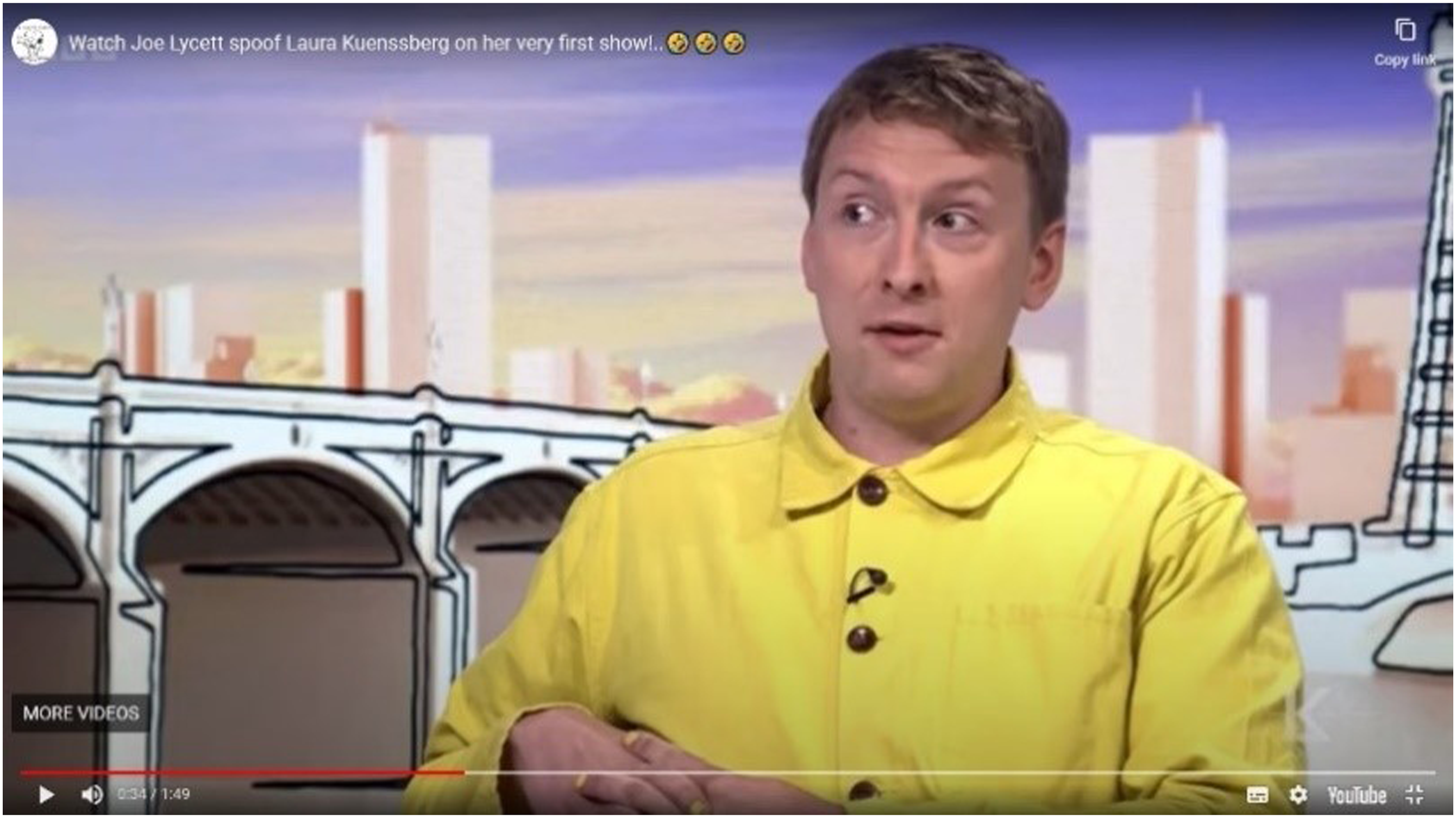
The gesture that follows this then further intensifies the role of ET in the performance. JL produces a reorientation of the body towards ET and leans towards her, escalating the marker of sincerity to one of personal intimacy (“are you reassured?”, line 36). As noted above, JL’s question prompts a mock-agreement from ET, “I’m very reassured” (line 37) contradicted by a shake of the head. Importantly, however, this lean towards ET enacts a therapeutic rather than political discussion frame (Illustration 4). JL steals the discursive power and responsibility of the host LK, by over-performing his affiliative responsibility to the group (Hernández-Flores 2008: 702) and enacting a pretence of concern for ET’s personal well-being. Lean towards ET.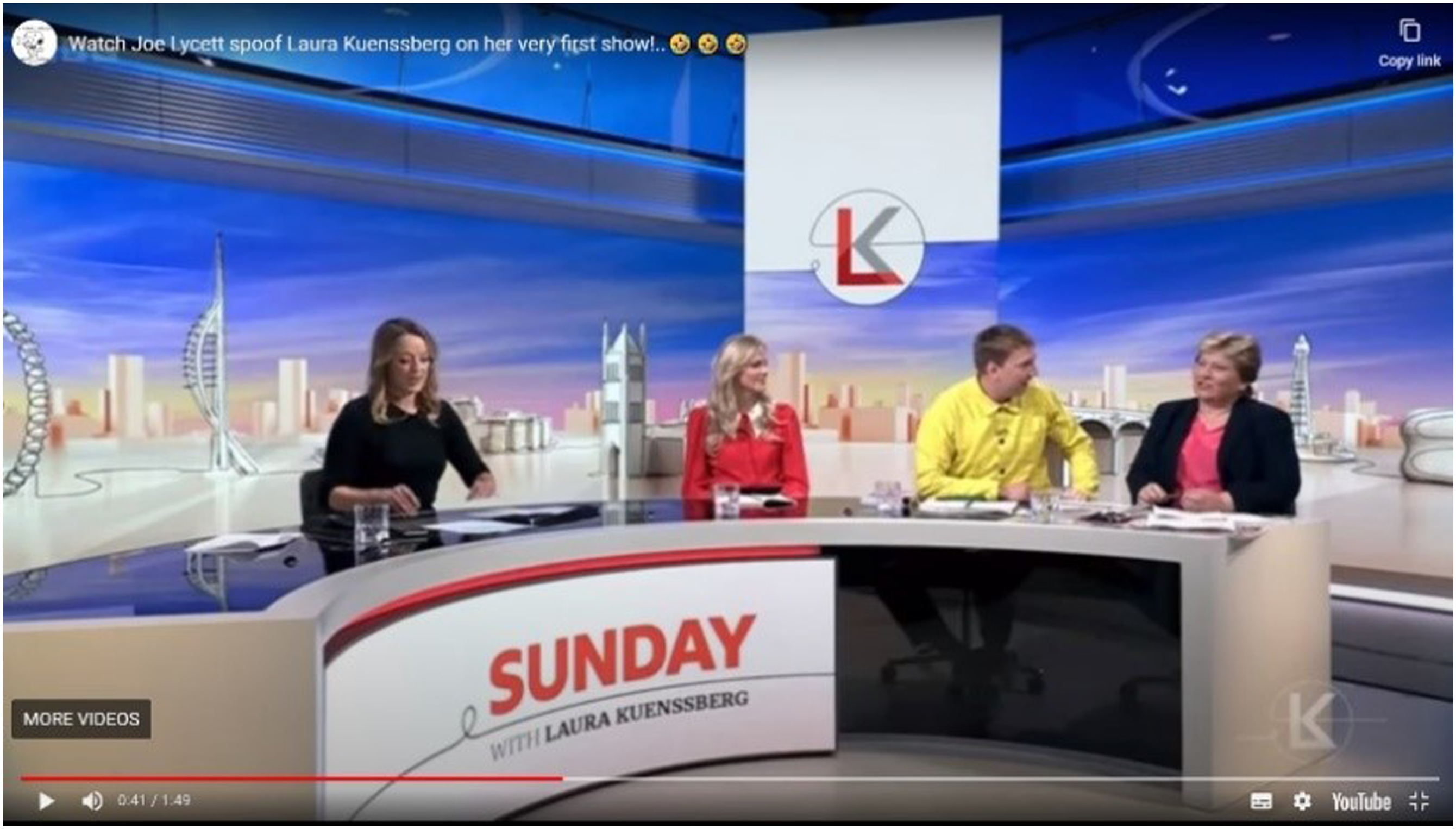
In terms of the interview arrangement, and in seizing power from the host, this is a significant breach of the format. Indeed, LK is obliged to emphasise that JL and ET are engaged in a masquerade by the use of “smirk” as indicating “non-serious or even comical” intent (Jenks 2022: 64) and emphasising JL’s lack of seriousness: “Er Emily Thornberry you’re smirking over there in the corner” (line 38), to which ET pleads commitment to the earnestness the format demands in “I’m trying not to smirk” (line 39).
While Clayman (2002a: 1399) acknowledges the loosening of interviewer responsibility in the panel discussion, what remains in place, and JL challenges here, is the host’s sole right to direct questions, invite turns and guide discussion towards guests. Discursive power over the interview is contested by JL sustaining a caricatured position for satiric effect, with LK seeking to reassert acceptable conditions of sincerity and emphasise her obligation to contain JL’s disruptive conduct. Significantly too, this performance by JL, assumes a political subjectivity that enables the satirising of opposing views, which extended beyond this immediate exchange to the media commentary and public discourse to follow. Indeed, JL sustained his performance of right-wing supporter on X for several weeks afterwards, including scoring Truss’s subsequent government performance at ten out of ten (Illustration 5) and sustaining a performance of support Truss and her policies designed to cast them into ridicule (Burrell 2022). Example of JL’s X account feed.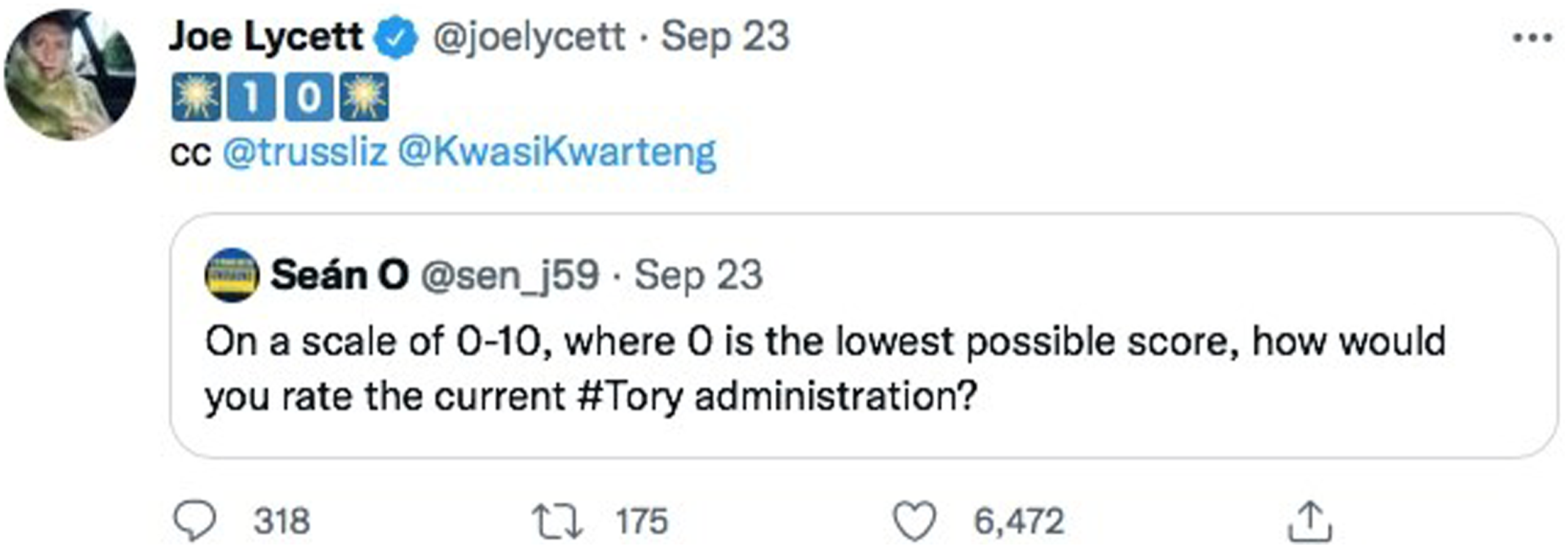
Conclusion
It has become apparent that, in Hutchby’s (2017: 103) words, the very notion of the political interview “needs to be understood in a more variegated way”. However, we argue this extends beyond the categorisation and conventional dynamics of the interview to the possibilities of effective performance and engagement within these evolving interview forms. Specifically, it is apparent that performance and non-conventional engagement play a significant role in the development of the contemporary political news interview and the tactics deployed there. The extent of this is best revealed by the application of a discourse historical analysis to media talk and embodied practice, which can reveal how the exploitation of shared political and cultural knowledge extends into types of media performance. However, needed are a more diverse tools of analysis that help us see how performance and gesture can disrupt and challenge the interview’s claims to legitimacy, including a focus on non-verbal performance and its full range of associations.
More importantly, though, the continued hybridisation of the interview with popular cultural forms can produce performative repertoires that contest the efficacy of political discussion itself, in its dependence upon truth and commitment. First, these hybrid modes of performance can offer another means of challenging the neutralism of the interview arrangement, as we see in the accountability interview. Second and even more, the panel discussion allows an ironic reversal of the participant roles upon which neutralism depends. What we see are modes of performance that include the potential to contest media conventions and expectations of behaviour, foregrounding satire and irreverence.
A more nuanced understanding of news and current affairs needs to take full account of the range and implications of hybridisation on journalism talk. This ought to reflect upon the roles and powers associated with diverse voices, in particular those able to utilise alternative forms of visibility and engage creative media discursive practices. With these alternative subject positions, comes a variety of performative capabilities and manners of using truth and information. This is not just a concern for analysts, but also those charged with the management of news interviews and their policy, who need to account for and be ready to contest forms of subjectivity and truth-telling that challenge conventional journalism practice.
Such challenges to journalistic form by performative disruption also have implications for journalism’s prospects of holding political actors to account. This is of particular pertinence in circumstances in which a populist political grammar is in the ascendancy. In terms of their contribution to the tenor or public discourse, the examples we look at above may be said to exploit a populist suspicion of media authority and so contribute to a political environment of post-truth and political cynicism. We therefore need vigilance against the dangers that performative mischief presents for public discourse, and our tools of analysis should sustain a critical rather than celebratory mode.
Footnotes
Declaration of conflicting interests
The author(s) declared no potential conflicts of interest with respect to the research, authorship, and/or publication of this article.
Funding
The author(s) received no financial support for the research, authorship, and/or publication of this article.
