




Abstract
Previous research suggests that a defining characteristic of satirical news shows (e.g. The Daily Show) is discursive integration: a creative blend of genre conventions of regular news and fiction. This study aimed to extend the concept of discursive integration to another popular form of satirical news: written satirical news. We focused on both liberal (e.g. The Onion) and conservative (e.g. The Babylon Bee) online outlets of satire. We collected texts published in 2018 by a total of 36 satirical news, regular news and fiction websites (65,530,647 words). Discursive integration was measured by means of linguistic register, because genres can be effectively identified through patterns of linguistic features. Four linguistic register dimensions were identified. Findings showed that written satirical news is indeed characterised by discursive integration because written satirical news’ register scored in between the registers of written regular news and written fiction. No differences in discursive integration levels were found between liberal and conservative satirical news. This study demonstrates the value of discursive integration for understanding the genre of satirical news across partisan lines.
Satirical news is an important alternative source of information about current affairs for many individuals (Brewer and McKnight, 2017). Exposure to satirical news has been shown to have informative and persuasive effects (Becker and Waisanen, 2013), which is why we need to understand satirical news’ characteristics. Much research has therefore focused on identifying which characteristics set satirical news apart from regular news (see Becker and Waisanen, 2013, for an overview). Most of these studies examined audiovisual satirical news in the form of television shows such as The Daily Show, Saturday Night Live and Last Week Tonight. Such studies have for instance found that satirical news shows are equally likely to present substantive information about issues and actors as regular news shows (Fox et al., 2007), but that they are more likely to criticise traditional news media (Wise and Brewer, 2010) and frame issues in a more emotional, negative and exaggerated way (Koivukoski and Ödmark, 2020).
One way to better understand satirical news is to study discursive integration (Baym, 2005). The discursive integration hypothesis states that satirical news shows have integrated genre conventions of regular news and fiction to such an extent that the boundaries between these integrated genres in satirical news have become inseparable (Baym, 2005: 262). Some scholars have proposed that discursive integration could also be a defining characteristic of another popular form of satirical news: written satirical news that is published by websites such as The Onion (e.g. Berkowitz and Schwartz, 2016; Waisanen, 2011). However, more work needs to be done to identify the defining features of written satirical news to improve our understanding of the characteristics of online satirical news articles (Becker and Waisanen, 2013). Therefore, the current study aims to quantitatively test whether and how discursive integration can also be observed in written satirical news.
Another reason why this study focuses on satirical news articles is that, at least in the United States, audiovisual and written satirical news differ in terms of audience characteristics. American satirical news shows are almost exclusively of a liberal origin (Becker and Waisanen, 2013; Young, 2019). Possible explanations include that most American comedians identify as liberal and that many conservative comedians believe that the American entertainment industry favours liberal, over conservative comedians (Dagnes, 2012). Although conservative satirical news shows are scarce compared to liberal ones, 1 liberal and conservative satire have been juxtaposed in the literature. According to Young (2019), liberal satirical news shows for instance contain more irony, implied humour and playfulness than conservative satirical news shows.
Like satirical news shows, the most popular online outlets of written satirical news (e.g. The Onion, The Borowitz Report; Faris et al., 2017) target a liberal audience, but there are certainly conservative alternatives (e.g. The Babylon Bee, Clickhole’s Resistance Hole). These conservative satire outlets have hardly received scholarly attention, perhaps because they are less known to the general public than their liberal counterparts (Young, 2019). Written satirical news therefore makes a good case to test whether liberal and conservative satirical news differ in discursive integration. Thus, the objective of this study is twofold: (1) to analyse discursive integration (Baym, 2005) in written satirical news, and (2) to compare discursive integration levels between liberal and conservative satirical news articles. Hereby, this study advances our knowledge of satirical news as a genre across partisan lines.
Discursive integration in written satirical news
The concept of discursive integration (Baym, 2005) was first used to explain the innovativeness of The Daily Show as the quintessential satirical news show of that time. Baym (2005) considered The Daily Show to be an ‘experiment in journalism’ because the show contained serious news reporting and, through humour, simultaneously violated journalistic standards (p. 273). The show mocked news issues and production using elements from regular news shows such as by adopting the news-desk setting and by presenting soundbites (Baym, 2005). This was combined with elements from fiction shows, because cast members played the role of ‘real’ journalists to convey their satirical opinions on topics in an entertaining way (Baym, 2005). Even though the concept of discursive integration was developed in the context of The Daily Show, discursive integration has turned into a concept that is more generally used to describe the innovativeness of satirical news shows (e.g. Feldman, 2017; Holbert et al., 2007).
A natural question that follows is whether discursive integration also applies to written satirical news. Various scholars have proposed that written satirical news articles are characterised by a blend of serious news reporting and role playing (e.g. Berkowitz and Schwartz, 2016; Stevens and McIntyre, 2019; Waisanen, 2011). Like audiovisual satirical news, the structure and delivery of satirical news articles are imitated from regular news, thereby giving the impression they represent mainstream journalism (Berkowitz and Schwartz, 2016; Peifer and Myrick, forthcoming). Elements adopted from regular news articles include a journalistic writing style, use of headlines and bylines, relevant visuals and accounts of eyewitnesses to the happening event (Waisanen, 2011). In addition, satirical news articles integrate elements from fiction genres by humorously deviating from reality through imagination-based storytelling (Skalicky, 2018; Stevens and McIntyre, 2019). Just like hosts of satirical news shows, writers of satirical news articles pretend to be ‘real’ journalists to both entertain and possibly convince audiences of their views. Discursive integration thus seems to be equally fundamental to written satirical news as it is to satirical news shows.
In order to identify whether and how regular news and fiction genres are discursively integrated in written satirical news, we propose to study linguistic register, defined as patterns of co-occurring linguistic features of collections of texts (Scarcella, 2003). Here, genres of regular news can be defined as collections of journalistic communications about recent events of public interest (e.g. van Leeuwen, 2005) and genres of fiction (e.g. political fiction, romance, mystery) as collections of written or spoken narratives about imaginary people and/or events (e.g. Rimmon-Kenan, 2003). Genres can be defined as discourse types that are characterised by specific formal properties, structure and communicative functions (Scarcella, 2003). Genres are marked by specific linguistic registers because registers reflect the communicative functions of genres (Biber, 2014; Scarcella, 2003).
For instance, previous studies have revealed that news reporting scores higher than academic prose on reported speech, as shown by the use of more public verbs (e.g. explains, argues) and more suasive verbs (e.g. decides, proposes; Xiao, 2009). A plausible explanation for this difference is that describing the ‘Who said what?’ is a more important function of news reporting than it is of academic prose. News reporting, however, scores lower than academic papers on informational elaboration, as demonstrated by the use of more demonstrative pronouns (e.g. That looks like) and more that complements (e.g. She said that she; Louwerse et al., 2004). This is the case because scientists generally have more time and print space than journalists to explain statements. We can thus differentiate between genres by examining the degree to which genres are characterised by different patterns of co-occurring linguistic features.
With regard to discursive integration, this means that we find evidence for the presence of discursive integration in satirical news when satirical news has a linguistic register that reflects a combination of the registers that belong to the regular news and fiction genres. An examination of linguistic register should thus reveal how salient features of the regular news and fiction registers have been synthesised in satirical news. We therefore hypothesised:
H1: Written satirical news scores in between written regular news and written fiction in terms of linguistic register.
Liberal versus conservative satirical news
A second question this study addressed, is whether liberal and conservative satirical news articles differ in their levels of discursive integration. Argumentation for why this may be the case is given in the book ‘Irony and Outrage’ (Young, 2019) which presents an analysis of the differences in nature between liberal and conservative satire shows, and their audiences. In this book, Young focuses on hypothesising why satirical programming is more popular among liberals, while outrage programming (e.g. Tucker Carlson Tonight, Hannity; Sobieraj and Berry, 2011) is more popular among conservatives. This hypothesis is twofold: liberal satire and conservative outrage (1) fulfill similar functions for their audiences such as promoting certain opinions and providing alternative sources of information, and (2) they appeal to liberals’ and conservatives’ differential preferences for ambiguity and certainty, respectively. Certainty is a key characteristic of outrage programming because such shows generally provide clear and explicit views on current affairs (Sobieraj and Berry, 2011). By contrast, satire shows draw attention to ambiguity for a humorous effect.
There is already extensive literature linking the psychological profiles of liberals and conservatives to the type of art and media content they consume. Compared to conservatives, liberals have shown a greater appreciation of ambiguous media such as abstract paintings (Wilson et al., 1973), complex poems (Gillies and Campbell, 1985), unconventional music (Rentfrow and Gosling, 2003), nonsensical humour (Wilson, 1990) and unpredictable storylines in television series (Rogers, 2018). Previous research has also shown that certain forms of humour that characterise satirical news (e.g. irony, hyperbole; Young et al., 2019) appeal more to liberals than conservatives, and that this is similarly the case for counter-attitudinal satirical content (Knobloch-Westerwick and Lavis, 2017). Seeing that liberals have been found to be more open to ambiguity than conservatives (Jost et al., 2003), this may explain why satirical news is more often consumed by a liberal than a conservative audience (Young, 2019).
Occasionally, liberals and conservatives produce and consume shows that play against type in the form of liberal outrage shows and conservative satire shows. According to Young (2019), the characteristics of these shows support the hypothesis that psychologically-driven differences in media preferences between liberals and conservatives are deeply rooted, because she found in an analysis of such shows that liberal outrage ‘can’t escape the comedy’ (p. 232) and conservative satire ‘can’t escape the outrage’ (p. 234). With regard to conservative satire specifically, shows often seems to lack the humorous incongruities and therefore ambiguity in political stance that characterises liberal satire shows (Young, 2019).
Other research, however, challenges the hypothesis that there is an important difference between liberal and conservative satirical news in terms of ambiguous nature. Several studies have demonstrated that psychological differences between liberal and conservatives may actually be exaggerations (e.g. Bakker et al., 2020; Frimer et al., 2013; Ludeke et al., 2016), because observed differences are often statistically very small (e.g. Frimer et al., 2013; Schein and Gray, 2015) and difficult to replicate (e.g. Bakker et al., 2020). Moreover, previous research suggests that observed differences can be attributed to self-report bias in two ways (e.g. Graham et al., 2012; Ludeke et al., 2016; Scherer et al., 2015). First, respondents have been found to have a tendency to answer self-reports based on their perceptions of trait desirability of their political ingroup (Ludeke et al., 2016), meaning that their answers could overstate good qualities of their ingroup. Second, self-reports can also be influenced by respondents’ stereotypical perceptions of the traits of the political outgroup (Graham et al., 2012; Scherer et al., 2015), such that their answers potentially overstate an outgroup’s bad qualities.
In this paper, we therefore test the hypothesis that liberal satirical news is more ambiguous than conservative satirical news (Young, 2019) by comparing their levels of discursive integration. One important source of ambiguity in satirical news can be discursive integration because the more extensively regular news and fiction genres are discursively integrated in satirical news, the more the discourse acts of reporting facts and telling fictional stories blend together (Baym, 2005). These blurred lines between discourse conventions are an important reason for ambiguous satirical content, which we should see reflected in linguistic register. The study of language has been shown in previous research to be a valuable approach for political communication and journalism research because liberals and conservatives differ in their language use (Roberts and Utych, 2020; Schoonvelde et al., 2019; Sylwester and Purver, 2015). For instance, liberals have generally been found to use more emotionally expressive language (Sylwester and Purver, 2015), more complex language (Schoonvelde et al., 2019) and less masculine language (Roberts and Utych, 2020) than conservatives. This study builds on this existing research by examining linguistic register as a proxy of discursive integration in satirical news. We accordingly hypothesised:
H2: Liberal satirical news scores in between regular news and fiction on more register dimensions than conservative satirical news.
Methods
Data collection
Linguistic register was analysed using the multidimensional-analysis (MDA) method developed by Biber (1988). This approach to identifying register dimensions has been extensively applied in studies on linguistic register (see Biber, 2014, for an overview). The first step of MDA is selecting the collections of texts to include in the analysis. Because previous research has shown that styles of news reporting can differ across time (Esser and Umbricht, 2014), topics (Semetko and Valkenburg, 2000) and countries (van Dalen et al., 2012), we only included texts that were published in 1 year, in one country, and on one news theme to ensure comparability. Specifically, we included texts that were published (1) in the calendar year of 2018 to present contemporary evidence, (2) in the United States as a country with a clear left-right divide (Davis and Dunaway, 2016) and (3) on politics because satirical news is often considered an alternative form of political journalism (Baym, 2005).
To collect the texts, we selected several websites for each of the three genre categories of interest: satirical news, regular news and fiction. Since satirical news websites publish considerably fewer articles than regular news websites, we selected as many satirical news websites as possible to build a large corpus for the register comparison. We consulted their ‘About’ pages to determine political leaning. Satirical news websites that published too few relevant articles (i.e. less than once every two weeks) were excluded from analysis. Furthermore, satirical news websites that had a too narrow focus for the purpose of this study were also excluded. These included Duffel Blog about army news, The Mideast Beast about Middle East news and Reductress about feminist news. Eventually, eleven liberal and five conservative satirical-news websites were selected (see Table 1).
Dimension means and standard deviations per website and per genre category.
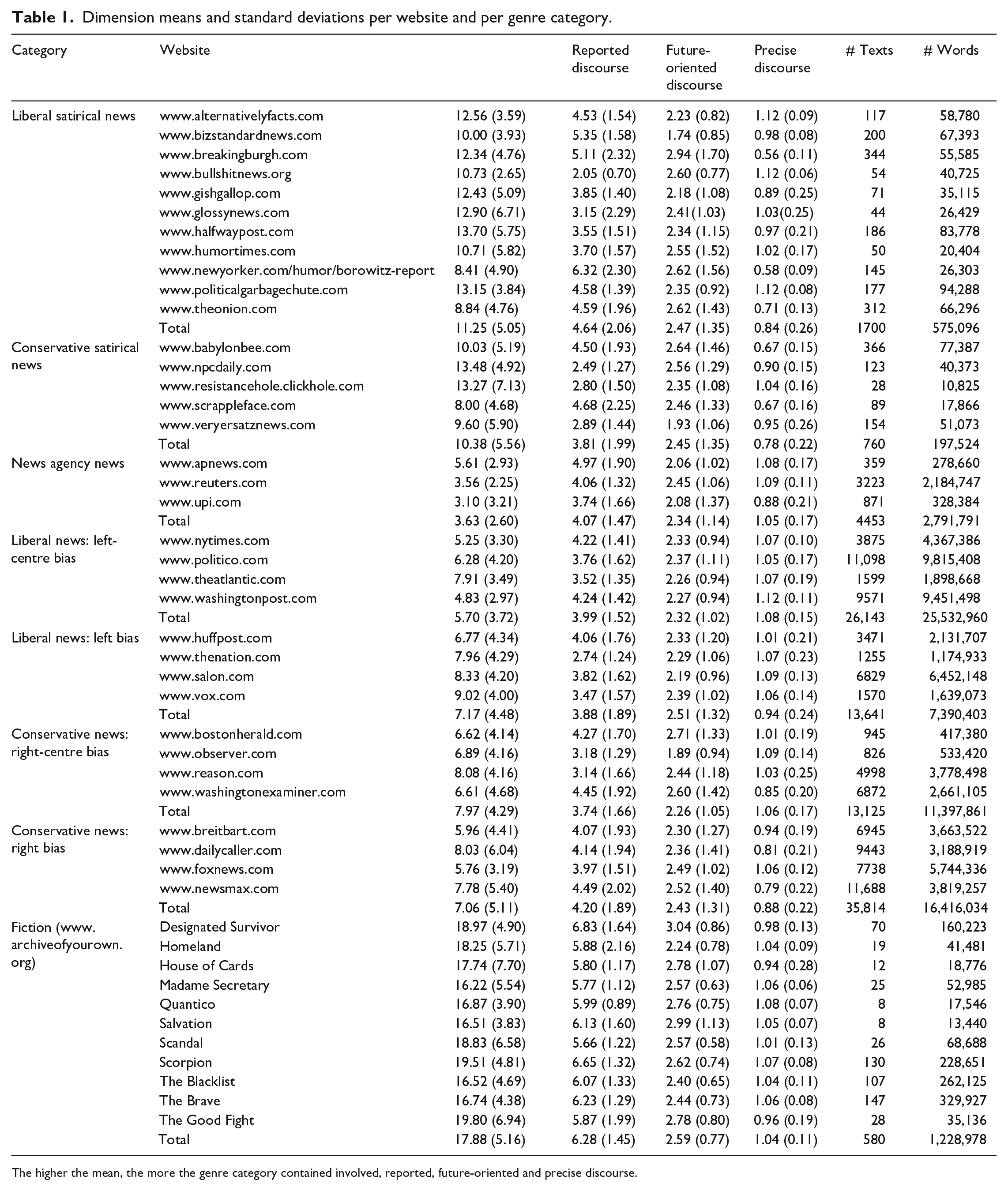
The higher the mean, the more the genre category contained involved, reported, future-oriented and precise discourse.
With regard to regular news, we distinguished between websites with different news biases to allow for the comparison between liberal and conservative regular news. Websites were selected for a specific news category when at least two out of three of the following sources gave a similar classification: (1) a Harvard study by Faris et al. (2017), in which classifications of news websites were based on both a content analysis and network analysis of social media news sharing, (2) fact checking website Media Bias Fact Check (http://www.mediabiasfactcheck.com) which uses manual coding to classify websites and (3) website All Sides (www.allsides.com) that presents ratings based on blind surveys results. We first selected the three largest news agencies (i.e. Associated Press, Reuters and United Press International) to represent the least-biased news category. We next selected four websites per news media bias category: left-centre biased news (e.g. Washington Post), left biased news (e.g. Huffington Post), right-centre biased news (e.g. Washington Examiner) and right biased news (e.g. Breitbart, see Table 1).
With regard to the fiction category, texts needed to meet two criteria to ensure comparability with the online satirical news and regular news texts. First, just like the satirical and regular news articles, the fiction texts needed to be about the topic of politics. Linguistic register is also known to differ between fiction genres that focus on different topics such as romance and mystery fiction (Biber, 1988). Second, because there are many modality-driven differences between print and online news in terms of content and form (Neijens and Voorveld, 2018), we wanted the fiction texts to be written for online reading just like the satirical and regular news articles. Consequently, we excluded books as important works of fiction to prevent modality from being a potential confound. We instead selected fan fiction because this is a popular form of online fiction that, although it is not written by professional writers, adopts the conventions of the original works of fiction as accurately as possible to conform to community expectations (Herbig and Herrmann, 2016; Stein and Busse, 2009). We selected a prominent open source repository for fan fiction, Archive of Your Own (www.archiveofourown.org), to collect the texts. We collected stories about political-fiction television shows (e.g. Designated Survivor, House of Cards, Madam Secretary) that were published in English in 2018 under the tag ‘none of the warnings apply’, which excluded erotic and excessively violent stories (see Table 1).
To collect the texts from these websites, we used - when possible - web scraping by means of the rvest package (version 0.3.5; Wickham, 2019) for R (version: 3.5.2). Texts from The New York Times (www.nytimes.com), POLITICO (www.politico.com) and The Washington Post (www.washingtonpost.com) were collected using the online news database NexisUni (available at: www.lexisnexis.com). We prepared the texts for analysis by removing html code as well as article information such as author names and publication dates. Our final corpus consisted of 96,216 texts from 36 websites. The total word count was 65,530,647.
Register dimensions
The second step in MDA (Biber, 1988) consisted of tagging the texts for the presence of a predetermined list of linguistic features. We used the Multidimensional Analysis (MAT) tagger (Nini, 2015) which tags texts for all 67 linguistic features used in Biber’s (1988) seminal work by means of the Stanford tagger for American English. Following MDA (Biber, 1988), frequency counts were normalised to a text length of 100 words and standardised.
The third step in MDA (Biber, 1988) was to identify register dimensions using factor analysis. In line with recommendations by Morrison (2009), we used principal axis factoring with a promax rotation. A scree-test indicated that the optimal number of factors was four (Cattell, 1966), as shown in online Appendix A (available at Open Science Framework: https://osf.io/mk48u/). Next, following MDA (Biber, 1988), we calculated the register scores per dimension by summing the standardised frequency counts of features that loaded positively. This sum was subtracted by the sum of standardised frequency counts of features that loaded negatively on the specific dimension. Linguistic features were included in the score of the dimension on which they had the highest loading, except when (1) their loading did not exceed the threshold of 0.3 and (2) they loaded on two dimensions with a difference of less than 0.1.
The final step in MDA (Biber, 1988) consists of interpreting the identified dimensions. We labelled the first dimension ‘involved versus informational discourse’ after Biber’s (1988) original dimension ‘involved versus informational production’. This dimension referred to the degree in which discourse is characterised by personal involvement or, instead, by more distant communication. Linguistic features that signalled personal involvement were, for instance, first and second person pronouns (e.g. me, myself, you), present-tense verbs (e.g. he believes, she thinks) and demonstrative pronouns (e.g. that looks like). The combination of these features indicated personal involvement: a focus on the present and on direct contact between conversation partners (Biber, 1988). The most important feature that signalled distant communication was word length. The longer words are, the more likely they carry the meaning of a sentence (Miller et al., 1958). For this reason, using longer words is an efficient and informative way of communicating information about a more distant issue.
The other three dimensions represented patterns of register variation that were specific to the genres in the current study. We labelled the second dimension ‘reported discourse’ because, among others, this dimension was characterised by the use of public verbs (e.g. comments, explains, argues), past-tense verbs (e.g. he believed, she assumed) and third-person pronouns (e.g. she, him, themselves). Public verbs generally serve as markers of reported speech because they describe communicative actions that can be observed (Calsamiglia and Ferrero, 2003). Furthermore, both past-tense verbs and third person pronouns are associated with reporting past events such as what someone has said previously (van Krieken et al., 2016).
We labelled the third dimension ‘future-oriented discourse’ given that the dimension comprised the use of suasive verbs (e.g. decides, proposes, suggests), predictive modals (e.g. will, would, shall) and infinitives (e.g. They offered to help). While suasive verbs can signal intentions to persuade readers that some future action is both likely and desirable, predictive modals typically only signal likelihood (Biber, 1988). Infinitives typically follow suasive verbs (e.g. She decided to help) and predictive modals (e.g. I will help).
The fourth dimension, ‘precise discourse’, only consisted of the type-token ratio, which is the number of unique words in a text divided by the total number of words of a text. Whereas a low ratio indicates a rather restricted or repetitious vocabulary, a high ratio indicates more nuances and therefore a precise vocabulary (Jarvis, 2013). In sum, the register dimensions we identified mark the extent to which the genre categories of interest in this study were characterised by personal or more distant communication (i.e. involved vs informational discourse), reported speech (i.e. reported discourse), predictive statements (i.e. future-oriented discourse) and lexical diversity (i.e. precise discourse). Online Appendix B provides an overview of which linguistic features belonged to which register dimensions, including corresponding factor loadings (https://osf.io/mk48u/).
Results
Table 1 presents means and standard deviations of the register dimensions for each genre category and website. In order to test our hypotheses, we compared the register-dimension means between genres categories. Multilevel analysis was used because this statistical approach could take into account that websites were nested in genre categories. Using the lme4 package (version 1.1-21; Bates et al., 2015) for R (version: 3.5.2), we fitted four linear mixed-effects models, one for each register dimension, with a random intercept for websites. Dataset, syntax and output are available here: https://osf.io/mk48u/.
Hypothesis testing
H1 predicted that the register of written satirical news would reflect a combination of the registers of written regular news and written fiction. The multilevel analysis (see Table 2) showed that both liberal and conservative satirical news were characterised by significantly more involved discourse than news agency news (tlib = 7.50, p < 0.001; tcons = 6.06, p < 0.001), left-centre biased news (tlib = 6.11, p < 0.001; tcons = 4.64, p < 0.001), right-centre biased news (tlib = 4.98, p < 0.001; tcons = 3.67, p < 0.001), left-biased news (tlib = 3.88, p < 0.001; tcons = 2.72, p < 0.05) and right-biased news (tlib = 5.18, p < 0.001; tcons = 3.84, p < 0.001). By contrast, liberal and conservative satirical news were characterised by significantly more informational discourse than political fiction (tlib = 9.28, p < 0.001; tcons = 8.18, p < 0.001). This means that both liberal and conservative satirical news scored in between regular news and political fiction on the register dimension of involved versus informational discourse.
Multilevel models depicting register differences between the genre categories.
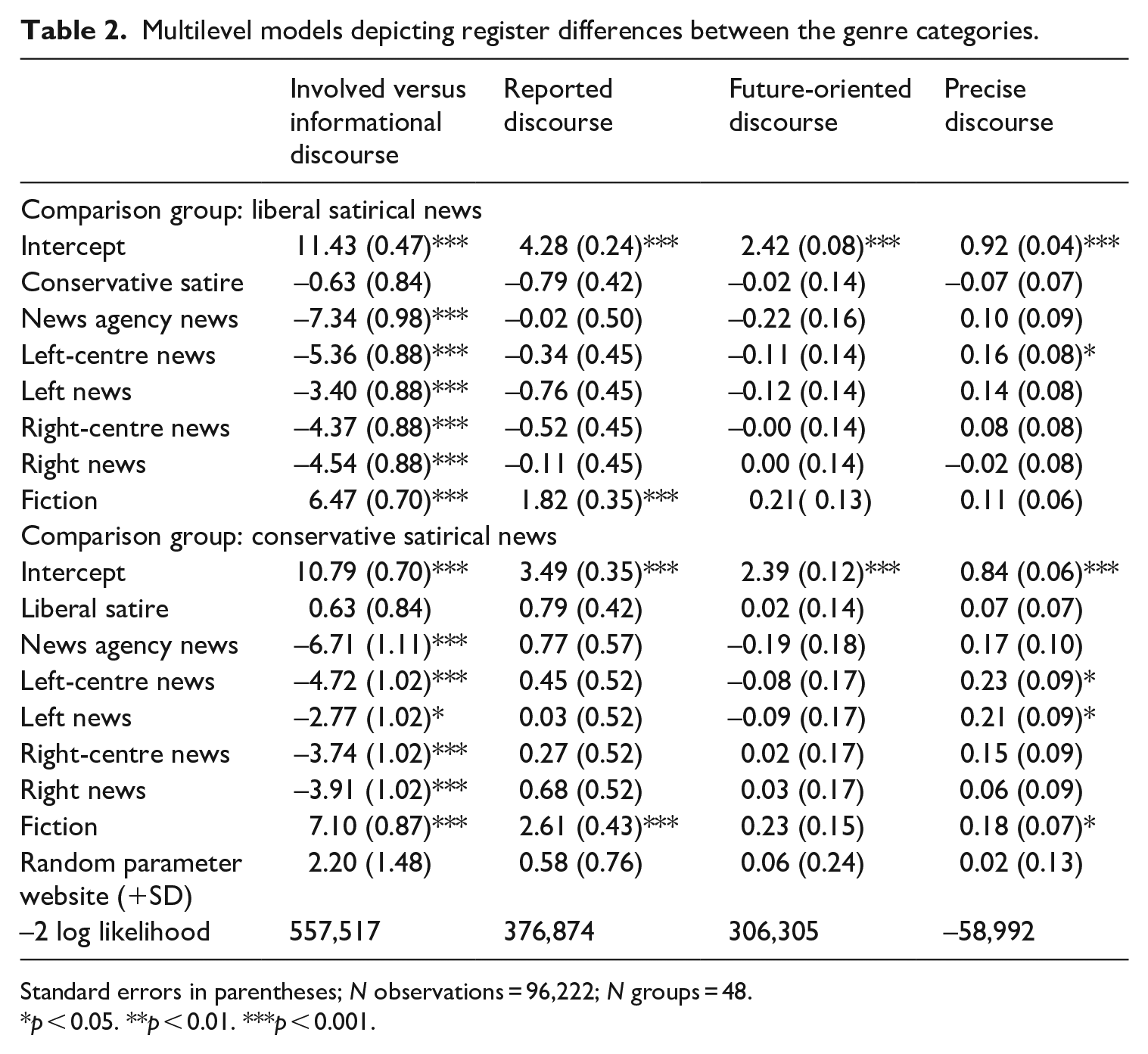
Standard errors in parentheses; N observations = 96,222; N groups = 48.
p < 0.05. **p < 0.01. ***p < 0.001.
The multilevel analysis revealed additional differences between liberal and conservative satirical news and regular news and political fiction on two register dimensions, but these differences did not reflect a combination (see Table 2). Both liberal and conservative satire contained significantly less reported discourse than political fiction (tlib = –5.25, p < 0.001; tcons = –6.01, p < 0.01) and less precise discourse than left-centre biased news (tlib = –2.05, p < 0.05; tcons = –2.32, p < 0.05). Conservative satirical news also scored lower on precise discourse than left-biased news (t = –2.58, p < 0.05) and political fiction (t = –2.48, p < 0.05). In sum, the only dimension in support of H1 was that of involved versus informational discourse.
H2 predicted that the liberal satirical news would score more often in between regular news and fiction in terms of linguistic register than conservative satirical news. As the results discussed above show, this was not the case. Interestingly, we also did not find significant differences between liberal and conservative satirical news on any of the register dimensions: involved versus informational discourse (t = –0.76, p = 0.45), reported discourse (t = –1.86, p = 0.07), future-oriented discourse (t = –0.16, p = 0.87) and precise discourse (t = –0.98, p = 0.33). These results suggest that liberal and conservative satirical news have comparable linguistic registers. Thus, the data did not support H2.
Our findings are depicted in Figure 1. For reasons of clarity, the categories left-centre and left-biased news have been collapsed into liberal news. Likewise, right-centre and right-biased news have been collapsed into conservative news.
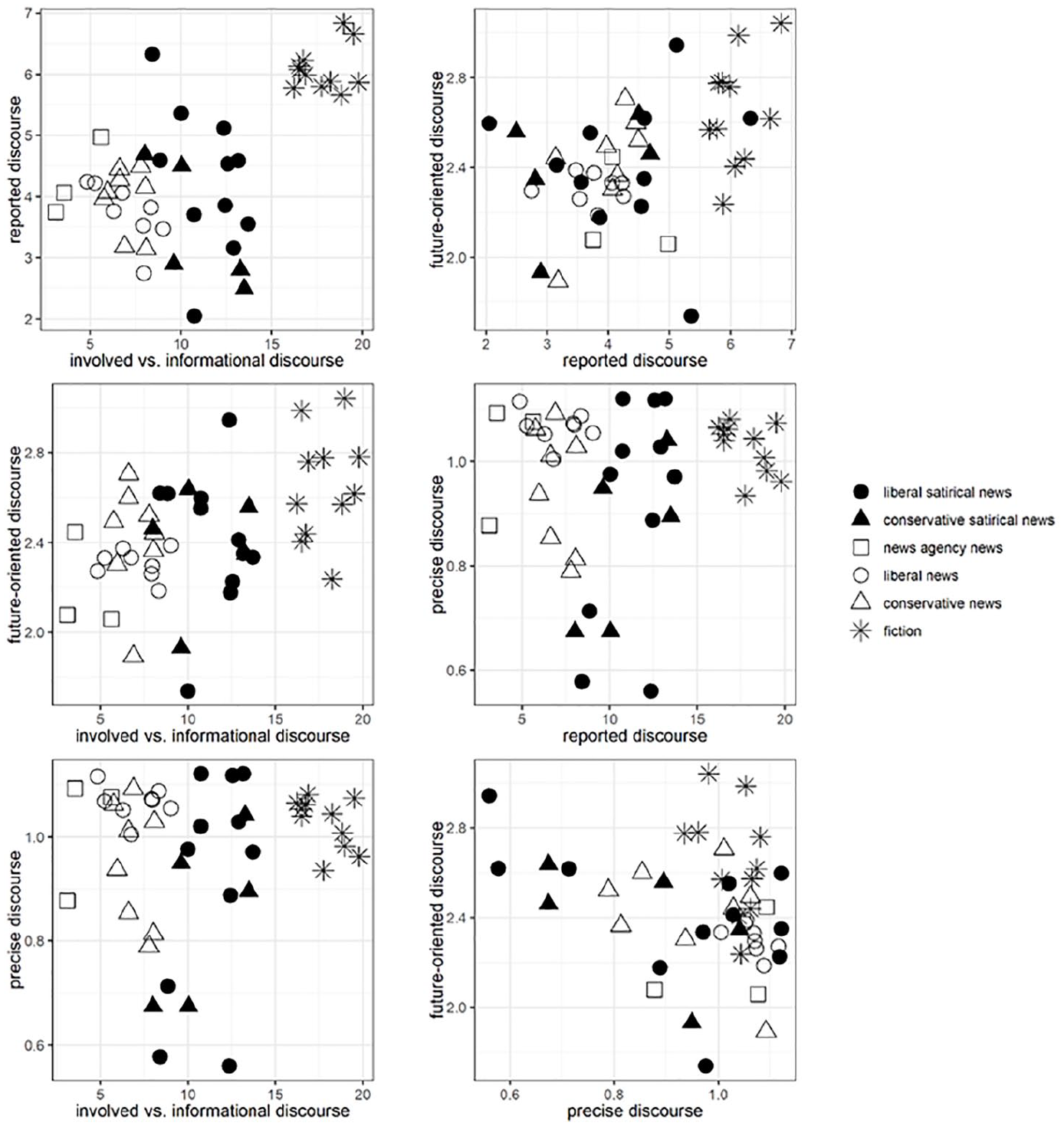
Scatter plot of the register dimension means per outlet.
We conducted additional analyses to test the possibility that a lack of differences between liberal and conservative satirical news was caused by an overall lack of differences in linguistic register between left-leaning and right-leaning news outlets. The multilevel models were now fitted with left and right biased news as reference categories. Results indeed showed no differences between liberal and conservative regular news on any of the dimensions (see online Appendix C: https://osf.io/mk48u/), suggesting that the news register is considerably constant.
Discussion and conclusion
Evidence for discursive integration
The first objective of this study was to quantitively test whether the concept of discursive integration, developed to explain the innovativeness of audiovisual satirical news (Baym, 2005), also applies to written satirical news (e.g. Berkowitz and Schwartz, 2016; Waisanen, 2011). Our results support the hypothesis that written satirical news is characterised by discursive integration (H1) because its register reflected a combination of the registers of regular news and political fiction. Satirical news scored in between regular news and political fiction on the dimension of involved versus informational discourse. This dimension has often been identified in previous research as an important dimension for differentiating between genres because it represents two communitive foci that are common for written genres (Biber, 2014). Our results revealed that discursive integration (Baym, 2005) in written satirical news manifests through a combination of these communicative foci. Like genres of fiction, satirical news focuses on personal involvement since it aims to entertain audiences. Like genres of regular news, however, satirical news also has an informational focus because it aims to present news facts in a new light. This study thus showed how, like audiovisual satirical news (Baym, 2005), written satirical news also represents a mix of genres of regular news and fiction.
Furthermore, results demonstrated two differences between the written satirical news categories on the one hand and the written regular news and written fiction categories on the other hand. First, satirical news contained less reported speech discourse than political fiction. This could be explained by how fiction narratives consist of much reported speech in the form of dialogues between characters. The second difference was that satirical news discourse was less precise than liberal regular news, and in the case of conservative satirical news also than political fiction. This difference in precision indicates that satirical news is characterised by a more repetitive writing style than some of the other genre categories.
The combined communicative focus in satirical news of involved and informational production could be an important cue for audiences to know that satirical news should be interpreted humorously rather than seriously. Satirical news is often praised for its ability to imitate rhetorical structures of news reporting (e.g. Berkowitz and Schwartz, 2016; Waisanen, 2011). Because of satirical news’ capacity to portray satirical content as traditional journalism, satirical news has been associated with fake news since both genres share a certain level of misinformation (Egelhofer and Lecheler, 2019). A crucial difference between satirical news and fake news, however, is that satirical news does not intend to deceive (Egelhofer and Lecheler, 2019). Instead, in satirical news, facts are distorted for the audience’s amusement. Therefore, deviations in news register such as demonstrated in this study could serve as a cue to alert the reader to the satiric nature of the message.
Little evidence for partisan differences
The second objective of this study was to examine whether the level of discursive integration in satirical news depends on the political leaning of the outlet, as implied by previous research that emphasised differences in ambiguity between liberal and conservative satirical news (Young, 2019). Our results do not support the hypothesis that liberal and conservative satirical news are characterised by different levels of discursive integration (H2) because their linguistic registers scored equally often in between the linguistic registers of regular news and political fiction. These results improve our understanding of the relationship between partisan bias and the nature of satirical news. Our study revealed how, at the level of discourse, liberal and conservative satirical news may be more similar than different. Hereby, our findings seem to challenge Young’s (2019) hypothesis of inherent differences in ambiguous nature between liberal and conservative satire.
Instead, our study supports a set of papers (e.g. Bakker et al., 2020; Frimer et al., 2013; Ludeke et al., 2016) that proposes that differences between liberals and conservatives may be exaggerations. While these studies focused on psychology and behaviour, we now add genre form to this list of findings because we did not find differences in linguistic register between liberal and conservative satirical news as well as between the left-leaning regular news outlets, on the one hand, and the right-leaning regular news on the other. Within their own genre (satirical news or regular news), the news outlets were found to have comparable linguistic registers, regardless of political leaning.
A possible explanation as to differences between liberal and conservative satirical news may have been exaggerated could lie in the importance of context for interpreting ironic discourse (Katz et al., 2004). Skalicky and Crossley (2019, pp. 61–62) have proposed that satire is a ‘discursive practice’ that relies heavily on the use of irony in addressing its targets. Studies on irony perceptions have shown that the likelihood of irony being interpreted as ironic rather than literal depends on many contextual factors such as the speaker’s gender (Katz et al., 2004), occupation (Katz and Pexman, 1997) and ingroup status (Burgers et al., 2015). The element of ingroup status seems especially relevant since it suggests that political group membership can influence whether addressees interpret satirical news as humorously intended, or not (van Mulken et al., 2010) or whether addressees think that the satire reflects the satirist’s genuine opinion (LaMarre et al., 2009). Satirical news from the political outgroup may thus be, by default, interpreted differently than from the political ingroup (Burgers et al., 2015).
Limitations and recommendations for future research
While a clear advantage of the multidimensional analysis method is that identified dimensions summarise the main communicative function of the included genres, it comes with the limitation that this bottom-up approach may obscure potentially interesting literature-driven dimensions. We recommend that future research also takes a top-down approach by testing differences between satirical news, regular news and political fiction in dimensions such as exaggerated discourse (Young et al., 2019).
A second limitation of this study is that we focused on satirical news published in the United States, a country with a clear left-right divide (Davis and Dunaway, 2016). Future research could investigate whether findings generalise to satirical news from countries that are characterised by different political systems and corresponding political dynamics (Charron, 2011). In some countries, coalition governments are formed out of parties that span the ideological spectrum. In such countries, we predict that the ideological positioning of satirical news outlets may not always be as apparent as in countries with a two-party system. Future research could replicate our study in these and other types of political contexts.
Finally, this study focused on the linguistic packaging of satirical news. This means that there may still be content differences between liberal and conservative satirical news that are worth exploring. First, future research could compare the actors that are criticised in liberal and conservative satirical news. In light of the partisan nature of satirical news (Becker and Waisanen, 2013), we predict that liberal satirical news more often targets conservative actors, while conservative satirical news more often targets liberal actors. Furthermore, given that respect for authority is a key value of conservativism (Dagnes, 2012), we predict that those higher in power are less often the target of criticism in conservative satirical news than in liberal satirical news. Lastly, future research could compare the issues discussed in liberal and conservative satirical news. Because previous research suggests that liberals and conservatives find different moral principles important to judge right from wrong in politics (Graham et al., 2009), we predict that they may criticise using different political values.
In conclusion, by means of a large-scale quantitative analysis, this paper shows that the concept of discursive integration (Baym, 2005) can be applied more broadly to satirical news rather than to satirical news shows only. Written satirical news was found to be characterised by discursive integration, regardless of the political leaning of the outlet. This paper therefore highlights the importance of analyzing different forms of satirical news to advance research on satirical news (Holbert et al., 2011) by showing how both liberal and conservative written satirical news represent a mix of genres of regular news and fiction.
Footnotes
Acknowledgements
We would like to thank Bob Brugman, Wouter van Atteveldt and Kasper Welbers for their help with web scraping.
Funding
The author(s) disclosed receipt of the following financial support for the research, authorship, and/or publication of this article: The research in this paper was supported by the Netherlands Organisation for Scientific Research (NWO), Vidi grant 276-45-005.
