



Abstract
Right-wing extremist (RWE) violence and terrorism pose a severe threat to Western societies, including Germany. This study tests how differences in journalistic descriptions of minority and majority victims of such attacks affect news readers. Building on social identity theory, we conducted a 2 (nationality: German, Turkish) × 2 (humanization, no humanization) × 2 (ingroup activation, no ingroup activation) between-subjects experiment in Germany (N = 420). We exposed participants to news articles about fictional RWE violent attacks and investigated how victims’ nationality, humanization—mentioning the victims’ friends and family and positive traits—and ingroup activation, i.e., explicitly stating that the victim was someone from the midst of society, impact perceived similarity to the victims and in turn (1) fear of right-wing terrorism and (2) the extent to which participants perceive the violent act as terrorism. We found that journalistic practices of humanization and ingroup activation do not mitigate the negative effect of Turkish nationality on similarity. Similarity positively relates to fear and use of the terrorism label. Further results, limitations, and implications for journalism practice are discussed.
Incidents related to right-wing extremist (RWE) violence constitute a critical threat to Western societies and reporting adequately about them poses a challenge to journalists. As of 2023, RWE is considered the largest extremist threat to German democracy (Bundesministerium des Inneren und für Heimat [BMI], 2023: 4). At the heart of RWE lies ingroup supremacism (European Union Agency for Law Enforcement Cooperation [EUROPOL], 2023)—the idea that a group, defined by characteristics such as race or culture, is inherently superior. RWE violence often targets minority members, as for instance in the Christchurch Mosque attacks, but victims may also belong to the majority population. In news coverage, journalistic cues signaling victims' group memberships may be crucial in shaping audience responses. Social identity theory (SIT; Tajfel and Turner, 2004) postulates that human beings have the basic need to belong to social groups. These groups can be based on various aspects, such as profession, ethnicity, or religion. Perceived similarity to others, derived from contextual cues, is an essential part of social group formation (Grigoryan, 2020). For instance, Muslim victims of right-wing terrorism (RWT) evoke less feelings of similarity and in turn less compassion in non-Muslim news readers (Knupfer and Matthes, 2023). In the context of 9/11, perceived similarity to the victims mediated the relationship between exposure to media accounts of victims and disaster-focused distress (Wayment, 2004). In the present study, perceived similarity is defined as perceptions of actual or imagined similarity to victims of RWE violence (see Knupfer and Matthes, 2023; Wayment, 2004). We build on SIT and the significance of perceived similarity to address the following research gaps.
First, while reports about terrorism generally increase fear in audiences (e.g., Jacobs and Van Spanje, 2022; Matthes et al., 2019; Von Sikorski et al., 2017), it is unclear how nationality of the victims of RWE violence and journalistic practices of victim depiction impact perceived similarity and in turn levels of fear. Nationality serves as a heuristic for group categorization and is associated with intergroup bias (Kumar et al., 2021; Tavoletti et al., 2022). Germany, where this study was conducted, has a large Turkish minority (Statistisches Bundesamt, 2022). Against this backdrop, German nationality constitutes an ingroup cue for the general population, whereas Turkish nationality is an outgroup cue. Scholars have suggested that establishing a common ingroup identity can decrease intergroup bias (Gaertner et al., 1993). We use this idea and manipulate explicit ingroup activation, as a possible bridge between in- and outgroup, by emphasizing that the victim was “one of us”. Additionally, humanizing victims by mentioning distinct human qualities and embedding them in a social system with family and friends may increase perceived similarity. Taken together, we test how nationality, humanization, and ingroup activation shape perceived similarity to the victims of RWE violent attacks and how similarity translates to fear.
Second, existing research points to open questions relating to terror label usage. Content analyses of news media suggest that acts committed by Muslim perpetrators are more often labelled as terrorism than acts committed by non-Muslims (Hase, 2021; Kearns and Betus, 2022). Experiments show that news consumers are more likely to label ambivalent violent acts committed by Muslims as terrorism than acts committed by non-Muslims (West and Lloyd, 2017). Yet, less is known about the potential influence of similarity derived from victim characterizations in news articles on audiences’ usage of the terrorism label.
Third, past research suggests that journalistic choices made in covering RWE violence and attacks impact audience responses (e.g., Brosius and Esser, 1995). Media outlets were criticized for their coverage of RWT: by describing the fatal attacks of the German “National Socialist Underground” (NSU) as “Dönermorde” (doner murders), journalists contributed to the dehumanization of the minority victims. While a large body of research investigates dehumanization, we focus on potential journalistic means to increase perceived similarity. To address these gaps, we conducted a 2 (nationality: Turkey, Germany) × 2 (humanization, no humanization) × 2 (ingroup activation, no ingroup activation) between-subjects experiment. Overall, this study advances the understanding of the impact of social categorization in the context of RWE violence through the lens of journalism studies. Before discussing the literature leading up to our hypotheses and research question, we provide an overview over the concepts of RWE, RWT, and provide information about the German context.
Right-wing extremist violence and terrorism in Germany
RWE is an umbrella term that includes heterogeneous ideologies, organizations, and strategies (Phahl-Traughber, 2019). RWE incorporates “nationalism, racism, xenophobia, anti-democracy, and the strong state” (Mudde, 1995: 206). We use the term “extremism” in line with other scholars (e.g., Bjørgo and Ravndal, 2019; Pfahl-Traughber, 2019) who emphasize extremists’ rejection of democratic means, including the endorsement of violence. RWE violence can be further subdivided into different forms, such as hate crimes or terrorism (Bjørgo and Ravndal, 2019). There is no univocal definition of terrorism (Weinberg et al., 2004), as the meaning and use of the term has changed over space and time (Hoffman, 2017). Hoffman (2017) notes challenges in defining terrorism, for instance due to its inherently negative moral connotation. He defines terrorism “as the deliberate creation and exploitation of fear through violence or the threat of violence in the pursuit of political change” (Hoffman, 2017). The psychological effects of terrorism are intended to go beyond the immediate victims of specific attacks (Hoffman, 2017; Weinberg et al., 2004), which speaks to its relevance for journalism studies. Because the current study focuses on audience perceptions, i.e., evaluations by laymen, we believe that Hoffman’s definition reflects the goals of this study sufficiently. Notably, variations of the core aspects of his definition are present in other conceptualizations (e.g., Moghaddam and Marsella, 2004).
In his typology of right-wing criminal activities, Koehler (2016a) differentiates between (1) non-political crimes (e.g., drug trafficking), (2) right-wing (non-violent) crimes, (3) right-wing violence, for instance against former group members, (4) right-wing violent hate crimes, and (5) right-wing terrorism. He defines hate crimes as “the physical assault or killing of individuals on the basis of a bias towards the victim’s identity” (Koehler, 2016a: 62). In contrast to terrorism, the strategic component of advancing a political agenda is absent in hate crimes (Koehler, 2016a). As RWT rarely includes explicit communication about political goals (e.g., claims of responsibility), another indicator for distinguishing hate crimes from terrorism is whether low (e.g., knife, bat) or high distance methods (e.g., firearm, explosives) were used in the violent act (Koehler, 2016a).
Since 1945, Germany experienced different phases of RWE. Until today, the largest attack took place in 1980 when a young man set off a bomb at the Oktoberfest in Munich, killing 12 and injuring over two hundred. The perpetrator was associated with the neo-Nazi paramilitia “Wehrsportgruppe Hoffmann” that was abolished in the same year. Other important cornerstones of RWE in Germany include the stark increase in violence in the beginning of the 1990s (Koehler, 2016b), targeting mostly asylum seekers (e.g., attacks in Mölln, Hoyerswerda). Between 2000 and 2007, the NSU committed a series of killings. Apart from a German policewoman, the NSU’s victims were regarded as “foreigners” as most of them had Turkish origin. Recent RWE attacks include the attacks in Hanau (2020), Halle (2019), and the murder of politician Walter Lübcke (2019). Interestingly, the RWE background of a number of attacks was at first not formally recognized (e.g., Oktoberfest bombing, Munich attack 2016, NSU murders). German RWT is often organized in small tactic units or is perpetrated by lone actors with no formal ties to terror organizations (Koehler, 2016b). Their terrorist actions are intended to exacerbate intergroup conflicts in society and thereby bring about a breakdown of the democratic system (BMI, 2023).
According to the Global Terrorism Index, far-right attacks accounted for 30% of fatalities from terroristic acts between 2007 and 2021, making it the second most lethal form of terrorism in the West after jihadist terrorism (Institute for Economics and Peace, 2022). Based on data from the right-wing terrorism and violence (RTV) dataset that includes Western European countries, the highest number of attacks between 2015 and 2021 was in Germany (Center for Research on Extremism, 2022). In 2021 alone, 19 acts of political terrorism were recorded in Germany. However, within the last years, the number of RWT attacks in Germany has decreased compared to previous years (Center for Research on Extremism, 2022). Among politically motivated crimes that are attributable to political, religious, or ideological motivation, RWE crimes dominate (BMI, 2023). Assault represents the largest category of violent crimes within RWE offenses. The vast majority of violent RWE crimes are xenophobic. Compared to 2021, RWE xenophobic crimes and acts of violence in 2022 have increased by 1.3% (crimes) and 16% (violent crimes) (BMI, 2023).
Effects of victim characteristics in news about RWE violence
A key theory in explaining dynamics between social groups is SIT (Tajfel and Turner, 2004). SIT postulates that belonging to and differentiating from specific social groups contributes greatly to an individual’s identity. Individuals make sense of their social environment by classifying themselves and others into social groups according to specific characteristics. Ingroups are constructed when observed features of others, such as religious affiliation or nationality, match one’s own feature(s). Thus, perceptions of (dis)similarity are at the very heart of social group dynamics and social categorizations (e.g., Grigoryan, 2020). Constructing an ingroup goes hand in hand with constructing a corresponding outgroup that does not meet the defining criterion. Carr and colleagues mention “perceived dissimilarity from the ingroup” and “number of cues used to signal group identity” as contributing to outgroup categorization (2013: 262). Further, similarity is central to identification processes (Hoeken et al., 2016) and social categorizations guide subsequent cognition, emotion, and behavior. As self-worth is derived from group memberships (Tajfel and Turner, 2004), individuals tend to evaluate other ingroup members favorably (Tavoletti et al., 2022) and meet ingroup members with benevolent cooperation-bias (Balliet et al., 2014; Kumar et al., 2021). Social categorizations depend on the salience of contextual information (Tajfel and Turner, 2004). After making similarities to a target group of harmful behavior salient, participants reported increased feelings of anger and rated the situation as more unfair (Gordijn et al., 2006). In contrast, when similarities to the perpetrators of this behavior were salient, participants reported less anger and more support of the perpetrators’ cause (Gordijn et al., 2006). Similar observations have been made in the context of crime news. A review of the rape blame attributions literature suggests that throughout a large number of studies, participants who felt more similar to the victims tended to attribute more blame to the perpetrator (Grubb and Harrower, 2008).
One of the features that is prominently disclosed in crime news and potentially affects categorization processes is nationality. Nationality cues shape in- and outgroup biases throughout different scenarios (e.g., Kumar et al., 2021; Tavoletti et al., 2022). We therefore assume that victim nationality constitutes a strong categorization cue that impacts levels of perceived similarity to the victims of RWE violence. We test German versus Turkish victim nationality because 2.75 million of Germany’s total population of 82 million have a Turkish migrant background, making it Germany’s largest ethnic minority (Statistisches Bundesamt, 2022). Hence, we propose that Turkish nationality cues foster outgroup categorization and lower levels of similarity in the general population:
Turkish (compared to German) victim nationality leads to less perceived similarity to the victims of right-wing extremist violence. Adding to the factual information of nationality, victims may be personalized and portrayed sympathetically. Previous research in the context of violence and crime found that news stories about White female victims were more strongly embedded in sympathetic narratives than news about minority female victims (Slakoff and Brennan, 2019). The operationalization of Slakoff and Brennan (2019) is comparable to what we understand here as humanization—that is, describing the victim as a good person and mentioning friends and family members. How the victims are presented is relevant because it may affect overall evaluations of the violent act. As captured in the concept of infra-humanization, outgroups and outgroup members can be perceived as possessing less complex human features (Leyens et al., 2007). Pereira et al. (2009) manipulated the humanity attributed to an outgroup and found that lack of human quality attributions, or infra-humanization, predicted levels of discrimination. In contrast, humanizing Muslims through positive attribute assignment reduced prejudice toward them (Pavetich and Stathi, 2021). We extend these findings by utilizing the journalistic tool of humanizing victims of RWE and testing its impact on perceived similarity. Particularly in the face of RWE violence targeting minorities, humanizing victims might be a way for journalists to mitigate intergroup bias and foster intergroup relations by increasing perceived similarity. The basic idea is that humanization showcases desirable features associated with distinct human qualities and embeds the victims in a relatable social network of universal value, namely their friends and relatives. That is, the shared underpinnings of humanity become salient. Thus, we hypothesize:
Humanization leads to more perceived similarity to the victims of right-wing extremist violence compared to no humanization. While nationality and humanization can serve as implicit categorization cues, there are explicit means to bridge intergroup boundaries. In the context of terrorist attacks, politicians and journalists may mention that the attack was an attack on democratic values, or an attack on “us” (e.g., Luengo and Ihlebæk, 2019). Particularly relevant for our theoretical background of SIT, the victims may be described as fellow, ordinary citizens—similar to New Zealand’s former prime minister Jacinda Ardern, who referred to the Muslim victims of the Christchurch attacks explicitly with “they are us” (see Besley and Peters, 2020). SIT inspired the common ingroup identity model (Gaertner et al., 1993) that emphasizes the contextual dependence of intergroup boundaries and describes conditions that facilitate the transformation of bright group boundaries to an inclusive “we” by establishing a common ingroup. Although the model mostly builds on the contact hypothesis, we adapt its basic assumptions to the purpose of this study. We operationalize ingroup activation with stating that the victim was “someone from the midst of society” and a “fellow citizen”. That is, when journalists actively mention that the victims belong to a common ingroup and showcase that they are not an outsider but part of larger society, we assume that levels of perceived similarity to the victims will increase:
Explicit ingroup activation leads to more perceived similarity to the victims of right-wing extremist violence compared to no ingroup activation. So far, we introduced several victim characteristics and journalistic means that may shape feelings of similarity to the victims in the readership. However, in reality, these factors interact and may conditionally impact similarity. While shared nationality may drive perceived similarity to the victims, humanizing the victims and explicit ingroup activation may decrease the hypothesized effect of nationality. A recent study showed that inducing feelings of similarity to an outgroup with an intervention improved attitudes toward the outgroup in children (Nasie and Stanescu, 2023). Notably, similarity was induced based on information that participants provided about themselves, such as family composition and interests (Nasie and Stanescu, 2023). Thus, perceptions of similarity to the victims may also be altered by journalistic cues that go beyond nationality. Hence, in the presence of humanization and explicit ingroup activation, the foreign victim nationality cue might lose its predictive power:
If victims of right-wing extremist violence are humanized and the ingroup is explicitly activated, the negative impact of Turkish nationality on perceived similarity is weaker.
Fear of terrorism
News about crime and violence can severely impact levels of fear in the audience (e.g., Romer et al., 2003). By definition, terrorists aim to cause psychological effects that go beyond the immediate targets of the attack (Hoffman, 2017; Moghaddam and Marsella, 2004). A plethora of studies found that exposure to terror increases fear of terrorism (Jacobs and Van Spanje, 2022; Matthes et al., 2019; Von Sikorski et al., 2017). The Christchurch attacks, which targeted the Muslim community, elicited anxiety in the general population (Byrne et al., 2022). However, experiments suggest that individuals’ emotional reactions to extremist violence and terrorism are partly predicted by who is targeted. An experimental study among non-Muslims found that when a victim of a terror act described in the news was Muslim (vs. non-Muslim), participants expressed less compassion (Schmuck et al., 2021). Perceived similarity to the targets seems to be at the center of shaping such group-specific outcomes. When a common ingroup with victims is emphasized, fear of terrorism is higher (Dumont et al., 2003). Thus, fear reactions to extremist violence and terrorism may vary depending on whether the victims are categorized as ingroup or outgroup members, i.e., to which degree they evoke feelings of similarity. A recent experimental study in the context of RWT revealed that Austrians perceived Christian victims of violent incidents as more similar compared to Muslim victims, and similarity to the victims, in turn, increased fear of terrorism (Knupfer and Matthes, 2023). We test whether similar mechanisms are at play when the attack is not clearly labeled as terrorism and hypothesize:
Perceived similarity to the victims of right-wing extremist violence is positively associated with fear of RWT.
Applying the terrorism label
Drawing back to the difficulty of conceptualizing terrorism (Hoffman, 2017; Weinberg et al., 2004), it is not surprising that applying the terrorism label poses a challenge to journalists and laymen. Still, using the label to describe acts of violence can affect emotional and attitudinal outcomes. An experimental study found that articles describing a violent perpetrator as Islamist or terrorist extended the appropriate condemnation time that participants reported for the perpetrator, compared to describing him as a shooter (Baele et al., 2019). This speaks to the “intrinsically negative connotations” (Hoffman, 2017: 24) of the term terrorism. In another experiment, members of minority groups were compared to members of the dominant social group and exposed to articles about a bombing, wherein the perpetrator was either described as terrorist or freedom fighter. The authors found that participants’ own group membership altered the moral evaluation of the perpetrator (Montiel and Shah, 2008). This indicates that the social position of the respondents determines the evaluation of violent acts and demonstrates the need to incorporate an SIT perspective. Hoffman (2017: 24) further elaborates on the “almost unavoidably subjective” decision to label actors or groups as terrorist. He posits that identification with the victims fosters the usage of the term terrorism, whereas identification with the perpetrator makes application of the label less likely (Hoffman, 2017). Recent content analyses suggest that attacks with Muslim perpetrators receive more media coverage than attacks committed by non-Muslim, far-right perpetrators (Kearns and Betus, 2022). Further, far-right attacks are less likely to be labelled terrorism compared to jihadist attacks (Hase, 2021; Kearns and Betus, 2022). These studies suggest there are biases in how news media use the term terrorism. But less is known about audience perceptions, i.e., under which conditions audiences use the label.
Whenever minorities are targeted, an alternative evaluation of a violent attack could be that it constitutes a hate crime. There are different schools of thought concerning the differentiation between hate crimes and RWT. Some scholars refer to the two as “close cousins” (Mills et al., 2017), and state that they can partly overlap (Bjørgo and Ravndal, 2019), while others emphasize their differences (Deloughery et al., 2012). One decisive feature is the level of preparedness. Deloughery and colleagues (2012) argue that the level of preparedness in hate crimes is lower than in terrorism. Koehler (2016a) uses a related strategy to disentangle both concepts by weapon choice (low, high distance) and the strategic dimension of the attack.
In the audience, subtle linguistic differences in describing a bombing abroad can impact whether the terror label is used (Dunn et al., 2005). In two experiments, participants were more likely to label a violent act terrorism when the perpetrator was Muslim compared to non-Muslim (West and Lloyd, 2017). Moreover, research found that individual predictors such as Islamophobia and media use impact the use of the terrorism label (Dolliver and Kearns, 2022), and that terrorism perceptions are guided by a self-serving bias (Shamir and Shikaki, 2002). Whereas most research in this domain investigates perpetrator characteristics, we test if victim characteristics influence the use of the terrorism label in the audience. Against the backdrop of SIT and media biases in terrorism label usage, it is possible that audiences are more willing to call a violent act terrorism if the perceived level of similarity to the victims of the attack is high. But, as the number of empirical results is too low to hypothesize, we pose a research question:
How is perceived similarity to the victims of right-wing extremist violence associated with terrorism label use? The conceptual model is depicted in Figure 1.
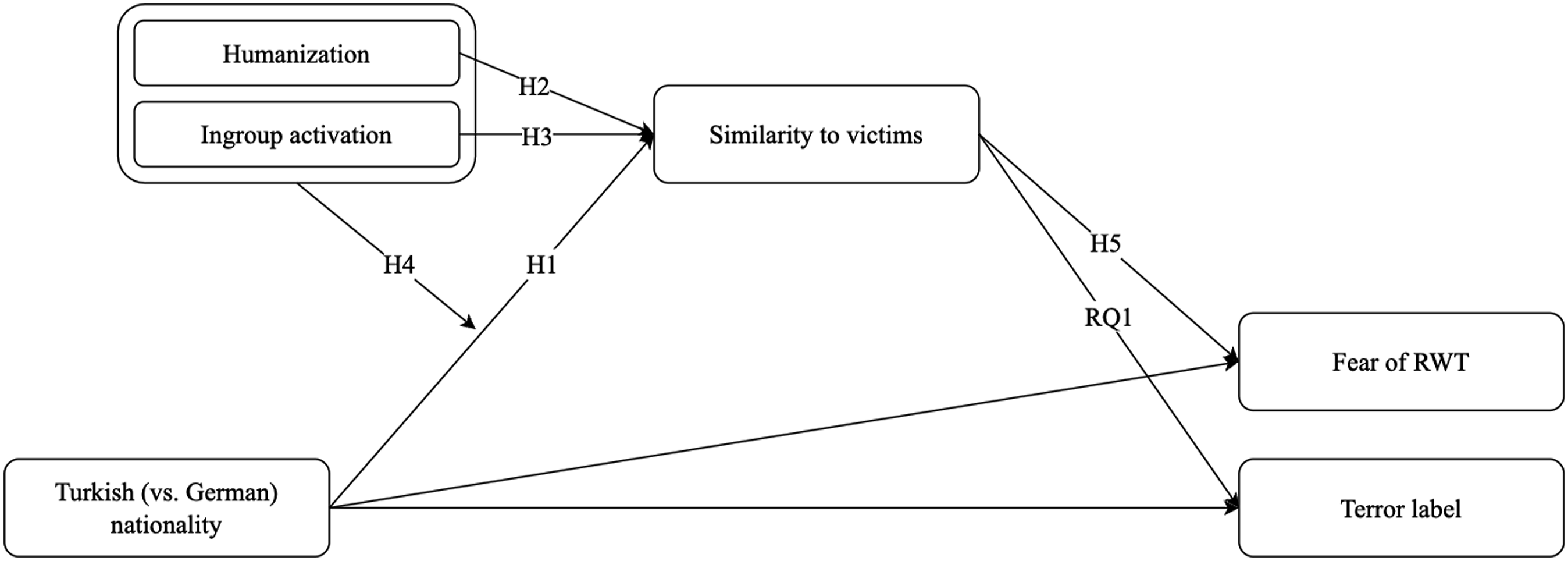
Conceptual model. Note. RWT = right-wing terrorism.
Method
We administered an online experiment based on quotas of Germany’s general population regarding age (Mage = 43.81, SD = 13.00; aged 18–65), gender (50.50% female), and education (16.90% no diploma, vocational/secondary school diploma, 27.50% university degree or equivalent) in April, 2022. Participants were recruited by a professional polling company. Participants who failed three attention checks (e.g., “I know how to count to 10”) and speeders (one third faster than the median) were excluded. The final sample included 473 participants. The majority of participants reported no migration background (88.40%; 2.30% born in non-German speaking country, 7.20% at least one parent born in non-German speaking country, 2.10% indicated not knowing) 1 . The data and Appendix are available online: https://osf.io/kw5av/. The study was approved by the Institutional Review Board of the Department of Communication at the University of Vienna (ID: 20220228_006). Respondents gave their informed consent prior to participation.
Procedure and stimuli
In this randomized between-subjects experiment, participants were exposed to two news articles. Exposing participants to more than one stimulus adds to external validity compared to single message designs (Reeves et al., 2016). Randomization checks for age, gender, and education were successful. Please see online Appendix A for details. Participants were assigned to one of the following conditions: (1) two news articles about RWE violent attacks depicting German victims who are humanized (i.e., family, friends and desirable character traits described) and a common ingroup is activated (i.e., victim described as one of “us”, fellow citizen) (n = 51), (2) news depicting German victims who are humanized without ingroup activation (i.e., victims not explicitly described as part of the ingroup) (n = 54), (3) articles describing German victims who are not humanized (i.e., no personalized information provided), but with ingroup activation (n = 53), (4) news with German victims who are not humanized and without ingroup activation (n = 53), (5) news depicting Turkish victims who are humanized and the ingroup is activated (n = 53), (6) articles with Turkish victims who are humanized without ingroup activation (n = 50), (7) coverage reporting about Turkish victims who are not humanized, but the ingroup is activated (n = 53), (8) news illustrating Turkish victims who are not humanized and the ingroup is not activated (n = 53), and (9) a control group which was exposed to two articles unrelated to violence (n = 53).
Examples of the nationality, humanization, and ingroup activation manipulation.
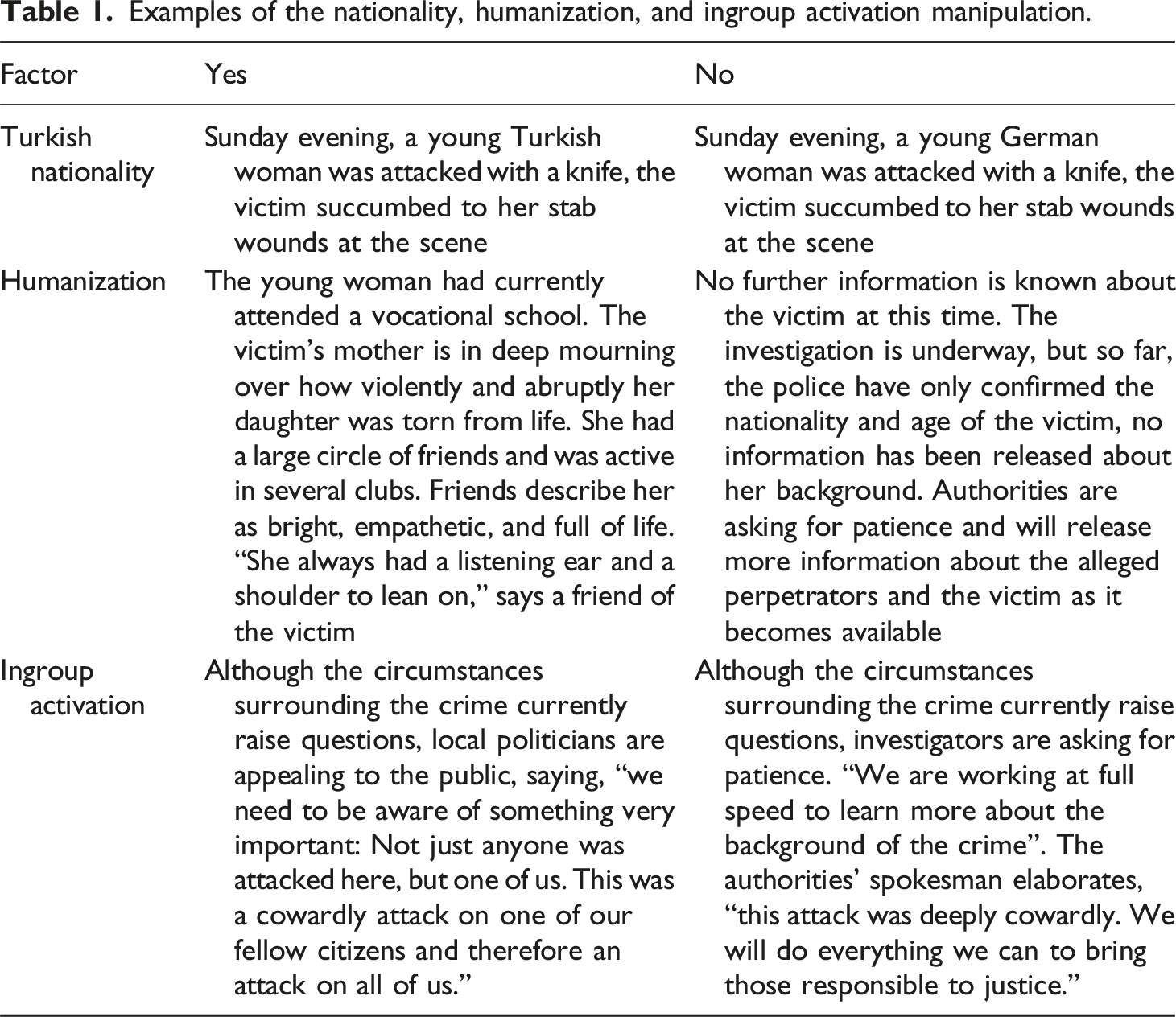
The articles resembled the online news of two German mainstream newspapers (Die Welt, Focus Online) with article length between 213 and 234 words. Each article was presented on a separate page. Participants had to spend at least 20 s on each article. There were no differences in evaluations of professionality of the articles (F (8, 464) = 1.950, p = .051). Since we observed differences in article credibility (F (8, 464) = 2.411, p = .015), we included credibility as a control. At the beginning of the survey, respondents answered questions on demographic information. After stimuli exposure, participants provided answers on the mediator and the dependent variables. As participants in the control group were not exposed to articles that included violence, their perceived similarity and terror label use was not assessed. At the end, respondents were debriefed. The experiment was part of a larger research project. Before participants entered this experiment, they completed another experiment on an unrelated topic.
Measures
Participants indicated their agreement to the statements on 7-point scales (1 – strongly disagree, 7 – strongly agree), unless stated otherwise. Information on all items, including descriptive statistics is provided in online Appendix B.
Three statements (e.g., “I am afraid that there could be a right-wing extremist terrorist attack near me”) adapted from Crowson et al., (2006) were used to gauge fear of RWT (α = 0.93, M = 2.92, SD = 1.76). To assess whether participants evaluated the attacks as terrorism, we used two items (e.g., “The articles described terrorist acts”) inspired by Dolliver and Kearns (2022) (ρ = 0.85, M = 2.90, SD = 1.81). The measurement of similarity to the victims is a typical measure of perceived similarity (e.g., Cohen et al., 2018; Grigoryan, 2020; Hoeken et al., 2016). Based on Knupfer and Matthes (2023), respondents were instructed to think back to the victims in the news articles and answer two items (e.g., “The victims that were depicted in the articles are similar to me”; ρ = 0.82, M = 2.63, SD = 1.55).
As control variables, we assessed political ideology with one item (1 – left, 10 – right), credibility of each article with one item (1 – not credible, 7 – very credible; M = 5.21, SD = 1.31), and migration background.
Statistical analysis
The data were analyzed using IBM SPSS (V27) and PROCESS (Model 12, 5000 bootstraps; Hayes, 2013). The control group was excluded, because similarity and label use directly referred to the victim manipulation that was not present in the control group. The experimental factors were coded using main effect deviation coding (−0.5, 0.5). We used factor scores based on regression coefficients of principal component analysis for the statistical analyses (see online Appendix B for results of the principal component analysis).
Results
Unstandardized regression coefficients.
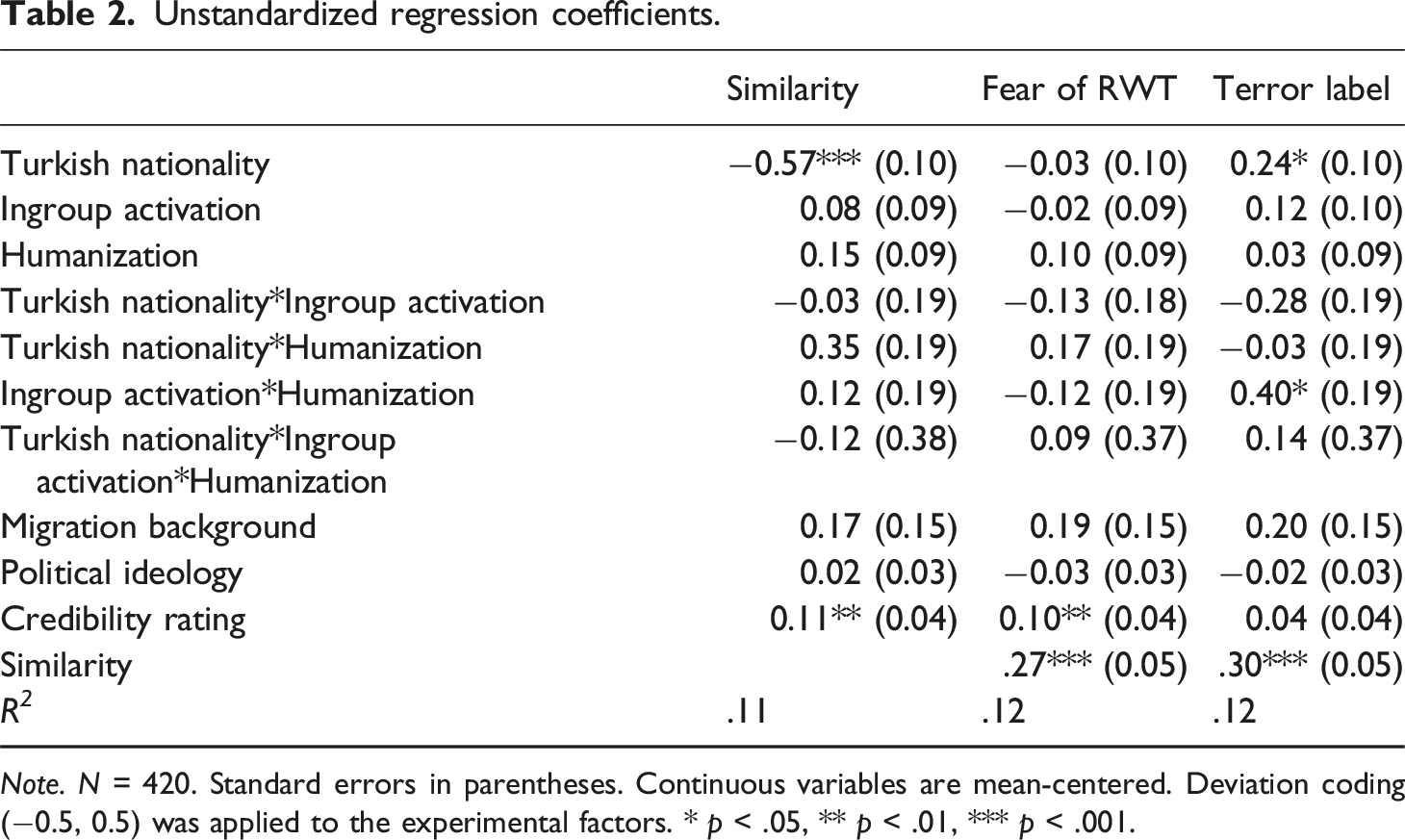
Note. N = 420. Standard errors in parentheses. Continuous variables are mean-centered. Deviation coding (−0.5, 0.5) was applied to the experimental factors. * p < .05, ** p < .01, *** p < .001.
The model predicting similarity was significant (F (10, 409) = 4.88, p < .001, R 2 = .11). In line with H1, nationality of the victims predicted perceived similarity (b = −0.57, t (409) = −6.01, p < .001). That is, Turkish victims elicited less feelings of similarity compared to German victims. We found no support for H2 and H3, as humanization (p = .124) and ingroup activation (p = .401) did not predict similarity. The three-way interaction effect on similarity was not significant (p = .745). Therefore, H4 was rejected.
The overall model predicting fear of RWT was significant (F (11, 408) = 5.15, p < .001, R 2 = .12). In support of H5, similarity was positively related to fear of RWT (b = 0.27, t (408) = 5.62, p < .001). Thus, participants who felt similar to the victims reported higher levels of fear. The index of moderated moderated mediation was not significant (b = −0.03, 95% CI [−0.25, 0.17]). The indirect effect of Turkish nationality on fear via similarity was significant and negative for all conditions, except for Turkish victims who were humanized and when the ingroup was not activated (b = −0.10, 95% CI [−0.22, 0.00]).
The overall model predicting terrorism label use was significant (F (11, 408) = 5.13, p < .001, R 2 = .12). RQ1 explored the relationship between similarity and terror label use. Perceived similarity was positively related to label use (b = .30, t (408) = 6.15, p < .001). That is, participants who reported to feel more similar to the victims were more likely to label the attack terrorism. The index of moderated moderated mediation was not significant (b = −0.04, 95% CI [-0.27, 0.19]). The indirect effect of Turkish nationality on label use via similarity was significant and negative for all conditions, except for Turkish humanized victims with no ingroup activation (b = −0.11, 95% CI [−0.24, 0.00]). Please see online Appendix B for details.
We repeated the analyses without the controls and most of the main results remained unchanged, indicating robustness. However, without the control variables, the interaction effect of nationality and humanization on similarity reaches significance. Please see online Appendix B for these additional analyses.
Discussion
Results suggested that among the experimental factors, only nationality impacted perceived similarity to the victims. Specifically, compared to German victims, Turkish victims elicited less feelings of similarity. This was in line with the SIT-based assumptions and highlights the central role that nationality cues play in evoking similarity. However, contrasting our assumptions, neither humanization nor ingroup activation diminished the negative effect of Turkish nationality on similarity to the victims. Similarly, the three-way interaction of nationality, humanization, and ingroup activation did not impact feelings of similarity. These results suggest that nationality is a strong cue for group categorizations and that potential journalistic means to alleviate intergroup bias when reporting about victims of RWE, specifically humanization and ingroup activation, failed to influence similarity ratings. In other words, when a nationality cue is present, journalistic choices of humanization and ingroup activation cannot override its influence.
Results further revealed that perceived similarity to the victims of RWE violence was positively related to fear of RWT. That is, when news readers perceive the victims of RWE violence to be similar, they also report more fear of RWT. This result is consistent with earlier findings on general fear responses to ingroup threats (e.g., Dumont et al., 2003) and extends them by shedding light on the timely issue of RWE violence. If news readers are exposed to victims with a foreign nationality, in our case belonging to the Turkish minority, they perceive less similarity and in turn also report lower levels of fear of RWT. It is possible that fear as an aversive emotional state with high anticipatory effort (Smith and Ellsworth, 1985) paves the way to supporting policies aimed at diminishing the source of fear (e.g., Lerner et al., 2003). Thus, lower levels of fear might translate to less political pressure to tackle structural problems underlying RWE and RWT. At the same time, eliciting fear is a central mechanism in terrorism that terrorists rely on to achieve political change (e.g., Hoffman, 2017).
Previous studies have shown that the media's labeling of RWE violence as terrorism is inconsistent, especially when compared to jihadist violence (Hase, 2021; Kearns and Betus, 2022). In our stimuli, we described ambiguous violent acts that were not explicitly labeled terrorism. As the distinction between hate crime and terrorism can be blurry (Bjørgo and Ravndal, 2019), the attacks could also be interpreted as hate crimes. The results indicated that when victims were perceived to be more similar, the terror label was assigned more readily. Albeit not hypothesized, we also found that Turkish nationality directly impacted terror label use positively. Mentioning minority cues in describing victims of RWE violence, thus, likely relates to the activation of heuristics. Since past RWT attacks mostly targeted minorities, minority victims may be closer to the model victim of RWT than German victims. Although not predicted, we further found an interaction effect of ingroup activation and humanization on terror label assignment, independent of nationality and similarity. That is, when victims are humanized and the ingroup is explicitly activated, the act is more likely to be labeled terrorism. This label is important because applying it may pave the way for supporting policies related to counterterrorism (Baele et al., 2019).
Limitations and future research
When interpreting the results of this study, it is important to keep some limitations in mind. The social groups we cued via nationality are tied to the country context and our approach to SIT was simplified, considering that social categorization is complex and characterized by ambiguity (see Bodenhausen and Peery, 2009). This experiment was conducted to test causal relationships. However, given the mediation logic we derived from SIT, the paths from similarity to fear and to label use are correlational. Further, we measured short-term outcomes. Longitudinal studies are needed to test how long-lived such effects are. Additionally, it would be important to clarify the role of social media and audiovisual news content, as our news stimuli were solely textual. Another limitation relates to the statistical power of the study. Although the sample size should be large enough to detect small to moderate effects, future studies should rely on a priori power analysis. Further, differences in conceptualizations of terrorism within the literature need to be acknowledged. The attacks described in our stimuli included a knife and a firearm, indicating mixed distance methods. The attacks resulted in one casualty (knife attack) and two injured persons (firearm attack). We opted for an ambiguous attack setup because one of the goals of the study was to find out if and how terrorism label use in the audience was shaped by victim characteristics. On another note, we investigated the general population and controlled for migration background of the participants. Future studies should additionally sample minority members. Differences in fear levels between minority and majority group members as a result of exposure to RWE news may exacerbate intergroup conflicts, ultimately impacting social cohesion and fostering polarization (Brüggemann and Meyer, 2023; Schmuck et al., 2020). A related limitation concerns our assessment of fear of RWT. We measured fear for oneself and did not include other dimensions, such as fear of RWT for others or the related concept of threat.
Implications and conclusion
Our findings indicate that nationality cues impact news readers largely—they perceive less similarity to foreign victims compared to victims from their national ingroup, which contributes to lower levels of fear. Further, our results show that the audience relies on victim characterizations provided in news articles to determine whether an attack was terrorism or not. Again, similarity to the victims is a key variable and positively associated with use of the terrorism label. But we also found indication of a heuristic that connects minority victims to RWT. The takeaway from this study is bitter because journalistic methods of humanization and ingroup activation failed to surpass nationality cues in shaping perceived similarity. Journalists need to be aware that nationality cues are particularly powerful in driving audience responses and cannot be mitigated by merely stating that foreign victims were “one of us” or good persons.
Supplemental Material
Supplemental Material - Who was hurt? Effects of victim characteristics in news articles about far-right violence on fear and terrorism label use
Supplemental Material for Who was hurt? Effects of victim characteristics in news articles about far-right violence on fear and terrorism label use by Helena Knupfer, Ruta Kaskeleviciute and Jörg Matthes in Journalism
Footnotes
Declaration of conflicting interests
The author(s) declared no potential conflicts of interest with respect to the research, authorship, and/or publication of this article.
Funding
The author(s) received no financial support for the research, authorship, and/or publication of this article.

Supplemental Material
Supplemental material for this article is available online.
Note
Author biographies
References
Supplementary Material
Please find the following supplemental material available below.
For Open Access articles published under a Creative Commons License, all supplemental material carries the same license as the article it is associated with.
For non-Open Access articles published, all supplemental material carries a non-exclusive license, and permission requests for re-use of supplemental material or any part of supplemental material shall be sent directly to the copyright owner as specified in the copyright notice associated with the article.
