




Abstract
We examined how the journalistic differentiation of Muslims from Islamist terrorists and terror news proximity (i.e., proximity of terroristic acts to viewing audience) influence the effects of news reports about terrorism by the Islamic State on Islamophobic attitudes. Drawing from social identity theory, findings from two experimental studies revealed that coverage not clearly distinguishing Muslims from Islamist terrorists (i.e., undifferentiated coverage) activated negative stereotypes about Muslims and, in turn, heightened Islamophobic attitudes. However, terror news proximity did not affect audiences’ reactions of fear, negative stereotypes about Muslims, or Islamophobic attitudes. We discuss the implications of those findings for research on terrorism as well as for journalistic practice.
Since the self-proclamation of the Islamic State (IS), 1 also known as the IS Caliphate, on June 29, 2014, news media outlets around the world have reported extensively on various IS activities (Ahmed & Matthes, 2017; Satti, 2015; Zhang & Hellmueller, 2016), including hundreds of planned, attempted, or realized terrorist attacks. In the process, questions regarding how news media should report acts of terrorism performed by Islamists have become central. Among the most pressing concerns, the extent to which media outlets differentiate and should differentiate Islamist terrorists from other Muslims living in particular societies (e.g., certain Western societies) has received particular attention because such acts are planned and committed in the name of Islam by Islamist terrorists who identify as Muslims (e.g., Hodges, 2015). Observing implicit biases triggered by racial or religious cues, if not both, and by perceptions of Muslims as potential terrorists that influence how journalists report acts of Islamist terrorism (Dixon & Williams, 2015), scholars have underscored the importance of explicitly differentiating Muslims in general from Islamist terrorists in news media (Gerhards & Schäfer, 2014; Sides & Gross, 2013). As such observers have highlighted, the failure to differentiate the groups can provoke or confirm negative stereotypes of all Muslims that can consequently trigger unwanted and negative effects on news consumers’ perceptions of Muslim citizens, for example, Western societies (cf. Respect Words Project, 2017). For instance, addressing the 2005 terrorist attack in London, Gerhards and Schäfer (2014) showed that the extent of such differentiation varied among news outlets that reported on the attack. Whereas the pan-Arab station Al Jazeera, headquartered in Qatar, explicitly differentiated Islamist terrorists from Muslims in general and “stressed that ‘Many Muslims have condemned the attacks’” (p. 14), the Cable News Network (CNN), based in Atlanta, GA, did not. Instead, CNN described the terrorists as “British-based radical Muslims” and classified “the perpetrators not only in terms of their nationality but also in terms of their religion”—that is, as Muslims (Gerhards & Schäfer, 2014, p. 14).
Other than activating negative stereotypes about Muslims (e.g., Schmuck, Matthes, & Paul, 2017), news coverage of Islamist terrorism can generate negative attitudes toward Muslims as a group (Arciszewski, Verlhiac, Goncalves, & Kruglanski, 2010; Das, Bushman, Bezemer, Kerkhof, & Vermeulen, 2009; Oswald, 2005; Schmuck, Matthes, von Sikorski, Materne, & Shah, 2018; Stephan, Renfro, Esses, Stephan, & Martin, 2005) and even encourage undue fear of terrorism—for example, of being a victim of a terrorist attack—among news consumers (Nellis & Savage, 2012; Slone, 2000; von Sikorski, Schmuck, Matthes, & Binder, 2017). By extension, when news reports do not explicitly differentiate Islamist terrorists from the general Muslim population, non-Muslim news consumers are liable to perceive significant overlap of both groups and, in turn, Muslims as a homogeneous, threatening outgroup (Park & Rothbart, 1982; Rothgerber, 1997). Such perceived threats can consequently entrench negative stereotypes about Muslims and undue fear of terrorism among news audiences.
Although Fischer, Greitemeyer, Kastenmüller, Frey, and Oßwald (2007) have demonstrated that the temporal proximity of acts of terrorism can increase or decrease the salience of terrorism, it remains unclear whether physical proximity to a terrorist attack, whether realized or merely attempted, can also influence the effects of news about terrorism. If the spatial dimension can play an important role in felt fear and perceived risk (Chiricos, Hogan, & Gertz, 1997; Heath, 1984), then it could matter whether a news consumer learns of a terrorist act, whether planned or realized, that occurred near to his or her residence versus at a distance. Psychological research has suggested that the proximity of threats triggers various behaviors (Mobbs et al., 2007), including canceling or postponing air travel plans, restricting destinations for holidays, and limiting the use of public transportation (Huddy, Feldman, Capelos, & Provost, 2002), and that, in short, “distance mitigates perceived threat” (Stamps, 2011, p. 751).
To elucidate the relationships of the mentioned dynamics in news coverage of terrorism, we conducted two studies with three aims. First, drawing from social identity theory (SIT; Tajfel & Turner, 1986; Ysseldyk, Matheson, & Anisman, 2010), we examined how differentiated and undifferentiated reporting about IS terrorism influences non-Muslim individuals’ Islamophobic attitudes, defined as hostile attitudes toward Islam and Muslims (Sheridan, 2006). Second, we analyzed the processes underlying potential negative generalizations of the outgroup—namely, Muslims in general. Given the results of previous research (von Sikorski et al., 2017), we expected that undifferentiated news coverage of terrorism would heighten audiences’ fear of terrorism, which would in turn engender Islamophobic attitudes among audiences. We also hypothesized that undifferentiated news would activate negative stereotypes about Muslims, which would in turn result in Islamophobic attitudes among news consumers. Third, because researchers have not experimentally tested how news about nearby or distant acts of terrorism affects audiences, we assumed, following previous research (Fischhoff, Gonzalez, Small, & Lerner, 2003), that proximity to the reported event would promote the fear of Islamist terrorism and Islamophobic attitudes in non-Muslim news consumers.
Altogether, we hypothesized that both the differentiation of Muslims in general from Islamist terrorists and proximity to reported Islamist terrorist attacks independently contribute to news consumers’ perceived fear of Islamist terrorism. Examining both factors in a single study and replicating it allowed us to test for potential interaction effects, which was a central innovation of our approach. We tested our assumptions with two experimental studies in two European countries: Study 1 was an online experiment using a convenience sample in Germany, whereas Study 2, conducted to replicate Study 1, was an online experiment using a quota-based sample in Austria.
Terrorism, News Differentiation, and Social Identity
Since the self-proclamation of IS in 2014, dreadful, shocking atrocities committed by IS terrorists have triggered intensive media coverage of Islamist acts of terrorism around the world (Satti, 2015; Zhang & Hellmueller, 2016). Although observers have continued to dispute what actions qualify as acts of terrorism (cf. Cooper, 2001), Moghaddam and Marsella (2004) and Nacos (2016) have proposed that such acts can be identified according to key criteria, including the use of violence, the intention to generate fear, and the aim to influence the political beliefs of citizens. By extension, to differentiate Islamist from non-Islamist terrorism and international from regional terrorism (e.g., in-state separatist movements), Arciszewski et al. (2010) have argued that Islamist international terrorism is regularly associated with “radical Islamic fundamentalists calling for Jihad” and “people directly linked to Islam and Muslims” (p. 7).
Differentiation in the depiction of Islamist terrorists who self-identify as Muslims and the Muslim population in general can play an essential role in news about Islamist terrorism (Gerhards & Schäfer, 2014; Sides & Gross, 2013; Stephan et al., 2005). On the one hand, undifferentiated reporting or, more broadly, generalization “refers to the extension of the characteristics or activities of a specific and specifiable group of people to a much more general and open-ended” segment of the population (Teo, 2000, p. 16). On the other hand, differentiated reporting distinguishes general and open-ended subsets of a population (e.g., Muslims in general) as well as the characteristics and activities of individuals (e.g., Islamist terrorists). According to von Sikorski et al. (2017), regarding reportage of Islamist terrorism, news differentiation can therefore be defined as the distinction of Islamist terrorism and terrorist acts committed by Islamist terrorists from Muslims and the Muslim population at large.
As argued by SIT (Tajfel & Turner, 1986; Ysseldyk et al., 2010) and theorized as the outgroup homogeneity effect (Park & Rothbart, 1982; Rothgerber, 1997), ingroup individuals tend to perceive outgroup members as homogeneous. SIT maintains that social behavior ranges along a continuum from interpersonal to intergroup behavior, although the extreme form of each behavior occurs only rarely. Interpersonal behavior has thus been described as the interactions among individuals determined by their interpersonal relationships and individual characteristics but not by their membership in social groups. By contrast, intergroup behavior is determined by the respective social group membership of interacting partners, not by their particular personal relationships. When social behavior is described as intergroup behavior, ingroup individuals tend to perceive outgroup members as homogeneous (Tajfel & Turner, 1986). At the same time, the outgroup homogeneity effect (Park & Rothbart, 1982; Rothgerber, 1997) suggests that ingroup individuals—for example, non-Muslims in Western societies—perceive outgroup members—in the same example, Muslims in those societies—as less variable than ingroup members and more similar to one another. Thus, when news reports addressing Islamist terrorism do not explicitly differentiate the outgroup categories of Islamist terrorists from Muslims in general, non-Muslim news consumers are liable to perceive that the two categories overlap (cf. Hogg & Reid, 2006) and to perceive that all Muslims, including Muslim terrorists, be similar.
News Differentiation and Fear of Terrorism
Among the objectives of terrorist organizations such as IS, spreading fear ranks highly (Cooper, 2001). Several researchers have shown that news about terrorism can prime news consumers’ reactions of fear and intensify their felt fear of terrorism (Dumont, Yzerbyt, Wigboldus, & Gordijn, 2003; Fischer et al., 2007; Lerner, Gonzalez, Small, & Fischhoff, 2003; Nellis & Savage, 2012; Saleem & Anderson, 2013; Saleem, Prot, Anderson, & Lemieux, 2017; Slone, 2000). Priming has been described as a memory-inducing effect in which exposure to certain mediated information (e.g., news about acts of terrorism) affects the future perceptions of individuals. The concept of priming rests on the idea that memory, thoughts, and decision-making depend upon highly complex associative networks of nodes that, in spreading activation, represent particular cognitions and emotions (Saleem et al., 2017). In that sense, “priming occurs when one encounters stimuli in the media which activate existing mental constructs which then (largely unconsciously) influence later evaluations of a target” (Mastro, Lapinski, Kopacz, & Behm-Morawitz, 2009, p. 616). As a case in point, Saleem et al. (2017) have shown that negative media portrayals of Muslims can prime news consumers to perceive Muslims as being generally aggressive. Although not in direct reference to the media priming framework, Nellis and Savage (2012) have observed that the frequency of exposure to TV news about terrorism relates to a greater fear “that a family member will be the victim of a terrorist attack” (p. 7), and Slone (2000) detected similar effects on news consumers’ fear of terrorism in Israel.
However, to date, researchers have tended to examine fear of terrorism by comparing news about terrorism with unrelated control conditions. By contrast, as news consumers confronting frequent news reports about IS are regularly exposed to information about attempted or realized attacks by IS extremists, we theorized that journalistic differentiation could play a crucial role in the felt fear of such acts of terrorism, largely because the differentiation of Islamist terrorists from Muslims in general can affect how much fear of Islamist terrorism news consumers experience when they are exposed to terrorism news. More specifically, we assumed that undifferentiated news about Islamist terrorism increases a non-Muslim’s perceived outgroup homogeneity and that not explicitly differentiating the outgroup categories of Muslims and Islamist terrorists further enables non-Muslims to perceive that all Muslims are similar and that, by extension, both Muslims and Islamist terrorists are part of the same broad outgroup. In turn, perceiving Islamist terrorists as part of a superordinate outgroup (i.e., Muslims) could exacerbate non-Muslims’ fear of terrorism (von Sikorski et al., 2017). The larger an outgroup, the greater the likelihood of being harmed by an outgroup member; then if all Muslims are perceived to be potential terrorists, the threat of their terrorism is far greater than if Islamist terrorists are perceived to be individual outsiders not associated with the Muslim majority. Such reasoning aligns with findings in psychology, particularly those of Stephan, Ybarra, and Morrison (2009), who have demonstrated that the relative group size of an outgroup plays a fundamental role in intergroup perceptions. It thus follows that the larger an outgroup is perceived to be, the greater its threat to any member of an ingroup as perceived by ingroup members. Therefore, news about terrorism that does not differentiate Islamist terrorists from Muslims in general should enlarge the perceived size of the outgroup and, in turn, intensify non-Muslims’ fear of Islamist terrorism. Conversely, news consumers exposed to differentiated news about Islamist terrorism should perceive the outgroup to be smaller and thus experience less fear of such terrorism.
With reference to media priming, we expected that both undifferentiated and differentiated news about Islamist terrorist acts would prime news consumers’ fear of Islamist terrorism and that such consumers exposed to news about Islamist terrorism would generally experience a greater fear of such terrorism. At the same time, following our theorizing and in line with SIT (Tajfel & Turner, 1986; Ysseldyk et al., 2010), the outgroup homogeneity effect (Park & Rothbart, 1982; Rothgerber, 1997), and intergroup threat theory (Stephan et al., 2009), we also expected that undifferentiated versus differentiated news about Islamist terrorism would intensity fear of IS terrorism among news consumers. Thus, our first hypothesis (H1) was as follows:
Once news of Islamist terrorism activates fear of such terrorism, Islamophobic attitudes arguably result (e.g., Stephan et al., 2009; von Sikorski et al., 2017). Islamophobic attitudes refer to hostile attitudes toward Islam and a general “dislike of Muslims” (Sheridan, 2006, p. 317; Runnymede Trust, 1997). In line with intergroup threat theory (Stephan et al., 2009) and its forerunner, integrated threat theory (Stephan & Stephan, 2000), we expected that when fear is associated with Muslims, individuals will exhibit more Islamophobic attitudes than ones with less fear. It follows that individuals more afraid of being victims of Islamist terrorism attacks will also have more Islamophobic attitudes, as we formally articulated in our second hypothesis (H2):
News Differentiation and the Activation of Stereotypes
Muslims are often associated with terrorism, violence, and aggression on TV (e.g., Dixon & Williams, 2015), in newspapers (e.g., Nacos & Torres-Reyna, 2007; Powell, 2011), and in video games (e.g., Saleem & Anderson, 2013). Moreover, as Dixon and Williams (2015) found, Muslims are heavily overrepresented as terrorist suspects on TV news programs. Other researchers have revealed that such portrayals of Muslims contribute to the formation of negative stereotypes of Muslims (Saleem et al., 2017; Saleem, Yang, & Ramasubramanian, 2016) and negative attitudes toward them and Arabs in general (e.g., Das et al., 2009; Park, Felix, & Lee, 2007). Understood as generalizations about social groups, social stereotypes can be defined as a “set of beliefs about the characteristics or attributes of a group” (Judd & Park, 1993, p. 110)—for instance, that Muslims are aggressive. Conceptually, negative stereotypes can be differentiated from Islamophobic attitudes; whereas the former are negative generalizations of Muslims, the latter indicate a general dislike of Islam and Muslims (Sheridan, 2006).
Following our earlier reasoning, media priming provides a theoretical explanation for those effects. As a consequence of exposure to news about Islamist terrorism, the association of Muslims with negative attributes (e.g., terrorist tendencies) becomes more salient in public (Mastro, 2003; Mastro & Tukachinsky, 2011). Repeated exposure to portrayals of Muslims as objectionable people can gradually make such social categorizations chronically accessible for use as cognitive shortcuts in attitude formation. Researchers have indicated that news about Islamist terrorism primes the association of offensive attributes such as aggressiveness and terrorist tendencies with Muslims in general (Saleem et al., 2017, Saleem et al., 2016). Moreover, previously cited work has suggested that negative stereotypes are transferred from a few Islamist extremists to Muslims in general (Saleem et al., 2017, Saleem et al., 2016). That effect can be explained by a stereotype- or generalization-focused account of terror-induced prejudice, one holding that news about Islamist terrorist threats is likely to increase negative stereotypes of Muslims in general because the stereotype (e.g., Muslims are aggressive) becomes generalized to all individuals considered to belong to the sociocultural group (Das et al., 2009). Furthermore, SIT can explain that process; individuals tend to promote the positive similarities of people in their ingroups yet focus on the negative similarities of the outgroup that contrast their own similarities (Tajfel & Turner, 1986; Ysseldyk et al., 2010).
Media content makes specific social identities salient that, in turn, cue category-based distinctions of people (Mastro, 2003). If, based on media portrayals, Muslims can be associated with a tendency toward terrorism, then non-Muslims can differentiate themselves against that tendency. The outcome is a social environment that promotes the development of negative stereotypes about and prejudice toward the outgroup and its members (Mastro, 2003). The way in which news media report Islamist terrorist attacks can therefore heavily influence whether aspects of portrayals of Islamist extremists become generalized to all Muslims as stereotypes (Gerhards & Schäfer, 2014).
However, to date, researchers have largely neglected to investigate how the extent of differentiation in news on Islamist terrorism influences the activation of negative stereotypes about Muslims and, in turn, the formation of Islamophobic attitudes. As news media coverage plays an important role in eliciting and confirming negative stereotypes about Muslims, the automatic association of Muslims with negative attributes can be prevented when media cover terrorist attacks in differentiated ways. For instance, if media coverage emphasizes that the tendency to commit acts of terrorism applies only to a few extremists and not to a broader, corresponding social group as a whole, then the activation of stereotypes about that group could be reduced. Thus, by emphasizing who is part of a group of terrorists and, more importantly, who is not part of that group, news media reports might prevent the generalization of negative stereotypes to the sociocultural group of Muslims as a whole (Jaspal & Cinnirella, 2010; Mastro, 2003). Conversely, news reports about terrorism that do not explicitly distinguish Islamist terrorists from Muslims are more likely to activate negative stereotypes about Muslims, as we articulated in our third hypothesis (H3):
In turn, negative stereotypes about Muslims can promote Islamophobic attitudes, following abundant evidence showing that negative stereotypes predict negative attitudes (e.g., Esses, Haddock, & Zanna, 1993; Stephan et al., 2005). When Stephan et al. (2005) exposed news consumers to news articles with positive or negative stereotypes about immigrants, they observed that articles with the negative stereotypes “led to significantly more negative attitudes toward the immigrant group” than articles with the positive stereotypes (p. 1). Exposure to a media prime can temporarily activate particular concepts in line with media content (e.g., negative stereotypes about Muslims), while a prime can also generate the spreading activation of related concepts (e.g., negative attitudes toward Muslims in general). Regarding news about Islamist terrorism, we assumed in our fourth hypothesis (H4) that the activation of negative stereotypes results in more Islamophobic attitudes, or more formally,
Proximity
According to the Global Terrorism Index (2017), a large proportion of Islamist terrorist attacks have occurred in Iraq, Afghanistan, and Syria. However, since the proclamation of IS, several western European cities, including Barcelona, Berlin, Brussels, London, Nice, and Paris, have been attacked by IS proponents. Thus, European news consumers confront news about IS terrorism either attempted or realized at a distance (e.g., in Middle Eastern countries and Russia) or nearby (e.g., in the city or country where they live). Despite that difference, researchers have not yet systematically examined whether proximity to a reported terrorist attack influences how such news is processed. Nevertheless, news reports about nearby or distant acts of IS terrorism could affect news consumers’ reaction to news about such terrorism and their evaluation of Muslims more generally. Previous research on fear of crime has shown that proximity of a criminal act can play a crucial role when interpreting news of the crime. For instance, Heath (1984) revealed that news consumers perceived crime to be a more serious problem when a reported criminal act was committed nearby instead of far away. Furthermore, psychological research has suggested that close versus distant threats trigger different forms of behaviors (Mobbs et al., 2007), as well as that distance from a threat mitigates how the treat is perceived (Stamps, 2011). Survey results analyzed by Fischhoff et al. (2003) have moreover indicated that fear of terrorism increased for individuals who lived within 100 miles of potential sites of future terrorist attacks (i.e., New York City) compared to such fear among individuals who lived farther away. Thus, spatial dimensions can play an important role in risk assessments and fear of terrorism. However, aside from that survey, the literature currently does not include experimental research designs that allow causal inferences about the effect of proximity to a reported terrorist attack on news consumers’ fear of terrorism. In response to that gap in the literature, we formulated a fifth hypothesis (H5) to test in our experimental approach:
Last, based on our reasoning elaborated in the preceding paragraphs, we furthermore expected an interaction effect between the factors of differentiation and proximity. Our two-factorial design allowed us to test for a potential interaction effect regarding whether effects on fear of terrorism are strongest when news is undifferentiated and reports a nearby event and weakest when news is differentiated and reports a distant event. For our sixth hypothesis (H6), we therefore assumed that
Altogether, although researchers have suggested that “terrorism news is most likely to increase prejudice attitudes [toward Muslims] when the news is physically close” (Das et al., 2009, p. 455), according to theory about media priming (Mastro & Tukachinsky, 2011), negative stereotypes (e.g., Muslims are bad) might be activated among news consumers independently of the location of the reported act of Islamist terrorism. Therefore, negative stereotypes about Muslims are liable to be activated regardless of whether the reported terrorist attack is near to or far from them. To examine the role of the proximity of news about terrorism and its interaction with news differentiation, we formulated two research questions as well:
All hypotheses and research questions appear in our hypothesized model (Figure 1).
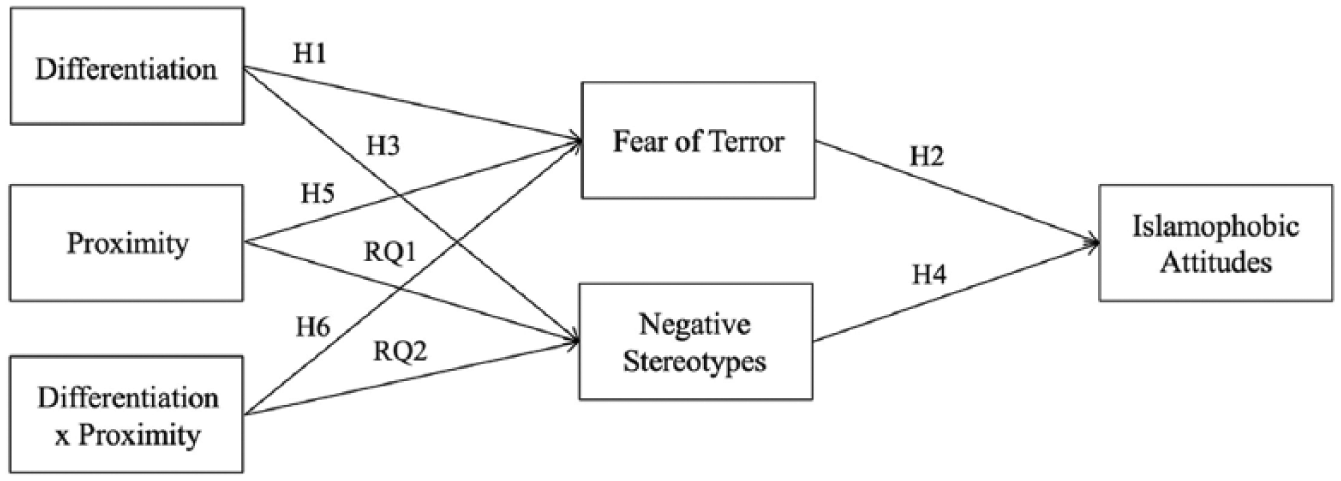
Hypothesized model.
Study 1
Method
We conducted an experiment involving an online survey in Germany from November to December 2016, when Muslims living in Germany represented 6.1% of the national population (Pew Research Center, 2017). The experiment relied upon a nonstudent convenience sample recruited by a research class as part of a university project. Students recruited participants outside the university (e.g., online, via personal networks, and with flyers including a link to the study).
Participants, Design, and Procedure
All 180 participants were non-Muslim residents of Mannheim, Germany, aged 18 to 80 years (M = 30.11, SD = 13.13); 62% were women, and 91.1% were German citizens. 2 All participants were also fluent in German. As an incentive to participate, we held a lottery for 10 gift-cards worth €20 among participants who completed the questionnaire. We employed a 2 (news differentiation: undifferentiated and differentiated) × 2 (proximity: nearby and distant) between-subjects design, 3 in which we randomly assigned each participant to one of the four conditions: undifferentiated news articles about nearby terrorism (n = 40), otherwise identical differentiated news articles about nearby terrorism (n = 48), undifferentiated news articles about distant terrorism (n = 50), and otherwise identical differentiated news articles about distant terrorism (n = 42). A randomization check for age (F(3, 176) = 0.67, p = .572), gender (χ2(6, N = 180) = 4.85, p = .563), education level (χ2(12, N = 180) = 17.85, p = .120), immigration background (χ2(3, N = 173) = 1.28, p = .733), and political orientation (F(3, 169) = 1.37, p = .253) indicated that randomization was successful. Each participant read five newspaper articles (i.e., three manipulated articles and two filler articles) at his or her own pace. After being exposed to the stimuli, participants completed a questionnaire addressing the dependent variables, after which we thanked and debriefed them.
Stimulus Materials
Drawing from published news articles, we created three news articles reporting attempted terrorist attacks or other IS activities for each condition (see Appendix A). As the use of multiple messages increases the external validity of experimental studies (Reeves, Yeykelis, & Cummings, 2016), we prepared three articles for each condition. We carefully designed the articles to resemble authentic news articles published in online newspapers; however, to prevent biased perceptions of the articles, we did not indicate any specific newspaper or media outlet for any article. At the same time, because journalists affect the extent of differentiation in news articles by applying various narrative frameworks and selecting certain quotations from sources, we added an expert’s opinion to the identical facts in each article. In the articles representing differentiated news, the expert’s statement stressed the difference between the mainstream Muslim population and Islamist terrorists, whereas in the articles representing undifferentiated news, the expert did not clearly distinguish the two groups (see Appendix A). In each article reporting a nearby terrorist attack, the title stated that the attack was planned in Mannheim and Frankfurt, Germany, whereas each article reporting a terrorist attack abroad stated that the attack was planned in St. Petersburg and Moscow, Russia. Because all variable-unrelated aspects of the versions of the articles were identical, participants were exposed to identical general information. All articles had approximately 200 words.
Manipulation Check
To test whether our manipulation succeeded, we asked participants where the terrorist attacks reported in the articles occurred. Participants who read articles of nearby attacks more often indicated that the reported attacks occurred in Germany than participants who read articles of distant attacks (F(1, 169) = 148.02, p < .001). In addition, participants who read differentiated news articles perceived that the articles explicitly distinguished Islam in general from IS more often than their counterparts who read undifferentiated news articles (F(1, 169) = 36.10, p < .001). Last, participants who read undifferentiated news articles more often indicated than ones who read differentiated news articles that the articles equated terrorism to Islam religion (F(1, 169) = 36.72, p < .001). Altogether, the results of the manipulation check indicated that our manipulations worked as intended.
Measures and Data Analysis
As presented in full in Appendix C, we gauged fear of terrorism using five items based on Fischer et al.’s (2007) research (Cronbach’s α = .86, M = 2.52, SD = 0.92; 5-point Likert-type scale). By contrast, we assessed negative stereotypes with six items based on Stephan et al.’s (2005) and Saleem et al.’s (2017) studies (Cronbach’s α = .79, M = 3.59, SD = 0.80; 7-point semantic differential) and Islamophobic attitudes with three items based on Lee, Gibbons, Thompson, and Timani’s (2009) scales (Cronbach’s α = .77 M = 2.28, SD = 0.82; 5-point Likert-type scale). Analyses of the factorial structure of the scale supported their unidimensionality. As covariates, we assessed both quantitative (i.e., frequency of personal contact with Muslims, M = 4.49, SD = 2.30; 8-point Likert-type scale) and qualitative aspects of personal contact (i.e., quality of experiences with prior contact with Muslims, M = 6.11, SD = 1.53; 8-point Likert-type scale) with Muslims by using one item each (Voci & Hewstone, 2003).
We performed an ordinary least squares path analysis (Model 4) using the PROCESS macro in the Statistical Package for the Social Sciences. We dummy-coded each experimental condition with a reference group—differentiation with undifferentiated news articles and proximity with news articles reporting distant terrorist attacks—and computed the interaction term by multiplying the mean-centered predictors. Fear of terrorism and negative stereotypes were modeled as mediators of the news articles’ effects on Islamophobic attitudes. To facilitate statistical inferences of indirect effects, we used 95% bias-corrected bootstrap confidence intervals (CIs) based on 10,000 bootstrapped samples. In all analyses, we controlled for frequency of contact with Muslims and perceived quality of contact.
To test whether the data fit our conceptual distinctions of fear of terror, negative stereotypes, and Islamophobic attitudes (see Carpenter, 2018), we performed a confirmatory factor analysis with the software lavaan in R using maximum likelihood estimation. A confirmatory factor analysis with three latent factors revealed an acceptable model fit (χ2 (87) = 155.92, comparative fit index [CFI] = .93, Tucker–Lewis Index [TLI] = .92, root mean square error of approximation [RMSEA] = .07, 90% CI = [.05, .08]), with all factor loadings between .52 and .89 (correlations: fear of terror and negative stereotypes = .17, fear of terror and Islamophobic attitudes = .18, negative stereotypes and Islamophobic attitudes = .40). However, the model fit significantly declined when given a two-factor structure, in which we merged negative stereotypes and Islamophobic attitudes (∆χ2 = 144.19, p < .001), and a one-factor structure (∆χ2 = 475.8, p < .001), which indicates that the three-factor structure achieved the best model fit.
Results
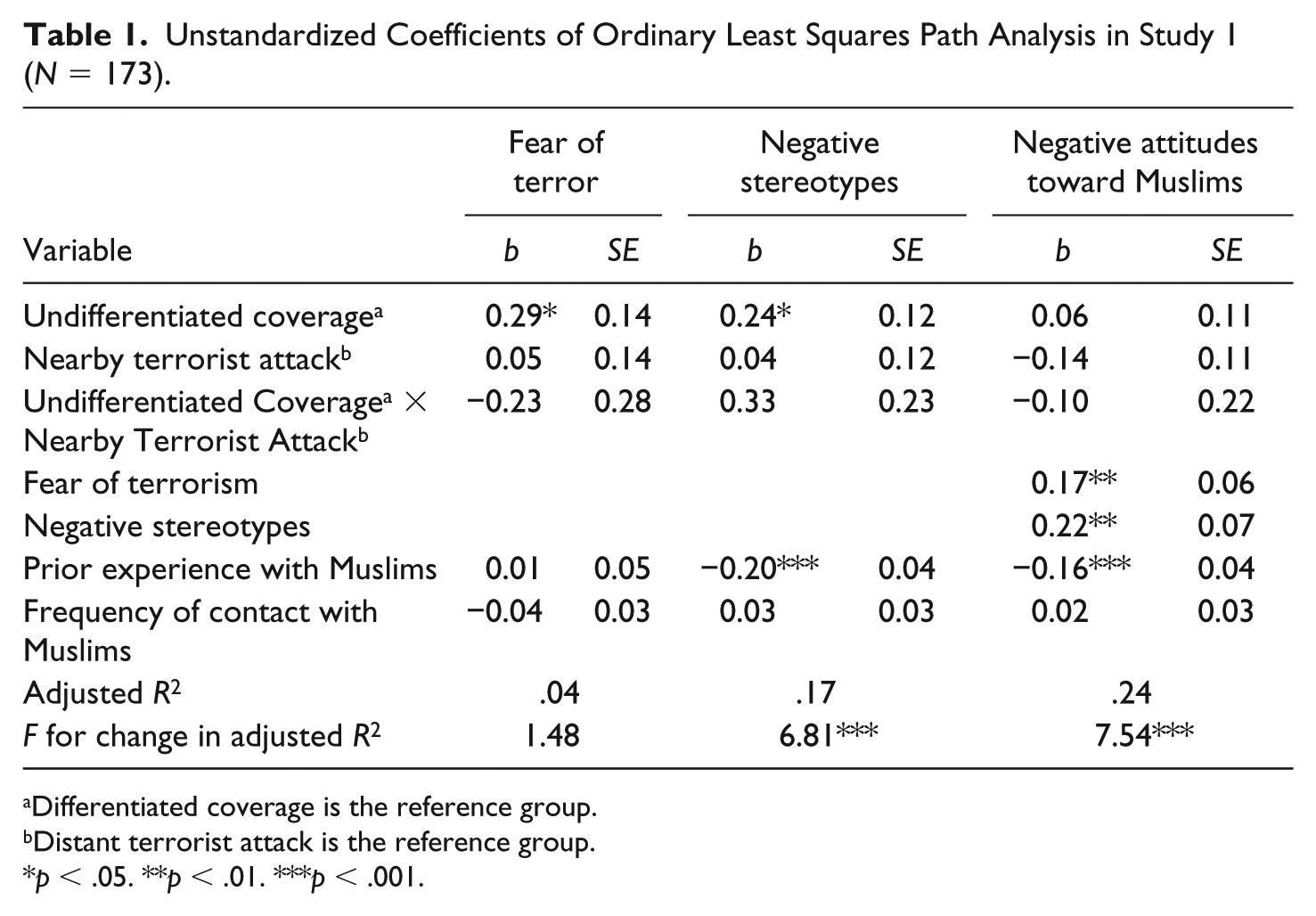
All results from Study 1 appear in Table 1. First, concerning the effects of undifferentiated news coverage about IS on fear of Islamist terrorism (H1), the undifferentiated news articles positively affected fear of terrorism compared to the differentiated news articles (b = 0.29, SE = 0.14, p = .043). Thus, news coverage that did not clearly differentiate Muslims in general from Islamist terrorists activated greater fear of terrorism than news coverage that did make that distinction, which supported H1.
Unstandardized Coefficients of Ordinary Least Squares Path Analysis in Study 1 (N = 173).
Differentiated coverage is the reference group.
Distant terrorist attack is the reference group.
p < .05. **p < .01. ***p < .001.
Our second hypothesis, namely that fear of Islamist terrorism predicts Islamophobic attitudes, also found support, for fear of such terrorism did indeed enhance Islamophobic attitudes among participants (b = 0.17, SE = 0.06, p = .01). Moreover, mediation analysis revealed a significant indirect effect of undifferentiated news coverage on Islamophobic attitudes via fear of Islamist terrorism (b = 0.05, SE = 0.03; 95% CI = [.00, .14]); exposure to undifferentiated news articles thus seemed to enhance fear of Islamist terrorist attacks, which in turn promoted Islamophobic attitudes.
Next, we investigated whether undifferentiated news coverage increased negative stereotypes toward Muslims (H3) compared to differentiated news coverage. Ultimately, exposure to undifferentiated news articles compared to differentiated news articles positively predicted negative stereotypes toward Muslims (b = 0.24, SE = 0.12, p = .041), which confirmed H3. Furthermore, as assumed in H4, negative stereotypes about Muslims predicted Islamophobic attitudes (b = 0.22, SE = 0.08, p = .004) as well as significantly mediated the effects of exposure to undifferentiated news articles on Islamophobic attitudes (indirect effect of exposure: b = 0.05, SE = 0.03; 95% CI = [.01, .14]). More tellingly, we found no direct effects of the undifferentiated news articles on Islamophobic attitudes (b = 0.06, SE = 0.11, p = .594) with mediators included in the models, which indicates that fear of Islamist terrorism and negative stereotypes about Muslims fully mediated the effect of news coverage on Islamophobic attitudes.
Regarding proximity, news coverage of nearby versus distant Islamist terrorist attacks did not significantly affect fear of Islamist terrorism (H5a) (b = 0.05, SE = 0.14, p = .652) or Islamophobic attitudes (H5b) (b = −0.14, SE = 0.11, p = .207). Furthermore, counter to H6, we detected no significant interaction effect of differentiation and proximity on fear of terrorism (b = −0.23, SE = 0.28, p = .410).
In answer to RQ1, proximity to a reported Islamist terrorist attack did not affect negative stereotypes about Muslims (b = 0.04, SE = 0.12, p = .760) or Islamophobic attitudes (b = −0.14, SE = 0.11, p = .201). Moreover, in answer to RQ2, neither differentiated coverage nor proximity to a reported attack had a significant interaction effect on negative stereotypes about Muslims (b = 0.33, SE = 0.23, p =.148) and Islamophobic attitudes (b = −0.10, SE = 0.22, p = .651). Among the covariates, prior positive experience with Muslims exerted a strong negative effect on negative stereotypes about Muslims (b = −0.20, SE = 0.04, p < .001) and Islamophobic attitudes (b = −0.16, SE = 0.04, p < .001). Taken together, the predictors explained 4% of the variance in fear of Islamist terrorism, 17% in negative stereotypes about Muslims, and 24% in Islamophobic attitudes, as detailed in Table 1.
Discussion
The results of Study 1 revealed that undifferentiated news coverage about IS terrorism compared to differentiated coverage indirectly affected participants’ Islamophobic attitudes via the two mediators: fear of such terrorism and the activation of negative stereotypes about Muslims. Those findings extend previous results that undifferentiated reporting can significantly increase news consumers’ fear of Islamist terrorism and thereby reinforce Islamophobic attitudes (Dumont et al., 2003; Slone, 2000; von Sikorski et al., 2017). As intergroup threat theory suggests (Stephan et al., 2009), the larger an outgroup, the more intense its perceived threat to members of an ingroup. In news coverage about Islamist terrorism, not differentiating between Muslims in general and Islamist terrorists substantially enlarges the outgroup and thus the perceived likelihood of being harmed by one of its members.
Furthermore, undifferentiated news coverage of IS terrorism activated negative stereotypes about Muslims in our sample, which supports previous findings regarding the activation of negative stereotypes about Muslims via news reporting (Saleem et al., 2017; Saleem et al., 2016). Exposure to undifferentiated news conflating Muslims and IS terrorists primed news consumers to these negative associations and made the concept “terrorist” more salient among them (Mastro, 2003; Mastro & Tukachinsky, 2011). Consequently, the activation of negative stereotypes about Muslims could have promoted Islamophobic attitudes (Das et al., 2009; Esses et al., 1993).
Surprisingly, Study 1 also revealed that the proximity of a terrorist attack exerted no effect on news consumers’ evaluations. To rule out the possibility that the sample generated a nonsignificant result and to further validate our findings, we conducted a second study employing a quota-based sample in a different European country: Austria.
Study 2
Method
Conducted to replicate the findings of Study 1, Study 2 was an experiment involving an online survey conducted with a quota-based sample in Austria in March 2017, when Muslims living in Austria represented 6.9% of the national population (Pew Research Center, 2017).
Participants, Design, and Procedure
Using Survey Sampling International, we formed a quota-based sample (n = 270) with reference to the demographic characteristics of Austria’s general population, including age (M = 28.77, SD = 13.34), gender (53.3% women), and level of education (8.9% compulsory school, 35.6% apprenticeship, 20.4% secondary vocational school, 20.4% high school diploma, 19.6% higher education degree). 4 Participants with university degrees and younger persons were slightly overrepresented relative to such individuals in the Austrian population. As in Study 1, we employed a 2 (news differentiation: undifferentiated and differentiated) × 2 (proximity: nearby and distant) between-subjects design with four conditions: undifferentiated news coverage about nearby terrorism (n = 58), differentiated news coverage about nearby terrorism (n = 86), undifferentiated news coverage about distant terrorism (n = 55), and differentiated news coverage about distant terrorism (n = 71). 5 A randomization check for age (F(3, 266) = .62, p = .602), gender (χ2(3, N = 270) = 2.80, p = .424), education level (χ2(3, N = 270) = 11.31, p = .503), immigration background (χ2(3, N = 270) = 1.08, p = .781), and political orientation (F(3, 266) = .96, p = .411) revealed that randomization was successful. Each participant read two manipulated newspaper articles presented on a blank screen; unlike in Study 1, however, we presented no filler articles due to time constraints. We programmed the survey software to expose participants to each stimulus article for at least 30 seconds to ensure that they read the articles. Upon completion of the study, we thanked and debriefed participants.
Stimulus Materials
All stimulus materials for Study 2 appear in Appendix B. Similar to Study 1, we created two news articles about IS terrorist attacks or other IS activities for each condition. We carefully designed the articles to resemble authentic online news articles of Der Standard, the most circulated Austrian quality newspaper, and Der Kurier, a large mass-market newspaper. All articles had between 300 and 320 words and presented identical facts of the terrorist event reported; however, in the articles representing differentiated news, the expert’s statement stressed the difference between the mainstream Muslim population and Islamist terrorists, whereas in the articles representing undifferentiated news, the expert did not clearly distinguish the two groups (see Appendix B). The first article reported planned terrorist attacks by the IS in Austrian cities that could be prevented by arresting terrorists and contained a differentiated or undifferentiated statement by a fictitious expert on jihadism. By contrast, the second article described a warning issued by Europol that the danger of an IS terrorist attack (e.g., in Vienna) was high; the article also contained a differentiated or undifferentiated comment by the director of Europol.
Manipulation Check
Participants who read news articles about nearby terrorist attacks indicated to a significantly higher degree than participants who read articles about distant attacks that the reported attacks occurred nearby (p < .001). Moreover, participants who read differentiated news coverage were more likely than ones who read undifferentiated coverage to perceive that the articles explicitly distinguished Islamist terrorism from Islam (p < .001). Altogether, the results of the manipulation check indicated that our manipulations worked as intended.
Measures and Data Analysis
Unless stated otherwise, all items used in Study 2 were analogous to ones used in Study 1 (see Appendix C). Fear of terrorism was gauged using five items (Cronbach’s α = .89, M = 3.35, SD = 1.38; 5-point Likert-type scale), 6 whereas the measurement for negative stereotypes was slightly adapted from that used in Study 1 to consist of three items based on Saleem et al.’s (2017) study (Cronbach’s α = .96, M = 4.25, SD = 1.66; 7-point semantic differential scale). We gauged Islamophobic attitudes with four items (e.g., Cronbach’s α = .93, M = 4.53, SD = 1.97; 7-point Likert-type scale). As covariates, we assessed the frequency of personal contact with Muslims with one item (M = 4.07, SD = 2.30; 8-point Likert-type scale) and the quality of prior contact with Muslims with two items (Cronbach’s α = .97; M = 4.30, SD = 1.92; 8-point Likert-type scale). The procedure used in data analysis was identical to that used in Study 1.
A confirmatory factor analysis with three latent factors revealed the model fit (χ2(51) = 151.01, CFI = .97, TLI = .96, RMSEA = .07, 90% CI = [.06, .09]). All factor loadings fell between .65 and .97 (correlations: fear of terror and negative stereotypes = .42, fear of terror and Islamophobic attitudes = .49, negative stereotypes and Islamophobic attitudes = .78). However, the model fit significantly declined with a two-factor structure, in which we merged negative stereotypes and Islamophobic attitudes (∆χ2 = 381.02, p < .001), and with a one-factor structure (∆χ2 = 968.62, p < .001), thereby indicating that the three-factor structure achieved the best fit.
Results
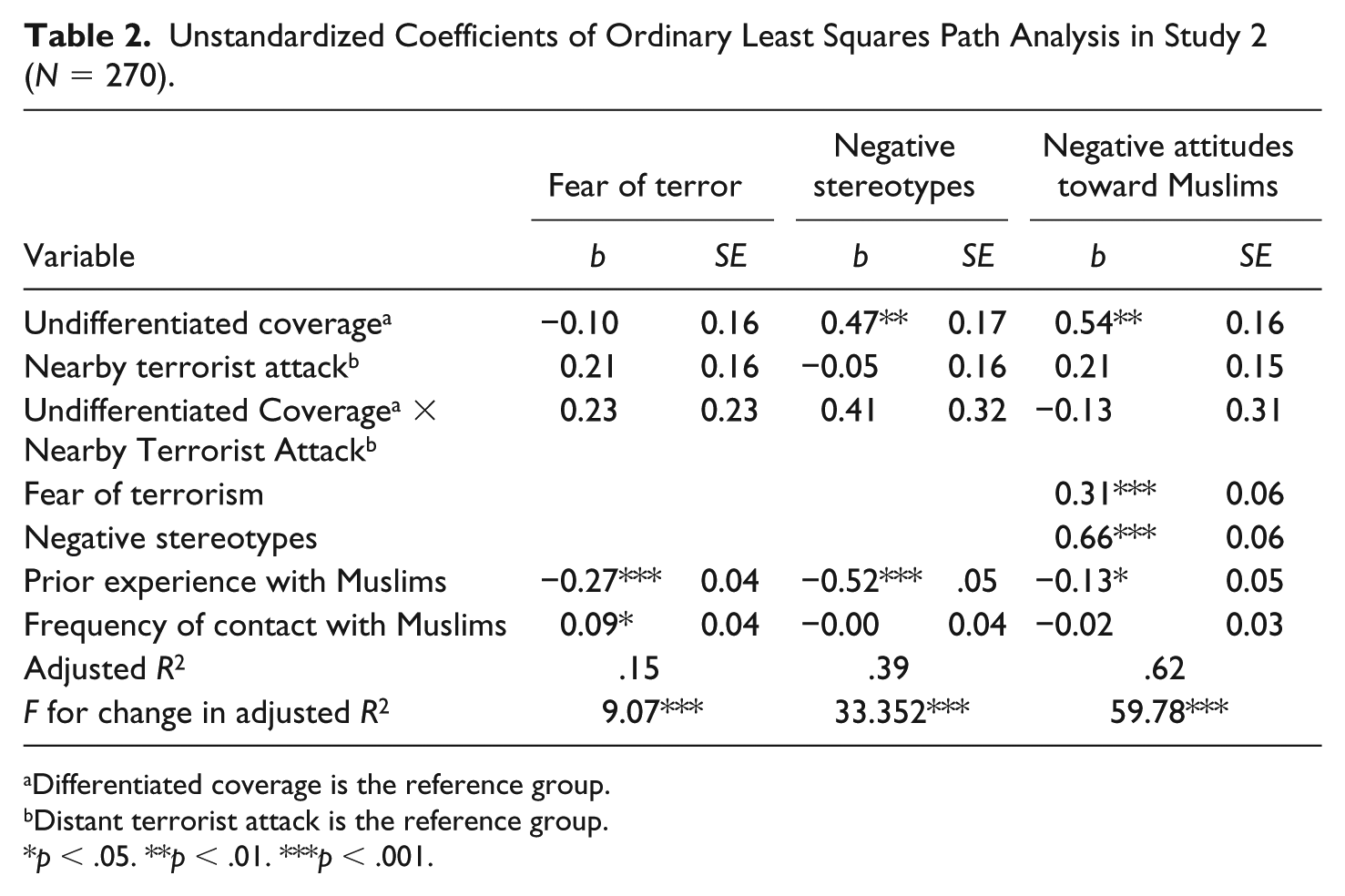
All results from Study 2 appear in Table 2. First, we expected that undifferentiated news coverage would intensify fear of Islamist terrorism compared to differentiated news coverage (H1). In contrast to Study 1, in Study 2 we found no support for that assumption (b = −0.10, SE = 0.16, p = .531). Although we did detect a positive effect of fear of Islamist terrorism on Islamophobic attitudes (b = 0.31, SE = 0.06, p < .001), which supported H2, we did not detect any support for a mediation effect of exposure to undifferentiated new coverage on Islamophobic attitudes via fear of Islamist terrorism (indirect effect of exposure: b = −0.03, SE = 0.05, 95% CI = [−.14, .06]).
Unstandardized Coefficients of Ordinary Least Squares Path Analysis in Study 2 (N = 270).
Differentiated coverage is the reference group.
Distant terrorist attack is the reference group.
p < .05. **p < .01. ***p < .001.
As in Study 1, in Study 2 we observed the positive effect of exposure to undifferentiated news coverage on negative stereotypes about Muslims (b = 0.47, SE = 0.16, p = .004), which supported H3. Concerning H4, we found a strong positive effect of negative stereotypes about Muslims on Islamophobic attitudes (b = 0.66, SE = 0.06, p < .001), which confirmed our hypothesis. Also as in Study 1, in Study 2 we observed a significant mediation effect of exposure to undifferentiated news coverage on Islamophobic attitudes via the activation of negative stereotypes about Muslims (indirect effect of exposure: b = 0.31, SE = 0.11, 95% CI = [.11, .55]. A direct effect of undifferentiated news coverage on Islamophobic attitudes (b = 0.54, SE = 0.16, p = .001) also surfaced that we could not associate with negative stereotypes about Muslims.
Even more similarly to the results of Study 1, in Study 2 we found no effect of proximity to a reported terrorist attack on fear of terrorism (b = 0.21, SE = 0.16, p = .182). That finding suggests that news reports about nearby terrorist attacks did not intensify fear more than distant ones and did not amplify Islamophobic attitudes, which contradicted H5. We also did not observe any significant interaction effects of differentiation and proximity on fear of terror (b = 0.23, SE = 0.23, p = .464) and thus rejected H6. In another reflection of the results of Study 1, proximity did not affect negative stereotypes (b = −0.05, SE = 0.16, p = .752) or Islamophobic attitudes (b = 0.21, SE = 0.15, p = .178) (RQ1).
In answer to RQ2, we observed no significant interaction effects of differentiated news coverage and proximity to reported terrorist attacks on negative stereotypes about Muslims (b = 0.41, SE = 0.32, p = .207) or Islamophobic attitudes (b = −0.13, SE = 0.31, p = .687). Concerning the covariates, positive prior experience with Muslims negatively affected fear of Islamist terrorism (b = −0.27, SE = 0.04, p < .001), negative stereotypes about Muslims (b = −0.52, SE = 0.04, p < .001), and Islamophobic attitudes (b = −0.13, SE = 0.05, p = .014), while frequency of contact with Muslims positively affected fear of Islamist terrorism (b = 0.09, SE = 0.04, p = .013). In sum, the predictors explained 15% of the variance in fear of Islamist terror, 39% in negative stereotypes about Muslims, and 62% in Islamophobic attitudes.
Discussion
Corroborating the findings of Study 1, the results of Study 2 showed that news coverage that did not differentiate Islamist terrorists from Muslims in general significantly increased the activation of negative stereotypes about Muslims. Such negative stereotypes, in turn, prompted Islamophobic attitudes. Triggered by undifferentiated but not differentiated coverage of IS terrorism, that mechanism can therefore be deemed robust, as we observed it in both studies.
In contrast to Study 1, Study 2 revealed the direct effect of undifferentiated news coverage on Islamophobic attitudes that we could not associate with negative stereotypes about Muslims. That finding encourages future research on other potential mediators of undifferentiated news coverage on Islamophobic attitudes. Although in Study 2 proximity did not exert any effect on the mediators or the dependent variable, which also occurred in Study 1, we observed a significant effect of undifferentiated news coverage on fear of Islamist terrorism in Study 1 that we did not detect in Study 2, despite that the path from fear of such terrorism to Islamophobic attitudes in both studies was significant. An explanation for that nonsignificant finding could be the existence of a pretreatment effect (Druckman & Leeper, 2012), namely that a general increase in fear of terrorism triggered by several IS attacks in Europe, including one in Berlin prior to data collection for Study 2, might have resulted in a ceiling effect.
Among the covariates, positive prior experiences with Muslims negatively affected fear of Islamist terrorism, whereas mere contact with Muslims exerted a positive effect. Those results support previous findings related to the contact hypothesis (e.g., Pettigrew, 1998) that certain forms of everyday contact with outgroup members might be insufficient to improve intergroup attitudes, as contact needs to be positive. Moreover, members of an ingroup who perceive an outgroup to be quite large react to the perceived threat with increased intensity (cf. Stephan et al., 2009).
General Discussion
In two studies, we examined the role of journalistic differentiation and proximity to reported terrorist activities in the context of news coverage addressing IS terrorism. Although proximity showed no relevant effects, our results revealed that journalistic differentiation can play an essential role in preventing negative stereotypes about Muslims among non-Muslim news consumers.
Activation of Negative Stereotypes
Conducted in different European countries, both studies showed that undifferentiated versus differentiated news coverage of IS acts of terrorism activated negative stereotypes about Muslims and, in turn, Islamophobic attitudes. That finding extends previous results on media portrayals of Muslims and the formation of negative stereotypes about them (Saleem et al., 2017; Saleem et al., 2016). Thus, in Western societies, explicitly differentiating the outgroup categories of Islamist terrorists and Muslims can help to prevent particular priming effects among non-Muslim news recipients (Mastro et al., 2009). One necessary precondition for such a priming effect, however, is its applicability to a certain social category (Scheufele & Tewksbury, 2007). When Islamist terrorists are explicitly differentiated from Muslims, the applicability of the former category to the latter category becomes distinctly reduced, and a respective priming effect can be prevented. Journalistic differentiation may therefore be a useful strategy for journalists in reporting terrorism committed by IS proponents that can also mitigate the activation of stereotypes about Muslims and, consequently, Islamophobic attitudes among non-Muslim news consumers.
Effects on Fear of Terrorism
Although the German sample in Study 1 exhibited a significant effect of undifferentiated news coverage on fear of terrorism, the Austrian sample in Study 2 did not. Possibly, culture- and context-specific aspects played a role in producing those inconsistent effects of undifferentiated coverage of news about terrorist activities. As additional analyses revealed, fear of terrorism was significantly higher in Study 2 across all conditions (M = 3.51, SD = 1.38) than in Study 1 (M = 2.52, SD = 0.92) (F(1,448) = 72.20, p < .001), although perhaps for circumstantial reasons. Shortly after data collection for Study 1, a major terrorist attack occurred in Berlin, followed by several other attempted and realized attacks throughout Europe. Following Druckman and Leeper’s (2012) emphasis on considering events that occur prior to data collection (i.e., pretreatment effects) when conducting experimental studies, the null finding of exposure to news in relation to fear of terrorism in Study 2 could have stemmed from a ceiling effect (cf. Das et al., 2009). In reality, when terrorist threats seem pervasive, it is difficult to prevent fear of terrorism among news consumers by offering news coverage that explicitly differentiates Muslims in general and Islamist terrorists.
To clarify the possible influence of ceiling effects, researchers could test a dose-dependent account of the effects of news differentiation. On the one hand, amid constant exposure to (undifferentiated) news about terrorism and generally high levels of fear of terrorism, exposure to differentiated news arguably needs to be more intensive and extensive. To gauge the influence of such potential changes, researchers could test news stimuli consisting of stronger cues (e.g., in headlines and in audio-visual formats) to examine whether stronger doses of differentiation can reduce fear of Islamist terrorism and, in turn, Islamophobic attitudes. On the other hand, presenting audiences with news about acts of terrorism that consistently differentiates Islamist terrorists who strongly identify as Muslims from Muslims in general and obscures any connection between Islamist terrorism and Islam may generate counterargument among news consumers, especially ones with preexisting negative perceptions of Muslims and Islam. Such strategies could consequently not reduce fear of Islamist terrorism but reduce trust in media because news consumers might perceive news stories to be biased or one-sided. Nevertheless, based on our results, news covering IS terrorism should at least provide some information (e.g., an expert’s statement) that clearly differentiates Islamist terrorists from the general Muslim population in order to prevent negative generalizations of Muslims. As another strategy, journalists and other communicators should use terms such as Daesh to refer to IS as a means to prevent associations between Islam and the terrorist organization.
Proximity
Previous research has suggested that distance mitigates fear (Heath, 1984; Stamps, 2011) and, by extension, that physical proximity to versus distance from an act of Islamist terrorism can breed negative prejudice toward Muslims (Das et al., 2009). Surprisingly, neither of our studies indicated any effects related to proximity of reported terrorist activity. Although the results of both manipulation checks indicated that our manipulation functioned as intended, exposure to news about terrorist threats might have triggered a biased perception of proximity. After all, “affective signals of threat increase perceived proximity” (Cole, Balcetis, & Dunning, 2013, p. 34), which suggests that people perceive the location of threatening events to be closer than it is in reality. At the same time, frequent exposure to news coverage of terrorism arguably makes the location of such activity less important. If places across Europe or the world are affected by IS terrorism, then it is likely that individuals anticipate that the cities where they live will be affected by such terrorism sooner or later. Consequently, each additional news report on IS activity not only makes the location where an actual act of terrorism was attempted or realized less important but also reinforces the fear of Islamist terrorism and negative stereotypes about Muslims. Furthermore, the randomness of terrorist actions—arguably, terrorism can occur anywhere at any time—can prompt fear in citizens anywhere and thus make the proximity of reported acts of terrorism less important. However, future studies should test those speculations, especially in non-European countries and societies with smaller or larger proportions of Muslims. In any case, the nonsignificant findings regarding proximity expand current knowledge on the effects of news about terrorism.
Limitations
First among the limitations of our research is that we exposed participants to news articles only. In the future, researchers should examine whether the effects that we detected can be replicated with, for example, TV news. The visual aspects of news about terrorism especially demand greater attention in effects studies. As Study 2 revealed an indirect and direct effect of undifferentiated news coverage of terrorism on Islamophobic attitudes, researchers should test additional mediators that could explain the particular processes at work.
Second, we used a convenience sample in Study 1, even if it was a nonstudent convenience sample (age range: 18-80 years), and we replicated the study with a representative sample. Panel studies should validate our experimental approaches by combining exposure measures with content analyses of news media in order to generate evidence in more externally valid settings. Moreover, research should be conducted in non-European settings using explicit and implicit measures (Das et al., 2009) as well as distinguish several types of IS terrorist attacks in the news. To that end, however, researchers should note that, in experiments, it is difficult, if not impossible, to manipulate news about real terrorist attacks. Because most respondents expect to have heard about such attacks, fake news reports cannot be used. By contrast, real news reports about real terrorist attacks have the disadvantage of ceiling effects because most respondents will have formed opinions prior to the experiment.
Researchers should also test whether patterns found in other studies—(un)differentiated reporting, fear of Islamist terrorism, negative stereotypes about Muslims, negative generalizations to Islam, and Islamophobia— extend to other groups or situations. In that context, at least three boundary conditions warrant consideration; the particular outgroup is a minority in a given society (e.g., Muslims in the United States), the outgroup is perceived in rather negative ways by the ingroup, and outgroup terrorists are perceived to be affiliated, whether culturally or religiously, to the broader outgroup. In response, researchers could examine, for instance, the conflict in Turkey between the Turkish majority and Kurdish minority in light of those boundary conditions. Those limitations notwithstanding, our findings pose important implications for understanding media and religion.
Conclusion
News media frequently and intensively report on IS terrorists, which is exactly what IS terrorists seek. IS terrorists generate energy and momentum for their movement by spreading fear across the world, as well as arguably divide Western societies by fueling Islamophobia among non-Muslims, which can affect the ways in which Muslims are perceived and treated in the Western world. When news media do not clearly distinguish terrorism from Islam, non-Muslims react with negative sentiments toward Muslims, as our research has clearly demonstrated. If that process occurs in the long term, then such sentiments might be felt by Muslims as efforts to suggest their lack of belongingness and need to be socially segregated. Although such speculation is beyond the scope of our research, suffice it to say that such feelings could attract some Muslims living in the Western world to IS ideologies. As our results indicate that differentiated news reporting can partly stem from that process, we call journalists to explicitly distinguish Muslims in general from Islamist terrorists in their work. With differentiated coverage, unwanted generalizations liable to promote hostile attitudes toward Muslims can be avoided, while news consumers can nevertheless be informed about threats that affect all of us.
Footnotes
Appendix A
Appendix B
Appendix C
Declaration of Conflicting Interests
The authors declared no potential conflicts of interest with respect to the research, authorship, and/or publication of this article.
Funding
The authors received no financial support for the research, authorship, and/or publication of this article.