




Abstract
This paper critically examines 48 digital news updates to six New York Times online articles collected through 181 captures via the Internet Archive’s Wayback Machine (WBM), a web scraping tool, pertaining to federal military and local police responses to Portland protests published in headlines, sources, quotes, hyperlinks, the order of information presented, and articles’ main thrusts of meaning. Through this analysis, we call for the notion of “ideological correction” to represent an additional element of the liquidity of journalism in this case — shifts in news explanations of single articles that altered the articles’ focus on and characterizations of law enforcement and protesters — sometimes even under the same, original headline and article URL.
Keywords
Introduction
Six days after a Black Lives Matter protester was shot in the head by police 1 forces in the U.S. state of Portland, Oregon, The New York Times posted its first online story about the law enforcement presence in the city (Olmos et al., 2020a). Over the course of a day, the article – including its headline and lede – saw a massive shift in explaining the role of police in the city. The headline no longer suggested federal officers were in the city to “quell unrest,” nor did its opening paragraph state they were there to “subdue a persistent group of protesters by shooting tear gas canisters and making arrests, as noted in the original version. The headline now read that federal agents were there to “Unleash [a] Militarized Crackdown” and included a quote in its lede that the agents were exercising a “blatant abuse of power” against demonstrators. All told, based on data captured by the Internet Archive’s Wayback Machine (WBM), the same article underwent least 14 updates in 24 hours, with the addition and removal of hyperlinks, quotes, and other content that altered the main thrust of the reporting and its charecterizations of police forces. The only noticeable indication that something had changed was in updated timestamps that appeared near the byline. The articles URL remained the same.
Certainly, news changes, and journalists are expected to update pertinent information as it becomes available. News has long undergone various forms of processing updates, from the days of shipping news to rewrite desks, from telegrams to the telefax (Burgess, 1985). Today's forms of updating news include writing new stories the same or next day, sounding breaking news alerts on TV and radio, fueling wire service reports, and publishing push and social media notifications. Today’s processes of updating the news also leave digital footprints that not only assist in understanding the practical aspects of how news changes in real-time but reveals ideological movements of the news as it is made (and remade). Indeed, since journalism’s adoption of the internet’s publishing platforms, scholarship has examined the characteristics of digital news updates in terms of what aspects of a news story changes, the temporalities of updating online news, and the additions to or corrections of information originally posted (Deuze, 2008; Saltzis, 2012; Usher, 2018; Widholm, 2016). Our project extends that work to explore the ideological and meaning-making aspects of the aspects of digital news updates beyond the content that is a “correction” or merely the update of new information, such as a moment of breaking news within a single article and URL.
To do so, we conduct a critical textual analysis (Parks, 2021) of 48 digital news updates to six New York Times online articles collected through 181 captures via the WBM, a web scraping tool, pertaining to federal military and local police responses to Portland protests published between July 17 and July 21, 2020. At its core, we hope to contribute to understandings of the layered meanings of digital news through analysis of updates that make a digital news article a type of palimpsest – a patchworked artifact marked, erased, and reworked (Shumow and Gutsche, 2016: 44). We will argue this type of palimpsest is imbued with issues of articles’ temporality, positionality, and power surrounding the fast-paced creation of news content and the replacement of content with new explanations and information that appeared in previous article versions. As its major contribution, we use this analysis to introduce the notion of “ideological correction” to represent shifts in news explanations after publication that alter post-published journalism beyond what scholars and readers might expect, particularly the ideological aspects of digital news updates in terms of the reproduction of dominant narratives of explanation (Lule, 2001) over time and the intersection of updated information and perspectives with original and lasting text and ideas.
Our paper begins with an overview of journalism as a cultural force related to ideological power dynamics in the process of newswork and the challenges and opportunities for journalism in a fast-paced digital world of updating. We then discuss our methodology, including using the WMB to capture data and our approach to conducting a “deep reading” (Handley and Rutigliano, 2012) through a critical textual and micro-longitudinal analysis (Kutz and Herring, 2005) of digital news updates. The article concludes with suggested future work based on our findings and contribution.
The power of news explanations: A conceptual framework
In this section, we discuss two major areas of scholarship that are related to this paper – the explanatory function of journalism and its relationship with time and production – to foreground our interpretive analysis that showcases the minute-by-minute updates to news, not just in terms of “facts,” but explanation.
Journalism as cultural connector
Before entering too far into the study, it is important to note that journalism is a complicated social and cultural force that is ripe for examination related to its epistemological forms, its forms of production, dissemination, and interactions amid sources, fellow reporters and social institutions, and audiences (for review, see Berkowitz, 1997). We also subscribe to notions that one of journalism’s main characteristics is its cultural position in relaying explanations for what is covered as “news” and journalistic commitment to dominant interpretations issued by structures of power that serve as journalism’s foundation as a social and cultural product (Gutsche, 2015; Hall, 1986; Sigal, 1973). Ettema (2005), for instance, describes the explanatory function of journalism that relays descriptions of daily news events through expressions that are salient and resonant for audiences as holding an “imaginative power” that elevates information shared into cultural messages. Here, the explanatory power of journalism through language, vantage point, source use, and other traits represents the crux of how journalism establishes its initial explanations of news events and issues (Lule, 2001). Embedded in these messages are ideologies, or “meanings in the service of power” (Thompson, 1990: 7), that reveal how journalism operates amid ideological spheres of influence that shape content alongside other normative forces of time, finances, and the cooperation and approval of fellow institutions (Berkowitz, 2011; Gutsche, 2015; Reese and Shoemaker, 2016).
Alongside the ideological aspects of news explanation (Bird and Dardenne, 1997), journalistic practice adheres to an “iron core” of newswork that revolves around processes of “bearing witness,” “following up,” explaining the news, and further investigating it (Jones, 2009: 5–8) to assist in both engaging audiences with (new) information to assist in a sense of public service of providing information, as well as embedding dominant ideology into daily news (Altheide and Snow, 1979; Ellis, 2020; Herman and Chomsky, 1988). Journalism, therefore, operates as an actor of ideology and through a ritual of communication to provide “language that help(s) structure and shape public discussion” (Lule, 1991: 76). This practice can occur over long (and short) periods of time as journalists seek or receive new information and/or explanations (Risley, 2000). Scholarship has found that in times of social protest and unrest similar to events of the Portland protests addressed in this paper, dominant explanations for social conditions in journalism are provided by police and governments so as to maintain a consistent, collective message for the benefit of “calm” and social order (Manning 1997). Simultaneous to the need for accessing and sharing “authoritative” explanations for everyday life and breaking news events (Kilgo and Mourão, 2021), journalists also find they must work quickly to maintain their own authority with audiences in an age of increased speed (Ekström et al., 2021).
Update journalism: From news bundling to breaking news
Updates to journalism are as old as the trade: Bundled news that was shipped across seas bridged continents, altered the sense of time in news, and provided journalists with updated content that required localizing and contextualizing “new” information that arrived locally from afar (Burgess, 1985). Newspapers in the U.S. have long produced “zoned” editions of their print material, with published news products including the earliest information sent to further physical distances in time to reach breakfast tables. Today, journalists are often updating online articles, from corrections to news explanations, operating in “real-time,” as digital news has further compressed the notions of time to meet the needs and interests of audiences, advertisers, and news competitors (Harro-Loit and Josephi, 2020). As journalism has reacted to influences of speed, journalists have taken various approaches to meet the interests and needs of audiences who are also demanding more information faster. News updates operate within the notion of the "liquidity" of news that articulates the influence and interactions of temporalities and technologies in producing up-to-the-minute content (Deuze, 2008; Widholm, 2016).
Scholars have presented a range of ways to examine the changing nature of digital news under similar temporal spells (e.g. Kutz and Herring, 2005; Lim, 2012), identifying, as we do in this paper, the increasing prevalence of “incremental news updates” (Usher, 2018). However, much of the work is descriptive in its details of how (and possibly why) news updates appear as they do (e.g. Karlsson et al., 2017). These discussions are often absent of critical and cultural understandings of the potential meanings associated with the purposes, practices, and philosophical aspects of news explanations and related ideological dimensions. Expanding the discussion to involve these elements would contribute further to notions of “layered news,” where acts and influences of reporting, contextualization, analysis, and projection build temporal (and cultural) understandings of news coverage over longer periods of time – from decades to minutes (Neiger and Tenenboim-Weinblatt, 2016). Current studies in the updating of news – even those that occur in similar manners to what we address in this study – reinforce normative work that indicate that the increased speed of digital journalism, journalistic interest in correcting inaccuracies, and appearing to operate in “real-time” (Zelizer, 2021).
Therefore, based on the above literature, we are led by the following research questions to guide a critical textual and “micro-longitudinal” analysis of news updates of one specific case: First, we ask, “What aspects or characteristics of news texts were updated in Times coverage of the militarized response to protests in Portland, and how did digital news updates alter or further develop overarching explanations for police and protesters’ behaviors?” Second, we ask, “How can critical explorations of news article updates inform understandings of the explanatory power of news?” We examine these questions following a discussion of our study’s method.
Constructing a deep reading of digital news updates: Method
The New York Times online articles and updates analyzed.
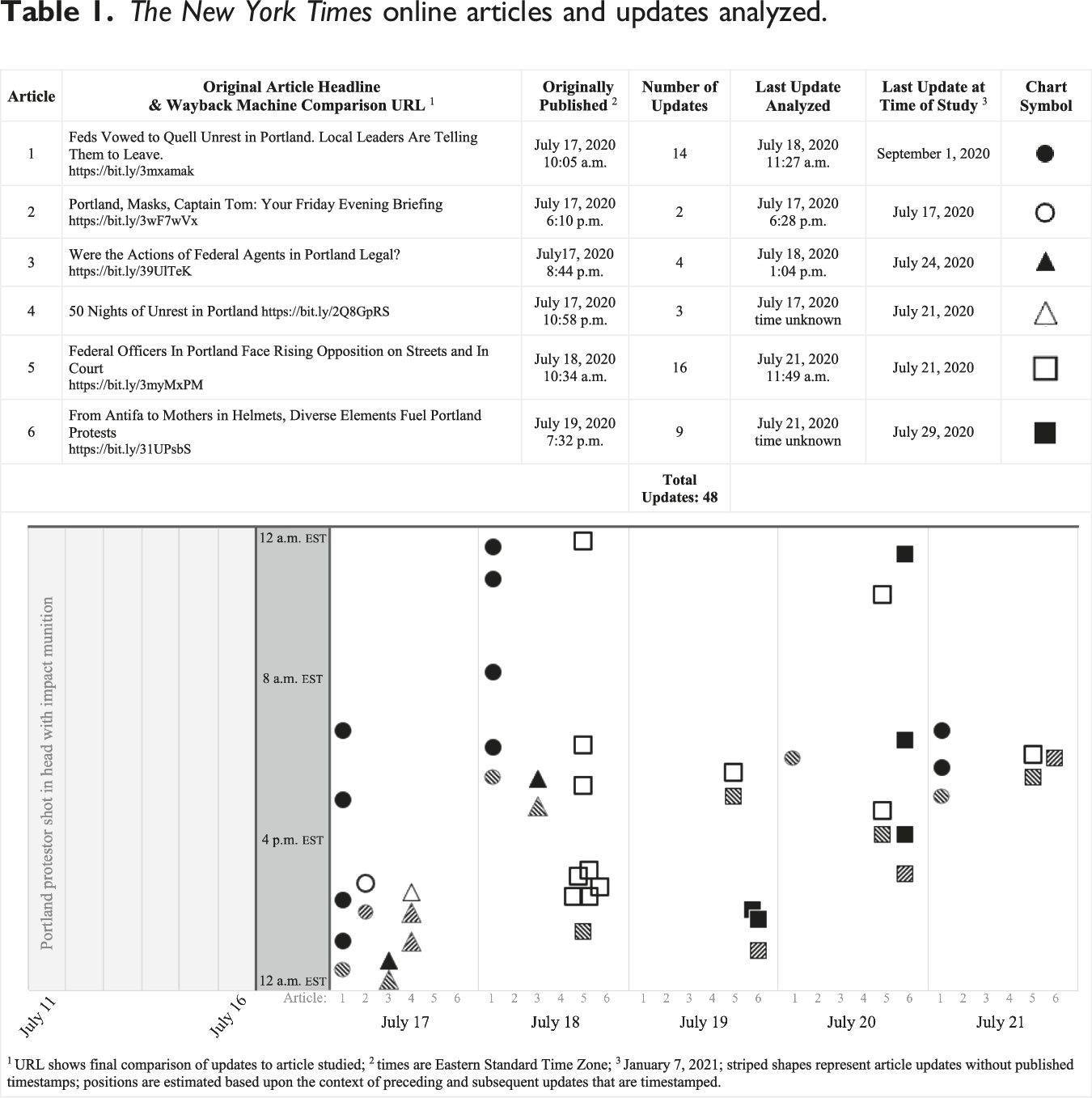
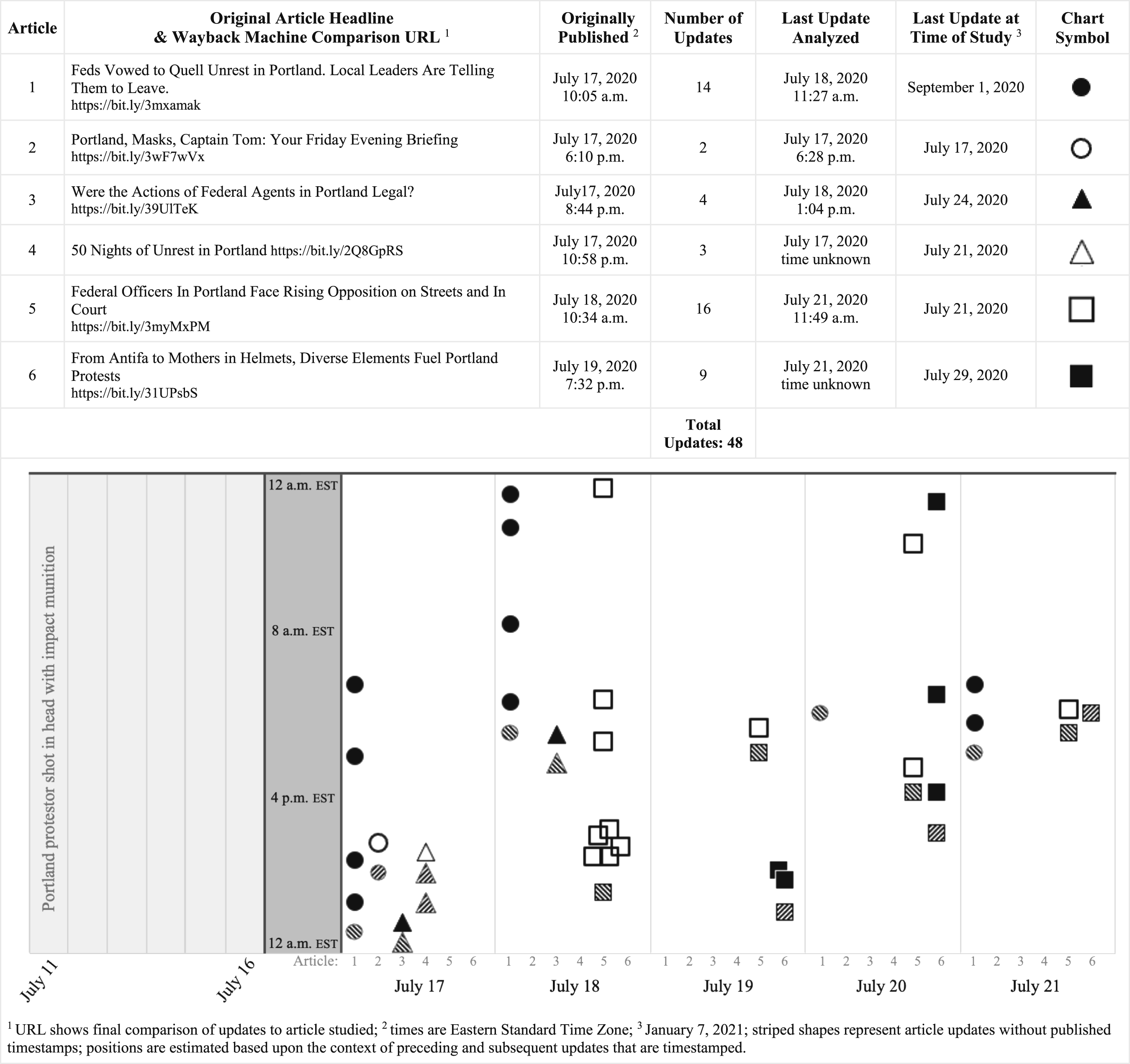
We entered into WBM URLs from the six Times articles as they appeared in September and October 2020 to collect screen captures of the related updates. Our search yielded 181 screen captures of updates that were published and captured by WBM within a one-week period following the articles’ publication. Of these captures, we identified 48 updates that included changes to the articles. To compare changes reflected by the WBM screen captures, we used the tool’s “changes” function, a feature that highlights modifications between two screen captures, highlighting and color-coding additions and removals. In addition to using this feature, we read through each screen capture to verify the accuracy of alterations between updates (for an example of visualizations related to “web changes,” see Mabe, et al., 2020.) 3
By selecting articles through WBM that show (as best as possible without our own web crawler) incremental alterations to articles as they are updated, we replicate the aims of a micro-longitudinal analysis to highlight updates across spans ranging from minutes to days. To identify common characteristics of updates selected for this study, we applied an inductive approach to read updates, paying particular attention to possible alterations to headlines, articles’ text (including ledes, sources, quotes, and hyperlinks), the placement and captions of photographs and videos, and the timestamp of updates (Kutz and Herring, 2005). We then began a “deep reading” (Handley and Rutigliano, 2012) of the changes within the updates captured by WBM to interpret how additions and removals of information or other alterations may have reinforced or subjugated one news explanation of and for the police response to protests in exchange for another. Through this reading, we paid particular attention to alterations in material that changed overarching meaning of a sentence, headline, or article thrust, or that focused or nonmaterial changes that updated characteristics such as spelling and grammar or includes information that did not change the meaning of a sentence, headline, or overarching article meaning.
This approach to a critical textual analysis of news (Parks, 2021) allows readers to interpret the building blocks of news explanations. Our readings independently and together included note-taking and discussions amongst authors (Berkowitz and Eko, 2007) related to the “explanatory power” of news coverage over time and within those explanations any shifts of power presentations (Thompson, 1990). A critical approach “demystifies ideologies and power” through rigorous and informed readings of a text to and interrogates its layered ideological meanings (Wodak and Meyer, 2009). Our approach to the articles and updates included in this study is informed by previous critical analyses of journalism texts to recognize and highlight issues of power, ideologies, and dominant social and cultural meanings as being hegemonic in their application through news storytelling (ie Lovelock, 2018). In our reading, we also paid particular attention to the “symbolic dimension of journalistic language” (Spurr, 1993: 91), such as metaphor, diction, vantage point, and sourcing to identify aspects of power in the articulation of meaning (Fairclough, 1995). We take an approach to this paper that borrows from critical examinations of journalism in which we critique the degree to and means by which journalism as cultural text connects dominant power structures and ideologies to everyday events, issues, and news. The following portion of our paper helps to identify the ideological function of digital news updates to shape what some users may only see and view as permanent – though we do not — and “final” (and/or merely edited or updated) articles.
News updates as cultural text: A critical textual analysis
In this section, we address our first research question, which asks about the elements and characteristics of news texts and how the updates altered or further developed overarching explanations for police and protesters’ behaviors. We present this analysis organized around the main characteristics of updates identified for this project – headlines, ledes, and article text – in articles captured by WBM. To be clear, the Times may have published more updates to articles than those we have read, though we have collected and analyzed the minimum number of article updates that WBM provided. Headline changes were found in five updates of two articles; one article (Olmos et al., 2020b) consisted of four of the headline changes and an update that included changes to the subhed/kicker. Of all the 48 updates analyzed for the study, 56% were recorded as having some form of textual additions to ledes and text in the articles’ body, including quotes (29%); hyperlinks (40%), and sources (29%). Removals of text included deletions of quotes (9%) and hyperlinks (18%); no sources were removed in updates.
Below, we will argue that news presentations and characterizations of police and protesters that appeared in initial articles consistently changed in article updates in ways from using language and explanation that criticized the legitimacy of law enforcement’s use of force to language and explanation that justified and made virtuous the presence and behaviors of protesters. Specifically, we will argue that coverage began by assigning military law enforcement the characteristics of “virtuous police” (Manning, 1997) though later – sometimes under the same headline and URL and with portions of the article text altered — repositioned their presence as being more complicated. Simultaneously, coverage recharacterized protesters as being instigators to acting as virtuous citizens. These shifts complicate the interpretations and explanations of what journalists cover online and what they present as being a static presentation in the form of a completed (or temporarily completed) article or update (for more, see Spurr, 1993). Not only does such an analysis complicate knowledge about digital journalism practice but opens an avenue for understanding means by which journalism and its cultural explanations change over time – even in short stints and possibly without the reader realizing.
Headlines: The power to signal story meaning
In this study, the headline was perhaps of the most noticeable or recognizable areas of alterations of articulations and characterizations of police and protesters as virtuous or violent that also changed over the course of updates. For example, the fourth update to one article’s headline 6 hours after it first appeared, “Federal Officers in Portland Face Rising Opposition on Streets and in Court” (Olmos et al., 2020b) change it to “Federal Officers Deployed in Portland Didn’t Have Proper Training, D.H.S. Memo Said” and repositioned the meaning of the article’s initial message. A reading of the article with its original headline argued that law enforcement was battling the “largest crowd in weeks,” with many of the protesters chanting, calling officers “terrorists,” reinforcing the idea in the article’s original headline that protesters were “rising” against those trying to calm them. The new headline now presents to users a perspective that delegitimizes law enforcement through stating that agents and officers “didn’t have proper training,” thereby positioning their use of force as a flaw specific to the agents on the ground — not the larger military institution — who were “facing” a “growing backlash.”
An earlier update to this same article, published more than 2 hours after the original article appeared, also changed a single word in its subhead that initially read, “Rather than tamping down persistent protests in Portland, Ore., a militarized presence from federal officers seems to have reignited them.” In this case, the word “reignite” positions officers as being unwittingly responsible for fueling the flames of discontent and casting those who have been “ignited” as operating without agency, merely as a result of the others’ presence. Suggesting that protesters were “re-ignited,” on the other hand, focuses on the active power/agency of protesters themselves to organize. The headline to another article was changed in an update 11 hours after it was initially published from “Feds Vowed to Quell Unrest in Portland. Local Leaders Are Telling Them to Leave” to “Federal Agents Unleash Militarized Crackdown on Portland” (Olmos et al., 2020a), which we mention in this paper’s introduction. The language and vantage points altered here shift the signal of what the story is about from a stance that sympathizes with the police who have “vowed” to “quell” an unruly lot to “unleash [ing]” in some form of barbaric and primitive manner in their “militarized crackdown.” Even though the initial headline indicated “local leaders” were “telling [federal agents] to leave,” the original perspective of the headline was that agents were there to do their duty and focused on a conflict between national and local institutions on how to approach protests. In the second headline, the agents having taken action “on Portland” positioned them as imposing themselves upon a community. Lastly, the initial reference of “Feds” rather than naming them as “Federal Agents,” as the updated headline does, employs the problematic tool of abbreviation and moniker that signals a familiarity and virtuousness, whereas spelling out the term “Federal Agents” indicates a more authoritative and “named” intruder or entity. While there could be additional reasons for this shortening, such as space, there are still meanings imbued within the language used and changed.
Though these alterations could be considered to some as “minor,” our reading suggests that such consistent changes to language throughout updates – particularly in headlines that provide users with concise and direct signals for interpreting an article’s focus and positionality on a news event or issue and that tell audiences what a story is “about” (Huxford, 2001) — contribute to sizable shifts in the articulation and characterization of police and protesters in this case. Of specific interest is how these changes represent the role of emotion through active and passive voice and the use of monikers and vantage point frequent to protest coverage (Araiza et al., 2016; Harlow et al., 2020) and in changes over short periods of time that direct users to particular ideological interpretations of language (Van Dijk, 2006).
Ledes: Presenting ideological position(s)
We found that alterations to article ledes through updates also recast coverage over time in terms of the virtuousness of both the presence of law enforcement and protesters' behaviors. One example (Olmos et al., 2020b) appeared in the Times’ second day of coverage. Published at 10:34 a.m., the article originally began: An aggressive federal campaign to suppress unrest in Portland appears to have instead rejuvenated the city’s movement, as protesters gathered by the hundreds late Friday and into Saturday morning – the largest crowd in weeks.
In the article’s fourth update at 5:50 p.m. — about 7 hours after the article was first published — the new lede read: The heavily armed federal agents facing a growing backlash for their militarized approach to weeks of unrest in Portland were not specifically trained in riot control or mass demonstrations, an internal Department of Homeland Security memo warned this week.
Within this update change, based upon a government document published two days before the Times’ original article appeared online, we see that “[a]n aggressive federal campaign” becomes more specific, the actors are identified as “heavily armed federal agents,” and readers are provided with an overarching hint of what to expect throughout the article related to debate about law enforcement’s legitimacy and, therefore, their activities that may not have been as virtuous as initially presented previously in the same article. Another example of changes to article ledes through updates that altered the article’s position on the “virtuousness” of police and protesters appeared even earlier than the example above — in the Times’ first story (Olmos et al., 2020a) where its lede read: “For weeks police officers on the streets of Portland have tried to subdue a persistent group of protesters by shooting tear gas canisters and making arrests — each by the dozens.” The article goes on to distinguish between the presence of local police officers, the arrival of federal officers, and how the military response evoked response from protesters.
In the article’s second update 4 hours later, the lede moved up detail about what the agents were wearing and some of their activities that appeared lower in the original article to have the new lede read: Federal agents dressed in camouflage and tactical gear have taken to the streets of Portland in unmarked vans, seizing and detaining protesters and unleashing tear gas in what Gov. Kate Brown of Oregon has called “a blatant abuse of power.”
The changes to this lede articulate the physical power (and threat) of the authorities that is reinforced by the partial quote of a state official who characterizes their presence as an “abuse of power.” The language that agents “purportedly” are there to “tamp down” “unrest” positions the article to cast a sympathetic position to law enforcement, which is wiped clean in the update and its new lede. The phrasing of agents “dressed in camouflage and tactical gear” sets a scene of an aggressive character, while the mention of driving the streets in “unmarked vans” hints to a sinister motive and act, mirrored in the description of them “seizing” and “detaining” citizens and “unleashing tear gas.” The changes became more graphic in the article’s fourth update, which added to the lede that agents were not only using tear gas but were also “bloodying protesters and pulling some people into unmarked vans.”
As ledes in journalism are designed to guide readers to the perspective(s) they can expect to read in an article, they also can serve — alongside headlines and other elements discussed in this paper — to form notions of an article’s overarching, ideological vantage point (Johnston and Graham, 2012; Qian, et al., 2019). In ledes across updates, language consistently highlighted philosophical and physical conflict surrounding law enforcement. Ledes focused on detail and descriptions of attire and actions and rationale or explanation for events and issues to reveal patterns of changing journalistic interpretation and explanation specific to the righteousness of police and protesters. Again, these changes occured within the same articles with same URLs over time with no indication of explanatory "updates" noted to readers. In turn, ledes contributed, then, to emotional storytelling about protests, rooted in conventional and divergent takes on the influence the common good by protesters and police alike (Richardson, 2008) and represent the act of "updating" operates beyond presenting "new information."
Additions and removals to article text: Altering the tale
While the above sections discussed alterations to headlines and ledes, here we identify the influence of additions and removals as elements throughout the articles that contributed to shifts (or reinforcements) of an original article’s storytelling (Bird and Dardenne, 1997). As we have mentioned above, here we focus on aspects of diction/language, dialogue and source quotes, descriptions of social actors and institutions that appear in the article, as well as news narratives and evidence that legitimizes these news depictions, all which form journalism’s “imaginative power” (Ettema, 2005) in presenting authoritative tales of meaning.
Perhaps the most striking of changes to storytelling in this coverage occurred in updates across one article (Olmos et al., 2020c) that saw four paragraphs (and a hyperlink) added in its second update 1 hour after the original story published. These changes challenged earlier articulations of law enforcement’s virtuousness and transformed protestors to a more virtuous state. These additions focused around a protester (and U.S. military veteran) who had been beaten by law enforcement while wearing a U.S. Navy sweatshirt. (The article also included "new" details such as him being “a 6-foot-2, 280-pound former Navy varsity wrestler.”) This personalized story around Christopher David — who the Times initially referred to as a “Navy veteran” and then in the second update as “a former Navy civil engineering corps officer” — provided the article and overarching coverage with a personal perspective. Yet the Times' updates changed the verbs describing David’s actions before being assaulted. The original article highlighted how David approached officers, feeling “the need to confront” (emphasis added) them about why they were “violating their oath to the Constitution” while the second update indicated that David “felt the need to ask” (emphasis added). Other changes about David’s violent interaction with officers changed from the Times writing that “a federal officer dressed in camouflage fatigues began hitting him with his baton before another doused him in pepper spray” (emphasis added) to David finding “himself being beaten with a baton by a federal officer dressed in camouflage fatigues as another doused him with pepper spray” (emphasis added). Journalism that includes personal or “human interest” stories, as in this case, centers storytelling around the emotion and individual influences of an issue or event on members of society that influences an article’s ideological and moral tale/telling (Lule, 2001). Hyperlinks – which both provide users with further information and reveal how digital journalists make meaning by including links and the types of content they tend to link to — also contributed to the Times’ digital storytelling in ways that provided (or challenged) the authority and actions of police and protesters. For example, one update added two hyperlinks to an article (Kanno-Youngs, 2020a) to provide explanation and evidence related to sources’ legitimization of their authority and actions. When discussing the U.S. government’s rationalization for sending troops to Portland that officials claimed was housed within “U.S. Code 1315,” the Times hyperlinked the term “U.S. Code 1315,” connecting the text to the code’s language on a Cornell University Law School website.
Elsewhere in the same article update, the newspaper linked a portion of the article’s original text that stated that the American Civil Liberties Union Foundation of Oregon had sued the U.S. government over its Department of Homeland Security’s decision to mobilize troops, connecting story text to the actual complaint hosted on the website of Oregon’s ACLU. As with many — if not all — of the updated changes identified throughout this paper, journalists likely had their reasons to alter content; however, a critical reading of the published work provides perspective for consideration as to the layered meanings of power embedded in the text — and changes to it. In the case of adding these hyperlinks, for instance, the news text becomes interactive and, some might say, more insightful by providing users with additional content and explanation. However, we consider that these additions (and what they are linked to) serve as a further form of articulation in the sense that it relinquishes the journalists themselves from clarifying the source’s position but in effect awards those positions greater, “objective” autonomy and authority. Indeed, journalists didn’t just add hyperlinks, but removed them throughout updates in ways that revised an article’s storytelling. 4 Such was the case in an article about how officers “shot one protester in the head with an apparent impact munition, leaving the man with severe head injuries and producing the image of blood dripping on Portland’s streets” (Olmos et al., 2020a). The link to a citizen’s Twitter account 5 was used as attribution for the incident’s description and was removed in the article’s second update, 4 hours after the article was initially published and more than 3 hours after its first update.
Unifying the ideological (and corrective) elements of article updates
Examples of news characterizations of law enforcement and protesters articles across updates.
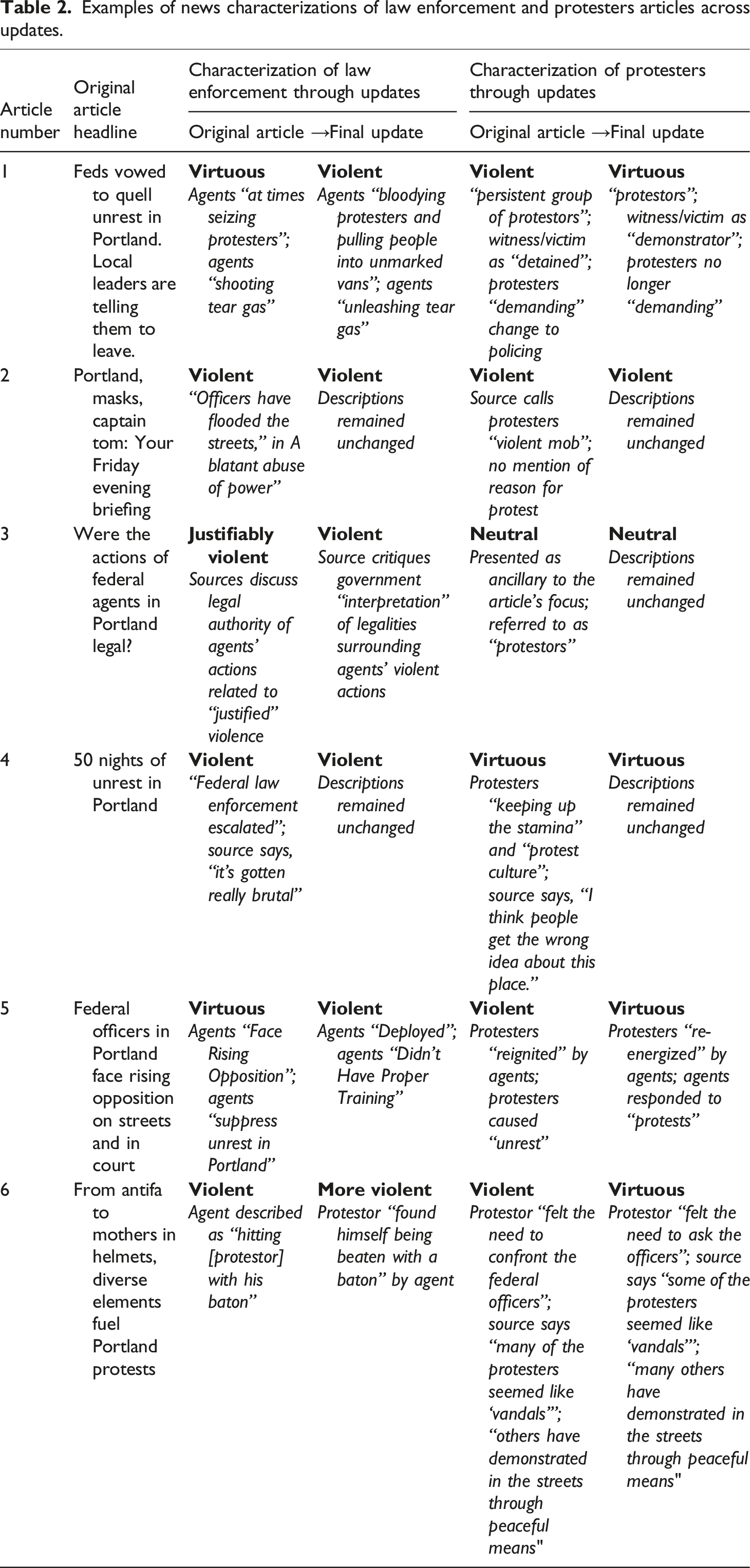
Article thrusts that we found to cast police as virtuous did more than justify the scenes or depictions of violence that presented police initially as violent, by presenting their behaviors and presence in Portland as a duty for the public good. For example, the first article analyzed (see Table 2) by the Times (Olmos et al., 2020a) in which its headline altered from “Feds” being present to “quell unrest” to “unleash [ing] militarized crackdown,” operated alongside changing depictions of protesters who were originally “persistent” in their activities and later were simply referred to as “protestors” or demonstrators. Such simultaneous changes of characterizations problematized the role of law enforcement and the sympathetic approach to protesters. In other words, as police moved along the spectrum from virtuous to violent throughout article updates, protestors were concurrently moving from positions of being violent to being virtuous. Similarly, the thrust of the fifth article (Olmos et al., 2020b) demonstrated the same shift, first presenting police as virtuous by painting them as victims who “fac[ed] rising opposition” to, three updates later, falling under the newspaper’s criticism of a DHS memo indicating they “didn’t have proper training.”
Article thrusts that were found to initially present police as “violent” and were later deemed “more violent” after article updates applied storytelling techniques and language that intensified the degree of violence portrayed. For instance, the sixth article (discussed in the analysis above) originally described how “a federal officer dressed in camouflage fatigues began hitting [a protester] with his baton before another doused him in pepper spray.” This description was later updated, changing the perspective, descriptions, and sequence of events to read "[the protestor] found himself being beaten with a baton by a federal officer dressed in camouflage fatigues as another doused him with pepper spray” (Olmos et al., 2020c). This shift allowed for the reader to both empathize with the protester who was now simultaneously being beaten and pepper sprayed and to view the police as more violent due to the intensification of actions from “hitting” to describing the victim of the police as “having been beaten.” Another article, the Times’ third (Kanno-Youngs, 2020a), was initially categorized as presenting law enforcement as justifiably violent as it described police behaviors through their legal authority. These behaviors were later categorized in an update to the article as being simply “violent” after article updates included a quote that introduced a critical perspective to the Department of Homeland Security’s “interpretation” of legalities.
To be clear, while this discussion surrounds specific alterations to single articles through updates, we emphasize that the complexities of our interpretations and arguments are rooted in the simultaneous functions of update alterations over time. We refer to this process of change to characterizations and explanations that shift the article’s ideological thrust as “ideological correction” to signify active shifts in news explanations after initial publication that alter "post-published" journalism beyond what scholars and readers might expect, such as corrections to grammar, spelling, and factual inaccuracies. These processes of piecing together various methods of storytelling and information-sharing host tucked-away spaces for ideological expression and transformation. We briefly discuss the implications from this study below.
Conclusion
This micro-longitudinal analysis of digital news updates proposes that the tracking of news explanations over (short periods of) time reveals underlying journalistic practices that position journalists as instinctively resorting to initial, institutional (and ideological) news narratives and meanings before altering – or updating – them as stories develop. Here, we expand further on answering our second research question, “How can critical explorations of news article updates inform understandings of the explanatory power of news?” Firstly, we believe it vital to highlight that these “ideological corrections” should not be viewed through the same lens as factual “corrections” with which journalism is most familiar, such as those related to spelling or inaccuracies. Certainly, articles under study here developed over the course of hours – in some cases, days (and it should be noted that while not included in this study, some articles saw updates even months after initially being published). Alterations we identify with this study's parameters are certainly wrapped-up in “new information,” “factual” clarification, and journalistic style; yet, these changes are different than the conventional thoughts related to "updates" as they were alterations to explanation that dramatically changed the Times’ coverage within each article/artifact in ways that presented ideological and power shifts in the outlet’s dominant expressions without any recognition for users.
Our study, therefore, contributes an ideological and discursive element to the analysis of liquid journalism to unveil issues of power in news explanations as today's online news coverage develops by-the-minute. Without speaking with journalists and editors for their rationales in news coverage and changes, such initial institutional sourcing that informed ideological explanations and charecterizations of events and actors in this case, we believe, represents a professional “gut reaction” of journalists to gain immediate and insitutionalized sets of information around which to shape an article's explanatory function. This micro-longitudinal analysis also further reveals how quickly journalists added "new information" and how such information altered explanatory functions of the articles and overarching coverage. Such work leads us to question how, and how frequently, journalists outside of this case initially align with institutional explanations, change the explanations, and never tell users. As discussed above, one expects overarching news narratives to change where the conflict, antagonists, protagonists, peripheral actors, and core explanations may appear differently – perhaps even in terms of their ideological representations – as new and additional articles appear over time. In this case, however, we have seen single news articles become palimpsests over which journalists made "updates" rather than publish new articles with new headlines and other elements, including URLs – even when the explanation for police and protester behavior changed.
From our study, future research should also consider what we refer to as the “reuse” of “lasting text” – quotes, facts and figures, other reporting, and verbatim language that appeared in original posts as "journalistic evidence" remained untouched in updates – even when the major thrust of an article changed. Simply, we question the virtue and ideological roles of "evidence" that appeares in an initial article and remains when an update alters the article's overarching narrative or explanation. In other words, we ask to what degree can evidence used to support an initial news narrative be "resused" for another? Furthermore, this study reveals implications for scholars who conduct analysis of online news articles that may be – or may yet be – updated online without clear indications of what has been changed in the article in terms of thrust and news explanation. The version of what online article is used for analysis for scholars of online news becomes vital, then, to what “version” scholars use in their own research.
Ultimately, wish to use this study as an opportunity to argue for – in the spirit of Thompson’s (1990) definition of ideology as “meaning in the service of power” – seeing liquid journalism as “updates in the service of power,” where alterations or updates that construct new meanings may reveal the degree to which initial journalistic ideological explanations of events and people may align with institutional expectations of explanation. Certainly, future examinations should seek to understand such potential, ideological influences inherent in digital updates, particularly when updates change the explanatory thrust of articles or overarching coverage.
Footnotes
Acknowledgements
The authors thank the reviewers for their critical comments in improving the manuscript and to Sawood Alam at the Internet Archive’s Wayback Machine for his suggestions and guidance.
Declaration of conflicting interests
The author(s) declared no potential conflicts of interest with respect to the research, authorship, and/or publication of this article.
Funding
The author(s) received no financial support for the research, authorship, and/or publication of this article.
