



Abstract
This article revisits claims made a decade ago about the importance of the word “sharing” in the context of social network sites (SNSs). Based on an analysis of the home pages of 61 SNSs between the years 2011 and 2020, the findings incontrovertibly show that “sharing” has lost its central place in the terminology employed by social media platforms in their self-presentation. Where in the mid-2000s SNSs relied heavily on a rhetoric of sharing to promote their services, by 2020, this rhetoric had been almost entirely dropped. The research reported here implies that social media platforms no longer feel a need or desire to be associated with these cultural beliefs. Given this, questions are raised as to whether “sharing” remains a keyword for social media.
Introduction
Sharing and Web 2.0: The emergence of a keyword was published in New Media & Society in 2012. In that article, I presented “sharing” as no less than “the fundamental and constitutive activity of [ . . . ] social network sites,” and as “the word that describes our participation in Web 2.0” (John, 2012: 167–168). I based these claims on an analysis of the home pages of 44 social network sites (SNSs) between the years 1999 and 2010. At around the same time, there was a flurry of academic interest in sharing, most of which was inspired by the seeming tension between a familiar concept and its appearance in a range of digital contexts (Belk, 2010; Belk, 2014a; Cammaerts, 2011; Harvey et al., 2014; Kennedy, 2016; Stalder and Sützl, 2011; Sützl et al., 2012; Wittel, 2011; Wittoker, 2013). 1
Ten years after the publication of Sharing and Web 2.0, though, can such grandiose claims still be made about “sharing”? Is “sharing” still the constitutive activity of SNSs? And if not, what does that tell us about social media at the beginning of the 2020s; about my more recent claim that ours is the “age of sharing” (John, 2016); and more generally about the longevity—or otherwise—of keywords?
This article updates Sharing and Web 2.0 by analyzing the home pages of 61 SNSs between the years 2011 and 2020, using the same methodology employed in that earlier article. The findings are striking: there is a clear reduction in the use of the terminology of “sharing” in the self-presentation of SNSs during the decade under study. Where in the mid-2000s SNSs relied heavily on a rhetoric of sharing to promote their services, by 2020 “sharing” appears hardly at all. The findings reported below give rise to a number of questions, answers to which are tentatively offered in the “Discussion” section. These questions include: (1) How is this decline of “sharing” to be accounted for? Are similar trends observable in other contexts? (2) Has the significance of the word “sharing” also declined in others of the semantic spheres I identified (John, 2013; John, 2016), namely, intimate communication and economic transactions? And finally, (3) what, if anything, is replacing “sharing” within the field of social media?
Of course, before doing the research, it was not possible to know that “sharing” is no longer the “constitutive activity” of social media. Ahead of that, though, there were nonetheless a number of good motivations for carrying out this follow-up study. One is to do with the constant state of flux in which social media subsist. As Burgess (2015) has said, all social media platforms “have been incrementally but inexorably made over for the entirety of their existence” (p. 281). If this is the case, then of course we should revisit earlier research articles to retest their findings and reevaluate their assumptions. This would appear to be a belief also held by Ellison and boyd (2013), who in 2013 revisited an earlier article of theirs from 2007 (boyd and Ellison, 2007) precisely to account for changes to SNSs between those two points in time. If SNSs could change so much in 6 years (give or take), then it would seem reasonable to expect to find changes across two decades of social media.
Not only are social media in a “constant state of flux,” though, they are also changing quickly. Indeed, it is a trope familiar to internet scholars that our field changes far quicker than we can study it and publish our findings about it. Given that, the opportunity to observe changes over a relatively long period of (internet) time would seem one worth taking. This article’s claims are demarcated by the end of 2020, and refer to a decade’s worth of data, which are compared with an earlier data set that also includes a decade’s worth of data. Analyses of data sets that span a substantial period of time have proven fruitful in a number of studies, such as Hoffmann et al. (2018) and Haupt’s (2021) work on The Zuckerberg Files. Studies such as those—and hopefully this one too—represent an effort to step away from the rapidly flowing stream of newness in social media and offer a broader temporal perspective.
In addition, what research into diachronic changes in SNSs show is that their use of language changes too. This point is made strongly by Wyatt (2004, 2021), who has traced the changing metaphors of the internet over time. The second edition of Crystal’s Language and the Internet (Crystal, 2006) can be used to make the same point.
A further motivation for writing this article relates to the place of keywords’ decline in the keywords literature, and a desire to shine a spotlight on moments of possible withdrawal, or on instances of meanings being shed in a way that perhaps renders a keyword somewhat less key. This is not to say that when writing about keywords, Williams and numerous others have not been sensitive to the historical shifts that words undergo; the meticulous attention usually paid by keywords authors to etymology is testimony enough to this. Nor is this to suggest that keywords authors should be more attentive to the contingent; after all, every text about a keyword seeks to contextualize it, to explain why, at this moment, this word is key, or even how what is key about it is changing over time (Striphas, 2019). Given this, as Williams wrote about the second edition of Keywords (Williams, 1983), any writing about keywords is “necessarily unfinished and incomplete” (p. 27). I take this as an invitation to see what has happened to “sharing”—at least in the relatively demarcated space of SNS home pages—a decade since my initial interrogation of it. I am by no means the first to sense this invitation from Williams, of course: Striphas (2016, 2019), for instance, returns to Williams to pick up the story of “culture,” while Bennett et al.’s (2013) New Keywords inquires into the fates of words marked as key by Williams. Building on the finding that “sharing” has been withdrawn from the front page of SNSs’ internet presence leads this article to pay special attention to matters of decline and withdrawal. This is not the only modality of change that is relevant to keywords, but it is the modality most relevant to the current case.
Many of the entries in Peters’ (2016b) edited collection of Digital Keywords—entries that are much longer than Williams’ (1976, 1983) expositions—illustrate the “unfinished and incomplete” nature of keyword analysis in ways that also gesture toward decline and lack, and not only change. For example: internet forums fail to fulfill the functions of the Roman forum (Forsyth, 2016); under conditions of capitalist hegemony, activism may be changing its meaning and losing its force (Yang, 2016); and, most notably, Peters’ own contribution—digital—opens with an acknowledgment that “its heyday as a keyword may have passed” (Peters, 2016a: 93). The reason for this, suggests Peters, is that when everything has become digital, there is simply no need to describe it as such any more. Largely, though, these processes of decline, when acknowledged, are not positioned front and center.
This can be seen in those few instances I could find of explicit treatment of words that are no longer considered keywords. Thus, for Bennett et al.’s volume of New Keywords (Bennett et al., 2013) the editors removed a number of words from Williams’ lists. These were words that the editors felt had not “sustained their importance in terms of the ways people represent their experiences and give meanings to their perceptions of a changing world” (p. xviii). Put differently elsewhere in their introduction, the authors note that “some words of interest to Williams in 1976 (career, for example) or indeed in 1983 (folk, genius) have lost the special quality of ‘significance and difficulty’ that attracted his attention” (p. xvii). Unfortunately, they do not offer explanations for this change. Durant’s (2008) essay on the process of identifying keywords includes even more explicit treatment of the fact that keywords sometimes cease to be keywords. Durant describes a “parlor game” among academics, whereby the participants at a seminar had to suggest 10 new keywords to add to Williams’ list, and 10 to remove. This game explicitly acknowledges that keywords can lose their significance. However, apart from saying that the list of “out” words was “revealing” (p. 130), Durant does not say what it actually revealed. Other Keywords-inspired texts have run into second and third editions without mentioning words from earlier editions that were excluded in newer editions (for example, Burgett and Hendler, 2020), or commenting only cursorily that words were excluded from a new edition because they “seemed less central to the conversation than they were ten years ago” (as in Christensen et al., 2021: xi).
However, it would nonetheless seem that the keywords literature has all the apparatus in place not only for accounting for no-longer-keywords, but also for more explicitly interrogating the additions and subtractions of meanings. My hope is that the research presented here serves as a kind of proof of concept for the benefits of focusing on the not-anymore and encourages others to consider performing similar kinds of analysis.
In the rest of this article, following a description of the methods used to collect and analyze the data, I present the findings, chief among them that “sharing” has almost disappeared from social media. The “Discussion” and “Conclusion” sections attempt to account for this decline. Before that, though, a very brief review of my original Sharing and Web 2.0 article, and some of the neighboring literature.
Sharing: a very brief exposition
In Sharing and Web 2.0, I document a number of trends in the use of the word “share” and its derivates by SNSs over the period of a decade. First, the word appears in conjunction with “concrete objects of sharing,” such as links, photos and videos. Second, it appears with “fuzzy objects of sharing,” such as “your life.” These are vague objects of sharing that allow for a broad range of interpretations as to what is to be shared (ideally, everything). Third, “share” appears with no object, as in the injunction, “Share!.” Fourth, “sharing” comes to replace existing terminology even where the act being described has not changed (for instance, changing “post your story” to “share your story”). At the end of that article, and in more detail in The Age of Sharing (John, 2016), the use of “sharing” in SNSs is shown to be related to its use in other spheres, at least in English-speaking countries. “Sharing” is the name for a specific type of therapeutic talk, encompassing assumptions about the redemptive power of talk about the self. It is also the name for a form of economic interaction based on trust and equality. “Sharing” as a keyword for social media “works” because of the interactions between these semantic fields and the assumptions they hold about the self and its relations with others. 2 This particular configuration of meanings, which emerged at a specific juncture in Western, English-speaking, cultures, I argue—most expansively in The Age of Sharing—made “sharing” uniquely apt for its extensive use by SNSs during the aughts.
Of course, that article was not published in a vacuum. In fact, looking back, it can be viewed as part of a surge in academic interest in various aspects of sharing (see Figure 1), which has since waned. This interest revolved around the so-called “sharing economy,” with consumption scholar Russell Belk (2010, 2014b) leading a research agenda focused on the spread of sharing, and arguing (Belk, 2014a), with others (Eckhardt and Bardhi, 2015; Morell, 2011), that whatever is happening on Airbnb, for example, it should not properly be called “sharing.” Other scholars, having noticed the growing prominence of the concept of sharing in online spaces, took up “sharing” as an analytical tool with which to critically examine computer-mediated communication (Cammaerts, 2011; Wittel, 2011; Wittoker, 2013) and our digitally mediated lives more broadly (Kennedy, 2016).
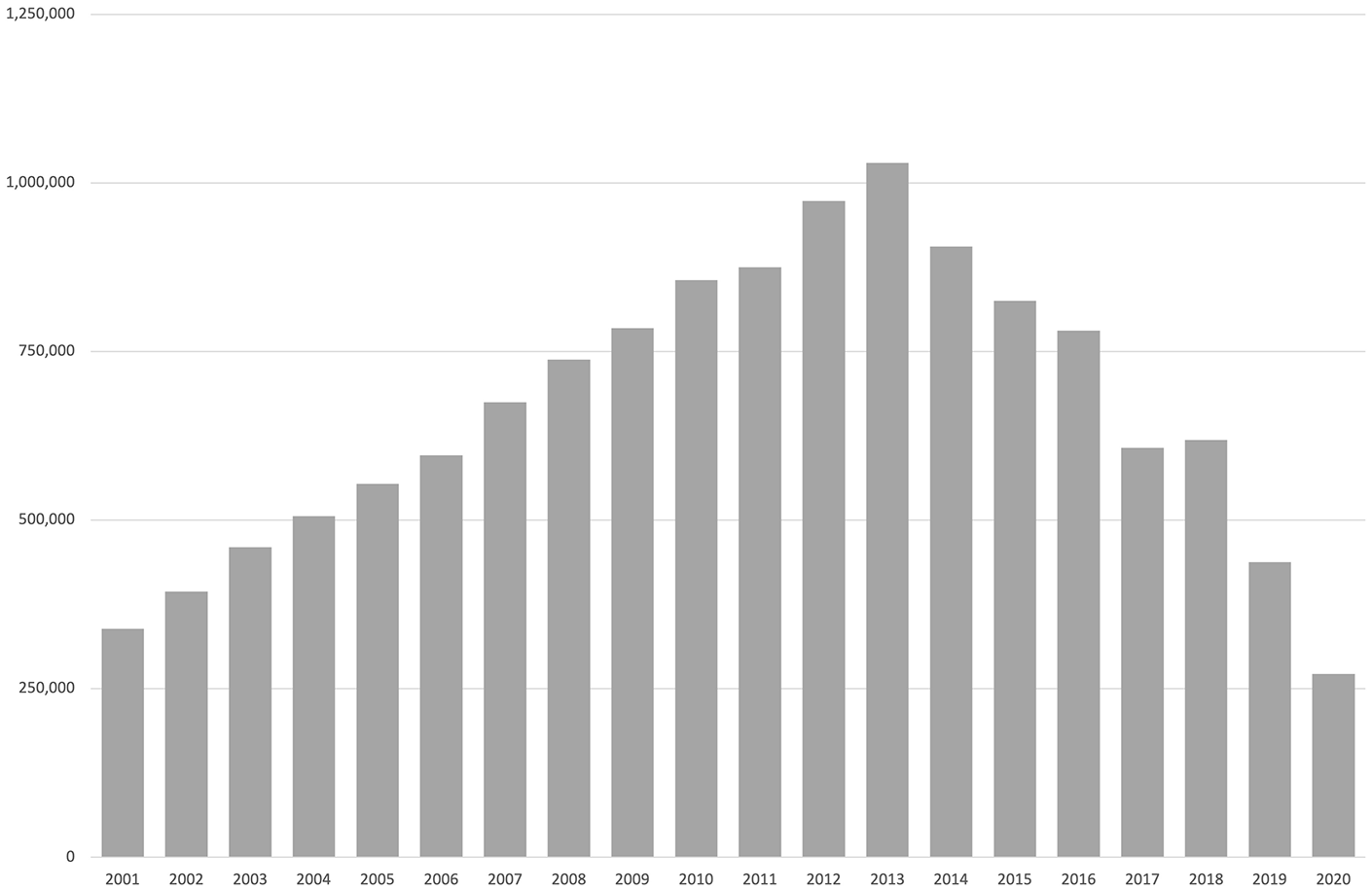
Number of results for Google Scholar searches for “sharing,” 2001–2020.
Method
The method adopted here is based very closely on that reported 10 years ago (John, 2012: 170–172). After all, given that this article seeks to update that one, it is only reasonable to follow as similar a protocol as possible. Starting with my list of 44 SNSs, I removed services that were no longer operational in 2011. Using various Wikipedia pages (the page I referenced in 2012 no longer includes numbers of users, requiring the use of additional resources) and a blog page published in 2021 with links to and descriptions of 101 SNSs, 3 a list of 61 SNSs was compiled. 4 Using the Digital Methods Initiative’s Internet Archive Wayback Machine Link Ripper, 5 I created a list of URLs of links to the Internet Archive Wayback Machine’s saved versions of the front pages of the 61 SNSs (one per month), from which I removed all links to versions from earlier than 2011. These links were put into the free software, Paparazzi!, 6 which produces screenshots from URLs. These screenshots—around 6500 in total—are the corpus of this study. 7
The screenshots were imported into MAXQDA for coding. I relied here on my categories of concrete and fuzzy objects of sharing, and uses of “sharing” without an object (that is, when an SNS implores, “Share!,” without saying what is to be shared). Concrete objects of sharing are photos, videos, links, and the like. Fuzzy objects of sharing, by contrast, include “instances where users are urged to share their ‘life’, their ‘world’, or their ‘real you’” (John, 2012: 173). I also tagged uses of “share(d)” when used to refer to having something in common (for instance, “Meet people who share your interests”). My method was to examine the earliest screenshot of each SNS and to code instances of sharing, where present. If the word “share” did not appear in the screenshot, I would tag it as “No share.” I would then move on to the next screenshot. If it was identical to the previous month’s screenshot, which was the case much more often than not, I would move on once more, until I came across a new version of the front page of that SNS, which I would then code. The product of this method was a record of changes regarding their use of “sharing” on the front pages of the 61 sampled SNSs.
I note that this sample is overwhelmingly constituted by American services. This is partly because of the selection of SNSs I originally made (2012), but also because this research is very much dependent on the meanings of the word “sharing” in the English language. More work in the spirit of my co-authored study of “sharing” in Chinese social media is required (Zhao and John, 2020).
A further limitation is the focus on front pages. Given that this study aims at a kind of reproduction, this limitation is partly dictated by my earlier decision to focus on front pages, which was itself a function of the technical limitations of the Wayback Machine (see John, 2012: 172). This has the consequence that I measure the most loudly shouted uses of “sharing” and am able to say less about what may be more mainstream, everyday uses. I discuss this issue further below. For now, it shall be acknowledged that what this research studies—very much like my original piece—is the language used in SNSs most public-facing self-presentations: their taglines and front pages, and not their Help or About pages.
Findings
The standout finding is that “sharing” has fallen from grace; it no longer serves as the predominant call for action on the front pages of SNSs. If barely a decade ago, I could convincingly and reasonably argue that “sharing” was the constitutive activity of social media, in 2021 this is no longer the case. Given Facebook’s dominance, it is tempting to start and finish there: at the start of the sample period, in 2011, Facebook’s tagline read, “Facebook helps you connect and share with the people in your life.” In 2014, this was changed to “Connect with friends and the world around you on Facebook.” The service’s home page (for non-logged in visitors) offered short descriptions of what one could do on the site, including “
In the remainder of this section I show that the example of Facebook is representative of the social media scene during the 2010s as a whole. To establish this argument, I first offer two visualizations that show the fall of “sharing” in broad terms, before delving into the data more deeply.
The first visualization (Figure 2) shows the proportion of active SNSs with the word “sharing” (or a derivative) on the site’s front page. This image picks up from the end of the time period covered in John, 2012, which, unfortunately, does not offer numerical data such as these. The chart shows that while “sharing” occupied a place on over one half of SNSs at the beginning of the sample period, during 2012–2013 this ceased to be the case. By 2016, only 20% of the sampled sites (that were live at the time) had “sharing” on their front page, a situation that does not dramatically change through to the end of 2020. Even when taking into account a decline across the sample of the number of words on the services’ homepages, the diminished place of “sharing” in constructing the visitor’s sense of what one does on this website or through this service is undeniable. To this I would add that this visualization (and the subsequent one) is generous toward “sharing”: for a year to be classified as a “yes” for the purposes of Figures 2 and 3, it was sufficient that only one screenshot contain the word “sharing,” even if for the rest of that calendar year there was no “sharing” on the home page.
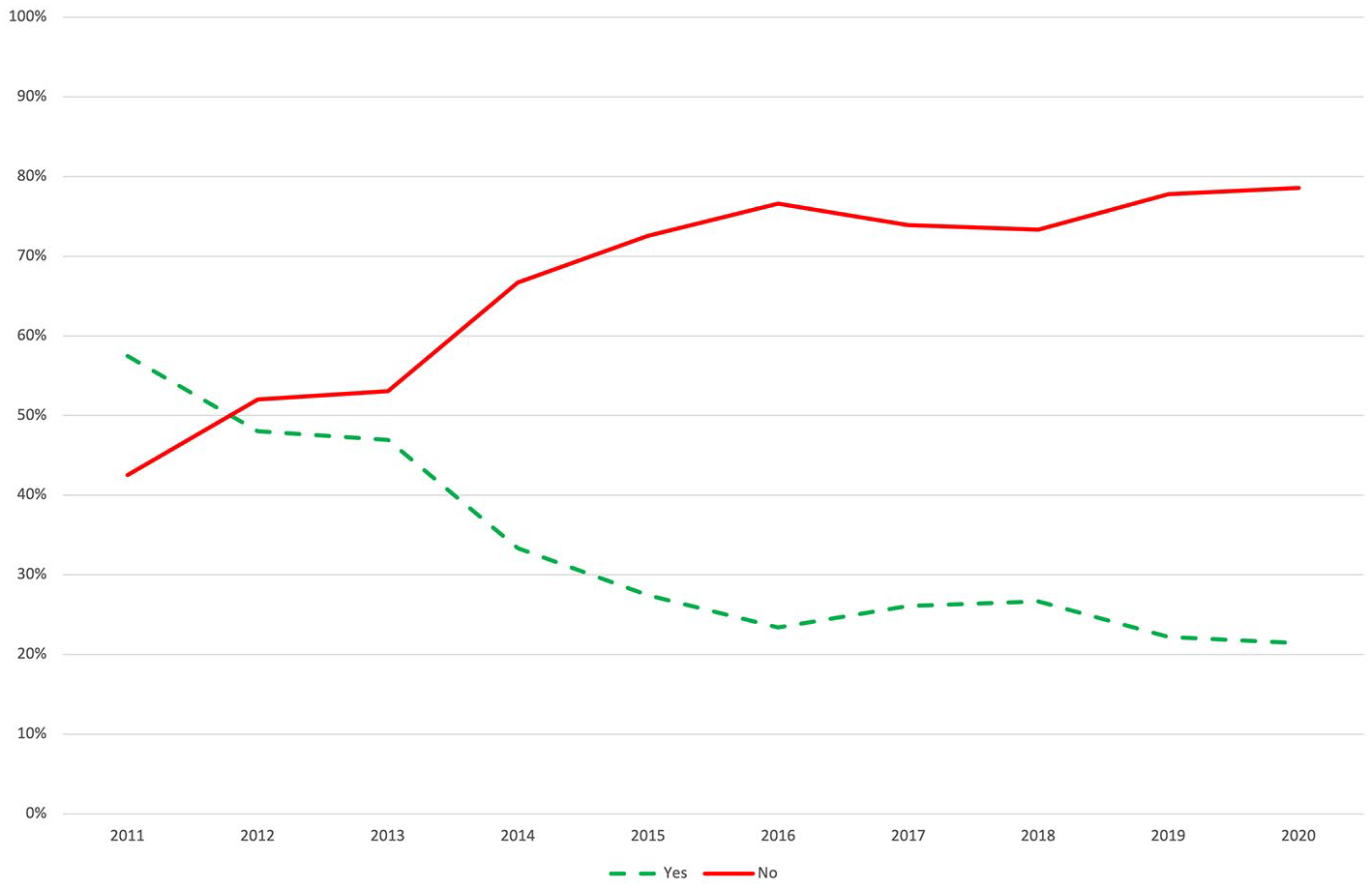
Proportion of SNSs with “sharing” on their front page, 2011–2020.
The second visualization (Figure 3) adds some nuance to the first. Here too, the decline of “sharing” is unmistakable. Indeed, only four sites (Academia, aSmallWorld, Classmates, and WhatsApp) had the word “sharing” on their homepage throughout the sample period. A number of others had it for as long as they were active during the sample period (Google+, TwitPic, Orkut, Multiply, Piczo, and Mastadon). A small number of services flirted with “sharing” before dropping it (Badoo, Fotolog, Hi5, Tumblr, MyLife, Tagged, and Xing). Most significantly, though, 19 sites started the sample period, or were launched during it, with the word “sharing” on the front page, only for it to be removed later on.
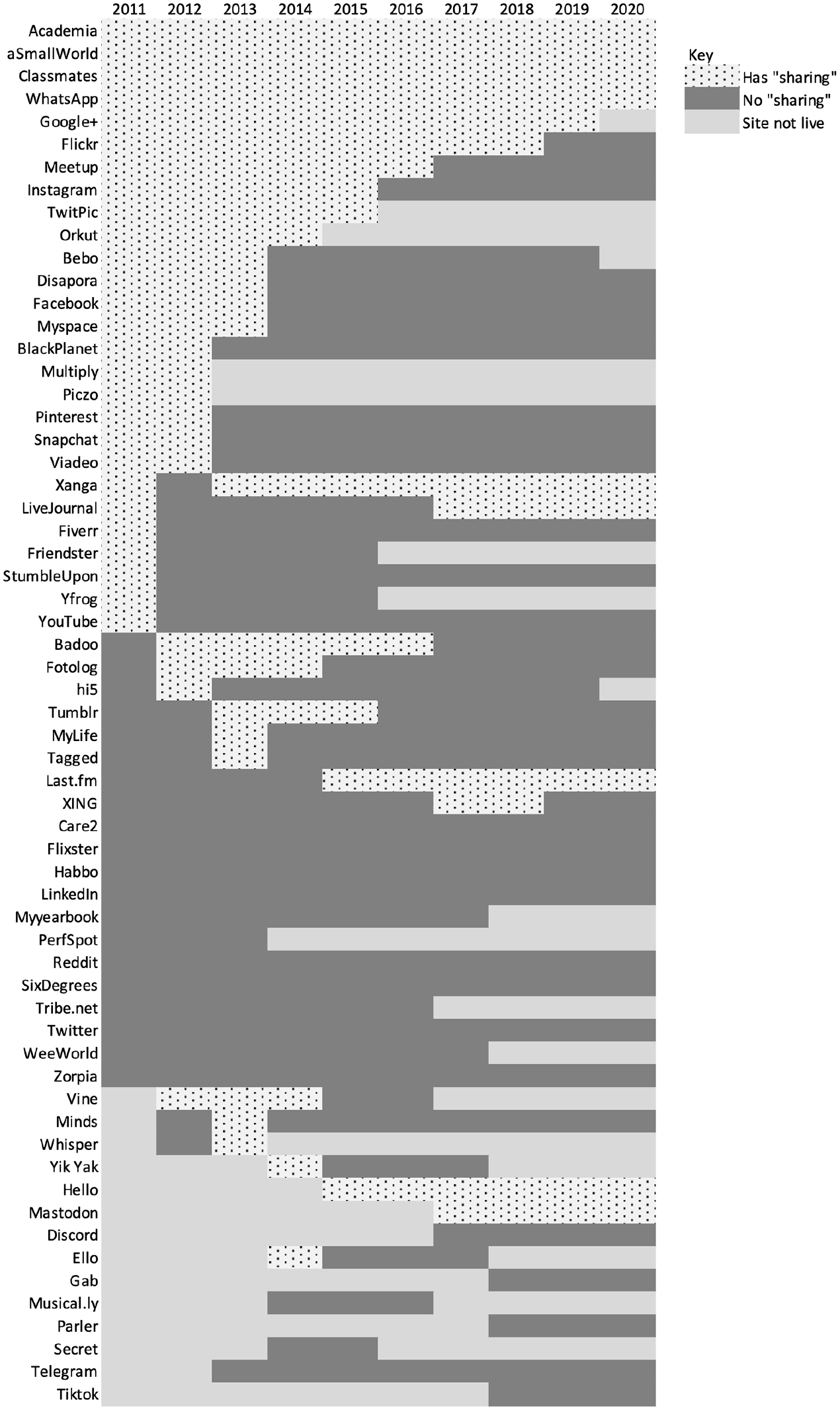
The use of “sharing” by site, 2011–2020.
One of my original arguments (John, 2012) was that, during the 2000s, and especially in 2005–2007, as well as becoming the word to describe participation in SNSs, two major shifts in how “sharing” was used were discernible. The first was new objects becoming attached to “sharing”: in addition to concrete objects of sharing, such as photos and links, SNSs started talking in terms of fuzzy objects of sharing, such as “your life.” The second was that the word “share” started to appear on its own, with no object at all. In the current sample, these processes can be seen to be rolled back.
Flickr provides excellent examples. In January 2012, Flickr’s tagline was “Share your life in photos”—a classic usage of “sharing” with a fuzzy object. The homepage also had a text box with the heading “Share.” This remained the case until January 2013, when the front page was dominated by announcements about the new Flickr iPhone app, though the text box with the “Share” heading remained in place. In mid-2013, a new design for the website was launched, which no longer included any fuzzy objects of sharing. The word “share” appeared without any object (“Share in full resolution”), though the reference to photos is implicit; in other words, a concrete object (photos) is implied. Worthy of note because of the lack of “sharing” is a text box headed with the word “Wherevr” that contained the text, “Upload once, send to any device, any screen, any friend, and any follower.” I shall come back to this point shortly; for now, let us note that the copywriters could very easily have included “sharing” in this text, but chose not to. In mid-2014, the site underwent yet another redesign, as the service went for a much simpler and cleaner look. In this version, Flickr retained the notion of sharing, with the text, “Share and connect with the Flickr community” prominently placed immediately beneath the main tagline. In mid-2015, this use of “Share” without an object was dropped, but “sharing” was still retained, though notably with a concrete object (“Upload, access, organize, edit and share your photos from any device, anywhere in the world”). This is a far cry from “share your life” and simply, “share,” in particular if we consider the use of “sharing” in relation to “photos” as extremely mundane, and as not igniting the semantic associations generally linked to “sharing.” Flickr’s journey away from “sharing” was complete by February 2017, when a redesign of the homepage meant that it now contained no talk of “sharing” at all.
Other sites can be similarly seen to be retreating from using “sharing” with a fuzzy object. For example, Meetup leant heavily on the phrase, “share something” for a number of years. From 2011 to 2013, the site’s tagline was “Do something • Learn something • Share something • Change something.” In 2013 this was changed to “Meetups are neighbors getting together to learn something, do something, share something . . . .” In both instances, “share something” is a vague turn of phrase, but nonetheless one that resonated with the company’s ethos at that time. Following a redesign in late 2016, though, the word “sharing” no longer appeared. Instead, the tagline read, “What do you love? Do more of it with Meetup.” In 2019 this was changed to, “The real world is calling. Join a local group to meet people, try something new, or do more of what you love,” and in 2020 the new tagline was, “Discover events for all the things you love.” Interestingly, with Meetup, the emotional timbre of “sharing”—as an intimate form of communication and more generally as a pro-social good, mostly pithily conveyed through the cliché that “sharing is caring”—is retained through the word “love,” but the word “sharing” itself is dropped from the site’s self-presentation.
Pinterest also described itself in terms of sharing (“Organize and share things you love”) at the beginning of the sample period, before dropping “sharing” in 2013 in favor of taglines such as “Collect and organize the things you love,” or “Welcome to Pinterest. Find new ideas to try.” Snapchat and Tumblr offer further examples of sites that dropped “sharing” with a fuzzy object and no longer employ that word at all. In 2012, Snapchat’s front page said that it was “the fastest way to share a moment on iPhone” while at that time Tumblr was telling users to “Share the things that you love.” In 2012 and 2016 respectively, Snapchat and Tumblr redesigned their homepages, losing all references to sharing.
Other SNSs in the sample can be seen dropping “sharing” with a concrete object. For example, in 2011 Fiverr described itself as “The place for people to share things they’re willing to do for $5.” A year later, however, this was changed to: “The world’s largest marketplace for small services, starting at $5,” and Fiverr did not use “sharing” on its front page again.
More striking are examples of sites that stop talking about “sharing” even in the contexts of photos, files and videos, described as concrete objects of sharing. One such instance is Vine, which dropped “sharing” after it had been using it in conjunction with “video.” When Vine launched in 2012, it described itself as “the best way to capture and share video on your iPhone.” This is “sharing” with a concrete object. Yet even this technical sense of sharing was dropped in 2014 for the new tagline, “Explore a world of beautiful, looping videos.” Likewise YouTube: in 2011 it was encouraging visitors to the site to “Join the largest worldwide video-sharing community!.” In 2012, however, it dropped its self-description as a “video-sharing community” and did not bring it back throughout the sample period.
A particularly interesting group of SNSs are those that were launched during the sample period, especially since 2014, when “sharing” was very much in decline. These are the sites at the bottom of Figure 3. Two of these—Mastodon and Hello—are notably different from the others. Mastodon launched in 2016, and from its first sighting on the Wayback Machine in 2017 had “sharing” on its front page, and kept various uses of sharing there throughout the sample period (“share sensitive discussions and media”; “share your ideas”; “sharing your thoughts”). Hello’s first appearance in the Wayback Machine in 2014, some time prior to its actual launch, included a reference to “content sharing.” During 2015, a series of teaser taglines (including “Be about it,” “Liberate what’s inside you”) did not include “sharing.” Moreover, when the service was officially launched in 2016, the company ran with the tagline, “express your passions and explore new ones.” We shall come back to the word “express” later on; for now I note that Hello could have used the word “share” here, but chose not to. They did, though, include “sharing” in its sense of “shared.” In 2016, the home page included the taglines, “connect with people who share your passions” and “connect with people who share your interests.” These taglines were still being used in 2020.
Four of the newer SNSs made use of the rhetoric of sharing before going on to drop it. Vine has already been mentioned in this regard. The other sites in this group are Minds, YikYak and Ello. For a 3-month period during 2013, Minds (on which more below) described itself on its front page as “a universal network to search, create and share free information,” but then ceased to use “sharing” in descriptions of the service. At or around its launch, YikYak invited users to “Share your thoughts. Keep your privacy,” but stopped using this tagline quite soon afterwards, and did not make use of “sharing” again. Ello’s use of sharing—which was very minimal—extended no further than mentioning “every post you share” in their manifesto against ad-driven social media.
Other services launched without deploying “sharing,” and did not at any point use it (Discord, Musical.ly, TikTok, Secret, Telegram, Parler, and Gab). Discord emphasized chatting and talking (“Your place to talk,” “A new way to chat with your communities and friends”) and made no use of “sharing.” Musical.ly and TikTok had very text-light websites during the sample period; what text there was did not include “sharing.” Secret—the short-lived app for anonymous posting—encouraged users to “Be yourself,” but not to “share.” Telegram’s website, despite having quite a lot of wordage, makes no mention of “sharing.”
This leaves us with Parler and Gab, which, together with Minds, have in common an appeal to conservative Americans. Parler prided itself on being “unbiased” and enabling “free expression” and “a lack of censorship.” The only appearance of “sharing” was in a text box seen on the website in July 2020, titled, “Free Expression, User Privacy,” in which the company stated, “Parler never shares your personal data.” However, even this usage of “shares” was dropped 3 months later, when that text was changed to, “We protect your privacy and will never sell your personal data.”
In short, “sharing” is no longer in use on the majority of SNSs today, sometimes even in cases where its meaning is quite neutral. Over the decade through to the end of 2020, platform after platform removed references to “sharing” from their home pages. A number of services were launched without making any use of “sharing” from the outset. How do we account for these findings, and what are their significance? We now turn to a discussion of these questions.
Discussion
The demotion of “sharing” from its earlier status as the sine qua non of social media companies’ self-presentation is unmistakable. It has been removed entirely from the home pages of many services, or left, uninspiringly, in conjunction with objects such as “pictures” or “videos,” where its metaphorical work is minimal. As mentioned earlier, this raises a number of questions: (1) How is the decline of “sharing” to be accounted for? Are similar trends observable in other contexts? (2) Has the significance of the word “sharing” also declined in others of the spheres I have identified (John, 2013, 2016), namely, intimate communication and economic transactions? (3) What is replacing “sharing” in the context of SNSs? In this section, I tentatively offer some possible answers.
Let us start with the question of how we are to account for the dramatic fall of “sharing.” One explanation draws on my two-pronged critique of the use of “sharing” by SNSs (John, 2012: 177–178), according to which the word helps companies conceal their commercial motivations. In the article from a decade ago, I showed how a rhetoric of sharing infused the documents that accompanied Facebook’s 2012 stock launch in a utopian way, quoting Mark Zuckerberg as writing, “People sharing more—even if just with their close friends or families—creates a more open culture and leads to a better understanding of the lives and perspectives of others.” Second, I pointed to the way in which talk of data being “shared” by Facebook (for example) with advertisers mystifies the fact that Facebook (for instance) in fact sells data to advertisers. With social media use as a mainstream activity deeply into its second decade, perhaps users no longer believe that by using SNSs they are making the world a better place. In addition, perhaps it is harder to camouflage the commercial interests of these services considering the publicity given to how much money they make. Perhaps, also, users are quite au fait with the commercial nature of social media; they know that SNSs use data about them to serve them targeted ads, which they are happy to receive because they are more relevant to their interests, and because it enables them to gain access to valuable services without paying money for them.
The first idea, then, is that the rhetorical power of “sharing” has waned over time as SNS users have become savvier both as to their business model and as to their political impacts: no one (surely) thinks that social media are, in toto, a force for harmony, mutuality, and caring. Put more neutrally, even Facebook has recognized that it is not only, or perhaps not even mainly, used for interpersonal communication between friends and intimates—the type of communication that emerged through therapy culture and came to be called “sharing” through a process I have described at length elsewhere (John, 2016: Chapter 2). As described by Hoffmann et al. (2018), in 2014 Facebook appears to have realized the potential in regular users engaging with content produced by public figures. They describe Facebook as adopting a “top-down model of celebrities and public figures ‘building’ content ‘for Facebook’ as a particular kind of broadcasting outlet” (p. 210). This is much less a model of “sharing” than people who know each other imparting information about their personal lives. It would appear that the decline of “sharing” reflects a distancing from utopian visions of the role of social media in making the world a better place, and the adoption of a more pragmatic attitude instead. 8
This argument is strengthened by research presented in a pair of articles about remix and configurable culture (Rosa et al., 2021; Sinnreich et al., 2020). Using quite different data sets, but arriving at broadly similar conclusions, these articles point to a decline in idealism in relation to media practices around copyright, a field in which the very term “file sharing” has been contested precisely because of its pro-social connotations . In the first of these articles (Sinnreich et al., 2020), the authors analyze Google search terms over 15 years and argue for a shift from what they term “utopian openness” toward “utilitarian openness.” In the second article (Rosa et al., 2021), based on longitudinal survey data, the authors find a waning of remix culture, which they attribute to the appropriation by the mainstream of practices of configurable culture, such as editing videos. In both cases, the authors’ argument is not that people are “remixing” less. Rather, having “faded in to the ‘background noise’ of mainstream culture” (Rosa et al., 2021: 45), practices that once had a countercultural or critical aura about them no longer do.
Because each of these articles contends with a multi-year timeframe, we can even see that this shift from the utopian to the pragmatic more or less overlaps with the decline of “sharing” as the keyword for social media. In other words, the decline of “sharing” would appear to be part of a broader transition away from naively optimistic framings of digital culture, and toward more pragmatic imaginaries. Tentatively, I would argue that this points to a maturity of digital technologies, perhaps even suggesting that these media are no longer “new” (Peters, 2009). Just as earlier communication technologies—the television, the telephone, and more—were rolled out along with utopian messaging about their potential to make the world better, so too were social media. Similarly, just as no one today seriously touts the television, qua television, as a technology that will solve the world’s problems, the decline of “sharing” may point to a moment in the cultural understanding of social media whereby illusions or hopes about their ability to bring humanity closer together are being shed. Indeed, contemporary popular cultural discourse around social media would seem to be focused on mitigating their potential harms rather than celebrating their emancipatory potential.
Central to my (2016) argument about “sharing” as a digital keyword are the other meanings associated with the word. As well as referring to participation in social media, “sharing” is also a type of communication, and a form of economic exchange (John, 2013). I argue that shifts in the use of these senses of sharing can also be seen, if less systematically documented than the above discussion of “sharing” in social media. Let us start with the “sharing economy.” As a Google search term, “sharing economy” peaked between 2015 and 2016, by which point “sharing” had disappeared from the front pages of most of the SNSs surveyed for this study. Its decline (as a search term) since then has been steep. 9 Again, it is not that people have stopped using the services once included under the umbrella of the “sharing economy,” such as Airbnb, Uber, and short-term rental electric scooters, but rather that their inclusion under the umbrella of the term, “sharing economy,” no longer works. Arguments that services like those just mentioned are “not really sharing” (see, for example, Belk, 2014a; Eckhardt and Bardhi, 2015) appear to describe the current state of affairs: judging from Google searches, the idea of a “sharing economy” does not resonate as it used to. 10
Things are more complicated in relation to “sharing” as a category of talk (Carbaugh, 1989). Talking about one’s self, one’s emotions, and one’s ties with significant others is the pillar of therapy culture (Füredi, 2004), and there are few signs that Western societies are turning away from this. However, among its many meanings, the Trump presidency—and Trumpism more generally, which of course predates the presidency—also signifies a particular communicative style: “alternatives facts,” to be sure, but also a disdain for “snowflakes” and the recourse to feelings as a rhetorical device, especially in political talk. This stance is most concisely captured in what has been described as the “unofficial mantra of Trumpism” 11 : fuck your feelings. I am not arguing that that social media companies dropped “sharing” because they identified a trend running counter to the form of emotional talk of that name. In any case, they were dropping “sharing” some years before 2016. I am arguing, though, that the other main components of “sharing” (the communicative, the economic) have also gone through a decline, or have been significantly challenged. This points to a broader context for the decline of SNS “sharing” than merely internal considerations of the relevant companies.
The third question posed at the start of this section is whether a discernible terminology is replacing “sharing” as the constitutive activity of social media. This study was not designed to identify alternatives to “sharing.” However, if there is a term emerging in its place, it is within the semantic field of “expressing yourself.” Some examples: in the lead up to the relaunch of Myspace in 2012, the website promised that “the new Myspace puts the power to express yourself back in your hands” (this is itself a turn of phrase that recalls Facebook’s “power to share” tagline); in 2014, Whisper—an app for anonymous communication—described itself as “the best place to express yourself online”; finally, in 2020, Parler, defining itself as “the world’s town square,” invited users to “Speak freely and express yourself.” “Expressing yourself” is a more individualistic approach to social media talk than “sharing”; it carries less weight of expectation for intimacy and mutuality, and can incorporate many more types of communication than sharing. One can “express oneself” through dance or song, for instance, in a way that does not ignite the associations with therapy culture in the same way that “sharing” does. There is clearly need for deeper investigation of the phrase, “express yourself,” in the context of social media. A preliminary step in this direction may be offered by Scharlach et al. (2021) in their study of the public-facing policy documents of five platforms, which holds up “expression” as one of four “core values” (p. 2) of those platforms. Other terms used by social media today to describe what their users do include far more neutral words, such as “post,” “chat,” “upload,” “discuss,” and “talk.”
Conclusion
This article—a reboot of a study of the concept of sharing in SNSs from 10 years ago—has incontrovertibly shown that “sharing” has lost its central place in the terminology employed by social media platforms in their self-presentation. Where once it was the “constitutive activity of Web 2.0” (John, 2012: 167), “sharing” now appears on the front pages of but a minority of SNSs’ websites. This underscores insights offered by scholars about the inexorable processes of change that social media are constantly going through, and points to a fruitful way of studying these processes.
This revisiting of a 10-year-old article also raises questions about keywords, or at least suggests approaching them with a degree of caution. To attribute the status of keyword to a word is to implicitly say something about the cultural moment for which it provides a key to understanding. The list of words we define as key must, therefore, keep changing, but not only by adding to it. Coming back to “sharing,” and finding it is no longer being used to do the rhetorical work it once was, should arouse in us a suspicion of established concepts. Does the notion of “platform” still operate as described by Gillespie (2010)? What about “big data,” “algorithms,” and “AI”? As mentioned above, anyone writing about a keyword is acutely aware as to its historicity and contingency. This article invites greater focus on keywords that are perhaps past their prime (cf. Peters, 2016a), with a hope and a belief that it can open new pathways into thinking about language.
Coming back to keywords also helps us see their historical context better. I refer back here to Ellison and boyd’s rethinking in 2013 of their 2007 definition of SNSs (boyd and Ellison, 2007). In their later contribution, Ellison and boyd point to a shift in emphasis in social media to the feed and the link at the expense of the friend’s list. The decline in “sharing” comports with this. “Sharing” is a more appropriate mode of communication when SNSs are about developing and nurturing one-on-one relationships. A shift in focus to the flow of information in one’s stream, and the growth in significance of celebrity users—as argued by Hoffmann et al. (2018)—can help explain the ousting of “sharing” and point to a change in the emphasis of the role social media see themselves as playing in the context of interpersonal relationships.
Are we to conclude, therefore, that “sharing” is no longer a keyword for the digital era? The fact remains that the practice of posting to social media is still called “sharing” in common parlance. It is also the case that the word “sharing” continues to encapsulate cultural beliefs about the self, about the power of talk in a therapeutic society, and about the positive potential of economic exchanges based on trust and mutuality. Moreover, the Google Books Ngram Viewer does not dip downward from the mid-2010s in a fashion resembling the Google Scholar results shown in Figure 1; it plateaus somewhat, but there is no visible decline. 12 And yet the research reported above shows that processes concerning the use of “sharing” on SNSs’ front pages that were put in motion in the mid-2000s have been rolled back, implying that social media platforms no longer feel a need or desire to be associated with these cultural beliefs. “Sharing” clearly is not doing for them anymore what it was able to do 10 or 15 years ago.
So, is “sharing” still a keyword? If it is, it is of a slightly different kind: it is no longer shouted from the rooftops, or deployed as a marketing term. Instead, it would seem to be carrying out its cultural work in the background, the kind of keyword that Peters (2016c: xxxiv) sees as infrastructural, or as analogous to prepositions, whose work goes mostly unnoticed. Is this the first stage of a keyword’s death, indicative of its potential longevity, or perhaps testimony to a shift in the nature of its keyness, such that it is still commonly used, but in slightly different spaces? These are both empirical and conceptual questions. Empirical, because it will be possible to track changes to “sharing” over time: will the link between the digital, the psycho-therapeutic and the economic meanings of “sharing” be loosened, thus vacating the word of what makes it so potent? Or will these metaphorical ties hold even as the word takes on a role that may be out of the limelight, but is nonetheless key? The questions are also conceptual because they require of us to think explicitly about when and how keywords stop being key, which, in turn, can contribute to broader conversations about the various kinds of change that keywords go through. In the current context, one possibility that might be worth exploring in future research is that attitudes toward the internet in general are shifting toward the negative: (Smith and Olmstead, 2018), for instance, has reported a decline in the proportion of US adults who think that the internet has mostly been a good thing for society. These issues remain open for further iterations of research.
Footnotes
Acknowledgements
The author would like to thank Paul Frosh, Neta Kligler-Vilenchik, and Limor Shifman for reading and commenting on early drafts. He is also extremely grateful to the anonymous reviewers for helping him improve this article.
Funding
The author received no financial support for the research, authorship, and/or publication of this article.
