



Abstract
This paper explores the implementation process of digital audience metrics as a key strategy in Swedish legacy news production during the last three decades. The historical adoption of metrics in the newsroom is not new but has grown fast (from analogue audience measurements in the 1950s and monthly statistics of unique visitors in the 1990s to a wide range of real-time data). This trend is important because Swedish news organisations have invested heavily in data analytics, which involves integrating metrics-driven journalism into a particularly strong and homogenous tradition of professional autonomy. Based on interviews with key senior managers and supported by the analysis of trade publications, as well as published interviews, the findings reveal three chronologically overlapping periods: the naïve stage of ‘getting online’, the destructive period of ‘social media prominence’, and the end of the ‘paywall hesitation’. This trend has led to a new equilibrium in which audience metrics are perceived as better aligned with the professional values of news selection. More importantly, the industry-wide embrace of metrics as guidance for more relevant and rational news production revolves around two main factors: First, although metrics are tied to organisational targets, they remain under editorial control. Second, the degree of granularity and diversification of metrics allow for wider support of their use for strategic purposes.
Keywords
Introduction
In the overall disruption brought by the internet to journalism, audience metrics stand out as met with scepticism and resistance (Assmann and Diakopoulos, 2017). Although news organisations have a long tradition of measuring audience preferences and behaviours (Napoli, 2010), datafied audience feedback has been perceived as a shift that “goes to the core of newsroom culture” (Assmann and Diakopoulos, 2017: 28). Metrics challenge journalists’ professional norms and autonomy, such as the balance between commercial and editorial values, and the selection and presentation of news (Carlson, 2018; Tandoc, 2019). Despite signs of resistance, journalists have been forced to make sense of, or make peace with metrics (Christin and Petre, 2020). Metrics now permeate news organisations from boardroom strategies to individual journalists’ news evaluations.
Although a great deal has been written about metrics and journalism over the past few years, the literature is less robust in historicising the development of editorial metrics, especially outside the US and UK. This study investigates the diffusion of digital audience metrics in relation to journalistic autonomy and judgment in the Swedish legacy news industry. Looking back at the evolution of metric adoption in the newsroom is important because it shows the institutional struggle in meeting a new technology that was initially met with scepticism, only to be widely adopted later by most news organisations. Here, I argue that the process of introducing metrics into the newsroom is still ongoing, and while it rationalises news production, it does so by quantifying journalism in ways that may go against journalistic professional norms and values (Ferrer-Conill, 2017). Moreover, the focus on the Swedish news industry is valuable because it is often characterised by a strong media market, strong public service, and a high degree of professional autonomy (Brüggemann et al., 2014; Humprecht et al., 2022; Hallin and Mancini, 2004), which intuitively clash with aspects of how metrics are adopted in the newsroom.
Perspectives on metrics and professional norms
Historical ways of measuring audiences
Measuring audience preferences and behaviours has a long tradition in the journalism industry (Napoli, 2010). Taking Sweden as an example, Swedish television audiences have been surveyed since broadcasting began in the mid-1950s, and annual surveys on media use began in 1969. These methods of questionnaires and tracking devices on a representative sample are still in use. However, digital publishing has brought possibilities for monitoring audience behaviour in a much more voluminous, detailed, and direct way, ultimately feeding back to newsrooms as real-time dashboards, algorithmic actions, and advanced analysis (Carlson, 2018; Kalsnes, 2019; Kristensen, 2021; Lamot and Paulussen, 2020; Moyo et al., 2019; Usher, 2013).
Napoli (2010) highlighted several waves of “rationalisation of audience understandings” in the US context: the 1930s wave—driven by advertisers’ demand for facts on reach, resulting in systematic reader surveys, and the 1970s wave—driven by technological possibilities of computer-aided statistics. Coinciding with an economic downturn, journalists perceived these statistics as commercialisation rather than science-based management. From a historical perspective, metrics represent the continuation of the rationalisation of audience understanding but are nevertheless distinct enough to indicate a new wave (Zamith, 2018).
Audience metrics arrived with a cluster of innovations in newsrooms: digital publishing, changing business models, and changing relationships with the audience are interwoven and interdependent factors (cf. Ekdale et al., 2015). Digital technology has changed both audiences’ media consumption and opportunities to gather data about this consumption (Napoli, 2010). Mau (2019) conceived digitisation and marketisation as drivers of a societal trend of metrification, leading to an “evaluation cult” and “competition framing”. In newsrooms, metrics have created possibilities for comparing “a story with another story, a section with another section, and even a reporter with another reporter” (Tandoc, 2019: 7). Ekdale et al. (2015: 955) found that journalists’ resistance to innovation is less about technology than resistance to “changes that they believe challenge journalistic autonomy and judgment, hurt the quality of the news product, and/or have been communicated poorly by the company’s leadership”. This almost summarises previous research on newsrooms’ resistance to metrics.
Metrics and professional values
Previous studies indicate metrics’ potential to accentuate competing norms on autonomy already embedded in journalism practice, for example, professional news selection versus audience preferences, and the balancing act between editorial values and economic imperatives (Anderson, 2011; Carlson, 2018; Kristensen, 2021; Petre, 2018; Tandoc, 2019). Drawing from a set of professional news quality criteria (e.g. original, comprehensive, and in-depth-reporting of social relevance), Fürst (2020) concluded that audience metrics have mainly hurt news quality and that both researchers and journalists perceive audience metrics as drivers of sensational and soft news.
Örnebring and Karlsson (2022) considered audience metrics as one of the three membranes (the others being audience research and citizen journalism) through which audiences have been able to influence the autonomy of journalistic work. This should be understood against the background of journalists’ ambivalent views of the audience, as the valued public but also a less valued public taste. However, metrics only signify an aggregated, invisible audience or, more accurately, aggregated behaviours that must be interpreted in newsrooms. This has been called a reductionist, technical, and behavioural measurement of audience engagement (Steensen et al., 2020). In this interpretation, the national context may play a part: Christin (2020) found that American journalists could dismiss metrics as market forces in the name of professional journalism, while French journalists were much more (emotionally) affected, since metrics could also represent the public.
Nevertheless, metrics have largely been interpreted as representing economic imperatives, creating tension between what journalists are “economically encouraged to do and what they are normatively inclined to do” (Welbers et al., 2016: 1050). In the Swedish context, journalists view metrics as both necessary and inevitable but also as leading to problematic commercialisation of content “by simplifying the definition of quality to a supply-and-demand logic” (Waldenström et al., 2019: 501). Although the negative effect of metrics seems particularly salient among commercial media, other news organisations are not exempt from the influence of metrics (Fürst, 2020). Indicating reach and public relevance, previous research has shown that metrics also matter in news organisations, where economic imperatives are less strong or absent (Ferrucci, 2020; Usher, 2013; Karlsson and Clerwall, 2013).
In summary, whether interpreting audience metrics as representing the market or the public (Christin, 2020), metrics challenge journalistic autonomy (Anderson, 2011, Örnebring and Karlsson, 2022), which leads to balancing acts and tension between metrics as useful guidance and other professional values or goals (Chua and Westlund, 2019; Karlsson and Clerwall, 2013; Kristensen, 2021; Nelson and Tandoc, 2019; Welbers et al., 2016; Zamith et al., 2019). This means that for metrics to overcome resistance in a traditional newsroom culture, the quest for high traffic numbers would preferably be translated into goals other than driving sensationalism and populism, and aligned with—or set to change—professional norms.
Therefore, the purpose of this study is to analyse the implementation of digital audience metrics in relation to journalistic autonomy and judgment in the Swedish legacy news industry. Looking back on web metrics, their use and meaning have already gone through several changes and will continue to do so. Hence, the research questions are:
What are the most important chains of events in the implementation of metrics, according to Swedish news organisations’ managers?
How are different aspects of implementing metrics in newsrooms, such as economic imperatives and audience influence on news selection, described and related to professional values in Swedish news organisations?
The case of Sweden
The Nordic countries stand out compared to other countries in the world, as well as Europe. Although differences exist between Sweden, Norway, Denmark, and Finland, they are grouped for several reasons: the historical background of early democratisation, press freedom, and a political climate promoting consensus and stability; the socioeconomic factors of the welfare state, in terms of educational levels, digital infrastructure, and widespread internet use among the population; and the well-used public-service media, an inclusive media market (now supported by state subsidies), and a high degree of journalistic professionalism (Allern and Pollack, 2017; Hallin and Mancini, 2004; Humprecht et al., 2022; Ohlsson, 2015; Syvertsen et al., 2014). Another distinction is that Nordic audiences seem more willing to pay for online news and are more loyal to traditional news media brands (Schrøder et al., 2020).
When Hallin and Mancini (2004) created their theoretical model for Western media systems, nine Northern European countries were described as Democratic Corporatists, a model characterised by seemingly incompatible features: commercial media and politically linked press, political parallelism and professionalised journalism, press freedom and state involvement. Hallin and Mancini (2004:70) clustered Sweden, Norway, Denmark, and Finland at the far-end corner of this model. When Brüggemann et al. (2014) revisited the media system model drawing from statistical data, they separated a specific Nordic type, emphasising the combination of professionalism, press subsidies, and the inclusive media market.
Nordic journalists share some characteristics that Ahva et al. (2017) linked to the political culture and ideals of the welfare state, such as consensus, freedom of the press, secure working conditions, and strong unions: they favour the role of detached watchdog rather than acting for societal change or maximal reach and traditionally feel shielded from political and economic pressures. Swedish journalists working in private or public media share professional values. Both groups have experienced some increase in economic pressure and audience orientation, leading to decreasing possibilities of performing quality journalism, while managers are less negative about audience orientation (Ibarra and Nord, 2013; Wiik and Andersson, 2016).
In Sweden, as in other countries, the digital transition has led to more fragmented media use, declining newspapers, closed (local) newsrooms, reconstructions, and consolidations of media groups (Allern and Pollack, 2017; Facht and Ohlsson, 2021; Nord and Von Krogh, 2021; Nygren et al., 2018). In recent years, scholars have noticed signs of hybridisation with the liberal model—that is, the Nordic media systems are becoming more similar to the US and the UK (Nord, 2008; Ohlsson, 2015). Drawing attention to growing class differences, polarisation in media use, and media policies sustaining a market rather than diversity, Jakobsson et al. (2021) proposed the term ‘neoliberal model of a media welfare state’, arguing that this better reflects the specific historical trajectory of Sweden than just ‘liberal’.
The Swedish news media industry
In terms of audience reach and resources for news journalism, the Swedish news industry is dominated by the publicly funded broadcasters Swedish Television (SVT) and Swedish Radio (SR), and a wide range of national, regional, and local commercial newspapers. Consolidation has been the newspaper industry’s strategy to meet the challenges of global competition and changing audience behaviour. Through acquisitions and cross-ownership, together with Norwegian companies Schibsted, Polaris, and Amedia, Swedish newspapers are now tied into two large media consortiums: Bonnier (Amedia, former Mittmedia, Hallpressen, Skånska Dagbladet, Gota Media), and Schibsted (NWT, VK, Stampen, Polaris). This is a mix of privately held, foundation-owned, and (Norwegian) stock trade companies (Facht and Lindberg, 2022; Facht and Ohlsson, 2021). The third largest media group is the foundation-owned NTM, which publishes 19 subscribed titles in different parts of Sweden. Although the number of newspapers has remained quite stable, only a few now exist outside these constellations. Stability was partly explained by press subsidies first introduced in 1971. Bonnier and NWT are the only groups that publish a handful of titles without subsidies (Facht and Lindberg, 2022).
Norwegian research shows that larger media groups can afford specialised expertise and share innovation (Puijk et al., 2021). In recent years, Swedish media groups have invested heavily in developing data analysis, almost annually acclaimed at the International News Media Association (INMA) awards, such as Best Use of Data Analytics or Research (Mittmedia 2020), Best Initiative to Retain Subscribers (Expressen 2021), Best Internal Data Dashboard and Reports (NTM, 2022), and Best Innovation in Newsroom Transformation (VK, 2022). As already mentioned, public service broadcasters have a long tradition of measuring news consumption. Despite an increasing online presence, Andersson Schwarz (2015) found that the organisations’ focus on broadcasting slowed the pace of implementing web metrics, and that the institutional caution of collecting personalised data also meant that accessible audience metrics would provide limited insight into audience preferences.
Method and material
This study of the implementation of audience metrics in Swedish newsrooms builds on interviews with a strategic sample of senior key managers in large news media organisations. Top managers and editors typically have the role of making metrics accepted in newsrooms and bridging commercial (or strategic) goals and editorial values (Christin and Petre, 2020).
Narrative analysis is a way of examining how individuals construct the story of themselves, their identity, and their position in the form of narrative practice (Bamberg, 2020). Narratives are used everywhere, including organisations and nations, and Czarniawska (1998) highlighted narrative as a key ingredient in her method of analysing organisations. Carlson (2018) also mentioned narratives as part of the meta-journalistic discourse in which journalists define and draw boundaries to strengthen legitimacy. Since narratives are about how people select, sort, and connect different events into a story (Bamberg, 2020), this article does not argue to reveal the objectively ‘true’ history but to shed light on a common understanding in the industry. As noted by Djerf-Pierre and Weibull (2009), retrospective interviews allow participants to critically self-reflect but are by nature an after-the-fact construction that could obscure internalised and changed values.
The definition of a narrative used by Czarniawska (1998) is narrower than that of Barthes (which includes all forms of communication) and requires a time chain: an original situation, followed by an action or an event that leads to a new situation. It can also be expressed as the grammar of narrative: equilibrium, event (conflict), and new equilibrium. The ‘plot’ thus requires a chronology that creates the impression of a cause–effect, that is, one thing follows another as a consequence.
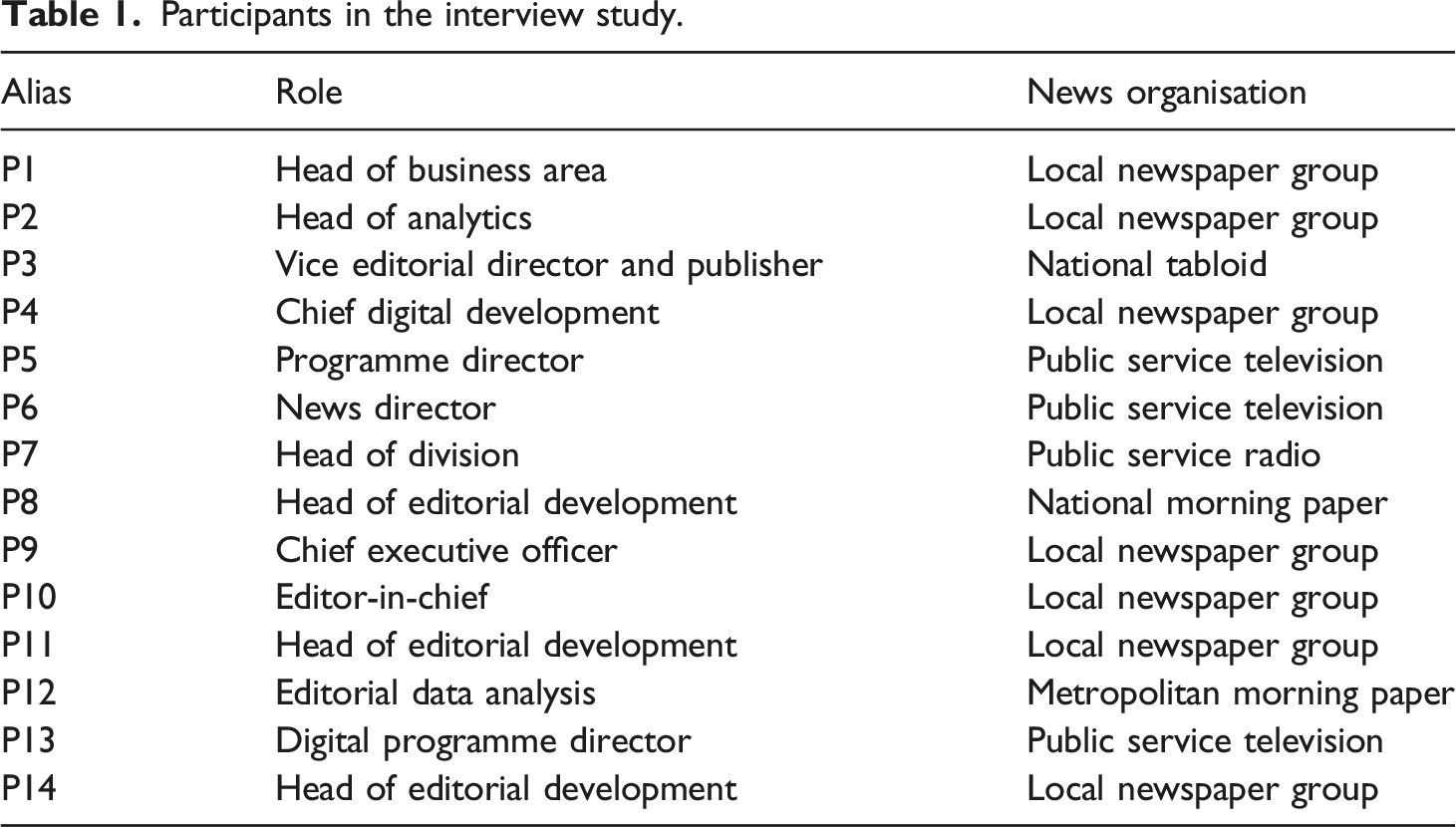
Most of the 14 participants in the study (see Table 1) worked strategically with metrics in their current professional capacity, while 2 were chosen for their long previous work experience over turbulent times. Several of the participants possessed work experiences from different companies; however, their current organisations were the two public service companies SVT and SR, and the six largest newspaper companies—Bonnier, Schibsted, NTM, Gota, Stampen, and NWT. The participants all shared a background in journalism, even though their current work roles sometimes lay at the intersection of journalism, business, and tech.
Participants in the interview study.
The participants were asked questions about their recollections of how the use of metrics unfolded within their organisation, the key shifts and factors that affected the organisation’s use of metrics over time, and the metrics that they currently prioritised within their day-to-day work. They also shared how metrics affected the job roles and responsibilities within the organisation as well as conceptions about the institution of journalism, and the tensions that arose at different points as metrics were integrated within organisational workflows. Although all of the interviews were based on the same interview protocol, the semi-structured approach permitted follow-up questions based on the responses offered to tease out memories, examples, novel issues, and contradictions.
The interviews were all conducted, transcribed, and analysed by the author in an iterative process. First, the narratives were examined at the thematic level, that is, how different themes recur, and how a person relates to them (e.g. whether it is external causes or personal responsibility). Second, a more structural level of examination was applied to how things were said, that is, what components the text consisted of, how the narrative was constructed, and by which elements (Riessman, 2008), feeding back to the thematic level.
The review of textual sources, such as trade press articles, published interviews, and other documents, increased the study’s reliability in terms of dating recollections of events and providing points of comparison with debates in the past. Important sources are, for example, the union’s Journalisten and Dagens Media (previously Medievärlden), owned by the newspaper publishers’ organisation until 2015, all digitally available through the media archive Retriever. Translations from Swedish are made by the author.
Findings – evolution of digital metrics
The first part of the findings aims to provide an overview of the implementation of metrics evolution in the Swedish news industry and the important chains of events (RQ1). The second part will delve deeper into the aspects of metrics and professional values tied to economic imperatives and audience influence (RQ2).
The chains of events were grouped into three overlapping periods based on the interviews: first, the naïve exploration of ‘getting online’; second, the quest for going viral during ‘social media prominence’; and third, the newspaper groups’ shift to audience revenues, that is, leaving the period of ‘paywall hesitation’ (see Figure 1). While the significance of these periods emerged from the interviews, the material quoted in this first part of the findings is mostly from textual sources. Overall timeline 1994–2022.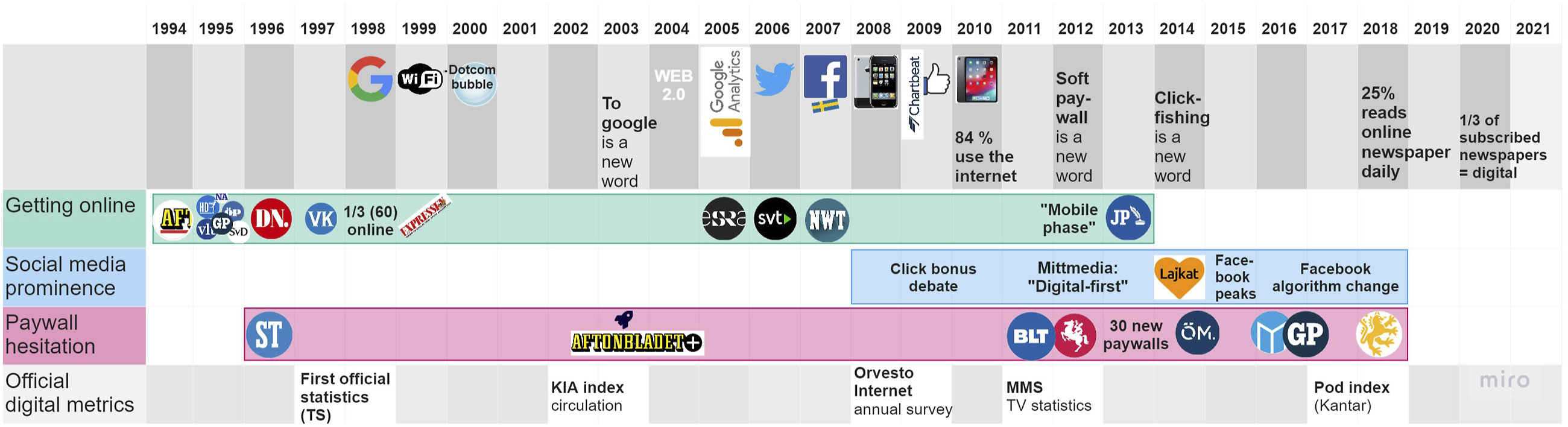
Period 1. getting online and naïve exploration 1994–2013
The period when traditional Swedish news media went online dates from 1994 to 2013. The tabloid Aftonbladet was the internet pioneer, and the local newspaper group Hallpressen was the last to go full-scale online. Public service radio published its first content online in 1999, and in 2005, all channels became available online. Public service television launched digital channels in 2003, and SVT Play in 2006 (see Figure 1). In 1998, approximately 60 Swedish newspapers published some news content online, and 40 newspapers were planning to provide ‘electronic news service’ in the same or the following year (Hedman, 1998). This would equal half of the Swedish newspapers at that time. Several local newspapers were among the early adopters, while others had a more cautious approach, such as the regional NWT group that re-entered in 2006 after a 1-year trial in the 1990s. Hedman (1998) underlined newspapers’ strategic reasons for going online as avoiding leaving the field open to competitors. Another important drive was technology; newspapers did not want to fall behind or seem outdated (Nygren and Zuiderveld, 2011). Hinderson (2013) also highlighted contingent factors, such as enthusiasts for new technology among newsroom staff.
In the beginning, digital metrics “were never driven from any kind of editorial perspective because it was about advertising money” (P1). Initial trade press reporting on digital metrics dealt almost exclusively with internet advertising and the quest for an industry standard. Regarding reach, editors stressed the possibilities of bridging geographical distances, and of reaching ‘young people with news and opinion’ (Meyer, 1997). However, newspapers also published positive news stories on their online statistics (visits, later visitors), similar to those on print circulation figures. Traffic records also became news, such as 9/11 in 2001, the tsunami disaster in Thailand in 2005, and the arrest of a serial rapist in Umeå, where 280 visits per second led to a server breakdown at local vk.se (Juslin, 2006). Weekly distributions of top lists were noticed in an early study of Göteborgs-Posten’s web desk, but Hedman (2006) never heard any references to them in meetings or other conversations between staff.
In summary, during the period of getting online, the editorial leadership explicitly stated the democratic benefits of reach. There was also an absence of immediate economic imperatives but hopes for future revenues.
Period 2. social media prominence 2008-2018
In Sweden, Facebook became the most influential social media, launched in 2007 and peaking in 2015, with 50% of the population as daily users (Davidsson et al., 2018; Andersson et al., 2021). Facebook became vital for audience interaction and content distribution, and was also embraced by public service media. However, although ‘clicks’ (reach) have remained important in the industry, social media has lost its prominent position as a driver of those clicks.
Social media was, of course, one piece in a larger puzzle causing what participants described as populistic ‘click journalism’: this was a tumultuous period of declining newspapers, major cutbacks, and online competition. Traditional newsrooms had embarked on the path towards working ‘digital first’—a maxim first stated by Mittmedia in 2012, and others followed. A symbolic shift among traditional newspapers occurred when the morning routine of flipping through the printed issue was replaced by a screen showing a top list of yesterday’s online news. This shift happened at different times in different organisations, but it signalled that metrics were a concern for the entire newsroom.
Chasing viral content was linked to an ad-based business model based on reach. However, “this pull to do things that are shared” was also felt in the public service radio, as voiced in the Publicist Club’s debate ‘Clicked or kicked’ in Stockholm: “… because even if you don’t want to compete, it’s sort of the measure of success that applies now” (Publicistklubben, 2014). In trade publications, traffic records were still about major news events, but also examples of “quirky news that spreads on the social web” (Medievärlden, 2011). Buzzfeed-inspired newcomers entered the media market, and in 2014, established media groups started their own: Omtalat.nu (Bonnier) and Lajkat.se (Schibsted).
Trade union representatives questioned whether quantity could truly be a measure of quality (Medievärlden, 2012), and the consequences of chasing clicks have been largely debated. As an experiment, Aftonbladet’s culture editor published the same article with two different headlines. Unsurprisingly, the headline containing ‘anal sex’ was clicked 700% more. She commented in an interview, “It’s an insult to working as a journalist if clicks are the kind of metrics we should have” (Granström, 2014). In a debate article, Tidholm (2016) attributed the negative impact of click-chase to the digital-first strategy, leading to “various uproaring news with bears” instead of orienting people in the local community and scrutinising power.
In 2016–2018, Facebook changed its algorithms in several steps, which led the editor of the Swedish viral site Breakit to exclaim, ‘Ow! Mark Zuckerberg just put the knife in the back of little me’ (Lundell, 2018). After 2016, social media interactions decreased markedly in Swedish local newspapers (Wadbring and Ödmark, 2019). Social media remained important but is now considered “more for brand-boosting” (P2) than driving traffic. This is also linked to the theme of period 3—paywalls.
Period 3. paywall hesitation 2001–2018
As in other countries, Swedish newspapers experimented with mixed models of free and premium online content, sometimes mainly to protect print revenues. The first but brief attempt to introduce a paywall was made by the local newspaper Sundsvalls Tidning in 2001. At the beginning of 2018, all Swedish morning papers had paywalls (Ohlander, 2017). The two tabloids kept a mixed model of open and premium content, and Aftonbladet was the pioneer, starting their ‘Plus’ service in 2003. A shift took place in 2013–2014 when approximately 30 Swedish newspapers introduced paywalls. Since paywalls decrease digital reach, this meant that newspapers had to persuade advertisers to “measure the quality of the clicks” instead of counting them (Thunander, 2013). Above all, paywalls were described by, for example, Mittmedia as a forced solution when realising that advertising money had gone elsewhere (Tenor, 2017).
Apart from international examples, Dagens Nyheter and the Norwegian local newspaper group Amedia (Kalsnes, 2019) served as examples of a viable business model and of how metrics could be used as a resource to develop content. If chasing clicks had been a contested phenomenon, the quest for paying subscribers seemed less so. Dagens Nyheter’s editor-in-chief explained in an interview that conversion metrics—that is, content that entices people to become customers—had the benefit of creating less conflict with professional journalism values than previous targets of “ad growth, to drive clicks”, since “the ad currency was not sophisticated enough” (Thambert, 2017). In retrospect, the participants recognised that conversion metrics could also function as an unsophisticated currency, leading to ‘conversion-baits’. Nevertheless, the participants highlighted the shift from (social media) reach to subscribers as a crucial change in terms of aligning commercial and professional values among Swedish newspapers. This leads us to the second part of the findings.
Findings – metrics and professional values
The following sections address RQ2, that is, how aspects of implementing metrics in newsrooms, such as economic imperatives and audience influence on news selection, are described and related to professional values in Swedish news organisations. The findings are structured as follows: First, how audience metrics have been connected to economic imperatives on an organisational and individual level, and second, how audience metrics are perceived to have affected news content. For commercial news media, these aspects somewhat overlap.
Economic imperatives in news organisations
As Carlson (2018) remarked, what web metrics have brought into industrial news production is both old and new. Reaching the audience is an economic imperative for commercial media, both offline and online, subscription-based and ad-based alike. However, in terms of newsroom culture, there was a big difference between subscribed newspapers, evaluated by circulation figures and occasional surveys, and single-issued tabloids, receiving daily sales figures and linking them to content “in the good old days of print”: Every night at ten o’clock, I would talk on the phone with an analyst about the day’s sales figures and what the line-up was for tomorrow. So there was always the intersection of commercialism and journalism. But of course, as a journalist, I had the last say, the analyst couldn’t say “you can’t do that”, but rather “okay, that type of article has led to 10,000 extra copies sold in the past; well then, I’ll add a bit more to tomorrow’s circulation”. (P4)
For subscription-based newspapers, early web metrics were mainly a concern for the small staff of web journalists ‘for fun’ or ‘mutual admiration’, not connected to any organisational receiver or target. P11 doubts that anyone in the news organisation even associated online traffic and ad revenue: “It was just: How many people are reading? So it was very primitive.” Traffic metrics continued to be trivial to the business model for a considerable period; online publishing represented small segments of audiences, newsroom staff, and revenues. As the importance of online news increased, so would the importance of metrics.
Connecting the economic imperative to the individual journalist
In 2008–2009, the trade press reported on a controversial payroll system: Journalists at the start-up Nyheter24 will receive a click-based bonus. The media entrepreneurs wanted to raise every employee’s awareness of the business model (advertising revenues based on reach), and its direct implication for their work, that is, to “write articles that people want to read and not what you want to read” (Resumé, 2008). The entrepreneurs entered journalism from a business background, which helped explain the clash, and the bonus system soon disappeared.
However, in more recent times, Waldenström et al. (2019) noticed other systems of rewards, such as celebrating click records with cakes. An individual click-based bonus might be foreign to a Swedish media context, but the interview analysis indicates that journalists are increasingly expected to take an interest in both reach and conversion to promote the survival of news organisations and journalism. They should use the numbers to understand what readers care about or don’t care about. So that they can change the journalism that they do so that they get it more read, and in that way help to strengthen our reader business, that we get money so that we can survive over time as publishers. (P14)
Instead of the symbolic wall traditionally dividing editorial and business, P8 described journalists as more engaged in metrics as both guidance and evidence because of economic imperatives (to stay viable and develop journalism). I encounter a huge commitment [to metrics] in the newsroom because people see the clear link between this and how we are doing financially, and it has been very important. We wouldn’t have started new editorial teams … if we hadn’t seen that our experiment … worked very well, which you can prove with the statistics. (P8)
The audience’s willingness to pay can also work as motivation: Initially, journalists were often disappointed to find their stories behind a paywall (reaching fewer): “Now, on the contrary, it triggers some … and of course, it’s an even better proof that you’ve done a good job if people want to pay for it” (P3).
Individual statistics are accessible to everyone in most commercial newsrooms. P5, who had a background in public service broadcasting, found some measurements quite extreme, especially conversion metrics. When we visit other news organisations, we see that many indeed make a point of evaluating their reporters on how their various publications are doing and even a conversion rate for each reporter—how many subscriptions they sell. So this could be something for research to look at, what it means for journalism when you even, well, if we were to measure the willingness to pay the public service fee against that, that, well, many have gone quite far. We haven’t gone that far. (P6)
Traditionally, Swedish journalists uphold similar professional values, regardless of their funding. This remark highlights a shift in norms perhaps less visible to the commercial publishers themselves, while for a public service media manager, the market and the editorial are still opposites. This could indicate a growing divide in the professional values of public and private news outlets.
Audience metrics as a negative influence on news content
Much research has taken an interest in metrics’ influence on journalists’ judgments. For example, Welbers et al. (2016) feared that journalists might cease reporting on important societal issues. However, studies have also shown that professional values might overrule audience preferences represented by metrics (Anderson, 2011; Karlsson and Clerwall, 2013).
A theme from the interview was social media’s role as a driver of ‘click journalism’. At first, Facebook was positively received in newsrooms as a means to come closer to the audience “because they were still people, instead of browsers” (P2). The epilogue writes somewhat differently: …journalism changed radically around the mid-10s, with a lot of focus and thoughts that social media would save us, and an incredible amount of video because Facebook said so, you wanted to go viral, you invested a lot in emotions, identity stuff, wrote a lot about the Swedish Democrats, because you knew it aroused emotions, and then people would start sharing it. (P3)
P4 remembered the local newspaper celebrating a viral article in 2015: “I was also part of this and thought ‘wow’ and ‘what a thing’. But it was as if we were shooting buckshot instead of pulling out the real gun, hoping at least one of these buckshot sticks.”
Strategies to increase audience metrics were also embraced at, for example, SVT’s local newsrooms, such as reports on every accident and fire, or quirky news about “strange animals doing strange things” (P5). When instructed to re-prioritise, local managers had to face that figures go down. P1 remembered discussions with another senior manager who expressed that journalism was not what was important, but to drive digital traffic between sites, because ‘this is genuinely a tech industry that we’re now in’. And we are still suffering, I would say, from the aftermath of this dark time in journalism, where numbers were first of all fake, or not so good, and used to push journalism in a direction where journalism essentially disappeared. (P1)
P11 described the impact of metrics as moderate in their newspaper. Still, “if you compare the journalism we did then to the journalism we do today, you can see that it was driven by page views”. Participants talk about click-driven journalism in metaphors such as ‘instant-sugar content’, ‘empty carbohydrates’, and ‘losing the soul of journalism’.
Aligning measures and values
Swedish news organisations have developed from what Cherubini and Nielsen (2016) termed rudimentary and generic approaches towards a more sophisticated analysis in a similar direction as leading US and UK organisations. Several metrics (e.g. click-through, time spent, scroll depth, retention, and so on) are now available in tailored dashboards, sometimes weighed together as rating ‘engagement’ on a 5-star scale. Managers also meet journalists, expecting numbers for how their stories perform. The importance of metrics also becomes evident from reactions when dashboards go down.
In hindsight, the participants perceived previous understandings and the use of metrics as limited. They were self-critical of the top-list focus, but subsequent metrics were also singled out, for example, when newspapers focused on conversion, leading to short-term strategies of ‘conversion-baits’. Instead, participants advocated for a range of metrics: “A short financial article will never become the most bought, but perhaps the best completion rate—there are many ways to define success” (P8). Key factors highlighted are multifaceted metrics, long-term perspectives, and joint discussions in newsrooms on how to interpret and present metrics.
Swedish Radio still describes the current phase as explorative, raising concerns about how to “avoid the traps when looking too much at data, the risk of influencing content in a way that we don’t want” (P7). Commercial newspapers, by contrast, express a new self-confidence emerging from the business model: “We know what is going to save us and that is journalism … we don’t panic, and that allows us to work more systematically” (P1). Behind the paywall, audience metrics seem to align better with journalists’ news selection, such as investigative, in-depth reporting. As hacks and editors, we love this development. It’s kind of back to basics really … I would say that [the old] gut feeling is more and more confirmed now by the data we have. (P11)
When stories get less reach (or engagement) than expected, they can be repackaged and put back on the site: “So if we believe in the material, we can make it get read. And we almost always succeed in making it get read” (P8). A similar remark was made by P12: We see audiences as intelligent and conscious, who also enjoy the occasional oddity but that's not to say that we put in any rubbish ... rather we bestow our unique material much more love [today]. … So I would say that the data support us in making better material, but based on what our journalistic sense has told us. (P12)
Another recurring theme is how metrics have helped newsrooms deprioritise content, often the content they already recognise as low quality, such as ‘boring documents from some political committee’ or ‘simple reports from every sports match’.
Conclusions
This study analysed the evolution of digital audience metrics as a key strategy in Swedish legacy news organisations. The results showed that although the use of metrics was practically insignificant at the start, it has proven potentially destructive to aligning the values of audiences and journalists. The main reason is attributed to the charged metric-centric arena of social media. When not aiming for viral content, managers felt that journalism could once more find its soul and leave ‘the dark time of the clicks’. Now, managers seem to feel that audience metrics align well with professional news selection. The narrative thus suggests that a new equilibrium has been reached. So, what has changed?
For commercial publishers, this is all about the shift to subscribers. However, individual journalists are increasingly expected to consider metrics as economic imperatives, either to increase power over strategic decisions and allocation of resources or as guidance to ensure the company’s (and journalism’s) viability. While public service broadcasting has a long tradition of measuring audiences, they perceive commercial newspapers’ detailed way of linking an individual journalist’s performance to revenue (i.e. conversion rate) as rather extreme. This accentuates an ideological divide between professional values in the public and private media; thus, metrics challenge the shared values and limited economic pressure that have characterised Nordic journalism. Nevertheless, factors facilitating the use of metrics are similar: First, experiencing metrics as linked to targets for the organisation as a whole, but still under the control of the editorial staff. Second, both metrics and how they are interpreted have become more advanced and diversified.
This study has two major limitations. First, its focus on managers carries a one-sided view of how news organisations use metrics. Second, this historical account of the evolution of metrics is conducted at a time when commercial publishers express increased confidence in the future and consistency between audience metrics and journalistic values. This is linked to a business model of digital subscribers, despite the fact that 80% of the Swedish newspaper industry’s reader revenue is still derived from print (Facht and Lindberg, 2022). In other words, it remains an open question how participants will look back at their current perception of metrics, and if, in hindsight, they will even perceive this period as a state of equilibrium.
To deepen our understanding of how editorial metrics create tensions with professional values, future research could conduct more focused comparative studies between public service and commercial media, and between managers and rank-and-file journalists. It is worth noting that a combination of resistance and acceptance may be found in both groups, and that journalists working in public media may not necessarily experience less pressure due to the pervasive implementation of editorial metrics in journalism.
This study contributes to the current knowledge on measurable journalism by taking a decidedly historical approach to the evolution of metrics in the newsroom through the eyes of managers at the strategic level. Although they may not decide on the evolution of the technology, they certainly influence the relevance and effect of metrics in the newsroom.
Footnotes
Declaration of conflicting interests
The author(s) declared no potential conflicts of interest with respect to the research, authorship, and/or publication of this article.
Funding
The author(s) disclosed receipt of the following financial support for the research, authorship, and/or publication of this article: This work was supported by the Ander Foundation: Anne-Marie och Gustaf Anders Stiftelse för Mediaforskning, The Ander Centre for Research on News and Opinion in the Digital Era [20181214].
