




Abstract
Research on incidental news exposure in the context of social media focuses on ‘successful’ incidental news exposure – when unintended news contacts result in active engagement and knowledge gains. However, we lack both theoretical and empirical approaches to the far more likely case that people keep on scrolling through their newsfeed without any post triggering active engagement. To fill this gap, the article conceptualizes a triple-path model of incidental news exposure on social media as a process. Building upon the Cognitive Mediation Model, dual system theories on information processing and recent empirical findings, three different pathways of incidental news processing are identified: automatic, incidental and active. The triple-path model thus allows to theorize the learning potentials that can plausibly be expected from each incidental news exposure path as a starting point for future research.
Keywords
Introduction
A growing body of empirical research has embraced the long established concept of incidental news exposure (INE) to investigate the potential of social media for political knowledge gains (Ahmadi and Wohn, 2018; Bode, 2016; Boukes, 2019; Karnowski et al., 2017; Lee and Kim, 2017; Oeldorf-Hirsch, 2017). Though these studies have produced a wide range of fascinating, at times contradictory empirical results, the theoretical advancement of the field has been hampered by two following key problems. First, there is a lack of systematic reflection whether the theoretical concepts originally developed, for example in television studies (Blumler and McQuail, 1968), retain their usefulness when applied to INE on social media with its distinctive formal structures and affordances for frequent physical interaction. And, second, the empirical studies rarely consider INE on social media as a comprehensive process, but pick out specific elements – usually the elements more easily measurable in a cross-sectional design – leaving us with a rather fragmented patchwork of empirical insights.
As a result, we know quite a lot about the antecedents and effects of what might be called ‘successful’ INE on social media: When people’s encounters with news result in active news engagement and potentially in knowledge gains (Karnowski et al., 2017; Kümpel, 2018; Oeldorf-Hirsch, 2017; Oeldorf-Hirsch and DeVoss, 2019). However, there is much less research and theoretical understanding of the opposite, but just as likely case: When people keep on skimming through the news headlines they encounter as by-products of their daily digital routines without any active engagement. Without engagement, are these incidental news encounters really ‘unsuccessful’ in the sense that they have no impact? And in what ways do the particular characteristics of INE through social media encourage its ‘success’, or not?
The article aims to address this theoretical gap by developing a comprehensive conceptualization of how news processing following unintended contact with news within social media newsfeeds may differ and whether these differences might entail different effects. The article has the following three objectives: (1) to outline formal structural conditions of incidental news contacts within social media newsfeeds, (2) to identify three possible paths of news processing after these contacts drawing on theoretical models of cognitive processing and on recent empirical insights into the specifics of INE on social media. Based on this triple-path model of incidental news processing, the article will also discuss (3) the learning potentials that can be plausibly expected from each INE path.
Incidental learning within social media newsfeeds
Within political communication research, the term ‘incidental news exposure’ can be used to describe both unintentional contact with news while using a medium for other reasons than active information seeking as well as the processing of and learning from unintentionally encountered news. For greater theoretical clarity, we suggest to clearly distinguish between two stages of INE, contact and processing: (1) What are the circumstances of non-intended news encounters in newsfeeds? and (2) which information processing behavior (and learning) might these trigger?
Contact stage: Characteristics of non-intended news contacts in newsfeeds
At present, most online news contacts occur when people access the webpages of news providers. However, as the defining characteristic of INE is unintentionality (Tewksbury et al., 2001), we will focus on the newsfeed of information intermediaries such as Facebook or Twitter where non-intended news contacts are most likely to occur. Due to different forms of content curation (Thorson and Wells, 2016), active and goal-oriented news selection decisions are not a necessary condition for being exposed to news content on social media. Rather, an automated distribution of content based on algorithmic personalization or social curation (Kaiser et al., 2018) enables users to receive news in a lean-back fashion (Gil de Zúñiga et al., 2017) whenever they access the platforms. Within the newsfeed, discovering news content is possible at low cost, which is in line with Downs’ (1957) original concept of incidental learning.
In a formal structural perspective, intermediaries support ‘simultaneous debundling and rebundling of content’, through which they ‘produce constantly updated streams’ (Schmidt et al., 2019: 854). We accordingly conceptualize newsfeeds as the sum of individual posts, presented in the form of a linear (but not always chronologically) ordered timeline (visualized in Figure 1) that compete for users’ attention (Kuiken et al., 2017).
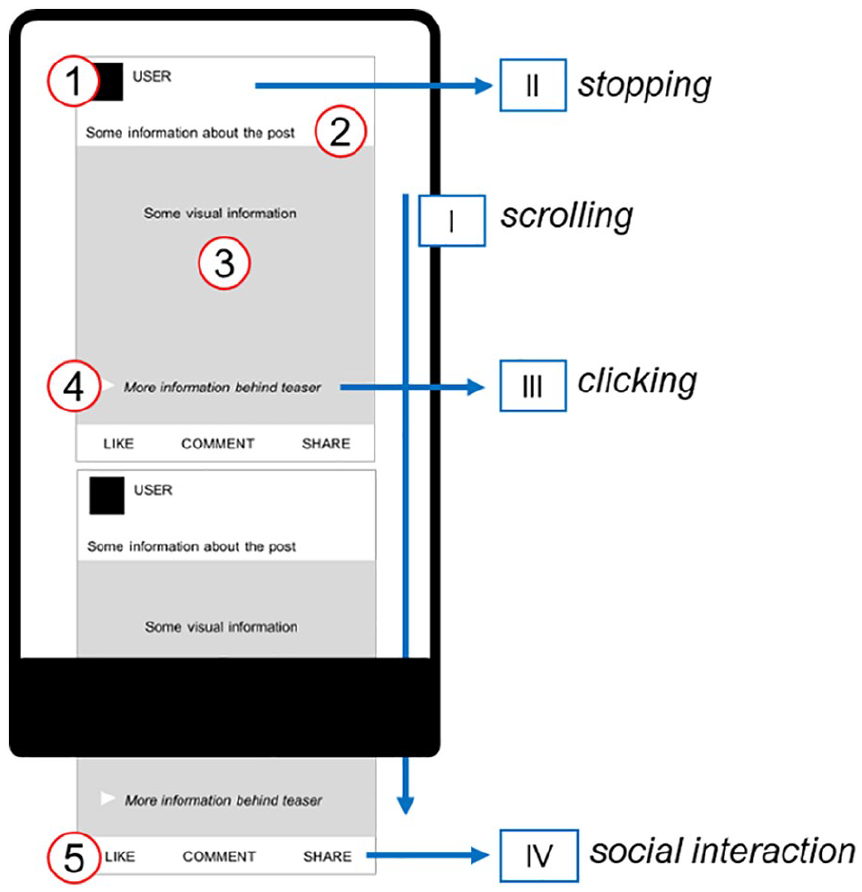
Formal characteristics of a newsfeed (1–5) and typical user activities (I–IV).
Main formal components of the individual news posts depicted in Figure 1 are (1) the source, including name and profile image, (2) a headline or short teaser text, often supplemented by (3) visual information – usually a preview of a linked page or a teaser image. This distinctive style of presentation, the ‘snack news’ format (Costera Meijer and Groot Kormelink, 2014; Schäfer et al., 2017), means that the actual news story remains hidden behind teasers and can only be perceived when the article is called up (4). In addition, there are (5) social endorsement cues such as the number of likes, and direct engagement features for commenting or sharing. In case of retweets, reposts, or shares, an additional (social curation) layer containing further information on the news recommender is supplemented.
The formal structural properties of a medium afford specific ways of physical interaction. We identify essentially the following four newsfeed activities: (1) the almost continuous scrolling through the newsfeed, (2) short interruptions of scrolling (‘stopping’) with varying dwell times spent on individual posts (still without clicking), (3) the calling up of full articles by clicking, and (4) visible social interactions (liking, commenting, sharing).
Following an affordance perspective, we suggest that formal structural characteristics of the newsfeed and potential physical interactions also effect news processing. Furthermore, we posit that on social media, action and cognition phases as part of the information processing (Tremayne and Dunwoody, 2001) alternate very quickly, as each encountered news item can trigger physical interactions. This represents a strong contrast to traditional forms of INE through television and, in turn, may limit the applicability of traditional theoretical conceptualizations of incidental news processing for the social media case.
Processing stage: Explaining learning from unintended news contacts
The theoretical conundrum of INE research is located at the processing stage: After the news contact has occured, by definition, unintentionally without motivation, what is the role of motivation in the processing stage?
Most INE studies rely on either one of two similar, yet not identical theoretical concepts, to describe incidental news processing and its effects: incidental or passive learning. Following the logic of Downs (1957), incidental learning is defined through the low costs of locating information. Though the news contact was unintentional, certain triggers (i.e. unexpected or surprising information; Yadamsuren and Erdelez, 2016) lead users to explore the news encounter intentionally and consciously afterwards (Marsick and Watkins, 2001: 26).
By contrast, passive learning, which originated in the context of television research (Blumler and McQuail, 1968), is ‘typically effortless, responsive to animated stimuli, [. . .] and characterized by an absence of resistance to what is learned’ (Krugman and Hartley, 1970: 184). Here, the aspect of effortlessness is not only related to the effort required to locate information, but especially to the effort required to voluntarily direct attention to a media stimulus. Processing can be passive with only ‘some minimal level of attention to the media in question’ (Tewksbury et al., 2001: 534) as long as ‘the material is acceptable [. . .], without conflict’ (Krugman and Hartley, 1970: 184). As such, passive learning is ‘low-involvement’ learning (Krugman, 1965). In other words, passive learning assumes a lack of motivation in the contact and the processing stage.
Even though they are at times used interchangeably, incidental and passive learning thus refer to different forms of news processing after unmotivated news contact. As incidental learning posits motivation at the processing stage, it is more easily compatible with the traditional research on political knowledge gains through news consumption where most approaches agree that motivation is a key variable for news learning (see David, 2009, for an overview). For example, using a medium for instrumental purposes leads to stronger knowledge gains than ritual media use (e.g. Eveland et al., 2003; McLeod and Becker, 1974).
Within the information processing paradigm, the CMM explicates that the ‘role of motivations is [. . .] to activate information processing behaviors that are the central determinants of cognitive media effects’ (Eveland et al., 2003: 362). According to the CMM, motivations are directing the attentional focus toward news, enabling and causing cognitive elaboration (Eveland, 2001; Eveland et al., 2003). As such, attention is a necessary, but not a sufficient condition for elaboration. Elaboration is the cognitive ability to connect new information with existing knowledge. It involves active processing, that is, investing ‘mental efforts to go beyond the information presented’ (Guo and Moy, 1998: 28). In contrast, INE is defined as an opportunity to learn from the news without initial motivation. Assuming that the CMM’s main causal link from attention to elaboration is still valid, we thus need to include bottom-up driven attentional processes.
Although there is evidence that the link from elaboration to knowledge postulated by the CMM is weakened within a social media context, since users might now ‘engage with the news posts, but not necessarily with the story content’ (Oeldorf-Hirsch and DeVoss, 2019: 3), cognitive explanatory approaches like the CMM have been confirmed as useful to theorize the underlying psychological mechanisms of learning from social media (Heiss and Matthes, 2019). These cognitive approaches are theoretically less developed, however, for explaining whether and under what circumstances incidental news contact that has not triggered attentive, systematic processing may still lead to learning. Hence, we open our theoretical explanations of incidental news processing by describing bottom-up driven processing processes (also related to traditional notions of passive learning) to supplement in our theoretical conceptualization, the top-down oriented CMM processing described earlier. For these bottom-up processes, we consider the structure of newsfeeds as highly influential on user behavior.
Theorizing a triple-path model of incidental news processing
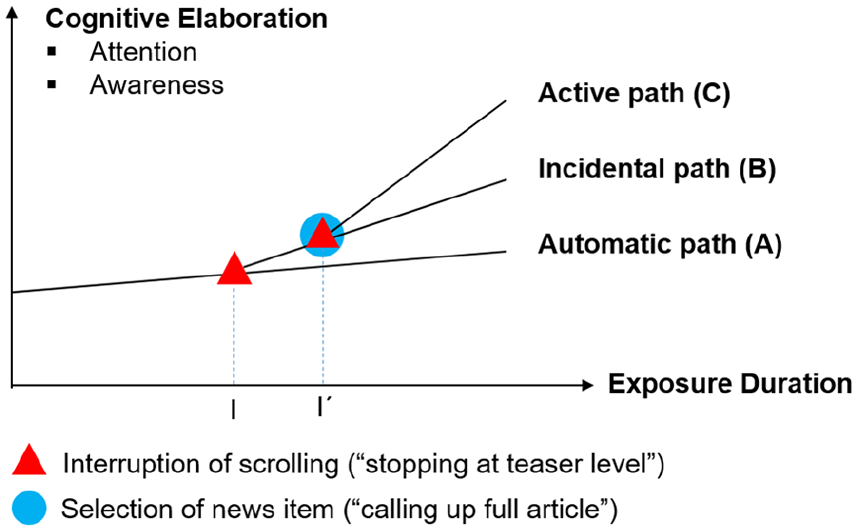
We argue that news processing occurring during the exposure to news that was not initiated by an interest in news should be conceptualized as a process with different pathways. We develop our triple-path model upon the identified newsfeed-typical behavior (scrolling, stopping, clicking; see Figure 1). Accordingly, the paths are hierarchically related in a way that stopping while scrolling (path B; see Figure 2) is necessary but not sufficient for calling up the article (path C).
Triple-path model of incidental news processing after unintended news contact.
The triple-path models’ visual representation (Figure 2) is based on a time dimension representing the continuous newsfeed use (X-axis), as well as on a cognitive elaboration dimension as the degree of invested attentional resources combined with the awareness of being exposed to a news item (Y-axis) (Buijzen et al., 2010: 430).
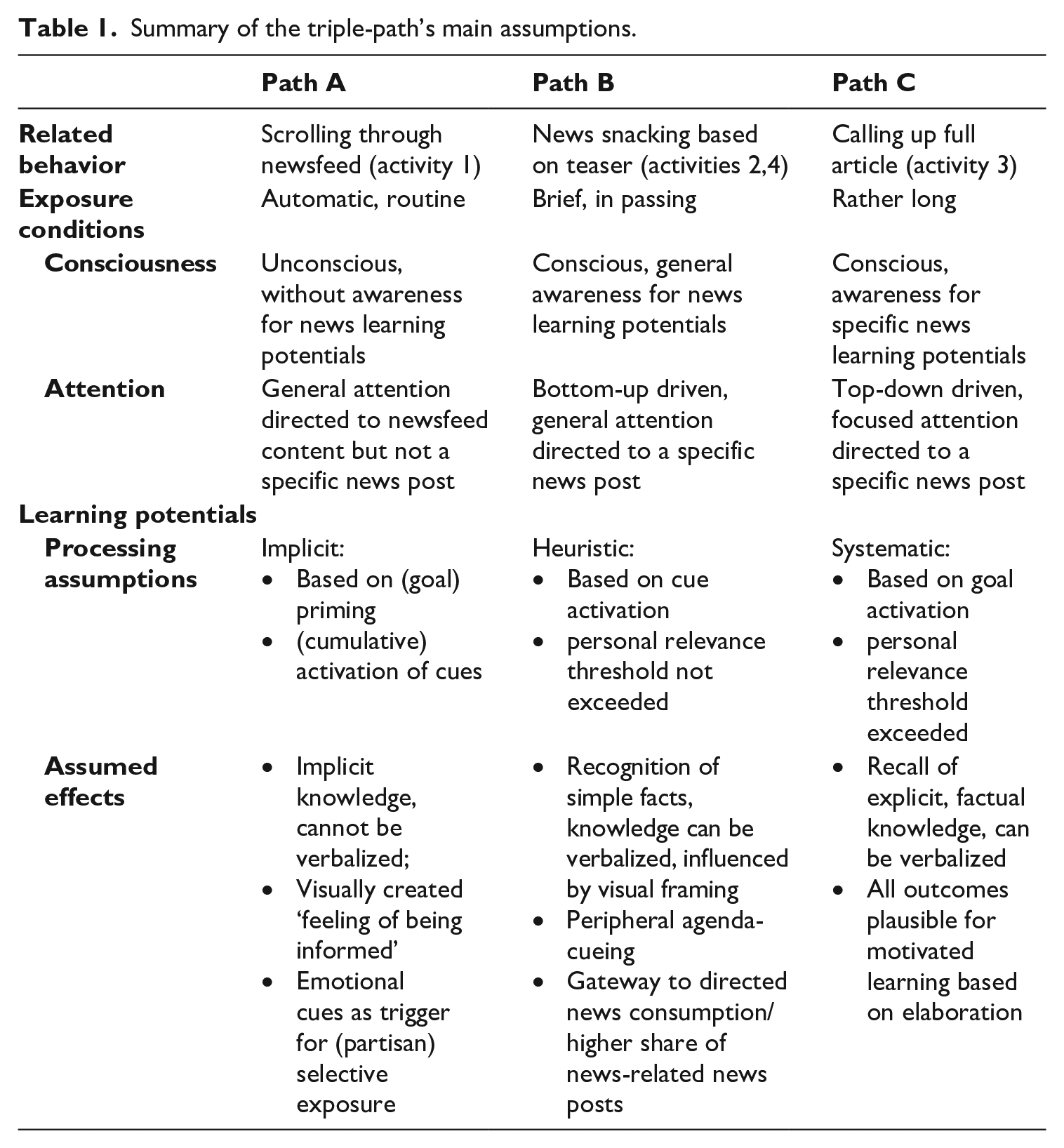
For each path, we first describe what a typical exposure situation looks like. We then outline the main processing assumptions, referring to empirical findings to determine the corresponding learning potential. These steps are summarized in Table 1. In each path, we also highlight our main theoretical propositions.
Summary of the triple-path’s main assumptions.
Path A: Automatic scrolling through the newsfeed
The distinctive design of newsfeeds seems to encourage the activity of scrolling, especially on smartphones (Ofcom, 2018). Scrolling, in turn, creates a kind of continuous stream of passing-by news posts. But how are these fleeting news impressions processed? Motivation-based theoretical models such as the CMM reach their limits here, as do empirical experimental studies, which force users to at least dwell briefly on a particular news item.
The triple-path model, therefore, proposes the idea of an automatic path (A) of newsfeed usage. As a starting mode for undirected, habitual newsfeed use, on this path content is only perceived and processed implicitly and thus unconsciously, and yet, we suggest that it may still frame and influence further processing if the user moves to path B.
Processing assumptions in path A: Automated usage leads to dominance of fast thinking
Sundar (2012) argues that users have more control over their news consumption in digital media environments which is supposed to increase involvement and thus the motivation to learn. How does this correspond to news consumption through newsfeeds? In principal, users here, too, have the opportunity to actively individualize their news consumption by means of explicit personalization (Bozdag, 2013), for example, by following certain profiles. However, this act of active control is probably only dominant when users adopt a new platform.
LaRose and Eastin (2004) argue that users may make a conscious decision that corresponds to their expected gratifications when using a new medium initially, but over time develop habits that no longer directly respond to their initial needs. Hence, in the early phase, users repeatedly adjust their newsfeeds until routine use reveals satisfactory results. Continuous use of the platform might result in overlearning the initially active in favor of a more passive and relaxed approach. Moreover, though personal curation of newsfeeds is until now only discussed in the light of selective exposure (e.g. Thorson and Wells, 2016), it is also reasonable to assume that self-selection of content likewise influences the processing itself: By actively adjusting their newsfeeds, users in the long run create streams of ‘likeable’ news posts, making newsfeed usage a highly pleasurable experience; ‘just scrolling’ feels rewarding and becomes routine. With this automation in usage, less mental resources are needed for decoding, but also less mental resources are made available by the user because the nature of the newsfeed content does not suggest any need for sophisticated processing (Kruikemeier et al., 2018; Salomon and Leigh, 1984).
This corresponds well to the characterization of habit by repetition, but habit is furthermore defined by ‘deficient self-regulation’ (LaRose and Eastin, 2004). It, therefore, seems plausible that especially routine newsfeed users fall into automatic mode, in which conscious self-regulation is not active, at least at first: A1: When using newsfeeds routinely, overlearning occurs, which means that behavior is more and more automated. As a result, less mental resources are needed, but also less are attributed.
Dual System Theories (DST) of human information processing are widespread. By contrast, Buijzen et al. (2010) propose a third route to describe possible effects of persuasive messages: While in many DST, the processing in intuitive mode is primarily associated with low levels of attention, in this third automatic mode, users are also completely unconscious of the fact that persuasive messages are actually present.
Furthermore, an automated newsfeed usage out of habit implies a dominance of system 1, ‘manifested behaviorally in cognitive-emotional preoccupation with using SNS’ (Turel and Qahri-Saremi, 2018: 3053). Groot Kormelink and Costera Meijer (2019) indeed find evidence for such an impulsive drive when examining user perceptions on scrolling: ‘What the logic of “scrolling” (i.e. “keeping it moving” even if one likes the content) suggests is that users find it (increasingly?) challenging to “commit” to one news item when there is a plethora of other content to consume’ (p. 12): A2: The newsfeed’s affordance for continuous scrolling makes the top-down allocation of attention more difficult, leading to a dominance of the intuitive mode of thinking. (system 1)
News posts within newsfeeds usually comprise different modalities, that is textual and (audio-)visual information. Building upon the notion of verbal–visual redundancy, it is often assumed that information presented in multiple modalities is more likely to ‘getting through to receivers’ (Sundar, 2000: 482). This, however, would presume that users are indeed engaging with the textual information, which is, as we argue, not inevitably given for news consumption through newsfeeds. Moreover, recent findings from psychology and neuroscience do point to a predominance of visual over textual information regarding the ease of processing (Powell et al., 2019). Especially for news posts, eye-tracking reveals that it is richer content (i.e. pictures and hyperlinks) that enhances attention (Kruikemeier et al., 2018).
This also refers back to the ‘cognitive-emotional preoccupation’ (Turel and Qahri-Saremi, 2018) when using social media. Since the unique quality of visuals is to be eye-catching and easily perceivable, they ‘exert an activating effect by fostering an emotional connection with the reader’ (Powell et al., 2019: 573). Given the hierarchical nature of news processing from attention to elaboration as stated by the CMM, it is more likely the visual aspect of a given news post that guides the preconscious filtering of content in the automatic mode. This in turn might lead to a greater influence of emotional responses when news posts within multimodal newsfeeds are selected by users in automatic mode: A3: A dominance of the intuitive mode of thinking when scrolling through the newsfeed in the automatic mode manifests in a greater influence of emotional responses when selecting news posts for closer attention (on path B or C).
Learning potential of path A
In the field of consumer research, studies of incidental (ad) exposure as well as of implicit effects are widespread, as research on advertising effects to a large extent cannot assume active processing. In political communication science, implicit effects are less investigated, although they can explain, for example, the effectiveness of political campaign banners on the basis of priming, that is, by temporarily increasing the accessibility of a mental construct (Buchanan, 2015: 323). This can also be done ‘subliminally’, without attention.
Against the background of the typical use of news outlined earlier (teaser level, scrolling by, without an explicit information goal), the contact conditions primarily applied to advertising stimuli in the past now also appear realistic for omnipresent news. Indirect effects of news would be of interest as news-related knowledge structures can be unconsciously activated. This, in turn, can stimulate appropriate behavior (e.g. to recognize and heuristically process a news post when encountering one during further newsfeed usage, see path B). Although implicit processes cannot lead to the formation of new goals (see Knoll et al., 2018, on implicit goal activation), implicit knowledge can thus promote the acquisition of factual knowledge.
The accumulation of different cues (e.g. technological interactivity cues, Sundar, 2012, or emotional cues) while scrolling enables a ‘ready application of cognitive heuristics triggered by those cues’, leading to information processing likely biased ‘toward heuristic, rather than systematic, processing’ (Kim and Sundar, 2016: 48). Hence, the longer people are scrolling through the newsfeed, the more cues are activated, making heuristic processing more likely than a systematic examination of a specific news post on path B: A4: The automatic use of the newsfeed activates cues without this being conscious to the user (unconscious priming). As a result, heuristic processing of the content (path B) may take place if the cue is encountered again.
On a purely physical level, it can sometimes be difficult to make a clear distinction between gradually slower scrolling and mental dwelling on a particular news item. Nevertheless, we assume that this differs in terms of processing: Moving beyond the rather rudimentary classification of system-1 versus system-2, we follow Stanovich (2009) in proposing that very different type-1 processes do exist and that path A and path B are variations of the ‘Autonomous Set of Systems’ (p. 56). This enables the triple-path model to consider that both the scrolling through the newsfeed as well as stopping for brief glances at a news post are not active forms of processing, but still differ: Heuristic processing in path B is more associated with explicit memory, and though not made consciously, the result can still be verbalized (Stoker et al., 2016). By contrast, scrolling without focused attention (path A) is more an implicit processing, contributing to implicit memory and not leading to verbalizable outcomes.
Here, we urgently need empirical research on automatic processing on social media to better assess the effects of the emotional, subconscious reactions particularly to visuals in newsfeeds. For example, Müller et al. (2016) show that the number of perceived political Facebook posts leads to a greater feeling of subjective knowledge. The authors explain this with the activation of stored knowledge structures, implying that news use has taken place. Since actual knowledge is not acquired to the same extent, these ‘false heuristic inferences’ go hand in hand with increased ‘illusions of knowledge’ (Müller et al., 2016: 439). It is currently an open question whether users form the perception of having seen ‘political’ posts based on automatic processing (e.g. by scrolling through pictures of Donald Trump) or whether this requires the heuristic processing of path B. Moreover, given the important role that emotions play in processes of selective approach and avoidance of news (Song, 2017), it may be that the emotional cues accumulating on the automatic path already contribute on a subconscious level toward directing attention to partisan news items which are then processed heuristically or selected for systematic perusal on path C: A5: Given the repetitive nature of news encounters within newsfeeds, the affective imprints of a news posts, largely based on visual or single word cues, may already contribute to ‘illusions of knowledge’ as well as selective approach and avoidance.
Path B: Conscious encounters with news on the teaser level
Starting off with the ‘skimming through teasers’ described in path A, no attention is intentionally directed to news posts if newsfeed usage is not driven by informational needs. However, the media environment can cause a bottom-up allocation of attention (Bucher and Schumacher, 2006). Attention is ‘a cognitive process of selectively concentrating on certain objects while ignoring perceivable others’ (Yang and Shen, 2019: 214). According to appraisal theory, attention is consciously directed to a news post if features of the media stimuli evoke a positive processing decision. These relevance checks are more or less automated and depend on ‘message, source, and network characteristics’ (Knoll et al., 2018: 9). Compared to purposeful, top-down guided newsfeed use, the specific stimulus and its characteristics are thus particularly influential in the context of unintended news encounters. As shown previously for newspaper headlines, both content and structure influence ‘intrapersonal factors (e.g. arousal and attention) that ultimately affect[ed] cognitive processing (e.g. encoding, storage, and retrieval)’ (Gibbons et al., 2005: 275).
If a news post thus captures the users’ attention, this leads to an interruption of the foreground activity (i.e. using the newsfeed for other purposes than information). When ‘headlines flash into consciousness’ (Tewksbury et al., 2001: 535), this is often perceived as surprise (Marsick and Watkins, 2001), leading to a ‘memorable experience’ of news item contact (Yadamsuren and Erdelez, 2016), and is accessible for self-reports. Based on our review on incidental learning assumptions, path B thus qualifies as ‘incidental’ learning in a strict sense since it assumes an interruption (Lee and Kim, 2017) that leads to a conscious exploration afterwards (Marsick and Watkins, 2001).
Processing assumptions path B: Heuristic evaluation on teaser level
These attentional responses can lead to visible social interactions, often operationalized as active engagement (e.g. Karnowski et al., 2017; Oeldorf-Hirsch, 2017), or might be restricted to ‘invisible’ mind focusing. Although news content at the teaser level is limited in terms of substance and complexity (Kümpel, 2019), these ‘snack news’ can in principal be processed with various levels of effort. However, ‘news snacking’ is not an attentive form of news reception: Though the news post grasped the user’s attention at first glance, it has not exceeded the personal relevance threshold which would have led to actually clicking on the linked article and thus to attentive, systematic processing in path C. Instead, we assume that processing based on heuristics is more likely.
Put simply, heuristic information processing is based on learned knowledge structures derived from experiences, observations, or socialization (Chaiken, 1980). These knowledge structures provide processing rules for specific situations, enabling an efficient and resource-saving form of processing. Heuristic processing is used particularly when only a limited amount of information is available or when the motivation is not sufficient to systematically process a situation and its content. Accordingly, heuristics are rather simple explanatory models.
The prerequisite for applying the learned and stored heuristics, however, is that they are present in memory, in other words cognitively available and activated. Activation happens by cues (e.g. while scrolling); if a certain cue is recognized, the corresponding processing rule is activated. An example for heuristic processing is the ‘proportion of news in feed’ acting as a cue for the importance of a topic (Stoycheff et al., 2018: 182). For this ‘peripheral agenda-setting’, media (or technology) cues are found to be more relevant than the content itself (Bulkow et al., 2013).
In most cases, people are not aware of how they have formed their opinion or knowledge: Content can be processed on the basis of learned rules (heuristics) so that the actual information is not stored beyond working memory, only the ‘evaluative implications’ of that information are recorded (Kim and Vishak, 2008). Instead of the message itself, an affective imprint of message exposure remains (Graber, 1988).
Learning potentials of path B
Even in traditional contexts, headlines not only need to convey a summary of the article, but also to attract attention to encourage reading (Andrew, 2007). The newsfeeds’ structure as an endless stream of potentially interesting, personalized content reinforces this competition for the scarce good of attention. Hence, headlines tend to be formulated in an extremely pointed or deliberately ambiguous way, often emotionalizing through negativity. Headlines can thus be misleading without being directly false (Ecker et al., 2014). When snacking news, these headlines serve as cognitive shortcuts for users, enabling them to efficiently deal with the rich supply. However, those who stay at the teaser level are provided with a different set of heuristic cues compared to those reading the full article (Andrew, 2007).
Findings from Yadamsuren and Erdelez’s (2016) qualitative study underline that especially the unusual, the bizarre, the outrageous or the crazy lead to allocation of attention after unintended contact with news, implying that soft news are more likely to succeed. As users with low interest in news are already less likely to find hard news in their newsfeed due to the different curation modalities (Kaiser et al., 2018; Thorson and Wells, 2016), this would further strengthen the dominance of soft news in INE. This is supported by findings for traditional media, according to which visual cues and other salient features of a news article determine the allocation of attention resources for further processing of the content (Bucher and Schumacher, 2006): B1: Given the automated relevance checks that occur during scrolling, news posts resembling soft news (strong visuals and emotional cues) are more likely to capture attention within the competitive newsfeed. Hard news (if present at all) are less likely to be recognized as relevant.
Furthermore, news teasers in newsfeeds are dominated by visuals and videos. As evidence from framing research shows, in the presence of both visual and textual information, the visual frames have a stronger impact during heuristic processing (Powell et al., 2019), even though the difference may depend on individual characteristics such as the processing style: B2: Given the dominance of visual over textual information during heuristic processing, knowledge gains based on visual frames are more likely on path B.
Lee and Kim (2017) find that recognition of political information is, unlike recall, not dependent on actual exposure to the content. That is, even when examining a news post superficially, it may still contribute toward recognizing particular aspects. However, this recognition potential is restricted to the teaser level in path B. Hence, reasonable learning outcomes based on path B are the recognition of political actors or other forms of rather simple factual knowledge, but not the recall of complex factual knowledge (Kümpel, 2019): B3: If a news post gained attention, it is initially processed based on heuristics, leading a) to positive effects on recognition but not on recall. Since exposure is restricted to the teaser level, recognition is b) limited to simple facts.
However, the formal characteristics of a news post also act as peripheral cues that drive social interactions in form of liking, commenting, or sharing (Oeldorf-Hirsch and DeVoss, 2019). Especially the liking of news posts is a low-effort and low-threshold form of engaging with news content (Knoll et al., 2018), which still implies concentrating attentional resources for a certain amount of time. It is thus plausible that ‘the more individuals elaborate on a snack news post, the more likely they may become to click on the link and seek more in-depth information [. . .]’ (Heiss and Matthes, 2019: 4). Moreover, active engagement is acting as implicit feedback for algorithmic personalization (Bozdag, 2013) or might encourage friends to share more of these news posts. Heuristic interactions with a news post might thus increase the amount of news posts within the individual newsfeed. We thus assume that active engagement on the teaser level might lead to a ‘gateway-effect’ (Baum, 2003), that is reaching inattentive audiences by making information more accessible: B4: Engagement with a news post indirectly increases the proportion of substantial news posts by means of algorithmic or social curation.
Path C: Active engagement with full articles
Under what conditions can bottom-up driven attention to a news post lead people to call up and elaborate on the full article? We argue that the last path C will only occur if the news post exceeds the personal relevance threshold and, unlike in path B, an attentive and potentially more effortful examination seems worthwhile to the user.
Processing assumptions in path C: Goal activation leads to systematic processing
As suggested by Knoll et al. (2018), we assume that goals do not always have to be pursued in the foreground and are not always conscious (Dijksterhuis, 2013). Rather, they guide our behavior because they direct our attention to goal-oriented information. After encountering a news post on the teaser level without initial information needs, the cursory examination of the teaser might reveal that it is related to an underlying goal and thus lead to it being called up.
According to uses and gratifications research, surveillance needs and social utility are the most important news use motivations in terms of knowledge gains (Eveland et al., 2003; McLeod and Becker, 1974). Hence, calling up news-related posts occurs predominantly when there is a thematic interest (Karnowski et al., 2017). However, such an ‘interest’ in a given news item might also be generated in situ (Kümpel, 2019) through perceived informational utility or emotional and thus more impulsive reactions. Another important determining factor for news engagement is the news recommender: social curation might increase the social relevance that is attributed to a given news post (Kaiser et al., 2018). Addressing the news user in person, through tagging or direct speech, increases the probability of active news engagement (Kümpel, 2019). Thematic prior knowledge, however, impedes reading (Karnowski et al., 2017): C1: Calling up the full article depends on the activation of an underlying interest in the news item and thus of a perceived informational, social, or hedonistic relevance.
If the news item finally exceeds the personal relevance threshold, the resulting active news engagement corresponds with ‘common’, active learning assumptions. The more a recipient is interested in a news item for informational needs, the more she is attributing attentional resources to it and the more likely she is to elaborate on the content. Given that INE is initially not associated with news interest, this path C is the path with the most prerequisites and the most unlikely to occur. This is confirmed by the empirical observation that an average user only clicks 7 percent of the political news stories available in the personal newsfeed (Bakshy et al., 2015).
Learning potential of path C
Lee and Kim (2017) demonstrate that active learning through news engagement after unintended news contact can lead to a positive and moderate effect (B = .51***) for the acquisition of political knowledge, which is remarkable for media effects. This effect is similar to that expected for reading newspapers, which is plausible because ‘the act of reading nearly forces attention’ (Eveland et al., 2002: 363): C2: Due to the necessary condition of perceived relevance, calling up the article after incidental news contact can be treated as intentional news use, leading to active processing and thus to factual knowledge gains (according to the substance of the actual news content).
Discussion
In this article, we aimed to bring more theoretical clarity to the concept of INE within social media newsfeeds, and thus, to hopefully facilitate future research in this field. In our opinion, future studies could greatly gain from distinguishing clearly between
(1) the two main stages of INE: incidental news contact (= non-intentional news contact while using (online) media for non-information goals) and incidental news processing.
(2) the three possible paths of news processing in an INE situation: automatic, incidental, and active processing, entailing different forms of learning and different learning potentials.
Our proposed triple-path model may thus aid in providing a more conclusive assessment of the overall relevance of INE through social media for the societal diffusion of political knowledge. As described earlier, knowledge gains are most likely in what we initially called ‘successful’ INE, when unintentionally encountered news exceed the personal relevance threshold and resonate with a personal learning goal, hence, leading to active processing (path C). This active processing is more likely to occur for people with an overall higher interest in news (and thus, a latent activated learning goal facilitating top-down attention allocation) whose newsfeed is also likely to contain a higher share of news items.
In comparison, incidental processing (path B) may seem the less ‘worthy’ path as it is limited to the teaser level of news posts. In other words, though content characteristics have stimulated some allocation of attention, processing is limited to the activation of existing knowledge structures, and likely to be strongly affected by visual and emotional cues. This implies that simple facts can still be picked up and remembered. Moreover, INE has the potential to stimulate political discussions with weak ties (Ardèvol-Abreu et al., 2017), allowing even simple ‘political information’ to become complex knowledge through discussion and elaboration.
By contrast, the automatic processing of news that users are not even conscious of is the most probable path A, whose effects still remain critically understudied in the field of political communication. Drawing on the results from advertising research, at least effects on information recognition (such as names of political actors) through priming are plausible for the broadest set of users. However, the strong role of visual and emotional cues in automatic (path A) and incidental processing (path B) may contribute toward partisan selective exposure (Song, 2017), the polarization of political debates and even make users more susceptible to mis- and disinformation (van Damme and Smets, 2014). In addition, processing effects on both paths may impact third-party variables, which in turn may dampen the probability of people actually learning from newsfeeds (subjective feelings of information, see Müller et al., 2016). Again, it would be important to explore whether newsfeeds particularly foster automatic, relatively unreflected modes of use – and thus path A processing. As fast thinking is associated with citizens being ‘trapped in a cycle of negativity’ (Stoker et al., 2016: 16), this might have problematic consequences for democratic politics.
The triple-path makes two contributions to the growing research field INE on social media. First of all, it provides a point of orientation for researchers needing to explicate processing after unintended news contact. Does their empirical model really refer to passive learning, or is it rather based on the assumption that newsfeeds provide triggers which in turn stimulate an attribution of attention and thus motivated processing (path C)? If the latter is the case, then the information potential of the analyzed unintended news contacts is probably best explained by the CMM or related motivational approaches.
Second, our triple-path model suggests that news processing after unintended news contact on social media is more likely to be heuristic (path B) at the teaser level than systematic (path C) at the article level. Future empirical research should reflect these probabilities more appropriately, for example, in the operationalization of the dependent knowledge variables. If, by contrast, the research aims to investigate the impact of a merely passive, lean-back newsfeed use, then the triple-path model argues that the plausible learning potential of path A lies in unconscious priming, necessitating a research design that includes measures capturing latent activation of knowledge structures. At the same time, our model strongly suggest that empirical research on both automatic and heuristic processing needs to pay more attention to the role of visual and emotional cues in the newsfeed.
In our opinion, however, the most urgent goal of current INE research should be to take a closer look at the newsfeed’s specific affordance of scrolling and skimming over teasers. Here, we need studies that investigate the role of newsfeed designs for supporting conscious attention and, consequently, elaborative processing (path C). Only if empirical research takes into account all theoretically plausible paths of INE in equal measure will we be able to really understand the information potential of omnipresent news on social media.
Footnotes
Funding
The author(s) received no financial support for the research, authorship, and/or publication of this article.