




Abstract
On Social Network Sites (SNS), citizens are frequently exposed to political news posts embedded in humorous context posts, such as funny videos or pictures. Using data from two experimental studies and a two-wave panel study, we test the effect of exposure to humorous context posts on message elaboration, and the consequences for political participation and knowledge. Results from the experimental studies indicated that incidental exposure to political posts in the context of humorous posts can increase message elaboration and in turn knowledge and participation. In line with these findings, results from the panel analysis revealed that exposure to humorous posts boosted message elaboration only among individuals who rarely used SNS for news. However, for citizens who use SNS for news more frequently, the effect of humor exposure on elaboration turned negative. While the panel data suggest that message elaboration positively affected political participation, there was no positive effect on knowledge.
Keywords
Social Network Sites (SNS) have emerged as an important new source for political information. According to data from the Pew Research Center (2017), 68% of Facebook users, 73% of Twitter users, 30% of Instagram users, and 31% of YouTube users use those SNS for news. On SNS, citizens are often exposed to political information not because they are actively seeking such information but run into it incidentally (Fletcher & Nielsen, 2018). Furthermore, the new media environment has changed the context in which political news are processed. Most importantly, even though political and non-political posts appear separately in the newsfeed, users tend to scroll down their newsfeed quickly, evaluate individual posts, and jump from one post to the next. Thus, the way users process a political post in the newsfeed may heavily depend on the context posts, that is, the reception of the preceding posts as well as the expectations of the posts to come.
Even though citizens are increasingly relying on SNS for their political information, political news may make up only a small share of most people’s SNS information environment. In fact, there is reason to believe that most social media users are exposed to a mix of political and non-political content in their newsfeed and that political hard news are increasingly processed amid humorous context posts (see Heiss, Schmuck, & Matthes, 2018; Quan-Haase & Young, 2010; Theocharis & Quintelier, 2016). Even though the effects of humor on political information processing have been intensely discussed (e.g., Baek & Wojcieszak, 2009; Matthes, 2013; Postman, 1985; Prior, 2005; Wirth, Schemer, & Matthes, 2010; Young, 2008), there is yet a lack of research on how humorous context posts may affect the processing of serious political content. Drawing on existing empirical findings and theories, expectations are mixed. To put it briefly, humorous context posts may either boost elaboration via increased attention or inhibit serious information processing because humor elicits positive mood.
In this study, we seek to combine research on incidental exposure to political information and humor. We conducted two experimental studies to test the isolated effect of humorous (as compared with non-humorous) context posts on political message elaboration in an incidental exposure situation. Second, we use panel data to replicate the effects of the experimental studies with survey data. This is highly informative because the experiments required a forced exposure situation to guarantee internal validity (De Vreese & Neijens, 2016). Panel data allow to draw conclusions about the degree to which the psychological mechanisms found in the experiments may affect individuals in real-life situations.
The study attempts to fill three pressing research gaps. First, and most importantly, we completely lack research on how the humorous context on SNS affects the processing of embedded political news. This is surprising, as entertainment use on SNS is high (Park & Lee, 2014; Quan-Haase & Young, 2010; Schäfer, Sülflow, & Müller, 2017). Related to that, we further examine the consequences of humor-driven processing in terms of political knowledge and participation. Second, existing research on the relationship between SNS use and political knowledge and participation is primarily based on cross-sectional survey research (e.g., Kim, Chen, & De Zúñiga, 2013; Valeriani & Vaccari, 2016). Survey studies in general can hardly isolate effects which occur during reception and cross-sectional studies specifically do not allow any causal conclusions of proposed relationships (Boulianne, 2015). Third, and related to that, there is a lack of research which investigates the psychological mechanisms which are involved when processing political content in a SNS context (Heiss & Matthes, 2016). This, however, is critical, because exposure situations on SNS are entirely different as compared with traditional media. This study contributes to the existing literature by investigating the causal role of humorous context posts on social media, using both experimental and panel designs.
Theoretical Framework
Past research has shown that news use may increase political participation and knowledge. The key mechanism linking news exposure to these outcomes is elaboration. The cognitive mediation model (see Eveland, 2001) outlines that news attention is a necessary, but not a sufficient, condition for effective learning outcomes. It is necessary, because only if people pay attention, they engage in elaborative processing, in which they connect the new information to past experiences and existing knowledge: “By linking the new information with previously stored knowledge, the news content will be more easily accessible for recall” (Eveland, 2001, p. 577). The time spent on elaboration may thus “increase the strength of the memory trace for the new information” (Eveland, 2001, p. 577).
The O-S-R-O-R (Orientation-Stimulus-Reasoning-Orientation-Response, see Shah et al., 2007) model follows a very similar logic and expands the role of elaboration to political participation. According to this model, news exposure leads to both interpersonal (i.e., conversation) and intrapersonal (i.e., elaboration) reflection processes. Both processes may affect individuals’ orientations, such as learning and efficacy. These new orientations may then affect individuals’ behavioral responses, including political participation (Shah et al., 2007). However, behavioral responses may also occur independently from knowledge gain. For example, thinking about politics may also stimulate emotional responses, which may hardly be related to any substantial knowledge effects (see Knoll, Matthes, & Heiss, 2018). Furthermore, individuals may often be exposed to attitude-congruent information which does not provide new information, but in fact only fosters existing knowledge structures and thus attitudes (Ajzen & Sexton, 1999; Sotirovic & McLeod, 2004). Thus, elaboration may increase political participation because of emotional involvement and stronger attitudes.
Taken together, the existing literature provides strong evidence that elaboration plays a key role in increasing citizens’ political knowledge and participation. However, there is still a lack of evidence whether and how these models can be applied to the SNS context (Oeldorf-Hirsch, 2018). Most importantly, this is because exposure and reception of political information is very different on SNS. First of all, individuals are increasingly encountering political information in incidental exposure situations. This means, they are not actively looking for political information but are exposed to such content because of algorithmic characteristics or network activities (Valeriani & Vaccari, 2016). Thus, the levels of elaboration on SNS may be lower and of different quality compared with situations in which citizens engage in active news seeking (Oeldorf-Hirsch, 2018).
Second, individuals may often be exposed to “snack news” rather than to full news articles. Snack news are social media posts which “convey a reduced version of a news story” and “are composed of a headline, a picture, a teaser of the news story, and social endorsement cues including ‘likes,’ ‘shares’ or comments of other users” (Schäfer et al., 2017). Even though such posts may often include links to more comprehensive stories, there is little evidence that following news sources would also boost the use of news websites (see Müller, Schneiders, & Schäfer, 2016). There is little reason that a single snack news post may contribute to citizens’ deeper knowledge and effortful participation. However, the more individuals elaborate on a snack news post, the more likely they may become to click on the link and seek more in-depth information (see Knoll et al., 2018).
Third, political snack news on SNS may occur amid other non-political posts, most importantly, entertaining content (Park & Lee, 2014; Quan-Haase & Young, 2010). As content changes quickly when users scroll through their newsfeeds, the reception of political and funny non-political content is highly entwined. Even though some similar situations may occur while watching television—that is, when a news show is interrupted by a short funny commercial—it is safe to argue that the overlap of different content is higher on social media. For example, if a Facebook user scrolls through her newsfeed, she might encounter multiple unrelated posts within seconds. However, even though they are unrelated, the reception of each individual post may strongly depend on the content of the other posts.
Humorous Context Effects
Based on the propositions outlined above, this study investigates the effect of humorous context posts on the elaboration of political hard news on SNS in an incidental exposure situation. Furthermore, it investigates the consequences of elaborating political content on SNS for political participation and knowledge. Existing research in information processing provides two theoretical explanations: a cognitive effects explanation and a mood effects explanation. The cognitive effects explanation emphasizes that humor increases attention and may thus stimulate elaboration. The mood effects explanation suggests that humor can also induce positive mood, which may dampen elaboration.
The cognitive effects explanation
The cognitive effects explanation draws on research in advertising, suggesting that humor can stimulate individuals’ attention to information which they would have ignored otherwise (Gruner, 1967; Weinberger & Gulas, 1992). A meta-analysis of humor in advertising (Eisend, 2009) has shown that humor significantly increases attention (r = .42). In fact, the effect on attention was the strongest among all investigated variables, including positive affect (r = .27) (see Eisend, 2009). In line with these findings, scholars in political communication have argued that soft news and political humor have the potential to create political involvement among citizens who lack political interest (Baum, 2002; for a discussion, see Baek & Wojcieszak, 2009). They assume that humor, in order to be apprehended (i.e., to understand the punch line), requires a certain amount of cognitive engagement (Matthes, 2013; Suls, 1983). Humans thus increase their attention when they expect humorous messages. Only if people understand the message, they are rewarded with feelings of enjoyment. Hence, citizens have to mobilize their cognitive resources and these resources may then be used to comprehend the political content, which is part of the message. In line with this reasoning, some research has found positive relationships between watching late night political comedy and viewers’ political knowledge (Baek & Wojcieszak, 2009; Cao, 2008) and participation (Moy, Xenos, & Hess, 2005).
Following this reasoning, humorous context posts may have a positive effect on message elaboration. This is because individuals usually encounter political snack news in incidental exposure situations. In such situations, they do not actively seek political information and may have low motivations to process the encountered political content. If the content appears amid humorous posts, individuals’ cognitive resources may be automatically activated and then used to elaborate the political content (see Baek & Wojcieszak, 2009; Matthes, 2013; Suls, 1983). However, it should also be noted that the humorous context may only be one factor among many which determine elaboration. For example, individuals may elaborate a political post because of their political predisposition (e.g., political interest), the specific content of the post (e.g., social information), or source information (e.g., shared by a good friend) (Knoll et al., 2018).
Mood effects explanation
Theories in information processing also suggest that humor may dampen elaboration. This is because humor can elicit positive mood (Wirth et al., 2010). The affect as information theory suggests that positive mood may signalize a safe and benign environment. Such a state, however, provides little reason to scrutinize information and engage in in-depth processing (e.g., Schwarz & Clore, 1983; Wegener & Petty, 1994). Following the same reasoning, negative mood may signalize a potential threat situation and thus stimulates message elaboration under certain conditions. For example, research in affective intelligence has found that individuals who experience feelings of fear are more likely to elaborate political content (MacKuen, Wolak, Keele, & Marcus, 2010). This is because in a state of anxiety, people seek information to anticipate and reduce potential risks.
Second, mood management theory argues that people tend to manage their informational environment in a way that “good moods are prolonged and their experiential intensity is enhanced, and that bad moods are terminated and superseded by good moods” (Zillmann, 2000, p. 103). Thus, if individuals are exposed to funny content eliciting positive mood, they may actively turn to similar media content to extend or boost their positive mood (Zillmann, 1988, 2000; also see Wegener, Petty, & Smith, 1995). In doing so, they avoid longer engagement with mood-threatening information. However, as political hard news are often somewhat boring, complex, or even negative, there is reason to believe that such information may indeed threaten positive mood and that individuals in positive mood may actively avoid to engage with it.
Finally, affective priming research suggests that individuals who are in a positive mood perform well in processing information which is mood-congruent (i.e., positive) and perform worse in processing mood-incongruent information (see Forgas, 2002; Baumgartner & Wirth, 2012). This is because positive mood activates affectively congruent information in mind, such as positive memories, and makes this information more accessible. In this state, it is easier to judge and store information which is not conflicting with the activated knowledge structures. Such priming effects are especially robust in learning situations. For example, individuals in positive mood performed worse in recalling negative words compared with positive words (e.g., Rinck, Glowalla, & Schneider, 1992). These learning effects also occur in news media exposure situation. For example, Baumgartner and Wirth (2012) have shown that individuals in a positive mood were less likely to recall negative than positive information from news media articles.
From this foundation, there is reason to assume positive as well as negative effects of humorous context posts in incidental news exposure situations. The cognitive effects explanation would suggest that the humorous context posts would mobilize cognitive resources which would also be used to elaborate on the hard news posts which appear incidentally amid the dominating humorous posts. The mood effects explanation suggests that humor elicits positive mood, which would then dampen political elaboration. Due to the competitive nature of these two explanations, we pose a research question:
Furthermore, we assume that the effect of the humorous context posts may be multiplied by individuals’ entertainment orientation. This is because entertainment is a key outcome of humor (see Porter & Golan, 2006). From the cognitive effects perspective, humor will increase individuals’ cognitive resources more robustly if they are more motivated to engage with entertaining content. Individuals with high levels of entertainment motivation may allocate more cognitive resources to the humorous context posts because they expect and seek entertaining content. As a side effect, this should also enhance the processing of the embedded political posts. However, strong entertainment motivations may also increase the effect of humor on individuals’ mood. For example, highly entertainment–oriented individuals are more likely to react with positive mood when they are exposed to humorous content compared with individuals who avoid humorous content.
Finally, as outlined earlier, there is a whole body of research which has shown that message elaboration is positively related to political knowledge and participation (e.g., Eveland, 2001; Shah et al, 2007). Elaborating political content is a cognitive process in which individuals actively think about the content they read or see. This process increases political knowledge because elaboration helps individuals to understand the political information and store it in memory. Besides knowledge gain, elaboration may also elicit emotions and foster existing attitudes (Knoll et al., 2018; Moon, 2013). Hence, there is strong reason to assume that elaboration is positively related to both knowledge gain and participation.
Overview of Studies
We present data from three studies which provide evidence on the effect of humorous context posts in an incidental news exposure situation on political message elaboration, and the consequences for political participation and knowledge. We define humorous context as a newsfeed that contains only a few political news posts and is dominated by humorous posts, such as funny pictures and videos. In the first study, we use a convenient sample of predominantly college students. In Study 2, we test the robustness of the effects by replicating Study 1 with a representative sample. The two studies were conducted with two independent samples, but used the same measures and stimulus material. While the experimental studies allowed us to isolate the effect of humorous context posts on social media, they also required a forced exposure situation which is hardly representative for the free choice media environment in real life. To test the applicability of the experimental findings in real world situations, Study 3 analyzes data from a two-wave panel survey. In the real world, the degree to which political and humorous posts are mixed may vary across SNS users. In fact, active news seekers may have a much higher share of political information in their newsfeed than mere incidental news users. Moreover, they may be exposed to personally relevant political information because they selectively connect to (befriend, like, follow) political sources and are exposed to algorithmic choices which match their political preferences (Knoll et al., 2018). Thus, humorous context posts may have a different effect for strong information seekers compared with individuals who are merely incidentally exposed to news.
The Austrian Context
The three studies have all been conducted in Austria. The Austrian media system is characterized by a high newspaper circulation and a strong public broadcaster, similar to Germany and Switzerland (see Hallin & Mancini, 2004). However, Austrian SNS users are quite similar to those in other countries. For example, some 51% of the Austrian population uses SNS. This is only slightly below European Union (EU) average (54%). Some 86% of Austrian young people (16-29 years) use social networks, which is slightly above the EU average level of 85%. Furthermore, 77% of Austrian young people say that they engage with news content online (vs. 71% EU average) (see Eurostat, 2018a, 2018b). Thus, even though Austria is characterized by specific systemic features, Austrian online users are fairly comparable with the European average. Moreover, there is evidence for increasing convergence of online media choices across countries (see Boczkowski, Mitchelstein, & Walter, 2011). However, considering the unique characteristics of the Austrian media system and the robust role of newspapers and the public broadcaster, our findings need to be replicated across different media contexts.
Study 1
Method
The first study was part of a research course and the students contributed to the design of the stimulus material and the data collection. We used a convenient sample of predominantly college students (N = 243, Mage = 25.23, SDage = 8.40; college degree = 25.10%, high school degree = 65.43%). Data were collected between May 25 and June 5, 2017. The participants were randomly assigned across the two conditions.
Stimulus
All respondents were exposed to the same three hard news political posts embedded in 16 non-political posts in a Facebook newsfeed. We use a Facebook newsfeed because Facebook is the most widely used SNS, both in general and for political news (see Pew Research Center, 2017). We used real existing news posts from the Facebook page of the Austrian Public Broadcasting Service (ORF). Each news post had an identical design and included a picture, a headline, and a short text. All three news posts were related to the issue refugee policy. The first post was about the EU plans to reduce refugee flows across the Mediterranean Sea; the second post was about an increase in the number of refugees arriving at the Italian coastline; and the third post was about a refugee agreement between the EU and Libya (see the appendix).
While the news posts were the same across groups, the context posts, that is, all non-political posts in the newsfeed, varied across the two groups. In the experimental condition, the context posts included only humorous content, such as funny cat videos, memes, and fail videos. In the control group, each of these funny posts was replaced by a neutral post, which was thematically and structurally similar to the funny post (see the appendix). For example, if the funny context post contained a video of a baby cat falling down the stairs, the neutral posts would include a video of a baby cat just walking around. Some of the non-political posts appeared in English language because funny viral memes are often shared internationally. We also ensured the structural similarity of the posts, such as a funny video post was replaced by a neutral (non-funny) video post, while a funny picture was replaced by a neutral picture.
We created two fake newsfeeds (a funny and a non-funny newsfeed); only the political newsfeeds appeared in both newsfeeds. We ensured that funny posts and their non-funny pendant posts appeared in the same order (see the appendix for examples of funny and non-funny pendants). Moreover, the news posts appeared in the same order in both newsfeeds and appeared as Post Number 8, 12, and 19 across both newsfeeds. We used a smartphone screen recorder to make a video of the two newsfeeds. We manually scrolled down the newsfeeds while screening. To ensure internal validity, we held the time of exposure for each pair of posts constant, resulting in the same total length of the two newsfeed-videos (3 minutes, 18 seconds in both groups). We also did not include sound. However, this did hardly reduce the external validity, as social media are often used in public places without headphones. Finally, the posts in both conditions did not contain any social information (likes, comments, shares).
Measures
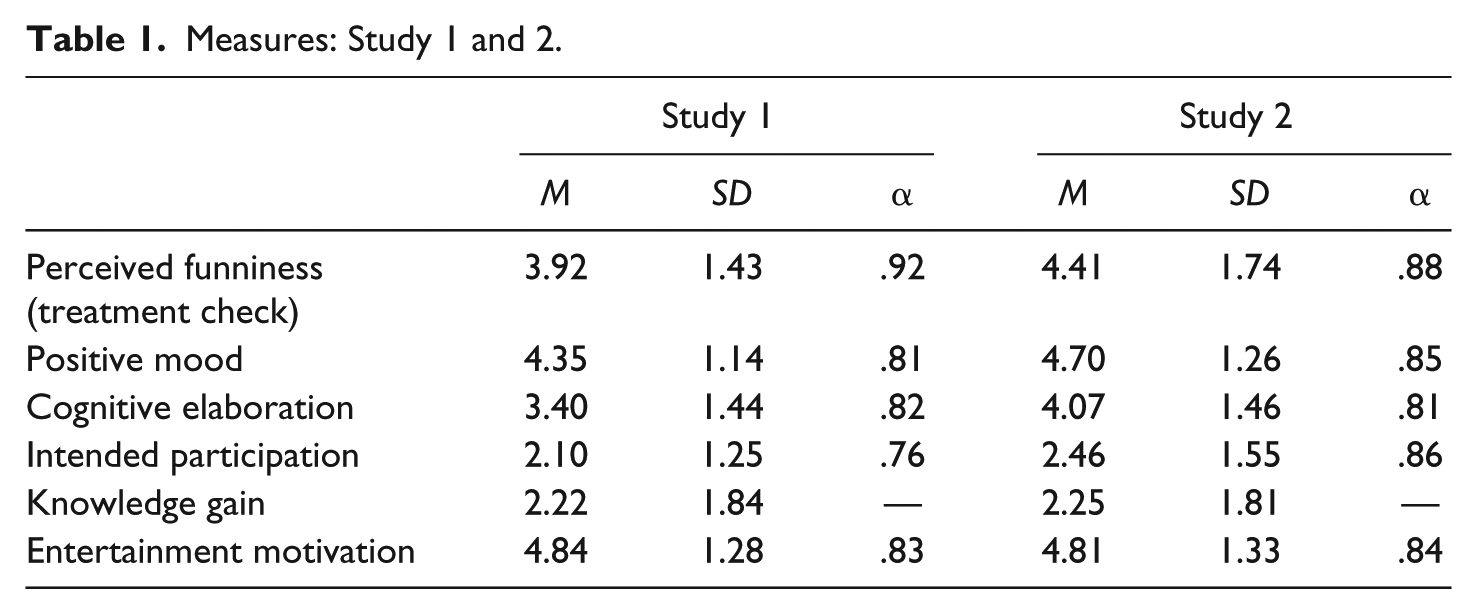
All variables were measured on a 7-point scale. We measured the perceived funniness of the posts in the newsfeed to assess treatment success. The variable was composed of three items, asking participants whether they found the posts to be (a) funny, (b) entertaining, and (c) boring (reversed). Mood was measured with six items, asking the respondents whether they (a) were in a good mood, (b) felt relaxed, (c) felt happy, (d) felt annoyed (reversed), (e) felt stressed out (reversed), (f) felt joyful, and (g) felt sad (reversed) (Wirth et al., 2010). To measure cognitive elaboration, we asked the participants whether (a) they intensively thought about the content of the political posts, (b) they focused on the facts in the political posts, (c) they critically reflected upon the content of the political posts while reading, and (d) they did not really think about the content of the political posts (reversed). Entertainment motivation was assessed by asking participants whether they use media (a) to be entertained, (b) to watch entertaining pictures or videos, (c) to pass time, and (d) to find entertaining information (Park & Lee, 2014; Quan-Haase & Young, 2010). Intended participation was measured by asking the participants how likely they would participate in political activities related to the topic of the political posts, including (a) signing a petition; (b) liking, sharing, or commenting the political posts they had seen; (c) attending a political event; and (d) participating in a demonstration (Kim et al., 2013). To measure knowledge gain, respondents were exposed to six statements, referring to the facts and arguments in the three political posts they had seen. Three of the statements were correct and three of them were incorrect (Matthes, 2013, for a similar approach). Participants responded to the individual statements with “True,” “False,” or “I don’t know.” We added up the sum of correct responses, resulting in an additive index reaching from 0 to 6. Table 1 provides an overview of means, standard deviations, and internal consistency measures.
Measures: Study 1 and 2.
Randomization
We performed randomization checks, indicating that randomization was successful. Individuals in the two experimental groups did not significantly differ in terms of age (b = .01, p = .92), gender (b = .16, p = .54), or education (χ2(2) = 1.43, p = .49), nor in terms of political interest (b = .02, p = .89), entertainment motivation (b = −.05, p = .77), or SNS use (b = −.28, p = .12).
Results
The treatment check indicated that participants in the entertainment group rated the posts as funnier as compared with the control group (b = 1.96, p < .001). We used regression analysis to test our hypotheses. Furthermore, we used mediation analysis to test the proposed indirect pathways proposed in the theoretical section (see Hayes, 2013). Confidence intervals (CI) for the indirect effects were calculated with the lavaan package in R, using 5,000 bootstrap samples (Rosseel, 2012). The results of Study 1 are shown in Table 2. The humorous context positively affected elaboration (b = 46, p < .05). In line with H2, elaboration, in turn, positively affected both intended participation 1 (b = .20, p < .001) and knowledge gain (b = .47, p < .001). We also tested the proposed indirect effects. As assumed, the humorous context positively affected intended participation (CI = [.015, .203]) and knowledge gain (CI = [.044, .415]) via elaboration. It should be noted that we found a significant positive total effect of the humorous context on participation (b = .33, p < .05), but not on knowledge. We did not find significant conditional effects of our treatment for different levels of entertainment motivation, as H1 would have suggested. Findings further indicate that that there was no main effect of humorous context on mood. However, we found that the effect on mood was moderated by entertainment motivation. For individuals high in entertainment motivation, the humorous context had a positive effect on mood. Against our expectation though, there was no significant effect of mood on elaboration. Furthermore, mood did neither directly affect participation intention nor knowledge gain.
Unstandardized Path Coefficients in Study 1.
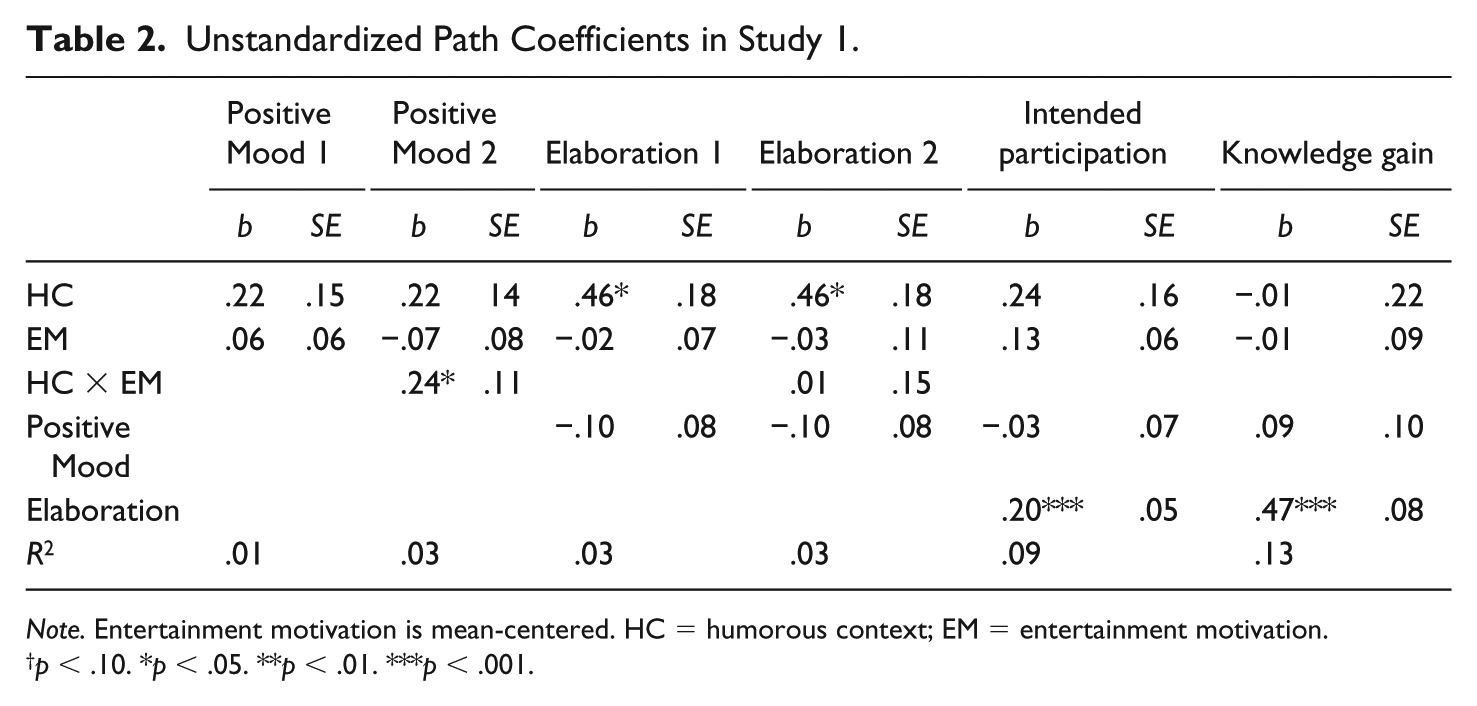
Note. Entertainment motivation is mean-centered. HC = humorous context; EM = entertainment motivation.
p < .10. *p < .05. **p < .01. ***p < .001.
Discussion
The results of Study 1 indicate support for the cognitive effects explanation. We found a positive effect of humorous context posts on elaboration and in turn on intended participation and knowledge gain. We did not find support for the mood effects explanation. Even though the humorous context induced positive mood among the more entertainment-oriented individuals, positive mood did not negatively affect message elaboration. These first findings hence suggest that the positive mood elicited by humorous context posts may simply not be strong enough to lower elaborative efforts in individuals. A second explanation may be that individuals process constantly and quickly changing information. In such a situation, individuals may be more flexible and open even for less mood congruent information. For example, because of the changing content in newsfeeds, they may perceive individual news posts not considerably mood threatening. Even if they shortly engage with these posts, more entertaining posts may directly follow and hence maintain their positive mood.
Study 2
Method
Study 2 was designed to replicate the findings of Study 1 with a representative sample of the Austrian population (N = 188, Mage = 41.54, SDage = 15.54; college degree = 14.98%, high school degree = 19.68%). Data were collected by the private company Survey Sampling International (SSI) between August 10 and August 17, 2017. We used exactly the same stimulus material and the same measures as we did in Study 1 (see Table 1 for statistics). Randomization checks were again successful. Individuals in the two experimental groups did not differ in terms of age (b = −2.06, p = .37), gender (b = −.30, p = .31), education (χ2(2) = 1.52, p = .47), political interest (b = −.12, p = .63), entertainment motivation (b = −.12, p = .54), or SNS use (b = .03,p = .92).
Results
First, treatment check results indicated no significant main effect of the humor condition on perceived funniness. However, we did find an interaction effect on perceived funniness (b = .42, p < .05), indicating that the humor condition had a positive effect for those with higher levels of entertainment motivation (the effect was significant for those above an entertainment motivation of 5.25, representing 35.6% of the sample).
The results of the second study are presented in Table 3. In contrast to Study 1, we did not find a significant main effect of the humorous context on elaboration. However, in line with H1, we did find a significant interaction effect of the humorous context times entertainment motivation (b = .35, p < .05), which points in the same direction as the interaction effect on perceived funniness (treatment check). The effect is significantly positive for individuals above an entertainment motivation of 6.15, representing 17% of the sample. Hence, we find support for H1 in this study. Again, in line with H2, elaboration was significantly correlated with intended participation (b = .32, p < .001) and knowledge gain (b = .45, p < .001). Based on these findings, we performed moderated mediation analysis (see Hayes, 2013). The analysis was again implemented using 5,000 bootstrap samples (Rosseel, 2012). Results indicated support for a moderated indirect effect of humorous context times entertainment motivation via elaboration on intended participation (CI = [.009, .272]) and knowledge gain (CI = [.017, .339]). We calculated the effect for entertainment motivation at its mean value, and above and below one standard deviation. Results are shown in Table 4. The results show a significant positive effect only for those high in entertainment motivation. We did not find total effects of the humorous context on neither intended participation nor knowledge gain. Again, we found no support for negative effects via mood. In line with Study 1, the humorous context positively affected the mood of individuals high in entertainment motivation, but we did not find a negative effect of mood on elaboration. Mood also did not directly affect intended participation or knowledge gain.
Unstandardized Path Coefficients in Study 2.
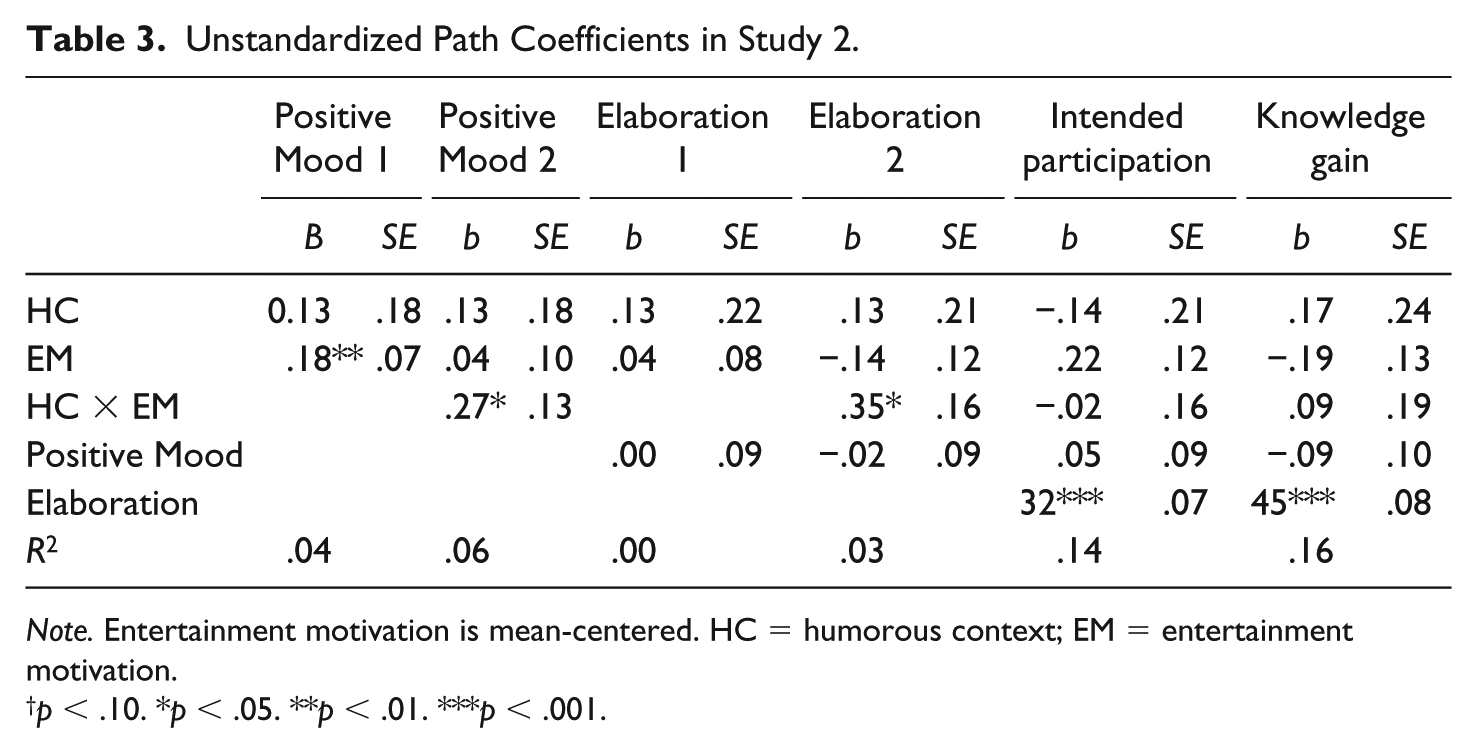
Note. Entertainment motivation is mean-centered. HC = humorous context; EM = entertainment motivation.
p < .10. *p < .05. **p < .01. ***p < .001.
Conditional Effect of Humor on Intended Participation and Knowledge Gain for Different Levels of Entertainment Motivation in Study 2 (Based on Models in Table 3).
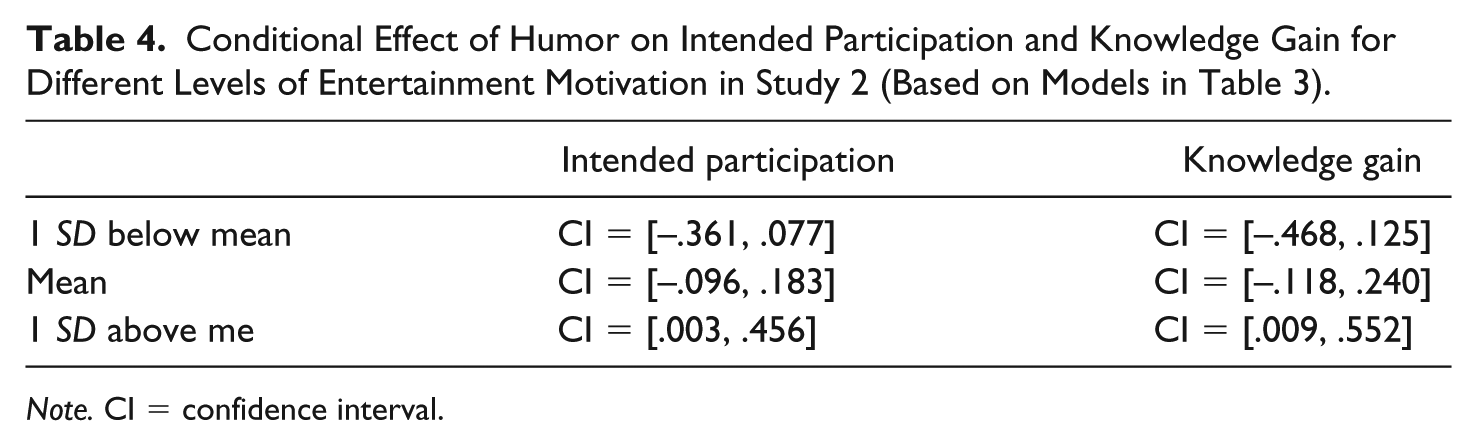
Note. CI = confidence interval.
Figure 1 provides an overview of the results of Study 1 and Study 2.
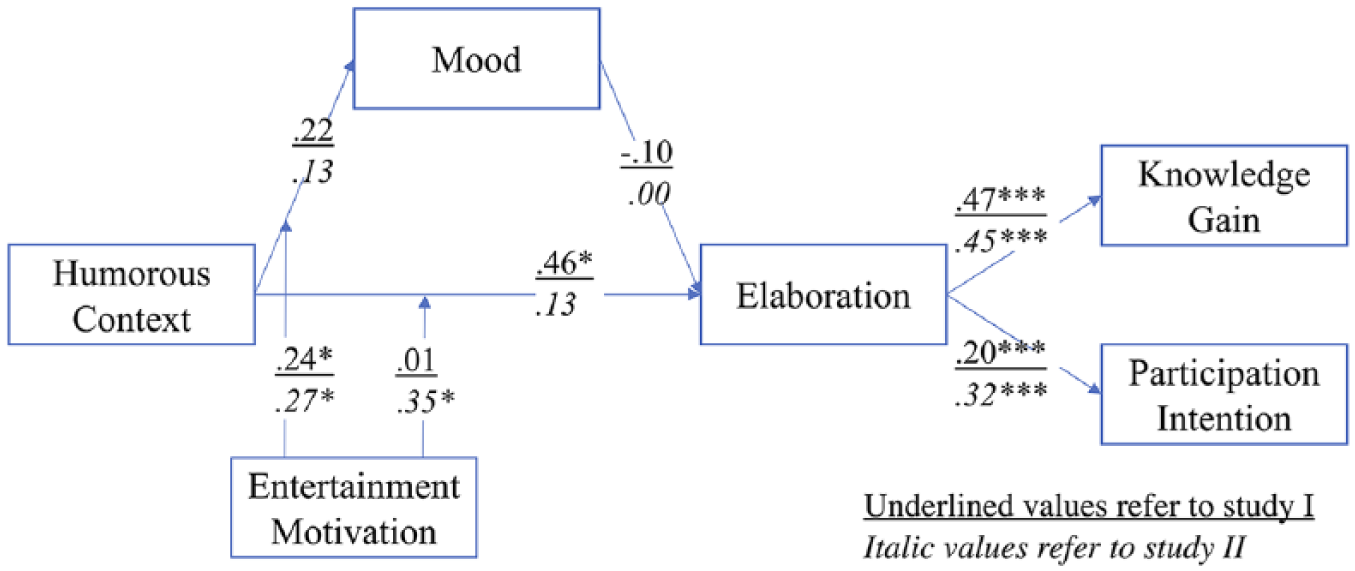
Unstandardized path coefficients for Study 1 and 2.
Combined Sample Effects
Finally, we also tested the effects across the combined sample of Study 1 and 2. In line with the findings of Study 1, we found a significant effect of entertainment context on elaboration (b = .31, p < .05), controlling for entertainment motivation, mood, and a dummy variable representing whether a participant belonged to Study 1 or 2. Furthermore, elaboration significantly predicted knowledge gain (b = .46, p < .001) and intended participation (b = .26, p < .001). We also found the corresponding indirect relationships via elaboration on knowledge gain (CI = [.022, .283]) and intended participation (CI = [.011, .169]). Although pointing in the expected direction, the total effects of the entertainment context on knowledge gain and intended participation did not reach statistical significance. Again, while we found a significant interaction effect of the humorous context times entertainment motivation on mood (b = .25, p < .01), we did not find a significant negative effect of mood on elaboration. Consequently, the corresponding indirect effects via mood on elaboration on knowledge gain (CI = [–.024, .010]) and intended participation (CI = [–.015, .006]) were not significant.
Discussion
The goal of Study 2 was to replicate the findings of Study 1 with a representative sample. While we found a positive main effect in Study 1, we found a moderation effect in Study 2. This moderation effect indicated a significant positive effect of the humorous condition only among those high in entertainment motivation. Accordingly, treatment check results in the national sample showed that only those with higher levels of entertainment motivation rated the context posts in the humorous condition as funnier compared with the control group. This might be related to the fact that the stimulus material was created in the context of a college research course and the used posts may represent humor perceptions of college students (see Note 1), who extensively use social media for entertainment purposes (Park & Lee, 2014). Moreover, their concept of humor may deviate from humor perceptions of the larger population. The fact, however, that we found the same interaction effect on perceived funniness as we did on message elaboration indicates that it was indeed the humorous content in the treatment condition which stimulated message elaboration.
Finally, the combined sample effects confirm findings from Study 1, that is, a positive main effect of humorous context posts on message elaboration and, in turn, on intended participation and knowledge gain. Taken together, the experimental studies provide convincing support for the theoretical notion that exposure to humorous context posts can increase political message elaboration, knowledge, and participation in incidental news exposure situations.
Study 3
In the third study, we use data from a two-wave panel study to investigate the relationship between humor exposure and cognitive elaboration of political content on SNS as well as the assumed effect of elaboration on participation and knowledge gain. The treatment condition in the experiments may resemble the newsfeed of a person who is frequently exposed to humor, but rarely exposed to political news on SNS. Hence, we use humor exposure as independent variable, which we define as the degree to which citizens use social media for humorous content. Furthermore, we measure the frequency of news exposure on SNS. In accordance with the theoretical discussion above, exposure to humor may stimulate cognitive resources and thus increase elaboration. However, humor may also elicit positive mood which may then dampen elaboration. While we used a forced exposure design in the experimental conditions, SNS users usually act in a free choice environment (De Vreese & Neijens, 2016). In such a situation, citizens may vary in terms of the share of humor and political news in their newsfeeds. Hence, the proposed positive or negative effects on elaboration may also vary in terms of an individual’s specific mix of humorous and news posts in the newsfeed. For example, just as in our experimental manipulation in Study 1 and 2, incidental news users may only see a few news posts and a much larger share of non-political (e.g., humorous) posts. However, intentional news seekers may see considerably large amount of news posts and only a few non-political posts (see Knoll et al., 2018). In addition to the already formulated hypotheses, we also pose the following research question:
Method
We collected data in the context of the Austrian national election 2017 (N = 559). We defined representative quotas for age, gender, and education. Because the questionnaire was mainly concerned with SNS use, we filtered out participants who reported to never use either Facebook, Twitter, YouTube, or Instagram as well as respondents above the age of 65. We collected data from 764 individuals in the first wave and some 73% responded in the second wave. Our sample is composed of 50.27% female, 19% had college degrees, and 27 had degrees from college-bound high schools. Participants were between 16 and 65 years old (M = 44.49, SD = 12.61). The first wave was conducted between August 29 and September 2, 2017. The second wave was implemented 1 week before the actual election. Data were collected between October 5 and 12. Hence, participants were exposed to 1 month of intensive election campaign in the period between the two waves. The election was held on October 15.
From the six political parties which were represented in the parliament, five parties participated in the new election: the two traditional large parties, the “Social Democrats” and the (conservative) “People’s Party”; the right-wing populist party “Freedom Party”; the “Green Party”; and the comparably younger liberal party “The New Austria” (founded in 2012). The Austrian electoral system is based on proportional representation in which single members of the national parliament are elected through party lists. However, there is a 4% threshold which parties need to exceed in order to receive seats in the parliament.
Measures
Except political knowledge and participation, all variables were measured on a 7-point scale. All SNS measures were related to Facebook, YouTube, Twitter, and Instagram which are most widely spread in Austria. We measured exposure to humor on SNS (M = 3.88, SD = 1.78, Spearman-Brown coefficient (ρ) = .71), with two items asking respondents (a) whether they use SNS to watch funny videos and pictures and (b) whether they follow sources on SNS which post funny and entertaining videos or pictures. To measure SNS news use, we asked respondents how important SNS were to them to get information on the current election (M = 2.76, SD = 1.87). Cognitive elaboration on SNS—α(t1) = .88, M(t1) = 3.47, SD(t1) = 1.72; α(t1) = .90, M(t2) = 3.01, SD(t2) = 1.78—was measured with three questions, asking respondents whether they (a) think about political posts and connect them with existing knowledge, (b) interpret the information in political posts in order to make sense of them, and (c) recall the information from political posts at a later point in time and think about it (Eveland, 2001). Political participation 2 —M(t1) = 1.91, SD(t1) = 2.35; M(t2) = 1.79, SD(t2) = 2.35—was measured with 12 items, asking participants whether or not they have engaged in liking or sharing a political post, adding a short comment to a political post, signing an online petition, participating in a demonstration, attending a political rally, working in a political organization, writing a longer political comment online, contacting a politician or journalist online, creating a political group on SNS, reminding others of upcoming political events, using campaign material (e.g., buttons), and signing an offline petition. Positive responses were summed up, resulting in an additive index reaching from 0 to 12 (see Kim et al., 2013). Knowledge—M(t1) = 4.03, SD(t1) = 2.25; M(t2) = 4.26, SD(t2) = 2.24—was measured with four correct and four incorrect statements on issue positions of the four major parties. Participants evaluated the statements (true, false, or do not know). Correct responses were summed up, resulting in an additive index reaching from 0 to 8 (see Matthes, 2013). Political interest (ρ = .91, M = 4.90, SD = 1.81) was measured with two items asking how much respondents were interested in (a) politics and (b) the current election. To measure general news use (M = 4.50, SD = 1.76), we asked respondents how often they get information on the election from the media. To assess ideology (M = 4.06, SD = 1.32), respondents rated themselves on a scale from left to right with higher values indicating right ideology. SNS use was assessed by asking respondents how frequently they used the four SNS to which SNS-related items in the questionnaires referred to: Facebook (M = 3.86, SD = 2.05), YouTube (M = 3.58,SD = 1.71), Twitter (M = 1.60, SD = 1.22), and Instagram (M = 1.82, SD = 1.47).
Results
The results of the panel analysis are shown in Table 5. The first column shows the effect of SNS use for humor on elaboration measured at Time 2, controlling for elaboration measured at Time 1. As expected, there was no significant main effect of humor exposure. However, we did find a moderating effect of humor conditional on the levels of SNS use for news (b = −.03, p < .05) (RQ1). The nature of this effect is depicted in Figure 2, which indicates a significant positive effect of humor exposure for individuals who rarely use SNS for news. The effect turns negative for individuals who frequently use SNS for political news. The second column shows the results of a negative binomial regression, predicting political participation. Again, we control for the Time 1 level of the dependent variable. Results revealed that cognitive elaboration of political information on SNS indeed positively predicted political participation (b = .07, p < .05), lending support for H2a. Finally, we found no significant effect of SNS elaboration on knowledge gain (H2b rejected). In fact, only political interest and general news use positively affected knowledge gain, while SNS news use even exerted a negative main effect on knowledge. We also ran a model without the interaction, in which the negative effect of SNS news use was even stronger.
OLS Regressions Predicting Message Elaboration and Political Knowledge, and Negative Binomial Regression Predicting Political Participation Based on Two-Wave Panel Data in Study 3 (N = 559).
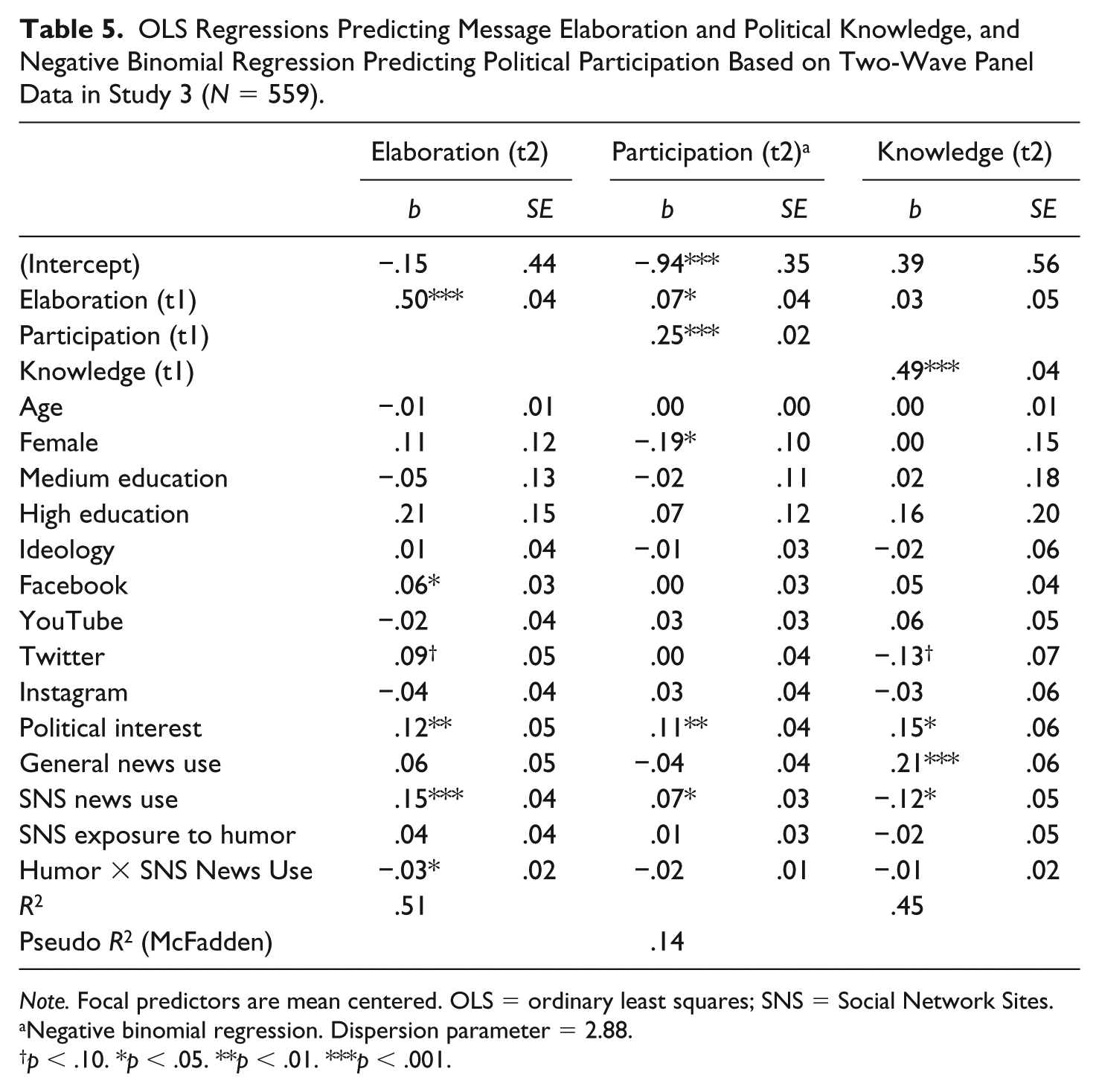
Note. Focal predictors are mean centered. OLS = ordinary least squares; SNS = Social Network Sites.
Negative binomial regression. Dispersion parameter = 2.88.
p < .10. *p < .05. **p < .01. ***p < .001.
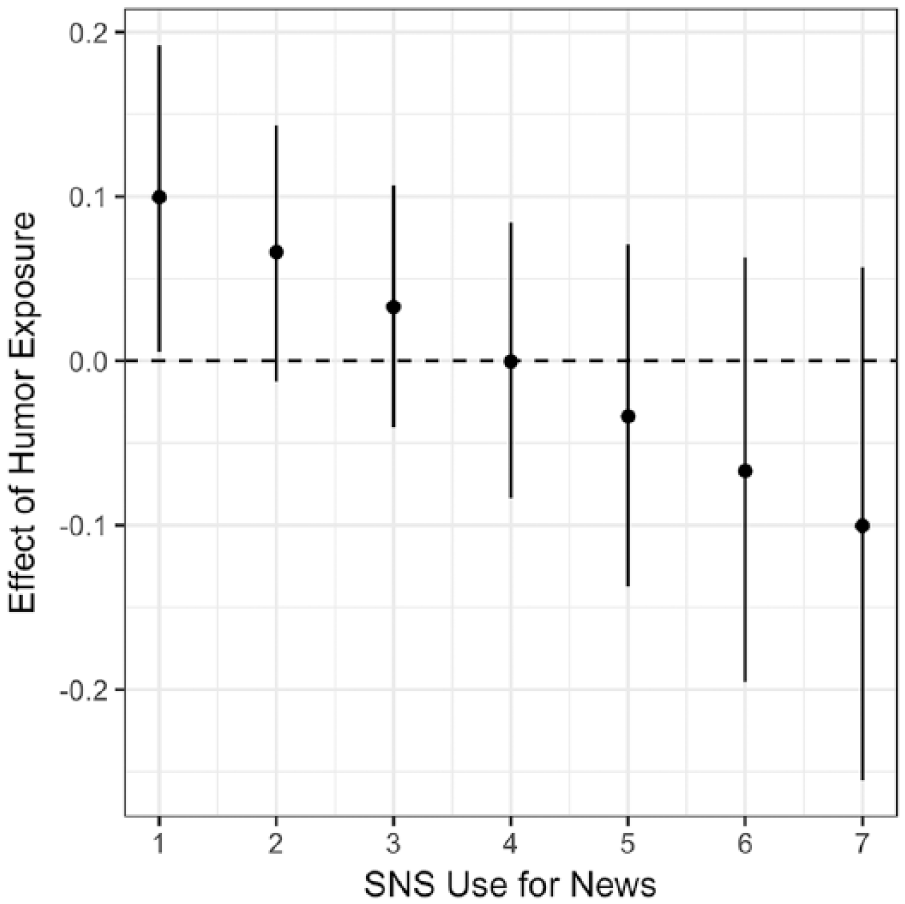
Effect of exposure to humor on SNS on elaboration of political information on SNS conditional on the frequency of SNS use for news in Study 3 (see Table 5).
Discussion
While the experimental studies investigated the effect of humor exposure in an isolated experimental situation, Study 3 relies on survey panel data, in which respondents reported memory-based real experience. As Figure 2 indicates, we find that weak SNS news users are more likely to elaborate political messages when they are frequently exposed to humorous content on SNS. 3 Interestingly, the effect of humor exposure becomes more negative, the more individuals use social media for political news. This may indicate that if citizens seek to engage with political news on social media in depth, this goal might become incompatible with increasing exposure to humor. One reason might be that high news seekers may actively engage with politics on SNS anyhow, and eye-catching humorous context posts may then redirect their attention away from the political content (Matthes, 2013). Taken together, the findings indicate that humor exposure may only benefit those who would otherwise hardly engage with political information on SNS. For others, who have already formed stronger political goals, humor exposure does not boost elaboration and may have even distracting effects.
Furthermore, the panel study provides additional information on the causal pathway from elaboration to participation and knowledge. While we could replicate the effect of elaboration on participation, we did not find a significant effect of elaboration on political knowledge. Even more surprisingly, our data show a negative main effect of SNS news use on political knowledge. This may indicate a general low potential of SNS news use to increase more general knowledge.
General Discussion
On SNS, the reception of political news takes place in an entirely new environment, in which political snack news posts are embedded in overly funny and humorous context posts (Park & Lee, 2014; Schäfer et al., 2017). The studies presented in this article provide first evidence on how humorous context posts on SNS affect political knowledge and participation via information processing in incidental news exposure situations. We tested two theoretical explanations: a cognitive effects and a mood effects explanation. We did not find support for the mood effects explanation, which would have suggested that humor increases positive mood and positive mood would then dampen elaboration (Wirth et al., 2010). Even though we found that the humorous context posts increased positive mood among the entertainment oriented consistently in both experimental studies, positive mood did not negatively affect elaboration.
We identify two possible reasons for this finding. First of all, political snack news appear in the context of constantly changing newsfeed content. In this context, individuals may not consider single news posts to be considerably mood threatening, because they may anticipate a funny post to follow right away. This is very different compared with classical media contexts, in which humorous content is processed for a longer period of time and may induce more persistent mood changes (e.g., Wirth et al., 2010). Second, and related to the first argument, the humor which is elicited by single social media posts may simply be too weak to signalize a benign environment or induce sufficient priming effects which would inhibit the elaboration of (mood-incongruent) political information. In other words, one may speculate that the mood generated by SNS posts is too weak in order to exert significant effects on elaboration. This should be addressed in future research.
While we did not find evidence for mood effects, we gathered clear evidence for the cognitive effects explanation. In the experiments, we exposed individuals to a newsfeed with predominantly non-political (humorous vs. non-humorous) and only very few hard news posts, which were not aligned to their personal preferences. In this situation, individuals who were exposed to the humorous context reported higher levels of message elaboration. We found that this effect occurred in the convenient sample in Study 1 (i.e., composed of younger and higher educated individuals) and for the more entertainment-oriented individuals in the more representative sample (Study 2). This effect was replicated in the panel study, as we found that intensive exposure to humorous posts stimulated elaboration for individuals who hardly use SNS for news (and may thus have a similar newsfeed to the one used in the experiments). In other words, individuals with a large share of humorous posts and a low amount of news posts in their newsfeed reported to think more about political posts as compared with individuals who score low on both variables. Interestingly, the effect of humor exposure becomes more negative, the more individuals use SNS for political news, indicating an incompatibility of strong entertainment and strong political information goals.
Taken together, our findings indicate that incidental exposure to political posts embedded in humorous context posts may stimulate political engagement among the less involved. Using social media to watch funny posts may indeed stimulate cognitive resources which may then be used to read and elaborate embedded political news on social media. The positive potential of these findings, however, should be treated with caution. Even though we find evidence that elaboration of political content on SNS had a positive effect on participation in our panel study, we did not find a significant effect on political knowledge. What is more, our panel analysis indicated that social media use for news even had a negative main effect on knowledge acquisition, while general news use had a positive effect. These findings question the role of social media as a source for news learning and lend support to the argument that engagement with politics on social media may drive uniformed types of political participation (e.g., Baumgartner & Morris, 2009; Heiss & Matthes, 2017; Vitak et al., 2011).
Some limitations of this study should be noted. First, we focused on humorous content only, but users may also be exposed to non-funny entertainment content. Furthermore, news organizations may react to the way how users process news on social media and provide a huge variety of political content. Thus, investigating different types of non-political and political content on social media is an important field of future research. Second, we used a forced exposure approach in the experiments. However, this was the only way to our knowledge to isolate the effect of humorous context posts while keeping internal validity high. Third, we relied on self-reported measures of elaboration and political participation. Even though such measures are widely used, they are also criticized because people tend to overestimate their behavior (e.g., see Junco, 2013). Future studies need to experiment with innovative methods which allow a closer observation of actual behavior, such as mobile experience sampling. With such methods, the important role of relational aspects (e.g., source cues) on social media could be studied in more detail. Fourth, the stimulus material was a Facebook newsfeed. Even though other SNS, such as Twitter or Instagram, create very similar incidental exposure situation, Facebook is not entirely representative for the huge variety of SNS. Finally, all our studies were conducted in Austria, and the panel study specifically may not be generalizable beyond the electoral Austrian context. Thus, our findings need to be replicated across countries, in non-electoral periods, using more innovative measures (e.g., creating real participation situations) and different SNS or instant messaging apps (e.g., WhatsApp).
These limitations notwithstanding, this study is the first to investigate the effect of humorous context posts on social media. Understanding such context effects is crucial to expand our knowledge about the effects of social media use on citizens’ political knowledge and behavior. Only if we understand how the specific reception situation on social media is different from traditional media, we can make valid conclusions on how citizens engage with politics on social media and how it affects the level and quality of knowledge and participation.
Footnotes
Appendix
Declaration of Conflicting Interests
The authors declared no potential conflicts of interest with respect to the research, authorship, and/or publication of this article.
Funding
The authors received no financial support for the research, authorship, and/or publication of this article.