




Abstract
Research consistently shows that while social media use does not enhance objective political knowledge, it increases users’ sense of being knowledgeable (subjective knowledge). However, it is unclear which specific modes of social media use lead users to an enhanced feeling of being knowledgeable. This work focuses on two factors that are believed to shape users’ subjective knowledge when using social technologies: (a) the intentionality of social media use (intentional vs. incidental news consumption) and (b) the relevance of the news content. In a pre-registered, two-wave experiment (N = 921), participants were exposed to either personally relevant or non-relevant topics on social media, either intentionally or incidentally. The results indicated that while intentionality of exposure did not affect subjective knowledge, intentional news search improved objective knowledge more than incidental exposure. The latter can still facilitate objective knowledge and increase subjective knowledge, as long as the news is considered as highly relevant.
Introduction
Social media have become increasingly popular as news platforms, with 30% of users getting their news primarily through social media (Newman et al., 2022, 2023). This increased consumption of news through these technologies is accompanied by an interesting scholarly observation: While users do not seem to learn much factual information from this news consumption (in terms of objective political knowledge; Amsalem & Zoizner, 2022), the use of social media in the context of news seems to increase people’s perception of being knowledgeable—their subjective political knowledge (Dreston & Neubaum, 2023; Lee, Diehl, & Valenzuela, 2022). Some even argue that this disconnect between objective and subjective knowledge in the context of social media could be labeled as an illusion of knowledge (Schäfer, 2020).
In line with descriptions of the public sphere, democracy can only live up to its ideals if individuals engage in informed debates and vote based on factual knowledge (Delli Carpini & Keeter, 1996; Habermas, 2006). Therefore, objective knowledge is understood as a key prerequisite for deliberative democracy. At the same time, a growing body of evidence suggests that it is especially individuals’ subjective knowledge that encourages them to participate in these political processes (Lee, Diehl, & Valenzuela, 2022; Schäfer, 2020). While research has repeatedly shown that social media news use goes hand in hand with political participation, mediated by increased subjective knowledge (Dreston & Neubaum, 2023; Lee, Diehl, & Valenzuela, 2022), it remains to be understood how individuals have to use these platforms to develop a heightened sense of knowledge. To date, attempts to explain the social media use-knowledge link have focused exclusively on objective knowledge. For instance, the “Political Incidental News Exposure” Model (PINE; Matthes et al., 2020) suggests that both people’s intentionality in consuming news on social media and the relevance of the information they encounter, influence their objective knowledge gains. Given the importance of subjective knowledge on the paths to political participation, it seems plausible to ask whether the proposed mechanisms leading to objective knowledge also apply to the formation of subjective knowledge.
To this end, the present study aims to evaluate the applicability of PINE at both, a cognitive (objective knowledge) and a metacognitive (subjective knowledge) level. Our research has two primary objectives: First, it intends to investigate the largely neglected question of how individuals increase their subjective knowledge and explore whether the intentionality of media use plays a crucial role; second, it aims to assess whether the relevance of news content influences the cognitive and metacognitive processes underlying political knowledge acquisition through social media. With this analysis, we seek to improve our understanding of the conditions under which social media can facilitate political knowledge versus when it merely fosters an illusion of knowledge.
Theoretical Background
Why Informational Intentions Shape Political Knowledge Acquisition
It has long been established that acquiring objective knowledge, that is, factually correct information stored in one’s memory (Delli Carpini & Keeter, 1996), depends on the learner’s intentionality. This also applies to the use of media. However, high motivation in the sense of consciously searching for information is not enough to ensure learning outcomes. People also need to elaborate newly incoming information for it to lead to objective knowledge gains (Eveland, 2001). Elaboration describes the intrapersonal cognitive process of connecting new information from the media with mentally previously stored information.
In traditional news media, such as newspapers and television, news is presented linearly, embedded with background information, and presented by a trustworthy source, such as a journalist. However, on social media, news is presented cumulatively from different sources and as short, mostly superficial chunks of information, so-called snack news (Schäfer, 2020; Schäfer et al., 2017). This abundance of posts may hinder the encoding and elaboration of each post (Lang, 2000, 2006). Furthermore, interaction is a defining feature of social media. All actors on social media can contribute to the flow of news, for example, by commenting on news posts or sharing information on their profile. These two major differences suggest that learning on social media may deviate from the established route of motivational news search and elaboration (Cho et al., 2009). Empirically, Oeldorf-Hirsch (2018) showed that intentionally searching for political news on both Facebook and Twitter was not directly related to either cognitive elaboration or objective political knowledge.
When discussing intentional news search, it is essential to distinguish between active undirected and active directed search (Bates, 2002). In active undirected search, users browse media to find any form of (political) information. In contrast, in active directed search, users actively access media with the goal of trying to find information about a specific (political) issue. Traditionally, people would turn on the TV or radio to search news, such as election results. Nowadays, with the increasing importance of social media as a news platform (Newman et al., 2022, 2023), many people instead turn to the social media platform of their choice expecting to find this information. This is especially true in times of crisis (Schroeder et al., 2013; Zhao & Zhang, 2017), such as the COVID-19 pandemic (Granderath et al., 2021). When referring to intentional news search in this paper, we understand it as active directed search. This active search for news on any platform, though, is relatively rare (Bates, 2002). Instead, people often create media environments where they encounter news without actively searching for it: Incidental news exposure. This form of news consumption is characterized by the absence of any situational political-information goal, whether it might be specifically focused on one issue or politics in general (Matthes et al., 2020). This is not a new phenomenon; people have also stumbled upon news while waiting for TV shows to start or while switching channels. Yet, it is especially pronounced on social media as its dense feeds create numerous opportunities for incidental exposure (Shahin et al., 2021). Through algorithmic curation and recommendations from friends, people are increasingly exposed to news incidentally (Kümpel, 2021).
Extensive research has examined the potential for learning from social media. A recent meta-analysis suggests that general social media use is not associated with objective political knowledge (Amsalem & Zoizner, 2022). However, they point to small learning effects in experiments as opposed to surveys. This picture is echoed when looking at the learning effects of incidental news exposure (Nanz & Matthes, 2022a). While some experiments find no learning effects (Feezell & Ortiz, 2019), others suggest that individuals with low political interest benefit the most (Kobayashi et al., 2020), and others find that incidental news exposure can lead to learning effects, but these are smaller compared to when people intentionally search for the same information (Nanz & Matthes, 2020). Consequently, it seems that it is decisive how people use social media to gain knowledge.
One of the main differences between intentional news search and incidental news exposure is the former’s ability to trigger elaboration (Shahin et al., 2021). Intentional news search is believed to trigger the central route of processing, which leads to deeper processing and elaboration of encountered stimuli. Incidental news exposure, on the other hand, is unmotivated, and relies on attendant cues, such as public endorsement, to trigger elaboration. While this peripheral route of processing has the potential to lead to elaboration, it is yet much weaker compared to the central route of processing (Petty & Cacioppo, 1986; Shahin et al., 2021). Since learning depends on the number of mental resources allocated (Shenhav et al., 2017; Sweller et al., 1998), one would expect stronger learning effects for intentional news search, compared to incidental exposure. However, empirical evidence yielded inconsistent results. While Nanz and Matthes (2020) found support for this, other studies found no positive relationship with either elaboration (Oeldorf-Hirsch, 2018) or objective knowledge (Dreston & Neubaum, 2023), regardless of whether people searched for news or incidentally encountered them on social media. Considering this mixed evidence, it remains to be examined which mode of social media use actually leads to political knowledge gains. Therefore, we ask:
RQ1: Does intentional news search lead to more objective knowledge compared to incidental news exposure?
Topical Relevance Shapes the Relationship Between Incidental News Exposure and Objective Political Knowledge Acquisition
Most research on incidental news exposure uses it as an umbrella term for two distinct processes triggered by news exposure that one did not initiate (Bates, 2002; Nanz & Matthes, 2020): (1) encountering a post deemed irrelevant and scrolling past it and (2) engaging in more detailed processing of an incidentally encountered post. This heterogenous conceptualization might explain the mixed findings on the effect of incidental exposure on political knowledge (Nanz & Matthes, 2022a, 2022b).
The PINE Model (Matthes et al., 2020) suggests that people have specific goals when using social media, often unrelated to politics, such as connecting with friends or finding entertainment. As users encounter posts, they quickly evaluate if they meet their initial processing goal and if not, whether they are still personally relevant and thus should update their situational processing goal. This quick, nearly automatic relevance appraisal requires minimal cognitive resources and is based on the initial few words of a post (Bode et al., 2017).
Several factors influence whether a post is evaluated as relevant, such as the message source and situational factors. People with a higher interest in politics, are more likely to fully read a political post they encounter incidentally; so are people who stumble across posts that are endorsed by their friends (Kümpel, 2019; Matthes et al., 2020) or relate to one’s home town (Nanz & Matthes, 2020). If a post is considered irrelevant, users quickly shift their attention to the next post (first-level processing) and continue pursuing their initial processing goal (e.g., entertainment). Because they do not engage in any further processing beyond the initial relevance appraisal, elaboration is minimal and thus all knowledge gains are attributed to passive learning (Bode, 2016; Matthes et al., 2020; Nanz & Matthes, 2020; Tewksbury et al., 2001). When a post is evaluated as relevant, users engage in more thorough and deep elaboration (second-level processing), allocating more cognitive resources to process the information (Matthes et al., 2020). In summary, the relevance of content influences the degree of attention individuals allocate to it, which subsequently determines the depth of elaboration and ultimately affects the acquisition of objective knowledge. Thus, the PINE model extends the reasoning put forward by Eveland (2001), see Figure 1 for an illustration.
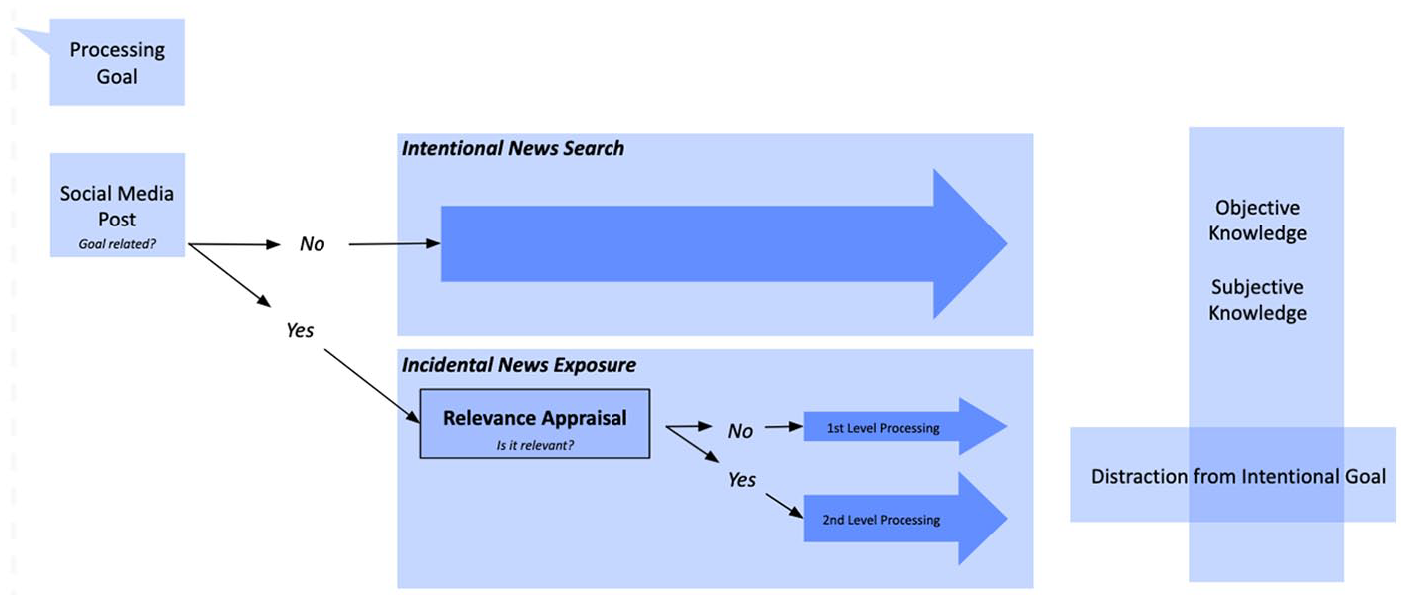
Illustration of processing through different modes or exposure.
Objective knowledge can be accessed either through recognition or recall, which represent two consecutive steps of memory processing. First, incoming information is encoded, which makes them available to be recognized later. In a next step, this information is elaborated on and finally stored in memory. As this second step requires more cognitive resources, the amount of simultaneously incomming information that can be recalled later is limited (Lang, 2000, 2006). In an experiment, Nanz and Matthes (2020) demonstrated that relevant information encountered incidentally could be both recognized and recalled, while less relevant information could only be recognized. This research is contradicted by studies that show no learning effect from incidental news exposure (Nanz & Matthes, 2022b; Oeldorf-Hirsch, 2018) or social media use in general (Amsalem & Zoizner, 2022). Given these inconsistent findings, we ask:
RQ2: Does incidental exposure to high relevance topics lead to more objective knowledge compared to incidental exposure to low relevance topics?
The Influence of Informational Intentions on Subjective Knowledge Gains
In their influential work, Delli Carpini and Keeter (1996) pointed out that political knowledge is important for many democratic actions, including political discussion and voting. However, numerous lines of research show that political actions are in fact not influenced by what people know (Dimitrova et al., 2014; Lee, Diehl, & Valenzuela, 2022; Lee & Matsuo, 2018) but by what they think they know (Lee, Nanz, & Heiss, 2022; Schäfer, 2020; Yamamoto et al., 2018). Political knowledge can be described along two different dimensions: objective and subjective knowledge. While objective knowledge refers to the factually correct information stored in one’s memory (Delli Carpini & Keeter, 1996), subjective knowledge refers to the perception of this very knowledge (Radecki & Jaccard, 1995; Yamamoto et al., 2018). As a metacognition, it describes the perceived ability to recall and express information (Frauhammer & Neubaum, 2023; Radecki & Jaccard, 1995). However, subjective knowledge is conceptually different from objective knowledge and only moderately related to it (r = .37; Carlson et al., 2009). While people with high objective knowledge, for instance, may know which party best represents their needs, one study shows that their actual turnout is better predicted by people’s confidence in their knowledge (Lee & Matsuo, 2018). Political action (like any other action) does not require a formal test of one’s objective knowledge; instead it seems that people consult their knowledge perception to assess whether they are knowledgeable enough to act based on that knowledge and even refrain from action like voting if they do not (Dunning, 2011; Kaid et al., 2007). Thus, people may act based on an illusion of knowledge, where their subjective knowledge is not sufficiently supported by objective knowledge (Schäfer, 2020). Therefore, it is important to investigate whether the way people consume news (on social media) leads to a widening or closing of this gap.
It has been repeatedly shown that getting news through social media is associated with increased subjective knowledge (Lee, Diehl, & Valenzuela, 2022; Schäfer & Schemer, 2024). This is partly due to the nature of social media, where viral posts are shared multiple times. This repeated exposure by different actors can create a sense of familiarity, even if the posts do not convey much more information than a simple headline. People may mistake this sense of familiarity for objective knowledge. Schäfer (2020) showed that frequent exposure to posts on a topic can make people feel as informed as those who read detailed articles. Other factors associated with social media have also been shown to influence subjective knowledge, including processing fluency (Frauhammer & Neubaum, 2023), stimulus (Scharrer et al., 2017; Weber & Koehler, 2017), and multitasking (Ran et al., 2016). Yet, it remains to be uncovered how the way people access news on social media (intentional search vs. incidental exposure) relates to subjective knowledge.
When people share political posts on social media, even without reading it, it boosts their subjective knowledge (Ward et al., 2022). A parallel connection exists between political talk and subjective knowledge (Dreston & Neubaum, 2023). This can be explained through self-effects. People partly infer their self-concepts on the way they behaved in the past (Valkenburg, 2017). This effect is particularly pronounced for public and non-anonymous actions, as they are more salient in memory recall (Ward et al., 2022). Thus, people, who engage in political actions like sharing or commenting on social media, perceive themselves as more knowledgeable. We anticipate that to a lesser degree intentional news search can also reshape one’s self-concept. People, who repeatedly and purposefully engage in news search might remember this behavior and will therefore view themselves as more politically knowledgeable. Incidental news exposure, however, might not be associated with self-effects, attenuating potential effects on subjective knowledge (Dreston & Neubaum, 2023).
H1: Intentional news search increases subjective knowledge compared to incidental news exposure for a) high and b) low relevance news.
How Relevance Influences the Effect of Incidental News Exposure on Subjective Knowledge
Building on PINE (Matthes et al., 2020), it can be argued that the topical relevance of an incidentally encountered post not only impacts objective knowledge but also subjective knowledge. Following a positive relevance appraisal, more mental resources are allocated to elaborating on the incoming information (Matthes et al., 2020). This heightened attention and elaboration can enhance individuals’ perception of their own knowledge (Dreston & Neubaum, 2023). Nanz and Matthes (2022b) provided initial support for this, as more intense elaboration was associated with more subjective knowledge.
People typically have some prior knowledge about topics they find relevant. Incidental exposure to these topics may activate this existing knowledge, reinforcing their perception of being knowledgeable. In contrast, less relevant topics may lead to shallow elaboration, resulting in smaller effects on subjective knowledge. However, even minimal elaboration from encountering irrelevant topics could still lead to a slight increase in subjective knowledge. Therefore, we hypothesize:
H2: Incidental news exposure to high relevance topics leads to higher subjective knowledge than incidental exposure to low relevance topics.
H3: Incidental news exposure increases subjective knowledge compared to no exposure.
The Clash of Intentional and Incidental News Exposure: Topical Relevance Drives Perceived Distraction
The PINE model (Matthes et al., 2020) suggests that when people encounter relevant information incidentally, they temporarily shift their processing goal (Matthes et al., 2020), which distracts them from their original processing goal (Nanz & Matthes, 2020). Imagine a scenario in which a person opens social media with the intention of searching news about a political bill. In between reading news about this bill, they might stumble upon news about their favorite football club. This shift in focus diverts cognitive resources to processing the football news, reducing attention to their initial goal of searching news about the political bill (Fisher & Weber, 2020; Lang, 2000, 2006).
This distraction may be driven by perceived relevance. A football fan, finding the news highly relevant, will be more distracted and retain less objective knowledge about the political bill than someone who is not interested in football (Nanz & Matthes, 2020). Additionally, subjective knowledge is not only influenced by people’s objective knowledge, but also by their behavior (Valkenburg, 2017; Ward et al., 2022). If people perceive themselves as distracted by the football news, as a result they may feel less knowledgeable about the political topic they originally intended to learn about. Therefore, we expect them to have less subjective knowledge compared to people who were not distracted.
H4: Incidental news exposure to a highly relevant topic reduces subjective knowledge for the intentionally searched topic when the incidental topic is more relevant than the intentional one. 1
Method
We conducted a two-wave online experiment in which the experimental manipulation (intentional search task in a social media feed) was introduced only in the second wave. The study was pre-registered on: https://aspredicted.org/6b5c-p6zc.pdf.
Participants and Procedure
Data collection occurred between June and July 2023 using the SoSci panel (Leiner, 2017), a German-speaking social scientific open-access panel. Based on a power analysis we aimed for a sample of 1,576 2 participants. The first wave (W1) comprised 1,633 complete cases. We pre-registered to only include students at German universities who would use social media at least once a week. As this rule was rather conservative and we aimed to increase the power of our sample, we included all German students who used social media regardless of the frequency. The second wave (W2) consisted of 1,344 complete cases after excluding 31 non-students, 53 people, who stated that they did not participate seriously, and 240 people who failed the attention check. Matching complete datasets from both waves led to a final sample of 921 cases (age: M = 26.37, SD = 6.51; 66.45% female, 30.08% male, 2.93% diverse, 0.54% n/a). 3
In W1, we asked participants about their demographics as well as their subjective knowledge of different areas of politics (general German politics, university-related policies, retirement-related policies, tax-related policies, and foreign policy; the latter serving as a distractor). W2 was distributed to each participant individually one week after they completed the first questionnaire. Participants could complete it at any time after that point. In W2, we primed participants’ identities as students by asking them what subject they were enrolled in and what stage they were currently in. Next, participants were assigned to one of four groups (see Design) and instructed to scroll through a mock social media feed as they would normally do. In addition, they were asked to pay close attention to one particular topic, as they would later be asked to recall information about this topic (intentional search task). The feed consisted of 20 posts, 4 of which focused on the political topic they were instructed to inform themselves about, 4 to 8 incidental news posts on other political topics, and 8 to 12 posts on sports, gossip, health, etc. Participants then answered several unrelated questions that served as distractors, before their general and topic-related subjective knowledge, and objective knowledge (free recall followed by recognition) were measured.
Design and Material
In our experiment, we manipulated two factors: exposure (intentional vs. incidental) and relevance (high vs. low). Each participant was instructed to search for information about a particular political topic (intentional news search) while simultaneously being exposed to other political posts in a social media news feed (incidental news exposure). Giving participants with an intentional search task ensured that participants encountered posts of the incidental manipulation truly unintentional. We manipulated the topical relevance of both the intentional news search (low vs. high) and the incidental news exposure (low vs. high).
Following Nanz and Matthes (2022b), our relevance manipulation depended on the fact that one political topic was considered more important by all participants than all other political topics (see below). To achieve that, we decided to use an all-student sample from Germany as they shared a common interest, namely university-related policies. A pretest revealed that students rated university-related policies (M = 4.14; SD = 0.6) as significantly more relevant than pension-related policies (M = 3.24, SD = 0.82; t(41) = 6.03, p < .001, d = 0.93) or tax-related policies (M = 2.92, SD = 0.71; t(41) = 8.63, p < .001, d = 1.33). 4 Therefore, university-related policies were used for the high relevance manipulation and both pension-related and tax-related policies were used for the low relevance manipulation. Participants were randomly assigned one of four groups (see Figure 2) and did not differ in either political interest or baseline subjective knowledge at W1:
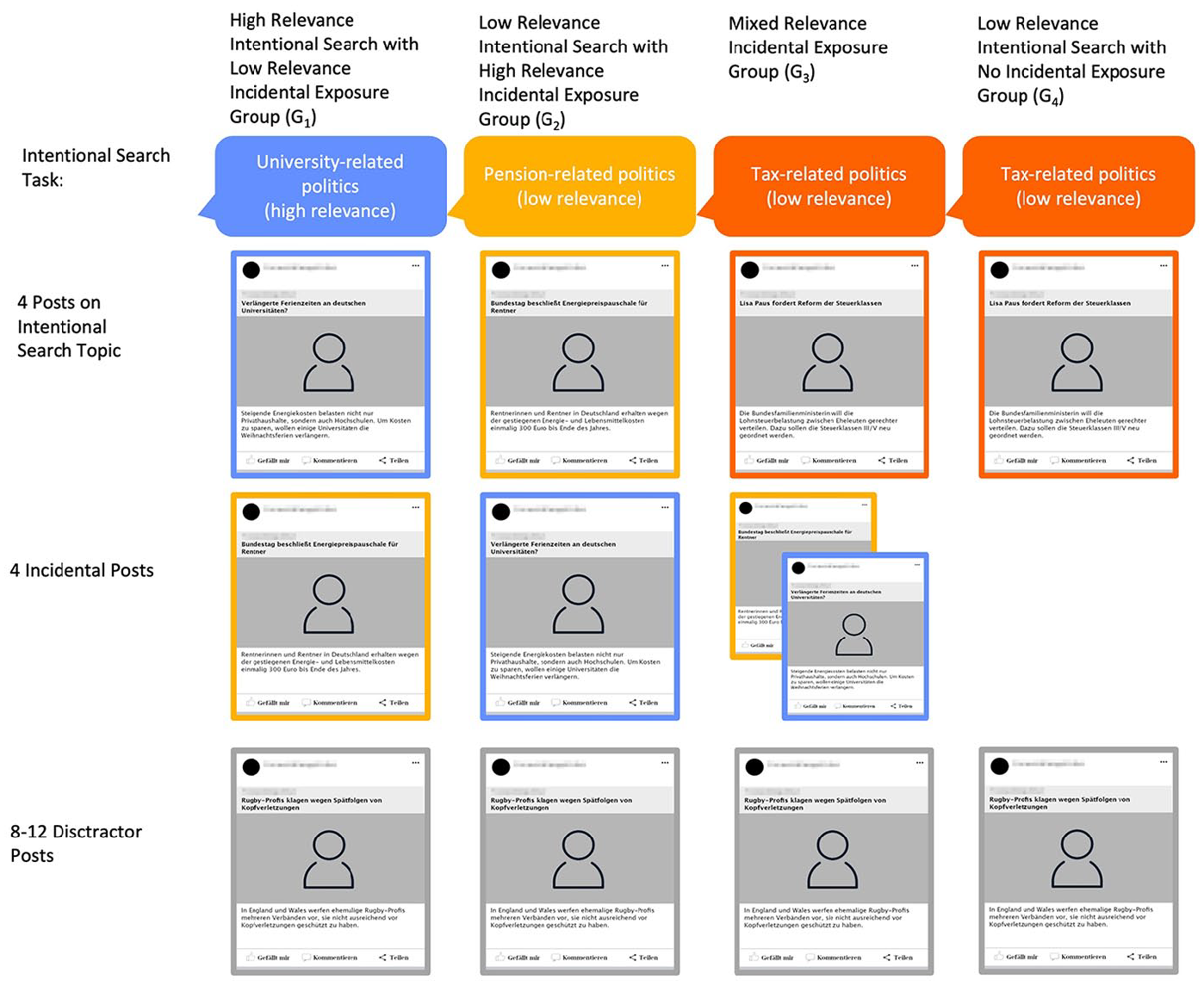
Visualization of the four experimental conditions.
The implementation of these four groups allowed us to test for effects of mode of exposure as well as relevance both within- and between participants. Additionally, we were able to test for interactions such as distractor effects of high relevance incidental exposure items on the intentional search task.
Dependent Variables
Subjective Knowledge
We measured subjective knowledge on four dimensions, that is, about (1) German politics in general and specific policies related to (2) universities, (3) pensions, and (4) taxes (e.g., “I know a lot about university-related/pension-related/tax-related policies”). Participants rated their subjective knowledge on a seven-point scale from “−3 I do not agree at all” to “3 I fully agree” (Yamamoto et al., 2018). We assessed subjective knowledge for all four dimensions separately in W1 and again in W2 after participants scrolled through their social media feed. This helped us to control for pre-existing knowledge and demand effects. The delta of subjective knowledge was calculated by subtracting W1 scores from W2 scores (general subjective political knowledge: W1 M = 4.11, SD = 1.46, Cronbach’s α = .95, 90% CI [0.95, 0.95]; W2 M = 3.84, SD = 1.45, Cronbach’s α = .95, 90% CI [0.94, 0.95]).
Objective Knowledge
Building on the distinction between recall and recognition (Lang, 2000), we first asked participants to freely recall any information they learned about policies related to universities, pensions, and taxes. Correct recall (either headline or text) was coded as 1, and incorrect recall was coded as 0, with a total possible score of four for each policy dimension. The intra-rater reliability of 100 data sets coded 3 weeks apart was moderate κ = 0.77.
Next, we measured recognition by presenting participants with excerpts from the headlines and texts missing key aspects and providing four alternatives to fill in the blanks (e.g., “Why have (semester fees/dorm prices/local transport ticket prices/student loans) been going up for years?”). We asked two single-choice questions per post, one about the title and one about the text, totaling 12 questions. Scores were calculated separately for each policy dimension. Participants answered questions on all three areas regardless of their social media feed to account for chance.
Analytical Approach
Poisson regressions werewas used to answer RQ1 and RQ2. To test H1 and H3, we computed separate ANOVAs for high and low relevance topics. For H1, H2, and H4 we calculated nonparametric t-tests.
Results
The first goal of this study is to address the question of whether the mode of exposure matters for people’s objective (RQ1) and subjective knowledge (H1 & H3) independent of the relevance of the information. Therefore, in the following results for both high and low relevance (HR & LR) topics are reported.
Effects of Mode of Exposure on Objective Knowledge
First, we examined whether intentional news search leads to more objective knowledge (operationalized by free recall and recognition) than incidental news exposure (RQ1). In addition, we exploratively analyzed whether incidental exposure leads to more objective knowledge than no exposure.
Free Recall
A Poisson regression for HR and LR topics with mode of exposure (intentional vs. incidental) as fixed factors and free recall as the dependent variable showed that intentional news search resulted in 78.23% (HR) and 95.4% (LR) more free recall compared to incidental news exposure (HR: z = 9.91, p < .001; LR: z = 9.88, p < .001;). Furthermore, we showed that incidental news exposure leads to more free recall than no exposure (HR: t(268) = 16.00, p < .001, d = 0.98; LR: t(268) = 26.37, p < .001, d = 1.61), see Figure 3. In response to RQ1, we can conclude that people acquire more objective knowledge when they intentionally search for information than when they incidentally encounter it. Nevertheless, incidental exposure leads to more knowledge than not being exposed to this information.
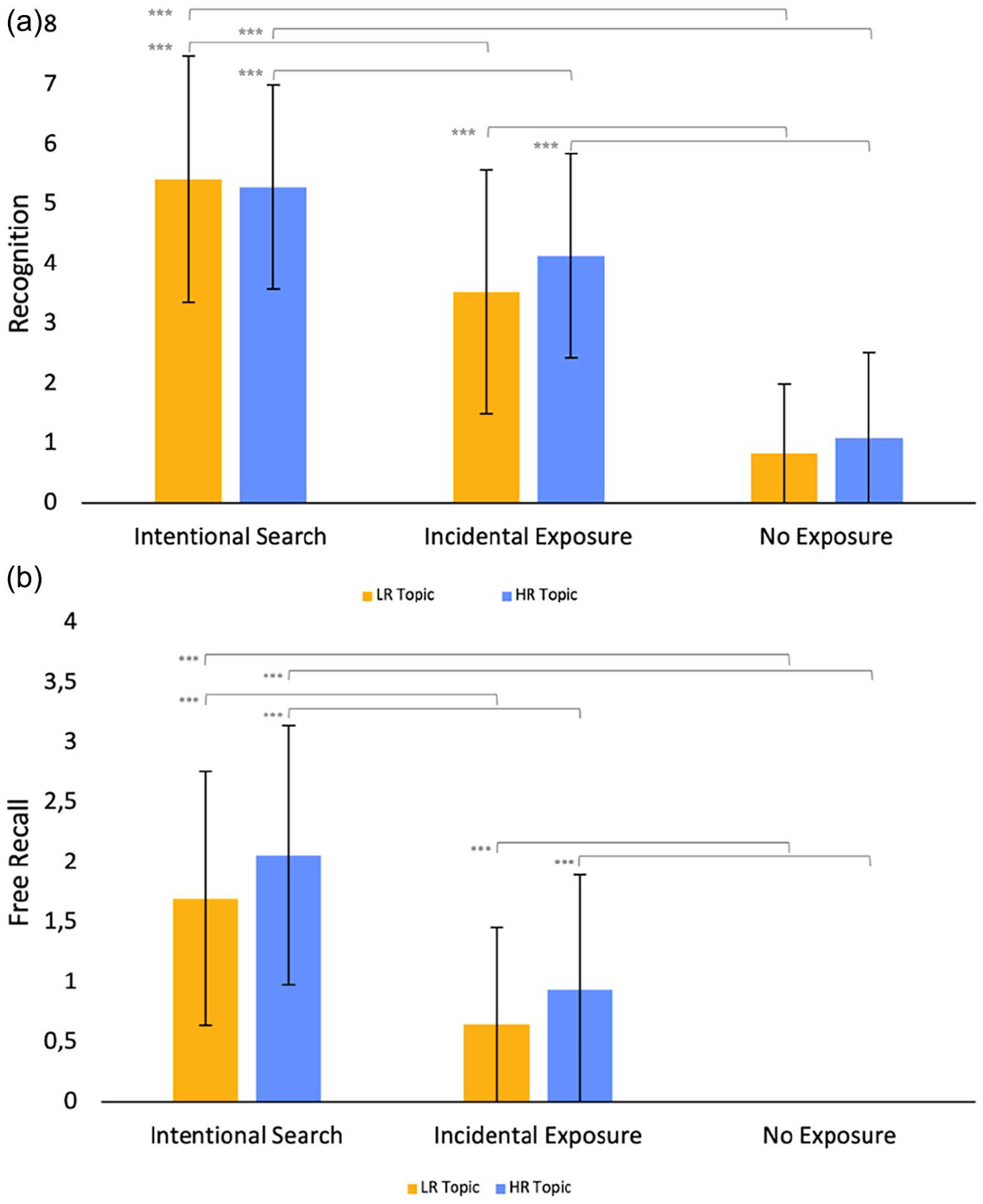
The effect of exposure on recognition and free recall for high relevance and low relevance topics. Note. The effect of mode of exposure (intentional (a) vs. incidental (b) vs. no (c)) on recognition (left) and free recall (right) for high relevance and low relevance topics. The bars represent mean values with standard deviations. Group differences were tested using Poisson regression, p < .05 (*), p < .01 (**), p < .001 (***).
Recognition
A Poisson regression analysis was conducted for HR (LR) topics, with the mode of exposure (intentional vs. incidental vs. none) as fixed factors and recognition as the dependent variable. The results showed that intentional news search resulted in 24.41% (42.73%) more recognition compared to incidental exposure (HR: z = 5.78, p < .001; LR: z = 9.52, p < .001), and 157.9% (187.43%) more recognition than no exposure (HR: z = 22.21, p < .001; LR: z = 23.9, p < .001). Incidental exposure resulted in 133.49% (144.69%) more recognition, compared to no exposure (HR: z = 18.76, p < .001; LR: z = 17.56, p < .001), see Table 1.
The Effect of Exposure on Subjective Knowledge, Recognition and Free Recall.
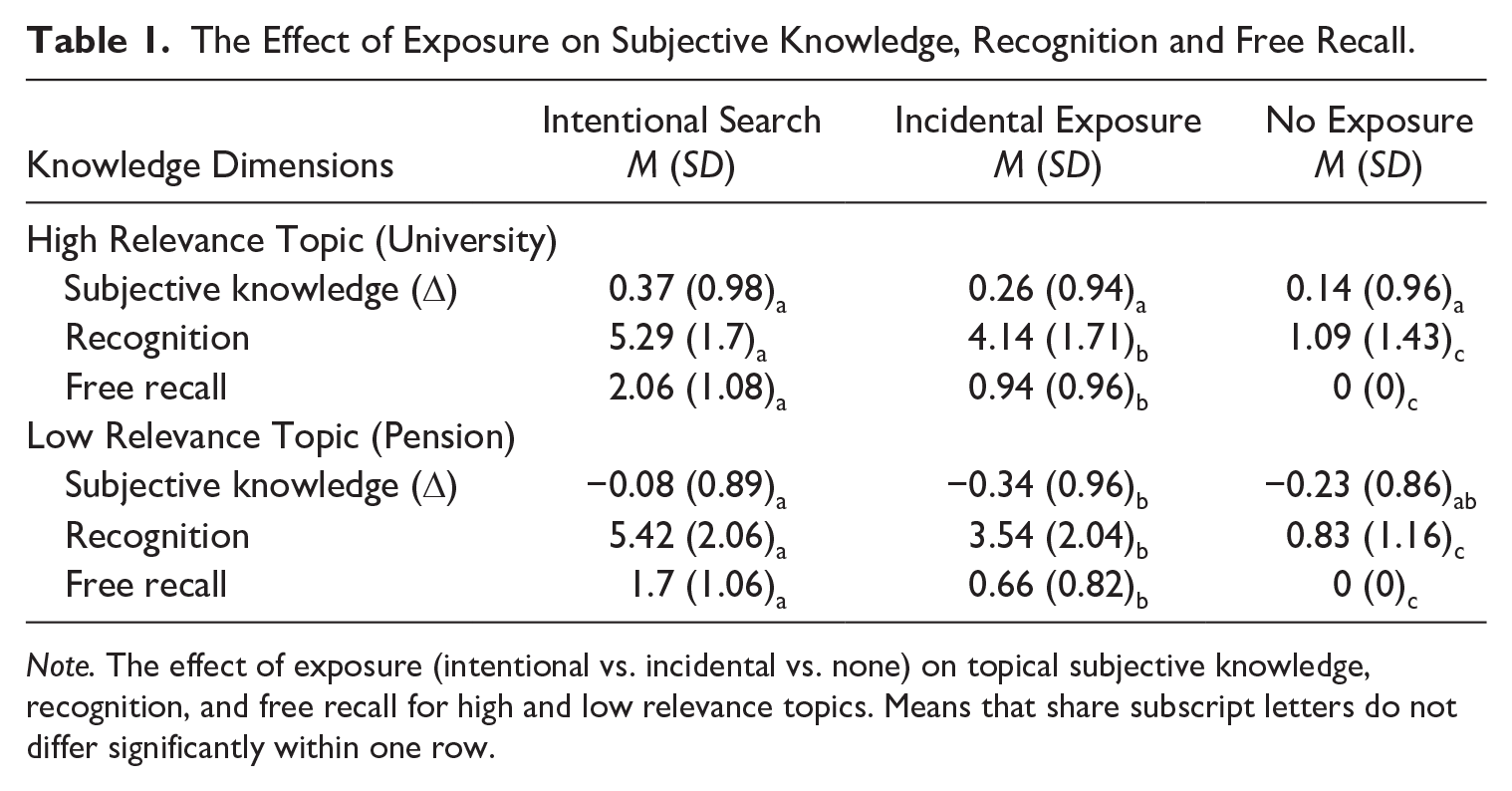
Note. The effect of exposure (intentional vs. incidental vs. none) on topical subjective knowledge, recognition, and free recall for high and low relevance topics. Means that share subscript letters do not differ significantly within one row.
Effects of Mode of Exposure on Subjective Knowledge
We expected people who intentionally searched for information to have more subjective knowledge than people who were incidentally exposed to the same information (H1). Further, we expected incidental news exposure would result in greater subjective knowledge than not being exposed to this information (H3). An ANOVA with the mode of exposure (intentional vs. incidental vs. no exposure) as fixed factor and change in topical subjective knowledge for HR (LR) topics as the dependent variable revealed a main effect (HR: F(2,699) = 3.21, p = .041, η2 = 0.01, LR: F(2,699) = 5.04, p = .007, η2 = 0.01). Subsequent pairwise comparisons showed no group difference for HR topics, while—for LR topics—intentional search led to more subjective knowledge compared to incidental exposure (p = .006, d = 0.28). 5 An additional nonparametric comparison between intentional search and incidental exposure 6 showed a small effect for HR topics (W = 26,369, p = .018, r = 0.11) and no effect for LR topics (W = 31,136, p = .277). While we found mixed support for H1, our results do not corroborate H3.
The Effect of Incidental Exposure on Knowledge as a Function of Topical News
The second goal of this study was to investigate whether the relevance of topics to which people are incidentally exposed affects their objective knowledge (RQ2) and subjective knowledge (H2). We analyzed the former using Poisson regression and the latter using both between-subjects comparisons and within-subjects comparisons. 7
Topical Relevance and Objective Knowledge
We found consistent effects for recognition and free recall. Participants incidentally exposed to HR topics scored 35.83% higher on free recall compared to participants exposed to LR topics (z = 4.01, p < .001). Additionally, they scored 15.91% higher on recognition compared to the LR group (z = 4.87, p < .001). Participants incidentally exposed to both HR and LR topics scored 49.88% higher on free recall for HR topics compared to LR topics (z = 5.67, p < .001). For recognition, they scored 8.17% higher for HR topics compared to LR topics (z = 2.56, p = .011).
Topical Relevance and Subjective Knowledge
Then, we compared the effect of HR versus LR topics on subjective knowledge for participants incidentally exposed to one of the two topics. The results indicated that HR topics led to significantly greater gains in subjective knowledge compared to LR topics (W = 18,601, p < .001, η2 = 0.3). Next, we analyzed the effect of topic relevance on subjective knowledge for participants incidentally exposed to both HR and LR topics. The results similarly showed that HR topics resulted in significantly greater gains in subjective knowledge than LR topics (W = 19,324, p < .001, η2 = 0.3), see Table 2. We conclude that in situations where people are incidentally exposed to HR topics, they subjectively and objectively gain more knowledge than when they are incidentally exposed to a LR topic, supporting H2.
The Effect of Incidental Exposure on Topic Subjective Knowledge, Recognition, and Free Recall by Topical Relevance.

Note. Means, Standard deviation in parenthesis.
Distraction Through Incidental Exposure to High Relevance Topics
We expected that when participants are incidentally exposed to high relevance topics this would lead to a perceived distraction from their intentional search task (H4). To test this, we analyzed the effect of HR versus no incidental exposure between groups on subjective knowledge for the intentional search task (LR). Our analysis showed no significant difference in subjective knowledge for the intentional search task (W = 23,347, p = .57) between participants incidentally exposed to high relevance topics (M = −0.2, SD = 0.97) and those who were exposed to no political topics (M = −0.17, SD = 0.89). Therefore, we reject H4.
Exploratorily, we tested whether incidental exposure to highly relevance topics leads to reduced objective knowledge for low relevance intentionally searched topics. A Poisson regression with the relevance of incidental exposure (high vs. none) as the independent variable (M = 3.6, SD = 1.65; M = 3.84, SD = 1.54) and recognition as the dependent variable found no effect (z = 1.87, p = .062). However, a second Poisson regression with free recall as the dependent variable showed that high relevance incidental exposure reduced free recall of intentional search topics by 33.59% (M = 1.47, SD = 1.03; M = 2.06, SD = 1.17; z = 5.433, p < .001). Thus, while we did not find a perceived distraction (rejecting H4), we found an actual distraction effect through incidental exposure to HR topics.
Discussion
This study had two primary goals. First, we examined how the mode of accessing news on social media influences objective and subjective knowledge. Second, we investigated whether incidental exposure to topics of varying relevance results in different forms of information processing. Our findings indicate that individuals who intentionally search for specific information on social media acquire more objective knowledge about the given topic than those who encounter the same information incidentally. Additionally, the processing of incidentally encountered stimuli varies with perceived relevance, with more relevant news being better remembered, supporting PINE (Matthes et al., 2020). However, we found no significant effect of the mode of exposure on subjective knowledge.
Objective Knowledge Gains Through Social Media
When people intentionally search for information on social media, they recognize and recall it more often than when they encounter it incidentally. In line with previous research (Shahin et al., 2021), our results underscore the role of intentional news search in triggering profound elaboration, which aligns with central route processing. In contrast, news encountered incidentally is processed less thoroughly, following the peripheral route. Further, we showed that the extent of elaboration of incidental news is contingent on peripheral cues, such as the relevance of information (Petty & Cacioppo, 1986). Our results confirm that more relevant incidental news prompts deeper processing, as suggested by PINE (Matthes et al., 2020).
In their recent meta-analysis, Amsalem and Zoizner (2022) found no overall learning effect from social media. Our findings add to this research and provide a more nuanced picture about when learning gains become detectable. In situations where people are motivated to learn, they can indeed acquire knowledge from social media. But even when people are not initially motivated, we found short-term learning effects. However, it is very likely that these incidental learning effects are mainly observable in laboratory settings. Nanz and Matthes (2022a) showed that experiments overestimate incidental learning effects compared to panel studies. In addition, because incidental news is processed very shallowly (Shahin et al., 2021), especially when they are of low relevance to the user (Matthes et al., 2020), it is likely that they will not be long-lasting.
Mode of Exposure Does Not Influence Subjective Knowledge Estimates
Our hypothesis that intentional news search would enhance individuals’ subjective knowledge, relative to incidental exposure to the same information, was not supported by our findings. It appears that while individuals can derive their self-concepts from observing their behavior (Ward et al., 2022), a single instance of digital news search may not be sufficiently impactful to modify one’s self-concept. People might need to engage repeatedly in news search, for it to influence one’s subjective knowledge (Dreston & Neubaum, 2023). Moreover, prompting individuals to evaluate their knowledge shortly after exposure to social media posts on a topic may highlight the superficial nature of information encountered, leading them to realize their limited understanding of the subject matter.
Individuals who incidentally encountered information did not perceive themselves as more knowledgeable than those who had no exposure to the topic in question. This finding is surprising for two reasons. First, previous research on passive learning (Carlson et al., 2009; Lee, Diehl, & Valenzuela, 2022) supported the notion of an illusion of knowledge (Schäfer, 2020), which we did not observe in our data as only objective not subjective knowledge was increased. Secondly, we expected the level of elaboration to predict subjective knowledge (Dreston & Neubaum, 2023). However, we note that relevance acts as a heuristic cue for subjective knowledge evaluation. Individuals incidentally exposed to highly relevant news tend to rate their subjective knowledge higher compared to those exposed to less relevant news. This finding suggests a potential expansion of PINE (Matthes et al., 2020) indicating that the relevance appraisal may not only shape learning effects but also our subjective learning gains.
While our results may seem to challenge the association between elaboration and subjective knowledge, it is more likely that a single experimental trial is insufficient to reveal such effects. Subjective knowledge likely requires repeated media exposure to increase. In this experiment, the focus on four policies within each topic may not have provided enough familiarity to significantly impact subjective knowledge (Schäfer, 2020). Instead, participants’ post-experiment perceptions likely reflected their pre-existing knowledge. This could be the reason why incidental exposure to high relevance topics results in momentary higher subjective knowledge than incidental exposure to low relevance topics. Consequently, a single exposure, whether intentional or incidental, does not seem to change perceptions of knowledge, but merely highlights pre-existing perceptions, as people recognize the complexity of political issues.
Theoretical and Practical Implications of Using Social Media as a News Platform
For years, studies have painted a pessimistic picture of social media’s potential to inform users: people do not seem to learn from social media but they seem to feel as if they did (e.g., Lee, Diehl, & Valenzuela, 2022). However, our study offers a more nuanced and optimistic view, demonstrating that users are, in fact, cognitively capable to learn from social media. Nevertheless, effective learning requires a synergy between users’ motivation and platform design.
Engaging with news on social media is not a uniform experience. Instead, it is crucial to examine the how and why behind individuals’ interactions with news on social media. Our research underscores the importance of intentionality in determining the extent of learning. When users intentionally search news on social media, they can effectively allocate the cognitive resources necessary to engage in deeper elaboration, thereby facilitating learning. In terms of platform design social media platforms could encourage active search and informational intentions by promoting their search functions.
In contrast, when news content is encountered incidentally, learning is highly dependent on its relevance. If the content is not relevant, users are likely to scroll past it remembering little to no information. Knowledge gains in such cases are largely passive and involuntary. However, when news aligns with individuals’ pre-existing interests, they are more likely to invest cognitive resources in elaborating on this incidental news, resulting in more objective knowledge. Users with higher algorithmic literacy can curate their social media feeds to expose them with information of interest (Karizat et al., 2021; Swart, 2021). In addition, platforms could highlight important, but less personally relevant news by adding relevance cues such as “important for you” or “liked by friends.” To take full advantage of this second-level processing, news providers on social media could accompany snack news with easy to access in-depth information (e.g., threads or links), so that interested users can get a more detailed picture instead of only consuming superficial news.
Both, as shown by this study, the way news is encountered and its relevance play crucial roles in social media learning processes, influencing the allocation of cognitive resources for elaboration and ultimately shaping the learning outcomes. At the same time, users need to be educated about the limitations of online news consumption, including recognizing when to switch to other platforms for a more in-depth coverage or to explore topics they are initially less interested in. Therefore, fostering both algorithmic literacy and media literacy amongst social media users is still a complementary task to adapting the platform design that encourages informational intentions.
While intentionality plays a crucial role in facilitating objective learning from social media, its direct impact on individuals’ subjective knowledge may be limited. Instead, it appears that a single exposure to information on social media does not increase people’s subjective knowledge. This observation underscores two key insights. First, people’s subjective knowledge is a relatively inert construct that is not immediately influenced by cognitive processes such as elaboration or heuristic cues (e.g., familiarity). Rather, people may build their knowledge perceptions through repeated media exposure. Consequently, people tend to perceive their subjective knowledge as higher for information that is relevant to them than for incidental encounters with non-relevant information, presumably due to increased exposure to relevant topics. It is possible to assume that people need to retrieve and apply their newly acquired knowledge first, for it to alter their knowledge perception. Second, individuals demonstrate a more nuanced understanding of their own knowledge than previously thought. Even when they acquire momentary objective knowledge, they do not conflate it with deep topical knowledge. Instead, our study suggests that users are able to recognize the complexity of political issues and understand that a single post does not encapsulate the full breadth of the issue. As a result, they do not overestimate their level of knowledge. This contradicts previous findings suggesting that social media might promote an illusion of knowledge.
Nevertheless, incidental exposure can hinder learning through distraction, yet users do not seem to notice this distraction. Given the limited cognitive resources available (Lang, 2000, 2006), incidental exposure to relevant information consume most of these resources, leaving insufficient capacity for the primary learning goal. Since social media platforms are designed to capture and maintain users’ attention, relevant incidental content is likely to dominate users’ focus. To enhance social media’s role as an effective mediator of news, algorithms could be adjusted to prioritize personally relevant and important news content at the top of feeds, thereby minimizing distraction. Consequently, both intentionality and relevance are crucial factors to consider when modeling the impact of social media on users’ and objective and subjective knowledge.
Limitations and Outlook
Our experiment is subject to several limitations. First, although participants were presented with four posts on each topic, they encountered each post only once. Yet, individuals typically engage with social media multiple times throughout the day. Future studies should consider this frequency of exposure when designing experiments. Second, we assessed objective knowledge shortly after participants scrolled through their feed and completed distractor tasks. While our approach technically measures long-term memory effects, these effects may fade as individuals move away from their phones. Third, like most studies in the field, we measured objective political knowledge through the recognition of single facts (e.g., Nanz & Matthes, 2020; Schäfer, 2020). While this is an adequate representation of learning from the news on social media (Schäfer, 2022), it neglects the fact that political news is more complex. Remembering a few facts should not be interpreted as having deep political understanding. Fourth, participants could not click on any post to get additional information, so we could not measure whether our manipulation triggered any additional information search behavior that would have allowed for more complex knowledge. Future studies should include opportunities for additional information search, as longer texts have been shown to more objective knowledge compared to social media posts (Schäfer, 2020). Fifth, despite our efforts to isolate subjective knowledge gains attributable solely to the experiment, participants still reported feeling more knowledgeable about high-relevance topics. Future studies should explore relevance manipulations that are independent of participants’ prior subjective knowledge.
Conclusion
In sum, this study demonstrates that not all forms of “social media use” contribute equally to learning, thereby extending the findings from Amsalem and Zoizner’s (2022) meta-analysis. When people (a) intentionally search information or (b) are incidentally exposed to relevant information, they can indeed gain objective political knowledge through social media. The degree of learning hinges on these two factors as individuals allocate greater cognitive resources accordingly. This study suggests a possible extension of the “Political Incidental Exposure Model” (Matthes et al., 2020) by indicating that incidental exposure to high relevance topics does not only have cognitive but also metacognitive effects in the form of enhancing subjective knowledge assessment. Furthermore, we showed that people’s subjective knowledge is more inert than previously assumed; individuals may rely on repeated exposure when judging their knowledge (Dreston & Neubaum, 2023; Schäfer, 2020). With people increasingly using social media as their primary news source, platform providers should embrace their responsibility as a modern news provider and encourage intentional news search over incidental exposure. At the same time, users could be trained to not use social media as passive consumers but also as active seekers of news to extend their corresponding knowledge.
Supplemental Material
sj-docx-1-crx-10.1177_00936502251317818 – Supplemental material for Navigating Social Media News Use: Exploring the Impact of Intentional and Incidental News Consumption on Objective and Subjective Political Knowledge
Supplemental material, sj-docx-1-crx-10.1177_00936502251317818 for Navigating Social Media News Use: Exploring the Impact of Intentional and Incidental News Consumption on Objective and Subjective Political Knowledge by Jana H. Dreston and German Neubaum in Communication Research
Footnotes
Declaration of Conflicting Interests
The authors declared no potential conflicts of interest with respect to the research, authorship, and/or publication of this article.
Funding
The authors received no financial support for the research, authorship, and/or publication of this article.

Supplemental Material
Supplemental material for this article is available online.
Notes
Author Biographies
References
Supplementary Material
Please find the following supplemental material available below.
For Open Access articles published under a Creative Commons License, all supplemental material carries the same license as the article it is associated with.
For non-Open Access articles published, all supplemental material carries a non-exclusive license, and permission requests for re-use of supplemental material or any part of supplemental material shall be sent directly to the copyright owner as specified in the copyright notice associated with the article.
