




Abstract
This article outlines the Political Incidental News Exposure Model. The Political Incidental News Exposure Model understands incidental news exposure as a dynamic process and distinguishes two levels of incidental news exposure: the passive scanning of incidentally encountered political information (first level) and the intentional processing of incidentally encountered content appraised as relevant (second level). After encountering political information incidentally, recipients briefly check the content for relevance (i.e., first level). If content is appraised as relevant, recipients switch to more intensive processing (i.e., second level incidental news exposure). Importantly, second-level incidental news exposure is assumed to have stronger effects on political outcome variables like participation and knowledge than first-level incidental news exposure. The Political Incidental News Exposure Model further acknowledges intention-based (i.e., incidental news exposure while not looking for political news) and topic-based incidental news exposure (i.e., incidental news exposure while looking for other political news) and it conceptualizes incidental news exposure with respect to political and non-political content. Theoretical and methodological implications are discussed.
Since large shares of citizens are connected on social media (SM), scholars have theorized about a new, digital public sphere (see Schäfer, 2016). Although SM have not been primarily invented for political purposes, researchers envisioned that the practices of sharing and posting news may reengage political bystanders that have tuned out of journalistic media. In fact, what can be considered as news and journalism in a digital environment can take various forms. As Ryfe (2019) states, a large quantity of online news comes from non-traditional actors, such as community blogs and advocacy groups. From a perspective of journalistic practice, many microbloggers and semi-professionals contribute to fulfill key democratic functions of journalism, most importantly by creating content that answers the informational needs of the public (Edgerly, 2017; Edgerly et al., 2009). In doing so, they also tend to ascribe to journalistic key values (Maares and Hanusch, 2018). To understand the full potential of SM, all of these different forms of news – defined as ‘new information about a subject of some public interest that is shared with some portion of the public’ (Stephens, 2007: 4) – have to be considered.
The phenomenon of incidental news exposure (IE) – exposure to news that people encounter without actively searching for it – is increasingly relevant to journalism research. Scholars have argued that IE may positively affect civic outcomes (e.g., Bode, 2016; Tewksbury et al., 2001; Valeriani and Vaccari, 2016). However, empirical research comes to contradictory conclusions. While some studies support the positive contribution of IE to citizens’ knowledge and participation (e.g., Valeriani and Vaccari, 2016), others find no relationship (e.g., Oeldorf-Hirsch, 2018), or a conditional relationship (e.g., Lee and Kim, 2017).
One reason for these conflicting findings may be the lack of a common definition of IE. For some, the mere flash of a headline while scrolling down one’s newsfeed already qualifies as IE (Bode, 2016; Tewksbury et al., 2001). For others, IE entails the full engagement with a relevant piece of information (Heinström, 2006; Yadamsuren and Erdelez, 2016). Theory building endeavors are therefore urgently needed (Dimitrova and Matthes, 2018; Knoll et al., 2020; Thorson and Wells, 2016).
This article outlines the Political Incidental News Exposure Model (PINE model). The PINE model understands IE as a dynamic process, in which individuals’ processing goals can shift based on what we call a relevance appraisal of encountered information. The PINE model differentiates two levels: First, a quick glance at or scanning of information that is deemed as not relevant (first-level IE), and second, a shift of processing goals leading to a full consumption of a news item (second-level IE) in cases of content deemed as relevant. Furthermore, most prior research suggests that IE only happens when people use SM for purposes other than looking for news. However, IE may also happen for search-domain-unrelated political information (Yadamsuren and Erdelez, 2016). That is, people may have a specific political processing goal (e.g., news on economy) and become incidentally exposed to other political information (e.g., news on immigration). We, therefore, argue that IE is also possible when individuals search for specific political news but then stumble upon unrelated political information.
Literature review
Tewksbury et al. (2001) were among the first scholars who discussed the Internet’s ‘ability to provide a typical user with an array of information choices that extend far beyond what he or she intentionally seeks’ (p. 534). They argue that IE takes place when ‘people encounter current affairs information [or other political information] when they had not been actively seeking it’ (Tewksbury et al., 2001: 534; see also Antunovic et al., 2018; Fletcher and Nielsen, 2018; Lee and Kim, 2017; Oeldorf-Hirsch, 2018). More specifically, there are three underlying assumptions. First, most scholars treat IE to be distinct from intentional exposure. As Lee and Kim (2017) put it, ‘[t]here are, broadly speaking, two possible ways to obtain political information: an individual either seeks out the information or accidentally encounters it with no intention of doing so’ (p. 1008). More specifically, exposure to content is considered intentional if the recipient had the goal to encounter that content. By contrast, IE is characterized by a lack of goal to be exposed to that content. These basic processing goals are in line with the uses and gratifications approach (Rubin, 2009).
Second, information encounters are only considered as incidental if citizens use media for non-news or non-political reasons. In other words, citizens experience IE when they see political information in situations where they used media for other purposes (e.g., entertainment) than political ones. In studies on IE, respondents are typically asked how often they ‘encounter’ or ‘come across’ news while they have been using media for a purpose other than to get the news (e.g., Oeldorf-Hirsch, 2018; Valeriani and Vaccari, 2016). More specifically, it is rather common to let respondents rate how often they encounter news on various web applications (e.g., blogs, Email, SM) and form a mean scale from their answers (e.g., Kim et al., 2013; Lee and Kim, 2017).
Scholars have suggested a very broad definition of IE to ‘news’. Respondents were asked about ‘news and information on current events, public issues, or politics’ (Tewksbury et al., 2001; Valeriani and Vaccari, 2016) or simply ‘news’ (Kim et al., 2013; Lee and Kim, 2017). As should be apparent, this may include all kinds of news, sports news, celebrity news, or lifestyle journalism. Especially the wording ‘or politics’ clearly suggests that news incorporates non-political information. This somewhat contradicts the original purpose of the concept: To explain political outcome variables such as learning or participatory behavior. In fact, while asking for ‘news and information on current events, public issues, or politics’, Tewksbury et al. (2011) used political knowledge as the dependent variable and they even excluded a knowledge question on the ‘weather pattern movement in the United States’ because it ‘did not appear to tap the desired concept in this case’ (p. 539). Also, Valeriani and Vaccari (2016: 1857) were interested in explaining ‘how accidental exposure to political information on SM contributes to citizens’ online political participation’ (italics added) but incorporated non-political news in their operational definition of IE.
Third, most if not all studies do not clearly define what they mean by ‘encountering’ or ‘coming across’ news, but rely on the audiences’ understanding of those terms. Given that a range of information encounter situations are considered as IE by both scholars and citizens (Bergström and Jervelycke Belfrage, 2018; Boczkowski et al., 2018; Yadamsuren and Erdelez, 2016), the typical operationalization of IE might be problematic. Did individuals read and process incidentally encountered information? Or do high scores on typical IE measures only indicate that respondents briefly glimpsed at headlines? These questions have not been answered in the available body of research.
As a consequence, empirical evidence on the role of IE to increase political knowledge and stimulate political participation is mixed. While some experimental research indicates that people may recall incidentally encountered political information on SM (Bode, 2016; Lee and Kim, 2017), observational studies found no significant relation between IE and political knowledge (Oeldorf-Hirsch, 2018). Similarly, results for political participation are at least partially contradictory. While Valeriani and Vaccari (2016) found significant effects of IE on political participation cross-sectionally, longitudinal data by Heiss and Matthes (2019) suggests that IE even hampers participation.
Reconceptualizing incidental exposure to political news
Defining news and political information
Previous studies have mainly focused on whether or not citizens were incidentally exposed to news, without explicitly speaking of political information. This may have two important drawbacks: First, in most if not all empirical studies, respondents are not presented with a definition of what ‘news’ actually is. Yet, quantitative as well as qualitative research clearly shows that citizens have a rather vague understanding of the term ‘news’ (Bergström and Jervelycke Belfrage, 2018; Vraga et al., 2016). Second, news as a one-dimensional concept is strongly contested in the scientific literature (e.g., Zelizer, 2013). News fulfills a number of societal functions, from strengthening identities to serving as a mean for mood control (e.g., Rubin, 2009). Not all news is relevant to IE and its outcomes.
We argue that the concept of IE has been suggested to explain political outcomes. Questions regarding the ‘relationship between use of the Internet and political engagement’ (e.g., Valeriani and Vaccari, 2016: 1860) and the Internet’s potential to come closer to the ideal of ‘an informed electorate’ (e.g., Bode, 2016: 25) represent the current research agenda. The aim is not to explain the consequences of exposure to sports news, celebrity news, or other entertainment-based types of news. Therefore, a vague conceptualization and operational definition of ‘news’ may not serve the concept’s purpose. In fact, not all news can be hypothesized to leave an impression on political outcomes. In line with Hanitzsch and Vos (2018), we therefore separate news into the following two broad categories: political news and non-political news. The notion of ‘public events’ may tap both and is thus too imprecise, both in terms of theory development and operationalization.
In line with Reinemann et al. (2012: 237), we understand political news as news which include the mentioning of (1) political actors, (2) decision-making authorities, (3) activities of planning, decision-making or realizing programs that relate to societal issues, or (4) news on the groups or people which are concerned by political decisions. Non-political news focuses on helping individuals to navigate the many options of lifestyles and products they could choose, offering positive and light news for mood control, or giving guidance on social relationships (see Hanitzsch and Vos, 2018). Under these definitions, both the source and style of political or non-political news is of secondary importance. In today’s media environment, a large share of news is not produced by journalists, but by various individuals and organizations (Ryfe, 2019). In result, a definition of ‘news’ should not only be limited to traditional media. Taken together, this leads to a first proposition.
Proposition 1: The concept of incidental exposure should explicitly distinguish between political and non-political news exposure, and should not refer to ‘news’ or ‘public affairs’ in general.
Incidental encountering versus deeper processing
There is no agreement in previous scholarship what the incidental ‘encountering’ of news actually means. Various studies refer to passive learning as the cognitive driver (e.g., Bode, 2016; Tewksbury et al., 2001; Valeriani and Vaccari, 2016). Per definition, passive learning may occur when recipients are not interested in gaining knowledge, so their attention deserts from the stimulus after a short amount of time (Krugman and Hartley, 1970). We argue that passive learning provides a good explanation for one key facet of IE, for instance, when individuals simply notice a headline while looking for other content.
Yet, we argue there are other situations of IE where passive learning cannot explain effects. Individuals may click on an incidentally encountered headline and read the full article. This is arguably also a form of IE, but one with subsequent effortful processing. This notion of IE is also used in library and information science in which IE is primarily discussed ‘as a memorable experience of a chance encounter with news [. . .] while the individual is using the Internet for news browsing or non-news-related online activities’ (Yadamsuren and Erdelez, 2016: 46, italics original). Here, encountering content would only qualify as IE, if the information sparks interest in the user. We believe that both conceptualizations are needed. Thus, in order to fully capture the concept of IE, we need to take into account the passive scanning of information deemed as irrelevant and the intentional processing of incidentally encountered information.
The latter notion is fully in line with what scholars have defined as IE: People stumble over political news they did not seek for in the first place, but they may also quickly or extensively read and process the political news if regarded as relevant. As Tewksbury et al. (2001) argue, sometimes ‘headlines [. . .] flash into consciousness whether the reader is interested or not’ (p. 535), but ‘[o]n occasion, [audience’s] interest is aroused long enough for them to register a headline and perhaps click and read the accompanying story’ (p. 536). Similarly, Fletcher and Nielsen (2018: 2453–2454) discuss multiple scenarios of IE: people may see a political post, see news previews on SM (i.e., headlines with text snippets) or may click on links which they encountered incidentally and then be exposed to the full news story. As noted by Vraga et al. (2019), ‘incidental exposure studies often stop at exposure – it is unclear to what extent people pay attention to and remember content they do not deliberately choose, rather than ignore or skip over it’ (p. 237). Qualitative research underlines this notion: Individuals report that they frequently skim only the headlines but sometimes engage in further information seeking after encountering intriguing stories incidentally (Boczkowski et al., 2018). Oeldorf-Hirsch (2018) provides one of the few studies which addresses this notion and links IE to elaboration and engagement with the content of the encountered post. Yet, existing operationalizations for surveys allow no assumptions about how respondents understand the concept of IE. As should be apparent, we would expect totally different outcomes for both facets of IE. Clearly, higher levels of attention to political content should lead to stronger effects on political outcomes compared to lower levels (see Lee and Kim, 2017). Based on these insights, we therefore formulate a second proposition for the concept of IE:
Proposition 2: The concept of incidental exposure should separate the scanning of information deemed as unimportant from the deeper processing of incidentally encountered political information.
It is generally theorized that people are either intentionally or incidentally exposed to news, and this is mostly measured across situations (i.e., in surveys). However, following from Proposition 2, people may constantly switch between passively noting information they find uninteresting and actively processing incidentally encountered news (Heinström, 2006). Especially when considering SM with their constant flows of information, IE can be understood as a dynamic process. It can be theorized that individuals constantly appraise the content they are confronted with, and since they may be exposed to various contents simultaneously, they may permanently switch between political content and non-political content. Based on their social network, individuals may stumble upon political information, and choose to process that information. As time goes by, individuals may again be exposed to non-political information, and switch their processing goal again. In order to fully capture IE, we need to treat it as a dynamic rather than static concept:
Proposition 3: The concept of incidental exposure should be treated as dynamic, since individuals can switch their processing goals from non-political to political, and vice versa.
Intention-based and topic-based incidental exposure
Previous scholarship only considered information encounters as IE if users turned to media for non-news – that is in our reading, non-political – motivations. According to this view, citizens experience IE when they see political information in situations where they used media for other purposes. Yadamsuren and Erdelez (2016) label this type of IE intention-based. Following this argument, IE cannot, by definition, refer to unspecific news seeking. That is, when individuals’ intention is to generally scan political news, there can be no IE to political news, even though individuals may find news they did not expect. The reason is that the underlying processing goal is to seek political news. Routine political surveillance of political news therefore excludes IE (see Antunovic et al., 2018).
However, we suggest an additional facet of IE, based on what Yadamsuren and Erdelez (2016) have called topic-based IE. Topic-based IE happens when people turn to media intentionally for a specific political topic but unintentionally find ‘unusual or interesting news on different topics while reading news on topics that interest them’ (Yadamsuren and Erdelez, 2016: 8). For example, citizens might turn to SM to look for the latest statement of the president but encounter information on environmental issues. IE may thus also happen for search-domain-unrelated news. That is, people may have a specific political processing goal and become incidentally exposed to other political information. This form of IE has been ignored in extant research. We believe this aspect matters because of the ways through which individuals are confronted with news on SM. Also, the notion of topic-based IE is important for explaining the outcomes of IE. That is, if people continuously switch between topics, this has important implications for learning and behavioral outcomes.
We do not argue that information encountered through topic-based IE has to lead to deeper processing. Topic-based IE may occur when individuals are exposed to political content that is unrelated to their processing goal but choose not to pay special attention to it. That is, such political content may just be quickly scanned by individuals. Topic-based IE may have the same effects as intention-based IE. The reason is that the incidentally encountered information is processed in very similar ways. In both cases, the incidentally encountered content is not searched for in the first place. In the case of intention-based IE, the primary processing goal is related to non-political information, for instance, checking updates on one’s personal network. In the case of topic-based IE, the primary processing goal is related to a specific political topic. In both situations, incidentally encountered information may be processed in passing. It follows:
Proposition 4: The concept of incidental exposure should incorporate both, the intention-based and the topic-based dimension.
Incidental exposure to political and non-political information
Besides the political domain, SM are heavily used for entertainment and relational purposes, and a typical newsfeed may regularly list political content next to non-political content. Thus, and following up on Proposition 4, the concept of IE may be relevant for situations in which individuals have a specific political processing goal and stumble upon non-political information, as for instance, private information by friends or sports news. Such IE to non-political information needs to be taken into account as well. The reason is that non-political IE can have important effects on political outcomes such as learning or participation. The more people are confronted with non-political content (without actively looking for it), the more they are potentially distracted from their primary political processing goal. It follows that excluding non-political IE may overestimate political outcomes because possibly distracting uses of SM are neglected.
Furthermore, individuals may continuously switch between political and non-political content. Drawing on Proposition 3, a dynamic perspective on IE, therefore, needs to examine the interplay of political and non-political processing goals. For instance, individuals may be interested in relationship-oriented forms of networking but stumble upon political news they find interesting. This may lead to a change in processing goals; in case the political information is deemed as relevant, the processing goal will be directed toward the political information. Yet, taking a diachronic perspective, individuals may be further exposed to non-political information as the newsfeed goes on (e.g., pictures of friends). This may again lead to a change in processing goals, but this time, away from political content. Thus, in order to understand if and why individuals switch their processing goals, we need to consider both types, IE to political content and IE to non-political content. Although IE to non-political content may not be the primary concern of political communication scholars, it still belongs to the general theoretical notion of IE. It allows us to explain the back and forth between the political and non-political world. It follows,
Proposition 5: There are two distinct but interrelated forms of incidental exposure: Incidental exposure to political and incidental exposure to non-political information.
The political incidental news exposure model (PINE)
The PINE model differentiates between political and non-political content. Following from that, we distinguish two different processing goals (see Knoll et al., 2020): First, a non-political processing goal that describes the motivation of individuals to attend to non-political information, and second, a specific political processing goal that describes individuals’ motivation to be exposed to information about a specific political topic. It should be noted that we do not assume that individuals use SM either only for political motivations or only for non-political motivations. We theorize that individuals possess (and may constantly switch between) a non-political or a political situational processing goal throughout the entire reception process. Rephrased, the PINE model’s focus lies on the situational processing goal and not on the motivation which led people to log into their SM in a current situation. The starting point of the model can thus be a specific time during reception. Furthermore, we exclude unspecific news seeking because IE can, by definition, not occur for the routine surveillance of political news.
For both goals – the non-political processing goal and the specific political processing goal – we would generally assume that IE to political content can occur. In the first case, people may be incidentally exposed to political information based on the curation of their SM environment (Thorson and Wells, 2016). In the second case, individuals may have a specific processing goal about a particular political topic, and – again based on curation – be exposed to other political information clearly outside that topic. Taking an effects perspective, the crucial question is, How is the incidentally encountered political information processed? We theorize the following two scenarios: According to the first, the incidentally encountered content is deemed as irrelevant. In that case, the original processing goal is maintained. The second scenario, however, describes a change in the processing goal. That is, people may choose to further process the incidentally encountered information in more detail. More specifically, we theorize that individuals automatically engage in a relevance appraisal. As argued by Knoll et al. (2020), individuals constantly scan their SM environment to check whether the incoming information requires further attention. As they put it, Social media users have to constantly decide which information is sufficiently relevant to deserve more extensive processing. The specific evaluation checks thereby operate on different levels of information processing (Lazarus, 1991). However, initial relevance checks are mostly stimulus driven and operate more or less automatic at low processing levels enabling easy and rapid decisions (Scherer, 2001; see Knoll et al., 2020: 8)
That is, we assume that individuals constantly engage in this cognitive process of relevance checking (i.e., relevance appraisal) when using SM. Similarly, Bode et al. (2017) argue that ‘[a]s part of the process of selective attention, people should respond to cues signaling the goal of the content being read’ (p. 1). In case of a negative relevance appraisal, incidentally encountered information is automatically scanned but deemed as unimportant, or more precisely, less important compared to the current processing goal. Incidentally encountered information that is appraised positively will be processed more thoroughly, that is, cognitive resources will be allocated to the content. It is important to note that a positive relevance appraisal is not the same and does not necessarily encompass further SM engagement (e.g., sharing, liking). Conceptualized as a cognitive process, a positive relevance appraisal does not necessarily lead to behavioral reactions like SM engagement. This is especially important because a range of other factors (e.g., extraversion, perceived norms) may play a crucial role whether individuals will share, like or comment SM content they appraised as relevant. Taken together, we theorize that all incoming information is permanently checked and appraised, which may lead to maintenance of an initial processing goal or, alternatively, to a switch of processing goals.
We further distinguish between a first-level and a second-level IE. First-level IE refers to situations in which the relevance appraisal of the incidentally encountered information is negative (i.e., irrelevant). Such first-level IE may nevertheless leave memory traces and lead to passive learning (see Bode, 2016; Tewksbury et al., 2001), especially after repeated exposure. First-level IE does not require a great amount of cognitive resources, but because of that, effects on political outcomes may be small and based on heuristic processes (Knoll et al., 2020). Furthermore, the original processing goal is maintained.
By contrast, the relevance appraisal of the incidentally encountered information is positive for the second-level IE. As a consequence, individuals form a new processing goal and process the incidentally encountered information in more effortful ways. This has fundamentally different consequences for political outcome compared to the first level. Now, the content is processed more thoroughly which may lead to cognitive elaboration. The effects on learning may therefore be much stronger for the second level as compared to the first level. The same may be argued for behavioral outcomes (Knoll et al., 2020).
Based on these insights, six theoretical paths can now be distinguished. The full PINE model is depicted in Figure 1. Aside from the previously discussed parts of our model, Figure 1 denotes that all processes of the PINE model are embedded in a variety of factors including individual, source, message and situational factors. We will highlight their influence with a special focus on the relevance appraisal later.
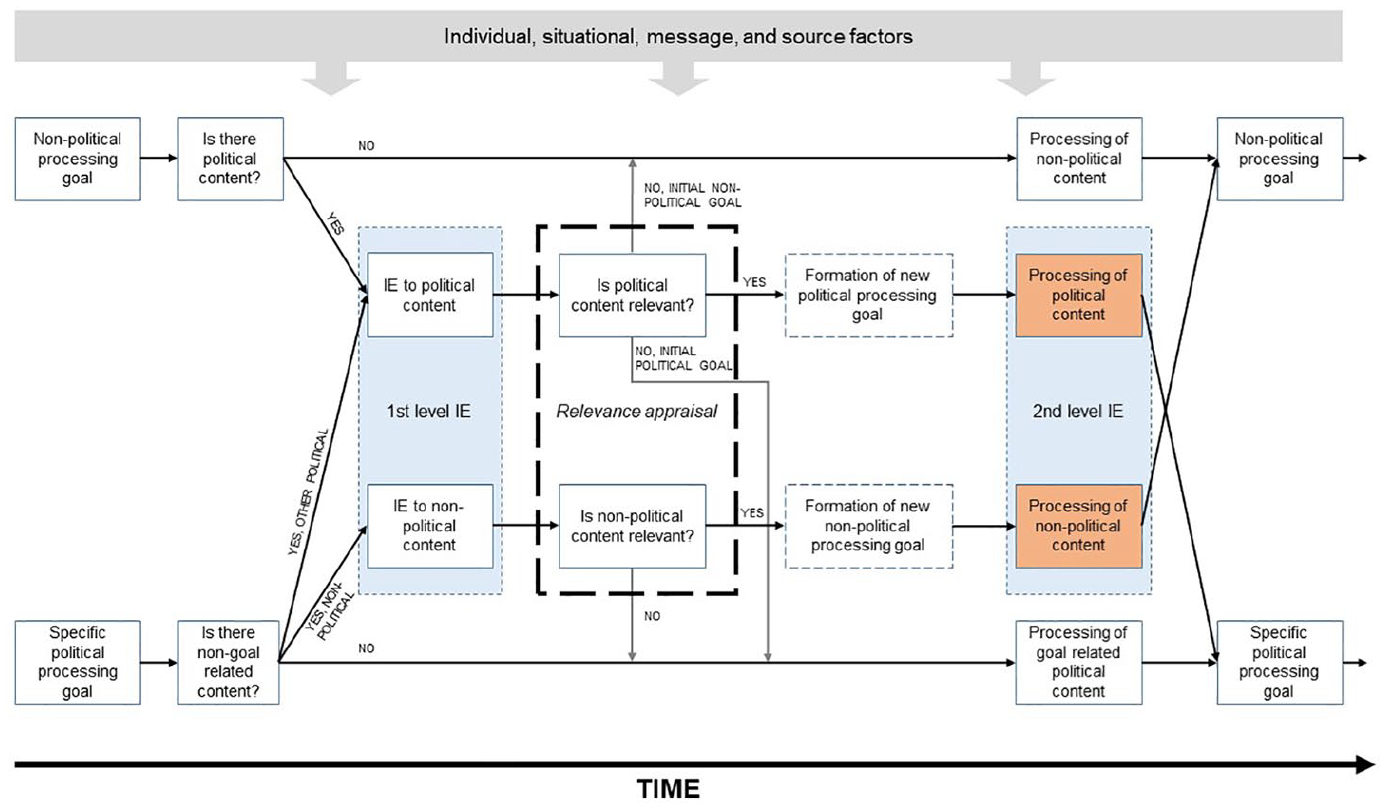
The political incidental news exposure model (PINE).
In addition, it is important to note that the model does not make an explicit assumption about the question whether or not the initial exposure is stimulus driven (e.g., respondents receive a message on their smartphone) or goal-driven (e.g., they search for information). However, it is assumed that during a reception process, people possess processing goals. This means, they form a specific motivation to look at certain content, no matter where that content comes from in the first place.
First- and second-level incidental exposure to political content
First, assuming a non-political processing goal, individuals may be confronted incidentally with political information based on SM curation. However, for this first path, the relevance appraisal is theorized to be negative, and the original processing goal is maintained. We call this first-level IE to political content. For recurring exposure, we would assume passive learning (see Krugman and Hartley, 1970). But since the information is processed in passing, effects are most likely small.
Second, again starting with a non-political processing goal, the relevance appraisal may be positive. This, in essence, means that the incidentally encountered political content is more relevant than the non-political content that individuals were looking for in the first place. As a consequence, a new processing goal is formed and the political content is processed in-depth (see for example, Karnowski et al., 2017; Oeldorf-Hirsch, 2018). We call this second-level IE to political content. Compared to the first level, effects on political outcomes are stronger. Since there has been a change of processing goals, individuals may not have the goal to attend to non-political information anymore. By contrast, they now have a specific political processing goal, that is, to get exposed to the content appraised as relevant. Yet, this may again change, as we will describe in our sixth path.
The first two paths assume a non-political processing goal. However, IE may also occur when individuals have a specific political processing goal, as for instance, when they intentionally search for information about a particular topic. As argued by Yadamsuren and Erdelez (2016), IE to political information may therefore also occur when individuals encounter information totally unrelated to this specific topic.
Third, in case of a specific political processing goal, incidentally encountered information may be appraised as irrelevant. Thus, there will be no change in processing goals after individuals briefly scanned the goal-unrelated political information. This path can be called first-level IE to goal-incongruent political content. This path is relevant because any encounter of goal-incongruent political content, even if deemed as irrelevant, may take away processing resources from the original political content. We will further revisit this aspect below.
Fourth, following this logic, incidentally encountered political information may be appraised as relevant, leading to a second-level IE to goal-incongruent political content. Here, due to a shift in processing goals, resources are taken away from the original political content and are directed to the incidentally encountered political content. Similar to path 2, more intense processing follows. This may lead to increased learning of the incidentally encountered content compared to path 3.
First- and second-level incidental exposure to non-political content
In addition to IE to political content, we theorized that individuals can be exposed to non-political content in incidental ways. This extension of the IE concept is important because it allows assumptions about the potential distracting effects of such non-political content. In line with our argumentation earlier, we distinguish two additional paths.
Fifth, a specific political processing goal may prevail at a given point in time, as for instance, when individuals want to read something about a particular political topic. Like for the first two paths, however, individuals may be exposed to other content, due to content curation. In case they are exposed to non-political content, they appraise as irrelevant, they will maintain their original political processing goal. This path can be called first-level IE to non-political content. Again, any encounter of non-political content, even if deemed as irrelevant, may take away processing resources from the original political content. We will revisit this aspect below.
Sixth, individuals may have a specific political processing goal and appraise the incidentally encountered non-political information as relevant. We call this second-level IE to non-political content. This level will disrupt the processing of the specific political information, and lead to a primary processing of the non-political content. This path illustrates that on SM, where political and non-political contents collide, the processing of political content can be disrupted in case more interesting non-political content pops up.
In sum, the PINE model distinguishes six theoretical paths, yet not all six paths may be relevant to a particular research question. The most important distinction, however, is between first- and second-level IE. Both types are theorized to differ with respect to political outcomes. When it comes to goal-incongruent political content, however, the pattern is more complex and depends on the specific research question. Yet, when we want to explain political learning as the immediate outcome variable, this form of IE can explain why exposure to specific political content can impede the learning of other political content. Finally, non-political IE is relevant to understand potential distraction effects when non-political and political contents converge, as is often the case on SM.
What drives relevance appraisals?
According to the PINE model, all information that individuals encounter on SM has to pass a certain threshold to initiate further processing. Already before the shift to digital media, attention was a limited resource which restricted the flow of information from the political system, to the news organization, and finally to news consumers (Hilgartner and Bosk, 1988). With increasing levels of information overload on SM, this situation is exacerbated (Feng et al., 2015). The contact with incidentally encountered information, and therefore, the initiation of a relevance appraisal is theorized to be mostly stimulus and curation driven. However, the outcome of the relevance appraisal heavily depends on individual factors, message and source factors, as well as situational factors (see Knoll et al., 2020).
Individual factors
Various personal characteristics might shape a person’s likelihood to further engage with incidentally encountered information. For example, those with high political interest might be more inclined to process political information they encounter incidentally regardless of the specific topic. Some people feel the obligation to stay informed about politics (Poindexter and McCombs, 2001) and might, therefore, be more likely to elaborate on political content they encounter incidentally. In addition, personality traits such as curiosity seem to be related to learning from IE (Heinström, 2006).
Message and source factors
Content-dependent factors can also influence the outcome of the relevance appraisal. Research showed that topical relevance and interest play major roles in information selection (Karnowski et al., 2017). Importantly, ideological slant has been shown to be a decisive factor when it comes to further engagement with incidental news (Lu, 2019; Weeks et al., 2017). Also the visual strength of a piece of information can be theorized to be an important predictor. With regard to political content, especially credible news sources and comments may heighten attention. Furthermore, social endorsements and choices of peers makes information more attractive (Turcotte et al., 2015).
Situational factors
Situational constraints matter. Information encountered through IE is only appraised as relevant when the available cognitive resources allow a further processing. SM use is predominantly part of a daily routine, which is repeated multiple times a day for short time intervals (Swart et al., 2017). Therefore, there has to be a temporal and situational fit to make further engagement (i.e., second-level IE) possible. Heinström (2006) identifies a number of hindrances for knowledge acquisition through IE: Emotional factors such as negative mood and indifference are major barriers, while positive emotionality fosters attention to new information. Antunovic et al. (2018) find that smartphone use might increase young adults’ chance of stumbling upon news, but situations often did not allow individuals to search for more information or read full-length articles.
Methodological and empirical implications
In line with Proposition 2, first-level and second-level IE should affect behavioral, cognitive, and emotional outcomes to different degrees. Thus, both levels have to be captured as separate dimensions. To capture first-level IE, survey research should employ items that assess whether respondents incidentally encounter political news which they did not process more thoroughly. Regarding second-level IE, items should tap the notion that exposure was unintentional and that respondents further processed the content. Although – as argued earlier – a positive relevance appraisal and SM engagement should not be used synonymously, thorough engagement with content might serve as a proxy for a positive relevance appraisal (see Oeldorf-Hirsch, 2018). Survey research could incorporate questions and items which tap the degree of attention, relevance, and further engagement with incidentally encountered content. Although by far not ideal, such items may serve as indicators for second-level IE.
Experimental research may disentangle the effects of first-level and second-level IE by means of manipulating message factors and situational factors. By inducing situations in which one group does not have the possibility to enter second-level IE (e.g., because of time constraints), we may be able to directly compare the effects of both processing levels. Furthermore, experiments may improve our measure of first-level IE by additionally employing eye tracking (e.g., Vraga et al., 2019; see King et al., 2019) and observational click data. By unobtrusively measuring the time spent on incidentally encountered content and clicks on information unrelated to the processing goal, experiments may also overcome the problems of using self-reported SM engagement as a proxy for positive relevance appraisals. Citizens cannot recall and consequently report content which they may have only scanned in a subconscious way (De Vreese and Neijens, 2016). This is especially true for SM. However, even though they might not remember seeing first-level IE content, it may still influence citizens. With eye tracking, sresearchers may capture these effects, without relying on participants’ memories.
Based on Proposition 3, the PINE model asks for research designs which include the possibility of multiple measures in each step of the process, such as experiments or think-aloud protocols. Processing goals should be measured both before and after exposure to the stimulus to investigate possible changes; similarly, it would be insightful to examine how attention patterns change before and after citizens encounter relevant incidental information. For instance, eye tracking could be used to investigate whether politically motivated people who appraise incidentally encountered non-political news as relevant end up focusing less on political content when returning to their newsfeed.
Furthermore, with Proposition 5, we highlighted that non-political IE might interfere with people’s goal to engage with political content. Therefore, incidental measures in surveys should ideally differentiate between non-political and political news encounters. In addition, both factors have to be part of the same model to explain political outcomes of IE. If people are exposed to both political and non-political content incidentally, both types may affect political participation or knowledge gain diametrically. If not measured explicitly, these effects might cancel each other out, resulting in the false impression that IE has no implications for citizens. Last, diary studies and Mobile Experience Sampling (MES) might complement experimental designs. While MES and diary studies are unable to capture most of first-level IE, they can give insights into the workings of relevance appraisals and further engagement in second-level IE under naturalistic situational settings.
Future research directions
At its core, the academic discussion of IE has evolved around the question whether or not the politically ill-informed and disengaged can become more active in political processes through IE. This strongly links to normative questions of journalism in its democratic role, held against the background of digitalized, networked information flows. Ideally, this would mean that citizens, although not motivated to always monitor the news, are able to fulfill their democratic duties because of IE. As the PINE model illustrates, there are crucial hindrances to this ideal. However, the model can serve as a starting point to investigate who will attend to and appraise relevance to which incidentally encountered content under which conditions.
The PINE model understands IE as a dynamic concept and distinguishes between first- and second-level IE. In fact, users may frequently encounter political information incidentally, but may only elaborate on the content if they appraise the content as relevant. Future research may take these two distinct processes into account and may address how these two types of IE relate to each other and, even more importantly, reinforce or attenuate gaps in political knowledge and participation. For example, is the opportunity of frequent first-level IE enough to equalize existing gaps (Valeriani and Vaccari, 2016), or may selective choices whether or not to engage in intentional processing of incidental encounters in fact widen existing gaps (Thorson and Wells, 2016)? In this context, we specifically call further research to examine the boundary conditions for a positive relevance appraisal among individuals with low political interest.
Second, in the dynamic IE process, predispositions play a crucial role, such as personal interests. Furthermore, specific network and content factors may determine the relevance appraisal, such as source cues or strong entertaining appeals. In this process, political and non-political content may compete with each other. While some work has already scrutinized message characteristics (e.g., topical interest, social cues) which might boost the likelihood of a positive relevance appraisal (e.g., Kaiser et al., 2018; Karnowski et al., 2017; Turcotte et al., 2015), there is little research on situational factors and personal characteristics for online information environments. Furthermore, if incidental political encounters are frequently appraised as relevant, non-political encounters may become less likely due to algorithmic filtering. However, if a user frequently interacts with non-political incidental encounters, political encounters may decrease in general (i.e., algorithmic filters, see Thorson and Wells, 2016). For example, the ample amount of entertaining content on SM may directly compete with less eye-catching political content. The related dynamics need to be closely and – even more importantly – diachronically observed, using innovative designs.
Third, future research may specifically test how the different routes as proposed in the PINE model relate to different outcomes. There is strong reason to believe that mere shallow processing in first-level IE situations may induce weaker direct effects on political outcomes compared to in-depth processing, which only occurs when incidental encounters are appraised as relevant. For example, mere shallow processing may lead to low effort political participation or small knowledge gains at best, whereas more elaborated processing may stimulate higher effort participation and deeper knowledge effects (see Heiss et al., 2019; Knoll et al., 2020; Oeldorf-Hirsch, 2018). However, these processes are yet to be empirically tested.
Fourth and related to the previous point, future research may also take closer look at the effects of pro- and counter-attitudinal IE and how they relate to attention, the appraisal of relevance, and further engagement with the content. Previous research suggests that SM increases the chances for individuals to be exposed to news which run counter to their ideological viewpoints (Brundidge, 2010). This, in turn, may affect their emotional responses and further information seeking behavior (Lu, 2019; Weeks et al., 2017). Thus, examining the match between individuals’ worldviews and the incidental content could give us a deeper understanding of IE effects.
Fifth, the PINE model is primarily designed within the context of SM. However, to what extent some elements of the PINE model may be translatable into other domains is open to discussion. Other domains (i.e., interpersonal discussion) may demand a different set of factors and boundary conditions. Finally, the PINE model has a cognitive focus. Specific emotions that may foster or inhibit deeper processing of incidentally encountered information deserve more attention in future research.
Conclusion
The PINE model separates the passive scanning of incidentally encountered political information from the intentional processing of incidentally encountered content. It further distinguishes intention-based from topic-based IE, and it conceptualizes IE with respect to political and non-political content. Most importantly, the PINE model treats IE as a dynamic concept which should be studied with a diachronic theoretical and methodological perspective. These theoretical notions reflect the complex media environment that citizens face on social network sites and they bear fundamental consequences for our empirical research endeavors on the concept of IE.
Footnotes
Funding
The author(s) disclosed receipt of the following financial support for the research, authorship, and/or publication of this article: This research was partially supported by the Austrian Science Fund (Project P 310 81-G29).