



Abstract
What is it about early childhood education and care that makes it a good place to be and become for most children? This question motivates the authors’ research and they believe that it should guide all knowledge-creation processes in education. Currently, however, it seems that the dynamics of the field of education, the field of early childhood education and care, and subsequent research are moving with and influenced by what Gregory Bateson (1904–1980) called the mechanics of schismogenesis. This is a mechanics in which the space for intermediate positions is shrunk as one is pressed into categorical positions. It describes the formation of social divisions and differentiations in which personalities are dissolved and disappear. The authors ask: Have we forgotten that education is also an affective project? Have we forgotten to ask what the content is of- and what kind of research we perform and politically implement for whom? Drawing on their long academic lives and field experiences, they write a multi-ethnographic article about the real and the ridiculous of early childhood education and care research (and policies). Do we really see the definitions, factors and indicators behind the chosen dominant research perspectives and what they represent and do? Are there other perspectives that might serve the child, the early childhood education and care professional, researchers and politicians well? Because it seems that while we speak of and hunt for knowledge, that same knowledge – what we know and what we do with what we know – slips out of the back door and into oblivion, gradually drying up our sources of knowledge with the rippling effects this might have. This article explores how knowledge is created or lost in academic studies, and perhaps what is considered real and ridiculous from various perspectives.
Keywords
Affective events of non-governance
As early childhood education and care (ECEC) researchers, we create and employ knowledge from first-hand, affective personal experiences with children, and professional and academic activity. Only some of this knowledge is considered valid as the basis for knowledge creation in academia, which is rarely scrutinized (Gumport, 2002). In this article, we write a multi-ethnography to address, explore and attempt to deterritorialize the spaces between affective and scientific knowledge. We see this as an attempt to counteract and avoid the mechanics of schismogenesis (Bateson, 1972), in which the space for intermediate positions is shrunk because one is pressed into categorical positions, dissolving personalities and de facto fuelling the formation of social divisions and differentiations. Gregory Bateson (1904–1980) in many ways concretized the geophilosophy of Gilles Deleuze (1925–1995) and Félix Guattari (1930–1992), which is one of our main theoretical strands in this article. Bateson (1972) described schismogenesis as processes of differentiation in the norms of individual behaviour resulting from cumulative interaction between individuals, where a dominating party's actions produce or reinforce the other's, creating feedback loops that, if left unchecked, cause conflict escalation that can break societies apart. Bateson noticed a strict differentiation between dominant male behaviour and subservient female behaviour in the communities he observed. This tension, he noticed, was liberated in ceremonial behaviours in which men dressed and acted as women and women as men. This subversion of their usual roles counteracted the otherwise unchecked force of schismogenesis, creating an equilibrium in the societies that made room for peace, imagination and growth. With this in mind, we create a kind of academic subversion, a ceremony of affective academia, to disturb the feedback loop of language and evidence-based knowledge practices in ECEC. Our aim is to produce a temporary site of equilibrium, or potentiality and (always temporary) non-dominance, to open space for imagination to infuse our ideas about what we need to know in ECEC, what may be real and what may be ridiculous.
We ask: Have we forgotten that education is also an affective project in which, for example, blind spots of both knowledge loss and manipulation might occur? Affect here refers to a preconceptual desire, passion or something (Massumi, 2015), which passes through the body without necessarily leading to any particular meaning, but which makes us responsive in a productive – not in the sense of good or bad – way and encourages us to move the stories about ourselves together and forwards (Reinertsen, 2024). For some, such stories might be ridiculous. For others, they are what makes knowledge and the human real, and where knowledge creation begins. Stories and storying is thus potentially dangerous and simultaneously dangerous not to tell. Therefore, we continue to ask if we have forgotten to ask what the content refers to and what kind of research we story, perform and politically implement for whom? And subsequently, what so-called knowledge or evidence-based facts do we recreate daily and socially support through our storied practices as professionals, as researchers and as politicians?
The academic field of ECEC is relatively new, dating back only a couple of hundred years, while the practices it entails – the care and affective relations of older humans and their babies and young children – are a biological imperative. Knowledge creation in ECEC, meanwhile, involves and is shaped by political, social and academic mainstreams and paradigms, such as governance, globalization, digitalization and market orientation (Reinertsen and Thomas, 2024) within a linguistic turn in science. A Vygotskyan (1896–1934) view of language and languaging, emphasizing language as mediating cognitive processes, dominates perspectives on education. Further, a view of data as evidence-based, construed through phenomenological and hermeneutic empiricist analysis and subsequent policies and pedagogies, is dominant. This dominant form of knowledge construction seems to render experiential knowledge gained through professional work on the kindergarten floor with children somewhat mysterious, less valid and perhaps even for some, as indicated above, ridiculous. Seen in relation to Bateson's schismogenesis, we can see how the accumulation of knowledge and directives based on the dominant discourse of language-based scientific knowledge created within the evidence-based knowledge paradigm, meanwhile, is assumed to build on facts and to produce new facts that should inform the work done on the kindergarten floor. What happens to the knowledge gained on the kindergarten floor? Is this knowledge factual or fictitious? Which field of knowledge creation offers representations of what matters for children and ECEC professionals?
For example, while research describes children and practitioners’ affective relations as important for children's flourishing (Garcia et al., 2016) and professional satisfaction (Osgood, 2012), research that draws on or explores affective relations is remarkable in current educational research and policies mainly by its absence (Aslanian, 2022). The affective aspects of education and care with young children are often unstated and unthought in the academy's devotion to industry logic (Gumport, 2019). This discrepancy leads to de facto knowledge loss instead of knowledge creation. In accordance with a Batesonian mechanics of schismogenesis, the result can be likened to an ethical and conceptual vacuum, in which human judgement is inaccessible. Hence, we are unable to create and conceptualize alternative images of the field that reach beyond what we within the academy are currently languaging and doing. This happens despite the experiential affective knowledge that researchers in the field carry with them from their years as practitioners in the field of education. Our affective bodily knowledge informs us that the academic knowledge production we are involved in has flaws, but simultaneously we know that knowledge-creation systems have become almost impossible to change. We are wearied by this coincidence of knowledge and occluding of knowledge that becomes a self-fulfilling prophecy that produces a widespread sense of powerlessness and participation in the exponential fractal growth of ECEC.
If we, as teachers, parents, researchers and humans, live and work in cultures that seem to have given up on the possibility that the future can be governed by a different course than that of the present, we remain in competition with ourselves and others, rather than engaged in producing change that is informed by affective knowledge – or, more precisely, informed by affective events of non-governance – from the field of practice we aim to improve.
Our culture, it seems, has lost its ability to speak of the uncontrollable, that which influences us all and makes us human – our very humanity potentially silenced. Attempts to establish objective measures of value have made hierarchies between people seem like the result of natural forces – conversations about what, how and who creates value are being silenced.
Affective non-knowledge and knowledge creation: Writing real and ridiculous non-selves
The concept and perception of affect refers to a preconceptual bodily intensity, as a desire or passion, as a threshold experience in which a transition becomes possible. Elsewhere, this is referred to and elaborated as an art of not knowing and a positioning of non-knowledge as activisms – newness and innovation happening within concepts and referred to as languaging (Reinertsen, 2020). This does not mean that other ways of knowing are devalued, but it is a warning that if we ignore seeing relationships also from an affective perspective, both the child and the teacher are in danger of being reduced to tools for something else or someone else's opinions and expertise. The intrinsic value and right of being of both is diminished. In the Nordic context, in which beliefs in and links between research and governance are tight through the financial and technological or digitalized systems, we claim that we are facing subtle and not-so-subtle signs of blurring between research-based evidence-making and policy-based evidence-making, which in the long run might not serve the field well.
Multi-ethnography is a collaborative research methodology in which one, two or more researchers think and write disparate stories on a given theme (Corcoran et al., 2023; Saldaña, 2015, 2021). The writing is unruly in the sense of affirming immanence, making sense of events and placing the individual in the middle of everyday life as an activist. The critical role of language and languaging in writing is therefore not about mediating cognitive processes, but about languaging affective activist events or somethings, the languaging performative ‘I’ is turned material and multiple (Reinertsen, 2022). It is a writing of our real and ridiculous non-selves – desire, force and, hence, politics being everywhere and at all levels. Everything can happen and everything is, and sometimes words and numbers cannot be spoken. Material and affective writing is not about writing simply about the multiple but about writing the multiple – all the strange somethings that might emerge between. The method is therefore non-representative and serves as a thinking tool for studying affects in sociomaterial space by conducting research with subjective data. Our goal in applying this methodology is to interrogate socially supported beliefs and their workings, and simultaneously show how affective bodily knowledge and praxis are entangled and stratified. Our multi-/autoethnographic approach emphasizes the indefinite, complex, reflexive and aesthetics of both method and means, process and product. Multi-ethnography allows explorations of hybrid identities to see how our lives are materially, socially, and culturally situated and interconnected.
We suggest multi-ethnographical material and affective writing as a way to access human judgement and occluded knowledge created in the ECEC field. We end with some thoughts on how affect-based pedagogy and research might contribute to doing and futuring children and childhood differently, and why this is important. To realize something other than either/or thinking, for or against neo-liberalism and neo-liberal evidence-based arguments, we aim to produce more profound and precise knowledge about what the evaluative onto-epistemological of othering is with/in this thinking and policies. We activate our affective knowledge to look this thinking in the eye and imagine how to do things differently. Activating here is in the Deleuze and Guattarian sense of conquering and producing the unconscious, which enables thinking with what one does not know and affirmations that we all make.
The key is located in paradox and an alternative view and function of language and languaging – the view and conceptualization of empiricism and the concept, time and space of reality. Deleuze and Guattari (2004) offer such an alternative thinking or policy, hence doing, through ‘writing as method and abstract machine developing on planes of consistency’ (73) – ‘[w]riting being becoming traversed by strange becomings that are not becomings-writer’ (265) but becomings through experiencing something (x) before which one is responsible in principle. Here, the writer is responsible not for the particular child, for example, but before the child, which gives the writer the feeling of a human affect of an unknown nature, ‘[f]or the affect is not a personal feeling, nor is it a characteristic; it is the effectuation of a power of the pack that throws the self into upheaval and makes it real’ (265). This implies a view of language going beyond any system of ‘semiology linguistics or logic’ (163), going beyond a view of reality that it is possible to measure and count. Rather, language and writing are seen as a new form of non- or a-representative expression, and thus language has the ability to de facto achieve a scientific conception of the world regarding facts and fiction. It is writing as a form of ‘non-knowledge linguistic activisms’ (Reinertsen, 2021), creating texts of everything. ‘[A]rticulating new values contingent on the dynamics of experience, language helps stretch the present as the past of soon futures, not as a deterministic convolution, but as an ethics of the future’ (Tynkkinen, 2024: in virtual space). It is a ‘language of events in which all identity disappears from the self’ (Deleuze, 2004: 5), affirming the possibility of context breaking and the necessity of emergence of the event – events of non-governance.
This is ultimately the test of knowing and competences, which makes me/us vulnerable and insecure and strips me/us of identity. And in this, my/our words might go awry and are silently often hidden and swept away by verbs and doings because I/we so need to be convincing that I/we will do. However, Deleuze (and also Jaeggi (2023) below) offers a simultaneous comfort and direction to my/your insecurity and vulnerability. He claims that events enjoy an irrationality, which is communicated through language to both the knowing and the person: For personal uncertainty is not a doubt foreign to what is happening, but rather an objective structure of the event itself, insofar as it moves in two directions at once, and insofar as it fragments the subject following this double direction. Paradox is initially that which destroys good sense as the only direction, but it is also that which destroys common sense as the assignation of fixed identities. (Deleuze, 2004: 5)
This is pivotal for writing as ‘sciencing up’ or achieving a scientific conception of the world and the separating of facts from fiction that we speak of here, blurring between research-based evidence-making and policy-based evidence-making, which might simply not just divert us from substantial productive processes, but also leave us open to manipulation and completely losing hope and direction of our systems and policies.
Together, different categories, dimensions and coordinates form ‘machinic assemblages … to make thought travel, make it mobile, make it a force of the Cosmos’ (Deleuze and Guattari, 2004: 379) – assemblages as the only thing we can ever know, increasing the importance of the researcher and the child together. The researcher and child together form the generator of the field of ECEC, the generative component from which the field grows exponentially.
Through layered (stratified) materialized assemblages, writing as research and science offers rich, varied and unique ways of acting and understanding if we are willing to listen and read in an affective way. Rather than describing and showing a phenomenon, writing research aims to show thoughts and feelings, which, instead of demonstrating thoughts and feelings, evokes thoughts and feelings, and, instead of collecting texts and forms from the outside worlds, creates a living textual reality. Delanda explains: It yields a view of reality in which assemblages are everywhere, multiplying in every direction, some more viscous and changing at slower speeds, some more fluid and impermanent, coming into being almost as fast as they disappear. And at the limit, at the critical threshold when the diagrams of assemblages reach escape velocity, we find the grand cosmic assemblage, the plane of immanence, consistency, or exteriority. (Delanda, 2016: 7)
Assemblages that ‘are everywhere, multiplying in every direction’, can also be understood as fractal – multiplying and endlessly reproducing. The stories and the poetry below are attempts to break the context open, momentarily subverting the process of schismogenesis. Taking affective cues, we unintentionally map and deterritorialize the spaces between categorical positions. These are stories as texts of everything, articulating newness, leaving both the writer and the reader, every subject, equally vulnerable in their judgements of the value of something or someone. We build on our personal experiences in ECEC and academia to ask: What are we doing in ECEC research and policies? What kind of knowledge creation are we daily recreating and supporting through practice? What do we do with knowledge that is created differently? How can we produce knowledge that shapes the field in league with and in response to children's basal needs and desires?
The art of being an outfielder
An outfielder is a person playing in one of the three defensive positions in baseball or softball, farthest from the batter. These defenders are the left fielder,[2] the center fielder,[3] and the right fielder.[4] As an outfielder, their duty is to catch fly balls and ground balls then to return them to the infield for the out or before the runner advances, if there are any runners on the bases. As an outfielder, they normally play behind the six players located in the field. [citation needed] By convention, each of the nine defensive positions in baseball is numbered. (“Outfielder” (2025) Wikipedia Available at https://en.wikipedia.org/wiki/Outfielder (Accessed: 20 June 2025)
About 10 years ago, I met my friends and future colleagues for the first time. After 15 years working in the kindergarten field, I remember the feeling distinctly of a childlike excitement about meeting other people who chose to take a Master’s in Kindergarten Pedagogy. ‘Who could these people be?’, I wondered, joyously. Looking around the classroom, I saw a collection of bright, warm, mostly quietly focused people. I felt honoured and lucky, almost as if I were in a dream. Our teachers lined up in front of us, bodies and faces now added to the names of authors I enjoyed and admired – mostly women, who share and develop the rare knowledge that is early childhood pedagogy. I met my people. I found out soon, however, that, even here, I was an outfielder.
I have always been an outfielder. I can even remember in elementary school, when my class was playing baseball in physical education, that I was on first base and excited about being in the game when one of the kids on my team told me that since I was so good at catching balls, I should go outfield. ‘What's outfield?’, I asked. ‘Over there’, he said, pointing far out, way out to an empty piece of grass near the fence that marked the border between our school and the rest of the neighbourhood. I was surprised that he thought I was good at catching balls since I didn’t remember ever catching a ball. I felt flattered, vulnerable and confused. But I went to the spot of grass at the edges of the field. No balls ever came my way. It was almost as if I wasn’t even in the game anymore. But I could see well from there what was happening and follow along with the game. The experience sat deeply with me and has become a memory that resonates today. Being pushed outfield in a friendly way and feeling somehow that that was the only place I could ever be. The game I am invested in is happening somewhere else, on the floor of some kindergarten.
Story 1. On the top floor, looking down
I am at a conference, sitting in a high-ceilinged auditorium in a university in Norway, listening to an esteemed male researcher present on a highly relevant theme for the field of ECEC. I respect this researcher and have built on his work to develop my own. His presentation is about ECEC teachers’ relationship competence with babies, building on the perspective and language of psychology and neuroscience. We are all listening. Most of us are female university lecturers and professors who began our careers as preschool teachers, spending much of our days sitting on the floor with babies and young children. We know what it is like to be on the floor, in a room filled with young children. We know what was demanded of us in that situation – and how it felt to be with babies and young children. We were there, bodies, mind, feelings … I begin to wonder how what we know and what we have experienced engaging in relationships with children is connected to what we are doing now, listening to an academic reproduction, detailing, categorizing and theorizing the process of being in relationships with very young children. The language makes the process appear unnatural and complex, something to be created and understood, analysed and somehow reproduced through a process of teaching others ‘how to do’. The research conducted is presented as necessary to understand, teach about and perform the professional activity here called ‘relational competence’ with babies in ECEC. Three components to relational competence are introduced as interconnected processes. This (long explanation), that (long explanation) and that (long explanation). Then, the question, our job … How can practitioners learn these three things to acquire relational competence? Can they learn these three things? That is our job. To teach students to have relational competence, and thus achieve high(er) quality ECEC. I am sitting quite high up in the auditorium, but the ceiling is far higher above me and us … I begin to feel the levels, the ever-growing mechanism we are building around the act of people caring for children under the age of five, ever further away from the floor where we did what we are talking about doing … something simple, secretively simple – the meeting between an adult and a child – to care for a young child, a baby, well.
I felt an immediate wave of disgust well up in my mouth. Results from one of the top researchers, in one of the most highly funded universities in the world, had recently been published. He found, after years of longitudinal research, that children who received focused one-on-one attention during the earliest years of development from carers do better in school and have better outcomes in life in general than children who do not receive focused one-on-one attention. Do we not already know that children who are given attention by their carers do better than children who are not given attention? Is this knowledge hidden from us? If so, why? How? What occludes it? As I attune affectively, I remember doing handstands for my parents as a child on the front lawn. What word for ‘attention’ can’t we say, and why?
Sometimes, I feel like I am calling out into the wind. I know what I am saying matters – at least, it mattered when I was sitting on the ground, in a kindergarten with very young children. It mattered that I sat there and was with them. But from my seat in the auditorium, from my desk at work, from the screen, the keyboard, zoom meetings, I don’t know what happens to the heat in my breath after it is expelled and translated into academic language, academic concerns that relate to ongoing and completed research studies and white papers.
When I say it mattered (the heat in my breath) when I was ‘with’ young children, it wasn’t because of an evidence-based pedagogical plan. My pedagogy was to be with them. The children did things. I brought things in for them: boxes, shelves, books, classic pedagogical toys made of wood, tin boxes that had held lip balm, face cream, tiny purses from thrift stores – any number of things. I did that. I chose things. I looked for things they might like to explore. And I arranged them before the children arrived or after they had gone home. But that is not what I did with the children. With the children, I did almost nothing. I was there; I maintained things.
They did things. They put the things I had brought into other things and carried the things to the other side of the room, or to another room, or to another child, or to me. They put things in their mouths. They sat on things. They gazed at things. They exchanged things. They walked with things. They climbed up and down things. I sat and enjoyed watching the things they did. Sometimes, they wanted to sit on my lap – usually with a thing in their hand, like a box or a book. Then I received them and looked at the thing they brought to me. We looked at it together. If the thing broke or toppled in our hands and we got surprised, I said ‘Oy!’, but I was quiet a lot. We trusted each other. We also wanted to be there together. I remember that mattered, the wanting to be there – at the same time – to be glad for what we could feel, do and know together. I know it mattered because I was there with the children, ‘mattering’ together. I think that is what the researcher means by ‘attention’, but I don’t think readers of the researcher's article necessarily will know that. Readers may have done these things with children but may imagine they need to do something different, called ‘one-on-one focused attention’.
When I say ‘together’, I don’t mean just one child and me, I mean the group. We were usually between 2 and 16 children at a time in any room together. And there were always things there with us to do, touch, feel, bring to change …
With the older children, I talked more, but still little. They talked mostly. They explained. They explained a lot and told me so much about things they knew, thought and that were important to them. They talked about things I didn’t always understand. But I tried, and that felt good and seemed to matter. I remember that feeling of children's immensity – the immensity of watching, listening, and facilitating the children's work and play. There was so much to do all the time, so many ideas at play – their ideas, I mean, not mine. My job was, essentially, to restrain from expressing my ideas. My ideas were inevitably narrower and less conducive for metamorphic activity than their ideas were. I restrained myself and received mostly, sometimes offering an idea that was gladly taken up: ‘Yes! We want to bake!’ or ‘Yes, we want to paint!’ … but what to bake and paint? … There was no plan for that. Circumstances decided that. Sometimes, we made up games together, like this one: ‘Guess what animal I am drawing as fast as you can’ (Figures 1 and 2).
This was ‘attention’. I paid attention to the children because, given space, time and trust, they themselves created far more than I or any adult could imagine. How much time is allotted to developing student teachers’ skills at listening and waiting, to hear and try to understand what children are saying and doing? For me, observing children at play has been a fascination since my own childhood. But this attitude is not necessarily ‘natural’ for most teachers or student teachers. What language can we create in teacher education that can support the skill and practice of waiting, watching and attending to children's creativity, imagination and agencies?
What I want to say is the heat in my breath, and when I open my mouth to let it out and convey the heat of children's knowledge, care, creativity, work, wonder and play, the heat is lost in the wind, and only the vibrations last – the shrill tops and dull bottoms of the message. I write the paper and get published, but the children's activity is silenced and made invisible. The field's size and shape increasing like a fractal, the children less and less in view (Kral, 2014, Lopez Aguilar, 2017).
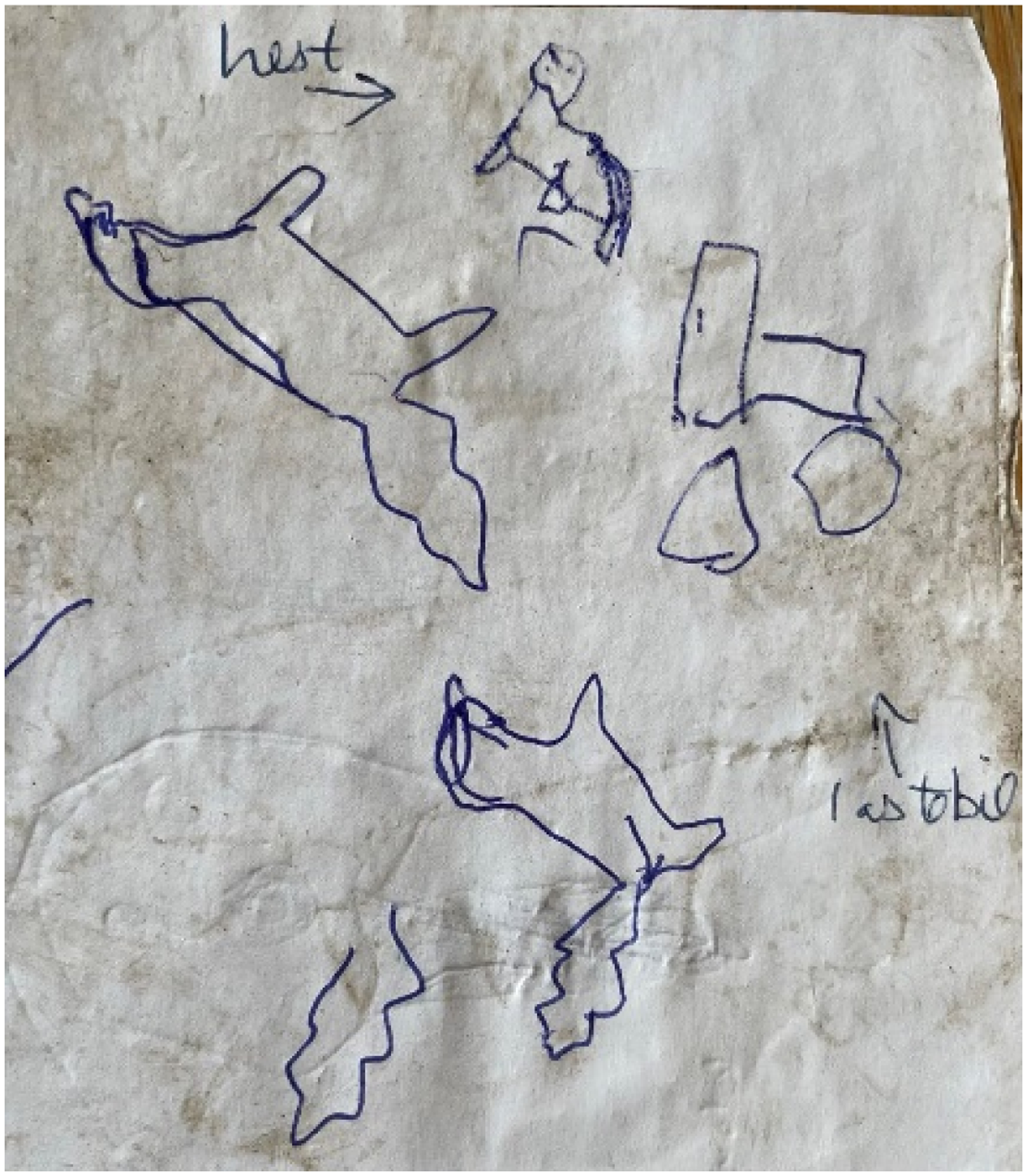
Drawing game made up with children outside one afternoon.
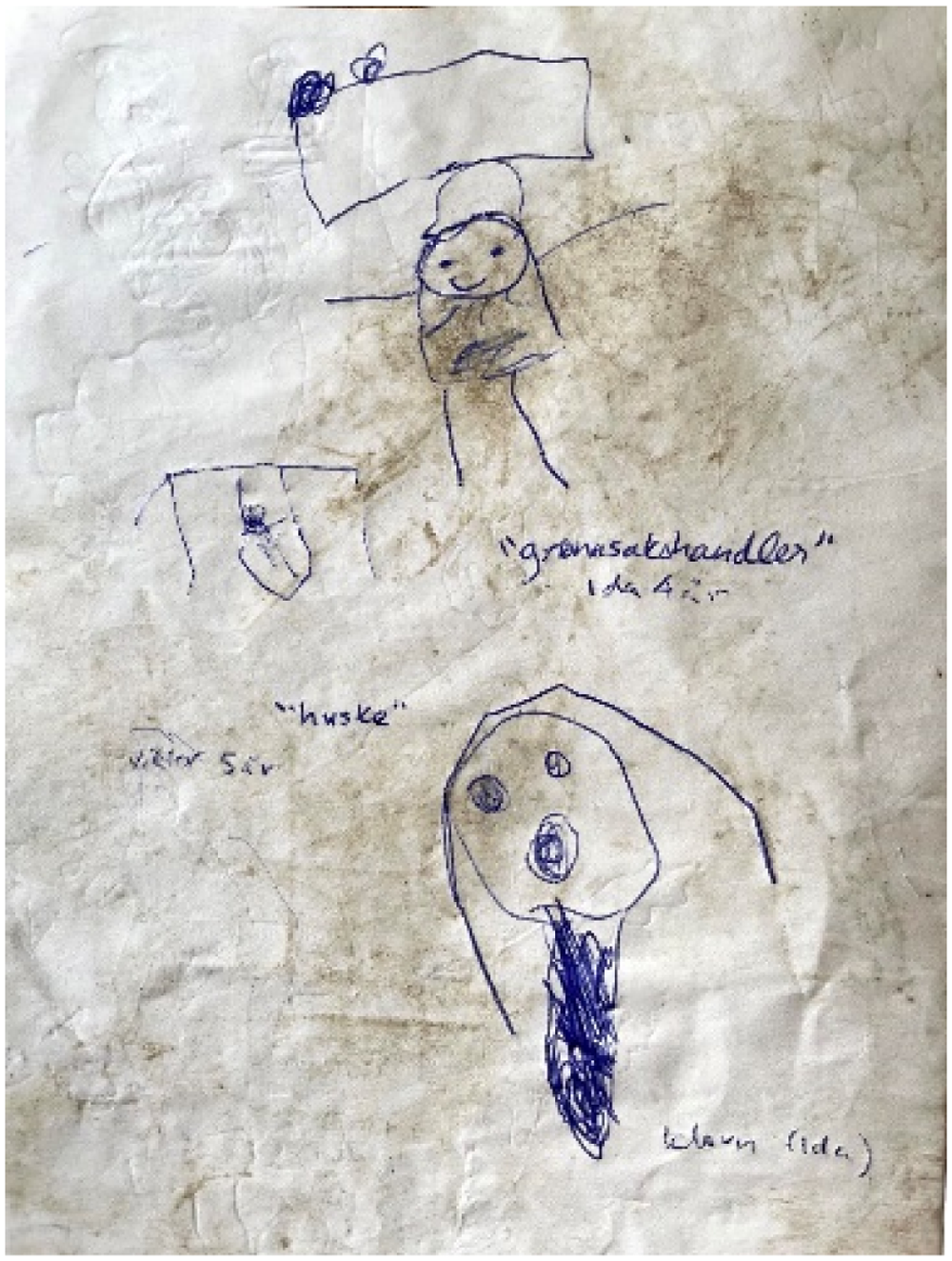
Four and five year old children's drawings of a “swing” a “vegetable seller“ and a “clown”.
Story 2. Facts we are supporting
The other day, I attended an in-service lecture at my workplace about future assessment practices and the use of digital tools. Based on historical considerations of what we know about assessment over the last 20 years in Norway, we were invited to reflect on the future of assessment and our assessment cultures. The speaker had conducted a literature search (mining?) with specific concepts related to assessment and digitization, and found that there were over 250 scientific articles and books that had been published on the topic in Norway alone over the last decade. However, only 10 of these publications dealt directly with the criteria used in the search, and that was the starting point for the speaker: that little had been done and published on the theme, and that most of what had been done was not directly relevant to what they wanted to talk about and emphasize as important. The idea of a lack of knowledge and understanding of the topic of assessment in general and the use of digital tools in particular was established as a fact and a truth there and then. Subsequently, the speaker got down to building up a series of arguments concerned with what they thought research-based and objective assessment should be, what should be done and how; further, they discussed what knowledge and competences it was crucial to create and develop to succeed. The crowd, my colleagues and I began to mumble – legs moving, eyebrows raised, glancing round … some very reassured about their own approaches and research, thumbs up. Some were seemingly against the whole thing though, with many having an expression of insecurity in their eyes. No one spoke. I leaned back and tried not to fold my arms. I folded my arms to try to think. ‘I contain multitudes, I know and don’t’ (Reinertsen, 2022). I need to protect my vulnerability to continue listening. How ridiculous is a situation of 200 highly educated people sitting there being told what to do because someone claims to know what is best on behalf of others. On the other hand, and being realistic and included, it is exactly, it seems, what we need to do.
The presentation was very clear and precise. It was critical and offered an appropriate warning against commercialization. The lecturer ended with a summary of important success factors for further work on the theme. These were factors ranging from the importance of autonomy and collaboration to critical thinking and analysis, inclusion, communication, testing and efforts to reduce any fear of digitalization, dialogue in learning organizations, leadership and ethics … Thinking about the 240 publications that were discarded, my guess is that such factors had been thoroughly described and analysed in these publications, but the idea of lacks and shortcomings presented earlier made me wonder how much the lecturer had previously defined as irrelevant in the literature search but nevertheless now portrayed as relevant in their own presentation and analysis in the end? They then took it upon themselves to highlight who in the workplace in question was making interesting progress and carrying out good research in the field. The speaker also made a point of huge differences existing between and within other organizations, kindergartens and schools, between those who work systematically and well with assessment and digitalization and those who do not – what they lack or do wrong. I kept on not speaking, my head spinning. I felt alienated, a type of alienation between cynicism and sadness, realism and almost naïve hope, laughability and demotivation. As an example: being against commercialization … Eh? … Who? What? When? … the words were too big, containing primarily political rhetoric. I know for a fact that in the current knowledge situation of ECEC, the lecturer made many good and valid points. Simultaneously, however, my experience, bodily effects of affects and intuition, signalled to me that this is much more complex – knowledge is, judgement is, never mind assessing what type of knowledge is relevant in every situation we pedagogically live.
In many ways, this was a classic neo-liberal situation, constructed linearly and causally with the best intentions of contributing to research-based knowledge production, learning and inclusion. But what is de facto – through instrumentalism and reductionism – produced is primarily a factual loss of knowledge and exclusion, which is counterproductive to what an educational institution aims to become and contribute. According to Bruno Latour (1946–2022), knowledge and every fact have careers, and this underscores his arguments about pluralism that he worked with throughout his life as a researcher. The obvious ‘solidity’ of any fact depends on constant social support. All subjects and objects are emergent, appearing and surfacing in the contexts in which they emerge or arise. In the neo-liberal arena, we need to ask ourselves what facts we are supporting – not being for or against different types of facts, but staring every fact in the eye and asking where it comes from, how it is produced, and what it can do for whom and when. I fear the career of facts telling us again and again that we are not good enough, that we need not only more knowledge but certain types of knowledge and, simultaneously, that some people are experts on exactly the particular types of knowledge we need, where asking about data and what it can do through this becomes redundant.
Are we in the process of eradicating knowledges that make us human and cannot be measured, at least in the short term – real and/or ridiculous? We seem to have ended up in conceptual and ethical vacuums, reducing data and evidence into facts expressed through either words or numbers, alienating us from the very fields we are supposed to practise and constantly improve, the children we are to support and educate. Voices are silenced, inner and outer, hindering access to judgement or at least telling us what it is smart to do or not to do. Being against something can be dangerous … reducing people to measurable digital entities and accounting figures, estranging our relationships, might, in the worst-case scenario, create kindergartens where there is no room for either the teacher or the child, and perhaps even research. The voices are already filled and the rooms are occupied. Is that what we really want or was that how we wanted it to become?
Multi-ethnographic writing as futuring
I/We multi-ethnographically write myself and you together, simultaneously and apart, same and other. Real and virtual, past, present and future come together. There is no protection but some kind of staying with and responsibility for a future and futuring before the other, before the child, before the system, before the judgement, and before liberalism and freedom. However, as our current pedagogical analysis and the facts we protect and support are so weak and narrow theoretically and methodologically, we risk being reduced to repetiteurs of slogans. Futuring, on the other hand, as that of writing abstract and liberated words and numbers is being invited and is inviting the other in. Subjective all. And with reference to the concept of alienation again: here we future a type of liberalism inspired by Jaeggi's (2023) practical and everyday take on positive freedom and alienation for accessing human judgement. Alienation is immanent, innate, hence authenticity is, paradoxically, a simultaneous individual and collective dimension. Alienation, according to Jaeggi, is about a particular experience of loss of freedom and being prevented from pursuing self-defined, meaningful aims. Freedom encompasses a collective dimension, which manifests itself, for example, in the struggle for democratic co-determination regarding the design of public space, working life and the material environment that constitutes one’s immediate worlds. The positive meaning of the word ‘freedom’ springs from the desire to be one's own master, to be a subject not an object, to be someone, to be an autonomous person: Understood in this way, the concept of alienation thematizes the complex conditions that underlie placing one's own actions and desires (or more generally: one's own life) in connection with oneself, being able to attribute them to oneself and make them one's own. The same goes for the many obstacles and distractions that affect one's own actions, desires and life. One is not always ‘oneself’; it is not always self-evident that one's actions and desires are ‘one’s own’, and one’s relationship to one's social and natural world is as constitutive as threatened. (Jaeggi, 2023: 95; our translation)
Deterritorialized futuring is important to avoid drifting out of one's own material (read also technological) environments, socialities and bodies. Such drifting can lead to externalization, exposure to discourses and stories told by others, and hence possible manipulation, powerlessness or submission. Science and research must be futured, written and told in such a way that both the researcher and the child can become storytellers and active players in their own fluid learning processes, events and lives, and what we try.
The writing of facts and methods is conditioned by being fictional (cosmic): the facts we need to future are fictionalizing facts and must be viewed as nothing else. Such writing and energetic discursivization might be called a mythological metabolism of cutting up, expanding the frames and paining together apart to surface yet again, always provided with an exit ghost – subjective data and non-knowledge creation storied in a cosmic poetic form and mapping somethings between, storying real and ridiculous matters mattering:
My workplace is restructuring I have been an educator for 40-odd years I am invited to a mapping conversation Wise girls play safe when mapping knowledge I prepare for majority forces and language I hope you got what you wanted and need, I said We got what you gave us, they said Major identity politics eat knowledge and swallow raw While Miles Davis (1959) however plays Kind of Blue in Green I refuse to have inner organs A cosmic provocateur Freedom resting elsewhere than in my will Catch me if you can
Our multi-ethnography has been an attempt to deterritorialize knowledge creation between fact and fiction, between research-based evidence-making and policy-based evidence-making, to avoid the mechanics of schismogenesis. Affective methods and pedagogy hereby turn into an enabling science that is hopefully worth considering when asking if there might be other perspectives that might serve us better. Such knowledge-building might seem indirect, but eventually it is pretty direct and inclusive.
Footnotes
Declaration of conflicting interests
The authors declared no potential conflicts of interest with respect to the research, authorship and/or publication of this article.
Funding
The authors received no financial support for the research, authorship and/or publication of this article.
