




Abstract
This article examines the contemporary Swedish policy responses to increased cultural and linguistic diversity in the field of early childhood education and care (ECEC). More specifically, it explores how national authorities and organizations initiate collaborations, use and produce policy knowledge and identify priorities and challenges. The analysis draws on a review of policy texts and in-depth interviews with high-level policy actors who act as an epistemic community. Using the concepts of representations and problematization, this study connects the generation of policy knowledge on diversity with the identification of solutions to address cultural and linguistic diversity. The findings suggest a consensus over the definitions of priorities for diversity policies in ECEC within this epistemic community. A core priority is emphasizing the importance of the Swedish language within a wider multilingual approach linked to increased participation in preschools, and to discourses of school readiness and societal integration. Yet, there is a tension between identifying policy priorities and structural challenges at different levels. Unequal conditions, residential segregation and lack of educated preschool staff present difficulties that require a more comprehensive approach than those taken by the official policy frames.
Introduction
Sweden has seen a considerable increase in the diversity of its population through migration and internationalization, a context that has placed new demands on early childhood education and care (ECEC). Swedish Migration Agency statistics show that more than 1.3 million people have arrived to Sweden in the last decade (SOU 2020:67) and in preschools, one-quarter of the children have a foreign background (SNAE, 2022). At the same time, ECEC has received an increasing interest and attention in the global policy agenda, with national and international policymakers launching strategies to enhance equality and access to quality preschools for all children (OECD, 2017). In the European Union, the Council Recommendation (2019) on High-Quality Early Childhood Education and Care Systems connects access to quality preschool services to later educational success, reduction of social inequalities and reduction of the achievement gap between children from different socioeconomic backgrounds. While the benefits of increased participation to children from disadvantaged and/or minority families are not new in the European policy narratives (see Vandenbroeck et al., 2018), the shift in the discourses around enhancing school readiness highlights new aspects of the education offered (Urban, 2015). Thus, policy makers’ investment in the field of early childhood can justify the improvement of several outcomes from ‘individual educational achievement to macro-economic (national) growth’ (Urban, 2019: 43). In addition, the Nordic Council of Ministers is interested in ECEC, particularly in relation to common principles in evaluation practices, issues of cultural diversity and integration and values concerning ECEC pedagogy (Nordic Council of Ministers, 2017; Urban et al., 2022). These policy contexts reflect international and national shifts in the role of ECEC, marking welfare and labour market changes that attribute to preschools more education-oriented goals as well as further social and economic functions (Alexiadou et al., 2022).
Language and education policy reforms are given specific attention and importance in all these international policy spaces. They are considered to support linguistic diversity for children, and combine learning the language of the country they live in while respecting their mother-tongue. The EU Council (2019) Recommendation mentions that children’s ‘missing language skills can hinder their future educational prospects and successful integration into a new society. Participation in early childhood education and care can help to mitigate these risk factors’ (p. 189/6). The adoption of multilingual education policies in ECEC is long-standing in several Nordic and European countries. Yet, changes that enhance the transformative role of multilingualism and its practical implementation are often challenged by the production of language hegemonies and monolingual orientations, such as in Luxembourg and Germany (Kirsch and Aleksić, 2021; Putjata, 2018), or characterized by contradictions, vagueness and a lack of clear ECEC language education policy, as in the example of Norway and Finland (Alstad and Sopanen, 2021; Giæver and Tkachenko, 2020).
Sweden represents a particular country of interest due to the international attention it receives as part of the Nordic welfare preschool model. This model is embedded in traditional social welfare policies regarding inclusion, parental support, universal provision of preschool and Sweden’s rights-centred approach to ECEC grounded in democratic values (Alexiadou et al., 2022; Einarsdottir et al., 2015). The newly-enhanced focus on the role of ECEC in the formation of future citizens, and the acquisition of necessary competences for schooling and employability later in life, marks a clear shift in the Nordic debates. These are influenced by global policy formulations and discourses (Karila, 2012), as in the case of Swedish ECEC policy context (Sjöstrand Öhrfelt, 2019). At the same time, while access to Swedish preschools is available to all children and participation is high (86% for 1- to 5-year-olds and over 95% for 4- to 5-year-olds, SNAE, 2022), Sweden is facing several challenges regarding ECEC. The enrolment rate for children with a foreign background, and especially foreign-born and newly-arrived children, is particularly low (SNAE, 2018b). In addition, a 2018 report of a 3-year review by the Inspectorate indicated that the Swedish preschool ‘is not equal for all children’, seriously impacting its compensatory mission especially in a societal context of increased school segregation (SSI, 2018: 6). Previous research also demonstrates alarming patterns of inequity and large variations in the provision of quality preschools across the country, which is compounded by a shortage of trained preschool teachers (Persson, 2020). As a result, different pedagogical approaches emerge in resource-rich preschools that focus more on learning activities, while preschools in socially disadvantaged areas tend to give emphasis on care and the compensatory mission (Lunneblad, 2021).
In this context, the current study examines the position of Swedish state actors and institutions and their response to increased diversity in preschools. The majority of Swedish studies in this area draw empirically on ethnographic, classroom-based research and surveys of preschool teachers’ perceptions. As to policy, there is historically based research (Hägglund and Samuelsson, 2009; Sjöstrand Öhrfelt, 2019) with few examples on concepts of intercultural pedagogies (Garvis and Lunneblad, 2019). Less attention has been given to ECEC policy formulation from the perspective of central state policy actors and organizations. This article seeks to fill the gap on policy research in focusing on diversity in Swedish preschools. To this end, this study addresses the following research questions: (a) how do key Swedish policy agencies and organizations collaborate over ECEC policy and diversity, and what sources of knowledge do they use and produce in the process? (b) what are the problematizations and priorities around diversity in preschool as constructed by the government and key policy bodies? (c) what are the representations of the contexts, conditions and difficulties that policy actors identify as framing the diverse preschools?
The Swedish context
ECEC policies
Public expenditure on the Swedish preschool is one of the highest in Europe with the government spending 1.6% of GDP per year (OECD, 2021). Historically, the provision of child-care has been a core part of Swedish family policy, steered by The National Board of Health and Welfare (Martin Korpi, 2015). When ECEC provision came under the responsibility of the Ministry of Education in the 1990s, the emphasis started to shift towards care and children’s development and learning. In 1998, the first curriculum for preschools was introduced, and the pedagogical goals were inspired by the Reggio Emilia approach. Since then, in addition to education, family and labour-market policies, the preschool became an arena for immigration policies with a focus on diversity and other universal principles (Lunneblad, 2006). The provision of active bilingualism and, in particular, mother-tongue teaching at preschool, has been recognized in national documents as a language policy strategy addressing children from various linguistic backgrounds. This stems from the political attention given to the needs of national minorities and immigrants concerning language rights (Roth and Hertzberg, 2010).
At the national level, governance of the educational sector is facilitated by school authorities and agencies, such as the Swedish National Agency for Education (SNAE) and the Swedish School Inspectorate (SSI), that collaborate at different levels. These are instruments for policy decision-making and evaluation of policy results and, as such, they have an important role in steering policy through their decisions (Jarl and Rönnberg, 2019). As institutional actors, they formulate policy and contribute to the school policy agendas, like for instance, SNAE that acts as a source of knowledge collection (for instance through evaluation and surveys), and dissemination (for instance through general advice to teachers and webinars). In addition to national-level institutions, Sweden has a decentralized administration of education organized in 290 municipalities (Lundahl, 2002). 1 Although research on other educational areas such as compulsory school have shed light on the roles and processes of national educational policies, less is known about these in the field of ECEC. Finally, it is important to note the influence of international policy actors that have an ECEC agenda. This study maps those policy collaborations and usage of knowledge that the Swedish agencies and organizations consider significant in the identification of (national) policy priorities.
Diversity in preschools
Addressing cultural and linguistic diversity is considered an important function of ECEC with increasing significance in the aftermath of the recent refugee crises. In 2018, a revised curriculum for preschool was established (Lpfö, 2018a), following a government decision that connected curriculum changes to issues of increased migration and greater cultural diversity, amongst other reasons (Government Decision, 2017). Preschool is represented as a social and cultural meeting space that can support social inclusion and prepare children for an increasingly internationalized society (Lpfö, 2018a).
However, practices suggest a different picture. According to earlier research, the view of preschool as an integration arena is not always permeated by interculturally pedagogical values, but often characterized by monocultural or monolingual practices that fail to fully recognize children’s cultures and languages (Åkerblom and Harju, 2021; Lunneblad, 2013). Early childhood policy has also been criticized for a shift towards an orientation that identifies second-language learners in deficit terms, having to compensate for their poor competence in the Swedish language (Olsson et al., 2016). Moreover, studies highlight pedagogical challenges in addressing the twin goal of Swedish language development and promoting a multilingual approach (Björk-Willén, 2018; Sandell Ring, 2021) and a lack of a clear language education policy (Puskás, 2018). Language development support becomes even more challenging in segregated areas where lack of contact with Swedish-born children and families complicates the sense of unity and belonging for multilingual children (Eek-Karlsson and Emilson, 2021).
In 2020, the Swedish government published the commission inquiry Preschool for all children – for better language development in Swedish (SOU 2020:67). The government commission’s inquiry aims to facilitate the work of policymakers by providing policy recommendations. Agencies and different parts of the government submit written responses to the published commission reports (SOUs), and a final text eventually results in a governmental proposal (a Government Bill) to be submitted to the Parliament (Nordin and Wahlström, 2022). 2 In March 2022, a part of the inquiry’s proposals to increase participation in preschool was submitted to the Swedish parliament as a government Bill Preschool for more children (Govt. Bill 2021/22:132). In June 2022, the Bill was approved after a political debate on the government’s proposals. 3
Theoretical framework
Bacchi’s approach on problematizations in policy
The study draws inspiration from Carol Bacchi’s approach and focuses mainly on the concept of problematization in the policy field. Originating in Foucault’s work, the term problematization is developed by Bacchi as ‘problem representation’, namely how ‘policy problems’ are produced, constituted and represented through a critical examination and reflection of policy practices (Bacchi, 2009). According to Bacchi, this is possible by working ‘backwards’, examining the ways a problem is constructed and, in doing so, challenge the thinking about policy as a problem-solving practice (Bacchi, 2012). By examining underlying assumptions and values of policy framings, emphasis is given to the forms of knowledge that establish public policy within a broad spectrum of governance, which includes experts’ positioning and the role of knowledge (used and produced) through and in governance.
Studying the conditions that construct problem representations also has discursive, lived and subjectification effects since specific interpretations of a policy problem can lead to public practices that affect people’s lives (Bacchi, 2009). Bacchi’s approach also encompasses reflective perspectives on the dimensions of such representations as these influence different social groups. The aim of Bacchi’s approach is to explore how representations are legitimized, through questioning, shifting the notions of ‘policy-problems’ and ‘policy-solutions’ and, ultimately, rethink policy development strategies.
Policy formulation and policy knowledge
This study focuses on the institutional actors that participate in policy processes and, in particular, contribute to the setting of goals and priorities for education and ECEC and safeguard quality, equality and compliance through state regulations. Policy contributions in these cases take the forms of, amongst others, knowledge generation and exchange, provision of information, evaluations of policy outcomes, support and guidance for policy implementation (Hill and Varone, 2017). Moreover, policy formulation tasks such as ‘understanding the nature of policy problems’ must be examined in a broader context of policy formulation processes (Turnpenny et al., 2015: 4), which includes local, national and international contexts. For instance, within the field of education, the influence of international actors on national policies highlights the need to consider relevant factors, such as government ideology among others, to understand why certain new policy ideas are adopted and others are not (Verger, 2014). The positioning of states within the international landscape (in regional and global ‘blocks’ of power and relations) places new demands on policy actors and transforms the policy field regarding the use and production of knowledge for policy makers – what ‘matters’, and what can be used as a resource to legitimate their (national) policies in an effective and robust way (Mangez and Hilgers, 2012: 194). Selecting relevant policy knowledge is a complex and multidimensional process, involving ‘an interrelated body of beliefs, information, evidence and explanation’ (Webber, 1991: 13) which needs to suit particular purposes and ‘solve’ particular policy problems.
Studying what kind of policy knowledge is selected and used, how it is (re)produced and how it is applied in specific policy contexts helps us to understand policy priorities and the values they support. However, it is also important to examine the roles and connections of the policy actors that are involved in the process, at the national level and beyond and how these mobilize policy knowledge and ideas from local, national and international levels. Expertise drawn from all these levels provides knowledge and problem-solving practices which reveal particular policy preferences and underlying values (Ozga, 2021). Thus, even if states are the main decision-makers in (education) policies, national experts participate in international networks and knowledge exchange activities and enhance their expertise through policy learning that, potentially, contributes to framing the issues in new ways (Haas, 2014). This study approaches the role of expert policy actors in the field of ECEC by drawing on the concept of epistemic communities.
The role of epistemic communities in policy knowledge
Haas (1992) describes the term epistemic communities as ‘networks of professionals with recognized expertise and competence in a particular domain and an authoritative claim to policy-relevant knowledge’ (p. 3). The concept of epistemic communities derives from the field of political science and is used differently across various fields. Members of epistemic communities usually come from different disciplines and, as a group of professionals, they ‘help identify cause-and-effect relationships, elucidate interlinks between problems, define the consulting state’s or organization’s interests, and formulate policy’ (Haas, 2014: 35). According to Dunlop (2009), one of the basic characteristics of epistemic communities is their capacity to shape policy by acquiring control of policy-knowledge production and, in turn, facilitate decision-making and policy learning. Yet, due to the differentiation of their roles, the level of epistemic communities’ influence on decision-makers’ learning can vary depending on temporal, spatial and knowledge content factors (Dunlop, 2009). As Haas (1992) argues, members of epistemic communities can affect state interests either through explicit identification of these interests for decision-makers or by shedding light to prominent dimensions of an issue, and hence attempt to guide decisions and shape policy interests.
The policy actors involved in this study represent national agencies and organizations that the study views as an epistemic community, tasked with identifying challenges on issues of high complexity, such as diversity in preschools. They generate implementation projects, guiding documents, policy advice, support materials and development activities for preschool professionals. They aim at operationalizing policies on diversity, identifying problems and offering guidance for practice. In performing these tasks, the policy actors draw on knowledge and expertise around ‘the problem’ through exchange, research, networks and collaboration. The article therefore describes and critically examines how policy problems in relation to ECEC diversity are identified and represented in the policy actors’ definitions of these problems when they set policy priorities and agendas. In doing so, they produce policy knowledge and, at the same time, have influence ‘on and through these knowledges’ (Bacchi, 2009: 26).
The study
Shaped by the theoretical ideas described above, the empirical study was designed to capture the ways in which key national institutions in policy making work in the field of diversity in ECEC. Since the identification and setting of policy priorities is the product of the interaction between institutions and individuals, the study relies on documentary reviews and interviews with high-level policy actors.
A purposive sampling approach was used (cf. Cohen et al., 2018) for the selection of the documentary material to review. The selection criteria included recent texts published by the government and state agencies regulating ECEC; texts that focus on cultural and/or linguistic diversity; and, texts that are publicly available. The reviewed documents are (a) the national Curriculum for the Preschool (Lpfö 18); (b) the government inquiry Preschool for all children – for better language development in Swedish (SOU 2020:67); and (c) the Inspectorate’s thematic quality review (SSI, 2017) on preschool’s work with language development of multilingual children. Following Bowen (2009), the documents were systematically reviewed for the purpose of providing the study with ‘contextual richness’ and descriptive information, and they were used in ‘pre- and post- interview situations’ (p. 36). The review of these documents informed the interview agenda by creating a foundation for investigating rationales and policy processes, and by connecting key themes to the interview themes, which made these two sources of data complement each other interactively.
Second, semi-structured interviews with eight high-level officials were conducted to understand the complexity of the ECEC policy processes. Written information about the study was given to the participants. Issues of consent and anonymity of the procedure were communicated in advance according to the Swedish Research Council (2017) guidelines. The interviews lasted 50–60 minutes each and were conducted in the Swedish language. Following a snowball sampling approach which indicated the ‘cohesion’ of the actors’ community (Noy, 2008: 334), the interviews included three participants from the SNAE, and one participant each from the Ministry of Education, the SSI, the Swedish Association of Local Authorities and Regions (SALAR), the National Centre for Swedish as a Second Language at the University of Stockholm and the City of Stockholm municipality. SALAR, an employers’ organization, represents all 290 municipalities and has collaborated with the SNAE over skills-development in preschools, including on issues of diversity. In addition to the national agencies and SALAR, issues of linguistic diversity are also addressed by the National Centre for Swedish as a Second Language at Stockholm University, which organizes initiatives to support all the municipalities. The unit Pedagogue Stockholm, which belongs to Sweden’s largest municipality, the City of Stockholm, is involved in providing access to many different types of support as well as professional development. Initial contacts were established with actors from the SNAE who then recommended relevant, potential interviewees in other organizations dealing with issues of diversity in ECEC. Thus, all interviewees had experience in the field of ECEC either working at state agencies (past or present), or in higher organizational positions at preschools. Also, two interviewees participated in the commission inquiry as experts (SOU 2020:67). Follow-up written communications occurred with four of the interview participants (from SNAE, the Ministry and the National Centre for Swedish as a Second Language) mainly for clarification but also for additional questions that emerged during the analysis of the material.
The interviews were transcribed and fully anonymized. I analysed the transcriptions of the interviews through a thematic coding approach with specific attention to language and discourse in participants’ descriptions of policy actions (Alexiadou, 2001; Creswell, 2014). All citations used in the article have been translated from the Swedish language into English by the author. I followed an inductive process of analysis, coding the material, examining its properties and generating abstract themes for each interview. This process established a comprehensive common group of thematic categories through an iterative process between the thematic categories and making connections with the theory (Creswell, 2014). The data were also examined in relation to similarities and contradictions in the discourses of the interviewees in developing policies for diversity at preschool. The analysed interview data were interpreted through repeated readings of the documentary texts, and in connection with the research questions.
In the following section, the main categories that emerged from the analysis process are presented, providing a structure for the findings.
Findings
Part I: A community of policy-practice and their sources of knowledge
This part of the findings describes the institutional collaborations regarding policies on diversity and multilingualism in Swedish preschools amongst high-level policy actors. These actors are viewed as an epistemic community of practice in their interlinked contributions and collaborations to policy on diversity in preschools. This section focuses on two dimensions of this policy-practice nexus through descriptions of (a) the authorities, agencies and organizations that constitute the primary actors in policy processes in this field, and their collaborative connections over issues of diversity, and (b) the forms of knowledge that these actors use in addressing priorities related to diversity. The relationships between the different policy actors vary depending on the role and responsibilities of specific agencies and organizations. These, in turn, determine the nature and degree of collaboration among them, but the findings also indicate a production of shared understandings and definitions of ‘the problems’ that govern interpretation and policy practice.
Figure 1 below illustrates patterns of institutional collaborations regarding policies on cultural and linguistic diversity in Swedish preschools as described and discussed by the interviewees. The table features also organizations and formations (EU, OECD, SICI, Nordic networks, research) that provide sources of knowledge that the interviewees use in policy-practice activities.
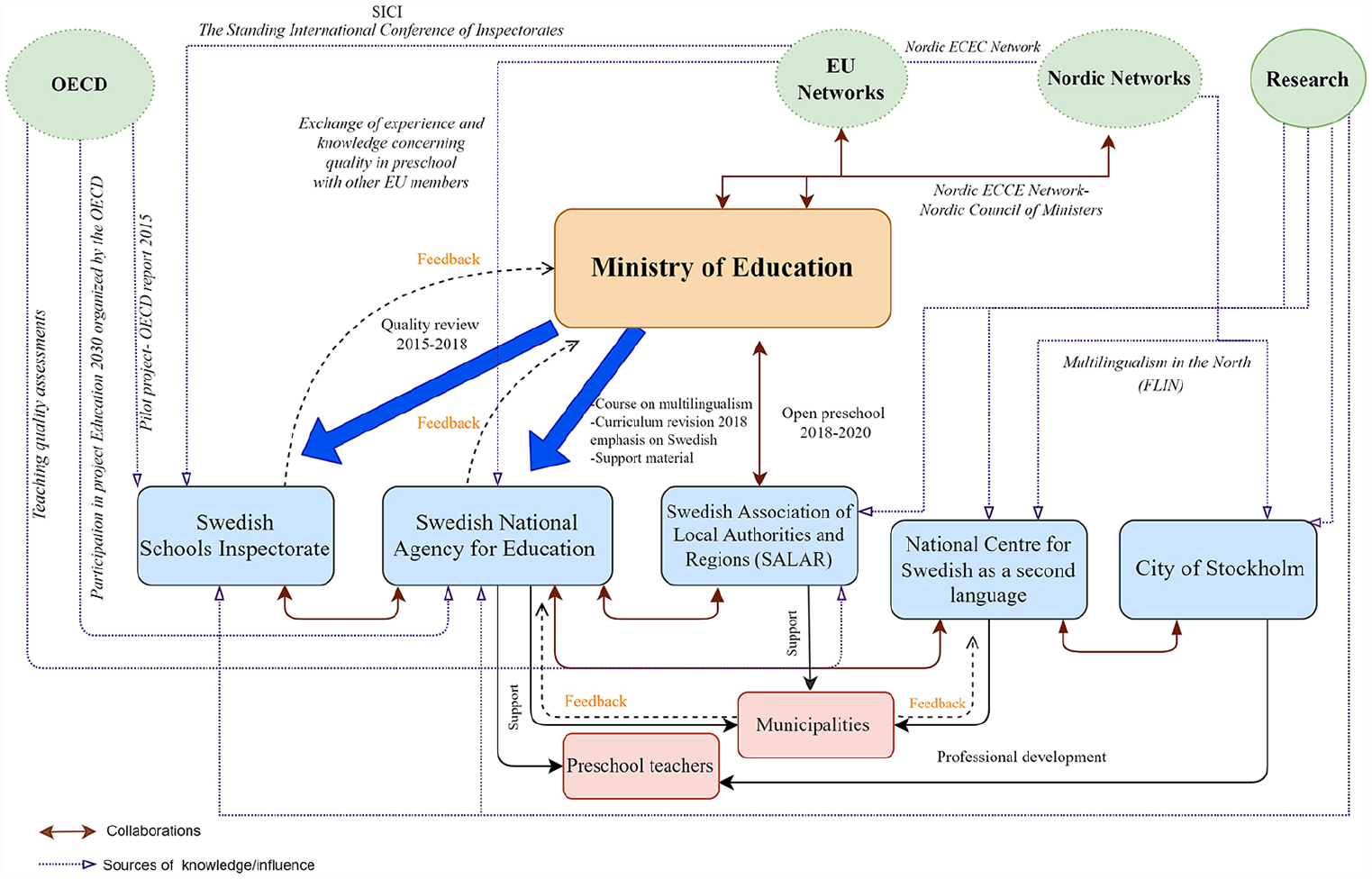
Collaborative relations and sources of knowledge among national agencies and organizations.
The three national actors are the Ministry of Education and its two main agencies: the Swedish National Agency of Education and the Swedish School’s Inspectorate. As the bold-blue arrows suggest, this is a framework that emerges from the political body of the Ministry within whose parameters all other authorities and agencies need to work. In the Swedish context, these agencies retain independence from the Ministry that cannot interfere in their work, but instead initiates legislation and issues regulations (Jarl and Rönnberg, 2019).
Collaborations between these actors are formal, but also ad-hoc when necessary. For example, partnerships between SNAE and SALAR are formed mainly regarding consultancy when new initiatives are introduced. More specifically, these two bodies collaborated over ‘the right to education in national minority languages’ in a municipality in northern Sweden that resulted in the production of a film, later published online as a good-practice, knowledge-sharing example (Participant 3).
The two closest and most systematic collaborations take place between the so-called ‘sister organizations’, the SNAE and the SSI, the first one being a normative authority, and the second a school-reviewing authority (Participant 1). Both are assigned specific tasks by the government with the duty to report and provide feedback after the completion of a task. The collaboration between these agencies underpin policy implementation processes through the contribution of SSI’s specialized knowledge to SNAE’s task of developing courses on multilingualism in preschools. In order to assist policy implementation, the SSI received in 2015 a 3-year government assignment to review preschools in different thematic areas, one of which focused on language development in multilingual children (Participant 2). During these quality reviews, there were always one or two reference persons from the SNAE involved in the process. There were also regular coordination meetings between the SSI and the Ministry of Education at the completion of every thematic project and written report, including the 2018 final report (Participant 2). The results of these meetings were presented to the Ministry of Education by the project manager and the general manager of the SSI. The work of the Inspectorate during the 3-year quality review is described as highly significant in several interviews, and primarily used as evidence in considering policy solutions.
When the National Agency for Education was assigned the task that they would revise the national curriculum, for example, . . . they referred a lot to our reports and what had been presented therein, and what had to be done. So, I believe that our reports have had a great impact in that way, in policy-making . . . what changes in the national curriculum the government saw were needed (Participant 2).
The SNAE confirms that during the revision of the ECEC curriculum, the SSI quality reviews regarding issues of multilingualism, among others, were taken into consideration. The SSI’s (2017) thematic quality review identifies not only difficulties in supporting children’s home languages but also a frequent lack of activities to support communication and language development in Swedish. Both this review, and the final 3-year report (SSI, 2018) are central in the work of the commission inquiry which emphasizes language development issues in Swedish (SOU 2020:67). The connections described by the actors suggest a using-and-sharing of policy knowledge that (a) identifies what are the main problems over diversity in preschools, (b) is the basis of continuous interactions and feedback and (c) indicates a close-knit community of policy-practice that develops shared understandings of the problem and its solutions.
The next section presents forms of knowledge production, exchange and dissemination which, according to the interviewees, are systematically used by the authorities in the process of forming policy solutions.
Academic research as a tool for informing policy
One of the most common sources of knowledge identified by the policy actors in different agencies and organizations is academic research. Apart from the national steering policy documents that constitute a central part of their work, research is used as facilitator in work production and implementation (Participant 2, 4). For the SSI, for example, research ‘serves as a basis’ that guides observations by providing information on what needs to be inspected (Participant 2). Moreover, research plays a significant role in thematic quality reviews and the formation and production of final quality reviews as a necessary factor of the current body of knowledge. A study of Segerholm et al. (2022) confirms how various inspection processes and activities use different types of knowledge and evidence of educational research as legitimate tools for their work. Furthermore, support materials and texts published on the SNAE’s website about multilingualism are produced by academic researchers (Participant 7). Similarly, the National Centre for Swedish as a second language and Pedagogue Stockholm use research-based material in their work. SALAR uses and disseminates research-based knowledge from national and international sources during their conferences, among others on intercultural approaches to preschool everyday work.
Knowledge dissemination and exchange – The Open preschool
A key example of a collaborative initiative that aims at knowledge dissemination is the Open preschool for language and integration. The Open preschool has been a Swedish institution since the 1970s and is a supplementary form of preschool’s work (SNAE, 2000). The government-initiated collaboration (2018–2020) between SALAR and the government was established to support foreign-background women to enter the labour market, and to increase participation in preschool for their children. It is described by the participants as ‘a bridge for the families and children into the Swedish preschool’ (Participant 1), and also as ‘good arena to get into the Swedish society’ (Participant 3), a meeting place associated with multilingualism and diversity. The collaboration objectives were to map how Open preschools work, and to disseminate knowledge on ways of working through different reports and support materials, films, webcasts, conferences and a specifically designed toolbox, which were all published on SALAR’s website. The Open preschool constituted an unexpected source of knowledge regarding participation questions in ECEC.
Then, we started travelling around the country and we kind of got new tips all the time and discovered that they did fantastic work with integration efforts, especially with women and also with the children . . . and also with a view to increase children’s participation in preschool. This was like opening a treasure chest to actually see everything fantastic that exists, and when we went there and looked, they were a little surprised . . . because no one had asked them in the past . . . So, this is kind of how we have been able to make ourselves visible to each other . . . and we’ve had workshops and reference groups where one has had the opportunity to share experiences and learn from each other (Participant 3).
After various efforts of scouting internationally for similar efforts and options on this issue, inspiration for this initiative came from Finland after a visit to Helsinki, while the final assessment report received the attention of the media and SALAR’s political chairman and the chief executive officer (CEO) (Participant 3).
International networks – OECD
Although not all interviewees had a direct connection with international collaborations, their organizations belong to several Nordic and European networks that focus on preschool and diversity issues, as shown in Figure 1. Most of the bodies represented in this study have Nordic connections and European collaborations established mainly by the Ministry of Education and the state agencies (SSI, SNAE). The SNAE participates on a voluntary basis in both the Nordic ECEC Network, an umbrella network under the Nordic Council of Ministers and in an exchange of knowledge and experience concerning quality in preschool with other EU countries (Participant 6). At the Ministry level, meetings with the Nordic ECEC Network occur twice per year, according to the interviewee from the Ministry of Education, who adds that issues of multiculturalism, multilingualism and children’s rights, are also frequently addressed and discussed in the European networks.
Another source of knowledge and influence discussed by some interviewees is the role of the OECD in their own work. The historical influence of OECD in Swedish policy-making and the establishment of standardized measurements have been examined in other areas of the Swedish educational system such as compulsory school (Grek, 2020; Lundahl and Waldow, 2009). Within ECEC, the OECD related activities include (a) SNAE and its curriculum division participation in the Education 2030 OECD project since 2017, which is described as very beneficial for curriculum development (Participant 6); (b) initiation of a pilot project by the SSI, after the recommendation of an OECD report in 2015, where the participation of Swedish preschool teachers and principals in a quality review contributed to a considerable source of knowledge on development work; (c) SALAR’s intentions to follow OECD recommendations of constructing ‘goal achievement measurements’ and ‘teaching quality assessments’ to monitor children’s learning progress, but ‘without assessing the children themselves’ (Participant 3). Assessing progress without assessing the children is a controversial issue among staff in Swedish preschools, which has received attention within SALAR, according to the interviewee. This is reflected in the agenda and the ambition of the organization to raise issues of equivalence, quality and the compensatory role of preschool, which is also explicitly connected to diversity and multilingualism – an example, however, of tensions over international discourses on quality evaluations and Swedish long-standing ECEC practices of keeping assessment away from individual children.
The following parts (II and III) indicate that despite the specialized tasks of the policy actors according to the missions of their agency or organization, they share consensual position over priorities and challenges in relation to diversity. This illustrates the power of their interpretations of what the issue is, how it should be defined and delimited and what the conditions are for future implementation practices.
Part II: Priorities in the policy agenda in response to diversity
Children’s rights to language development: Individual perspectives
There is consensus amongst the interviewees that one of the core tasks of preschool is to ensure that all children acquire and develop the Swedish language, grounded in the policy document of the curriculum for preschool. Using the language of values and rights for children, the interviewees draw additionally on the authoritative legal text of the UN Convention on the Rights of the Child (ratified in Swedish law in 2020) as reference and conceptual framework to argue for language development as a fundamental democratic right for children. This right is discursively connected to the right for children to express their identity, and respect for their cultural background as well as their home languages. 4 Sweden’s five national minority languages are supported in governing documents such as the Education Act (SFS 2010:800) and the curriculum for preschool (Lpfö, 2018a). By foregrounding these rights, the interviews highlight the mastery of Swedish as the key fundamental right for all children linked to the right to develop, in parallel, a different mother tongue as public policy for preschools.
[I]n the late eighties . . . there is talk of a culture-conscious way of working . . . so when the curriculum is developed, it is very much that children’s multicultural belonging should be supported and the development of their language. But what we then see in the revised curriculum now, that is also a clear projection of children’s right to the Swedish language. To have the opportunity to develop their Swedish language, and to maintain and get to develop and be stimulated in their language development also in their mother-tongue (Participant 1).
The children’s right to develop the Swedish language and their mother-tongue is described by some interviewees as a balancing act in supporting multilingualism. Even though the term ‘multilingualism’ is not mentioned in the curriculum text, it is extensively used by the policy actors with a positive attitude, focusing on the task of preschool to promote all of the children’s languages. One interviewee, in particular, considers that the curriculum has set ‘very high goals’ regarding multilingualism and second language development where both are described as strengthening children’s identity and learning. At the same time, an exclusive focus on Swedish would deprive children of their chance to ‘develop their full potential’ and miss the ‘whole picture’ (Participant 5).
Despite identifying language development as a process where Swedish and mother-tongues coexist, there is a clear hierarchy of priorities and a positioning of Swedish as a basis for multilingualism. The emphasis on Swedish is evident in key ECEC policy documents with systematic attempts to strengthen its provision in preschools as stated in (a) the newly revised 2018 preschool curriculum (under the description of the task of preschool), and, (b) the Bill Preschool for more children (Govt. Bill 2021/22:132). The main rationales used to frame this focus on the Swedish language entail both individual and societal implications, which are connected to future access to education and opportunities for success for individual children:
. . . it is clear that if you do not get to learn Swedish and you live in Sweden, then it will be difficult at school. It will affect your grades and it will affect your conditions for the rest of your life . . . so preschool has an important role . . . and it has also been strengthened in the curricula . . . [P]reschool has a clear task to promote children’s development of Swedish. And it is necessary, you should be able to live and be a part of Swedish democracy . . . (Participant 6).
The focus and priority on the Swedish language in the policy agenda is described as a prerequisite to prepare children for compulsory school. This comes as a response to educational needs in connection to discourses on the important compensatory role of preschool, namely to ‘even out’ differences for children due to different socioeconomic or cultural backgrounds (Participant 3). Most participants highlight that insufficient knowledge of Swedish creates unequal conditions for success, ‘which later creates problems for the children, when compulsory schooling begins’ (Participant 1). In particular, the participants who were involved themselves (or their bodies) in the work of the commission inquiry (SOU 2020:67) explain that this has been one of the main reasons for the initiation of the investigation.
[T]here have also been signals that children’s Swedish may not be what one would expect when they start preschool class . . . so it’s about us having to strengthen the Swedish language (Participant 5).
Previous research in the field suggests that children’s poor knowledge of Swedish upon leaving preschool is due to inadequate second-language pedagogic practices, or a hierarchical language shift (Björk-Willén, 2018), which can result in major language deficiencies especially in segregated areas (Sandell Ring, 2021). This is identified as a problem requiring policy solutions, namely to support children’s Swedish language acquisition and set the decision-making agenda accordingly; implement the commission inquiry recommendations, and approach the preschool curriculum from these perspectives as an ‘expression of political will’ (Participant 1).
Increased participation in preschool as part of integration policy: Societal perspectives
The extended link between preschool language development and the wider goal of societal integration is clearly stated and further supported in the Bill Preschool for more children (Govt. Bill 2021/22:132). Increasing preschool participation constitutes the main policy recommendation from the commission inquiry (SOU 2020:67) that was imported as expert knowledge to the Bill. It concerns children whose mother-tongue is not Swedish and those who live in socio-economically disadvantaged areas. This entails strengthening the responsibility of the municipalities to offer children a place at preschool without the parents having applied for it. This is, according to the participants, a ‘major effort that the government makes’ (Participant 1) and they refer to these measures, for instance, when they talk about the Open preschool, whose goal includes the wider integration of the parents in the Swedish society.
The SOU is also a lot about the fact that there are children who do not go to preschool, who are in environments where they do not get to meet the Swedish language on an everyday basis and you want to protect the children’s rights to the Swedish language in the new country to which they have arrived (Participant 1).
In line with the recommendations from the commission inquiry (SOU 2020:67), the interviewees highlight the societal implications of enhancing preschool participation and, as a result, the development of the Swedish language. In addition, participation is connected to a domino effect of better school results, future establishment in the labour market and integration in the Swedish society.
After all, it’s about being able to complete your education, enter the labor market, be able to get a job, because it’s also a big problem that you see in society today that if you don’t have sufficient language skills, you might also have difficulty communicating in the workplace (Participant 3). If you don’t know the Swedish language, you can’t partake of important information as a citizen nor can you make yourself understood (Participant 6).
Low language competence in Swedish is described as a barrier to enter into the Swedish society. This way, the Swedish language becomes a ‘democratic right’ (Participant 5) to exercise social and democratic participation and citizenship, and a precondition for social equity.
Increased participation at preschools has also wider implications in policy areas identified as priorities for the government in tackling issues of segregation and crime. The representation of crime as a result of poor education trajectories that can be counteracted with positive early preschool attendance (SOU 2020:67), is viewed in the discourse of the participants ‘not just about law, order and more police’, but it requires ‘starting early with the value mission’ as an added dimension (Participant 3).
These significant societal perspectives place increased participation at preschools as a high priority in the policy agenda. Moreover, preschool is discursively seen as the space for early intervention when it comes to supporting Swedish language development. Political attention and problem-solving strategies, thus, blend discourses of exclusion/inclusion with and set ECEC as an important policy sector for ensuring language as a children’s (democratic) right and language as competence.
Professional development
The interviewees identify knowledge and professional development needs for preschool staff and municipal leadership positions in ECEC so that they can better respond to children’s rights in language development, and thus fulfil the goals of the preschool curriculum. They all acknowledge the sharp increase in the numbers of multilingual children in preschools since 2015, which gave rise to ‘a great demand and much more pressure to educate educators when it comes to multilingualism’ (Participant 4). An issue that was geographically delimited in the past is now seen to affect educators at a national level:
I think what really happened after 2015 is that. . . it kind of became a national change because several preschools in the country – no matter where – received newly-arrived or multilingual children, which had to make everyone think about these issues. Previously, there had perhaps often been a few suburbs in the big cities that had thought about these issues . . . so, the difference, I think, is that it became like a national issue in a different way. . . how we support the language and diversity and how we approach it (Participant 7).
As a policy reaction to this, the SNAE received a government assignment in 2015 to strengthen and support municipal leaders, teachers and other target groups in education, from preschool to adult education, in their provision of high and equal education quality for newly-arrived children and children with another mother-tongue than Swedish. For preschools, such support includes online materials on multilingualism, such as videos, articles, questions for reflection and learning modules. In addition, the SNAE offers a professional development course on interculturality and multilingualism for all preschool staff to increase their competences and deepen knowledge on intercultural approaches and children’s multilingual development. This course, described as the one ‘most in demand’, has been offered since 2013 (Participant 4). The need for continuous professional development for preschool staff regarding Swedish-as-a-second-language is raised in the commission inquiry (SOU 2020:67) and extensively discussed by several interviewees, who make strong points around depth and substance of multilingual practices:
[E]ven if you are a trained preschool teacher, you must have a high level of competence, and what’s also clear in the SOU inquiry is that precisely when it comes to multilingualism, children’s second language development and children’s language development, the competence needs to be strengthened (Participant 5). We have to work in a different way. We have to work with language development, systematically. We need to know why we say the things we do. We have to be able to think about repeating and doing things in different ways, so to speak (Participant 8).
In the descriptions above, cultural and linguistic diversity become manifest in educators’ everyday work. Thus, the interviewees describe the need for higher awareness and knowledge as pragmatically necessary, but also as factors for change to strengthen children’s holistic language development. Support materials and professional development can make educators ‘more prepared’ while giving them the tools to collaborate with guardians (Participant 8).
Part III: Challenges and hindrances to ensuring good conditions for a diverse preschool
In addition to identifying policy problems and priorities in relation to diversity in preschools, all interviewees discussed specific structural barriers that impede the successful policy implementation. Several of these barriers overlap with the problems identified in the commission inquiry (SOU 2020:67), unsurprisingly, since the inquiry had a high impact on policy discussions, and two interviewees were also involved in it. Below, the final part of the findings focuses on language development and the perceived factors that hinder it.
National-macro level: Residential segregation and lack of trained preschool teachers
Most interviewees identify demographic and preschool segregation as one of the main problems that hinder children’s language development, especially in Swedish, for two reasons. First, preschool, represented as a meeting place where children should mix and socialize regardless of ethnicity, language and socio-economic background, cannot perform this function in highly segregated contexts. Secondly, there is a lack of higher-education trained preschool teachers at the national level, as well as a lack of other trained educators at post-secondary or secondary level in these preschools.
The preschools that have the most difficult conditions, there, there are fewer preschool teachers and . . . there are more untrained staff . . . So, this is something we’re thinking about quite some . . . that it’s pretty unequally distributed, conditions and knowledge . . . It might also be the case that education regarding. . . I mean, knowledge about children with another mother tongue or language competence also is lower when you don’t have trained staff, which means that the children who need this most do not have access to it (Participant 7).
Long-standing recruitment difficulties of educated preschool staff across the country are even larger in areas of low socio-economic and high segregation status, since teachers ‘may not apply to preschools in certain vulnerable areas’ (Participant 3). Although Sweden has invested in the education of multilingual staff (often with a migration background themselves), recent media reports indicate a low level of Swedish language competence in this group, which is confirmed by several interviewees. Research studies have also identified recruitment difficulties in these areas, arguing that the lack of trained staff with a good level of Swedish language knowledge impedes a preschool education based on scientific grounds (Sandell Ring, 2021).
Municipal-meso level: Uneven conditions and recourse distribution
Challenges to educational equality as a result of structural problems of segregation are enhanced by large variations in the organization and distribution of resources across Sweden’s 290 municipalities. There is unanimous agreement among the interviewees that implementing national goals and priorities depends on municipal leaders’ efforts to provide adequate conditions, which at this point ‘differ very much between different municipalities, between different preschools’ (Participant 5).
[T]he government wants greater equity . . . that is also the reason for reinforcements in the curriculum. It looks the way it does that one [the government thus] clarifies even more the expectations and demands that one places on preschool and, in turn, also requires that municipal leaders create preconditions (Participant 1).
The interviewees discuss conditions for equality in relation to: (a) preschool staff availability and staff density, opportunities for planning time, reflection and collective collaboration with qualified colleagues; (b) distribution of the staff where necessary; (c) investment on strengthening the educators’ competences while maintaining a long-term perspective and continuity in the educational work. In a country where education and resource governance has been highly decentralized since the 1990s (Lundahl, 2002), addressing this issue becomes a tall order.
Micro level: Uneven conditions of knowledge
Large variations in preschool teachers’ knowledge and competences constitute one of the main challenges that hinder children’s exposure to language and thus language development, especially in their mother-tongue but also in the Swedish language in specific cases. Almost all of the interviewees refer to the Inspectorate’s thematic quality review regarding the uncertainty of preschool teachers in relation to multilingual children’s mother-tongue development and dilemmas in working with an intercultural approach. The interviewees involved in the commission inquiry (SOU 2020:67) refer to specific measures and suggestions for career steps for preschool teachers and initiatives for staff competence in language development in Swedish and intercultural skills. However, the Bill does not include any of these policy recommendations, which reflects how expert knowledge can be used in a selective way at the political level (Nordin and Wahlström, 2022).
Conclusion
This study provides an insight into the workings of Swedish state actors and institutions and their contribution to ECEC policy formation in questions of diversity, through their representations of particular policy problems and solutions.
The findings suggest that knowledge use and knowledge production are adapted depending on the issue focused and the targeted recipients (Ministry, municipalities, preschool teachers, principals). So, the various steering documents, academic research and international networks, among others, provide rich sources of material that, in turn, lead to generation of policy-solution practices and deliberations. Moreover, knowledge exchange among agencies and organizations is facilitated through their collaborative initiatives over issues of diversity. Policy knowledge is, thus, applied as dissemination practices, such as the case of SALAR’s collaborative initiative over the Open preschool to assist municipalities on integration issues. It is also used in policy-making processes as it is manifested in the influential role of the Inspectorate’s reviews on the revised curriculum and in the commission inquiry SOU (2020:64). As Haas (2014) points out, epistemic communities of practice often have members with different organizational interests that can identify and elucidate various aspects of an issue.
Even though these bodies have specialized tasks that target different constituencies regarding diverse preschools (Dunlop, 2009), there is a high degree of consensus on how priorities and challenges regarding diversity issues are represented by the Ministry, the national school authorities (SNAE and SSI) and SALAR. To a large extent, this also applies to the interviewees from the National Centre for Swedish as a second language and the City of Stockholm. In addition, contextual factors and changing demographics after the 2015 refugee crisis mark a national shift in responses to diversity in ECEC. This highlights the broader interplay between policy-knowledge use, production, exchange and problem-solving in accordance with international ECEC agendas such as the influential role of OECD’s recommendations.
Turning to the particular representation of policy priorities, children’s rights to develop both Swedish and their home languages are advocated in ECEC policy. Multilingualism is seen as enriching, but there is a clear set of hierarchal values with emphasis placed on the development of the Swedish language and the adoption of a school readiness approach. In addition, increasing participation in preschools is seen as the means to mitigate inadequate language development in Swedish, a problem identified within wider integration efforts. However, there are indications that the benefits of increasing participation can be minimal in relation to closing future achievement gaps (Sierens et al., 2020). Research suggests that more concrete and sustainable strategies concerning the quality of preschools are necessary than mere increase in participation, to enhance equity policies and possibilities for learning (ibid.). In a study of policy making for intercultural education in Cyprus, similar gaps were identified ‘between policy rhetoric and practice’, where the state’s intention to provide equal opportunities and resources to children of diverse backgrounds was hampered by institutional structures that led to exclusion (Hajisoteriou and Angelides, 2013: 103). Specific conditions to realize the benefits of participation in high quality ECEC are also highlighted at the EU level and focus on the importance of aligning educational policy intentions with wider, well-operating policy frameworks (Vandenbroeck et al., 2018).
The policy actors in this study refer to such tensions and draw attention to contexts and conditions that are challenging for diverse preschools at different institutional levels. Uneven conditions and difficulties in recruiting trained and linguistically competent preschool staff across the country are also embedded in discourses that focus on the municipality level. This reflects a challenge that national policy frameworks often face, that is to share common goals with other levels of governance and so ‘develop coherent approaches’ (Vandenbroeck et al., 2018: 48) in addressing diversity. The tension between centrally-defined policy priorities and conditions that hinder their realization at other levels of policy and practice indicates a need for more comprehensive approaches than those taken by the official policy framing as well as more intense knowledge sharing and awareness to preschool staff over issues of diversity.
Footnotes
Declaration of conflicting interests
The author declared no potential conflicts of interest with respect to the research, authorship, and/or publication of this article.
Funding
The author received no financial support for the research, authorship, and/or publication of this article.

Availability of data and material
No.