




Abstract
This paper examines the role early childhood education has as an institution that potentially provides for children from differing cultural and language backgrounds and instils respect and tolerance for difference. The particular focus is an emphasis in the Australian early childhood national curriculum that presents a strengthened importance on First Nation Australians. As a country Australia has had a history of racism since European occupation. This attitude has had a detrimental impact on First Australians and many migrants. The context of the paper is the recent national referendum where the Australian populace denied a voice to parliament for Indigenous Australians. In this paper we explore initiatives introduced to support the idea of reconciliation by introducing Aboriginal perspectives into the early childhood curriculum. The research is project-based and we examine the role of early education in supporting long-term equity and social justice in a country that still suffers from a colonial/settler outlook.
Keywords
Introduction
When children are healthy, safe and learning well in their early years, they are better able to reach their full developmental potential as adults and participate effectively in economic, social and civic life. Providing ECEC is regarded as a means of promoting equity and social justice, inclusive economic growth and advancing sustainable development. (UNESCO, n.d.)
This paper is an exploration of early childhood pedagogy, content and the responsibility of educators to society. Education is never neutral. The consortium who designed the first Australian early childhood curriculum, Belonging, Being, Becoming: An Early Years Learning Framework (AGDET, 2009), discussed the difficulties they encountered when trying to produce a document that represented the latest research and reflected how they were curbed by attitudes that prevented them challenging some long-held beliefs about early childhood education. The project that is at the centre of this paper examines changes in the latest version of the Early Years Australian Curriculum (AGDE, 2022) with an increased focus on First Nation Australians and discusses the question of how to incorporate First Nations perspectives into our learning spaces. The attention to First Nations education is also dealt with in the Victorian Early Years Learning and Development Framework (DET, 2016b) and, among others, the Marrung Aboriginal Education Plan 2016–2026 (Cubillo, 2019; Department of Education and Training, 2016a). Cubillo comments on The Marrung and discusses silences in settler/colonial history in relation to Aboriginal history as well as the idea that a curriculum built on the idea of deficit is silent on the concept of Aboriginal knowledges being an asset. Much research understandably has a focus on the experience of the Aboriginal child (e.g., Emmett et al., 2019) and the importance of partnerships with family and community (VAEAI, 2020). Staines (2021) also addresses the importance of non-Indigenous children being exposed to programmes where Aboriginal perspectives are embedded and states her argument: … that embedding Aboriginal and Torres Strait Islander perspectives in early childhood education and care is equally as important for the benefit of non-Indigenous children, regardless of whether there are any Aboriginal and Torres Strait Islander children attending your centre. In this context, my ‘why’ is centred around creating an anti-bias, anti-racist and inclusive curriculum.
Identifying the issue
There has been an eerie silence in Australia since the country rejected a First Nations voice to parliament in 2023. Support for the voice to parliament was not unanimous among Aboriginal and other political leaders with opposition and support coming from representatives of progressive and conservative sides of politics. The divide between the politics and what is happening in the preschool world overlaps uncomfortably at times as educators explore appropriate ways to explore history and culture that will reflect on children's growing worldview. After 2009 the designers of the first national early childhood curriculum engaged in a discussion where they described the difficulties of trying to produce a document with room for all (Sumsion et al., 2009). We suggest this dilemma also exists as early childhood settings have worked on developing Reconciliation Action Plans (RAPs) in a context that is political and ideological as well as educational. This present paper examines the diversity of circumstances in meeting recommendations on acknowledgement of First Nations in the revised version of the Early Years Learning Framework (AGDE, 2022). As well as the rejection of the Indigenous voice to parliament many educators will experience a situation where there is no First Nations presence among staff or families. Some educators have worried that uncertainty and lack of knowledge of ‘Indigenous perspectives’ (Atkinson, 2017) can lead to silence (AITSL, 2020). What are the implications of addressing such silence and what are the complexities, in a country where diversity is increasing, of providing relevant and effective experiences across different settings, populations, languages and cultural backgrounds to advance the reconciliation project.
The research documented here was carried out before the 2023 referendum. The teacher had attended professional development programmes on appropriate ways to introduce an Indigenous perspective into her educational practice as well as engaging with local First Australians. She had considerable previous experience in the use of the arts in the curriculum that respected cultural customs and traditions, especially Aboriginal perspectives. The second outcome of the national framework asks that children should be connected and contribute to this world. The challenge discussed here is not just how non-Indigenous educators play a role in inculcating a sense of social justice and a belief in equity into their pedagogical practice but also to what extent. Since the 1970s early childhood professionals have acknowledged First Nations people through children's literature, for example, the Aboriginal children's story The Rainbow Serpent, by Dick (Goobalathaldin) Roughsey, was the Australian children's picture book of the year in 1976 and in 1979 Percy Trezise and Dick Roughsey took out the picture book of the year award for The Quinkins. Aboriginal storytellers have been a popular resource and children's songs like ‘Jabbin Jabbin’, the ‘Yorta Yorta’ song, ‘Inanay’ and more recently Gina Williams ‘Wanjoo’ song have been parts of the early childhood repertoire popular with young children. In Australia in 2024 these offerings probably reflect a ‘tourist approach’ (Derman-Sparks and Edwards, 2019) to cultural inclusion but they also suggest that early childhood settings have a mindset that is welcoming to the concept of inclusion. With government support and curriculum and practice guidelines there is a base for these initiatives to be extended. Resources on history, knowledge, language and stories available to the early childhood workforce are increasing and becoming more sophisticated (Staines, 2021).
Two projects and examples of pedagogical documentation of the children's activities and responses are presented here as examples of practice that were developed following input and resources from recommended sources. Some of these resources also provided examples of staff embedding an Indigenous perspective in daily practice (e.g., Atkinson, 2017). Early education has an aim that children will develop opinions that are respectful of diversity and critical of racist attitudes. The projects documented in this paper were conducted in a setting where there were children from various language backgrounds, but no families or staff identified as Aboriginal. Relevant support was sourced through reconciliation workshops, local history walks and being able to invite a local Aboriginal storyteller and a dancer into the centre. The children's emotional and cognitive responses were investigated through exercises where the children created their own Acknowledgment of Country, which has become a commonly recommended practice. The second project was also on a topic well-covered, the seven seasons of the Kulin nation, but this time there were a number of influences.
Staines (2021) suggests that embedding other knowledges and perspective into the learning environment can have the potential to develop anti-racist and inclusive curriculum. In this paper we explore the activities of a non-Indigenous person working in a social and cultural environment where there were no Indigenous families. Given Australia's population size and distribution this is a common situation. We analyse the content presented and reflect on the complexity of working with children and families when the aim is to generate awareness of the history, culture and perspectives of First Australians. We are interested in silences and one silence we discuss is the issue of the identified contradiction between educational aims and views in the wider society. The Uluru Statement from the Heart (2017) asked for a First Nations Voice to Parliament and a Makarrata Commission for agreement-making and truth-telling, often referred to as Voice, Treaty, Truth-telling. The first silence encountered is the wider community rejecting the first step, the Voice, in an unambiguous vote.
Education is important and it is the responsibility of educators to encourage reconciliation that has the potential to enrich our lives and address present and historical injustices. This responsibility is included in the national early childhood curriculum (AGDE, 2022) and the Victorian curriculum (VEYLDF, 2016b). This research was designed to encourage an exploration of Indigenous perspectives during daily activities. The projects were conducted before the 2023 referendum where the populace rejected the first aim of the Uluru Statement. Following the Voice referendum the position of educators is complex. Many are already committed to developing Reconciliation Action Plans (RAP) while others are beginning this journey. Will some now find themselves out of step with their community, will the referendum impact on approaches to reconciliation and early childhood education practice? This is particularly relevant to centres where there are no Indigenous families and staff. To explore this issue, we analyse the practices observed in the two projects reported on in this paper and unpack the pedagogy in relation to the question of embedding Indigenous perspectives in everyday practice. The idea of embedding Aboriginal perspectives in practice is to support the aim of generating awareness of the history, culture and perspectives of First Australians as a move towards social justice for all.
The research
Reconciliation Action Plans (RAP) have been a recommended response to the Aboriginal voice called for in the national Early Years Learning Framework (EYLF) (AGDE, 2022). Many of the strategies for the design of a RAP were carried out in the centre where the research was conducted. Activities included participation in local workshops to learn about Aboriginal history, local language, cultural customs, resources available local First Nations groups were contacted and visits to the centre were arranged. This latter took the form of local dancers and storytellers attending the centre to share knowledge and skills with the children. Careful planning, skilled use of materials and involving children as decision-makers in their own learning were features of the projects initiated. We provide details from two of the projects documented. The projects differ in that one follows a well-travelled path of embedding an Indigenous practice into the life of the centre, a Welcome to Country (Grace et al., 2021) while the second is a hybrid initiative with a number of drivers.
Project 1 acknowledgement: Emotional journey through shared language
The teacher
Acknowledgement of Country has become an important aspect of practice as the action/ritual has the potential to help children discover the difference between ‘Welcome’ which can only be delivered by a custodian of the land and an ‘Acknowledgement’ which contains a complex recognition of what has gone before and an acceptance and appreciation of different relationships to the land. That it is a ritual is a reminder and it is a ritual that the children have embraced so they get pleasure out of learning and repeating the Acknowledgement of Country. The teacher describes the development of the Acknowledgement of Country in this setting: I would like to start with the children saying the Acknowledgement of Country. The last couple of years I was involved in a Reconciliation Action Plan process for a kindergarten and as a part of that process centres need to build relationships with the traditional custodians of the land on which we reside, which in our case involved visiting the Wurundjeri land council, inviting the land council education team to visit us, professional development for staff was provided, incursions with Elders, discussions with families of children at the centre and consulting Djirri Djirri Dance who provided an invaluable Woiwurrung language pack. At the time the centre was using a rather generic acknowledgement, for example it contained problematic language such as ‘thank you’, as it has been pointed out, saying ‘thank you for the land’ when children often associate the word thank you with gifts, may lead to the misconception that the land was somehow gifted to them and Djirri Djirri suggested using this acknowledgement that I am about to share with you, which incorporates the Kulin Nation layers of Country and Woiwurrung language such as the word mundanai which means embrace, making it more meaningful for us as we are situated on Wurundjeri land. Personally, I have found that using this Acknowledgement has provided a deeper understanding of the concept of ‘Country’ and consequently a richer learning experience for the children. It is long, but I have taught it to both 3- and 4-year-old children. I break it down into short call-and-response phrases with actions and as often is the case, if I as the teacher am confident in my delivery and I set my expectations that the children are competent and capable, they rise to the occasion. Honestly, many of the children memorised it quicker than I did and that goes for the songs too. Wurundjeri Acknowledgement (shared by Mikayla, Djirri Djirri Dance) We at kinder mundanai the Wurundjeri people as the traditional custodians of the land where we play and learn. We mundanai the buladu biik, biik-ut, baanj, murnmut, wurru-wurru, tharangalk biik and bunjil-al wilam-u bunjil's home above the clouds. We mundanai the many grandfathers and grandmothers of yesterday and today. Woiwurrung word translations Mundanai – embrace Buladu biik – below country where we walk, dance and get our ochre Biik-ut – on country where we dance Baanj – water Murnmut – wind Wurru-wurru – sky Tharangalk biik and bunjil-al wilam-u – bunjils’ home above the clouds
Connection to the curriculum
Through our ongoing relationship with our Learning Nature – walking the songlines programme and as we deepen our relationship with the country we live in and the Wurundjeri, the first people of this country, the children have learned the Acknowledgement above. The Acknowledgement has introduced us to new Woiwurrung terms and the Wurindjeri layers of creation (Figure 1). There are tangible elements of culture, such as language, dance, animals, plants and the environment and connected within and alongside these are the more intangible elements imbued with spiritual meaning and significance. The shared language, the children's enthusiasm for the particular Acknowledgement of Country and the relationship with the Djirri Djirri dancer are related to the following outcomes in the EYLF curriculum document (2022).
Outcomes
Outcome 1. Children have a strong sense of identity: Children learn to interact in relation to others with care, empathy and respect
Outcome 2. Children are connected with and contribute to their world: Children respond to diversity with respect
Outcome 5. Children are effective communicators: Children engage with a range of texts and gain meaning from these texts
The children
Teachers and children were on this learning journey together trying to form a bridge between the past and the present and kindle a reawakening, however small, of the sleeping language of Woiwurrung and attempt to familiarise and understand concepts around connection to Country that had been shared. The following is one of the texts the children used to explore their understanding of the levels of the Acknowledgement.
Project 2. Naturing session: Biderap
The teacher
The children were investigating the concept of the Kulin nations seven seasons. Familiar with the idea of four seasons a nuanced observation of changes to weather, plants, grass, birds, butterflies and insects was conducted. The project took place during the Biderap season which is the hot dry season during January and February. At this time butterflies are common and the tussock grass (bowat) is long.
The teacher describes the preparation that was involved in observing changes during the Biderap season. A book about walking in the bush was introduced to the children, audio files of bush sounds and bird calls were listened to emphasise that listening before hearing can be important. The children had been discussing the seven seasons and had a Monarch butterfly chrysalis that had emerged in the Biderap season. The children named the butterfly Sweet Pea and decided to free it in the nearby Botanic gardens. The Acknowledgement of Country was performed at the beginning of the visit as well as an English song.
Connection to curriculum
During the visit to the Gardens the children observed aspects of Biderap in the surrounding environment. They ‘took time to focus on friendships and connect with each other’ through running on the grass, lying on the picnic rug ‘and others chose to make jewellery and wands with natural materials they had collected that had fallen from trees and bushes’. We released our Biderap butterfly ‘Sweet Pea’ that had emerged from its chrysalis in our classroom and gave our blessing and wishes for her life in the Gardens. Using their musical voices, the children sang ‘Sweet Pea’ the poem Hurt No Living Thing by Christina Rosetti.
Outcomes
Outcome 1.2 Identity: Children develop their emerging autonomy, inter-dependence, resilience and sense of agency
Outcome 2.1 Community: Children develop a sense of belonging to groups/communities and understanding reciprocal rights and responsibilities necessary for active community participation
Outcome 5 Communication: The children express ideas and make meaning using a range of media
The children
Language excerpts on the release of Sweet Pea
V. I wish for her to fly into the Botanic Gardens and be with the other butterflies
J. I wish you find a nice home
D. I love you Sweet Pea and I’ll miss you
L. I hope you have a good time in your new home
A. I wish her to be safe when she flies away
A. Sweet Pea you are my first butterfly, I love you
E. I wish for her to finds lots of flowers
I. I hope she has a good night, I love you
G. Goodbye Sweet Pea, I love you
L. I wish for her to go and find some butterfly friends
Discussion of the projects
These projects were quite different. The first entailed the development of an Acknowledgement of Country that had meaning for the children and reflected their interest and sharing of First Nations language and knowledge with a visiting Aboriginal dancer. The second was a mixture of the teacher learning about the seven seasons and using meaningful events like encouraging observation and listening as well as the excitement of growing a butterfly that is associated with the Biderap time of year to help children observe seasonal change. From the children's comments the Victorian era poem/song by Christina Rosetti was an overriding influence on their emotional response as they released the butterfly. The poem is an expression of the connectedness of all living things, has a gentle morality and probably stirred the children's sentiments through personifying of the creatures mentioned.
The first project fits easily within the early childhood literature as Acknowledgement of Country has become an important element of practice for many early childhood educators. A research project (Grace et al., 2021) explored features of Acknowledgement of Country in relation to practice. The research involved process, implementation and the meanings embedded in the process. One aim of the research was to ‘provide research data that informs the development of professional training for educators, particularly non-Aboriginal educators, to support them as they embed Acknowledgement of Country in early learning environments’ (p. 1). Develop relationships with local Aboriginal people. Seek out and honour local Aboriginal knowledge. Privilege Aboriginal culture in celebrations of diversity, because we are on land that belongs to the First Peoples. Prioritise time for professional reflection and learning. Invest in a shared collection of resources. (pp. 4–5)
The Acknowledgement of Country in Project 1 was carefully and thoughtfully developed. Relationships with local Aboriginal people were sought and local knowledge of language and concepts, like the difference between ‘thank you’ and ‘embrace’ were appreciated. The children were enthusiastic and their installation suggests they had a feeling for layered levels of perception of the land as they added the stages of ochre paintings and words to an art installation expressing the environment. The project indicated respect of cultural protocols and the shared learning taking place.
The second project was a mixed one in that there were a variety of elements that included the seven seasons of the year celebrated by people of the Kulin nation juxtaposed against children's existing knowledge of weather and seasons. The gardens are a mix of cultures in that the land is part of the five groups that make up the Kulin nation and these people are the custodians of the land. The present gardens were laid out in the mid-nineteenth century and designed by European men in the colony. As times have changed the gardens have changed and now represent a mix of histories. Sustainability has become an important theme and this has brought with it an emphasis on local flora. As well as thousands of plants from around the world the garden has an Aboriginal Heritage Walk. The grassy lawn area the children visited was by the Tecoma Pavilion which is part of the non-Indigenous built environment. The Monarch butterfly, Sweet Pea, was not a native but the species first appeared in Australia in the 1870s. However, the somewhat similar brown butterfly that is observed in Melbourne gardens in some profusion at this time of the year is a sign of the Biderap season and a native to Australia. Christina Rosetti was a romantic poet, associated with the Pre-Raphaelite movement and deeply religious. Such a combination has historical relevance for Australia, but the elements need to be unpacked.
Analysis
The projects above are quality examples of early childhood education. The material presented was thoughtful, stimulating, engaged the children and had ‘life-worthy’ significance (Acker et al., 2021). Given the title of this paper, ‘Early childhood pedagogy, human values and the social contract’, we analyse these projects within the problematic context of the daily realities of racism in Australia and the dark history of relationships between First Nation Australians and a settler-colonial mindset. In 2024 children across Australia participated in activities for Reconciliation week. The theme was ‘Now More than Ever’ to emphasise the importance of reconciliation. This year the events took place in the face of rejection of an Aboriginal voice to parliament at the 2023 national referendum and the fact that the Government National Agreement to Close the Gap on Aboriginal Disadvantage established in 2020 is not on track to meet most of its targets by 2031. Staines has promoted embedding Aboriginal perspectives in early childhood practice and urged educators to be aware of the ‘why’ (2022). The question of ‘why’ reconciliation is important can be answered at several levels that all involve issues of human values and social justice. As the embedding of Aboriginal perspectives in early childhood practice has gained wide support, we consider the potential of such procedures to impact on early childhood curriculum, teacher agency generally and the future impact on the wider society.
We have taken two examples of practice, one a sophisticated approach to the Acknowledgement of Country and another an enjoyable mix that was guided by multiple interests while still privileging the role of Aboriginal knowledge with the recognition of custodianship through the Acknowledgement and the underlying discussion and observance of the Biderap season. There are now many resources to assist educators in embedding Aboriginal perspectives in their practice, there is a growing emphasis on assisting non-Indigenous teachers and among the profession there is a willingness while also a lack of confidence. Grace et al. (2021) focused on the need to support non-Indigenous educators and this has been an issue raised by others. One aspect of the Grace et al. research project was the expressed fear of ‘getting it wrong’ (p. 32) that many of the staff experienced. Such concerns are legitimate. Many First Nations people are feeling their way. Through the break-up of Aboriginal families, historically and in the present, the loss of language and contact with Country there are many uncertainties. There is present and historical anger, feelings of guilt from some of descendants of the settler-colonial population and insouciance from others and there is always the threat of cultural expropriation.
The issue we raise here is the situation that teachers are faced with as they consider the early childhood curriculum content in terms of acknowledging First Australians and the aim of education to promote reconciliation within the context of the wider society and its systems. We consider the following questions and consider their relevance to the two projects described. This discussion has significance because since the referendum there are changing views by some political parties and some state governments on how to progress to a Treaty which was the second step of the Uluru process (Linder and Hobbs, 2023).
Question 1. How strongly is the presence of First Australians reflected in the curriculum?
Question 2. How is history taught and whose culture is being promoted?
Question 1: How strongly is the presence of First Australians reflected in the curriculum?
There are two aspects to this question. The first is what do the National (EYLF) and Victorian (VEYLDF) mandated curriculum documents require of teachers when promoting an inclusion of First Nations children, families and information in daily practice. The second refers to everyday practice and the projects reported on in this paper. In the case of the curriculum documents there is an emphasis throughout on Aboriginal and Torres Strait Islander children and their families. On the second page of the EYLF document there is an acknowledgement of First Nation Australians as the Traditional Owners and Custodians of the Land. The following quote clearly states the responsibility of early childhood staff to embed Aboriginal and Torres Strait Islander perspectives into their practice. Embedding Aboriginal and Torres Strait Islander perspectives is a shared responsibility of approved providers, educators and other professionals working in early childhood educational settings, regardless of whether Aboriginal and Torres Strait Islander children and families are enrolled in that setting. (AGDE, 2022: 16)
Overall, there are 87 mentions of Aboriginal and Torres Strait Islander people and three references to First Australians across the national document. These references were spread across the Principles, Pedagogy, Practices and Outcomes of the curriculum. In the introduction early childhood education, in relation to Aboriginal and Torres Strait Islanders, is seen as a national policy priority towards the government's National Agreement to Closing the Gap. Recommendations for the staff early childhood teams include: encouraging knowledge of understanding Aboriginal and Torres Strait Islander perspectives, welcome children's expertise and cultural traditions and staff should attend professional development sessions and critically reflect on their practice. Reconciliation Action Plans reflect the principles outlined in the EYLF, an important one being to involve local First Nations people in early childhood programmes if possible and invite Elders to share local knowledge with all children (Outcome 2, p. 38).
The projects described in this paper were responsive to the emphasis on embedding perspectives in the everyday and involving local Aboriginal people. The research study by Grace et al. (2021) supported need to talk about First Nations people in the present and involve them in the programme. ‘Position Aboriginal people in the twenty-first century’ (p. 9) and they state that one powerful way to do this is the involvement of local First Nations representatives. The explorations that took place across the two projects described above were positioned in the present day. The artwork from the first project reflected old knowledge and a view of Country that is held and practiced by Aboriginal people today. This was an exercise in different ways of seeing. For the children their experience of the curriculum was an unfolding from where they live, and local geography became an important reference as they learnt new words and another way of considering the world.
Connection to Country is a crucial part of Aboriginal culture that exists across all the different groups. Colonialism disrupted this connection in cruel ways, destroying customs, language and families through imprisonment on missions, the stolen children and laws that excluded Aboriginal people from many aspects of ‘white’ society. How much of this history can be shared with young children? Grace et al. (2021) suggest this is a discussion the educators need to have. The EYLF includes history under pedagogical principles but mainly embeds the history in the story of 60,000 years of custodianship and sustainable practices. These ideas were present in both projects with the second one being more firmly placed in the present as the children explored an actual physical environment as they were introduced to different ways of seeing the seasons and experiencing the release of the Monarch butterfly as a symbol of caring for nature. It is worth noting that the example of seasons given in the curriculum document refers to six seasons and names associated with New South Wales (p. 43). This is worth noting as the similar topics being pursued across early childhood centres in regards embedding Aboriginal and Torres Strait Islanders suggest early childhood staff are complying closely with information and recommendations supplied. Specific examples may easily lead to the use of the New South Wales understanding of seasons and language in another part of the country, in this case in Victoria.
Question 2: How is history taught and whose culture is being promoted?
This question needs to be answered within the context of early childhood education. For preschool children formal knowledge of history would be minimal and their knowledge of society would be internalised through the interactions they enjoy in their daily life. Family supply information about identity. The early childhood curriculum is more conceptual than didactic. The first project provided children with a different view of their cosmos and their response was enthusiastic. They expressed this in the eagerness displayed in learning the Acknowledgement and the readiness with which it was performed when it seemed appropriate, for example, when they went to the garden to observe the Biderap season. The history being experienced in both projects was an expression of a wisdom about the Country of Australia, in this corner that they were familiar with, that proceeded the knowledge they and their families had of their environs. There was a sense that this was privileged knowledge.
In the second project the children were in the Botanic gardens. There they experienced a fusion of history, plants and built environment which meant different approaches to the natural world were present and there is inclusion in the gardens. The Aboriginal heritage walk, the native plants, the insects and birdlife that the children listen to and observe are part of different approaches to seasons. Four or seven seasons, they are not exclusive. For both these projects Aboriginal perspectives were a focus as this was an exploration of the seven seasons but some of the stories, songs and artefacts had a different source. The story that was read was A Walk in the Bush by Gwyn Perkins. This is an eccentric book about a grandfather taking his grandson for a bush walk. The grandson is pictorially portrayed as a cat, the grandfather does all the talking claiming among other things he can speak caterpillar. The song the children sang was a poem by Christina Rossetti, ‘Hurt No Living Thing’, which has a sentimental Victorian ambiance with fabulous language. Singing this song and releasing the Monarch butterfly dominated the children's comments about the walk. The use of non-Aboriginal artefacts to support the walk and the release of the butterfly to celebrate Biderap presents an approach that supports the early childhood idea of supporting children's interests and encouraging engagement. This was a selection of a quirky book, a song the teacher promoted and the children liked, resources from the local Aboriginal group and the Victorian image of the seven seasons of the Kulin nation. Growing the butterfly was an exciting exercise in nature studies.
Children in this centre come from multiple ethnic and language backgrounds and these are acknowledged among the books on display, posters, games and puzzles. In a context where all are welcomed and then participate in projects that celebrate First Nations knowledge as the oldest in the country is inclusive. Both these projects were exemplars of thoughtful exercises the children participated in. The second one, as a mix of histories and cultures presented a different approach. Biderap was the focus and the children were interested in observing one of the seven seasons. The introduction of non-Aboriginal material was thoughtful, respectful and enhanced the experience. This is an example of how teachers who are not Indigenous can bring their own understandings to their role in promoting reconciliation and social justice as part of their programme. The role of creating an inclusive and culturally safe environment should give educators confidence in working with diverse ideas. Educators also invite children and families to contribute their ideas, interests and questions to create unique and familiar environments. For Aboriginal and Torres Strait Islander families, these contributions can assist in building an intercultural space where both Western and traditional Aboriginal and Torres Strait Islander knowledges are shared. (AGDE, 2022: 23)
Discussion and conclusion
This paper has examined the idea of early childhood pedagogy in relation to educators’ responsibility to reflect human values and equity in their teaching, particularly supporting the notion of reconciliation for First Australians. The context is that meeting these requirements in terms of the contradiction that the wider society presents does not necessarily support the ideals the mandated curriculum has asked early childhood staff to honour. This is evidenced by the referendum for the Voice to Parliament in 2023 and the rejection of Voice as a first step to reconciliation brings up questions of confidence for staff that could be influenced by a number of issues. One is that the families they are working with may not support their actions. Grace et al. (2021) cite some of the controversy that has developed over the years about the notion of Welcome to Country or Acknowledgement of Country. Not everyone is onside. Another issue is that for the centre where the data were collected there were no Aboriginal children, staff or families. This is not an unusual situation given population size and distribution, but it leads to a situation like the staff member in the Grace et al. study being worried about ‘getting it wrong’.
A third issue is also the risk of ‘getting it wrong’ but in this case a pattern of narrowly pursuing interests and activities that reflect the suggestions made in the curriculum and accompanying resources may be constraining. There is a danger that curriculum content becomes superficial if it is too closely followed. The children, staff and families in a centre also bring knowledge, languages and experience that could be used to support inclusion and the social contract. In this sense the second project described here had elements of promoting local Aboriginal culture, prioritising the Kulin nation seasons and the natural environment while also introducing aspects of knowledge from other places to enhance the activities of the children. Their friendship-play in the gardens and making jewellery and wands with natural materials that had fallen from the trees indicates a mixing of childhoods and a familiarity and respect for natural materials.
The development of an Acknowledgement of Country is one that has become common practice. The emphasis on local language is adopted in many instances. The example given here was a quality example that the children felt had been partial gift and partly of their own making. It could be used for making activities special. The children also had a sense of appreciating the difference between thank you, which suggests something was owned and given while the word embraced implied a loving relationship.
In conclusion reconciliation has an immense and important role for the early childhood sector and education more generally. It is a change that should also be assisted by governments and the community. Decolonisation is a political issue as well as an educational and social one.
Mayo wrote, When we have power over our destiny our children will flourish. They will walk in two worlds and their culture will be a gift to their country. (Mayo and O’Brien, 2023: v)
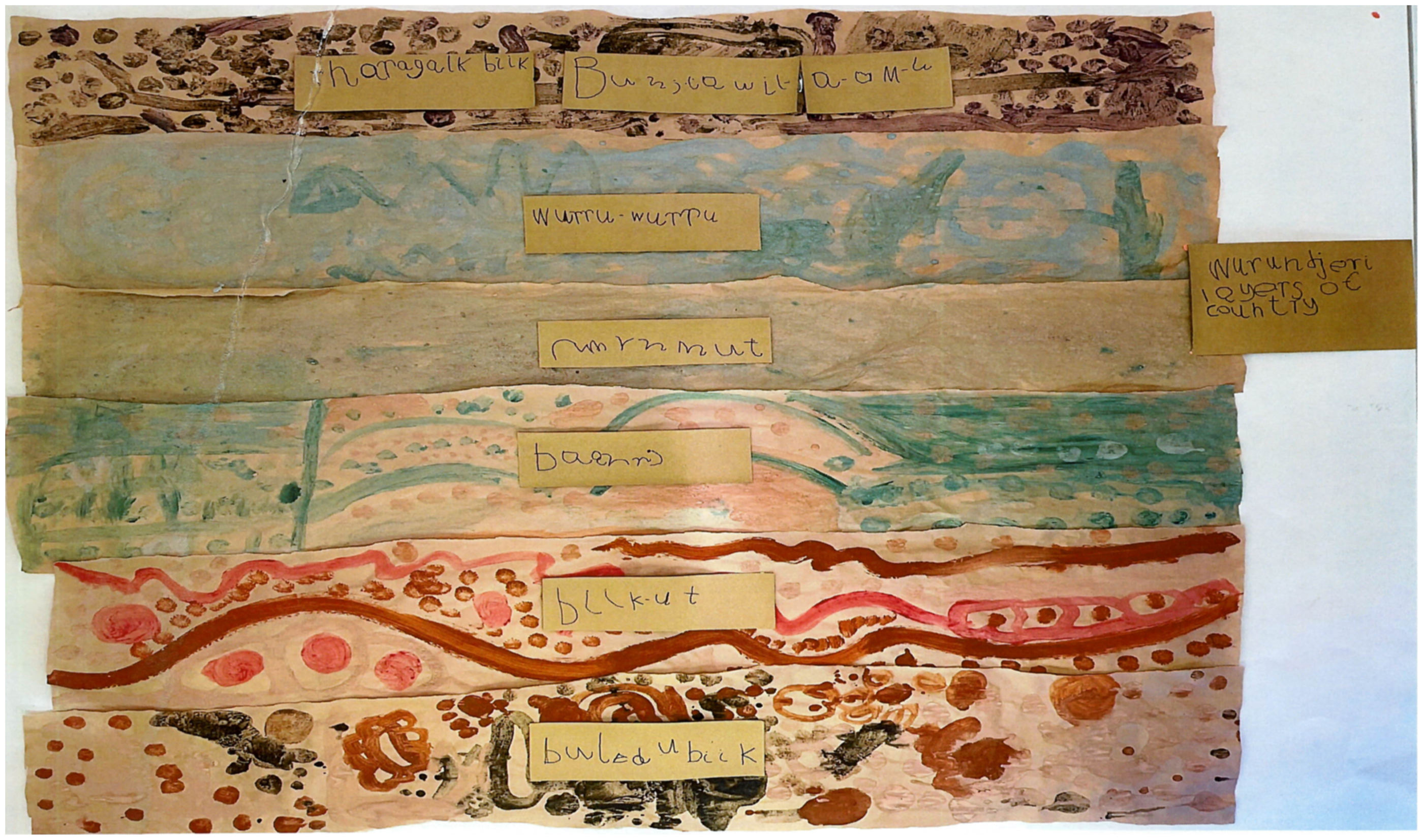
Inspired by the acknowledgement, the children created a ‘Wurundjeri layers of country’ installation, using coloured ochre and Indigenous symbols representing the different layers of the country.
Footnotes
Declaration of conflicting interests
The authors declared no potential conflicts of interest with respect to the research, authorship and/or publication of this article.
Ethics statement
This research was conducted with the approval of the RMIT Research Committee, Melbourne, Australia. All the research materials have been taken from Melbourne Girls Grammar with permission.
Funding
The authors received no financial support for the research, authorship and/or publication of this article.
