



Abstract
Artivism—the intersection of art and activism—is emerging as a significant pedagogical approach for engaging young children in complex social issues, such as environmental sustainability and supporting children's rights. This research study explores the integration of artivism into early childhood education curricula, with a focus on how early childhood educators can uphold children's rights while empowering them as active agents of social change. Using environmental sustainability as a pedagogical provocation, the research examines how preschool children, through creative expression, explore their roles in shaping equitable and sustainable futures. This paper challenges the idea of childhood as passive and presents children as active participants with rights, as supported by the United Nations Convention on the Rights of the Child. Situated within a rights-based framework, the study emphasizes the importance of recognizing children as capable social actors, rather than passive recipients in need of protection. The curriculum, which incorporated child-led art-making and story-sharing sessions—including contributions from an Indigenous Knowledge Keeper—prioritized children's voices, facilitating their engagement with social issues through creative activities. Utilizing a duoethnography research methodology, the researchers reflect critically on the pedagogical processes required to recognize and support children's agency while also considering the ethical responsibilities involved in fostering children's activism through the visual arts. The paper concludes by offering practical recommendations for early childhood educators, emphasizing strategies to create learning environments that respect children's rights, amplify their voices, and encourage their active participation in societal change, thereby contributing to a broader reimagining of the child as an empowered agent in both educational and social contexts.
Keywords
The term “artivism” involves using art and artistic creation as a tool for activism to transmit messages related to social issues or advance positive social change (Serra et al., 2017). Similarly, craftivism involves using diverse craft-making materials such as string, textiles, recycled objects, and beads to engage in social issues (Greer, 2014; Sanders-Bustle, 2022). Although artivism and craftivism have been explored through research, these pedagogical practices are notably absent in Early Childhood Education (ECE) academic literature. There is a multitude of literature and research expressing the importance of “craft” and “art” in early learning settings; however, studies related to “craftivism” and “artivism” are limited. The focus of this article arises from the premise that these pedagogical practices offer a rights-based framework for children to articulate their perspectives on social issues and to position themselves as activists through arts-based forms of advocacy. In this article, advocacy will be referred to as the act of supporting or promoting the rights, needs, and voices of individuals or groups—particularly children—aimed at empowering them to participate meaningfully in decisions that affect their lives and to influence social change (Tesar and Jukes, 2017). While both artivism and craftivism are considered in this study, the theoretical discussion here primarily emphasizes artivism, as it more directly aligns with the visual and expressive practices observed in the research. Craftivism is referenced as a related mode of creative activism, but in this study, the children's engagement more closely reflected artivist practices such as drawing, painting, and poster-making rather than textile- or material-based craft forms (Corbett, 2017).
Art is highly discussed as both a pedagogical approach and a curriculum component in many early learning settings. Art has many benefits, including developing fine motor skills, creating representations, and experiencing empowerment through creation, and can strengthen children's capacity to make connections within their communities and larger worldviews (Shulsky and Kirkwood, 2015). In addition, through art-making, children exercise imaginative, abstract, critical thinking skills and problem solving (Lucas and Spencer, 2017). The arts can also offer important ways to implement and uphold the rights of children as outlined in the United Nations (UN) Convention on the Rights of the Child (UN, 1989), as art speaks to children and adults in different ways (Todres and Kilkelly, 2022). Through the arts, both children and adults can engage deeply in the creative process, exploring the connections between rights and the social issues that hold personal significance to them (Tesar and Jukes, 2017; Todres and Kilkelly, 2022).
Given the limited research involving young children as active participants in social justice and sustainability projects, and especially related to artivism and craftivism, it is essential to share insights that can inform future researchers and early childhood educators working in this emerging area of practice. The rationale for choosing the ECE context is grounded in the recognition that young children are often overlooked in discussions of social justice and sustainability, with their voices frequently marginalized or undervalued. This research seeks to challenge that trend by highlighting the importance of listening to and empowering young children as active participants and agents of change. By focusing on ECE settings, the study emphasizes the critical opportunity educators have to nurture children's agency and amplify their perspectives from an early age.
The research outlined in this article offers pedagogical insights for using environmental sustainability as an illustrative example framed through a multidimensional lens that integrates ecological, social, and educational perspectives. The primary focus is on the active participation of children as change-makers, with an emphasis on how early childhood educators can recognize and support children's agency, capabilities, and rights through the lens of artivism.
Our research team was composed of two professors and two students enrolled in an undergraduate Child Studies degree program at a mid-size university in Western Canada. The students acted as research assistants and participated in the duoethnography conversation with the professors who were co-investigators of the study. Utilizing a duoethnography research methodology (Sawyer and Norris, 2013) allowed us to critically reflect on our observations of preschool children as they engaged in artivism and respond to key research questions:
How does children's engagement in artivism impact their understanding of environmental sustainability? How might early childhood professionals apply their knowledge of child artivism and social/environmental issues to professional practice, program design, and curriculum development?
Our exploration of artivism as a pedagogical practice will first include a review of academic literature published over the past two decades and theoretical underpinnings related to child rights, ECE, and visual arts education in the early years. An excerpt from our duoethnography discussion will follow with an analysis of our observations of the children's environmental-sustainability-related activities. Rather than focusing on outcomes related to environmental issues themselves, our goal is to offer evidence-based recommendations for how educators and researchers can effectively support children's artivist endeavors and advocate for children as active agents of social change. By examining artivism as an emergent practice within early childhood contexts, this article offers a novel perspective on children's rights and agency, positioning artistic activism itself as an innovative and insightful way to understand and support children as active participants in social change. Through sharing our observations, we hope that the study findings will contribute to current ECE research literature and offer practical guidance for educators on enhancing their pedagogical practices in support of children's activism, particularly in relation to artivism.
Theoretical underpinnings: Children's rights, agency, and social engagement
This research is grounded in the understanding that children's rights, agency, and empowerment are fundamental to how young children engage with social issues, particularly through creative expression. The central idea is to challenge the traditional notion of childhood as a period of innocence and passivity and instead position children as active participants and change-makers (Cannella, 2002; Garlen and Hembruff, 2022; Spyrou, 2020).
This shift in perspective aligns with reconceptualizing childhood not as a time shielded from complex social realities but as a period of active engagement, where children can assert their rights, express their concerns, and engage in social action (Garlen, 2019; Kuby, 2013). In recognizing the Reconceptualizing Early Childhood Education (RECE) movement, we acknowledge the prolific work of scholars (Bloch, 1992; Cannella, 2002; Swadener and Kessler, 1991) who for 30 years have advanced and made a compelling case for reconceptualizing ECE theories and practices. By situating children as active agents with the right to participate in matters affecting them, we acknowledge their capacity to contribute meaningfully to social discourse. In ECE, the concept of the agentic child is central, emphasizing that children have the right to be recognized as capable social actors in their own right at present and not in the distant future (Ashton, 2023; Taylor, 2017). This perspective challenges the prevailing protective models that often limit children's agency, particularly in relation to social issues such as injustice and environmental sustainability. Rather than perceiving children as passive recipients of knowledge, educators are encouraged to cultivate environments in which children's voices are authentically heard, valued, and acted upon. This approach aligns fundamentally with the United Nations Convention on the Rights of the Child (UN, 1989), which recognizes children as autonomous individuals endowed with inherent rights. Complementary to this, policy frameworks such as the Council of Europe's Strategy on the Rights of the Child (2022–2027) underscore the critical intersection between children's rights and environmental sustainability. Specifically, the Strategy advocates for providing children with meaningful opportunities to engage in decision-making processes concerning climate action and environmental protection, thereby acknowledging their right to a safe and sustainable future (Council of Europe, 2022). Central to these frameworks is Article 12 of the UNCRC, which enshrines children's rights to express their views on matters affecting them, to be heard, and to actively participate in decisions that shape their lives. This principle is vividly illustrated through artivism, wherein children harness creative expression as a means for articulating their perspectives on social issues. Engagement in artivism not only empowers children by offering an accessible and impactful mode of self-expression, but also cultivates a profound sense of agency, ownership, and responsibility.
In the context of environmental sustainability, the concept of children as empowered, active agents is especially relevant. Through artivism, children do not merely absorb knowledge about sustainability but actively participate in the dialogue and advocate for change through creating visual representations of their beliefs and actions. This pedagogical approach aligns with children's rights-based frameworks (CRBA) that emphasize collective, relational learning and co-creation of meaning, where children are seen as co-creators of their learning and their social worlds (Collins and Par 2016; Taylor and Pacini-Ketchabaw, 2015; Welty and Lundy, 2013). By engaging children in sustainability-related initiatives through creative expression, educators can foster “democratic learning that values listening, dialogue and diversity and … the co-construction of meaning whose outcome is unpredictable and therefore held open” (Moss, 2014: 127). An environment where “democratic pedagogy” (Langford, 2010) and activism are valued and supported allows children to contribute to social change and claim their rightful place as agents of transformation.
This framework is further supported by the growing body of Common Worlds research, which challenges human-centered approaches by exploring how children engage with the world in relational and multispecies contexts (Rooney and Blaise, 2022). In these frameworks, children's creative expressions—such as artivism—are not isolated from their relationships with the environment, other species, or the broader social world (Taylor, 2017). Donna Haraway's concept of “response-ability” offers a compelling reframe. It is described as the practice of “venturing off the beaten path to meet unexpected, non-natal kin”—such as when children's imaginative play transformed them into animals, birds, and fish during our study—and responding to new questions, interactions, and obligations that arise in these encounters (Haraway, 2016: 120). Applied to early learning settings, this concept encourages adults to create spaces where children's questions and actions are taken seriously, and where educators respond to children with care, openness, and commitment.
Our research findings indicate that children are not only willing to engage with social and environmental issues, but they actively seek out opportunities to do so (Forman, 1989; Garlen, 2019). The barrier is not children's capacity for engagement but, rather, adult-imposed limitations stemming from overprotective, deficit-based views of childhood.
Tensions arise when children express curiosity about complex social issues or show a desire to act yet are often met with hesitancy or dismissal due to an adult-centric view of childhood as a time of innocence and protection (Garlen, 2019). In these instances, the child's right to participate becomes overshadowed by the adult-imposed notion that they are not yet capable of handling such issues. “The construction of child (and human) development assumes human deficiency. The child is always becoming, always attempting to learn something new, to advance, to become an adult” (Garlen, 2019: 64). This has implications for not valuing or recognizing what children know and can accomplish in their childhood years. It points to a deficit image of the child rather than strengths-based views of children as reflected in Haraway's notion of “response-ability” and Garlen's critique of the overprotection of innocence (Cannella, 2002). This is where the empowerment of children becomes a critical lens for practice.
Empowerment, in this context, refers to the process of enabling children to recognize and assert their own rights and take meaningful action towards social change (Alderson, 2014; Thomas, 2021). Alderson (2014) emphasizes the importance of listening to children's voices as the primary source of knowledge about their own views and experiences. Building on Rinaldi's “pedagogy of listening” (2012), Davis (2014) explained that, listening to children is not just a matter of good pedagogy; encounters with others, where each is open to being affected by the other, is integral, I will suggest to life itself … But more than this, it means opening up the ongoing possibility of coming to see life, and one's relation to it, in new and surprising ways. (2014: 1)
Equally important is the recognition that educators’ own perceptions and image of the child shape the ways in which they engage with children's activism. How we view children—whether as passive recipients of knowledge or as active contributors to society—fundamentally influences how we create opportunities for them to participate in social issues like sustainability (Garlen, 2019; Gladstone et al., 2021). Educators must critically examine their own image of the child on an ongoing basis, acknowledging that their personal beliefs about children's capabilities, rights, and roles can change based on social, political, and cultural discourses as well as lifeworld experiences, and can affect their pedagogy. By viewing children as competent, engaged, and capable agents of change, educators can foster learning environments where children's perspectives are taken seriously, and their actions are seen as meaningful contributions to ongoing societal discussions.
In managing and contributing to the discussions about what is currently happening in children's worlds, educators must move beyond traditional, protective models and instead position themselves as co-learners and facilitators. This involves being open to children's ideas, listening with intention to their concerns, and creating spaces where they feel empowered to explore and express their beliefs. When educators actively engage with children's perspectives, they contribute to a shared understanding of contemporary social issues, creating a dynamic and reciprocal relationship where both children and educators learn from one another. In doing so, educators not only support children's activism but also model the value of listening to and learning from young people in the context of social and environmental change.
Methodology: Layering multiple interpretations using duoethnography
This research study received ethics approval from the Human Research Ethics Board at [Mount Royal University]. 1 Testimonial Model Release forms were signed by parents of the children who participated in the craftivism sessions, allowing images of artwork to be included in the journal article. In considering relational ethics and child assent, we explained the purpose and process of the research study to the children, and all of them agreed to participate in the study. Participants did not receive monetary compensation; however, all art supplies and the storybooks that we read to the children were gifted to the childcare center.
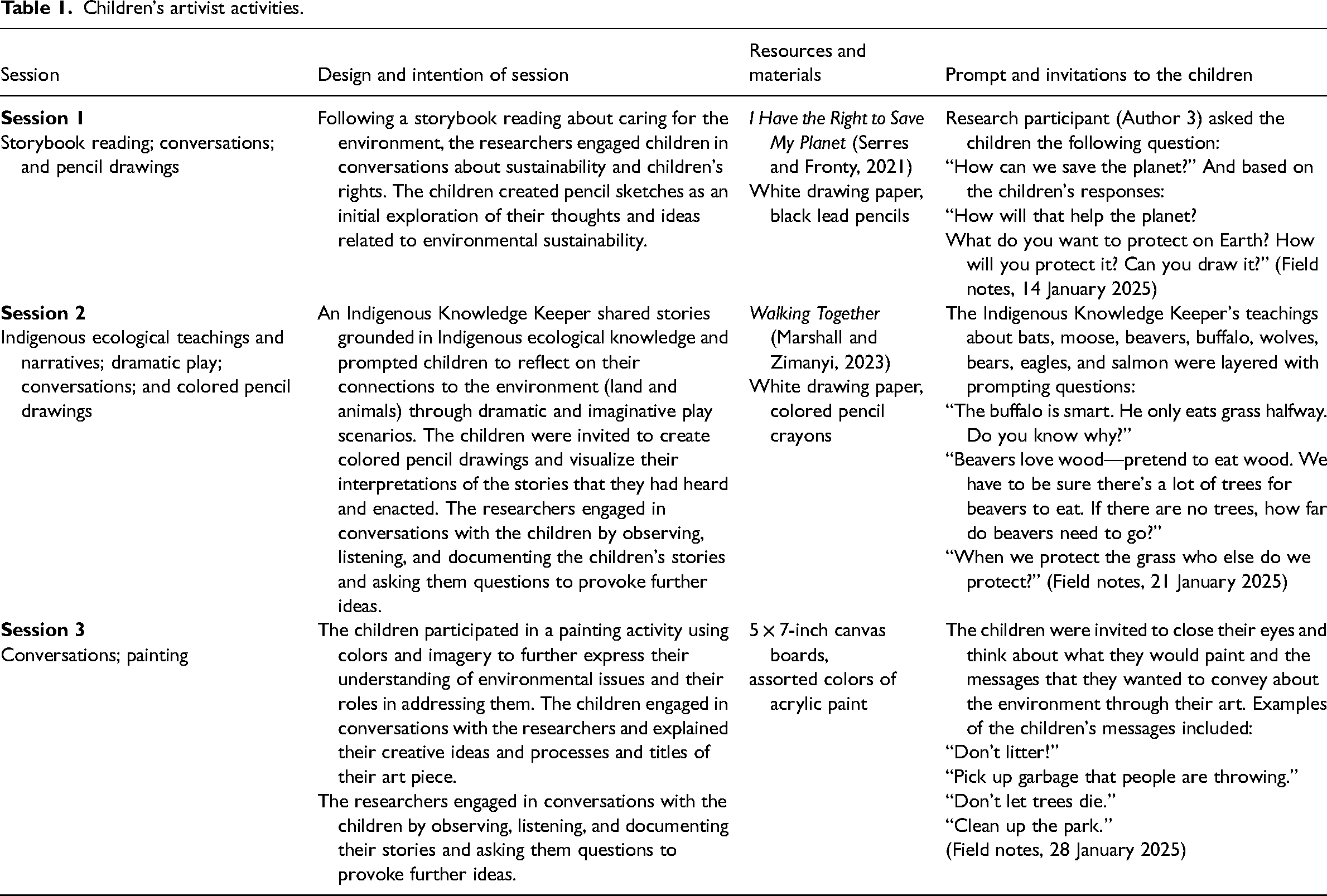
Utilizing a qualitative duoethnography research methodology allowed us, as researchers, to engage in a critical and dialogical examination of our observations and experiences working with children. This helped to uncover personal biases, ethical tensions, and moments of learning that may not have been evident during the research itself (Cummins and Brannon, 2022). While conducting duoethnography research, we critically considered and discussed our observations of children's engagement in art-making at a community preschool during the three 2-hr sessions outlined in Table 1. The 16 children were from diverse cultural backgrounds and were five and six years old. As members of the research team, we ourselves adopted dual roles as researchers and participants. During a 2-hr duoethnography interview, scheduled after the final session with children, we responded to the research questions and co-constructed knowledge about how children come to understand and address social issues—specifically, environmental sustainability—through artivism. Based on our observations of the children's play and art activities, we discussed relevant implications for pedagogy and teaching practice.
Children's artivist activities.
In recognizing that data are generated and analyzed simultaneously, and that “duoethnographers work in multiple intersections of identity, culture, history, narrative, politics and reflexivity” (Sawyer and Norris, 2013: 67–68), it was important for us to reflect and to situate our “self” (identity) within the intersections of time and place as we engaged in conversation. Following the interview, the dialogue transcript was analyzed by each research team member individually using qualitative (axial and selective) coding. Axial coding involved highlighting key ideas in the transcript that we had emphasized in relation to the research questions, that were repeated during the interview, and that stood out and surprised us. We later compared and discussed our analysis and, as a group, selected the themes that emerged from our observations, dialogue, and interpretations of the children's art. Duoethnography created space for researchers to interrogate their roles, assumptions, and evolving understandings of children's rights, agency, and participation. While our study may have focused on children's perspectives and experiences, the duoethnography approach allowed us to add another layer of interpretation—exploring how we made sense of the findings and how our views evolved through the process. Through critical reflections within the duoethnography, we examined what strategies and activities worked well, the challenges that we and the children faced, and the limitations of the research. We also identified key messages and recommendations for researchers and early childhood educators. Our critical reflections on the findings of the craftivism and artivism studies and the comparison of the children's activities and learning outcomes have provided valuable insights into how to better support young children as activists.
This research on artivism and sustainability emerged from our earlier research study focused on the social issue of homelessness. In keeping with the long-standing practice of “craftivism” (Corbett, 2017; Greer, 2014), our intention was to use craft-making as a way for children to spread messages of kindness and advocacy. The craftivism project aimed to engage young children in hands-on creative activities, using real-life examples such as images of homelessness in their own communities to introduce the social issue. Storybooks (Gunti, 2019; Lippert, 2022) and discussions provided important context, and the children's final craft work was compiled and donated to an organization for youth experiencing homelessness, reinforcing the tangible impact of their creative efforts. However, despite the original focus on crafting, all the children who participated in the project were naturally drawn to visual arts methods—creating drawings, paintings, and other forms of artwork—as their preferred medium for expressing activism and messages of kindness. This shift in the children's approach led to a realization that visual arts and artivism was a more intuitive and effective medium for young children to communicate their advocacy (Forman, 1989). Inspired by the shift from craft to art, this article explores the second phase of the study on sustainability, which was focused exclusively on artivism using visual arts methods to explore environmental issues with young children. The artivism project introduced children to environmental stewardship through collaborative art-making, storybooks, and guided discussions. Indigenous ecological perspectives on sustainability were shared by an Indigenous Knowledge Keeper and woven into the project to provide a more culturally diverse understanding. This involvement enriched the project by bridging traditional knowledge to contemporary environmental concerns, fostering respect for diverse worldviews. One key challenge was the difficulty children faced in connecting their art to the broader concept of activism, underscoring the need to frame complex social issues in developmentally accessible ways (Clark, 2010). While the study extensively explored artivism as a creative and expressive process, the activism component—particularly, children's understanding of and engagement with activism as a deliberate social or political practice—was less developed. This limitation points to the importance of designing pedagogical approaches that explicitly link artistic expression to concrete activist actions and outcomes, tailored to young children's capacities. To support young children in grasping activism, educators can employ strategies such as using concrete, relatable examples of local issues, storytelling that centers children's experiences, and facilitating small-scale community actions linked to their art (Thomas, 2021). These scaffolds help transform abstract concepts into tangible practices that young children can understand and in which they can participate meaningfully. Despite these challenges, the study reinforced the potential of artivism to empower young children as active agents in addressing social issues, fostering their ability to engage meaningfully with topics like sustainability through creative expression.
This study employed a combination of dialogic, narrative, and art- and play-based activities to explore children's engagement in artivism and their understanding of environmental sustainability. We intentionally kept the topic broad to give children freedom to explore and gravitate toward the issues they felt most passionate about, and to provide insight into their agency, leadership, and natural inclinations as activists. Through a series of creative sessions, children engaged in discussions, storytelling, and artistic expression relating to the social issue of environmental sustainability, as described in Table 1.
Research findings
Children's autonomy and rights in artivism and environmental sustainability
Through critical discussion and analysis of our experiences in this study, we conclude that artivism effectively contributes to the realization of children's rights, as articulated in the UNCRC (UN, 1989). Our research particularly aligns with Articles 12, 13, and 15, which uphold children's rights to be heard, to express themselves freely, and to participate in peaceful assembly. Through artivism, children are given opportunities to engage with social issues in ways that are both age-appropriate and authentic to their interests and lived experiences. Rather than enforcing strict adherence to predetermined themes, we allowed the children to guide their own creative processes, even when their work diverged from the initial focus. This approach reflected a commitment to child-led inquiry and respect for each child's agency. In doing so, we recognized that not all children would engage with the topic in the same way or at all, and that variability is a natural and valuable part of a rights-based research framework when working with children. This study also reinforces the importance of acknowledging children as the experts of their own lives. Their contributions—whether aligned with the topic or not—offered meaningful insights into how they interpret and engage with the world. By centering their voices, we moved beyond traditional adult-led research models and embraced a more child-centered approach that prioritizes inclusion, respect, and autonomy.
Following the final art session, our research team met to discuss the children's play and art-making experiences. Although we had hoped to include children in our duoethnography discussion, we were unable to do so due to research ethics restrictions. However, our conversations with the children during the sessions deepened our understanding of their perspectives on artivism and social issues, which we took with us into the conversation. An excerpt from our duoethnography dialogue/transcript in the text box below reflects the key research findings that helped us to uncover some specific dos and don’ts of enacting artivism in ECE settings, which are explained in the next section.
Dialogical pedagogy and critical personalization of learning
Dialogue plays a critical role in helping children connect with and personalize the importance of environmental sustainability. Through open-ended conversations, the children were encouraged to share their lived experiences and consider how environmental issues impact their daily lives. During a group discussion centered on personal encounters with the natural world, a child described walking in the woods with their family and seeing deer, which helped them relate environmental sustainability to familiar, meaningful moments. This process of personalization was further deepened by our prompting questions and invited children to reflect on why the issues might matter to them. Linking sustainability to the people, places, and routines that they care about engaged the children with the topic in more thoughtful and emotionally resonant ways. These dialogical interactions allowed them to understand the broader significance of environmental sustainability and situate themselves within it. Integrating dialogue with personal reflection was therefore essential in fostering meaningful engagement with this social issue.
The role of play in retention, understanding, and engagement
Play emerged as a powerful tool for supporting children's memory retention, understanding, and engagement with the issue of environmental sustainability. A particularly effective strategy was the use of embodied learning, when the children mimicked movements of various animals during the session facilitated by an Indigenous Knowledge Keeper. This form of active participation heightened their engagement, sparked curiosity, and made the learning process more playful and enjoyable. The physical activities helped reinforce the information in the children's memory. When revisiting the topic the following week, the children recalled the animals and their associated lessons with accuracy and enthusiasm. The children's ability to retain this information illustrates how movement-based play can reinforce key concepts in a way that is engaging and cognitively effective. The integration of play created a bridge between abstract concepts relating to the natural world and tangible, experiential learning, ultimately deepening the children's connection to the subject matter.
Utilizing artivism as a catalyst for children's change-making
Artivism creates a powerful and meaningful pathway for young people to engage with social issues and reflects how they naturally learn, express, and connect with the world through creativity, imagination, and dialogue. Children are often overlooked in critical discussions about contemporary issues such as environmental sustainability, and they are frequently dismissed as too young to grasp complexities or contribute significantly. This perspective not only underestimates their capacity but also silences voices that are capable of offering diverse, insightful, and hopeful perspectives. Our research challenges this assumption and reveals that children understand social issues, and when provided with accessible and relevant tools, they can actively participate in advocacy and inspire others to care and act. Artivism offers children a familiar and empowering medium through which they can explore complex topics, express their ideas, and communicate their concerns. By grounding the learning process in artistic expression that originates from their own interests and experiences, children are better able to connect with and care about the issues at hand. This method does more than just educate—it fosters a sense of agency, helping children see themselves as capable of initiating change. Artivism reshapes the narrative around children's roles in social justice, positioning them not as passive observers but as informed, expressive, and impactful social change-makers.
Scaffolding pedagogical practices and artivism as a layered process
Our research highlights that artivism is most impactful when it is approached as a layered and scaffolded process rather than a standalone practice. Integrating art with play, dialogue, and questions creates a dynamic and evolving learning environment where children can gradually deepen their understanding of complex social issues such as environmental sustainability. The structured progression—from black-and-white pencil drawings to colored pencils, and eventually to painting—allowed children to focus first on ideas before engaging in more expressive visual forms (see Figure 1).
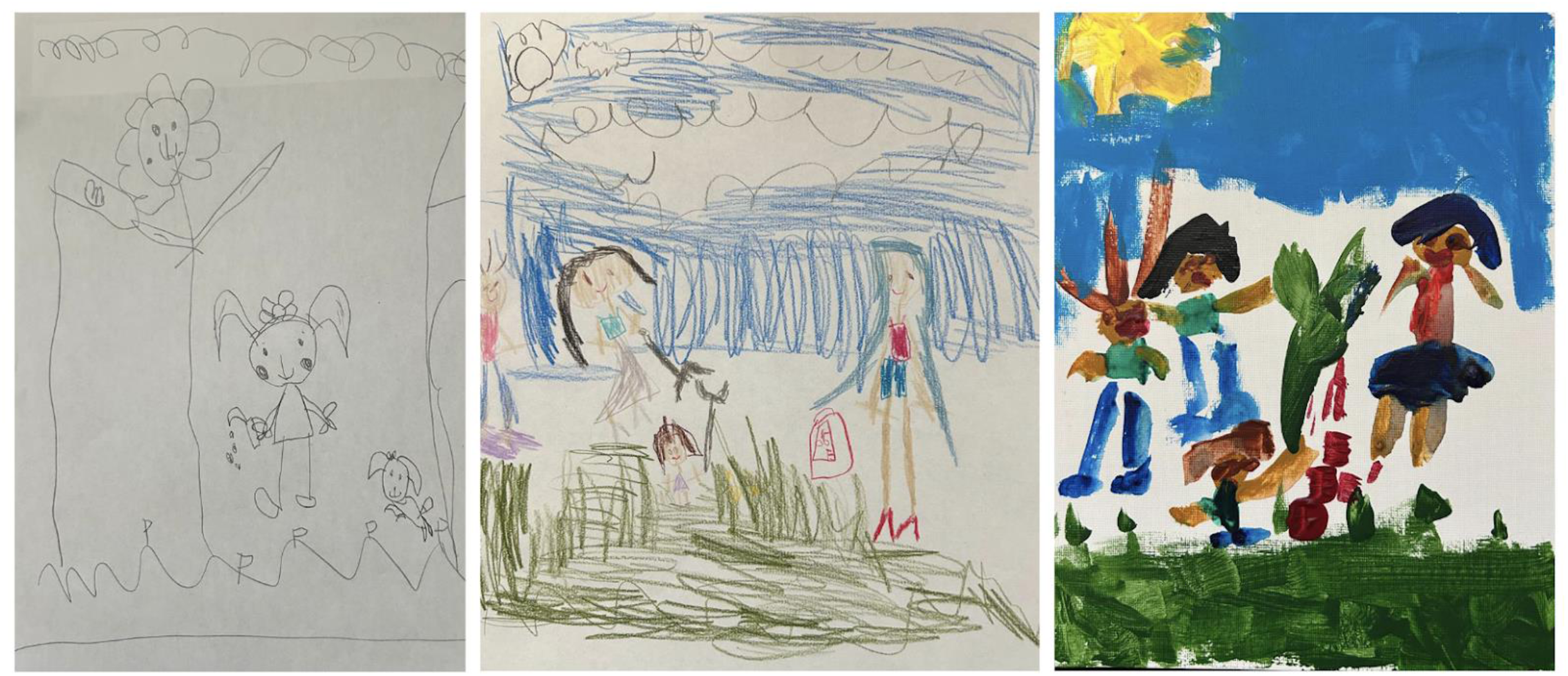
A child's evolving understanding of environmental sustainability is illustrated through a progression from pencil drawing to colored pencil drawing to painting.
This deliberate layering encouraged slower, more thoughtful engagement, sparked meaningful conversations, and generated questions that increased the children's understanding of issues. The scaffolded approach not only supported conceptual learning but also helped the children to form personal connections to the issues. A key distinction between this study and our previous research on craftivism lies in the treatment of activism itself. In this study, although briefly mentioned, there was no in-depth or explicit discussion with the children about the concepts of advocacy and activism, whereas the previous study included these conversations. Emphasizing the “vism”—the activist component in craftivism—proved effective in the previous study in helping children see themselves as capable, engaged participants in social change. Including this element in the current study may have further deepened the children's understanding of what it means to be a change-maker. Overall, our findings suggest that through the thoughtful combination of modalities—art, play, dialogue, and reflection—children's learning and activism is deepened and empowered.
Discussion and recommendations for early childhood educators
We conclude that artivism effectively contributes to the realization of children's rights and their “contributions—whether aligned with the topic or not—offered meaningful insights into how they interpret and engage with the world,” as reflected in the presented data (quotes and artworks). The findings from this duoethnography shed light on the possibilities and tensions involved in engaging preschool children in artivism. As we explored our experiences and pedagogical choices, a complex portrait emerged—one that challenges dominant developmentalist narratives that often frame young children as not ready for civic engagement or activism. Instead, the data suggest that young children are capable of participating in socially and environmentally conscious art-making, and that their participation is enriched when educators approach artivism as a relational, rights-based, and co-constructed practice. Future research and pedagogical work should focus on developing and testing scaffolded frameworks that explicitly connect children's creative expression with activist intentions and actions. This includes ongoing support for reflection, dialogue, and opportunities for children to see the impact of their efforts, thus deepening their sense of agency and civic engagement from an early age.
Theoretically, this work is informed by critical childhood studies and post-developmental perspectives (Pacini-Ketchabaw and Taylor, 2015), which call for a reimagining of children not as passive recipients of adult knowledge but as active meaning-makers and agents of change. These perspectives trouble the boundaries of what is considered appropriate content for early learners and instead invite educators to engage with children's questions, emotions, and embodied expressions as valid sites of knowledge production. Our findings reinforce this view and illustrate that when artivism is facilitated with attention to children's relational worlds, multimodal communication, and local experiences, it becomes a powerful tool for participation and advocacy.
The “dos and don’ts” presented in Table 2 were developed from and show connections to the research findings. Through discussing the duoethnography transcript, we came to recognize the limitations of the study caused by time restrictions and tight program scheduling at the childcare center. This reduced our opportunities to engage in lengthy conversations with the children about environmental issues and activism and limited the children's time for play and art-making. Although the limitations were challenging to navigate during the study, they sparked reflection and critical dialogue and were the impetus for recommendations included in the “don’ts” column (Table 2). The pedagogical strategies that supported the children's artivist activities are included in the “dos” column. The “dos and don’ts” are not prescriptive checklists but invitations to reflect critically on practice. They offer concrete ways for educators to navigate the ethical and pedagogical considerations of integrating artivism into ECE while centering children's rights to expression, participation, and connection (UN, 1989). These recommendations also aim to unsettle the idea that activism must be grand or global; instead, they emphasize the significance of everyday acts of care, inquiry, and resistance that take root in the local and familiar.
Dos and don’ts of practicing artivism
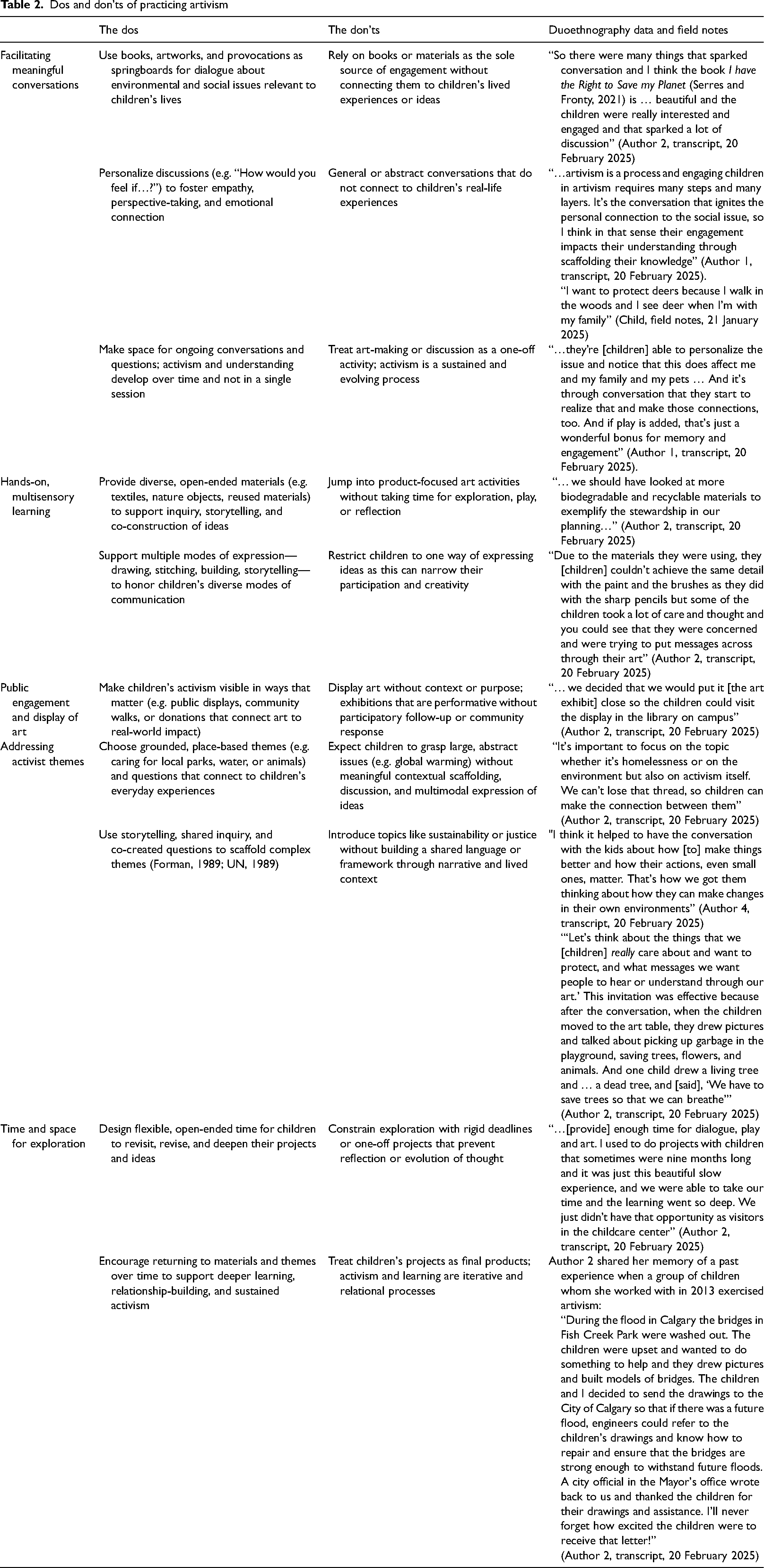
Importantly, the findings also point to several tensions that educators may inadvertently fall into—often driven by institutional constraints or well-meaning but adult-centric notions of learning outcomes. For example, treating art-making as a one-off activity or focusing solely on product over process risks instrumentalizing children's creative work rather than valuing it as part of an ongoing conversation. Similarly, introducing complex social issues without sufficient scaffolding or contextual grounding can leave children confused or disengaged. These missteps underscore the importance of slowing down, listening closely, and allowing children's interests and curiosities to guide the process.
Though this study centers on the immediate pedagogical implications of engaging children in artivism, it is essential to also consider the long-term potential of such experiences in shaping children's civic identities. Participatory, arts-based pedagogies do more than facilitate creative expression in the present—they help children develop a sense of agency, belonging, and ethical responsibility that may carry into their future roles as socially engaged citizens (Ashton, 2023; Clark, 2010; Davis, 2014). When young children are invited to explore real-world issues through child-led inquiry and multimodal expression, they are positioned not as future citizens but as current actors within a broader civic ecosystem (Thomas, 2021; Todres and Kilkelly, 2022). These early encounters with rights-based, justice-oriented learning offer the potential for transformative civic trajectories in which children internalize values of care, interdependence, and collective responsibility. As Alderson (2014) and Cannella (2002) argue, fostering children's participation from a young age not only affirms their rights but also builds the critical and relational capacities that underlie democratic engagement and ethical activism later in life. Within this frame, artivism becomes not merely a momentary intervention but a foundation for lifelong civic sensibilities—one that begins with listening to children and grows through sustained, collaborative pedagogical practices.
This research affirms that artivism in ECE is most impactful when it is responsive rather than directive, emergent rather than prescriptive, and co-created rather than adult-led. It requires educators to be attuned not only to the materials and themes they bring into the classroom but to the relationships, questions, and meanings that emerge through children's play, dialogue, storytelling, and artistic expression. In doing so, we can move beyond tokenistic or performative engagements with children's rights and toward pedagogies that make room for children as present-tense participants in social and environmental transformation (Thomas, 2021).
Conclusion
This research situates artivism—the blending of artistic expression and activism—as a vital, transformative pedagogical approach within ECE. Through its integration into a rights-based framework, the study demonstrates that young children are capable of engaging meaningfully with complex social issues such as environmental sustainability and can actively contribute to broader societal change through creative, participatory learning processes. These findings challenge traditional conceptualizations of childhood that depict children as passive recipients of knowledge and shield them from complex issues. Rather than enforcing adult-defined agendas, artivism recognizes children as active, rights-holding participants in their own learning, with the capacity to reflect on, engage with, and address the social and environmental challenges of their time.
A central pedagogical takeaway from this study is the imperative for early childhood educators to cultivate learning environments that explicitly uphold children's rights to self-expression, agency, and meaningful participation in social discourse. The research reaffirms that children's participation in matters that affect them is not only a right but a necessary element of their holistic development. In this context, artivism emerges as an essential tool for promoting critical thinking, empathy, and social responsibility in young learners, thereby fostering their capacity for active citizenship. This approach, however, calls for more than sporadic, one-off activities; rather, it advocates for the integration of artivism as an ongoing, evolving component of the curriculum, interwoven with other pedagogical practices. By providing children with repeated opportunities to revisit and refine their artistic and activist work, educators enable deeper engagement, reflection, and growth over time.
Furthermore, the research underscores the importance of contextualizing children's activism within diverse cultural frameworks, such as Indigenous knowledge and ecological teachings, to enhance their understanding of sustainability, justice, and collective responsibility. Indigenous perspectives provide an essential counterpoint to dominant narratives in early childhood pedagogy by emphasizing relationality, reciprocity, and a more-than-human approach to learning (Rousell and Cutter-Mackenzie-Knowles, 2023). By incorporating these perspectives, educators can enrich children's exploration of environmental sustainability, facilitating a more nuanced, interconnected understanding of social and ecological justice.
Educators must grapple with the ethical responsibility of fostering children's activism while ensuring that their participation is both engaging and ethically sound. This requires a pedagogical stance that be open to the messiness and unpredictability of creative processes, recognizing that the path to social change is non-linear and often fraught with uncertainties. Educators must navigate these complexities with sensitivity and attentiveness, remaining committed to children's agency while respecting the integrity of their voices and ideas. The research calls for educators and researchers to critically reflect on their own perceptions of children's capabilities and their ever-evolving image of the child, ultimately understanding how these perceptions influence the design and implementation of pedagogical practices.
This research, therefore, challenges the prevailing pedagogical frameworks that often view childhood as a time of innocence and preparation for adulthood. Instead, it positions children as fully-fledged social actors, capable of both understanding and influencing the world around them. Artivism offers a means by which educators can facilitate the active, rights-based participation of children in societal conversations, cultivating a sense of agency and responsibility for the collective well-being while offering a platform for their voices to be heard. In acknowledging the groundwork that has already been laid by the RECE movement, this research makes a compelling case for the reconceptualization of ECE and of the child as a key player in the process of social and environmental transformation. It calls for a reimagining of the role of educators as facilitators of child-led activism, where the pedagogy be not merely about transmitting knowledge but about co-constructing knowledge with children and empowering them to advocate for their rights, their communities, and the planet. By centering artivism in early childhood curricula, we affirm that young children are not only recipients of care and education but are essential contributors to global conversations.
Footnotes
Funding
The authors received research funding from the Mokakiiks Centre for Scholarship of Teaching and Learning at Mount Royal University in Alberta, Canada.
