




Abstract
This article asks the question of what documentation is doing, rather than what documentation means in the context of early childhood education. By focusing on the documentation of a young child’s playful exploration with water that inhabits a classroom wall, new materialist theories are put to work to ponder documentation’s agentive capacities and intra-activities. What is argued is that documentation is inviting powerful creating and resisting actions that offer senses of belonging for a child. Consequently, it is proposed that teachers both shift from and overlay matters of fact and matters of concern. The implication is that documentation can be put to work in influential ways when its actions (rather than meanings) within spaces are foregrounded. This article offers original contributions to contemporary debates regarding agentive readings of documentation practices that can influence forms of ethical and flourishing pedagogies in a policy climate that can otherwise confine.
Introduction
As part of their pedagogical practice, teachers of young children employ observational strategies to make sense of playful learning. Such documentation is often presented on classroom walls through photographs alongside written narratives. Within the context of English early childhood education (ECE), documentation is heavily influenced by intensifying policyscapes driven by accountability and datafication narratives (Bradbury, 2018) that can narrow the pedagogical offer (Roberts-Holmes and Bradbury, 2016). Nevertheless, alongside the observation and assessment of progress, documentation has other multiple functions (Alasuutari et al., 2014) that include forms of pedagogical reflexivity and encompass sharing learning episodes with children, their families, colleagues and visitors.
Whilst documentation practices can be framed as all the processes and functions involved (Elfström Pettersson, 2015), what is often overemphasised within the English context is the ‘magnetic pull towards measuring children’s achievements’ (Basford and Bath, 2014: 123). Such narratives can create disillusionment and defiance (Dahlberg et al., 2013), which, in turn, can demotivate and frustrate professional identities (Bradbury, 2012). In this article, I put to work new-materialist theories to consider what documentation is doing by framing it as agentic (Lenz Taguchi, 2010) and building from recent work that experiments with similar paradigms in the field of ECE (Chesworth, 2018; Odegard, 2019). Through this, I ponder how far it is possible to generate new intellectual and ethical resources to think (Taylor and Ivinson, 2013: 665) about the tensions entangled with documentation practices that operate within assessment and accountability narratives.
In this article, I bring original insights to the field of agentic readings of documentation practices that can shed light on how teachers navigate powerful assessment policy drivers. In order to do this, I take Elfström Pettersson’s (2015, 2018) findings that the materials involved in documentation practices can intra-act to condition narratives and provide a vantage point for reflection, but I extend that focus to the powerful performativity of the documentation itself. In addition, I build from Rautio’s (2014) theorisations of child–matter intra-actions and Hackett and Rautio’s (2019: 1029) study of language and body relations to enquire about the intra-activity in between documentation–teacher–classroom–child. Barad (2007) posits that agency is something that is co-produced intra-actively (rather than interactively) between the human and non-human. Intra-action is an idea borrowed from physics that troubles the inanimate and passive nature of objects, and has been developed by the physicist Karen Barad: The neologism ‘intra-action’ signifies the mutual constitution of entangled agencies. That is, in contrast to the usual ‘interaction,’ which assumes that there are separate individual agencies that precede their interaction, the notion of intra-action recognizes that distinct agencies do not precede, but rather emerge through, their intra-action. (Barad, 2007: 33)
In turn, these ideas can offer some illumination of the structures that, De Freitas (2016, cited in Blaise et al., 2017: 32) argues, can sometimes be neglected within relational ontologies. Such frames might point to the ethical gestures at work that can offer a picture of a motivated and flourishing teacher, which Latour (2004: 225) might describe as shifting from ‘matters of fact to matters of concern’. By doing so, I offer new thinking to the field about how documentation practices can create pedagogical spaces that trouble the significance of accountability and assessment narratives.
The present article revisits data generated from my doctoral study and is organised into three parts. Debates in the literature will be initially scoped and include consideration of the English policy context, the search for alternative approaches and research that considers agentic notions of documentation practices. Second, I outline my experimentation with ‘more than human ontologies’ (Jackson and Mazzei, 2012) and how I created data in response to the intra-actions between humans and non-humans, which, Kuby (2017: 877) argues, can create knowledge and realities. Here, I ask the question of what is left unattended and underexamined in regard to the performativity of the documentation itself. Third, I take stock of the broader theory and practice implications of how teachers might put their documentation practices to work within, outside and in contestation of assessment agendas.
Documentation practices within the English assessment agenda
Documentation practices in the English policy context are influenced by the formalised assessment and reporting of children’s learning progress, and this positioning is unusual within international ECE curricula (Bradbury, 2014). The curriculum for young children in England, the Early Years Foundation Stage (Department for Education, 2017), combines notions of education and care, playful pedagogies and stages of subject-based developmental outcomes (Roberts-Holmes, 2012). Policymakers continue to ascribe significance to developmental theories, where normative stages can be observed and assessed (Wood and Hedges, 2016). More recently, the contentious move to reinstate formalised measurement of children’s abilities as they start statutory education, known as baseline assessment, is a manifestation of the powerful discourses of accountability at work (Bradbury et al., 2018). Parallel to this, the curriculum is being revised by the UK government, and there is strong sector opposition, with uneasiness that this might threaten its play-based pedagogy (Pascal et al., 2019).
The curriculum can be problematic to put into practice, as teachers can be confined by its prescriptive nature (Anning, 2015). The significance placed on the measurement of progress can lead to a lack of attention for individual children, as teachers are caught up within school-readiness narratives (Robert-Holmes and Bradbury, 2016). Such practices highly value a systematic, linear progress of learning and thus reject more multifaceted, non-hierarchical, rhizomatic interpretations (Sakr and Osgood, 2019). The volume of data collected leads teachers to view children as either ‘fitting the norm or deviating from it’, with a resulting loss of complexity, and, in effect, the child is ‘datafied at four’ (Bradbury, 2018: 12). Such discourses paint a picture of teachers negotiating accountability discourses that exert powerful leverage on their pedagogical decision-making. However, other influential discourses are also at work, such as those associated with caring (Aslanian, 2015) and authority (Warren, 2014), as teachers forge relationships with young children that require subtle relational capacities.
Documentation processes are thus positioned within agendas of formative and summative assessment, and theorised as a sort of ‘assessment game’ that has dualist and conflicting purposes (Basford and Bath, 2014: 120). Basford and Bath (2014) posit that forms of assessment gameplay can be traversed when teachers develop stronger pedagogical knowledge that challenges accountability and pursue other agendas. When assessment is framed as an ethical and relational practice, it creates the potential for teachers to challenge how they and the children in their classes are viewed (Basford and Wood, 2018: 361).
The search for alternative assessment models
Acting back against assessment agendas through documentation practices carries risks, as any challenge in a climate of accountability is problematic (Basford and Wood, 2018). Moss (2015) argues that there is a dire need to find alternative agendas which contest dominant ways of thinking and might precipitate discourses of hope and environments in which teachers, children and ECE communities can flourish. Such contestation can be seen in how teachers seek alternative, less formalised approaches to documenting children’s learning processes that emphasise observation and teacher interpretation through narrative and visual methods (Kline, 2008).
Alternative approaches that emphasise observation of the processes (rather than assessing the outcomes) of learning have been termed ‘pedagogical documentation’; this has various iterations, originating from well-regarded international models such as the Italian municipality of Reggio Emilia (Edwards et al., 2012) and the approach of learning stories within the New Zealand curriculum (Ministry of Education, 2017). Pedagogical documentation has been defined as ‘material communication tools appropriated or developed by teachers/practitioners or researchers for the purpose of recalling, reflecting on, re-thinking and re-shaping learning, teaching, knowledge and understanding’ (Carr et al., 2016: 277). However, documentation practices as a pedagogical endeavour of understanding the quality of practice and nature of children’s learning is a discourse that can be unchallenged (Alvestad and Sheridan, 2015) and also has a paucity of international research (Emilson and Pramling Samuelsson, 2014). The practice of pedagogical documentation has an enthusiastic international following, but remains difficult to transplant across sociopolitical contexts (Fleet et al., 2017). Moreover, the practice can be time-consuming (Kalliala and Pramling Samuelsson, 2014), oversimplified (Pacini-Ketchabaw et al., 2015) and part of an array of demanding multi-documentation practices (Alasuutari et al., 2014).
The application of pedagogical documentation in the English policy context often relies on the professional knowledge of those leading pedagogical practice (Stobbs et al., 2017), and can be largely unknown outside of English-based Reggio networks (Sightlines, 2010). Cowan and Flewitt (2019: 2) posit that observation and documentation are understood to be a valuable endeavour for practitioners but can be in tension with the summative assessment requirements of the curriculum. Thus, the adoption of documentation practices can be ‘superficial and misunderstood’ (Basford and Bath, 2014: 127). Additionally, holistic approaches such as learning stories have been critiqued in their marginalisation of curricular subjects (Blaiklock, 2010). Consequently, there seems to be much enthusiasm for the subject but its complexity and differing applications mean that there is a lack of research that demonstrates how documentation has influenced practice (Alasuutari and Kelle, 2015; Alasuutari et al., 2014: 125–126; Rintakorpi et al., 2014).
The agency of documentation practices
The idea of documentation being agentive has been explored through the application of post-human and new-materialist theories (Coole and Frost, 2010; Fox and Alldred, 2017). Such thinking shifts away from the human at the centre of the enquiry and instead brings focus to the liveliness in between the human and non-human world. Through such lenses, objects such as documentation can be understood as a ‘methodological tool for learning and change in any pedagogical practice’ (Lenz Taguchi, 2010: 10). Influenced by the physicist theory of Barad (2007), Lenz Taguchi (2010: 10) uses the idea of intra-action between humans and the materials in the environment to position documentation as agentive and performative: ‘Hence this pedagogy is inclusive of the material as a strong performative agent in learning’.
Agentic research in the field of documentation practices can centre on the materiality and interconnected nature of the human and non-human elements. Taking Lenz Taguchi’s (2010) conceptions of agentic materials within documentation as a starting point, Elfström Pettersson (2015) emphasises children’s participation with teachers when documentation is produced. The findings suggest that the materials involved in documentation, such as photographs and labels, have the capacity to condition narratives as they are ascribed different meanings by children and teachers. Magnusson’s (2018) more recent work around photographic agency and documentation finds that such practices can trouble ways of looking when children have open access to cameras. Similarly, Merewether (2018) explores ways to listen to children with documentation practices and finds that the materiality of the objects involved, such as cameras, notepads and pens, needs to be acknowledged, and the camera seems to have more agency in the assemblage.
There are further examples of research that explores the agentic qualities of pedagogical documentation and also encompasses political and ecological agendas – sometimes termed ‘pedagogical narration’ and associated with the Common Worlding movement (Blaise et al., 2017; Kummen, 2014; Pacini-Ketchabaw et al., 2015; Taylor and Pacini-Ketchabaw, 2015). Similarly, ‘Lively Stories’ (Van Dooren, 2014, cited in Blaise et al., 2017: 36) is an example of documentation that attends to the interrelationships between children, teachers, other species and the natural world. Such forms of observational practice are inspired by Latour (2004) in studying what concerns practitioners. In effect, such documentation practices align ECE within wider political debates and engage global environmental issues that promote the protection of the natural world, echoing Latour’s (2004: 225) counsel of repositioning ‘matters of fact’ to ‘matters of concern’. Empowering teachers’ agency to observe what is of political and ethical concern within their community frames documentation as a resistance to normalisation and ‘taken-for-granted’ interpretations, and leaves room for ‘negotiating ethically grounded professional choices’ (Lenz Taguchi, 2008: 280).
Method
Shaped by new-materialist theories (Alaimo and Hekman, 2008: 2; Gannon and Davies, 2012), my methodological frame explores the materiality of documentation practices to trace their relationship with the discourses of assessment agendas in English ECE. Through this, I am interested in working with agentic notions to see what documentation does by paying attention to its intra-activity within classroom spaces. In particular, I am interested in documentation’s capacity to behave as a methodological tool for learning (Lenz Taguchi, 2010: 10), and how it can foreground ethical concerns (Blaise et al., 2017; Kummen, 2014; Pacini-Ketchabaw et al., 2015; Taylor and Pacini-Ketchabaw, 2015) in a policy climate heavily shaped by accountability discourses.
By employing new-materialist theories that align with feminist positions (traditionally views that have been marginalised in wider educational research), I worked closely with a female research participant who educates very young children. Furthermore, my approaches attended to a wider focus than the language the participants employed, and included imagery, sensory data and materials created and selected by the participants. Similar to the work of Odegard (2019), I am inspired by the use of bricolaging data through new-materialist paradigms. Bricolaging involves more fluid and intuitive approaches to what constitutes data, and involves reusing, reassembling and shifting fragments to make new installations and assemblages to think with (Denzin and Lincoln, 2011; Kincheloe, 2001; Rogers, 2012). As the theoretical positioning moves away from the human as the primary focus, the enquiry needs to consider other factors beyond language, which form part of the wider intra-action between the human and non-human participants (Mazzei and Jackson, 2017: 1090).
The sample was recruited from my professional network and comprised teachers working within one school situated on the outskirts of a north-west English city within an area of high social disadvantage that served a largely dominant monocultural population. I recruited three teachers for my doctoral study but, for the purposes of this article, I have focused on one participant, Michelle (pseudonym), who was an experienced teacher based in the nursery class and had a senior management position as curriculum lead for the early years. Michelle was invited as she used documentation in her daily practices and had a comprehensive knowledge and understanding of statutory assessment requirements.
The data-collection method I used in this enquiry was inspired by the reframing of the interview as an intraview (Kuntz and Presnall, 2012; Petersen, 2014), which acknowledges both visual and sensory approaches (Pink, 2015). Accordingly, physical movements, the embodied human relationships, and the materials, spaces and location were considered along with language. In practice, this involved a more detailed alertness to how the documentation was entangled with entities beyond written and spoken language. This meant that I tried to find ways to capture the non-verbal, the emotive affects and the collective experience of two bodies within the situated space of the intraview, responding to and with a piece of documentation so meaning and sense-making were inextricably bound together (Barad, 2007; Bozalek and Zembylas, 2017).
In the spirit of post-human ontoepistemological methodologies, I was keen to let the research approaches unfold and enable the research to emerge in the moment, in order to try to make sense of knowing through the research event itself (Taylor, 2016). As a result, I gave my participant the decision of what constituted documentation practices for her and used her self-chosen examples. My approach to ethical processes involved national (British Educational Research Association, 2018) as well as institutional requirements. As there are also multiple entwinements in my enquiry that include more-than-human participants, I am positioning myself ethically in terms of the non-human aspects of the school (Hultman and Lenz Taguchi, 2010). Thus, it follows that I am engaged in an ethical relationship with the non-human matter of the school. However, this opens a question as to what an ethical consideration of the non-human means in this context (Fairchild, 2017; Taylor, 2016). Post-human scholars, such as Bennett (2010: xiii), describe this as following ‘the scent’, which I interpreted to mean being open and alert to the human and non-human relations within the research assemblage.
With the collected fragments of visual, auditory and embodied data, I put to work a diffractive analysis (Barad, 2007; Haraway, 1997). This approach looks for differences when one set of data is read through another, and attends to the patterns that evolve (Hultman and Lenz Taguchi, 2010). Similar to Fairchild (2017), I put to work MacLure’s (2010: 282) concept of ‘glow data’ to select data by looking to what attracted attention and an emotional resonance, affect and reaction, which draws comparison with a researcher’s own experiences. As I requested that Michelle chose the documentation for the data collection, this led to a sense of what she found to ‘glow’ in her own documentation practice, which, in turn, led to the focus of the analysis. I approached the diffractive analysis by shifting, rereading and layering my own experiences and interests within and alongside theoretical ideas (Lenz Taguchi, 2010, 2012). This meant, in practice, that I counted as data a wide range of human and non-human elements, such as the documentation (Figure 1); intraview audio transcripts; my journal entries that noted embodied, sensory and emotional affects between myself, Michelle and the documentation; and photographs of where the intraview took place. Thus, in my diffractive analysis, I worked with both things and words to trace their affects and relationships between and within each other (Bozalek and Zembylas, 2017; Lenz Taguchi, 2012), and think about what the documentation was doing.
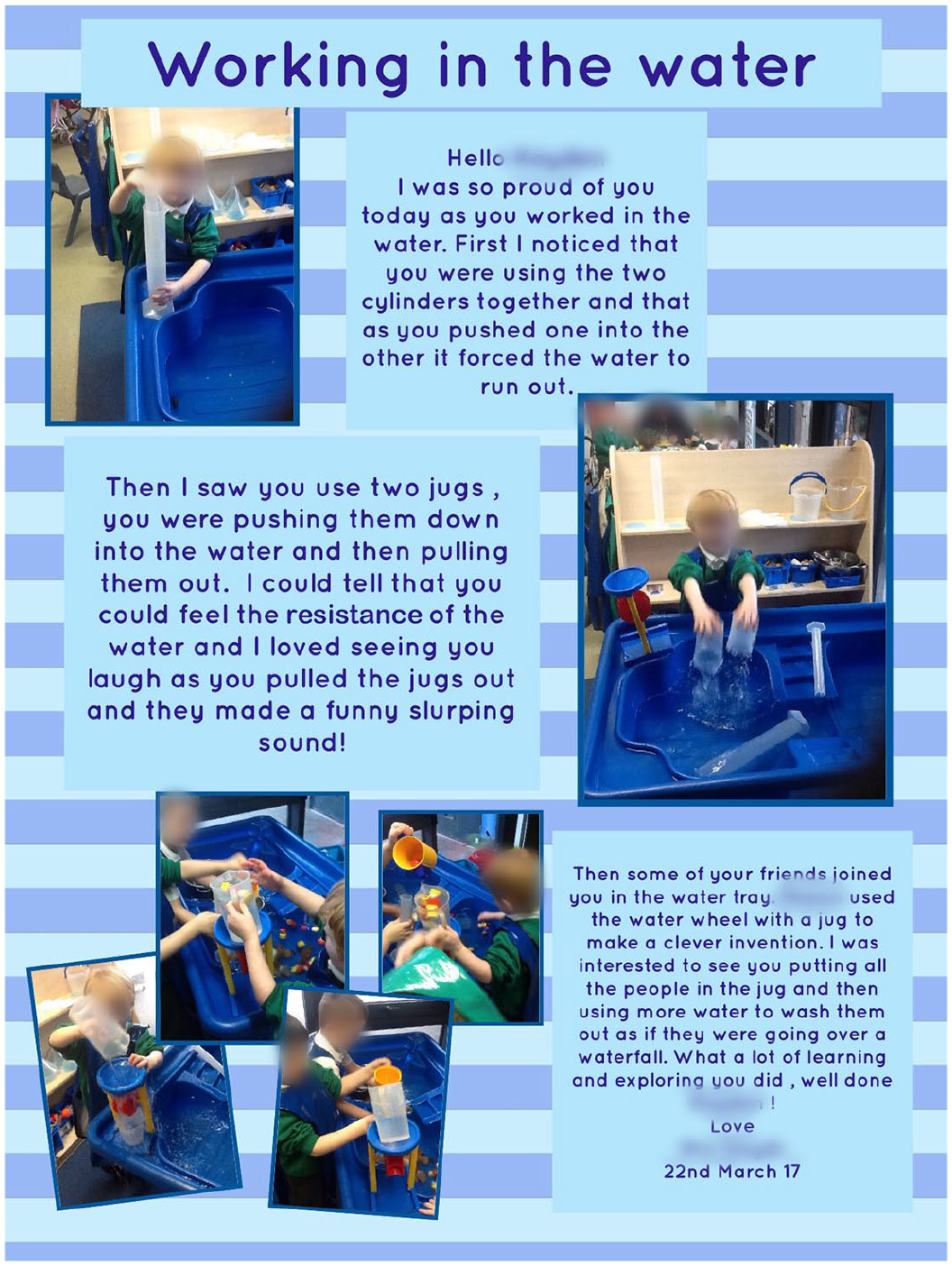
Working in the water Documentation of Tyler playing in the water made by his teacher, Michelle.
For the purposes of this article, I return to one of the bricolage data assemblages, which centres on Michelle’s documentation of water play from a three-year-old boy, Tyler (pseudonym), who is in his first few weeks of attendance in the nursery class (Figure 1).
Findings
In these findings, I present the results of my diffractive analysis to trace what the documentation is doing by thinking about how matter and meaning are entangled (Barad, 2007) through three different lenses. The three lenses involve tracing the intra-activity of the documentation in relationship with discourses, the child and the embodied sensory elements.
Documentation–discourses
First, I look at the learning story created by Michelle of Tyler’s exploration with water to consider what the documentation is doing (Figure 1) by thinking about the material-discursive intra-activities at play. The documentation shows Tyler playing both alone and alongside others, and is presented through photographs and related narratives addressed to the child and signed by Michelle. The first images show Tyler in an apron alone at the water tray, aware of the camera and smiling directly back, busying himself with filling and pouring. Further on, a second set of photographs shows his attention directed towards other children and, as such, might represent the learned cultural behaviour that values eye contact and interaction. It is an active visual account of social and non-verbal play with water that brings focus to the range of learning processes at work. This suggests that Michelle is knowledgeable about how documentation practice can illuminate what she values in her pedagogical practice (Stobbs et al., 2017).
Now, I look at the same documentation to focus in on the discourses that are at work from the perspective of Michelle, observing and documenting Tyler’s water play. On first reading, the connection between the play and the learning is illuminated by Michelle’s carefully chosen terminology: ‘First I noticed that you were using the two cylinders together and that as you pushed one into the other it forced the water to run out’; ‘I could tell that you could feel the resistance of the water’. Alongside a descriptive account of the actions that Tyler and the water make, the language seems to bypass the vocabulary and numerical milestones associated with measurement within the ECE curriculum. Instead, technical, scientific and mathematical terms are employed (‘cylinders’, ‘forced’, ‘resistance’, ‘pushing’, ‘pulling’, ‘invention’) that align water play with discourses associated with traditional schooling, suggesting that playful learning is a powerful pedagogical vehicle for a young child.
In addition, the emotional and relational intra-activity comes to light between the child, the parent and the teacher. Michelle has designed the learning story to be read by the child and his parent together at home, and the tone is thus celebratory and approving: ‘I was so proud of you today as you worked in the water’; ‘What a lot of learning and exploring you did, well done Tyler!’ Thus, what documentation is doing through a material-discursive positioning is pointing to discourses associated with the potential of playful learning as a catalyst for mathematical and scientific thinking for its own sake and outside of assessment frames. As importantly, caring discourses are also at work (Aslanian, 2015) and reveal a more complex and nuanced intra-activity between the material and the discourse, which binds educational relationships with teachers and young children.
Documentation–the child
Second, I reflect on what documentation is doing by considering the intra-activity in between the child and the documentation itself. Within the documentation, Michelle’s written language demonstrates that she values Tyler’s play. Such practice is influenced by the New Zealand approach of learning stories, which places significance on the sharing of narratives that identify the process, social and relational nature of ECE (Ministry of Education, 2017).
In particular, Michelle makes non-verbal actions that consciously consider where and when to site the documentation within the classroom space: ‘I thought, “You know what I’ll do? I’ll put a big version of it in the water area”’ (Albin-Clark, 2019: 86). In the audio version of the transcript, there are traces of Michelle’s excited voice and facial expressions, which aim to mimic Tyler’s emotional response as he first notices the documentation situated exactly where the learning took place: ‘The next day, when he came in, he looked at it and he was, like, “It’s me, it’s me”’.
Furthermore, Michelle recalls Tyler’s emotional response: ‘So, I think, for him, it was, it was all about “This place, ohhh this place is all about me”’. Through the intraview process, the documentation can be seen to be in relationship with the audio and embodied sensory responses. Thus, the documentation itself can be framed to act at a crucial time and space for Tyler in his first few weeks of establishing himself as a valid member of the class. Moreover, the documentation can be seen in relationship with the place of school (Blaise et al., 2017) and how it behaves as an ‘active agent’ (Lenz Taguchi, 2010: 63).
Additionally, the documentation itself is active in making Michelle put it on the wall at child height by the water tray to catch Tyler’s eye. In the intraview transcript, Michelle recalls the physical and visual presence of the learning story: ‘It might still be there, although it might be a bit splashed now’. Thus, the documentation itself is in relationship with both Michelle and Tyler in its temporal and physical position. This gestures towards the documentation acting as an invitation that enfolds Tyler into the world of school in those early first weeks of his attendance: ‘what it actively does or performs in relation to the pedagogical practice where it is produced’ (Lenz Taguchi, 2010: 64).
Thus, what the documentation is doing in the intra-activity is again related to valuing playful pedagogies, but, through a material-discursive lens, other factors are at work. The factors of time, space, place and a sense of belonging are part of a more complex intra-activity at play in between the child and the documentation.
Documentation–embodied sensory elements
Finally, I reflect on what documentation is doing by considering the intra-activity in between myself, the participant and the documentation. There are further layers more subtly intra-acting but revealing Michelle’s interpretation of Tyler’s reaction and my own analysis of Michelle’s retelling. Diffractive analysis moves away from interpretation and looks to researchers in relation to the data. Here, I consider how data attracts attention and an emotional resonance, affect and reaction (MacLure, 2010). Through bringing into focus the more embodied and subjective responses of the researcher self, relational intra-actions gesture towards ‘a becoming with the data’ (Lenz Taguchi, 2012: 265).
Thus, the intraview fragments, photographs of the intraview and record of the embodied, sensory and emotional affects all become important pieces of data. When these elements are read in relation to the documentation itself, it tells of a shared pleasure and excitement, heads bowed together leaning over the documentation in finding what was mutually affective: Jo: I got goosebumps when you said that. [Jo strokes her forearm and breathes out loud; Michelle laughs] Jo: Boom, boom, boom. [shared laughter] Michelle: Kapow. Jo: That is awesome. Michelle: Is that alright? Is that what you wanted? [excited chatter rising in volume and shared laughter] Jo: It’s bloody awesome. (Intraview transcript)
What documentation is doing in the intra-activity in between the documentation, the researcher and the participant gestures towards taking seriously the significance of embodied and sensory responses. Bozalek and Zembylas (2017) describe this approach to diffractive analysis as taking account of the interdependence of materialities. Such attention to factors beyond language, such as sensory data, can add a further nuance to what a material-discursive intra-activity can involve (Mazzei and Jackson, 2017: 1090). Moreover, the sensory and embodied elements of the data bricolage – such as relational elements, the attention to goosebumps and photographs of spaces – all still act to foreground the human at the centre of the enquiry. This points to the tensions that are present in new-materialist paradigms. However, my research can contribute an example of seeking productive and pragmatic models of post-human theorising in educational contexts by ‘keeping sight of the human’ (Bennett, 2016: 70) and a methodology that can be described as a form of ‘mild post-humanism’ which studies the entanglement between human and non-human (Bennett, 2016: 63).
Discussion
The question posed is about what documentation does outside of prevailing assessment agendas. The following discussion attends to the material-discursive intra-activity of documentation practices to illuminate possible actions and productive affects. I propose that the intra-actions between the documentation, the child, the discourses and the sensory embodied research process have produced two broad actions of creation and resistance. Moreover, these resisting and creating actions have transformative potentialities for ECE teachers to assert their pedagogical practice to act outside of dominant discourses where non-human elements such as material, space and place are seen as performative and agential in how learning is constructed (Lenz Taguchi, 2010).
First, a sense of belonging to school has been created through material-discursive intra-actions and the early relationship forming between Michelle and Tyler, which is associated with discourses of care (Aslanian, 2015). In this case, this sense of belonging is funnelled through the creation and placement of the documentation demonstrated through Michelle’s attention and approval of Tyler’s social and relational play within the learning story. Teachers of young children engage themselves with developing close emotionally attuned relationships with individual children in order for them to feel comfortable and ready to explore the learning experiences on offer in school. This is a time-sensitive act on behalf of the teacher, and is particularly relevant at the beginning of children’s school experiences. Such emotional work is associated with discourses of care, which are involved in developing close relationships between teachers and children. The documentation placed in the classroom within a specific time and place is considered by Michelle to act as a reassurance to Tyler of his place in the life of the school. Hence, the material nature of the documentation can be seen to be inextricable from the discourses that suffuse its creation, placement and positioning within the school’s spatiality. This serves as an example in ECE research of how the agency of a material such as documentation can be considered to produce helpful affects for humans. This reaffirms the notion of the agentic potentialities of documentation and its association with the production of professional knowledge (Alasuutari et al., 2014).
Barad (2012) argues that the enactment of agency emerges through the responses between matter and humans. In my findings, the matter is the non-human element of documentation itself, recalled by Michelle as caught in a cycle of wetting and drying on the classroom wall, and thoughtfully placed in the location where the play happened and positioned so Tyler saw the imagery the very next day. The actions and agency of the water are also at work here. Thus, I extend Rautio’s (2014) exploration of child–matter intra-actions to incorporate the role of documentation. The documentation occupies physical space where intra-actions emerge that invite human senses of belonging and value.
Second, actions of resistance have been produced through material-discursive intra-actions that act against the framing of documentation practices within assessment agendas. The language of the statutory curriculum in terms of achievement of developmental milestones is omitted within this example. In this way, the ‘magnetic pull’ of observing children as a form of measurement is resisted (Basford and Bath, 2014: 123). Instead, what is foregrounded is the child’s play-based social experiences and their place and value in the school community. By sidestepping developmental milestones, the documentation practice seems to clarify rather than complexify – to be redacting created knowledge to what is deemed contextually essential, culturally valued, and locally constituted and created. What is emphasised is the teacher–child relationship, which acts to invite a knowledge of belonging that is dispersed and shared, and acts between Michelle and Tyler through the agency of the documentation. In addition, the sensory traces of the data itself had a role to play in the form of goosebumps and shared emotions between the researcher and the participant – a signification of affect at work within the research assemblage, which encompasses more than language (Mazzei and Jackson, 2017).
Michelle puts to work her documentation practices for multiple purposes. From a material-discursive viewpoint, the material of the documentation is powerfully suffused with discourses of care; it gestures to children that they have a place and significance in the school, which is enfolded in the building of a warm teacher–child relationship. Pedagogically, the documentation practices foreground the playful and social as a means of mathematical and scientific learning, but notably omit the assessment and measurement of developmental milestones. In doing so, this enables a sidestepping of the discourses associated with assessment agendas tied up with regulatory bodies such as the Office for Standards in Education, Children’s Services and Skills, whilst at the same time developing practices that are aligned with a commitment to playful pedagogies. The findings concur with previous research (Kocher and Pacini-Ketchabaw, 2011) which suggests that documentation practices can act as a form of resistance to how assumptions are made about children by displacing and transforming thinking through the process of reviewing documentation. Resistance in this construction matters because it is a productive force that has substance and direction. Significantly, resistance is not practised for its own sake, but as a means of teachers co-constructing and putting their own professional knowledge to use through documentation practices.
However, the implications of using documentation practices as a form of resistance to assessment agendas for teachers are double-edged. It seems empowering for Michelle to enact her pedagogical leadership through documentation practices. This suggests that the making and positioning of documentation can have influence within the actual spaces of the classroom. Yet it is risky for teachers to resist assessment agendas because the dominant discourses within influential policy narratives form and direct practice towards the generation, collection and tracking of observations of children’s learning to this inevitable end. Effectively, Michelle sidesteps this narrative by foregrounding other agendas that she deems more relevant to her practice at this juncture. Subsequently, the documentation enables Michelle to act as an advocate for children and families, freeing her up to enact practices that align with her pedagogical choices within an ‘assessment game’ (Basford and Bath, 2014: 119).
Conclusion
In summary, I have found that agential readings enable a view of what documentation can do – and what it does is produce resisting and creating movements which, in turn, create spaces for teachers to work with and against dominant discourses. In doing so, this enables teachers such as Michelle to foreground what matters to them – and this means foregrounding playful, relational and ethical pedagogies outside of assessment agendas. Returning to my research enquiry, I will now ponder the implications and limitations of what documentation can do within assessment policy narratives, and in what ways my research builds on agentic notions of documentation practices.
First, there are implications that arise from my findings which build on the notion of documentation as agential (Lenz Taguchi, 2010). If I am proposing that Michelle is putting her documentation to work in order to shift from matters of fact to matters of concern (Latour, 2004), this has implications for how possible it is to take such risks when teachers are required to work within school-readiness and datafication narratives. However, the concepts of shifting from one action to another can be oversimplistic and reduced to an unnecessary binary. By applying Barad’s (2007) notion of diffraction as a way of thinking about my findings, in conjunction with Latour’s (2004) proposal, I suggest that a more nuanced, overlapping and blended action is more helpful. Therefore, it is not a case of Michelle displacing the ‘facts’ of assessment with what concerns her, but rather a conflation and intersection of what matters and what concerns. In this construct, Michelle becomes an expert assessment gameplayer (Basford and Bath, 2014) by working within and outside of assessment agendas. However, it also brings the potential of seeing a nursery teacher reconstituting her role by positioning documentation practices through her pedagogical work with political and ethical intent. The implications of such foregrounding of more relational and ethical assessment practices (Basford and Wood, 2018), seen through the lens of new materialism, point towards more hopeful and flourishing discourses (Moss, 2015) at work, which are much needed when teachers can feel demotivated (Bradbury, 2012).
However, what documentation can do is also curtailed by limitations and tensions, and any resistance of discourse operates within a policy landscape with complex sets of drivers at work. Inevitably, the extent to which teachers can create spaces for resistance operates within a navigation of policy. Through focusing on what emerges from material-discursive intra-actions, I argue that Michelle has opened up spaces for policy disruption, and this viewpoint has been underexamined in previous studies that have taken a performative view of documentation (Elfström Pettersson, 2015, 2018; Hultman and Lenz Taguchi, 2010; Lenz Taguchi, 2010; Merewether, 2018).
Practically, the potential of recognising the actions and affects of documentation practices within classroom spaces builds on a long-recognised literature related to documentation as a powerful pedagogical tool (Dahlberg and Moss, 2006; Reggio Children, 2001; Rinaldi, 2006). The everyday act of positioning documentation and the possible affects it can have is a highly accessible idea and exemplifies not just an intellectual resource (Taylor and Ivinson, 2013), but also a very practical pedagogical strategy. In this thinking, I depart from interpretations where documentation practices are viewed as a capturing of intra-active events (Pacini-Ketchabaw et al., 2015). Rather, I extend Pacini-Ketchabaw et al.’s (2015) view of capturing and instead posit that documentation practices are creating intra-active events.
In addition, these findings provide an example of how a relational study can meaningfully explore the structural connections that underpin assemblages, such as those within the assessment agenda, which De Freitas (2016, cited in Blaise et al., 2017) believes have been neglected within relational ontologies. Furthermore, this notion offers a realistic kind of weapon in the ECE classroom-practice armoury that might counter policy intensification, and repositions aspects of the accountability agenda into a discourse shaped by the teacher, rather than something that teachers react to and are constrained by.
In short, what documentation does is foreground what matters and concerns teachers, and that can happen despite the powerful assessment agendas at work in the field. The affects and performances of agential readings of documentation within classroom spatialities can do important work on behalf of teachers, constructing them as expert assessment gameplayers (Basford and Bath, 2014). This becomes possible by taking seriously the interrelationship of the meanings and sense-making in between things and words (Barad, 2007; Bozalek and Zembylas, 2017; Lenz Taguchi, 2012).
Footnotes
Acknowledgements
I am grateful for the support of the teachers who kindly gave their time for my data collection and also my doctoral supervisors Dr Liz Chesworth and Prof Elizabeth Wood.
Funding
The author received no financial support for the research, authorship and/or publication of this article.
