




Abstract
In this conceptual paper, the affective intensity of joy is approached as becoming. Following a relational ontology, joy is attended to both as performed in relation to others (human and more-than-human) and as a performative agent. This paper is based on an empirical exploration of the remarkableness of young children's everyday lives in a Finnish early childhood education context. This study contributes to the emerging field of affective and embodied research practices in early childhood education by disrupting and reimagining the way in which joy is thought about and researched. Exploring joy from a post-qualitative methodological approach and drawing on a relational ontology will afford novel research insights and new knowledge about joy as a phenomenon beyond the individual human. By reading diffractively and drawing on a ‘practical provocation’, the author aims to increase understanding of joy as a performative force, which is important for early years practitioners and researchers. Acknowledging the relational and performative aspects of young children's joy within intra-action reveals the remarkable and transformative possibilities in seemingly unremarkable and mundane events.
Setting the stage: joy and early childhood education
The word ‘joy’ is widely used in different educational texts, policies, research and practice. For example, ‘joy’ is mentioned 13 times in the Finnish National Core Curriculum for Early Childhood Education and Care (Finnish National Agency for Education, 2018). The curriculum states that every child is entitled to have experiences of joy in the context of early years education – more specifically, the joy of learning and success, joy in play and in making, and the joy of creating and experiencing (Finnish National Agency for Education, 2018). Generally, in both research and practice, the word ‘joy’ has a positive connotation and is mostly understood as something good and desirable. However, in these contexts, joy is seldom defined, theorized, explored more widely or critically examined. There is a need to challenge these dominant assumptions of joy by also considering joy as a phenomenon that is wider than something that only occurs in an individual human being.
Fortunately, there seems to be increasing research interest in relational approaches to joy, emotions and affects (e.g. Burnett and Merchant, 2018; Cekaite and Andrén, 2019; Dernikos et al., 2020; Ehret and Rowsell, 2021; Kuby, 2014; Leander and Ehret, 2019), including in the context of Finnish early childhood education and care (Byman et al., 2022; Karjalainen, 2020; Karjalainen et al., 2019; Nordström et al., 2019; Nordström et al., 2021). Furthermore, research interest in the everyday and ordinary, understanding how we make sense and meaning, is also gaining more traction. There has been a call for more variety in the methodological research approaches to both affect and the mundane, arguing that understanding the mundane and ordinary is key to the humanities and social sciences (Hall and Holmes, 2020; Pahl and Rowsell, 2020) – that is, a focus on everyday practices, ranoticing and engaging with the remarkable in seemingly unremarkable, mundane and messy activities and in-betweens in early childhood education (Back, 2007; Pahl and Rowsell, 2020) . This might provide us with possibilities for a more nuanced understanding of joy as an embodied and affective phenomenon, and children's sense-making, exploring questions like why joy is important, if joy can be contagious, if we as humans can control joy, and if there can be a dark, negative, side of joy.
My prior research has discussed how young children's positive affect is evoked when they are creating, making and sharing different texts and interests in the course of their multimodal and playful joint activities (Nordström et al., 2019); how approaching joy from a new-materialist perspective and thinking with theory helps us unfold joy (Nordström et al., 2021); and the widened and affective text worlds that young children navigate (Nordström et al., in press). This paper is a way of extending that work, exploring joy as a performative force in early childhood education by drawing on feminist new-materialist and post-human theories (e.g. Alaimo and Hekman, 2008; Bennett, 2010; Dolphijn and Van der Tuin, 2012).
The rationale of this paper is to engage with joy as an affective and performative force in everyday life in early childhood education, pushing against binary thinking that separates, for example, humans from non-humans, nature from culture, the mind from the body, or theory from practice (Murris and Bozalek, 2019; Niccolini and Ringrose, 2020). With performativity instead of representationalism (Vannini, 2015), the objective is not to neatly categorize what happens in early childhood education, but to think, see and feel with what joy as a force can do. While in representational notions knowledge generation is bound to verbal language and a reality exists independently of the researcher, in performative notions, humans, more-than-humans and entanglements are always becoming (Leander and Boldt, 2013). As a result, knowing and being – or, more precisely, becoming – cannot be separated (Hultman and Lenz Taguchi, 2010). Hence, performativity entails joy being a doing rather than something we have (see also Barad, 2003). Further, I strive to problematize privileging certain types of knowledge and ways of being (Murris, 2021; Niccolini and Ringrose, 2020). Joy is viewed here as both something that is emergent in intra-action and as a performative agent that has an agential role in this emergence. Intra-action refers to the objects, energies and bodies that transform in and through their relation with each other so that becomings happen simultaneously for all entangled entities. Their becoming is dependent on the relational moves between them (Barad, 2007). Agency is not an attribute but the ongoing reconfiguring of the world (Barad, 2003) and, through its performative force, joy is agential.
Joy, as an affective intensity (see also Leander and Boldt, 2013), shares conceptual space with both emotion and affect, including mood, feelings, desires and impulses. Moreover, following Massumi (2015), affects are prepersonal and precognitive intensities rather than ‘mere’ personal feelings (see also Dernikos et al., 2020). A generic definition of joy as a spacious concept embedded in practices and relations (Zembylas, 2016) is utilized in the work discussed in this paper. Further, I am not drawing a conceptual distinction between affect and emotion, even though I recognize that both have previously been defined in various ways (e.g. Dernikos et al., 2020; Zembylas, 2016), as I see that they are still intersecting in complex, dynamic tensions. It is important to note at this point that joy is approached as an affective intensity which increases our power of acting, following a Deleuzian reading of Spinoza's three fundamental affects – joy, sadness and desire – where Deleuze (1988: 101) states that ‘joy augments our power of acting’. In other words, joy has performative and transformative agency. In this paper, this agency is explored through thinking with events, or ‘practical provocations’, from young children's literacy practices. I explore one practical provocation in which joy was becoming in a storytelling activity.
Working with and through a relational ontology (e.g. Barad, 2003; Murris, 2021), the relationality of joy is of interest, focusing on what happens in the in-betweens and in everyday, mundane and messy practices in early childhood education. A relational ontology is concerned with what and how we know and why it matters (Murris, 2021). Following this line of thinking, joy as a performative force is relational and becoming; it is co-created and a co-creator. In other words, joy is becoming in relation rather than pre-existing or only residing within an individual child. By shifting focus away from the intentions and attributes of individuals and turning attention more to what is becoming through intra-actions, early childhood researchers have recognized the complex meaning-making and knowledge production that take place in early childhood education (Hackett and Rautio, 2019; Hultman and Lenz Taguchi, 2010; Rautio, 2013).
Acknowledging joy as performative thus leads us to reimagine early childhood education as in need of attending to the relational aspects of joy, simultaneously decentring the individual human. It is also necessary to emphasize that joy does not unfold according to a pre-existing model or formula; rather, joy can be unexpected and unruly (Johnson Thiel, 2020; Kuby, 2014; Nordström et al., 2021). Approaching joy as performative entails the potential to rupture, rethink and enliven educational practices as emergent, entangled and embodied (e.g. Dernikos et al., 2020; Enriquez et al., 2015; Leander and Boldt, 2013). The contribution of this work lies in reimagining everyday practices in early childhood education by asking not what joy is, but what approaching joy as a performative force can do and what joy can encompass. I also offer some considerations from a post-qualitative methodological point of view on approaching joy as a phenomenon.
In the following section, I discuss something I like to call a ‘practical provocation’ (inspired by Murris, 2021) of one everyday moment where joy was becoming. It might also be called a vignette or an example, but the concept of a practical provocation prompts us to approach the empirical material as thought-provoking events, or diffractive moments, from practice. The practical provocation here is offered with humility, as a companion for thinking, seeing and feeling with instead of a prescriptive or representational example (see also Vintimilla et al., 2021). Practical provocations are diffractive engagements that will hopefully offer an imaginary of how joy felt, what it looked like, and how it was experienced in these particular events (see also Murris, 2021).
Practical provocation: a storytelling session or entanglements of agentive and performative forces
The empirical material that is foregrounded in, and prompted the writing of, this paper consists of ethnographic video recordings of a three-month literacy project, field notes, semi-structured interviews, photographs and children's artefacts. The empirical material was produced as part of ‘The Joy of Learning Multiliteracies’ research and development programme (Nordström et al., 2018).1 The research and development programme aimed to promote young children's multiliteracies, based on the pedagogy of multiliteracy advocated by the New London Group (1996), as well as a pedagogical model formed by the research group in Helsinki. The following practical provocation unfolded during the project, where a group of eight children aged four to six were making their own Storybooks. The Storybook is a pedagogical resource where the child is the storyteller and illustrator. The Storybook provides a template for telling one's own story using a multitude of modalities, such as written texts, drawings, photographs and sounds (e.g. Kumpulainen et al., 2018; Nordström et al., 2021 ). The Storybook also affords events of mixing analogue and digital materialities, modulating content creation (see also Sintonen, 2020b).
During these everyday literacy practices in early childhood education, diffractive reading was employed in noticing the remarkable events when joy was performative. Here, diffraction replaces interpretivism and representationalism in the sense that the event is attended to as an emergent, open and dynamic process, in which we should pay attention to differences and delicate details that matter instead of focusing on, for example, comparing, coding, contrasting or categorizing (see also Jackson and Mazzei, 2013; Murris and Bozalek, 2019). Diffraction refers to the process of waves being disrupted as they encounter obstacles, resulting in an observable pattern of interference, and, in this paper, the research interest lies in how affective intensities, much like waves, move, erupt and disrupt. This way of thinking and reading with the practical provocation offers an alternative and powerful way to think about joy as an eruption of the affective intensities in an early childhood education setting. In the following practical provocation, the children are gathered for a storytelling session, listening to five-year-old Amanda (all names are pseudonyms) as she tells a multimodal story she has created (see Figure 1): The group are sitting in a semicircle round the edge of the circular red mat where they usually have these kinds of gatherings. Amanda first seems reluctant to share her story, but after two of the other children, Cilla and Viggo, tickle her, she tells her story. The story is about a family of mice, and how the mother mouse goes out foraging for mushrooms and the mice children are left home alone. In Amanda's story, it is summer and the sun is shining. The children's gazes are shifting between Amanda and her Storybook as she shares her story. The teacher is helping Amanda read and tell the story, and she also helps with the tablet when there are problems with reading a QR [quick response] code. When the QR code finally works, it takes us to the sounds of Amanda's story, which are sounds of mice squeaking. The children are sitting close to each other, often touching the arm of another child whilst listening. As the mice start squeaking on the tablet, the children move closer but still make sure everyone can see both the book and the tablet, and hear the sounds. When the sound stops playing, they all smile. Amanda's story ends with the mother mouse becoming friends with a cat, and together they eat strawberries and mushrooms in the rain. When Amanda finishes her story, the group smile again and give her a round of applause, and it is time to hear the next story from one of the other children.
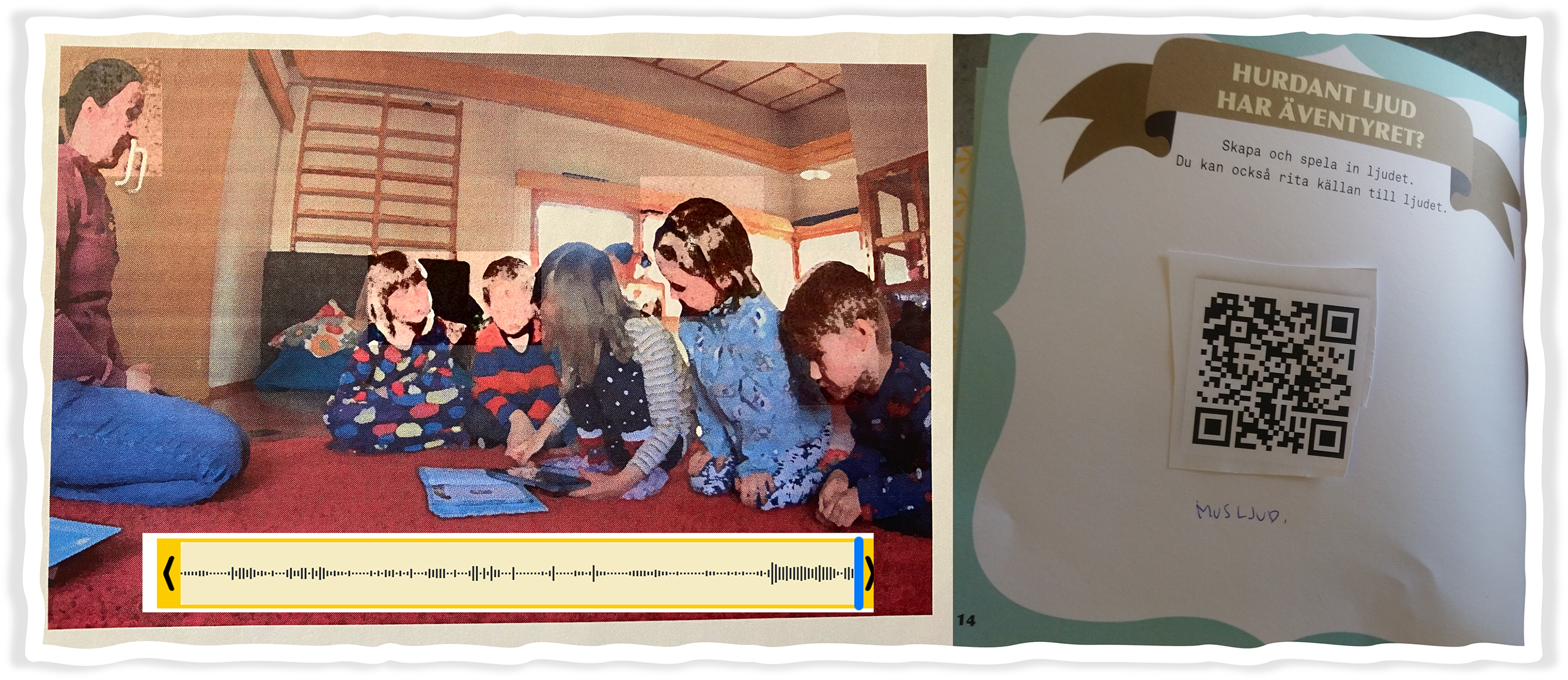
The storytelling session.
Joy was built up during the Storybook project, constantly bubbling under the surface and diffracting in sometimes unexpected situations (see also Nordström et al., 2021). Of course, the project was in no way isolated from other activities at the early childhood education centre, or the everyday lives of the children and teachers. The event is attended to as an assemblage of agentive entities during the storytelling session, where a diffractive reading guides us to focus on the intra-action, such as the moving bodies and materialities, and the entanglements of these (see also Sintonen, 2020a). The tablet provides sensory experiences through the sonic dimension of a story (see also Wargo, 2017). The performance of collective joy arose with specific reference to the social relationships and materialities present, the situation, and appears to be ‘contagious’, or ‘sticky’, between the humans in this group (e.g. see Ahmed, 2014; Von Scheve and Ismer, 2013). This contagion was made salient by the togetherness of embodied movements. Figure 1 is an attempt to illustrate the diffractive reading of the empirical material, where the atmosphere, the sounds, the moving bodies and the material dimensions are entangled, and a method of cutting-with is applied, as suggested by Wohlwend and Johnson Thiel (2019). In this event, the performative and agential force of joy becomes palpable in its swelling and eruption.
By thinking with this practical provocation, we engage with and encounter the empirical material as agential, not making distinctions between theory, practice and data (Jackson and Mazzei, 2013). This approach captures diverse aspects of becomings in early childhood education, which are dynamic and in flux. Further, the approach acknowledges the interconnectivity of bodies, actions and materials in seemingly random and everyday moments.
Drawing on Barad (2007), the children's Storybooks can be read as a material-discursive practice, where performativity is attended to as various material-discursive practices, which, in turn, produce different material configurings of the world (see also Penn, 2020). The performances of joy in the empirical material were attended to from a relational and cultural perspective (Karjalainen and Puroila, 2017; Kuby, 2014; Nordström et al., 2021), also resting on my theoretical and cultural knowledge. Haraway (1988) proposes an epistemology of ‘situated knowledges’, which entails that subjects can develop knowledge with greater objectivity by accepting and understanding the contingency of their place in the world, and hence the contestable nature of their claims to knowledge, than if they claim to be neutral observers. Further, I was attentive to the processes of transformation that we can engage in as researchers when using a relational ontology (Hultman and Lenz Taguchi, 2010). My aim is to propose not merely how these readings of the empirical material with and through a diffractive lens open new ways of seeing, hearing and thinking, but also how they, in fact, produce a different encounter with our empirical material as we interrogate our own positioning and intra-actions as researchers in situ.
We should take and consider seriously the practices and entanglements that children engage in. Moments like the one discussed above are saturated with affect and movement, and focusing on these aspects helps us appreciate the mundane as remarkable. These moments, entangled with literacy practices, can be sites of potential transformations (Rodriguez Leon, 2021) – that is, each intra-action can leave a residue within a child, which has the possibility to shape their meaning-making, thoughts and feelings, and relationships (Rodriguez Leon, 2021). Thinking, seeing, reading and engaging with and through practical provocations suggests that the performative force of joy is an unruly and intricate entanglement within intra-action (Hackett and Somerville, 2017; Murris, 2021).
Understanding joy as a performative force
Performativity, properly construed, is not an invitation to turn everything (including material bodies) into words; on the contrary, performativity is precisely a contestation of the excessive power granted to language to determine what is real. (Barad, 2003: 802)
In this paper, performative joy is approached as an affective intensity (Leander and Boldt, 2013) and attended to both as performed in relation to others (both human and more-than-human) and as a performative agent. When thinking through a relational lens, the practical provocation above can be understood as more than only an illustration of everyday literacy practices in an early childhood education setting. Rather than acting separately of one another, Amanda, her story, the Storybook, the children and the tablet acted with, through and in-between the moment as joy unfolded (see also Leander and Boldt, 2013; Rodriguez Leon, 2021). Joy is attended to as a collective and pre-personal force that does things (Zembylas, 2016). As an affective intensity, joy entails the complex and intertwined relations of bodies, materials and practices in historical and contextual situations (see also Lin and Li, 2021). Joy is approached not as a thing or category, nor as an essence, but rather as a ‘doing’, meaning that joy is a kind of becoming or activity, and therefore a force. Understanding joy from multiple perspectives has a significant and growing relevance for educators and researchers in the field of education as novel perspectives might offer solutions that disrupt dominant explanations, beyond the innate and the intentions of individuals (see also Hohti and Truman, 2021; Zembylas, 2016). Micciche (2007) attends to emotions as embodied, relational, meaningful and performative. If we focus on Micciche's (2007) depiction of emotions as performative, she suggests that emotions have the potential to enact and construct, to become and undo, and to make meanings.
Performativity offers an alternative to representationalism, as the focus shifts from issues of correspondence between descriptions and reality, as well as the power of words to represent pre-existing things, to matters of practices, actions, doings and becomings (Barad, 2003; Koro-Ljungberg et al., 2018; Vannini, 2015). Barad's (2007) notion of response-ability (both ethical responsibility and the ability to respond) encourages us to look at everything, seen or unseen, as agentive. Following this line of thinking, materialities and affects, such as joy, are co-constituents and agentive in meaning-making and knowledge creation – or in relation (Gunnarsson and Bodén, 2021). Therefore, situations where joy is performed are approached as brief and fleeting events formed by a ‘mesh of related bodies’ (both human and more-than-human; Rautio, 2013: 396). This could allow for us to reimagine the seeming unremarkableness of the events and becomings that children seem to enjoy. Joy appears to be uncontrollable and fragile but at the same time remarkably potent. In the practical provocation discussed above, the affective intensity of joy was present in the early childhood education classroom and in the storytelling activity. It was shaped by the agentive entities, but still out of reach to be controlled. As in the storytelling activity, joy cannot be forced or (at least not easily) predicted. It requires room for spontaneous turns, time, plunging in and allowing oneself to become moved, transformed and affected within and by the event (see also Bennett, 2010). Joy as a performative force also entails attending to the context and situatedness of these events, and their assemblage in space and time. Further, joy unfolds beyond the individual subject and is, from this perspective, attended to as distributed in assemblages and as a becoming in the multiple modes entangled in the intra-actions among the agentive entities (Hultman and Lenz Taguchi, 2010; Kuby, 2014; Sheridan et al., 2020).
Engaging with a relational ontology and reading diffractively
A relational ontology, inspired by Barad's (2003) agential realism, entails being concerned not with what is but with becoming, and has been offered as an alternative to representationalism, disrupting the idea that researchers can acquire tools and techniques to examine the world objectively and separately from themselves (Murris and Bozalek, 2019). Engaging with a relational ontology emphasizes the connectivity and relationality of different entities in the world, where phenomena and objects do not pre-exist but come into being through their intra-actions with other entities (Lin and Li, 2021; Murris, 2021). According to Barad: The universe is agential intra-activity in its becoming. The primary ontological units are not ‘things’ but phenomena – dynamic topological reconfigurings/entanglements/relationalities/(re)articulations. And the primary semantic units are not ‘words’ but material-discursive practices through which boundaries are constituted. This dynamism is agency. Agency is not an attribute but the ongoing reconfigurings of the world. (Barad, 2003: 818)
In this conceptual paper, engaging with joy as becoming is used to engage with the mundane, making the familiar unfamiliar and thus opening new perspectives. Joy is the phenomenon that is being explored through the material-discursive practice of reading diffractively. Here, I call attention to the role of the researcher, as a diffractive methodology also entails a deep personal immersion and reflection, connecting with the researcher’s own sensory and subjective experiences (see also Ellingson and Sotirin, 2020; Hall and Holmes, 2020; Pink, 2015). In reading diffractively, theory and methodology are intertwined, creating an onto-epistemology. Following Hultman and Lenz Taguchi (2010), ‘[d]iffraction is best illustrated with the rolling, pushing and transformation of waves in, for example, the sea’, rather than reflection (Barad, 2003). Diffractive reading is methodological thinking that is fluid and unstable, and has uncertain and indeterminate dimensions, where we look for events that are evoking transformation in the agentive entities involved (Hultman and Lenz Taguchi, 2010; Murris, 2021). This approach brings the use of space, resources and embodied intra-actions to our attention. Further, the approach suggests an attentiveness to the assemblages constituted by the physical, temporal and spatial aspects of young children's everyday practices (Burnett et al., 2020). This non-representational methodology (Vannini, 2015) seeks to reimagine established ways of thinking and seeing by orienting to the affect, the unsaid, and the incompleteness and openness of unfolding events (see also Nordström et al., 2021). Hence, the practical provocation offered above is not claiming to reconstruct or represent the moment, but rather suggests a novel way to think about affect with theory (Jackson and Mazzei, 2013). A relational ontology prompts us to focus on the intra-action and differences in the moment. The uncontrollability and unruliness of joy in the practical provocation was discernible as it could have unfolded in a multitude of different ways, with just a small difference changing the course of events. For example, Amanda could have decided not to tell her story, or the sound of mice could have had a frightening effect. The possibility of an abundance of events was becoming in the moment; it just happened to arrive at this particular performance of joy in this particular space and time.
In this exploration of joy, diffraction is used as an overarching methodological framing in the ways in which I materially engage in and with the world as a researcher (Barad, 2007; Moxnes and Osgood, 2018). In the practical provocation discussed, I was attentive towards how the empirical material was made (Ellingson and Sotirin, 2020; Elwick, 2020) by reading the events diffractively. Following a relational ontological approach entails putting to work concepts that open up possibilities to understand joy as emergent in a relational field, where human and more-than-human forces are equally at play in unfolding becomings (Hultman and Lenz Taguchi, 2010). This relational field is in constant change, intra-action and emergence, affecting the agentive entities and co-producing a flow of performances (Wohlwend and Johnson Thiel, 2019). By thinking through and engaging with practical provocations (Murris, 2021), the focus is on the relational and material becoming rather than separate pieces of empirical material or data (e.g. Sheridan et al., 2020). Reading diffractively created opportunities to encounter empirical material as dynamic, fragmented and entangled in unexpected and remarkable ways (Barad, 2007; Hultman and Lenz Taguchi, 2010). Further, these readings of the empirical material with and through a diffractive lens open new ways of seeing and thinking, producing a different encounter with the material as we also interrogate our own positioning and intra-actions as researchers.
Concluding thoughts: what can reimagining joy as a performative force do?
In this paper I have discussed how we can refocus on the remarkability of joy in everyday life and in seemingly mundane events by reimagining everyday practices in early childhood education and asking not what joy is but what approaching joy as a performative force can do, and what joy can encompass. I claim that joy is performative, transformative and relational in its becoming. I also offer some methodological considerations on the complexity of trying to understand affective intensities and one's own positionalities in a diffractive reading. With a post-qualitative and non-representational approach, it is possible to reimagine the relationships among humans and more-than-humans in everyday early childhood education activities. A diffractive methodological approach informs us on how we can see, hear, feel, experience and sense joy in situ. A diffractive reading draws attention to joy as an effect of mutual engagement in the intra-action of children, adults and materials (see also Murris and Bozalek, 2019). Attending to affective intensities as multimodal practices might also inform future methodological research (see also Westberg, 2021).
The conceptual exploration of the performative force of joy in this paper has implications for practitioners and researchers in demonstrating how affective intensities are performed and entwined with everyday life and meaning-making in an early childhood education context. By thinking with what joy can do, this paper offers alternative ways of understanding joy as a phenomenon and how our intra-action with other (both human and more-than-human) entities might produce novel subjectivities and performative enactments. Practical provocations can be understood as entanglements, in which the researcher is included. Further, in the construction of difference and how it matters, the researcher might be able to notice complex and dynamic relations (see also Jenkins et al., 2021).
Even though this work is just a beginning, joy is becoming in everyday practices and does not emerge by intent or predictably, but rather unexpectedly in seemingly mundane and messy moments (Hultman and Lenz Taguchi, 2010; Kuby, 2014; Nordström et al., 2021). Joy seems to require room and openness to allow oneself to become moved and transformed within and by the moments. Joy can simultaneously be uncontrollable, fragile, potent and strong (see also Ehret and Rowsell, 2021). It cannot be forced and should be approached with care. A post-qualitative methodological approach informed by post-human theories guides us as researchers to slow down, ponder and focus on the details that matter. This approach opens up novel and experimental ways of producing knowledge and reimagining educational practices and research.
A broadened view of young children's emotions and affects, putting bodies, sensations and performance in focus, has the potential to increase our understanding and appreciation of young children as sense-makers and meaning-makers (for further discussion, see Hackett et al., 2020; MacRae, 2019). Building on Bennett’s (2010) work concerning vibrant matter and enchantment, the joy of young children can unfold in events where there is an openness towards material surroundings and affective intensities, and an attentiveness to more-than-human forces. Further, a focus on the sensory, embodied and entangled intra-actions in early childhood education might extend our understanding of young children's knowledge production beyond the predominance of language as a force (see also Sintonen, 2020b). If joy is a dynamic becoming of knowledge and relationalities, performative and relational, does this also mean that joy can be destroyed, transformed or dampened into something other than joy? Maybe the distance between joy and other affective intensities is fluid and messy, without clear boundaries. Also, an exploration of joy as rebellious, unruly and provocative in early childhood education settings is needed to deepen further our understanding of joy as a performative force. Finally, inquiry into how post-human theories and post-qualitative methodologies can inform and transform educational practice in early childhood education is called for – that is, how pedagogy, materials, places, spaces, atmospheres and time are both becoming and transformative in young children's everyday lives.
Footnotes
Acknowledgements
I would like to express my sincere gratitude to Sara Sintonen, Jenny Renlund, Jenny Byman, and Rachel Sinquefield-Kangasfor valuable comments and discussions during the writing of this paper. Jenny Byman and Carolina Tallgren are thanked for helpingwith the empirical material.
Declaration of conflicting interests
The author declared no potential conflicts of interest with respect to the research, authorship and/or publication of this conceptual paper.
Funding
This work was supported by Victoriastiftelsen, Svenska kulturfonden, and the Finnish Ministry of Education and Culture (grant number OKM/15/040/2017).
