



Abstract
This article examines the unfolding joy in young children’s literacy practices in a Finnish early years classroom. We focus on the unfolding of joy in intra-action among children, adults and materials during literacy learning endeavours by thinking with new materialist theories, and the data from an early years multiliteracies project named The Storybook. Our goal is to draw attention to the material and relational dimensions of young children’s joy in its moment-to-moment unfoldings by examining how joy unfolds unexpectedly in a moment when children, adults, Storybooks and other material resources intra-act.
Introduction
Affect and emotion play a pivotal role in young children’s literacy practices and in literacy learning and teaching (Burnett and Merchant, 2018). Affects and emotions contribute to (children’s) general well-being and learning outcomes (Murray and Palaiologou, 2018; Pekrun and Linnenbrink-Garcia, 2014), and attending to affects and emotions in research increases our understanding of what is at stake for children in literacy practices. However, surprisingly little research attention has been directed to conceptualising ways in which affects and emotions are entangled with social and material relationships at play during literacy events in early years classrooms. (For exceptions, see Burnett and Merchant, 2020; Daniels, 2019; Dernikos, 2020; Kuby and Rucker, 2020; Thiel 2020). In this study, we are specifically interested in the emergence and unfolding of positive affect, i.e., joy, in young children’s literacy activities, as it is known to be an important part of children’s literacy learning and well-being (Burnett and Merchant, 2018; Murray and Palaiologou, 2018). In this study we adopted a new materialist perspective to investigate the unfolding of joy in children’s literacy practices in a Finnish early years classroom. Specifically, our investigation focuses on the emergence and unfolding of joy in a literacy event participated by a five-year-old child, Viggo, other children, adults and a Storybook. By drawing on a new materialist perspective, we attend to joy as extensively entangled with children, materiality and early literacy learning and teaching. We argue that this perspective enables us to shed light on new possibilities of literacy learning and teaching that have been overlooked by other perspectives (Leander and Ehret, 2019). We hold that a new materialist perspective can widen our understanding of joy as something relational and collective, as vitally related to a multitude of others (human and material) (see also Braidotti, 2018).
Often the terms emotion, affect and feeling are used interchangeably, and the definitions of these terms vary (see e.g., Dernikos et al., 2020). In this study, we utilised a broad definition of affect as a category that includes feelings and emotions. This definition is in line with Vannini’s (2015: 8–9) description of affect as “a pull and a push, an intensity of feeling, a sensation, a passion, an atmosphere, an urge, a mood, a drive—all of the above and none of the above in particular. Affect is embodied but not coterminous with the body”. From this standpoint, we attend to joy as an affective intensity, which builds connections among previously unconnected elements and makes possible new ways of experiencing (Leander and Boldt, 2013).
A Finnish early childhood classroom, which serves as the context of this research, represents a fertile ground for studying joy in children’s literacy practices. In Finnish early childhood education, positive emotional experiences, play and inquiry are valued as important for children’s learning and well-being (EDUFI, 2016; Kumpulainen et al., 2014; Kumpulainen, 2018; Nordström et al., in press). Additionally, a characteristic of Finnish early childhood education is a focus on the processes, not the product, and the absence of assessing a child’s competence and literacy learning. The Finnish national core curriculum for early childhood education and care (EDUFI, 2016) states that every child is entitled to gain experiences of joy in the context of early years education, more specifically the joy of learning and success, in play and in making, creating and experiencing. The core curriculum also articulates that “children must have an opportunity to explore the world with all of their senses and their entire bodies” (EDUFI, 2016: 62). Furthermore, throughout the Finnish core curricula, from early childhood education to secondary education, multiliteracy is one of the core competencies to be promoted in all educational activities. In the curricula, multiliteracy is approached from a sociocultural perspective, in which interaction and communication, and production and interpretation of various multimodal texts and messages, are central. The curriculum stresses that children are encouraged to explore, use and produce texts in diverse environments (EDUFI, 2016: 48). Therefore, we find it intriguing to explore joy in the formal learning environment in the context of Finnish early childhood education and care, during children’s literacy activities.
In the context of Finnish early childhood education, joy has attracted research attention. For instance, Karjalainen et al. (2019), examined shared moments of joy between teachers and children as a relational rather than an individual phenomenon. The study shows that joyful encounters occur unexpectedly, and they require teachers to value the mundane moments as important spaces to create reciprocal, respectful relationships with children. Also, our own earlier study on children’s multiliteracies learning activities in the Finnish context (Nordström et al., 2019), revealed that positive affect was evoked when children were creating, making, and sharing different texts and interests in the course of their multimodal and playful joint activities. However, we identified a gap concerning the materiality of joy, both in the aforementioned Finnish studies as well as on an international level.
In the present study, we advance current research knowledge about joy in children’s literacy practices by considering the material dimensions of joy, informed by new materialist perspectives. From this approach, joy is not born out in the minds of individuals but is relational and inseparable from the intra-action and entities entangled in it. In particular, we focused on how the affective intensity of joy unfolds in early years literacy practices through thinking with intra-action. By considering joy an affective intensity, often catching us by surprise, we draw attention to what is being generated through embodied entanglements (Kuby, 2014; Leander and Boldt, 2013). The concept of intra-action (Barad, 2007) encompasses entangled relationships of humans and materials in constant and joint exchange and influence, a coming to be within relationships. In the present study, thinking with intra-action emphasizes how children, adults and Storybooks are involved in the unfolding of joy. By utilizing agential cuts (Barad, 2007) we seek to provide temporary stability, attending to the agentive entities which come to matter in the intra-actions (Sheridan et al., 2020). We argue that an understanding of the nuances of affective intensities and their entanglement with literacy practices is essential for unpacking the complexity of literacy learning and for creating fruitful conditions for joy in early years classrooms.
Following this line of thinking, we attend to young children’s joy as materially and relationally unfolding in situ. Manifestations of joy entail reciprocal relationships with others, with matter and with the surrounding environment. We focused on the situated features of joy, how relations and connections are formed, embedded in historical and cultural contexts and practices (see Zembylas, 2007). To these ends, we examined how joy unfolds in young children’s literacy practices during one literacy event where children, adults and a Storybook intra-act and joy is distributed across the assemblage.
Contextualising the study: The early childhood education centre and the multiliteracies project
This study was conducted in a Swedish-speaking early childhood education centre in Southern Finland, situated on the outskirts of the city (Finland has two official languages, Finnish and Swedish, and instruction is provided for both language groups in separate educational institutions (Ministry of Education and Culture and EDUFI, 2018)). The first author of this paper collected the data in collaboration with the teacher. One group of children, or “class”, consisting of eight children aged four to six years old, one teacher and one childcare worker took part in this study. Overall, the children in the centre had varied socio-economic backgrounds, and many of the children came from bilingual homes (the Swedish and Finnish languages). The centre follows the Finnish national core curriculum for early childhood education and care, which is adapted locally.
Our study focused on the groups’ multiliteracies project, inspired by the Storybook, a pedagogical resource developed by the national ‘The Joy of Learning Multiliteracies’ research and development programme. The Storybook offers a template for storytelling. The story can be made up of several multimodal texts, such as written text, images, symbols, photos, sounds and combinations of these. Both analogue and digital forms of storytelling can be applied in the Storybook. The Storybook is a child’s own book in which the child is the storyteller, writer and illustrator. It is designed to encourage children to interpret and produce a range of texts and messages as a part of promoting multiliteracies, and it does not require the creator to have mastered basic reading and writing skills. In the pedagogical activities, informed by a sociocultural framework, the focus was on promoting children’s creative thinking, multimodal meaning-making, and reflection on their work (Kumpulainen et al., 2018).
In the multiliteracies project, the children created their own stories and Storybooks over the course of three months. The children worked in groups, but on their own story at their own pace. They created content to fit the template and layout of the book, following the narrative structure provided in the headings, guiding the creation of the story; see Figure 1. The teacher, Tove (all names of study participants are pseudonyms), guided and supported the children in constructing their stories and provided materials for making, for instance, crayons, modelling clay, magazines, glue and a tablet.
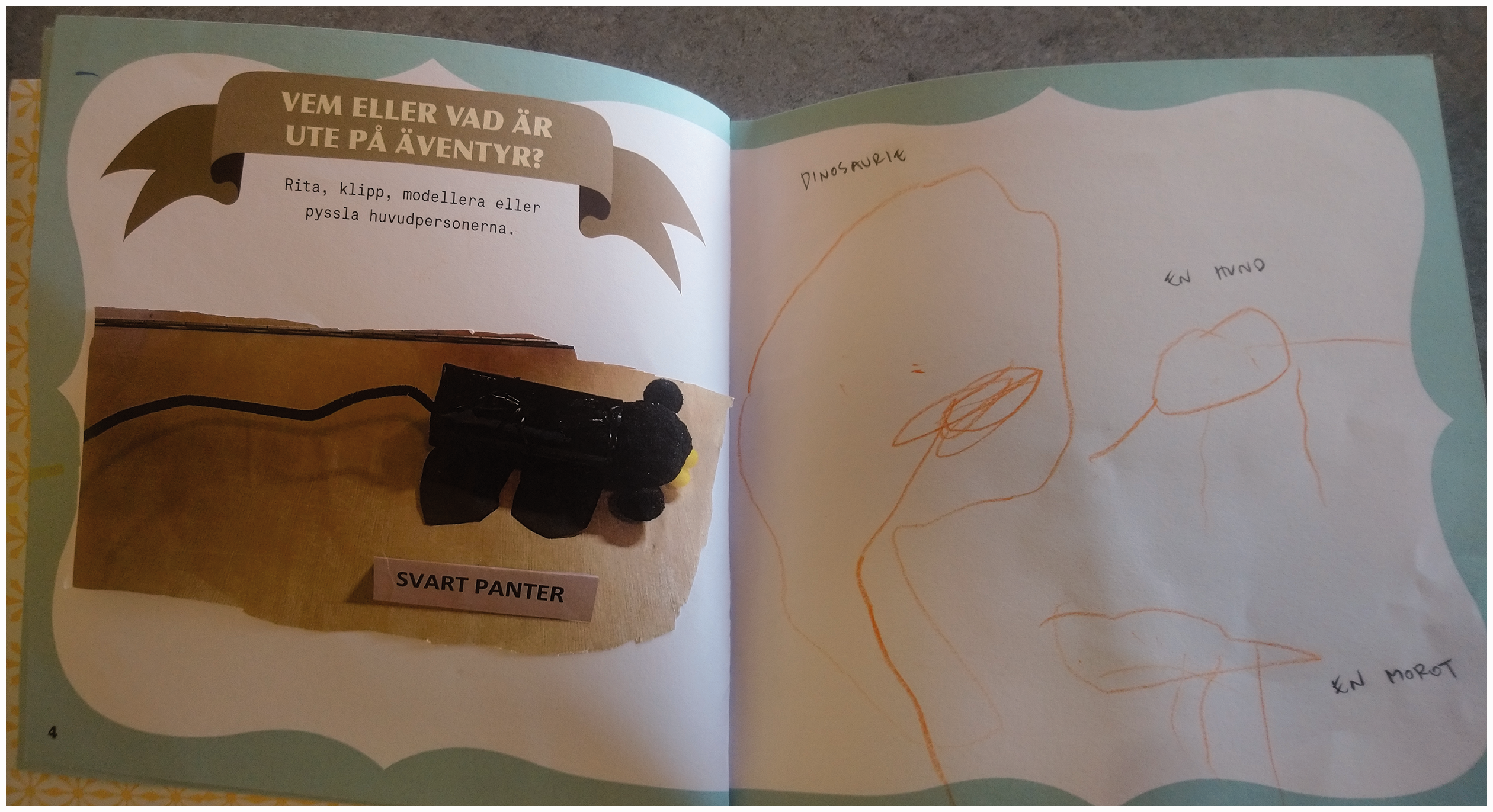
A spread in a Viggos Storybook. The Storybook guidance (translated from Swedish in brackets): [Who or what is out on an adventure? Draw, clip or clay model your main characters]. Main characters: A black panther on the left, a dinosaur, a dog and a carrot on the right.
The groups’ Storybook project followed a multiliteracies pedagogy framework of experiencing, conceptualising, analysing, and applying (Cope and Kalantzis, 2009; New London Group, 1996). That is, the project entailed the children making their main character with clay and/or crayons, creating sounds for the story with the help of digital devices and QR codes, familiarising themselves with weather symbols and emojis, using clips from newspapers, and sharing their story with the other children during a group session.
Affective literacies and intensities in early childhood education
Sociocultural theories have played a commendable role in highlighting the significance of multimodal interaction in young children's literacy practices. In the field of early childhood literacy, sociocultural perspectives conceptualize literacies as socially situated practices, embedded in historical and cultural contexts and practices, considering the multimodal nature of children’s meaning-making and communicative practices (Kress, 1997; Larson and Marsh, 2013). However, within this framework of literacy practices the affective intensities in literacy learning have not been thoroughly explored (e.g., Dernikos, 2020). That is, the emotions and feelings, bodies and movements, sensory dimensions and events which unfold in often unexpected ways and which also encourages us to reimagine our understanding of literacies. These affective intensities can inform and transform literacy learning and teaching. The new materialist approach adopted to unfold joy in this study brings forth a new perspective to children’s literacy practices, that is, how affective intensities unfold in the in-betweens and interconnections of human and nonhuman bodies. Further, the new materialist perspective may offer insights into how joy can be promoted in early years classrooms in everyday activities and literacy practices, by shedding light on the unexpected and embodied unfoldings.
There has been a growing interest in affective literacies and relational and material aspects of literacy practices amongst literacy scholars in recent years (e.g., Burnett and Merchant, 2018, 2020; Burnett et al., 2014; Leander and Ehret, 2019). Leander and Ehret (2019) discuss the affective turn in literacy studies as a result of the need to consider the affective and embodied entanglements in order to understand literacy practices. Further, Leander and Boldt (2013) emphasize literacy as situated, forming relations and connections in the ongoing present, often in unpredictable ways, and as saturated with affect and emotion, which representational approaches are unsuccessful in answering, as they suggest in their critical exploration of “A Pedagogy of Multiliteracies” by the New London Group (1996). Following this line of thinking, affective intensities, multimodal literacy practices and meaning-making are deeply entwined with the material dimension. Accordingly, some literacy scholars have turned to sociomaterial (e.g., Kervin et al., 2017), new materialist (e.g., Wohlwend et al., 2017) and posthuman perspectives (e.g., Sheridan et al., 2020) in exploring the affective (e.g., Burnett and Merchant, 2018) and material dimensions (e.g., Hackett and Rautio, 2019) of literacies. Kuby and Rucker (2020) refer to literacies as lively in their investigation into literacies as otherwise and children as fully (in)human, whereas Dernikos (2020) maps out how enthusiasm emerges during literacy practices and is entangled with embodied movements, affect and sonic vibrations as a means of understanding social justice. Thiel (2020) discusses how unruly placemaking events and embodied literacies disrupt the capitalist structures underpinning traditional understandings of everyday early childhood literacy practices. This body of research makes visible ways in which literacies and affective intensities are entangled with bodies and movement, and how they can be unexpected and unruly. Building on this work, we focus on the notion of joy. By attending to the intra-action among humans and nonhumans, it becomes possible to examine joy free from dualisms, such as material/immaterial, mind/body, nature/culture (e.g., Dernikos et al., 2020).
Adopting a new materialist perspective in tracing entanglements of early childhood literacies brings the use of space, resources and embodied intra-actions to attention (see also Hackett et al., 2020). Further, the new materialist approach suggests an attentiveness to the assemblages (Deleuze and Guattari, 1987) constituted by the physical, temporal and spatial aspects of young children’s literacy practices (Burnett et al., 2020; Kuby and Rowsell, 2017). If early childhood literacies are saturated with affect, entangled in relationships, embodied and situated in the material dimension, joy may be unfolding in these settings.
A new materialist perspective to joy: Thinking with intra-action and agential cuts
Intra-action (Barad, 2007) encompasses entangled relationships of humans and nonhumans in constant and joint exchange and influence. In the present study, thinking with intra-action draws our attention to how children and the material dimension contribute to unfolding of joy (see also Kumpulainen et al., 2019). The conceptual framing of intra-action lies in Barad’s (2007) agential realism, where humans and nonhumans are regarded as agential actors in the world as it constantly comes into being (Barad, 2007; Braidotti, 2018). Implications of this understanding are that there is no separation of entities prior to intra-action and that humans are not the only agentive actors in the research scene (see Sheridan et al., 2020).
Some scholars have discussed the challenges in how to define joy and how to differentiate joy from other (positive) emotions or affects, and there is no generally accepted definition of joy in the research literature (see e.g., Karjalainen et al., 2019; Zembylas, 2007). We attended to affects as more than personal and individual feelings or emotions, rather like intensities that can amplify or diminish the capacity to act, and which emerge in encounters with (both human and nonhuman) others (Dernikos et al., 2020). Further, we understand joy as an affective intensity which “augments our power of acting” (Deleuze, 1988: 101). Essential in our new materialist approach is that joy is socially, culturally, politically and historically informed, without ignoring the relationality and interconnectivity of affective intensities. The approach emphasizes the role of both human and nonhuman bodily performances (or unfolding acts) and the unexpectedness of these unfoldings in educational contexts. Therefore, understanding affective intensities and emotions as situated, embodied and fissured, as proposed by Kuby (2014) guided our work. Kuby (2014) argues that “to ignore the performance of emotions in schools is to ignore students’ ways of knowing and making sense of their realities”. She suggests that we should understand affects and emotions as a verb, actively performed in relation to others, embracing the unpredictable performances of ways of being together, and understanding the larger relational, historical and ideological context in which emotions occur (Kuby, 2014). In the present study, this entailed attending to the unfolding joy as situated and embodied, and us being attentive to unexpected unfoldings of joy.
The new materialist approach applied in this study brings the physical, temporal and spatial aspects of young children’s joy and literacy practices to attention. Joy is considered to be a dynamic and messy affective intensity, and it is practically impossible to trace all the events, relationships and intra-actions which contribute to the unfoldings. Here the focus is on becomings, where meaning unfolds in the entangled relationships between humans and/or materials (Sheridan et al., 2020). Following this line of thinking, the objective in this study is not to predict outcomes of intra-action, but to study joy as it unfolds in situ. That is, how joy unfolds and is manifested in the intra-actions between children, teachers and/or material objects.
Thinking with the storybook project
When the group was working on their Storybooks, Alexandra (first author) was there documenting the sessions with a video recorder. If she was unable to attend the sessions, the teacher would record the activities. A small video recorder was used and was left at the ECE centre for the three-month period so that the teachers could film any literacy activities they found important and meaningful to record and share with the researchers. Alexandra asked the teacher to record all the activities she thought were promoting multiliteracies, but especially the activities around the Storybook. Alexandra missed a few sessions of making the Storybook and viewing these videos afterwards, it became clear to her how important her presence there was for the analysis and for thinking with the videos.
Following the relational and material unfoldings and manifestations of joy during literacy learning endeavours led us to adopt a non-representational methodology (Dernikos, 2020; Leander and Boldt, 2013; Vannini, 2015) in order to think with theory and data (Jackson and Mazzei, 2012). This entailed thinking with video recordings of the situations in which the children were working on their own stories and Storybooks, and using semi-structured interviews with the children (conducted in pairs), field notes, artefacts and photographs to provide additional insights to the analysis of the video data. In this study, the audio-visual data played a significant role, as they allowed us to go back to the recordings, and see, hear and relive the situations repeatedly. Thinking with intra-action (Jackson and Mazzei, 2012: 118-136) as a part of the non-representational approach allowed for a methodological means of experiencing data, that is, “to think and feel within the possibilities of the data and not “over” them toward conclusion” (Leander and Boldt, 2013). Furthermore, in this analysis approach we tried to think and rethink, vitalize, to “render rather than represent and report” (Dernikos, 2020). The aforementioned non-representational approach thus entails blurring the distinctions between theory and method in a reflexive move to think with theory (Jackson and Mazzei, 2012; Wohlwend and Thiel, 2019).
In our thinking with data, we approached embodied expressions of joy as communication in multiple modes entangled in the intra-actions among the agentive entities (see Kuby, 2014; Sheridan et al., 2020). We focussed on the intricate and dynamic relationships among actants and unexpected and expected actions, identities, materials and realities (see Wohlwend and Thiel, 2019). We were attentive to the embodied intra-actions among children, adults and materials during their engagement in literacy learning endeavours (Leander and Boldt, 2013).
Viggo and the storybook: Unfolding unexpected and embodied joy
In this section, we will delve deeper into the unfolding of joy during the Storybook project. We demonstrate how joy unfolded unexpectedly in a moment where three children, the teacher, Storybooks and other material resources, and Alexandra (a researcher, first author) intra-act. By thinking with agential cuts, the focus is on the relational and material becoming, rather than on separate pieces of data (e.g., Sheridan et al., 2020). The purpose of agential cuts is to connect entities to make them accessible and understandable (Wohlwend and Thiel, 2019). In this analysis, the focus is on a cut that involves an enticing moment in which the entanglements of Viggo, a Storybook, Tove, the classroom, Alexandra, scissors, magazines, glue sticks, markers and a teddy bear come to matter. In particular, the focus is on the dynamic relationalities and tensions among these agentive entities, making visible the joyful materialising of the Storybook. The following vignette sets the stage for our analysis.
Viggo is a five-year-old child. He is one of the eight children in this group. He is bilingual, as most of the children in the group are. His Finnish seems to be stronger than his Swedish, and as Alexandra gets to know him, she wonders if one of the reasons Viggo is drawn to the Storybook is how it provides him with multiple opportunities to express himself, through drawing, creating a soundscape, modelling with clay, and dramatizing. Usually, Viggo does not seem overly enthusiastic about various activities and crafts at the early childhood education centre, which according to the teacher Tove’s interpretive comment might have to do with some challenges with his fine motor skills. However, Viggo seems excited every time he works on his Storybook. He is absorbed by the book, the story he is making, or something about the whole project, in ways that do not appear in other activities. This is exemplified when Viggo insists on continuing working on his Storybook even when the official session is over, and he grasps the book with both hands so that it doesn’t get taken away from him.
In this situation, three children, the teacher, and me with the camera, are sitting around a table in the classroom. The children, that is, Noah, Malin and Viggo, are finalising their Storybooks with the help of Tove (the teacher). The Storybooks lie in front of the children, and on the table are also scissors, magazines, glue sticks, markers and a teddy bear. The situation gives Alexandra an impression of a mutually trusting and unrushed atmosphere in the classroom, as she is trying to capture the moment in her field notes as well as in a video recording. The impression was also formed through her observations in the class, the children turned to Tove when they were wondering something, and Tove took the children’s initiatives seriously and treated the children with respect and affection.
Tove looks up from the paper on which she is writing down Viggo's story and says: Snipp, snapp, snut, så e sagan slut (literally: Snip, snap, snout, thus the story ends; a common ending for stories and fairy tales in Swedish). What a wonderful story you have. Viggo flips through his book smiling, then closes the book and keeps it in his hands and states: Now my story is finished without any particular audience, but he seems pleased. There is a calmness in the way he states that his story is finished, both in the tone of his voice as well as in his movements when he gently picks up his book with a subtle smile. Tove responds, smiling and looking at Viggo: Now it is finished, yay! Viggo smiles back and gazes through the window as he lifts the book to his chest and hugs it with both arms (see Figure 2).
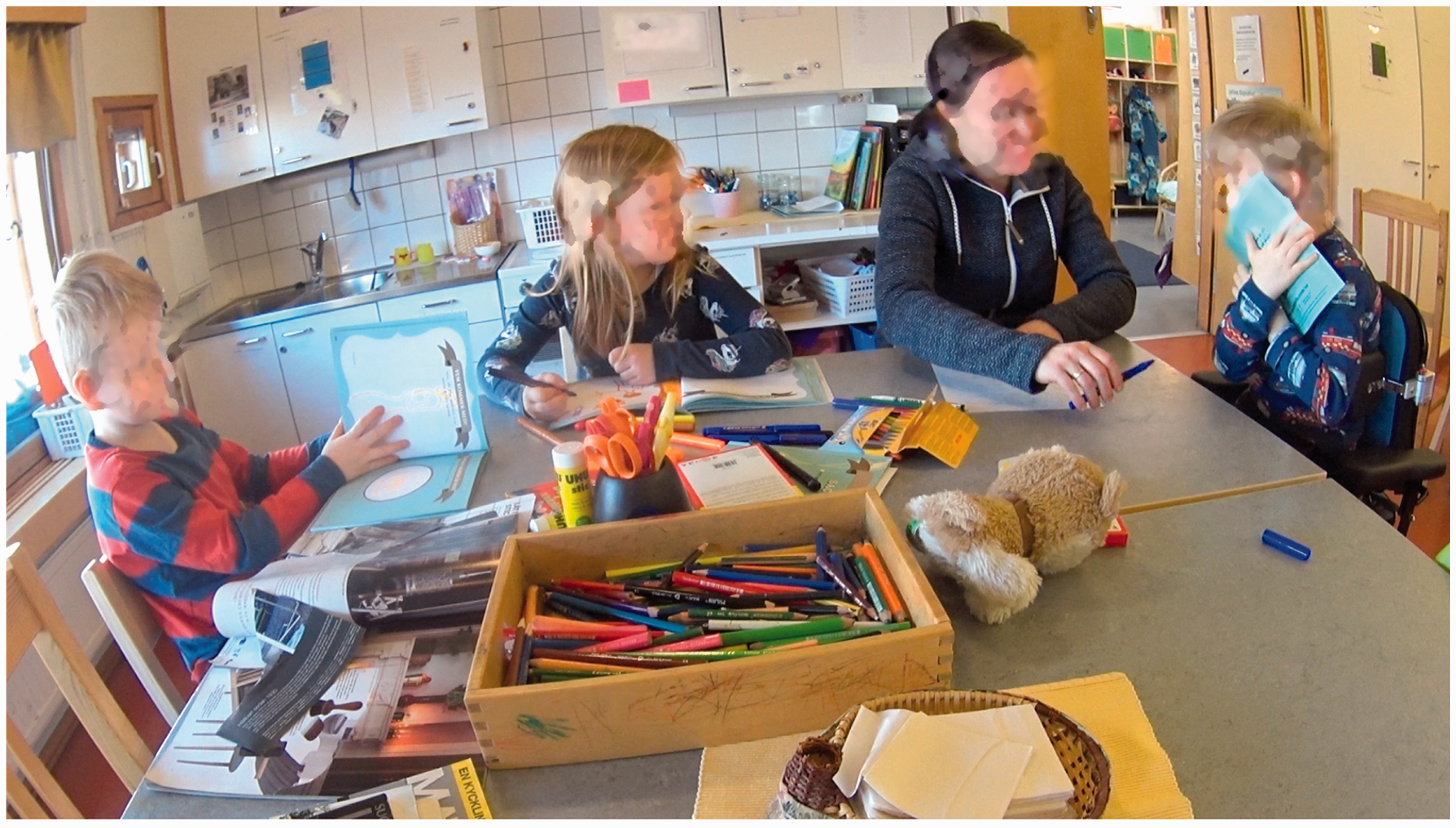
Unexpected embrace.
The embrace surprises Alexandra, and she interprets that the same applies to Tove. Tove gives Alexandra a surprised but smiling look and then turns towards Viggo again. Here, the movements ignite the affective intensity and distribute it across the space. Alexandra is left wondering if Viggo himself is surprised by this embodied manifestation of joy. Aww, says Tove and smiles at Viggo. Her tone of voice is soft, and in this short statement, her voice is almost crackling, which Alexandra reads as being deeply moved and even overwhelmed. Tove’s gaze shifts from Viggo to Alexandra, and further to the other children sitting at the table, and back to Viggo, while laughing. Tove is holding a marker in one hand, and with the other reaching out to grab the cap, not shifting her gaze away from Viggo. She tries to make contact with Viggo, and he answers her so much that she can write down his story. For Viggo, communicating with Tove does not seem important at this moment. Even though Viggo does not verbally answer Tove, he acknowledges her words with a smile and nod. The Storybook is in Viggo's hands, up against his cheek, and the movements require Viggo to let go of the marker he has in his hands to keep up with the embrace. Tove looks at Alexandra and smiles. Alexandra smiles back. Just moments later, Viggo initiates a high five with the Tove, which is followed by smiles from them both. During this time, the Storybook stays in Viggo's hands. Tove reaches out to grab the Storybook (so she can insert a piece of paper in it), but it refuses to leave Viggo's hands, the bond is not yet ready to be broken.
This vignette aims to try to enliven the warmth and affection of the situation, which quite frankly, seems like an impossible task but worth trying. Attempting to put this to words falls short of the experience of both being there and the feeling of being part of this distributed moment of joy. In this agential cut, the dynamic relationalities among Alexandra, Tove, Viggo, the Storybook, the marker and so forth are entangled in an intra-action in which the joy is becoming. Here, Viggo and the Storybook initiate something that disrupts the everyday activities in the classroom with a wave of joy. Together they make joy matter.
Not only does this moment materialise joy in Viggo, but the joy was also distributed across the assemblage and space. Tove, the other children and Alexandra were also affected. Further, the joy is not limited to that moment only, but it is distributed across time as well – Alexandra feels it again when she reviews the data. The agentic role of the video data becomes apparent when it re-ignites that moment of collective joy when she watches it later, and the ways that it puts her in relation to the warm feelings that she felt amid the situation itself. Presumably, the joy is something that will also be enfolded in the book – so that Viggo will continue to experience joy through his ongoing contact with the book. Perhaps the joy will be extended to other readers of his book as well. Also, while we only share this one moment of Viggo and his Storybook in an embrace, noteworthy is that this is an entanglement of matter and feelings materialised through the months of the process of its making.
In these entangled and embodied intra-actions among children, adults and materials (see also Kuby et al., 2015), we might experience what Thiel (2020) describes as “an undeniable intimacy that demands a body’s careful and thoughtful attention”. This demonstrated divergence from the expected, together with the notion that affect is not predictable and is established in relation to others, resonates with Kuby’s (2014) idea of emotions and affects as fissured, embodied and situated. Further, it resonates with Thiel’s (2015) suggestion that children are more engaged when provided access to a wide range of materials and opportunities to explore and participate in literacy practices, which may also be significant for the unfolding of joy. As Daniels (2019) points out, young children’s literacy practices are contingent on unexpected assemblages and relationships between the children, the material resources and the classroom.
Further, we emphasize that joy is not only unfolded in a specific moment but has temporal and spatial tracings in events, feelings, relationships and intra-actions, which will remain untraceable (see also Burnett and Merchant, 2020). Joy unfolded, not only in between children’s situated and temporal social relationships with other children or the teacher (nor me) but also in relation to the material resources and surroundings (see also Daniels, 2019), such as the Storybook. As researchers and educators, this is something we should pay attention to to a greater extent; we should be more receptive to the moving bodies and matter around us.
Conclusions
We suggest that paying attention to the material resources and the material environment is pivotal in investigating young children’s joy, as the material dimensions are an often neglected, but important part of children’s literacy practices. Kuby et al. (2015) came to a similar conclusion in their investigation into children’s intra-actions with materials in literacy learning, arguing that the intra-actions with materials should be validated as a way of communicating alongside basic reading and writing. Moreover, our thinking with data illustrates the role of materiality in young children’s joy, which is a relatively novel perspective in investigating affective intensities in educational settings. Within the new materialist approach, it was possible for us to reimagine the relationships among humans and nonhumans in everyday early childhood literacy activities (see also Wohlwend and Thiel, 2019). The unfolding of joy was fluid and recursive. Our new materialist perspective draws attention to the unfolding manifestations of joy as an effect of mutual engagement in intra-action of children, adults, and materials. In other words, we are unsettling the idea of the individual human as the sole site of production of affects and emotions. We do this by attending to moments when people, material resources and the surrounding environment offer opportunities in relation to each other.
The literacy practices in the Storybook project were multimodally accomplished, using a wide range of material resources. The project afforded the children with opportunities to create their own stories, drawing on their interests and experiences. In their multimodal literacy practices, the children were entangled with materials, people, pedagogies and the environment. The activities encouraged the children to engage with varied materials and afforded multiple rich intra-actions with the material resources and the surrounding environment. The Storybook project illuminates children’s ways of knowing, being and doing, emphasizing the material and situational nature of young children’s literacy practices in educational contexts (see also Burnett et al., 2014).
The unfolding joy in the case of Viggo and the Storybook might indicate pedagogical implications relevant to early years practitioners and early literacy pedagogy. Specifically, we illuminate how affective intensities are entangled in the social and material aspects of literacy practices and meaning-making. We suggest that joy emerges in everyday practices and that it does not always emerge by intent or predictably, but rather through unfolding processes. The unfoldings discussed in this paper provide insights into the entanglements, intensities and embodiedness of joy. Moreover, we suggest that to develop a pedagogy that supports the occurrence of joy, the pedagogical design should consider an open-endedness of activities, affording opportunities for children to freely explore and engage with both the materials resources as well as the surrounding environment, and encouraging them to do so.
Footnotes
Acknowledgements
We would like to express our sincere gratitude to the children and practitioners who participated in this study. We gratefully acknowledge the MOI research team for valuable suggestions and discussions. The reviewers are thanked for critically reading the manuscript and suggesting valuable improvements.
Funding
This study was funded by the Finnish Ministry of Education and Culture’s The Joy of Learning Multiliteracies research and development programme (no. OKM/15/040/2017) and Victoriastiftelsen.
