




Abstract
What might the concept of queer joy offer to early childhood educators in New Brunswick, Canada? As a part of a study about the supports and barriers to comprehensive sexuality education in New Brunswick, Canada, we sought to speak with early childhood educators about the ways in which sexuality education happens in early childhood centers. We wondered: What kinds of sexuality education is already happening within early childhood centers and under what conditions? What do educators need to feel supported in this work? In a study with 11 early childhood educators, we found that they often spoke about 2SLGBTQI+ people and families through a lens of inclusion. Yet, despite this inclusion of 2SLGBTQI+ identities into the normative ECE space, there was no understanding of queerness and transness as joyful—and no real thinking through what queerness and transness might offer the educator and the classroom space in early childhood centers. As we imagine the possibilities for sexuality education within ECE contexts, we look forward to seeing what might happen when children and educators summon queer joy.
Introduction
What is queer joy and what might it offer to Early Childhood Educators in New Brunswick, Canada? Queer joy—which engages joy, collaboration, and collective world-building—is an important project within Early Childhood Education (Burkholder and Keehn, 2024; Burkholder et al., In Press; Wright and Falek, 2024). We are interested in exploring how 2SLGBTQI+ 1 families and communities thrive in their social worlds—including interactions within Early Childhood Education (ECE)—outside of risk and loss frameworks (Fields et al., 2014; Robinson and Schmitz, 2021). ECE typically attends to the lives and learnings of children from birth to 8 years of age. In jurisdictions across most of North America, 2 this means that ECE usually crosses into two locations – Early Learning and Child Care (ELCC) centres 3 in the years prior to universal public education, and within schools from kindergarten (for 5-year-olds) to second or third grade.
There is limited current research on the knowledge and comfort level of New Brunswick sexuality education teachers, and no existing research on sexuality education within Early Childhood Education in New Brunswick, Canada (Exceptions include: Burkholder et al., In Press; Keehn and Burkholder, In Press). While Cohen et al. (2004) reported that elementary and middle school teachers were supportive of the inclusion of sexuality education curriculum, they also reported that they felt only somewhat knowledgeable and comfortable teaching sexual health topics. For instance, only 60% of the teachers surveyed had received training on teaching sexuality education. The authors also noted that, “teachers questioned their ability and comfort around content addressing some of what were perceived as more sensitive topics such as sexual diversity, masturbation, sexual behavior, and sexual problems, and concerns” (p. 6). In a 2016 national survey of Canadian educators, teachers admitted that 2SLGBTQI+ students would not feel safe in their schools and a minority of teachers also felt teachers should be able to opt out of 2SLGBTQI+-inclusive education (Taylor et al., 2016). In our 2021 survey of 412 New Brunswick in-service educators, we found that most teachers believed that sexuality education was an important component of school-based learning, and that particular topics should be covered in K-2 contexts, including: the appropriate names for genitals, consent, bodily autonomy, personal safety, and gender and sexual diversity (Byers et al., 2024). We also learned that:
Most participants reported that teachers in general, and themselves in particular, were not provided with adequate training to teach SHE either as part of their Bachelor of Education training or through subsequent professional development opportunities in their work as in-service teachers. Nonetheless, about half of the teachers had taught SHE in New Brunswick. Perhaps as a result, many had engaged in self-directed learning. (Burkholder et al., 2022: 5)
This article describes a component of a larger SSHRC-funded study called Supports and Barriers in Teaching Comprehensive Sexuality Education in New Brunswick (SexualityNB). We have worked with pre-service and in-service teachers (Early Childhood Centers to Grade 12) to investigate the real and perceived supports and barriers to incorporating comprehensive sexuality education in New Brunswick early childhood centers and public schools. Part of our aim is to challenge ableism, white supremacy, settler colonialism, and cisheteronormativity in school-based sexuality education. In this article, we explore a subset of this study, working with 11 ECE educators. First, we explored sexuality education practice with three early childhood educators through a series of qualitative interviews. Later, we held participatory arts-based research workshops exploring sexuality education with 16 in-service educators (in this group, 8 participants were early childhood educators). In this paper, we look to the data emerging from this fieldwork to investigate two of our project’s larger questions: What is happening in ECE settings in relation to sexuality education in New Brunswick? What issues, supports, and barriers are early childhood educators encountering in their classrooms as they teach?
Positioning ourselves in the study
We come to the study differently positioned. Casey is a white cis femme bisexual associate professor and the PI of the SexualityNB Project. Pam W. is a white cis female. Pam M. is a cis femme lesbian assistant professor who began the project while living and working in New Brunswick and who has since relocated to Ontario. Melissa is a white cis femme lesbian educator and faculty lecturer in New Brunswick.
We submitted an earlier draft of this paper to the 2023 American Educational Research Association (AERA) annual meeting, and had our paper accepted for presentation. On her way to the conference, Casey tweeted an image of our paper handout that shared the title of our piece, “Making space for queer joy in early childhood education: Exploring the ways that early childhood educators take up gender and sexuality in New Brunswick, Canada.” A few days after the conference, when Casey had returned home, a noted contrarian Canadian media personality 4 found a tweet that Casey had written earlier that month which read “Excited to travel to Chicago today for #AERA2023—I’ll be presenting on #queerjoy & #gender & #sexuality in early childhood education with @aeraqueersig (2:50 pm, April 13th).” This contrarian media personality alerted his followers to the tweet by quote tweeting Casey and offering the remark, “Yes this doesn’t sound creepy” (see Figure 1).
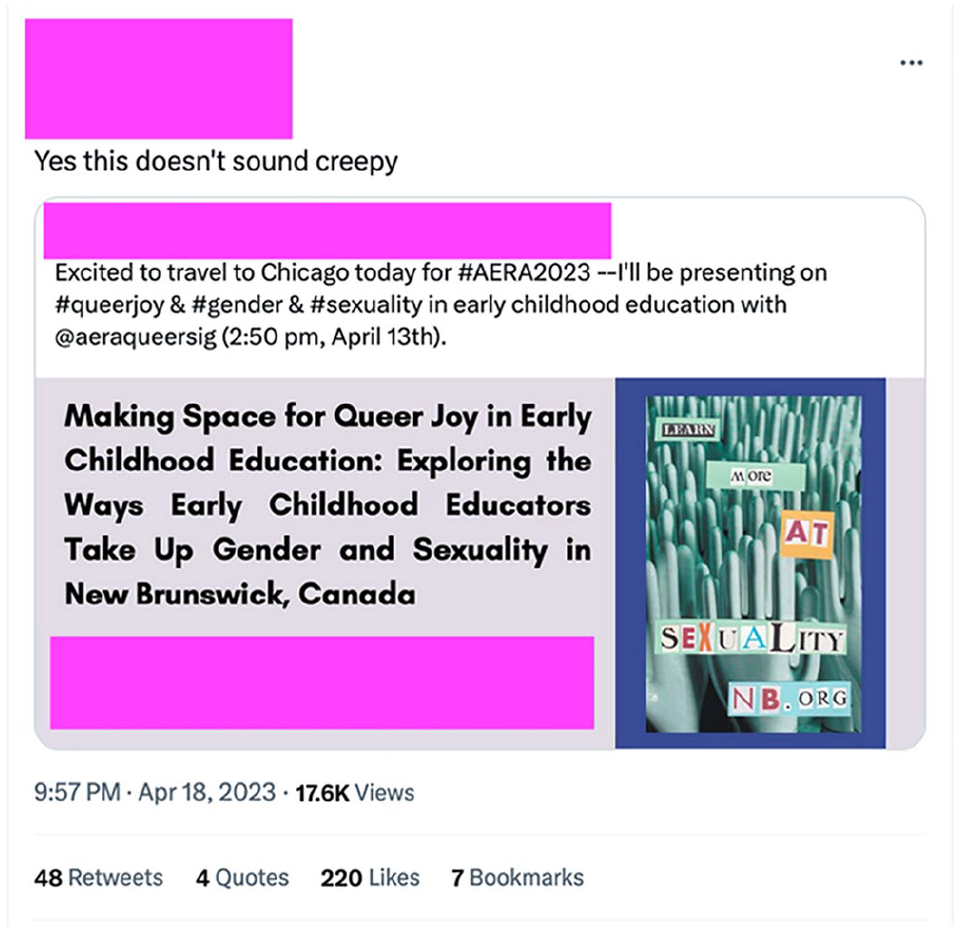
AERA Tweet.
Following this retweet, several internet commentators responded to the title of the conference paper. They published Casey’s work address online for other concerned queerphobes to take note of. The resulting comments highlight some discourses that circulate in response to including queer and trans people and communities in ECE spaces. Through their discursive responses, these commenters do the work of solidifying the notion that “the way particular positions—including those perceived as political, radical, feminist or queer—are considered to be ‘having an agenda’, while the status quo or normative positions are considered neutral, despite also having values embedded” (Chapman, 2022: 5). We seek to take their critiques seriously and respond to them through the existing research literature and by drawing on our own findings, keeping our research questions in mind: What is happening in ECE settings in relation to sexuality education in New Brunswick? What issues, supports, and barriers are early childhood educators encountering in their classrooms as they teach? In addition, we wish to highlight the ways that these positions serve the status quo while simultaneously promoting violence and misunderstanding. We imagine how we might respond through an interrogation into what queer joy offers sexuality education in ECE. We structure our theoretical framework and literature review using three Twitter comments—made in response to Casey’s Tweet about presenting at AERA in Chicago in April 2023—to respond to current public discourse about sexuality education, queerness, and perceptions of childhood. Then we describe our findings using preliminary qualitative semi-structured interviews with 3 early childhood educators in New Brunswick, and data from an arts-based workshop with 16 in-service educators. First, we contextualize New Brunswick’s political and educational landscape.
Context
To gain an understanding of educators’ experiences within sexuality education, we first situate the study in New Brunswick’s sociopolitical context when we undertook the study, including the 2023-2024 public debate around the New Brunswick Education Department’s Policy 713. Policy 713 sets out the “minimum requirements” to support queer and trans youth (and workers, including teachers, assistants, and staff) to feel supported in schooling spaces (e.g. classrooms, field trips, extra-curricular activities; Government of New Brunswick, 2020: 1). In 2023, the then Minister of Education (Bill Hogan) noted that he sought to “make changes” to Policy 713 based on public outcry, with what he described as “hundreds of phone calls and emails” (Ibrahim, 2023: para. 5). After the province’s Child and Youth Advocate (Kelly Lamrock), asked for the emails and phone calls that led to this decision, the three emails sent over 4 months were released to the public—not hundreds as the Minister had previously reported. The Minister of Education’s primary concerns are around “biological males” sharing washrooms with female students, that trans students can play sports, and that students may ask to be referred to by a name and pronoun without their parents’ consent (Canadian Press, 2023). The now former New Brunswick Premier (Blaine Higgs) was in strong support of the Minister’s suggestions and noted that children should not be exposed to any kind of “promotion” of queer and trans communities in schools (Ibrahim, 2023). Policy 713 emerged in 2020, and it took only 3 years for conservative rhetoric to disrupt this policy (that needs strengthening, not weakening; Burkholder and Keehn, 2024). We acknolwedge that since our original writing, Premier Higgs and Minister Hogan have been removed from their positions as premier and minister in an election that took place in October 2024. The original Policy 713 was reinstated by the newly elected Susan Holt government. While Higgs lost his premiership and riding, Hogan was reelected by his constituants to continue to serve as an MLA in the provincial government. Although they no longer influence educational policy in New Brunswick, the legacy of their transphobic policy making has had reverberations across Canada, and impacted the landscape of our study, which we describe below.
The 2023 Policy 713 review unfolded alongside escalating threats against trans and queer communities across Canada (Boynton, 2023; McGinn, 2023) and a sharp increase in anti-queer and anti-trans rhetoric and violence in the United States (CBC News, 2022; Mangin et al., 2022), and the UK (McLean, 2021). In August 2023, the New Brunswick provincial government pushed forward the revision to Policy 713 which “create different and restrictive rules for Trans and gender diverse students than their peers. This discriminates against trans and gender diverse students, and could expose these young people to serious harms, bullying, and violations of their privacy – at home and at school” (Canadian Civil Liberties Association (CCLA), 2023: para. 2). In September 2023, the 1 Million March 4 Children protests held across the province saw a vocal minority of the public taking to the streets to decry the inclusion of sexuality and gender identity in public schooling (1 Million March 4 Children, 2023). Our work together was grounded in this political context, as well as a critical queer theoretical context that seeks to disrupt and decenter whiteness and settler colonialism as well as homonormativity (Smith, 2010). We frame what follows using three Tweets on X made in response to Casey’s AERA Twitter post as our subheadings. On the advice of the editors of this journal, we have removed the citations which link these phrases to specific social media users.
“Sexuality has no place in ECE” (Anonymized, 2023)
The New Brunswick Early Learning and Child Care Curriculum Framework– English (2008) 5 (NBCF~E) is the mandated curriculum for young children birth to four in New Brunswick. This curriculum framework specifically includes mention of sexuality education, and it is important to be clear about what is included. The official curriculum documents articulate that “each child embodies race, religion, culture, language, social & economic status, gender, sexual orientation, and ability” (Early Childhood Research Team, 2008: 5). The expectations of learning within the NBCF-E related to gender and sexual orientation are explicitly present within the Diversity and Social Responsibility: Professional Support Document (Ashton et al., 2010). For example, within the section called “Appreciating their own distinctiveness and that of others,” learners are expected to “becom[e] knowledgeable and confident in their various identities including cultural, physical, racial, spiritual, linguistics, gender, social and economic” (See e.g. Ashton et al., 2008: 6–9). Intersectional identities, alongside the call to change exclusionary and discriminatory practices and making choices in decisions that affect them, honor the rights of children as per the United Nations Conventions on the Rights of the Child, including gender expression and identity. Other aspects of sexuality and gender education including sense of self, relationships with self and others, problem-solving, and literate identities are integrated within the broader-based learning goals of well-being (Ashton et al., 2008), play and playfulness, communication, and social responsibility (Ashton et al., 2009). We also recognize the lived curriculum differs from the official one, and we expand upon this below.
There seems to be some public misunderstanding about the kinds of topics that are included in sexuality education in ECE. One Twitter user noted in response to Casey’s AERA Tweet, “Introducing BDSM 6 to children as part of early childhood education?” (Anonymized, 2023). While there is no mention of BDSM in the New Brunswick Early Learning and Child Care Curriculum, other aspects of sexuality and gender education including relationships with self and others, problem-solving, and literate identities are integrated within the broad-based learning goals of well-being, play and playfulness, and communication (Ashton et al., 2008). However, moral panics about sexuality education endure in the ECE setting. As one Twitter user noted, “Those two things [Queer Joy & Early Childhood Education] have no place in the same sentence. This is sexuality we are talking about. This has zero positive impact for kids that have no idea what sexuality even is. Insane” (Anonymized, 2023). There seems to be some fear about what is and what is not included in sexuality education in ECE. As we learned through our conversations, the sexuality curriculum is most often an emergent one, negotiated with young children, their educators, and families. Having established the context in which sexuality education exists in New Brunswick’s ECE spaces, we now turn to the theoretical framework of the study.
Theoretical Frameworks
“Queer theory is the gateway to hell” (Anonymized, 2023)
This study adopts a critical perspective that foregrounds the possibilities of queer joy in sexuality education (Burkholder and Keehn, 2024; Wright and Falek, 2024). Within ECE contexts, such as the one in New Brunswick, we acknowledge that whiteness, cisnormativity, and heteronormativity function as the normative standards influencing the values and norms perpetuated in educational centers, including curricula (Burkholder et al., 2021). This extends to the representation of certain types of families and the organization of play-based environments (Renold, 2005).
We also draw upon critical queer theory as a lens for our work. Critical queer theory unsettles. Critical queer theory interrogates how particular genders and sexualities become normalized over others (Sullivan, 2003) and troubles those discourses working to hold gendered and sexual binaries in place (Miller, 2017; Segwick, 1990). Importantly, we wish to decouple the problem of whiteness and settler colonialism from queer theory (Smith, 2010), and in particular our expansive conception of queer joy, which makes space for Indigenous joy (Ashcroft, 2022), Black joy (Combs, 2023), crip joy (Danylevich and Patsavas, 2023), trans joy (Shuster and Westbrook, 2022) femme joy (Dahl, 2016), and fat joy (Evans et al., 2021), among other marginalized and deeply felt joys within the context of New Brunswick and elsewhere. Rather than a “gateway to hell,” queer theory encourages questioning of the status quo and a thinking through of power and order (Segwick, 1990). We look to queer joy as a theory and method of resistance amidst this particular context. Tristano (2022) encourages us to center queer of color joy by confronting the hypervisibility of 2SLGBTQI+ people experiencing trauma both inside and outside of academia with joy:
Our joy holds immense power. We produce joy in spite of the material realities and structures of power placed upon us. It is a survival mechanism. A joyous state allows us to explore the limits of human curiosity; renegotiate what relationships can look, feel, sound, and smell like; and use desire to propel us through the social world where we refuse colonial futures and expand decolonial options (p. 279).
We also are deeply indebted to the theorizing of José Esteban Muñoz who offers us that “we must strive, in the face of the here and now’s totalizing rendering of reality, to think and feel a then and there.” He continues, “we must dream and enact new and better pleasures, other ways of being in the world, and ultimately new worlds” (Muñoz, 2009: 1). Children do this work of queer futurity—of reimagining and questioning and dreaming forward new worlds in their everyday. Casey has a kid who constantly does exactly this. They “dream[] and enact[] new and better pleasures, and other ways of being in the world” (p. 1). Teaching through queer joy offers us ways of imagining these new and better pleasures, taking the lead from children, and queering the world through joyful questioning.
Literature review
“Kids don’t need to see this sort of thing.” (Anonymized, 2023)
A recent review of the literature across early childhood (Prioletta et al., 2022) found that sexuality education is seen to be appropriate for older rather than younger children; an absent curriculum is theorized as maintaining a construction of childhood innocence (Blaise, 2010; Robinson, 2013). Adult constructions of childhood innocence have inspired resistant attitudes around young children’s sexual cultures (Ramjewan and Garlen, 2020) with early childhood curriculum also being concerned with the protection of young children from issues of sex and sexuality (Templeton and Cheruvu, 2020). Robinson (2013) argues, “sexuality has come to signify danger in the lives of children through discourses of innocence and protection, which have largely dismissed children’s sexual subjectivities” (p. 42; see also Davies and Robinson, 2010; Renold, 2005, 2006; Robinson, 2008, 2013). In ECE spaces, institutionalized sexual innocence, “not only produces confusing messages for children who overtly engage with or enjoy their sexuality, but. . . endangers those who experience sexuality as threatening or as harassment” (Renold, 2002: 429). Further, the assumption that parents actively resist sexuality education in ECE contexts (Davies, 2021; Kintner-Duffy et al., 2012) along with a lack of pedagogical resources and support, leads to sexuality education in ECE as being a largely unsupported and often uncomfortable curriculum. Yet, researchers in Ontario, Canada (Balter et al., 2016, 2018) studying ECE educators’ experiences working with young children (birth to aged 4), found that the emergent sexuality curriculum occurred during play, toileting, and self-touch, and was influenced by children’s family values. Our research with in-service early childhood educators corroborates this finding.
Recognizing that children recreate romantic narratives regularly in play (Blaise, 2009), we know that innocence doesn’t apply (Reddington, 2020). Indeed, the term childhood innocence emerged in the late 19th century through laws intended to protect young children from sexual exploitation by cis white men (Davies and Robinson, 2010). Childhood innocence was not theorized to keep children from exploring their own sexualities, which can have damaging effects on the way children perceive themselves, their families, or their non-normative identities (Davies and Robinson, 2010; Gilbert, 2014). Unfortunately, childhood innocence has become mired in rhetoric about developmentally appropriate practice. The National Association for the Education of Young Children (NAEYC), for instance, disrupts the notion of universal stages of development, since children experience diverse identities, injustices, and activism dependent on context and political climate (National Association for the Education of Young Children (NAEYC), 2020). Further, in Canada, children have both a right and a responsibility as citizens to uphold the grounds of gender and sexuality to be free from discrimination. This is also upheld by the United Nations Conventions on the Rights of the Child. So, not only do children have sexual agency, but it is their human right to know and understand human sexuality beyond heterosexuality. Omitting an affirming sexuality education in early childhood is not about innocence; it is about adult discomfort, homophobia, and transphobia.
Methods
Our project engages both qualitative and participatory visual methods, which offer opportunities for high levels of impact, participant engagement, and social transformation as important part of the research process (Burkholder et al., 2021; Kendrick et al., 2021; Mitchell et al., 2017). Engaging visual methods with participants provides direct forms of advocacy that are difficult to ignore, even by policy makers (Mitchell, 2011; Mitchell et al., 2017). In this article, we describe the findings from preliminary qualitative semi-structured interviews with 3 early childhood educators in 2021 and 11 early childhood educators in an arts-based workshop in December 2022. We note that it has been difficult to find educators to speak with us about their sexuality education practice in early childhood contexts and have used our preliminary analyses as another form of recruitment through video production (see Figure 2 and https://youtu.be/So6IRA4o0ek).
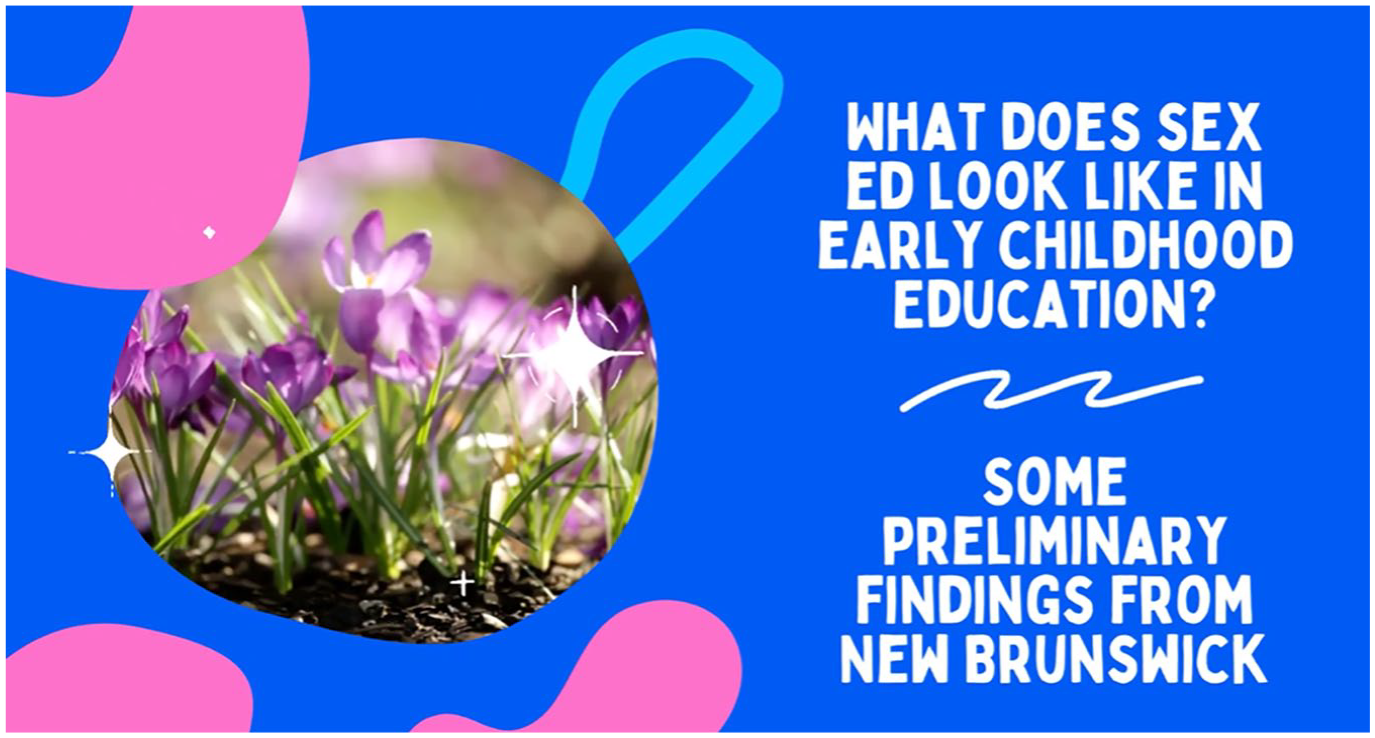
Preliminary findings from a study with Early Childhood Educators.
Data sources
To invite Early Learning and Child Care educators into this project, we posted an invitation (see Figure 3) on social media. We also contacted the Department of Education and Early Childhood Development where staff distributed the poster via email to directors of ELCC Centers.
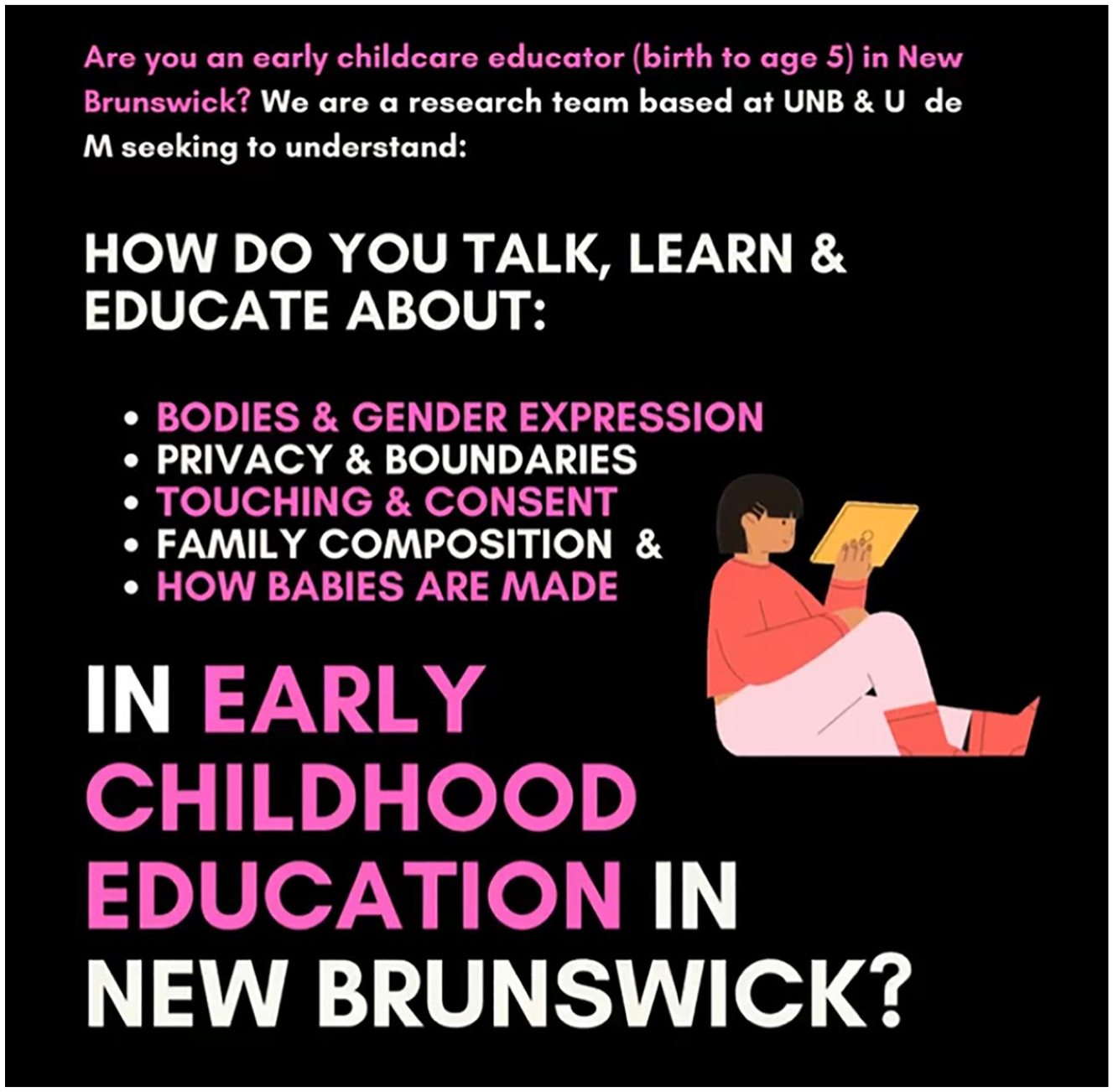
Recruitment poster.
Three early childhood educators responded to our invitation. Two of the educators we interviewed were working in or with designated ELCC centers, and one educator was working within a program for young mothers and their children. Madison 7 is a director of a not-for-profit ELCC located in a small town. She has 25 years of experience in her center as an educator and now director, and is also an active citizen within the town. Lori has over 20 years of experience working in childcare centers as an educator and a director, and currently works as a ELCC consultant in a large district. One of her responsibilities is to develop and implement professional learning. Dawn works as a child development coordinator in a program for young children and their mothers. She saw herself as a child advocate helping new moms learn about mothering, including how early gendered identities are taught and learned by infants and passed along by their moms. We met with each of the educators individually online in 1-hour semi-structured conversations.
Later, in December 2022, Casey and Melissa held an arts-based workshop with 16 in-service educators who taught Kindergarten to Grade 12. Eight of the participants taught in Early Childhood contexts (Kindergarten to Grade 2). We began by asking educators to create collages in response to the prompt, “what I wish I learned about teaching sexuality education” (see Figure 4). Next, we asked educators to create linocuts that responded to the prompt, “what do you desire to be successful in teaching sexuality education in your context.” We held several semi-structured group interviews alongside the art making, which helped us to understand teachers’ thoughts more broadly. This data, alongside the three interviews with early childhood educators, helps to inform our findings.
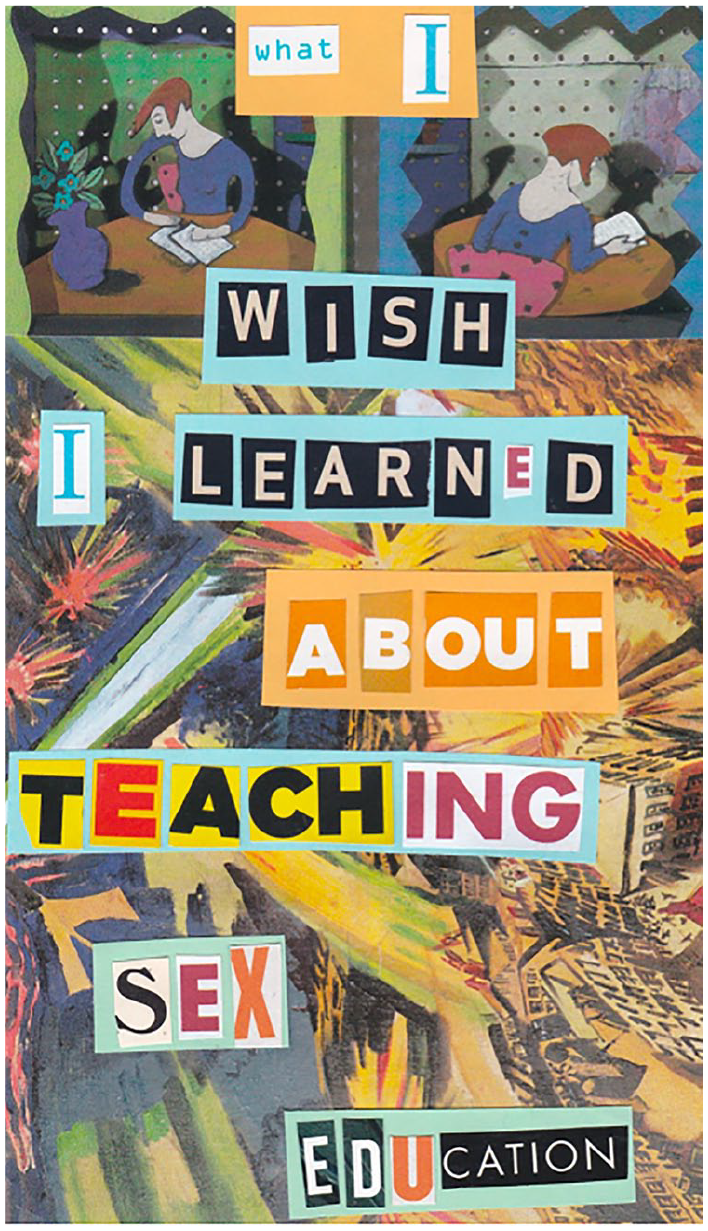
What I wish I learned about teaching sex education.
Findings
The emergent curriculum
In analyzing the transcripts with the early childhood educators through constant comparative analysis (Charmaz et al., 2018), where we co-constructed theory from the interview transcripts and art productions, we noticed that the sexuality curriculum was most frequently discussed in an emergent manner. Curricular provocation occurred through children’s questions and observations specifically within the context of bodies, play, and materials. Lori noted that the sexuality curriculum over the past 25 years had shifted from “where do babies come from, to gender fluidity.” Madison and Lori each recalled instances where bodies evoked curriculum, such as when mothers and educators were pregnant, and an instance when a father arrived in a skirt to pick up their child. As has long been the case in play, young children are continually taking up, assigning, and enacting family roles and characters from popular culture (Prioletta et al., 2022). In a play-based popular culture example, Madison described how a young child, while playing Elsa, began shifting their gender identity, first within the frame of Elsa-Frozen play and then more broadly across other areas of the center and at home. To support the child, family, educators, and herself, Madison started a private Facebook page with four families undergoing similar shifts so they would have a space to share their experiences. The educators in this study also reported that the sexuality curriculum emerged from children’s questions and was related to their knowledge of self and families. We shared these resources in a short video of our findings that we sought to share with educators, policy makers, government workers, and more (see Figure 5). We shared this video on social media and have archived it on our dedicated project website, https://sexualitynb.org.
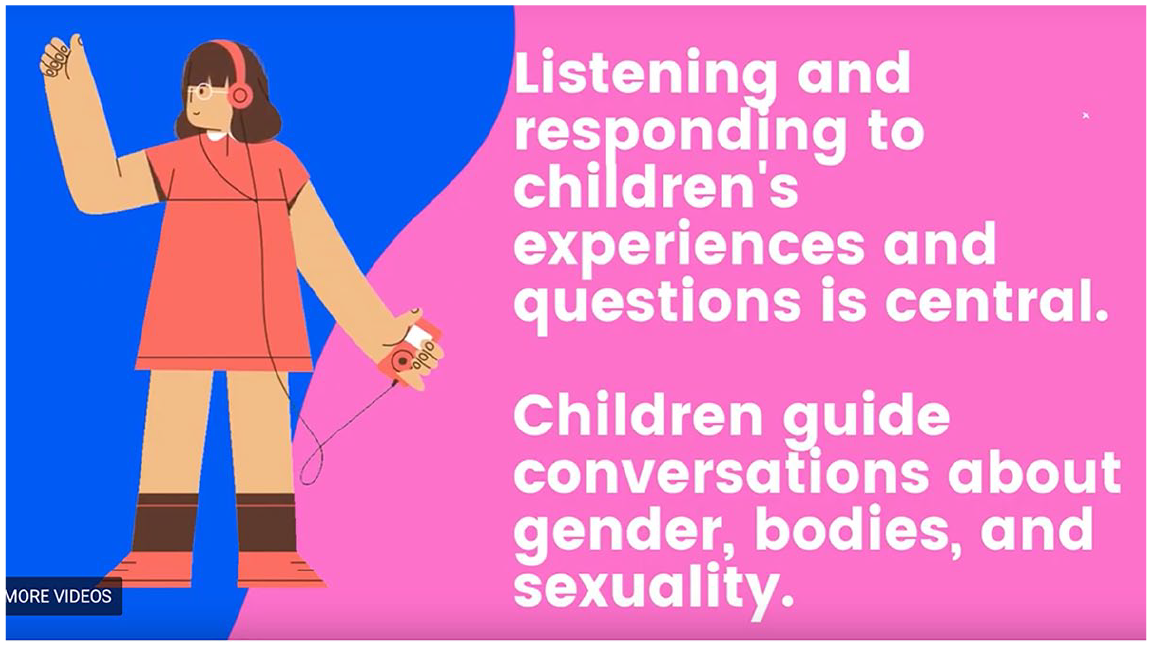
Children Guide Conversations about Gender, Bodies and Sexuality.
In the arts-based workshops, we found that the learner was placed at the center of inquiry into sexuality education. As with the three Early Childhood Educator participants, these 8 school-based participants suggested that sexuality education was emergent, and that classroom topics and content were often driven by student inquiry and questions. We also found that Kindergarten to Grade 2 educators in these workshops were seeking books, resources, and experts (see Figure 6)—tall orders in our underfunded schooling system.
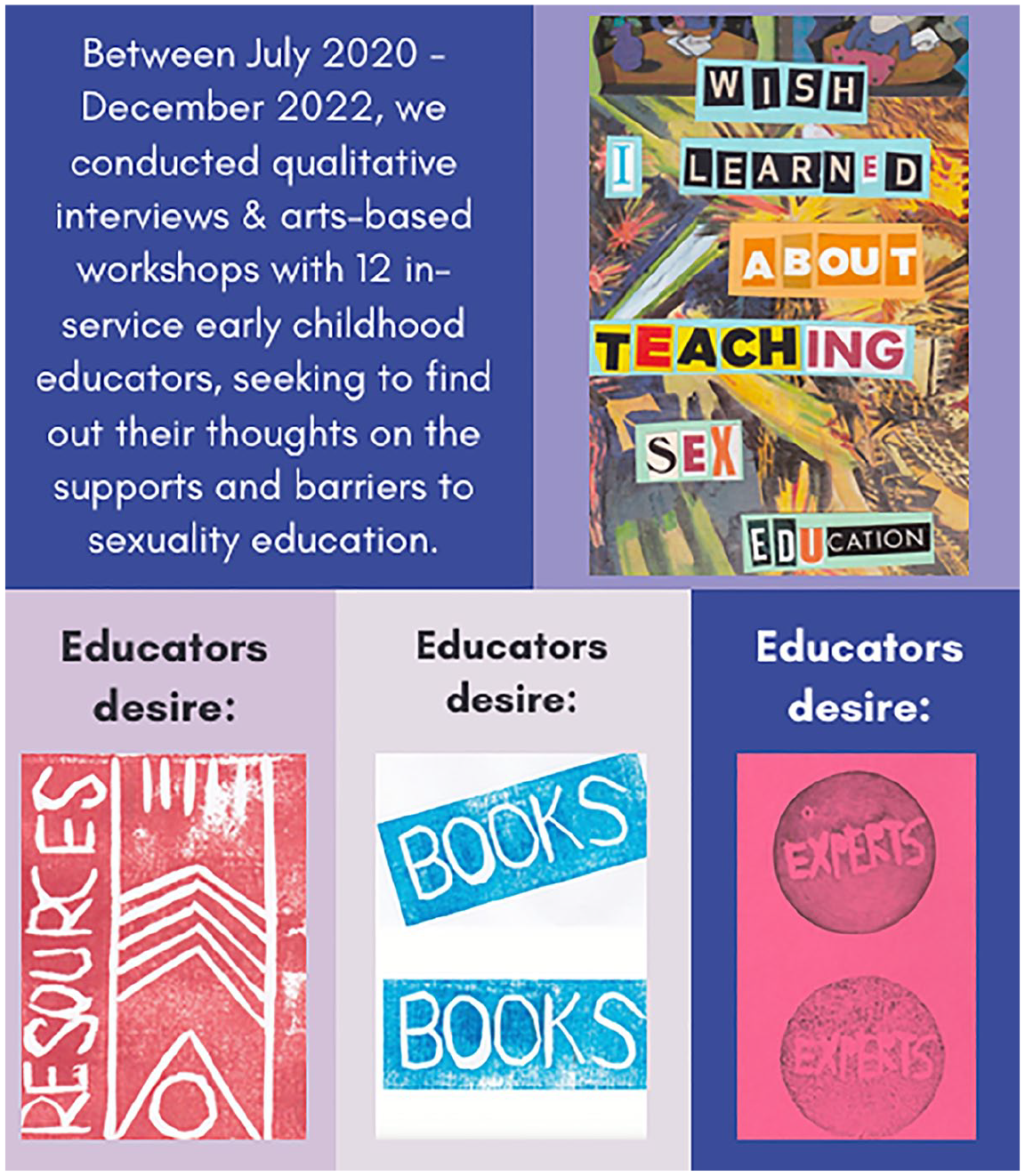
Educators desire resources, books and experts.
Sexuality education as a negotiated process
Sexuality curriculum was also evidenced as a negotiated process between people and discursively gendered objects. While meeting with mothers as part of her work, Dawn gave examples of their conversations around the gendered nature of young children’s toys. Madison spoke of a time when she changed the picture books in the center after realizing their focus on whiteness. As part of this initiative, she bought and included 2SLGBTQI+ books in the Center’s new collection and negotiated keeping them in the space when a mother expressed her concerns about their presence, requesting their removal. We see this act of resistance in the face of normative dissent to be an example of how educators sought to support their students first.
We saw educator-participants also construct the sexuality classroom as a space of hope and potential. As Halberstam (2009) writes of the queer and trans community, “hope is not something one can afford to lose and for them giving up on futurity is not an option” (n.p.). Likewise, in their work on queer utopias, Jones (2013) articulates, “we recognize that queer futurity is not so much about crafting prescriptions for a utopian society—in which everyone is happy and life is ideal—but by making life more bearable in the present because in doing so we create the potential for a better future” (p. 2). Here, queer futurities and utopias become less about achieving complete happiness and more about creating “spaces in which to breathe” (Jones, 2013: 3). In this sense, a queer utopia is the creation of a space that allows for both a push back against normativity and hope for queer futurity.
The educators spoke about contradictions and paradoxes within ECE sexuality education, and how they might be acted upon with various communities. Educators identified supports to their practice, which included: the presence of parent committees, supportive curricular frameworks, inclusive libraries, learning from their experiences and doing research, as well as creating bonds and trust with families. Educators also identified several barriers to incorporating sexuality education in ECE contexts, including: feelings of discomfort, a lack of resources, and how to negotiate conversations about sexuality and gender with families. Dawn shared, “I wish that I was more educated on how to properly address [gender and sexuality] with the parents. . .toddlers, they’re still learning language, right? So, it’s explaining to them in the proper way so that they can understand what they can do at that age. But I found it was more of a struggle to communicate with the mother.” We noted this resistance and wondered what might happen if early childhood educators were provided with what they were calling for: books, resources, and experts. And we wonder, what if these worries around inclusion were queered toward joy?
Although Dawn, Madison, and Lori did not use the language of heteronormativity, they were each aware that they were working with and against heteronormativity and homophobia. They were also aware, across their lifetimes, how societal norms related to sexuality and gender were shifting and creating a wide range of possibilities, tensions, and contradictions. They cited instances where they acted with care and agency, while indicating that they desired greater curricular support. Lori organized professional learning sessions online with 100 ELCC educators who had chosen to do a book and video study on anti-bias curriculum in ELCC. For Lori, questions arose as to what materials should be used, for whom, and when. As she wrote to us at the close of the sessions, she noted, “This has been albeit [a] challenging professional learning activity. . . We need to reflect upon ‘what do I not talk about [with the children]’ and ‘what is the risk of not talking about these things’.” But what about joy? Where does queer joy operate and what might it offer to ECE practitioners?
What does queer joy offer to ECE practitioners?
As Wright and Falek (2024) have suggested, building on Shuster and Westbrook’s (2022) findings, it is evident that there is a noticeable absence of joy in sociological research. This absence stems from an overemphasis on portraying marginalized individuals and communities through narratives that highlight their hardships, creating a so-called “joy deficit” (p. 1). Regrettably, these deficit narratives tend to shape public perceptions, both within and outside these groups, leading to the widespread acceptance of these ideas as representative of 2SLGBTQI+ folks’ lived experiences. Within our data, we noticed that educators spoke about 2SLGBTQI+ people and families through a lens of inclusion. Yet, despite this inclusion of queerness and transness through families and personal identity into the normative ECE space, there was no understanding of queerness and transness as joyful—and no real thinking through what queerness and transness might offer the educator and the classroom space in ECE. As Keenan (2017) reminds us, the ECE classroom is a space where we can queer gender as we work alongside children to reimagine and push back against normative masculine and feminine scripts through play, talk, and being together.
ECE teachers in New Brunswick are not given the training, support, and resources they need to teach a comprehensive sexuality education in their classrooms–they have told us as much. And we want to acknowledge the concerns of one reviewer of this article who pointed out that, arguably, these teachers need more resources to survive teaching sexuality education before they can thrive, or before they can reach a point of accessing the language of queer joy. We recognize that many of these teachers are simply repeating the rhetoric and language found within the province’s curriculum and inclusion policies (including broad and vague language like, celebrate diversity, create safe spaces etc.). But we also seek to problematize language which positions queerness as a deficit or solely as a task of inclusion–and where the only way for queerness to exist is through conservative and narrowed frameworks or through the urgent, bureaucratic teacher chore of inclusion and parental rights (Burkholder and Keehn, 2024).
As Casey’s doctoral supervisor, Claudia Mitchell, always says, “so what?” What might we—as teacher educators, queer people, parents, and folks interested in dreaming forward queer and joyful futurities with children—do with this knowledge? How might we take our findings with this small population of early childhood educators and (re)imagine the ECE space? How might we further mobilize these findings across a range of ECE sexuality education topics, like bodies, touching, consent, families, love, and pleasure? If we lean into queer and trans joy in ECE, what new possibilities might emerge? How might the research approach itself center queer joy, including the visual invitation to participate in research and the affect that is elicited through questioning? In acknowledging that educators might be nervous about getting it wrong and excluding children and families, we ask: What can we do, as queer and ally researchers, to support queer joy to flourish in ECE spaces? What can we do to make a material difference in these spaces? Perhaps we might work to redistribute funds from granting bodies into these underfunded childcare spaces and help provide what educators are calling for: resources, experts, and books. Our next steps in the project are to create, share, and co-construct with teachers and early childhood educators in producing small invitations to play—where we create opportunities for spaces of queer and joyful play and of inquiry to share with early childhood educators and children (see Figure 7).
Find out more at SexualityNB.org.
As we imagine the possibilities and opportunities for sexuality education within the ECE space, we cannot wait to see what happens when children and educators use these invitations to play to “dream and enact new and better pleasures, other ways of being in the world, and ultimately new worlds” (Munoz, 2009: 1).
Footnotes
Funding
The authors disclosed receipt of the following financial support for the research, authorship, and/or publication of this article: This research was supported by the Social Sciences and Humanities Research Council of Canada under the Insight Grant Competition [#435-2020-0144].
