




Abstract
This article presents the correlation analyses of mathematics item response theory scores from the Early Childhood Longitudinal Study, Kindergarten Class of 1998 and 2010 data, and proposes the critical need for systematic efforts to improve the quality of pre- and in-service teachers of young children in teaching mathematics.
Keywords
The key advocacy professional organizations associated with early mathematics (the National Council of Teachers of Mathematics and the National Association for the Education of Young Children) issued a joint position statement regarding the critical importance of early mathematics education in “Early childhood mathematics: Promoting good beginnings” in 2002. This statement was updated in 2010. It affirms the vital importance that all children receive “high-quality, challenging, and accessible mathematics education” (National Association, 2010: 1).
Why is early mathematics important? Proficiency in early mathematics has been statistically related with children’s later mathematics proficiency (e.g. Claessens et al., 2009; Claessens and Engel, 2013; Duncan et al., 2007; Fuson et al., 2015; Lee et al., 2011). When children show high proficiency in mathematics at school entry, they tend to consistently show high levels of proficiency in mathematics throughout their school years (Schoenfeld and Stipek, 2011).
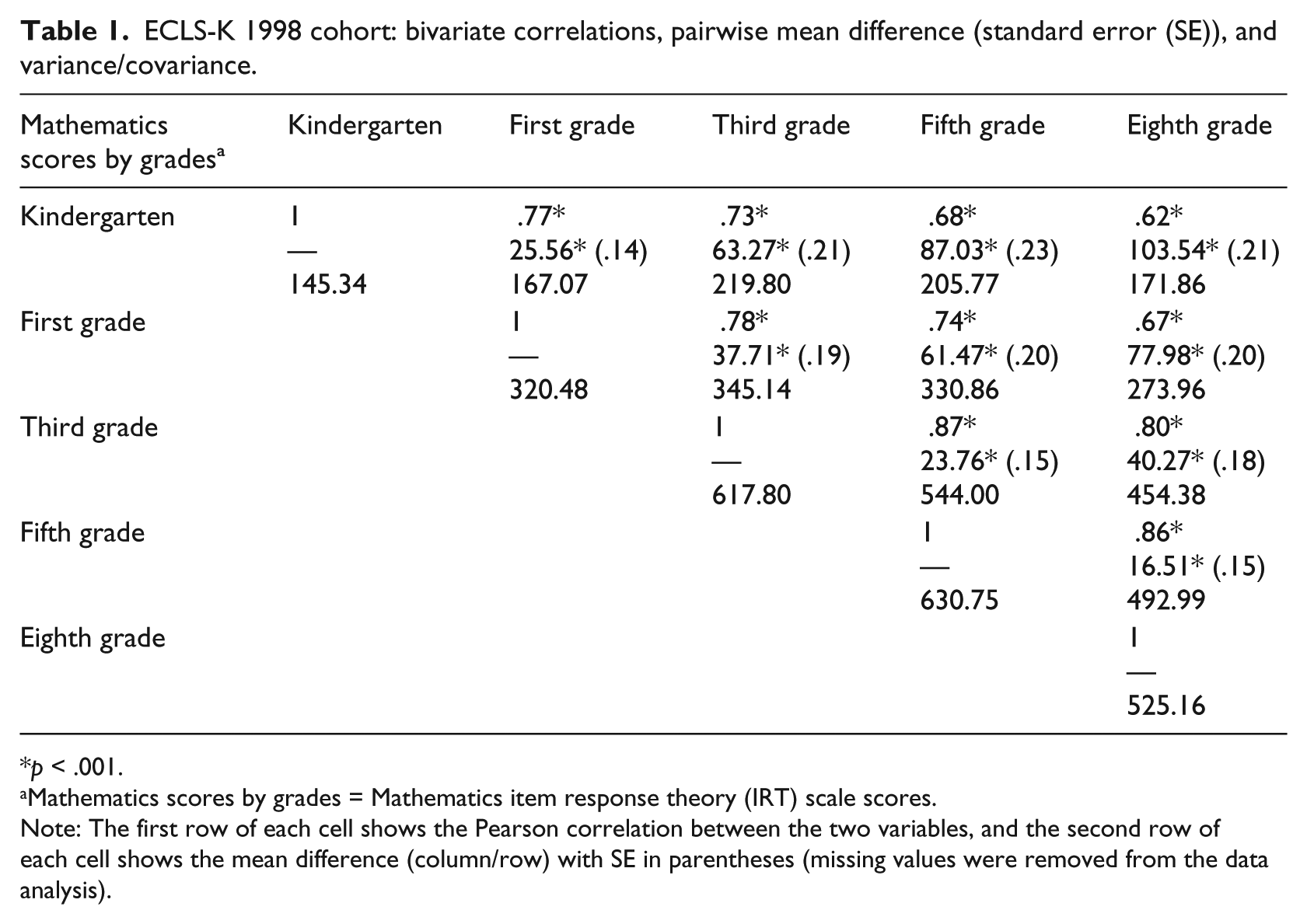
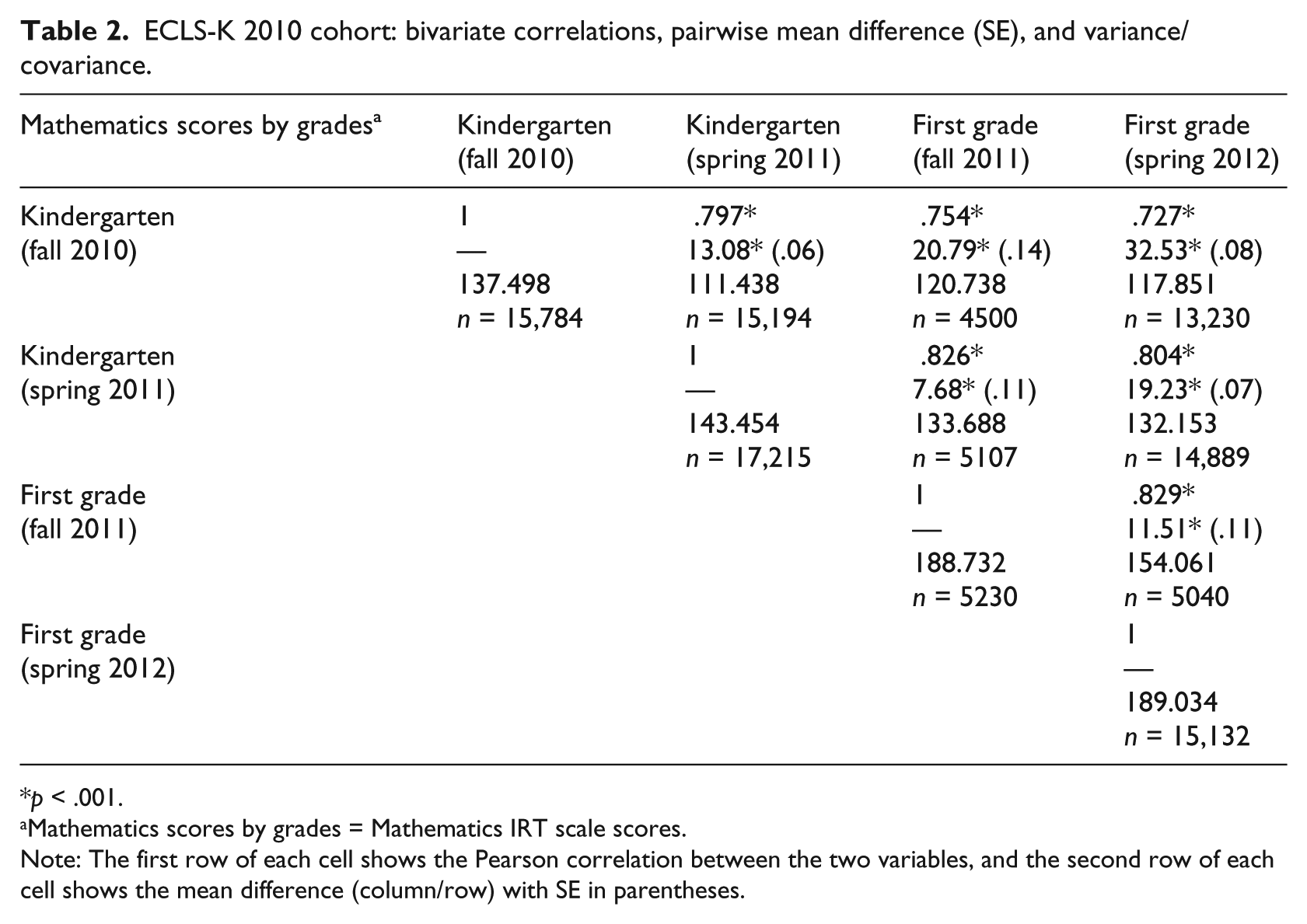
Tables 1 and 2 present Pearson correlations of mathematics proficiencies, showing statistically significant correlations between subsequent grade levels. Table 1 shows correlations between the grade levels kindergarten versus first grade; first grade versus third grade; third grade versus fifth grade; and fifth grade versus eighth grade. The data has been obtained from the Early Childhood Longitudinal Study, Kindergarten (ECLS-K) Class of 1998, a longitudinal study conducted by the US Department of Education’s National Center for Education Statistics. The ECLS-K Class of 1998 is a nationally representative sample of children who entered kindergarten in fall 1998 and were followed through to eighth grade.
ECLS-K 1998 cohort: bivariate correlations, pairwise mean difference (standard error (SE)), and variance/covariance.
p < .001.
Mathematics scores by grades = Mathematics item response theory (IRT) scale scores.
Note: The first row of each cell shows the Pearson correlation between the two variables, and the second row of each cell shows the mean difference (column/row) with SE in parentheses (missing values were removed from the data analysis).
ECLS-K 2010 cohort: bivariate correlations, pairwise mean difference (SE), and variance/covariance.
p < .001.
Mathematics scores by grades = Mathematics IRT scale scores.
Note: The first row of each cell shows the Pearson correlation between the two variables, and the second row of each cell shows the mean difference (column/row) with SE in parentheses.
As Table 1 shows, children’s mathematics IRT scores are statistically correlated with their subsequent mathematics proficiency from kindergarten through to Grade 8. This confirms previous study findings (Cunha et al., 2006; Entwisle et al., 2005).
Table 2 presents the analysis of the ECLS-K Class of 2010 data and shows significant correlations of mathematics IRT scores between subsequent grade levels by semester (spring and fall at kindergarten versus first grade). The ECLS-K Class of 2010 is a nationally representative sample of children who entered kindergarten in fall 2010 and were followed through to first grade. As shown in Table 2, children’s mathematics performance is also statistically correlated with their mathematics proficiency in subsequent semesters from kindergarten through to Grade 1.
As Tables 1 and 2 show, children’s early mathematics performance is closely correlated with their mathematics performance throughout their school years. These analyses cannot show a cause–effect relationship, but it is assumed that children’s early mathematics proficiency reveals a strong relationship with their later mathematics proficiency. This is an important fact, which highlights how critical early mathematics proficiency is. All children should have the opportunity for a good beginning in their early years of education in order to become proficient in mathematics in their later school years. Providing children with high-quality mathematics education is vital to help all children have good beginnings in learning mathematics (National Association, 2010). To do so, it is essential that teachers of young children have highly competent content and pedagogical knowledge of (knowledge about how to teach) mathematics.
Many early childhood teachers show reluctance and a lack of knowledge about the mathematical content that is appropriate in elementary schooling (Copley, 2004; Lee, 2005). Yet they often reveal a high level of confidence in teaching mathematics (Lee, 2005). In particular, because mathematics is less complex at the early childhood level, mathematics teachers of young children show a high level of confidence in teaching (Chen et al., 2014). However, early childhood teachers need a profound understanding of early mathematics, including how early mathematical knowledge and skills are linked with children’s later mathematical knowledge and skills (e.g. mathematical vocabulary, procedures, connections between concrete and abstract models) and an understanding of vertical alignment (College and Career Readiness Standards, 2009). Lack of knowledge about how to implement purposeful mathematical instruction in the classroom (Ginsburg et al., 2001) has also been reported as problematic.
Some researchers have applied value-added approaches to present the link between teachers and students’ mathematics achievement in the early and elementary school years, and have shown the substantial effects that teachers may have on children’s mathematics performance (Rowan et al., 2002; Wright et al., 1997).
Early childhood teachers tend to teach mathematics by integrating various hands-on activities, but they often fail to implement purposeful practice in teaching mathematics (Ginsburg et al., 2001). Observing children’s routines in the classroom, it becomes evident that there are numerous moments that teachers of young children can take advantage of to teach mathematics on a daily basis. Teachers tend to integrate numbers (saying numbers, adding numbers, or subtracting numbers) and shapes (e.g. identifying and saying/asking the names of shapes, identifying the number of attributes of shapes) in their daily communications. However, early mathematics is not limited to numbers and shapes. According to the mathematics standards of the National Council of Teachers of Mathematics, children should learn five contents (number and operations, algebra, geometry, measurement, and data analysis and probability) and five processes (problem solving, reasoning and proof, communication, connection, and representation) in mathematics in the early years. Some early childhood teachers may be concerned that young children may not understand abstract mathematical content such as algebra, data analysis, or probability. This is a major concern. Without building a strong and concrete foundation of mathematical knowledge and skills from the early years, children tend to fail in mathematics in their later years due to the lack of a foundational, concrete understanding of mathematics.
Systematic efforts are necessary to prepare pre- and in-service teachers and to support them in understanding the vertical alignment of mathematical content and processes (e.g. how a particular mathematical concept/process is associated with a mathematical concept/process in later years). It is also necessary to provide experiences to teachers of young children so that they can learn how to teach mathematics to young children in a practical and relevant manner.
Footnotes
Funding
The author(s) received no financial support for the research, authorship, and/or publication of this article.