




Abstract
Exploring how online hate speech infiltrates public discourse, this article examines the antisemitic hashtag, ‘#JewGoal’, tracing its spread from the FIFA gaming community to online football discussions. Analysing 1364 public tweets on the platform ‘X’ (formerly Twitter), the article illustrates how the hashtag, framed as humour and sports commentary, perpetuated antisemitic stereotypes through historical tropes and cultural symbols. Utilizing the Lacanian concepts of jouissance and llanguage, the study reveals how #JewGoal extended beyond mere humour, exposing an excessive enjoyment tied to its repetitive and absurd use. This dual function – offering inclusion in online communities while perpetuating harm – underscores how normalized antisemitic language infiltrates sports fandom. By framing #JewGoal as a llanguage of hate, its impact lies not in explicit content but in its provocative repetition. By detailing the persistence of antisemitism in digital spaces, the article emphasizes the need to critically address the enjoyment derived from harmful online speech.
Introduction
Today, social media occupies a key site for expressions of online hate and abuse to be displayed, with social media platforms providing the opportunity for various forms of vitriol to be shared (Black et al., 2023; Kearns et al., 2023; Poulton, 2016). In the case of sport, offline rivalries are increasingly played out online, as manifestations of hate move beyond stadiums to social media platforms, where controversies, key players and long-standing rivalries become vehicles for sharing and inciting abuse (Cleland, 2014; Seijbel et al., 2022; Watanabe et al., 2019). Consequently, while abuse in sport forms part of a complicated picture of rivalry and enmity, for which deriding the opposition plays a fundamental and no less important role in generating collective forms of identity, online discussions of football offer a convenient and accessible space for certain stereotypes to be conveyed (Black et al., 2023; Young, 2019). Accordingly, this article pays specific attention to exploring how expressions of antisemitism maintain a common, and possibly expanding, category of online abuse, related directly to examples of football culture.
Specifically, this article explores the spread of the antisemitic hashtag – #JewGoal – from the FIFA video game community into wider online football discourse. The term, ‘Jew goal’, describes a type of football goal, where, in a two-on-one situation with the goalkeeper, a player passes the ball across the goal instead of taking a direct shot. The term originated among the FIFA video game community, where it is a recognized tactic employed while playing the game. 1 It implies a level of opportunism or ‘unfairness’, which, without breaking any rules, the player who scores such a goal is seen as capitalizing on the preceding play, or the efforts of the passing player, resulting in the accusation that the scoring player has achieved a ‘cheap’ or ‘easy’ goal. In doing so, the term draws from the racist antisemitic stereotype of the lecherous ‘Jew’ living off the hard-work and effort of others (Marcus, 2015). What remains unique to the term, however, is how it has migrated from video game to online discussions of real football games. In effect, the tactic, while widely recognized within the FIFA community, has since been used to describe similar actions in real-life play. This phenomenon reflects a significant development in the manifestation of antisemitism within online spaces, particularly where the fictional world of video games intersects with real-world sports discourse.
In particular, by exploring this migration, we argue that such phrases exemplify the ease with which online hate speech can manifest in everyday, offline contexts. Namely, we note how the role of humour and community in the trivialization and perpetuation of antisemitism – whereby humour and irony are employed to mask the offensive nature of language – can create a sense of belonging among those who participate in this form of expression, while also downplaying its harmful effects.
Drawing on Lacanian psychoanalysis, the concept of jouissance is used to examine this trivialization through the excessive enjoyment that fuels examples of online hate (Lacan, 2006[1966], 1999[1975]). Through introducing Lacan’s (1999[1975]) llanguage, it is highlighted how language becomes a tool for expressing the senseless repetition and enjoyment of a racist gesture that retains its significance despite its absurdity. Through this theoretical and empirical framework, the analysis sheds light on the emergence and normalization of antisemitism across video games and digital spaces that encourage further understanding of the intersection between enjoyment, identity and language in the perpetuation of online hate.
Ultimately, the purpose of this article is to introduce and reflect upon the spread of an antisemitic gesture from its emergence in the video game, FIFA, to online discussions surrounding real football games. We consider how the ‘Jew goal’ hashtag was adopted and used as part of a broader culture of hate and antagonism as it moved from a digital gaming context to an online public space, fuelling discriminatory discourse and impacting the ways fans experience the game. In exploring this trajectory, the article reveals the intersection between digital media, sports culture and the normalization of harmful ideologies. Indeed, to better understand the symbolic and affective investments that underpin such hateful expressions, the use of the psychoanalytic concept, jouissance, helps to illuminate how certain forms of enjoyment can be attributed to the resentment, envy, and fantasies of stolen or excessive enjoyment that underpin online antisemitism.
Theoretical framework: Jouissance and a Lacanian approach to online hate
Untranslated in the work of Jacques Lacan, the term jouissance is frequently interpreted as referring to ‘enjoyment’.
2
This is not, however, a connotation of pleasure or fun, but something that, for Lacan (2006[1966], 1999[1975]), goes beyond the pleasure we more regularly partake in. Jouissance thus refers to an excess, which both troubles and plagues the subject. Such an account bears a unique significance when attributed to examples of the other, for whom it is in our relation to jouissance that we fantasize and imagine some external cause, in this case, ‘the other’, as the obstacle to our enjoyment. There is no truth to this obstacle beyond the fact that it is this perceived other who proves to be so troubling for the subject. With regard to antisemitism, and referring specifically to Freud’s account of the ‘fantasy that there really is something special about the Jew’, Frosh (2004: 328–329) notes how, The other group is seen as having some privilege, something special about them, and this envied thing fuels the hostility. Linked to this is the notion that the hated other is an object of fascination as well as hostility: The anti-Semite cannot leave the Jew alone, is stirred and excited by the Jew, and is made real and alive only through this fascination.
In such cases, it is either the other’s jouissance which proves so troubling for the subject (their food, clothes, or better access to state provisions), or the fact that it is one’s own jouissance that the other seeks to steal (Black, 2023). Here, Žižek (2008: 43) notes how ‘In the anti-Semitic ideological fantasy, social antagonism is explained away via the reference to the Jew as the secret agent who is stealing social jouissance from us (amassing profits, seducing our women . . .)’. Laden within this is the surplus of enjoyment that one experiences when engaging and sharing certain conspiracy theories or when partaking in or distributing racist abuse (Black et al., 2023). 3 More importantly, such enjoyment does not sit outside of language but is instead structured through it, where jouissance attaches to the signifiers of difference and animates the very fantasies through which the other becomes both envied and abhorred. To better grasp this entanglement of enjoyment and difference, we must explore more closely how language itself operates – not as a neutral medium, but as a material force that shapes and unsettles the subject.
Llanguage of hate: A Lacanian reading of the #JewGoal Hashtag
Lacan (1999[1975]) would come to develop his account of jouissance, paying specific attention to the materiality of language and its strange affects upon the subject. Whereas Lacan (2006[1990]: 112) proclaimed that ‘the least you can accord me concerning my theory of language is . . . that it is materialist’, for Lecercle (1990: 105 cited in Salecl, 2000: 138, fn.21), ‘Language is material not because there is a physics of speech, but because words are always threatening to revert to screams, because they carry the violent affects of the speaker’s body, can be inscribed on it, and generally mingle with it’. What we can learn across both accounts is how ‘our living organism forms a closely tied knot with language’ (Vanheule, 2024: 159). Vanheule (2011: 153, sic) adds, words should not be thought of a[s] neutral logical signs, but as bodily invested elements. The words we use are not just communicative carriers of messages. They also embody a jouissance or an affective value we, as speakers, don’t fully grasp. Signifying articulation drains jouissance from the body and connects jouissance to the signifier, which is why words play a vital role in regulating corporeal arousal.
This approach elaborates upon our conception of language by prescribing it a certain significance in our relation to the world. That is, language does not simply ‘represent’, but also ‘acts’ upon the world; in the struggle for meaning, language always persists with a remainder to that which cannot always be defined or made sense of (Salecl, 2000). It is ‘in the remainder [. . . that] the antagonism of . . . the social symbolic struggle . . . is inscribed’ (Salecl, 2000: 126). This remainder represents what ‘escapes the speaking being’ underscoring the limits of linguistic representation and the ways in which meaning consistently evades full capture (Lacan, 1999[1975]: 139). In other words, in the search for meaning, or in the task of making sense, our use of language is marked by that which prevents it from the totality of any final or complete meaning.
We can, in this regard, determine that ‘the remainder, the leftover that insists in language’ is what Lacan’s llanguage refers to (Salecl, 2000: 124). 4 Whereas structuralist accounts of language seek ‘to integrate language into semiology’ (Lacan, 1999[1975]: 101), according to Lacan (1999[1975]: 138), ‘Llanguage serves purposes that are altogether different from that of communication’. In effect, llanguage’s ‘matrix is the infantile la-la-la, the babbling of children’, where, as Guanzini (2024: 9) explains, ‘What counts . . . is not the articulation of meanings but the fact that words are pulsating traces, mixtures of voices, sounds, letters, odours, visions, places, and bodily sensations’. Therefore, before meaning, and before any determination of the signifier and signified, there is llanguage – the strange materiality of language that imparts upon the subject the task of making sense of language, of using it in order to achieve some form of linguistic understanding. While language serves as a systematic and analytical tool for engaging with itself, offering a framework for comprehension (Salecl, 2000), inherent to this process is an inevitable remainder. This remainder is the irreducible that resists or disrupts the structure that language seeks to impose.
Accordingly, what llanguage denotes is the very form of ‘language in all its non-intended ambiguities and wordplays’ (Žižek, 2024: 122). In fact, while llanguage can ‘be reduced to some kind of subversive poetic playfulness which liberates the speakers from the confines of the hegemonic ideology’, as Žižek (2024: 123) highlights, it can also ‘serv[e] as an instrument of violent humiliation and oppression’. Žižek (2024: 123) notes, A typical act of racists is to designate its enemies with an apparently ‘neutral’ term whose obscene echoes deliver a clear racist message – and, when the attention is drawn to it, the perpetrator claims that his hands are pure since he used the term in its neutral sense . . . Try to formulate a racist/sexist notion in its pure logical structure and its absurdity immediately becomes clear.
Whereas language serves the purpose of communication, producing meaning and reference, llanguage bears witness to the obscene enjoyment that underwrites a certain word or phrase, whose neutrality, purports to the excessive enjoyment that it is afforded. In this regard, what the ‘Jew goal’ hashtag presents is the ‘senseless repetition’ of the term itself (Vanheule, 2011: 154), which in its very banality – bearing in mind that neither ‘Jew’ nor ‘goal’ bear no immediate offence – carries with it the crux of its antisemitic significance. It is here that we can begin to see that while, for Lacan (1999[1975]: 24), ‘The signifier is the cause of jouissance’, it is llanguage that serves its function.
What llanguage reveals is the extent to which the practice of racism relies upon a certain level of enjoyment that plays upon the absurdity of language, indeed, of a racist gesture that bears no logic or sense, but which nonetheless retains its significance through its very repetition and absurdity. Whether the adoption of the ‘Jew goal’ functions primarily as a source of banter, exchanged as part of the collective rivalry, or as a deliberate and impassioned attempt to identify and abuse a particular group, what undercuts both assessments is the enjoyment they contain. Outside of regular speech or communication, the ‘Jew goal’ hashtag reflects a llanguage of hate, whereby it is the enjoyment of one’s investment in the affects, quirks and playfulness of the hashtag that demonstrates its excessive adoption. While language reflects the mundanity of communication, what returns for us is the jouissance of llanguage. The material effects of this can be seen in the use of certain signifiers, which bears witness to the nonsensical repetition of their enjoyment.
Therefore, in the findings that follow, we identify and reveal a consistent pattern: regardless of how the hashtag was used, or for what purpose it was applied, its presence was marked by a striking regularity of enjoyment. This ‘surplus’ was evident in the analysed ‘Jew goal’ tweets, where virtually any player, irrespective of actual Jewish heritage, could be designated a Jew; in the proliferation of insults accompanying explicitly antisemitic references; and in the expansive, indiscriminate deployment of Jewish identity and antisemitic tropes, frequently detached from any factual grounding. Where posts frequently ended with the hashtag #JewGoal, this suggested a form of attachment grounded less in meaning than in affect. Ultimately, in view of the above theoretical framework, we argue that the function of the hashtag lay in the antisemitic enjoyment it enabled and circulated. To support this analysis, we underwent the following process of data collection.
Methodology and method
From the subtle use of employing certain Jewish stereotypes, to the indirect and possibly unintentional enactment of antisemitic racism, in this article, we explored and analysed how antisemitism surfaced in discussions surrounding the video game, FIFA, as well as in broader online conversations about football.
Data collection and analysis
For this study, Twitter (now known as X) served as the empirical context, a platform well-established in sports fandom research. Twitter/X has long been a significant space for sports fans, particularly football supporters (McCarthy et al., 2022; Williams et al., 2014), and offers a unique opportunity to explore fan behaviours as well as societal issues through its affordances. A central feature of Twitter/X is the use of hashtags, which allow for the creation of ad hoc publics composed of individuals with shared or opposing views (Bruns and Burgess, 2015). This functionality enabled the emergence of the hashtag, #JewGoal, which, although evolving over time, provided a consistent focal point around which meaning was negotiated across various events.
The dataset for this study included 1364 public tweets posted between 2010 and 2020 that contained the phrase ‘Jew goal’ or the hashtag #JewGoal. 5 The sample was restricted to original tweets and replies, which were manually collected using Twitter/X’s native search interface. A rigorous, transparent data collection, which adhered to best practices in qualitative social media research, underscored the collection of tweets (Black et al., 2023; Doidge et al., 2024; Guzmán et al., 2021; Hayat et al., 2016). Moreover, the dataset was confined to public tweets in accordance with ethical guidelines for social media research (Townsend and Wallace, 2017), ensuring respect for privacy and consent.
The analysis employed a reflexive thematic approach, which emphasizes the researchers’ active role in interpreting the data through an iterative and flexible process (Guest et al., 2012). Reflexive thematic analysis is particularly suited to examining complex, socially constructed phenomena, such as the hashtag, #JewGoal, as it allows for the identification and exploration of patterns of meaning that evolve over time (Braun et al., 2022). The process of analysis began with familiarization with the dataset through an initial reading of the tweets, followed by the generation of recurring themes and patterns within the content. These themes were not predetermined but were derived from the data itself, thus providing an inductive approach to analysis of the sample (Boyatzis, 1998). Following this, the themes were reviewed and refined, with frequent revisiting of the dataset to ensure themes were fully representative of the content. The identified themes were then organized into overarching categories that addressed the various ways in which the hashtag was employed, its evolving meanings, and the social implications of its use. This analysis allowed us to remain sensitive to the complexities of the data, providing an understanding of the hashtag, #JewGoal, which transcended individual events to become a significant site of meaning-making within the larger discourse surrounding sport, antisemitism, and online hate.
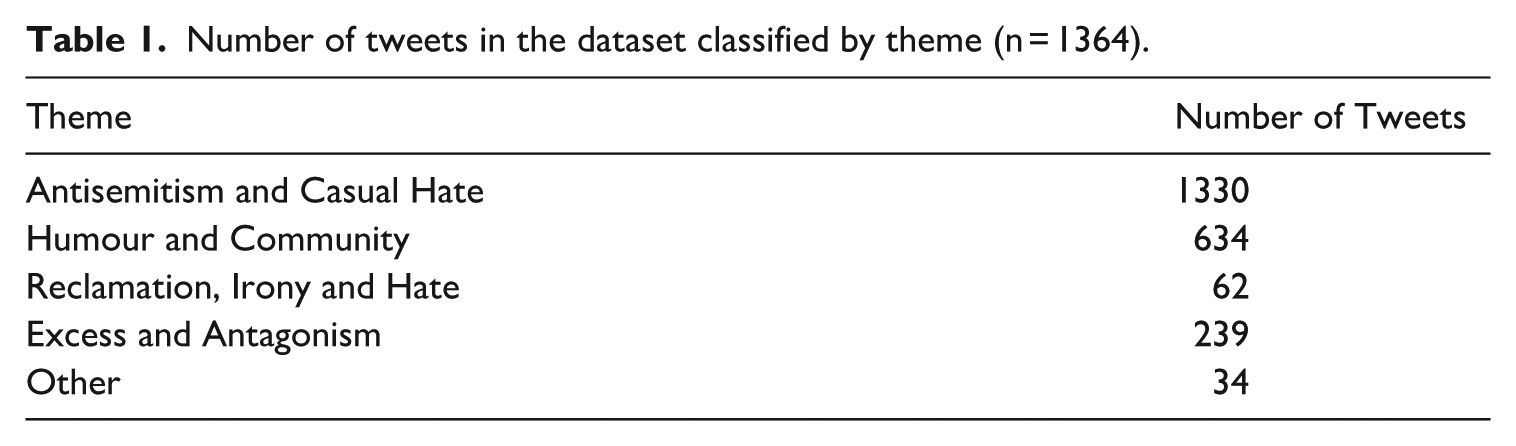
Table 1 provides a summary of the number of tweets by category. The average word count per tweet was 10 words with a range from one to 33 words. With the exception of 34 tweets, all tweets featuring ‘#JewGoal’, or variants (n = 1330), were categorized as antisemitic and casual hate. The remaining tweets included tweets where users queried the meaning of the term, were critical of the usage of the term, or the meaning and intent of the tweet was uncertain.
Number of tweets in the dataset classified by theme (n = 1364).
Findings
The following findings reveal how antisemitism circulated in digital football cultures through the use of the hashtag, ‘#JewGoal’. In doing so, specific attention is given to highlighting how the term embeds antisemitic meaning within everyday football discourse, drawing on long-standing stereotypes and reframing them as humour or banter. Rather than being dismissed as harmless trolling, such expressions are shown to reproduce exclusionary narratives that normalize hate. In particular, where casual hate becomes a shared point of identification, the findings conclude with an examination of how a consideration of enjoyment (jouissance) can sustain the appeal of such discourse, making antisemitism part of the affective texture of digital football fandom.
Hashtag hate: The ‘Jew Goal’
As Poulton (2016: 1984) explains, ‘Antisemitic discourse is language, themes, or imagery that use or evoke malicious ideas about Jews and Jewish-related issues’. This discourse encompasses a wide array of expressions, from overt physical violence and property destruction to more insidious forms, such as, graffiti, hate mail, and social media posts. Online platforms, in particular, have become a fertile ground for such rhetoric, allowing for the rapid dissemination of antisemitic content that draws on historical prejudices, while also adapting them to contemporary contexts (Ekman, 2022). These digital interactions often amplify long-standing stereotypes, whereby the pervasive nature of antisemitic discourse in online environments underscores the need to critically engage with and address these harmful narratives, especially as they intersect with and influence public opinion amid broader geopolitical conflicts. This was made apparent in tweets that specifically adopted the ‘Jew goal’ hashtag (#JewGoal), illustrating how antisemitic coding infiltrates public online discussions. This term has been employed to critique or demean particular goals in both virtual and actual football games, embedding discriminatory undertones within seemingly mundane sports commentary.
Tweets such as ‘Croatia scored the best Jew goal ever  #ARGCRO #JewGoal #WorldCup2018’ and ‘Ronaldo scores a Jew goal. . . not impressed, but I understand why they took the Jew option! #Fifa #JewGoal’, demonstrate how antisemitic tropes are weaponized to describe moments in football perceived as opportunistic, underhanded, or lacking sportsmanship. These comments reinforce stereotypes of cunning or deceit frequently associated with antisemitism. Elsewhere, ‘That was a very #Jewish goal from Torres. #JewGoal #Fifa #everytime #UCL’ or ‘Can see Pirlo has been teaching the Italians the #JewGoal’, expand the scope of this rhetoric, linking it not only to individual players but also to national and cultural identities, thereby perpetuating harmful and exclusionary narratives. These examples highlight how antisemitism is recontextualized in the digital sphere, cloaked in humour or sarcasm, and diffused under the guise of ‘banter’ (Miller, 2022).
Whereas previous research has highlighted how antisemetic terminology is often used to refer to specific clubs with a perceived Jewish heritage, such terminology is usually qualified as not referring to Jews per se, but is, instead, simply an exchange of the rhetoric that defines and shapes the rivalry between clubs (Burski and Woźniak, 2021; Curtis, 2019; Poulton, 2016, 2024). Though this is certainly the case, what the above examples reveal is ‘how antisemitic rhetoric has become a part of the vernacular culture of [football] fans’ (Seijbel et al., 2022: 841). This rhetoric is often dismissed as not targeting any specific Jewish individual, and, by extension, as not directly confronting Jewish people in an overtly antisemitic way. Yet, what these examples reveal is ‘not the immediate reality of Jews, but the image/figure of the ‘Jew’ which circulates and has been constructed’ as part of a racist fantasy that both frames and positions how ‘Jews’ are experienced and encountered (Žižek, 2008: 66, italics added).
The examples of antisemitic language used in tweets reveal not a reflection of actual Jewish individuals or communities, but, as Žižek (2008) argues, the image or figure of the ‘Jew’ constructed within a racist fantasy. This fantasy serves to frame and position how ‘Jews’ are imagined, encountered, and discussed, with the antisemitic image of the Jew being, in Žižek’s (2008: 66) terms, ‘intolerable and rage-provoking’. Accordingly, the term ‘Jew’, and the hashtag #JewGoal, were not used to describe factual identities, but instead functioned as derogatory signifiers. They invoked a set of stereotypes associated with cunning, selfishness, or deceit, projecting these traits onto players and teams in the context of competitive football. By equating such behaviours with Jewishness, these tweets perpetuate long-standing prejudices under the guise of humour or critique. Moreover, they demonstrate how online spaces, particularly social media, serve as sites for the circulation and normalization of racist fantasies. By embedding such language in discussions about sport, antisemitic rhetoric becomes an accepted part of the discourse. This not only reinforces harmful stereotypes but also obscures their origins and implications, making them appear as natural elements of sports commentary.
Antisemitism at the Nexus of gaming, sport, and the digital
The above examples of antisemitism cannot simply be disregarded as mere fun, or, alternatively, as nothing more than a banterous exchange between football fans or video-gamers. In fact, ‘while always proclaiming that everything is for the lulz’ or just a joke and people should have a sense of humour’ (Johanssen and Krüger, 2022: 250), expressions of antisemitic ‘discourse can influence and reflect hostile attitudes to Jews, . . . contributing to an atmosphere in which antisemitic ‘hate crimes’ against Jews and Jewish institutions are more likely to occur’ (Poulton, 2016: 1984). Here, we locate antisemitic discourse alongside other cases where online hate and abuse have resulted in, or led to, real-world effects. In the case of reported Incels and the Alt-right, examples of online hate have been found to result in cases of actual violence (Cleland, 2014; Guiora and Park, 2017).
We refer explicitly to the #GamerGate controversary, which, in 2014, began as an online harassment campaign ostensibly focused on ethics in video game journalism but quickly escalated into a broader cultural conflict. Targeting primarily female developers, critics, and journalists, #GamerGate saw individuals – often under the banner of anonymity – using social media to engage in coordinated harassment, doxxing, and threats. High-profile targets, such as, game developer Zoë Quinn and media critic Anita Sarkeesian, faced severe personal and emotional abuse (Gray et al., 2016; Stuart, 2014; Wingfield, 2014).
This case of misogyny points towards an important political implication arising from how entertainment technologies are increasingly impacting and affecting our day-to-day lives, as well as our experience of reality (Flisfeder, 2017). Today, We no longer speak of our online, as opposed to our offline, lives – our digital, as opposed to our analogue, existences – but of a postdigital state in which electronic and networked devices are so deeply integrated with our sensual and relational experiences that it becomes increasingly hard to tell where the one ends and the other begins. (Johanssen and Krüger, 2022: 76)
In the case of sport, it is easy to see how the confluence of the virtual and real underwrites our sporting experiences. Clubs, journalists, athletes, and coaches are increasingly required to make use of digital media platforms, where, today, fans can experience a sense of connection to a sport through real-time interaction, eliminating the need to be physically present at events (Kavanagh et al., 2019). Again, the importance here is not to perceive this virtual experience as different to the reality of attending or watching a live sporting event, but, instead, to observe how any sporting event is always-already virtually rendered in the various meanings and interpretations that are attributed to the sporting occasion. This reflects the increasingly permeable boundaries between different online spaces, where digital and physical interactions are interwoven. It underscores how virtual actions can result in real-world actions and real-world effects, which in turn reshape the virtual landscape – a dynamic that is central to understanding contemporary social phenomena in the digital age.
There is, therefore, no distinguishing between our ‘online’ and ‘offline’ existence, inasmuch as what is ‘real’ or ‘virtual’ cannot be separated to distinct realms of human existence. Unhelpful dichotomies between the real and virtual world are, as the examples in this article illustrate, proving increasingly unhelpful in distinguishing and making sense of the fluidity of our day-to-day communications, hate included. Indeed, what seems to transpire in the ‘Jew goal’ example is the extent to which the virtual reality of a well-known video game can be used to foment and establish an antisemitic gesture, which subsequently becomes part of the online lexicon of football discussions. This phenomenon underscores how distinctions between virtual spaces can blur in problematic ways. In particular, the hashtag, ‘#JewGoal’, underscores how neologisms, in this case an antisemitic slur, originating in a virtual gaming platform, can be adopted in discussions on a social media platform. While the use of ‘hashtags’ work as powerful tools in enabling the emergence and coordination of ad hoc publics – fluid, temporary groupings of individuals connected through shared interests, concerns, or conflicts – by aggregating content across platforms, hashtags create virtual meeting points where individuals with similar, or opposing, views can converge, engage, and debate. This functionality facilitates the rapid organization of discussions, amplifies marginalized or niche perspectives, and makes visible tensions and solidarities within digital spaces. Hashtags are not merely markers of trending topics, but actively shape the contours of public discourse by clustering conversations, fostering collective identities, and, sometimes, escalating conflicts.
This functionality further complicates, and, perhaps, obscures, the spread and experience of antisemitism from video game to social media. As highlighted in examples, such as, ‘Dear oh dear oh dear. Thought I only see that on FIFA  #jewgoal’ and ‘Looks like @SouthamptonFC have been perfecting the FIFA Jew goal in training! #fifa #sfc #jewgoal’, a troubling interplay between virtual gaming culture and real-life sports discourse is revealed. These examples demonstrate how a virtual action – originally associated with gameplay in the FIFA video game series – was translated into a broader lexicon that perpetuated antisemitic stereotypes. In addition, statements like, ‘That Chelsea goal reminds me of my FIFA playing days. . . #JewGoal #cfc’ not only normalize the term but also blur the lines between virtual gameplay and real-world sports commentary. Further still, tweets, including, ‘These footballers have been playing FIFA too much #passgoal #jewgoal #motd’, underscore the pervasive influence of gaming culture on social media football commentary. Here, the Jew goal hashtag functions as a conceptual bridge, bringing a digital stereotype into real-world contexts, whereupon certain behaviours in professional football mirror those associated with the term in video game discussions. By referencing FIFA gameplay, these comments highlight how antisemitic language from virtual environments infiltrates broader discussions, reinforcing discriminatory patterns while masking them as humour or casual observation.
Humour, community, and casual hate: Trivializing antisemitism in online gaming cultures
If the emergence of an antisemitic term could expand beyond the world of a virtual video game to online discussions regarding real sporting events, then, to what function did the employment of this term fulfil? To understand the prevalence of the ‘Jew goal’ hashtag, we can examine the intended response that examples of racism seek to produce. According to Salecl (2000: 120), the prime intention of injurious speech is to provoke the person assaulted to question his or her identity and to perceive him- or herself as inferior. But the speaker also seeks another response: by uttering injurious speech the speaker searches for confirmation of his or her own identity. Attempting to overcome an uncertainty in this regard the speaker engages in race-bashing in order to define him- or herself as part of the racist community that would grant him or her stability.
It is this desire for recognition that can easily be observed in the case of social media, where the function of the ‘like’, or other sharing capabilities, plays its part in maintaining the digital network that one exists in (Flisfeder, 2021). On this basis, it is not simply the case that the act of hate conveys a recognition on behalf of the racist from the addressee, but that one’s virtual existence online can be recognized and affirmed as well (Salecl, 2000). This highlights a critical tension between the virtual and the real in online interactions. As De Vos (2020) notes, the recognition tied to ‘real-world’ interactions often relies on the digital validation of the online ‘like’. In the context of the #JewGoal hashtag, this virtual confirmation frequently expressed an implicit sense of insider knowledge, creating an exclusive dynamic for those employing the term, where the hashtag operated as a cultural marker, signalling belonging to an unspoken community familiar with both FIFA gameplay and its specific, antisemitic coding.
For instance, tweets, such as, ‘Nah Suarez just done the dirty if you know you know #JewGoal  ’ and ‘Every FIFA player knew what was coming next. . . [. . .] #JewGoal’ emphasized the role of insider status. The reference to, ‘if you know you know’ and ‘every FIFA player’, creates a boundary between those ‘in the know’ and outsiders, which reinforced a sense of shared understanding among certain users. Here, the hashtag served not merely as commentary but as a signal of alignment with an unspoken subculture that implicitly accepted the antisemitic hashtag. Similarly, tweets like ‘That Man City goal just made every frequent FIFA player rage on their couch #jewgoal #MCFC’ links real-world football events to virtual gameplay, suggesting a seamless overlap between the two. This blending of contexts serves not only to normalize antisemitic language by embedding it within a larger framework of shared gaming and sports experiences, but the invocation of common frustrations or expectations among FIFA players further legitimizes the term’s usage, masking its offensive nature behind the veneer of relatable humour.
What the above examples suggest is how the Jew goal hashtag can be used in such a manner that its very impudence can function as a source of in-group identity. The object of this identity is the antisemitism it purports, which is easily denounced as not serious. Such behaviour is characteristic of trolls, whose actions are frequently dismissed as mere ‘trolling’, thereby minimizing their broader implications. This dynamic reveals the deeper risks of online spaces, where the boundaries between virtual and real experiences blur, allowing discriminatory language to permeate and persist under the guise of humour and subcultural identity. In fact, while banter in gaming often takes the form of trash talk or light-hearted teasing – whereupon players create rivalry, deepen immersion, and foster community through humour – the use of the Jew goal hashtag reveals that, within certain parts of the FIFA community, such banter both relies upon and perpetuates examples of antisemitism.
Reclamation, irony, and hate in football rivalries
The question of whether certain examples of antisemitism in football culture represent genuine expressions of hateful intent, or reflect long-held footballing rivalries has been closely investigated in Poulton’s (2016, 2024) research on the English Premier League football team, Tottenham Hotspur. In the early to mid-twentieth century, Tottenham’s North London location attracted many Jewish immigrants who became loyal fans, creating a visible Jewish presence in the club’s support base. Over time, this connection has become part of Tottenham’s identity, where, despite its largely diverse fanbase, the club’s assumed ‘Jewishness’ has led to both negative and positive attributes. This is also reflected in examples of the ‘Jew goal’ hashtag, where references to Tottenham were frequently made. In examples, such as, ‘Cue the Tottenham #JewGoal jokes. . .’ and ‘I know Spurs have Jewish heritage, but come on Lennon!? #JewGoal’, the hashtag deliberately exploited Tottenham’s Jewish associations. Equally, ‘Playing against #Spurs and they score a #JewGoal #ironic #FIFAproblems’ and ‘Lol Spurs going for a #JewGoal. Ironic’, echoed the use of irony to diffuse or obscure the offensive intent, which was highlighted above. Here, the repeated references to irony emphasize the problematic nature of aligning Tottenham’s perceived identity with the term, suggesting an implicit expectation that the audience understands and accepts this framing.
Elsewhere, Tweets such as ‘So Spurs scored a #JEWGOAL #yidos’ and ‘Defoe the Yiddo with a #Jewgoal #shitpun’ explicitly invoked the term ‘Yid’, a widely contentious and historically charged word. While rival fans have been known to employ antisemitic chants at Tottenham games, Tottenham supporters have also reclaimed some of this identity, with many adopting the term ‘Yid Army’ to describe themselves in defiance of its derogatory usage (Poulton, 2016). This has sparked considerable debate over whether such reclamation subverts or perpetuates antisemitism, where examples of Jewish stereotypes are ‘usually intended to “wind up”, taunt and provoke Tottenham supporters, rather than as malevolent racialised othering with pernicious intent towards Jews as Jews’ (Poulton, 2024: 2031). Consequently, though some Tottenham fans have reclaimed the term as part of their identity, its usage in these contexts aligns with an antisemitic framing, conflating the club’s identity with the derogatory implications of the ‘Jew goal’ hashtag.
In making sense of both the positive and negative examples of the word ‘Yid’, Poulton (2016) draws upon the work of McCormack (2011) in order to highlight ‘the changing nature and multiplicity of language’ (Poulton, 2016: 1994). For Poulton (2016: 1993), what remains essential to the ‘linguistic reclamation’, performed by Tottenham supporters, is ‘the changing nature of language and importance of cultural context’. However, while ‘New words are created, old ones die or can take on new meanings, just as new words can develop old meanings’, and though ‘This is dependent upon cultural context and the intent behind the use of language’ (Poulton, 2016: 1997), we question the merits of adopting such a contextual perspective, which does not consider the various uses and adoptions of the Jew goal hashtag.
While examining the context in which a particular term is used and shared can say something about the discursive environment in which this term is employed, as well as its intended targets, it can also relinquish the perpetrator of the racism they avow (Black, 2021). Ultimately, ‘The subject who is perceived as the author of injurious speech is therefore only the effect, the result, of the citation, and the fact that the subject appears to be the author of the utterance simply disguises the fact’ (Salecl, 2000: 119). Moreover, this underscores a more pertinent problem underlying contextual analysis: Who decides what is banter or outright racism in a particular context? Is it the victims or the perpetrators? Who decides whether the victim’s claims are justified? Can we view the victim’s justifications in the same light as the perpetrators’ claims that their actions are merely expressions of football rivalry – banter, joking, or light-hearted teasing? And, finally, what is the outcome of such analysis? Once the context has been identified, and once intent and victim have been deduced, where do we go when we have decided, following some assumed standard of measurement, that this example is ‘banter’, and therefore allowed, while this example is ‘racism’, and therefore must be rightfully condemned. Again, who arbitrates this process? Who manages and prevents it? Whereas the importance of cultural context fails to consider the agency of online hate, as well as the position from which analyses of context, victim, and intention are performed, we provide an additional approach in order to make sense of the nature and prevalence of the Jew goal hashtag – that of ‘enjoyment’.
Rather than grounding our analysis in the shifting cultural meanings of language and intent, we turn to psychoanalysis in order to conceive how racist speech is not simply a function of ignorance or miscommunication, nor reducible to context alone (Black, 2023). Specifically, we argue that the recurrence and circulation of terms, such as the Jew goal hashtag must be seen as symptomatic of deeper libidinal investments. What this allows us to theorize is how racist expression can persist even when disavowed as ‘just a joke’ or ‘mere banter’. Where the antisemitic tweet or hashtag may be framed by its user as playful or ironic, psychoanalysis insists that such rationalizations conceal the deeper structures of enjoyment that organize the subject’s relation to speech and others.
In this regard, the Jew goal hashtag can be seen as both a linguistic signifier, interpreted in situ, as well as a condensation of antagonisms, marking a point where racist enjoyment erupts into public discourse under the alibi of sporting rivalry. By focusing on enjoyment, our approach foregrounds the libidinal economy of hate speech, the unconscious pleasures that attach to repetition and circulation, and the difficulty of regulation when such expressions are structured around the obscene underside of social bonds. This moves us away from attempts to fix meaning through context, towards an interrogation of why certain forms of hate persist, despite widespread public condemnation.
Excess and Antagonism: Jouissance in online antisemitism
Let us consider the following examples: ‘Willian & Torres definitely don’t have foreskin #JewGoal’, deliberately invoked an antisemitic stereotype linking Jewish identity with circumcision, a practice that holds cultural and religious significance in Judaism, but which trivializes a meaningful aspect of Jewish life by reducing it to a crass and degrading comment, aligning it with the broader antisemitic framework of the hashtag. The fact that neither player has Jewish heritage further demonstrates the indiscriminate and baseless application of these stereotypes. Next, the tweet, ‘spurs has absolutely Anne Franked it #JewGoal’, with its reference to Anne Frank, a symbol of Holocaust suffering, turns historical atrocity into a flippant remark about a team’s performance, thus exploiting and trivializing Jewish trauma. While the invocation of Anne Frank reflects a broader tendency within online spaces to co-opt historical and cultural symbols for shock value or humour, further normalizing their misuse (Nagle, 2017), elsewhere, the example, ‘Real Madrid to the gas chambers. #jewgoal’, explicitly references the Holocaust as a form of insult. This example represents the most egregious manifestation of antisemitism within the hashtag, aligning football commentary with genocidal rhetoric. By invoking the imagery of gas chambers, the tweet not only dehumanizes its targets but also reveals the dangerous extremes to which antisemitic language can escalate in online spaces, wherein other examples, such as, ‘I’m about to shove a dreidel up your arse #jewgoal #fifa13 #tweetit’, combined a Jewish cultural symbol with a violent and vulgar threat. Finally, ‘#MUFC equalise with a goal straight outta’ the synagogue. #JewGoal’, deliberately draws on religious imagery and the use of ‘synagogue’ to further a derogatory punchline that reinforced the harmful conflation of Jewish identity with ridicule.
By leveraging stereotypes, historical trauma, and cultural symbols, these tweets contribute to a broader normalization of antisemitism, blurring the lines between humour and hate. While this aligns with other examples, where the hashtag functioned to mock or demean Jewish culture and religion under the guise of football commentary, what we draw attention to is the ‘creativity’ which these examples reveal. Here, the various ways in which the hashtag could be employed and the different contexts to which it was afforded bespeaks a certain ‘creative enjoyment’ in the hashtag’s adoption. In each case, it was not simply that the hashtag was employed, but that what resided in its use was an inherent enjoyment in applying it to a variety of antisemitic tropes. This undermines any contextual determination, which only goes so far as interpreting the discursive content of abuse, in all its variety. Where the surplus of enjoyment lies is not at the level of content, but in the form in which this enjoyment takes: the fact that any player and almost any scenario could be labelled ‘Jewish’.
Indeed, in the above examples, what seems to underwrite the various uses of the ‘Jew goal’ hashtag is the employment of the hashtag itself, which, over the course of its usage, revealed both the nonchalance and indifference that it afforded. Here, a whole host of frustrations could be reified into the ‘Jew goal’ hashtag: a symbolization that bared no specific content, beyond the very form of the hashtag that encompassed and manifested so many different applications and uses. More to the point, where examples of enjoyment could be found was in the excess that the hashtag permitted. That is, while anyone could openly adopt the hashtag, across a variety of topics and discussions, we witness not simply an excess in the hashtag’s adoption, but also an enjoyment in the various ways in which the hashtag could be made to mean something. This something proved a central characteristic of the FIFA community, for whom adopting the hashtag served as a marker of one being ‘in the know’, and, thus in the community of FIFA players. In the end, what mattered was that adopting the hashtag allowed individuals to share in a collective enjoyment, expressed through the diverse ways the hashtag was used.
Conclusion
In conclusion, our analysis underscores how humour and shared cultural references become vehicles for the spread of antisemitic rhetoric. Notably, the comedic tone, often framed as harmless or ironic, was identified as obscuring the violence and prejudice underlying such language, enabling its circulation among wider audiences. Furthermore, the use of the ‘Jew goal’ hashtag, as a marker of insider status, helped strengthen the collective bond among those participating in this discourse, creating a space where antisemitism was not only tolerated but celebrated as part of the community’s identity.
This article has suggested that one way of analysing the hashtag’s adoption was through Lacan’s llanguage and its role within the spread of online hate. What llanguage reveals is the surplus of enjoyment that is attached to the creation of new terms and meaning through language, and to the excess that resides within the neutrality of a phrase or expression that becomes the very vessel of an enjoyment that is found in its absurdity. In the above examples, this absurdity functioned to enable the ‘Jew goal’ hashtag a certain dexterity in its adoption, whereby its application could be easily refuted or playfully ignored. What remained was a certain libidinal support that functioned as a form of social recognition among its perpetuators; an acknowledgement of one’s virtual presence amid an online community of fellow gamers and football fans. Such recognition can itself be read alongside the enjoyment of partaking in an online transgression, where, in the case of the ‘Jew goal’ hashtag, any reply, share, or like served only to compound the surplus of enjoyment that resided within the excesses of its use.
While this study offers important insights into the circulation of antisemitism in digital sports and gaming cultures, several limitations point towards opportunities for further research. The dataset, drawn from tweets posted between 2010 and 2020, provides a valuable historical perspective but may not fully capture more recent trends in online antisemitism, particularly given the rapid evolution of digital platforms and discourses. Moreover, by focusing solely on Twitter/X, the analysis does not account for how such language might manifest differently across other social media sites, forums, or gaming platforms with distinct user dynamics. To this extent, while analysis of the phrase, ‘Jew goal’, and the hashtag, ‘#JewGoal’, enabled a detailed analysis of one antisemitic expression, there remains the opportunity to extend this analysis to include other relevant coded terms, potentially offering a more comprehensive view of online antisemitism.
Finally, whereas the disintegration of the virtual and the real only entrenches the generalization of the virtual in our day-to-day lives, what we see in examples of online hate is how the virtual becomes the product of an enjoyment that bespeaks a llanguage of hate: where what returns is a libidinal investment in the provocation and perpetuation of hate. What this asserts, however, is the undeniable fact that ‘the subject him or herself is ethically responsible for the jouissance of his or her speech’ (Salecl, 2000: 136). To this extent, what we hope to have achieved in this account is to demonstrate how forms of enjoyment underpin our online interactions, thereby equipping us with the theoretical means to interpret the effects of antisemitism across the diverse contexts in which it manifests.
Footnotes
Authors’ note
For the purpose of open access, the author has applied a Creative Commons Attribution (CC BY) licence to any Author Accepted Manuscript version arising from this submission.
Funding
The authors received no financial support for the research, authorship, and/or publication of this article.
Ethics considerations
All tweets used in this research were publicly available on Twitter/X at the time of data collection, reflecting the principle that openly accessible online content may be examined without seeking individual consent. No private or identifying information beyond what was publicly visible was collected or analysed, thus adhering to established ethical guidelines for social media research.
Consent to participate
Not applicable
Consent for publication
Not applicable
