




Abstract
The rise of online hate speech in sports is a growing concern, with fans, players and officials subject to racist, sexist and homophobic abuse (in addition to many other prejudices) via social media platforms. While hate speech and discrimination have always been problems in sports, the growth of social media has seen them exacerbated exponentially. As a consequence, policy makers, sport governing bodies and grassroots anti-hate organisations are largely left playing catch-up with the rapidly shifting realm of online hate. Scholars have attempted to fill this vacuum with research into this topic, but such is the evolving nature of the issue that research has been diverse and fragmentary. We offer a scoping review into the scholarship of online hate in sport in order to encourage and facilitate further research into this urgent issue. Our review will achieve this through offering a comprehensive cataloguing of previously employed methodologies, case studies and conclusions. In doing so, it will not only equip future researchers with a concise overview of existing research in the field, but also illuminate areas and approaches in need of further examination.
Introduction
The examination of the role of the internet as a medium for prejudice and hate speech has been the subject of increasing academic scrutiny in recent years (see Hale, 2012; Bliuc et al., 2018; Matamoros-Fernández & Farkas, 2021). Hate speech is defined as ‘spreading, inciting, or promoting hatred, violence and discrimination against an individual or group based on their protected characteristics; which include “race”, ethnicity, religion, gender, sexual orientation, disability, among other social demarcations’ (Kilvington, 2021a, p. 258). Castano-Pulgarin et al. (2021) outline a similar definition based on social demarcations but expand on how hate can be communicated through ‘the use of internet and social networks, based on power imbalance, which can be carried out repeatedly, systematically and uncontrollably, through digital media and often motivated by ideologies’ (p. 1). For the purposes of this research context, it is important to distinguish this definition of online hate from online ‘hating’, which is an act that does not necessarily have to contain reference or discrimination towards an individual’s social demarcations (e.g., race, ethnicity, sexual orientation) and ‘is considered successful [by the haters] even if it provokes no reaction in others whatsoever’ (Malecki et al., 2021, p. 2). This distinction is particularly important when we consider online hate in the context of sport.
It is our contention that the mediatisation and digitalisation of sporting events position them as flashpoints for online hate. Increasingly, these developments have been cited as a concern beyond academic circles, and by the mainstream media, sports organisations and activists. Recent high profile flashpoint incidents include the backlash athletes have received for following the lead of National Football League (NFL) player Colin Kaepernick in publicly protesting systemic racism through the taking of the knee (Zirin, 2021), the racist abuse levelled at three Black England players who missed penalties in the final of the men’s Union of European Football Associations (UEFA) 2020 Championship (MacInnes, 2021) and the mobilisation of far right fan groups demonstrating against LGBTQ+ inclusive initiatives in sport (Reuters, 2021). These and other incidents have fostered a growing awareness of the role of online communication structures (particularly major social media platforms) in perpetuating hate speech. There have been prominent calls to legislate against this in some way. Accordingly, attention turns here to the importance of fully understanding the nature of online hate by first reviewing the state of research on this topic.
Historically, sports became enclaves which allowed emotions to flow more freely but they also became sites where violent subcultures could survive and thrive. The controlled catharsis and emotional experience of watching and playing sport was connected to slowly changing features of society. In the context of spectator disorder this was sustained by a subculture of physical violence (Elias & Dunning, 2008). Forms of identity find expression too in the symbolic violence connected with allegiance to football teams and engagement in discriminatory behaviour as a consequence of that rivalry (Davis, 2015; Miller & Benkwitz, 2016; Kilvington, 2017).
Sport remains a key site for such behaviours and the increasing pervasiveness of online communication has necessitated greater scrutiny of the relationship between sport and expressions of hate. Media are important ideological vehicles and critical agents in the commercialisation of sport, such that, today, sports events and media are intimately connected (Kilvington, 2021a). Furthermore, sport has long been an influential enclave in which political, economic, cultural and social issues have played out locally, nationally and internationally (Bairner, 2001; Messner, 2011). Thus, the two exist in a symbiotic relationship, reinforcing each other’s prominence and popularity. A media issue such as online hate takes on particular significance and cultural resonance when viewed through the enclave of sport, a totem for identities and a key battleground for cultural disputes. Galtung (1991) writes that in sport ‘we are probably dealing with one of the most powerful transfer mechanisms for culture and structure ever known to humankind’ (p. 150). Furthermore, instances of online hate in sport are becoming more prominent and prolific: Kavanagh et al. (2016) for instance point to growing concerns surrounding the relationship between online hate and major sporting events: ‘In the daily social commentary surrounding major sporting events, we are continually witnessing significant negative online interaction and in many cases, such abusive and/or threatening discourse’ (p. 786).
Thus, hate, as understood for the purposes of this paper, is constituted of acts of abuse (verbal, physical or digital) tied to deeper, underlying systemic oppressions (such as racism, misogyny, ableism, etc.). We draw from Willard’s (2007) accounting of the variety of activities and tactics that constitute online hate. In brief, Willard classifies seven distinct types of online hate: flaming (sending threatening or rude messages), harassment (repeatedly sending offensive messages), denigration (posting rumours or misinformation), cyber stalking (harassment extended to include harmful threats), impersonation (pretending to be someone in order to embarrass or disgrace them), outing/trickery (revealing sensitive information to others), and exclusion (purposefully excluding someone from an online community or group). Furthermore, across each category we conceive of acts of hate as performing the dual purpose of denigrating a specific group (or groups), while also fostering an atmosphere of hostility towards the targeted group(s). This also includes examples of hate that are directed at those believed to be representing, upholding and/or protecting the values and interests of the targeted group(s). Such hate is significant, and worthy of the attention of this review, especially with regards to the function it fulfils in furthering systemic oppression (see Smith [2002] for further research on the nature and impact of online hate speech). Due to its capacity to go beyond socio-cultural taboos and risk censure, as well as in its attempts to exert control over who can legitimately belong to and operate in particular sport spaces, we argue that it is in conceiving of hate in accordance with the systemic oppressions that it relies upon that examples of online hate can be distinguished from less direct and explicit forms of oppression or discrimination, including acts of prejudice, which focus primarily on preconceived ideas and beliefs directed towards another individual/group.
In this paper, we provide a scoping review of literature that considers the intersection between sport and online hate. With the aforementioned recent flashpoint events for online hate triggering increasing media and political attention, it is important to take stock of existing academic research in order to provide a firm foundation for the likely upswing in further work in the field. This will ensure a basis of study from which future instances of online hate can be examined. Our review takes the form of a preliminary overview of the potential size and scope of knowledge in this field. We also identify gaps in the field and thus lay the foundation for further research into this highly significant and rapidly evolving area. Notable in our recommendations is the need for much more extensive primary data collection 1 and particular emphasis is also placed on broadening the focus of sporting and hate ‘contexts’, developing a research infrastructure that is informed by and engages with a much greater number of stakeholders and that reflects a wider variety of methodologies. A review such as this is also put together with the likes of practitioners, athletes and journalists, who report on the topic, in mind. An overview of research in this area is written with the aim of informing stakeholders that influence public policy decisions and for improving the quality of public discourse on the subject. Scoping reviews provide a level of succinctness and readability that is beneficial for non-academic stakeholders. Next we outline the process and rationale that led to the selection of the 41 papers that met our selection criteria, after which we then discuss dominant trends, contexts, themes and methodologies that have shaped this field of research.
Research Design of Scoping Review
Scoping reviews are now an established form of identifying and mapping evidence as well as clarifying key concepts and definitions in academic literature. They are also useful where there is a need to identify potential knowledge gaps and to generate questions for future systematic reviews and data collection (Tricco et al., 2016). Research on online hate generally is a rapidly evolving field since the mid-2000s with an accompanying lag in the growth of studies that examine its manifestation in sport; as Shreyer and Ansari (2022) argue ‘in emerging research fields […] conducting a scoping review is helpful in identifying, locating, and, then, synthesizing the existing knowledge’ (p. 751). Furthermore, while systematic reviews aim to answer specific questions about a field and/or assess the quality of the research within it, we aim to map the field in order to provide a general foundation for future research. Dowling et al. (2018) claim that scoping reviews have been ‘underutilised’ in sport studies in comparison to other disciplines and that as the field is growing rapidly and merging with an increasing number of disciplines, the ‘use of research synthesis is therefore an important step in ensuring we continue to build edifices (i.e. good theory) within the field rather than a pile of bricks’ to effectively communicate the contribution of the field. Therefore a scoping review was deemed the appropriate approach for our study (p. 765).
Scoping reviews ‘do not claim to be exhaustive’ (Dowling et al., 2018, p. 444). Nevertheless we strove for a comprehensive and feasible method. We limited our review to published research concerned primarily with online hate in sport, thereby eliminating any publications with a tangential or lack of focus on this. Given the noted lag and the evolving nature of research in this area, we did not apply any overt date restriction in our selection criteria. The earliest publication identified was dated 2005 and the latest 2022. Four main selection criteria were utilised. Inductively: research had to be peer reviewed, written or available in English, primarily concerned with online hate and sport, and readily available to researchers online.
The third criteria in particular required a close in-depth examination of text given the potential breadth of symbolic violence manifested in research on online hate and the need for conceptual clarity in the context of sport. As noted elsewhere, the adoption of broad search criteria and loose conceptual definitions can generate complications in literature reviews (Tricco et al., 2018). Therefore, we developed a criterion that dictated we focus on the central thesis, i.e., the findings and discussion/analysis of articles in order to determine whether they were primarily concerned with acts of online hate or merely addressing the topic from a contextual standpoint. For instance, the (otherwise valuable) research of Cashmore and Cleland (2012), who focus on burgeoning attitudes of inclusivity among English football fans regarding queer identities, detail the history of homophobia in football, but their focus and findings are in identifying a relative shift away from hate and not on exploring the nature or impact of hate itself. Importantly, there is no discussion of homophobia online. Furthermore, and as noted above, online hate is itself widely defined and understood. Thus, careful consideration was given to refinement of this issue, building on some existing work. Although Kilvington (2021a) and Castano-Pulgarin et al. (2021) focus specifically on individual or group social demarcations in a hateful context, a wide spectrum of work could qualify for inclusion on this basis such as racism, sexism, homophobia, transphobia, sectarianism and so on. Online racism qualifies quite clearly under the conceptual umbrella of online hate, for instance. However, the majority of research conducted in this area does not refer to terms such as ‘online hate’ or ‘cyber hate’ in title, abstract or key words, being described more specifically in the published literature as ‘online racism’ or ‘cyber racism’.
It was therefore necessary to balance the need for specificity with scope - taking account of prominent prejudices and their associated academic terminology while avoiding an unnecessarily narrow or skewed focus on a select group. Therefore, the search terms used to identify relevant research in the field were both broad and specific. Following this logic, search terms identified and built on specific subcategories of hate (e.g., ‘racism,’ ‘misogyny,’ ‘homophobia,’ etc.) and also wider expressions of this (e.g., ‘abuse’, ‘prejudice’, ‘hate speech’ and so on). Each part of our search string focused on a particular dimension of the trilateral intersection of sport, online communication and hate, at least one of which had to be included in the abstract, keywords and/or title of publications and that was within these respective ranges.
Our Scopus search adopted a search string comprised of three parts: one pertaining to hate terms, one pertaining to sport terms, and one pertaining to online communication. The search terms in each part of the string encompassed both the general and specific, that is, we used umbrella terms such as ‘social media’, ‘hate speech’, ‘abuse’ and so on, linked these with prominent social media sites like ‘Facebook’, ‘Twitter’ etc., and then connected that to particular forms and expressions of discrimination, such as ‘racism’, ‘homophobia’ and so on. In this way, we sought to capture ‘wood, trees and twigs’. Scopus is one of the largest online academic databases that can facilitate such detailed searches. In addition, it indexes sources from multiple disciplines, thus ensuring that the scope of our review was not confined to particular academic fields or arbitrarily neglected work of potential relevance conducted by others. Taking on board Levac et al.’s (2010) assertion that ‘researchers combine a broad research question with a clearly articulated scope of inquiry’ we opted for Scopus as it allowed us to construct specific, intertwining search strings (outlined above) which married nuanced inquiry to a wide sweep of results (p. 3). Furthermore, while mindful of ‘the trade-off between breadth and comprehensiveness and feasibility in our scoping studies’ (p. 5), we felt it was more efficient to focus our energies on one vastly comprehensive database. Rather than combing through multiple, likely overlapping, sets of results from numerous databases, and, thus, spreading our resources too thinly, the use of Scopus helped to ensure a database of sufficient resources which allowed us to refine our results with depth and attention.
Using this method, our initial search identified 406 results through Scopus. In peer debriefing and in accordance with criteria above, the research team deemed some results immediately irrelevant on the basis of an examination of titles, key words and abstracts. Given the breadth of our search, this was to be anticipated. For example, the inclusion of the term ‘abuse’ and ‘sport’ generated hits of many publications on drug abuse in sport – specifically, performance enhancing drugs - and on child protection. Further publications were discounted where, even though the focus was abuse of sporting figures or officials, attention was paid chiefly to incidents occurring at live matches or in traditional mainstream mass media coverage. In those publications, the online dimension of abuse was but a minor element of the research rather than a central concern (such as Hartman-Tews et al.’s [2021] examination of discrimination faced by queer individuals in various sports settings, which looks at the impact of a variety of negative experiences rather than focusing chiefly on online hate). Yet other papers dealt with prejudices in sport that were connected to aspects of online communication, but these were specifically concerned with shifting attitudes (i.e., greater acceptance of LGBTQ+ teammates or players, or changing attitudes to women’s sport). These papers required careful vetting from our team as they touched on many matters (sport, identity, and online communication) central to our inquiry. Nevertheless, it was decided that they did not fit with our third criteria – that is, being primarily concerned with online hate in sport. Hate in such papers was discussed in the wider context of findings which attested to changing attitudes. Ultimately, the structures which facilitate such hate, the socio-political factors which shape it, the motivations of its perpetrators and the impact on its targets – all key concerns of the field this review seeks to document – were not the focus of such papers.
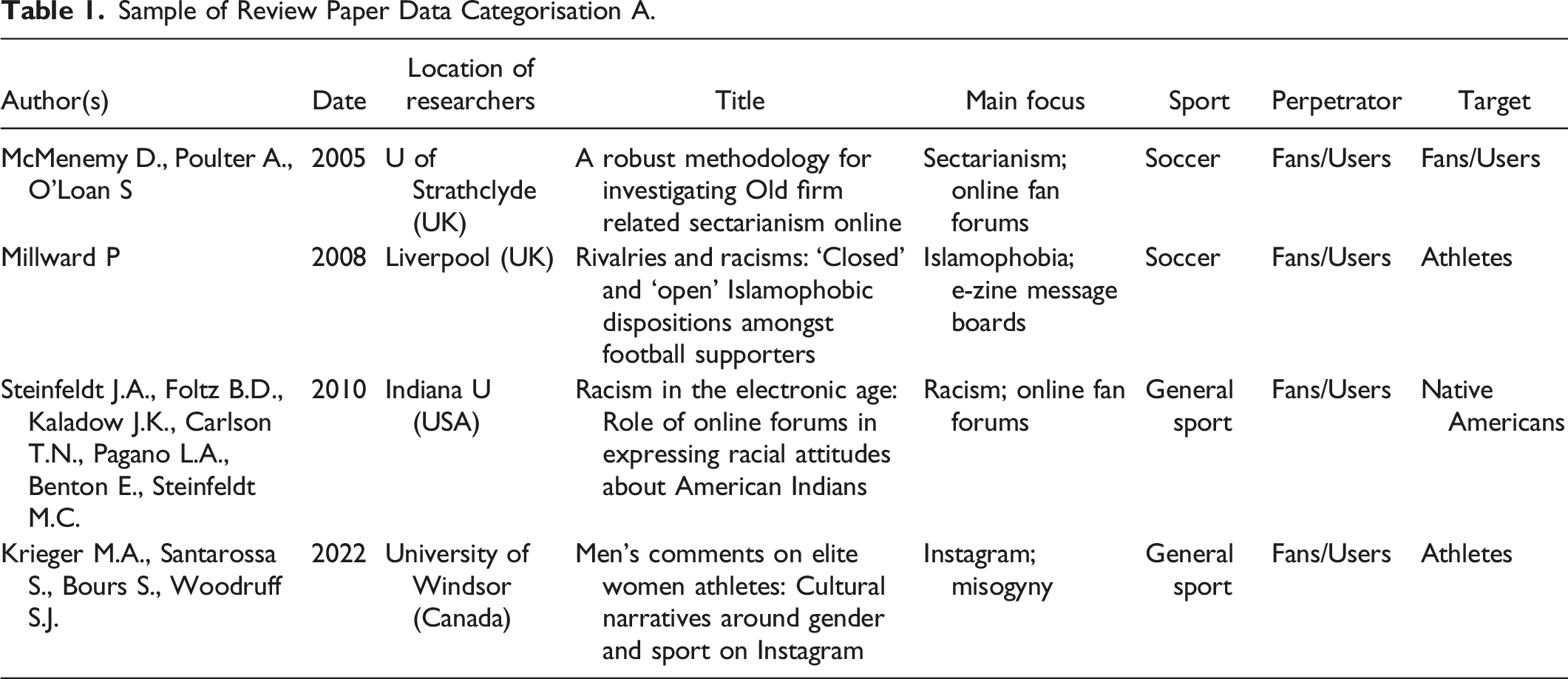
Sample of Review Paper Data Categorisation A.
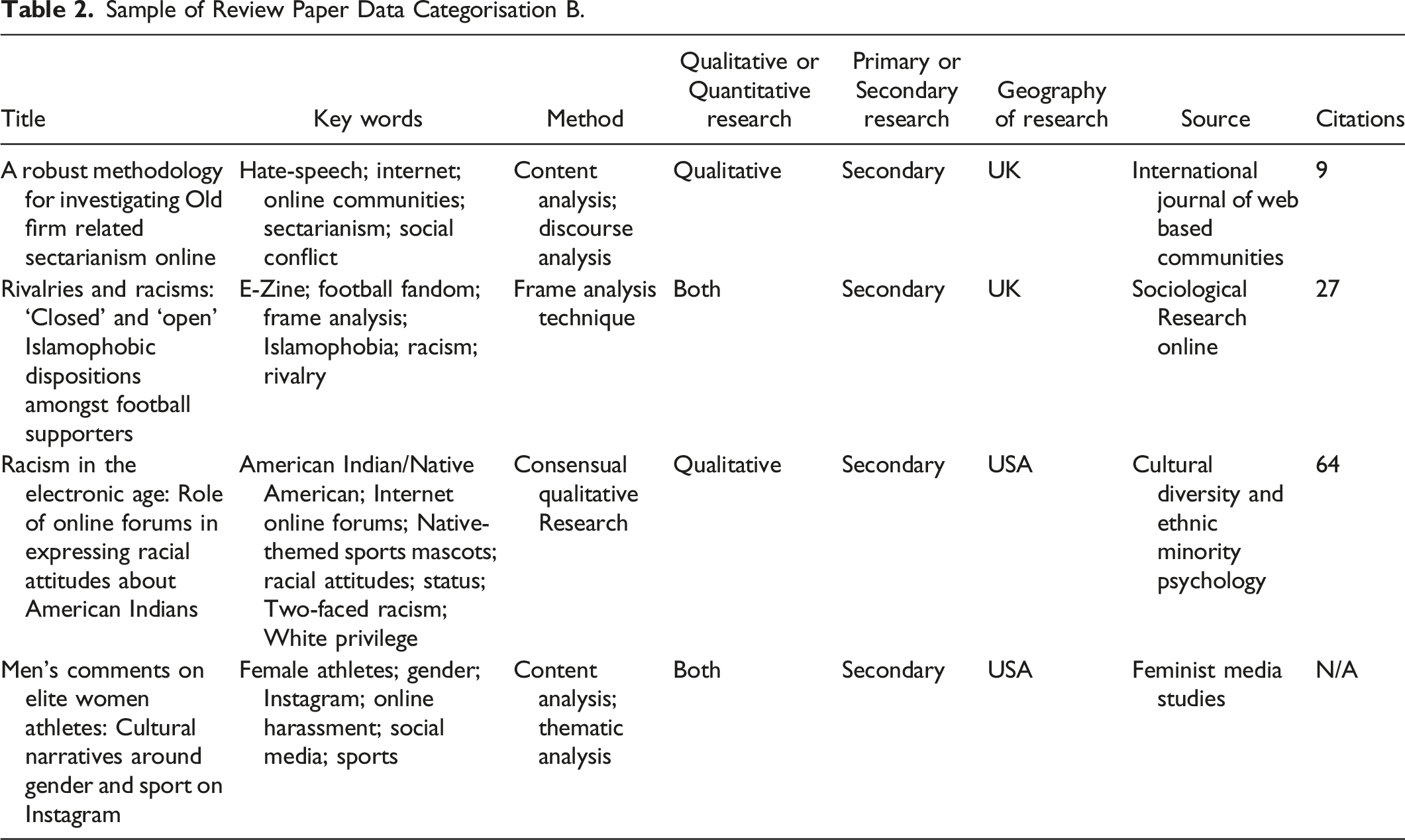
Sample of Review Paper Data Categorisation B.
We were strictly concerned with online hate directed towards and/or committed by people connected to sport (such as athletes, fans, journalists, etc.). Thus any hate perpetrated by athletes – by means of their status as public sports figures – was deemed relevant, regardless of those to whom this was directed or the nature of the abuse. Furthermore, hate perpetrated by journalists or fans also required us to consider context in order for it to be deemed relevant e.g., that targeted at players or fans of rival teams or a reaction to sports events. Research methodologies and key findings were also recorded. Cross-coding was completed by the research team to ensure consistency in the employment of search criteria and in the coding of these selected publications.
There were some linguistic restrictions owing to the use of publications written and/or available in English. Online hate itself, and in sport, is of global concern, within academia and beyond, and our initial search identified publications written in languages other than English. These underscore the need for further international and cross comparative investigations into the issue. Our focus on publications whose chief focal point was online hate also affords future opportunities to consider more subtle and systematic forms of discrimination in sport, such as implicit bias in social media coverage. We acknowledge too that more might be gleaned from wider and intersectional approaches to discrimination in sport in offline sports media (see also, ‘Discussion’). The scope of our findings outlined in the next section are, we argue, an important and necessary starting point in understanding the state of research into online hate media in sport and some important conceptual and empirical nuances that arise.
Our fourth criteria - that sources must be readily available - ruled out research exclusively published in book chapters 2 (four otherwise relevant examples of which were identified in our search), which limits the scope of our review. However, that criterion was devised in light of the resource we wanted this review to function as for other reviewers in the field. Namely, as a concise and accessible guide to current research that facilitates future studies. In writing a review of research ultimately aimed at addressing discrimination and inequality, we felt it in keeping with the ethos of the field to place an emphasis on accessibility of resources on this very subject.
Findings
To develop a broad and accessible overview of the field, our review process involved collecting data pertaining to a number of key insights and trends in the papers we examined (see Tables 1 and 2). In this section, we present a succinct account of those trends: first we outline the significance of the dates of publication, before addressing the particular forms of online communication focused on in the papers of the review. Following this, we detail the specific sporting, geographical and cultural contexts focused on within the papers and then address the findings pertaining to the most prominent perpetrator and target groups of online hate in sport, before discussing findings related to the role of anonymity in facilitating online hate. In the closing section, we provide an examination of the methodological trends of the papers in the review.
Context
The research field in online hate and sport has grown since the mid-2000s: from an initial six journal papers published between 2005 and 2014 to an overall total of 35 publications between 2015 and 2022. Clearly this rise is linked to the growth of social media itself. It has also been noted that the growth of the far right, in countries such as the USA, Brazil, India and the UK, has contributed to much more academic attention given to online hate more broadly (see also, Matamoros-Fernández & Farkas, 2021). In the context of sports-related research, high profile protests such as taking the knee against systemic racism (Duvall, 2020), and campaigns against everyday sexism in sport (e.g., #morethanmean) (Antunovic, 2019), have immersed sport further into wider ‘culture wars’. Furthermore, although the research field of online hate in sport is growing in terms of the number of publications, it is not yet possible to assess the impact of this work given its relative infancy. There have been 512 citations of the publications reviewed here with an average of 12.5 citations per paper. Impact is neither confined to, measured by or achieved via citations alone, but we should anticipate an increase in these as more contexts and methodologies are incorporated into future research.
From message boards to Twitter
Platforms Examined.

It is not surprising that Twitter was the most popular medium for researchers followed by Facebook and online fan fora. Twitter’s growth has some parallels with that of the research examined in this review: the earliest paper was published in 2005 and the latter half of the 2010s sees a significant increase in the attention paid to the topic. Twitter was founded in 2006 and saw considerable growth in the first half of the 2010s (growing from a user base of approximately 30 million at the start of the decade to over 300 million by the end of it [Statista, 2022]) before levelling off somewhat in 2015 - though the platform did experience major growth in 2020, due perhaps to the Covid-19 pandemic (Leetaru, 2019; Twitter, 2020). As an open social media platform, Twitter allows for interactions between all of its users, thus facilitating direct communication between sports fans and athletes. Furthermore, the platform differs from others, such as Facebook, in terms of ease of data accessibility (Williams & Burnap, 2016). This being said, Twitter has also been criticised, both for not requiring the consent of those whose posts become a data source (Linabary & Corple, 2019) and because the characteristics of the platform discourage meaningful inclusive engagement (Baker & Rowe, 2013). Rather than democratising discourse, users (e.g., politicians, athletes or ‘influencers’) can dominate this, disproportionately. This requires researchers to pay particular attention to any patterns in Twitter datasets.
Locations and sports
Locations/Cultural Contexts Examined.

Unsurprisingly, given its status as the most popular sport worldwide, association football or soccer was the focus of 11 (26.8%) of the studies examined, followed by American Football (n = 8/19.5%) and eight (19.5%) studies that focused on sport more generally (see Table 5). Football has a long and problematic history of rivalries that have led to violence, including hooliganism, racism, sexism, and homophobia within stadia (Dunning et al., 1984; King, 1997; Serrano-Durá et al., 2019). The generation and dissipation of excitement and tension associated with the game as well as the noted history of rivalries have been reflected too in online spaces. These studies have positioned football in an instrumental fashion to develop arguments on wider social media issues such as inhibition (e.g., Kavanagh et al., 2016) and reactions to sports organisations espousing political positions (e.g., Cavalier & Newhall, 2018). Here, questions can be asked about the potential generalisability of the findings to any or all sports.
Sports Examined.

Social Media Users as Recipients and Perpetrators of Online Hate
Specific Types of Hate Examined.

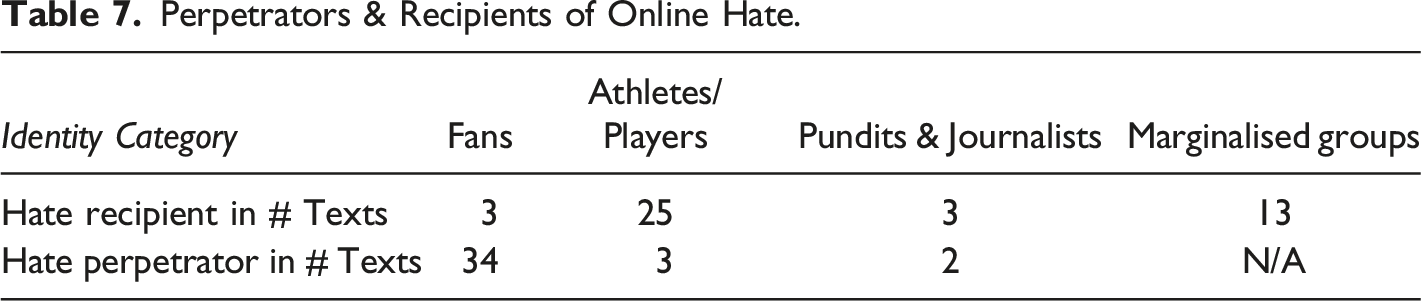
The most frequent recipient of hate were athletes themselves. These publications have identified aspects of the nature of its impact on athletes. For instance, the targeting of female athletes is cited frequently as a potential barrier to female participation in sport (McCarthy, 2021). Indeed, expressions of online hate directed towards athletes or their representatives are characterised by researchers as a gatekeeping exercise in which perpetrators attempt to delegitimise the participation of particular marginalised groups (Doidge, 2015; Litchfield et al., 2018; Kavanagh et al., 2019; Duvall, 2020). Often, the abuse of athletes was triggered by a flashpoint event which informs the nature of the online hate, such as Duvall’s (2020) look at how NFL player Colin Kaepernick’s protest had galvanised far-right racists to enact co-ordinated abuse campaigns with an ideological fig-leaf of ‘justification’ based on his high profile ‘disrespecting’ of the anthem on the sports field.
Perpetrators & Recipients of Online Hate.
The significance of anonymity
Indicative of the wider research on online hate crime, issues of anonymity and transparency were raised in the publications examined here, showing varied views on these. Hate was not limited to ‘backstage’ online platforms largely hidden from audiences beyond fellow haters, but also featured in ‘frontstage’ platforms where user identities were foregrounded (Steinfeldt et al., 2010; Love et al., 2017; Kilvington, 2021a). Following the racist abuse of three Black English players at Euro 2020, Twitter (2021) released a statement to say that 99% of the users removed from their platform for racist abuse were identifiable. Nonetheless similar abuse persists on this platform and some have questioned the effectiveness of attempts to address the issue (e.g. MacInnes, 2021). Specifically, attention was directed by researchers to the influence of community ethos and the fostering of online environments. In these, perpetrators feel comfortable espousing hate as it attracts support and admiration from peers even if it earns condemnation from others (Stick et al., 2021). Hate, it is argued, is exacerbated in online environments which rely on user-reported moderation (e.g., McCarthy, 2021).
Others argued that anonymity was key in fostering an environment in which users felt empowered to espouse online hate in a manner regarded as taboo offline, in mainstream society (Sanderson, 2010; Love & Hughey, 2015; Page et al., 2016). In earlier publications (e.g., Fisher & Wright, 2001), a contrasting view was posited: that it was a key feature in the utopian potential of online communication, thereby fostering an environment untainted by historical and cultural prejudice. However, since then it has come to be seen as a critical factor in fostering online environments where social taboos against prejudice and discrimination can be elided, thus also allowing hate to circulate without fear of sanction. As Kavanagh et al. (2016) state: ‘some of the characteristics that make online spaces most attractive such as the freedom of expression, perceived or actual anonymity, reduction of inhibition and expression of thought also make this environment difficult to regulate and police’ (p. 66).
In short, while some posited anonymity as a central factor in the circulation of hate online (Sanderson, 2010; Love & Hughey, 2015; Page et al., 2016), others argued for a more nuanced understanding that goes beyond the simple assumption that transparency alone can curb online hate through a re-imposition of mainstream taboos and fears of stigma (Steinfeldt et al., 2010; Matamoros-Fernandez, 2017; Love et al., 2017; Litchfield et al., 2018; Kavanagh et al., 2019). While anonymity was regarded as facilitating hate, our review of this work underscores a critical rejoinder: neither is transparency alone a guaranteed solution. Such a simplistic approach obscures the historical rootedness, cultural ties and social contingencies of social media and of sport.
Thus far we have examined the locales, sporting and social media contexts in which hate is propagated. We have also offered a synopsis of what is known about users as recipients and perpetrators and of issues concerning moderation, censorship and anonymity that animate academics and the research community more widely. Next we consider the methodologies for tackling hate within our data set.
Methodologies and Recommendations for Tackling Online Hate
Research Methods of Texts Examined.
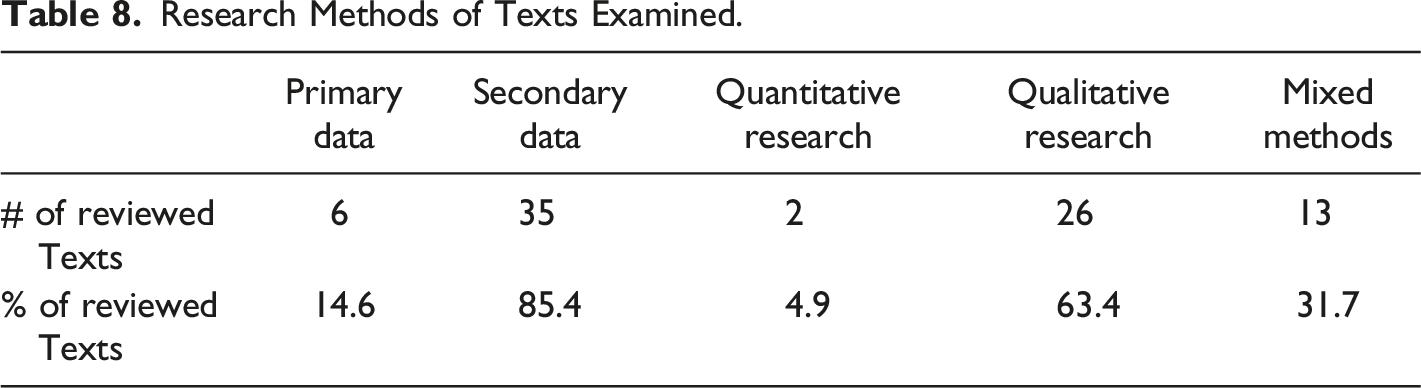
As outlined in an earlier footnote, we used strict criteria in labelling each publication in terms of primary or secondary data. We deemed that only research generated by the researcher(s) would be considered primary data, such as interviews, ethnographies, surveys, etc. Three claimed to use netnographic methods (Kavanagh et al., 2016; Litchfield et al., 2018; Kavanagh et al., 2019). Although netnographic data can be viewed as a primary data source that is often blended with analysis of secondary social media data (see Kozinets, 2015), the articles in our review that identified the use of netnographic methods, employed them in a way that specifically focused on the collection of social media data that was already generated. Kavanagh et al. (2016) for example, ‘used existing tweets, rather than having any researcher involvement or interaction with the online community’ (p. 787). Deeper thematic analysis with a clear theoretical underpinning, such as critical race theory in the context of racism (e.g., see Kilvington, 2017) can articulate the sociological and cultural nuances of online discourses in such contexts. If discovery is indeed the aim in all sciences and, in so doing, to make known something previously unknown, to advance human knowledge and make this more certain (Elias, 2009), there is scope for more mixed methods designs based on primary research.
We found notable differences in our dataset regarding the scope and conception of potential solutions to tackle online hate in sport. Most of these were framed in terms of actions by distinct groups: policy makers, sports authorities or social media platforms. One explanation for these differences was the parent or subject discipline. Publications in the fields of marketing and business focused on internal solutions from and for sports organisations and social media platforms (e.g., O’Hallarn et al., 2018; O’Hallarn et al., 2019; Sveinson & Hoeber, 2020) while others in humanities fields such as sociology and communications framed their arguments more in relation to policy makers and/or the wider society. Examples of these varied approaches included calls for more rigorous and nuanced training for media professionals with regard to racism (Kilvington, 2021b), the need for sports teams to provide social media education and training to players (Kilvington & Price, 2019; Sanderson et al., 2020), recommendations for sports authorities to engage with fan groups on fighting stereotypes and prejudice (Millward, 2008), the need for greater transparency in social media censorship guidelines (Matamoros-Fernandez, 2017), calls for the introduction of anti-racist workshops into secondary education that are rooted in sports-based case studies (Merga & Booth, 2017) and appeals for sporting organisations to take a more active role in maintaining the mental health of athletes (Oshiro et al., 2020). Many also raised important ethical and societal implications about the proliferation of online hate in sport whose recommendations to organisations were of an advisory status. This is to be expected given the lack of direct engagement with stakeholders in the production of such research.
Others conceptualised their findings less in terms of recommendations, however advisory, and more as contributions to research practices surrounding online hate and sport. Examples ranged here from providing psychological frameworks to better understand the motives of perpetrators (Sorokowski et al., 2020; Meggs and Ahmed, 2021), and the manner in which perpetrators conceptualise targeted athletes (Oshiro et al., 2020), through to the relationship between online space and sports culture in facilitating hate speech (Hirsch, 2021) and how heteronormative identity is tacitly enforced in online fan communities (Kian et al., 2011).
Discussion
Sport is an illuminative context in which hate speech and discrimination occur. Culture wars and global socio-economic soft power battles catch fire through the lens of the sporting theatre and burn deeply thereafter. The research reviewed identifies repeatedly how the emotional characteristics associated with sport are provocative ingredients for proliferating hate speech in social media spaces. In the variety of texts examined in this review, noteworthy trends and knowledge lacunas emerge that point towards fruitful areas for future research. In recent years there has been an upsurge in scholarly investigations regarding online hate in sport. This is concurrent with a growing concern in the mainstream political and media spheres (Spellman, 2021; Evans, 2021). Further research in this field is of key social and political significance, and should therefore be informed by the context of the foundation it builds upon, ensuring that it fulfils the potential for further exploration offering rich and varied forms of inquiry. For purposes of conciseness, we focus on the following key recommendations for future research here: broadening the scope of research beyond Western sporting contexts; further analysis of under-examined prejudices; research that is cognisant of characteristics of specific sports and their relationship with online hate; further focus on more niche and image-based social media platforms; greater use of primary research techniques; and exploration of the links between incidences of online abuse and organised hate groups.
There is a clear need to move beyond the westernisation of media and communication studies. As Milan and Treré (2019) put it: ‘while the majority of the world’s population today resides outside the West, we continue to frame key debates on democracy, surveillance, and the recent automation turn by means of “Western” concerns’ (p. 489). Equally then, when addressing the issue of online hate in sport, we must be wary of presuming the universality of the specific discourses and contextual factors that shape the problem in the West.
One of the key characteristics of sport is that by the nature of its competitive scope, different countries and cultures frequently compete as peers and opponents on the world stage, and as a result, fans of sport learn about ‘the other’ through the experience of following their own team/country. This should make it easier for academics to expand the scope of their research in this area from a contextual perspective. This is crucial for developing a more nuanced understanding of the complexities of hate speech. For example, Rodriguez (2017) outlines how the use of the word ‘puto’ is understood in a much different way for football fans in South and Central America than in North America where it is viewed as explicitly homophobic. Casting a wider net for a greater variety of sports would allow future researchers to similarly uncover the nuances of other sporting cultures which have fostered such cultural grey areas in which abuse can flourish.
Many of the studies presented here refer to the characteristics of sport in quite a broad way when analysing social media behaviour. For example, Kavanagh et al. (2019) in their study of sexism and misogyny in tennis, examine how sporting spaces are traditionally seen as problematic hyper-masculine environments. This is instructive in establishing sport’s broad influence on social media interactions. However, there is room to focus on the effect that the nuances of tennis and the traditions of the sport itself have on the discourse, how this compares to football or skateboarding or any other sport in this particular context. Thus there is a need for more theoretical underpinning in the research field.
Racism is by some distance the specific type of hate which has attracted the most research. While there is ample room for further research into this, our review does highlight the potential for focusing on other types of hate in future research on online hate. In the wake of recent events, such as Jake Daniels becoming the only out LGBTQ+ top flight English football player since Justin Fashanu in 1990 and criticisms of UEFA for their response to homophobia during Euro 2020 (Evans, 2021), homophobia is a potentially important avenue for further work. And given the ongoing debates over the role of trans athletes in sports (Ingle, 2022), online transphobia is likely to garner greater public and academic attention. While it is easier, relatively speaking, to suggest that more research is needed on transphobia, Islamophobia, misogyny or anti-Semitism for instance, the solutions are determinedly more complex. This also speaks to wider challenges in Higher Education, driven partly by disciplinary and paradigm rivalries but also by the Taylorisation and neo-liberalisation of the sector more generally (Liston, 2012). These have led to structural inequalities within academia that restrict access to research funding and resources and, consequently, the voices of academics themselves who have lived experiences of these same prejudices within the sphere of hate speech. This affords us the opportunity to emphasise one of the most significant knowledge gaps identified in our review. The inclusion of more public social media platforms in research would also establish better knowledge of the spectrum of online hate. Kavanagh et al. (2016) compiled their typology of virtual maltreatment with the motivation that the ‘ability to appropriately define and classify abuse types is essential for conceptual clarity among researchers, as well as to inform safeguarding initiatives, however, relatively little is known about the types of abuse that occur in online spaces’ (p. 784). Relatedly, contextual clarity is needed with regard to how the different structures of different platforms shape the forms of abuse carried out on them, bearing in mind McLuhan’s adage that ‘the medium is the message’ (p. xx). Our review highlighted the movement in the research towards public social media platforms and the dominance of Twitter as a site of investigation. This could be expanded to incorporate other new platforms that will no doubt emerge. TikTok offers the specific potential for more visual research methods to be employed. This does not ignore the relevance of more niche sporting media, such as blogs and fan forums, and the recent movement of de-platformed far right posters to more ‘welcoming’ spaces such as Parler and Gab (see Jasser et al., 2021). Platforms with specific geographical coverage (e.g. WeChat) might also be considered for communities who cannot access Twitter and Facebook. This is because specific social media platforms attract different demographic groups (Bock, 2017) and marginalised groups.
The lack of reflective dialogue with the object of study in online hate research more widely (see Matamoros-Fernández & Farkas, 2021) is also evident here in relation to sport. This is symptomatic of a dearth of primary data on online hate and sport, the majority of published research to date being reliant on analyses of secondary data sets, both big and small, that are instances of online hate. Though less readily accessible to researchers hitherto, the impact of this on athletes and their representatives could yield important insights as well as shaping our understanding of the similarities and differences between online and offline hate. As Rivituso (2014) writes in his study of the impact of cyberbullying on college students, engagement with the targets of online abuse offers researchers the opportunity ‘to get as close as possible to the personal experience of an individual by allowing them to turn their thought processes back to the detailed events of a unique, lived experience’ (p. 72). While such primary data-gathering is undoubtedly more cumbersome than analysis of instances of online hate, Kilvington and Price (2019) – one of the few papers in this review to carry out primary research – assert that ‘Researchers need to keep knocking on the doors of powerful institutions and organisations and asking important questions. Sometimes the failure to answer such questions provides a telling response in itself’ (p. 74). Suffice to say that the instantaneous nature of online communication about sport leads to more spontaneous, anonymous, distanced forms of hate whose impact has yet to be considered more fully by researchers. A related set of questions concerns the challenges of regulating online and offline hate speech in sport and the place of free speech objections to this. Adopting more primary data collection methods, including more researcher-involved netnographies, opens the field to questions not yet posed and to the possibilities, indeed potentialities, of engaging with more stakeholders. Further examples might include interviewing or surveying perpetrators to understand their motivations and experiences. Importantly, researchers should seek more actively to incorporate the lived experiences and expertise of a wide variety of stakeholder groups. This will help not only to comprehend better the issues but also to address these together, in a more holistic fashion and perhaps based on reflexive principles around the co-construction of knowledge. This recommendation extends to the wider sporting family (e.g. clubs, administrators) and to sports journalists, social media companies and legislative experts.
For understandable reasons, co-ordinated hate campaigns also remain underexplored. The majority of publications in this review address cases of what might be termed ‘spontaneous hate’, arising from the interaction between a flashpoint sports-related incident and societal and cultural prejudices, whether latent or overt. Some research has explored the coordinated actions of some members of a supporter base in perceived defence of their team’s reputation and/or identity (e.g. McLean et al., 2017). However, only Glathe and Varga (2018) examine the role of organised extremist ideologies in shaping incidents of online hate in sport to further their purposes. Given the recent mainstream media attention into the leveraging of sport by far right groups (Aroas, 2019; Colborne, 2020), much more could be gleaned through detailed analysis of how such groups enact and exacerbate incidents of online hate.
This review was not without its limitations. As noted in a previous section, we were limited to research available in the English language, thus ruling out potentially relevant research in this field conducted beyond the Anglosphere. Furthermore, our strict focus on research that primarily considered online hate in sport excluded those papers (discussed in our Research Design section) that examined examples whereby online hate was touched on from a contextual standpoint rather than being the focus of the findings and/or analysis of the paper. Such papers are undoubtedly of relevance to key issues in the field of online hate in sport and provide useful reference points for future research. Within the confines of this paper, however, it was necessary for us to keep a tight focus on what constituted research directly applicable to our review. Accordingly, despite these limitations, we nonetheless feel that the review offers a succinct overview into an important body of research into online hate in sport and provides researchers with a useful tool for further contributing to the field in interesting and under-explored directions.
In conclusion, it is vital that research on online hate in sport embraces and builds upon academic interdisciplinarity, in order to mitigate the narrowing of intellectual horizons and the move towards an increasing fragmentation into ever more distinct specialities that communicate less and less with each other, online and offline. Thus computer scientists might collaborate to much greater effect with media scholars, and those in business might work alongside sociologists of sport. In this fashion, future research may be less prone to the taking rather than the making of the very problems it seeks to examine. Here, critical scholarship on power, the sociology and philosophy of knowledge can sit more comfortably and productively alongside alternative practices and views that question knowledge production, including stakeholders directly affected by online hate in sport. This, we conclude, is where real and meaningful impact is more likely to occur into the future.
Supplemental Material
Supplemental Material - A Scoping Review of Research on Online Hate and Sport
Supplemental Material for A Scoping Review of Research on Online Hate and Sport by Colm Kearns, Gary Sinclair, Jack Black, Mark Doidge, Thomas Fletcher, Daniel Kilvington, Katie Liston, Theo Lynn, and Pierangelo Rosati in Communication & Sport
Footnotes
Declaration of Conflicting Interests
The author(s) declared no potential conflicts of interest with respect to the research, authorship, and/or publication of this article.
Funding
The author(s) disclosed receipt of the following financial support for the research, authorship, and/or publication of this article: This work was supported by the Part of the Tackling Online Hate in Football (TOHIF) project. Funded by AHRC UK-Ireland Collaboration in the Digital Humanities Research. AHRC Reference: AH/W001624/1.

Supplemental Material
Supplemental material for this article is available online.
Notes
References
Supplementary Material
Please find the following supplemental material available below.
For Open Access articles published under a Creative Commons License, all supplemental material carries the same license as the article it is associated with.
For non-Open Access articles published, all supplemental material carries a non-exclusive license, and permission requests for re-use of supplemental material or any part of supplemental material shall be sent directly to the copyright owner as specified in the copyright notice associated with the article.
