




Abstract
Political microtargeting practices aim at exposing social media users to political content that aligns with their preferences and interests. Hence, such exposure becomes a personal experience, dependent on individual perceptions. So far, research has rarely investigated young social media users’ personal experiences with targeted political advertising (TPA). In the present study, five qualitative focus group interviews with 20 young social media users (Mage = 19.30, SD = 1.59) were conducted to descriptively explore young social media users’ experiences with TPA. The insights indicated little intuitive reflection about TPA and targeting disclosures on social media. Participants often based their knowledge on algorithms for commercial advertising. This awareness did not seem to translate to TPA automatically. Once aware of TPA, however, they intuitively understood its potential threats. Our insights highlight the importance of educational programs to increase adolescents’ and young adults’ TPA-related awareness.
When young social media users navigate their social media environment, they are accustomed to receiving content that appeals to them (e.g. Van den Broeck et al., 2020). Hence, the customization and personalization of content in the digital age, including social networking sites, have become essential to marketers, shaping young users’ interactive media behavior (Montgomery and Chester, 2009). Political campaigners have realized the potential of using fine-grained advertising to reach online audiences, applying online microtargeting practices that target voters with fitting content (Zuiderveen Borgesius et al., 2018). Although young social media users may be accustomed to receiving content that matches their preferences on social media platforms (see, e.g. Van den Broeck et al., 2020), online microtargeting practices may be experienced as fairly new. A recent study revealed that adolescents improved their awareness about advertising practices based on personalization only around the age of 20 while not yet possessing a full understanding of the concrete underlying data-driven processes (Zarouali et al., 2020). These insights might suggest that young people’s vulnerability to online microtargeted advertising, in general, can extend into their early adulthood, stressing the relevance of investigating adolescents’ and young adults’ experiences with microtargeting also in the political context.
Political microtargeting centers around the practice of collecting and analyzing users’ online data to identify audiences that are most susceptible to specific content because (1) they are likely to share sympathies with the political party or actors and (2) they are interested in topics that are also of interest to an election campaign (e.g. Zuiderveen Borgesius et al., 2018). As such, advertising encountered on social media can become a highly personal and individual experience. For example, a social media user going to school might be more frequently targeted with topics on education, constituting an issue fit of targeted political advertising (TPA). The same student might have preferences for the Green Party and could behave accordingly on social media (e.g. by engaging with content on sustainability topics and eco-friendly brands). Such data points can categorize the student into the voter group corresponding to other supporters of the Green Party. As a result, political parties can aim to reach voters likely to support the party or candidate and show topics that evoke voters’ interests (Votta et al., 2023; Zuiderveen Borgesius et al., 2018). After political actors have set the targeting settings as the advertisers, ad-delivery algorithms operate in the background to show the advertisements to predefined subgroups (Dobber and De Vreese, 2022).
Political microtargeting is argued to be a potentially promising tool to reach otherwise detached audiences (Zuiderveen Borgesius et al., 2018). Since young voters most likely get in touch with information about political campaigns via social media, political microtargeting could serve as a tool to better reach this voter group (e.g. Ohme, 2019). Despite its relevance, research on political microtargeting involving adolescents and young adults is scarce. Hence, placing the spotlight on younger cohorts is an important step to developing a further understanding of the potential benefits and pitfalls of fine-tuning online political advertising appeals to younger recipients. Even more so, since adolescents and emerging adults may be exploring and forming their identities (see, e.g. Arnett, 2000; Erikson, 1968), which can relate to political engagement and involvement (e.g. Beaumont et al., 2006; Porter, 2013). This study adds the perspectives of young social media users to the existing literature on (in)congruent political microtargeted advertisements.
In this study, we zoom in on individuals’ experiences with the political fit (i.e. congruence between one’s party preferences and the political party/candidate as the sender of TPA) and the issue fit (i.e. congruence between one’s interests and the political topic of TPA; Binder et al., 2022; Hirsch et al., 2024b). The persuasive potential of political microtargeting lies in shaping or altering recipients’ attitudes and behaviors by showing individuals content that resonates with their predispositions or interests. In that regard, research has shown that congruent microtargeted political ads can positively shape individuals’ attitudinal evaluations toward political actors (e.g. Binder et al., 2022; Hirsch et al., 2024a; Krotzek, 2019; Zarouali et al., 2022, 2024) and the ad itself (Chu et al., 2024) or enhance voting intentions (e.g. Chu et al., 2024; Lavigne, 2021; Zarouali et al., 2022, 2024). As this research has shown, evaluative assessments can take place on different levels—on the level of the individual actors, the political parties, the advertising strategy itself, and the advertisements.
One aim of this study is to understand how the political fit and the issue fit of TPA separately and in combination shape young social media users’ perceptions, evaluations, and reactions. In answering these questions, the following study does not only extend the field by complementing existing quantitative research with a qualitative perspective on the different (in)congruity mechanisms but also generates a more nuanced understanding of the interactions between the political fit and issue fit of TPA.
Delving into these more nuanced experiences is of great relevance given the multiparty context of this study and offers insights into individuals’ motivated reasoning about (in)congruent microtargeted political ads. Since a higher number of political parties can approach voters on social media, microtargeting experiences can be very differentiated and nuanced with small changes in individuals’ processing and evaluations.
By conducting synchronous online focus group interviews with adolescents and young adults, we generated descriptive insights that contribute to the understanding of (1) how young social media users perceive and process TPA, (2) activate their knowledge about the mechanisms of microtargeted persuasive attempts, and (3) evaluate the individual- and societal-level implications of microtargeted political ads on social media. By opting for this methodological approach, participants were able to discuss the investigated topics in a social setting surrounded by their peers, enabling dynamic interaction and exchange. From a practical standpoint, insights should help shape educational programs and interventions to enhance microtargeting-related advertising literacy among adolescents and emerging adults. On a theoretical notion, this study contributes to an in-depth understanding of how the political (mis)fit and issue (mis)fit of TPA on social media are experienced and processed in a multiparty country of the European Union. Further, it zooms in on the implications that young recipients associate with TPA on an individual and societal level.
Individuals’ recognition and sensemaking of TPA
Research on advertising literacy and persuasion knowledge has strongly focused on how recipients develop knowledge related to different advertising formats, such as targeted/personalized advertising, native advertising, and influencer advertising (e.g. Binder et al., 2022; Van Dam and Van Reijmersdal, 2019; Van Reijmersdal et al., 2022). One unifying factor is the notion that people’s knowledge repertoires develop throughout their childhood up to adulthood and get richer with each persuasion episode (e.g. Friestad and Wright, 1994; Rozendaal et al., 2010; Zarouali et al., 2020). Recipients need persuasion knowledge and literacy skills to deal with potentially intrusive persuasion attempts such as TPA (see, e.g. Friestad and Wright, 1994; Hudders et al., 2017). However, it might be difficult for recipients to untangle TPA due to so-called “black boxes,” masking the actual functioning of algorithmic content distribution, feed creation, or targeted advertising on social media (e.g. Guess et al., 2023).
Recognition of the persuasive elements of TPA
Recognizing advertising and persuasive appeals is a decisive precondition for activating reactions like reactance or coping strategies, which can then influence message elaboration and evaluation (e.g. Friestad and Wright, 1994; Wojdynski and Evans, 2020). Covert or personalized/targeted advertising is likely to create a threshold for individuals’ advertising recognition. In the covert advertising recognition and effects (CARE) model, Wojdynski and Evans (2020: 10) elaborate on three factors that can shape individuals’ advertising recognition: individual characteristics (e.g. knowledge, motivational dispositions), as well as cues for “top-down recognition” (e.g. disclosures), and “bottom-up recognition” (e.g. characteristics of a message). For a change of meaning to occur—that is, “the transformation of a consumer’s understanding of a particular action as a persuasion tactic” (Campbell and Kirmani, 2008: 556)—disclosures need to be recognized and adequately understood, and recipients need to understand that “a message’s source and intent may be different than they first appear” (Wojdynski and Evans, 2020: 16). However, empirical evidence suggests that individuals often have difficulties in recognizing or recalling disclosures (e.g. Boerman et al., 2017; Boerman and Kruikemeier, 2016) or in fully understanding them despite visually paying attention (Binford et al., 2021). Research also focused on factors such as how the depiction and preciseness (e.g. Jansen and Krämer, 2023; Jost et al., 2023; Meier et al., 2024) and positioning (e.g. Wojdynski and Evans, 2016), or the conveyed transparency information (e.g. Dobber et al., 2024) can shape individuals’ attention, understanding, and/or recognition. Providing more precise information about the applied targeting criteria can equalize existing information asymmetries between advertisers who apply microtargeting practices and targeted recipients who might not possess full information about the processes (Dobber et al., 2024). In that regard, more detailed targeting-specific disclosures can activate individuals’ beliefs that their data had been used to show targeted advertising (Hirsch et al., 2024a). Not only individuals’ recognition but also their normative evaluations of microtargeted political ads might be altered. More extensive labels in the form of visually highlighting the targeting criteria were shown to be a trigger for individuals’ manipulative intent evaluations (Meier et al., 2024), whereas existing targeting-specific disclosures did not yield such effects (Binder et al., 2022; Hirsch et al., 2024a).
Derived from these insights, it can be argued that the effectiveness of targeting-specific disclosures might, on the one hand, depend on how transparency information is depicted and, on the other hand, on individuals’ knowledge about the existence of such disclosures and their motivation to engage in further transparency information seeking.
Another factor contributing to advertising recognition can relate to congruity elements. Political microtargeting distinguishes itself from other types of political advertising by fine-tuning messages based on online users’ data, either shared voluntarily or by engaging in online behavior and interactions (e.g. Dommett, 2019; Dommett et al., 2024). To reach the goal of exposing voters to more granular messages, various targeting criteria can be used which may range from more general parameters such as demographics (e.g. age, gender, education) or geographic information (e.g. Binder et al., 2022) over identity- or personality-based targeting (e.g. Holman et al., 2015; Zarouali et al., 2022) to interest/preference-based or inference-based targeting (e.g. Dommett, 2019; Votta et al., 2023). Consequently, such microtargeting criteria can either create a match or mismatch with individuals’ actual predispositions, preferences, and/or characteristics. Successfully microtargeted advertising appeals can, therefore, act as heuristics for recipients to recognize that what they encounter is targeted based on their data (Binder et al., 2022; Hirsch et al., 2024a).
As suggested by the CARE model (Wojdynski and Evans, 2020), such top-down and bottom-up cues interact with individual characteristics. Hence, such interactions can make advertising recognition highly personal. Since in-depth research on TPA recognition is still scarce, the present study investigated which cues (i.e. bottom-up or top-down) young social media users use to recognize TPA and asked the following research question:
RQ1: Can adolescents and young adults recognize TPA on social media? If so, how?
Persuasive mechanisms of the political fit and issue fit of TPA
One key persuasive mechanism of political microtargeting centers around creating fine-grained messages based on recipients’ characteristics and/or interests (see Zuiderveen Borgesius et al., 2018). Research has mainly investigated the influence of (mis)fitting TPA from a quantitative perspective. Findings have shown that once a message aligns with psychological traits (Krotzek, 2019; Zarouali et al., 2022), party preferences (Binder et al., 2022; Hirsch et al., 2024a), political issues (Chu et al., 2024; Endres, 2020), or other information (e.g. gender identity; Holman et al., 2015), it can enhance the targeted message’s persuasive impact on recipients. Congruent political advertising, hence, can elevate evaluations in favor of the message senders (e.g. political parties or candidates; Hirsch et al., 2024a; Krotzek, 2019) or activate behavioral intentions (e.g. voting; Chu et al., 2024; Zarouali et al., 2022). Against the backdrop of self-congruity theories, these findings resonate with the theoretical assumption that content in line with individuals’ self-concept or schemas (i.e. experiences or attitudes) can create positive outcomes (e.g. Sirgy, 2018).
Although congruence seems to be a decisive factor in that regard, the underlying mechanisms driving congruence can be based on two lines of theoretical argumentation. First, as suggested by message elaboration theories, content that is perceived as more relevant might also stimulate the processing of a message (e.g. Petty and Cacioppo, 1986). As shown by recent studies, personality-based congruent political ads can enhance message elaboration (Zarouali et al., 2022) as well as individuals’ perceptions of the ad’s relevance (Zarouali et al., 2024). Second, congruence might be processed as a heuristic, which can reduce the critical evaluation of TPA (Binder et al., 2022; Hirsch et al., 2024b). The underlying mechanism in that regard could relate to content blending in with individuals’ pre-existing values and opinions when congruence is established. In line with the theory of motivated political reasoning, individuals are expected to be more accepting of content that resonates with their existing political attitudes (e.g. Taber and Lodge, 2006) to confirm and/or maintain prior beliefs (e.g. Bolsen et al., 2014; Taber et al., 2009).
Consequently, congruent content might not evoke the same kind of processing as content that represents a violation of existing values or expectations. For example, when exposed to counter-attitudinal information, individuals might be more likely to show stronger cognitive involvement in the form of counter-arguing or disconfirming the information while accepting pro-attitudinal information without more thorough reflection (i.e. the disconfirmation bias; Taber et al., 2009; Taber and Lodge, 2006). Alternatively, individuals might be more likely to seek out and give more valence to confirming information compared to counter attitudinal information, which describes the attitude congruence or confirmation bias (e.g. Taber et al., 2009; Taber and Lodge, 2006).
In political microtargeting, motivated reasoning processes among voters can be activated by, for example, either strengthening voters’ party identification with messages involving the preferred party or by persuading voters via exposure to pro-attitudinal information. Research in that regard has shown that political microtargeting can be effective through partisan matching (e.g. Binder et al., 2022; Lavigne, 2021; Noetzel et al., 2024) or issue matching (e.g. Chu et al., 2024; Decker and Krämer, 2023). A recent study in the context of political microtargeting found that political ads originating from the preferred political party were evaluated more positively compared to an opposing party, and issues considered important were rated as more acceptable (Vliegenthart et al., 2024), indicating motivated reasoning processes in microtargeted political advertising.
Even though establishing congruence can be an effective strategy in shaping individuals’ processing and evaluation of microtargeted political ads, individuals might still experience mistargeting (e.g. Auxier et al., 2019). This might be of special relevance in this study, given the multiparty context. In a political environment with multiple parties, online political microtargeting might need to work in a more granular manner to account for the plethora of possible combinations of (mis)fit parameters. However, as a recent study using a Meta Ad Targeting dataset shows, even in a multiparty system, political parties use demography-based targeting criteria more often than other criteria (Minihold and Votta, 2024), hence potentially increasing mistargeting. Nevertheless, counter-attitudinal information shown in a microtargeted political ad might still be persuasive, depending on certain features such as message phrasing (Decker and Krämer, 2023). Likewise, misfitting ads could still address content about a group that one might feel connected to (see, e.g. Hersh and Schaffner, 2013). Thus, mistargeting could also be persuasive under certain circumstances. In terms of information processing, it is theorized that misfitting content in the form of counter-attitudinal information could induce more critical processing and evoke counter-arguing (e.g. disconfirmation bias; Taber et al., 2009) or foster more negative outcomes when an experienced incongruity cannot be resolved (e.g. Mandler, 1982). Although the impact of congruence and incongruence might relate to these previously established mechanisms, it seems not entirely clear yet how nuances and differing variations of (in)congruence (e.g. political misfit combined with issue fit) could shape processing and evaluations—even more so, in a multiparty setting.
To generate a more in-depth understanding of how young social media users experience the mechanisms of TPA’s political fit and issue fit, as well as combinations thereof, we asked the following research question:
RQ2: How do adolescents and young adults perceive the influence of the political fit and the issue fit of TPA on social media?
Democratic implications of targeted political advertising
Online political microtargeting has gained scholarly attention not only regarding micro-level implications (i.e. effects on voters’ attitudes or behaviors). Broader discussions center around the democratic implications of TPA. On the micro-level (i.e. citizens), scholars discuss that one advantage of political microtargeting can relate to offering more relevant information, which can better reach detached audiences (Zuiderveen Borgesius et al., 2018). Disadvantages can include privacy invasions and the exclusion or manipulation of voters by, for example, propagating only specific issues instead of showing the full variety of a campaign’s topics (Zuiderveen Borgesius et al., 2018).
On the macro-level (e.g. democracy and public discourse), TPA may lead to campaign diversification, with political parties adjusting to the needs of their electorate (Zuiderveen Borgesius et al., 2018). At the same time, TPA could be linked to changes in public discourse by potentially strengthening filter bubbles and polarization (e.g. Jamieson, 2013; Kuehn and Salter, 2020; Ribeiro et al., 2019), restraining political privacy and freedom of association (e.g. Kreiss and Howard, 2010), and relating to chilling effects (i.e. a change in online information-gathering processes) among the electorate (e.g. Hirsch et al., 2024a). Parties could also focus more strongly on so-called “wedge issues,” which are “issues of divisive nature” (Kruikemeier et al., 2022: 3). Empirical research found indication that political actors in the US rely on such issues (Kruikemeier et al., 2022). Another associated potential risk relates to “pledge obfuscation,” which describes that not all citizens might be exposed to pledges made by political actors to the same extent, either because the advertisers do not consider them relevant or because the algorithm estimates the pledges as “incongruent with the targeted citizen’s political viewpoints” (Dobber and De Vreese, 2022: 3). Although these potential threats show the extent to which political microtargeting could pose risks to society and democracy, scholars also raise questions about the actual impact of these practices compared to other forms of campaigning (see, e.g. Baldwin-Philippi, 2017).
Empirical research focused on the perceived threats of TPA appears to be scarce. However, related to the theoretical underpinnings of psychological reactance theory (Brehm, 1966), individuals may need to recognize and perceive potential threats as preconditions to react accordingly and restore the threatened freedom. Freedom could be restored by adjusting privacy behaviors (e.g. Binder et al., 2022; Boerman et al., 2021) or by shifting awareness to disclosures in order to make an informed decision about the trustworthiness or credibility of the content and sources individuals are exposed to (e.g. Boerman and Kruikemeier, 2016). For individuals to activate protective behaviors, they would need to understand or be aware of the risks of online microtargeting, as high levels of privacy concerns were shown to be related to individuals’ privacy protection behaviors (Jansen and Krämer, 2023). Research, however, found that transparency information or targeting knowledge (i.e. the awareness of targeting practices) were not linked to recipients’ worries about the privacy of their online data (Dobber et al., 2024; Jansen and Krämer, 2023). Thus, this prompts further inquiry into how and under which circumstances individuals may be effectively sensitized to reflect on privacy or other risks related to online political microtargeting. In the present study, we investigated adolescents’ and young adults’ risk perceptions of microtargeted political ads based on their very own experiences. In order to understand how they view their vulnerabilities and those of their environment, we asked the following research question:
RQ3: Which threats do adolescents and young adults associate with TPA on social media?
Methods
Participants and procedure
We conducted five qualitative online focus group interviews with 20 emerging adults (70% females, 30% males) aged between 16 and 22 years (M = 19.30, SD = 1.59) in Austria. The focus groups took place between January 2023 and May 2023, during which no major election campaigns were taking place. We contacted young social media users via convenience sampling, which resulted in a diverse sample (see Table 1). We advertised the study in student social networking groups and among students of Mass Media and Communication Science at the University of Vienna. When agreeing with the study conditions, participants provided their informed consent and participated in a short online questionnaire to gather general information (e.g. demographics and social media use). The focus groups were conducted online via Zoom, lasted approximately 1.5 hours, and were video and audio recorded. Participants received 25 euros as compensation. To ensure anonymity, participants logged in with a pseudonym unrelated to their real name. The Institutional Review Board at the Department of Communication of the University of Vienna approved the study (review no. 826).
Characteristics of the single focus groups.
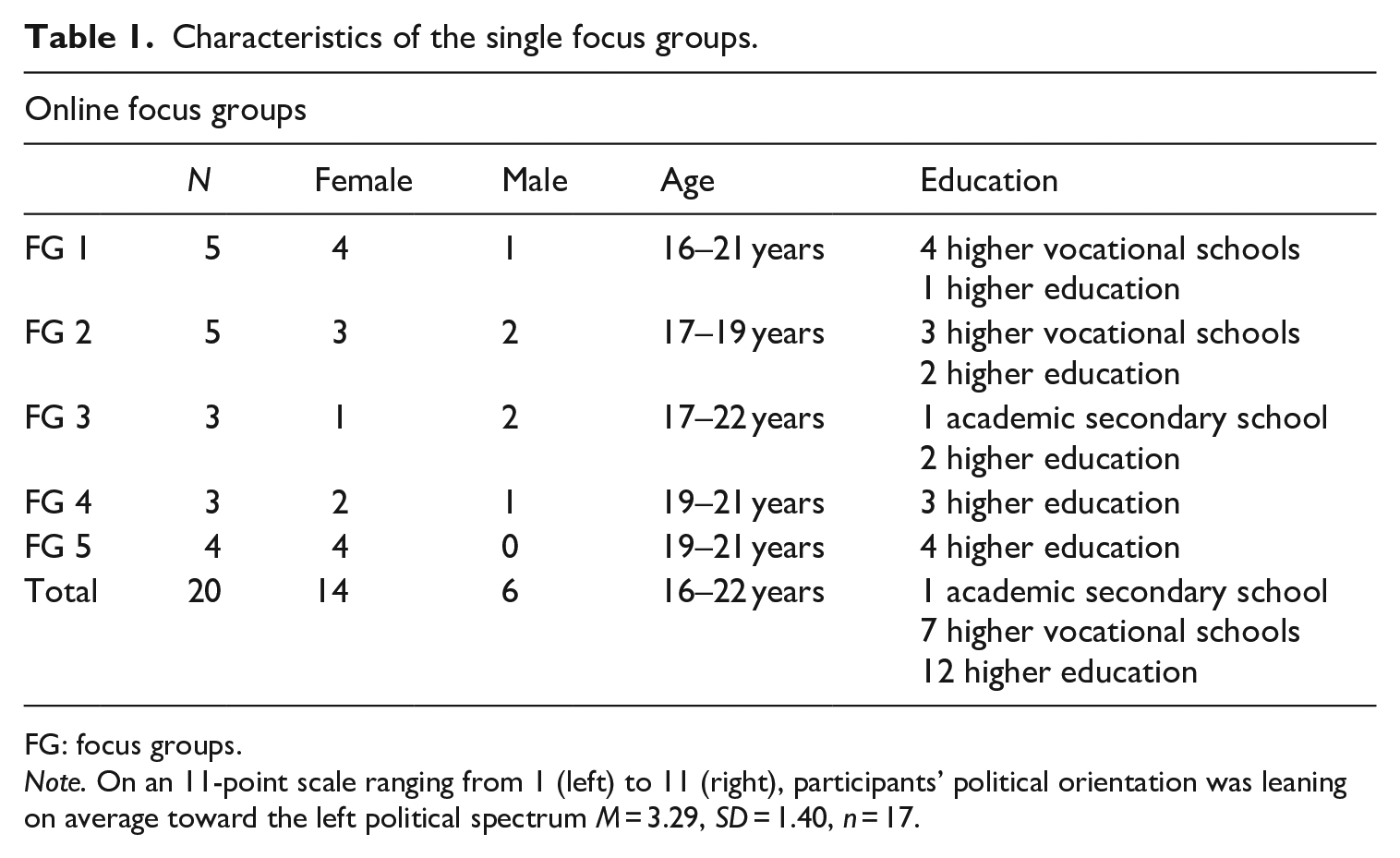
FG: focus groups.
Note. On an 11-point scale ranging from 1 (left) to 11 (right), participants’ political orientation was leaning on average toward the left political spectrum M = 3.29, SD = 1.40, n = 17.
We conducted semi-structured focus group interviews (see Holvoet et al., 2022, for a similar approach). We applied the focus group approach to profit from the more natural and balanced group setting that is created for participants to share opinions and experiences compared to single interviews (e.g. Eder and Fingerson, 2003; Heath et al., 2009). This is particularly relevant for younger participants because group settings account for peer culture through which young people “construct their meanings collectively” (Eder and Fingerson, 2003: 35). In addition, focus group interviews foster interaction and collaboration among focus group participants. In doing so, participants may inspire each other’s responses, which, in turn, enriches the generation of knowledge and understanding of individual or shared experiences (e.g. Lunt and Livingstone, 1996). Previous research has shown that the interactive discourse between young participants during focus group sessions generated relevant insights into young people’s awareness and understanding of as well as experiences with social media content (e.g. DeVito et al., 2018; Holvoet et al., 2022; Van Dam and Van Reijmersdal, 2019). Furthermore, the dynamic and interactive nature of focus group settings can prompt individuals’ memories regarding their experiences with topics that otherwise might not be as salient in their minds (e.g. Vranken et al., 2023). Hence, focus group interviews were chosen as a methodological approach to investigate individuals’ TPA experiences dynamically, interactively, and embedded in a social peer setting.
The focus groups were conducted online in a synchronous way. Synchronous online focus groups are expected to yield similar insights in terms of participation and cooperation as face-to-face focus groups (Stewart and Shamdasani, 2017). Conducting focus groups online comes with several advantages, such as facilitating scheduling, allowing participants to be situated in their usual, comfortable surroundings and can be perceived as more anonymous and less formal (e.g. Stewart and Shamdasani, 2017; Zwaanswijk and Van Dulmen, 2014). Synchronous online focus groups generally allow participants to discuss topics similarly to physical presence due to the possibility to react to non-verbal cues (see Schneider et al., 2002). This can enhance convenience on the participants’ side and create more openness among participants to share their thoughts and experiences while being embedded in a virtual support group (Stewart and Shamdasani, 2017). Further, online focus groups facilitate the gathering of audiences that are otherwise hard to reach, such as young participants.
During the focus group interviews, we relied on a question guideline, which ensured that the research topics were consistently covered while guaranteeing flexibility for related or new topics (see Online Appendix A for topic overview). In the interviews, we highlighted that participants did not have to disclose affiliations with political parties or other related information. We performed member checks during the interviews to adhere to quality standards (see Van Dam and Van Reijmersdal, 2019 for a similar approach). In addition, we contacted participants again after their participation and invited their reflections in case they had follow-up thoughts. At this point, participants could also inform us if their data should be deleted. For all participants, there were no further remarks. Following the analysis, we conducted a peer debriefing of our interpretations. Online Appendices are available at: https://osf.io/mtkpj/.
Analysis
The focus groups were transcribed and analyzed using MAXQDA (version 2022/2024). We applied the structuring content analysis described by Mayring (2015) to analyze the transcripts. We deductively defined the main categories and subcategories, elaborated on definitions and anchor examples, and coded and extracted the relevant material. After coding, we structured the content by paraphrasing and summarizing the extracted parts per (sub)category and established patterns. During this process, we occasionally revised our coding. The presented quotes were translated from the original language into English. An overview of the coding system is shown in Online Appendix B (Table B1).
Results
Recognition of TPA on social media
Most participants did not recall any TPA on social media at first glance. However, such ads became more prevalently recognized throughout the discussions with their peers, and their awareness increased. This indicated little intuitive reflection about TPA, contrasting young people’s general awareness and reflections about targeting practices in advertising on social media. Hence, it seemed that the participating young social media users might have been rather unfamiliar with TPA at first glance.
As suggested by the CARE model (Wojdynski and Evans, 2020), individuals’ advertising recognition can depend on two types of cues: the top-down cues (i.e. targeting-specific disclosures) and the bottom-up cues (i.e. message characteristics that relate to congruity elements in this study). Regarding young social media users’ bottom-up recognition, it appeared overall challenging for many to name the factors that constitute (in)congruent TPA on social media, which was reflected in their relatively uncertain answers. Only participants in two focus groups mentioned the political party as a congruity element (FG 1, 16- to 21-year-olds; FG 4, 19- to 21-year-olds). Participants mainly mentioned elements centering around topics and interests. Age was also named as a prominent element, which seemed to be intuitive for many participants. It was mentioned that politicians try to be “relatable” and “nonhierarchical” (FG 2, 17- to 19-year-olds), follow social media trends, and use youth language (e.g. anglicisms). Some also mentioned past online behavior (e.g. liking content, looking at content, searching behavior), while other less prominent factors mentioned were gender and location.
Although some participants generally described having difficulties recognizing whether the content is a targeted ad or not (FG 2, 17- to 19-year-olds) or “how coincidences play together, or whether it is no coincidence at all” (FG 3, 17- to 22-year-olds), other participants felt relatively confident about their power to intervene in this type of advertising. Some stressed their self-determination over algorithms, for example, by intentionally confusing the algorithms and clicking on different kinds of content or searching for different information (e.g. from all political parties; FG 2, 17- to 19-year-olds; FG 3, 17- to 22-year-olds). Participants throughout all focus groups advocated the importance and need for more transparency on “who has my data, how are my data used, and to whom they are given” (FG 1, 16- to 21-year-olds). This also translated to disclosures marking sponsored content and providing more specific information about why an ad was shown and which data or filters had been used. These reflections showed insecurities about existing disclosures as well. When asked whether they would check for additional targeting-related information on social media, many seemed not to do so. This seemed to contradict their general awareness that disclosures would help to remove the surprise element and put ads into a different perspective. This might indicate that targeting-specific disclosures, including transparency information, might not yet function sufficiently as top-down cues to ease recognition and understanding of TPA (see Wojdynski and Evans, 2020). Nonetheless, many participants communicated their wish for more self-advocacy by giving the power back to them so that they could decide which content from which party they see to avoid that “you get [. . .] bombarded, without being able to do anything about it, or without ever having consented to it” (FG 5, 19- to 21-year-olds). Participants in this focus group also discussed thresholds of TPA and agreed that at the beginning, they would not think about the targeting strategy behind a political ad. One participant also mentioned that it could be just a “coincidence” to see a fitting ad. However, if they were exposed to such fitting advertising more regularly and frequently, it would induce a change of meaning, namely to come to the realization that there could be a strategy behind seeing this ad: “I don’t think it would be my first thought, but maybe later, when I receive many, then I would think, how do they know now that this topic fits and this one as well and this one as well.” Frequency might also act as turning point to perceive such ads as creepy, provoking reflections such as “whether my searching history is being surveilled, how do they get this information.” These insights would not only imply that frequency might induce more reflections in terms of targeting awareness and privacy issues, but it could also backfire in terms of creepiness or, as one participant described, being “turned off by the algorithm.” (FG 5, 19- to 21-year-olds).
Untangling the persuasive mechanisms of (in)congruent TPA
To gather an in-depth understanding of young social media users’ sensemaking of (in)congruent TPA and its underlying mechanisms in terms of information processing, we zoomed in on the influence of TPA’s political and issue (mis)fit and the combination thereof.
Congruence of TPA
When reflecting on TPA that aligns with their preferences for political parties (i.e. political fit) and interests in political topics (i.e. issue fit), participants’ evaluations ranged from positive—for example, “I think I would feel rather confirmed in my values or my interests” (FG 1, 16- to 21-year-olds), “it interests me either way” (FG 4, 19- to 21-year-olds), and “I think I would not be so opposed” (FG 5, 19- to 21-year-olds)—to neutral—for example, “I know where my convictions lie, and I do not need to have it confirmed once more” (FG 2, 17- to 19-year-olds) and “at least it is tailored and [. . .] not just anything” (FG 1, 16- to 21-year-olds). Their reactions ranged from short astonishment to reflection regarding the algorithm, such as, “First I would wonder, then I would remember, ah, okay, true, algorithms, and of course, it is tailored to me” (FG 1, 16- to 21-year-olds). As one participant reflected, if nothing had been searched online beforehand, they wondered, “why is the algorithm so sure that I am so sure” (FG 5, 19- to 21-year-olds). Participants in one focus group also described that only a certain frequency and precision of TPA would prompt their reflections on why the ad had been shown since the first instance could have been by coincidence (FG 5, 19- to 21-year-olds). Many participants also described feelings of uneasiness when content is targeted very well, sometimes even causing some to avoid pursuing the topic further or looking for extra information: “I actually want to forget it right away instead of really dealing with it” (FG 2, 17- to 19-year-olds). Congruent TPA also seemed to hamper their awareness of the persuasive character behind the ad: “[T]hen I do not have as much the feeling that it is advertising that is directed toward me and that tries to convince me of something” (FG 4, 19- to 21-year-olds). Another participant also concluded that when “it fits entirely, then this gets lost because you do not see a mistake” (FG 4, 19- to 21-year-olds).
Incongruence of TPA
When reflecting on TPA that does not align with their party preferences and interests, participants’ evaluations ranged from being “annoyed” (FG 1, 16- to 21-year-olds) to being “astonished,” “insecure,” or “uncomfortable” (FG 5, 19- to 21-year-olds). Several participants said they rarely received ads from disliked parties, except for a few exceptions (FG 2, 17- to 19-year-olds; FG 3, 17- to 22-year-olds). Participants often expressed astonishment when receiving something not aligned with their preferences, triggering reflection. Reflections centered around notions of “how did it happen that such an ad is shown to me even though I actually do not stand for it at all” and “what have I done [. . .], or what could social media have heard so that it thinks that it is like that” (FG 2, 17- to 19-year-olds). Other participants reported having “no interest” or “no urge” to further engage with such ads, either continuing to scroll or clicking away (FG 4, 19- to 21-year-olds; FG 1, 16- to 21-year-olds). However, participants in one focus group said, “maybe [. . .] I engage with it more than for parties and topics that attract me more” (FG 1, 16- to 21-year-olds). In this case, they talked about making fun of ads or exchanging them with friends. Others expressed annoyance or even anger (FG 4, 19- to 21-year-olds). Some participants also perceive incongruent content as less personalized, creating a distance between the ad and themselves, making it seem “not that they want exactly me, but that I am one of many, and they, ‘unfortunately,’ reached exactly me who does [. . .] not share the ideology” (FG 3, 17- to 22-year-olds; FG 5, 19- to 21-year-olds). In this context, they reflected on two types of TPA: “[T]he one that simply targets my interests and the one [. . .] that aims at changing my mind. So [it] consciously shows me exactly the opposite of my values or my moral concepts” (FG 1, 16- to 21-year-olds).
Political party over topical interests?
Although many participants were relatively straightforward in their stances of (mis)fitting TPA, there seemed to be more fluidity regarding the interplay between the party and issues. On the one hand, the political party seemed to be a more convincing factor than the topic: “[E]ven if the content would somehow apply to me, it does not attract me because [. . .] the party probably is above the message itself” (FG 4, 19- to 21-year-olds). However, reactions seemed to be different for ads from parties that partly fit and are not entirely rejected by participants; then, the topic could also have an influence. When a party “does not fit entirely, but is also not entirely off, but the topic interests me a lot, I think [. . .] then I would feel the most that it is targeted to me” (FG 4, 19- to 21-year-olds), such an ad could encourage elaboration and reflection. In that case, participants agreed on a certain level of “openness” to “get to know” the party and form an opinion.
Perceived threats of TPA on social media
Most participants were generally capable of reflecting on different risk factors associated with TPA. Despite being asked about the potential benefits, they elaborated more extensively on the associated threats. Mentioned benefits were rather general, such as staying informed, mobilizing voters, or adjusting to younger voter segments. Their reflections on the threats encompassed a more diverse set of concepts.
Like-minded and cross-minded filter bubbles
The threat of algorithms creating filter bubbles was prominently discussed in all focus groups. In addition to their unanimity that filter bubbles can be “very problematic” and “dangerous,” participants shared several associated reasons and consequences. In most focus groups, participants claimed that uniform opinions would more likely be manifested, reducing the exchange of opinions. They described that due to filter bubbles, people might only be exposed to opinions or political orientations aligned with their worldviews while receiving little to no content on other opinions. Participants said their own thinking patterns and opinions would be reinforced and confirmed. As one participant described,
[. . .] because you really only get sensitized to your own topics, but other topics are not questioned at all and then [one . . .] only remains in their spectrum and the others in theirs and then [. . .] there is not really an exchange, but just a confirmation. (FG 1, 16- to 21-year-olds)
Some participants expressed their worries on increased majority thinking, creating the illusion that “everyone thinks like that, anyway” (FG 2, 17- to 19-year-olds). This can again encompass losing sight of other opinions and reducing the diversity of perspectives. Participants also discussed the potential loss of objectivity and reduction in complexity due to catchy communication and lack of input of new information within the bubble (FG 1, 16- to 21-year-olds). Due to “the algorithm deciding what you see” (FG 3, 17- to 22-year-olds), some participants also expressed their concern that filter bubbles influence people’s opinions and behavior (FG 4, 19- to 21-year-olds) and push people in a specific direction (FG 5, 19- to 21-year-olds).
When reflecting on filter bubbles, participants mostly referred to filter bubbles as being embedded within a single group of like-minded people. Participants from two focus groups reflected on cross-opinion filter bubbles. One participant stressed that, especially for young voters, an early categorization into groups is problematic:
[Y]ou are put very early into a box [. . .], then the algorithm kind of decides that you stay there. So, I think if a person would now politically reorientate, [. . .] they will never ‘get away’ [. . .] from what was shown previously. (FG 2, 17- to 19-year-olds)
Another participant agreed, concluding that it feels like a “battle against yourself” (FG 2, 17- to 19-year-olds). This resonates with other opinions describing two difficulties. First, there is the realization that one is trapped in a filter bubble. As one participant summarized, “I do think that this could happen fast that one slides into a direction without realizing at the beginning and then it is your own filter bubble, and your entire world, and your political attitude” (FG 5, 19- to 21-year-olds). Second, breaking out of a filter bubble requires motivation, engagement, and investment. Participants discussed that it could help to be confronted with sudden “discrepancies” or with input from outside social media (e.g. discussions with family or exposure to news; FG 3, 17- to 22-year-olds). Such input could break the cycle of normalizing one’s opinion on social media. However, as one participant in the same focus group described, staying in one’s bubble could happen because otherwise, “you simply make life difficult because you then always have to engage actively in this exploration and always have to search for [. . .] information” (FG 3, 17- to 22-year-olds).
Influence and manipulation
Participants in all focus groups discussed the threat of TPA influencing voters on social media by altering attitudes and opinions. One focus group deemed this problematic for young people still developing their opinions. One participant expressed worry that such “niche advertising” could hamper the development of young people’s opinions, adding that a critical reflection should not be automatically assumed because “you always only believe what you [. . .] see” (FG 2, 17- to 19-year-olds). Participants also discussed that parties try to be catchy (FG 2, 17- to 19-year-olds) and influence young people by following trends or by creating a coolness factor (FG 5, 19- to 21-year-olds). Participants in these groups further expressed critical thoughts about parties presenting themselves as a young people’s party, advocating for issues that might not be part of the electoral programs.
Another critical point was related to the freedom of independent opinion-making. As one participant expressed, “parties know exactly that there exists an algorithm, and they know exactly that this advertising is there to manipulate even more these predefined user profiles and to create this [. . .] turning point, that [. . . one] vote[s] for their party” (FG 2, 17- to 19-year-olds). In this realm, many participants expressed their concern over subconscious influence and manipulation, related to messages that “get [. . .] carved into my brain,” being “brainwashed,” and having an opinion simply because “you have just seen it 20 times already and therefore it is your opinion” (FG 2, 17- to 19-year-olds). These thoughts resonate with other participants (FG 1, 16- to 21-year-olds) who shared that TPA could influence them subconsciously because it can anticipate their opinions or resonate with their preferences. These tactics might increase the risk of agreeing “subconsciously, no matter the opinion.” Another participant agreed, saying that subconsciously one knows “that is actually the party that I support, then it is okay by and large.” Participants further explained that this could lead to a “laissez-faire” attitude, namely that “a certain laziness develops in the subconscious,” simply accepting the messages that parties convey instead of further engaging with them. This contradicts other participants’ opinions from the same focus group. Two participants mentioned TPA on social media playing “a minor role” or just being “a drop in the ocean” and not the “foundation for everything” (FG 1, 16- to 21-year-olds).
In addition to the political party, the topics addressed in the content could also enhance the influence on voters. Instead of addressing the masses, people can be addressed with topics that
they are interested in as an individual person, that [. . .] polarize them; therefore, it is also easier to push people in specific political directions on a large scale or to also alter the political window accordingly to the left or the right. (FG 3, 17- to 22-year-olds)
This resonates with a particular fear of participants that combining algorithms and political advertising could leave an imprint, mainly when data are used to “make the electorate support a party that would not be considered otherwise.” One participant also expressed fear that increased exposure could cause a shift and “push you in this direction, further and further” (FG 5, 19- to 21-year-olds). Participants in this focus group agreed on this risk and perceived the algorithm to be “very smart” but were unsure about the extent to which such an influence is possible and thought it might be most dangerous where parties are very close to each other.
Exclusion and polarization
Another prominent threat that the majority of the focus groups mentioned was that not everyone was exposed to the same ads and content, which could exclude voter groups, topics, and political parties. As a result, opinions could be distorted and pushed to the extreme because the comparison lines are lost, creating a “tunnel vision that is kind of hard to leave” (FG 4, 19- to 21-year-olds). This phenomenon was seen as less problematic in traditional posters or newspaper advertising, where several poster ads are shown next to each other. As one participant explained, one difficulty related to this is that it is hard to know what other political ads are circulating on social media (FG 2, 17- to 19-year-olds). Some participants in FG 1 (16- to 21-year-olds) summarized that voters should have the same chances of receiving political advertising, and political parties should have the same chances of showing political advertising.
In most focus groups, participants reflected on the dangers of TPA-induced or TPA-strengthened polarization. They talked about opinions being “confirmed” and becoming “more extreme” and “radical.” The access to “populism” and “fanaticism” could be more accessible, and marginalized groups might be “radicalized.” As one participant described, “because you are more aware that you are part of a rather marginalized group, you can also be tempted more quickly to partly adopt very radical views” (FG 3, 17- to 22-year-olds). Participants in another focus group similarly reflected that “boundaries between parties and the connected opinions harden somehow even more.” Likewise, it was stated that
the more arguments you find for a topic, the less you deal with counterarguments and vice versa [. . .]. Therefore, this is actually an extremely great danger for democracy because a democracy should aim for diversity and freedom, and this has nothing to do with diversity and freedom [. . .] anymore. (FG 1, 16- to 21-year-olds)
Discussion
This study aimed to understand how young social media users perceive and understand TPA on social media. It advances the scholarship by (1) zooming in on emerging adults, (2) showing how the participating adolescents and young adults recognize TPA on social media, (3) untangling the mechanisms of perceived (mis)fit perceptions, and (4) generating insights into perceived individual- and societal-level implications of TPA. Three main conclusions can be drawn: (1) Participants showed little intuitive reflection about microtargeting practices in political advertising. However, once they were aware of the topic, they translated their understanding of algorithms in general to the context of TPA. (2) Critical reflections about TPA seemed to depend on whether a political ad aligned with their party preferences, partly supporting theoretical notions of (in)congruity processing mechanisms. (3) Participants intuitively understood the threats associated with TPA and named a variety of potential dangers related to (mis)fitting TPA. This, however, did not appear to translate to concrete defense mechanisms or an intuitive awareness of disclosures.
Regarding the first conclusion, compared to other sectors, such as product advertising, it seemed more difficult for participants to name the mechanisms of TPA. Many stated they had not heard about this topic before, and when asked how they could realize that an ad was personalized or targeted, they seemed unsure while still naming relevant targeting criteria. This suggests that young social media users might possess the cognitive schemas related to microtargeting as an advertising practice but might nevertheless struggle to activate this information. In other words, while many participants seemed to grasp the general concept of microtargeting in advertising also related to algorithms, they may still struggle to recognize, be aware, to remember, or articulate these mechanisms regarding TPA. Two possible implications might stem from these insights: First, microtargeted political ads in their current form and embedded within the current rather limited transparency information might not be efficient enough to activate young users’ schemas and understanding of TPA. Second, once participants reflected upon the topic together with their peers, many were capable of translating their understanding of algorithms and data-driven processes to TPA and were able to reflect on TPA on social media. This seems to point to a possible gap between young recipients’ subjective knowledge about how social media advertising works and their capacity to identify related persuasive mechanisms. At the same time, these insights may imply that literacy programs could help to sharpen young recipients’ recognition or understanding of advertising practices that use more subtle mechanisms (see, e.g. Walrave et al., 2018). However, when interpreting these insights, it is also relevant to consider that online political microtargeting can be a phenomenon that is difficult to grasp (Dobber et al., 2024) related to the masked underlying mechanisms of algorithmic categorization and tailoring that overall lack explanation (see, e.g. Hargittai et al., 2020).
On a different note, it could be that individuals might have had difficulties in verbalizing the detection of political microtargeting because they might assume that all content they encounter on social media is targeted. As such, it would be interesting to more systematically investigate whether individuals perceive all advertising on social media as being targeted or based on which parameters they might draw the line of differentiating between different degrees of microtargeting. Insights from one focus group suggest that there might exist a difference in perceptions based on, for example, the frequency of targeting or how fine-grained targeting is. Unfortunately, we cannot make any further conclusions in that regard since we did not systematically and in-depth focus on the thresholds of young people’s targeting perceptions in this study. Future qualitative studies should be dedicated to answering these questions, as it might generate a more nuanced understanding of the turning point of political microtargeting, that is, how much online political microtargeting might be acceptable and when it is perceived as too intrusive or whether congruity elements might alter these evaluations.
Second, the persuasive mechanisms of TPA derived from participant’s reflections are mainly in line with insights from quantitative research (e.g. Binder et al., 2022; Hirsch et al., 2024a) and resonate with evidence from motivated reasoning research. Many adolescents and young adults in our study did not seem disturbed by TPA that was in line with their preferences, which did not appear to evoke any further critical reflections because they either expected it or because it was in line with their prior beliefs. These insights corroborate with a confirmation bias described in motivated reasoning, namely the seeking out of information that blends in with existing beliefs (e.g. Taber et al., 2009; Taber and Lodge, 2006). Only upon further elaboration did some participants reflect on the autonomy of their decision-making or the extent to which such advertising could subconsciously influence others or themselves. As for misfitting TPA, such content potentially raised their attention, especially when the political party did not match their preferences. In that case, some described to look at it, think about it, or engage with it. At the same time, such advertising could also prompt reflections about their behavior, making them unsure about why the algorithm would show them content not in line with their preferences (see also Swart, 2021). Overall, the insights might imply that when recipients encounter incongruent microtargeted political ads, they might not automatically ignore or avoid them. An increased cognitive response to counter-attitudinal information is in line with motivated reasoning (e.g. Taber et al., 2009; Taber and Lodge, 2006), however, the response in this study seemed to range from ignorance, over astonishment, to engagement, whereas disconfirmation was not as prominently discussed. It is important to bear in mind that a disconfirmation bias might become prevalent once individuals discuss more concrete and specific microtargeted political ads. The focus of this study was on an overall assessment without focusing on a chosen set of political ads, which is further discussed in the limitation section.
Another relevant extension to previous research is that (mis)fit perceptions did not seem to be black-and-white experiences for some participants. This highlights the persuasive potential of advertising not stemming from an extreme fit or misfit but instead originating from political parties that they did not fully reject, or that did not fully align with their preferences. This insight could be particularly relevant for multiparty systems, where the differences between certain parties can be small (see, e.g. Zuiderveen Borgesius et al., 2018). Future quantitative research could further address the different shades of (in)congruent TPA on social media to investigate these nuances and their persuasive potential to better understand young social media users’ reactions to TPA and to develop educational interventions or programs. Further, such insights could also put previously established null findings of the issue fit of TPA into perspective (Hirsch et al., 2024a). Participants placed greater importance on the political party than on other congruity elements, except for situations where a political fit might not be as strongly established. In this situation, if the topic matched their interests, it could supersede the political party in importance and render the proposed advertising interesting. These insights are once more interesting in the light of motivated reasoning as it shows that there are some degrees of freedom between the confirmation and disconfirmation bias, meaning that individuals might show more nuanced processing and reactions to political advertising that is not situated at the extremes of congruity experiences (i.e. extreme fit or misfit). One possible way to interpret this finding is that political fit and issue fit might interact in a u-shaped rather than in a linear relationship. Put differently, when considering the latitude between congruence and incongruence, persuasiveness might peak once voters receive microtargeted political content from a party they neither entirely align with nor reject. Existing studies do not yet seem to draw a conclusive picture concerning the interplay between the two fit elements (e.g. Binder et al., 2022; Chu et al., 2024; Hirsch et al., 2024a; Kruikemeier et al., 2022). Consequently, the present study indicates that future research could also investigate nonlinear relationships as this might shed light on the interplay and nuances of congruity elements in online political microtargeting.
The described insights might also be of special interest given the multicountry context the study was embedded. The findings seem to suggest that political parties that are similarly situated on the political spectrum might have more degrees of freedom in convincing voters with topics that are perceived as interesting. This interpretation may challenge the notion that online political microtargeting might be less useful in a multiparty system (see Zuiderveen Borgesius et al., 2018). Overall, caution needs to be applied when generalizing these conclusions. More research on the nuances between various interactions is needed, qualitatively as well as quantitatively, to better understand the potential and limits of online political microtargeting in a multiparty environment.
Third, despite the less pronounced intuitive reflections about TPA, once participants were aware of the topic, many thoroughly reflected on how they experienced (mis)fitting TPA and on possible large-scale implications. Although participants highlighted benefits mainly centering around adjusting to and reaching younger voters (see also Zuiderveen Borgesius et al., 2018), their reflections on potential threats seemed more prominent and multifaceted. Filter bubbles seemed to be the most tangible for participants. They reflected on various possible implications of TPA-induced filter bubbles, such as reduced exchange of opinions, majority thinking, complexity reduction, creation of illusions, and early categorization into boxes. In terms of early categorization into predefined boxes, some participants feared that their freedom and capacity to develop their own political identity could be jeopardized by algorithms and related political advertising (see also Bucher, 2017). Such unwanted categorization could occur if they decided to change their political orientation or had to conduct online searching behaviors related to school assignments. As such, filter bubbles could be created unintentionally, not appropriately reflecting their opinions.
These sentiments also reflected some of the participants’ wish to safeguard their self-determination and autonomy by having power over TPA. When reflecting on targeting-related disclosures, some participants expressed the need for more transparency about how their data were used and why certain ads were shown to them. While many knew that disclosures could alter how they processed advertising, disclosure awareness seemed limited. One reason could be that TPA disclosures might not be strong enough yet to leave an imprint on young recipients that would allow them to access their knowledge (see, e.g. Binder et al., 2022; Binford et al., 2021; Boerman and Kruikemeier, 2016). One way to improve targeting awareness via disclosures could be by providing more precise transparency information or by improving the visibility of the applied targeting criteria by placing this information right next to the content (Dobber et al., 2024; Jansen and Krämer, 2023; Meier et al., 2024). This was also mentioned by some participants in our focus group study. The current shortcoming of targeting-specific disclosures implies that users need to leave the interface in which they encountered the ad and click on extra fields to access the transparency information on microtargeting (e.g. Binder et al., 2022). Receiving this information only when engaging in those additional steps might also depend on individuals’ knowledge about the existence of and their motivation to actively engage in those extra steps, thus potentially not increasing transparency most effectively. The insights generated in this study, however, can only provide limited evidence into this specific aspect. Therefore, further qualitative studies on individuals’ knowledge, motivations, and expectations of targeting-specific disclosures would be insightful. Such follow-up studies could also delve into another dynamic observed in this study, namely the potential discrepancy between young people’s subjective feeling of control and their understanding of TPA and actual coping mechanisms against unwanted persuasion induced by TPA.
Limitations and future research
In this study, synchronous online focus groups were conducted. While this approach has several advantages (e.g. convenience for participants, anonymity), previous studies have shown that conversation and discussion flows can be experienced as harder to follow or to stay engaged in–a shortcoming that, however, might largely apply to asynchronous focus groups (e.g. answering delayed comments in written form; Zwaanswijk and Van Dulmen, 2014). Synchronously conducting online focus groups, however, can yield similar cooperation rates to face-to-face focus groups (Stewart and Shamdasani, 2017).
The focus groups were conducted outside of an election campaign. Therefore, we relied on participants’ memories of encountering TPA or, if they could not remember any such instances, worked with hypothetical scenarios. This approach contributed to a discussion that did not center on the dynamics of an election campaign, issues, or party politics. Nevertheless, replicating this study in an election context would decrease potential memory biases due to the greater saliency of TPA on social media. Further, we did not offer a predefined set of examples of TPA to avoid biases in our discussions. We were not interested in generating knowledge about specific political parties; therefore, this approach helped us to keep the discussions’ focus on TPA as a campaigning strategy. It also allowed participants to decide independently which information they wanted to disclose.
There are multiple ways how this issue could be addressed in future research. During an ongoing election campaign participants could be invited to scroll through their social media and share their thoughts on the encountered targeted political ads. In doing so, participants could directly share how they would react to the encountered TPA. This could also allow researchers to observe whether and how participants would engage with targeting-specific disclosures. With the increase in precision, comes also the stronger focus on the single parties or political candidates of the ads. This can be a virtue for evaluating the (mis)fit more precisely. However, scholars should reflect on the influence this aspect could have on a group dynamic in the case of focus group studies. Alternatively, single interviews could be conducted instead.
The present study focused on disentangling two important congruity elements, namely congruence based on preferences for political parties (i.e. political fit) and interests (i.e. issue fit). The insights suggest that the issue fit is context- and situation-bound, hence demanding methodological approaches that allow the investigation of (in)congruent TPA as immediate, real-world advertising experiences. For this purpose, think-aloud studies from a qualitative perspective (e.g. Van Someren et al., 1994) and mobile experience sampling studies from a quantitative perspective (e.g. Otto and Kruikemeier, 2023) can offer great assets for more nuanced insights. In addition, it is important to note that other congruity elements exist beyond the political fit and the issue fit in the context of political microtargeting. Future research should continue investigating how different congruity elements interact and shape individuals’ attitudes, opinions, and reactions. This also relates to another intriguing phenomenon that is of relevance but was not covered in this study, namely, the circular influence of online political microtargeting. This circularity exists because it is yet unclear whether individuals receive TPA because they engage with content that is shaped by their prior attitudes or whether individuals engage with content because they receive TPA in line with their prior beliefs. Future studies on these cyclical nuances of online political microtargeting are therefore needed.
We relied on a nonrepresentative convenience sample of adolescents and young adults. This study’s insights should be interpreted against the background of this descriptive qualitative research approach. The study aimed to delve into in-depth individual experiences related to TPA and evaluations thereof. The established insights can serve as a basis for future qualitative research, emphasizing specific results of this study (e.g. feelings of self-determination versus objective agency or the early categorization into preselected boxes) or for quantitative research, testing the insights on a larger scale with a representative sample to investigate their generalizability. The focus groups were semi-structured, applying predefined interview questionnaires. Nevertheless, individuals could address new topics and thoughts, leading to different conversation courses and involvement in each focus group. Hence, the focus groups were characterized by different dynamics, and topics were discussed to a different extent. Furthermore, input shared by other members has inspired individuals’ answers. Although a social desirability bias can never be ruled out entirely, it did not seem to be a prominent issue in this study. The study neither covered a sensitive topic or centered around normative attitudes or behaviors, nor was it connected to the interviewer’s characteristics (see also Krumpal, 2013). A safe, respectful environment was created for and by the participants, transparently providing participants with all necessary anonymization information. Regarding the interviewing process, several measures were undertaken to minimize the potential risk of socially desirable answers, for example, by reassuring hesitant participants, asking follow-up questions, or providing context to participants (Bergen and Labonté, 2020). Hence, differing dynamics most likely mirror real-life conversations, during which individuals engage with their environment and might discuss content they see online to different extents, which was also the case in this focus group study.
Conclusion
Insights from the focus groups show that the participating young social media users understood the possible risks related to TPA. These, however, did not seem to originate from a full familiarity or awareness of political microtargeting on social media. For the most part, it was difficult for participants to recognize TPA based on their past experiences and to identify it in terms of congruity elements. Moreover, there seemed to exist a gap between the subjective feeling of self-determination and objective agency. This highlights the importance of clear disclosures and measures to increase political microtargeting literacy. Educational programs could focus on training young recipients’ awareness of TPA and its related mechanisms that otherwise might be hard to disentangle due to automated or more subtle processing based on predefined experiences or schemas. Hence, young voters would need to develop the capacity to step aside to reflect on TPA that they encounter.
Footnotes
Funding
The authors disclosed receipt of the following financial support for the research, authorship, and/or publication of this article: The authors received financial support by the Vienna Doctoral School of Social Sciences at the University of Vienna, Austria.
