




Abstract
Social media platforms take on increasingly big roles in political advertising. Microtargeting techniques facilitate the display of tailored advertisements to specific subsegments of society. Scholars worry that such techniques might cause political information to be displayed to only very small subgroups of citizens. Or that targeted communication about policy could make the mandate of elected representatives more challenging to interpret. Policy information in general and pledges, in particular, have received much scientific scrutiny. Scholars have focused largely on party manifestos, but policy information and pledges communicated via online advertisements offer a new arena with new dynamics. This study uses Facebook’s ad library to describe how Dutch political campaigns advertise policy information and pledges in the run-up to the 2019 European Elections. The results show that much policy information is displayed to small subsegments of society. These findings provide evidence for concerns about pledge obfuscation, voter manipulation and mandate interpretation.
A decade ago, political campaigns could communicate a limited number of pledges and policy information via manifestos and mass media. But the advent of social platforms such as Facebook and Instagram brought along with the possibility to target and tailor political messages to specific subgroups of the electorate. Political campaigns can now communicate much more diverse pieces of information than before, directly to parts of the electorate. Even less prominent pledges that were unfit for mass media can now be conveyed to the (small) subsegments of the electorate for whom that specific information is thought to be especially relevant.
Scholars identify upsides and downsides. An upside is that political campaigns can convey relevant messages, congruent with the receiver’s preferences, directly to parts of the electorate. Targeting electoral pledges or policy information to receptive audiences could also be positive for representation. Citizens who felt unheard by the traditional mass-mediated political campaigns may realize that political campaigns do not only represent dominant voices in society (Zuiderveen Borgesius et al., 2018).
A downside is that the ability to target and tailor political pledges may raise questions about the mandate of the elected party (Barocas, 2012). A party that ran a mass-mediated campaign and promised to shut down all coal power plants has a clear mandate. A party that ran a digital campaign and made 10 different promises to different subgroups of the electorate has a less obvious mandate. As Hillygus and Shields (2009) put it: ‘Can politicians claim a policy mandate if citizens are voting on the basis of different policy promises?’ (p. 14). Next to mandate issues, the affordances of social platforms also give way to redlining: ignoring ‘unimportant’ voter groups (Howard, 2006). Such voter groups may be targeted less often and consequently get promised less, which may result in issues regarding representation.
The literature on electoral pledges focuses to a great degree on party promises that are made in manifestos (e.g. Thomson et al., 2017; Naurin et al., 2019; Håkansson and Naurin, 2014; Dolezal et al., 2016) or, to a lesser degree, reported on by the traditional media (e.g. Duval and Pétry, 2018; Müller, 2020; Kostadinova, 2017; Duval, 2019). Pledges made directly to citizens by political campaigns through online paid advertising have received much less academic scrutiny. This lacuna needs to be addressed, especially since ‘the linkage between what parties promise during election campaigns and what governments deliver afterward is central to democratic theory’ (Thomson, 2011, 187).
This study makes use of Facebook’s publicly available ad library. This is a searchable database that includes all advertisements bought by political parties and candidates. Although there are some issues with this database (see Leerssen et al., 2019), Facebook’s ad library was crucial for this study. Focusing on the campaign in the run-up to the European Parliamentary elections of 2019, in the Netherlands, this study combines a content analysis of all policy information conveyed and pledges made by the Dutch political parties and their spitzenkandidaten (between 20 April 2019 and 23 May 2019; N = 305) in Facebook ads (N = 125) with an analysis of the metadata provided by Facebook’s ad library to answer the following key question: How are Dutch political advertisements conveying policy information or pledges displayed to users of Facebook and Instagram, during an election campaign?
Theoretical framework
Party mandate and promissory representation
The communication of policy information in general or pledges in specific is a vital part of the electoral mandate. The party mandate model works effectively when three conditions are met: (1) the manifestos have to be clear and distinct, (2) citizens vote on the basis of policy, and (3) parties should ‘fulfil their policy mandate’ (Louwerse, 2011, 18).
The party mandate model assumes that citizens have enough information to make a decision. When citizens do not have enough information, the mandate models do not work effectively. There are at least three main ways in which citizens can gather the needed information. First, by reading party manifestos. However, citizens hardly read party manifestos (Adams et al., 2014; Adams et al., 2011; Andersen et al., 2005), and manifestos generally contain ‘barely comprehensible language’ (Bischof and Senninger, 2018, 473). Second, by consuming news about party policy content. However, media reports about pledges and policy are biased towards the larger parties (Kostadinova, 2017) or towards pledge-breaking (Müller, 2020), where traditional media operate as a ‘burglar alarm’ (Duval, 2019, 1), and the coverage of pledges is often filled with horse race, conflict and strategy news (Ergün and Karsten, 2019). Third, by exposure to political campaign messages. This third ‘way’ is especially important because the first and second come with drawbacks, and because the affordances of digital media enable unfiltered and tailored contact between the political party and the electorate.
Unfortunately, while proponents of digital campaigning techniques hail its potential to represent the non-dominant voices in society (e.g. Zuiderveen Borgesius et al., 2018), techniques such as political (micro)targeting might just as easily obfuscate rather than illuminate parts of their policy positions to segments of the electorate. After all, microtargeting specific subgroups with tailored policy information per definition means ignoring a larger part of the electorate. As microtargeting techniques appear to become more widely used, citizens increasingly see only parts of the puzzle, rather than the puzzle as a whole.
This can be especially problematic in light of the promissory representation model (Mansbridge, 2003), which rests strongly ‘on the ability of citizens to sanction or reward their elected officials’ (Duval, 2019, 1). According to this model, first, voters choose their representatives on the basis of pledges. Second, representatives in office fulfil their pledges, or do not. Third, voters reward or punish the representatives on the basis of their pledge-fulfilment record (Mansbridge 2003; Duval, 2019). Pledges communicated through online ads are seen in a much more fragmented way than pledges communicated through party manifestos. Citizens see the pledges that are thought to be relevant to them and, since citizens do not see sponsored labels accompanying ads (Kruikemeier et al., 2016), they might not realize they are exposed to a tailored ad (even though ads are in fact accompanied by sponsored labels). As a result, first, voters cannot realistically choose their representatives on the basis of their pledges because voters likely only see a small proportion of pledges made per party. Second, for the same reason, voters cannot realistically determine whether representatives fulfil pledges or not. Third, this makes rewarding or punishing representatives rather challenging.
The notion of ‘the rational voter’, who votes on the basis of careful autonomous and cognitive deliberation is an important point of departure in mandate theories (see Louwerse, 2011 for more information on mandate theories) as well as the promissory representation model (Mansbridge 2003). However, much is to be said for a less rationalistic conceptualization of deliberation. Deliberation may also include ‘emotions, convictions, and experiences’ (Susser et al., 2019, 9). Whichever perspective on deliberation is more adequate is beyond the scope of this current study. This study looks at the stage before deliberation: the transmission of policy information in general and pledges in particular. As such, the normative consequences of this study’s findings are not dependent on the mode of deliberation.
Microtargeting
Microtargeting can be described as ‘a type of personalized communication that involves collecting information about people, and using that information to show them targeted political advertisements’ (Zuiderveen Borgesius et al., 2018, 82). The process and outcome of microtargeting is a combination of strategic choices from the political advertiser, and the workings of Facebook’s ad delivery algorithm. First, the political advertiser determines for what goal the algorithm should optimize. For instance, an advertiser could ask the ad delivery algorithm to optimize for clicks, engagement, views or reach. Then, the advertiser chooses the boundaries within which the algorithm will seek users who will be displayed to the advertiser. These boundaries can be broad, for example, users between 18 and 65 + who live in the Netherlands (this is the default setting when buying an advertisement in the Netherlands). But these boundaries can also be much more specific, for example, users between 18 and 24 years old, who are parents of a child between 0 and 12 months (see Facebook Ads Manager, 2021).
Facebook’s algorithm then estimates how many people the advertisements will reach per day, and, depending on the predefined goal, how many people will click on the ad. After that, the algorithm displays the ad to users. How exactly this algorithm determines who gets to see an ad and who does not, is unclear due to its non-transparent design (see Pasquale, 2015; Brevini and Pasquale, 2020), and its rapidly changing nature (Barrett and Kreiss, 2019). However, it seems that perceived relevance is an important precondition. Ali et al. (2021) found that the ‘content of a political ad alone can significantly affect which users Facebook will show the ad to’ (p. 2). The content of the ad is ideally congruent with the perceived political preferences of the user (Ali et al., 2021). This means that perceived progressives are less likely to receive a conservative ad, even if they in fact fall within the boundaries defined by the advertiser (e.g. young parents between 18 and 24 years old). So, while the political advertiser sets the boundaries for the ad delivery algorithm, the advertiser has no control over who gets to see the ad within those boundaries. Consequently, when the boundaries are narrow, the algorithm has less ‘autonomy’ to seek relevant users than when the boundaries are broad. This means that, even if parties do not target granularly, their advertisements can still be displayed to a non-proportional group of users. For example, a liberal party could buy an advertisement and not change the default targeting setting (users between 18 and 65 + who live in the Netherlands). Facebook’s ad delivery algorithm could still display that ad to a much more specific group of people.
Whether it is the strategic choice of the advertiser to target a specific group of people with a pledge, or if it is the result of the ad delivery algorithm’s workings that a specific group of people is displayed a specific pledge, the result is problematic as it could lead to pledge obfuscation.
Pledge obfuscation
(Micro)targeting could induce pledge obfuscation, which occurs when citizens are not exposed to specific pledges, for example, because those pledges are not deemed personally relevant by the advertiser, or considered incongruent with the targeted citizen’s political viewpoints by the algorithm. Pledge obfuscation makes it more difficult for citizens to get an overview of what policies a party proposes and promises. In fact, this is why Bayer (2020, 1) argues that political microtargeting can and should be regulated: ‘micro-targeting impacts the fundamental right of the non-targeted citizens to receive information, and consequently, the democratic public discourse’.
Pledge obfuscation can be the consequence of deliberate actions of the political advertiser but can also follow from the workings of social media platforms’ algorithms. First, a political advertiser may, for instance, deem a message only relevant for people living in a certain geographical area, and thus ignore people outside this area. A real example of such a scenario can be found in Dobber et al. (2017, 13) where a Dutch campaign leader stated: ‘We’ve managed to get something done related to gas extraction in [the province of] Groningen. [..] So we put out a dark post, only for Groningen residents.’ Second, social media platforms’ algorithms may actively work to ignore users holding incongruent political views. Indeed, Ali et al. (2021) found that political ad delivery algorithms charge more money when a Democratic political advertiser wants to reach likely Republican voters than when a Republican advertiser wants to reach the exact same group. Zuiderveen Borgesius et al. (2018, 87) alluded to pledge obfuscation, by briefly describing ‘a lack of transparency’ around the promises a party makes as a threat that might follow from political microtargeting. This threat of pledge obfuscation presupposes that specific political pledges are made to specific people and not repeated to a larger audience (either as a strategic choice from the advertiser or as a consequence of algorithmic design). This leads to the first hypothesis.
H1: Political parties make specific promises that are solely displayed to subsegments of the electorate.
Are older people shown more Eu-skeptic policy ads?
In general, people form their political preferences between the age of 12 and 25 but rarely change political opinions over time, which suggests that each age cohort’s political preference is influenced by the societal particularities of the time when people were adolescences (Grasso et al., 2017; Rekker, 2018; Peterson et al., 2020). For example, current British youth seems to be overwhelmingly leftist, as in 2017 only 20% of the youth voted conservative (Rekker, 2018). In the Netherlands, baby boomers are more left-leaning than the cohorts directly above and below them (Rekker, 2016; Van der Meer et al., 2017).
In particular, this study focuses on the case of the 2019 European Parliamentary Elections. In this light, Rekker (2018) has shown that across Europe opposition against EU membership is lowest in age group 15–20, increases in age group 21–29, further rises in age group 30–64, and peaks in age group 65–99 (p. 65). Therefore, it is expected that Eurosceptic parties cater to older age groups, Europhile parties approach younger age groups. Such a schism along with the age lines can be problematic as, over time, it might increase polarization between age groups, and subsequently decrease solidarity between generations.
This leads to the following hypothesis.
H2: Policy ads of EU-sceptic parties are displayed to older age groups (45–54, 55–64, 65 + ), policy ads of pro-EU parties are displayed to younger age groups (18–24, 24–34, 35–44).
Pledges and policy information
This section focuses especially on targeted pledges versus targeted policy information, and what issues get targeted to whom. For now, there is no literature on interparty differences between how often political parties communicate pledges and how often they ‘only’ communicate broader policy information. This leads to the following research question:
RQ: Are there differences between parties in the degree to which they communicate pledges versus policy information?
Zooming in on the framing of these policy information advertisements and pledges, this study further follows the framework of Naurin et al. (2019). Campaign messages are framed to preserve the status quo, change the status quo, or review the status quo. Bawn and Somer-Topcu (2012) found that Dutch parties in government would benefit from taking more extreme positions, while opposition parties would benefit from more moderate positions. This study expects that likely government coalition parties defend their past record, while opposition parties want to do things differently. This expectation does not contradict Bawn and Somer-Topcu (2012), because a ‘defend-the-status-quo-position’ can be extreme, and a change position can be considered moderate. Think for instance about environmental issues or social issues. In this light, the following is expected:
H3: Government coalition parties communicate more ‘preserve the status quo’ information, while opposition parties communicate more ‘change the status quo’ information.
Issues
Finally, this study looks at the issues that are being displayed to users. According to Bennett and Pfetsch (2018), the Habermasian ideal of an inclusive public sphere is increasingly hampered by two key developments. First, the popularity of social media leads to less effective gatekeeping from traditional journalism (Tandoc and Vos, 2016), which contributes to a ‘cacophony of public voices’, but also disperses the public sphere (Bennett and Pfetsch, 2018, 245; see also Dahlgren, 2005, 151). Second, following the first development, it has become more difficult to find common ground (Bennett and Pfetsch, 2018). The affordances of digital advertising contribute to the ‘cacophony of public voices’ (Dahlgren, 2005, 151) by enabling political advertisers to directly communicate to the electorate, circumventing journalistic gatekeeping (Kreiss et al., 2018; Farhall et al., 2019). The dispersion of the public sphere is furthered by the possibility of political advertisers to appeal increasingly specific audiences, which are perceived to be susceptible to the content of the advertisement (either by the advertiser or by the algorithm). As a result, only a few people may receive policy information about a specific issue (e.g. education) because it is deemed personally relevant to only that small group of people. Consequently, those who are exposed to different issue advertisements may experience more difficult to find common ground. Where the traditional news media used to set the shared public agenda (e.g. McCombs and Shaw, 1972), social media contributes to more individual information flows which in turn lead to differences in perceptions of which issues are important and which are not (see Zuiderveen Borgesius et al., 2018). In order for this fragmentation to occur, political advertisements must differ across target audiences. In other words: fragmentation would mean that some audiences see advertisements about specific issues, while other audiences do not see ads about those specific issues. This leads to the last hypothesis.
H4: Policy information about specific issues is displayed only to specific audiences.
Case
This study builds on earlier pledge research in the Netherlands (e.g. Thomson, 2001; Mansergh and Thomson, 2007; Adams et al., 2014) and focuses on the Facebook and/or Instagram ads of Dutch political parties and their spitzenkandidaten in the run-up to the European Parliament Elections of 2019 (which occurred on 23 May 2019 in the Netherlands). The Netherlands is a multiparty democracy and representative for other European multiparty democracies. There are 13 political parties in parliament, the campaign budgets are modest (less than 10 million euro), and turnout is relatively high. The Dutch campaign for the European Parliament Elections is a special case in comparison with other national elections, because elected representatives gain a seat in parliament and chances are slim that the spitzenkandidaten (except for Frans Timmermans) are appointed European Commissioner. In other elections, the representatives can form a government on a local, provincial or national level. In the EP elections, the individual parties that campaign on a national level are part of transnational europarties. Pledges made by these europarties are not part of this paper (but see Kostadinova and Giurcanu, 2019).
Method
This study employed a content analysis, in which the pledge, as well as the pledge context, was studied. The analysis included ads that were placed on Facebook and/or Instagram between 20 April 2019 until 23 May 2019, and that included either narrow pledges or policy information. The parties used 127 ads to communicate 70 narrow pledges and 235 contained broader policy information. This study looks solely at Facebook and Instagram ads. Facebook, which owns Instagram is the most important digital advertising platform (together with Google, which owns YouTube; Bond, 2017). Regarding political ads, Facebook and Google were the most dominant digital ad platform in the 2021 Dutch national election (see, e.g. FTM, 2021).
Facebook’s ad delivery system offers political advertisers many different granular microtargeting criteria (Facebook Ads manager, 2021). However, Facebook’s ad library only provides information about the number of impressions of each ad, and the proportion of those impressions per gender, age group, and region, alongside an estimate of the amount of money spent on the ad.
In 2019, Facebook had over 10 million Dutch users, and Instagram had 4.9 million Dutch users (Van der Veer, Boekee and Hoekstra, 2019). These users are aged 15 or older. There were almost 14 million Dutch citizens aged 18 or older in the Netherlands in 2019 (Statistics Netherlands, 2020). A large share of the Dutch population is a Facebook and/or Instagram user (see Table 1). Table 2 provides information about the intensity of Facebook and Instagram use in 2019 (Van der Veer, Boekee and Hoekstra, 2019). Moreover, on average, in 2018, Dutchmen spent slightly less time (21 min a day) on social media than women did (25 min a day; Schaper et al., 2018).
Dutch users of Facebook and Instagram per age group, in 2019.

Note. Source is Van der Veer, Boekee and Hoekstra, 2019.
Dutch daily users of Facebook and Instagram per age group, in 2019.

Note. Source is Van der Veer, Boekee and Hoekstra, 2019.
Coding
The analysis focused on the following key variables: pledge issue, specificity of pledge (narrow/policy information) and type of pledge (preserve status quo, change status quo, review). In addition to this, the metadata provided by Facebook about the people exposed to the ad was copied. This entailed the proportion of the audience that was male/female, that fell in the age group 18–24, 24–34, 35–44, 45–54, 55–64, 65 or older, and that lived in one of the 12 Dutch provinces. Facebook reports these variables as percentages of a total number of ‘impressions’. The number of impressions is reported rather imprecisely by Facebook. For example, the number of impressions can be reported between 100.000 and 125.000. Coders always took the average. In this example, coders would report 112.500. Impressions do not mean that a person has actually seen or engaged with the ad. Something counts as an impression if the ad was displayed on a person’s feed.
Specificity of pledge. This study distinguishes narrow pledges (Naurin et al., 2019) and mere policy information. This study applies Thomson’s (2001, 180) definition of a narrow pledge (‘the criteria used to judge the fulfillment of the pledge are provided by the [party], not the researcher’). All ads conveying policy information, but not the criteria to judge the fulfilment of the ‘pledge’ are considered policy information. This means that ads that did not convey any type of policy information, for example, because they asked for donations, were excluded. In line with Naurin et al. (2019), we treated narrow pledges and policy information as binary variables.
Type of pledge. This variable was based on Naurin et al. (2019). The analysis identified pledges as aiming to either preserve the status quo, change the status quo or review the status quo.
Pledge issue was based on the issues identified by the comparative agendas project (Bevan, 2014; p.9). This variable originally had 23 issues, but during coding eight more were inductively added (Functioning of EU, Exit from EU, Terrorism, Foreign interference, Digitalization, European Security & Vital Interests, Euro, Political Representation). The comparative agendas project (CAP) measures what political actors are talking about in the public arena. To systematically compare different contexts (e.g. countries), CAP has built a list with issues that are part of policy agendas. The coding system stems from the United States but has been applied to different countries (Dowding et al., 2016). In this study, the issue list of CAP has been used as a blueprint, to identify the major issues that one could expect to encounter when coding political advertisements about policy. The list that was used contained relevant issues until 2014. This was a time where digitalization, functioning of the EU, exit from the EU, foreign interference, European security and vital interests, and to lesser degree terrorism and political representation were less-salient issues in the public arena. Although they could be classified under one of the major issues identified by CAP, we have chosen to add these specific issues to the list because this would make the list more informative. For instance, digitalization could fit under the major issue ‘Space, Science, Technology, and Communications’, but this would be less informative than adding the issue of digitalization to the list.
Eurosceptic parties. Being pro-EU in this study means being in favor of more European integration. Being Eurosceptic means opposing more European integration. In line with De Vries (2018), we consider VVD, GroenLinks, D66 and social democrats PvdA pro-EU. We consider ChristenUnion/SGP and the Socialistische Partij Eurosceptic (De Vries, 2018).
Intercoder reliability
One extra coder was trained using the codebook. A random sample of 40 pledges (13% of all pledges) was used to calculate intercoder reliability (Krippendorff’s alpha). The variables Pledge issue, specificity of pledge, type of pledge scored >.70 (see Table 3). The variables attack ad, fear appeal, anger appeal and enthusiasm appeal were also coded but scored <.60 and were dropped from the analysis. Variables ad mode and type of change were also coded and scored >.70 but were not included in this study.
Intercoder reliability scores.

Results
Table 4 shows large differences between the parties that communicated policy information via Facebook and Instagram 1 . For one, D66 is the most active online advertiser of policy content but their ads seem relatively ‘untargeted’. D66 is followed by the Social Democrats and the Socialist Party (and to a lesser degree the Green Party). But when comparing the overall policy-related online ad campaigns, especially the Socialist Party, the Social Democrats, and to a lesser extent the ChristianUnion/SGP and the Green Party have been reaching subsegments of society with their campaigns. The VVD’s policy ads were often displayed to small groups of users: 64% of their policy ads have less than 10.000 impressions. The average number of VVD impressions is boosted by one ad with 1.000.000 impressions. CDA, Animal Party and Senior’s Party spread only a handful of policy ads.
Overview of the overall display distribution of each party’s policy ad campaign in terms of impressions, gender and age group.

Zooming in on narrow pledges (and testing hypothesis 1: Political parties make specific promises that are solely displayed to subsegments of the electorate), it becomes clear that almost half of all parties make specific promises to small groups. Table 5 shows that VVD, CDA, ChristianUnion/SGP, Senior’s Party and Animal Party made promises to very small audiences. Being a woman makes it likelier to receive a narrow pledge. This could be because these promises were targeted to gender, or because gender is associated with the categories that parties used to target citizens. But it could also be that the ad delivery algorithm deemed the content of the ad more relevant for women or for users who possessed a specific characteristic that is associated to gender. Table 5 gives an overview of the pledges and the number of impressions each pledge received. It is important to note that these pledges were not repeated to larger audiences 2 .
Pledges that were displayed to only a small group of people.

Note. The 1 indicates how often this pledge was made to 0–1,000, 1000–5,000, or 5000–10,000 people. None of these pledges were repeated to larger audiences.
Does location matter?
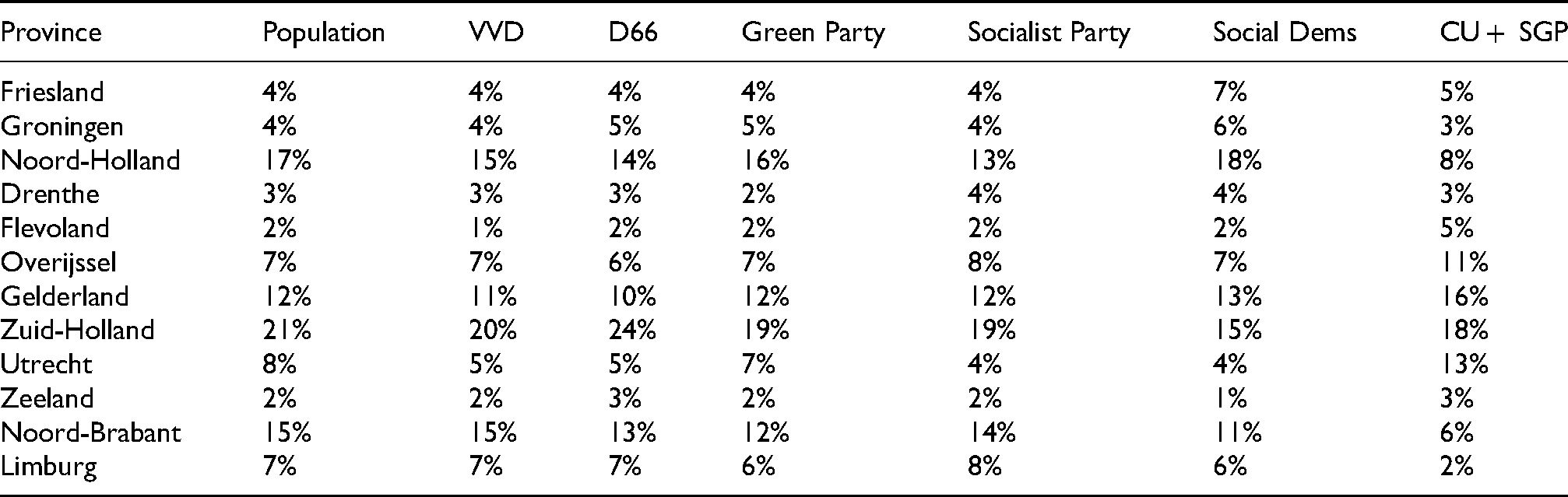
Moving to ‘geotargeting’, Table 6 shows that almost all individual parties spread their policy ads proportionally over the nation. An outlier is ChristianUnion/SGP. This orthodox reformed Christian party prioritizes the Dutch bible belt (i.e. Zeeland, very small portions of Zuid-Holland and Noord-Brabant, Utrecht, Gelderland and Overijssel). The ads of the ChristianUnion/SGP are displayed disproportionately in the bible belt. The ads of the other parties seem to have been displayed proportionately and similarly over the country.
Between-party comparison of the distribution of policy ad impressions per province.
EU scepticism
Moving to H2 (Policy ads of EU-skeptic parties are displayed to older age groups (45–54, 55–64, 65 + ), policy ads of pro-EU parties are displayed to younger age groups (18–24, 24–34, 35–44)). Table 7 shows that the younger age groups (18–24 and 25–34 years) are served more ads by pro-EU parties (VVD, D66, Green Party, Social Democrats). The ads of the more EU critical party CU + SGP are also displayed in comparable numbers as those of the pro-EU parties to the younger users. The most EU-critical party in this analysis (Socialist Party), however, indeed disproportionately focuses on older age groups. Hypothesis 2 is partly supported.
Interparty comparison distribution policy ad impressions per age group.
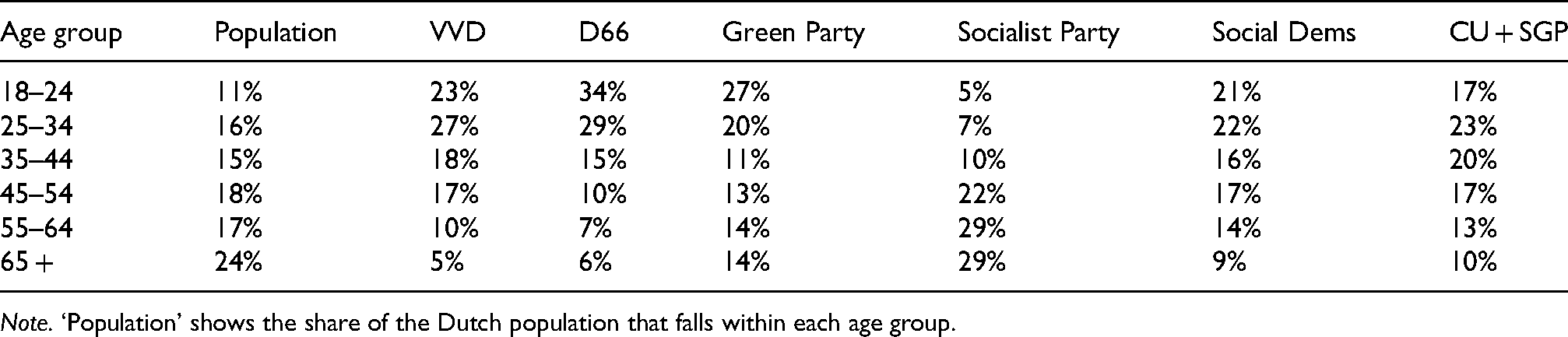
Note. ‘Population’ shows the share of the Dutch population that falls within each age group.
Pledges versus broader policy information
The RQ (are there differences between parties in the degree to which they communicate pledges vs. policy information?) was answered with a Kruskal–Wallis H test. The H test yielded a significant difference between the parties regarding the narrow pledges they made in their online advertisements: χ2(8) = 50.930, p = .001. The Animal Party most communicated narrow pledges. 84% of their pledges were narrow. The Animal Party was followed by the ChristianUnion/SGP (39% of all pledges were narrow) and the Green Party (31% of all pledges were narrow). A Mann–Whitney test showed that the Animal Party made significantly more narrow pledges than the ChristianUnion/SGP: Z (Nanimal = 32, N ChristianUnion/SGP = 18) = −3.28, p = .001. The Green Party made significantly more narrow pledges than the Social Democrats and the other parties (excluding the ChristianUnion/SGP and the VVD): Z (NGreenParty = 48, NSocialDemocrats = 45) = −2.69, p = .01. The other parties all communicated less narrow pledges and more broad policy information. In other words: the Animal Party communicated the most specific about their policy preferences followed by the ChristianUnion/SGP, Green Party, VVD, and then the rest.
Coalition versus opposition ads
The third hypothesis (government coalition parties communicate more ‘preserve the status quo’ information, while opposition parties communicate more ‘change the status quo’ information) was tested by grouping the parties together that form the government coalition in the Netherlands (VVD, CDA and D66). ChristianUnion/SGP is excluded because this is a combination of ChristianUnion, which is a coalition party, and SGP, which is not. The opposition parties (that placed policy ads) are Green Party, Socialist Party, Social Democratsand Animal Party. An independent t test showed that, as expected, on average the coalition parties communicated significantly more ‘preserve the status quo’ information (M = .58, SD = .50) than the opposition parties did (M = .12, SD = .33): t(264) = −9.11, p < .0001.
Issues
Testing H4 (Policy information about specific issues is displayed only to specific audiences), this study finds that the policy ads of D66 and Green Party about specific issues were not displayed only to small subsegments of the electorate. VVD’s policy ad about Law, Crime and Family Issues led to 500 impressions, and VVD’s ads about International Affairs and Foreign Aid led to 9000 impressions. Socialist Party’s policy ads about Agriculture & Fishing and Animal Welfare (9500 impressions), Energy (1500) were only seen by very specific groups. Social Democrats’ policy ads about Education (500, 1 × 1500 and 3 × 5500 impressions), and Cultural Policy Issues (1 × 500, 4 × 1,500 and 3 × 5500) were seen by only small groups of people. ChristianUnion/SGP’s ads about Energy were seen by two times 500 people. The Animal Party’s ads about Transportation (4500 impressions) and Functioning of EU (2 × 3500), finally, were also seen by only a small subsegment of society.
Discussion
This study set out to describe how policy information and pledges of Dutch political campaigns were displayed to users of Facebook and Instagram. The findings show that almost all parties use Facebook ads to communicate policy and that many parties make electoral promises that are displayed to only small groups of people (<10,000 displays). This is a problematic finding from an electoral mandate perspective as well as from a promissory representation perspective.
Electoral mandate perspectives presuppose citizen knowledge that informs the vote (see, e.g. Louwerse, 2011). Displaying policy information and pledges to only very small segments of the electorate (i.e. less than 10,000 displays per promise) means that a large share of the electorate has no access to that specific piece of policy information and thus cannot update their knowledge and beliefs appropriately.
The selective display of pledges to very small groups of society is also problematic from the perspective of the promissory representation model. According to this model, citizens first choose, and then reward or punish their representatives on the basis of their pledges and the degree to which they fulfil those pledges. Promising, for example, ‘No EU membership for Turkey’ to 10,000 or less people, of which only 22% are women is problematic because (1) only a few people are promised this and for these people this promise may feel like a priority, (2) many people do not receive this promise, (3) people who may disagree with this policy, for example, Turkish people who may (or may not) be considering a vote for this party, are actively withheld relevant information. Parties do present a manifesto that should contain all the policy information, but research shows that people do not read manifestos (Adams et al., 2011), and that manifestos contain ‘barely comprehensible language’ (Bischof and Senninger, 2018, 473). Media may coverage policy information, but this coverage is subject to biases (Ergün and Karsten, 2019; Duval, 2019; Kostadinova, 2017).
More concretely, this study presents empirical evidence for some of the threats of political microtargeting, as identified by Zuiderveen Borgesius et al. (2018, 87): A party may highlight a different issue for each voter, so each voter sees a different one-issue party. In this way, microtargeting could lead to a biased perception regarding the priorities of that party. Moreover, online political microtargeting could lead to a lack of transparency about the party’s promises. Voters may not even know a party’s views on many topics.
This study has shown that especially concern about the threat to transparency about the party’s promises is warranted. It is impossible to state with certainty on the basis of the metadata provided by Facebook whether the threat of parties falsely presenting themselves as ‘a different one-issue party’ to each voter is real. But this study does find that specific issues were communicated only to very small subgroups of society, which might mean that to some voters only one issue was presented. This is in line with the idea of disrupted public spheres of Bennett and Pfetsch (2018). For one, because political parties tailor and target different ads to different subgroups of the population, which contributes to the ‘cacophony of public voices’ (Bennet and Pfetsch, 2018, 245). But also because certain issues are only communicated to very specific groups of people (i.e. issue ads that were displayed (much) less than 10,000 times). Such issue specific targeting might contribute to calving of common ground by replacing the shared public agenda by a more individualized agenda. In a similar vein, while Somer-Topcu (2015) as well as Hersh and Schaffner (2013) found evidence for the value of broad and ambiguous political appeals to voters, this study indicates that political parties present themselves one-dimensionally to specific voter groups, which resonates with the work of Ezrow et al. (2014).
This study also finds that, indeed, microtargeting causes certain voters to be ignored (Zuiderveen Borgesius, 2018; Howard, 2006). Microtargeting inherently ignores voters, either as a consequence of strategic choices from the advertiser or following from the ‘optimization’ of the ad delivery algorithm. And this is problematic from a democratic theory as well as a fundamental rights perspective (Bayer, 2020). In this study, we introduced and found evidence for the concept of pledge obfuscation. This means that certain people are deliberately not exposed to specific promises, while they might (or might not) see other promises. On a larger scale, structurally ignoring certain voter groups could induce online ad deserts. People who are in such an ad desert do not receive any online political advertisements at all. They can be in an ad desert by choice when they install an ad blocker, but also involuntarily when, for instance, they are perceived to be ‘safe’ supporters of one specific party. More worryingly, inactive voters could also be placed in such an ad desert: making it relatively challenging to become active. Especially since it is rather difficult to notice it when one receives much less political advertisement than their fellow citizens.
The consequence for citizens, as briefly mentioned by Zuiderveen Borgesius et al. (2018) is that ‘certain groups may be underrepresented in a democracy’ (p. 88). In other words, some people can (1) more effectively give a (more rational-based or more emotional-based) mandate to their representatives and (2) more effectively choose representatives on the basis of pledges and subsequently better punish or reward them based on their record on pledge fulfilment in comparison with the ignored citizens. In this light, the question posed by Hillygus and Shields (2008, 14), about whether ‘politicians can claim a policy mandate if citizens are voting on the basis of different policy promises’ becomes more pressing.
With regards to the political pledge literature, this study focuses on pledges conveyed through online advertisements. Earlier pledge research focuses on manifestos (e.g. Thomson et al., 2017; Naurin et al., 2019; Håkansson and Naurin, 2014; Dolezal et al., 2016) or, to a lesser degree, on pledges covered by the media (e.g. Duval and Petry, 2018; Müller, 2020; Kostadinova, 2017; Duval, 2019; Ergün and Karsten, 2019). This study shows that policy information in general and pledges in specific are communicated through targeted online advertisements and this means that pledge research should examine online advertisements in addition to manifestos and media coverage.
Limitations and directions for future research
The approach of this current study is not suitable for, say, the US presidential elections because the number of ads would be too large to manually code. Future research could focus on automated methods and use speech-to-text engines to study pledges on a much larger scale. Future studies could also track pledge fulfilment and examine whether advertisement characteristics predict pledge fulfilment. For example, to what extent are pledges communicated to many people more likely to be fulfiled than pledges communicated to only a few people? Moreover, Facebook provides little information about ad metadata such as targeting criteria or exclusion criteria or the use of custom and lookalike audiences. This study has important limitations due to the opaqueness in Facebook’s public-facing systems. For example, this study can show differences between subgroups in the policy information that they encounter. However, we cannot show why, for example, women see more narrow pledges because it is impossible for a researcher not affiliated with Facebook to ‘take a look under the hood’. To put it more strongly, a value of this study is also to underscore the limitations of Facebook public accountability tools. In comparison with before 2018, we can now see that women see more narrow pledges – which is valuable. But we cannot see exactly why women see more narrow pledges. This is a crucial step in understanding online campaigns and their societal impact, but researchers are limited to the public data available. As a result, the exact workings of Facebook’s algorithmic recommendations remain ill-understood (but see Ali et al., 2021, for an attempt). Moreover, the information that Facebook does provide is helpful but aggregated to very broad levels (e.g. province over city). A supplementary dataset with more detailed information about who was targeted (e.g. from WhoTargetsMe) could provide a more granular understanding of who promises what to whom. Finally, it would be useful to first examine whether certain pledges were made disproportionately to specific people and then survey the nation to see whether these specific electoral groups are also more knowledgeable about that specific issue or policy.
Supplemental Material
sj-docx-1-bds-10.1177_20539517221095433 - Supplemental material for Beyond manifestos: Exploring how political campaigns use online advertisements to communicate policy information and pledges
Supplemental material, sj-docx-1-bds-10.1177_20539517221095433 for Beyond manifestos: Exploring how political campaigns use online advertisements to communicate policy information and pledges by Tom Dobber and Claes de Vreese in Big Data & Society
Footnotes
Declaration of conflicting interests
The author(s) declared no potential conflicts of interest with respect to the research, authorship, and/or publication of this article.
Funding
The author(s) disclosed receipt of the following financial support for the research, authorship, and/or publication of this article: This work was supported by the Riksbankens Jubileumsfond, (grant number MXM19-1137:1).

Supplemental material
Supplemental material for this article is available online.
Notes
References
Supplementary Material
Please find the following supplemental material available below.
For Open Access articles published under a Creative Commons License, all supplemental material carries the same license as the article it is associated with.
For non-Open Access articles published, all supplemental material carries a non-exclusive license, and permission requests for re-use of supplemental material or any part of supplemental material shall be sent directly to the copyright owner as specified in the copyright notice associated with the article.
