




Abstract
Science has established the human-caused nature of climate change, yet the prevalence of climate-related misinformation persists, undermining public understanding and impeding collective action. Strikingly, existing research on belief in misinformation about climate change has disproportionately focused on WEIRD (Western, Educated, Industrialized, Rich, and Democratic) countries. To move beyond this, our online survey (N = 8541) includes high-income countries in North America (US), Western Europe (France, Germany, UK) and East Asia (Japan), as well as an upper-middle income country in South America (Brazil) and lower-middle income countries in South Asia (India and Pakistan). By examining the interplay of news media usage, information sources, and trust in these sources, we advance our understanding of how these factors influence belief in climate change-related misinformation in diverse socio-cultural contexts. Across countries, we found that the strongest determinants of belief in misinformation about climate change were identifying as right-wing (compared with left-wing), consuming less offline news, having less trust in scientists, environmental activists, as well as international organizations, and having more trust in politicians, celebrities, and energy companies. Overall, trust in sources of information about climate change and demographic variables were much stronger predictors of belief in misinformation about climate change than reported news consumption (online, offline or on social media). These findings suggest that trust is key to understanding belief in false information about climate change.
Introduction
Despite the long-established scientific consensus that human activities are the primary drivers of climate change, conspiracy theories, contrarians’ viewpoints, and misinformation about its origins, impacts, and solutions continue to propagate in the contemporary information environment (Biddlestone et al., 2022; Cook, 2020; van der Linden et al., 2017). Exposure to and belief in such misinformation, especially in Anglophone countries, continues to confuse the public, limiting support for mitigation policies (Cook et al., 2018; Zhou and Shen, 2021), preventing the required collective action (van der Linden et al., 2017), and reducing public trust in scientific consensus (Painter et al., 2023).
Past research highlights several factors, such as political identities (Walter and Murphy, 2018), ideological biases (Newman et al., 2018), and cultural worldviews (Kahan et al., 2011), that contribute to false beliefs about climate change. However, besides these individual factors, while at their best, news media can help provide accurate and reliable information, news media have also been identified as a key external factor which – sometimes intentionally, sometimes unintentionally – helps amplify and propagate non-scientific claims by climate denialists as well as vested interest groups (Cook, 2020; Petersen et al., 2019; Supran and Oreskes, 2017; van der Linden et al., 2017).
Coan et al. (2021) classified the arguments frequently used by contrarians as follows: (1) global warming does not occur, (2) humans are not the cause, (3) the impacts are not bad, (4) solutions will not work and (5) climate science is unreliable. Since these claims contradict mainstream climate science (Cook, 2020), they fall under the definition of misinformation proposed by Vraga and Bode (2020), which refers to ‘information considered incorrect based on the best available evidence from relevant experts at the time’ (p. 138). Accordingly, we use average agreement with these claims as a scale to measure false beliefs about climate change, understood here as belief in climate misinformation.
Research has highlighted that the news media serves as a primary source of information for the public on climate change (Newman et al., 2020; Schäfer and Painter, 2020). Across the countries where data are available, television remains the single most important medium, whereas online media including news websites, social media platforms, and messaging apps hold equal prominence (Ejaz et al., 2022). Mainstream news media can influence public policies on climate change, enhance people’s understanding of its impacts, and often seeks to inform, educate, and engage the public on climate change (Boykoff, 2011; Cheng and Gonzalez-Ramirez, 2020; Comfort et al., 2020; Ejaz et al., 2022).
Although the positive effects of news use on political knowledge and climate change-related attitudes are well documented, albeit mostly in the United States and Western European countries, the relationship between news use and climate change misinformation is less clear, particularly beyond Western, Educated, Industrialized, Rich, and Democratic (WEIRD) countries. For instance, fossil fuel companies have used the news media to raise doubts about the adverse effects of climate change by undermining the scientific consensus and spreading misinformation (Supran and Oreskes, 2017). Likewise, content analysis of conservative media in the United States and Europe confirms that contrarians feature more prominently in media coverage of climate change relative to expert scientists (Bohr, 2020; Dunlap and Brulle, 2020; Krange et al., 2021; Petersen et al., 2019; Vowles and Hultman, 2021). In addition, it has been argued that people may be primarily exposed to misinformation by the news media (Tsfati et al., 2020), and that by reporting or debunking misinformation, news media risks amplifying it. However, research has found that exposure to fact checks reduces people’s belief in misinformation (Porter and Wood, 2021), and there is some evidence to suggest that news use lowers the acquisition of false beliefs over time (Altay et al., 2023).
The scientific literature on climate news consumption and misinformation about climate change is sparse and has focused on the unusual case of the United States, leaving many of the countries most affected by climate change underrepresented. Therefore, to fill this gap and respond to growing calls to include more non-WEIRD countries (see, for example, Cologna and Siegrist, 2020; Schäfer and Painter, 2020), we conducted an online survey between August and September 2022 in eight countries: Brazil, France, Germany, India, Japan, Pakistan, the United Kingdom and the United States. We collected data on people’s beliefs in five different examples of climate change-related misinformation: global warming is not happening, greenhouse gases are not causing global warming, actions being taken to prevent climate change won’t work, climate change will not have a negative impact on my country, and climate change will not have a negative impact on the world (Coan et al., 2021). This scale takes into account the most recent evolution of climate change denialism, and includes new elements that have been added over time, such as the scepticism over solutions to mitigate climate change (Painter et al., 2023) and the notion that the impact of climate change is exaggerated (Capstick and Pidgeon, 2014; Whitmarsh, 2011). We also measured respondent’s use of offline and online platforms, trust in climate news, and recalling their respective sources.
The countries were selected because we were interested in comparing countries – like France, Germany, Japan, the United Kingdom and the United States – where patterns of news use and misperceptions about climate change are relatively well mapped out compared with those – like Brazil, India and Pakistan – where we know very little about news media use and misperceptions about climate change. Furthermore, these countries are also interesting to study because of their diverse histories of scepticism, climate vulnerability and policy.
For example, the United Kingdom and the United States are two Anglophone countries where some forms of climate scepticism have been consistently prevalent in the media (Boykoff and Farell, 2019; Painter and Gavin, 2015), in contrast to Germany, France and Japan (Adam et al., 2020; Asayama and Ishii, 2014; Painter and Ashe, 2012). Brazil was chosen because it has traditionally expressed greater concern for misinformation (Newman et al., 2020); however, relatively little is known about climate misinformation, specifically with President Jair Bolsonaro, a climate change sceptic, in power until recently (Ferrante and Fearnside, 2019). India combines high trust in climate science (Whiting, 2023) with news media portraying nationalistic attitudes towards climate change, resisting global mitigation policies by framing them anti-nationalist (Billet, 2009). Finally, belief in misinformation is high in Pakistan, it is one of the only two countries left in the world where polio is still endemic, partly due to widespread misperceptions about the polio vaccine (Ejaz et al., 2021; Ittefaq et al., 2021). Moreover, both India and Pakistan, which collectively account for more than 20% of the world’s total population, are often ranked highly vulnerable to the negative consequences of climate change (Eckstein et al., 2019), making them especially relevant countries to study.
Accordingly, we investigated the following determinants of false beliefs about climate change across countries: (1) socio-demographic variables such as age, gender and political orientation, (2) the types of media used to consume information about climate change (offline, online and social media), (3) reported exposure to specific sources of information about climate change, and (4) trust in specific sources of information about climate change. In the section below, we briefly review past literature and introduce our research questions. We note that given the lack of empirical research on most of these questions outside of WEIRD countries (and the United States in particular), we formulated research questions instead of hypotheses.
Review of the literature and research questions
First, we investigated the determinants of attitudes towards climate change across countries. Previous work found that women, more educated and younger participants were more accepting of the scientific consensus on anthropogenic climate change (Hornsey et al., 2016). Overall, demographic variables tended to have much smaller effects than trust or political ideology – with people identifying as right-wing having lower belief in climate change (Hornsey et al., 2016). Yet, most of these studies were conducted in very affluent countries, and it has been documented that some demographic effects, such as the positive effects of education, tend to be stronger in less affluent countries. Moreover, the issue of climate change is less prone to political instrumentalization in less affluent countries (Czarnek et al., 2021) and in non-anglophone countries (Smith and Mayer, 2019). Similarly, the right-left wing continuum is a weaker predictor of attitudes towards climate change in Central or Eastern Europe than Western Europe (McCright et al., 2016; Poortinga et al., 2019).
RQ1. What socio-demographic variables are associated with false beliefs about climate change?
Second, we investigated the types of media use associated with false beliefs about climate change. A survey conducted in 20 countries found that using social media for news was associated with less climate scepticism, but there was significant heterogeneity across countries (Diehl et al., 2021). In countries with higher-than-average levels of climate scepticism (e.g. Russia, New Zealand) using social media for news was associated with less climate scepticism, while in other countries using social media for news was associated with more climate scepticism (e.g. South Korea, Germany). More broadly, a lot of correlational evidence points to the idea that social media use is associated with higher belief in misinformation or higher belief in conspiracy theories (Uscinski et al., 2022).
Across countries, broadcast news use is associated with less climate scepticism (Diehl et al., 2021). But the positive effects of news use may differ by medium. For instance, a survey in Portugal showed that news use was associated with higher level of concern about climate change, and that consumers of public TV channels were more knowledgeable about climate change than consumers of commercial TV channels (Cabecinhas et al., 2008). Similarly, a survey in Germany found that public TV news use was associated with more awareness of climate problems, while print media news was associated with less awareness (Arlt et al., 2011).
Other types of evidence suggest that the news may help raise awareness and inform people about climate change. For instance, longitudinal studies in the United States have shown that greater coverage of climate change was associated with greater levels of public concern about climate change (Carmichael and Brulle, 2017). These positive effects may be weaker in some countries than others. For example, an analysis of print media in the United States, Brazil, China, France, India and the United Kingdom, between 2009 and 2010 found that climate change sceptic opinions were mostly voiced in the United States and the United Kingdom (Painter and Ashe, 2012).
RQ2. What types of media use are associated with false beliefs about climate change?
Third, we investigated the effect of information sources (e.g. scientists or celebrities) on false beliefs about climate change. This is particularly relevant given that in recent years the issue of climate change is being increasingly discussed by laypeople, politicians, or even celebrities (Anderson, 2011). Overall, paying attention to science and environmental news is associated with more knowledge about climate change and its effects (Zhao et al., 2011). However, watching Fox News in the United States has been shown to increase familiarity with some climate change policies, such as the Green New Deal, but also increase opposition to it (Gustafson et al., 2019).
RQ3. Which information sources are associated with false beliefs about climate change?
Across the world, scientists remain the most trusted source of information about climate change (Brewer and Ley, 2013). Trust in scientists is associated with more correct beliefs about climate change, such as increased certainty that climate change is happening (Arbuckle et al., 2015). A meta-analysis found that trust in scientists is one of the strongest predictors of acceptance of climate change (Hornsey et al., 2016). Across 20 countries higher trust in science is associated with less climate scepticism (Diehl et al., 2021). Another meta-analysis of 141 correlations from 51 studies found that trust in scientists and trust in environmental groups were the forms of trust the most strongly associated with climate-friendly behaviours (Cologna and Siegrist, 2020). While general trust and trust in institutions to provide relevant information were only weakly correlated with climate-friendly behaviour, trust in industry was not significantly correlated with climate-friendly behaviour. Yet, studies looking specifically at trust in fossil fuel industries found negative correlations with climate change mitigation behaviours (Dietz et al., 2007; Leonard and Leviston, 2017).
Most work on trust and climate change attitudes and behaviours has been conducted in North America and Western Europe, and recent meta-analyses suggest that ‘Future efforts should be dedicated to disentangling trust-behaviour relationships in Eastern Europe, as well as Asia, Africa and South America’ (Cologna and Siegrist, 2020).
RQ4. How is trust in different information sources associated with false beliefs about climate change?
Data
Ipsos was commissioned to survey 8541 online respondents across Brazil, France, Germany, India, Japan, Pakistan, the United Kingdom and the United States. Data were collected between the 26th of August and 21st September 2022 as part of a the Oxford Climate Journalism Network (OCJN) project at the Reuters Institute for the Study of Journalism at the University of Oxford.
Ipsos applied quotas for age, gender and region to match the national population. However, because questionnaires were fielded online, our samples can only be representative of the online population. In France, Germany, Japan, the United Kingdom and the United States, where Internet penetration is high, this is unlikely to have a large impact on the results. However, in India and Pakistan, and to a lesser extent Brazil, where Internet penetration is lower, there are relatively large differences between the online population and the national population. In addition, because the survey was fielded in English in Pakistan and India, the data from these countries are representative of younger English speakers and not the national population because it is not possible to reach other groups in a representative way using an online survey. In India and Pakistan, the data are, at best, representative of the online, English-speaking populations (see Appendix I for distribution of the sample).
Measures
Dependent variables
Our measure of holding false beliefs about climate change draws on the work of Coan et al. (2021). They analysed large corpora of contrarian claims about climate change and identified five ‘super-claims’ representative of climate change contrarianism. Accordingly, participants were asked the extent to which they agreed (‘strongly disagree’ [1], ‘tend to disagree’ [2], ‘neither agree nor disagree’ [3], ‘tend to agree’ [4] and ‘strongly agree’ [5]) with these claims: (1) global warming is not happening (M = 2.19, SD = 1.37), (2) greenhouse gases are not causing global warming (M = 2.50, SD = 1.37), (3) actions being taken to prevent climate change won’t work (M = 3.12, SD = 1.20), (4) climate change will not have a negative impact on my country (M = 2.30, SD = 1.38) and (5) climate change will not have a negative impact on the world (M = 2.22, SD = 1.38). Given that all these claims are contrary to scientific evidence, we take agreement with them as evidence of holding false beliefs about climate change. We averaged agreement across these five claims to build the false beliefs about climate change scale (α = .88, M = 2.46, SD = 1.11) (Table 1).
Sample sizes, Internet penetration and mean false beliefs about climate change by country.
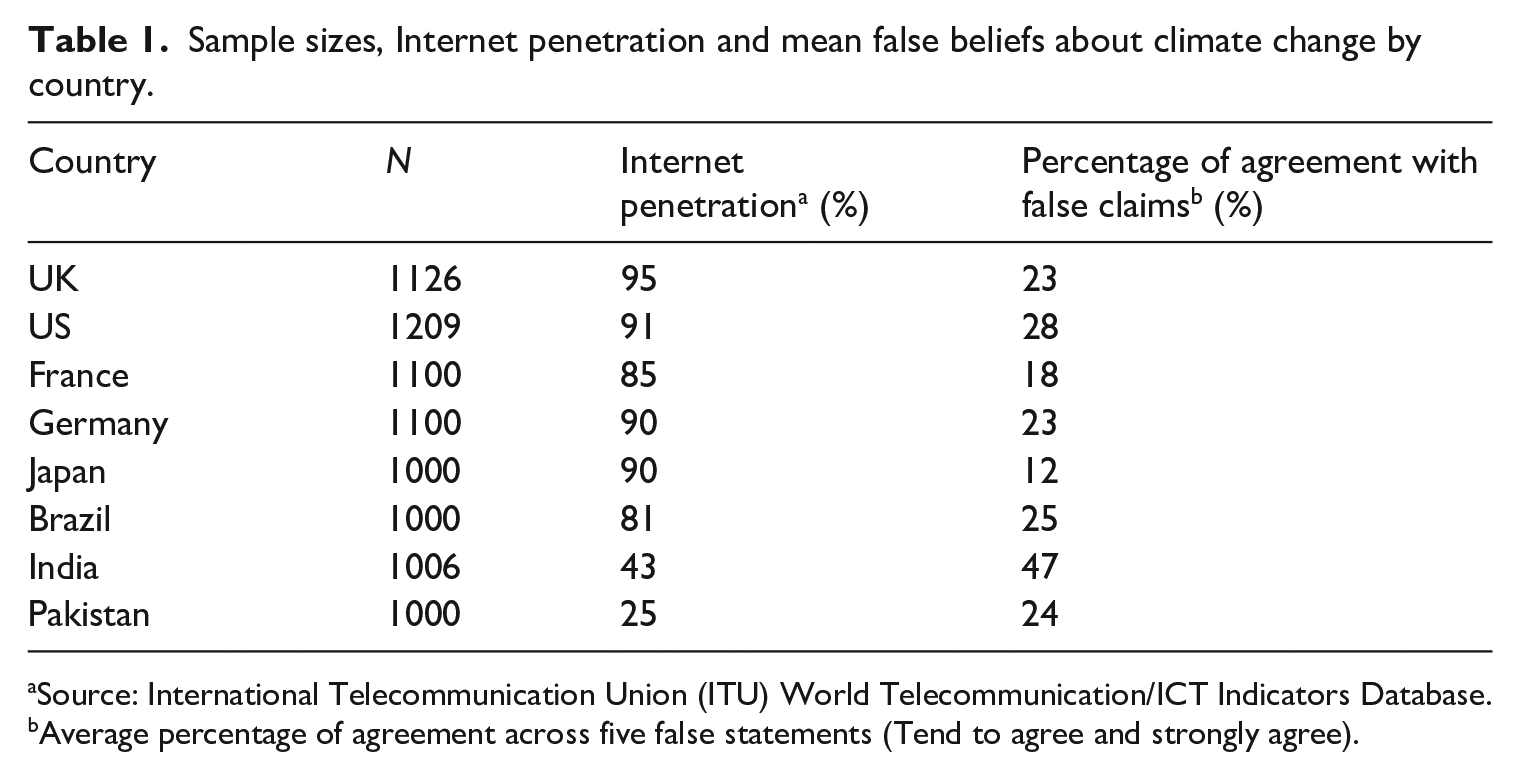
Source: International Telecommunication Union (ITU) World Telecommunication/ICT Indicators Database.
Average percentage of agreement across five false statements (Tend to agree and strongly agree).
Independent variables
We measured self-reported exposure to different types of climate change news (e.g. offline media, social media), self-reported exposure to different sources of information in climate change news (e.g. scientists, celebrities), and trust in different sources of information.
The media through which people consume climate change news was measured with the following question: Thinking specifically about the news or information about climate change you saw, read or heard within the last week. Where did you see, read or hear this? Respondents chose between: Television news, Radio news, Printed newspapers and news magazines, Websites/apps of newspapers and news magazines, Websites/apps of TV or radio news companies, Websites/apps of other news outlets, social media (e.g. Facebook, Twitter, Instagram, TikTok, etc.). We divided media use in three categories: offline (TV, radio and print newspaper), online (websites of newspaper, TV/radio and digital news outlets) and social media. For descriptive information on the use of these media across countries, see Appendix II and III in supplementary information.
The sources of climate change information were measured with the following questions (a separate question for each news medium responents said they had used): Aside from any journalists, reporters, presenters, etc. that may have delivered the news or information, which types of organisations or individuals do you recall commenting or being mentioned as the source on Television news, Radio news, Printed newspapers and news magazines, Websites/apps of newspapers and news magazines, Websites/apps of TV or radio news companies, Websites/apps of other news outlets, and social media? Participants chose between: Politicians or political parties, Scientists, Environmental activists, Celebrities, The Government, Official international institutions, Charities, and Energy companies. We averaged responses for each source across types of medium (i.e., offline, online, and social). For instance, scientists as a source of information about climate change have three scores: scientists on offline media (average of TV, radio and print), scientists on online media (average of websites, TV/radio, and digital news outlets) and scientists on social media. Appendix IV and V show the distribution of respondents recalling respective information sources across different platforms.
We measured trust in sources of information about climate change by asking participants about the extent to which they generally trust or distrust each source mentioned above on a scale from ‘strongly distrust’ [1] to ‘strongly trust’ [5]: Politicians or political parties (M = 2.61, SD = 1.26), Scientists (M = 3.84, SD = 1.10), Environmental activists (M = 3.32, SD = 1.28), Celebrities (M = 2.70, SD = 1.23), The government (M = 2.98, SD = 1.29), Official international institutions (M = 3.44, SD = 1.20), Charities (M = 3.25, SD = 1.13) and Energy companies (M = 2.94, SD = 1.24). Following previous studies (e.g. Hobolt and Tilley, 2018; Mattes and Bratton, 2007), ‘don’t know’ responses were recoded as ‘neither trust nor distrust’ [3] and ‘prefer not to say’ responses were excluded from our analysis to ensure analytical robustness and minimize data loss. To view the distribution of trust for each climate information source across countries, please refer to Appendix VI in the supplementary materials.
We measured trust in the news about climate with the following question: would you generally trust or distrust news media (organization delivering news to public via radio, TV, newspapers, or online) as a source of news or information about climate change. Respondents indicated their level of trust in news media (M = 3.28, SD = 1.17) on a scale from ‘Strongly distrust’ [1] to ‘Strongly trust’ [5].
Last, we measured socio-demographic variables including age (M = 41.51, SD = 14.97), gender (49.1% male), education, and political ideology. Education was treated as a categorical variable: bachelor/higher degree (42%) versus no bachelor/higher degree (58%) to standardize the data across countries. Political ideology was measured on a 7-point left to right scale, which we categorized into left (collapsing values from 1 to 3 – 23.3%), right (collapsing values from 5 to 7 – 29.1%) and centre (value 4, accounting for 28% of responses). Responses were recoded in this way to remove the effect of different response styles in different countries. As on average, 9.3% selected ‘don’t know’ and 10.3% ‘prefer not to say’, we included these categories to prevent exclusion of cases.
Results
First, we investigated the socio-demographic variables associated with false beliefs about climate change (RQ1) in Model 1 of Table 2. We found that men (β = .06, p < .001), younger people (β = .13, p < .001), participants who identified as right-wing (β = .24, p < .001), and those who either identified as being in the centre (β = .05, p < .001) or preferred not to answer (β = .05, p < .001) were more likely to agree with climate change-related misinformation. These effects persist across all models, notwithstanding observed variation between different countries. Education was not significantly associated with misperceptions about climate change, except in Model 4, where a positive but weak association was observed between individuals with a university degree and belief in misinformation (β = .03, p = .003).
Hierarchical linear regression predicting false beliefs about climate change.
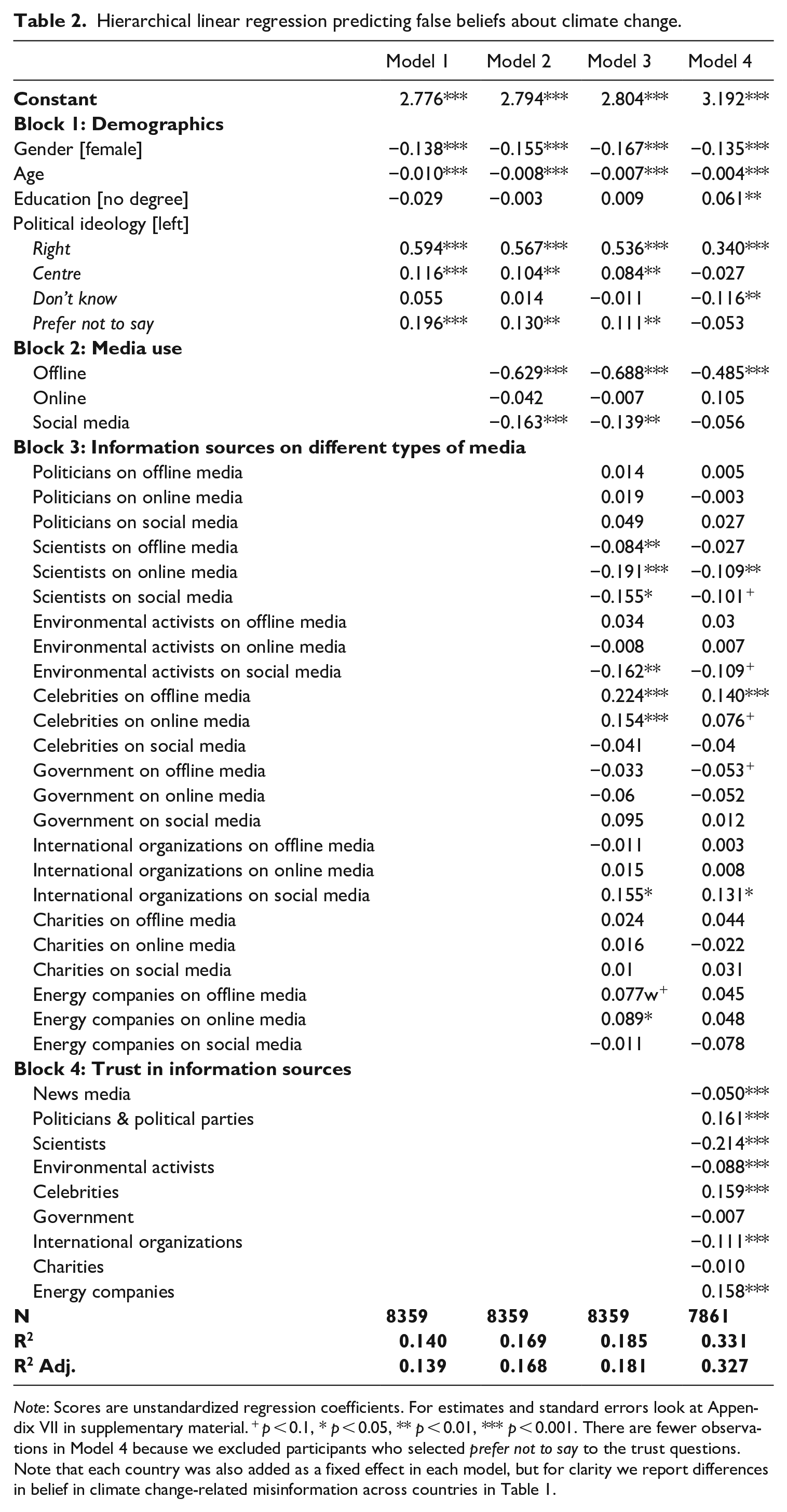
Note: Scores are unstandardized regression coefficients. For estimates and standard errors look at Appendix VII in supplementary material. + p < 0.1, * p < 0.05, ** p < 0.01, *** p < 0.001. There are fewer observations in Model 4 because we excluded participants who selected prefer not to say to the trust questions. Note that each country was also added as a fixed effect in each model, but for clarity we report differences in belief in climate change-related misinformation across countries in Table 1.
Second, we built on the previous model and investigated the effect of media use for climate change news on false beliefs about climate change (RQ2, Model 2). We found that the use of offline news media platforms (TV, radio and print newspaper) (β = −.15, p < .001) and social media (β = −.05, p < .001) was associated with lower false beliefs about climate change. We did not find any significant association between online news media use and false beliefss about climate change (β = −.01, p = .432). The effect of offline news use is consistent across countries (Figure 1) and holds when controlling for trust in information sources (Model 3 and 4), while the effect of social media is inconsistent across models and countries, as, for instance, social media use is no longer statistically significant after controlling for trust (Model 4). The addition of media use in the model explained an additional 3pp of the variance compared to Model 1 containing only demographics and countries (from 14% to 17%).
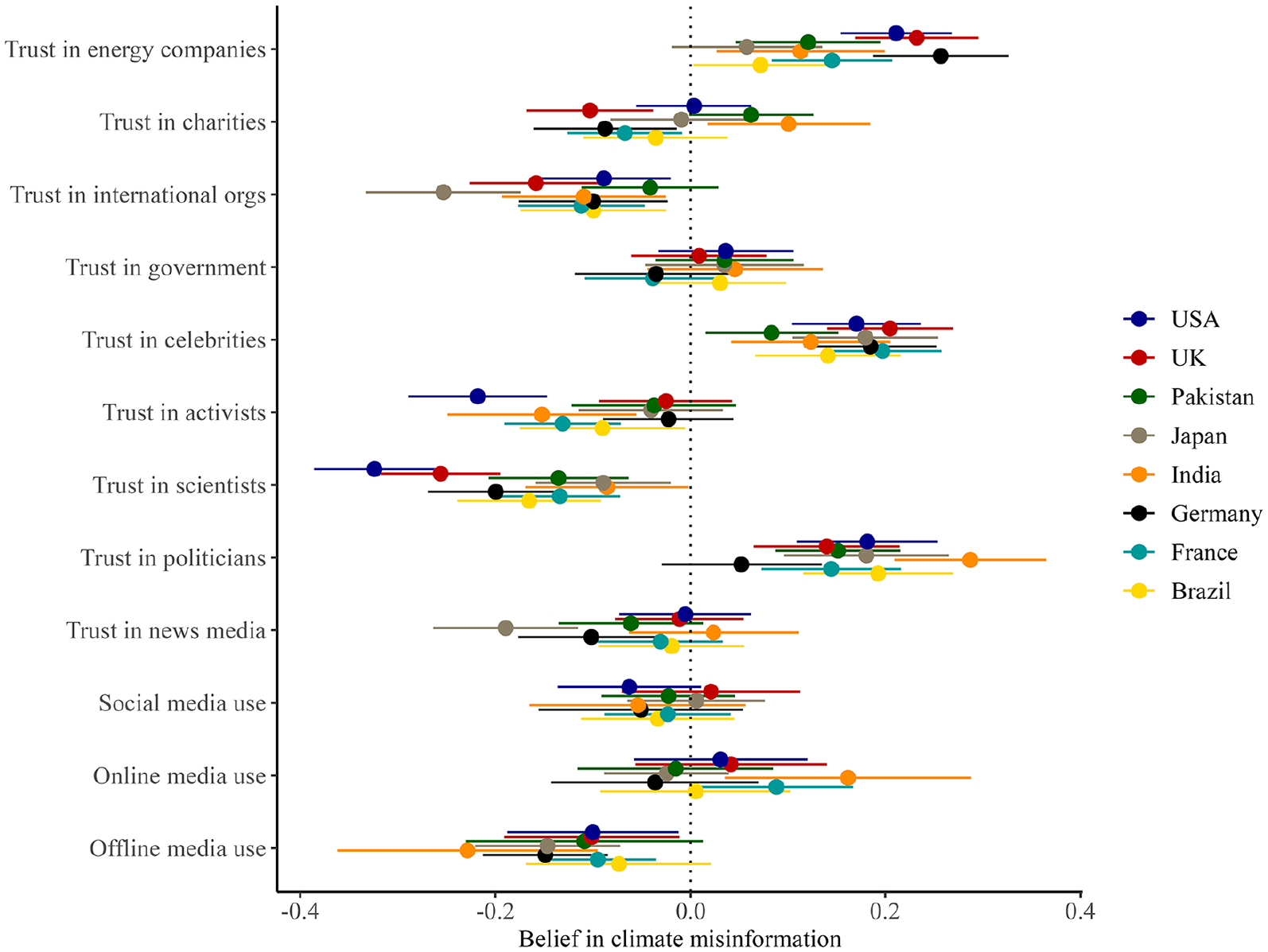
Predictors of false beliefs about climate change, including trust in various information sources and different types of news platform use. Error bars represent the 95% confidence interval. Note: Coefficients presented are standardized.
Third, building on previous models, we examined the role of exposure to specific sources of information about climate change on holding false beliefs about climate change (RQ3, Model 3). We found that respondents who recalled being exposed to climate change information from scientists on offline media (β = −.04, p = .006), online media (β = −.08, p < .001), and social media (β = −.03, p = .015) showed lower levels of false belief. Similarly, respondents who recalled exposure to climate change information from environmental activists on social media (β = −.04, p = .007) were less likely to hold false beliefs. In contrast, respondents who recalled being exposed to climate change information from celebrities on offline (β = .07, p < .001) and online media (β = .05, p < .001), international organizations on social media (β = .03, p = .025), and energy companies on offline media (β = .03, p = .047) and online media (β = .03, p = .047), were more likely to hold false beliefs about climate change. These effects weaken, or are no longer statistically significant, in subsequent models that include trust in specific sources of information about climate change (Model 4). The addition of exposure to specific sources of information in the model only explained an additional 1pp of the variance compared to Model 2 (from 17% to 18%), suggesting that reported exposure to specific sources of information about climate change explains little to no variance in false beliefs about climate change.
Fourth, we examined the role of trust in different sources of information on false beliefs about climate change (RQ4, Model 4). We found that higher trust in scientists (β = −.21, p < .001), environmental activists (β = −.10, p < .001), international organizations (β = −.12, p < .001), and the news media, was associated with lower false beliefs about climate change. On the other hand, trust in politicians (β = .18, p < .001), celebrities (β = .18, p < .001), and energy companies (β = .18, p < .001) were associated with stronger false beleifs. Trust in government (β = −.01, p = .55) and charities (β = −.01, p = .39) had no statistically significant effect. The lack of significance for trust in government can be partly attributed to its strong correlation with trust in politicians and political parties, suggesting similar associations with false beliefs. The addition of trust in sources of information about climate change in the model explained an additional 15pp of the variance compared to Model 3 (from 18% to 33%), suggesting that trust explains a large share of the variance in false beliefs about climate change.
Cross-country similarities and differences
Given national differences in media and political systems, some of the aggregated effects reported above do not hold in every country. In this section, we discuss cross-country similarities and differences (for separate models by country see Appendix VIII in supplementary material).
Regarding cross-country differences, Indian respondents had stronger false beliefs about climate change compared with those in other countries. This result aligns with past work (Climate Action Against Disinformation (CADD), 2022), and may reflect nationalistic narratives in India that disproportionately blame Western countries for climate change, obscuring the nuanced climate change debate (Billett, 2009) and India’s role in emitting greenhouse gases, potentially contributing to public confusion and the spread of misinformation (Murali et al., 2021: 18). Though this result could also be due to a form of acquiescence bias, as we discuss below. In India and France, online news use was positively associated with false beliefs about climate change. Only in Japan and Germany was trust in the news associated with lower false beliefs.
Regarding cross-country similarities, trust in scientists was associated with lower false beliefs about climate change, while the opposite was observed for trust in celebrities. In all countries except for Germany, trust in politicians was positively associated with false beliefs about climate change. Except for Pakistan, greater trust in international organizations was associated with lower false beliefs. Apart from Japan, higher trust in energy companies was associated with higher false beliefs. In all countries except Brazil, India, and Pakistan, respondents identifying as right-wing (compared with left-wing) held stronger false beliefs about climate change. Finally, in every country but Brazil, offline news use was associated with weaker false beliefs about climate change (see Figure 1).
Discussion
The present study aimed to address several gaps in the existing literature regarding climate news consumption, trust in different sources, misinformation about climate change, and underrepresentation of non-WEIRD countries. While previous research has extensively examined the positive effects of news use on political knowledge and climate change-related attitudes, the role of news media in protecting individuals from belief in misinformation about climate change remains uncertain, especially in countries beyond the European and US contexts, such as Brazil, India and Pakistan, which despite being ranked highly in the climate vulnerability index remain under-researched. Thus, including these countries allows a more comprehensive understanding of the global dynamics of climate change misinformation.
Overall, we found that trust in sources of information about climate change is a stronger predictor of false beliefs about climate change than the type of media used to consume information about climate change (offline, online and social media) and the reported exposure to specific sources of information about climate change (e.g. scientists on social media or celebrities on offline media).
Regarding media use, offline news use was consistently associated with lower false beliefs about climate change across countries, while online and social media use were not. This is potentially very challenging, given mounting evidence that most people with access to the Internet are opting for digital media at the expense of legacy media like television, radio, and printed newspapers (Newman et al., 2023). However, media use only explained a small additional part of the variance in false beliefs (3pp).
This finding is in line with the idea that the news media protects people (at least a little) from misinformation by exposing them to reliable information and/or by debunking false information (Altay et al., 2023). Tsfati et al. (2020) may still be right that the news media contributes to amplifying misinformation by exposing people to false information, but increasing exposure is not sufficient to increase belief, and recent evidence suggests that in Western democracies the news media may very well increase awareness of misinformation while reducing belief in it (Altay et al., 2023).
However, the news media is not a homogeneous category, and the positive effects of media use reported here are exclusive to offline news media. This could be because there is more climate change denialism news on online news media than offline news media in the countries surveyed. Thus, the effect of online news use may be more heterogonous than the effect of offline news use given increased opportunities to consume climate contrarian information online than offline. Moreover, the effect of offline news likely hides disparities across news outlets given that some prominent news outlets have engaged in climate change denialism news coverage, such as right-wing cable channels in the United States and right-wing newspapers in many English-language countries. Finally, social media use was associated with lower false beliefs about climate change, but this effect did not hold after controlling for trust in specific sources of climate change information. The benefits of social media use may be weaker and/or more heterogeneous than the benefits of offline news use. For instance, while social media use may help people with low trust in scientists find climate denialist news, it may also help people with high trust in scientists to learn more about climate change.
Self-reported exposure to some specific sources of information about climate change was associated with false beliefs about climate change in different directions. For instance, exposure to information about climate change from scientists on offline, online, and social media was associated with lower misinformation belief about climate change. While exposure to information about climate change from celebrities on offline and social media was associated with higher belief with climate change-related misinformation. However, these effects were weak, highly inconsistent across countries and models, and only explained a small additional part of the variance (1pp).
These findings suggest that while the specific sources of information about climate change matter, their effects on false beliefs about climate change may vary depending on the context and country. Future studies could rely on a combination of survey and tracking data to measure the effect of climate change information exposure from specific sources and actors more accurately.
Trust in specific sources of information about climate change explained a large part of the variance in false beliefs about climate change across countries (15pp). Higher trust in scientists, and international organizations were associated with lower belief in misinformation about climate change, while higher trust in politicians, celebrities and energy companies was associated with higher belief in climate change-related misinformation.
The strong predictive value of trust on false beliefs about climate change, and the cross-cultural robustness of this finding, suggests that trust is central to understanding misperceptions about climate change. Trust is known to play an important role in the acceptance of communicated information: people are more likely to accept information from trusted sources and largely disregard information communicated by distrusted sources. In our case, trust in scientists may have reduced climate change misperceptions by increasing exposure to and acceptance of reliable information about climate change (and vice versa for trust in celebrities or politicians). However, it could also be that people who trust scientists the most also happen to be more knowledgeable about climate change because of their socio-economic status, or that people whose views align with the scientific consensus, e.g., because they are concerned about the planet and want to preserve the environment, happen to trust scientists the most (and vice versa for trust in celebrities or politicians). Future research should try to disentangle the causal pathways through which different forms of trust may affect false beliefs climate change. Yet, the fact that trust captures a share of the variance in false beliefs not accounted for by demographic variables (such as education or political orientation) or media use (such as social media use) suggests that it is unlikely to be a mere self-selection effect.
To maximize their global effectiveness, interventions aimed at reducing belief in misinformation about climate change may want to target the most vulnerable groups, such as people with low trust in scientists and/or high trust in celebrities. Future studies should manipulate experimentally whether increasing or decreasing trust in these sources affects the acceptance of information from these sources, and ultimately, false beliefs about climate change. Overall, our findings extend previous work on the importance of trust in scientists to understand attitudes and beliefs about climate change, notably through its cross-cultural scope and the variety of determinants and forms of trust included in the survey.
This study has limitations. First, as with all surveys on news consumption, there are questions over whether people are able to accurately describe their own news use (Fletcher and Nielsen, 2018; Prior, 2009). Past research has shown that imperfect recall by respondents may lead them to misrepresent their media use, potentially biasing estimates in statistical analyses (Guess, 2015). However, due to a different set of challenges and limitations with passive web tracking data (Bosch et al., 2023; Pew Research Center, 2020), 1 researchers lack a news use ‘ground truth’, and it remains unclear if and when people underestimate or overestimate their news. In the present study, if people are overestimating their offline news use (as Prior, 2009 suggests), it may be that the negative association between it false beliefs about climate change is weaker or would disappear with more precise measurement. Similarly, underestimation of online news use (as recently found by UK media regulator Ofcom, 2022) could be hiding a significant relationship with false beliefs. Yet, because over/underestimation may vary among different demographic groups, it is difficult to be sure.
Second, the research on measuring public attitudes related to climate change using surveys has cautioned about the issue of social desirability bias, which fails to fully reveal the true attitudes of citizens (Beiser-McGrath and Bernauer, 2021) and even inflate self-reported green attitudes (Larson and Kinsey, 2019). However, despite their limitations, recent research suggests surveys may not be as problematic as commonly perceived (Jones-Jang et al., 2020; Kirkizh et al., 2024), and nonetheless remain a realistic method for data collection across multiple countries. Third, to assess respondents’ agreement with various climate change-related misinformation, the questions were framed negatively, in line with previous work (Capstick and Pidgeon, 2014; Coan et al., 2021). However, this negative framing may have influenced respondents’ perceptions (Fischer et al., 2019), particularly given the likelihood of varied response styles across different countries, where individuals in some countries may exhibit a greater susceptibility to acquiescence bias compared with others, which could have happened in the case of India. Hence, it is important to consider the said limitations when interpreting the findings.
To conclude, we found that across eight countries the strongest determinants of false beliefs about climate change were identifying as right-wing (compared with left-wing), consuming less offline news, having less trust in scientists, environmental activists, and international organizations, while having more trust in politicians, celebrities, and energy companies as sources of information about climate change. Overall, the results highlight that it’s the characteristics, attitudes and beliefs of people – especially their attitudes towards specific information sources – and not simply exposure (whether it occurs online, offline or on social media) that are central for understanding the effects of information and misinformation. This insight, we hope, will help advance both our scholarly understanding of factors influencing misinformation spread about climate change as well as practical attempts to address such belief.
Supplemental Material
sj-docx-1-nms-10.1177_14614448241250302 – Supplemental material for Trust is key: Determinants of false beliefs about climate change in eight countries
Supplemental material, sj-docx-1-nms-10.1177_14614448241250302 for Trust is key: Determinants of false beliefs about climate change in eight countries by Waqas Ejaz, Sacha Altay, Richard Fletcher and Rasmus Kleis Nielsen in New Media & Society
Footnotes
Funding
The author(s) disclosed receipt of the following financial support for the research, authorship, and/or publication of this article: This research was supported by the European Climate Foundation (ECF).
Supplemental material
Supplemental material for this article is available online.

Notes
Author biographies
References
Supplementary Material
Please find the following supplemental material available below.
For Open Access articles published under a Creative Commons License, all supplemental material carries the same license as the article it is associated with.
For non-Open Access articles published, all supplemental material carries a non-exclusive license, and permission requests for re-use of supplemental material or any part of supplemental material shall be sent directly to the copyright owner as specified in the copyright notice associated with the article.
