



Abstract
Despite the importance of climate news in shaping public engagement, little is known about how different types of media – mainstream and non-mainstream – relate to pro-climate behaviour, and what psychological processes condition these effects, particularly in cross-national contexts. This study addresses that gap by examining the emotional and evaluative mechanisms linking climate news use to pro-climate behavioural intentions (e.g., using less energy at home, flying less often, and repairing rather than replacing), and how these relationships vary across countries. Drawing on online survey data from 8,541 respondents across eight countries – Brazil, France, Germany, India, Japan, Pakistan, the United Kingdom, and the United States – we test a multi-group structural equation model with climate anxiety as a mediator and media trust as a moderator. Results show that mainstream news use is consistently associated with stronger behavioural intent across all countries. Non-mainstream media use has positive but more context-dependent effects, especially in settings where digital platforms dominate climate information. Climate anxiety emerges as a robust and universal predictor of behavioural intention, though it is not consistently shaped by media use – indicating that emotional responses may stem from sources beyond the news. Media trust amplifies the direct effects of mainstream news use but does not moderate the indirect pathway via anxiety. Overall, the findings reveal a surprising degree of cross-national consistency in how news use, media trust, and emotional responses shape climate engagement.
Keywords
Introduction
The news media are central to how the public learns about climate change, forms emotional responses, and considers behavioural action. Decades of research have linked media exposure to increased climate concern and support for climate policies (Brulle et al. 2012; Carmichael and Brulle 2017; Carvalho 2010; Moser 2016). Yet, much of this work treats media influence as a straightforward matter of exposure, overlooking the psychological mechanisms that shape whether and how people act. In particular, there has been limited attention to how trust in media content and the emotional impact of climate communication interact to influence public behaviour, especially across diverse national contexts.
Early research on media effects, grounded in theories of agenda-setting (McCombs and Shaw 1972), social learning, and behaviour (Bandura 2001), established that media exposure is linked to heightened climate concern and support for policy action (Arlt et al. 2011; Carmichael and Brulle 2017). However, more recent studies suggest that this relationship is neither automatic nor uniform. Instead, the influence of climate change news exposure often depends on intervening psychological processes, such as perceived risk, emotional responses, and efficacy beliefs (Liao 2024; Meng et al. 2023; Rice and Miller 2023; Vrselja et al. 2024). These findings shift attention away from exposure alone and toward the psychological mechanisms, including emotional responses and perceived credibility, through which climate information is interpreted and acted upon.
Among the most important psychological responses to climate information is climate anxiety – a cluster of emotions including fear, worry, sadness, and helplessness triggered by the perception of escalating climate risks. A recent meta-analysis found that climate anxiety is positively associated with climate concern, but also negatively related to mental well-being, underscoring its complex and ambivalent role (Kühner et al. 2025). Alongside emotional responses, trust shapes how individuals engage with climate content, influencing not just belief, but whether information is seen as urgent, credible, and actionable (Shehata and Strömbäck 2022). This dynamic is particularly relevant in today’s fragmented media environment, where trust in news is in decline (Newman et al. 2024), and media effects may hinge as much on source credibility as on content (Strömbäck et al. 2020). While many studies link trust to climate-related beliefs, much of this work focuses either on single-country contexts (Krishna 2021; Mede et al. 2025) or, when comparative, tends to examine trust in science (e.g., Diehl et al. 2021), rather than trust in the news media (for an exception, see Ejaz et al. 2024) – despite the latter being the primary source of climate information for most people (Newman et al. 2020). Accordingly, we argue that while exposure matters, responses often depend on emotional and credibility cues drawn from media sources, helping explain why the same information mobilises some and disengages others. In this study, we examine how news media use, climate anxiety, and media trust jointly shape pro-climate behavioural intentions.
In recent years, people’s news consumption habits have shifted markedly, with digital platforms, such as social media and online-only outlets, now competing with television, radio, and print as primary sources of information (Newman et al. 2024). Climate news consumption also reflects this fragmentation, as audiences increasingly access content across both legacy and digital-native outlets (e.g., Vox, Huffington Post; see Painter et al. 2018). As Shehata and Strömbäck (2013) argue, media fragmentation may alter how media effects unfold by reshaping how audiences select, trust, and engage with news content. Therefore, in line with Fletcher and Park (2017), we classify news sources into mainstream media, referring to professionally produced content delivered via legacy platforms such as TV, radio, and print, while non-mainstream media includes digital-first platforms and peer-to-peer content, especially via social media. While not without limitations, this distinction still captures relevant differences in editorial norms, information quality, and platform affordances – factors likely to shape how climate information is received and acted upon. Yet few studies have compared mainstream and non-mainstream climate news effects, especially across diverse national contexts including the Global South (Schäfer and Painter 2020).
Based on these considerations, our goal in this study is to examine how climate news consumption – across both mainstream and non-mainstream sources – interacts with individuals’ emotional responses (climate anxiety) and their trust in media to shape pro-climate behavioural intentions. We test this using a path model grounded in appraisal-based emotion theory, the Extended Parallel Process Model (EPPM), and prior work on media credibility and affect, focusing on individual-level psychological mechanisms over structural or system-level explanations. Using survey data from 8,541 participants across eight countries – Brazil, France, Germany, India, Japan, Pakistan, the United Kingdom, and the United States – we assess whether these pathways hold across diverse information environments, including several underrepresented Global South contexts. In short, we find that psychological responses and trust in news media are often more consequential than exposure alone, and that the pathways linking media use to behavioural intent differ between mainstream and non-mainstream environments. More broadly, this study contributes to understanding how emotional and credibility-related cues shape climate engagement across contrasting national settings, while also revealing a surprising degree of consistency in these relationships, indicating that individual-level mechanisms may operate similarly across diverse media and political environments.
Theoretical Framework
News Media Use and Pro-Climate Behavioural Intentions
Climate change is one of the most urgent challenges of our time, yet public understanding and willingness to act continue to vary widely. While the scientific consensus on its causes and consequences is clear (IPCC 2023), how people perceive and respond to the issue is shaped largely by communication, especially through the news media (Moser 2016), which remains the primary source of climate information for most citizens (Newman et al. 2020). Past research shows that news coverage of climate change influences the policy agenda (Carmichael and Brulle 2017), shapes public discourse (Carvalho 2010), and affects perceptions and behavioural intentions (Arlt et al. 2011).
Although traditional news outlets have long shaped how climate change is framed and prioritised in the public sphere, the rise of digital media has transformed how information flows. Today, individuals navigate a hybrid media system where climate content circulates across mainstream journalism, social media, specialised digital outlets, influencers, and peer-shared content (Chadwick 2017). This shift has expanded the diversity of voices, narratives, and emotional framings that people encounter. As a result, public responses to climate change may be shaped not just by exposure to climate-related information, but also by the platforms through which it is encountered – each offering distinct affordances – and by the emotional, cognitive, and credibility-related mechanisms that shape how such content is processed (Chen et al. 2023; Molder et al. 2022; Papacharissi 2010).
A substantial body of research supports a positive association between news media use and pro-climate behavioural intentions. Exposure to climate-related news has been shown to increase public concern, awareness, and willingness to engage in climate action – factors that commonly precede behavioural change (Beattie 2024; Schirmag et al. 2025). Arlt et al. (2011), based on survey data from Germany, revealed that certain types of media – such as quality newspapers – were positively associated with pro-environmental behaviours. Similarly, Rice and Miller (2023) found consistent positive effects of news use on climate-friendly behaviours across eleven countries, operating through its influence on attitudes and efficacy. In another study, Thaker (2023) revealed that media coverage was positively associated with perceived awareness of climate change, though not with personal risk perceptions and, in fact, was negatively associated with motivation to participate in collective action. Finally, a recent meta-analysis by Bogert et al. (2024) found stronger pro-climate beliefs among those who use new media more frequently than traditional media. These findings suggest that news consumption can support climate engagement, especially when coverage highlights tangible risks and solutions, though effects vary by media type, framing, and behavioural outcome.
Notwithstanding the overall positive association between news use and pro-environmental outcomes, the relationship may vary depending on the type of media through which people encounter climate information. Mainstream news outlets tend to frame climate issues through institutional logics, expert commentary, and policy discourse, which can foster awareness but also reinforce status quo understandings of climate responsibility and action (Boykoff and Boykoff 2007; Carmichael and Brulle 2017). In contrast, non-mainstream sources often foreground activist narratives, emotional appeals, and calls for urgent action (Boulianne and Belland 2019; Chen et al. 2023). These outlets may resonate more with younger or politically engaged audiences and can provide mobilisation cues that encourage behavioural intentions.
Given these differences in framing and narrative focus between mainstream and non-mainstream media, the generally positive association between news use and pro-climate attitudes may operate through distinct pathways – an area that warrants further comparative investigation across media types. Furthermore, most existing evidence of this positive link comes from Global North contexts, raising questions about whether similar patterns hold in more climate-vulnerable and under-researched countries in the Global South, where non-mainstream media often play a more prominent role in climate news consumption (Ejaz et al. 2025; Schäfer and Painter 2020). Recognising the distinct framing and mobilisation cues offered by mainstream and non-mainstream outlets, we anticipate that the use of either type of media for climate news will be positively associated with pro-climate intentions. Therefore, given the growing significance of diverse media environments and varied use of different media types, we propose our first hypothesis:
Affective and Credibility Mechanisms: The Roles of Anxiety and Trust
News use is one pathway through which individuals’ climate-related attitudes and intentions are shaped. Yet beyond the informational dimension, emotional responses – particularly climate anxiety – play a crucial role in shaping how people engage with the issue. Climate anxiety refers to a range of negative emotional reactions to the perception of impending “environmental doom” arising from climate change, including fear, dread, doom, and habitual worry (American Psychological Association 2017; Clayton 2020; Williams et al. 2024). It reflects not only cognitive awareness but also the emotional burden of climate threats, ranging from rising temperatures and extreme weather to socio-ecological collapse. This emotion is increasingly recognised as both a symptom of the climate crisis and a driver of behavioural engagement (Helm et al. 2018; Ojala et al. 2021).
The media’s role in activating climate anxiety is well documented. Climate news – particularly when it presents the issue in urgent, catastrophic, or human-centred terms – can amplify individuals’ emotional reactions (Nabi et al. 2018; O’Neill and Nicholson-Cole 2009). Visual imagery, dramatic framing, and repeated exposure to bleak forecasts may intensify affective responses, particularly among those who already feel personally or morally implicated in climate action (Feldman and Hart 2018). While such anxiety is sometimes framed negatively (as paralysing or overwhelming), growing research suggests it can also be mobilising, fuelling behavioural intention, civic engagement, and policy support – especially when accompanied by a sense of efficacy or collective responsibility (e.g., Chapman et al. 2016; Swim et al. 2019).
Theoretically, this logic is supported by psychological and communication models that place emotion as a mediator in the persuasion and behaviour change process. The EPPM (Witte 1992), for instance, suggests that emotionally charged information – when perceived as both threatening and solvable – can heighten action-oriented responses. Similarly, dual-process models such as the Elaboration Likelihood Model (Petty and Cacioppo 1986) posit that emotions can serve as heuristics, motivating individuals to engage with information and translate concern into action, particularly under conditions of low cognitive elaboration. In the context of climate communication, the frameworks imply that emotional engagement – particularly in the form of anxiety or worry – functions as a conduit between media exposure and behavioural intention.
Empirically, several studies have shown that climate-related emotions mediate the effects of media consumption on action. For example, Vrselja et al. (2024) found that while both traditional and online media were directly associated with pro-environmental behaviour in Croatia, climate worry significantly mediated this relationship only for traditional media. Meng et al. (2023) reported that exposure to environmental information on different social media platforms was positively associated with pro-environmental behavioural intentions, with this relationship mediated by both cognitive and emotional factors. Myrick and Conlin (2020) also found that emotional arousal in response to climate narratives predicted greater willingness to act environmentally. Extending this, Myers et al. (2023) demonstrated that specific emotions – such as sadness and hope – can mediate the effects of climate messaging on policy support, highlighting how different emotional responses may channel media influence in distinct ways.
Drawing on prior findings, we argue that the relationship between climate news use and pro-climate behavioural intentions is shaped by psychological processes – particularly anxiety. In this view, media exposure may motivate behaviour by evoking concern, unease, or perceived threat related to climate change, which in turn can increase people’s willingness to act. This expectation aligns with the EPPM, which suggests that emotional arousal is linked to greater motivation to act when perceived threat is paired with efficacy, and draws on media credibility perspectives to indicate that trust may shape the strength and nature of these emotional associations. On this basis, we propose the following:
While news consumption is important for acquiring climate change information and eliciting emotional reactions, trust in news media is equally consequential when considering how individuals engage with and respond to climate-related content. Media trust – defined as the degree to which individuals perceive news organisations as credible, accurate, and fair (Tsfati and Cappella 2003) – has been shown to influence not only whether people attend to the news, but also how they process and respond to it (Kohring and Matthes 2007). In the context of climate change, a complex and often polarised issue, trust in the messenger often conditions acceptance of the message itself (Diehl et al. 2021; O’Neill and Nicholson-Cole 2009). For this reason, scholars have increasingly focused on trust in information sources as both a determinant and a predictor of pro-climate attitudes (Drews and Van Den Bergh 2016).
Importantly, trust in information has a direct association with climate action tendencies. Individuals who trust the media are more likely to perceive climate change coverage as credible and informative (Ejaz et al. 2025), while lower trust in traditional news sources can weaken engagement and reduce support for climate policies (Stoutenborough et al. 2014). This aligns with broader research showing that trust in information sources – including scientists – is positively associated with belief in climate change and support for mitigation efforts (Carmichael and Brulle 2017; Cologna and Siegrist 2020; Hornsey et al. 2016). A recent meta-analysis by Bogert et al. (2024) further confirms that both trust in science and news media use predict stronger climate beliefs. In this way, trust in news media functions not only as an antecedent to information processing but also as a motivational resource supporting climate action. Collectively, these findings suggest that trust in climate-related news media plays a direct and important role in motivating public engagement. We therefore hypothesise:
Beyond its direct association, media trust may also shape how media exposure translates into emotional and behavioural intentions. Specifically, we posit that trust in media moderates the emotional mechanism – climate anxiety – through which media consumption influences behavioural intent. Drawing on models of moderated mediation (Hayes 2018), we argue that the strength of this mediating effect of climate anxiety between news use and pro-climate intention depends on individuals’ trust in news media. That is, people who trust the media are more likely to experience emotionally resonant responses when encountering climate information, which in turn increases their likelihood of acting. Conversely, for those with low media trust, even frequent exposure to climate news may fail to generate meaningful emotional engagement or mobilisation (Shehata et al. 2022).
This logic aligns with theories of motivated reasoning (Kunda 1990) and source credibility in persuasion (Hovland and Weiss 1951), both of which emphasise the importance of perceived trustworthiness in shaping responses to information. In climate communication, the credibility of the source can amplify emotional reactions and behavioural intentions, particularly when the topic is complex or contested (Hart and Feldman 2016). Moreover, in today’s hybrid media environment, where audiences navigate competing narratives, the affective and behavioural effects of climate news are likely conditioned by whether the source and information are perceived as legitimate and reliable (Vrselja et al. 2024).
In addition to shaping emotional pathways, trust in media may also condition the direct relationship between media exposure and behavioural intent. That is, while exposure to climate news may increase the likelihood of pro-environmental action, the strength of this effect depends on how much individuals trust the media. When the source is trusted, audiences are more likely to view climate news as credible and relevant, increasing their likelihood of acting on it. By contrast, low trust may lead individuals to question, dismiss, or even resist the information. As Miller and Krosnick (2000) show, media effects are strongest among those with high media trust.
Media trust, then, can act as both an amplifier and an attenuator of climate news effects – moderating not only the direct informational pathway but also the indirect emotional route via anxiety, though the latter may vary across media types and contexts. While prior research has examined trust in information sources and climate attitudes, few studies have tested this specific configuration of trust as a moderator across both emotional and informational pathways, and even fewer have done so in a multi-country comparative context. This study addresses that gap by modelling how media trust shapes both the direct and indirect effects of climate news use on behavioural intentions across eight national settings. Accordingly, we propose the following hypotheses:
Data and Methods
To test our hypotheses, we commissioned Ipsos – a global market research and polling company – to survey 8,541 online respondents from Brazil, France, Germany, India, Japan, Pakistan, the United Kingdom, and the United States (N ≈ 1,000 in each country, see Table 1). Data collection took place between 26 August and 21 September 2022 as part of a larger project on climate change news. Participants were recruited via Ipsos online panels, following the company’s standard procedures for sampling and data collection.
Sample Sizes and Timeline of Data Collection Across Eight Countries.
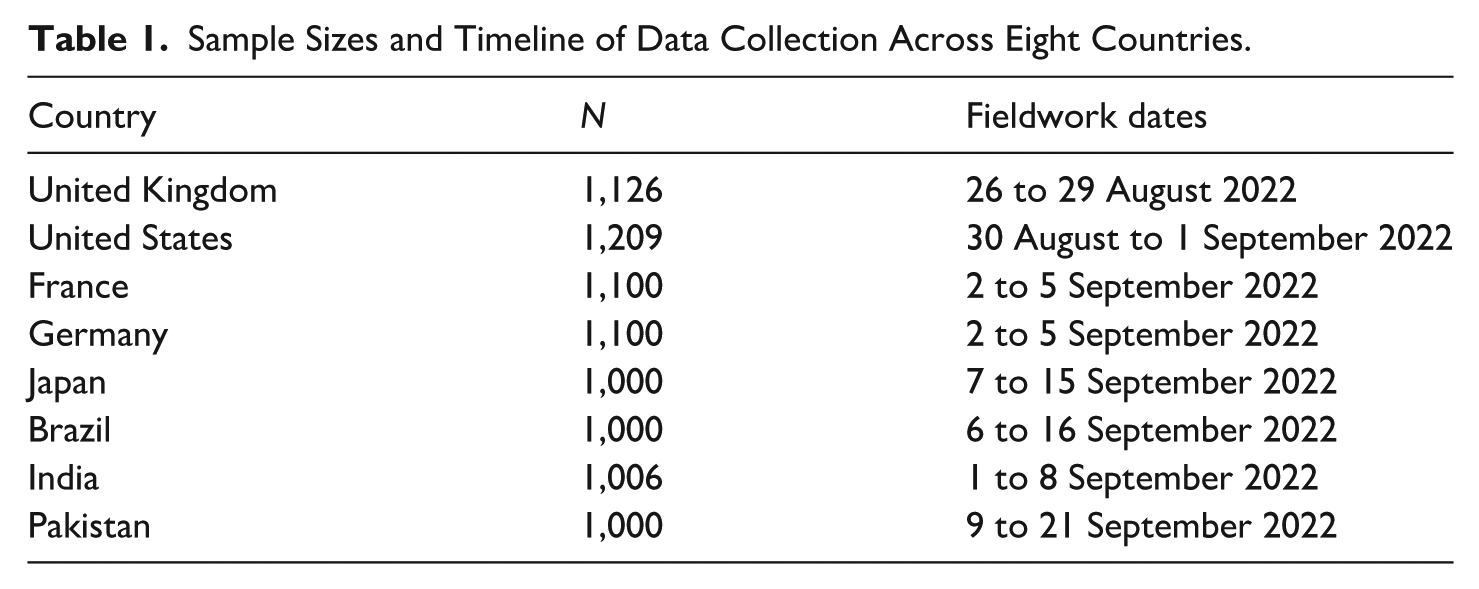
These eight countries were selected using a most different systems design logic (Przeworski and Teune 1970), which enables the testing of whether hypothesised mechanisms hold across maximally diverse contexts. In line with this rationale, the sample includes countries that differ markedly in their media systems (Humprecht et al. 2022), climate vulnerability (Eckstein et al. 2019), level of concern about climate change (Dechezleprêtre et al. 2025), and the extent of scholarly attention they have received regarding climate communication. For instance, while France, Germany, the United Kingdom, and the United States are relatively well studied, research remains limited for Brazil, India, and Pakistan – despite their high climate vulnerability (Schäfer and Painter 2020). They also differ in how people access climate information: while audiences in the United Kingdom, United States, France, and Germany tend to rely more on legacy media, those in Brazil, India, and Pakistan are more likely to use digital or social platforms (Ejaz et al. 2022). These variations provide an opportunity to test whether the media and psychological pathways hypothesised in this study hold across contextually diverse information environments.
Quotas for age, gender, and region were applied to align the samples with national census data. However, because the survey was conducted online, our samples can only be representative of the online population. In Brazil, France, Germany, Japan, the United Kingdom, and the United States, where internet penetration is high, the effects of this limitation are less pronounced. In India and Pakistan, where internet penetration is lower, there are relatively large differences between the online population and the national population. In addition, because the survey was fielded in English in Pakistan and India, the data from these countries are representative of younger English speakers and not the national population, because it is not possible to reach other groups in a representative way using an online survey. In India and Pakistan, the data is, at best, representative of the online, English-speaking populations.
Measures
Dependent Variables
Our measure of behavioural intent to adopt climate-friendly actions is based on key behaviours recommended by the United Nations’ ActNow campaign (United Nations 2021). Participants were asked the extent to which they intended (“certain not to” [1], “very unlikely to” [2], “fairly unlikely to” [3], “fairly likely to” [4], “very likely to” [5], “certain to” [6], “already doing it” [7]) to engage in the following actions: using less energy at home (M = 4.89, SD = 1.58), walking, cycling, or taking public transport instead of using a motor vehicle (M = 4.56, SD = 1.75), flying less often or not flying (M = 4.49, SD = 1.77), throwing away less food (M = 5.10, SD = 1.59), repairing rather than replacing items (M = 4.82, SD = 1.55), recycling more (M = 4.98, SD = 1.58), switching to renewable energy sources (M = 4.32, SD = 1.66), and choosing eco-friendly products (M = 4.64, SD = 1.55). These responses were averaged to form an overall behavioural intent scale (α = .85), with moderate to strong inter-item correlations, ranging from r = 0.35 to r = 0.56. Additionally, factor analysis indicated that these behaviours loaded primarily onto a single factor, further suggesting that they represent a single construct. For the distribution of the composite behavioural intent variable across countries, see Figure 1.
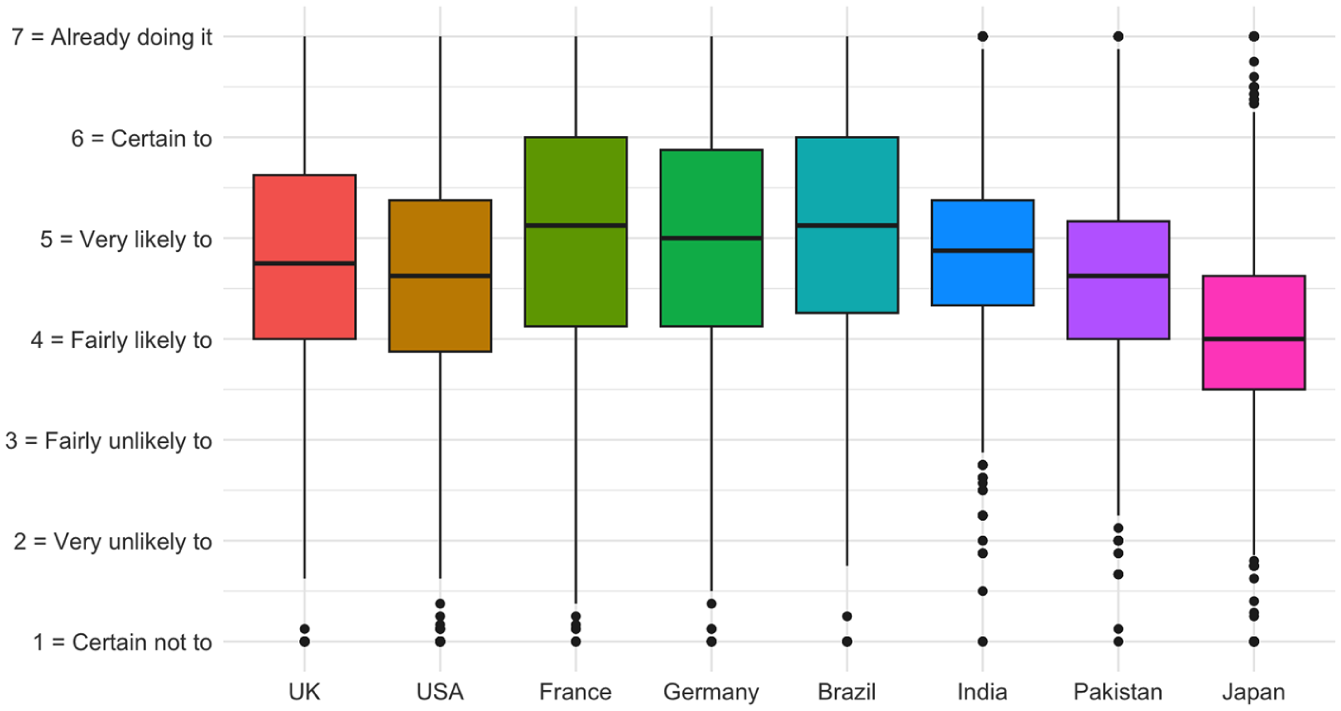
Distribution of behaviour intent across eight countries.
Independent Variables
Following Fletcher and Park (2017), we measured self-reported use of different types of climate change news (e.g., offline media, social media) and exposure to different sources of information in climate change news (e.g., scientists, celebrities). The news media through which people consume climate change news were measured with the following question: “Thinking specifically about the news or information about climate change you saw, read, or heard within the last week, where did you see, read, or hear this?” Respondents chose from the following options: Television news, Radio news, Printed newspapers and news magazines, Websites/apps of newspapers and news magazines, Websites/apps of TV or radio news companies, Websites/apps of other news outlets, and social media (e.g., Facebook, Twitter, Instagram, TikTok, etc.). As motivated in the Introduction, we divided news media use into two categories: mainstream (M = 0.15, SD = 0.22) (TV, radio, print newspapers, Websites/apps of newspapers/magazines, and Websites/apps of TV or radio) and non-mainstream (M = 0.12, SD = 0.26) (Websites/apps of other news outlets, and social media).
Moderator Variable
In line with Newman et al. (2020), trust in the news about climate was measured by asking the following question: “Would you generally trust or distrust news media (organisations delivering news to the public via radio, TV, newspapers, or online) as a source of news or information about climate change?” Respondents indicated their level of trust in news media (M = 3.28, SD = 1.17) on a scale from “strongly distrust” [1] to “strongly trust” [5].
Mediator Variable
Climate anxiety was measured following the approach of Ogunbode et al. (2022) and Whitmarsh et al. (2022), capturing six emotional responses to climate change: anxiety, sadness, helplessness, stress, worry, and fear. Participants were asked to rate their agreement on a five-point scale (“strongly disagree” [1], “tend to disagree” [2], “neither agree nor disagree” [3], “tend to agree” [4], “strongly agree” [5]). We inquired about the following emotional responses: anxious (M = 3.35, SD = 1.17), sad (M = 3.39, SD = 1.18), helpless (M = 3.25, SD = 1.18), stressed (M = 3.20, SD = 1.18), worried (M = 3.60, SD = 1.14), and frightened (M = 3.27, SD = 1.19). The emotional items demonstrated strong internal consistency (α = .87), loaded onto a single factor, and showed moderate to strong inter-item correlations (r = 0.45–0.64), supporting their interpretation as a unified construct of climate anxiety.
Demographic Variables
We measured socio-demographic variables including age (M = 41.51, SD = 14.97), gender (49.1 % male), education, and political ideology. Education was treated as a categorical variable: bachelor/higher degree (42 %) versus no bachelor/higher degree (58 %) to standardise the data across countries. Political ideology was measured on a seven-point left-to-right scale, which we categorised into left (collapsing values from 1 to 3–23.3 %), right (collapsing values from 5 to 7–29.1 %), and centre (value 4, accounting for 28 % of responses. On average, 9.3 % selected “don’t know” and 10.3 % “prefer not to say,” we included these categories to prevent exclusion of cases. Political responses were coded in this way to remove the effect of different response styles in different countries.
Bivariate Correlation Analysis
To provide an overview of the relationships between key variables, Table 2 presents the means, standard deviations, and bivariate correlations. As expected, mainstream and non-mainstream media use were moderately associated. Both media trust and its interactions with media use were positively related to pro-climate behavioural intentions. Climate anxiety showed a positive association with both media trust and behavioural intentions, but weak and negative correlations with the interaction terms. All correlation coefficients remained below conventional thresholds for multicollinearity concerns (Hair 2011; Tabachnick and Fidell 2018), supporting the suitability of these variables for inclusion in subsequent multivariate analyses.
Means, Standard Deviations, and Correlations Between Key Variables.
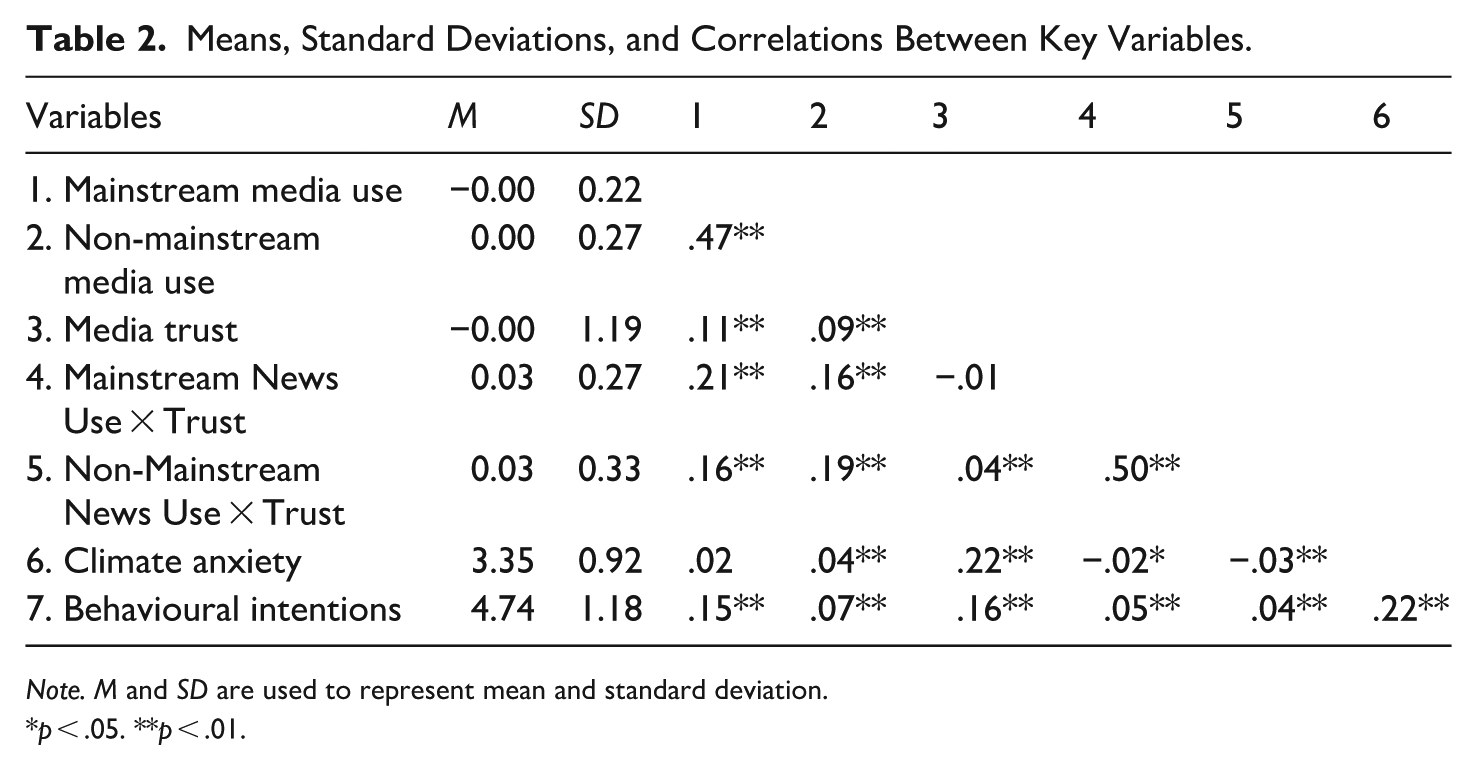
Note. M and SD are used to represent mean and standard deviation.
p < .05. **p < .01.
Analytical Strategy
A visual representation of the conceptual model is presented in Figure 2. All hypothesised paths correspond to the theoretical framework outlined earlier. Specifically, the model included direct and indirect relationships from both mainstream and non-mainstream media use to pro-climate behavioural intention, with climate anxiety as the mediator and media trust as a moderator of both pathways.
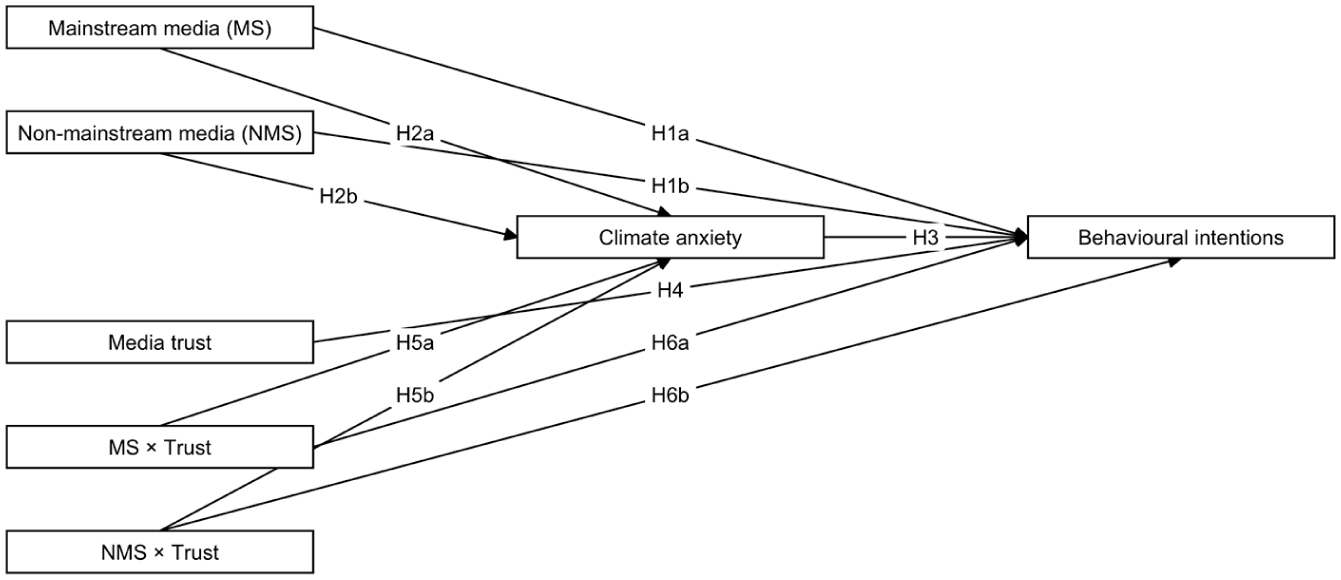
Conceptual model outlining hypothesised relationships.
We tested the model using multi-group structural equation modelling (SEM) with maximum likelihood estimation in R (version 4.3.2), implemented via the lavaan package (Rosseel 2012). The model was estimated across eight countries using a multi-group approach, where each country was treated as a separate group, allowing all path coefficients to vary freely across countries without cross-group constraints. This approach allowed us to examine the consistency and variation of key mechanisms across diverse national contexts. To complement this, we also presented results from the pooled model to highlight generalisable patterns across countries. Taken together, the pooled and country-specific results offered a fuller picture of both cross-context robustness and context-specific nuance. Furthermore, to address potential multicollinearity among predictors, continuous variables were mean-centred before computing interaction terms. All models included age, gender, education, and political orientation as covariates.
The final pooled model demonstrated acceptable fit, with a Comparative Fit Index of 0.994, a Tucker–Lewis Index of 0.929, a Root Mean Square Error of Approximation of 0.023 (90% confidence interval [0.013–0.036]), and a Standardised Root Mean Square Residual of 0.004.
Results
To test our hypotheses, we first examined the pooled structural model to identify general patterns across eight countries. Results from this model were visualised in Figure 3, with key estimates, including from covariates, summarised in Table 3. Among the covariates, younger, female, and left-leaning respondents were more likely to report climate anxiety, while those who were older, female, and left-leaning were more likely to express their pro-climate behavioural intentions. Building on these aggregate results, we then drew on multi-group estimates to assess whether key relationships held consistently across national contexts. Below, we presented results in line with the hypotheses outlined earlier.
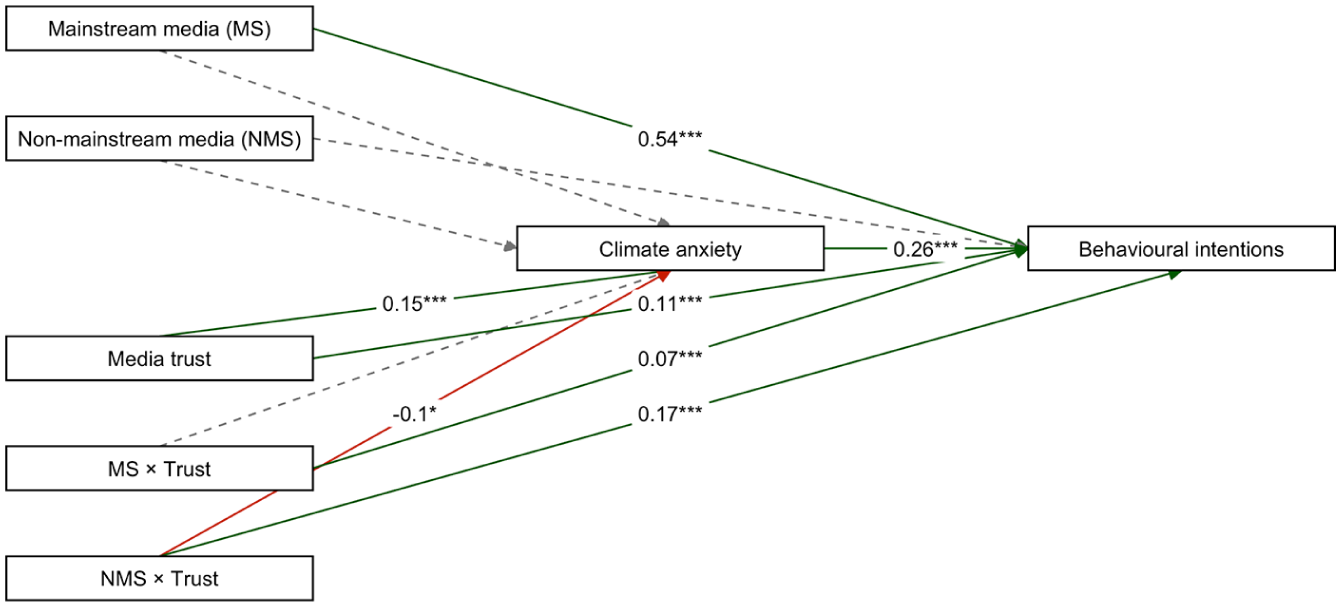
Estimated structural model of predictors of pro-climate behavioural intentions.
Pooled Structural Model Predicting Climate Anxiety and Pro-Climate Behaviour.
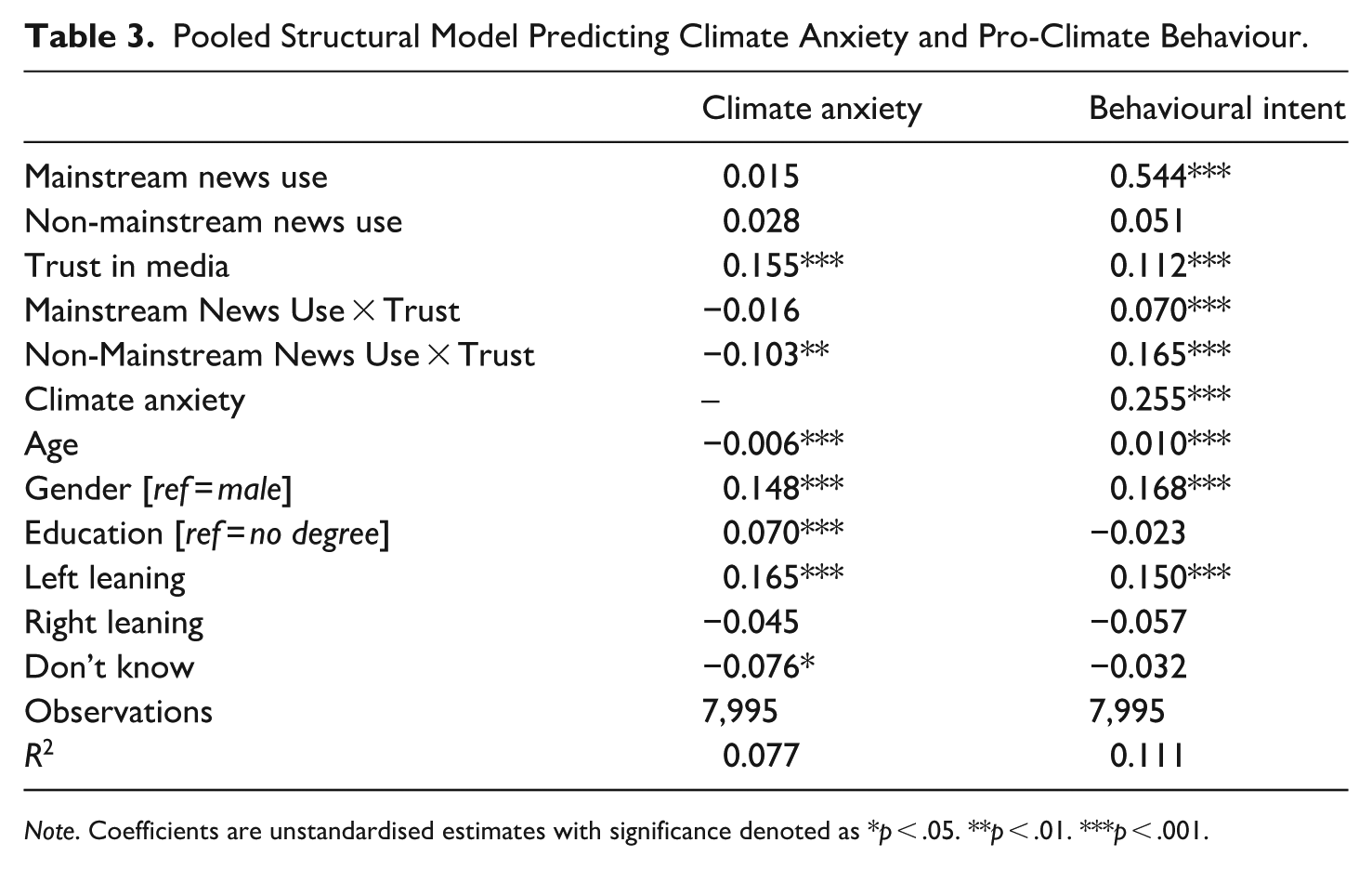
Note. Coefficients are unstandardised estimates with significance denoted as *p < .05. **p < .01. ***p < .001.
Our first set of hypotheses (H1a and H1b) concerned the direct relationships between climate news use from both mainstream and non-mainstream media and pro-climate behavioural intentions. The findings offered strong support for H1a. In the pooled model, mainstream media use for climate news was positively associated with pro-climate behavioural intentions (β = .104, p < .001). This pattern was consistent across countries, ranging from the United Kingdom (β = .028, p < .001) to India (β = .120, p < .001). By contrast, evidence for H1b was more mixed. At the aggregate level, the association between non-mainstream media use and behavioural intentions was not statistically significant (β = .012, p = .334). However, significant positive effects were observed in all eight countries, including India (β = .060, p < .001), Pakistan (β = .057, p < .001), and Brazil (β = .043, p < .01). This contrast between pooled and country-level estimates likely reflected modest effect sizes and variation in standardisation across contexts. While these factors could attenuate aggregate effects in multi-group SEM, they also underscored the value of examining country-specific patterns alongside overall trends.
H2a and H2b examined whether climate anxiety mediates the relationship between mainstream and non-mainstream climate news use and pro-climate behavioural intentions. As shown in Table 4, the pooled indirect effects for both pathways were not statistically significant, offering no support for these hypotheses. Country-level estimates presented a broadly similar picture, with only Japan showing a significant indirect effect for mainstream media use (β = .029, p = .004), and no country exhibiting a significant indirect path from non-mainstream media use. While these indirect effects appeared limited, they built on the strong and consistent direct association between climate anxiety and behavioural intentions (H3), observed at both the aggregate and country levels (β = .202, p < .001).
Standardised Path Coefficients from Multi-Group SEM Across Eight Countries.
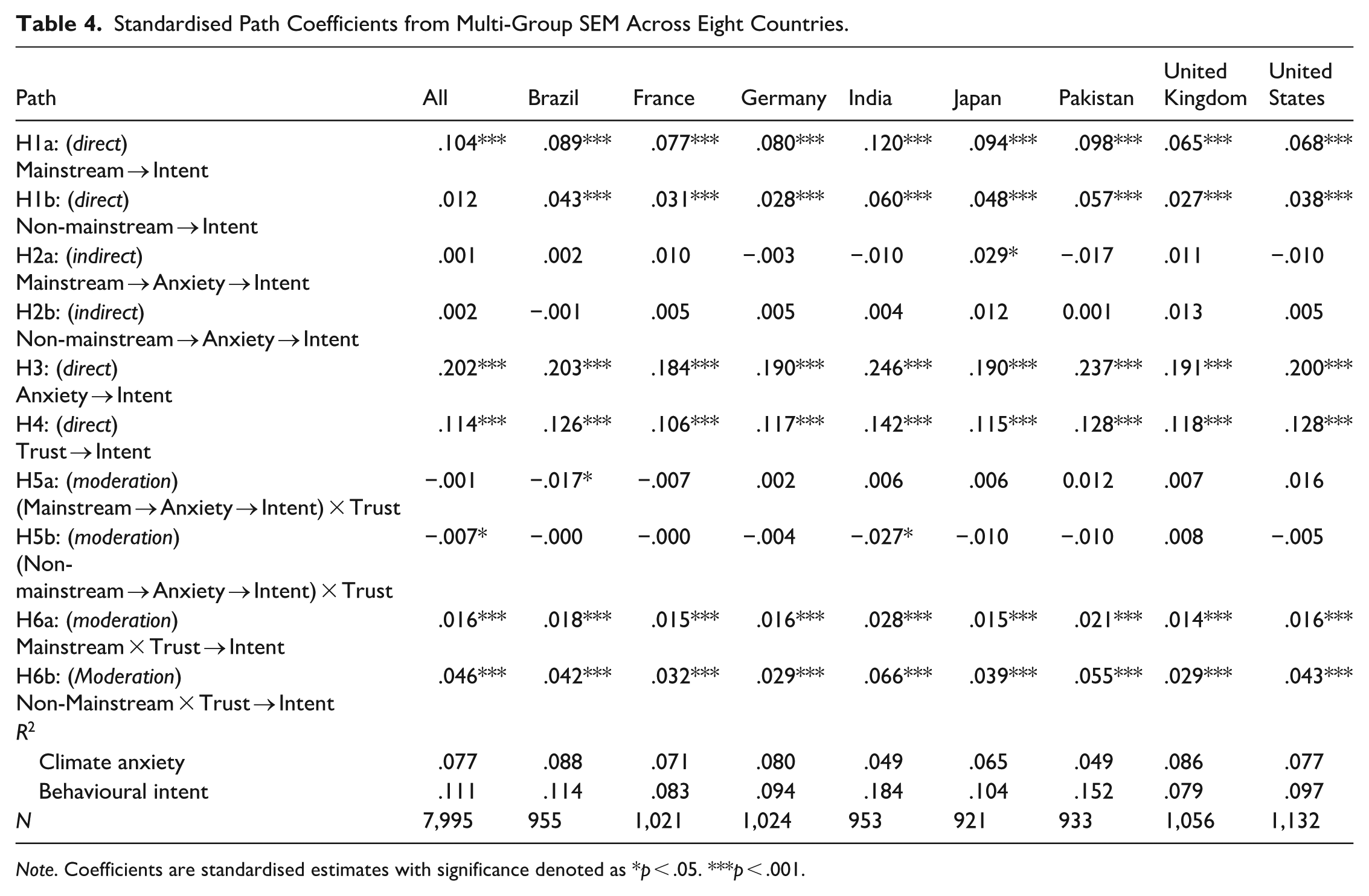
Note. Coefficients are standardised estimates with significance denoted as *p < .05. ***p < .001.
Next, we hypothesised that trust in news media would be positively associated with pro-climate behavioural intentions (H4). This expectation was strongly supported. In the pooled model, media trust significantly predicted behavioural intentions (β = .114, p < .001). The relationship was robust across all eight countries, with significant positive effects ranging from β = .106 in France to β = .142 in India (all p < .001), underscoring the central role of trusted information in shaping climate-relevant behaviour.
We also examined whether the indirect relationship between climate news use and pro-climate behavioural intentions – via climate anxiety – was moderated by trust in media (H5a and H5b). As shown in Table 4, there was limited evidence for these moderated indirect effects. For mainstream media use (H5a), interaction terms were generally small and non-significant, except for Brazil (β = −.017, p = .040). In the case of non-mainstream media use (H5b), a small but statistically significant effect was observed in the overall model (β = −.007, p = .019), and in India (β = −.027, p = .032), suggesting that higher media trust may slightly weaken the anxiety pathway from non-mainstream sources. Taken together, these findings offered only partial support for H5.
Lastly, we examined whether media trust moderates the direct relationship between climate news use and pro-climate behavioural intentions (H6a for mainstream sources; H6b for non-mainstream sources). As shown in Table 4, results offered clear support for both hypotheses. The interaction terms were statistically significant in the overall model as well as across all eight countries, suggesting that trust in media strengthens the direct association between climate news use – regardless of source – and pro-climate behavioural intentions. Notably, the interaction effect was consistently larger for non-mainstream media, suggesting that the influence of trust is particularly important when individuals use non-mainstream for climate news.
Discussion
Using online survey data from 8,541 respondents across eight countries, this study examined how climate news consumption – across both mainstream and non-mainstream media – shapes pro-climate behavioural intentions through emotional mechanisms, and how these relationships are conditioned by media trust. Building on the EPPM (Witte 1992) and the Elaboration Likelihood Model (Petty and Cacioppo 1986) to explain the role of emotion, and source credibility theory (Hovland and Weiss 1951; Tsfati and Cappella 2003) to account for the role of trust, we proposed a framework in which climate anxiety mediates the relationship between news exposure and behavioural intention, while media trust moderates both the emotional and informational pathways. Using a multi-group structural equation model across a diverse set of countries, the analysis provides theoretical and empirical insights into how climate media effects operate across varied sociopolitical and media environments.
First, the findings consistently support a direct link between mainstream media use and pro-climate behavioural intentions. Across all eight countries – and in the pooled model – mainstream news use was positively associated with intent, reaffirming the influence of traditional media as a channel for climate information and behavioural cues (Moser 2016; Schäfer and Painter 2020).
By contrast, the pooled effect for non-mainstream media use was not significant. One explanation is that the influence of non-mainstream media is more heterogeneous across contexts than that of mainstream media. Prior research suggests that alternative or non-mainstream sources encompass a diverse mix of outlets and communicators, including activist organisations, citizen journalists, partisan actors, and conspiracy-oriented channels (Holt et al. 2019). This heterogeneity means that non-mainstream exposure may reinforce pro-climate engagement for some audiences (Hackett et al. 2017) but might also reduce support when the content is sceptical, polarising, or frames climate action as threatening to economic or political interests (Anderson 2017). These countervailing influences can offset each other in a cross-national model, producing a null effect, even though country-level associations – where such influences are more contextually aligned – were generally positive.
At the national level, the picture is more consistent. Associations were positive in every country and particularly strong in India and Pakistan, where social and digital platforms are more widely used for climate information than legacy media (Wetts et al. 2025). In such contexts, limited climate coverage in mainstream outlets – often due to resource or editorial constraints (Nguyen and Tran 2019) – may heighten the influence of non-mainstream sources. While these sources appear to support climate engagement across the board, their role is especially pronounced in countries where mainstream media coverage remains sparse. This dynamic may shift, however, as escalating extreme weather compels mainstream media to also engage more directly with the crisis (Ejaz and Najam 2023).
Second, we found limited support for the indirect pathways via climate anxiety. Neither mainstream nor non-mainstream media use significantly predicted behavioural intention through anxiety, with only Japan showing a mediated effect for mainstream news. This suggests that while media exposure may prompt emotional responses, these emotions do not consistently operate as a bridge to behavioural motivation. One explanation may be that climate news coverage often adopts political or strategic frames, reducing emotional salience and offering little actionable guidance – thus dampening its affective and motivational impact (Boykoff and Boykoff 2007; Hase et al. 2021; Sanford et al. 2023). Additionally, climate anxiety may arise from lived experience or social contexts, making it less directly shaped by news use.
However, climate anxiety itself remains a robust and consistent predictor of behavioural intention across all countries. This supports models like EPPM (Witte 1992), which argue that emotional responses can motivate action when a perceived threat is paired with efficacy. While prior research has highlighted both the mobilising and paralysing effects of climate anxiety (e.g., Clayton 2020; Ojala 2012), our findings suggest that anxiety promotes engagement, clarifying its independent contribution beyond media exposure and reflecting individuals’ personal appraisal of climate threats.
Lastly, trust in news media emerged as a consistent and positive predictor of behavioural intention across all countries, reinforcing its role as a foundational condition for engaging with climate content (Diehl et al. 2021). Crucially, trust also amplified the effects of both mainstream and non-mainstream media use on behavioural intent, with stronger interaction effects observed for non-mainstream sources. This suggests that in the absence of institutional gatekeeping or journalistic norms, audiences depend more heavily on trust to judge the credibility and relevance of content – echoing earlier work on source credibility and selective engagement (Ejaz et al. 2024; Tsfati and Cappella 2003). However, we found little evidence that trust moderates the indirect pathways via climate anxiety, indicating that while trust may shape how audiences interpret news, it does not systematically amplify or dampen the emotional pathway via climate anxiety.
Taken together, what is particularly striking across these findings is the high degree of cross-national consistency, despite the diversity in media systems, political contexts, and levels of climate vulnerability. One explanation for this convergence may lie in the globalisation of climate discourse and the increasing salience of climate impacts, which have made climate change a shared concern even in countries with differing institutional capacities and media infrastructures. As extreme weather events become more frequent and intense, emotional and cognitive responses to climate information may be increasingly shaped by shared psychological mechanisms rather than by national contexts alone. Additionally, the widespread use of digital platforms, transnational media sources, and media framing of climate change as a global issue may contribute to a more standardised information environment and shared public understanding, thereby reducing variability in how audiences encounter and respond to climate news. These findings suggest that, at least in the domain of climate communication, psychological responses and trust may be more universally consequential than previously assumed.
While this study offers cross-national insights using a robust analytical framework, several limitations should be acknowledged. First, the reliance on cross-sectional survey data limits causal inference, particularly for mediation effects. Second, self-reported measures of media use and behavioural intent may be subject to social desirability or recall bias. Third, due to the online survey method, the findings are more representative of the online population, potentially limiting generalisability, particularly in countries with lower internet penetration. Finally, our broad categorisation of media types may mask important within-platform variation – for instance, climate content on television can differ markedly across channels. Future work should use more granular data, including digital trace methods or content-linked surveys, to capture how specific media sources shape engagement.
In sum, this study demonstrates how climate news use, emotional responses, and media trust jointly shape pro-climate behavioural intentions across diverse contexts. It extends EPPM by showing that emotional responses, while important, often operate alongside direct informational effects rather than serving as the primary mediating pathway. This highlights the value of incorporating cognitive and emotional co-processing into models of climate communication, particularly in contexts of high issue salience. It also refines appraisal-based emotion theory by confirming that climate anxiety is a robust and generalisable motivator of engagement across different media and political environments. The moderating role of media trust, especially for non-mainstream sources, broadens the applicability of source credibility theory to digital and less-regulated information spaces. While media effects are often seen as context-dependent, we observed striking consistency across countries: mainstream media use, climate anxiety, and media trust all emerged as stable predictors of behavioural intent. These findings suggest that while national context still matters, certain mechanisms of climate engagement – especially the role of trust and affect – may operate similarly across societies. Together, these contributions highlight the value of combining cognitive, affective, and trust-based perspectives to explain climate communication effects across varied contexts. Future studies should examine how these mechanisms interact over time, and explore whether similar cross-national consistencies emerge for other climate-related attitudes and behaviours.
Footnotes

Funding
The authors disclosed receipt of the following financial support for the research, authorship, and/or publication of this article: This research was supported by the European Climate Foundation (ECF) and the Laudes Foundation as part of the Oxford Climate Journalism Network (OCJN).
Declaration of Conflicting Interests
The authors declared no potential conflicts of interest with respect to the research, authorship, and/or publication of this article.