



Abstract
Theories of symbolic bordering highlight how xenophobic media coverage and humanitarian messaging create boundaries between migrants and receiving communities partly based on deservingness. Contrasting with studies of mainly text-based representations of refugees, we examine refugee-serving organizations’ visual communications work on Instagram. Using a discourse-centered online ethnographic approach, we collected 191 posts made in early 2021 by five UK-based organizations. Then, we applied quantitative content and qualitative semiotic analysis to these posts, complemented by two semi-structured interviews with communications staff members. We show how visual choices invoke divisions between posts’ refugee subjects and their intended audiences, while rendering some refugees legible and particularly worthy of protection or empathy. These choices include using stereotypical elements, obscuring identifiable people, and explicitly attributing quotations to refugees. We also identify “takeover” posts where refugees had controlled organizations’ social media accounts. Our study contributes understanding of how symbolic bordering occurs visually online and has implications for humanitarian communications practice.
A growing body of scholarship under the banner of “digital migration studies” (Leurs and Smets, 2018) has identified how digital aspects of human migration—ranging from representations of migrants in media to the practices of migrants themselves—both contribute to and are shaped by political settings online and offline. On one hand, these studies reveal how powerful actors use digital technologies to control migratory flows, identify and assign “criminality,” and protect the perceived interests and integrity of receiving states (Latonero and Kift, 2018; Madianou, 2019). On the other hand, digital technologies are also central ways by which migrants are represented to Western audiences that impact understandings about the scale, composition, and impacts of mobility (Abid et al., 2017; Bleich et al., 2015).
Connecting these territorial and symbolic aspects results in what Chouliaraki and Georgiou (2019, 2022) have called the “digital border.” We build on their account to examine how specific linguistic and semiotic choices in imagery of refugees sustain this border by engaging in bordering practices that divide citizens from migrants (Anderson, 2013) and shape perceptions of who is worthy of protection. Here, we diverge from most work that has established how news and state-based elites enact symbolic bordering to focus on the refugee sector. This sector has multiple objectives—welfare provision, systems advocacy, capacity development, and research (Käkelä et al., 2023)—and has institutional as well as grassroots characteristics. Just as it remains important to scrutinize how powerful actors enact symbolic bordering against forcibly displaced people, it is crucial to do the same for organizations whose work aims to advocate for and protect refugees’ interests.
Therefore, in this study we ask two questions: how do refugee-serving organizations represent refugees in their digital communications work on Instagram, and how do these representations enact features of symbolic bordering? We focus on Instagram for two reasons. First, it is one of the key means by which refugee organizations communicate, fundraise, and market their importance. This is emblematic of Instagram’s wider significance as a major repository of photographs, particularly conveying self-representations, that has a large user base (Newman et al., 2022). Prior work has productively identified how groups of interested users gather around specific issues (Jaramillo-Dent and Pérez-Rodríguez, 2021; Karsgaard and MacDonald, 2020), and how visual content aims to influence what followers think, perceive, and believe (Dumitrica and Hockin-Boyers, 2022; Walby and Wilkinson, 2023). This makes it an excellent place for examining the visual aspects of the refugee sector’s strategic communications work (Leaver et al., 2020). Second, as a primarily visual site, it contrasts with studies of media focusing on textual representations of migrant groups (Bleich and Van der Veen, 2022; although see Banks, 2012). Social semiotic research demonstrates how images are key to understandings, attitudes, and relationships (Bleiker et al., 2013). Moreover, both the sizes of and mechanisms underpinning these effects are likely to both differ from and interact with text-based content (Prior, 2014).
To address our questions, we used a discourse-centered online ethnographic approach to identify 191 Instagram posts made by five UK-based refugee organizations between February and April 2021. Then, we applied quantitative content analysis and qualitative visual semiotic analysis to identify patterns of representation in these posts. We complemented this analysis with two semi-structured interviews with communications staff at two of the refugee organizations. We find prevalent use of imagery revolving around camp settings and obscuring of identifiable people—practices that potentially reinforce symbolic borders between refugee subjects and audiences in receiving countries. Yet we also find practices that offer the possibility of challenging these borders: replacing iconographic images with personal conversations, attributing quotations to refugees, and giving refugees control over organizations’ social media posts via “takeovers.” Throughout, we highlight how the patterns of representation in these posts are related to the digital affordances and norms present on the platform as well as the logics of engagement that characterize advocacy communications work online and offline.
In total, we make three contributions. First, we extend empirical study of humanitarian communications to visual and digital realms. Understanding patterns of portrayals on social networking sites like Instagram takes greater urgency as advocacy organizations working on a variety of issues—not just those involving refugees—turn to these sites that prioritize image-based content, which in turn can signal socially shared norms of acceptable communication practices (Valentim, 2023). Second, we further develop existing theorization of symbolic bordering (Chouliaraki and Georgiou, 2022) by demonstrating how sector- and platform-specific characteristics support this process. As such, our study offers a template for future work involving other domains and social networking sites. Third, we shift critical attention toward the ways that the refugee sector itself engages in bordering practices that have been more typically associated with xenophobic mass media. Yet by doing so, we also highlight the practical possibilities for Instagram being a site of resistance through communications practices.
Our article proceeds as follows. First, we locate the key conceptual and theoretical claims within existing scholarship on digital migration studies and humanitarian communication. Second, we detail our data collection and methods. Third, we set out our findings that focus on four communication strategies and how refugees are represented by each of them. Finally, we discuss how organizational and platform affordances relate to these strategies, and what our analysis implies for humanitarian communications practice.
Symbolic bordering and refugee organizational communication
Our theoretical argument is that symbolic bordering practices can occur through visual means, and that platform-specific digital features—notably, in how users are networked—contribute to this aspect of the digital border. Focusing on humanitarian communication settings that increasingly rely on social media to raise public awareness and engagement with advocacy goals that aim to foreground refugees’ interests, we make this case in two steps. First, we outline how symbolic bordering has been applied to media coverage about refugees, and particularly social media that contains visual elements—either appearing in isolation or alongside text in a multimodal fashion as on Instagram. Second, building on a growing body of work on refugee organizations cited later, we consider how communications work invokes these patterns when it focuses on the vulnerability or deservingness of the populations for which it advocates.
Symbolic bordering and representations of (European) migration
The concept of symbolic bordering, as applied to media-based representations of migrants entering Europe, comprises linguistic processes by which journalists and humanitarian organizations create and apply criteria of deservingness to determine “which faces, bodies, voices are ‘appropriate’ and ‘newsworthy’” (Chouliaraki, 2017: 92; Fassin, 2007). This boundary-making process is part of what Chouliaraki and Georgiou (2022) call the digital border, or the “shifting assemblage of technologies and meanings organized around historically-specific power relations that regulate migrant mobility across space and time” (p. 20). Although surveillance technologies such as biometrics, e-borders, and remote sensing are clear examples of how digital borders shape migratory experiences (Amoore, 2011), changing public understandings of migration—particularly via targeted advertising on digital platforms—is an important bordering strategy that is also at the disposal of political actors (Collier, 2023). For example, a well-established body of research shows how mass media representations of migration and migrants in receiving countries are not only generally negative but also impact attitudes and preferences (Bleich and Van der Veen, 2022). Yet the digital border is not solely determined by elites and their activities: rather, it is better understood as “a contradictory space where military security, humanitarian care, and activist solidarity co-exist” (Chouliaraki and Georgiou, 2022: 21).
We extend this reasoning to Instagram content, arguing that Instagram is an important site of symbolic bordering with respect to refugees. To be sure, the original conception of the digital border acknowledges how social media—comprising their content, users, and networks—sustain bordering functions. In our study, we develop this further by drawing empirical attention to the ways that symbolic bordering visually occurs on Instagram specifically. Moreover, although Chouliaraki and Georgiou (2022) attend to the impacts of visual objects, they circumscribe the role of images to “performances of responsibility occur[ing] within a western economy of visibility” (p. 143). By contrast, we place greater importance on imagery as a vector for symbolic bordering that involves networks of users—specifically for image-based social networking sites like Instagram, and more generally as images have superseded text for communicating information (Dan, 2019). This is because images may have distinct impacts that work differently from text (Prior, 2014).
Communicating refugee advocacy: organizational perspectives
By focusing on the communications work of refugee-serving organizations as it occurs on Instagram, we build on the work of David Ongenaert (2019), among others, to conceive this work as comprising: the practice of organized and systematic symbolic social action. . .within the public sphere to reach set goals, co-create the refugee organization, perform civic relations and fulfil its mission by groups of people that pursue the (perceived) common good for forced migration. (p. 202)
Here, we must acknowledge how these organizations’ communications practices exist within, and often aim to respond to and challenge, offline border policy regimes that simultaneously display logics of deterrence and securitization alongside logics of humanitarianism and care (Moreno-Lax, 2018; Pallister-Wilkins, 2017).
Documenting how organizations communicate their priorities and agendas is important for two reasons. First, organizations’ materials—often encountered through social media activities (Dimitrova et al., 2022)—provide ways by which members of the lay public are exposed to political issues and claims (Munger et al., 2022). This is particularly the case for forced migration, where media can provide “parasocial contact” (Schemer and Meltzer, 2020) with refugees to users either alongside or instead of actual engagement. Second, these materials and practices potentially impact downstream attitudes and behaviors toward refugees. Some of these are explicit and expected in advocacy contexts, such as donating to causes, while others aim to change perceptions and norms of what is considered “acceptable” online and offline language about migrants (Valentim, 2023).
A range of empirical work based on textual analysis and qualitative interviews has traced the communications practices of organizations involved in providing services to and advocating for migrants and refugees. These include studies of the International Organization for Migration (Bradley and Erdilmen, 2023; Veeramoothoo, 2022), the UN High Commissioner for Refugees (Ongenaert et al., 2023), and national bodies including the Danish Refugee Council (Ongenaert and Joye, 2019). On one hand, this work demonstrates how refugees are often portrayed as anonymous or voiceless victims of circumstance—a trope common to other mass and social media representations (Rosa and Soto-Vásquez, 2022). On the other hand, refugees are also cast as empowered individuals who have degrees of agency both in deciding to flee conflicts and contributing to host societies. This echoes historical analyses showing how international organizations emphasize refugees as being self-reliant—possibly to reassure donor governments (Easton-Calabria, 2022).
Scholars in critical refugee, postcolonial, and feminist traditions have identified problems with both types of representation, which serve the interests of high-income receiving states rather than the refugees they are ostensibly meant to protect. By restricting refugees to stereotypical roles characterized by victimhood, conventional humanitarian images of crowds in boats or waiting for aid reinforce Western expectations (Danewid, 2017; Malkki, 1996). Moreover, they decontextualize forced migration flows from their settings and causes (Bhambra, 2017) while absolving Western governments from their complicity in global displacement (Ticktin, 2017). Yet, efforts to reframe refugees as resilient entrepreneurs fall into similar traps by foregrounding the benefits that receiving states might obtain by welcoming these people (Easton-Calabria, 2022) while providing Western audiences with voyeuristic windows onto refugees’ personal stories—what Orgad and Seu (2014) have called “intimacy at a distance.” Altogether, refugee-serving organizations’ communication practices contribute to defining “who counts” (Allen et al., 2018) as refugees among Western audiences, and are better viewed as political and moral acts (Holzberg et al., 2018).
We build on this work in three ways. First, in contrast to most work on humanitarian organizational communication that has focused on textual outputs (though see Ongenaert et al., 2022 for an important exception), we focus on patterns of visual representation. 1 Second, by virtue of our digital ethnographic approach detailed in the following section, we are able to study communications outputs through which advocacy organizations aim to access audiences in ways that more closely mimic how users actually encounter these posts (see Dimitrova et al., 2022 for examples of this mechanism on Facebook). This contrasts with approaches that use hashtags to gather comprehensive datasets about topics (e.g. Guidry et al., 2018). Third, we concentrate on UK-based refugee-serving organizations rather than the largest international organizations serving refugees. This provides insights about communications practices occurring in the absence of highly corporate structures.
Data and methods
Source organizations and sampling procedures
Given our focus on how Instagram-based communications strategies involving refugees contribute to symbolic bordering, we used an online discourse-centered ethnographic approach. Generally, this approach involves “the systematic observation of selected sites of online discourse with direct contact with its social actors” (Androutsopoulos, 2008: 2; see also Hart, 2017), which acknowledges how digital media are connected with offline phenomena (Varis, 2016). Our specific implementation, comprising several stages and techniques detailed in this section, aimed to identify how refugee-serving organizations supplied particular representations which link with the expectations of symbolic bordering.
Table 1 summarizes our selected organizations, accurate as of February 2021. We chose organizations that were UK-based, were either founded or became more active in response to the 2015 European refugee “crisis,” and had many followers (in the thousands rather than dozens or hundreds) which we took to indicate greater visibility in relevant online networks conducting advocacy work for refugee-related issues. As such, they represent a set of accounts that users supportive of refugees would likely find through the platform’s algorithm that suggests further accounts to follow. Moreover, focusing on organizations that became more visible and significant from 2015 allows us to explore whether and how established humanitarian communications practices have continued to appear on Instagram. We intentionally excluded large international refugee organizations because these bodies’ approaches to messaging about refugees and migrants have already been scrutinized, and our interest was in identifying the extent to which conventions of humanitarian communication were present in these UK-based refugee-serving organizations.
Description of the refugee organizations.
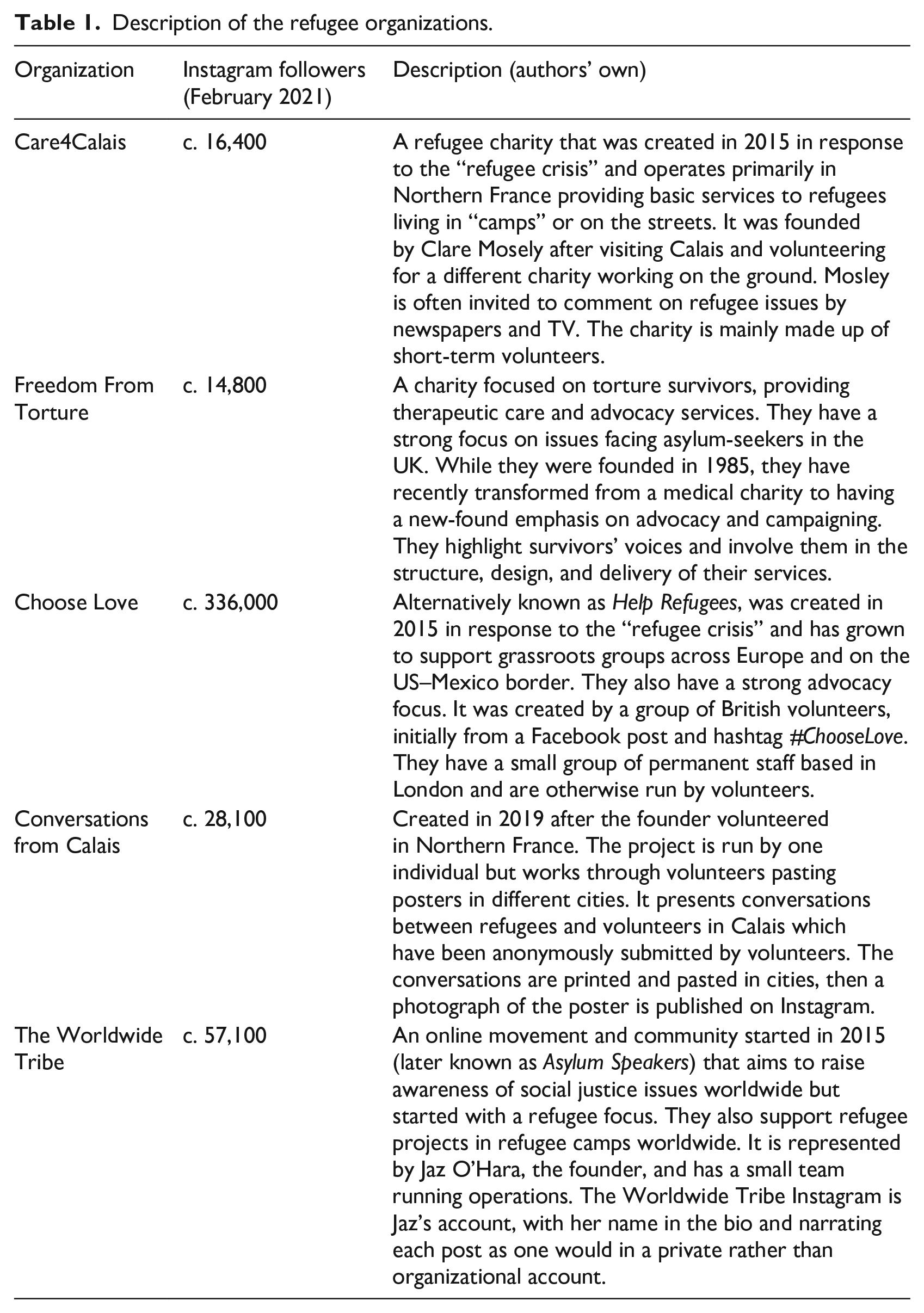
From February to April 2021, the first author collected the screenshots after creating a new Instagram account to reduce concerns about the platform’s algorithm shaping feed results (Laestadius, 2017; Rogers, 2021). Screenshots included accompanying captions as they appeared on the account’s feed. The researcher only took screenshots depicting refugees or refugee-related issues such as detention or policy developments. During the 2-month period, they sampled content from the Instagram feed every 3 days to mimic a user sympathetic to refugee issues who occasionally viewed these five organizations’ posts. We chose this approach of accessing posts, rather than directly searching for all images returned by using specific hashtags, because this is the principal way by which the platform is used. Moreover, it enabled us to view and understand the posts in their local contexts, which is essential for discourse analysis (Wodak et al., 2013). As such, we stress that the resulting collection of images we analyze in this study is not a comprehensive set of all of these organizations’ Instagram content, but rather an ethnographically informed sample of posts that a reasonably engaged user would have likely seen during the study period.
Visual content analysis
Next, we developed a coding scheme to capture aspects of these posts that were known to be relevant manifestations of symbolic bordering. (The full scheme appears in the supporting information.) Initially, we based the scheme on a literature review of prior studies into humanitarian communication, as well as the first author’s data collection experience which revealed common or significant features. Then, we refined the scheme by applying it to a separate sample of 15 Instagram posts made by other prominent refugee organizations around the same time, and discussed areas where available codes did not sufficiently capture what was in the posts. To be clear, this sample does not feature in our analysis: rather, we used these images to calibrate the coding scheme and generate a shared understanding of the codes’ meanings.
While we develop the links between the coding scheme and the measured concepts as part of the empirical results which follow, several features are worth describing in greater detail here. “Obscuring techniques” refer to efforts at anonymizing or removing identifying characteristics of people in images. This can either be done by the original photographer (such as by having human subjects turn their backs) or after the image has been taken (such as by blurring or cropping faces). “Iconic images” refer to the presence of visual tropes that prior quantitative and qualitative research into representations of refugees and asylum-seekers has identified as being especially common, such as mother-and-child figures or boats and lifejackets (Bleiker et al., 2013; Olier and Spadavecchia, 2022). Finally, “takeover posts” are posts that are curated and written by refugees themselves, in contrast to communications professionals or volunteers who would normally handle social media activities for an organization.
After agreeing on a final scheme, the first author coded all 191 posts, of which the second author independently coded a randomly selected 20% subsample (comprising 39 images). Formal intercoder reliability tests indicated that all dimensions displayed reliability levels of at least 0.60, with the point estimates of 14 of 18 features meeting or exceeding 0.80 which is commonly viewed as an acceptably high level (O’Connor and Joffe, 2020). Table 2 provides an abridged version of the reliability results corresponding with the dimensions on which we focus in the empirical section, with full results in the supporting information.
Abridged intercoder reliability statistics.
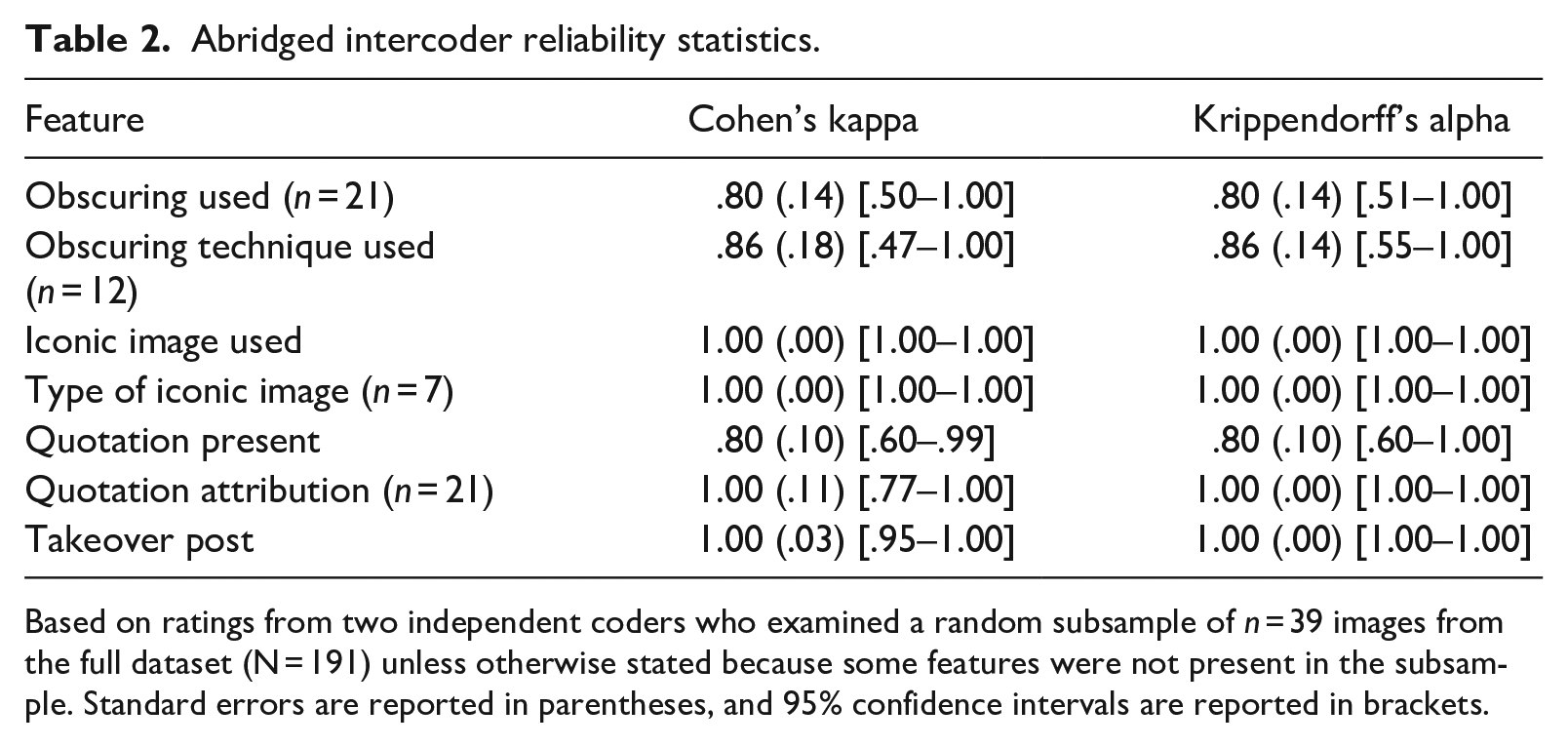
Based on ratings from two independent coders who examined a random subsample of n = 39 images from the full dataset (N = 191) unless otherwise stated because some features were not present in the subsample. Standard errors are reported in parentheses, and 95% confidence intervals are reported in brackets.
Qualitative visual analysis
Next, we explored the patterns identified by the quantitative analysis in greater detail by using qualitative visual analysis, completed by the first author. This stage combined elements of social semiotics, critical discourse analysis, and compositional analysis. Image composition contains three levels: information, salience, and framing (Rose, 2016). These choices are best understood through Kress and Van Leeuwen’s (2006) comprehensive guide to multimodal visual techniques, and later developed by visual scholars (e.g. Aiello, 2006). Key features include visual forms, color, spatial organization, shot focus, and the position between the viewer and subject. The analysis also approaches posts in an intertextual manner that acknowledges how “the meanings of any one discursive image or text depends not only on that one text or image, but also on the meanings carried by other images and texts” (Rose, 2016: 188). These dependencies can occur horizontally—across posts—or vertically to political messengers and contexts (KhosroviNik, 2017). As they conducted the visual analysis, the first author identified common features across the posts regarding how refugees were represented and discussed through visual and textual components. They also noted how specific visual techniques occurred within posts’ contexts. We illustrate particular communication techniques using exemplar images without claiming they are representative of the whole corpus of images.
Qualitative interviews
Although we rely on Instagram content as the primary evidence base for our argument, we have supplemented this with online qualitative interviews with two communications staff, associated with two different organizations, who were available during the study period and gave informed consent to participate which was re-confirmed at several points. This part of the research, conducted by the first author, had been reviewed and approved by the University of Oxford. 2 We have reported interviewees’ identities according to their preferences. In line with our digital ethnographic approach, we used these interviews to enrich our analysis of online representations with the perceptions and intentions held by these staff members who were more closely involved in the production of their organizations’ materials. Specifically, these interviews focused on eliciting what the individuals intended their Instagram communications work to convey about refugees, as well as what perceptions underpinned those intentions.
Empirical and ethical considerations
On one hand, our multimethod approach displays advantages over using a single approach in isolation, especially in digital settings where technological affordances, offline dynamics, and the wider contexts associated with posts shape online messages’ meanings. Concatenating methods can validate findings and generate new knowledge in its own rights (e.g. Allen and Easton-Calabria, 2022; Baden et al., 2022). On the other hand, we acknowledge how our materials and methods display important limitations. For example, it would have been ideal to conduct interviews across all organizations, but this was not possible due to practical limits on staff availability. Moreover, we do not claim that our organizational sampling strategy was comprehensive: rather, we intended for it to capture organizations that were visible and active on refugee-related issues in the United Kingdom. Consequently, we delimit our empirical claims as relating to communications practices enacted by this particular set of organizations, and use the qualitative interviews and published secondary sources to contextualize our findings.
Symbolic bordering in refugee-serving organizations’ communications
Overall distribution of communications practices
Our first step shows how four key communications practices were distributed in our sample of Instagram images. As mentioned earlier, we focus on these four practices because prior studies of humanitarian communications, as well as our own pilot study, identified them as being particularly salient in the refugee context. 3 Table 3 presents the relevant results of the quantitative content analysis, broken down by organization.
Distribution of key communications practices by organization.
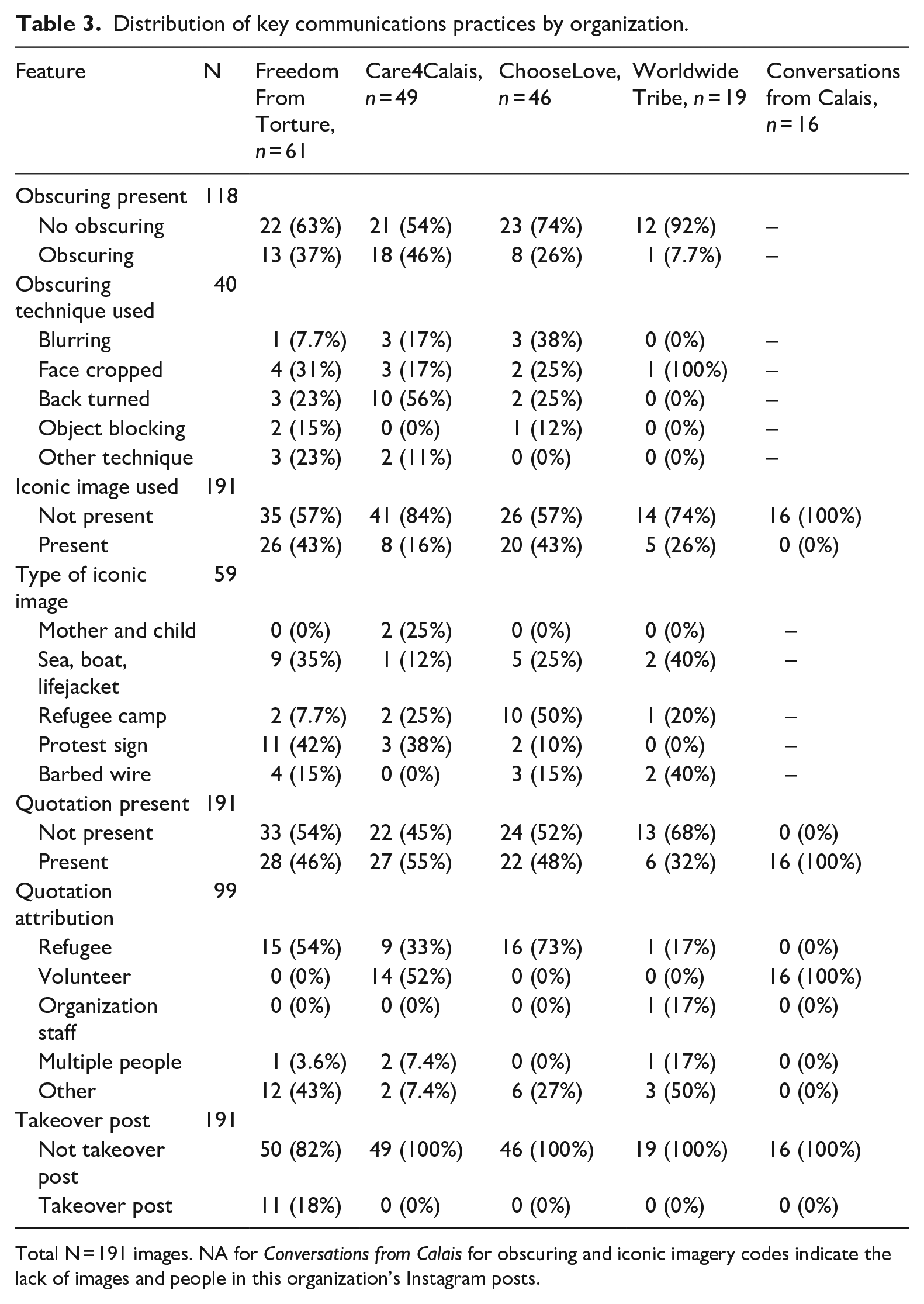
Total N = 191 images. NA for Conversations from Calais for obscuring and iconic imagery codes indicate the lack of images and people in this organization’s Instagram posts.
First, 31% of sampled posts, mainly from the accounts of Freedom from Torture and ChooseLove, contained forms of iconic imagery that have characterized refugee-related humanitarian communication to date. Iconic images use common frames of references and accepted visual motifs of a particular subject to condense complexity into recognizable and often simplistic representations. Second, 34% of posts containing recognizable human figures had obscured those figures’ identities. Third, 41% of posts containing a quotation had explicitly attributed the quote to a refugee, with 6% of sampled images—exclusively from the Freedom from Torture account—were “takeover” posts where the refugee had full autonomy over the post. Finally, all the posts from Conversations from Calais followed a format that lacked imagery but featured a quotation attributed to a volunteer. In the following sections, we focus on each of these practices by using qualitative semiotic analysis—complemented by the interviews—to examine how these representations relate to features of symbolic bordering.
Iconographic imagery: refugees as stereotypical humanitarian subjects
In advocacy communications work, iconographic images aim to foster engagement with audiences—whether that is behavioral, such as donating to causes or signing petitions, or attitudinal such as reconsidering prior beliefs—by using quickly recognizable visuals to stimulate emotional responses based on assumptions about deservingness and the vulnerability of the subject (Baberini et al., 2015). Yet icons necessarily simplify and remove information. In forced migration settings, the lost information often relates to the context and drivers of underlying displacement as well as individuals’ specific and varied experiences of mobility (Mortensen and Trenz, 2016). Consequently, this choice enacts symbolic bordering by perpetuating the stereotypical representation of refugees as humanitarian subjects.
Within humanitarian communication, the refugee child represents a particularly vulnerable subject (Bozdag and Smets, 2017). This iconographic figure connotes innocence and purity, cutting “across cultural and political difference . . . to address the very heart of our humanity” (Malkki, 1996: 388). While our content analysis revealed how ChooseLove (and Care4Calais to lesser degree) drew upon camp-based imagery, further inspection revealed how young children prominently featured within these settings. ChooseLove specifically made 15 posts during the study period that featured smiling children in a refugee camp location. Figure 1, a ChooseLove post from our dataset, typifies this practice. It depicts a young girl, Israa, smiling and facing the camera in front of a dirty tent. She holds the tent rope in a natural manner, suggesting she is familiar with the refugee camp. Israa’s smiling gesture, gaze, and the front-facing angle of the shot seeks to create a strong and positive social relationship between her and the viewer. 4 Yet there are elements that establish and maintain distance: the refugee camp itself, a lack of surrounding context, the position of the camera which sets the viewer apart from the environment as an onlooker (Kress and Van Leeuwen, 2006: 42). Consequently, Israa is simplified along the lines of vulnerability and difference. This illustrates how iconographic visual choices maintain logics of certain refugees as suffering and deserving people who stand apart from politics.
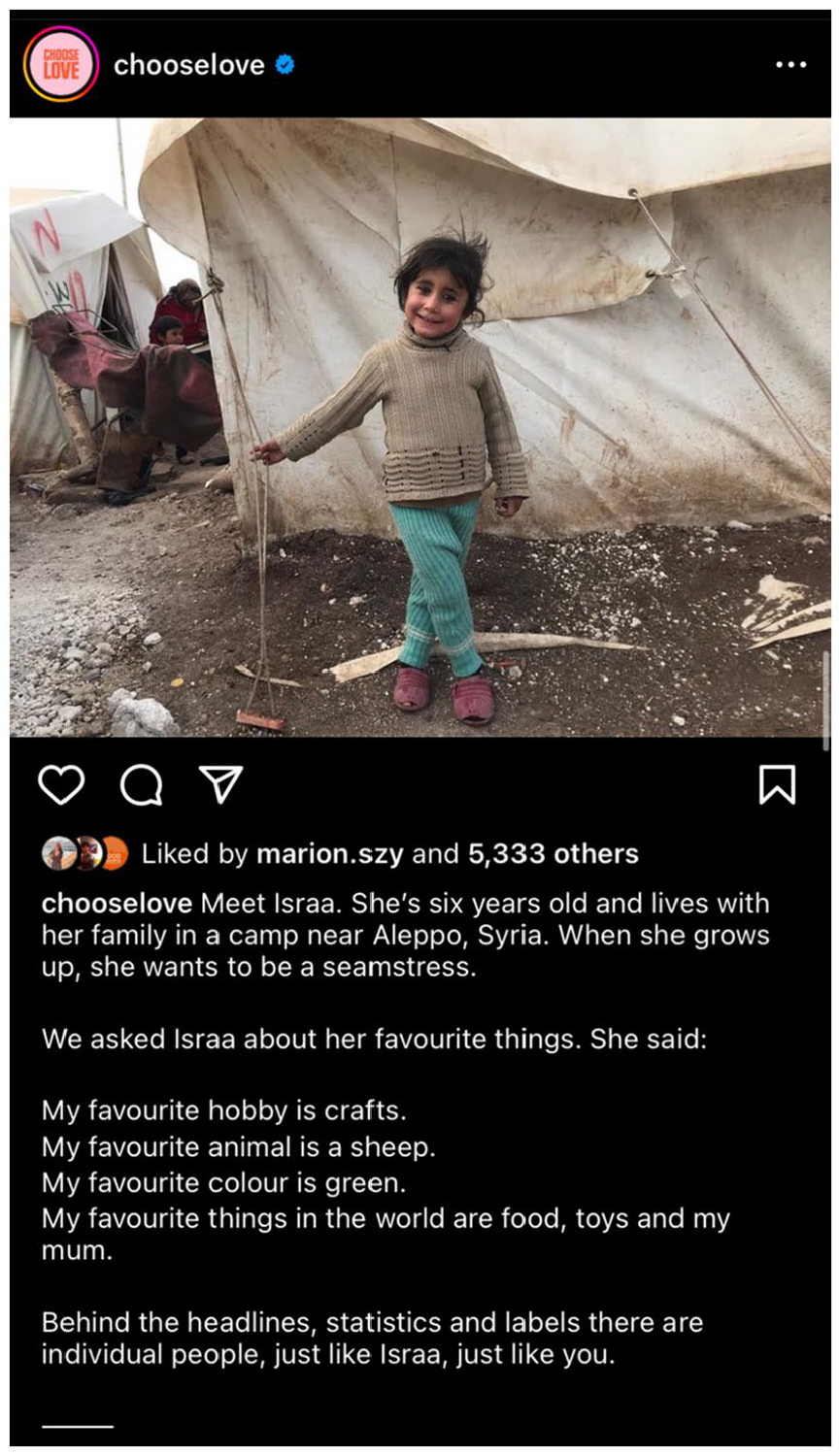
ChooseLove Instagram post (2 February 2021).
What might drive this practice? Here, we offer three possible explanations deriving from practical knowledge about Instagram as well as the interview data. First, the platform itself prioritizes attention-grabbing visual content with short captions. Second, converging and competing media content on the platform means that refugee organizations encounter a crowded space. These two features may encourage organizations to include iconic imagery to secure audiences’ attention and reduce barriers to communicating efficiently. Yet this may have unintended consequences: as Mathilda who founded Conversations from Calais (and was also an employee of ChooseLove at time of interviewing) observed, “you read one of the conversations [from Calais] and then you scroll past it and see . . . a video how to make your dinner.” Likewise, repeated usage may lead users to become desensitized and disengaged—the opposite of the desired effect. 5
Third, iconic images command the attention of refugee organizations as they conceive their marketing and fundraising strategies. For example, Mathilda asserted that it’s known absolutely everywhere that a photo of a child is going to perform much better than a photo of three men in Calais or anywhere in the world . . . [P]eople want to feel pity and they want to be able to empathize and they want to feel something that makes them donate, and that’s usually seeing a child in a really tough situation.
On the narrower question of whether tragic imagery raises the likelihood of donating to charitable organizations by eliciting pity or sympathy, there is suggestive evidence of short-term and circumscribed effects (Baberini et al., 2015). Yet Mathilda’s explanation points to the wider conceptual and cultural underpinnings of this approach in the refugee sector. First, asylum regimes in the United Kingdom and across Europe have been characterized by a “culture of disbelief” (Anderson et al., 2014) that fosters distrust of claimants and their motivations, even after they have been granted refugee status. Invoking vulnerability is one way that some organizations within the refugee sector have attempted to circumvent this (Mayblin and James, 2019). Second, public perceptions tend to be more negative toward male-presenting refugees, particularly when they are portrayed as being younger and in larger groups (Ward, 2019). Gendered assumptions about vulnerability—and therefore who is worthy of protection (Mesarič and Vacchelli, 2021)—intersect with wider cultures of disbelief to produce expectations about which kinds of visuals would be more effective at eliciting pity. Consequently, as the refugee sector increasingly focuses on fundraising using commercialized platforms like Instagram, organizations may be more likely to use iconic imagery involving suffering or deservingness narratives to secure donations.
Beyond the iconographic: reflexive engagement
By contrast, some refugee-serving organizations have consciously chosen to avoid images of refugees in their posts. This is clearly demonstrated by Conversations from Calais: as illustrated in Figure 2, it solicits volunteers to submit conversations they have had with refugees, prints quotations from these submissions on physical posters that are pasted in public locations, and then shares photographs of those posters on Instagram.
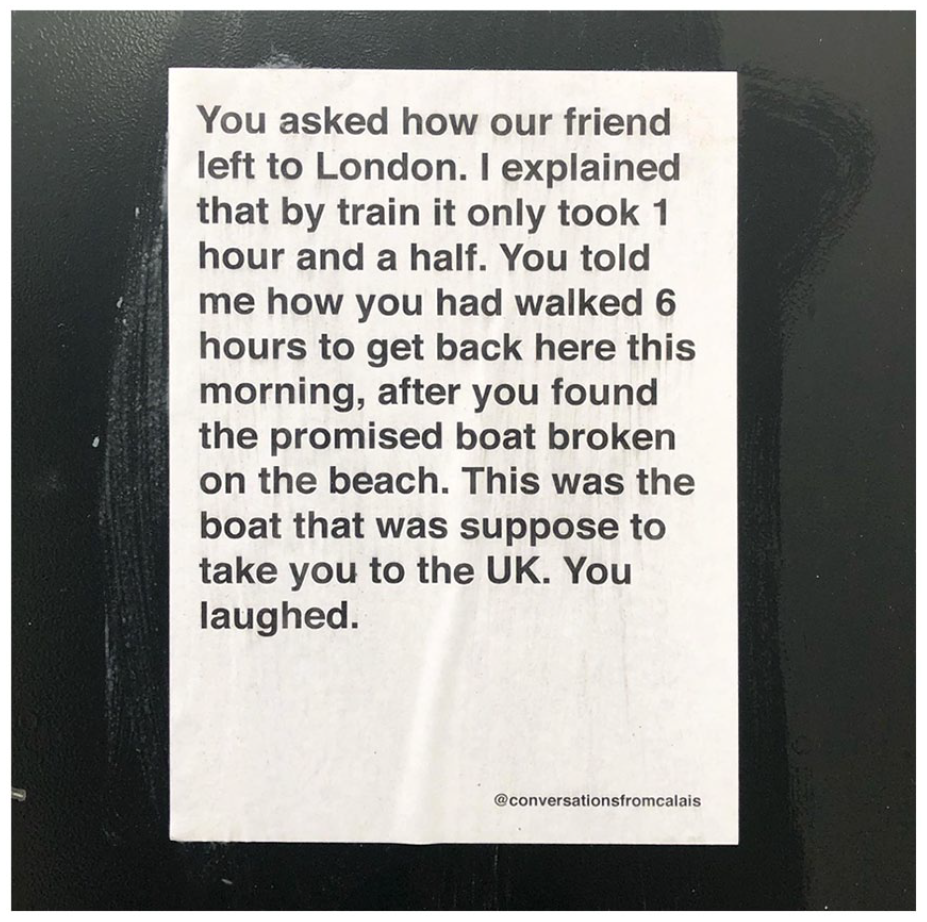
Conversations from Calais post (24 March 2021).
The content, composition, and semiotic resources in these posts provide a strong alternative approach to communications that avoids iconographic images. First, the simple and consistent design foregrounds the textual content, which features short sentences and direct language. Second, the content centers on the refugee’s account which demonstrates how they are sources of knowledge in their own rights. Third, the conversations use pronouns (“I” and “you”) that place the viewer in the position of the volunteer, which creates a more direct relationship with the refugee in the conversation. Fourth, in another attempt to reduce distance between users and refugees, the conversations are physically inserted into locations with which users would be familiar. Finally, through the affordance of the grid in Instagram that displays posts as a collection, the posts archive a diverse set of experiences, topics, and activities involving refugees. As such, the project aims to counter ahistorical and limited conceptions of refugees (Eastmond, 2007: 255) by highlighting everyday aspects of life in Calais. Its founder Mathilda explained that her intention was to “show there is so much about the refugee experience” and “find a way to communicate what I was experiencing in Calais and how different that was to what I was reading, listening to, seeing through the media and politicians when talking about refugees.”
Yet despite the promise of this communication technique to challenge stereotypical representations of refugees and foster reflective engagement with users, there are several constraints on this potential. One of these relates to the ways that users interact with posts—such as by liking, commenting, or sharing content—and thereby give greater attention to some representations of refugees over others which may either challenge or reproduce the symbolic border between refugees and users. Indeed, Mathilda observed how the “tragic” stories perform the best: despite her intentions being otherwise, it is possible that audiences will not perceive the multiplicity and diversity of activities in Calais. These patterns of engagement matter because they contribute to what people are exposed to on the platform. While the grid feature enables displaying multiple Calais-based experiences, the project will not necessarily be viewed as a collection. Rather, most users engage with Instagram through their feed views—and, consequently, only the most recent or most interacted post would likely appear on a user’s feed, ordered in ways dictated by Instagram’s algorithm.
Obscuring faces: safeguarding or diluting refugee voice?
The third communications practice present in our sample is the obscuring of faces: about 1 in 3 (34%) posts containing identifiable people used this technique. This took several forms, such as by displaying refugees’ backs, using other objects in the environment as blocking tools, or by blurring faces after the photograph was taken. Among the sampled organizations, Care4Calais used this technique the most. 46% of its posts containing identifiable people had obscured at least one of the individuals’ identities. While focusing on refugees’ turned backs was the most common technique in these posts (comprising 56% of the obscured posts), three of its posts displayed extreme forms of blurring as displayed in Figure 3.
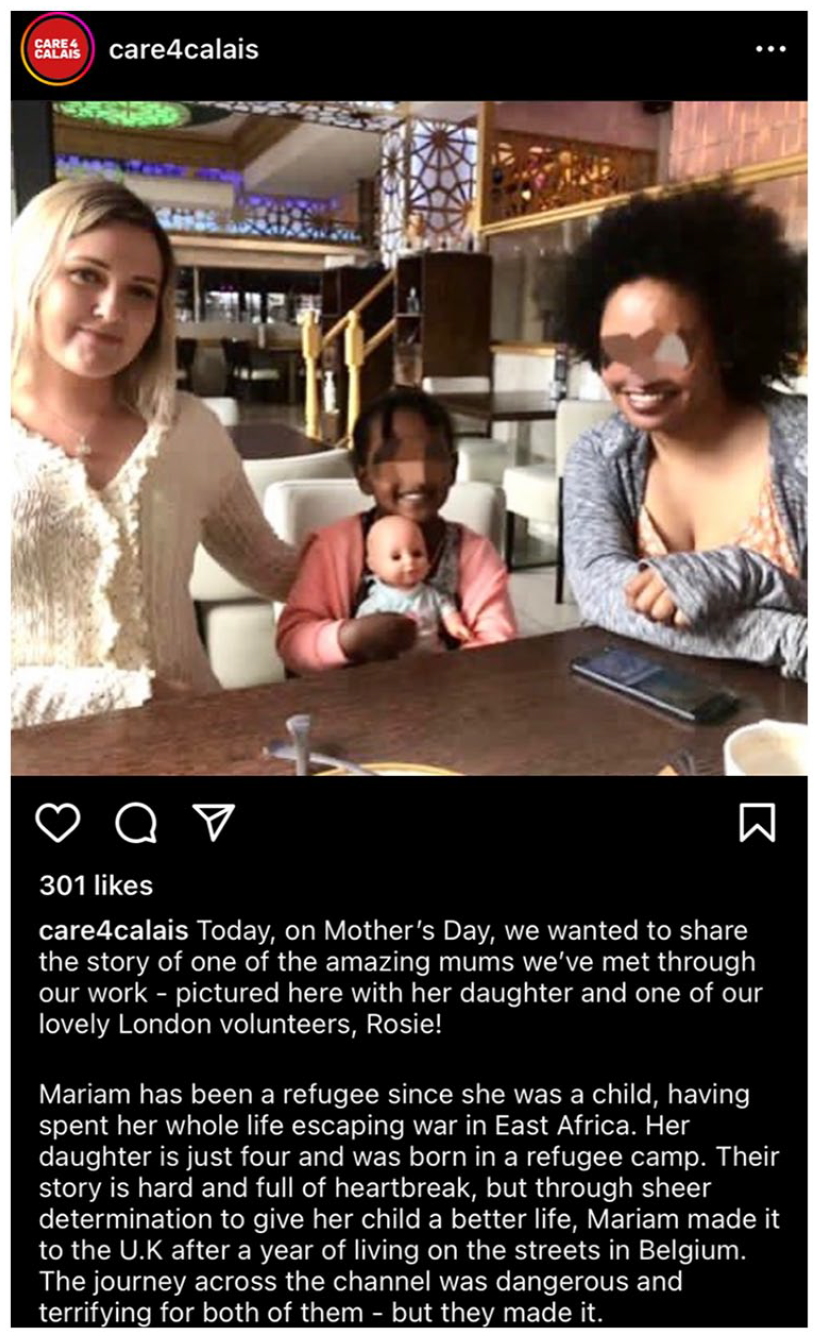
Excerpt from Care4Calais post (14 March 2021).
This image captures the tension associated with this communications practice as it relates to symbolic bordering. On one hand, it allows refugees in a range of positions and degrees of insecurity to be able to share their stories on Instagram: in this sense, obscuring refugees’ identities is a safeguarding responsibility. On the other hand, attempts to safeguard refugees can result in a “ventriloquized” (Chouliaraki and Georgiou, 2022: 167) voice where the refugee organization still speaks for the refugee. Indeed, Figure 3 highlights how perhaps well-intentioned safeguarding practices results in a refugee’s experience being understood through the lens of a Western volunteer. The existing unequal relationship between the refugee and the volunteer is compounded by the blurring technique which results in only the volunteer being legible to the viewer, and the racialized refugee and her child relatively illegible and voiceless. Moreover, blurring as a technique of anonymization is associated with the criminal justice system: the criminalization of migration, as studied via concepts such as “crimmigration” (Bosworth et al., 2017), is a regular feature of media coverage and reflected in migration policies that emphasize deterrence and punishment (Caviedes, 2015). Finally, whether on the grounds of understanding the need for safeguarding or by agreeing with the organization’s narrative, this visual choice allows users to engage emotionally with the post without actually engaging with the refugee. This raises a key question for refugee organizations: how to anonymize a vulnerable individual while also representing their personhood?
Quotations and takeover posts: creating new spaces for inclusion on Instagram?
On this question, our materials revealed the possibility of contesting patterns of symbolic bordering by including refugees’ voices in ways that recognize their personhood as well as the complexity and multiplicity of displacement. This occurred on a spectrum: from the inclusion of quotations attributed to refugees, to posts that involve refugees taking full control over the message (a “takeover”). Our content analysis indicated that ChooseLove and Freedom from Torture were more likely to explicitly attribute quotations in their posts to refugees. Yet only Freedom from Torture engaged in takeover-style posts during the study period, when they comprised 18% of the sampled posts.
These takeovers demonstrate a particular communications strategy afforded by social networking sites. This practice by Freedom from Torture began on the organization’s Twitter account, and then was reposted on their Instagram account. As illustrated in Figure 4, they feature Omar who is an ex-resident of Napier Barracks in the United Kingdom. This is a disused army site that has been used as temporary housing for people seeking asylum (Tobin, 2022). In June 2021, the UK courts determined that the housing was inadequate, and residents were unlawfully detained during COVID-19 lockdowns.
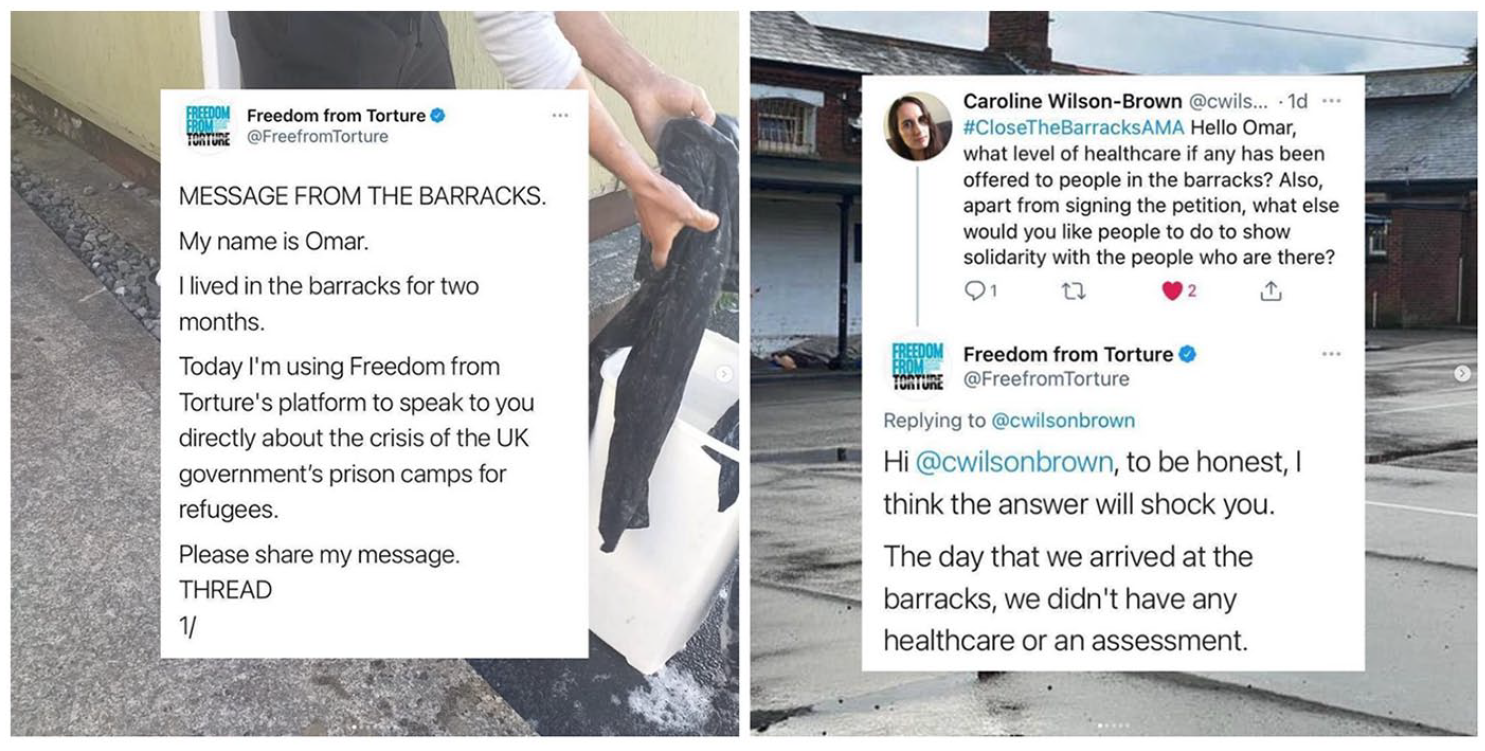
Takeover posts by Freedom From Torture (4 February 2021).
The discursive power of these posts rests in Omar’s authenticity as an ex-resident of the barracks, conveyed via a virtual relationship between him and users by the phrase “speak to you directly.” Moreover, unlike quotations attributable to refugees, this relationship is sustained by direct interaction as Omar responds to users’ questions about his experience in the barracks, without intermediation by organizational professionals (although the organization is providing the means for this interaction). This achieves two objectives. First, it conveys situated knowledge of displacement from which users can learn, which stands in contrast to technical forms of knowledge about refugee stocks and flows (see Cramer and Toff, 2017). Second, and more fundamentally, the act of refugees speaking represents a challenge to the perspectives of states that tend to dominate media coverage of displacement. Aalia, former Media Manager at Freedom From Torture, explained that this practice fits with the organization’s mission “to empower survivors that we are helping so that [they] can advocate for themselves once they have recovered. And changing the narrative of charities being kind of paternalistic in their approach.”
Yet the potential for takeover-style posts to open different spaces for refugee voices goes beyond their distinctive content. It also involves refugee organizations recognizing and taking advantage of the digital affordances of social networking sites. For example, Aalia explained that Freedom from Torture regularly uses the takeover format because “posting a picture of a tweet gets a lot of engagement . . . it’s amplifying our Twitter profile and it just seems to get more pick-up than if we just wrote it underneath and, you know, captioned an image.” As such, the logic of engagement driving further visibility and reach via platform algorithms also contributes toward the perceived appeal of takeovers.
Therefore, as a means of promoting refugees’ voices, these communications practices present opportunities and challenges. On one hand, foregrounding refugees’ actual statements and knowledge—most explicitly via takeover posts—provides greater visibility of refugees’ agency as they navigate and express complex social, political, and historical realities. If decisions about who is given the right to speak are themselves political assertions of personhood (Couldry, 2010), then takeover posts are an important means for contesting simplistic views of refugees as either security threats or humanitarian subjects. Empirically, the potential effects of this exposure should not be downplayed, especially when set against evidence suggesting that these forms of communication can meaningfully shift attitudes, especially when invoked alongside the kinds of strong emotions that visual and personalized content can elicit (Aarøe, 2011). Yet on the other hand, as is the case for other communications strategies, takeovers rely on individuals who possess certain levels of digital literacy and personal interest as well as organizations who can coordinate these activities. This means some refugee voices could be prioritized over others, even inadvertently. More broadly, while social networking sites might expand the range of sources of information available to users (Leeper, 2020) and provide alternative ways of organizing social movements (Bonilla and Rosa, 2015), there remain questions about their actual effects (Feezell and Ortiz, 2021).
Discussion
How have UK refugee-serving organizations visually portrayed the refugees they seek to represent on Instagram? By applying quantitative content analysis to identify patterns of representations in 191 Instagram posts made by five sizable organizations in early 2021 and collected via an online discourse-centered ethnographic approach, using qualitative visual analytical methods to dissect these patterns more closely, and contextualizing these findings with insights from two practitioners, we have explored four sets of communications work: iconic imagery, text-based design, obscuring of identifiable facial features, and incorporating refugee voices through quotation and “takeover” posts. We argue that these practices reinforce and challenge processes of symbolic bordering that divide refugees from citizens, as well as draw boundaries among refugees themselves. Moreover, as corroborated by communications staff, the affordances of Instagram and the logic of engagement through vulnerability contribute to these practices.
As such, our study first contributes important evidence of how refugee organizations engage in symbolic bordering by way of their visual content and digital activities, which contrasts with existing work on humanitarian communications. While we did find continuation of some communications practices known to hold for text-based content—such prioritizing professionalized over refugee voices (Chouliaraki and Georgiou, 2022; Georgiou and Zaborowski, 2017)—we also documented how the visual format of Instagram offers distinctive opportunities for representing refugees in ways that move beyond stereotypes. In addition, by drawing attention to “takeover” posts, we highlight how Instagram provides opportunities for accessing refugees’ own representations—although not without risks of their own.
The second contribution, on which we focus for the remainder of this discussion, is to theorization of how symbolic bordering occurs on a specific social networking site and in the context of refugee-serving humanitarian organizations. Specifically, we argue that attending to Instagram as a site of bordering reveals how networks of actors (comprising advocacy organization and audiences) engage with technological norms and platform-specific abilities. This can reinforce symbolic bordering, but can also create alternative avenues for contestation that may spill-over onto other platforms as well as offline.
First, it is worth remembering that refugee organizations are increasingly professionalized actors operating in politicized fields. Our qualitative interviews demonstrate how perceptions of “what works” run through decisions about which forms of content to publish. For example, the presence of iconic imagery highlights the tension between reflexive representation and pressures within the charity sector, notably fundraising and responding to audiences (Orgad, 2013). These pressures prioritize campaigns rooted in short-term responses that preserve organizations’ purposes while remaining familiar and exciting to audiences. As such, the key performance indicators of Instagram content are not necessarily shifts in messaging around migration. Instead, they are pragmatically indicated by donations, followers, and brand awareness. To be sure, it is reasonable to expect that organizational values and missions, whether explicitly stated or tacitly practiced, may also shape communications outputs. While a full analysis of our selected organizations’ values is beyond our scope, we acknowledge how this aspect delimits the options available to practitioners: for example, Freedom from Torture aims to engage in both campaigning and service delivery activities in ways that center people with lived experience, whereas Care4Calais is an emergency aid charity. Therefore, the Instagram posts we have studied arise from communications strategies that determine who and what should be seen. As such, we argue that they are best thought of not only as multimodal texts that supply certain representations to audiences, but also as sets of practices that manage relationships among sector organizations, users, and refugees themselves (Serafinelli and Villi, 2017).
Second, Instagram users create demand for specific representations by responding to these communications strategies. Liking, commenting, and sharing posts contribute to the power of some messages over others—not only in terms of endorsement but also by enhancing their visibility to other users and sending signals to organizations that a given campaign is worthwhile. Here, it is particularly important to acknowledge how logics of profit and entertainment, as well as values of humanitarianism, motivate these dynamics: organizations’ decisions are guided by audience engagement statistics as well as stated policies and values. On one hand, these logics are relevant to any media dependent on advertising. On the other hand, since organizations’ communications strategies are instantly watched and publicly observed on social networking sites, they can be quickly copied and reused in ways that are different from traditional mass media. In this regard, future work could productively examine the reception of these approaches among audiences and communications staff using either qualitative digital ethnographic techniques such as walkthroughs, go-alongs, and scroll-backs (for a review see Møller and Robards, 2019), or quantitative approaches like experiments and social network analysis.
Third, the technological affordances and norms of Instagram (and social networking sites more generally) have implications for the extent to which refugee voices are included. Notably, by linking organizations and users, Instagram potentially holds large sway both over the communications strategies ultimately chosen by organizations and what is seen (and engaged with) by audiences. Moreover, as demonstrated by “takeover” posts, social networking sites provide ways for audiences to engage more directly with refugees despite degrees of mediation by organizations and limitations of capacity and digital literacy potentially affecting which refugees are given access. However, where levels of digital literacy and interest exist alongside design similarities across platforms, examples of refugee voicing can transfer through these networks in ways that are not as readily possible via legacy mass media.
Taken together, our findings extend conceptions of symbolic bordering by adding insights deriving from the practices of refugee organizations on a major social networking site. They highlight the importance of attending to the ways that platform- and sector-specific logics interact with choices about semiotic content to produce conceptual maps of who counts as deserving refugees that inform other digital surveillance and governance practices. Moreover, understanding these forms and mechanisms potentially helps to sustain representations that more closely match refugees’ actual experiences. This is important not only for the sake of accuracy, but also as a means of potentially changing attitudes and preferences in receiving societies which are often based on misperceptions of refugees (Thorson and Abdelaaty, 2023).
Our study also has implications for communications work as it plays out in humanitarian settings. Refugee-serving organizations are powerful professional actors in the public storytelling of migration that contribute to social norms of acceptable communication that have likely consequences for political behaviors such as voting or joining social movements as well as policymaking (see Valentim, 2023), particularly for users who are already sympathetic to refugees. Moreover, social networking sites such as Instagram play important roles as sources and circulators of these storytelling norms. By demonstrating how choices involving imagery relate to divisions among refugees, receiving communities, and digital audiences, we highlight the need for critical self-reflection on the part of organizations themselves as they develop their communications strategies. This should also involve recognizing the networked and public nature of social networking sites—particularly Instagram—which amplify the supply of and demand for particular kinds of messages to greater degrees than legacy mass media. Doing so has the potential for not only moving refugee-serving organizations’ communication beyond stereotypical representations, but also for this shift to spill-over into broader public discussions and forms of resistance happening both online and offline.
Supplemental Material
sj-docx-1-nms-10.1177_14614448231220856 – Supplemental material for Visual bordering: How refugee-serving organizations represent refugees on Instagram
Supplemental material, sj-docx-1-nms-10.1177_14614448231220856 for Visual bordering: How refugee-serving organizations represent refugees on Instagram by Anya Jhoti and William L Allen in New Media & Society
Footnotes
Funding
The author(s) disclosed receipt of the following financial support for the research, authorship, and/or publication of this article: Funding for William L Allen’s contributions to this research was provided by the British Academy (grant number PF21\210066).

Supplemental material
Supplemental material for this article is available online.
Notes
Author biographies
References
Supplementary Material
Please find the following supplemental material available below.
For Open Access articles published under a Creative Commons License, all supplemental material carries the same license as the article it is associated with.
For non-Open Access articles published, all supplemental material carries a non-exclusive license, and permission requests for re-use of supplemental material or any part of supplemental material shall be sent directly to the copyright owner as specified in the copyright notice associated with the article.
