




Abstract
This Special Collection “Forced migration and digital connectivity in(to) Europe” historicizes, contextualizes, empirically grounds, and conceptually reflects on the impact of digital technologies on forced migration. In this introductory essay, we elaborate digital migration as a developing field of research. Taking the exceptional attention for digital mediation within the recent so-called “European refugee crisis” as a starting point, we reflect on the main conceptual, methodological and ethical challenges for this emerging field and how it is taking shape through interdisciplinary dialogues and in interaction with policy and public debate. Our discussion is organized around five central questions: (1) Why Europe? (2) Where are the field and focus of digital migration studies? (3) Where is the human in digital migration? (4) Where is the political in digital migration? and (5) How can we de-center Europe in digital migration studies? Alongside establishing common ground between various communities of scholarship, we plea for non-digital-media-centric-ness and foreground a commitment toward social change, equity and social justice.
Introduction
To put it summarily, electronic mediation and mass migration mark the world of the present not as technically new forces but as ones that seem to impel (and sometimes compel) the work of the imagination. (Arjun Appadurai, 1996, p. 4)
The impact of the interlocked phenomena of human mobility and digital mediation – described by the anthropologist Arjun Appadurai already two decades ago – has accelerated in recent years in Europe and beyond. Digital migration has emerged as a contentious topic during the recent so-called “European refugee crisis.” The wide circulation of news images of smartphone carrying Syrian refugees, and Syrian refugees taking selfies upon their safe arrival on European shores became resources for various actors in Europe to imagine themselves and their relation to incoming others. Focusing on the context of Europe, this special section of Social Media + Society seeks to historicize, contextualize, empirically ground, and conceptually reflect on the impact of digital technologies on forced migration. We position our intervention in response to the recent upsurge of popular and emerging academic debate on refugees and digital technologies, and it is our specific ambition to recover and foreground again a shared commitment toward social change, equity, and social justice. By reflecting on what is specific about digital connectivity and refugee experiences but also by acknowledging parallels with other communities, we plea for reflexive politics of knowledge production on digital migration. This emerging research focus which seeks to understand the relation between migration and digital media technologies can be labeled digital migration studies.
A rich body of scholarship exists that has charted how media and communication technologies have historically played an essential role in the everyday lives of migrants across the world. Migrants have maintained networks and relationships across distance and borders through exchanging letters and audio-cassettes, setting up diaspora newspapers, transnational radio stations, accessing satellite television, engaging in transnational telephone conversations and sending remittances. Scholars have also documented how satellite dishes, Internet cafés and more recently migrant smart phone usage and refugee selfies have been projected in populist, right-wing and anti-immigrant discourse as symbols of threat, exclusion, and the supposed failure of integration and multiculturalism. Over the course of the last decade, the scale, intensity, and types of migration and digital mediation have drastically changed and accelerated. Notwithstanding persisting digital divides, the international proliferation of information and communication technologies (ICTs) has greatly impacted upon a variety of migration dynamics, most notably for forced migrants. The transformation of migration toward an always already digitally mediatized migration is a twofold process. The context of forced migrants coming in(to) Europe is the specifically situated example explored in this special section, however it is only one of the possible entry-points to begin to understand the contemporary global conjuncture of migration and digital mediation.
In Europe, top-down governmental border control and migration management by state authorities increasingly rely on digital technologies, for example to surveil the Mediterranean and detect unwanted “irregularized” migrants, to algorithmically process asylum seekers’ biometrics through datafied discrimination, and to scrape social media data for the purpose of predictive analytics and policing. Second, from the bottom-up perspective of everyday experiences of forced migrants, smart phones, social media platforms and apps are mobilized to access information, resources and news; for purposes including communication, emotion-management, establishing intercultural relations, identification, participation, political protest and sending/receiving remittances. The rapid developments in migration that happen in conjunction with the spread of ICTs raise considerable theoretical, methodological and ethical challenges. The articles included in this special collection take up these challenges, and illustrate the broad scope of digital migration studies. Regardless of their varying foci, the articles in this collection operate from a common ground of interdisciplinary theoretical frameworks, mixed-methods approaches and ethical research practices. Combined, they demonstrate the importance of ethically sensitive, socio-culturally and historically aware and comparatively situated understandings.
The plans for this collection date back to 2015, when we realized smart phones, selfies and ICT’s were increasingly mobilized as new means of “symbolic bordering” (Chouliaraki, 2017) between Europeans and newcomers. News media, policy makers, and academics were in agreement that forced migration and digital connectivity were increasingly intertwined, however, the usages, experiences, and implications of digital connectivity in the lives of forced migrants largely remained uncharted. Arguing there is a need for more in-depth, critical, and comparative research into this topic, especially in the context of Europe, early January 2016 we pitched our plans for a special collection on “Forced migrants and digital connectivity in(to) Europe” to Zizi Papacharassi and the editorial board of Social Media + Society. SM + S was our preferred outlet because we were explicitly looking for an online open-access journal that would welcome critical, collaborative, interdisciplinary and contextualized interventions on the societal impact of digital migration, from a variety of paradigms. We envisioned to foster a dialogue between scholars from fields, including science and technology, media, gender, cultural, and communication studies as well as migration and refugee studies, law, anthropology, sociology and geography drawing on qualitative, mixed, and quantitative methodological approaches.
Special collections published by the journal shape research in new areas and offer state-of-the-art reflection on urgent phenomena and cutting-edge developments. We are grateful SM + S was willing to offer us a platform to chart a pressing socio-political conjuncture. In our call-for-papers circulated in February and March 2016, we explained our rationale:
Approaching forced migration as a complex societal, political and cultural phenomenon, we seek to consider different aspects of digital connectivity, such as the use of social media by migrants, activists and trolls, issues of affectivity, representation, materiality, mobility, solidarity, political economy and the communication industry, as well questions related to gender, race, sexuality, nation, class, geography and religion; identity; diaspora; media literacy; policy; legislation and human rights.
Furthermore, we explained for us “the label forced migrants includes here asylum seekers, refugees, stranded migrants, left-behind children and child migrants as well internally displaced populations amongst others.” The overwhelming response from researchers based across the world confirmed a growing transnational and multidisciplinary interest in this pressing issue. After initial selection and several stages of double-blind peer review this special collection consists of 14 pieces: alongside our introduction, there are 10 original research papers included, as well as 3 thematic book reviews that include a Q&A dialogue with the authors of the reviewed books.
We highly appreciate the trust, assistance, and support by Zizi Papacharissi, Stacy Blasiola, Rachel Kinnard, and the journal editorial board. We value the time and energy invested by all peer reviewers who offered valuable feedback. We would like to extend a word of special thanks to the 27 contributing authors for collaborating with us on this urgent collective endeavor. It was a pleasure to work with you, and we learned a lot from reading your texts and from observing collaborations on various transnational research teams. Our authors draw on online and offline fieldwork and empirical data covering various forced migrant communities including Syrians, Somalis, Palestinians, Tamils, and Iraqis across contexts including Austria, France, Germany, Sweden, Somalia, the Netherlands, and Turkey. Finally, and most importantly, we are grateful to all participants involved in research projects covered in this special collection. Thank you for being willing and able to share your opinions, perspectives and experiences with the research community. De-naturalizing digital connectivity in the lives of forced migrants in Europe and on their way to Europe, we hope this collection may trigger more socially just policy frameworks and contribute to a better situated understanding of the agency, challenges and predicaments faced by forced migrants in Europe and beyond.
Digital migration imaginaries
Digital migration has triggered a “plurality of imagined worlds” (Appadurai, 1996, p. 5) in the context of the so-called European “refugee crisis.” The digital has been mobilized and imagined in contrasting ways by different groups of state actors: for example, as a way of understanding contemporary migration, as a way to control mobility, as a way to attack it, as a way to esthetically capture it, and as a way to uncover agency. In the table below, we provide an overview of the various conflicting digital migration imaginaries shaped by various groups of actors across Europe. We offer an indication of whether the actors are oriented toward top-down control or bottom-up experiences, whether they focus on collectives or individual migrants, and we list which actors are covered by the articles in this special collection.

This non-exhaustive overview indicates that both “migration” and “the digital” in digital migration are not singular but plural assemblages. Digital migration means different things to different groups of actors. Moreover, digital technologies do not magically fix “the crisis,” neither through top-down government implementation, nor in bottom-up everyday use, rather they can actually exacerbate the situation halting mobility, dismissing voice, and surveilling connectivity. However, when centering emerging new digital coalitions we can also uncover glimpses of hope for transformation, for greater social justice. For the foreseeable future, the challenge for digital migration studies will be to embrace these paradoxes and accounting for ambiguity.
Rather than introducing the articles included in this special collection one by one, we structure this introductory essay around five provocative questions: (1) Why Europe? (2) Where are the field and focus of digital migration studies? (3) Where is the human in digital migration? (4) Where is the political in digital migration? and (5) How can we de-center Europe in digital migration studies? These questions together allow us to highlight the red thread we have discerned in the articles included in the collection, locate various communities of scholarship, articulate which debates, according to us, are at stake, which avenues are worth pursuing, what challenges and obstacles we foresee and how we could possibly address those.
Why Europe?
The “European refugee crisis,” is a problematic term given to a period beginning in 2015 when an estimated number of 1,000,573 asylum seekers from Syria, Afghanistan, Iraq, and Eritrea arrived in the European Union by crossing the Mediterranean Sea or traveling overland (United Nations High Commissioner for Refugees [UNHCR], 2015). We would like to emphasize here that this is not a crisis which belongs to Europe. It is a crisis experienced by those who are forced to flee their homes, a traumatic experience which is aggravated by being met with hostility and aversion after making a dangerous journey and when trying to claim asylum, a universal human right. The mass movement of forced migrants was only discursively constructed as a crisis when refugees entered Europe, although proportionally much more substantial groups of, for example, Syrian refugees were already living in Lebanon, Turkey, and Egypt, sometimes for years. Many stated one million newcomers in 2015 would be “too many” for Europe to handle, but it is important to consider this number adds up to less than “0.5 per cent of the EU population” (Anderson, 2017, p. 1529).
Rather than acknowledging the resilience of those who arrive against all odds fleeing war, persecution and surviving grueling conditions, exploitation, danger, and circumstances during their journeys, they are met with suspicion, fear, and anxiety (Duffield, 2016). With images of sinking ships, war atrocities—for example, the iconic image of 5-year-old Omran Daqneesh who became known as the “boy in the ambulance” (Hunt, 2016)—and drowned bodies—most notably the death body of 3-year-old Alan Kurdi who washed ashore in Bodrum, Turkey (Vis & Goriunova, 2015), Europeans occasionally get confronted with the spectacle of human tragedy, but there is limited attention for the background story, the root causes, Western interventionism, and the lingering effects of (neo)colonial legacies. Europe, with its legacy and championing of global human rights in the world and particularly the Global South, taps into the vocabulary of crisis to suspend its normal order, to operate in a state of emergency and to thereby legitimate extraordinary measures (Agamben, 2005; Habermas, 1975). As Zygmunt Bauman observed,
What we call ‘refugee crisis’ is but one of multiple manifestations of the state of ‘interregnum’—one in which the habitual ways of acting have stopped working properly and bringing familiar results, but the new ways—more adapted to the changed conditions—are still at best stuck at the drawing-board stage. (Bauman, 2018, p. 2)
Thus, the expectations of those refugees that were spotted carrying the flag of the European Union on the motorways of Hungary and Austria asserting, “We share your respect for justice, freedom and human rights and here we are! We belong!” (Anderson, 2017, p. 1527) were quickly disappointed. Stephen Castles (2017) highlights the impact of colonial histories and the neoliberal world order in his critique of the a-historical discursive construction of “the European refugee crisis”:
Who can forget the picture of Nigel Farage, leader of the UK Independence Party (UKIP) standing in front of a poster of a column of Syrian refugees trying to get to Germany? The image of the “strong, white leader” standing in the way of a flood of desperate people—many of “Middle Eastern appearance”—threatening “our way of life” helped shape public opinion in the UK. (p. 1540)
We concur with Castles (2004), who observed “migration control is really about regulating North-South relationships and maintaining inequality” (p. 224), and this becomes apparent by teasing out the ways in which “the migrant” is imagined. The migrant serves as a “placeholder, marking memories of empire, or fears of globalization, or a sense of impending catastrophe” (Anderson, 2017, p. 1535). The migrant body, in particular, has become a site for the enactment of borders (Whitley, 2017).
Media framing of refugees entering Europe has drastically changed over time from early 2015 onwards, reflecting a supposed “fall of reported emotions” in European citizens (Georgiou & Zabarowski, 2017, p. 8). Frames shifted from initial “careful tolerance,” to “ecstactic humanitarism” and finally to militaristic framing of “fear and securitization” (Georgiou & Zabarowski, 2017, pp. 8-11). Importantly, Georgiou and Zabarowski (2017) found opinions of refugees themselves are hardly ever included in news reports, and stories commonly lack contextualization and historic information. The employment of different sets of metaphors reveals the ways in which refugees are othered. First by using animalized metaphors and “zoopolitical categories” such as “barn doors” refugees were produced as animalized subjects, and as a “specific spatial technology of power” the irregular character of their travel was emphasized (Vaughan-Williams, 2015). Second, the usage of water-related metaphors demands scrutiny. Abid, Abdul Manan, and Abdul Rahman (2017) note the dehumanizing usage of metaphors like influx, flow, flood, pour, wave, stream, surge, absorb, inflow, tide, swell, hail, spill, trickle, outflow, overflow, and spillover in Lebanese, Jordanian, Turkish, Egyptian, and United Kingdom, United States, and United Arab Emirates (UAE) news media detaches refugees from their humanity, rendering them into an indistinguishable, uncontrollable mass. By presenting migration as a crisis-situation—a temporary anomaly—underlying structural dynamics and “the complexity of our common existential condition” (Bauman, 2018, p. 2) are rendered invisible. Most urgently, in the context of Europe, this means the lingering structural effects of the history of European colonialism and the globally uneven impact of neoliberal capitalism are purposefully forgotten.
The contemporary European migration regime is “yet another re-drawing of the global colour line” (De Genova, 2017, p.2). Extraordinary measures are applied on a daily basis to protect a particular “European way of life” (Goodman, Sirriyeh, & McMahon, 2017). Digital technologies increasingly play a key role in furthering processes of migration management and border control. Consider, for example, how Frontex, the pan-European border control agency established in 2004 to secure Europe’s external land, sea, and aerial borders mobilizes digital tools and data. Europe’s technologized digital migration regime includes mass deportation, surveillance, deterrence, predictive analytics of social media activity, offshore sensoring, and dronification at the Mediterranean to return ships back to sea and renouncing the right to claim asylum. Alongside a datafied surveillance arsenal, Frontex also provides infographics to inform the general European public about “migratory routes,” see Figures 1 and 2 (Frontex, 2017).

Frontex “migratory routes map,” screenshot taken 28 September 2017 (Frontex, 2017).
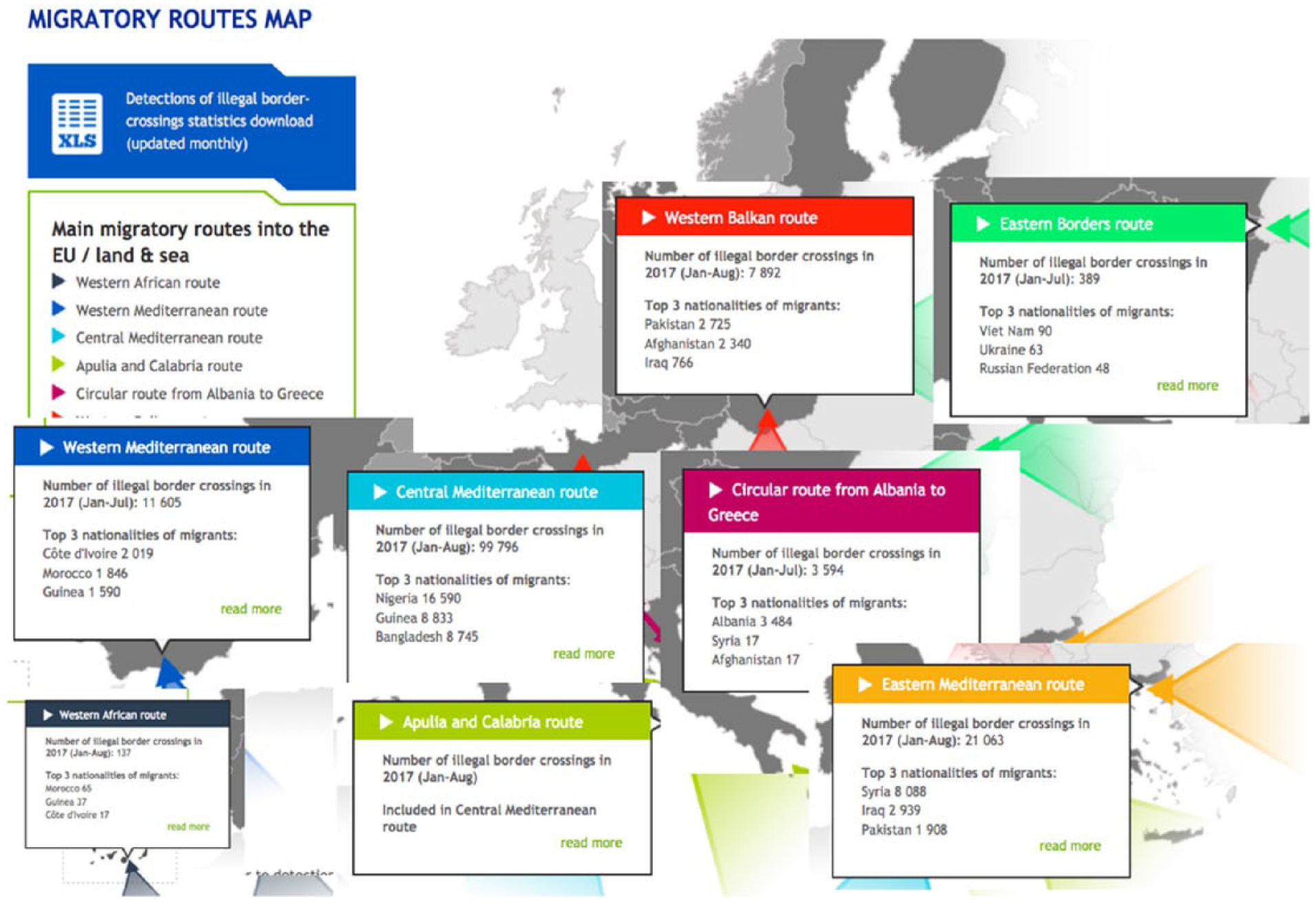
Authors compiled figure above combining details about migration routes provided in the Frontex “migratory routes map” (Frontex, 2017).
These data visualizations, although tapping into ideological notions of objectivity, transparency, and neutrality are not neutral. The decision to represent refugee travel trajectories with arrowheads pointed at Europe, for example, is an act of “symbolic bordering” (Chouliaraki, 2017). The infographic consists of signs that draw on connotations of weaponry, threat, contagion, and invasion (Leurs & Shepherd, 2017). Following established conventions of data visualizations, the size, and scale of the arrows included in the figure can be expected to reflect proportional sizes of incoming newcomers. This, however, is not the case, the size of the arrows does not consistently reflect actual figures of interceptions: the blue and orange arrows in the infographic are similar to green in their size, but, respectively, visualize 11.605, 21.063, and just 389 interceptions. Rather than transparent and accountable, these visualizations emphasize Europe is under threat and illustrate the institutionalized performance of indifference in the face of tragedy. Through such dehumanizing practices, experience of affect and emotion are avoided, viscerally disconnecting European audiences from the situation of others and rendering obsolete European humanitarian obligations of rescue (Fassin, 2007).
Digital tools also provide new opportunities for documenting, challenging, and countering migrant governmentality. The Forensic Architecture (2012) group, for example, “went against the grain” in using counter-surveillance technologies to document the “left-to-die-boat.” This case revolved around a boat leaving Tripoli with 72 migrants on the morning of 27 March 2011. After it ran out of fuel, food, and water, 63 migrants lost their lives while drifting for 14 days within the North Atlantic Treaty Organization (NATO) maritime surveillance area in Libyan and Maltese Territorial Waters. During this time, people on the ship had several points of contact, a distress call was placed using a satellite phone, a military helicopter provided food and drinks, and a visually sighted aircraft and naval vessel did not provide assistance (Forensic Architecture, 2012). This intervention triggered debate, however, unfortunately the situation has not improved, to date Mediterranean boat migration remains extremely deadly (Sigona, 2017).
Early 2018, we Europeans may think the crisis is solved, when we listen to what our politicians say and we judge on the basis of the little that we see on the news. After the EU closed the Aegean route and outsourced the handling of Syrian refugees to Turkey through its multi-billion euro deal in March 2016, attention for ongoing human tragedy at the borders has faded. However, this deal has not decreased massive loss of life, in contrast. Europe remains the deadliest migration destiny in the world, but we Europeans do not really see it anymore on our screens. The following data are publicly available: alongside nearly a million of arrivals, a registered 3,735 people have died or went missing in 2015 (UNHCR, 2015). In 2016, an estimated 5,143 people died trying to cross the Mediterranean Sea into Europe, while 387,895 people arrived, in 2017 a registered 186,768 people arrived to Europe by land and sea and 3116 people have died or gone missing, and as of March 2, 2017, 11,690 arrivals have been registered while 418 deaths and missings have been recorded (International Organization for Migration [IOM], 2018a). Populations of migrants differ by routes, mostly people from Nigeria, Guinea, Bangladesh, Ivory Coast, and Mali travel to Italy. People from the Syrian Arab Republic, Iraq, Afghanistan, Pakistan, and the Republic of the Congo are in the majority in taking the route to Greece, while the route to Bulgaria is mostly taken by people from Afghanistan, Pakistan, Iraq, the Syrian Arab Republic, and Iran/Turkey (IOM, 2018b). Although politicians emphasize the crisis has been solved as the numbers of arrivals are down, the relative death rate has steadily grown over the course of the last few years.
From the information that official organizations make available, European citizens could get the impression that the deal with Ankara and the closure of the Aegean route were indeed successful crisis remedies. For example, through digital dashboards, the IOM lists 86 deaths were registered in Europe in 2017 at the time of writing (see Figures 3 and 4). However, “the Mediterranean” is another region in the drop down menu of the website, listing 2993 deaths/missing persons. By excluding deaths at the Mediterranean from the visualization of Europe, IOM provides a misleading data-visualization, illustrating the non-neutrality, political character, and subjectivity of data visualizations.

Missing migrants project website, region ‘Europe’ screenshot taken 24 November 2017 (IOM, 2017).
This, taken together with increasing xenophobia, racism, and islamophobia after the post Brexit vote and various terrorist attacks that further triggered anti-immigration populist responses, we can observe a very bleak image which stands in sharp contrast with Europe’s motto “Unity in Diversity.” Furthermore, although the EU situation is heavily mediatized, it stands in sharp contrast with developments elsewhere in the world, particularly in the Global South. The mass movement of forced migrants was only discursively constructed as a crisis when refugees entered Europe, although proportionally much more substantial groups of, for example, Syrian refugees were already living in Lebanon, Turkey, and Egypt, sometimes for years. As a matter of fact, across the world, 20 people are forced to flee from their homes every minute. Globally, over 65.6 million people were forcibly displaced in 2016 (UNHCR, 2017). This number, surpassing the total population of the United Kingdom, includes a variety of people, including refugees with recognized status, asylum-seekers, internally displaced persons (IDPs), returnees, and stateless persons.
Where are the Field and Focus of Digital Migration Studies?
This special collection provides a primer on digital migration studies in Europe. The emergence of the field and focus of digital migration studies is marked by the growing circulation of academic buzzwords, including “connected migrants” (Diminescu, 2008), “e-diasporas” (Diminescu, 2008), “mediatized migrants” (Hepp, Bozdag, & Suna, 2011), “digital diasporas” (Brinkerhoff, 2009; Everett, 2009; Gajjala, 2008), “diasporas in the new media age” (Oiarzabal & Alonso, 2010), migrant “feedback mechanisms” (Bakewell, Engbersen, Fonseca, & Horst, 2016), “digital togetherness” (Marino, 2016), “ICT-based co-presence” (Baldassar, Nedelcu, Merla, & Wilding, 2016), “migrant polymedia” (Madianou & Miller, 2012), “virtual intimacies” (Wilding, 2006), and “transnationalism online” (Sahoo & de Kruijf, 2014) among others. In this section, we seek to chart what the field wants, what the field of digital migration studies wants to see, where it came from and where we feel it is heading.
Digital migration does not fit the narrow confines of specialized disciplinary foci, it encompasses research conducted across various disciplines, including media, cultural, and communication studies, Internet studies, information studies, migration studies, ethnic, diaspora and racial studies, mobility studies and transnationalism, gender and postcolonial studies, anthropology, development studies, geography, border studies, urban studies, human-computer interaction, science and technology studies, and law and human rights. Although the “European refugee crisis” is widely discussed in the mainstream media also as “the first of its kind in a fully digital age” (Ponzanesi, 2016, p. 19), there is a relative lack of systematic academic research on the role of ICTs on the lives of forced migrants in Europe or wanting to move to Europe (Ponzanesi & Leurs, 2014; Leurs & Ponzanesi, 2018). Notable exceptions include scholarship around refugees’ “information precarity” (Wall, Campbell, & Janbek, 2017), “refugee integration and social media” (Alencar, 2017), “refugee media journeys” (Gillespie et al., 2016), desires of “becoming (im)perceptible” (Witteborn, 2015), and governmentality through “digital deportability” (Trimikliniotis, Parsanoglou, & Tsianos, 2015). Besides the slow cycle of academic publishing which always creates a time-lag between current events and publication, there are several possible explanations for this gap. Mobility studies quite successfully bridges media and migration scholarship; however, it is principally and relatively a-politically concerned with urban movements and highly mobile, elite migrants rather than transnational, and forced migrants. Media and communication studies work on migration is commonly not cited in refugee and forced migration studies literature, as the latter is mostly focussed on the underlying causes and consequences of migration. As Gillespie, Osseiran, and Cheesman (2018) note in this collection, “most of these studies have yet to consider the increasingly important role of the digital in transforming refugee experiences and mobilities.” Conversely, communication and media scholars do not draw upon migration studies frameworks in their research on/with migrants.
We can discern three paradigms in the field of digital migration studies that are not mutually exclusive, and are increasingly combined. Drawing on Candidatu, Leurs, and Ponzanesi (in press), in Table 1, we provide an overview of these three paradigms, listing illustrative publications, theoretical and methodological approaches, and merits and obstacles.
Digital Migration Studies Paradigms, Developed From Candidatu, Leurs, and Ponzanesi (in press).

The three paradigms of migrants-in-cyberspace, everyday digitally mediated migrant life and migrants as digital data traces can be characterized by their varying “digital-media-centric-ness” (Pink et al., 2016, pp. 9-11): the extent in which digital media are centered as starting points of research. As discussed by Smets (2018), non-media-centric research alerts us technologies can never be considered as inseparable from offline material, historical, socio-political contextual dynamics. Embracing non-digital-media-centric-ness is imperative for digital migration studies to avoid repeating the sensationalist exceptionalism surrounding the technological fetishization of the smartphone carrying and selfie-taking refugees. Singling out technology use perpetuates stereotypical understandings of forced migrants, as if it is special and unexpected people coming from outside of Europe are carrying a relatively cheap piece of technology when fleeing from war, violence, and prosecution. As social justice oriented researchers, moving beyond technophilia and techno orientalism is important, and we should be “concerned first with social problems (social inequalities, race, gender) and then with technology” (Gregory, McMillan Cottom, & Daniels, 2017, p. xxi).
The three paradigms distinguished above co-exist simultaneously, and single studies may combine elements from several or all of these paradigms. For example, in her study on how members of the Palestinian and Tamil diaspora mobilize digital practices in their attempt at “rerouting the narrative,” Kumar (2018) combined data driven digital mapping with web-based content analysis and in-depth interviews with key informant interviews.
As noted above, although the field of digital migration studies is establishing itself, there is a lack of attention for the specific context of forced migrants, or what Witteborn describes as the “digital force in forced migration” (2018). Mobilizing approaches that acknowledge the often-paradoxical roles digital connectivity may play, this special collection offers several interventions that address this gap. Kutscher and Kreß (2018) argue that children’s rights and social work generally lack attention for “social media and their meaning for the life situation of children and youth,” particularly unaccompanied minor refugees. They draw on the methodological approach of “artifact analysis” to articulate the ambiguous potential of social media usage for participation in German society. Gillespie et al. (2018) approach smartphone usage among Syrians in Europe from an infrastructural perspective to highlight these devices serve both as lifelines and are as important as food and water, while simultaneously also highlighting how usage may simultaneously result in exploitation and heightened surveillance. Sánchez-Querubín and Rogers (2018) draw on digital methods, including “issue mapping” to map user-generated “route-work” to critique contemporary practices of bordering. Siapera, Boudouridis, Lenis, and Suiter (2018) present a big data study on framing and affective networks to stake out how refugees are positioned in the “hybrid media system.” In researching #refugee-related hashtags on Twitter in the period between November 2015 and May 2016, they found the most prominent actors were politicians, media outlets and non-governmental organizations (NGOs). The Twitter user @SouthLoneStar was one of the key accounts in their study. This account’s profile photo shows a white adult male wearing a cowboy hat. Interestingly, journalists recently uncovered this account was not the conventional member of the American “alt right,” but a Twitter bot. This fake account, suspended in Summer 2017 for Russian links, was part of a St. Petersburg run disinformation campaign (Hern, 2017). The emergence of digital data, social media analytics and most notably bots as increasingly important actors in digital migration studies illustrate the importance of refocusing our attention away from the technological spectacle toward forced migrants’ embodied experiences.
Where is the Human in Digital Migration Studies?
Hence there is a sense in which we are all migrants now, whether or not we move physically from one part of the world to another. Via digital technology, most of us are in touch on an everyday basis with a diversity of cultures and opinions. Distance is no longer any barrier to instantaneous communication, driven by a vast expansion in computer power—Anthony Giddens (in Kunushevci, 2017, n.p.)
Anthony Giddens draws on the figure of the connected migrant to reflect on the global contemporary human condition, which is increasingly shaped by transnational communication, mobility, and potentially cosmopolitan encounters. Although intended as a conceptual intervention to reflect on how ongoing societal transformations spurred by migration and the proliferation of ICTs result in “empowering” and “volatile” futures (in Kunushevci, 2017) the question arises which particular migrants Giddens has in mind. The barriers Giddens speaks of are more easily surmountable by certain mobile populations, rather than others. Particular forms of human mobility (forced migration) are problematized and undesired, while others are championed and welcomed (highly skilled expatriate migrants from the Global North). Therefore, by foregrounding the human in digital migration studies, in this section, we would like to call into question how a-contextualized generalizations of migrants gloss over everyday practices and experiences of empowerment and subordination, which might in turn exacerbate power hierarchies. The human body and experience in digital migration is distinctly situated in intersectional grids of power relations shaped by politics, history, culture but also particularly patterns of nationhood, ethnicity/race, class, religion, age, gender, sexuality, language, and able-bodiedness among other factors. The distinctly situated experience and perspective of the human in digital migration studies can be foregrounded by reflecting on our own role as academics, accounting for our own categorization practices and by decentering technologies. In short, there is particular urgency to assert more firmly our social justice orientation. “The migrant,” and particularly “the forced migrant” are performatively constructed figures with real, material, and embodied consequences. Researchers are complicit in this process.
We digital migration researchers can reflect more on our own role in this construction by asking ourselves two critical questions: “To whom and to what is research on migration a contribution” (Sandoval García, 2013, p. 1429) and “How can we scholars, who are also part of the ‘migration industry’ conduct work on migration?” (Anderson, 2017, p. 1535). These are two fundamental questions for migration scholars in general, but they do also hold particular urgency for scholars working on migration in the context of digital mediation. Alongside academics and policy makers, the migration industry assemblage mentioned by Anderson includes government agencies, private sector subcontractors who manage detention centers, and dronified surveillance but also actors in the “migration industry of connectivity services” (Gordano Peile, 2014) including money transfer services and mobile phone corporations like Lebara that specifically target refugees as they seek to tap into a new market segment. For example, as European government agencies are increasingly adopting digital data-driven opportunities for a more efficient, neutral, and disembodied migration management and border control (see also Latonero & Kift, 2018; Trimikliniotis et al., 2015), it is important to realize that our social-justice approaches, methodologies, tools, and findings may be co-opted or used in unintended undesirable ways. For example, although our work on migrants’ digital trace data, social media presence, transnational connectivity, or digital identities is commonly addressed to specialized academic audiences, we should be attentive to how it may be transferred into undesirable local and national initiatives including and verifying of individual asylum journeys and narratives (Leurs, 2017). Similarly, observations on the ways in which displaced populations negotiate “information precarity” (Wall et al., 2017), “decision-making” (Dekker, Engbersen, Klaver, & Vonk, 2018) and become “infomediaries” (Borkert, Fisher, & Yafi, 2018) could be co-opted for social media deterrence campaigns and surveillance. Besides self-reflexivity, we may find inspiration in research practices including participatory action research (Gillespie et al., 2018) and ethics-of-care (Tronto, 1994) in aiming to involve and recognize informants not as static objects of research, but as active subjects who can have an important say in decisions in the research process, including the focus, methodologies, writing, and publication process. For example, Borkert et al. (2018) demonstrate how members of a studied community can be included as fellow researchers and co-authors. Nonetheless, we realize the gap in the always already hierarchical relationship between privileged researchers and research participants or collaborators can never be bridged entirely, but a sense of “asymmetrical reciprocity” (Young, 1997) should be an important aim.
As a form of advocacy, our scholarship may offer new insights to contribute to the ongoing and necessary critique of the “categorical fetishism” of migration, refugees, and asylum seekers (Crawley & Skleparis, 2018). As Crawley and Skleparis (2018) plea, it is imperative to problematize the “categories ‘refugee’ and ‘migrant’ as if they simply exist, out there, as empty vessels into which people can be placed in some neutral ordering process” (p. 49). Bakewell (2008) pleas to conduct “research beyond categories” that is policy irrelevant by making visible the “normality” of everyday life (p. 432). Indeed, it is virtually impossible to discern between voluntary and forced migration, and rather than sticking with dichotomies we have to embrace non-linear, continuum, and relational approaches. One way to do so is to draw on narratives of “aspirations” and “frustrations” (Van Heelsum, 2017) of people involved to develop new critical vocabularies. For example, during her fieldwork in Germany, Saskia Witteborn (2015) documents how digital practices were mobilized by her informants for alternative ways of knowing that enabled critiques of bordering through “unbecoming” and “imperceptible” subjectivity. We should also dare to make generative research refusals as a way to reflect on the parameters and the politics of knowledge production of our digital migration research (Tuck & Yang, 2014). This is a difficult step which we tend to avoid, for example, out of fear of critiques of navel-gazing or being dismissed as being too involved with our research collaborators. However, we are confident a greater level of reflexivity and de-neutralizing the research process will allow us to further strengthen our claims and establish a more ethical research practice. By drawing on empirical data on the lived experiences of everyday life we can counter, nuance, and differentiate common narrowly defined frames and stereotypes. As such by highlighting common humanity, we can avoid further spectacularization, othering, neutralizing and naturalizing of migrant research participants emphasize they are fellow human beings with aspirations. Forced migrants are commonly perceived as vulnerable groups seeking survival, but attention is needed for how their quest is broader: to “create a life and not only to live” (Crawley & Skleparis, 2018, p. 58). Illustratively, in her account of the “mediation of hope” as observed among Iraqi households in Jordan, Twigt (2018) emphasizes how the “affective affordances” of digital devices are taken up to negotiate periods of in-between-ness “Waiting does not necessarily imply passivity. It can be an active and tiring process of constantly orienting oneself to potentialities for security. Many Iraqi refugees act.” Importantly, Twigt highlights her informants are complex individuals; they are not only refugees, but perform many other roles all at once. Demonstrating the plurality, dynamism, polyvocality, and multi-layered nature of informants’ collective and individual subjectivities can serve to disrupt the symbolic violence of categories.
Where is the Political in Digital Migration?
Migration, and particularly forced migration, can be considered one of the most pressing contemporary political issues of our age. However, the political nature of forced migration is not commonly sufficiently scrutinized as Horst (2017) argues, “One of the most invisible aspects of forced migration, ironically, is its highly political nature. The reasons for flight are highly political, refugees are conscious political subjects, and refugee flows have always been a matter of high politics” (p. 6). It has been noted research in this area should foreground more the politics and policies of migration (Geddes & Scholten, 2016) as well as reflect better on the normative and theoretical aspects of forced migration and politics (Gibney, 2014). When it comes to migration and digital connectivity, it is therefore also urgent to become more attentive to the roles political processes play, and where the political and the digital are expected to intercede with migration. Migration research, including much research on media, traditionally tends to explain migration flows within a political field in which governments, institutions, policies, and mainstream political debate are driving and shaping realities. When looking at mainstream media coverage, such as newspapers, the voice of politicians is dominant too, often at the expense of those of citizens and refugees themselves (Chouliaraki & Zaborowski, 2017). A focus on the digital allows for a more decentralized, networked, and indeed diasporic way of understanding political power. New media have transformed the way in which national identity and nationalism are expressed, organized, and experienced (Alonso & Oiarzabal, 2010). Means of digital communication have spurred new ways for imagined communities to exist on a more global scale.
Thinking about the political in digital migration opens up ways to conceive migrants and migration not merely as the outcomes of political push factors or the objects of law-making and political instrumentalization. Instead, attention for the political in digital migration highlights the agency of diasporic communities and their roles as powerful political actors. For example, in this collection, Borkert et al. (2018) demonstrate that forced migrants settled in Berlin are not “passive victims” but “active agents” who find agency in staking out their positionalities.
While to some extent, the potential of media and communication technologies as tools for diasporic engagement with “homeland politics” has been demonstrated even before digitization (e.g., Hassanpour, 1998 on Kurdish satellite broadcasts and the “extraterritoriality of state sovereignty”), the digital era has equipped diaspora communities with new political opportunities and mobilizing structures. As Kumar (2018) argues, different online platforms and digital tactics are “transnational springboards for new and more public forms of diaspora identity politics.” Diasporic communities gain voice, visibility, and effective political impact by making use of the opportunities provided by digital technologies (Andén-Papadopoulos & Pantti, 2013; Keles, 2015; Osman, 2017). In her conversation with Ilse Van Liempt (2018), Idil Osman emphasizes the democratic potential of (social) media from a diasporic perspective.
We should be wary, however, not to fall into the trap of blind techno-optimism when it comes to the political empowerment of migrants and diasporic communities. The flip side of the digital migration coin presents an image that is much grimmer. The digital is of course also profoundly political in its abilities to provide different actors with possibilities to oppose migration or impede on the rights of migrants. Syrian activists have shared how anti-regime diasporas face “digitally enabled transnational repression” and anti-Assad protests have been deterred through the reach of “networked authoritarianism” (Moss, 2016, p. 1). Two contributions in this collection provide explicit ways to understand and critically approach the more “uncivic” dimensions of digital migration. Building on Cammaerts’ (2012) mediation opportunity structure theory, Ekman (2018) investigates how social media networks provide opportunities for anti-refugee and racist mobilization. While the organization in his study, the Swedish group Soldiers of Odin, did not manage to gain support in mainstream media and did not become a lasting network, it is clear that digital communications harness a potential for political currency of more extremist and anti-migration voices. Latonero and Kift (2018), then, shed light on a very different but equally critical aspect of politics in digital migration, that is, the ways in which digital infrastructures are used for surveillance and control. In their overview of corporations and (EU) authorities using digital infrastructures for controlling migration, they point out at the ethical questions and risks for vulnerable populations in the so-called “digital passage” (see also Gillespie et al., 2018; Latonero, 2016).
How to de-Centralize Europe in (Digital) Migration Studies?
The dominant strand of scholarship on (media and) migration focuses on the Global North, and on Europe in particular. The increased influx of refugees into Europe in the past years, mostly via the Balkan and Mediterranean, has shifted the focus of much policy and scientific debate in Europe and beyond on issues of migration, borders and security. While, as we highlighted in the introduction, refugee movements are massive beyond the European continent, press coverage and academic knowledge production alike have been (and are) profoundly Eurocentric in their attention for refugee issues. Tazzioli (2014), drawing on radical cartography, demonstrates how spatial imaginaries of Europe transform as a result of recent migration flows. Walters (2009), too, has argued convincingly that cartographic imaginations of migration and displacement are highly Eurocentric, evoking a sense of territorial invasion and the breaching of national sovereignty. These examples, along with continuing calls to de-westernize (Curran & Park, 2000), decolonize (Shome, 2016), or provincialize media research (Willems & Mano, 2016), inspire us to de-centralize Europe not only in migration research in general but in digital migration research in particular.
De-centralizing Europe in the field of digital migration does not mean neglecting Europe altogether. As signaled above, and as showcased by several of the contributions in this volume (e.g., Latonero & Kift, 2018), some recent developments in Europe with regard to, for instance, surveillance and the technologization of borders deserve the full attention of critical media scholars. Some of the most urgent debates related to media and migration take place as a result of migration into Europe and the public and political reactions to it. We argue that there are at least three ways to de-centralize Europe in this strand of research. They all share a common emphasis on site-specificity and contextuality, which may lead to less monolithic conceptions of mass migration into Europe, and indeed a pluralization of Europe.
A first way is to foreground experiences of refugees in particular cities or on particular routes within Europe. The present special issue includes several efforts in this respect. The study by Gillespie et al. (2018) focuses on different sites in France. Kutscher and Kreß (2018) present the findings of a study among refugee youth in youth welfare institutions in three different Bundesländer (German federal states), whereas Borkert et al. (2018) set their study in Berlin. Each draws attention to the many different ways in which digital and migratory experiences interconnect and materialize under certain local, regional, and national circumstances. A second way is to shift the empirical focus from European “centers” and metropolitan research contexts to its physical borders. This sheds light on the multitude of refugee trajectories, and the experiences of many refugees within so-called liminal spaces. We find such a focus in research on (the lack of) digital connectivity in border spaces or refugee camps (e.g., Chouliaraki & Georgiou, 2017; Smets, 2018; Twigt, 2018; Wall et al., 2017). These studies show that so-called liminal space is not “nowhere,” nor “in-between,” but that it may function according to its own spatial logics, with its own power dynamics, intricately related to digital technologies. A third way is to effectively move beyond Europe and set empirical studies on digital migration elsewhere. This is most prominently observed within media anthropological studies, such as the large-scale Why We Post project led by Daniel Miller et al. (2016) which included a series of studies showcasing diverse uses of social media across the globe. Several of those studies paid attention to (forced) migration, such as Costa’s (2016) study on social media in Southeast Turkey, reviewed in this special issue (Smets, 2018). These different strategies permit looking at migration in(to) Europe in a more pluralized way and without some of the normative and Eurocentric suppositions often encountered in this field.
Conclusion
1) Why Europe?; 2) Where are the field and focus of digital migration studies?; 3) Where is the human in digital migration?; 4) Where is the political in digital migration?; and 5) How can we de-centre Europe in digital migration studies?
These questions allowed us to articulate our take on digital migration studies and to animate a dialogue among several communities of scholarship that may otherwise be functioning as silos. They do not only enable us to demonstrate the particularity and urgency of the different contributions in this special collection. They are also meant as a modest starting point for a dialogue on what digital migration scholarship is today, and what it can become in the future. To which conversations can and should we digital migration scholars contribute? What are our main intellectual battles? How does digital migration studies relate to the different related scholarly fields, and to the communities it studies? It is, as we demonstrated, an emerging interdisciplinary field of research that needs to position itself within the manifold imaginaries of digital migration.
As we find ourselves at the beginning point of shaping digital migration studies, more questions will inevitably arise beyond those that we have identified above. It is our firm belief that these questions will emerge from a wide range of disciplines and that we are in need of extending the conversation of what digital migration is to different scholarly fields and modes of knowledge production. We would like to reach out, in the first place, to scholars working in those fields and on those issues that have been covered only implicitly or to a limited extent in this special collection, but that are nonetheless necessary for a more critical and layered understanding of digital migration across different contexts. First, there is a need to connect with the field of (human and social) geography and what it can teach us about questions of conflict, place-making and embodied experiences of (digital) space. This also pertains to issues such as urban–rural relational dynamics and the right to the city of migrants, all of which are increasingly digitally mediated. Second, we need to include more critical legal and human rights perspectives to root more firmly the orientation toward social justice, and to create awareness of the dynamic interactions and tensions between human rights in practice, legal categories and social realities. Third, joining up with scholars from the fields of feminism, critical race, lesbian, gay, bisexual, transgender, Intersex, and questioning (LGBTIQ), and sexuality studies may allow us to understand better the ways in which questions of homonationalism, LGBT rights, discrimination, and identity formation have digital and diasporic dimensions. More work is needed indeed, but we do hope the contributions in this Special Collection offer a starting point to develop social justice driven digital migration studies in the future.
Footnotes
Acknowledgements
We would like to express sincere gratitude to the contributors to this special collection for collaborating with us. Besides, we have been able to develop the framework for this introductory essay, and the collection as a whole, thanks to stimulating discussions with colleagues from various fields including Media, Gender, Communication, Internet, Postcolonial and Migration Studies at several occasions, notably the Association of Internet Researchers Conference (Berlin, October 2016), the Royal Netherlands Academy of Arts and Sciences “Connected Migrants Colloquium” (December 2016), the International Migration, Integration and Social Cohesion Annual Conference (Rotterdam, June 2017), and the European Communication Research and Education Association Diaspora, Migration & Media Conference (Bilbao, November 2017). We are grateful to Zizi Papacharassi and the editorial board of Social Media + Society for believing in this project. Thanks Stacy Blasiola, Rachel Kinnard, Deepanjali Gurung and Abhishek Mathur for your editorial support.
Declaration of Conflicting Interest
The author(s) declared no potential conflicts of interest with respect to the research, authorship, and/or publication of this article.
Funding
The author(s) disclosed receipt of the following financial support for the research, authorship, and/or publication of this article: Koen Leurs discloses receipt of the following financial support for the research, authorship, and/or publication of this article and editing of the special issue: the Netherlands Organization for Scientific Research (NWO) Veni grant “Young connected migrants. Comparing digital practices of young asylum seekers and expatriates in the Netherlands,” project reference 275-45-007 (2016–2019).
