




Abstract
This article examines strategies by the Irish state to phase out the extraction and burning of peat as a carbon fuel source in relation to the growing energy demands of data centres. One of the major proposals within the ‘just transition’ for post-extractive peat boglands is to incentivise the construction of data centres and associated energy infrastructures alongside bog reclamation projects to encourage carbon sequestration. These entangled plans for data, energy and carbon ‘storage’, driven by large-scale and transformative relations to boglands, inherit colonial ways of valuing bogs as ‘wastelands’ that must be put to work for industrial capital. We argue that through paired digital and green industrial strategies, the transformative energy cultures and frontiers of capital continue to expand beyond the apparent sites of data and energy infrastructural development, penetrating deeper into the earth and its atmosphere.
About 20% of the surface of Ireland is covered in peatlands. These unique environments have historically been depicted as ‘wastelands’, requiring the interventions of colonial and post-colonial administrators to render them useful for energy and agricultural production. With only 1% of the country’s peatlands remaining in a ‘natural state’, the majority of drained and cut bog today present a different kind of wasteland, one left by the aftermath of extraction which continues to actively ‘waste’ through the emission of carbon long-stored underground. These drained and cut peatlands are concentrated in the rural midlands of Ireland where, since the 1950s, large-scale industrial peat extraction for energy generation has been directed by the semi-state company Bord na Móna (BnM). Peat is a dirty carbon fuel – it burns hot and releases more atmospheric pollutants than coal. In 2018, BnM announced plans to phase out industrial extraction and burning of peat as part of state commitments to reduce carbon emissions and offset climate impacts by 2030. Many of the country’s peat-fired power plants have already closed, and the few remaining are using the last of their peat stores before closing for good. As one of the country’s largest landholders, with a landbank of around 80,000 ha (~1% of Ireland’s total landmass), BnM has been tasked with transforming these brownfields into productive, ‘green’ assets, including via large-scale renewable energy infrastructure (Figure 1) and carbon sequestration. They are also tasked with delivering a ‘just transition’ for the hundreds of industrial workers and their communities reliant on peat-cutting and related industries. The idea of a ‘just transition’, developed by the international trade union movement, is that the phasing out of carbon fuels must simultaneously account for significant loss of employment and lifestyle in regions dependent on industrial carbon and, ideally, contribute a groundwork for a new, carbon-neutral society centred on green industrial development (see Morena et al., 2019).
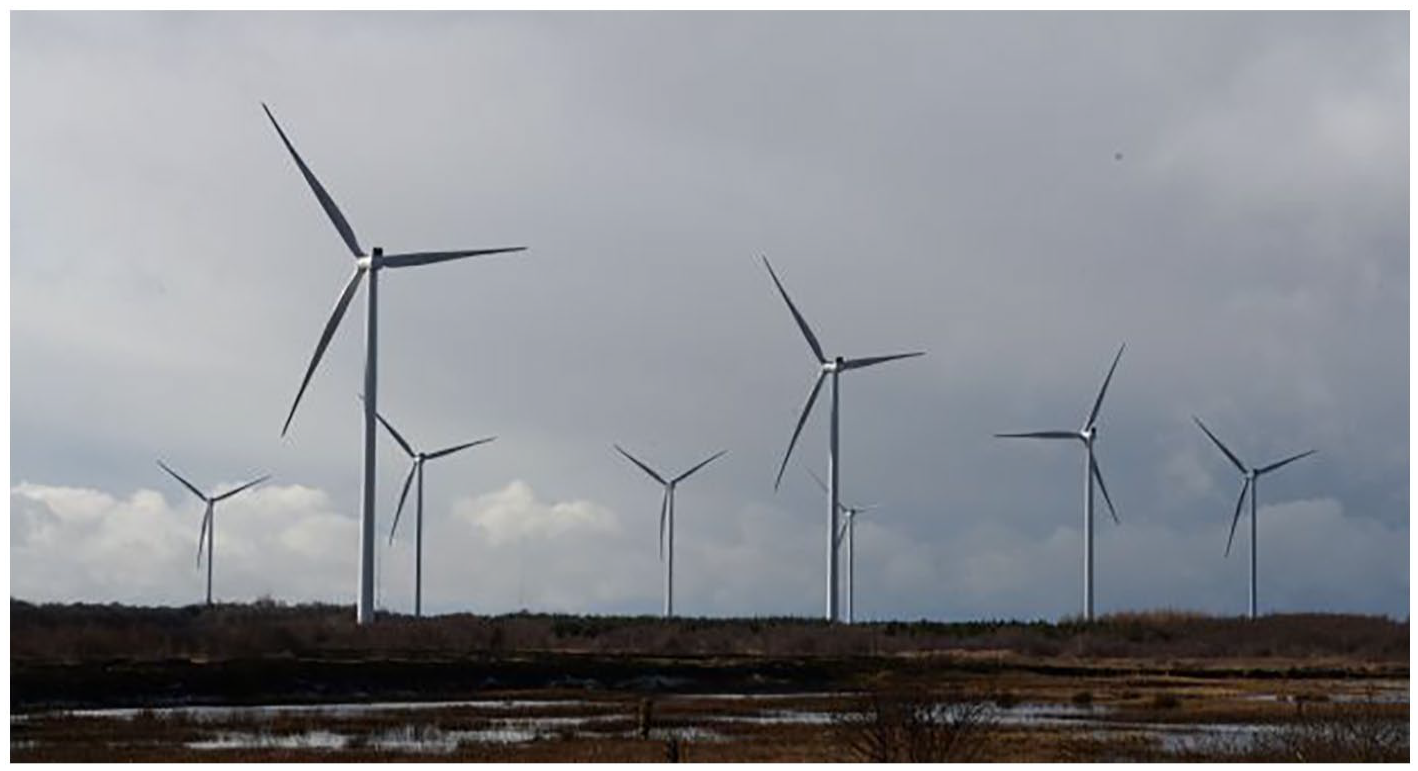
BnM’s Mountlucas Wind Farm in Offaly.
Dublin is less than 50 km from Ireland’s post-industrial bog landscapes. It is also the location of the highest concentration of data centres in Europe and the terminal point for much of Ireland’s energy generation. Ireland acts as one of the most significant repositories for data in the world, especially for the big tech ‘hyperscalers’, hosting information across Amazon Web Services (AWS), Google, Facebook and Microsoft’s cloud, commerce and business platforms. Reasons for this include a favourable tax rate, supporting infrastructure and state policies, and a ‘climate’ suitable for cooling (Brodie, 2020a). The energy required to support this mass concentration of data infrastructures is profoundly affecting Ireland’s energy futures, driving many decisions about climate change and renewable energy strategies (Bresnihan and Brodie, 2021b), with state grid operator Eirgrid projecting that 25% of the country’s energy will go to data centres by 2030 (Eirgrid Group, 2021a). With warnings of blackouts in winter 2021–2022 due to strains on the grid, the Government and tech industry have come under increasing pressure, compelled to acknowledge data centres’ disproportionate drain on Ireland’s energy resources, which are already undergoing a transition away from fossil fuels to renewable energy. In response, the data centre industry has formed lobby groups like Cloud Infrastructure Ireland designed to herald corporate renewable energy commitments (Beesley, 2021). Companies like Amazon, Facebook and Microsoft have invested in wind energy projects, many located on boglands, and new data centre developments are encouraged to locate in rural areas, closer to energy generation and away from the grid-strained capital region (Day One Team, 2020; Swinhoe, 2021).
What connects the land and energy transition underway in the bogs of Ireland with the infrastructural expansion of the ‘cloud’ via renewable energy and data storage infrastructures? In this article, we pinpoint sites and policies through which industry, government and semi-state organisations in Ireland are representing big tech companies as solutions to climate change through the landscape of Ireland’s peat boglands. Central to this unfolding data centre and energy story in Ireland’s bogs is the history and logics of waste/value contained within approaches and strategies for bogland productivity and profitability. While many have written about the waste economies and ‘externalities’ of digital technologies and infrastructures (Gabrys, 2011; Parikka, 2015; Taffel, 2021), including those of data centres (Hogan, 2015; Taylor, 2020; Velkova, 2021), this article focuses on how the specific waste landscape of peatlands is becoming important to digital infrastructures in historical continuity with older forms of extraction and development. The large-scale, transformative projects of ‘smart’ and ‘green’ eco-modernity represented by data centres, wind farms and carbon sequestration evoke discourses from the 18th and 19th centuries, when efforts to drain and reclaim these semi-aqueous territories were driven by moral as well as economic imperatives. These colonial logics and their spatially transformative enactment have endured in how politicians, climate scientists, industrialists and spatial developers alike see bogs as somewhere that must be made valuable for capitalist accumulation at the expense of existing ways of life. We show how the post-industrial bogs of Ireland are framed as contemporary ‘wastelands’ in need of repurposing for the new green economy consisting of data, renewable energy and carbon services. Rather than focussing on a particular project or infrastructure, our interest is in the broader context, evident in policies, planning, investments and specific projects, that is being shaped to a large extent by corporate and state actors aligning with the multinational tech industry. While inheriting certain colonial ways of relating to boglands, current efforts to repurpose the bogs also represent a departure from previous political economies of postcolonial Ireland. Visions of post-extractive landscapes once filled with workers now appear as automated landscapes – whether the server stacks of data centres, wind turbines harnessing the atmosphere, or the soil sequestering carbon, with the land, ecologies and atmospheres of the bog fuelling a ‘renewable’ future driven by powerful private companies and with minimal intervention from local communities.
Our contribution to this special issue is to situate data centres as one interlocking element of big tech and data-driven solutions to overlapping social, economic and environmental problems centred on renewable energy and carbon accounting. As scholars in geography and media studies, our approach is necessarily interdisciplinary, drawing from postcolonial histories, environmental and energy humanities, human geography and science and technology studies. The political ecologies of energy, carbon, data, infrastructure, landscape and waste are each broad topics on their own terms. Situating our research within the complex, multi-scalar transformations unfolding in the Irish bogs does not, however, allow for any neat parsing of one from the other. Drawing from and building upon these intersecting humanities and social science discourses around waste/value, digital infrastructure, renewable energy and climate solutions, this article analyses boglands as landscapes where these issues are overlapping and being operationalised by multinational tech corporations in partnership with the Irish state. Common across historical periods and industrial transformations in Ireland is a clash of scale, whereby the technoscientific mastery that characterises large-scale state and corporate strategies comes into friction with or has trouble accounting for the life, ecologies and practices of local communities. But rather than emphasise this clash, as we do in other work (Bresnihan and Brodie, 2021a), we demonstrate that the multi-scalar effects of digital infrastructure and climate solutions in the Irish context can be understood through historical precedents of the contemporary ‘green’ energy transition. In doing so, we analyse how big tech is becoming increasingly entangled in environmental futures across public and private initiatives, from the renewable energy transition to other engineered climate solutions, putting us in conversation with work on global green capitalism and extractivism (Arboleda, 2020; Dale et al., 2016; Riofrancos, 2019). Ultimately, while big tech is enormously ‘scalable’ and adaptive to macro- and micro-scale friction (Vonderau, 2019), state and corporate strategies account primarily for global and national climate and energy concerns. In the midlands of Ireland, this has taken the form of converging logics of large-scale ‘storage’ projects within the transformation of post-extractive peatlands from wastelands into data facilities and carbon sinks, both serving projects of value for the state and big tech companies while often failing to account for, or even bulldozing, existing communities and practices.
Methodologically and empirically, this research is situated within lively and controversial debates about just transitions (Mercier et al., 2020) and the interrelations between data centres, big tech and climate politics in contemporary Ireland in popular and policy discourses across environmental organisations and political parties (see Mercier, 2021). Our research practices frequently intersect with our work and commitments beyond academia surrounding data centres and renewable energy politics. However, most of the data for this study was collected during the COVID-19 pandemic, which made on-site fieldwork among the bogs and the communities that live on and by them nearly impossible. It also limited our collaboration to long, weekly Zoom chats and many Google Docs – methods of collection and collaboration made possible by the big tech infrastructures vacuuming energy and water from Ireland and sending information coursing across multinationally owned cables in the Atlantic to data centres in Montréal and nearby. Despite these limitations, data was also collected during, in the words of BnM themselves, one of the largest land transformations in Irish history, a process which accelerated from 2020 to 2021. In spring 2021, BnM rebranded from a semi-state company in charge of peatlands to a ‘climate solutions’ company (with large peat bog land holdings). While we take issue with the company’s triumphalist narrative, these unfolding circumstances meant that our research was adapting at pace with government strategies and corporate developments, which operate on an accelerated timescale from above but also run aground across the wobbly terrain of rural spatial and infrastructural development (see Brodie, 2020b; Brodie and Velkova, 2021; Burrell, 2020; Carse and Kneas, 2019). Many of the projects we discuss thus remain in the planning stages, including for a just transition, strategies only outlined in policy documents and drawn up in maps and calculations, with bogs enclosed and communities waiting for or objecting to these new developments. But within anticipation, as Cymene Howe urges (2019: 3), there is a time and place for intervention, ‘intermittencies’ of politics and ecology that, however messily, disrupt big tech and big energy futures. In presenting data and concepts in the way they are here, across many and largely speculative sites and ideas, all of which have become entangled with capital, data, energy, the bogs and their futures, we are joining a growing body of literature across above-mentioned humanities and social sciences disciplines trying to make sense of what ‘big tech’ companies are doing with carbon and energy strategies, what kinds of futures might be waiting, and some existing ways in which big plans are encountering friction on-the-ground.
Waste, value and improvement through Ireland’s bogs
The capitalist relation of waste/value and its mediation through colonial science and technology has been well examined by scholars in environmental humanities and political ecology (Gidwani, 2013; Goldstein, 2013), including the foundational role of land in the colonial ideology of ‘waste’ (Liboiron, 2021). Crucial to these logics are the designation and classification of land and ways of life on it via state and institutional arrangements. The colonial division of the world into territories for extraction has centred on the idea of ‘wild’ frontiers, the ‘terra nullius’ of colonial imaginaries, or ‘wastelands’ awaiting profitable enterprise, each of which classify and make landscapes legible and render territories and bodies inert for extraction (Rasmussen and Lund, 2017; Wenzel, 2020; Yusoff, 2018). In Ireland, we can see this within the institutional arrangements of colonialism as they were expressed and enacted through the ecological, social and technical matter of bogs, classified as ‘wastelands’ by British colonial planners. English Bog Commission maps drawn up between 1809 and 1814 seeking new lands for agricultural production include details on the ideal geographical locations of drainage ditches, soil types and utilisation to make the bogs valuable for agriculture (Ruuskanen, 2018). As historian Esa Ruuskanen (2018: 22) writes, colonial commentators and landscape ‘improvers’ of the 18th century ‘envisioned how a country so widely covered with “wastelands” could possess a lush, cultivated countryside and wealthier population and serve as the granary of the industrialising England’. This new circulation connected the land, people and imperial trade as a new mode of economic production which also saw itself as ‘improving’ the wasted landscapes of the bogs, their impoverished residents, and their cultures (see Feehan and O’Donovan, 1996). The main use of the bogs by the indigenous population was turf-cutting for fuel, intensified during the 18th century as the forests were cleared, depriving people of the other main source of energy. Turf-cutting was a subsistence activity based on ancient turbary rights and customary practices. The key aspect of colonial modernity, in contrast, was vast, transformative scale and resource extraction – how practices and knowledge deployed in one place could be extended to other places to render them more productive (Tsing, 2016), a logic of ‘improvement’ that was applied across the British colonial world (Bhandar, 2020). The universal knowledge of European modernity was not symbolic but inscribed and often violently enforced through techniques, methods, classificatory systems and technologies. In this way, it was not just topographic or general environmental information that was relayed through the decades in Ireland, but the single-minded focus on the large-scale draining of bogs to capitalise on land for agricultural production, canal transport and forestry (Ruuskanen, 2018).
Ireland’s postcolonial institutions inherited British ‘imperial eyes’ (Pratt, 1992) in terms of how bog ‘wastelands’ were viewed and how efforts were mobilised to reclaim and capitalise on them. Ireland won independence from Britain in 1922 but it was not until 1932, under the new Fianna Fáil Government, that efforts to ‘make use’ of the bogs began in earnest. The key figure in this ‘crusade’, as he called it, was CS Andrews, a Fianna Fáil politician and veteran of the Irish Civil War. Andrews was from Dublin and did not actually visit a bog until appointed to the Department of Industry and Commerce in 1933, charged with the industrialisation of turf development – admitting in his memoir that his early understanding of the word ‘bog’ was poverty and backwardness (Andrews, 2001). His task, as he saw it, was to transform ‘the vast waste areas of our bogs into a valuable source of wealth’ (Andrews, 2001: 114). Andrews spear-headed the development of the turf industry, initially through the setting up of the Turf Development Board in 1934, and then the creation of BnM as a semi-state company after World War II. Under the subsequent Turf Development Act of 1946, BnM was provided with new powers to acquire extensive tracts of bog land from private landowners, as well as financial resources to develop the expertise and technologies for advancing the process of peat extraction and burning for energy generation. In the 1950s–1960s, BnM sets about the building of peat-fired power plants across the country’s rural midlands and west in partnership with the national utility Electricity Supply Board (ESB). As well as transforming bog landscapes through industrial activities, BnM helped create a ‘modern’ form of social and cultural life in the midlands, developing infrastructures for workers, including housing and schools, that drew populations into previously ‘underdeveloped’ rural regions.
Thus, within any just transition out of peat extraction’s carbon economy, there are multiple social formations at stake. There are ‘traditional’ practices such as subsistence turf-cutting, what Larry Lohmann (2016) calls small ‘e’ energy cultures: specific arrangements of people, places and ecologies (including bogs) organised according to different social and ecological practices, values and contexts. But there is also an industrial-scale energy culture associated with what Cymene Howe (2019) refers to as ‘energy-intensive modernity’ that comes with its own social, affective and material infrastructures. In practice, the cultures and economies of peat that exist in large parts of rural Ireland blur any clear distinctions between these energy cultures: peat industry workers heat their homes with their own cut turf, and commercial contractors cut turf for turbary rights holders. 1 The distinction, though, is important for identifying how the industrial development of the bogs is bound up with national development and modernist ideologies, institutionalised through semi-state BnM providing secure jobs, regional prosperity and energy for the nation. This familiar, optimistic picture of mid-20th century progress continues to inform present transitions: workers and midlands communities extol the heyday of this public energy culture (real or imagined), demanding to be taken care of as the peat industry declines and new visions for ‘wasted’ bog landscapes take shape. In this framework, any truly ‘just’ transition at the state level needs to provide plans and services to care for workers and communities reliant upon peat industries and practices for subsistence and livelihood as they are replaced and displaced by new policies, industrial forms and infrastructures.
Since the 1980s, the peat industry has been in steady decline, levelling out by the 1990s (Clarke, 2010). BnM developed the country’s first wind farm on a cutaway bog in Mayo in 1992. Debates have continued since then about what to do with the post-industrial, cutaway bog, and the workers and communities who relied on them perennially surfacing (Irish Congress of Trade Unions, 2017). The newer ingredient in recent bogland development is foreign direct investment (FDI) in ‘green’ industries and technologies, a centre point of Ireland’s current state economic strategies. As peat and other carbon fuels have declined, the need for energy has accelerated with the growth of data centres, and within the intersecting rise of data use and energy demand with the state-regulated decline of fossil fuels and so-called dirty industries, data centres and renewable energy are paired as drivers of the ‘fourth industrial revolution’ heralded by the tech industry centred on ‘greener’ and ‘smarter’ digital technologies. They are thus poised materially and discursively, both in the post-extractive midlands as well as elsewhere in the country, to inherit the assurances of modern industries. Their promises of prosperity come at the hands of a global economy that, as the story goes, will not continue to rely on spewing carbon into the atmosphere.
BnM, as a formerly ‘dirty’ energy company, plans to place itself at the centre of these future-driven renewable strategies (Bord na Móna, 2017). According to the company,
Central to this transition is the use of our land bank for a range of beneficial uses such as renewable energy, industrial uses (eg Data Centres), biomass, nature and biodiversity as well as recreation and tourism. As Bord na Móna owns c. 80,000 hectares of land the transition from peat production to a variety of new uses will be the biggest land transformation in modern Irish history. (Bord na Móna, 2017: 1)
In May 2021, after 3 years in development, BnM announced that it had ‘completed’ its transition from a fossil fuel company to a ‘climate solutions company’, including waste services and recycling in the midlands, as well as large-scale energy and data centre infrastructure. Rather than a state agency directly developing resources, BnM and the Irish state enable global tech and energy companies to harness value through access to land, low corporation tax and planning and development policies. Peat harvesting machines, warehouses and peat-fired power plants are replaced by wind turbines, battery farms and data centres – only this time, industrial wage labour is replaced by automated machinery, few maintenance workers and highly skilled jobs brought in from abroad. Projects such as the transformation of a former peat-fired power station into a battery storage facility for intermittent renewable energy by South Korean multinational Hanwha Energy in 2018 capture neatly the ways industrial ‘waste’ is translated into post-industrial value through converging ‘green’ energy, technology and transnational capital.
The temporality of tech-driven FDI has strong purchase in Ireland (as elsewhere), fulfilling the progressive arc from ‘brown’ to ‘green’ – from resource-intensive, polluting industries drawn from the ground (and burned into the air) to cloud-based services and smart technologies, fuelled by ‘clean’ energy sources harnessed from the atmosphere and natural movements of the earth. It is a hard narrative to challenge. However, this publicised transition from outright extraction to ‘green’, ‘smart’ and FDI-driven energy futures, especially considering the astronomical scale of data centre energy use, masks the continuation of the environmentally and infrastructurally transformative ‘improvement’ logics that have pervaded through Ireland’s history. As BnM’s recent re-brand declares, ‘The scale of Bord na Móna’s operations has always been large’, and this scale is being transferred and intensified via new data and energy systems. Underlying this shift, we argue, is the persistence of the ‘waste/value’ nexus, as post-industrial bog ‘wastelands’ become new projects of large-scale value creation and extraction. These understandings of past, present and future associated with colonial modernity’s ways of seeing and sustaining progress are continually activated through dominant, common-sense logics of capitalist value and processes of technoscientific mastery (Papadopoulos, 2018). While lessening a certain kind of pollution, these infrastructures require different sorts of extraction and intervention that continue to lay waste to landscapes and alternative ways of living on and relating to them, including existing turf-based energy cultures upon which many people in rural Ireland still rely. A just transition then must include an enormous transformation of the entire energy system, one which will electrify rural household heating and energy use via renewable energy, at the same time that big tech and energy companies are coming to drive the shape and make-up of these new energy systems to funnel electricity to data centres. Projects that link green energy, emissions reduction and data services are increasingly connected both materially and ideologically through technological infrastructures, and the bogs are an emerging landscape within which these solutions are being made to seem common-sensical due to their association with an outdated, extractive and overtly carbon-intensive industry and set of practices.
Data centres’ transformative energy culture
Data centres especially would appear to be, along with transformative renewable energy generation and storage infrastructures, an apt legacy of colonial logics of ‘waste’ and ‘improvement’ in the service of growth and expansion. Much like the carbon fuels of endless capitalist growth through the 20th century, the continuous collection of data has been referred to variously as ‘oxygen’, ‘gold’ or ‘oil’ of the fourth industrial revolution (Taffel, 2021). This, of course, acts to occlude the dirty externalities and waste of data collection and storage, whether the energy- and water-hungry data centres themselves (Hogan, 2015), the extractive systems that fuel them (whether wind farms, rare earth components and their obsolescence) (Bainton et al, 2021; Dunlap, 2020; Riofrancos, 2019), or the ugly business of data mining (Srnicek, 2017). As Max Liboiron (2021) demonstrates in their remarkable book Pollution Is Colonialism, the very logic of ‘waste’ assumes a colonial relation to land and resources that can be used for capitalist accumulation, in the process laying waste to existing ways of life and alternative futures outside of these logics. Waste and value are entangled in the need to accumulate capital and resources, and this is true for data-driven industries as much as traditional polluting enterprises – waste is a byproduct of capitalist activity as well as a resource to be defined and managed. An industry mantra of data collection – ‘garbage in, garbage out’, or the principle that cruddy data produces useless analysis – corresponds to the wasteful valuation and unseen externalities of data as a waste and energy economy. Even with enough ‘garbage’ data, insights can be valuable, but that collection requires vastly wasteful energy use and infrastructures by data-driven businesses that they must manage (see Voices of the Industry, 2017), with endless piles of garbage (and the ongoing destructive externalities of energy-intensive data collection and use) needing land and infrastructure for storage, optimisation and sorting via more energies and technologies. As others attuned to the neoliberal political economies of discard have found (Povinelli, 2011; Tadiar, 2013; Weston, 2012), new frontiers of capitalism always await the application of Western technoscience and institutional organisation to transform waste into value.
Mél Hogan (2014) argues in an article provocatively titled ‘Archive as Dumpster’ that digital storage must account for these increasingly large datasets, to the degree that
storage is now largely understood to be ever-expandable, to the point where many argue that this new archive inherently bypasses the issue of appraisal (and therefore, value) by allowing that no digital artifact be thrown away, discarded, or deleted. . .[Data infrastructures] assume a synchronous dumpster/archive, where things are neither lost nor preserved. (pp. 15–16)
The social and environmental costs of generating and storing this data are, however, hidden from sight—at least for those far away or shielded from the infrastructures themselves (Taylor, 2020; Thylstrup, 2019). What is novel within converging discourses of big data, climate and energy is that these processes and relations of wasting, the externalities of the digital economy, are being presented as positive new opportunities for local, regional and national development. The solution for one kind of wasteful activity – limitless data and energy use – is to relegate something and somewhere else to waste.
Eirgrid, the semi-state company responsible for managing Ireland’s grid, has warned that total data centre energy demand (based on current connections and proposed applications) could account for 25% of Ireland’s total electricity supply by 2030 (Eirgrid Group, 2021a). Ireland’s electricity continues to be reliant on fossil fuels, with about 50% of the grid still powered by natural gas and about 40% renewable (Eirgrid Group, 2021b). Ambitious targets of 70% renewable energy are thus unlikely with such high levels of additional demand coming online. Leading data storage providers like AWS are pledging 100% renewable energy for their data centres, buying up significant new renewable power generation in rural wind farms (built on blanket bogs in places like Donegal and Galway). In 2020, BnM announced that it had raised €1.6 billion to fund a series of major, large-scale ‘climate action projects’ across its 80,000-ha landholding. These projects largely consist of industrial wind and solar energy infrastructure. BnM currently owns and operates six wind farms but has proposals for at least two more, including the country’s largest wind farm if completed (Leinster Leader, 2021). The level of investment in energy infrastructures dwarfs the €108 million state funding going into bog reclamation projects, touted as primary future employment for former BnM workers. Wind farms, however, do not provide much permanent local employment – such as data centres, after the initial construction, they require minimal maintenance and day-to-day management. But the siren call of large-scale FDI investment remains strong. As midlands county Offaly councillor Noel Cribbin stated when interviewed about a potential data centre in his constituency,
‘With the terrible impact of job losses in Bord na Mona on the area in the last months, we have a great opportunity to showcase the fabulous opportunities that exist here. It is time to see an injection of jobs and prosperity into the area’ (Westmeath Examiner, 2020).
Nearly identical arguments tying together foreclosed promises of modernity, energy cultures and multinational tech capital in rural Ireland could be found in the case of Apple’s failed data centre in Athenry (see Brodie, 2020b) or any number of these proposed projects scattered across the country. 2
While BnM’s just transition plans, and their promise of continuing industrial-scale transformation and provision for formerly employed populations, have received a good deal of attention and media coverage, proposals for data centres themselves have so far been speculative. A 2017 plan was first centred on BnM cutaway bog holding Cúil na Móna, outside of Portlaoise, Laoise, in the midlands. Brian Stanley, Sinn Féin TD for the region, expressed excitement and support, but BnM gave limited press and the proposal apparently disappeared off the map. In 2019, a different BnM proposal surfaced for a ‘renewable biogas’ plant on the same site, which would convert waste to a natural gas equivalent. Construction would employ about 100 people, with 10 permanent employees required. The data centre and biogas proposals, according to a BnM representative, are interlinked (Bord na Móna, 2020, personal communication). The company’s transition plans include the construction of data and energy ‘hubs’ across their holdings, mostly in the midlands. In this model, wind farms and other energy projects will be built out to attract data centre investment to these rural areas, like a carrot on a stick. The strategy has been bolstered most recently by advice from the Commission for Regulation of Utilities (CRU) concerning the spatial development of data centres – with the risk of ‘rolling black-outs’ occurring in the Greater Dublin Region, the CRU has advised Eirgrid and ESB to prioritise application requests by data centres outside the region and that can provide their own power or power storage (Commission for Regulation of Utilities, 2021). BnM has received interest from multinationals brought to them by the IDA, and they hope to develop four sites by 2030. One of these is the pilot Bord na Móna Energy Park, a planned 200-MW wind and solar power generation hub, set to become Ireland’s first dedicated renewable energy business park (Renewables Now, 2021). The hybrid power complex is to be installed on over 3000 ha of land crossing the counties of Meath, Offaly and Westmeath. Apart from producing electricity from wind turbines and solar panels, the site will integrate flexible power generation technology, battery storage and hydrogen production capacity, designed to attract industrial and high-demand energy users such as large-scale data centres (Renewables Now, 2021), (Figure 2).
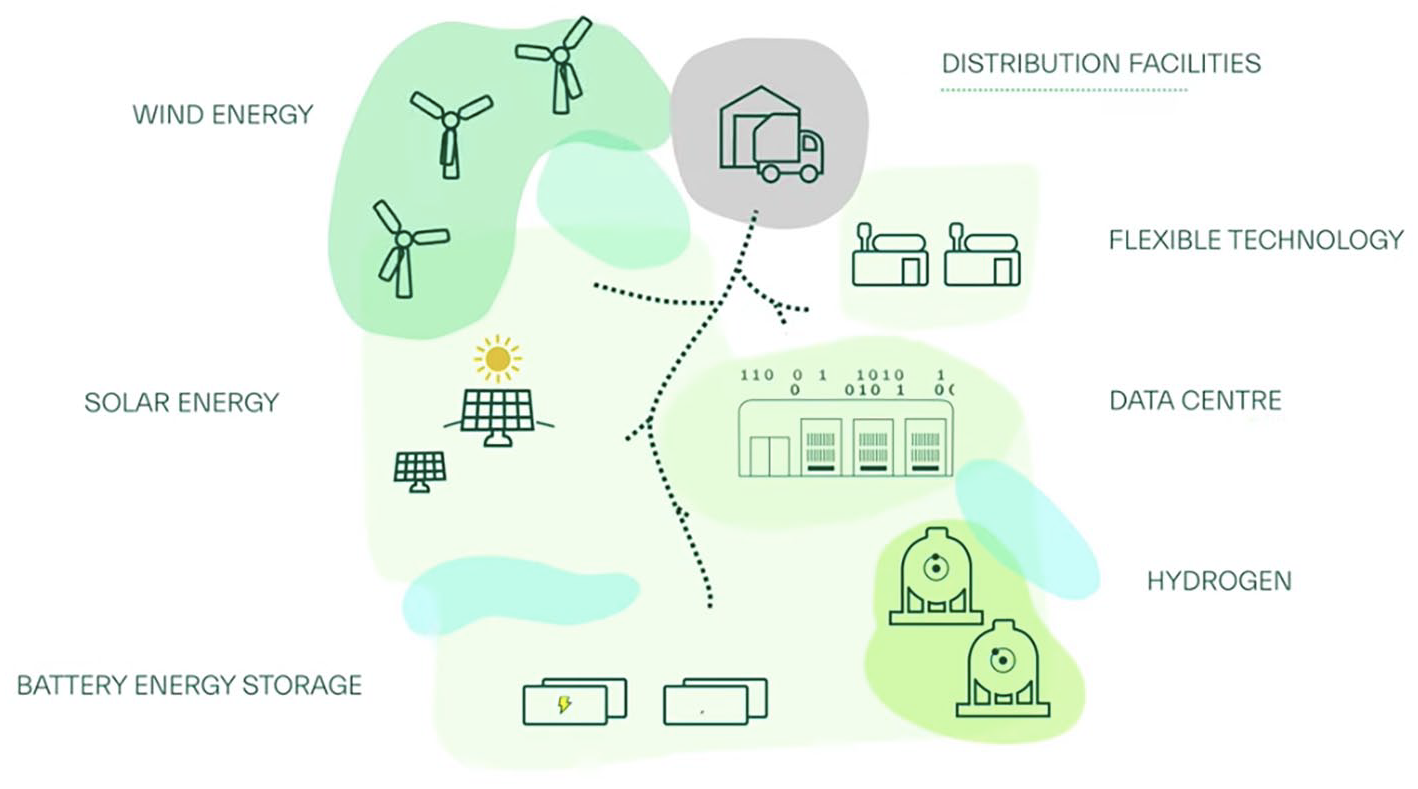
Screengrab from promotional video for the planned Bord na Móna Energy Park, advertising the connectedness of energy and data systems on the new site.
With paired data and energy infrastructures increasingly being located in rural Ireland and, specifically, its boglands, there are pressing questions about who Ireland’s expanding and contested wind, solar and associated energy infrastructures are for, and who carries their social and ecological costs (Bresnihan and Brodie, 2021b). By reducing energy politics to undivided and large-scale energy resources within the metrics of the state and large-scale corporate energy – for example, peat vs wind, or carbon vs renewable, whether in households or in data centres – the social (and power) relations that undergird the making, distributing and using of that energy are obscured, especially in terms of what Irish policy calls ‘large energy users’ like data centres. Access and use of the public grid are not even, and technology companies are increasingly powerful in shaping energy distribution, bolstered by state strategies to incentivise private development of renewable infrastructures. Common across corporate and state strategies, within which tech companies profit from circular renewable waste economies, is a basic admission that multinational FDI dictates how energy is built and used. This new energy culture rests on the assumed environmental virtues of large-scale ‘clean’ energy and an economic future tied to big tech, or the dovetailing of atmospheric energies, climate and the ‘cloud’ that we have explored elsewhere (Bresnihan and Brodie, 2021b; Brodie, 2020a), here becoming an elementally enacted process in which large, unmanned infrastructures like data, wind and battery farms, built on ‘wasted’ peat bogs, drive and dictate the distribution of energy for all. The extensive, networked and intensive energy culture of data centres dominates the future, eclipsing and displacing existing and alternative labours and cultures of peat boglands, whether small or industrial in scale.
The ‘discarded’ practices that persist on the bogs, including livelihood and energy subsistence economies reliant on turf-cutting, remain lively despite their relegation as ‘part of the past’ (Hennessy, 2017). Plans to either ‘re-wild’ the bogs by re-wetting them for carbon storage or build large-scale energy and data infrastructures largely require local activity on and around the bogs to cease. Turf-cutting communities who were given the opportunity to represent themselves at the National Peatlands Forum in 2012 stated that ‘we don’t live in a wilderness and we don’t want to live in a wilderness’ (National Parks and Wildlife Service, 2012: 19). As Neferti Tadiar (2013) argues similarly in terms of ‘disposability’ politics, the ‘forms of personhood and cooperation, improvisatory and experimental arrangements of social life’, which continue to occur despite dominant systems, are ‘remaindered within the enlarged production time of capital’ (p. 20). Of course, the vilification and planned removal of small-scale cultures of energy which go against the progressive arc of eco-modernity is not new, and shares similarities with other associations of poor, subsistence living as particularly environmentally destructive or irresponsible, something to be corrected and managed by responsible, technological enterprise. Anil Agarwal and Sunita Narain’s (1991) influential study articulated what they called ‘environmental colonialism’ and the uneven share of blame and responsibility forced upon the global south by mainstream environmentalists in the global north. The vilification of turf-cutters thus also shares something with the vilification of other subsistence energy cultures that rely on wood or charcoal in a time of climate change and biodiversity loss, the aforementioned small ‘e’ energy cultures of localised practice (Lohmann, 2016). Althoughrural areas in Ireland are becoming ‘energy rich’ with the growth of wind farms and other energy infrastructures, they are in fact often ‘fuel poor’, to borrow Laura Watts’ (2019) framing of the renewable energy cultures of the Orkney Islands. Many of Ireland’s rural areas – including 23% of houses in the midlands and an astonishing 37% of houses in Offaly – still relied on turf-fuelled heating systems in 2017 (Central Statistics Office, 2017), despite multiple former power plants and three existing wind farms in the county. New energy and just transition strategies will have to ensure that homes receive electrified heating via a green-powered, ‘smart’ grid governed and managed by big data technologies (Sadowski and Levenda, 2020). Even drastically reducing individual, household carbon use requires simultaneously an extensive (and expensive) cultural, infrastructural and political transformation – whether retrofitting homes and heating systems, convincing locals of the value of carbon reduction, or facilitating a cultural shift away from domestic peat. The big tech and energy companies benefitting from green growth are not only shouldering comparatively little burden within ‘green’ transitions. They will ultimately compel rural communities, already navigating an unjust and uneven transition out of fossil fuel dependence, to enrol and buy into smart, green technologies and programmes via top-down strategies focussed on grid transformation, optimisation and individual consumption habits.
As has already become evident through dozens of realised or unrealised data centre projects in Ireland, their most lively politics have to do with energy and other environmental externalities (Brodie, 2020b). Supporters in the state and civil society will argue that data centres are cleaner infrastructures than older industrial ones, and that companies are devoted to delivering them with limited environmental and carbon impact, signifying progression from ‘dirty’ to ‘clean’. However, as detractors are quick to point out, data centres and energy infrastructures are always tied up in wider circuits of value and ecological arrangements. Just as historical projects of enclosure and improvement were premised on social, even moral, grounds (Wenzel, 2020), so the re-fashioning of post-industrial bog landscapes – and with them, Ireland’s entire energy system – is articulated with global commitments to fight climate change. These pledges are increasingly organised through carbon accounting and pushes to ‘net-zero’ (Dyke et al., 2021; Song, 2021), or the principle that by adding supplemental renewable energy and removing carbon from the atmosphere while maintaining a lower-level of ongoing emissions, the deleterious effects of carbon pollution will be effectively offset. Data centre companies operating in Ireland like AWS and Microsoft have begun partnering with and buying renewable energy directly from rural providers to adhere to regulations, which is also good public relations considering the scale of their energy demands, and even though additional energy is still drawn from a carbon-intensive national grid. As Thea Riofrancos argues (Haugen and Riofrancos, 2022), capitalists are not against scaling down emissions if it creates an industry for them. In the next section, we will see how beyond energy, tech companies are intervening in bogland carbon sequestration science for these accounting goals.
Conservation, ‘sinks’ and the technologies and epistemologies of carbon storage
Apart from the obvious contradictions in scale and practice of climate accounting strategies, when applied to landscapes designated strategic for ‘conservation’ or ‘wilderness’ value (see Rasmussen and Lund, 2017), their ways of putting ecological relations to work also inherit the colonial treatment of the bogs as spaces to be made profitable by removing and discrediting existing or alternative relations to them. The transferral of these global circuits of knowledge and value about data, carbon and energy onto bog landscapes enacts what Howe (2019: 399) calls an ‘anthropocenic eco-authority’ which appears progressive and common-sensical but ensures that the present and future power of extractive capital is intensified and unchecked towards the ‘greater ecological objective’ of global climate management. Data storage facilities and their associated energy infrastructures, then, are only one technologised bogland solution to the problem of climate change, optimising potential value from wasteful consumption practices. Another intertwined strategy is the incentivisation of the bogs as ‘carbon sinks’ for ongoing emissions, demonstrating a further function of ‘storage’ required of the bogs for carbon accounting and technological progress, enacted through partnerships between the state and the same tech companies building new data centres. This is a deepening of the entanglement of data storage and technologies into bogland landscapes through datafied climate solutions accounting for atmospheric carbon via different logics and infrastructures of storage which also operationalise the waste/value nexus.
The productivity of the bogs has historically relied on processes and infrastructures of drainage – creating firm ground from which to cultivate, extract, or build profitable enterprises. Today’s large-scale plans for the bogs inherit this mode of technoscientific mastery designed to make these landscapes legible and valuable for capitalist accumulation, whether for large-scale development or for carbon sequestration. But in the face of such processes, the semi-aqueous, anaerobic environments of living bogs carry ecological and cultural properties that historians, archaeologists and environmental scientists have long sought to demonstrate and defend. The cultural and ecological properties of living bogs are tied to the idea of storage and preservation of cultural and environmental artefacts and traces. Until recently, the value of the bogs-as-storage referred to the potential treasure trove of cultural and environmental records that lay underground, including the famed ‘bog bodies’ preserved for centuries in the anaerobic muck, and efforts to protect these records by ensuring appropriate archaeological surveying have been side-lined by the drive of large-scale industrial peat extraction in the 20th century (see Hitchcock, 2020). The Celtic Otherworld of Tír na nÓg, or the Land of Eternal Youth, is associated with bogs, a place where time stands still, indicating the entanglement of scientific and cultural temporalities of the bogs. Since the 1970s, a small but committed community of residents, environmentalists and scientists have been instrumental in protecting and raising awareness about bogs in Ireland – see the Irish Peatland Conservation Council (founded 1982) and Community Wetlands Forum (founded 2013), linked in with transnational networks and expertise on peatlands developed since the 1970s). Situated, community-based projects involving local enthusiasts, former peat industry workers, birdwatchers, artists, writers, botanists and professional scientists offer ways to consider the work of bog restoration and care as labour, producing social and ecological value that exceeds commodity-production.
But peat bogs also act as an index and storage container for atmospheric carbon through the ages. The recent upsurge in interest in the potential value of the bogs for carbon sequestration signals a shift in focus among peatland policymakers and mainstream environmental groups – from employment and local conservation, respectively, to global climate science. In late 2020, the Irish government, along with BnM, announced a €108 million plan to re-wet 80,000 acres of cutaway bog, claiming that this would ensure the storage of 100 m tonnes of carbon in perpetuity (McGrath, 2020). These claims were met with a degree of ambivalence from those who have already worked for years, even decades, to protect intact bogs from BnM extraction. Critics note that the benefits of this reclamation are still unclear, relying on abstract carbon calculations, and would take much longer to work than are accounted for within government claims.
3
There is no doubt that living bogs offer some of the most effective forms of organic carbon capture and storage (Leifeld and Menichetti, 2018). However, Jennifer Gabrys (2009: 677) argues that the conception of natural ‘sinks’ as waste receptacles constitutes a much wider metabolic process that evades metrics of human-centred climate and ecological temporalities, with the ‘time spans’ of soil- and water-based ‘environments and climates’ in friction with carbon accounting. Liboiron (2021: 65) similarly articulates the necessary colonial assumptions of treating the so-called natural world as a sink and service provider:
If a river is for waste assimilation, it can only be a fishing spot if those activities do not preclude its role as a sink. Fostering some futures and eclipsing others is a key technique of the managerial ontologies that characterize Resources and pollution.
A bog can only become a carbon ‘sink’ if its other relations are made secondary to its human-centred role as a climate service provider, whether for state or corporate carbon offsetting metrics.
For BnM and the Irish state, the logic of re-purposing the post-industrial bogs as a carbon sink ticks several boxes: transforming wastelands into value in the form of climate services performed by nature; offsetting industrial emissions elsewhere; and potentially becoming financially self-sustaining through the sale of carbon credits. These strategies are also integrated with big tech, revealing not only the degree to which the tech industry is entering into the climate sector but, more worryingly, into the very fabric of Irish environmental governance, even beyond the aforementioned energy systems. Recent large-scale investments and partnerships between public sector organisations in Ireland and multinational tech companies include Terrain AI, a project from researchers at Maynooth University, Microsoft and Science Foundation Ireland, which will map carbon storage potentials across a number of landscapes in Ireland using AI (Figure 3), recalling British colonial mapping of resources and the ‘improvement’ crusades of Arthur Young and his ilk:
While the project is capturing data from land types in Ireland, the intention is to design a cloud platform that can use the insights from the Irish findings and be shared with other countries to help them explore land usage and carbon reduction in their own jurisdictions. (Hallahan, 2020)
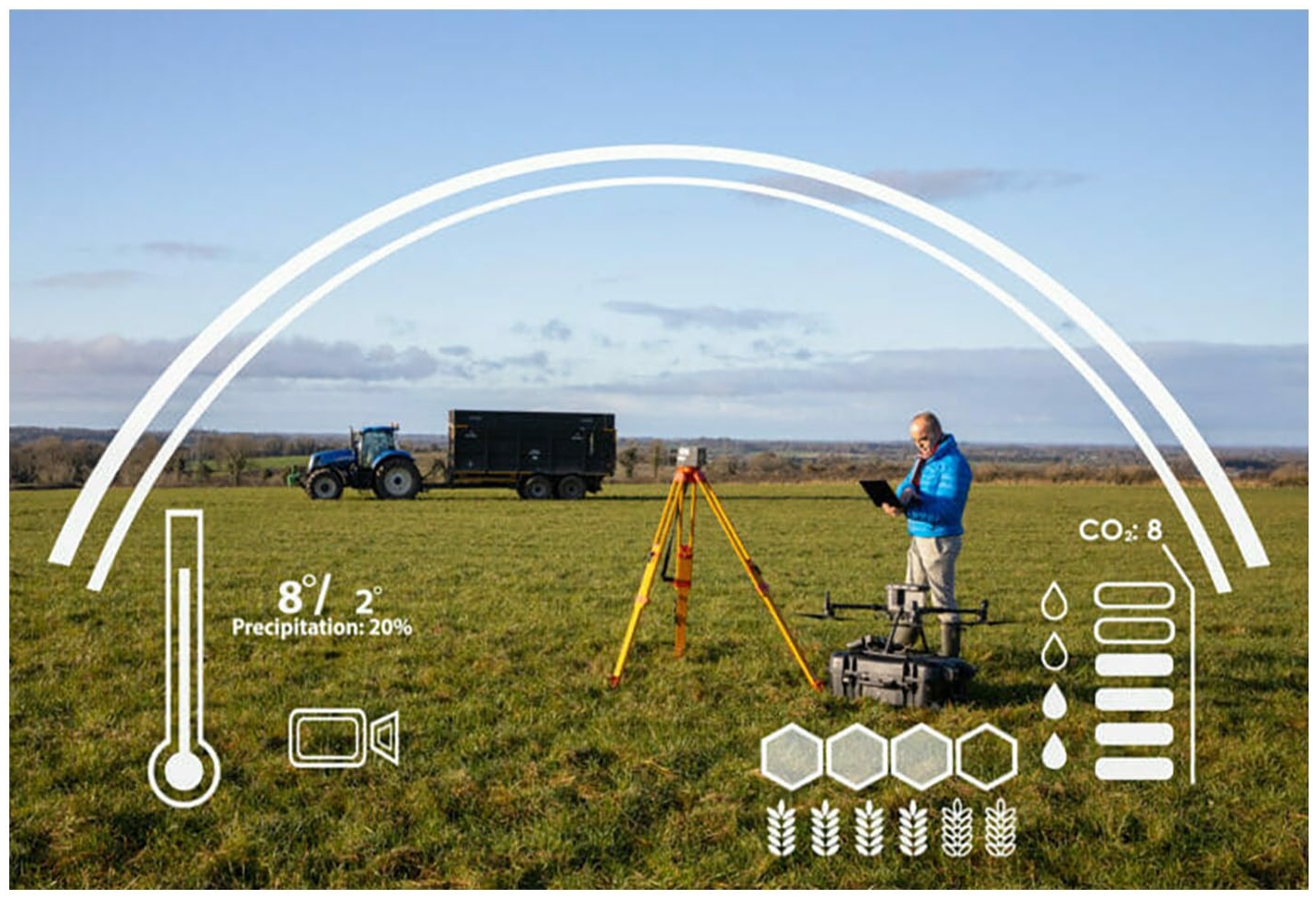
The interface of the Microsoft-partnered Terrain AI project.
The ‘cloud’ is operationalised towards a global carbon accounting ledger for big tech enterprise. Intel has similarly recently partnered with Irish National Parks and Wildlife Service on a bog restoration and re-wetting project in the Wicklow Mountains, slated to improve water quality for the metro Dublin area and help with Intel’s climate and water pledges, the thirty-third such project worldwide as ‘part of [their] commitment to achieve net positive water globally’ (Intel, 2021). 4 But as investigations into carbon accounting have demonstrated (Song, 2021), these projects present potentially lucrative tax credits for corporations looking to offset heavy carbon emissions elsewhere and capitalise on land-based carbon credits. But whereas pollution ‘sink’ evokes something negative, the unintended gathering of wasteful emissions, the notion of carbon ‘storage’ suggests the intentional design of infrastructure to (temporarily) hold something that is or may be of value in the future – whether through cleaner water or carbon credits.
The turn to seeing ecosystems and landscapes as ‘service providers’ is not new – between catchment management, biodiversity conservation and climate mitigation and adaptation, the potential socio-environmental and financial benefits of harnessing nature’s bio-physical and geo-chemical properties have been widely identified within environmental governance since the 1990s (see Carse, 2012; Wakefield, 2020). What is important to point out here are the ways that ‘natural’ service provision is presented as a climate solution for and by tech companies via proprietary technologies. Synthesising a growing body of literature on the topic, Nelson and Bigger (2021) have proposed the term ‘infrastructural nature’ to describe ‘policy approaches, scientific practices, discourses and investment strategies that make ecosystems legible, governable and investable as systems of critical functions that sustain and secure (certain forms of) human life’ (Nelson and Bigger, 2021: 2). The task of making ecosystems legible requires considerable scientific and technical work to map, assess, value, monetize and, ultimately, circulate an ecosystem service such as carbon sequestration (Dempsey and Robertson, 2012). This is not to say that nature is no longer material, or that the global biosphere is not being massively depleted and polluted, but that the dominant response to the climate crisis is increasingly shaped by the way material natures and processes are being produced, circulated and commodified as information (Bresnihan, 2020). Furthermore, this entirely new class of ‘fictitious commodities’ is not produced through the traditional, industrial labour process, but through a novel and complex assemblage of science, technology and multiple non-state and financial intermediaries (Leonardi, 2017). It is in this context that we see the advent of digital technologies and tech companies as providing potential solutions to the challenges facing policymakers, scientists and NGOs in translating situated and complex ecosystems into information (Gabrys, 2016). The emphasis on data-tech-as-solution to environmental problems stands as the obverse side of the environmental externalities produced by data – landscapes become silos for carbon and data, as ongoing capitalist activity requires emerging and networked infrastructures to store and manage them.
Data centres as infrastructures are central within this wider eco-modernist discourse, and will be a major part of how places are enrolled in their own transformation via data for climate services – after all, where will Microsoft’s cloud platform on carbon storage be hosted? The impasse here is not only about the ‘big’ in big tech and the ‘small’ in small-scale energy and conservation practices, then, but rather around making the bogs productive and what this productivity means for labour, growth and profitability, especially in terms of networked solutions for climate change. No matter what, bogs are dynamic, diverse and complex environments that must be made – or ‘improved’ – to fit within large-scale commercial projects. To build data centres and their associated energy infrastructures on the bogs, the bogs must remain drained, or even require further draining, as bogs are not amenable to stable construction (Holmes, 2016: 38). But, while it would seem that re-wetting and data/energy development are contradictory, they each account for carbon emissions within ongoing capital growth in the tech sector. In a fascinating plan written up by an architecture student, these two waste strategies are even synergised, as active wet bogs could be used as natural cooling sites from which to withdraw and then recycle water, reducing energy use (Holmes, 2016: 42). As an extension of the ‘moebius strip of wind/data’, tech companies are adding new links to their circular supply chains within property and land resources provided to them by state partnerships, whereby atmosphere and geology are ‘drawn into the cloud’ (Bresnihan and Brodie, 2021b: 1647) and made profitable through renewable energy and carbon sequestration projects.
These final examples demonstrate that the transformative energy cultures and frontiers of capital continue to expand beyond apparent sites of data and energy infrastructural development, penetrating deeper into the earth and its atmosphere. Whether we are discussing plans for data centres to better integrate with the local environment or the way that their wider assemblages are mobilised for climate actions and investments via carbon accounting, the ‘smart’ infrastructures of big tech and their waste economies are increasingly entangled within ‘green’ projects supported and subsidised by the state. Despite this public investment, they do not deliver on central promises of a just transition due to the continuity of these transformations in rendering certain practices, landscapes and ways of life either ‘valuable’ within capitalist endeavour, or value-less and wasted.
Conclusion
Our contribution to this special issue on data centres is to deepen our understanding of how data centres operate within a broader material and ideological context linking large-scale renewable energy, carbon sequestration and data services as ‘green’ frontiers of/for climate action and continued capitalist accumulation. Ireland, specifically the transformations unfolding in the midland peatlands, offers an illuminating case study for examining the transformative energy culture represented and enlisted by and for data centres being enacted via big tech companies receiving public incentives and support to further their expansion. We argue that ways of seeing bogs specifically as ‘wastelands’ inherited from colonial modernity continue to inform their treatment as (post-industrial) ‘wastes’ to be managed by making them valuable for capital and, today, as pollution sinks for ongoing capitalist activity. They become productive only in the sense that they are networked or automated service-providers requiring little to no labour, returning to ‘wilderness’, as some writing on data centres have commented (Taylor, 2019), while their integration into public initiatives flies in the face of Green New Deal promises of jobs and investment via climate projects. In a more cynical way, then, the Irish state and its partners in the tech industry have also inherited the colonial tactic of dispossession from common lands, enclosing the bogs and expelling existing ways of life and knowledge about them in the service of large-scale, transformative projects.
But peatlands are not like coalfields or other similar carbon resource reserves. It is not just energy that is at stake in the material of peat, even though it seems only large-scale ‘human energetic desires’ (Howe, 2019) are being taken into account. While we must be careful not to unilaterally pit existing, ‘small-scale’ energy and conservation practices against the ‘large-scale’ of global capital and state infrastructural development, we should also not lose sight of the processes by which big tech is becoming entangled within public services, biodiversity and global climate science which purport to serve a common good. Intel is not solely interested in securing clean water for Dublin residents; Microsoft is not creating a carbon storage database and platform out of pure good will. The global ‘future’ of eco-modernity administered by data centre companies is here, as though there is not a present or a past to be reckoned with as societies transition away from fossil fuels – and this cuts both ways, from the ‘antiquated’ ways of life being expelled from the progressive arc of green capitalism to the ongoing legacies of colonial modernity within global energy cultures. Like colonial improvement of the bogs, big tech is enrolling new landscapes into an emerging ‘smart’, ‘green’ supply chain, a ‘future’ which is seen to be already here. Within this future, data centres appear to be a central and inevitable part while the existing communities, ecologies and practices become ‘waste’, excess life that must be relegated to the past or managed and extracted from to conjure a ‘green’ energy culture centred on global tech. This is the primary reason why we are extrapolating from largely speculative strategic plans about the direction these developments are going. While data centres are increasingly under public scrutiny, big tech companies are becoming involved in more and more facets of climate and energy politics in Ireland and far beyond (Pasek, 2019; Velkova, 2021), meaning that the environmental strategies of big tech companies in Ireland are materially entwined within an expanding global supply chain of green capitalism. The direction that regulatory and corporate frameworks around smart, green economies have travelled in the past decade tells us that more big tech intervention will dictate climate action without directed action by activists, scholars and policymakers to not only imagine but also to enact something different. Rather than pre-emptively learn to live with an inevitable future driven by big tech, we can work through this anticipation – as Howe argues, ‘An anticipatory approach is instructive in times that are marked by ecological discord because it attunes our attention to the subjunctive future of the might be’ (Howe, 2019: 3, our emphasis). In doing so, we can look to existing practices and objections that could provide an alternative and more careful shape to our energy systems and the forms of knowledge and activity that fashion them.
Footnotes
Funding
The author(s) disclosed receipt of the following financial support for the research, authorship, and/or publication of this article: Patrick Brodie would like to acknowledge the Fonds de Recherche du Québec - Société et Culture (282690) for their support of this work.
