



Abstract
This study grounded on computational social sciences and social psychology investigated sentiment and life domains, motivational, and temporal themes in social media discussions about robotic technologies. We retrieved text comments from the Reddit social media platform in March 2019 based on the following six robotic technology concepts: robot (N = 3,433,554), AI (N = 2,821,614), automation (N = 879,092), bot (N = 21,559,939), intelligent agent (N = 15,119), and software agent (N = 18,324). The comments were processed using VADER and LIWC text analysis tools and analyzed further with logistic regression models. Compared to the other four concepts, robot and AI were used less often in positive context. Comments addressing themes of leisure, money, and future were associated with positive and home, power, and past with negative comments. The results show how the context and terminology affect the emotionality in robotic technology conversations.
Discussions about robotic technologies and whether they represent an advancement or a threat for the future of humanity have interested societies across time and around various advanced technology inventions since the beginning of industrial automation. Sometimes, the message is that robots and artificial intelligence (AI) will help societies progress by supplementing or assisting humans and easing their burden (i.e. Tucker, 2018). Other times, the headlines stress that advanced robotic technologies will inevitably infiltrate our homes and workplace, function autonomously as social actors, and replace humans and steal their jobs (i.e. Gardels, 2018). In state-of-the-art discussions on robotic technology, the general public often has the role of receiving news, with interviews of experts for insights on the recent advancements in, for example, machine learning and new generation social robots. However, considering that the masses ultimately have the critical role of accepting or resisting changes that affect their everyday lives, attention should be given to discussions in which public opinion and emotions toward robotic technologies on the societal level are expressed.
Surveys are a widely used method to capture the public’s attitudes toward robotic technologies (Naneva et al., 2020). However, surveys utilize questions and statements predesigned by researchers and, therefore, are not suited for studying socially regulated public discussions. Rather than being just a collection of individuals’ opinions, public opinion formation is affected by communication and social factors (Hoffman et al., 2007), and it can sometimes be significantly influenced by the voices of few (Lewandowsky et al., 2019). Thus, another way to grasp the societal pulse on a topic and its development over time is to examine naturally occurring discussions taking place on social media platforms. Understanding public opinion and emotional language in discussions about robot technologies is crucial because socially shared norms are likely to be persistent and spread (Farrow et al., 2017) and because norms and attitudes influence user behavior (Heerink et al., 2010; Venkatesh and Davis, 2000). Although some investigations on AI and robot discussions on news and social media have been conducted (Carter et al., 2020; Fast and Horvitz, 2017; Io and Lee, 2020; Javaheri et al., 2020; Lee and Toombs, 2020; Sinha et al., 2020), more rigorous comparison between sentiments about different robotic technology concepts and thematic contexts is needed.
In this study, we utilized computational tools to investigate sentiment in social media discussions on robotic technologies. Our aim was to discover how the prevalence and positivity of the comments varied based on the concept used (robot, automation, AI, bot, intelligent agent, software agent). Because discussions on different robotic technologies in different contexts are likely to vary (Savela et al., 2018; Taipale et al., 2015; Wittenbrink et al., 2001), we also compared the discussions focusing on different life domains (work, home, leisure), motives (social, power, money), and temporal themes (past, present, future). Theoretically, our study is grounded in the social psychological processes of social representations and natural language processing of emotions and attitudes, while also considering theories on basic psychological needs and prejudice when examining the connection of context on linguistic expressions in social media. This is the first study to use life domain, motive, and temporal lexicons to investigate social media discussions on robotic technologies. Our research will expand the existing literature on human–robot interaction and technology acceptance by utilizing automated linguistic methods to analyze public opinion on robots.
Using text analysis to identify emotions and attitudes toward robotic technologies
Research on attitudes and social acceptance of robots has mainly relied on surveys with self-reported measures and on user studies with convenience samples focusing on certain technology products (Naneva et al., 2020; Savela et al., 2018). These types of studies are well suited to uncovering the explicit emotions and attitudes people hold and are able to express on demand, but researchers have called for other types of measures in the field of acceptance of robots (Naneva et al., 2020). One option is to analyze informal conversations in a natural setting such as social media, which provides affective content to examine as it is a popular way to receive and share information (Sun et al., 2015). Social media platforms are societally important discussion forums and channels to share opinions and emotions. As such, they are a rich source of implicit attitudes and emotional reactions that can help us to understand the opinion formation processes and social factors behind them (Goldenberg et al., 2020; Kanavos et al., 2014; Munezero et al., 2014; Sullivan, 2015). For example, emotional reactions could be affected by the choices in terminology and representations they activate (de Groot, 1989; Moscovici, 1988; Smith, 1998; Wagner et al., 1999).
In addition to the relevance of the social context, collective emotions and what they can reveal about attitudes toward topic such as robotic technologies are interesting in themselves. Considering that most of our knowledge on public opinion originates from survey studies (Hofman et al., 2021) and that emotions are connected to cognitive attitudes and behavior (Peters and Slovic, 2007), investigating the acceptance of robotic technologies through affective attitudes in written language is also needed. Computational social sciences provide methods for such investigations (Chang et al., 2014; Edelmann et al., 2020; Lazer et al., 2020). As important societal and behavioral issues are widely discussed in social media, such data offer a possibility for natural language processing of public discussions around the concepts under investigation, such as robotics. As the target of interest is emotional expressions in public discussion, the emotional orientation of comments on social media can be analyzed as socially constrained expressions of affect (Munezero et al., 2014).
Researchers have argued that social media conversations reveal collective emotions and attitudes that are constructed and maintained socially and are a part of the social context where they are expressed (Goldenberg et al., 2020; Kanavos et al., 2014). In a way, the new era of computational linguistics leans on a social psychological research tradition that stresses the significance of collective conceptions carried through social representations (Moscovici, 1988), while a more cognitive approach to representations describes how mental representations are activated from individual’s memory (Smith, 1998). Investigations of implicit attitudes have utilized mental representations and word associations to reveal subconscious attitudes that are not necessarily readily available to the individual (see, for example, de Groot, 1989; Wagner et al., 1999), although the certainty of whether the attitudes discovered this way are in fact unconscious has been questioned (Fazio and Olson, 2003). Still, word associations highlight the significance of representations and semantics behind the chosen words and exact concepts the attitude is targeted at.
Following the previous line of reasoning, it can be argued that different concepts of the same topic might trigger different emotions and attitudes and, for example, different expressions of sentiment in social media conversations. Considering the topic of robotic technologies, all the different but related concepts have individual origins and certain histories of how and in which contexts they have been used. For example, a robot can be technically defined as a programmable machine that can manipulate its environment (ISO 8373, 2012). The word originated from a Czech play in 1920, where it was used as a supplement for the word automation to describe mechanical slaves that were played by human actors (Stone, 2004). Robotic devices and artificial beings have, however, been part of mythologies since long before that and have been known in history as, for example, machines or automata (Stone, 2004). Its origin and depiction in cinema may have influenced the representations people have in mind when they use the word robot, compared to other related concepts. In addition to the etymology and culturally shared fictive imagery, social representations of robotic technologies are influenced by today’s existing robot devices. As the appearances and names of certain products and models become part of the representations of robots, they also influence public discussions on the topic.
Besides the usage history and potential connotations associated with different concepts, opinions, and emotional expressions on subjects such as advanced technologies are likely to depend on context. Although researchers have argued that explicitly measured attitudes are stable through time and contexts (Buhrmester et al., 2011), contextual cues have been found to affect implicitly measured attitudes (Wittenbrink et al., 2001). Fazio and Olson (2003) specify that the flexibility of attitudes is likely to be greater in sensitive subjects for which people have greater motivation to mask their true opinions. Therefore, context-specific variation is likely to be found in emotional and attitudinal expressions in social situations such as on social media, where natural language is influenced by social norms (Hynes and Wilson, 2016; Spears et al., 2002).
Acceptance of robotic technologies in different contexts
Previous literature has found that robots are generally accepted, especially in domains that are monotonous, dangerous, or require challenging skills from humans (Naneva et al., 2020; Savela et al., 2018; Taipale et al., 2015; Takayama et al., 2008). Although this seems to be different in the case of social robots (Naneva et al., 2020), the integration of robots into social contexts and leisure activities has been met with some suspicion (Savela et al., 2018; Taipale et al., 2015; Takayama et al., 2008). Researchers have argued that this skepticism is related to domestic and work environments that require social interaction and where robots replace humans (de Graaf et al., 2019; Savela et al., 2021a, 2021b). However, interaction with a robot or artificial intelligence instead of a human in an online environment received less negative reception in one study (Oksanen et al., 2020).
While some studies have examined the processes and influencing factors involved in the acceptance of domestic robots (Smarr et al., 2014; Sung et al., 2010), rigorous studies comparing work, home, and leisure domains remain scarce. In addition to potential uncertainty toward social interaction with robots (Savela et al., 2021b), negative views of robots might stem from fears of decreased control (Latikka et al., 2021) or worsening economic situation (Dekker et al., 2017). The effect of economic considerations on opinions of robots seems to depend on the individual’s perspective; those at risk of being replaced by robots are likely to talk about robots differently than those emphasizing the efficiency and economic benefits of automation of jobs (Berg et al., 2018; Dekker et al., 2017).
In addition to life domains and motivational contexts, discussions of robotic technologies could vary depending on the temporal focus of the discussion. Talking about future technologies shifts the focus on readiness to accept robotic technologies not yet in use or that may be invented in the future. Because familiarity with technology in a certain context can increase its attractiveness and acceptance (Reis et al., 2011; Taipale et al., 2015; Zajonc, 1968), fear of the unknown is likely to cause uncertainty or even anxiety in discussions about unfamiliar entities such as advanced technology (Carleton, 2016). Similarly, it could be argued that positivity toward robotic technologies will increase in time due to increasing familiarity, and apprehensive discussions more likely involve newer technologies. Although contradicting this argument, a large-scale survey on European citizen’s opinions reported decreasing acceptance of robots between 2012 and 2017 (Gnambs and Appel, 2019).
Research overview
This study utilizes computational social science framework and methods to investigate sentiment in social media discussions of robotic technologies and the connection of positivity with different life domain, motivational, and temporal themes. The main broader theoretical framework of our research is social psychological theories about language and representations (de Groot, 1989; Moscovici, 1988; Smith, 1998; Wagner et al., 1999), as investigating attitudes and emotions in text is highly dependent on linguistic choices and conceptions. As certain robotic technology concepts might prove to be more dominant or more integrated in general discussions, examining changes in usage over time will reveal conceptual trends of robotic technology. For this reason, our first research question maps out the usage trends of six robotic technology concepts (robot, automation, AI, bot, intelligent agent, software agent).
Based on integrated threat theory (Stephan and Stephan, 2000; Stephan et al., 2008), negative stereotypes can affect attitudes negatively and cause prejudice. Considering both this and research arguing that language affects people’s appraisal processes (de Groot, 1989; Wagner et al., 1999), different concepts of robotic technology could be linked to different social and mental representations that are in turn likely to be associated with certain emotions and attitudes. Therefore, our second research question examines differences in sentiment orientation between discussions around various robotic technology concepts.
The main components of integrated threat theory, namely realistic and symbolic threat (Stephan and Stephan, 2000), represent the potential for negativity to be caused by a threat to realistic capital, such as income or power, or symbolic property, such as social identity. Vanman and Kappas (2019) argue that these threats could be behind the acceptance of robots, as the fear of losing one’s job to robots or anxiety toward robots taking the place of humans as social actors could be interpreted as realistic and symbolic threats to humans. Robotic technology could therefore be a threat to basic human needs, such as social relatedness to others (Baumeister and Leary, 1995; Ryan and Deci, 2000) and competence and autonomy (Ryan and Deci, 2000). To consider human motives and perception of potential threat to intrinsic needs, we analyzed sentiments in robotic technology discussions and compared them with linguistic focus on social, power, and financial motives. Considering the significance of context in acceptance of robots (Savela et al., 2018; Taipale et al., 2015) and in social media discussions in general (Hynes and Wilson, 2016; Spears et al., 2002; Wittenbrink et al., 2001), we also analyzed how sentiments in robotic technology discussions are associated with linguistic focus on life domains of work, home, and leisure. Finally, we examined the difference in sentiment by temporal focus (past, present, and future).
Given the broad viewpoint of our study on different themes, we pose research questions for our explorative study design rather than hypotheses. The research questions are as follows:
How does the usage of robotic technology concepts (robot, automation, AI, bot, intelligent agent, software agent) vary in Reddit discussions?
How does the positivity in Reddit comments differ among different robotic technology concepts (robot, automation, AI, bot, intelligent agent, software agent)?
How is a greater focus on different life domains (work, home, leisure), motives (social, power, money), or temporal aspect (past, present, future) connected to positive comments in Reddit discussions on robotic technologies?
Method
Procedure
To answer our research questions, we collected data from the Reddit social media platform in March 2019. Reddit was the fifth most visited social media platform in the United States and had more than 330 million active users monthly in 2018 and has grown rapidly in popularity since (https://www.redditinc.com/). It has been a popular source of research data for its versatile and expansive content and relatively high quality (Medvedev et al., 2019; Zamani et al., 2019) and has been previously utilized for investigating discussions and perceptions of specific phenomena (Brett et al., 2019; De Choudhury and De, 2014). Reddit was chosen as the source of social media data for our study because it contained discussions related to different robotic technologies on multiple viewpoints in various channels and subgroups.
Figure 1 presents the data collection and inclusion process in a diagram. Our premise was to investigate social media discussions around the concept of robot, but we also needed to identify relative concepts for comparisons and to have a better overview on technologies related to robots. As a starting point, we utilized the definition and vocabulary for robots and robotic devices by International Organization of Standardization (ISO 8373, 2012), which emphasize that robots have some degree of autonomy and actuated mechanism with programmable axes while robotic devices lack either. Automation and its declensions were chosen to consider the predecessor of the concept of robot, as robot has been argued to replace the previously used automaton (Stone, 2004). AI, software/intelligent agent, and bot were chosen to represent advanced technology like robots without actuated mechanism that do not operate in the physical world. In line with the rationale that different words may evoke different emotions because language affects people’s appraisal processes (de Groot, 1989; Wagner et al., 1999), all concepts were treated as their own topics, instead of combining them into artificial topics created by researchers themselves. For the same reason, we restricted our focus on hypernyms. Based on the examination of the definitions and etymology and on preliminary familiarization of the conversations in subreddits, we identified relevant robot-related concepts as seeds and formulated search criteria to find the relevant texts (see Figure 1).
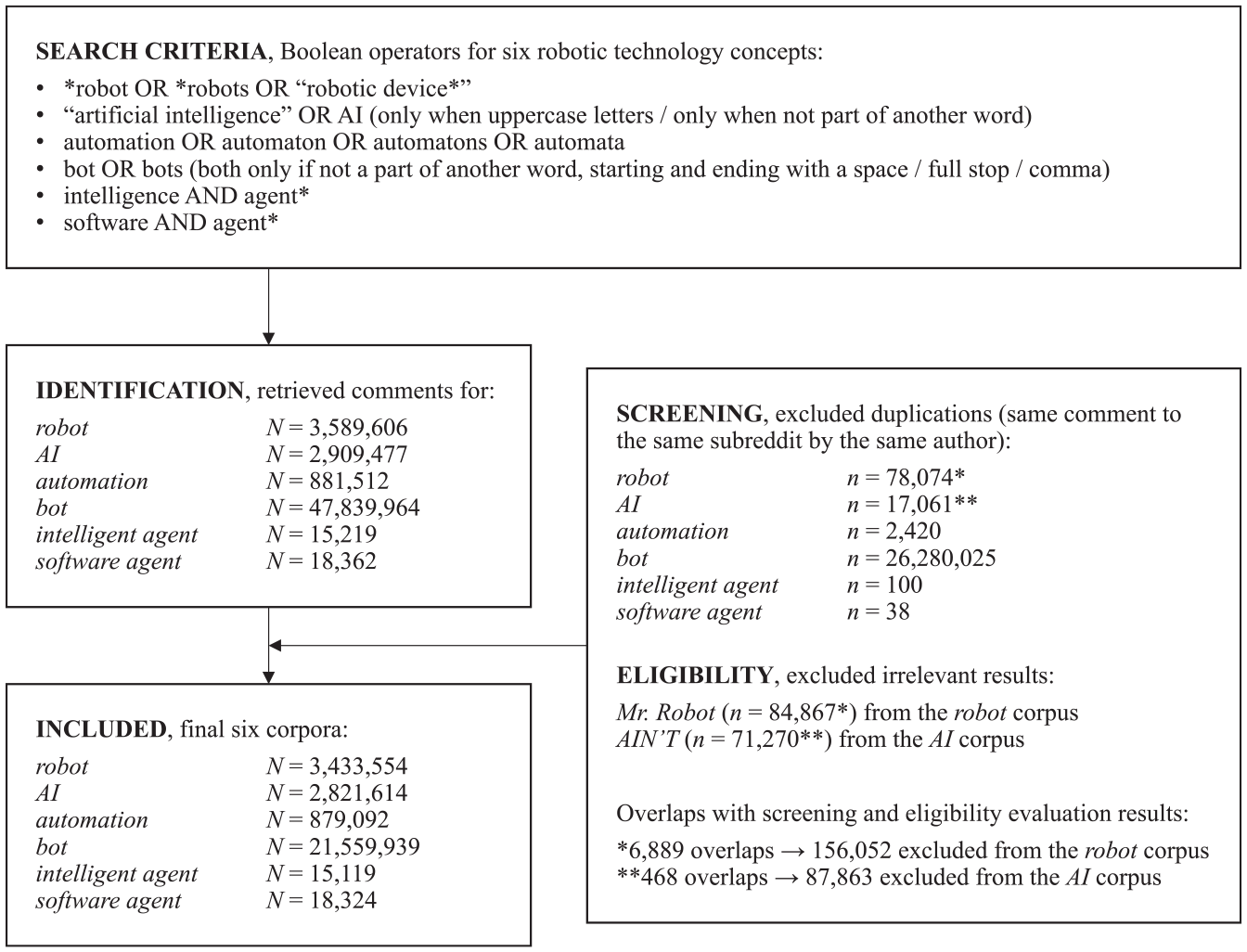
Data collection and inclusion process of robotic technology comments in Reddit.
Second, we analyzed the Reddit corpus of pushshift.io to identify texts referring to the selected terms (Baumgartner et al., 2020). We retrieved 3,589,606 comments for the concept of robot; 2,909,477 for AI; 881,512 for automation; 47,839,964 for bot; 15,219 for intelligent agent; and 18,362 for software agent.
We prepared the corpora for further analysis by excluding duplications that were identical comments by the same author to the same subreddit. In addition, we excluded comments found by identification of the phrase Mr. Robot (n = 84,867) from the robot corpus, since a reference solely to the name of this particular TV-show does not refer to technology, and comments found by identification of the capitalized expression AIN’T (n = 71,270) from the AI corpus. Exclusion of duplications and irrelevant comments resulted in the final six corpora: robot (N = 3,433,554), AI (N = 2,821,614), automation (N = 879,092), bot (N = 21,559,939), intelligent agent (N = 15,119), and software agent (N = 18,324). The number of distinct comment IDs (n = 27,824,212) showed that there was very little overlap between the different corpora (N = 28,727,642). The comments were submitted by 2,810,035 authors in 137,344 different subreddits, AskReddit (n = 2,088,865) being the most prevalent channel for robotic technology discussions based on the number of hits for our key concepts. We also used downsampling and selected 1,000,000 texts randomly from the bot corpus to be used in the regression analysis.
We processed the content of the comments with the Valence Aware Dictionary for Sentiment Reasoning (VADER; Gilbert and Hutto, 2014), a sentiment analysis tool that is among the best performing in social media text benchmarks (Ribeiro et al., 2016), to assess the positivity of the comments. We also used the Linguistic Inquiry and Word Count (LIWC) text analysis software (Pennebaker et al., 2015; Tausczik and Pennebaker, 2010) and its lexicons to analyze LIWC’s categories work, home, leisure, social, power, money, focus past, focus present, and focus future.
Measures
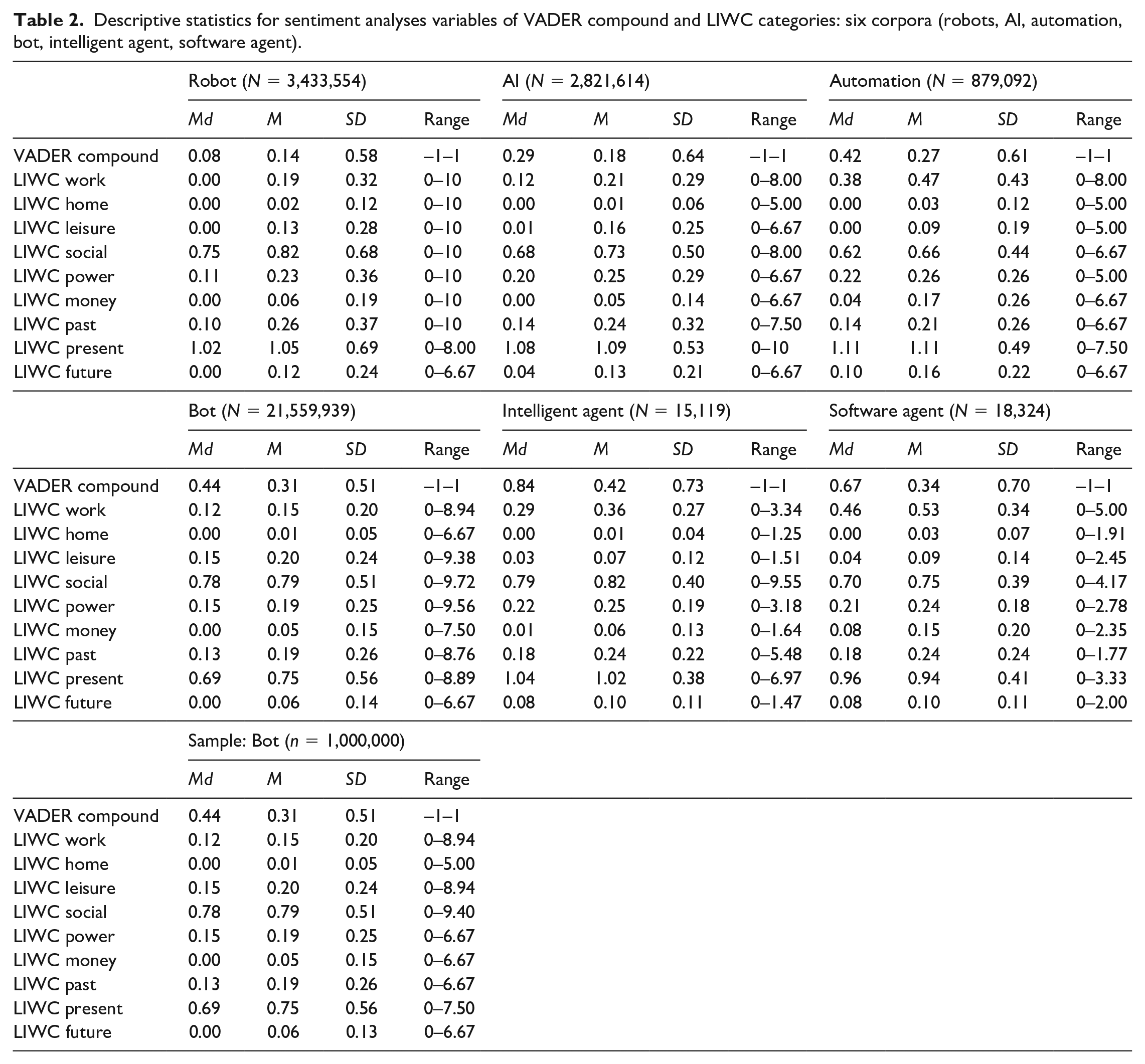
Descriptive statistics of the study variables are reported in Table 1. The main dependent variable of this study is the VADER compound score. Using the thresholds recommended for VADER, we created a categorical variable that labeled each text as positive (0.05<), neutral, or negative (<−0.05). A dummy variable indicating positive comments with a value 1 and neutral or negative with a value 0 was used as the final dependent variable in the analyses reported in results. Descriptive statistics of the final dependent variable for all six corpora are reported in Table 1 and the original VADER compound score statistics in Table 2.
Descriptive statistics for positive comments: six corpora (robots, AI, automation, bot, intelligent agent, software agent).
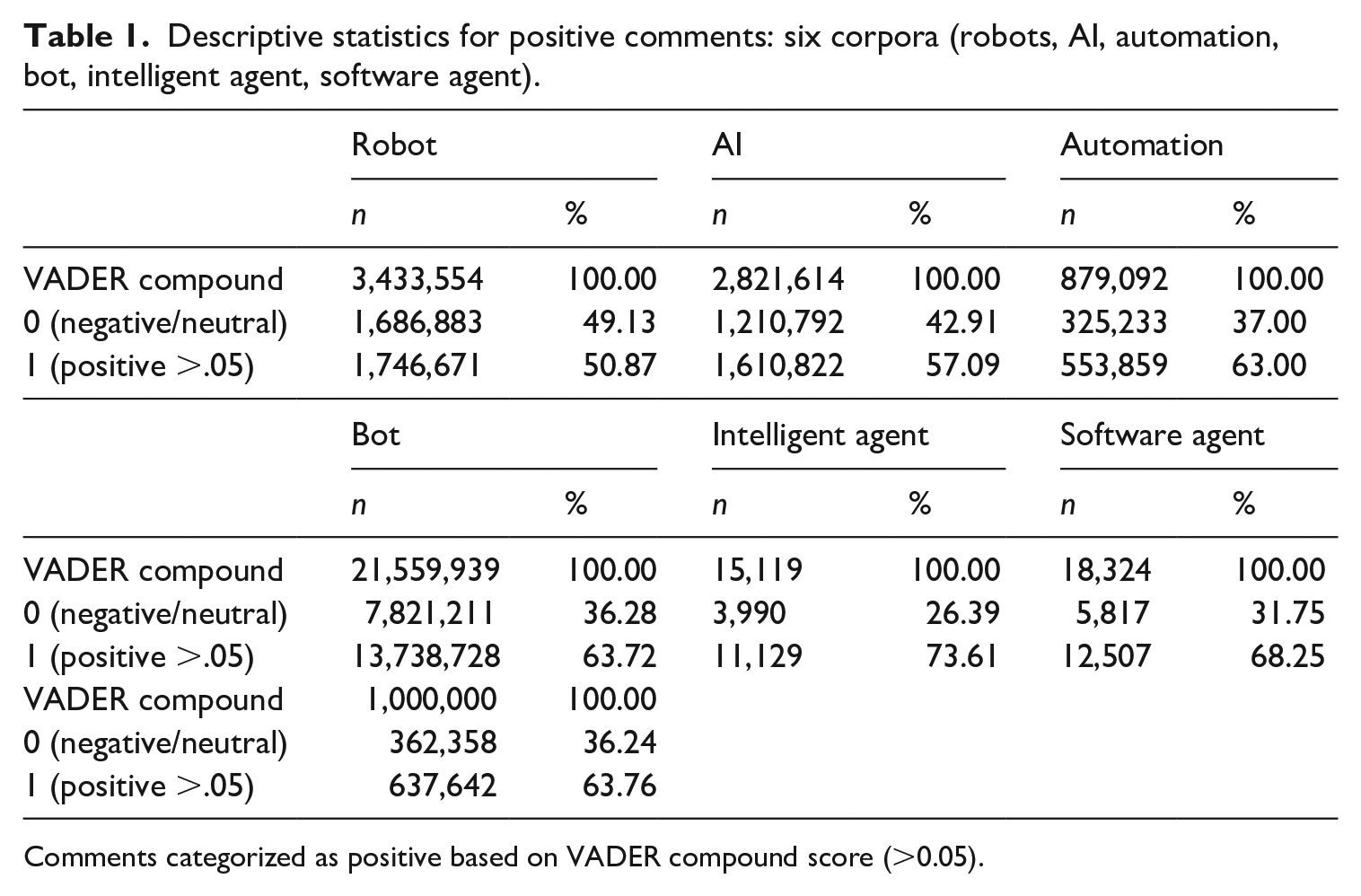
Comments categorized as positive based on VADER compound score (>0.05).
Descriptive statistics for sentiment analyses variables of VADER compound and LIWC categories: six corpora (robots, AI, automation, bot, intelligent agent, software agent).
To use the VADER sentiment analysis results as an outcome variable in our study, we validated it for our datasets collected from Reddit. We tested the validity of the dependent variable of VADER compound score using a random sample of 500 robot and AI comments and participants (N = 539) from Amazon Mechanical Turk. Human raters rated the positivity or negativity of 20 comments on a scale from −4 to 4. These were rescaled to a scale of −1 to 1 to allow comparison of the mean score from human raters with the VADER compound score for the same comment. Among the 500 comments, 67.60% of VADER compound scores were located within ±0.5 points of the mean score of human raters, suggesting relatively close agreement. Here, rather than an exact match, we aimed to verify a same direction and similar strength, considering the different original scales and scoring style of humans compared to the VADER compound score. In addition, however, only 34.60% of the VADER compound scores fell between the CI 95% of the mean score from human raters.
For comparing categorization to positive comments instead of continuous variables, we also created two dummy variables indicating positive comments from human raters’ mean score and from the VADER compound score (>.05). Among the 500 comments, 61.40% received the same value from human raters and VADER, and Cohen’s kappa shows fair agreement (κ = .224) when comparing the positive dummy variables.
Table 2 reports descriptive statistics of the main independent variables of the study, the six LIWC lexicon categories (work, home, leisure, social, power, money, focus past, focus present, and focus future). In each category, raw LIWC output gives each comment a score from 1 to 100 that represents the percentage of category-specific lexicon words present in the text. For our analysis, we rescaled the LIWC variables to 1–10.
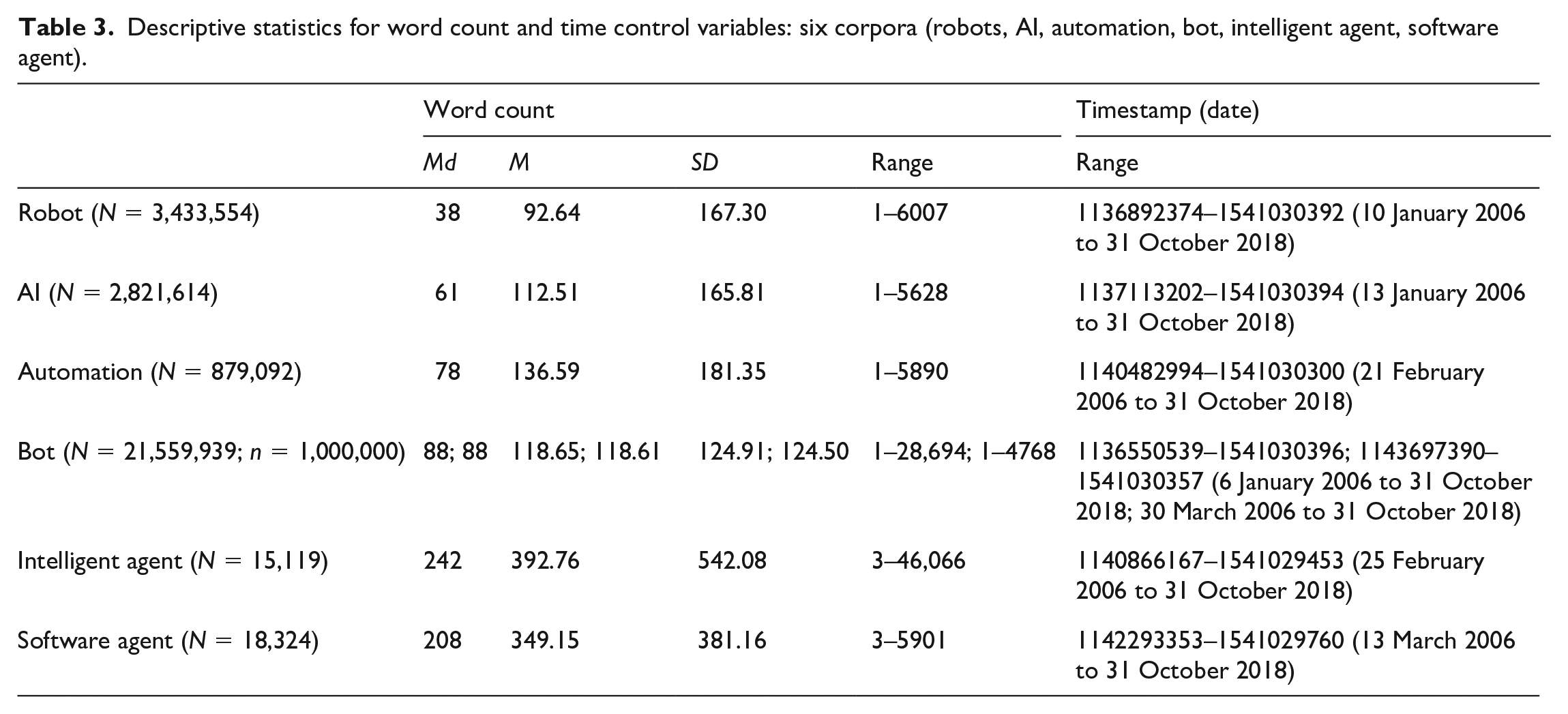
Finally, Table 3 shows descriptive analysis of the two control variables used in the models: word count and time created. Word frequency ranged from 1 to 46,066 words, where one word can include long sentences combined into one word (e.g. #RespectTheRobot, Stupidrobot). The first comment was created on 6 January 2006 12:28:59 and the last one on 31 October 2018 23:59:56.
Descriptive statistics for word count and time control variables: six corpora (robots, AI, automation, bot, intelligent agent, software agent).
Statistical techniques
We chose to use logistic regression analysis because the assumptions of linear regression (ordinary least squares) were violated due to the distribution of the VADER compound score and its error terms. In addition, higher agreement based on the validation analysis between human raters and VADER compound score categorized as positive comments provided further support for running analyses with the dummy variable. We report odds ratios (ORs), standard errors for odd ratios (OR SEs), average marginal effects (AMEs), and p values for average marginal effects. With the original bot corpus, the regression analysis did not achieve convergence. Instead, we drew a random sample of 1,000,000 comments from the bot corpus for the logistic regression models. Descriptive statistics are provided for both the original corpus and the sample.
In the logistic regression models, we used LIWC variables as continuous independent variables with a scale from 1 to 10. For the dependent variable, we used a categorical dummy variable of comments categorized as positive based on VADER compound score (>0.05). With a dependent variable with two groups (positive; not positive = negative/neutral), the models predict the likelihood of a comment being positive if its thematic content emphasizes one of the six LIWC lexicon categories. Thus, the idea of the average marginal effects is to estimate the average increase or decrease of likelihood for a comment to be positive for each independent variable.
Considering how easy it is to find statistically significant results with large datasets, our main analyses aimed at demonstrating the associations with effect sizes (ORs and AMEs) and comparing the directions of the effects of related thematic variables. Our analytical approach has been previously established and AME coefficients are useful and highly reliable for comparing effects across models (Mood, 2010).
We used a python script with SentimentIntensityAnalyzer from vaderSentiment 3.3.2 to produce VADER compound scores and LIWC 2015 software to produce nine LIWC category scores (work, home, leisure, social, power, money, focus past, focus present, and focus future) for our six corpora. Stata 16 SE was used for the analysis and graphics.
Results
Descriptive statistics of the comments in the six corpora show that the concepts of robot and AI occurred in similar frequency in the Reddit discussions (N = 3,433,554; N = 2,821,614), followed by automation (N = 879,092). However, the most popular concept of the corpora was bot (N = 21,559,939), while intelligent agent (N = 15,119) and software agent (N = 18,324) were the least popular concepts used in the 2006–2018 timeframe.
Yearly occurrences of the six robotic technology concepts in Reddit comments are reported in Figure 2. The differences in volume of the comments can be seen from the vastly different scales of the histograms of each corpus. Based on yearly frequencies, robot was the most popular concept of the six until 2010, with bot surpassing it in 2011; the popularity of AI increased, but it remained the third-place trend among these concepts during 2006–2018. Usage of the six concepts per year revealed acceleration over time for the words bot, automation, and AI. Their recent popularity can be seen in their proportion of comments dated after 2013 (94.85%, 91.30%, 88.76%, respectively) compared to the three other concepts robot, software agent, and intelligent agent (83.45%, 80.05%, 75.77%, respectively). Besides being the most frequently occurring concept in the 2006–2011 corpora overall, bot was also the most increasingly used concept in Reddit discussions during the timeframe, thus representing the new trending concept of robotic technologies.
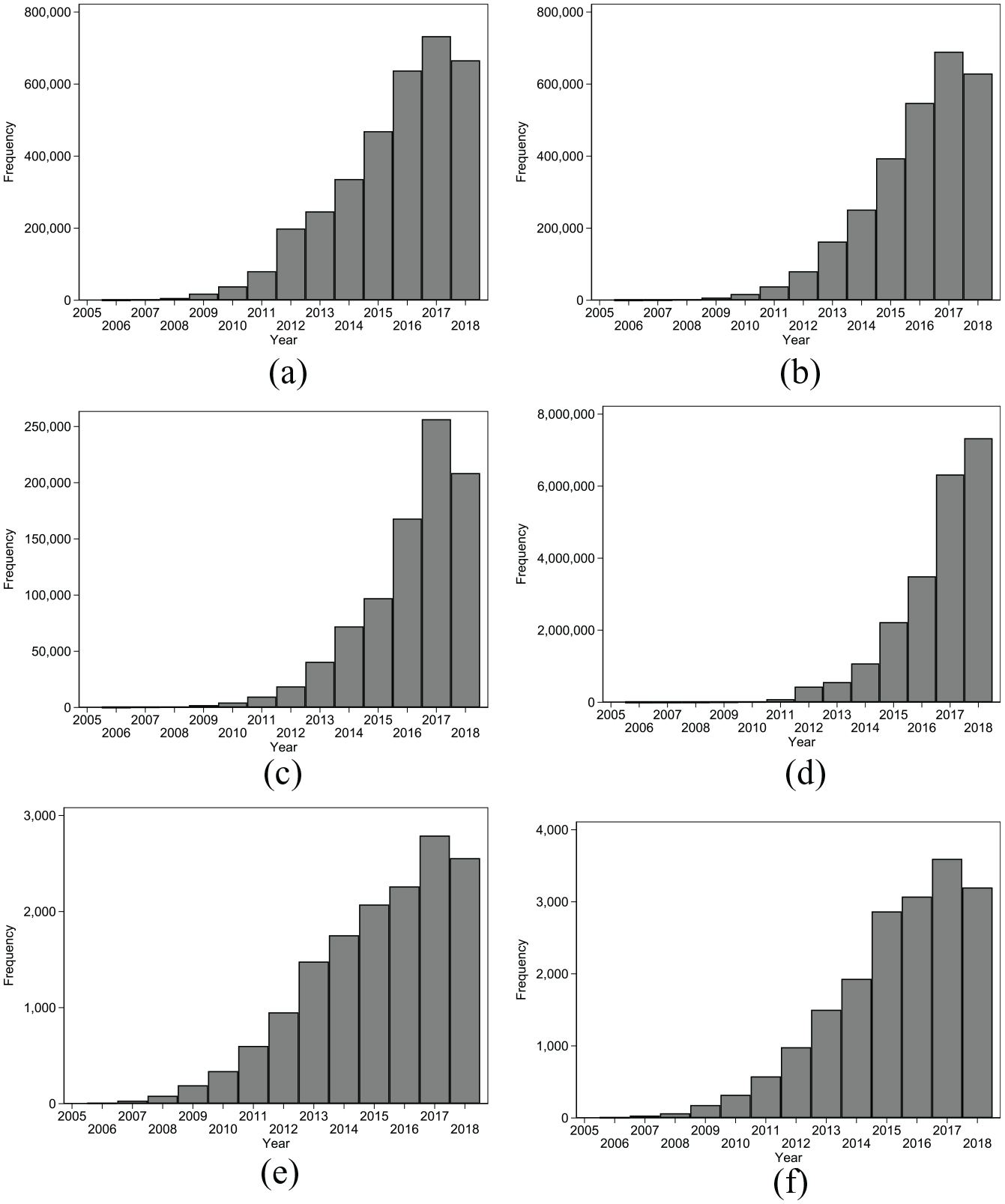
Histograms of Reddit comments referring to robotic technology by year (2006–2018): (a) robot, (b) AI, (c) automation, (d) bot, (e) intelligent agent, and (f) software agent.
Based on the descriptive statistics on VADER sentiment analysis results reported in Table 1 and Figure 3, the concepts of robot and AI were used less often in positive (50.87%, 57.09%) and more often in negative (30.84%, 33.87%) contexts compared to the other concepts’ proportions of positive (63.00–73.61%) and negative (18.73–27.91%) comments. The largest proportions of positive (73.61%, 68.25%) and smallest proportions of neutral comments (0.88%, 3.84%) were identified for the intelligent agent and software agent corpora, suggesting they were less often used in casual or neutral discussions and more often in emotional discussions, especially positive ones, than were the other four concepts. The smallest proportion of negative comments was found in the bot corpus (18.73%). Comments categorized as neutral were most often found in the bot (17.55%) and robot (18.29%) corpora.
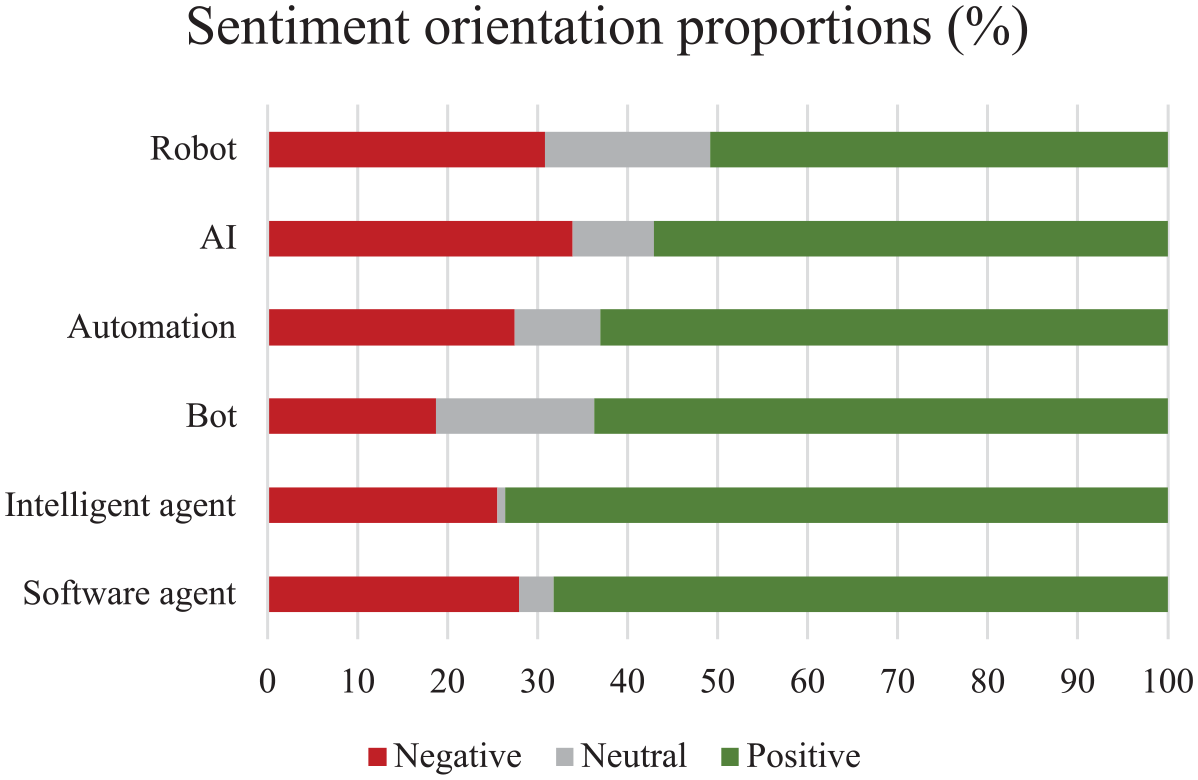
Proportions of negative, neutral, and positive comments in Reddit (2006–2018) by six robotic technology concepts.
Results of the logistic regression analyses are reported in Table 4. For each corpus, Model 1 compared three different life domains (work, home, leisure). We found that comments were less likely to be positive if they used LIWC home vocabulary (AME = −0.510 to 0.047, p < .001) compared to LIWC work (AME = −0.009 to 0.230, p < .001) or LIWC leisure (AME = −0.042 to 0.243, p < .001) vocabularies, the statistically nonsignificant result of LIWC home lexicon in the software agent corpus being the only exception.
Logistic regression models predicting positive comments by six robotic technology concepts.
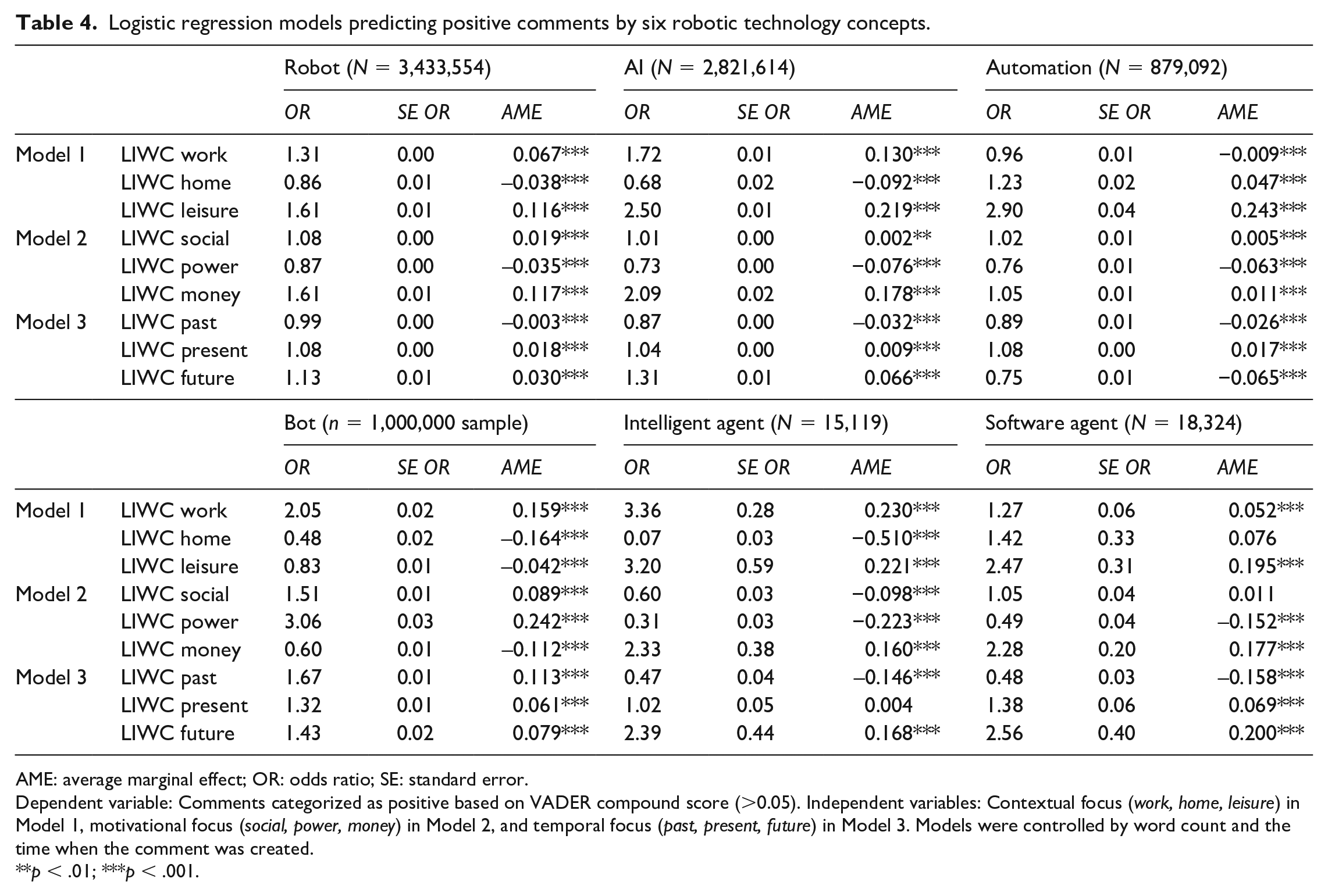
AME: average marginal effect; OR: odds ratio; SE: standard error.
Dependent variable: Comments categorized as positive based on VADER compound score (>0.05). Independent variables: Contextual focus (work, home, leisure) in Model 1, motivational focus (social, power, money) in Model 2, and temporal focus (past, present, future) in Model 3. Models were controlled by word count and the time when the comment was created.
**p < .01; ***p < .001.
Model 2 of each corpus predicts positivity of the comments by three different motivational contexts (social, power, money). The relationship of the LIWC social lexicon with positivity was small (AME = 0.002–0.019, p = .000–.002) or statistically nonsignificant, except the slight positive connection in the bot corpus (AME = 0.089, p < .001) and negative connection in the intelligent agent corpus (AME = −0.098, p < .001). Apart from the bot corpus (LIWC power: AME = 0.242, p < .001; LIWC money: AME = −0.112, p < .001), robotic technology comments using LIWC power lexicon (AME = −0.223 to −0.035, p < .001) words were less likely and LIWC money lexicon (AME = 0.011 to 0.178, p < .001) words more likely to be positive.
Finally, comparing three temporal aspects (past, present, future) in Model 3 of each corpus revealed that, with the exception of the bot corpus (AME = 0.113, p < .001), comments using the LIWC past lexicon (AME = –0.158 to −0.003, p < .001) were less likely to be categorized as positive consistently across the robotic technology corpora. The relationship of LIWC present category with positivity was small or nonexistent, except the slight positive connection in the bot and software agent corpora. With the exception of the automation corpus, comments using LIWC future vocabulary were more likely to be categorized as positive across the different robotic technology concepts.
Summary and concluding discussion
This study utilized computational tools to investigate sentiment and life domain, motivational, and temporal themes in Reddit social media discussions on six concepts related to robotic technologies (robot, AI, automation, bot, intelligent agent, software agent). The study was grounded on computational social sciences and social psychologies theories on language and representations. The comments were processed using VADER and LIWC sentiment analysis tools and the sentiment results were then analyzed both descriptively and further with logistic regression models. During the timeframe of 2006–2018, AI became the third most used concept in Reddit discussions, robot being the most popular concept until the popularity of bot rapidly increased and surpassed it in 2011. Compared to the four other concepts, the concepts of robot and AI were used less often in positive comments. In addition, we found comments addressing themes of leisure, money, and future to be linked to positive and home, power, and past to negative comments.
As social psychological theories on language and representations suggest (de Groot, 1989; Wagner et al., 1999), the usage of robotic technology concepts in social media discussions vary depending on the concept. Robot and AI, and especially bot, were found to be more dominant concepts in social media discussions compared to automation, intelligent agent, and software agent. Yearly occurrence analysis revealed accelerating usage over time of the concepts of bot, automation, and AI. Based both on increasing yearly frequencies and popularity of the concept in Reddit discussions during the timeframe overall, bot was the new trending concept of robotic technologies. However, the results suggest that the concepts of robot and AI were also fairly popular topics discussed in Reddit forums. Thus, the occurrences of robotic technology in Reddit discussions varied depending on the concept and over time, answering our first research question.
Considering our second research question and research arguing that language affects people’s appraisal processes (de Groot, 1989; Wagner et al., 1999), we examined sentiment orientation between discussions around different robotic technology concepts. We found that robot and AI occurred more often in negative and less often in positive comments than the four other concepts, which suggests that robot and AI are associated with more negative conceptions and concerns. Based on integrated threat theory (Stephan and Stephan, 2000), negative representations and stereotypes can affect attitudes negatively. Following the reasoning of integrated threat theory used in the context of robotic technology (Vanman and Kappas, 2019), robot and AI could be perceived as the robotic technologies most threatening to humans from the perspective of realistic or symbolic threats. Examining sentiments and changes in usage over time revealed that intelligent agent and software agent were less integrated in discussions in general and in discussions that were free of strong emotional or attitudinal tendencies. In contrast, comments referring to bots and robots were most often categorized as neutral, and as they were also the most frequently occurring concepts overall in 2006–2018 Reddit discussions, it could be argued that they are the most integrated robotic terminology of the six concepts in casual social media conversations.
Guided by our third research question, we scrutinized the connections of sentiment in robotic technology discussions and different contextual themes: life domains, motives, and temporal focus. We found that comments were less likely to be positive if they used domestic vocabulary compared to work or especially leisure vocabularies. This was in line with previous research on domestic environments (de Graaf et al., 2019). In contrast to this, Taipale et al. (2015) found in a previous study that the introduction of robots into leisure activities or social domains was less likely to receive positive reception than their introduction into work domains, where their use was more familiar. However, a study by Oksanen et al. (2020) reported a positive reaction to interacting with a robot or artificial intelligence in a gamified online environment, which can be considered belonging to leisure activities.
Robots in social domains and social interaction with robotic technology have received skepticism in previous literature, especially when robots were intended to replace humans (de Graaf et al., 2019; Savela et al., 2018, 2021a, 2021b; Taipale et al., 2015). However, this study did not find support for a negative relationship between social vocabulary and positive comments. In line with previous findings regarding the relationship between acceptance of robots and decreasing sense of control (Latikka et al., 2021), comments using power vocabulary were less likely to be categorized as positive. Economic vocabulary had an opposite connection, which is somewhat in contrast with the previous findings regarding fear of one’s own decreasing economic situation (Dekker et al., 2017) but can be understood from the perspective of efficiency and the economic benefits of automation of jobs (Berg et al., 2018).
In contrast to arguments about familiarity and mere exposure effect and fear of the unknown (Carleton, 2016; Reis et al., 2011; Zajonc, 1968), comments using a past tense lexicon were less likely positive and comments using future tense more likely positive across the different robotic technology concepts. Thus, the result of emotional and attitudinal language on social media suggests that fear of the unknown does not decrease the readiness to envision and talk about new robotic technologies of the future with positive expectations. This is also strengthened by the fact that although robot has been a dominant part of robotic technology discussions in Reddit longer than bot and AI, we found no evidence that the sentiment in robot comments overall would have turned more positive than newer and thus less familiar concepts.
Theoretical contributions and implications for practice
Our research demonstrates how the usage of robotic technology concepts in discussions of one social media platform vary over time and based on the concept, and how certain concepts (robot, AI) are linked with more negative emotions and attitudes, as identified through automated text analysis. Different robotic technology concepts being associated with different representation of certain emotions highlights the significance of language used and thus supports social psychological theories about language (de Groot, 1989; Moscovici, 1988; Smith, 1998; Wagner et al., 1999). Thus, our research contributes to the linguistic research on robotic technology.
Our findings on the different life domain, motivational, and temporal contexts contribute to understanding the reasons and theoretical basis behind the acceptance of robotic technology. The themes of home, power, and past focus being associated with more negative sentiment implies that robotic technologies pose a rather realistic threat in the perspective of integrated threat theory, such as a threat to humans’ private space, authority, or autonomy (Vanman and Kappas, 2019). No vast differences in texts focusing on social terminology and the focus on leisure and future terminologies being strongly connected to positive comments furthermore suggests low symbolic threat. However, our results do not support the notion of realistic economic threat posed by robotic technology as we found no evidence on higher negativity in texts on work and money. The negative association with discussions about power implies that human autonomy and control over robotic technologies is a more prevalent threat present in social media discussions. Thus, our findings propose that robots and especially artificial intelligence are perceived most threatening to humans from the different robotic technologies as they threaten the power balance of humans’ authority over technology.
These findings on how robotic technologies are discussed in social media also have societal and practical implications on the development of advanced technology. Based on Reddit comments, it seems that people do not talk as negatively about robotic technology and even express positivity in discussions focusing on leisure, work, money, and future. However, the negative findings regarding discussions on power and home contexts suggest that technology developers and policy makers should place attention and effort on enabling people to retain their sense of autonomy over technology and sense of security about technology entering their private life domain of home environment. Investing on leisure domain and preserving human autonomy and control over robotic technologies should prove to be beneficial when developing sustainable advanced technology.
Limitations, strengths, and future research direction
Our data were limited to Reddit platform discussions and may not apply to discussions in other social media environments and cannot be generalized to all people. Regardless of our automated inspection and randomized manual checks of the data for potential sources of skewness, social media big data have its limitations in terms of validity and reliability. For example, informant reliability is weakened by the phenomenon of bots generating text content in social media platforms. Although duplicated comments were excluded from the data used for analyses to avoid skewness of the results based on repeated posting, because of the search word for the bot corpus and its large size compared to the other corpora, we should be careful not to overestimate the popularity of bot discussions over other robotic technologies. It should also be noted that a word such as “bot,” for example, has multiple meanings in different contexts and interesting context-specific information cannot be observed when treating them as a one category.
Choosing the six concepts related to robotic technology also has its limitations. We chose to restrict our focus on hypernyms that represent the key concepts in themselves, instead of including, for example, certain robot types, brands, or models. Adding extra terms was judged problematic by our research team as it increases the number of discussions and even then, there might be something left out. The rationale for our approach was that we were interested in emotional language in the conversations using these main keywords specifically. It should also be noted that the six concepts do not equally relate to the concept of robot but instead have their own etymology and discussions on the definition. This is demonstrated well in the discussions about defining the social role in the concept of “agent” (Jennings et al., 1998; Maes, 1995). Our findings contribute to the discussion on how to use and interpret the six concepts related to robotic technology from the perspective of how they are used in casual discourse on the Internet.
As shown in our descriptive statistics, emotions and attitudes toward certain technologies have evolved during the span of our study. For this reason, we controlled for the confounding effect of time, the comments were posted in our logistic regression models. In the descriptive statistics, we chose to focus on yearly frequencies to observe the overall trends for the timespan of 12 years and for getting an overview that is not affected by monthly or daily occurrences. Future studies could examine the impact of specific events on the use of certain concept in social media and sentiments related to these discussions.
Although our data included the available comments of the whole population of Reddit users, without randomized experiments big data and other observational studies are limited in not providing verification for causal effects (Hoerl et al., 2014). However, descriptive observations are the foundation of predictive and explanatory investigations and provide beneficial insights (Hofman et al., 2021). Thus, utilizing average marginal effects of inferential statistics in addition to descriptive analysis methods gives strength to our findings from the comparisons between themes, but future research should investigate the generalizability of the findings in other public discussions and further study the associations using data and methods more suited to examine causality. It can be argued that identifying emotions or attitudes from text offers different information to that obtained through explicit measurement methods. For this reason, future research should investigate whether explicit measurements such as surveys reveal similar connections between different robotic technology concepts and life domain, motivational, and temporal themes. We verified the validity of the VADER tool for identifying positive comments in our data using human raters. Future research should continue to develop automated content analysis tools and their reliability for social scientific research. Our research contributes to the use of computational tools in public opinion mining in social psychological research in the context of robotic technology.
Conclusion
The results shed light on how terminology and thematic contexts affect the emotionality of robot conversations on social media. Based on our findings, bot, robot, and AI are popular concepts in public social media discussions, the latter two discussed less often in positive comments than bot, automation, intelligent agent, or software agent. The results show that robotic technologies are more likely to be found in positive context when discussed about themes such as leisure, money, and future, while discussions about home, power, and past themes are more often associated with negative or neutral comments on robotic technologies. This implies that robotic technologies are not talked as positively in discussions about home context, power dynamics, or past time, but are likely to be a part of positive discussions when talking about leisure activities, economic issues, or the future. Our findings advance our understanding on emotional talk about robotic technologies, how they are discussed in social media and in what contexts. In addition, the study advances the use of tools from computation social science for studying emotional expression and public opinion in social media. Gaining knowledge of the emotions of the public in more natural and organic environments is also relevant to legislation and the experts developing new applications for technology. Negative emotions and resistance may challenge the desired benefits from the introduction of robots into new domains, whereas social acceptance and positive expectations could guide the most beneficial and sustainable utilization of new technology.
Footnotes
Declaration of conflicting interests
The author(s) declared no potential conflicts of interest with respect to the research, authorship, and/or publication of this article.
Funding
The author(s) disclosed receipt of the following financial support for the research, authorship, and/or publication of this article: This research received funding from Pirkanmaa Regional Fond of the Finnish Cultural Foundation (Robots and Us Project, 2018–2019, PIs Jari Hietanen, Atte Oksanen, and Veikko Sariola), Kone Foundation (Urban AI project, 2021–2024, PI Atte Oksanen, grant 202011325), and from the Vienna Science and Technology Fund (grant VRG16-005, funding Max Pellert and David Garcia).
