



Abstract
This study employs the orientation–stimulus–reasoning–orientation–response (O-S-R-O-R) framework to examine how multi-platform news consumption is associated with civic participation during the COVID-19 pandemic (offline and via social media) and how this relation is mediated by civic talk and civic attitudes. A survey was administered to 1500 adults in Belgium. Results from structural equation modelling indicate how civic talk with weak ties is not associated with civic attitudes or participation. Analysis of indirect effects reveals that multi-platform news consumption stimulates two different types of participation, through civic talk with strong ties and civic attitudes. The results shed light on previously unexplored pathways towards participation, while providing support for the O-S-R-O-R framework and highlighting the role of social media as an emerging arena for civic participation.
Keywords
Introduction
During the early months of the COVID-19 pandemic, many European countries issued lockdowns and called for social distancing. Meanwhile, healthcare systems functioned under severe pressure due to a shortage of medical equipment and capacity and many at-risk social groups, such as elderly, were bound to their homes without social contact (Armitage and Nellums, 2020; Verelst et al., 2020). Against this background, the current study assesses how and why Belgian citizens engaged in forms of civic participation to collectively ‘flatten the curve’ and aid social groups most affected by the lockdown measures and the consequences of the virus.
Civic participation has been a topic of wide interest within both political and communication literature. While some conceptual disagreement exists among scholars (Ekman and Amnå, 2012; Ishizawa, 2015), the presence of civic participation is understood as a crucial marker of democratic health (Shah et al., 2005). In general, the concept is understood as referring to voluntary civic actions aimed towards solving collective or community issues (Nah et al., 2016; Theocharis and van Deth, 2018a). As opposed to many institutionalized forms of participation (such as voting or contacting politicians), these actions are not directly targeted towards the government, nor are they located within the sphere of politics. Instead, they are often embedded within a local context and directed towards neighbourhood problem-solving, by improving conditions of social groups outside one’s own network of family and friends (Ekman and Amnå, 2012; Kim and Ball-Rokeach, 2006). As such, while forms of civic participation often lack a clear-cut political connotation (Theocharis and van Deth, 2018b), they have been found to foster and relate to norms of reciprocity, solidarity and faith in others (Likki and Staerklé, 2014; Nah et al., 2016; Shah et al., 2005).
One mode of action that proved especially relevant in the context of the COVID-19 crisis is volunteering. Given the focus on direct helping instead of policy change, volunteering is recognized as a prominent form of civic participation (Ishizawa, 2015; Kaun and Uldam, 2018; Pavlova et al., 2021). Broadly, volunteering encompasses activities where time is given freely to benefit another person or group (Wilson, 2000). Many such activities emerged during the first months of the pandemic, such as sewing facemasks, doing groceries for elderly or 3D-printing respiratory systems. Within this crisis context, these acts were often organized ad hoc, without organizational guidance or resources (Trautwein et al., 2020).
Apart from offline acts of volunteering, we will assess civic participation through social networking sites (SNS). With the advent of mobile and digital communication technologies, ways of participating in civic life have evolved as well. Social media specifically offer new ways for citizens to let their voices be heard, work on solutions and organize collective action, by displaying their mobilization and activating their networks (Bennett and Segerberg, 2012; Xenos et al., 2014). In addition, acts that emerge on these platforms are more than online counterparts of offline participation. They have been shown, empirically and theoretically, to be standalone form of engaging with politics and social issues (Gibson and Cantijoch, 2013; Theocharis, 2015). In crisis situations, SNS form important spaces for mobilization and coordination of civic action: they allow disparate citizens to unite when institutions falter in the provision of public goods and services, or when physical contact is limited (Bennett and Segerberg, 2012; Theocharis et al., 2017). These affordances are of particular relevance when considering the crisis caused by COVID-19 (Waeterloos et al., 2021). Indeed, a recent study from Denmark showed how social media groups notably facilitated civic activity and solidarity during the pandemic (Carlsen et al., 2020).
The aim of this article is to shed light on the processes underlying civic participation. To do so, we will employ the orientation–stimulus–reasoning–orientation–response (O-S-R-O-R) model, which stems from communication mediation theory and integrates various predictors of civic participation in a sequential process (Eveland et al., 2003; McLeod et al., 1999; Sotirovic and McLeod, 2001). The main tenet of the model is that media stimuli work to influence interpersonal communication and discussion on current issues. In turn, these communication processes lead to a set of outcome orientations, such as civic attitudes or political knowledge which then work to enhance participatory behaviours (Cho et al., 2009; Shah et al., 2005).
Various studies have employed the O-S-R-O-R model, as it provides a unified analytical structure to study processes of motivation, information and expression related to media and democratic participation (Shah et al., 2017). Still, however, several underlying mechanisms that work to stimulate participation remain to be explored. First, most research employing the model assesses conventional and institutional forms of participation, targeted at the political sphere (e.g. Chan et al., 2017; Chen, 2021), while only few studies include forms of civic participation targeted at collective or community issues (Muñiz et al., 2017), which is the focus of this study. Second, as SNS are increasingly being acknowledged as platforms and tools for collective action, our study includes SNS participation as an independent mode of participation (Oser et al., 2013; Theocharis and van Deth, 2018b). Moreover, this study further advances the understanding on how informational media uses stimulate civic participation, by focussing on multi-platform news consumption. The concept refers to the regular combination of different news media in one’s information habits (including both offline legacy news sources, such as newspapers, as well as digital native news media, such as specific mobile news applications; Diehl et al., 2019; Wolfsfeld et al., 2016). Although there is at least some evidence that combining multiple news platforms in a news diet might have unique effects on participation (Diehl et al., 2019; Molyneux, 2019), this assumption has not yet been tested within a theoretical framework such as the O-S-R-O-R model.
In short, using structural equation modelling (SEM), this study examines how multi-platform news consumption is associated with volunteering and SNS participation among Belgian citizens during the COVID-19 pandemic. Moreover, we will assess whether civic talk and the presence of civic attitudes function as mediators in the relation between multi-platform news consumption and civic participation.
Theoretical framework
Communication mediation models
To address the different processes that result in civic participation, political communication research has long moved beyond stimulus–response (S-R) theories, which claim that exposure to mass media directly leads to certain behavioural or cognitive outcomes. For instance, the communication mediation model, as proposed by McLeod et al. (1999), adds interpersonal discussion to the sequence. Within this framework, it is assumed that communication, both in terms of mass media exposure and interpersonal discussion, mediates the impact of an individual’s pre-existing orientations, conditions and characteristics on civic participation. In addition, these communication stimuli work indirectly to influence civic participation through a set of subsequent orientations, such as political knowledge or efficacy. However, updates of the model have rejected the notion that interpersonal communication is a mere stimulus of civic participation, in the same way as mass communication (Shah et al., 2005). Instead, interpersonal communication is assumed to be a distinct mediating factor between exposure to mass communication (such as news) and participatory behaviour. Hence, an expanded model (O-S-R-O-R) has been proposed where ‘reasoning’ (R), be it intrapersonal (through cognitive reflection) or interpersonal (through discussion), captures the processes that happen between media stimuli (S), subsequent orientations (O) and behavioural outcomes (R) (Cho et al., 2009). The O-S-R-O-R model thus disassembles the different communication variables and emphasizes how mass and interpersonal communication complement each other to enhance civic participation (Shah et al., 2005). In this sense, the model highlights the evolution in political communication research from a focus on ‘what media do to people’ towards ‘what people do with media’ (Sotirovic and McLeod, 2001).
In sum, as an integrative and parsimonious framework, the O-S-R-O-R model has gained attention in recent political communication literature seeking to uncover the pathways underlying citizens’ participatory behaviour. According to various scholars, the model has proven its utility by integrating and organizing various important dimensions in examining the mutual dynamics between media use and political behaviours (Chan, 2016; Chan et al., 2017; Chen, 2021). Although the model is not without its limitations, it has been proven useful in studies that focus on various geographic and political contexts (Gil de Zúñiga et al., 2019), as well as different digital technologies such as mobile apps (Johnson et al., 2021). Indeed, as Chan (2016) argues, the model is particularly relevant for the study of social media (such as Facebook) as their different affordances can be integrated along the different components of the model.
In the following sections, the different processes that underly the assumptions of the model will be presented, together with the hypotheses of this study.
Multi-platform news consumption and communication mediation
News media are important facilitators of participatory behaviour as they allow citizens to stay informed on different social issues and become aware of the problems in their communities. Moreover, through news media, citizens can gain knowledge on possible courses for social action and ways to respond to occurring social events (Boulianne, 2016; Eveland et al., 2003; McLeod et al., 1999; Shah et al., 2005). To date, different studies have established positive relationships between news use and participatory behaviour, with both variations in the types of news use considered as well as the forms of participation (e.g. Gil de Zúñiga et al., 2012; Livingstone and Markham, 2008). In addition, informational media uses have been found to foster several orientations that often facilitate civic participation, such as civic awareness (Boulianne, 2016), civic duty norms and information efficacy (Moeller et al., 2018).
Despite these findings, it has become clear that the nature of these effects heavily depends on which types of news media are used, how they are used and by whom (Strömbäck et al., 2017). People’s media habits (i.e. how they make and sustain choices within the news supply) tend to reflect the media environment in which they are formed. In turn, shifts in news habits are assumed to impact the ways in which citizen seek to participate (Edgerly et al., 2018). Our current multi-platform, high-choice media environment is characterized by an increased supply of media platforms and the proliferation of digital, social and mobile media. As such, academic attention towards multi-platform news consumption has grown (Prior, 2007; Schrøder, 2015; Shehata and Strömbäck, 2018; Van Aelst et al., 2017).
Multi-platform news consumption refers to ‘the habit of paying regular attention to, or relying on, more than one information and communication technology modality for the consumption of news and public affairs information’ (Diehl et al., 2019: pp. 2–3). A recent body of research suggests that this specific type of news consumption might have unique effects on civic participation because people are more frequently exposed to mobilizing information and calls for social interaction and political action. These mobilizing effects are attributed to the complementary nature of distinct technological affordances, which cause each news platform to present and convey information in a unique manner. Consequently, different news platforms are believed to enhance the effects on discursive practices and contribute in unique ways to participation (Diehl et al., 2019; Strömbäck et al., 2017). For instance, while newspapers can be considered highly information dense, mobile news apps are higher in terms of their immediacy, providing individuals with real-time information and possibly, an informational advantage (Molyneux, 2019). Furthermore, Wolfsfeld et al. (2016) argue that people who combine different news media in their information habits, invest more time and effort into keeping up which current affairs. Due to this investment and the possible feelings of empowerment that result from it, they are more likely to take part in participatory behaviour.
Whereas there is some empirical evidence that multi-platform news consumption has beneficial effects in terms of increased civic participation (e.g. Edgerly et al., 2018; Molyneux, 2019), this assumption has not yet been tested within an established theoretical framework. Therefore, based on the assumptions of the O-S-R-O-R framework as well as the literature depicted above, we expect the following, as shown in Figure 1.
H1. Multi-platform news consumption is positively associated with civic talk with strong (H1a) and weak (H1b) ties.
H2. Multi-platform news consumption is positively associated with civic attitudes.
H3. Multi-platform news consumption is positively associated with volunteering (H3a) and SNS participation (H3b).
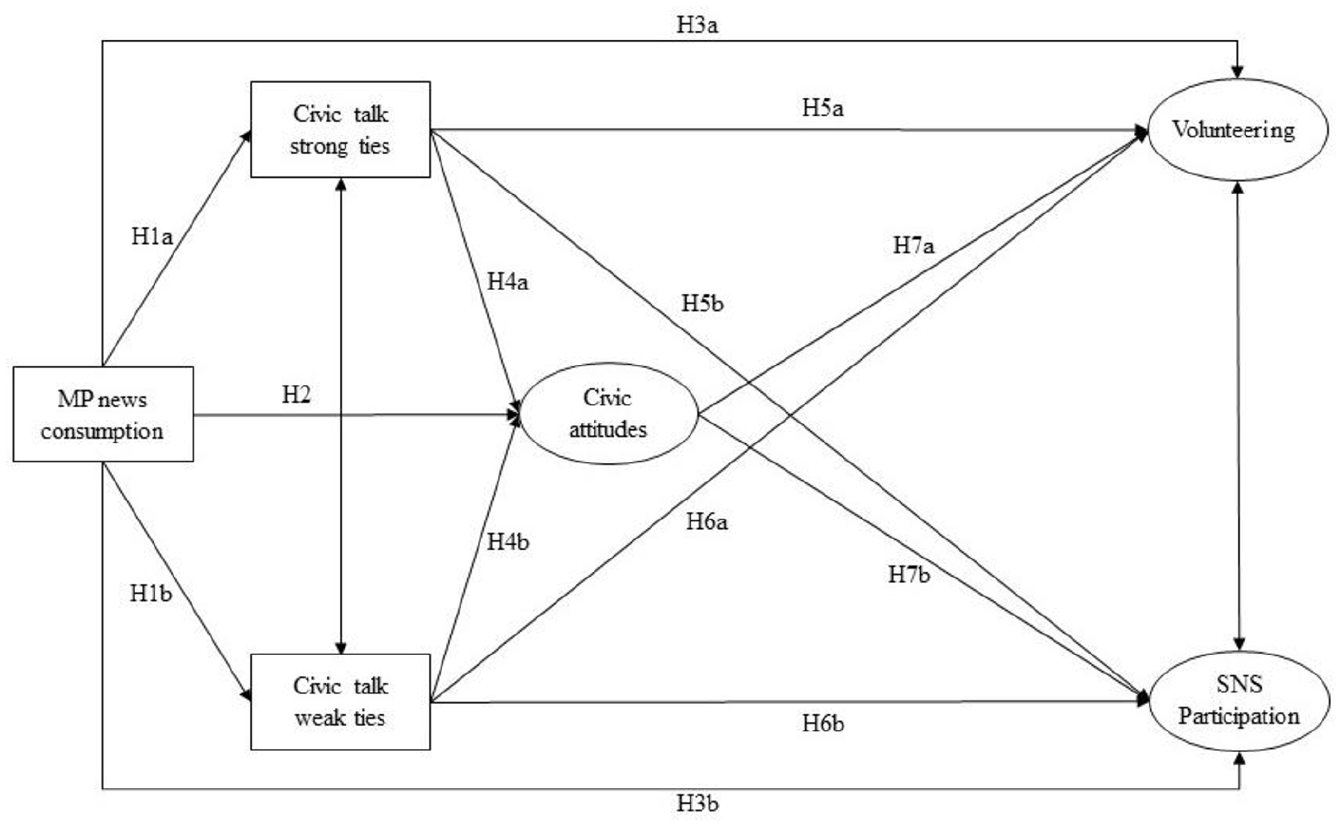
Hypothesized model.
Civic talk as reasoning
The O-S-R-O-R model includes a reasoning pathway (R) that mediates the relationship between media stimuli, subsequent orientations and behavioural outcomes. Reasoning refers to the ways of processing information gained from media stimuli by making cognitive connections to past experiences and prior knowledge (Eveland et al., 2003). One way of doing so is through interpersonal discussion. This allows individuals to make sense of received media messages, as well as learn more about social issues, different viewpoints and relate more closely to social and political events, which potentially leads to deeper engagement (Sotirovic and McLeod, 2001).
Prior studies have confirmed the important role of interpersonal discussion in fostering participation, as well as subsequent civic orientations as proposed in the O-S-R-O-R framework (Ekström and Östman, 2013; Gil de Zúñiga et al., 2017; Klofstad, 2015). In addition, it has been argued that the impact of interpersonal discussion depends on the discussion networks through which these conversations occur. One of the relevant attributes of these networks is the level of closeness and intimacy that exists between individuals. As such, a distinction is often made between ‘weak ties’ and ‘strong ties’. Specifically, weak ties link members of different social groups and thus exist between acquaintances, rather than between close friends or family which are connected through strong ties (Granovetter, 1973; Kavanaugh et al., 2005).
Various perspectives exist on how these weak- and strong-tie networks might alter the effects of civic talk on participation. While the importance of strong ties (e.g. spouses, close relatives and friends) as important sources of social influence and pressure cannot be overlooked (Straits, 1991; Valenzuela et al., 2018), larger, more diversified networks of weak ties offer more chances to come across mobilizing information and be recruited to participate in civic action. These weak-tie networks can provide novel information, resources for participation and diverse perspectives, as they connect often distinct social groups (Gil de Zúñiga and Valenzuela, 2011; Granovetter, 1973; Kavanaugh et al., 2005).
Recently, scholars have drawn attention towards the affordances of digital communication technologies in the context of interpersonal communication for civic purposes. Computer-mediated communication, through social media platforms or instant messaging apps, has been found to expand one’s social network with weak ties by removing geographical and time-related barriers. This again increases information flows and chances to encounter mobilizing resources (Boulianne, 2015; Gil de Zúñiga et al., 2021; Gil de Zúñiga and Valenzuela, 2011; Valenzuela et al., 2018).
Accordingly, our study will include both civic talk with strong and weak ties as possible predictors of civic participation, with civic talk referring to informal discussions about politics and current events that occur between citizens and their peers or social network (Klofstad, 2010). Moreover, we will test the mediation assumption of the O-S-R-O-R model and pose following hypotheses and research question (see Figure 1):
H4. Civic talk with strong (H4a) and weak (H4b) ties is positively associated with civic attitudes.
H5. Civic talk with strong ties is positively associated with volunteering (H5a) and SNS participation (H5b).
H6. Civic talk with weak ties is positively associated with volunteering (H6a) and SNS participation (H6b).
RQ1. Does civic talk mediate the relationship between multi-platform news consumption and civic participation?
Civic attitudes as subsequent orientations
As proposed in the communication mediation model, the relationship between communication and behaviour is not a direct one. Rather, the model draws from psychological insights and asserts that media stimuli stimulate interpersonal communication, through which a set of subsequent orientations is developed which in turn enhance participation in civic action (Eveland et al., 2003). This second set of orientations thus represents an additional process between reception of the media message and the response of the audience (McLeod et al., 1999). Theoretically, it is assumed that news consumption and communication with peers form important ‘developmental assets’ to acquire a sense of civic competence (Boyd et al., 2011).
Studies employing the O-S-R-O-R framework have included a variety of orientations to assess this mediation hypothesis, such as political efficacy (Chan et al., 2017), political knowledge (Cho et al., 2009), trust (Li and Chan, 2017) and political sophistication (Muñiz et al., 2017). Less frequently considered, however, is the role of civic attitudes as a possible bridge between civic talk and civic participation. As civic participation is aimed at collective issues among community members, it is likely that perceptions and norms about what constitutes a ‘good citizen’ will influence these types of behaviour (Pattie and Johnston, 2013). In this regard, civic attitudes can be considered as a sense of civic responsibility or duty: they refer to an individuals’ personal beliefs concerning whether they can and should make a difference in the community (Blais and Achen, 2019; Doolittle and Faul, 2013). In the context of the pandemic, it seems plausible that people who are more confronted with media messages and interpersonal communication about COVID-19, are more likely to have their sense of civic duty enhanced. The rationale here is that by consuming news and having civic conversations, people come across calls to action and are made aware of certain issues, which possibly triggers their feelings of ‘needing to do something’.
H7. Civic attitudes will be positively associated with volunteering (H7a) and SNS participation (H7b).
RQ2. Do civic attitudes mediate the relationship between multi-platform news consumption, civic talk and civic participation?
Methods
Sample and procedure
An online survey was administered to 1500 Belgian individuals between 18 and 65 years old, between 17 and 19 April 2020. A professional research organization recruited the participants. The eligibility criteria to participate in the study were (a) being resided in Belgium, (b) being aged between 18 and 65 years and (c) speaking Dutch. To assure a heterogeneous sample, a stratified sampling procedure was used. Based on Belgian federal statistics, we a priori stratified the data with regard to gender, age, employment status and educational degree, so that the proportion of the strata reflects the proportion of the Flemish population.
In total, 8000 panel members received an email with a short study description and invitation to participate. Prior to filling out the survey, respondents were informed about the study’s purposes and asked for their informed consent. When 1500 respondents had been reached in accordance with the strata, the research organization closed the survey link. The study was approved by Ghent University’s Ethics Committee. Table 1 provides the descriptives of the sample, including age, gender, income and highest educational degree.
Characteristics of the study sample.
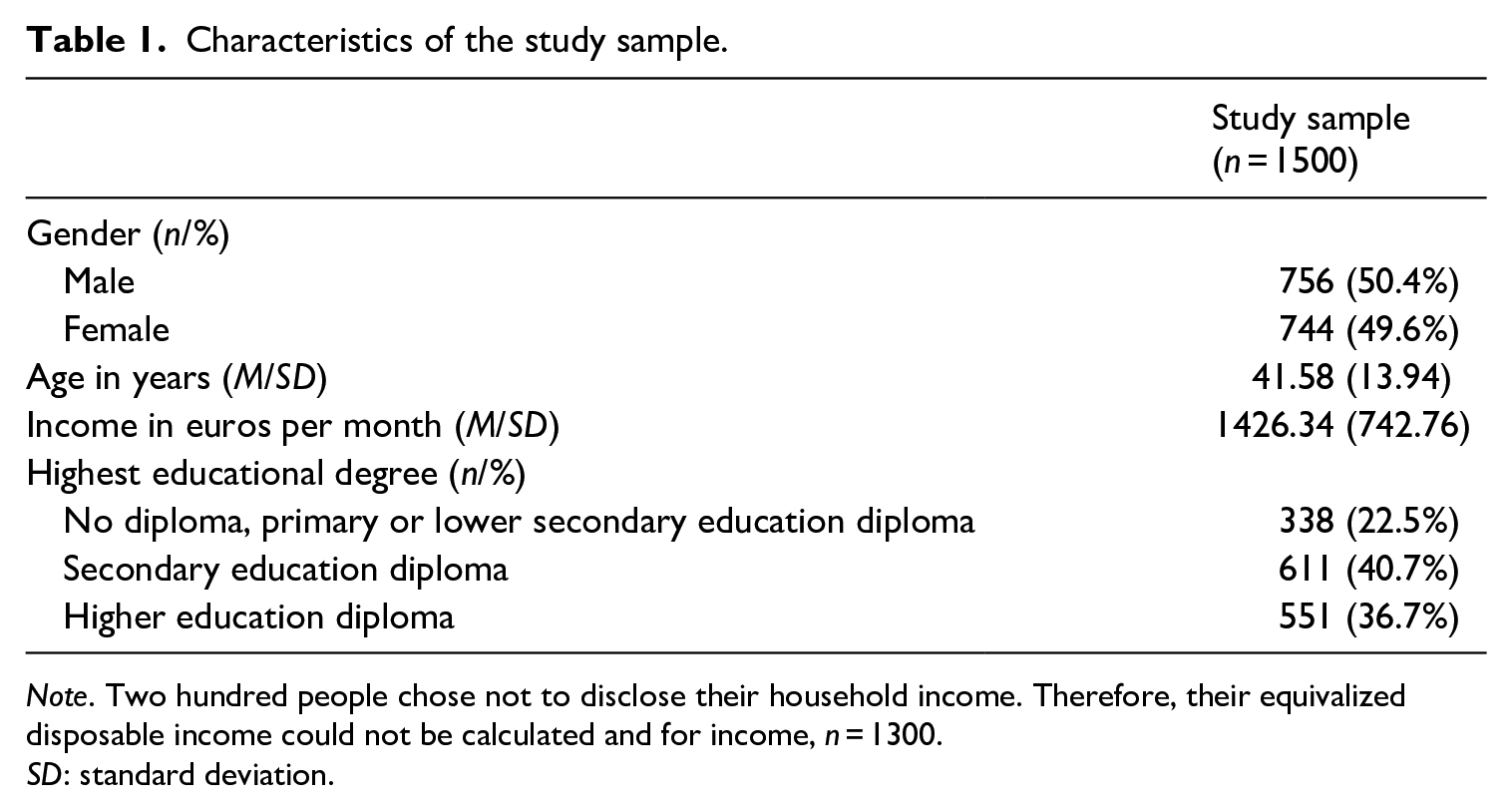
Note. Two hundred people chose not to disclose their household income. Therefore, their equivalized disposable income could not be calculated and for income, n = 1300.
SD: standard deviation.
Analytic strategy
As a first step in our analyses, we assessed the correlations between our study variables using SPSS 26. SEM was used to examine the relationships between multi-platform news consumption, civic talk, civic attitudes and civic participation. Robust maximum likelihood estimation was applied, given that there was evidence that the dependent variables were skewed. All SEM analyses were conducted using Mplus version 8.4 (Muthén and Muthén, 2017). Missing variables were excluded from our analyses using listwise deletion, resulting in a final sample of 1300.
Our main analyses were conducted in two phases. In the first phase, we assessed the factor structure of our latent constructs and built a measurement model to examine whether our observed variables reflected the latent constructs (i.e. civic attitudes, volunteering and SNS participation). In the second phase, we constructed the structural model with SNS participation and volunteering as outcome variables (see Figure 1). Age, gender, income and highest education were included as covariates in the structural model. Furthermore, we formally tested evidence of mediation using the INDIRECT command in Mplus to assess the value and significance of the product of the indirect pathways by which multi-platform news consumption influences volunteering and SNS participation.
The adequacy of both the measurement and the structural model was evaluated using several fit indices. Chi-square, root mean square error of approximation (RMSEA), Tucker–Lewis index (TLI), comparative fit index (CFI) and standardized root mean square residual (SRMR). In general, a non-significant chi-square is an indication of good model fit. However, due to the sensitiveness of the chi-square to large sample size, it is almost always significant and thus not an adequate test of model fit (Kline, 2015). The CFI and TLI range from 0 to 1.00, with a cut-off of .95 or higher indicating that the model provides a good fit and .90 indicating that the model provides an adequate fit (Hu and Bentler, 1999). Values below .06 and below .08 are considered indicative of a good fit for RMSEA and SRMR, respectively (Brown, 2014). Given the large sample size, p-values < .01 are considered significant.
Measures
Appendix 1 contains a detailed overview of the survey items, as well as the mean and standard deviation per item.
Consistent with the work of Ponnet et al. (2015), an exploratory factor analysis was conducted, to evaluate our theoretical two-factor structure. At this stage, some poor- and cross-loading items were omitted from the analysis. For SNS participation, respondents rated four items, with factor loadings ranging from .57 to .83, R² = 39.45. For volunteering, our respondents rated three items, with factor loadings ranging from .51 to .75 (R² = 13.07). This factor structure was confirmed through a confirmatory factor analysis. Respondents were asked how often they had engaged in any of these activities, since lockdown measures were first enforced. Respondents rated the items on a 5-point Likert-type scale ranging from never (1) to very often (5).
Results
Bivariate correlations and measurement model
Table 2 presents the bivariate correlations among the study variables. All variables were significantly and positively correlated with each other at p < .01, with the exception that civic talk with strong ties was not significantly correlated with volunteering. Our measurement model provided a good fit: χ²(83) = 356.57, p < .001; RMSEA = .05 (CI: .04–.05); CFI = .96; TLI = .95; SRMR = .04. All factor loadings were above .47.
Correlations among study variables.
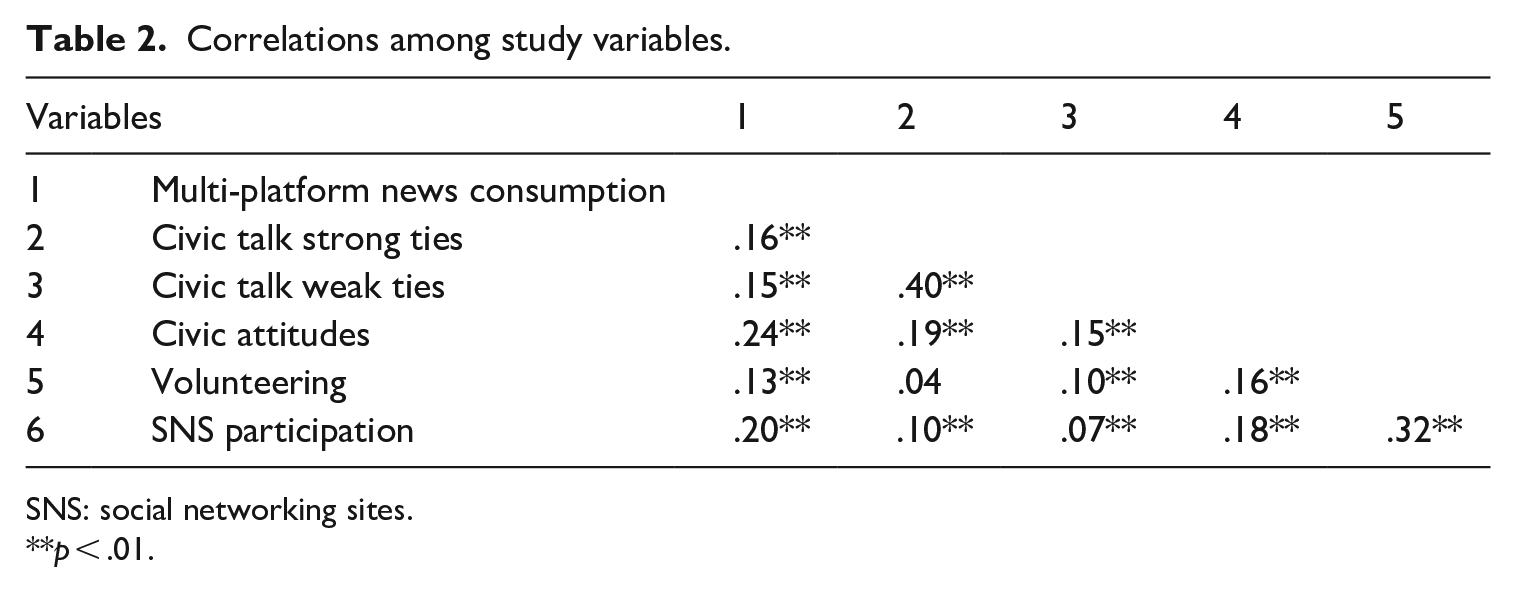
SNS: social networking sites.
p < .01.
Structural model
Figure 2 presents the results of the structural model. The model provided a good fit, with χ² (194) = 589.80, p < .001; RMSEA = .040 (CI: .036–.043); CFI = .94; TLI = .93; SRMR = .04. The socio-demographic variables that were included as covariates (age, gender, income and education) were not significantly related to volunteering. However, age was significantly associated with SNS participation, indicating that younger people are more likely to participate in this type of participation (β = –.10, p < .01). Moving on to our hypotheses, multi-platform news consumption was positively associated with civic talk with both strong (β = .16, p < .001; H1a) and weak ties (β = .15, p < .001; H1b), as well as with civic attitudes (β = .23, p < .001; H2). Furthermore, we found a positive and direct association between multi-platform news consumption and SNS participation (β = .20, p < .001), but not for volunteering (β = .09, p = .02). As such, H3b was confirmed. Civic talk with strong ties positively predicted civic attitudes (β = .18, p < .001; H4a). However, we could not establish a similar association for civic talk with weak ties (H4b; β = .06, p = .07). Finally, civic attitudes were found to be positively associated with both volunteering (β = .21, p < .001; H7a) and SNS participation (β = .14, p < .001; H7b). The full model, adjusted for the covariates, explained 7.2% of the variance in volunteering and 8.9% of the variance in SNS participation.
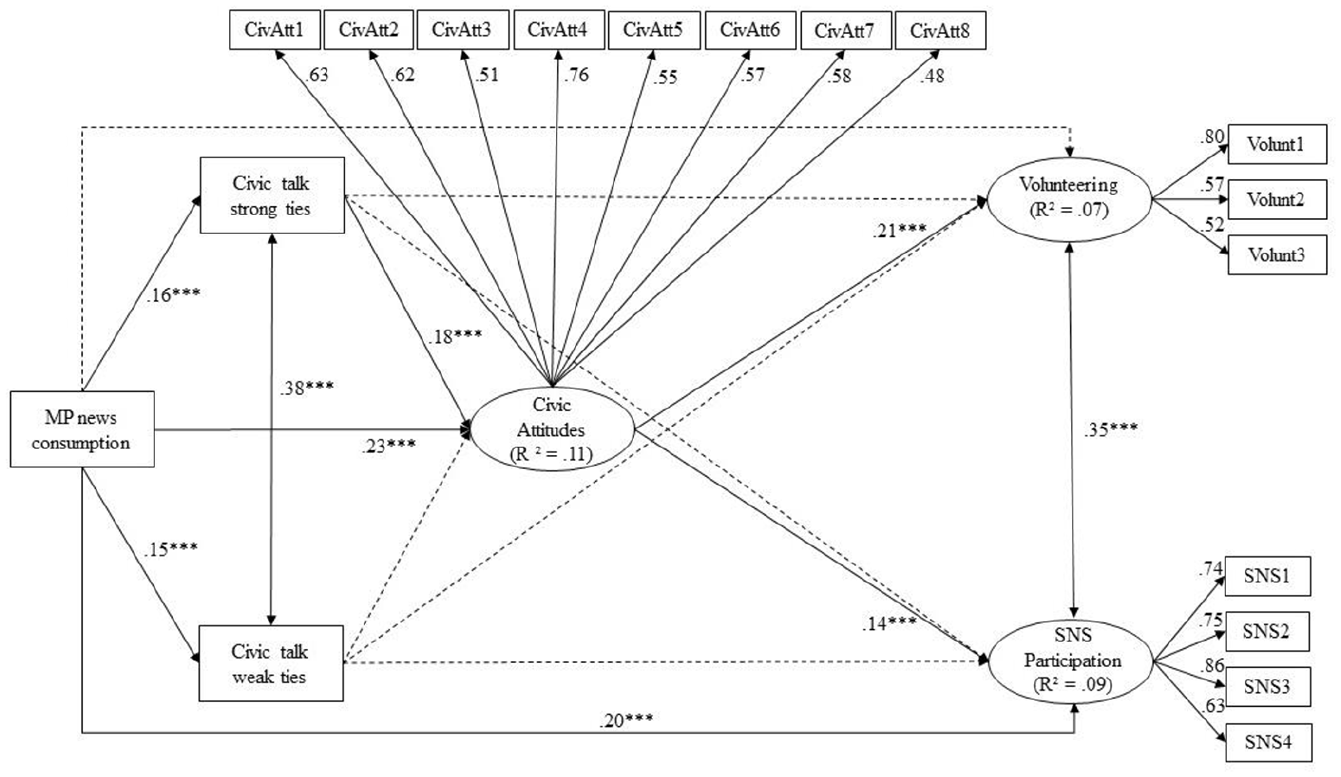
Structural model.
To assess the mediating role of civic talk (RQ1) and civic attitudes (RQ2) in the relationship between multi-platform news consumption and civic participation, we formally tested the significance of the different indirect paths (summarized in Table 3). We found that civic attitudes significantly mediated the relationship between multi-platform news consumption and both types of civic participation (β = .048, p < .001 for volunteering; β = .032, p < .001 for SNS participation). However, we found no significant indirect effects between multi-platform news consumption and volunteering through civic talk with strong ties (β = –.007, p = .192), or through civic talk with weak ties (β = .013, p = .023). Similarly, the indirect effects between multi-platform news consumption and SNS participation through civic talk were not significant (β = .007, p = .22 for strong ties; β = .002, p = .712 for weak ties). Finally, our results indicated that multi-platform news consumption influences volunteering and SNS participation through both civic talk with strong ties and civic attitudes (β = .006, p < .01 and β = .004, p < .01 respectively), providing support for the O-S-R-O-R framework.
Summary of indirect effects.
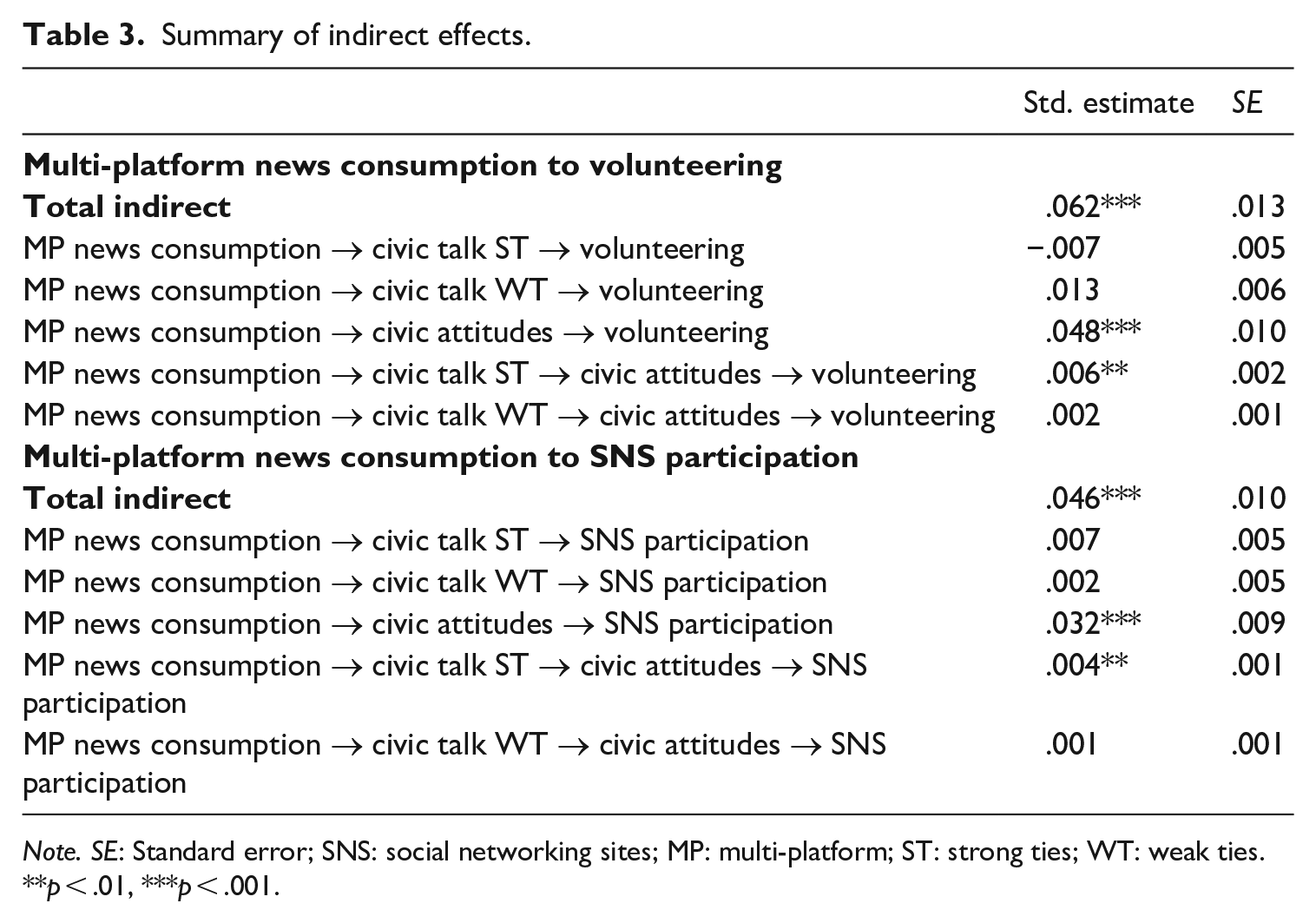
Note. SE: Standard error; SNS: social networking sites; MP: multi-platform; ST: strong ties; WT: weak ties.
p < .01, ***p < .001.
Discussion and conclusion
The current study employed the O-S-R-O-R model to examine the underlying mechanisms that work to stimulate civic participation during the COVID-19 pandemic. Our study advances the literature on civic participation and media in several ways. To the authors’ knowledge, this study is the first to include multi-platform news consumption in a theoretical model, such as O-S-R-O-R to explain two types of civic participation. Previous research applying the O-S-R-O-R framework has mainly focussed on more conventional, offline understandings of participatory action (e.g. attending political meeting or protests), as well as election times (e.g. Gil de Zúñiga et al., 2019; Park, 2019). However, our study provides evidence for the applicability of the model not only in a crisis context, but also with a focus on civic participation. The latter refers to voluntary civic actions outside the locus of government and state, aimed towards solving collective or community problems and improving conditions of social groups (Ekman and Amnå, 2012; Nah et al., 2016; Theocharis and van Deth, 2018a). In addition, our study highlights the role of SNS as an arena for civic participation, especially during times of crisis. During this time of amplified need, frustration and limited physical contact, SNS function as virtual mobilizing structures where civic participation can emerge (Carlsen et al., 2020; Ortiz and Ostertag, 2014).
Our study aimed to advance the O-S-R-O-R framework by including multi-platform news consumption as the stimulus aspect. Prior research has suggested that consuming news through a combination of platforms is likely to increase civic participation as citizens come across mobilizing information more frequently and because these news consumers are likely to be more willing to invest time and effort in addressing social issues (Diehl et al., 2019; Wolfsfeld et al., 2016). Indeed, we found a significant and direct relation between multi-platform news consumption and SNS participation. This might be explained by the affordances of digital and mobile media, which are often combined with more established news platforms in multi-platform news diets. Digital native news platforms, such as social media or instant messaging apps, allow citizens to receive information and act on this information in a centralized manner, through the same platform, which possibly stimulates participatory behaviour (Gil de Zúñiga et al., 2019). In each case, more research is needed regarding how and why multi-platform news diets work to enhance emerging forms of participation. For instance, future studies might focus on in-depth analyses of multi-platforms news consumption patterns, to understand which platforms complement each other in facilitating participation. Furthermore, we found that multi-platform news consumption positively predicts both civic talk and civic attitudes, which confirms the assumptions made in previous research on the merits of consuming news through multiple platforms on a regular basis. From a practical viewpoint, it might be relevant for community institutions and news media to think about ways to stimulate this type of news engagement where citizens rely on various news outlets in a complementary manner. Encouraging citizens’ curiosity to discover the increasing supply of news platforms to construct their individual news diets could be an important objective.
The study further examined how reasoning processes, in the form of interpersonal communication, work to enhance civic participation. Specifically, we build on a recent strand of literature which emphasizes the role of weak-tie communication in fostering participatory behaviour. Contrary to our expectations, civic talk with weak ties did not reinforce civic attitudes, nor was it associated with any form of participation included in the study. While this finding is surprising and contradicts previous research (Ardèvol-Abreu et al., 2019; Valenzuela et al., 2018), a possible explanation might be attributed to the context of the study. During times of crisis and external shocks, people’s strong-tie interactions tend to intensify, while their overall networks shrink. Recent studies found that this was also the case during the early months of the COVID-19 pandemic: while people’s acquaintance networks became smaller, their closest ties became strengthened (Elmer et al., 2020; Kovacs et al., 2021). As people fall back on their strong ties during crises, they might also readdress their social media use towards these ties. In this regard, Ohme et al. (2020) showed how during the early months of the pandemic, the use of both mobile messaging apps and social media platforms increased in Belgium. Specifically, during key crisis events (such as COVID-19-related press conferences) use of messaging apps increased, while social media followed later on. This again suggests how during a time of crisis, people first focus on communication with their strong and close ties while they only gather responses from their broader network of weak ties on, for example, Facebook and Twitter afterwards. Our results extend these findings, as it was found that civic talk with strong ties (M = 3.64, SD = 1.14) occurred more frequently than civic talk with weak ties (M = 2.62, SD = 1.12). Taken together, it may be that the mobilizing characteristics that are often attributed to weak-tie networks and computer-mediated communication, do not hold in times of crisis and that weak ties function less as a bridge towards participation as has been previously assumed. As such, further research in this area is warranted where, for example, weak and strong ties in both on- and offline contexts are disentangled.
Civic talk with strong ties was found to be a significant predictor of civic attitudes, which in turn was positively associated with volunteering and SNS participation. As such, our results shed light on a to date unexplored mediating path towards participation from multi-platform news consumption through civic talk with strong ties and civic attitudes. Different news platforms have often complementary strengths and weaknesses because of their unique affordances (Molyneux, 2019). As our results suggest, combining these platforms facilitates civic talk and the formation of civic attitudes, which then leads to civic participation. It seems that these attitudes, as a sense of civic responsibility to commit to action in the community, play a vital role in translating the effects of communication to participation. This might be of relevance to policy makers and educators, who often struggle with questions on how to engage citizens in democratic life. Stimulating the development of civic attitudes might be an important course of action, as they are crucial in fostering citizen initiatives to help social groups in need and mitigate possible negative outcomes of crisis situations.
These results should be interpreted in light of several limitations. First, we employed a cross-sectional design and therefore, the direction of the proposed associations could only be inferred theoretically. For instance, we assumed that multi-platform news consumption influences civic attitudes through civic talk. However, it is also possible that the presence of these attitudes is predictive of citizens’ news consumption patterns. Thus, these civic attitudes might also function as a set of pre-existing orientations, instead of subsequent orientations. As Gil de Zúñiga et al. (2019) argue, more work is needed to rigorously test the assumptions of the communication mediation model. Specifically, longitudinal and experimental research should address this issue.
A second limitation of this study is the context in which it was conducted. The COVID-19 pandemic has proven to be an unprecedented health crisis. As this study was conducted during the first lockdown period in Belgium, this is likely to impact the generalizability of our findings. While it was our goal to examine how civic participation emerged during the COVID-19 crisis, we encourage future research to employ the proposed framework in different study contexts. Furthermore, future studies interested in participation during the pandemic could take into account issue-specific variables, such as personal confrontation with the crisis or COVID-19-related stress and concern. Finally, our study did not include any pre-existing conditions that possibly precede citizens’ multi-platform news consumption. While the results established a positive relationship between multi-platforms news consumption and participation, through civic talk and civic attitudes, more work is needed to understand these processes. Moreover, recent work in the field has established that reciprocal relationships between news consumption and political participation exist, meaning that in the long term, both tend to function as a virtuous cycle (Kruikemeier and Shehata, 2017; Lee and Xenos, 2020). As such, future research should not only assess the pre-existing conditions that explain multi-platform news consumption, but also the possible reciprocal nature between this specific news diet and participation. Despite these limitations, our study provided overall support for the theoretical assumptions of the O-S-R-O-R model, while advancing our understanding on the mechanisms underlying civic participation. Our study is the first to empirically and simultaneously capture the diverse assumed benefits of multi-platform news consumption. It seems that the affordances of diverse news platforms indeed complement each other to enhance discursive practices and attitudinal development and ultimately, civic participation.
Footnotes
Appendix 1
Survey items.
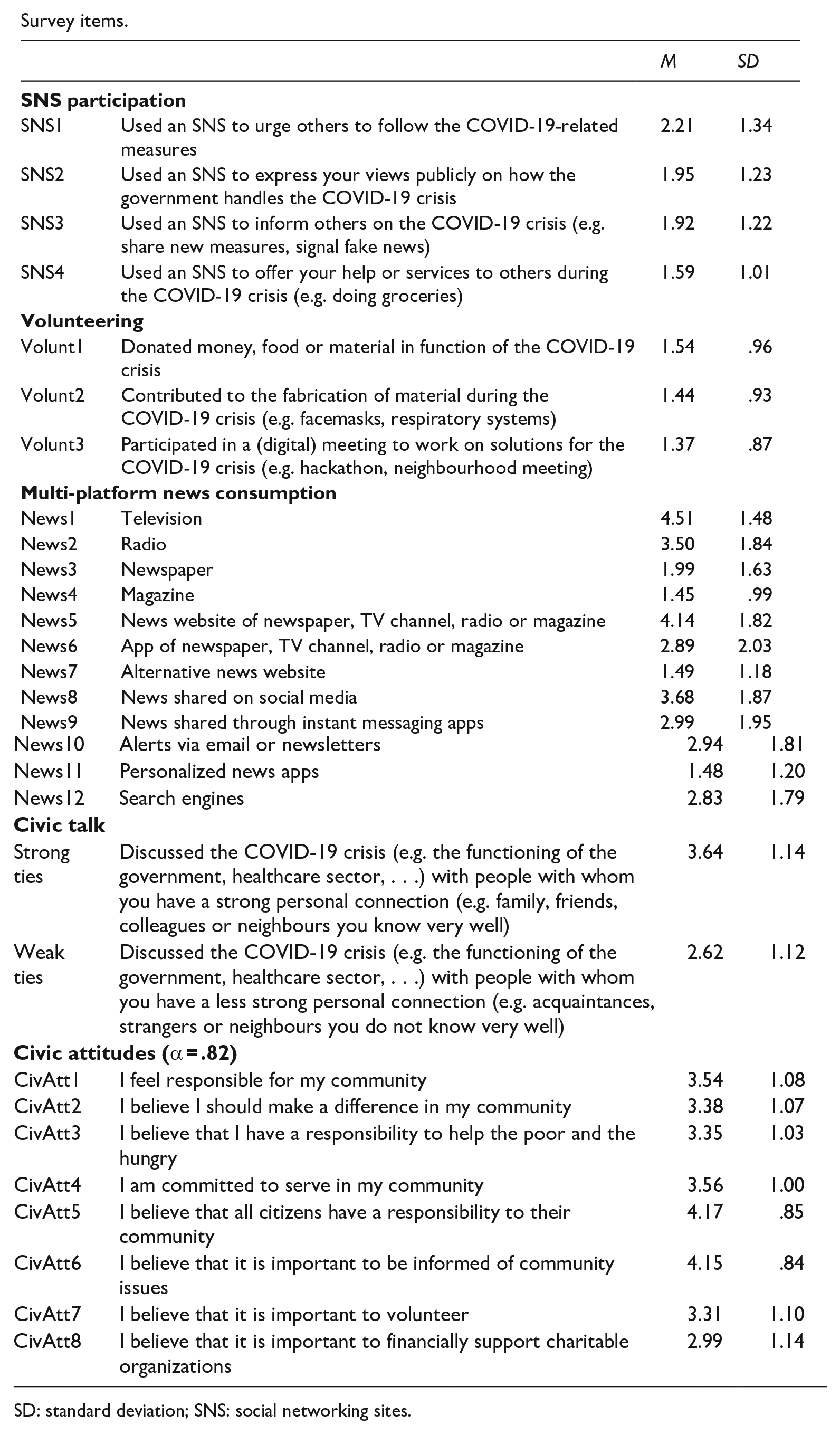
| M | SD | ||
|---|---|---|---|
|
|
|||
| SNS1 | Used an SNS to urge others to follow the COVID-19-related measures | 2.21 | 1.34 |
| SNS2 | Used an SNS to express your views publicly on how the government handles the COVID-19 crisis | 1.95 | 1.23 |
| SNS3 | Used an SNS to inform others on the COVID-19 crisis (e.g. share new measures, signal fake news) | 1.92 | 1.22 |
| SNS4 | Used an SNS to offer your help or services to others during the COVID-19 crisis (e.g. doing groceries) | 1.59 | 1.01 |
|
|
|||
| Volunt1 | Donated money, food or material in function of the COVID-19 crisis | 1.54 | .96 |
| Volunt2 | Contributed to the fabrication of material during the COVID-19 crisis (e.g. facemasks, respiratory systems) | 1.44 | .93 |
| Volunt3 | Participated in a (digital) meeting to work on solutions for the COVID-19 crisis (e.g. hackathon, neighbourhood meeting) | 1.37 | .87 |
|
|
|||
| News1 | Television | 4.51 | 1.48 |
| News2 | Radio | 3.50 | 1.84 |
| News3 | Newspaper | 1.99 | 1.63 |
| News4 | Magazine | 1.45 | .99 |
| News5 | News website of newspaper, TV channel, radio or magazine | 4.14 | 1.82 |
| News6 | App of newspaper, TV channel, radio or magazine | 2.89 | 2.03 |
| News7 | Alternative news website | 1.49 | 1.18 |
| News8 | News shared on social media | 3.68 | 1.87 |
| News9 | News shared through instant messaging apps | 2.99 | 1.95 |
| News10 | Alerts via email or newsletters | 2.94 | 1.81 |
| News11 | Personalized news apps | 1.48 | 1.20 |
| News12 | Search engines | 2.83 | 1.79 |
|
|
|||
| Strong ties | Discussed the COVID-19 crisis (e.g. the functioning of the government, healthcare sector, . . .) with people with whom you have a strong personal connection (e.g. family, friends, colleagues or neighbours you know very well) | 3.64 | 1.14 |
| Weak ties | Discussed the COVID-19 crisis (e.g. the functioning of the government, healthcare sector, . . .) with people with whom you have a less strong personal connection (e.g. acquaintances, strangers or neighbours you do not know very well) | 2.62 | 1.12 |
| CivAtt1 | I feel responsible for my community | 3.54 | 1.08 |
| CivAtt2 | I believe I should make a difference in my community | 3.38 | 1.07 |
| CivAtt3 | I believe that I have a responsibility to help the poor and the hungry | 3.35 | 1.03 |
| CivAtt4 | I am committed to serve in my community | 3.56 | 1.00 |
| CivAtt5 | I believe that all citizens have a responsibility to their community | 4.17 | .85 |
| CivAtt6 | I believe that it is important to be informed of community issues | 4.15 | .84 |
| CivAtt7 | I believe that it is important to volunteer | 3.31 | 1.10 |
| CivAtt8 | I believe that it is important to financially support charitable organizations | 2.99 | 1.14 |
SD: standard deviation; SNS: social networking sites.
Funding
The author(s) disclosed receipt of the following financial support for the research, authorship, and/or publication of this article: This work was funded by the Research Fund of Ghent University (Grantscode BOF.STG.2018.0002.01). The interpretation of the data, the writing of the article and the decision to submit the article were the sole responsibility of the authors and were not influenced by the funding institution.
