




Abstract
Given its significance for society’s character, future and identity, migration has dominated media discourse. At present, the ascendance of digital platforms which broaden opportunities to produce, share and access content online has ignited debates about migration’s discursive construction. Often approached as promoting tolerance and inclusivity, social media are also believed to unleash xenophobia and intergroup antagonism. Working with a cross-section of tweets from the 2019 Canadian Federal election, this article asks how was migration framed, which users influenced the flow and substance of discourse and did Twitter diverge from conventional media space? It finds, while chains of citizen-users overwhelmingly employed Twitter to distribute original content, anti-immigration communications and actors were disproportionately featured. Considering these results, this article introduces the concept of digital nativism to clarify how technical affordances, user intentions and wider socio-political conditions intersect to produce emergent patterns of anti-immigration discourse and mobilization that are participatory, interactive and broadly distributed.
Keywords
Torn between the exigencies of ‘(global) accumulation and (national) legitimation’, affluent societies’ relationship with migration is Janus-faced (Barrow, 2005: 125). While economic and demographic pressures generate demands for workers and settlers, fears regarding national sovereignty and identity are producing counteracting calls for closure. Within this environment, migration attracts extensive, often vituperative, media coverage, with broadcasters defining events and structuring what is socially knowable (Benson, 2013). Beyond shaping the issue’s reality, migration’s mediation clarifies and communicates group boundaries with the identification and construction of strangers, outsiders and ‘others’ underpinning articulations of peoplehood, solidarity and social inclusion and exclusion (Benhabib, 2004).
Currently, digital platforms’ ascendance is upending these arrangements, ensuring migration’s public framing – the discursive process wherein particular elements of issues are foregrounded to promote specific interpretations (Entman, 1993) – is participatory, dynamic and driven by unorthodox actors and claims – making patterns (Meraz and Papacharissi, 2013). While their importance is undisputed, social media’s effects remain contested. Often approached as democratic technologies that promote connectedness and inclusivity, there is growing concern they amplify intergroup antagonism, including nativism, racism and Islamophobia.
Despite growing interest in migration’s digital mediation, knowledge remains impressionistic. Existing studies have provided vivid, thick descriptions of the communication strategies of particular segments of users (Ekman, 2019; Urman and Katz, 2020) and around prominent hashtags (Barisione et al., 2019; Kreis, 2017) and exceptional, high-intensity events (Olesen, 2018; Risam, 2018). While insightful, conclusions derived from analysis of specific discursive configurations or actors offer a partial view, obscuring the more routine, but still consequential, ways migration is constructed online. To capture the breadth and diversity of social media use, this article analyses a broad cross-section of tweets from the 2019 Canadian Federal election – a period where public discourse and issue construction are distinctly salient and accessible (Gruzd and Roy, 2014) – and evaluates their character vis-a-vis legacy outlets. In doing so, it exposes novel communicative patterns and finds anti-immigration messages were overrepresented, generated greater engagement and underpinned by the promotional and discursive labour of lay actors.
Through its findings and methodological approach, this paper not only illuminates Twitter’s implications for migration’s public framing, but improves knowledge of how nativism – a political ideology that opposes migration on the grounds it threatens the nation’s integrity and ethnocultural character (Betz, 2019) – is being restructured by digitally networked communications. Based on its results, the concept of digital nativism is proposed to capture how Twitter’s technical features and social architecture ensure anti-immigration discourse and mobilization, phenomena that have historically been hierarchical, mass-based and the province of authoritative voices and issue entrepreneurs, are increasingly participatory, interactive and broadly distributed. As will be elaborated, considering such dynamics accentuates how technical affordances, user intentions and wider political and discursive opportunities intersect to produce emergent expressions of xenophobia.
This study’s findings are normatively, conceptually and empirically significant. In promoting and legitimating specific orientations, migration’s framing shapes reactions, cultivating solidarities which can foster inclusion or fuel suspicion, antipathy, even violence (Wahlström and Törnberg, 2021). Conceptually, this article’s comparative, empirically grounded approach informs ongoing debates. Despite calls for comparisons with mainstream coverage, social media are overwhelmingly studied in isolation, making it difficult to distinguish general communication patterns from those specific to and shaped by social platforms. Finally, studies typically privilege the United States and Europe. Thus, considering Canada – a country whose citizens embrace social media, but, unlike many, display significant trust in traditional journalism and support for migration and multiculturalism (Kaufmann, 2019) – offers a more complete picture. Before presenting this study’s design, results and significance, the following sections review existing research and contextualize the Canadian case.
Digital boundary maintenance: migration in emergent media environments
Featuring 335 million users and a half-billion daily posts, the micro-blogging site Twitter represents a leading social platform (Lin, 2019). Often entailing mundane interaction and phatic communication, Twitter is also used to discuss important socio-political topics and is transforming public communication. Unlike mainstream media which feature a restricted range of perspectives, as a demotic, many-to-many communication system, Twitter’s technological affordances allow congeries of unorthodox actors to produce and distribute content and shape depictions of events. Social tagging – the use of hashtags, mentions and other digital objects to index, link and publicize discussions – further elevates lay voices, ensuring representations of issues are networked and distributed (Murthy, 2018). Finally, Twitter transforms the quality of narrative construction, encouraging communications that are colloquial, affective and capable of reconfiguring public discourse (Papacharissi, 2016).
Regarding migration, Twitter is increasingly used to engage and debate the boundaries of belonging. Reflecting research on social media, civic engagement and progressive activism (Gerbaudo, 2012), several scholars claim Twitter displays empowering, pro-social effects. As engines of ‘context collapse’ (Marwick and boyd, 2011), Twitter and related platforms encourage engagement with contrary perspectives and socially distant others (Bruns, 2019). In addition, Twitter is believed to foster solidarity, with scholars noting, during the so-called refugee crisis, the circulation of affective, unconventional content assisted in raising consciousness, stirring empathy and breeding support (Olesen, 2018). Finally, like the Arab Spring, Black Lives Matter and other social movements, activists have leveraged Twitter to publicize injustice, build coalitions and encourage direct action around migrants’ rights (Báez, 2018; Costanza-Chock, 2014). Moreover, Twitter is conceived as an alternative media space inflected with views historically excluded from the public sphere – the space where citizens articulate and form opinions through discussion and debate. In permitting minority groups to ‘talk back’, express their lived experiences and cultivate shared discourses and counternarratives, Twitter offers ‘radical new potentials for identity negotiation, visibility, and influence’ (Jackson and Foucault Welles, 2016: 399). Specifically, Twitter’s technical features promote the emergence of ‘networked counterpublics’ (Jackson and Foucault Welles, 2016) and ‘crowdsourced elites’ (Papacharissi and de Fatima Oliveira, 2012) as the platform’s participatory, collaborative character – the ability to amplify particular messages and voices through networked participation – empowers migrants and their advocates to obtain inordinate attention (Risam, 2018).
Conversely, it is argued digital platforms’ communicative structure, algorithms and governance facilitate other-directed hostility and ‘platformed’ racism (Matamoros-Fernández, 2017) and antagonism (Farkas et al., 2018). Regarding Twitter, with messages limited to 280 characters, the site precludes complexity, favouring one-dimensional (1D) assessments where foreigners are often positioned as separate from and against the national citizenry (Betz, 2019). Furthermore, when combined with the impulsivity surrounding Twitter’s accessibility and ease-of-use, distanciated and depersonalized interactions encourage incivility and normalize hate speech (Theocharis et al., 2020). Although not appearing to cause parochialism in a strict, deterministic sense, Twitter’s architecture is also believed to route information in ways that harden cultural faultiness. Alongside permitting users to filter content, promotional algorithms ensure individuals who have engaged with xenophobic communications are more likely to encounter similar content as Twitter recommends associated hashtags, accounts and information (Kreis, 2017). Thus, while claims of hermetically sealed echo chambers are overstated as individuals encounter multiple information sources within today’s high-choice media ecosystem (Dubois and Blank, 2018), digital platforms appear to promote ideological clustering and in-group favouritism, dynamics distinctly conspicuous among conservatives harbouring xenophobic views (Heiss and Matthes, 2020). 1 Moreover, anti-immigration discourses resonate with Twitter’s attention-oriented commercial logic, which, by prioritizing virality, promotes sensationalist and incendiary communications about despised others (Hopster, 2021). Finally, given the surfeit of access points and absence of professional gatekeeping, Twitter is frequently exploited by extremists. Whether by seeding content, encouraging harassment, or pursuing forms of ‘attention hacking’ (Marwick and Lewis, 2017), disenchanted individuals and hate groups have weaponized Twitter’s affordances to energize receptive users, attack migrants and other marginalized groups and expand their influence (Awan, 2014; Walsh, 2020c).
While scholars have interrogated Twitter’s role in advancing illiberal agendas, correcting undue emphasis on its democratic possibilities, such issues have not been sufficiently plumbed. Accompanying discrete discursive strategies (Poole et al., 2021), research has prioritized elites and established communicators and organizations, including charismatic leaders (Fuchs, 2018), anti-immigration parties (Stier et al., 2017), policing agencies (Walsh, 2020b) and extremist groups (Ekman, 2018), while neglecting emergent framing patterns and broad participation from ordinary users. Accordingly, existing studies are less precise about how social media are reconstituting, rather than simply accelerating or amplifying, anti-immigration discourse, with knowledge of digitally connected ‘anti-publics’ (Cammaerts, 2007) or anti-democratic counterpublics motivated by xenophobia and ethnoracial animus remaining fragmentary and limited (Ekman, 2018). 2
This study addresses this lacuna by systematically analysing Twitter discourse from the 2019 Canadian election and engaging the following research questions: how is migration constructed online, which users influenced the flow and substance of discourse, and does Twitter diverge from conventional media space, offering counternarratives and alternative accounts of events? In mapping the broader universe of discourse and activities of and connections between manifold participants, it captures significant, but neglected, discursive practices and configurations, revealing, whether concerning patterns of framing, participation or engagement, Twitter disproportionately featured anti-immigration messages and actors, with communications being dominated by cultural and security-based concerns, driven by ordinary users, skewed towards original content and displaying significant connectivity.
In interpreting these outcomes, the concept of digital nativism is offered as a starting point and lens for assessing how Twitter’s logic and affordances offer potent opportunities to propagate xenophobic agendas from the bottom-up. Accordingly, while assessments of nativism have traditionally prioritized elite actors and unidirectional appeals to masses of anxious, atomized citizens (Young, 2017), this study reveals new dynamics of claims-making and assembly where anti-immigration discourse and agendas are constructed, distributed and amplified through the routine and overlapping activities of multifarious actors. Specifically, it details how ordinary end-users disproportionately leveraged Twitter’s participatory, interactive and connective architecture to align themselves with, contribute to and link broader exclusionary narratives, creating patterns of discourse that were interconnected, pluralized and disruptive of dominant narratives.
While such results appear to imply Twitter favours and amplifies anti-immigration content, rather than a necessary affinity, this study suggests such outcomes likely stem from the distinctive motivations and desires for action possessed by participants. As elaborated in the conclusion, since progressive actors were equally able to access Twitter’s affordances, the prominence of nativist communications appears to have socio-political, as much as, technological origins. With nativists distrusting and opposing establishment voices, as well as, finding their views disparaged within the Canadian press and political sphere (Gillies, 2020), such users possessed uniquely powerful justifications for circulating counter-discourses online. Thus, as a sensitizing concept, digital nativism not only expands knowledge of xenophobia’s articulation in visible digital spaces but illuminates complex, reciprocal interactions between the communication practices of illiberal counterpublics and mainstream discourse and institutional arrangements.
Migration, nativism and the Canadian Federal Election
While Canada is often framed as ‘exceptional’, given historically broad support for large-scale migration, refugee resettlement and official multiculturalism (Trebilcock, 2019), developments preceding the 2019 election unsettled such arrangements, transforming migration into a source of significant, often rancorous, debate.
The months before the election were punctuated by claims of ‘crisis’ as Canada’s Southern border experienced an influx of irregular asylum-seekers following the Trump administration’s ‘refuge ban’. Within this context, the Conservative opposition labelled uncontrolled migration a security risk and affront to Canadian sovereignty and hospitality (Gaucher, 2020). In addition, the Liberal Trudeau administration’s policies, whether increasing annual migration targets or accepting thousands of Syrian refugees produced significant outcry, with the majority of right-wing voters expressing racialized anxieties (Graves and Smith, 2020). 3 Hardened sentiment has been accompanied by appreciable far-right mobilization. Canadians are among the most active participants on extremist websites and forums (Daigle, 2020), and Canada has experienced a recent surge in hate crimes (Kheiriddin, 2019). Politically, such dynamics were acutely visible in the rise of the anti-immigration People’s Party of Canada [PPC]. Unlike the leading federal parties – Liberal [LPC], Conservative [CPC] and New Democratic [NDP] – who remained committed to migration and cultural pluralism; the party’s agenda drew on a mix of Islamophobia, racism and nativism with its leader, Maxime Bernier, promising to end ‘mass migration’, abolish official multiculturalism and vet migrants – particularly those of Muslim background – according to their cultural values. While such appeals were frequently yoked to liberal principles, including tolerance, secularism and gender equality, the party embraced exclusionary ideologies, with Bernier refusing to disavow support from white supremacist groups and claiming the prevailing ‘cult of diversity’ threatened Canada’s western identity. While receiving less than 2% of the popular vote, the PPC’s agenda continues to resonate with many disenchanted Tories, creating future political openings and signalling nativism’s reappearance in federal politics and public discourse (Kleinfeld and Dickas, 2020).
While all federal parties have embraced social media as publicity machines, like other far-right groups, online platforms were distinctly prominent in the PPC’s outreach efforts. Possessing diminutive resources and largely excluded from media and political space, Twitter, in particular, was employed by the party’s leadership and supporters to bypass media gatekeepers, build a so-called ‘People’s Network’ and cultivate and channel anger towards common national enemies, whether migrants or political and cultural elites acting in contravention of the nation’s interests (Pinkerton, 2018). Such developments have not, however, gone unchallenged. Reflecting increased polarization, support for immigration has expanded on the left and, reacting to the PPC, the LPC and NDP escalated their electoral strategy of denouncing xenophobia and racism, with pro-immigration candidates and their supporters making extensive use of digital platforms (Ling, 2019). Accordingly, the election offers a fruitful site for interrogating migration’s digital mediation.
Methods
All tweets featuring migration-related keywords and at least one hashtag referencing the election (e.g. #elxn43) or Canadian politics (e.g. #cdnpoli) were gathered during the electoral cycle (September 11–October 21) using Twitter’s API (n = 13,029). 4 To ensure a representative data set while facilitating in-depth analysis, after removing accidental inclusions, a systematic sample containing every fifth message was assembled (n = 2273). Alongside addressing concerns about the representativeness of Twitter’s API, this approach allowed broad topics and chains of discourse, rather than discrete events and segments of users, to be tracked and reconstructed. Such targeting also ensured the study’s parameters were theoretically salient. As communicative anchors that contextualize many-to-many conversations, widely recognized hashtags indicate, rather than sectional, communications were crafted to share information, perform ‘publicness’ and shape mainstream discourse (Bruns and Burgess, 2011a).
Tweets were compared with legacy media. Newspaper headlines published during the election featuring migration-related keywords were gathered (n = 215), with leading national and regional outlets contained in the database Canadian Newsstream being targeted to capture geographic, ideological and stylistic (tabloid vs broadsheet) variation. Headlines are readily comparable. Like tweets, they are telegraphic and quickly summarize events. In addition, readers engage with headlines more frequently than full-text articles, rendering them distinctly influential (Richardson, 2006).
In articulating their desirability and moral worth, communications about migrants and refugees often represent forms of boundary work that engage relations and inclusion and exclusion and display decisive implications for polity’s parameters, identity and future (Bosniak, 2008; Walsh, 2015). Accordingly, beyond addressing an ‘imagined audience’ of users (Marwick and boyd, 2011), sample messages frequently offered normative appraisals of what the ‘imagined community’ of the nation should look like (Anderson, 1991). To capture migration’s discursive construction, data concerning message frame, sentiment and authorship was collected and analysed. Tweets and headlines were assigned one of the following frames: victim, contributor, risk and other. Messages coded victim portrayed migrants as innocent individuals adversely affected by external events or the actions of others. If messages positioned migration as benefitting society, they were coded contributor. Communications designated risk problematized migration, characterizing migrants as undeserving outsiders and sources of harm. When multiple frames were potentially present, messages were coded as the leading frame. If a predominant frame could not be established, the message was considered ambiguous and coded other. Beyond defining situations, frames fuel emotions and contain tonality (Jasper, 2011). In highlighting migrants’ vulnerability and benefits, the victim and contributor frames were likely to elicit compassion and approval and, thus, were classified as containing positive sentiments. Conversely, in depicting migrants as threatening others, messages coded risk were likely to generate fear and hostility and coded negative. The final category – other – involved messages lacking tonality. Accompanying factual or neutral statements, it included ambiguous, contradictory or confusing communications. Messages coded positive, negative and other were assigned scores of +1, −1 and 0 to calculate mean sentiment and dissect trends in tonality. Table 1 features messages containing each frame.
Frame categories in Twitter posts.
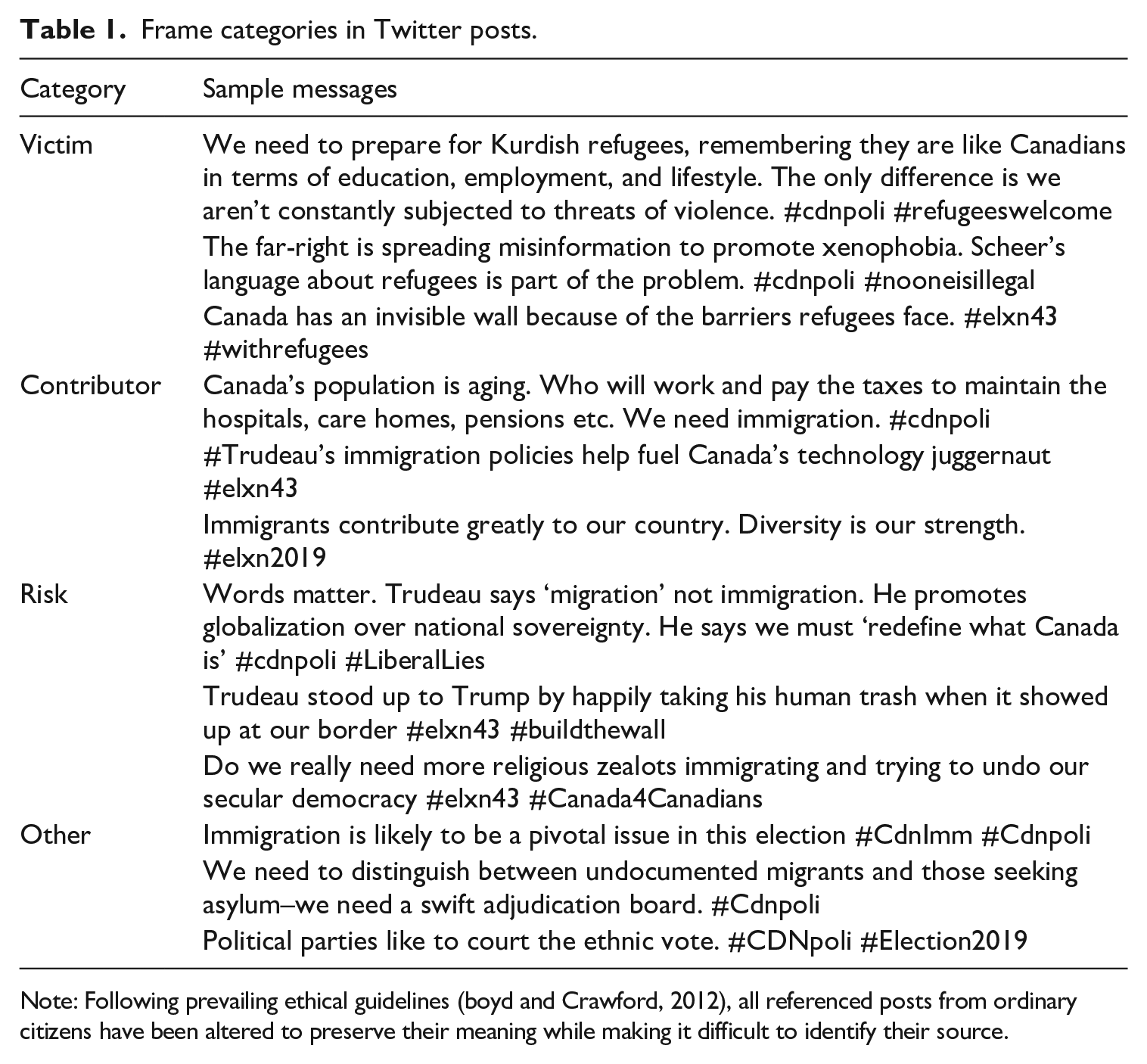
Note: Following prevailing ethical guidelines (boyd and Crawford, 2012), all referenced posts from ordinary citizens have been altered to preserve their meaning while making it difficult to identify their source.
To assess the plurality of voices on Twitter and delimit particular groups of end-users, patterns of authorship, whether concerning institutional standing (citizen-users versus politicians, journalists, intellectuals and other conventional elites) or party identification and political ideology were recorded. Regarding the latter, party identification reflected users’ endorsement of a specific candidate or party while ideology entailed alignment with the right or left of the political spectrum. 5 Only parties supported by over 5% of sample users were analysed. These included the: far-right PPC, centre-right CPC, governing and centre-left LPC and progressive NDP. Coding decisions were made by consulting users’ biographies and recent posts.
While textual data can be computationally analysed, machine-led approaches struggle establishing communications’ deeper meanings (Murthy, 2018). Accordingly, to preserve contextual nuance, communications were hand-coded. When present, other media objects (emojis, images etc.) were briefly examined to inform coding decisions. To ensure consistency, messages were assessed by at least two members of the research team. If consensus was unattainable, the message was deemed uncodable and categorized other to enhance the study’s reliability. 6
While content analysis exposes the thematic and affective contours of discourse and meaning-making, it cannot account for digital platforms’ organizing possibilities and ‘ecology of social mechanisms’ (Tufekci, 2017: 117). Through the presence of digital and syntactic markers (likes, retweets, hashtags and mentions) Twitter contains ‘aggregative functionalities’ (Gerbaudo, 2018) that promote ideational and thematic clustering and link users and posts in communicative networks. Accordingly, while specifying the entire discursive network’s topography and evolution exceeds this article’s ambit, descriptive statistics concerning networked participation and engagement were employed to gauge the relational qualities of communication, construct a profile of nodes and analyse differences in users’ behaviour and resonance. To identify bridges or users distinctly active in linking communications and shaping their diffusion, data concerning the use of hashtags was scrutinized. In addition, mentions and retweets were used to pinpoint hubs or crowdsourced elites within the discursive network. As basic measures of in-degree, mentions and retweets were treated as connections between users and indicators of popularity and influence. Word frequency counting software was used to tabulate the frequency of ties between users with directed links being recorded if syntactic markers were present that suggested one user referenced (@) or shared content from (RT) another. Such procedures were also employed to calculate the overall degree of connectivity and proportion of isolates or disconnected users. Finally, the receipt of likes and retweets was analysed to measure responsiveness, impact and the extent messages affiliated with particular users, frames and sentiments were endorsed and shared.
Results
Frames and sentiment
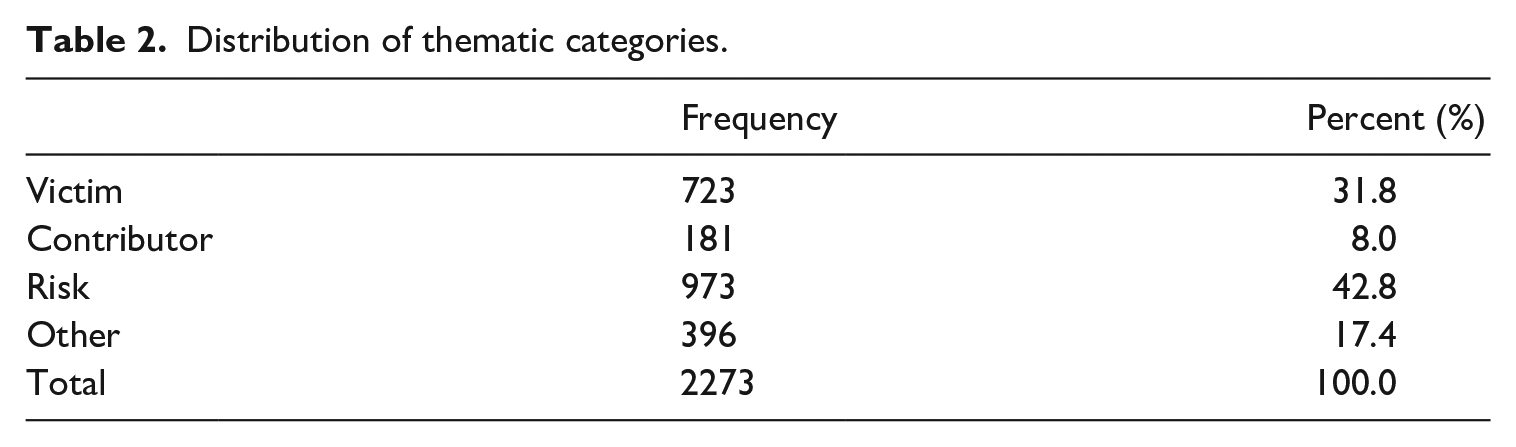
Table 2 presents the distribution of message frames. For tweets expressing tonality, the leading frame was risk (42.8%; n = 973). Such messages constructed migrants and refugees as alien, immoral and responsible for various social problems, implying their arrival and presence jeopardized the integrity of the national citizenry. As with xenophobia generally (Hervik, 2011), issues concerning physical danger, symbolic identity and material interests represented leading themes. In the first instance, foreigners were pathologized as predatory and responsible for criminality, diminished sovereignty, extremism and violence: Politicians are temporary. Militant immigrants are difficult to get rid of and cost lots of lives. #cdnpoli #nomoreterrorists Who let ISIS into Canada? And the illegal border crossers? #cdnpoli #TrudeauMustGo #openborders Trudeau opened our borders to 60,000 Syrian Islamists. See how well Sweden has done with dozens of rapes per day. #cdnpoli #PPC2019
Distribution of thematic categories.
Foreigners were also constructed through repertoires of essentialized difference with migrants’ origins and backgrounds – whether linguistic, ethnoracial or religious – conceived as disrupting the presumed isomorphism between people, place and identity: Trudeau supports mass migration, open borders, and the removal of Christian values that founded this great country. #elxn43 #PPC #Globalism The CBC [Canadian Broadcasting Corporation] celebrates The Replacement of Whites by Immigrants. #cdnpoli #qanon #alt-right #defundCBC Migration will extinguish Canadian identity #MCGA #elxn2019 #stopmassimmigration
Accordingly, large-scale diverse immigration was portrayed as fragmentary, unassimilable and endangering Canada’s future and ostensibly superior culture and identity. Finally, xenophobia was tethered to material concerns surrounding employment, overpopulation and profligate spending, with foreigners depicted as burdens and competitors: Rental prices up 40% in Toronto. Will get worse with a Tsunami of immigrants. #elxn43 #housingcrisis Where is the immigration restriction policy to protect the climate and sensitive ecosystems? #cdnpoli Ending mass-migration will save $30 billion and drive-up wages. #elxn43 #PPC
Together, the profile of anti-immigration communications reveals important shifts in migration’s framing. While studies of news-making in Canada (Bauder, 2008) and elsewhere (Philo et al., 2013) imply anti-immigration sentiment is predominantly informed by instrumental and socioeconomic issues, when considering their primary themes, tweets overwhelmingly linked migration to security (42.5%, n = 414) and identity-based (35.4%, n = 344) concerns. Several leading hashtags featured in anti-immigration communications further evince a nativist turn and reveal palpable anxiety around safety (#nomoreterrorists, #bettervetting), sovereignty (#illegals, #openborders) and cultural displacement (#Canada4Canadians, #stopmassimmigration).
Whether problematized in political, cultural or socioeconomic terms, migrants frequently represented targets of visceral hostility. Accompanying affective expressions of fear, loss and insecurity, many tweets contained dehumanizing speech that associated migrants’ bodies and origins with pollution (e.g. ‘scum’, ‘human trash’ and ‘shithole countries’), dynamics that promote their othering by making them easier to abhor and condemn (Cisneros, 2008). Accordingly, anti-immigration messages often constructed binary oppositions between an in-group of virtuous, respectable citizens and threatening out-group whose exclusion is necessary and desirable. Furthermore, as the preceding communications reveal, beyond blanket xenophobia, discourse was often racialized with Muslims, in particular, deemed categorically suspect. Alongside referencing news stories about violent, often sexually based, crimes in Europe and North America, users asserted connections between refugees, terrorism and extremism and characterized migrants as agents of Islamification, a deliberate attempt to usurp political power and undermine society’s legal and cultural basis. Whether animated by Islamophobia or parochialism generally, by cultivating exclusionary solidarities, such framings may promote conflict, legitimate hierarchy and foster the ossification of group boundaries, portending a polity that is more defensive, tribal and factious (Evolvi, 2019; Walsh, 2020a). Moreover, alongside encouraging withdrawal from social platforms and disengagement from public life (Munger, 2017), encounters with hostile, exclusionary discourse and related forms of symbolic violence have been found to reinforce migrants’ othering in ways that affect their self-identities, generating anxiety and perceptions of inferiority in which their marginalization is internalized as normal, even deserved (Menjivar and Abrego, 2012).
The inclusion of anti-elite discourse also suggests, for many users, Twitter constituted a nativist counterpublic for reconfiguring public discourse and advancing perspectives excluded from the mainstream public sphere. Here, the platform was appropriated to promote fringe views as users frequently circulated far-right tropes originating in Europe and the United States, including nativist and alt-right phrases (‘Make Canada Great Again’ [#MCGA], #BuildTheWall, #Globalism etc.) and conspiracies migration was orchestrated by secretive, nefarious elites to obtain future votes or displace white populations (‘The Great Replacement’). Furthermore, while anti-immigration actors often appeared to belong to dominant groups, many self-identified as marginalized and part of a counterhegemonic struggle. Accordingly, alongside expressing disaffection with political and cultural elites, dynamics displayed in several hashtags (#Trudeaumustgo, #DefundCBC, #DefundtheUN, #Globalism, #LiberalLies), many users framed their messaging as exposing threats establishment actors had ignored, downplayed or suppressed. Ultimately, in portraying legacy outlets and elected officials as withholding the truth and acting in contravention of ‘common sense’ thinking, such claims represent populist counternarratives in which anti-immigration actors were positioned as promoting the values and interests of a silenced, forgotten majority (Gerbaudo, 2018).
Rather than indiscriminately negative, Tweets were counterbalanced by humanizing and supportive content. The positively toned victim (n = 723) and contributor (n = 181) frames were present in 39.8% of messages. Communications coded victim highlighted migrants’ marginality, whether stemming from official policy, warfare, economic exploitation, discrimination, or other sources of deprivation and exclusion. The contributor frame, which stressed migration’s benefits, whether concerning cultural vibrancy, innovation or economic and workforce growth, was significantly underrepresented. Pro-immigration messages were most likely to engage with perceived xenophobia as 60.8% (n = 550) highlighted and critiqued experiences of prejudice, racism and cultural denigration. Accordingly, beyond discussing migrants’ vulnerability and virtues, positively toned messages often contested nativist discourse by asserting migrants’ personhood, debunking stereotypes and censuring individuals perceived as promoting fearmongering and hate speech. For instance, users frequently fact-checked misrepresentations of migrant numbers, costs and methods of arrival (e.g. ‘Bernier doesn’t care migrants have a positive economic impact’; ‘Refugees don’t “jump a line” – stop spreading hate’) to counteract misinformation and, by inserting various hashtags (e.g. #refugeeswelcome, #nooneisillegal, #noborders, #stopdetention), expressed solidarity. Hence, alongside fostering exclusionary anti-publics, Twitter was appropriated to promote inclusive perceptions of shared humanity and deservingness.
Computing the ratio of positive to negative messages produced a mean sentiment score of −.03, revealing anti-immigration discourse was slightly overrepresented. However, when read in isolation, such results obscure important trends. Accordingly, messages were interrogated through three additional optics.
First, tweets were compared with newspaper headlines. If social and conventional media discourse are equivalent, there is little reason to reject the null hypothesis of Twitter reflecting, rather than transforming, public communication. Table 3 reveals tweets disproportionately contained negative tonality, with analysis revealing substantial, statistically significant differences. Accordingly, contra claims of consistent anti-immigration bias, headlines typically offered positive assessments, outcomes likely derived from the fact, for broadsheets specifically, discourse is constrained by professional standards concerning accuracy, fairness and harm limitation (Iggers, 2018). In addition, while tweets were skewed towards migration’s effects on sovereignty and identity, when headlines problematized migration, they adopted a restrictionist perspective where migration was opposed on instrumental grounds – its economic, environmental and fiscal effects. While over one-third of negatively toned tweets referenced cultural and identity-based concerns, only 11.8% (n = 8) of headlines did. Finally, unlike tweets, headline’s tonality correlated with general public opinion. For example, an Environics Institute poll from October 2019 revealed the ratio of favourable to unfavourable views of migration to be 63:34 versus 61:32 for sample headlines (Carbert, 2019). Further demonstrating Twitter’s appropriation as a reactionary counterpublic, such results suggest, instead of mirroring legacy media or public sentiment, the site reapportions discursive opportunities and presents a propitious setting for propagating nativist ideologies and their emphasis on ethnocultural preservation and integrity.
Thematic frames and mean sentiment of tweets and headlines.
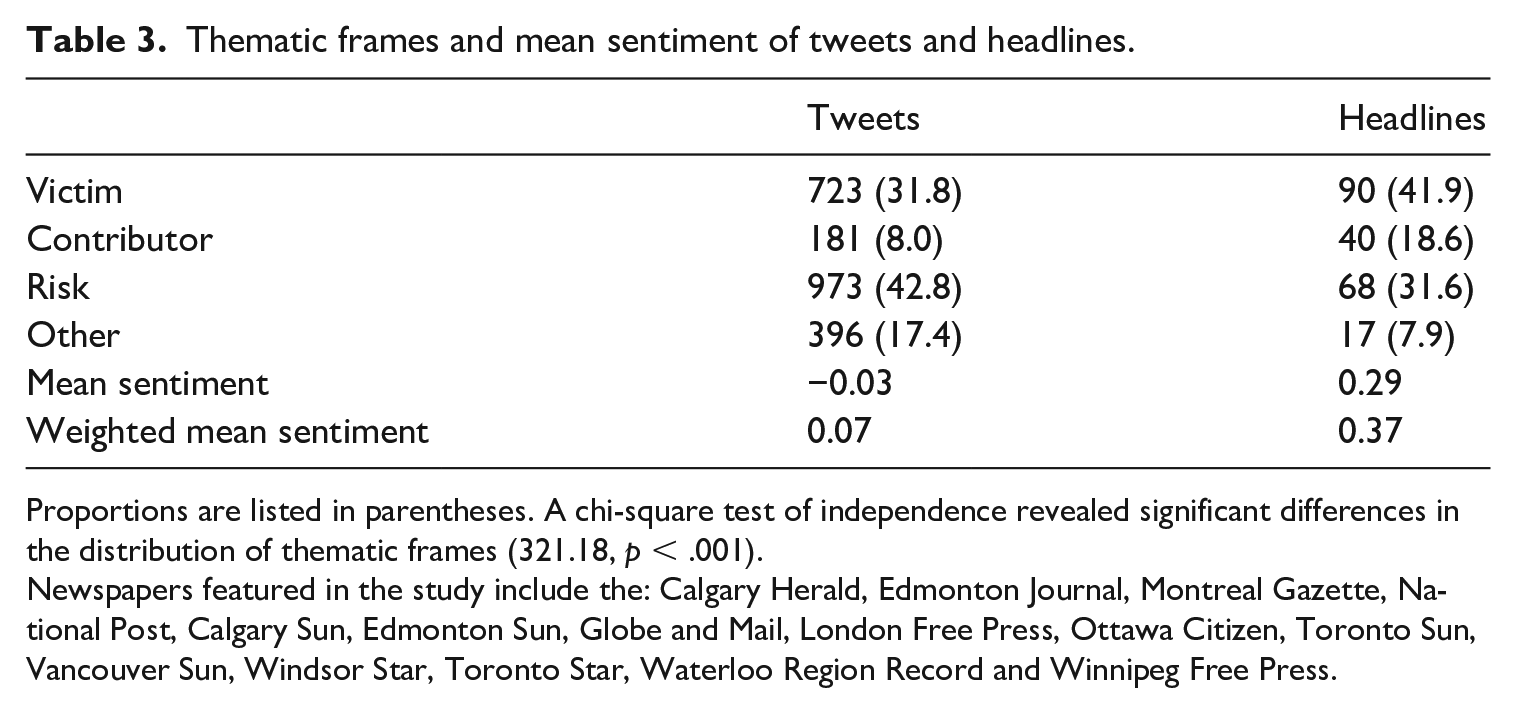
Proportions are listed in parentheses. A chi-square test of independence revealed significant differences in the distribution of thematic frames (321.18, p < .001).
Newspapers featured in the study include the: Calgary Herald, Edmonton Journal, Montreal Gazette, National Post, Calgary Sun, Edmonton Sun, Globe and Mail, London Free Press, Ottawa Citizen, Toronto Sun, Vancouver Sun, Windsor Star, Toronto Star, Waterloo Region Record and Winnipeg Free Press.
Second, given Twitter users and newspapers are not monolithic, the distribution of sentiment scores may partly reflect the profile of sample accounts and outlets. Thus, communications’ tonality was analysed in relation to different types of users (lay vs expert) and outlets (left broadsheet, right broadsheet and tabloid). 7 Table 4 reveals, compared to experts, citizen-users disproportionately posted negative tweets. Regardless of their sources, tweets were less likely to feature positive sentiments than broadsheets, while tabloids were most likely to problematize migration. Found to be statistically significant, differences in mean sentiment between citizen- and expert-users (.35), as well as, between Twitter and left and right broadsheets (.58 and .59), suggest grassroots participation unleashes negativity and resentment.
Message frame and sentiment by account and newspaper type.
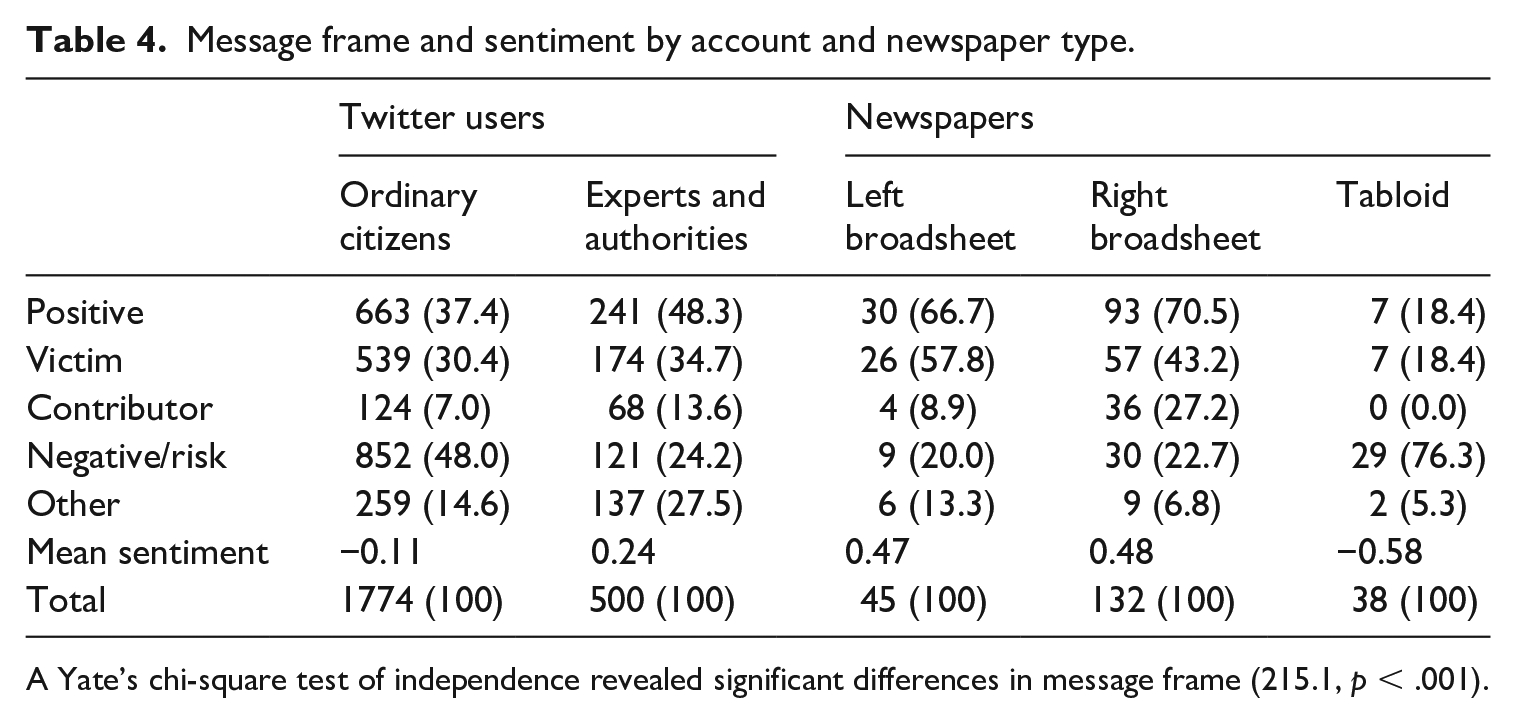
A Yate’s chi-square test of independence revealed significant differences in message frame (215.1, p < .001).
Twitter users’ party identification was also considered. Users associated with the LPC and NDP posted 20.9% and 6.2% of messages, while CPC and PPC supporters were responsible for 17.1% and 16.7%, suggesting far-right perspectives were disproportionately featured. 8 Moreover, considering political background revealed significant struggle over migration’s symbolic construction. Discourse was polarized with CPC (M = −.68) and PPC (M = −.81) supporters offering unfavourable assessments, while individuals aligned with the LPC (M = .57) and NDP (M = .70) disproportionately espoused pro-immigration rhetoric (Table 5). Together, such findings expose the paradoxes of participation as, alongside empowering progressive voices, the democratization of media-making can also be leveraged to promote anti-democratic agendas. Ultimately, these results challenge Habermasian claims expanding access to the public sphere represents an antidote to conflict, enmity and extremism.
Message frame and sentiment by party identification.
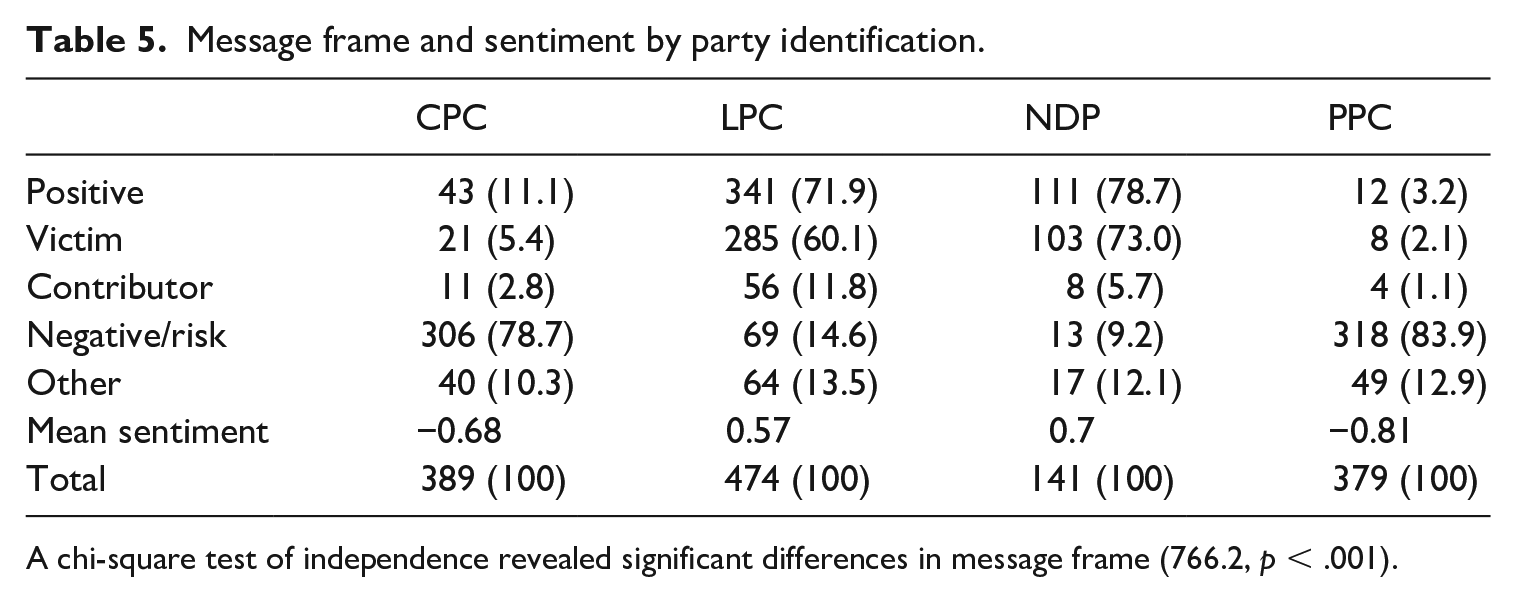
A chi-square test of independence revealed significant differences in message frame (766.2, p < .001).
Finally, with the fragmentation of media space, communications’ reach varies substantially. To account for variability in readership and illuminate the pathways messages potentially traverse, sentiment scores were adjusted to reflect messages’ visibility. For headlines, scores were weighted according to their respective outlet’s average circulation, while tweets were weighted based on the follow ratio (followers per account divided by followees), a reliable estimation of interest from others. 9 As Table 2’s final row reveals, while such weightings raised the mean sentiment of tweets and headlines to .07 and .37, suggesting pro-immigration discourse reached more individuals, tweets remained comparatively negative.
To capture patterns of claims-making, identify influential users and gauge communications’ resonance, statistics concerning participation and engagement within the discursive field are presented and analysed below.
Participation and engagement
Concerning the profile of claimants, tweets were overwhelmingly circulated by citizen-users (78.1%; n = 1775), with the remainder posted by media outlets and journalists (9.0%; n = 204) or other experts (12.9%; n = 294). 10 Twitter also featured significant popular creativity. Messages were largely original with 63.4% (n = 1441) authored by the posting account. Accounts coded media were most likely to post user-generated content (84.3%; n = 172) while citizens were least (58.5%; n = 1038). Accordingly, while not entirely autonomous and informed by discourses produced by powerful actors and in various settings, citizen-users typically appropriated Twitter to independently lodge claims, offer interpretations and take sides on migration and refugee issues. When accounting for political ideology, grassroots participation was particularly visible among right-wing users. Alongside being overrepresented, right-leaning accounts appeared distinctly vocal and energized, tweeting 12.5% more frequently than left-wing users (z = 2.17, p = .03). 11 In addition, significant differences in the ratio of citizen- to expert-users among right (90:10) and left-leaning (77:23) accounts were observed (χ2 = 40.89, p = .000), with conservatives also being more likely to post original content. 12
Accompanying authorship, the relational qualities of discourse were assessed to capture connectivity and identify which users were more active in steering and anchoring the communication network.
First, hashtag use was compared. As forms of ‘searchable’ talk, hashtags’ inclusion often represents a process of social tagging that, by suturing audiences and re-embedding communications in new contexts, encourages ‘ambient affiliation’ (Zappavigna, 2018) and the formation of ‘ad hoc issue publics’ (Bruns and Burgess, 2011b). Accordingly, their presence reveals the extent Twitter’s sociotechnical affordances were leveraged by different users. Anti-immigration communications were 19% more likely to feature hashtags (z = 4.35, p = .000), with tweets from far-right PPC supporters featuring 32% more than pro-immigration users (z = 4.47, p = .000). Such findings imply right and far-right users were more likely to act as bridges and information brokers who strategically appropriate Twitter to promote particular users and narratives.
Users’ mentioning activities were also assessed to illuminate the allocation of attention and identify crowdsourced elites – nodes frequently referenced or retweeted by others. Regarding the entire discursive network, while over two-thirds (n = 16) of the top 25 in-degree hubs were associated with federal parties (@cpc_hq, @lpcpressbox, @peoplespca) and their leaders (@andrewscheer, @maximebernier, @justintrudeau, @jagmeetsingh, @elizabethmay) or mainstream journalists (e.g. @mariekewalsh, @cgalipeauTJ) and news outlets (e.g. @ctvnews, @macleans, @globalnews), alternative information sources were also present as the remaining accounts represented niche outlets associated with tabloid (@sunlorrie), far-right (@rebelnewsonline, @truenorthcentre), ethnic (@immigrantnews) and digital media (@cdnpoli_memes) or activist organizations (@migrantrightsca) and ordinary citizens embracing nationalist-conservative and extremist ideologies (n = 3). In addition, Twitter’s appropriation appeared to elevate non-dominant voices and reconfigure hierarchies of influence as several crowdsourced elites garnered attention despite lacking elite connections or large follower counts. In particular, correlation analysis found no association between followers and in-degree (r = .217, p = .297).
Comparing the profile of crowdsourced elites promoted by pro- and anti-immigration users reveals noticeable differences in the structure of attention and information flow. Those opposed to migration were significantly more likely to promote actors and perspectives excluded from the mainstream public sphere. While progressive actors – activist groups (n = 1), alternative media (n = 2) and ordinary citizens (n = 2) – were present among the top 25 pro-immigration hubs, establishment voices consisting of conventional broadcasters and political elites (n = 20) were overwhelmingly featured. Conversely, anti-immigration actors displayed a clear preference for lay voices and far-right perspectives. Ordinary citizens (n = 9) and far-right media (n = 3) were overrepresented, while accounts associated with establishment voices were underrepresented (n = 13) with many of the latter (e.g. @liberal_party, @justintrudeau) only featured due to significant expressions of frustration and resentment.
While, like most social networks, attention and influence were hoarded by a handful of accounts, prioritizing key hubs neglects significant connectivity among non-elite users. Specifically, while the entire network’s top 25 in-degree nodes were present in 42% of mentions and retweets, the majority of such exchanges occurred among less influential accounts. Furthermore, tweets were highly integrated and typically enmeshed in interaction chains. When including likes as a measure of connectivity, only 20% (n = 454) of users were not referenced, retweeted, or endorsed and, as such, represented isolates. 13 Such results suggest, while disparities of visibility and influence were present, the communication network displayed a more lateral, multicentric structure where, rather than simply engaging with social media elites (whether established or emergent), notable interaction among peripheral nodes also occurred. Such results are significant as prior studies of Twitter use around dramatic media events, prominent hashtags and viral episodes concerning migration found the platform represented an ‘echo chamber’ (Barisione et al., 2019) with media outlets and traditional opinion leaders representing critical interactants, while masses of disconnected users lacked voice, reacted to and recirculated elite-generated content (see also Poole et al., 2021; Siapera et al., 2018).
Given attention was broadly, albeit unequally, distributed, analysing the number of engagements (likes and retweets) messages received helps illuminate patterns of reception and resonance throughout the discursive field. Figures 1–5 visually depict engagements as a function of message source, sentiment and frame. While conventional elites received more engagements than citizen-users (Figure 1), such results were not statistically significant (z = .68; p = .494), suggesting influence was dispersed. Figure 2 reveals engagements were not correlated with party identification, with a one-way analysis of variance (ANOVA) test finding no significant group differences (F = 1.05, p = .370). Nonetheless, far-right communications generated disproportionate attention as messages from PPC-tagged accounts received 10% more engagements than supporters of the governing LPC which obtained 20 times the share of the popular vote. Responsiveness was associated with political ideology as messages from right-wing accounts received significantly greater engagements (z = 2.25; p = .024, Figure 3). Further underscoring the centrality of lay voices among anti-immigration users, citizen-users associated with the political right received 22.1% more engagements than left-wing establishment actors. Regarding sentiment and frame, negatively toned messages generated greater engagement with a one-way ANOVA test revealing significant group differences (F = 8.1; p = .000, Figure 4) and pairwise variations between the negative and other groups (p < .01), as well as, positive and other groups (p < .05). Finally, Figure 5 indicates framing influenced responsiveness (F = 6.9, p = .000) with the risk category generating greater engagement. Post hoc tests found significant differences between the risk and contributor group (p < .05), risk and other group (p < .001) and victim and other group (p < .05).
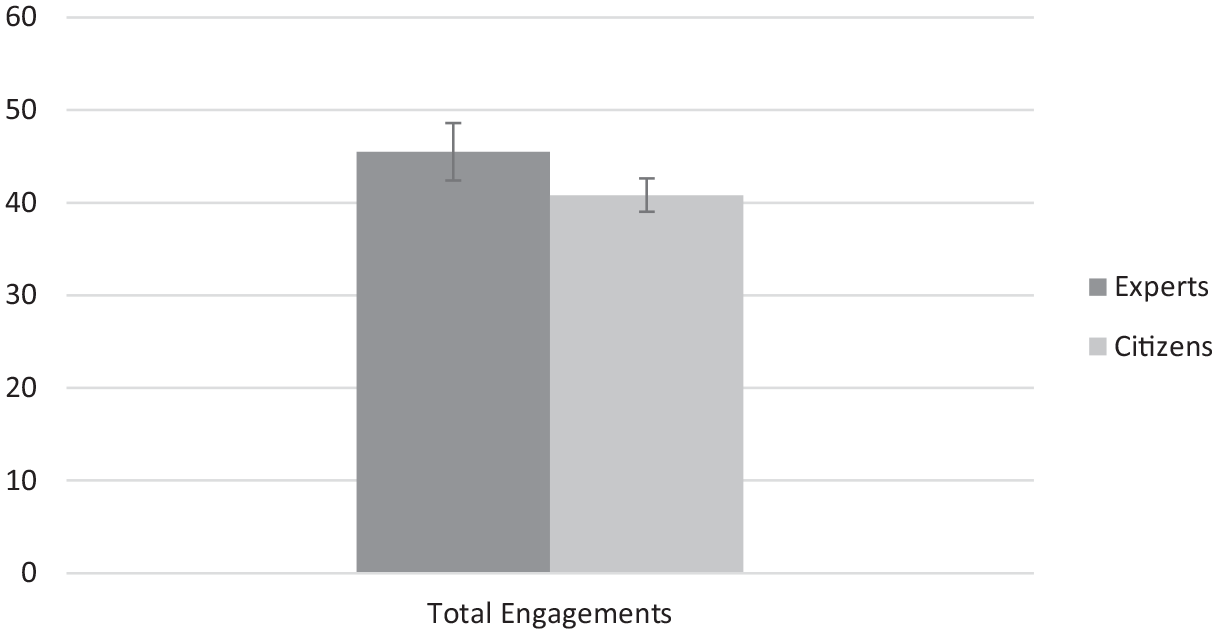
Engagements by user category.
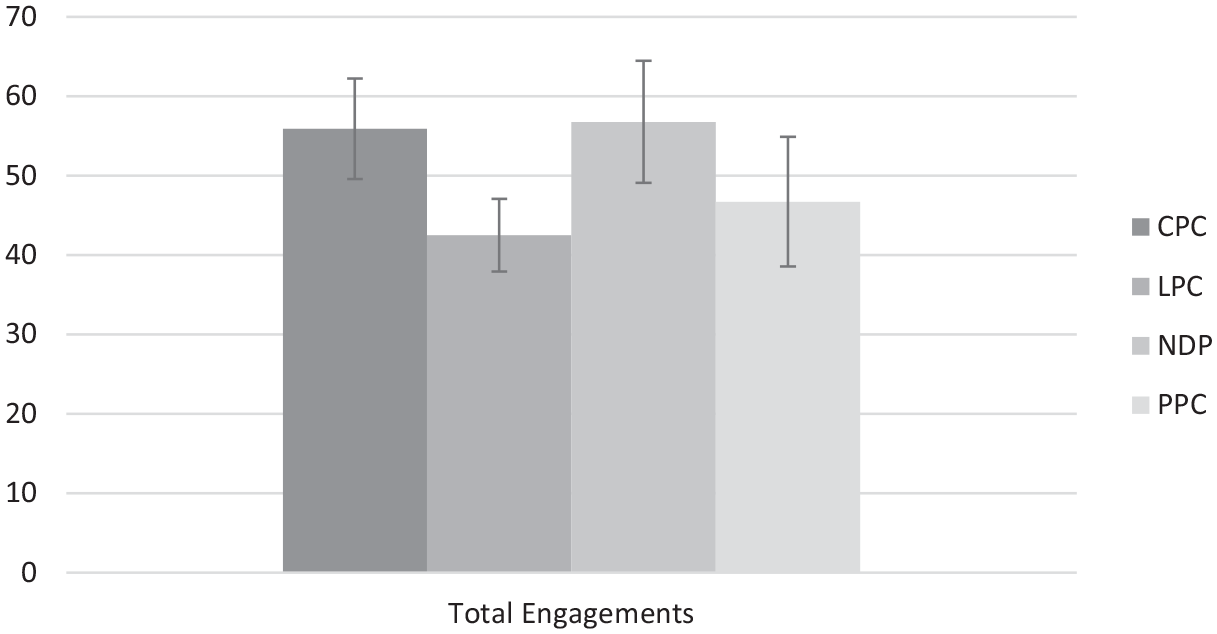
Engagements by party identification.
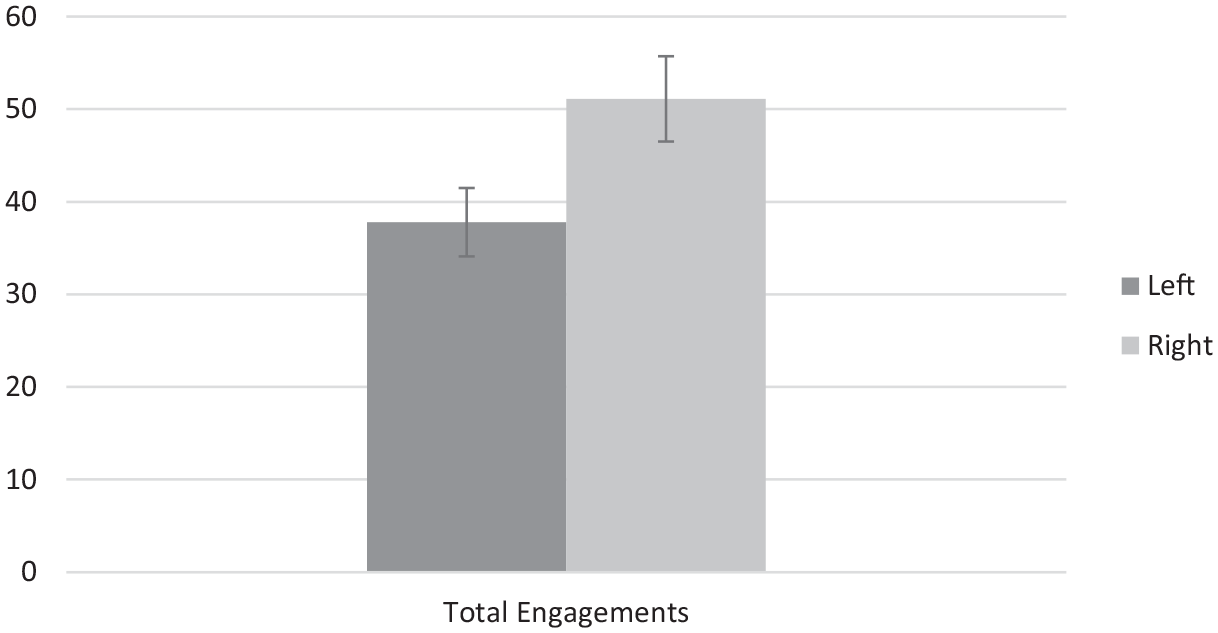
Engagements by political ideology.
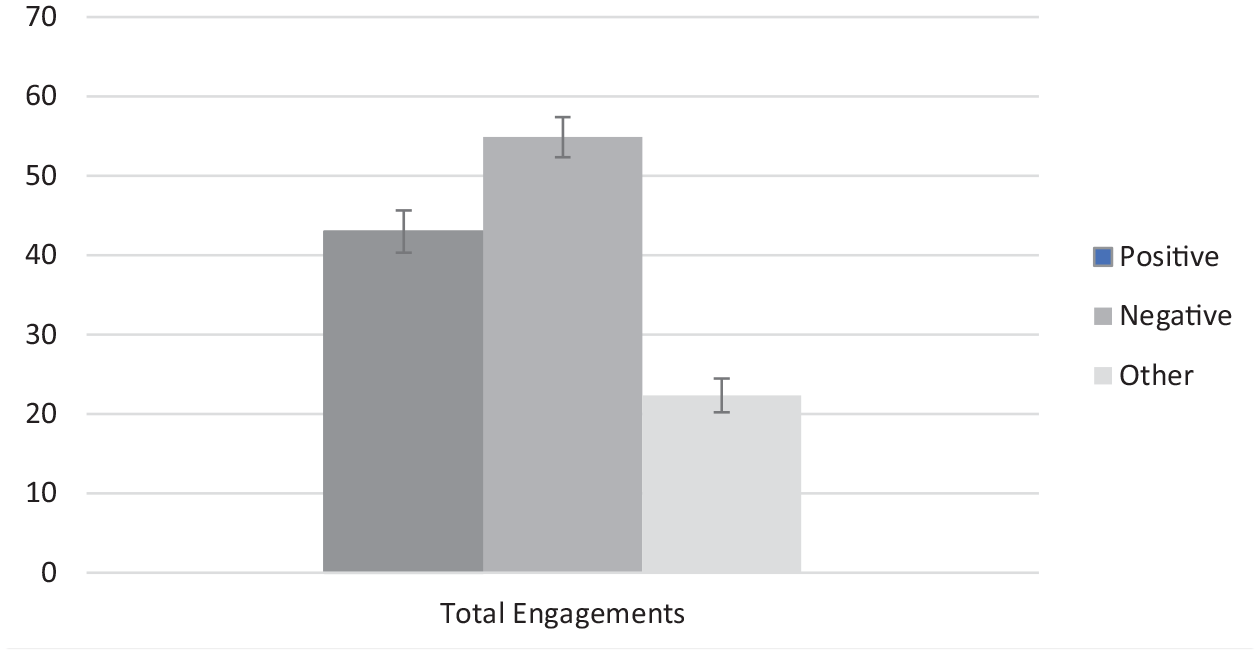
Engagements by message sentiment.
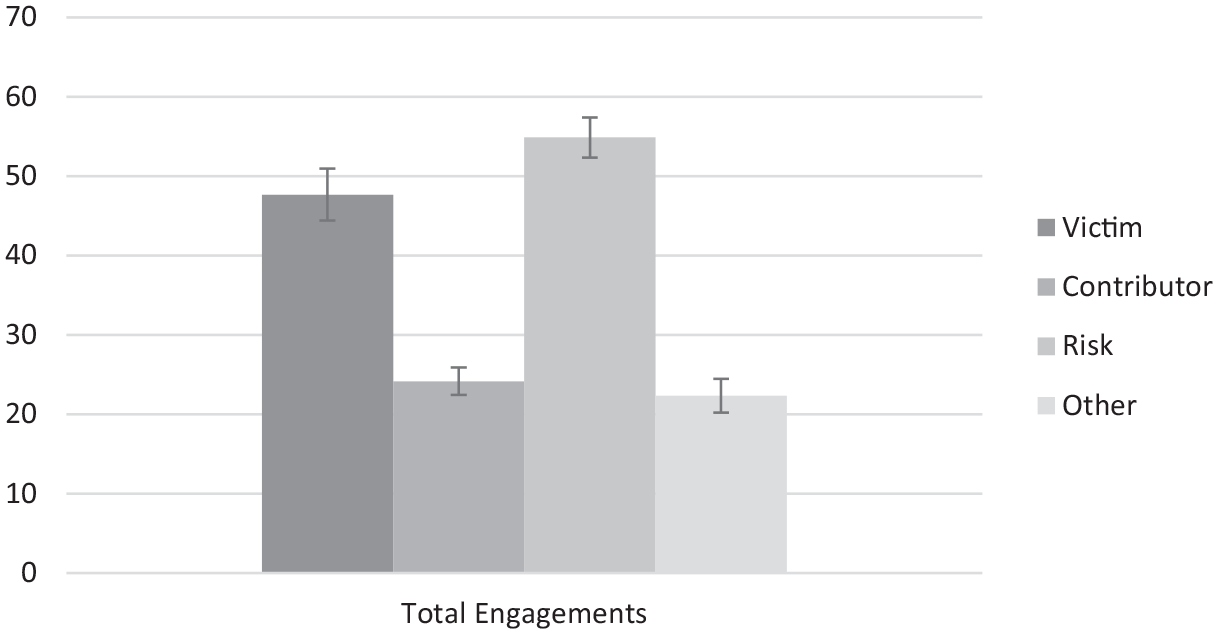
Engagements by message frame.
While messages’ reach and the centralization, density and modularity of the discursive network – whether communications are driven by strong ties and clusters of homophilous, highly devoted users or defined by weak, boundary-spanning ties that traverse significant social distance – can only be established through detailed network analysis (Himelboim et al., 2017), likes and retweets offer direct evidence of influence, ideological support and the extent content is endorsed and amplified. Moreover, they display looping effects as their accretion signals unanimity, ensuring onlookers are more likely to approach the information messages contain as credible, legitimate and worthy of recirculating (Tandoc et al., 2018). Accordingly, this study’s results suggest Twitter provided significant opportunities for nativist communications and actors to acquire disproportionate visibility and resonance online. While the precise character and extent of such influence requires further unpacking and does not necessarily imply anti-immigration communications transcended partisan milieus, research has found frequent interactions and intense in-group engagement promote ‘emotional contagion’ (Gerbaudo, 2016: 245) which can strengthen collective identities, solidify group boundaries and entrench participants’ ideological proclivities (Wahlström and Törnberg, 2021). Put differently, even if failing to infiltrate the cultural mainstream, the extent of engagement around nativist content may encourage radicalization among dedicated participants and promote further tribalism and fragmentation.
Discussion and conclusion
The preceding results reveal, whether concerning patterns of discourse, participation or engagement, xenophobic content was distinctly conspicuous on Twitter with anti-immigration users disproportionately appropriating the platform to contest mainstream discourse, reconfigure hierarchies of influence and advance exclusionary worldviews and agendas. While not devoid of humanitarian or supportive content, negative framings of migration, both generally and compared to legacy outlets, were overrepresented. Concerning the quality of discourse, the prominence of communications about national security and identity suggests anti-immigration users embraced ideologies of nativism and were devoted to drawing and policing boundaries of friend and enemy, self and other. The presence of considerable anti-elite content, as well as, discourse and claims absent in the cultural and political mainstream also suggests Twitter was embraced as an exclusionary counterpublic for challenging establishment voices and promoting reactionary social change. Results concerning the structure and organization of the discursive field further corroborate Twitter’s role in upending public communication and established configurations of knowledge, authority and influence. Rather than hierarchical, Twitter discourse featured significant vernacular creativity and was relatively diffuse. The majority of tweets featured user-generated content and were engaged with by other accounts, suggesting users adopted an enunciative approach and typically acted as producers of information, sentiments and opinions. In addition, ordinary users posted the lion’s share of communications and wielded influence approaching that of traditional elites, dynamics especially applicable to conservative and far-right users who, not only tweeted more frequently, but were more likely to be ordinary citizens and circulate original content. Through patterns of networked participation and engagement, anti-immigration users were also distinctly devoted to transforming public discourse and information flows. Alongside using hashtags more frequently to connect and fuse users, ideas and beliefs, they were more likely to flag and amplify far-right actors and perspectives marginalized within the political and cultural mainstream. Finally, messages featuring negative frames and tonality, as well as, those authored by right-wing and PPC-tagged accounts generated engagements at rates exceeding their offline support, implying Twitter helped augment communications featuring insular nationalism and inimical, affectively charged content. Together, this mix of findings reveals, while not exclusively featuring xenophobic discourse and exclusionary solidarities, Twitter can be harnessed to promote them in ways not available in prior media ecologies.
Beyond advancing conversations about Twitter’s central tendencies and communicative consequences – an important task in itself – this study’s findings illuminate entanglements between digital communications and xenophobia, revealing how the platform facilitates new configurations where expressions of intergroup antagonism are animated by complex and dynamic assemblages of actors and discourses. Beyond producing exclusionary content, anti-immigration actors appropriated Twitter’s connective, interactive and promotional affordances to conjure harmful others and dilate the visibility and impact of their messaging. Thus, alongside being employed to elevate nativist ideologies, Twitter facilitated forms of digital nativism or patterns of anti-immigration mobilization that are organic, participatory and decentralized.
For scholars of ethnonationalist movements, rather than natural or inevitable, national identities and group boundaries are transactional products of claims-making, with interested parties harnessing mass-communications to promulgate their preferred visions of historical and political reality (Calhoun, 1997). Consequently, despite recurrent appeals to peoplehood and popular sovereignty, nativist movements have historically been demagogic and elite-orchestrated, with professional and structurally advantaged communicators – politicians, journalists, pressure groups, intellectuals – playing a central role in promoting insular nationalism, constructing foreign others and exogenously activating popular animus (Hervik, 2011; Welch, 2002). Accordingly, while public support is essential to nativist movements’ longevity, lay actors have customarily represented targets of mobilization – distant and inert spectators answering, rather than initiating, calls to action (Schrag, 2011).
This research reveals such arrangements are being disrupted as digital platforms have reduced transaction costs, ensuring the sources of nativist discourse are fragmented and kaleidoscopic. Beyond providing a new channel for rallying the masses through one-to-many appeals, the preceding results suggest Twitter’s technological affordances expand the scope of participation and transpose definitional power, unsettling distinctions between the media, public and moral entrepreneurs and raising the possibility nativist sentiments and ideologies can be propagated through the routine practices of end-users. Accordingly, alongside sharing, disseminating and amplifying the claims of others, citizen-users possessed independent voice, using Twitter: to post content suffused with the desires of ordinary Canadians; identify shared enemies; and police the boundaries of the imagined national community. Finally, beyond expanding the breadth and depth of participation, Twitter facilitated mass-collaboration on the part of sprawling, loosely affiliated webs of disenchanted netizens. Specifically, in allowing users to create, tag, share and like invidious, anti-immigration communications, the platform’s nodal configuration and interactive affordances appeared to promote new forms of agency, expanding opportunities for peripheral ideas and actors to acquire attention and resonance. While users’ micro-actions may appear insignificant in isolation, the mass-connectivity that defines social platforms ensures they accumulate to create a digitally imbricated patchwork or ‘tapestry of hostility’ (Lim, 2020: 605), extending the social reach of nativist discourse and encouraging and inflaming anti-immigrant sentiments among receptive users, outcomes that, as received research suggests, are likely reinforced by Twitter’s recommendation algorithms (Ozduzen et al., 2020). While not always clear if such efforts constituted a premeditated campaign or resulted from the activities of ‘ad hoc issue publics’ (Bruns and Burgess, 2011b), as the boundaries between the two are often indeterminate, such forms of networked influence ensured, while relegated to the fringes of formal Canadian politics, nativist discourses and actors obtained outsized impact online. Even if such efforts are unsuccessful in normalizing exclusionary ideologies, given Twitter’s previously detailed significance for subject-making, they are likely to harden xenophobic identities, encouraging extremism and producing citizenries that are more divided and embittered. In the final instance, considering such dynamics accentuates the forms of politics and sociality fostered by digital platforms and suggests, beyond hosting nativist content and communities, Twitter ‘intervenes’ in and shapes their existence and amplification (Gillespie, 2015).
As a final caveat, although they shift the parameters of the possible and are actively implicated in discursive formations and socio-political processes, the effects of social platforms like Twitter are not pre-ordained, but embedded within and shaped by the social conditions surrounding their use. Thus, rather than inevitable or necessary, nativism’s prominence within the Canadian Twittersphere is likely attributable to the country’s aforementioned resilience as a multicultural democracy and success in maintaining robust support for expansive, diverse immigration (Kaufmann, 2019). While a full elaboration requires more scrutiny than is possible here, instead of technologically driven, as Twitter’s architecture was available to and harnessed by users of diverse ideological and institutional positions, this study’s results are better explained by the interlocking relations between social platforms and nationally specific political and discursive opportunity structures – those persistent features of the political and communicative environment that, by affecting expectations of success or failure, shape individuals’ action orientations (Koopmans and Olzak, 2004; Tarrow, 1994). Concerning the Canadian context, lacking social and political capital, marginalized within the incumbent power structure and perceiving their ‘way of life’ as under attack and slipping away, nationalist-conservative and, especially, far-right actors were, presumably, distinctly energized, disaffected and motivated to exploit Twitter as a counterpublic for expressing their grievances and reconfiguring public discourse, sentiment and opinion. Such interpretations are consonant with prior research which has found the extent of anti-immigration discourse online and opportunities to access institutionalized politics and achieve visibility and resonance within the public sphere to be inversely proportional, with the latter denuding networked participation of its perceived necessity and utility (Trenz et al., 2020, cf. Koopmans, 1996). 14 In these ways, assessing nativism’s digital mediation not only exposes new modalities of xenophobia, but accentuates and advances conversations regarding the interdependence of technical affordances, user intentions and prevailing institutional and normative conditions. Nonetheless, while the available evidence points to nativists’ failure in accumulating political and symbolic support, given digital platforms’ penetration within affluent societies, it is entirely possible contingent events and shifts in the established balance of forces may allow anti-immigration actors to recruit new members, build coalitions and mainstream their agenda. Accordingly, while gauging the precise nature and extent of their effects requires, whether through interviews, surveys or panel and exposure studies, further empirical investigation, the extent of xenophobia and exclusionary communications on Twitter gives cause for concern as existing studies of online hate speech and uncivil discourse suggest recurrent exposure desensitizes audiences (Jubany and Roiha, 2016), de-mobilizes targeted groups and primes ethnocentric views and identities (Munger, 2017), dynamics that, in the context of migration, may foster negative attitudes, legitimate xenophobia and bolster support for social closure and hardline policies (Farris and Silber Mohamed, 2018).
Limitations and future research
While helping to delimit Twitter’s effects and devise a heuristic for work on ‘the empowered production of difference and identity’ within this digital age (Comaroff, 1996: 166), this study displays limitations that can inform future research. First, as a single-country study, it is unable to determine if its results are unique to Canada or part of a broader trend. Second, while Canadian elections have not been targets of coordinated misinformation campaigns (Dubois and McKelvey, 2019), the possibility of distortions caused by bots and fake accounts represents an additional limitation. Third, while exposing communications’ relational qualities, this study cannot specify the general configuration or morphology of the discursive network and establish whether participants were part of a coordinated effort or transitory alliances. In addressing these limitations, subsequent studies could proceed as follows. To better account for the complex intersections between affordances, motivations and institutional arrangements, rigorous cross-national comparisons could be conducted. In addition, while discerning the authenticity of users is a labour-intensive process beyond this project’s scope (Farkas et al., 2018), future studies could employ various filtering systems to assess the extent of spurious communications and information pollution. Finally, to comprehensively map digital nativism’s structural composition and determine whether mobilization is driven by coherent institutions and identities or flexible, personalized and spontaneous forms of connective action (Bennett and Segerberg, 2013), this study’s comprehensive approach could be supplemented with detailed network analysis, as well as, ethnographic and micro-level studies of the specific ways end-users leveraged Twitter’s features and infrastructure.
Footnotes
Funding
The author(s) disclosed receipt of the following financial support for the research, authorship and/ or publication of this article: This work was made possible by an award from the Digital Ecosystem Research Challenge, funded in part by the Government of Canada.
