




Abstract
As a contentious issue affecting the character, boundaries and future of social order, migration represents a recurrent source of moral panic. While analysts have considered conventional outlets’ role in triggering collective alarm, less is known about social media’s effects on migration’s construction as a social problem. Working with an original dataset of tweets from the 2019 Canadian election, a period of heightened concern and outcry for significant portions of the electorate, this paper employs content analytic methods to assess migration’s online demonization and interrogate the patterns of framing, participation and engagement brought within the issue’s orbit. Alongside documenting significant disquiet and antipathy, its findings suggest that Twitter is transforming panic production and facilitating forms of reaction involving mass-participation and collaboration; interference from automated ‘bots’ and considerable dispute, dissent and negotiation. Based on these results, the sensitizing concept of platformed panics is proposed to capture how social media’s technical affordances, design and appropriation align to promote moral panics that are networked, algorithmic and contested.
Introduction
While representing a significant force of globalization, transnational migration has ignited a nationalist backlash involving intense anxiety, punitive overreaction and the ossification of territorial and moral boundaries in many affluent societies (Koulish and Van der Woude, 2020). Framed as jeopardizing national sovereignty, security and identity, unwanted non-citizens – irregular migrants, asylum seekers and other ‘vagabonds’ (Bauman, 1998; Weber and Bowling, 2008) – have emerged as folk devils scapegoated for ‘all that is wrong with the nation’ (Drislane and Parkinson, 2016). In interpreting moral panics around migration, scholars have accentuated media’s essential and necessary role in propagating stereotypes, cultivating a ‘disaster mentality’ and mobilizing support for intensified policing and control (Carrabine, 2008; Tong and Zuo, 2019)
This paper updates and expands existing work by interrogating migration’s construction on social platforms. Despite repeated calls for engagement with emergent media environments (Brouwer et al., 2017; Critcher, 2017; Falkof, 2020), social media’s effects on moral panics represents a significant blind spot. To address this lacuna, the present study assesses migration’s representation on Twitter during the 2019 Canadian Federal election – a period where debates about specific issues and the general character of public life are uniquely visible and contentious (Jacoby, 2000) – and maps the patterns of claims-making, participation and engagement brought within its orbit. Alongside analysing migration’s characterization and confirming the existence of panicked reactions amongst a significant portion of users, it documents how, more than hosting content, social media ‘intervene’ in and shape patterns of communication in ways that transform the sources, techniques and rhythms of panic production (Gillespie, 2015). Specifically, its findings suggest that, by encouraging mass-participation and collaboration, facilitating the deployment of automated ‘bot’ accounts, and enabling the circulation of counter-narratives from dissenting voices, digitally networked communications are restructuring moral panics. In these ways, emergent media ecologies appear to facilitate patterns of social reaction that are networked, algorithmic and contested, dynamics that are likely to intensify as digital technologies are further embedded within the flows of daily life. Based on these results and informed by broader research on the politics of social platforms, the sensitizing concept of platformed panics is proposed to capture how the technical affordances, design and appropriation of digital platforms align to produce emergent patterns of collective outcry and alarm.
As a caveat, while striving to be comprehensive, space constraints ensure this paper’s propositions require more considered attention than can be provided here. Accordingly, its spirit is evocative and exploratory as much as explanatory. Rather than offering a final, definitive statement, this paper’s conceptual, empirically grounded approach is meant to generate discussion, offer developmental suggestions and engage broader conversations about social media’s actually existing effects. In the final instance, given the complexity and extent of scholarship on migration, media and moral panic, its findings can and should be subject to further scrutiny and debate. Before detailing this study’s design and results, the following section reviews received research.
Migration, media and moral panic
A keyword in studies of deviance, crowd behaviour and social construction, moral panic refers to hysterical episodes wherein particular issues and behaviours – including drug use, pornography, terrorism, paedophilia and welfare fraud – are positioned as threatening society’s values, interests and very existence (Cohen, 2011). Rejecting the facticity of social problems, the concept highlights the role of discourse, labelling and claims-making in transmuting ‘objective molehills’ into ‘subjective mountains’ and producing and amplifying the very problems of which they speak (Jones et al., 1989: 4). Essential to panics are folk devils – deviant outsiders who offer ‘visible reminders of what we should not be’ (Cohen, 2011: 2). Constructed as irredeemably evil and auguring moral decline, they are subject to hyperbolic fear and unconstrained opprobrium with reactions being excessive and inappropriate. Part of a ‘politics of substitution’ (Jenkins, 1992), by identifying common enemies, panics crystallize group boundaries, allowing powerful ‘right-thinking’ actors, whether pressure groups, elected officials, broadcasters or agents of social control (Cohen, 2011), to advance their interests, divert attention from intractable problems and mobilize support for the established order (Thompson, 1998).
While representing a perennial source of unease, over the past quarter-century, migrants and refugees have emerged as leading folk devils with politicians, security experts and other moral entrepreneurs constructing non-citizens – particularly those deemed unwanted and unauthorized – as threatening outsiders responsible for various societal ills, whether unemployment, dependency, cultural conflict or crime and, increasingly, terrorism (Critcher, 2017; Philo et al., 2013). Informed by the dislocating effects of globalization and neoliberal restructuring, borders and related distinctions between inside and outside, us and them, have assumed renewed importance as symbols of order, stability, control (Loader and Sparks, 2007), dynamics culminating in muscular regimes of policing, surveillance and sovereign power (Pickering and McCulloch, 2012). Thus, reflecting Durkheim’s discussion of the consensual nature of crime and its control, reactions to migration represent forms of ‘constitutive boundary maintenance’ (Bosniak, 2008) which, through the development of exclusionary solidarities, reveal and reiterate the desired parameters, character and future of public life (Aas, 2019).
Like moral panics generally, the outcry migration begets is activated and sustained by media discourse, with broadcasters playing a primary and indispensable role in shaping what is publicly thinkable. By uniting viewers and maximizing awareness, media outlets name issues as public concerns, making otherwise diminutive behaviours appear ubiquitous (Goode and Ben-Yehuda, 2010). Beyond publicity, media discourse and imagery offer moralistic ‘inventories’ of the purported threat, sensitizing audiences and exonerating punitive interventions (Wright, 2015). While panics are matters of degree and often vary considerably in ‘intensity, duration, and social impact’, the cohesive and narrow focus of media coverage has historically presented social disapproval as broad, unified and consensual, cultivating perceptions of a united front (Garland, 2008: 13; Goode and Ben-Yehuda, 2010). Ultimately, by hardening communal boundaries and conjuring stigmatized, excluded others, mediated representations translate ‘stereotypes into actuality’, inciting self-fulfilling processes of deviancy amplification (Young, 1971: 11).
While research on Canada (Bradimore and Bauder, 2011; Esses et al., 2013) and other settings (Kubrin et al., 2012; Longazel, 2013; Tosh, 2019; Walsh, 2015; Walsh and Lee, 2017; Welch and Schuster, 2005) has illuminated media’s role in vilifying migrants and asylum seekers, analysts continue to privilege mass-broadcasting while neglecting how social media – online venues that promote the creation and exchange of content within virtual communities – is upending ‘one-way flows of information and power’ and transforming the construction of public issues and events (Falkof, 2020: 5).
Such neglect is significant as, more than neutral vessels or tools, social media constitute sociotechnical platforms whose participatory, interactive and connective affordances, while not determinative, affect the relations and exchanges they feature and contain (Gillespie, 2010; Van Dijck, 2013). Given their accessibility and ease-of-use, social media permit those formerly known as the audience to distribute sprawling quantities of content and shape public discourse in ways unavailable in prior media ecologies (Turner, 2010). Additionally, as citizens increasingly acquire news online, they are emerging as significant information sources that affect public knowledge and sentiment. While initially valorised as promoting democratic forms of citizen journalism and offering access to the vox populi (Gerbaudo, 2018; Goode, 2009), scholars have recently highlighted social media’s role in the propagation of information pollution. Here, actors ranging from governments to extremist groups have exploited digital communications and deployed bots – computer algorithms programmed to mimic human actors – in an effort to manipulate information flows and automate the spread of ‘computational propaganda’ around contentious issues (Bradshaw and Howard, 2017; Vaidyanathan, 2018). Finally, social media’s nodal configuration expands the circumference of human association. Through ‘likes’, ‘retweets’, hashtags (#) and mentions (@), social platforms contain ‘aggregative functionalities’ that index communications, contextualize discussions and promote ideational and thematic clustering, uniting otherwise dispersed users around shared interests and concerns (Gerbaudo, 2018). Together, such characteristics suggest social media not only facilitate social and communicative action, but mediate them and actively shape their constitution, promoting emergent modalities of ‘platformed sociality’ (Poell and Van Dijck, 2013).
While a handful of moral panic scholars have assessed digital platforms, their transformative power has not been sufficiently plumbed. On the one hand, studies have documented how, whether concerning online predators (Marwick, 2008), youth violence (Ruddock, 2013) or ‘fake news’ (Bratich, 2020; Carlson, 2020), social media represent targets of collective outcry and alarm. Additionally, a small, but growing, body of research has interrogated how traditional moral crusaders, including media outlets, pressure groups, policing agencies and political parties and officials, have appropriated digital platforms to vilify migrants and promote social exclusion (Berti, 2021; Chavez, 2013; Kreis, 2017; Walsh, 2020b). Despite the insights of existing work, by highlighting reactions to social media or privileging conventional actors and claims-making practices, received scholarship neglects how digital communications are reconstituting, rather than simply featuring or accelerating, moral panics.
The present study addresses this neglect. Unlike the bulk of existing research which assesses communications associated with particular communities of users, prominent hashtags and exceptional events, this paper utilizes content analytic methods to systematically map migration discourse on Twitter during the 2019 Canadian Federal election. In identifying general trends and analysing broad patterns of public communication, careful attention is devoted to digital platforms’ effects on panics’ emergence, resonance and perpetuation, an agenda that, given the issue’s significance for the drawing and policing of social boundaries, migration is uniquely suited to address. As detailed below, its results indicate that, alongside displaying significant, although by no means unanimous, anxiety and outcry, communications were dominated by ordinary users, featured significant activity from bot-like accounts and entailed considerable ideological conflict and polarization. These findings imply that in expanding the profile of moral entrepreneurs, permitting the automation of claims-making and engagement, and providing new opportunities to ‘talk back’ and defuse or reverse overblown hysteria, Twitter’s structure and affordances are reconfiguring the character of moral crusades, generating platformed panics that are networked and participatory, automated and algorithmic and fiercely resisted by folk devils and their advocates. While such conclusions can be partially gleaned from existing conceptual interventions, they have yet to be empirically verified and elaborated (Hier, 2019; Ingraham and Reeves, 2016).
Canada presents a fruitful research site for addressing such issues. Accompanying significant social media use and international migration, developments surrounding the 2019 election, whether claims of a migration ‘crisis’ or mounting nativism and Islamophobia, suggest that, despite historically widespread support (Bloemraad, 2012), migration increasingly represents a site of considerable unease. Accordingly, while the country continues to display greater levels of support for large-scale migration, cultural diversity and multiculturalism vis-à-vis the U.S. and Europe, public opinion has hardened, becoming less favourable and more polarized. In particular, while opposition remains far from pervasive, reactions to migration display the five criteria of moral panic; concern, consensus, hostility, disproportionality and volatility (Goode and Ben-Yehuda, 2010).
Heightened concern and consensus were evinced in opinion polls, increased political attention and proposed interventions. 1 Informed by growth in irregular arrivals and the Liberal Trudeau administration’s commitment to expansive admissions and refugee resettlement, recent surveys indicate migration represents a salient source of anxiety. One June 2019 poll found 63% of Canadians felt too many migrants were arriving (Wright, 2019), while separate polls from January 2019 found 57%, 48% and 47% of respondents, respectively, believed that migrants overburdened public services; terrorists were exploiting refugee admissions and asylum seekers were generally ‘fake’ and arriving to work or exploit the welfare-state (Bricker, 2019). Additionally, migrants, particularly Muslims, were associated with social and moral decline, with many Canadians viewing their presence as transforming Canada’s culture and values in undesired ways (Wilkins-Laflamme, 2018). 2 Further, 39% of potential voters felt too many visible minorities were arriving, with 69% of conservatives expressing racialized anxieties (Ekos Politics, 2019).
Disquiet was also reflected in formal politics. At the Federal level, the election featured the People’s Party of Canada (PPC), a new anti-immigration party led by former Conservative MP Maxime Bernier. While failing to attract significant support, much of the PPC’s platform, whether eliminating ‘mass migration’ and official multiculturalism, vetting migrants based on their cultural values and proclivities or fortifying the border to curb illegal entries, remains widely supported by right-wing voters, creating future political openings and presaging a nativist turn (Grenier, 2018; Kleinfeld and Dickas, 2020). Provincially, such dynamics were distinctly visible in the Coalition Avenir Quebec’s – the province’s ruling nationalist party – promotion of Bill 21, legislation that pandered to Islamophobic sentiments by banning the use of face coverings when accessing select public services.
Apprehension was accompanied by significant hostility and disproportion. Right-wing politicians frequently catered to popular animus, employing divisive, emotionally charged rhetoric to promote escalations in policing and control. Conservative opposition leader Andrew Scheer demonized asylum seekers, equating refugees with fanaticism and violence and claiming admissions were being infiltrated by terrorists and criminal gangs (Gaucher, 2020). Additionally, Bernier circulated dire predictions of civilizational conflict where, if left unchecked, mass migration and ‘political Islam’ would ‘destroy’ Canada’s ‘liberal democratic heritage’, while another PPC candidate suggested Muslims should be forced to ‘swim back to the Middle East’ (Kleinfeld and Dickas, 2020). Antagonistic discourse has been accompanied by increased extremism and racist abuse. Hate crimes have spiked (Kheiriddin, 2019), white supremacist groups have burgeoned (Balgord and Smith, 2021) and Canadians are amongst the most active participants on far-right websites and forums (Daigle, 2020). Fear and resentment were partly fuelled by exaggerated and conspiratorial claims as anti-immigration actors have employed conventional and online media to circulate narratives of risk and danger incommensurate with migration’s actual volume, demographics and effects (Hill, 2019). 3 Consequently, citizens’ knowledge is often based on ‘colossal misperceptions’, with many grossly overestimating the total number of refugees and irregular migrants, as well as, the proportion of immigrants arriving from the Middle East and North Africa (Korzinski, 2019). Additionally, despite considerable countervailing evidence, a substantial portion of Canadians believe migrants are importing crime, receive more financial assistance than pensioners and are taking jobs from native-born workers (Rogers, 2019).
Finally, while panics have traditionally been conceived as short-lived episodes, it is increasingly acknowledged that society’s mediatization has produced a culture of fear involving continuous anxiety and outcry (Garland, 2008). Accordingly, while the handwringing surrounding migration was quickly overshadowed by the spectre of COVID-19 in early-2020, if the past offers any suggestion (Bradimore and Bauder, 2011), rather than dissipating, anxiety lies dormant and remains capable of quickly transmuting into full-scale panic.
Research design and methods
Data collection
Alongside being distinctly accessible and well-archived, Twitter was analysed as it represents a leading and searchable site of public communication that allows previously private utterances and interactions to be scrutinized in ways unavailable in prior media environments. Messages posted during the 2019 election (September 11–21 October 2019) containing a migration-related keyword and at least one hashtag referencing Canadian politics (e.g. #cdnpoli) or the election (e.g. #CanadaVotes) were collected (n = 13,029). 4 After removing irrelevant entries, a systematic sample containing every fifth tweet was assembled (n = 2273). Beyond ensuring messages were specific to Canada, targeting widely recognized hashtags ensured that rather than interpersonal or sectional communication, tweets represented forms of public claims-making intended to affect national discourses concerning migration, citizenship and nationhood.
Coding scheme
Tweets’ sources, themes and reception were analysed. To identify usage patterns, communications were coded based on the institutional standing, political views and authenticity of the posting account. In the first instance, users’ professional background was recorded to distinguish tweets posted by ordinary citizens versus experts, authorities and issue entrepreneurs (e.g. academics, politicians, journalists, media outlets). Utilizing participants’ recent posts and Twitter biographies, party identification and political ideology were also recorded. Accounts were classified according to their endorsement of a specific candidate or party or alignment with the right or left of the political spectrum. 5 Concerning party identification, only parties endorsed by over 5% of sample accounts were considered. These included the progressive New Democratic Party (NDP), centre-left and governing Liberal Party of Canada (LPC), centre-right Conservative Party of Canada (CPC) and far-right PPC. Finally, to establish the extent of media manipulation, accounts were scrutinized to determine whether they were administered by bots. Following prior research, the open-source software package Botometer (previously BotOrNot) was employed to calculate the likelihood accounts were controlled by computer algorithms (Bessi and Ferrara, 2016). As a machine learning programme that extracts information concerning, inter alia, temporal activity, metadata, user statistics, network structure and message content and sentiment, Botometer generates a score between 0 and 1 that reveals the probability an account is automated. 6 Like methodologically similar studies, accounts with scores above 0.5 were classified as social bots (Badawy et al., 2018). As a caveat, given the complexities of pattern recognition and online behaviour, bot detection is a challenging, imperfect task (Cresci, 2020). Thus, while estimating the extent of spurious communications and artificial voices, the results of such analysis are illustrative rather than definitive and should be approached with some caution.
Messages were also coded for their thematic content and emotional valence. Like newspaper headlines, tweets condense complex issues into brief, meaningful statements that shape their interpretation. For this study, themes represent the interpretive frames or organizing ideas present in communications that orient readers’ thoughts, judgements and reactions. Tweets were assigned to one of two broad categories – anti-immigration and pro-immigration – with each containing several issue-specific frames. As will be elaborated, anti-immigration messages problematized migration as a source of material or symbolic risk and insecurity, while pro-immigration tweets portrayed migrants as either deserving victims adversely affected by inequality and injustice or contributing community members. While data on both forms of content is presented and analysed, given this paper’s interest in documenting patterns of moral panic, greater attention is devoted to mapping patterns of anti-immigration discourse.
Beyond rendering issues intelligible, interpretive frames activate emotions and express tonality (Lecheler et al., 2015). In portraying foreigners as threatening others, anti-immigration messages were likely to generate fear, suspicion and aversion, and, thus, were coded negative. Conversely, in expressing sympathy and support, pro-immigration tweets were coded positive as they promoted identification with and concern for migrants. When a predominant theme could not be established or a message was deemed neutral, unclear or ambiguous, tweets were designated ‘other’.
While social media broadens access to the means of public communication, expanding the number and range of producers, messages’ visibility and resonance vary considerably. Accordingly, to gauge responsiveness and reception, the number of engagements – likes and retweets – per message was employed to measure interest, ideological endorsement and the degree content was shared and amplified (Conover et al., 2011).
Coding
To establish the context and deeper meanings that anchor communications, tweets were manually coded by three researchers with each message being assessed by at least two coders. When disagreements emerged, they were resolved through a team meeting. If consensus was unattainable, the message was coded other.
Results
Before considering the configurations of discourse and participation associated with migration’s construction, it is helpful to discuss general patterns of Twitter use.
During the election, 2273 sample messages were posted by 1651 distinct accounts, suggesting communication was driven by a multiplicity of actors. Although anti-immigration content was over-represented (n = 973, 42.8%), negative assessments were counterbalanced by significant positive communications (n = 904, 39.8%). Additionally, nearly one-fifth of postings were coded other as they were neutral, unclear or ambiguous and lacked a discernible affective orientation (n = 396, 17.4%). Accordingly, rather than systematically unfavourable, migration was constructed in ambivalent terms. As detailed in the following paragraphs, such results suggest that, unlike traditional moral panics wherein various experts and elites -editors, politicians, judges, police chiefs- seemingly ‘talk “with one voice”’ digital platforms appear to foster patterns of discourse and communication that are variegated, cacophonous and cross-cutting (Hall et al., 1978: 16).
Anti-immigration discourse
Thematic foci in anti-immigration tweets (n = 974).
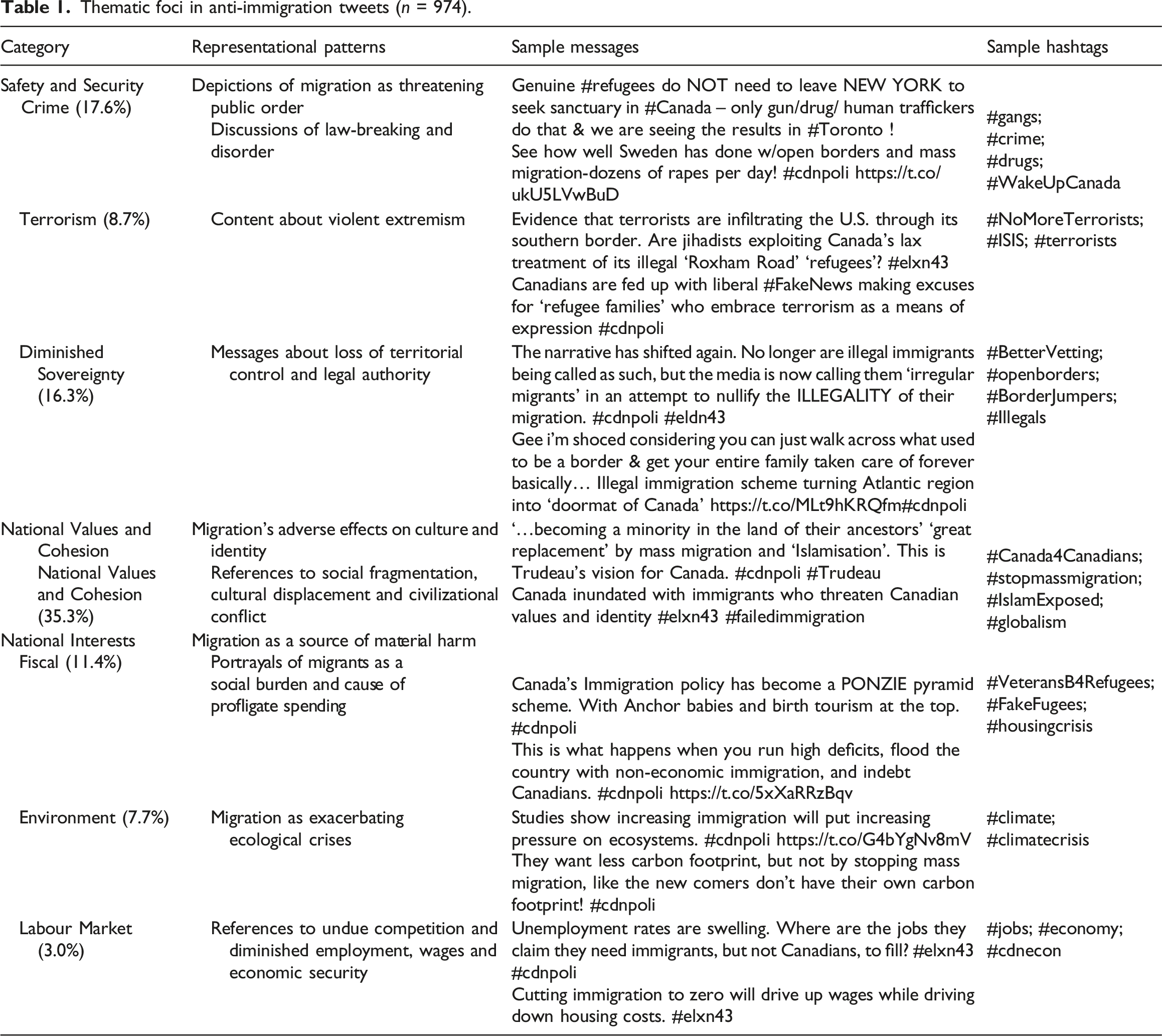
Representing 42.5% of anti-immigration communications, the dominant theme was safety and security. Tweets within this category constructed migrants as imperilling public order. Despite being considerably less at risk of serious offending (Jung, 2020), several messages asserted migrants’ inherent criminality. Through references to anecdotal evidence, inflated statistics or sensationalist news stories from Europe and North America, users portrayed foreigners, particularly young Muslim men, as morally tainted and responsible for significant vulnerability and harm, whether concerning sexual assault, gang membership, gun violence or drug and human trafficking. Permeable borders were also associated with terrorist infiltration as tweets frequently referenced a nation ‘under siege’ and depicted migrants and refugees as attempting to destabilize and subvert society. Finally, unauthorized migrants were constructed as categorically suspect with their entry and presence undermining legal order and the state’s sovereign powers of classification and decision. Here, it was argued, alongside conveying an unguarded, ‘open door’ and inviting additional transgression, uncontrolled migration was problematic as the absence of vetting and rigorous scrutiny left its riskiness unknown and unevaluated (Ashworth and Zedner, 2014). Moreover, the presence of criminalizing discourses – ‘illegal migrant’, ‘criminal alien’, ‘illegals’ – portrayed migrants as promoting lawlessness while simultaneously encouraging authoritarian interventions (Vollmer, 2011).
Outcry was also fuelled by concerns about national cohesion and identity as 35.3% of anti-immigration messages depicted migration’s volume and character – whether ethnoracial, religious or linguistic – as obstructing integration, destroying the social fabric and enervating the ‘horizontal comradeship’ that underpins the imagined national community (Anderson, 1991: 7). Reflecting moral panics’ core features, such tweets often expressed longing for an uncorrupted ‘golden age’ where Canada’s moral, cultural and territorial borders were coterminous and interlocking (Pearson, 1983). Messages also cited immutable cultural differences and contained expressions of ‘neo-racism’ where foreigners were unable or unwilling to adopt the core values and public culture of Western societies (Balibar, 2007; Hervik, 2011). While often emphasizing general social difference, like discussions of national security, Muslims were frequently depicted as distinctly problematic. Based on essentialist narratives of ‘Islamification’ and a ‘clash of civilizations’, several tweets positioned Muslims as barbaric, anti-modern and actively seeking to replace cultural traditions and political principles – whether concerning sexuality, women’s rights, free speech or legal authority – fundamental to liberal democratic arrangements (Hervik, 2011). Reflecting the broader rise of authoritarian populism, users often claimed such outcomes were part of the ‘Great Replacement’ – a far-right conspiracy where ‘mass migration’ was orchestrated by political and cultural elites to displace white, Christian populations in the West (Bergmann, 2021). Whether associated with Islamophobia or diffuse nativism, in articulating distinctions between virtuous citizens and uncivilized others, such messages constructed migrants as recalcitrant minorities and pernicious intrusions into the nation’s social and cultural space.
Finally, 22.1% of negative messages referenced migration’s deleterious effects on the nation’s material interests. Reflecting neoliberal priorities concerning efficiency, austerity and self-reliance, several messages claimed foreigners burdened taxpayers, compromised public services (healthcare, education, housing etc.) and unfairly diverted supports from vulnerable citizens, including veterans, Indigenous Canadians and those experiencing homelessness (e.g. ‘Trudeau is again attacking our Veterans while paying for illegal migrants’; ‘We need a moratorium on all paths of immigration until we can provide for the people here already. Canada has the fastest growing homeless population in the developed world’). While such issues were often framed in pragmatic, instrumental terms with tweets presenting statistical evidence and underscoring migration’s financial costs, posts equally highlighted moral failings and pathologized migrants as either irresponsible, prone to dependency or exploiting Canada’s hospitality. In the latter instance, several messages referenced ‘birth’ and ‘benefits tourism’ and questioned refugees’ legitimacy and motivations, with many claiming asylum seekers were opportunistic ‘queue-jumpers’ rather than fleeing genuine persecution. Users also blamed large-scale migration for overwhelming Canada’s carrying capacity, placing excessive pressure on the natural and built environment and exhausting valuable resources (housing, energy, clean water, green space etc.). Additionally, by increasing labour market competition, fragmenting the working-class and exerting downward pressure on wages and working conditions, migrants were characterized as compromising native-born citizens’ life-chances and economic security. While often framed as an inevitable consequence of migration, like anti-immigration discourse generally, such messages also expressed populist discontent and the belief mainstream media and political-economic elites were deliberately concealing the truth and acting in contravention of the nation’s interests.
Accompanying their alignment with various folk devils and social problems, other discursive processes, including rhetoric, metaphor and narrative construction, further contributed to migrants’ representation as deviant others and invaders. Tweets often featured febrile xenophobia and considerable toxicity. Through the use of various pejoratives – ‘human trash’, ‘garbage’, ‘scum’, ‘invaders’, ‘anchor babies’, ‘shithole countries’ – when describing migrants and their homelands, many users disparaged foreigners as non-members and permanent outsiders (e.g. ‘What will keep thugs, gang bangers, and garbage culture immigrants from murdering with impunity?’; ‘All those border invaders were raised out of their shithole countries courtesy of Canadian taxpayers’). The extent of hate speech and invective corroborates claims that, compared to conventional media and public discourse, Twitter’s governance and architecture, whether concerning user-anonymity or the absence of professional gatekeeping, promote verbal and symbolic violence (Evolvi, 2018).
Othering also occurred in more insidious ways. Several messages employed the language of natural disaster and water-based metaphors to convey the dangers of permeable borders and uncontrolled migration. Migrants were equated with a ‘tsunami’, ‘tide’, ‘wave’ and ‘deluge’, with messages claiming their arrival and presence threatened to ‘flood’, ‘swamp’ and ‘inundate’ Canada, leaving the country ‘drowning’ in, among others, crime, debt and disorder (e.g. ‘Canadian immigration becomes a tsunami, fuels biggest gain in Canada’s population’; ‘Our core identity is being eroded. Socialist policies, liberalism and a flooding of immigration are to blame’). Alongside cultivating perceptions of imminent catastrophe and implying migration is intractable and damaging, by portraying migrants as a unitary, menacing collective, such depictions strip them of their individual humanity, preclude empathy and recognition and communicate the need for swift, remedial action (Innes, 2010).
Whether intentional or inadvertent, rhetorical slippage and imprecision further solidified migrants’ marginal, outsider status. Many messages conflated disparate groups of migrants whether refugees, immigrants or undocumented arrivals. For instance, tweets about refugees and asylum seekers often contained hashtags referencing their illegality (#BorderJumpers, #IllegalImmigrants, #FakeFugees), while others claimed Canada received approximately one million immigrants a year (e.g. ‘Startling research shows immigration is closer to 1 million. That’s 3% of population’; ‘This year 1 million come to Canada on way to citizenship’) – an inflated figure that incorrectly counts roughly 600,000 temporary workers and students as permanent settlers (IRCC, 2020). 7 By depicting distinct categories of migration – forced and voluntary, regular and irregular, permanent and temporary – in wholesale, undifferentiated terms, such portrayals present foreigners as a ‘homogenous group sharing similar characteristics, backgrounds, [and] motivations’ (KhosraviNik, 2009: 494), implying they constitute ‘an anonymous, swarming mass united by a shared determination to exploit’ the host society’s ‘generosity’ (Morrison, 2019: 597).
Anti- and pro-immigration tweets by migration type.
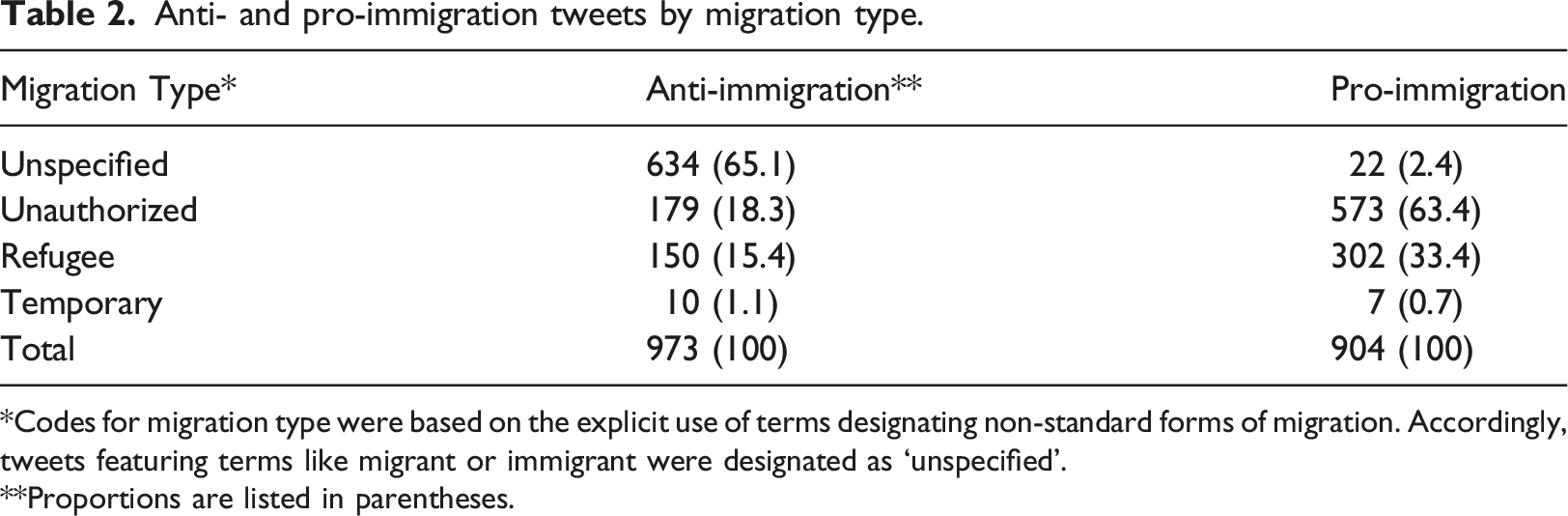
*Codes for migration type were based on the explicit use of terms designating non-standard forms of migration. Accordingly, tweets featuring terms like migrant or immigrant were designated as ‘unspecified’.
**Proportions are listed in parentheses.
Twitter was also appropriated to debunk stereotypes and censure public figures and ordinary users for spreading misinformation and stoking intergroup antagonism. For example, by linking to journalistic reports and academic research or offering their own interpretations, several accounts engaged in fact-checking to combat bloated rhetoric about migrants’ costs, legitimacy or methods of arrival and inoculate against irrational fear (e.g. ‘Migrants are not queue-jumping: see the fact sheet on irregular border crossings’; ‘Conservatives are promoting xenophobia and fearmongering about borders’; ‘Those on the right routinely ignore migrants’ positive economic impact’). Accordingly, beyond being mobilized to promote anxiety, conflict and discord, Twitter’s effects on social reaction appear complex and Janus-faced as the platform was also employed to offer alternative accounts of events and contest anti-immigration crusades. Thus, Twitter not only features reactions that are more extreme and vituperative than found in traditional media space, but also appears to foster patterns of discourse and claims-making that are sharply bifurcated and conflictual.
Patterns of participation
The sources of migration discourse were also analysed. Table 3 presents the distribution of tweets posted by citizen- and elite-users, as well as, the proportion of original content and negative, anti-immigration communications. As it indicates, discourse was predominantly fuelled by bottom-up participation from lay actors. Additionally, compared to expert and authoritative voices, citizen-users were disproportionately responsible for anti-immigration content, with statistical analysis revealing significant differences (
Profile of sample accounts.
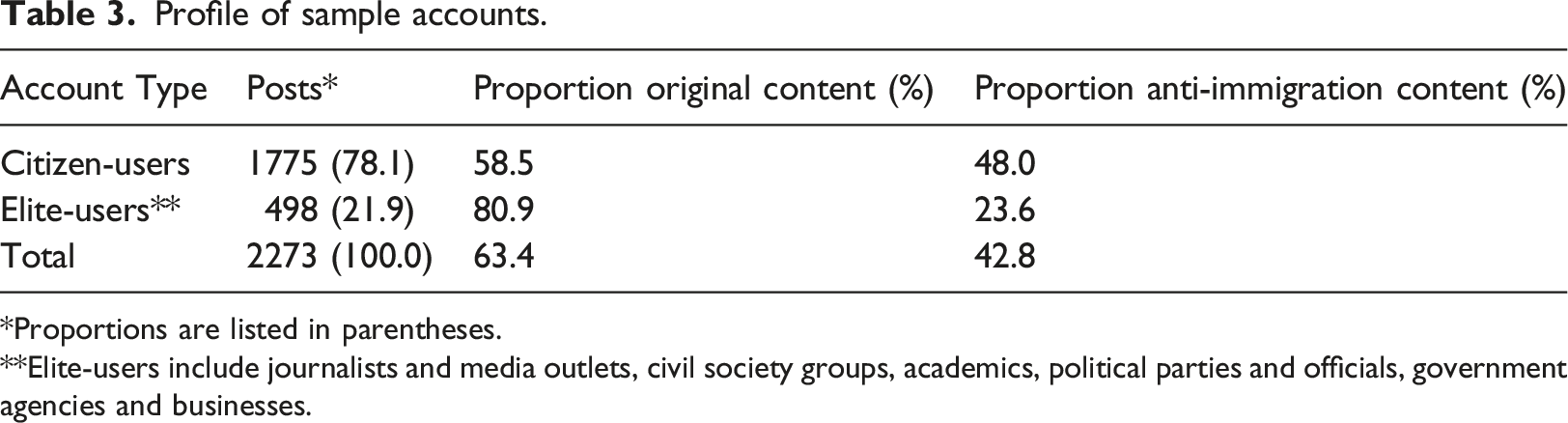
*Proportions are listed in parentheses.
**Elite-users include journalists and media outlets, civil society groups, academics, political parties and officials, government agencies and businesses.
Tweets by political ideology of sample accounts.
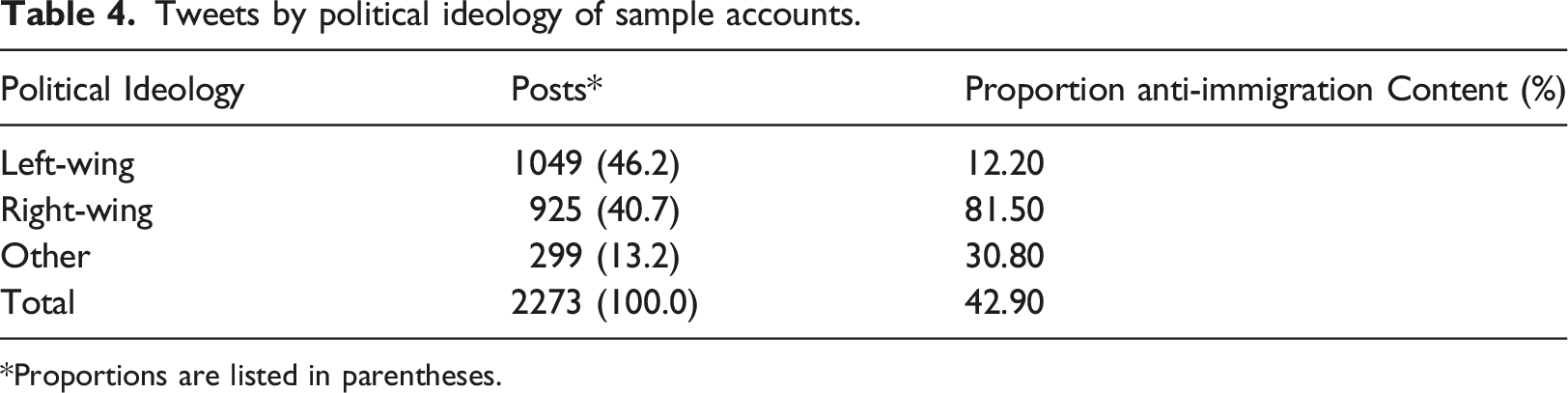
*Proportions are listed in parentheses.
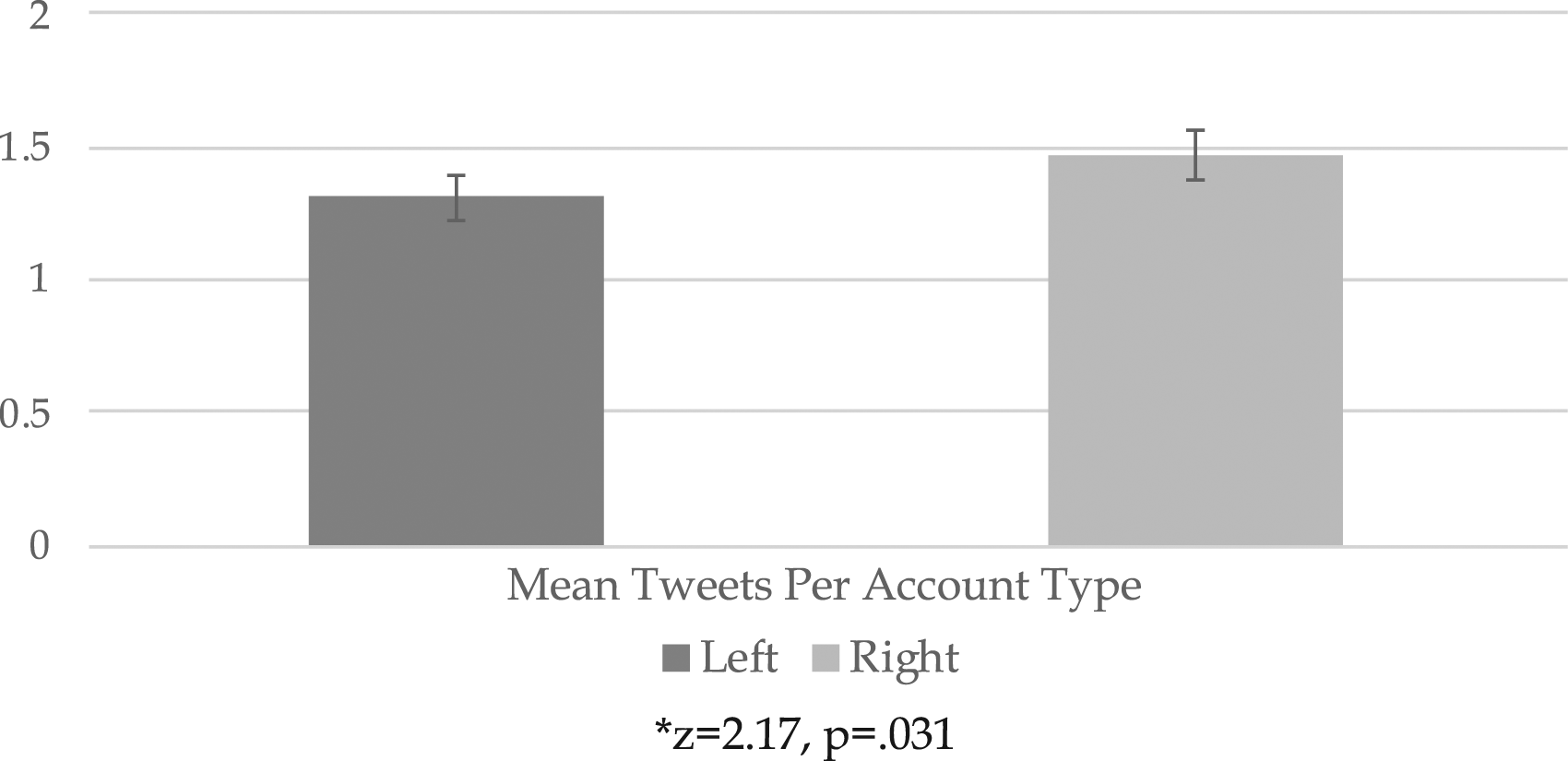
Frequency of Twitter use by political ideology*.
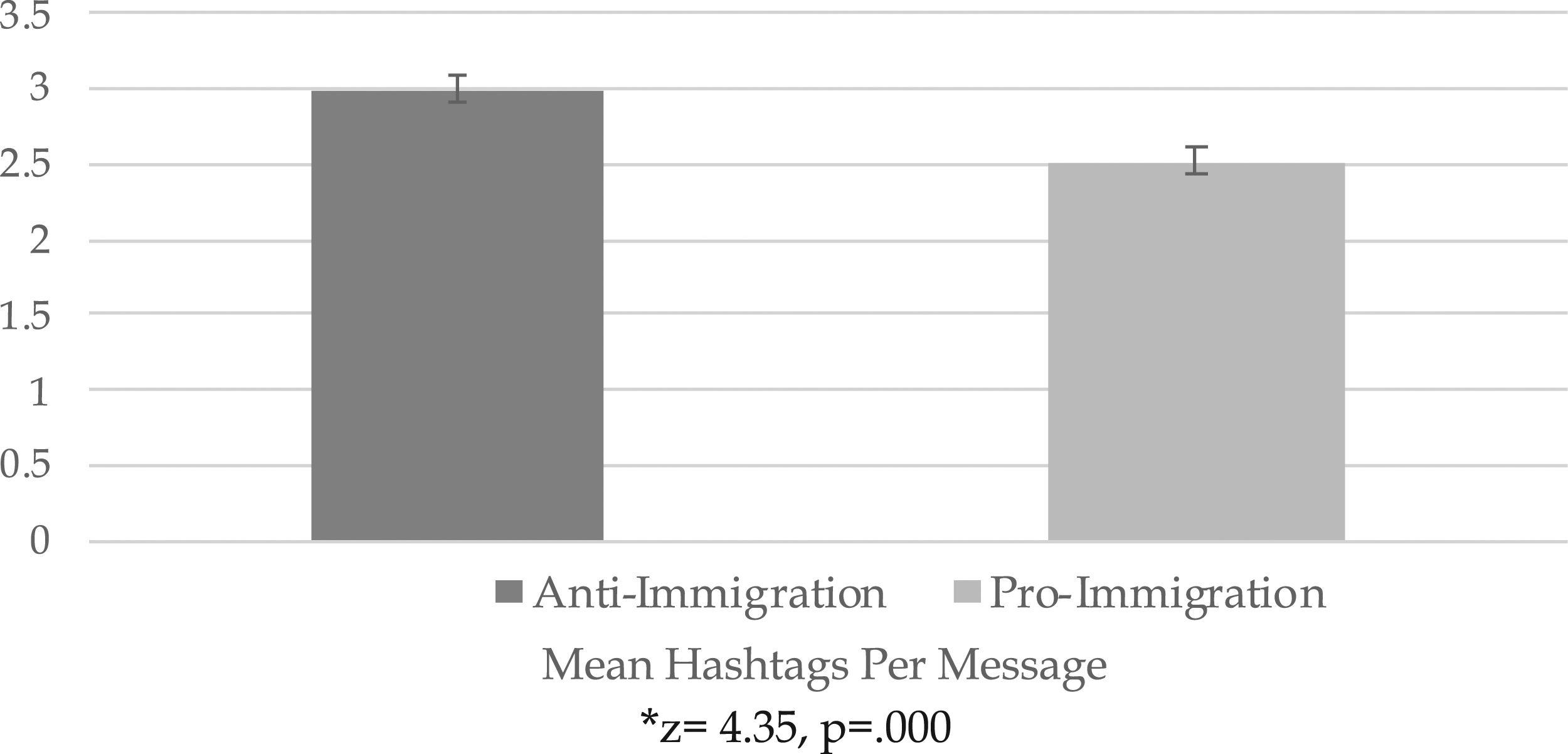
Frequency of hashtag use by message frame*.
Finally, bot analysis was conducted to assess the likelihood communications were inauthentic and animated by computer algorithms. Of the 1651 distinct accounts featured in the dataset, 9.7% (n = 160) were flagged as featuring bot-like characteristics. While displaying considerable diversity, implying they were mobilized for varied purposes, the available evidence suggests that, rather than randomly or evenly distributed, bots were disproportionately deployed to affect the arc of public communication, and, reflecting the experiences of countries like the US and UK (Vaidyanathan, 2018), seed and spread anti-immigration discourse and agendas. While no significant differences in posting frequency were observed, messages from bot-like accounts were more likely to feature anti-immigration communications and negative tonality (50% versus 42% for non-bot accounts, z = 1.97, p = 0.049). Additionally, bot-like accounts were more likely to harness Twitter’s affordances to amplify content and connect users. Specifically, messages from bot-like accounts (M = 3.66) contained 37% more hashtags than those posted by other accounts (M = 2.67; z = 4.02, p = 0.000). Further exposing the extent to which media manipulation was associated with nativist agendas and crusades, when considering the ideological profile of sample users, bot-like accounts were significantly more likely to appear as right-wing users (48.1% versus 39.9% for other accounts; z = 2.31, p = 0.021) and far-right PPC supporters (27.4% versus 16.6% for other accounts; z = 4.37, p = 0.000).
Responsiveness and engagement
Alongside mapping Twitter discourse, this study documents its reception. With unorthodox actors empowered to engage in media-making, it is increasingly necessary to account for differences in communications’ visibility and influence. To these ends, engagements were employed as measures of responsiveness. Alongside conveying tweets’ reach and resonance, engagements display recursive effects that augment content’s credibility and dissemination. As they amass, engagements signal unanimity and common sense, ensuring onlookers are more likely to perceive communications’ claims as legitimate. Additionally, perceived popularity increases the likelihood recipients of information will also like, comment on or share it with others (Moscato, 2016).
Tweets by party identificaiton of sample accounts.
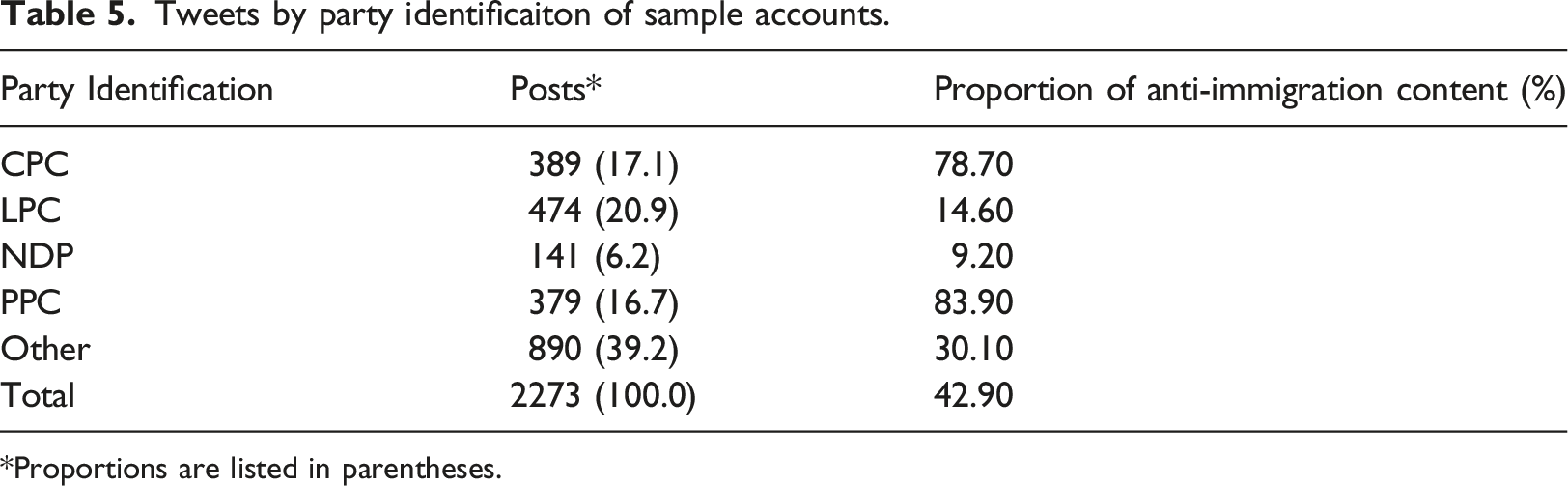
*Proportions are listed in parentheses.
Proportion of citizen-users within top 10% of sample accounts by total engagements.

Discussion and conclusion
Accompanying an upsurge in anti-immigrant sentiment in Western societies, there has been precipitous growth in social media use, with digital platforms restructuring daily life and transforming public communication. In an era where sizable shares of citizens receive their news online, digitally mediated depictions of migration have significant implications for how individuals think about, discuss and respond to the issue. Answering calls for more thorough and empirically guided consideration of social media’s effects on societal reaction and the construction and control of social boundaries, the present study has considered how Twitter was used to cultivate moral panics around migration. Working with a cross-section of tweets from the 2019 Canadian election, it has mapped the patterns of participation, framing and engagement displayed in emergent media environments. Beyond documenting panicked reactions, whether in relation to excessive concern, anxiety or hostility amongst a significant portion of Twitter users, its results reveal that Twitter was appropriated in ways that transform conventional patterns of panic production. As outlined below, these findings resonate with broader claims that, while they do not rigidly determine outcomes, technological objects and systems structure the possible and shape sociality, facilitating and promoting particular modes of thought, action and association.
Regarding patterns of discourse and representation, while negative communications were far from universal, Twitter was disproportionately used to circulate emotionally charged content, manufacture and amplify anxious uncertainty and promote exclusionary solidarities. Beyond appearing more frequently, anti-immigration communications were more likely to emphasize cultural and security-based issues associated with public order and morality over instrumental concerns linked to migrants’ material effects. Additionally, tweets containing negative sentiments and depicting migrants in fearsome, suspicious and antagonistic terms generated significantly greater engagement, suggesting social platforms like Twitter present advantageous environments for advancing xenophobic discourse and agendas. Such outcomes are particularly concerning as, reflecting the claims of moral panic scholars, research on media imagery indicates anti-immigrant content has distinctly powerful effects and can reinforce stereotypes, heighten out-group hostility, unleash acts of discrimination and mobilize support for exclusion and criminalization (Esses et al., 2013).
More than a venue for launching anti-immigrant crusades, the preceding results also suggest Twitter’s sociotechnical affordances have produced a partial recalibration of moral panics, promoting patterns of reaction that are networked, algorithmic and contested.
In the first instance, patterns of participation reveal that, alongside posting the majority of communications and obtaining influence rivalling traditional issue entrepreneurs, citizen-users displayed significant creativity and acted as producers of information, sentiments and opinions. Accordingly, while the significance of ‘primary definers’ (Hall et al., 1978) and established, structurally advantaged institutions and communicators persists and can hardly be overestimated, by allowing all citizens to directly contribute to the processes of framing, intermediation and agenda-setting, social media transform how deviance becomes morally legible, ensuring folk devils’ construction is increasingly subterraneous; driven and co-produced by multitudes of energized, disaffected and technologically literate netizens (Ingraham and Reeves, 2016). As further evidence of Twitter’s role in upending hierarchies and promoting vernacular discourse and perspectives, the prevalence of populist, anti-elite discourse in which broadcasters and political-economic elites were pilloried for promoting migration and jeopardizing the nation’s identity and interests, suggests groups traditionally associated with moral entrepreneurs and the cultural mainstream have joined the ranks of folk devils. The preceding results also highlight the possibility of interactive and crowdsourced crusades. Beyond empowering end-users to produce content, data concerning engagements and hashtag use reveals Twitter facilitated networked forms of influence and dissemination where, by tagging, linking and promoting anti-immigration communications, those previously excluded from the means of mass communication were able to reconfigure public debate and engineer outsized attention online. Ultimately, non-professionals’ emergence as critical interactants indicates previously stable distinctions between the media, public and moral crusaders are increasingly fuzzy and indeterminate.
Alongside obviating the need for powerful gatekeepers, elite connections and institutional resources to fuel widespread alarm, the preceding results offer qualified support to claims that, with communications’ digitization, panics and the patterns of discourse and engagement underpinning them can be partly, if not entirely, computational; mediated and steered by computer algorithms. A sizable share of sample accounts displayed bot-like characteristics with analysis revealing they were disproportionately deployed to manipulate public opinion and generate publicity and engagement around xenophobic content. Specifically, suspected automated accounts were significantly more likely to post anti-immigration communications, be affiliated with conservative and far-right actors and exploit Twitter’s searchable, interconnected structure through the use of hashtags. Despite their outsized presence and activities, bot-like accounts failed to obtain significant engagement and resonance, implying that, in the Canadian context, their present influence is not only overstated but arguably represents a source of irrational anxiety (Carlson, 2020). Nonetheless, when coupled with digital communications’ social penetration and continued technological advancement, it is entirely possible contingent events and shifts in the political balance of power will lower the transaction costs of moral crusades, empowering fringe groups to successfully manipulate information flows and anonymously propagate divisive, anti-immigration content without expending significant energy or resources.
Finally, rather than consensual and univocal, digital communications ensure social reactions are subject to fierce dispute, conflict and negotiation. Specifically, this study’s findings suggest panicked reactions and hostile, anti-immigration discourse are not only conspicuous, but increasingly contested online. Negative communications were far from hegemonic as users also employed Twitter to circulate sympathetic and supportive content frequently couched in the inclusionary language of moral duty and recognition. Alongside humanizing migrants and accentuating their positive contributions, by debunking stereotypes, counteracting misinformation and critiquing perceived injustice, a significant portion of pro-immigration tweets represented counter-narratives devoted to challenging negative evaluations, defusing moral crusades, and highlighting tensions between xenophobia and Canada’s inclusionary values, identity and public culture. Accordingly, such results are commensurate with broader claims that media fragmentation and the rise of ‘niche and micro-media’ (McRobbie and Thornton, 1995: 559) have attenuated moral guardians’ authority, promoted message pluralism and ensured panics represent fractious episodes that are ‘more likely to be blunted and scattered amongst competing narratives’ (Goode and Ben-Yehuda, 2010: 99). In these ways, the evolution of media systems appears to have altered the nature and trajectory of moral panic. Rather than unfolding in a vertical or hierarchical fashion where, in sounding the alarm and publicizing threats to public morality, broadcasters fuel widespread indignation, media systems increasingly act as forums for waging horizontal contests concerning the validity of alarmism itself (Garland, 2008).
Nonetheless, while the issue requires more scrutiny than can be provided here, when combined with the existence of online ‘filter bubbles’, ‘echo chambers’ and ‘information cocoons’ (McIntyre, 2018), the extent of ideological polarization within the Canadian Twittersphere implies that, rather than encouraging cross-talk and reducing social distance, visible digital spaces are likely to promote patterns of affiliation that connect the like-minded, encourage homophily and reinforce allegiances and proclivities, further entrenching society’s ‘moral barricades’ (Cohen, 2011; Sunstein, 2018). Thus, while they may impede hegemonic reactions, digital platforms are also likely to increase social friction and conflict, producing societies that are more tribal and divided.
The present study has analysed migration’s discursive construction on Twitter. Although it has assessed a representative cross-section of tweets from the 2019 election, its findings are limited by the fact they are restricted to a single platform and national context. Thus, to determine if its results are distinctive to Canada or representative of a global trend, future work should interrogate the experiences of other countries and regions, particularly those where anti-immigrant politics and agendas are more widely embraced and institutionalized. Subsequent research could also examine other platforms (Facebook, Instagram etc.) and non-textual content (images, videos etc.) to further disentangle the complex and interlocking relations between technical affordances, user behaviour and nationally specific social and institutional formations.
Footnotes
Funding
The author(s) disclosed receipt of the following financial support for the research, authorship, and/or publication of this article: This work was made possible by an award from the Digital Ecosystem Research Challenge, funded in part by the Government of Canada.
