




Abstract
Cognitive intelligence is rarely discussed in the context of digital inequality for practical and normative reasons: substantial difficulties around measurements and the fact that it cannot (easily) be changed. In the current contribution, cognitive intelligence is studied in relation to resources and appropriation theory which explains digital inequality as a process of four successive phases of Internet access: motivational, material, skills, and usage. For the measurement of cognitive intelligence, we build on considerable efforts devoted to developing alternatives to cumbersome intelligence quotient (IQ) tests of intelligence. We conducted a two-wave online survey in the Netherlands, resulting in a sample of 1733 respondents. The importance of IQ was confirmed with direct positive effects on education, economic, social, and cultural resources, and on Internet attitude and skills. The results reveal several details that can enhance our understanding of the specific mechanisms through which IQ and education operate in digital inequalities.
Keywords
Introduction
In academic work on digital inequality, differences in Internet access (now typically considered as a sequence spanning motivation, material access, skills, and usage) are mostly observed at the individual level and sometimes at the collective level when countries are compared. At the individual level, several characteristics are found to affect different types of access (for a review, see Scheerder et al., 2017). Common are gender, age, education, labor positioning, income, and access to a particular social network, followed by ethnicity, personality, or health (Scheerder et al., 2017). Cognitive intelligence, however, is rarely discussed, not to mention observed, in this context, and digital inequality research seems to have turned a blind eye to its importance. Cognitive intelligence is the very general ability to reason, plan, solve problems, think abstractly, comprehend complex data, learn quickly, and learn from experience (Gottfredson, 2000). It refers not to the amount of knowledge one has but to the ability to acquire and apply knowledge (Gottfredson, 2000). A related factor, the level of education, is one of the most important variables that surfaces in digital divide research (Scheerder et al., 2017). Although studies of (cognitive) intelligence show that educational level is strongly related to intelligence, it is far from being equal (Deary et al., 2007). While education supports people in acquiring skills and knowledge as well as in civic virtues, it cannot equalize intellectual talent (Gottfredson, 2000). Furthermore, it is not evident what it is about educational level that makes it so important in digital inequality. It may include knowledge about digital media, abilities or capacities to manage digital media, or perhaps some form of intelligence. As such, inequalities in educational attainment cannot be explained simply in terms of individual variations in intelligence. There are many other individual factors that explain the correlation between intelligence and educational level, such as motivation or interest in school or a persistence or willingness to study (Neisser et al., 1996). Moreover, several collective factors play a role, such as family background, school quality, and social class, as the development of intelligence is not only genetic but also environmental (see next section).
Digital inequality research neglects cognitive intelligence for both practical and normative reasons. Although cognitive intelligence can be measured well with intelligence quotient tests (Gottfredson, 2000), digital inequality research typically prefers large-scale, often national, surveys (Scheerder et al., 2017), rendering the measurement difficult, as self-reports of IQ are often considered to be contaminated with a variety of distortions related to self-deception, impression management, and reconstrual (Paulhus et al., 1998). A normative reason is that scholars mainly see digital inequality as a social problem and are inclined to find ways to encourage digital inclusion. The assumption is that cognitive intelligence is largely genetic and cannot (easily) be changed (Gottfredson, 2000). This might also explain why even obvious problems related to securing access to and using digital media for those with low cognitive intelligence are barely investigated (Chadwick et al., 2013; Duplaga, 2017). In the current investigation, we report on a large-scale nation-wide survey that explored the relation between IQ and parameters of the digital divide using self-report measures of intelligence that serve as proxy questions for IQ tests. Although we acknowledge difficulties around measuring IQ with self-reports, we build on considerable efforts devoted to developing alternatives to cumbersome IQ tests of intelligence. These efforts have progressed beyond a simple request to rate one’s intelligence on a single scale. In the next section we will further elaborate on important concepts used in digital inequality research that can be linked to theories of intelligence.
Theoretical background
Digital inequality theory is mostly multidisciplinary, comprising sociology, psychology, economics, and educational science (van Dijk, 2020). As a result, the concept is defined in numerous ways. In the current investigation, we require a broad definition that considers important individual and contextual background factors. A useful theory then is the resources and appropriation theory (van Dijk, 2005, 2020), which attempts to explain digital inequalities as a process of the differential appropriation of four successive phases of access to digital media: motivational or attitudinal, physical or material, digital skills, and usage. Causes relate to a large number of personal and positional categories of individuals that affect an individual’s resources and the technical design and properties of specific digital media. The consequences of the process include a number of outcomes of digital media use on the main domains of society.
Personal and positional categorical inequalities: education and IQ
Resources and appropriation theory proposes that an unequal distribution of resources is produced by personal and positional categorical inequalities. The main contribution of the current investigation is the addition of cognitive intelligence as a personal categorical means of inequality. IQ is the most popular measure of cognitive intelligence and is, for example, used to investigate distributions in populations (Platt et al., 2019), for the assessment of intellectual disability, or for educational placement and evaluating job applicants (Abou El-Seoud and Ahmed, 2018). It is mainly studied in relation to income (e.g. D’Acunto et al., 2019) and job performance (e.g. Soysub and Jarinto, 2018). Intelligence influences the rate at which individuals can learn and the complexity of intellectual problems that individuals can solve (Gottfredson, 2000). As a result, a high IQ enables some individuals to occupy social niches that are difficult for those of lower levels of IQ to enter (Rowe et al., 1998). The concept of IQ, however, is often contested. IQ measures ignore other types of intelligence such as social, emotional, and creative intelligence (Neisser et al., 1996), and are often used as a static and determinist (mostly genetic) feature of humans (Sternberg and Wagner, 1993). Its genetic underpinning is especially questioned, particularly when related to race, gender, and social class (Gould, 1996). Intelligence in terms of IQ is both genetic and environmental (Devlin et al., 1997; King et al., 2019) and is able to change within a family, school, or other social environment and across the life span and over generations (Tucker-Drob and Briley, 2014). Over the lifespan, the brain undergoes morphological and substantial changes as a result of physical, health, and environmental factors (Deary and Batty, 2007); IQ increases in childhood, peaks among young adults, and then declines with age as so-called “fluid intelligence” degenerates (Desjardins and Warnke, 2012). Furthermore, the Flynn effect shows that IQ scores have increased over generations throughout the twentieth century (Flynn, 2009). Despite the narrowness of traditional concepts of IQ measures, the importance of intelligence and the link to cognitive processes for acquiring resources and using the Internet make it an important variable in digital inequality research that should not be ignored simply over controversies regarding definition and measurement.
When departing from resources and appropriation theory, the focus is first on the relation between IQ (operational definition of the personal category of cognitive intelligence) and educational level attained (specification of a positional category). IQ and education are closely related, but are not equal (Deary et al., 2007; Neisser et al., 1996) and inequalities in educational attainment cannot be explained simply in terms of individual variations in IQ. Education depends on factors beyond someone’s cognitive capabilities, for example, interest and knowledge (Scheerder et al., 2020), and on social contextual factors that cause the same educational opportunities not to be available to everyone (Deary and Johnson, 2010). While acknowledging there is no consensus on the direction of causation between education and IQ (Deary and Johnson, 2010), in the current contribution, we follow the most popular hypothesis that:
H1. IQ contributes positively to educational level attained.
Resources
Following resources and appropriation theory, we argue that both high levels of education and IQ enable people to access resources that are difficult for those with lower levels of education and IQ to possess. To investigate what forms of resource inequality result from different levels of IQ and educational attainment, we draw on Bourdieu’s (1986) capital theory, which proposes three forms of capital for determining an individual’s position in social space, that is, economic, social, and cultural capital. As such, we consider economic resources as material assets that are “immediately and directly convertible into money and may be institutionalized in the form of property rights” (Bourdieu 1986: 242). Income is considered the most prominent economic resource in digital divide research. Prior research revealed that although it is difficult to disentangle causal pathways, education and intelligence both influence economic resources, such as income (Ceci, 1991).
Social resources are network-based and available in relationships or as “the aggregate of the actual or potential resources which are linked to the possession of a durable network of more or less institutionalized relationships of mutual acquaintance and recognition” (Bourdieu, 1986: 247). Social resources are associated with both educational attainment (e.g. Bonfadelli, 2002; DiMaggio and Garip, 2012; Selwyn, 2013; Tilly, 1998), and IQ (Chadwick et al., 2013).
Cultural resources are linked to Bourdieu’s idea of embodied or incorporated forms that refer to the imprinting of culture, which requires time and investment. We stay close to this account of embodied cultural capital by regarding cultural resources as differences in cultural participation or receptive cultural activities (Yaish and Katz-Gerro, 2012). Such activities are more popular among those with higher levels of educational attainment (Bennett et al., 2009; Ferrant, 2018). There is less evidence for a link between IQ and the cultural resources as considered here, although other notions of cultural capital have been associated with intelligence (Sullivan, 2001). Following resources and appropriation theory, we hypothesize that:
H2. IQ contributes positively to (a) economic, (b) social, and (c) cultural resources.
H3. Education contributes positively to (a) economic, (b) social, and (c) cultural resources.
The Internet appropriation process
The core of the resources and appropriation theory is access to technology, which is considered as a process of appropriation following attitudinal, material, skills, and usage access. Attitudinal access concerns one’s attitudes toward the Internet. According to a large body of research based on theories of technology acceptance, attitudes are crucial to using it (Davis, 1989). Material access can be defined in terms of the devices that people use to access the Internet and the web as a whole, including desktop computers, laptops, tablets, smartphones, game consoles, and interactive televisions (Napoli and Obar, 2014; van Deursen and van Dijk, 2019). Skills access concerns the skills necessary to use the Internet, which range from more operational and informational to social and content creation-focused (van Deursen et al., 2016). Usage access forms the final stage of Internet appropriation and concern the time that people spend online and the activities that they engage in (van Dijk, 2020).
Resources and appropriation theory suggests that all four phases of appropriation are affected by the resources that people have access to. Prior research has for example revealed that those with lower incomes exhibit relatively negative attitudes toward the Internet (van Deursen and van Dijk, 2015), have problems affording the costs of material access (Hilbert, 2010), and use the Internet less productively (Zillien and Hargittai, 2009). A lack of social support might have a negative impact on the use of the Internet (Scheerder et al., 2017) and on engaging in a wider variety of Internet uses (Neves and Fonseca, 2015). Those with many social relationships by contrast are more likely to obtain technology and to receive support when materials are purchased or in the event that such technology malfunctions (van Dijk, 2020). Relatively less considered in empirical digital inequality research are cultural resources, although culture-based activities, knowledge, and perceptions are important for indicators of digital inequality (Robinson et al., 2015; Scheerder et al., 2017). Although the contribution of culture-based factors is often filtered out by statistical adjustments for education or income (Abel, 2008), participation in cultural activities can be expected to be a powerful predictor of inequalities besides the effects of socioeconomic status and social capital. We hypothesize that:
H4. Economic resources contribute positively to (a) attitudinal, (b) material, (c) skills, and (d) usage access.
H5. Social resources contribute positively to (a) attitudinal, (b) material, (c) skills, and (d) usage access.
H6. Cultural resources contribute positively to (a) attitudinal, (b) material, (c) skills, and (d) usage access.
Besides resources, we expect IQ and education to directly influence the appropriation process. People with higher intelligence and levels of education are likely to have stronger attitudes, as they better understand related possibilities and dangers (Jeske and van Schaik, 2017). Similarly, Internet skills are expected to be better developed as a result of educational advantages (Helsper and Eynon, 2013; Scheerder et al., 2017) and better cognitive capabilities. Finally, higher intelligence and levels of education might result in undertaking activities online that require more cognitive processing, for example, online education or self-actualization (van Deursen and Helsper, 2017). We hypothesize that:
H7. IQ contributes positively to (a) attitudinal, (b) material, (c) skills, and (d) usage access.
H8. Education contributes positively to (a) attitudinal, (b) material, (c) skills, and (d) usage access.
The process of appropriation suggests that attitudinal, material, skills, and usage access have a sequential nature. Within the process, however, all prior stages remain important (van Deursen and van Dijk, 2015). A positive attitude toward the Internet is not only critical for obtaining material access (Brandtzæg, 2010; Davis, 1989; van Deursen and van Dijk, 2015), but is also necessary to develop Internet skills and to partake in a diverse range of Internet uses (Dutton and Reisdorf, 2019; Reisdorf and Groselj, 2017; Scheerder et al., 2017; van Deursen and van Dijk, 2015). Material access is associated with obtaining and developing Internet skills (Correa et al., 2018; Mossberger et al., 2012; van Deursen and van Dijk, 2019), and also affects the diversity of Internet use, as different devices have particular characteristics that support particular uses (Correa et al., 2018; Hargittai and Kim, 2010; Katz, 2017; Mossberger et al., 2012; Pearce and Rice, 2013; van Deursen and van Dijk, 2019). We also expect Internet skills to be relevant for Internet use, as a higher skill level allows for a wider range of activities (Correa et al., 2018; Pearce and Rice, 2013; van Deursen and van Dijk, 2015). Following this path of “sequential digital deprivation” (van Deursen and Helsper, 2017), we hypothesize that:
H9. Attitudinal access contributes positively to (a) material, (b) skills, and (c) usage access; material access contributes positively to (d) skills and (e) usage access; skills access contributes positively to (f) usage access.
Outcomes of Internet use
To analyze the consequences of the appropriation process, it is productive to classify Internet outcomes within domains identified by the traditional social exclusion literature. Helsper (2012) distinguishes between economic (wealth, employment, education, and finances), social (formal and informal support, political, and civic networks), cultural (identity and belonging), and personal (health, leisure, and self-actualization) outcome domains. Recent studies suggest that a strong link between these four outcome domains and the Internet access types discussed in resources and appropriation theory. Besides being important for achieving material access, Internet skills, and uses, Internet attitude has an independent effect on Internet outcomes (van Deursen and van Dijk, 2019). Recent empirical work on material Internet access suggests that device opportunities (in terms of technical characteristics), the diversity of devices used, and ongoing expenses required to maintain hardware, software, and subscriptions, all relate to inequalities in Internet outcomes (van Deursen and van Dijk, 2019). Internet skills are very important when it comes to inequalities in outcomes of Internet use (Scheerder et al., 2017) as they are fundamental in translating Internet uses into the achievement of high-quality outcomes (van Deursen and Helsper, 2018). The link with outcomes is most evident for Internet uses that need to be performed before the corresponding outcomes can be obtained (van Deursen and Helsper, 2018). Recent research even suggests that Internet use in a certain domain might result in outcomes of another domain (e.g. engaging with the Internet in formal social ways also strongly relates with cultural belonging outcomes; van Deursen and Helsper, 2018). IQ and education might both explain this phenomenon. In short, all four forms of Internet access have independent effects on achieving Internet outcomes and we thus hypothesize that:
H10. (a) Attitudinal, (b) material, (c) skills, and (d) usage access contribute positively to Internet outcomes.
Conceptual model
Figure 1 shows the conceptual model used for the current investigation.
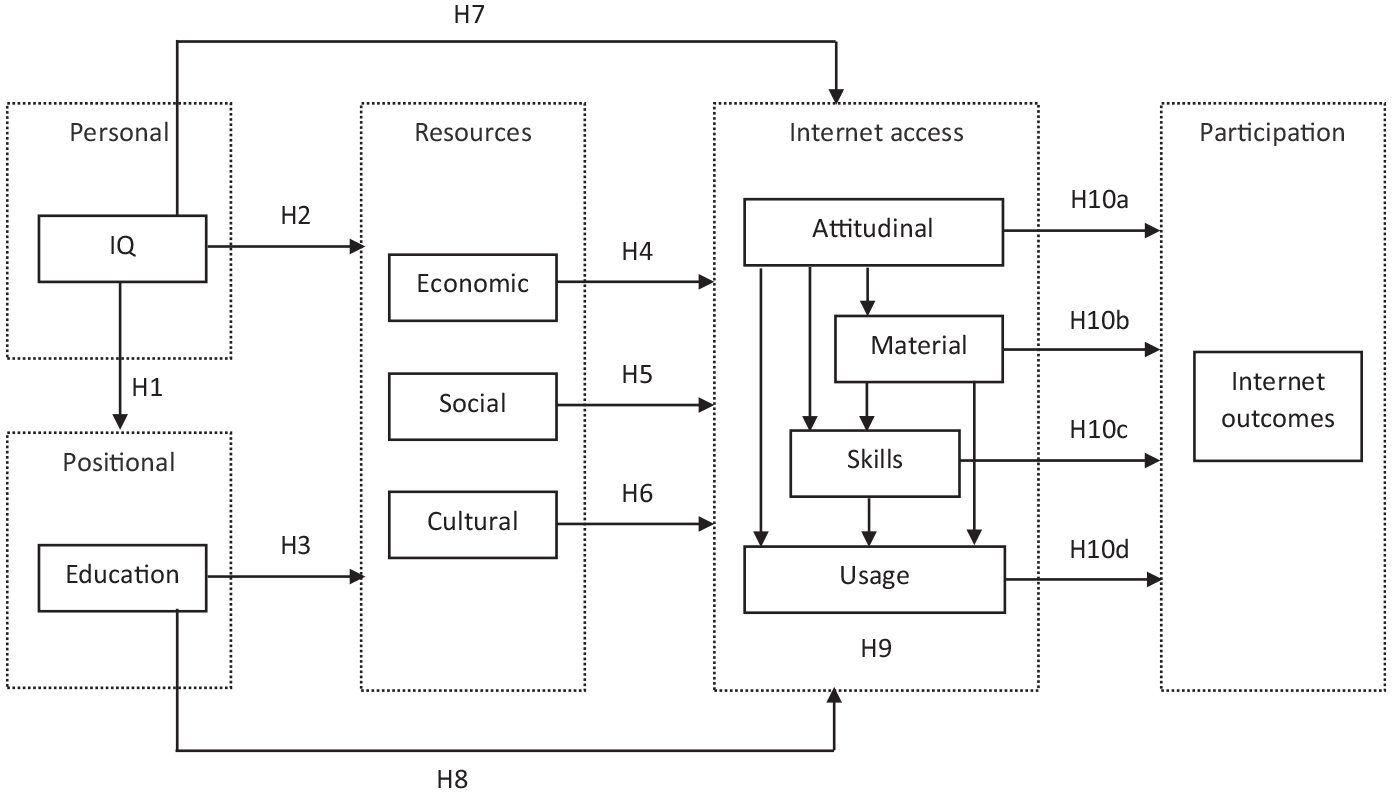
Conceptual model and hypotheses.
Method
Sample
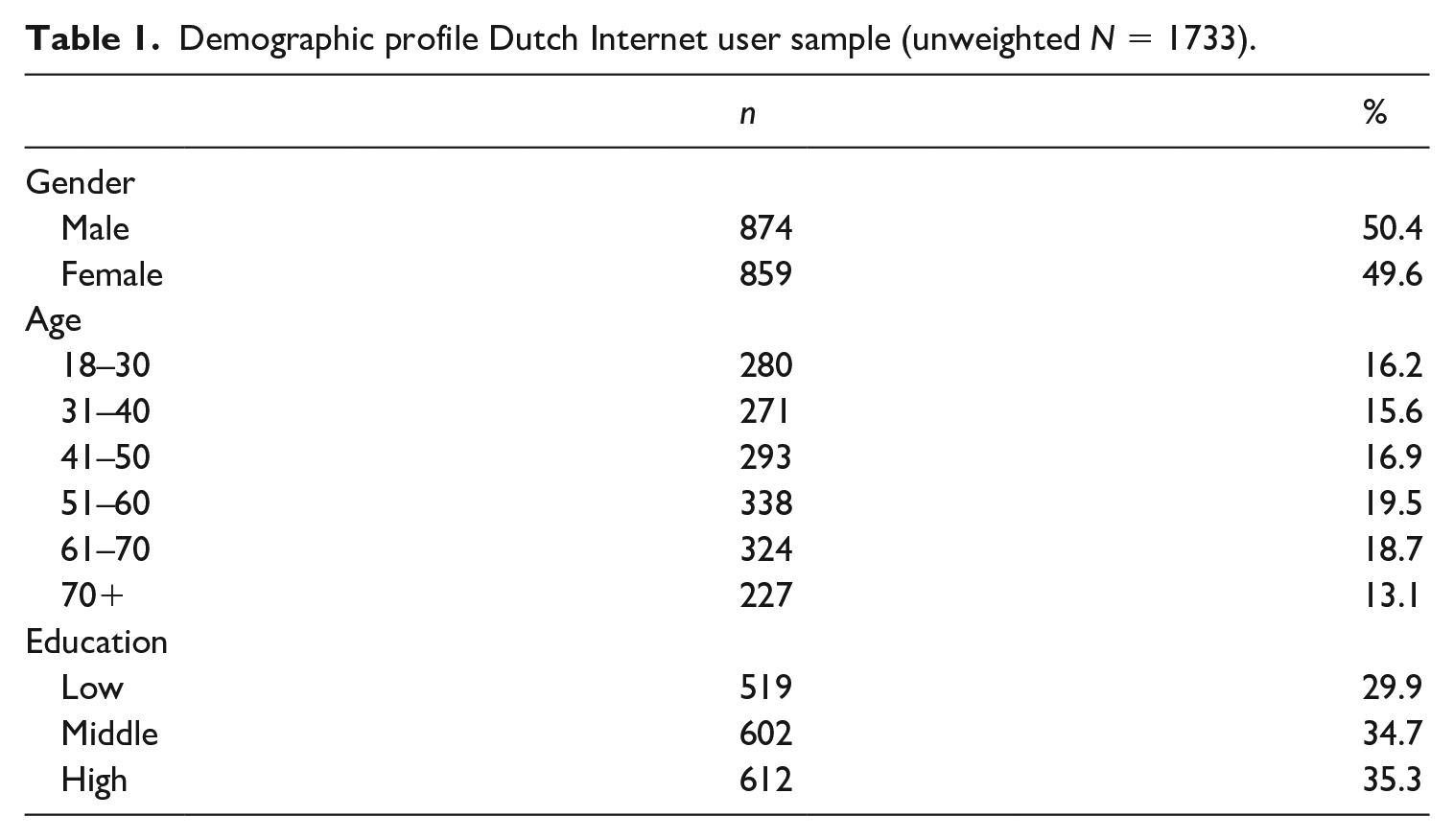
We conducted a two-wave online survey in the Netherlands with a 1-month time lag. Both surveys were organized by a professional market research organization. Members received a small monetary incentive for every survey they completed. The panel is a representative sample of the Dutch Internet user population. The first wave survey was held in April 2020 and was used to gather the respondents’ background variables of IQ, educational levels attained, and economic, social, and cultural resources. The second wave survey in May 2020 was applied to the same respondents and used to gather data on Internet attitudes, skills, materials used, types of uses, and types of outcomes achieved from Internet use. During data collection, we ensured that the final sample represented the Dutch population in terms of gender, age, and educational level. The final sample (respondents to both surveys) includes 1733 respondents (78.0% of the first survey). Table 1 summarizes the demographic characteristics of the respondents.
Demographic profile Dutch Internet user sample (unweighted N = 1733).
Measures
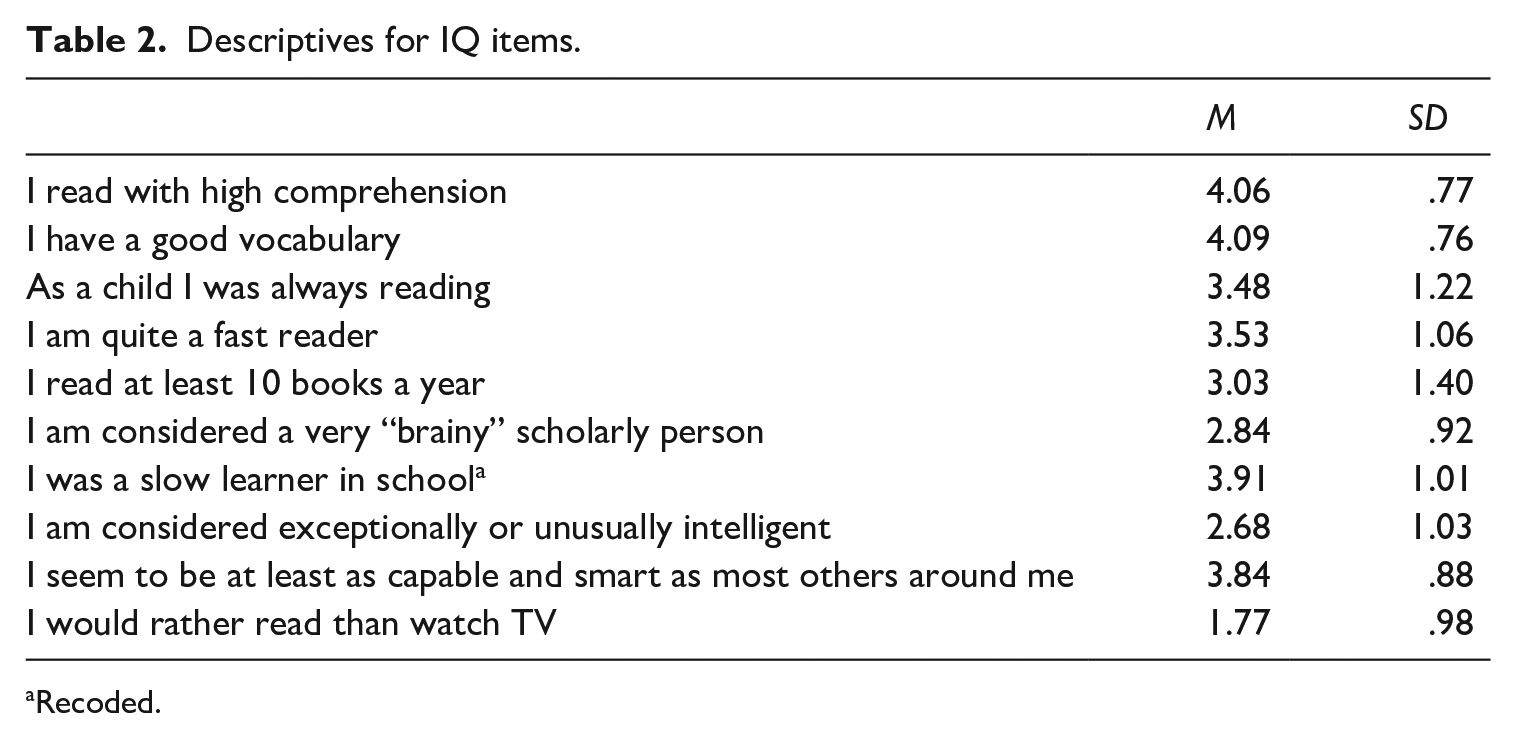
To provide an exploration of IQ in relation to digital inequality, we used 10 self-report items identified by Paulhus et al. (1998). They found these 10 items to perform best as indirect measures of intelligence, as they correlated relatively high with the scores of four IQ instruments, namely, Gough’s (1953) intelligence efficiency scale, Hogan’s intellect composite scale (Hogan and Hogan, 1992), Sternberg’s (1988) behavior checklist, and Trapnell’s (1994) smart scale. The 10 items are either direct ability-related items (e.g. “I was a slow learner in school”), indirect items about ability (e.g. “I am considered exceptionally or unusually intelligent”), or items about reading behavior (e.g. “As a child I was always reading”). The items were scored on a 5-point agreement scale (α = .73, M = 3.32, SD = .55; see Table 2).
Descriptives for IQ items.
Recoded.
To assess education, data regarding degrees earned were collected and used to create three groups: low (primary), middle (secondary), and high (tertiary) educational achievement.
Economic resources were measured by annual household income surveyed on a 13-point scale with an average value of €30,001–40,000. For further analysis, the scale was trichotomized (€10–30,000, €30–60,000, and > €60,000). For social resources, we used the social support survey proposed by Sherbourne and Stewart (1991). Respondents completed 18 items covering emotional (e.g. “Someone you can count on to listen when you need to talk”), informational (e.g. “Someone who can give you good advice when in a crisis”), and tangible (e.g. “Someone who would help you if you were bedridden”) support. All items were rated on a 5-point Likert-type scale with anchors none of the time (1) and most of the time (5). We computed an aggregate measure of support availability (α = .96, M = 3.84, SD = .85). Cultural resources were measured as participation in culture-oriented leisure activities (DiMaggio, 1982). We created a variable for the number of different types of collective cultural activities that the respondents were involved in over the previous year: historical museum, classical music or opera performance, concert or dance event, dance performance, play or cabaret, library, art museum or gallery, and cinema. All eight dichotomous items were summed into a single scale (M = 3.14; SD = 2.27).
Attitudinal Internet access was measured by three items adapted from (Helsper et al., 2017) digital motivation scale. The items are balanced for the direction of response and measured on a 5-point agreement scale (α = .75, M = 4.12, SD = .70). A sample statement is “Technologies such as the Internet and mobile phones make life easier.”
To measure material Internet access, we considered the total number of seven devices used to connect to the Internet: a desktop computer, laptop, tablet, smartphone, smart TV, game console, and smart device (e.g. activity tracker and smart assistant). Subsequently, seven dichotomous items were summed into a single scale (M = 3.43, SD = 1.53).
Skills Internet access was adapted from the conceptual idea behind the Internet skills scale (van Deursen et al., 2016). We proposed 30-item reflecting operational, information navigation, social, and creative Internet skills. In a principal component analysis, a 14-item skills construct showed an eigenvalue over 1.0, explaining 60% of the variance. This skills construct contains items for all four Internet skills and exhibited high internal consistency (α = .96, M = 3.65, SD = .98). All items were scored on a 5-point scale ranging from “not at all true of me” to “very true of me” (see Appendix 1).
Usage Internet access was conceptualized as part of a wider conceptual framework that examines outcomes that digital divide policies aim to achieve (Helsper, 2012). van Deursen and Helsper (2017) used this theory-driven classification of Internet outcome domains to operationalize different types of uses that people perform to achieve the corresponding outcomes. We followed this approach and proposed several use items in each of the four domains (economic, social, cultural, and personal). This resulted in a list of 50 different types of Internet uses. Respondents were asked for each item to indicate to what extent they use the Internet for a specific activity, using a 5-point scale (“never” to “daily”) as an ordinal-level measure. Principal component analyses with varimax rotation resulted in 10 factors (31 items) with eigenvalues over 1.0, together accounting for 71% of the total variance. For the analysis, we transformed these items to a dichotomous answering scale reflecting whether the Internet was used for a particular activity or not. In total, the 31 dichotomous items were summed into a single scale (reflecting the diversity of use) and divided by 31 (M = .58, SD = .23; see Appendix 2).
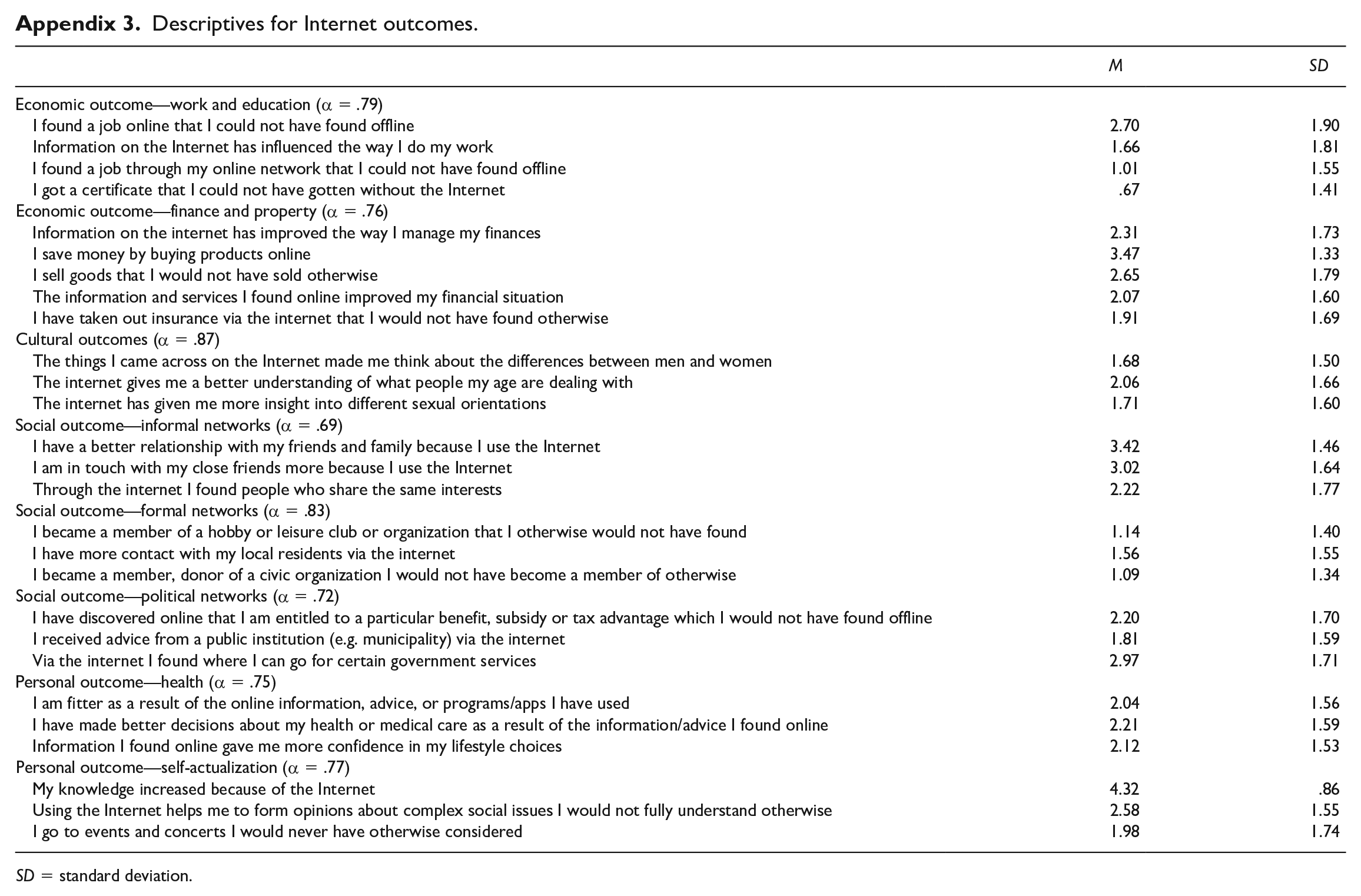
Internet outcomes were based on a range of outcomes proposed by van Deursen and Helsper (2017). The outcomes relate to the same categories considered for usage Internet access (and are thus derived from Helper’s wider conceptual framework). Respondents were asked to what extent they agreed that they had achieved an outcome. Principal component analyses with varimax rotation resulted in an eight-factor structure with eigenvalues over 1.0, together accounting for 69% of the total variance. The 27 items in the eight factors were dichotomized (not achieved/achieved) and summed into a single scale (reflecting the diversity of outcomes) and divided by 27 to reflect the diversity of Internet outcomes (M = .21, SD = .19; see Appendix 3).
Pretesting of all survey questions was conducted through eight cognitive interviews. Cognitive interviewing involves systematically developing survey questions through investigations that intensively probe the thought processes of individuals presented with such inquiries (Willis, 2005). We considered this especially important for measuring intelligence, as the questions needed to be understandable to everybody. Questions that surfaced as problematic were evaluated and adjusted. Each survey took approximately 20 minutes to complete.
Data analysis
To test our hypotheses, we applied a path analysis using Amos 20.0 to determine whether the conceptual model (Figure 1) explains the relationships between IQ, education, resources, Internet access, and outcomes. To achieve an extensive model fit, we included the χ2 statistic, the ratio of χ2 to its degree of freedom (χ2/df), the standardized root mean residual (SRMR < .08), the Tucker–Lewis index (TLI > .90), the comparative fit index (CFI > .95), and the root mean square error of approximation (RMSEA < .06; Hair et al., 2006). We added covariates between the economic, social, and cultural resources.
Results
Structural and path model
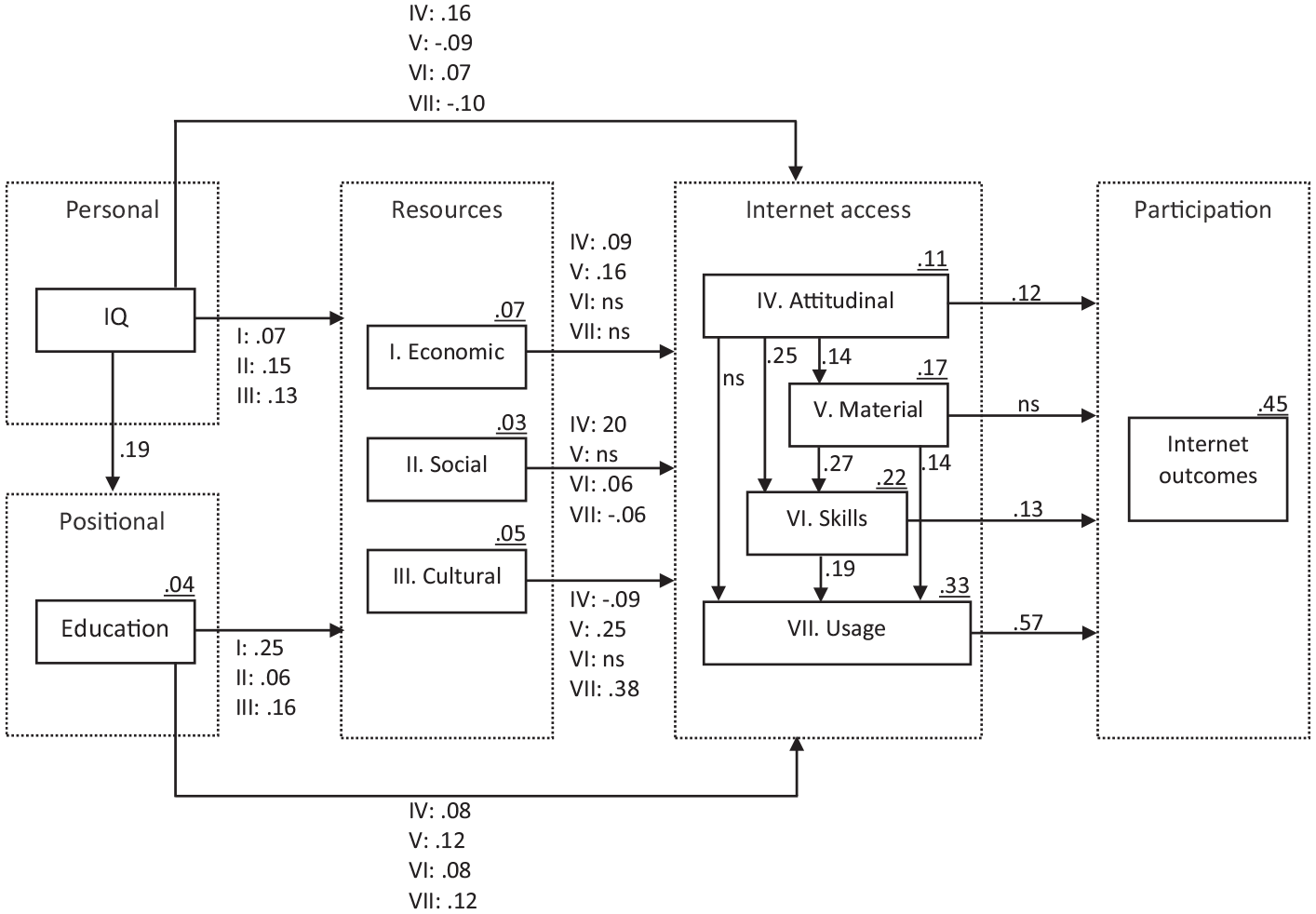
The fit results obtained by testing the validity of a causal structure of the conceptual model in Figure 1 are good: χ2(6) = 19.34, χ2/df = 3.87, SRMR = .02, TLI = .96, CFI = .995, RMSEA = .04 (90% confidence interval [CI] = [.02, .06]). The correlation matrix of the variables is displayed in Table 3. Figure 2 provides the path model with coefficients and variances explained.
Correlation matrix.
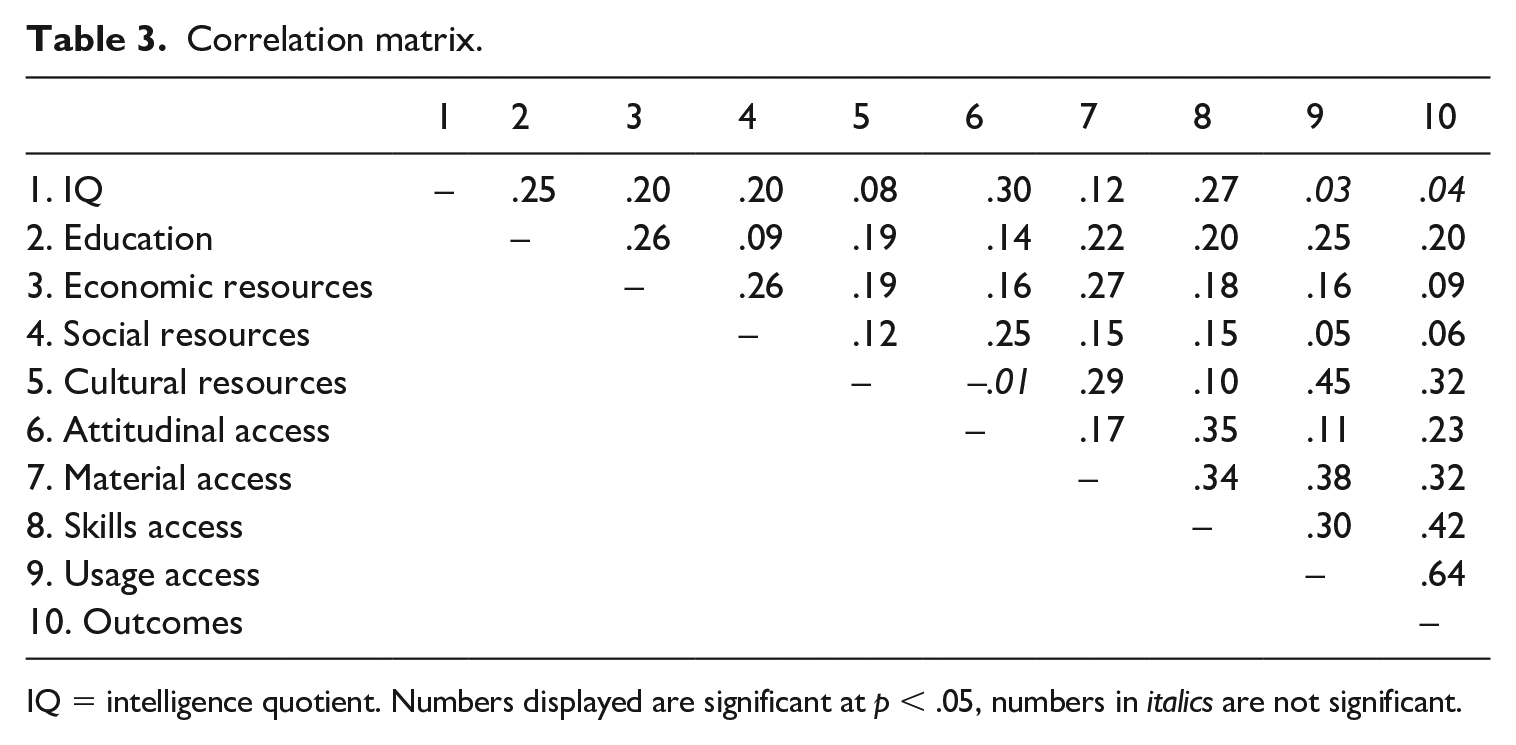
IQ = intelligence quotient. Numbers displayed are significant at p < .05, numbers in italics are not significant.
Measurement model.
Overview of the hypotheses
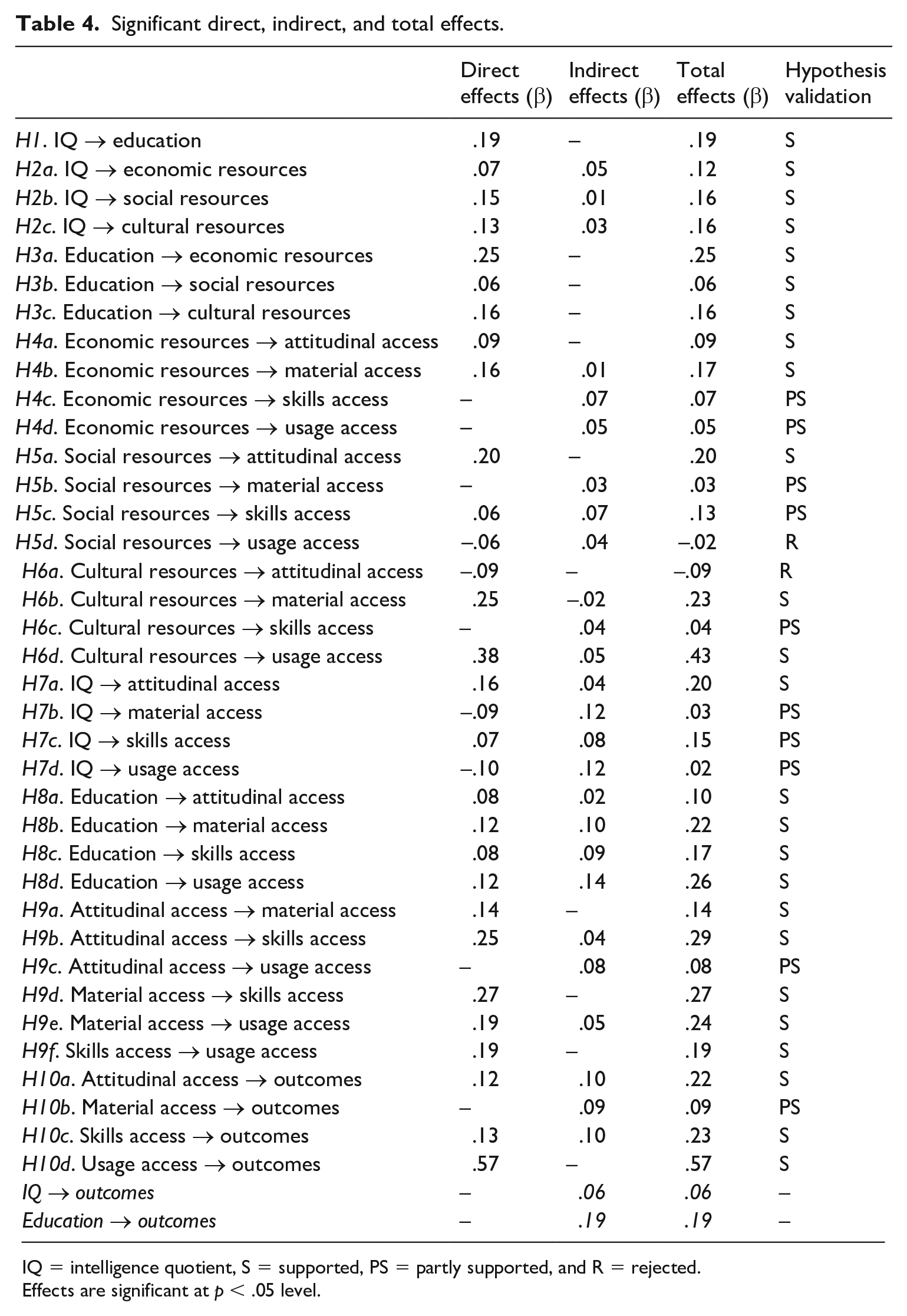
The standardized path coefficients shown in Figure 2 reveal several significant direct and indirect effects between IQ, education, economic, social, and cultural resources, the four Internet access types, and Internet outcomes. Table 4 summarizes the validation of the hypotheses.
Significant direct, indirect, and total effects.
IQ = intelligence quotient, S = supported, PS = partly supported, and R = rejected.
Effects are significant at p < .05 level.
The first hypothesis is supported: IQ has a positive influence on education. Furthermore, IQ has a positive direct influence on economic, social, and cultural resources, supporting hypotheses H2a, H2b, and H2c. Via education, indirect influences of IQ appear for all resources. The results also reveal a direct and indirect positive influence of IQ on Internet attitude and Internet skills, supporting hypotheses H7a and H7c. IQ negatively directly influences material and usage Internet access, although the indirect effects (via education and resources) are positive and slightly larger. Hypotheses H7b and H7d are partly supported.
Education positively influences all resources, supporting hypotheses H3a, H3b, and H3c. Furthermore, education has direct and indirect positive effects on all four Internet access types, supporting hypotheses H8a, H8b, H8c, and H8d.
Economic resources directly positively influence attitudinal and material Internet access, supporting hypotheses H4a and H4b. The influence on skills and usage access is indirect (via attitudinal and material access), partly supporting hypotheses H4c and H4d. H5a and H5c are supported, as social resources directly influence attitudinal and skills Internet access. H5b is partly supported; social support contributes only indirectly to material access. H5d is rejected, as the direct influence of social resources on usage access is negative and indirect positive influence does not compensate for this. For our hypotheses on cultural resources, H6b and H6d are supported. However, H6a is rejected, as the results show a direct negative influence on attitudinal Internet access. H6c is partly accepted as there is only a positive indirect effect on skills access.
The sequential nature of the four Internet access types is mostly confirmed, and hypotheses H9a, H9b, H9d, H9e, and H9f are supported. H9c is partly supported as the influence of attitude on usage access is indirect.
Finally, the results show that attitudinal, skills, and usage access directly positively influence Internet outcomes, supporting hypotheses H10a, H10c, and H10d. The influence of material access is indirect, so hypothesis H10b is party supported
Discussion
Main findings
In the current contribution, we used resources and appropriation theory to study the role of cognitive intelligence (measured as proxies of IQ, the traditional measure of cognitive intelligence) in the process of Internet appropriation and in benefiting from Internet use. The importance of IQ was confirmed with direct positive effects on education, on economic, social, and cultural resources, and on Internet attitude and Internet skills. As Internet appropriation runs from Internet attitude, material access, Internet skills, and Internet uses to achieving tangible outcomes, IQ stands at the beginning of the Internet appropriation process. The results as presented reveal several details that can enhance our understanding of the specific mechanisms through which IQ and education operate in digital inequalities.
Both IQ and education revealed positive effects on resources. Education has a stronger effect on economic resources. Education adds skills—such as development of job-relevant knowledge—that are valued in the marketplace and result in better job performance and wages (Byington and Felps, 2010; Gensowski et al., 2011). Those with higher IQ scores will have an increased likelihood of receiving higher education and by this mediating manner also have greater job-relevant knowledge. Economic resources in turn primarily effect Internet attitudes and material access, or the number of devices an individual can afford to establish an Internet connection.
For obtaining social resources, IQ appears to have a stronger contribution than education. This is somewhat unexpected as we considered IQ as a fundamental cognitive variable, while education is considered as a social process of acquiring knowledge, skills, values, morals, beliefs, and habits (Dewey, 1938). One explanation might be that those with higher IQ better understand the opportunities arising from social interactions (Conti et al., 2013). Social resources support the establishment of positive attitudes and the development of skills as people require a particular network that motivates or forces them to learn specific skills (Helsper and van Deursen, 2017).
The effect of IQ and education on cultural resources is comparable. Education is an important vehicle to transfer cultural advantage and be exposed to a variety of arts (DiMaggio and Useem, 1978). An explanation for the role of IQ might be found in the IQ measures used in this study. These, to some extent, reflect individuals’ tastes and media consumption. Cultural resources were found to contribute to material and usage access. We measured cultural resources as participation in culture-oriented leisure activities. This is likely to be reflected in the number of activities performed online, and also in the devices used to access the Internet.
The results revealed that IQ has a strong direct positive effect on attitudes toward the Internet, and a direct negative effect on material and usage Internet access. These negative effects are somewhat unexpected. An explanation might be that higher IQ makes people more critical in purchasing technology and in its use. Prior research (that did not consider IQ measures) found that educational level of attainment has a positive effect on being critical and considerate in using certain devices and online applications (Scheerder et al., 2017). Our findings might indicate that IQ plays a substantial role in this matter. The indirect effects of IQ (through education and resources) on material and usage access, however, are positive, making the overall effects very small. As a result, IQ seems to mainly shape digital inequalities through attitudinal and skills access, as both access types have a significant impact on outcomes. Unlike IQ, education has a strong positive effect on material and usage access and has a greater overall impact on Internet outcomes as compared with IQ. This would suggest that education introduces (or encourages) people to a larger variety of devices to go online and a larger variety of online activities. In any way, to further unravel the exact mechanisms at play here, digital inequality research will benefit from further qualifying or reconsidering the concepts and influence of education by also accounting for intelligence.
Policy directions
The results show that IQ cannot simply be neglected as digital inequalities relate to this inherent endogenous and partly innate trait. While altering a fundamental cognitive variable is extremely difficult, seriously considering digital inequality research does suggest that we place more emphasis on differences in cognitive intelligence. The Internet environment is characterized by increasing complexity and options, characteristics that place a major premium on cognitive intelligence. If more research would address the cognitive demands of Internet use, we might better determine how to structure the online environment, deliver better services, or provide better instructions. This may ease the burdens of complexity and promote wiser choices.
The level of IQ is determined by innate abilities and wide-ranging, societal, and historical contexts (Flynn, 2009). This suggests that fairly traditional educational and economic, social, and cultural policies adapted to the digital realm have to step in. Education might not improve IQ levels in a short term but it can compensate for a relatively low level of IQ, in this case by extending knowledge about digital media and improving digital skills. For instance, both positive and negative effects of the Internet and their reinforcement or compensation required can be discussed in schools at every level. This will improve Internet attitude and subsequent phases of Internet appropriation. Economic, social, and cultural policies of the government and, public and private organizations, both national and local, can support the (economic, social, and cultural) acquisition of resources that are needed to the appropriation of the Internet as observed in this contribution. One of the most important educational and cultural policies in this context is the priority to improve the level of all types of reading (see the proxy items for IQ used in this study). This has become an essential educational priority in our digital and visual culture.
Furthermore, a suitable approach is needed to help people with lower IQ to learn digital skills and use the Internet following their own needs instead of those of their educators or service providers. Currently, the Internet is not adapted to their abilities (Rocha et al., 2012). Improved Internet accessibility and usability and a better understanding of designs and interfaces can support those with lower levels of intelligence (and education). Another way of support is supervision when using the Internet. Typically, in cases when those of low cognitive ability are trained in using digital media, they often are “infantilized” (Chadwick et al., 2013) and considered as unable to understand or deal with this technology. Instead, teachers should give more trust and focus on the preferences and skills already present. Other possibilities will emerge with more augmentation of Internet technologies with capabilities to be adaptive and to proactively learn about users and their requirements, providing projective guidance and support (Smith et al., 2006).
Limitations and future research
For the measurement of IQ, in the current investigation, we used 10 items scoring highest on comparative tests. Paulhus et al. (1998) extracted a number of self-report items showing potential as proxy IQ scales or more economical substitutes for IQ tests. The idea was to find great practical advantages, as it would not be necessary to run subjects individually in a tightly supervised laboratory setting. Although 10 items were proposed, their data still suggest that self-reports remain difficult as proxies for IQ tests. An important drawback is that correspondence between self-rated items and IQ tests results from a common tendency to base one’s self-perceived intelligence on abilities different from those covered in IQ tests (Sternberg, 1988). Paulhus (1986) adds that discordance is furthermore expected due to motivated (inflated self-perceptions due to narcissism or self-deception) and unmotivated ignorance (a lack of interest, concern, or insight; Campbell and Lavallee, 1993). Despite these drawbacks, the 10 items seem suitable to use in relative comparisons between (groups of) respondents rather than for providing a more absolute conclusion on how intelligent a (sub)population is. Despite the difficulties of measuring IQ in large-scale surveys, this—to our knowledge—first empirical investigation of IQ in digital inequality research does point toward the importance of IQ in the inequality debate, which warrants further investigation rather than simply ignoring the construct.
The measurements for Internet uses (and Internet outcomes) reflected diversity. Although the variables contained a wide variety of uses, they were not analyzed separately. Future research might further entangle how IQ influences specific types of uses. This also accounts for different Internet skills as in the current analysis, these were merged into a single variable.
The sample used in the current investigation is representative in terms of age, gender, and education level. We did not specifically target those with intellectual disabilities. This would require a different survey approach. However, if those with intellectual disabilities were also included, the identified relationships would likely have been even stronger, as such individuals should suffer more from a lack of skills, Internet use diversity, and beneficial outcomes. Lussier-Desrochers et al. (2017) address the main challenges or conditions associated with digital inclusion for those with intellectual disabilities and mention challenges related to access to digital devices; sensorimotor, cognitive, and technical requirements; and the comprehension of codes and conventions. Their investigation provides an important step toward realizing and understanding the digital inclusion for people with intellectual disabilities.
Finally, the current study was conducted only in one country, the Netherlands with a relatively high-educated population with very high Internet connection rates and a relatively high level of digital skills. The advantage of this is that the role of cognitive intelligence or IQ could better be differentiated as the educational system and the technological infrastructure are available for everybody in this country.
Footnotes
Appendix
Descriptives for Internet outcomes.
| M | SD | |
|---|---|---|
| Economic outcome—work and education (α = .79) | ||
| I found a job online that I could not have found offline | 2.70 | 1.90 |
| Information on the Internet has influenced the way I do my work | 1.66 | 1.81 |
| I found a job through my online network that I could not have found offline | 1.01 | 1.55 |
| I got a certificate that I could not have gotten without the Internet | .67 | 1.41 |
| Economic outcome—finance and property (α = .76) | ||
| Information on the internet has improved the way I manage my finances | 2.31 | 1.73 |
| I save money by buying products online | 3.47 | 1.33 |
| I sell goods that I would not have sold otherwise | 2.65 | 1.79 |
| The information and services I found online improved my financial situation | 2.07 | 1.60 |
| I have taken out insurance via the internet that I would not have found otherwise | 1.91 | 1.69 |
| Cultural outcomes (α = .87) | ||
| The things I came across on the Internet made me think about the differences between men and women | 1.68 | 1.50 |
| The internet gives me a better understanding of what people my age are dealing with | 2.06 | 1.66 |
| The internet has given me more insight into different sexual orientations | 1.71 | 1.60 |
| Social outcome—informal networks (α = .69) | ||
| I have a better relationship with my friends and family because I use the Internet | 3.42 | 1.46 |
| I am in touch with my close friends more because I use the Internet | 3.02 | 1.64 |
| Through the internet I found people who share the same interests | 2.22 | 1.77 |
| Social outcome—formal networks (α = .83) | ||
| I became a member of a hobby or leisure club or organization that I otherwise would not have found | 1.14 | 1.40 |
| I have more contact with my local residents via the internet | 1.56 | 1.55 |
| I became a member, donor of a civic organization I would not have become a member of otherwise | 1.09 | 1.34 |
| Social outcome—political networks (α = .72) | ||
| I have discovered online that I am entitled to a particular benefit, subsidy or tax advantage which I would not have found offline | 2.20 | 1.70 |
| I received advice from a public institution (e.g. municipality) via the internet | 1.81 | 1.59 |
| Via the internet I found where I can go for certain government services | 2.97 | 1.71 |
| Personal outcome—health (α = .75) | ||
| I am fitter as a result of the online information, advice, or programs/apps I have used | 2.04 | 1.56 |
| I have made better decisions about my health or medical care as a result of the information/advice I found online | 2.21 | 1.59 |
| Information I found online gave me more confidence in my lifestyle choices | 2.12 | 1.53 |
| Personal outcome—self-actualization (α = .77) | ||
| My knowledge increased because of the Internet | 4.32 | .86 |
| Using the Internet helps me to form opinions about complex social issues I would not fully understand otherwise | 2.58 | 1.55 |
| I go to events and concerts I would never have otherwise considered | 1.98 | 1.74 |
SD = standard deviation.
Funding
The author(s) received no financial support for the research, authorship, and/or publication of this article.
