



Abstract
Our article analyses partisan, user-generated Facebook pages and groups to understand the articulation of political identity and party identification. Adapting the concept of scenes usually found in music studies, these Facebook pages and groups act as partisan scenes that maintain identities and sentiments through participatory practices, principally by making and sharing memes. Using a mixed methods approach that combines social media data and interviews during the 2019 Canadian federal election, we find that these partisan scenes are an active part of elections and the overall political information cycle in Canada but endure beyond election cycles. Rather than trying to sway voters of different political affiliation and influence the election outcome, Facebook users employ memes to hang-out and build community, thereby reinforcing partisanship.
Introduction
Our study explores the relationship between political communication, political identity and partisanship through citizen-led Facebook pages and groups. Building on a larger study of the 2019 Canadian federal election, we analyse a subset of major partisan groups and pages on Facebook to understand how users performed political identity and participated in the online campaign. We observed these groups for 4 weeks during the election, analysed their metrics and subsequently interviewed their moderators to understand how partisans shared memes. Our findings offer insight into the vexing question of how partisanship and political identity exist together online. Partisans and fans participated in these groups and pages by creating, sharing and discussing memes. We found that creators, overall, did not make memes to influence the election by swaying voters from other political camps or to go viral. Rather, partisans created memes to maintain their political identities and affective attachments to political parties. How memes performed these functions differed between partisan communities. Liberal and social democratic meme pages exhibited a stronger engagement with popular culture and meme jokes, whereas people on the political right mostly made memes using their own vernaculars.
Bridging Political Communication and Cultural Studies, we argue that these pages and groups on Facebook functioned as partisan scenes. Scenes is a term used in Cultural Studies to describe ‘loosely bounded social worlds oriented to forms of cultural expression’ (Woo et al., 2015: 288). In our context, the collective work that occurs on our Facebook pages and groups are enduring partisan scenes which cultivate specific political identities and party affinities. These scenes endure beyond election cycles though clearly become more active during campaigning periods. Like music scenes, partisan scenes perpetuate partisan attachments, settle differences and help citizens feel political. These scenes exist separate from the political parties themselves. Rather they are a partisan push at the periphery of party platforms and brands: they maintain party loyalty while translating the daily events of the campaign into jokes and common reactions. Our research on memes and theorization of partisan scenes adds a useful analytical and methodological approach to understand everyday political communication globally.
Citizen-initiated campaigning in Canada
Canada is a novel case to study memes, partisanship and political identity. The country is a stable parliamentary democracy usually classified as a liberal media system (Hallin and Mancini, 2004) and, in recent years, has witnessed a hybridization of its media system (Chadwick, 2013). It is exceptional for having a first-past-the-post election system with more than two parties. The currently ruling Liberal Party of Canada (LPC) and the Conservative Party of Canada (CPC) usually hold power, but more frequent minority governments have led to greater influence for Canada’s social democrats, the New Democratic Party (NDP), the regional Bloc Quebecois (BQ) and the Green Party of Canada (GPC). Canada has weaker levels of partisanship than the United States (Bélanger and Stephenson, 2010). Parties cautiously interact online, wary of risks and careful to set strict message discipline for candidates (Marland, 2016; Small et al., 2014). Canadian parties, like parties in the United Kingdom and the United States, have adopted citizen-initiated campaigning by encouraging members to act as personalized messengers, and have cautiously approached enlisting online partisans in the campaign (Gibson, 2015). Most notably Conservatives developed an informal relationship with early Canadian blogging communities (Flanagan, 2007). At the same time, bloggers and citizen journalists have also disrupted election messaging, particularly in the 2015 election when the incumbent Conservative party struggled to maintain its party brand as citizen journalism uncovered scandals about candidates’ pasts (McKelvey et al., 2018). A number of third parties from Shit Harper Did (active from 2011 to 2015) (Piebiak, 2014) to the rise of new third-party advertisers like the Canada Proud Network (started in 2016) participate in election campaigns, politically aligned but outside party control. Third-party groups, particularly the Canada Proud Network’s Ontario Proud page, have attracted growing interest in Facebook pages as effective campaign tools. As well, Canada has an online culture known to create and share memes about its political leaders and parties (Lalancette et al., 2019; Lalancette and Small, 2020).
For the 2019 election, LPC leader and Prime Minister Justin Trudeau sought re-election, faced against first-time leaders Andrew Scheer (CPC), Jagmeet Singh (NDP), Yves-François Blanchet (BQ) as well as long-time GPC leader Elizabeth May. Former CPC leadership candidate Maxime Bernier split from the Conservative Party to form his own People’s Party of Canada (PPC), offering a far-right, libertarian option on the 2019 ballot. Important to our discussion below, race was an important theme in the 2019 election. NDP leader Singh was the first member of a visible minority (a Sikh) to be head of a major political party in Canada, and Time Magazine released a photo of LPC leader Trudeau wearing brownface 8 days into the campaign, causing a major scandal for a leader branded as a progressive. Later, photos of Trudeau wearing blackface in high school circulated. In addition, the federal government launched a series of reforms to enhance voter security including monitoring for election, cybersecurity training for political parties and requirement of online websites over a certain size to provide an ad library. Only Facebook complied. Google and Twitter banned political advertising instead. Critics of the measure noted that the definition of advertising did not apply to emergent grey areas such as influencer marketing, organic messaging, political bots or memes (Reepschlager and Dubois, 2019). Importantly, there has been no evidence of foreign interference or problematic advertising, but the restrictions on paid advertising leave organic campaigning and meme makers free to informally campaign online.
Participatory media as an expression of political identity
Our study considers how participation in citizen-led Facebook pages and groups expresses political identity and party identification. In doing so, we follow Marichal (2013) who described activity on Facebook pages and groups as a kind of microactivism. Political identity is understood here as shared beliefs, values, attitudes and emotions that interpret events and – not always but often – forge affinities to political parties. Contrary to instrumental approaches that theorize partisanship as a rational choice by voters to maximize their own benefits in elections, expressive approaches to partisanship have pointed out the role that social identities play in promoting emotional attachment to a political party and political issues. In the expressive account of political identity, such emotional and identity-based attachments explain the stability of party loyalty over time and the relative insignificance of short-term events on vote choice (Achen and Bartels, 2017; Huddy and Bankert, 2017; Kreiss, 2018; Mason, 2018). Research into this second approach suggests that aesthetic and humour choices co-construct political identity such that font preferences differ between Democrats and Republicans (Haenschen and Tamul, 2020). Differences have also been noted in how partisans react to content. More broadly, Dannagal G. Young (2019) argues that outrage media for conservative audiences and political satire for liberal audiences fulfil similar emotional needs, suggesting a relationship between political identities, forms of humour and party identification.
Answering calls to take memes seriously in politics (Dean, 2019), we argue that memes are an ideal object to study political identity formation in citizen campaigning on Facebook. 1 Memes – or what we define as amateur-created, sharable images – are popular, participatory media that combine humour, aesthetics, emotions and politics (Baldwin-Philippi, 2019; Frazer and Carlson, 2017; Phillips and Milner, 2017; Szablewicz, 2014). Memes have become part of political movements globally (Milner, 2016; Mina, 2019; Nissenbaum and Shifman, 2017). Through practices of making, sharing and enjoying memes on social media, followers develop affective bonds, create opportunities for engagement and create shared pleasures. These activities are part of contemporary political campaigns. As Moody-Ramirez and Church (2019) found in the United States, how Facebook pages and groups shared memes about Hilary Clinton and Donald Trump shaped the candidate’s public image as well as cultivated shared emotion, principally dislike, among members.
Meme’s networked-ness elaborates its utility to the study of political identities. The iceberg (Figure 1) is both a meme and a way to understand the networked nature of memes. 2 The iceberg meme jokes about everything below the surface, that which is not immediately visible.
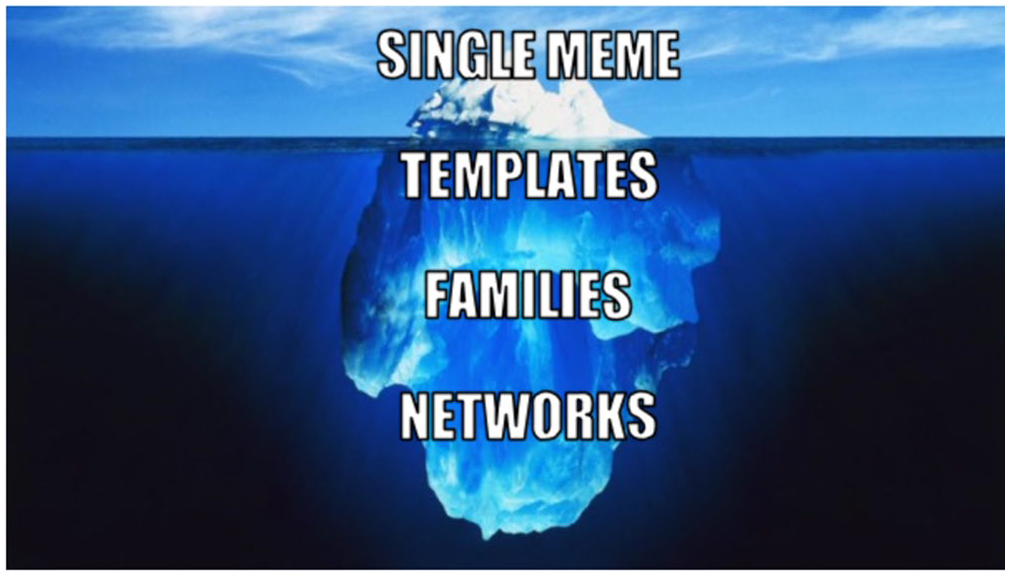
Summary of meme literature.
Scholarship agrees that a single meme is the ‘tip of the iceberg’ and looks below the surface of the image to its relations and cultural contexts. An individual meme is ‘a genre of internet humor that combines language and text towards ambiguous ends, memes create endless variations from a relatively limited number of variables’ (Lovink and Tuters, 2018). We think of these limited variables as templates. Pick your font (Impact, Arial, Comic Sans), your image (Doge or maybe Smudge the cat) and add your content to make a meme. Together, humour and style merge to create an amateur-ish look or what Nick Douglas (2014) describes as Internet ugly aesthetic. Going further down the iceberg, Elad Segev et al. (2015) conceptualize individual memes as being part of ‘meme families’ that share quiddities or ‘recurring features that are unique to each family and constitute its singular essence’ (p. 419). The iceberg above is a meme family. The image above is just one iceberg stock photo used in the meme family. Meme families share references to other families. In the case above, the iceberg is like other multiple panel caption memes. Connections between families form meme networks and more broadly meme cultures. Importantly, memes do not reference back to a monolithic Internet Culture. As we have learned from Whitney Phillips and Ryan Milner (2021), we cannot presume a White, middle-class Internet culture as universal. Black Twitter and Indigenous Twitter are two examples of the diverse meme cultures (Brock, 2019; Frazer and Carlson, 2017).
We find great affinities to research production studies and fan studies in political communication to understand the expression of political identity through memes. To the former, third-party professionals now manage social media and run ‘meme factories’ to produce political content for hire (Abidin, 2020; Ong and Cabañes, 2019). Their authenticity is valuable enough to be bought and sold to campaigns. For example, Michael Bloomberg paid prominent meme makers to endorse his brief run in the 2020 American Primaries. Prominent meme accounts and other influencers churned out pro-Bloomberg memes, foreshadowing a potential future of memes in political advertising (Lorenz, 2020). Less obviously, many social media are part of stealth media, or professional campaigning appearing as grassroots through misleading Facebook pages or automated accounts (Kim et al., 2018; Woolley and Howard, 2018). Professional social media campaigning often falls outside the control of the official parties, giving rise to independent, professional ‘satellite campaigns’ that work to support parties in general elections (Dommett and Temple, 2018).
In tandem with these new forms of professional campaigning, political fandom is seen as another popular force of contemporary online political campaigning (Hinck and Davisson, 2020; Lalancette and Raynauld, 2019; Street, 2004; Wilson, 2014). If politicians are either celebrities like Trump or behave like celebrities like Trudeau, then supporters can be understood as fans. McMillin (2020) argues that modern politicians have curated supporters who run large online fandoms around them. These fandoms typically exist online where they share an array of content, including memes about politicians (Hinck and Davisson, 2020; Hunting, 2020; Kosnik, 2008). Fan communities personalize politics and become the ‘unofficial parties who shape the flow of messages through their community’ (Jenkins et al., 2013: 7). Professional election campaigns try to cultivate or at least benefit from these independent meme producers. In the United States, Donald Trump has enjoyed support from the now banned The_Donald subreddit. The former US President has even invited key meme makers to White House visits (Broderick, 2019). On the other side, the influential Facebook group New Urbanist Memes for Transit Oriented Teens – an influence for some of this article’s interviewees – endorsed Bernie Sanders in the Democratic Primaries (Bliss, 2020). These efforts suggest a new phase of networked ward politics where parties court meme makers and their followers (Kreiss, 2016).
Building on these integrations of political communication and fan studies, we introduce the term scenes to describe citizen-initiated campaigning. Most often, memes are contextualized as part of subcultures (Milner, 2016; Nissenbaum and Shifman, 2017; Phillips, 2016). Meanwhile, the term ‘scene’ is used as a spatially oriented iteration on the concept of subculture (Hesmondhalgh, 2005; Woo et al., 2015). According to Straw (2001), it ‘is usefully flexible and anti-essentializing, requiring of those who use it no more than that they observe a hazy coherence between sets of practices or affinities’ (p. 248). This conceptual flexibility helps us understand our Facebook pages and groups as specific places of meaning-making and political practice that are part of larger contexts in which political identities and partisanship are shaped through expressive means. Whereas scenes are typically used to describe music and local venues, Grimes (2015) shows in her work in Game Studies that scenes help conceptualize the function of Internet sites to fan culture, arguing for the existence of digital scenes through online culture. As we discuss, Facebook groups and pages function as scenes that maintain political identities through sharing memes.
Methods
Data were collected as part of a larger study of the use of political memes in Canada. The overall goal of the project was to understand popular communication about the election through the systematic study of the production and circulation of memes. The project was part of the Digital Ecosystem Research Challenge, an inter-university collaboration monitoring political activity on Facebook, Instagram, Twitter, Reddit, YouTube and 4chan. Our study here focuses on Facebook. Although Canadians use many social media, Facebook is the most popular with 69% of Canadians using Facebook in 2019 (Brin and Charlton, 2020). From interviews, we know politicians, activists and meme makers agree that Facebook is the best social media platform to reach Canadians.
Phase 1 – identification of partisan Facebook groups and pages sharing memes (July–September 2019)
We first built a sample of public Facebook groups and pages sharing memes about Canadian politics. Pages and groups are two different social affordances on Facebook. Pages are centrally administered communication channels usually used for businesses or artists to connect to customers and fans or, in our case, channels administered by a few moderators creating, curating and posting memes. Groups are decentralized spaces where all members can post and comment on memes. Based on past research that found Canadian bloggers clustered by party, we suspected comparable political activity on Facebook ((Elmer et al., 2012). We used Facebook’s search function and ‘Related Pages’ to build an initial list of 25 pages and groups. Queries used the full names and acronyms of Canada’s major parties (Liberal, Conservative, NDP, BQ, GPC and PPC) as well as the names of major party leaders. To compensate for Facebook’s search personalization, we used many different accounts of undergraduates, graduates and professors in two major Canadian cities (Montreal and Ottawa). We refined our sample to groups and pages that
Had posted recently and frequently to avoid including inactive groups or pages;
Had more than 1000 members to eliminate groups that were too marginal or niche;
Focused on federal rather than provincial or municipal politics.
We ended up with a list of 15 groups and pages that included professional and citizen-led campaigning. We found pages and groups that existed for the Liberal and the NDP parties, for the leaders of the PPC (Maxime Bernier) and the CPC (Andrew Scheer), and many pages against Justin Trudeau. We found nothing for the GPC. Later in the study, we asked interviewees (moderators or administrators) to further recommend pages and groups to see if we missed any. Interviewees did not recommend any groups we had not found already. Names of the Facebook pages and groups are available upon request, but we are not disclosing the names of our interviewees to protect their anonymity.
Phase 2 – group and page observation during election (October 2019)
Data collection involved monitoring and student observations of our sample from 28 September to 28 October 2019, the last 3 weeks of the official campaign period plus 1 week after the election. Canada does not have a fixed start to the campaign, so we started collecting data as soon as possible after the writ was drawn on 11 September 2019. Data collection was deliberately manual, an attempt to find solutions to the lack of access provided by Facebook and the allure of big data. Teams of 2–3 students from two Political Communication classes tracked specific Facebook groups and pages for the 4 weeks, recording observations of memes weekly and reporting back at the end of observations with their reflections of group dynamics. Data collection was a classroom experiment in digital ethnography at scale. Students logged posts that included meme and meme-like graphics. Building on our literature review above, we defined memes as manipulated images combining words and texts that are not explicitly intended to represent data or information (see Appendix 1 for our decision tree used in class). Our sample avoided infographics or visual quotes, instead looking for images with an ‘Internet ugly’ aesthetic discussed above as well as images that referenced known meme families and networks. Graduate research assistants monitored the student groups’ weekly uploads to ensure consistent data collection of memes. After collection, the team further reviewed and validated that all images could arguably be called memes. In addition to classifying memes, students also identified if an image mentioned a party leader. Classroom discussion, observations from the research team and data collection resulted in a general impression of memes in the election that we triangulated with other data.
Phase 3 – integration of Facebook data (November to December 2019)
After manual data collection, we unexpectedly received access to Crowdtangle data for our sample, thanks to the main research team at the Digital Ecosystem Research Challenge. We had applied in August 2019 for Facebook data access before the election through Social Science One, but we did not receive access ourselves until May 2020. The provenance of our data access, however, presented challenges as our manual data collection could not be joined with Crowdtangle data easily. Crowdtangle uses a different per-post identifier than Facebook, so we had to clean URLs from Crowdtangle and our sample to isolate Facebook’s post identifier. In both data sets, URL values were truncated down to the post identifier that we used to merge our manual data and Crowdtangle data. The merger allowed posts coded above to include reactions, number of comments and the post text.
Phase 4 – interviews (December to March 2020)
After the election, we obtained ethics approval to contact and interview administrators and moderators of meme pages and groups as well as two third-party advertisers known to use memetic style in their Facebook organizing. Interviews were virtual (phone or videoconference), semi-structured and organized into three parts: the group’s origins and operation, election insights and the future of memes in politics. When possible, interviews referenced memes as trace data. We discussed specific memes with interviewees (Dubois and Ford, 2015). In total, we conducted five interviews with moderators of Facebook pages and groups in total (see Table 1). Two of these interviews were with professional communicators who popularized Facebook pages and groups for official third-party campaigning in Canada about their work, the conservative Canada Proud and the progressive North 99. We were unable to interview Anti-Trudeau and Pro-Scheer administrators despite repeated attempts to establish contact. However, our interviews do capture a wide spectrum of Canadian politics from the far-right Pro-Bernier pages to the mainstream and progressive pro-Liberal pages to the left-wing pro-NDP groups. Interviews were transcribed and then coded around emergent themes and answers to similar questions.
Subsample collected between 28 September 2019 and 28 October 2019.
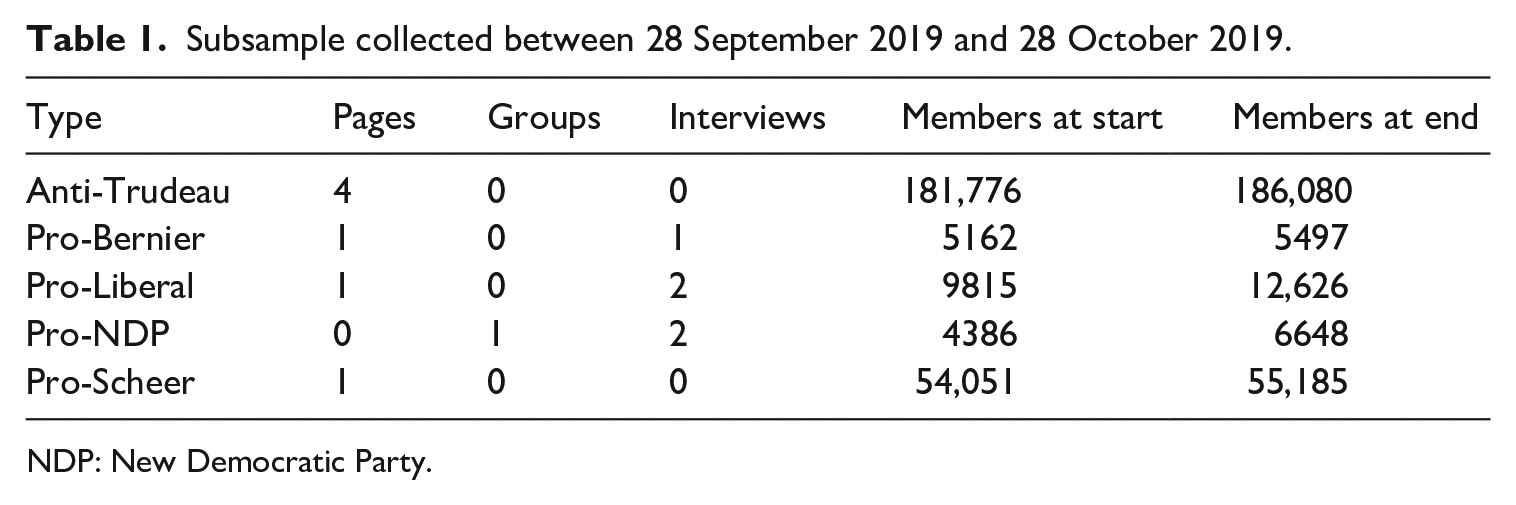
NDP: New Democratic Party.
Facebook groups and pages subsample
For this study, we focused on a subsample of eight pages and groups that we identified as citizen-initiated campaigns operating independently of parties or third-party advertisers. To protect the confidentiality of interviewees, we have not disclosed the names of the pages and groups in our subsample. Instead, we have grouped this subsample in Table 1 according to their political orientation: against Trudeau as well as groups in support of the CPC, LPC, NDP and PPC. For those we did interview, none indicated their participation in any satellite or grassroots campaigns (Kim et al., 2018). No interviewees claimed to be collaborating with the parties although some indicated that their members included current and past party members. Pro-PPC groups did claim to have interviewed party leader Maxime Bernier, the only example of direct communication we found in our subsample.
Notably, membership in our sample is small compared to official party and leader pages on Facebook. Justin Trudeau, at the start of our sample, was by far the most popular leader in Canada with 6,756,746 followers. Other leaders had between 6890 followers (Blanchet, PQ) and 289,710 followers (Scheer, CPC). Party pages also had more followers with the CPC with 453,537 members and the PPC with 18,143 members.
Defining partisan scenes
We frame the analysis of our findings through the concept of scenes. Scenes, according to Straw (2015), can be understood as collectivities marked by some form of proximity; as spaces of assembly engaged in pulling together the varieties of cultural phenomena; as workplaces engaged (explicitly or implicitly) in the transformation of materials; as ethical worlds shaped by the working out and maintenance of behavioural protocols; as spaces of traversal and preservation through which cultural energies and practices pass at particular speeds and as spaces of mediation which regulate the visibility and invisibility of cultural life and the extent of its intelligibility to others. (p. 477)
In our case, Facebook groups and pages were scenes that cultivated specific political identities and party identifications. Inductively, we found three trends in these pages and groups that correspond with the quote by Straw above. Facebook meme pages and groups act as scenes that
Foster shared political identities and cultural energies;
Interpret and pull together election events to maintain and reinforce party identification;
Work out, teach and enforce protocols of partisan political behaviour.
We now address all three trends in turn.
Spaces that foster shared political identities and cultural energies
Partisans used memes to develop affective bonds between themselves and the party. As seen in Figure 2, memes (teal in the chart) were a popular format in these groups throughout our collection period. These pages and groups gave meme creators a place to be and to share the excitement and disappointment of an election. Regardless of their party’s chances, memes provided partisans a place to hang-out and manage the campaign. Meme pages and groups were a place for both staffers and voters outside the party to laugh and cope with the election. Interviewees describe their experiences as funny, amusing, exciting and significant.
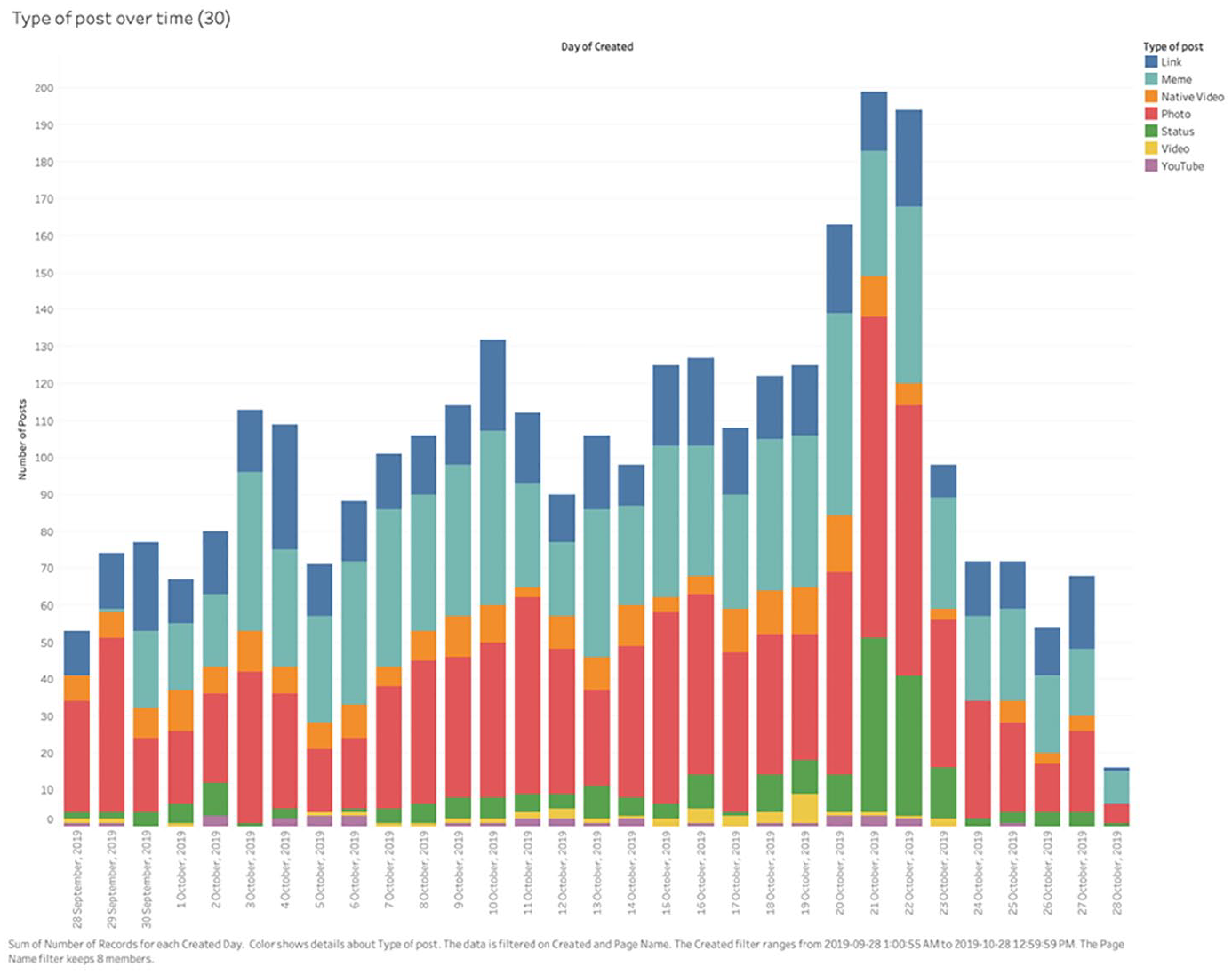
Type of per days in sample of Facebook pages and groups.
Interviewees described sharing memes as ‘shitposting’. Whereas Urban Dictionary defines this as ‘to post random unnecessary shit with no context or meaning’, we find that shitposting was more a way to hang-out and be online without putting too much thought into what is being posted. Posts were a way of being together and sharing partisan sentiments. As one interviewee explained, ‘[my Facebook group] is the only place I can go to have a sense of community and have people who understand my perspective, and so I can laugh along with these jokes . . . So it provides a certain sense of community I guess’ (Anonymous, personal communication, 24 February 2020). Humour was central to memes: ‘It’s an inside joke basically’ (Anonymous, personal communication, 8 March 2020). Creating and sharing memes became partisan media habits that led to affective bonds, imbuing Facebook groups and pages as important sites that partisans enjoyed following and engaging with. While not immediately apparent to some interviewees, the value of their meme page, which they saw as a place for shitposting, on the election caught them by surprise: I cared about the election. I didn’t care about the group. I honestly didn’t think this was going to influence the election . . . I was there to have fun. What was interesting was what happened during the election was that the community was such an enriching place to be because of so many people posting like, ‘Oh, I just got obsessed with Jagmeet’, or ‘I’m so inspired’. . . It was so fun to be in the group at the time. It was just fun! You know, and people joined and I guess we saw that triple in the membership at the time. And I think that it’s not about influencing the election. It’s kind of an inside baseball, like we motivate each other, kind of. (Anonymous, personal communication, 24 February 2020)
The joy, fun and edginess that interviewees described capture the ambivalence of meme culture. These practices can create important, fun experiences for all sorts of politics. Memes could be cruel or kind, jokes directed inward to the group as much as outward towards other parties.
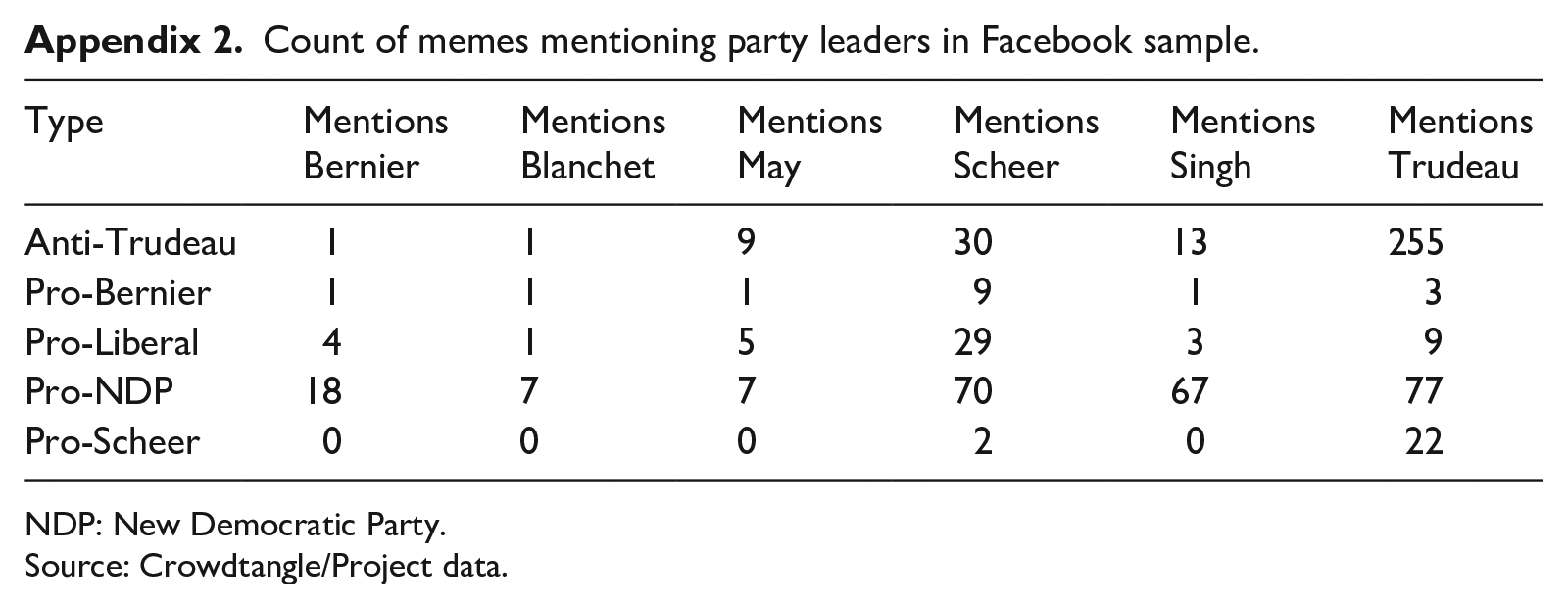
Scenes played with their relations to party brands and leader’s self-presentation. As seen in Appendix 2, most groups shared a lot of memes discussing other party leaders. Although groups differed in their treatment of other leaders (as we discuss next), memes often attempted to de-brand or deconstruct their opponents (Marland, 2016). In mocking party leaders and their respective supporters, memes cultivate an antagonism of us/them between partisans and their opponents while also shaping party identification. Memes gave groups some autonomy in the formulation of party identity and partisanship. They could find funny, critical or satirical memes that resonated when official messaging fell flat and maintain support when the party disappointed. As an informal campaign, memes created a partisan outside, where beliefs and values could be politicized without necessarily being endorsed by the party.
For the pro-Bernier group, party identification with the PPC relied on mocking the Conservative Party as a bad choice (Figure 3). The NDP had a similar approach of mocking Liberal supporters as a way to justify their own party (Figure 2) – a trend especially pronounced at the end of the election campaign when the NDP tried to convince supporters not to strategically support the Liberals to prevent a Conservative party win (a popular trope in Canadian elections). The pro-NDP group, notably, also shared a lot of positive messages about the party and the leader.
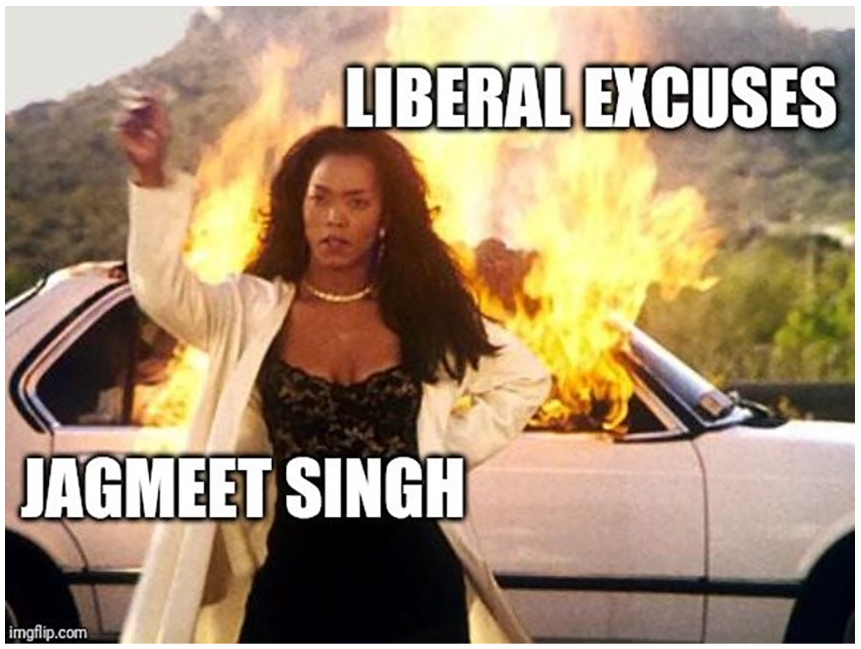
Pro-NDP meme targeting Liberals.
Pages and groups in our sample pushed at the limits of political discourse and party brands, showing that partisanship endures even as the party disappoints. This complex relationship between partisanship and party identification is best understood through the reaction to Trudeau’s brownface incident on the pro-Liberal page. On 18 September 2019, Time Magazine reported that Prime Minister and Liberal Party leader Justin Trudeau wore brownface make-up at a private school party in 2001. The event happened before our sampling period, but images of Trudeau in brownface appeared throughout our sample across partisan lines. The incident troubled one pro-Trudeau meme page as partisans of colour and allies had to reconcile their support of the party with their leader’s past behaviour. Admins of colour reacted differently, ranging from being sad, ‘gutted’ as one interviewee explained, to another giving up on the leader as just another ‘rich kid’ (Anonymous, personal communication, 5 March 2020). The group began to make fun of Trudeau and the incident to get the anger out. Posts then shifted away from Trudeau to be more about the party and policies. The turn is seen in Table 2 in Appendix 2 where pro-Liberal groups posted very little about Trudeau. Memes allowed Liberals to stay committed to the party while being disappointed in the leader, maintaining a party attachment beyond the party leader’s celebrity status. In this example, the transition from Prime Minister to platform reaffirms how groups functioned as scenes that are able to withstand controversy around specific individuals and re-focus their partisan positions and cultural energy around a more general political affinity.
Overall, pages and groups talked about issues more ideologically and more provocatively than the party could. For pro-NDP interviewees, memes allowed members to vent their disappointment with the party’s often conservative election strategies. By contrast, Maxime Bernier was a transgressive candidate that appealed to Canadians who also voiced support for then-US President Donald Trump. The pro-Bernier page then pulled in followers from outside mainstream Canadian politics. While quite active during the election, these scenes endured beyond election cycles. All pages and groups in our sample were active before and after the election. Like music scenes, partisan scenes perpetuate partisan attachments, settle differences and help citizens find political community. The scene further describes the informal campaign as an ongoing process, intensified but not defined by the election process, that develops broader political and partisan identities loosely connected to the party itself.
Interpret and pull together election events to maintain and reinforce party identification
Sharing memes is as much about new ideas as about maintenance of partisan values and beliefs in the face of constant change – a ‘working out and maintenance’ of partisanship or as Straw (2001) puts it elsewhere, ‘as spaces organized against change’ (p. 255). Meme groups and pages worked to define their own visual vernaculars that mixed common meme families with their own unique aesthetics, topics and references. Interviewees did not actively identify with meme networks and instead attributed their references to common meme culture because of being ‘extremely online’. Meme makers consciously drew from memes appropriate for the audience and issue – dank memes instead of boomer memes. Picking the right memes for their community seemed like part of the fun. All pages and groups produced their own orphan memes which Brubaker et al. (2018) define as ‘isolated meme instances that share common identifiers of meme families – format (e.g., image macros and lettering), stance (e.g., tone), and content (e.g., style of humour) – by including similar content, but lack replication within the greater memetic network’ (p. 743). They also frequently used meme templates like Expanding Brain (see Figure 3). The sampled pages and groups also differed in their self-referentiality. Anti-Trudeau pages created the most orphan memes, while others created an entirely unique mix of text and images. The latter included their own watermarks to brand memes in what we assume to be an attempt to credit their work and stop poachers re-using their memes without attribution.
Liberal and New Democratic pages and groups were actively aware of intersecting identities and questions of representation and tried to respond through memes and group management. All our interviewees presented as men – an issue raised by Liberals and New Democrats. As one NDP interviewee explained, ‘I didn’t even realize that [the admin team] was all white until someone pointed that out’ (Anonymous, personal communication, 24 February 2020). To counteract this, for a time, the group instituted Men-less Mondays when ‘only women and non-binary and non-male identifying people are posting’. By contrast, the pro-Liberal page consciously started making jokes about Trudeau’s brownface incident. While we were unable to interview anti-Trudeau or pro-Conservative groups, the opposite was true for the pro-Bernier interviewee who participated in an anti-feminist group that had previously been banned and re-built on Facebook. Anti-Trudeau and pro-Bernier pages often targeted prominent female public figures like environment minister Catherine McKenna and environmental activist Greta Thunberg, who participated in Montreal’s climate march during the election campaign. Trudeau’s brownface is another instructive example where Liberal and New Democratic pages and groups did not re-post the harmful image of Trudeau in brownface make-up, whereas it was an important graphic in anti-Trudeau groups. These findings suggest that memes perform identity work that relates partisans to matters of race, class and gender as much as party. In this manner, memes help to construct the partisan scene through audience-specific content that helps construct and maintain shared identities.
Work out, teach and enforce protocols of partisan political behaviour
Partisan activity teaches these vernaculars to other members through comments, reactions and whether memes were accepted or taken down by the admins. Interviewees noted that they curated memes on their pages or groups, taking down inappropriate remarks when flagged by members or other admins. All scenes tried to balance being open while also ensuring a respectful group. The pro-Bernier admin noted an ongoing issue with Facebook’s content moderation, suggesting that Facebook’s community standards limited its group activities. No page or group studied had a clear organizational structure for these decisions with management issues either being discussed in private chats or on the group itself. For example, Liberals and New Democrats worried about the appropriateness of some meme templates, like the potential misogyny of the ‘Distracted Boyfriend’ or the Drakeposting formats, and tried to encourage users not to post or share these memes. These concerns would either be addressed in the comments below a meme, or posted and pinned to the page by admins.
Party brands and party leaders did influence how partisans could meme. As our pro-Bernier admin explained, ‘some candidates are meme-able . . . Some are not . . .’ Explaining their support of Bernier over other Conservative candidates, the admin contined, ‘When we looked at the Bernier campaign and we saw that he’s using the whole like red pill, blue pill sort of meme . . . We’re like, that’s our guy’ whereas Andrew Scheer ‘was just un-meme-able unfortunately and like you can’t, it’s not magic, you know, you can’t just make meme out of someone. They need to be like memorable in a way’ (Anonymous, personal communication, 8 March 2020). Partisans then differed in how they could take advantage of their leader’s meme-ability or un-meme-ability.
While partisan scenes all engaged in image-building of parties and leaders, anti-Trudeau groups differed in their hostility compared to other pages and groups in our sample. In contrast to Lalancette and Raynauld (2019) who found that Canadian memes attacked the politics, not the personality of former Prime Minister Stephen Harper, attacks on Trudeau were often juvenile and personal. Memes flipped the letters in Trudeau’s name to spell Turd and encouraged voters to ‘flush the turd’ in the next election. Even criticism of Justin Trudeau’s inconsistent record on climate change could be turned into a personal attack. The day after the Conservative Party labelled Trudeau a ‘high-carbon hypocrite’, the meme in Figure 4 circulated on pro-Scheer pages and was picked up by other anti-Trudeau pages that added personal attacks and conspiracies to the meme. The second plane, while initially mocked for its environmental pollution, became filled with references to far-right views like the false claim that Trudeau paid off former child soldier Omar Khadr, conspiracy theories that allege Trudeau is the son of Fidel Castro and personal attacks by presenting images of a young Trudeau as a party animal (Figure 5).
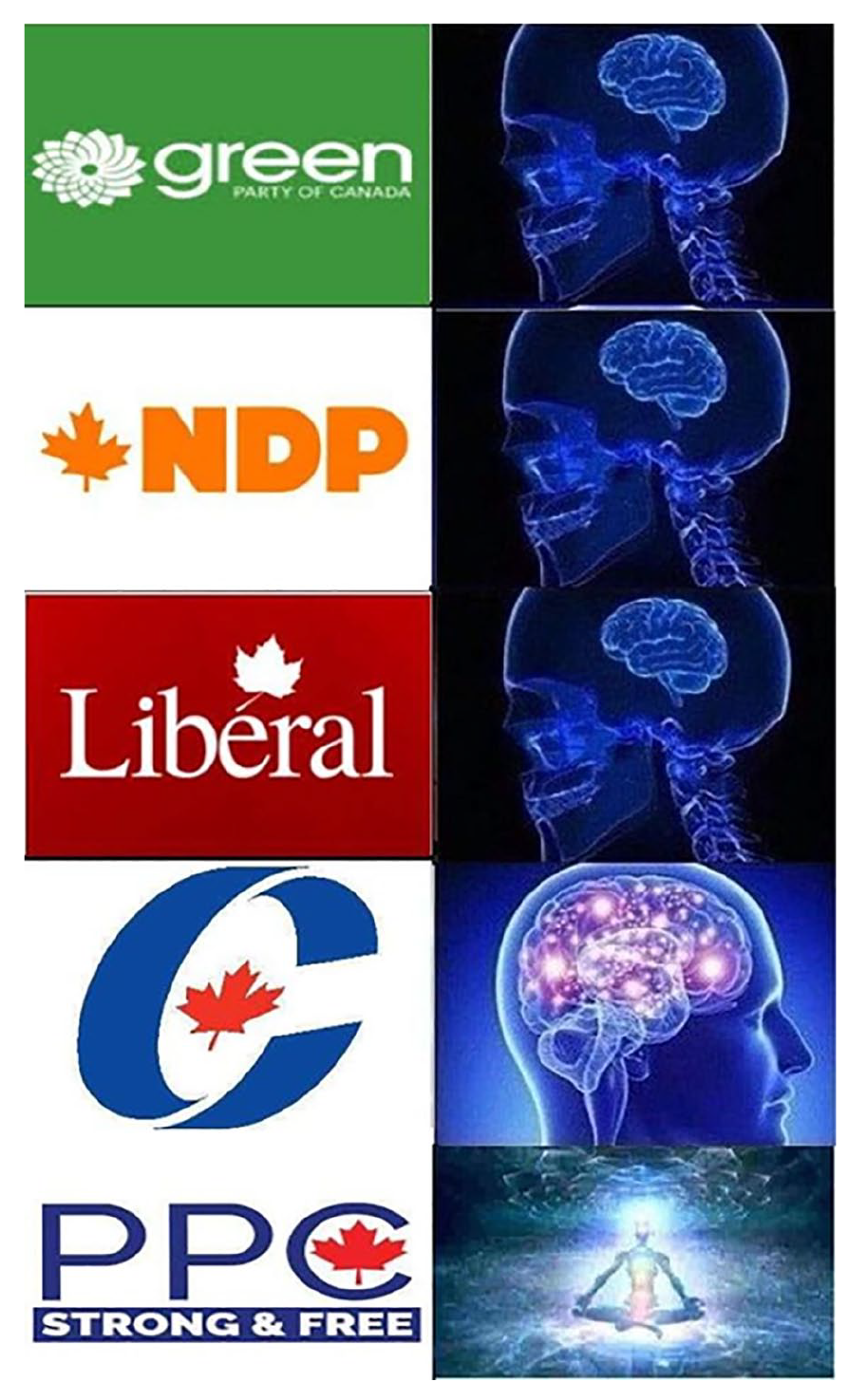
Expanding Brain Meme template used by pro-PPC meme group.
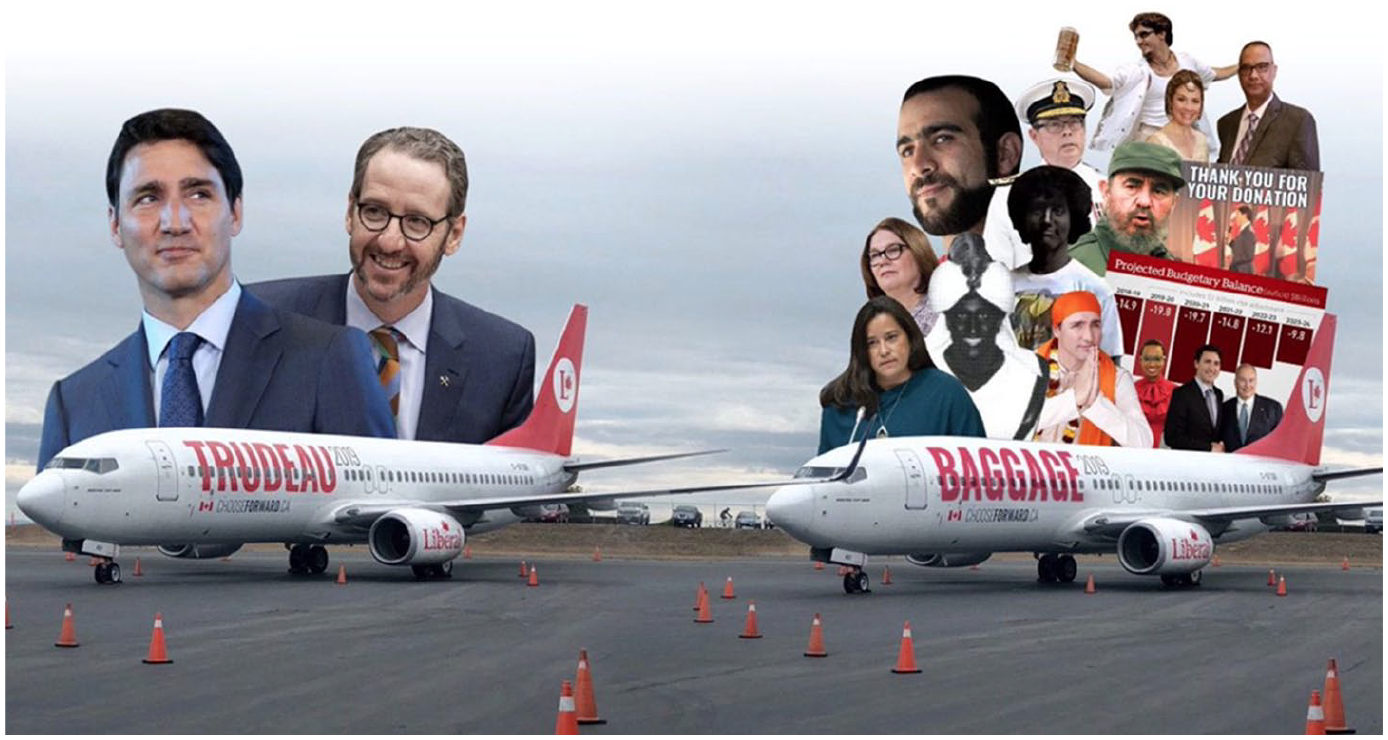
Meme mocking Liberal’s use of two campaign planes including conspiracy theories.
The image also references a common theme in anti-Trudeau pages, namely the portrayal of Trudeau as a sexual predator. Memes cultivated a notion that Trudeau was guilty of sexual misconduct, a story that became its own event through junk news site The Buffalo Chronicle and allegations from the CPC suggesting that Trudeau had left his teaching post at a private school after having a relationship with a student. No press room in Canada could confirm that allegation. The emphasis on Trudeau as a sexual predator is reminiscent of the paranoid style of American politics where [T]he sexual freedom often attributed to the enemy, his lack of moral inhibition, his possession of especially effective techniques for fulfilling his desires, give exponents of the paranoid style an opportunity to project and express unacknowledgeable aspects of their own psychological concerns. (Hofstadter, 1964: 85)
As Hofstadter argues, conspiracists commonly apply their own moral concerns around sexuality onto a target, which we see in the case of Trudeau. The attack on Trudeau’s character emulates the projection of illicit sexual actions. These attacks on Trudeau differed from NDP memes that focused more on his politics or as an inferior candidate compared to Jagmeet Singh. In these examples, memes constructed ‘cultures of expression’ (Woo et al., 2015) such that members could recognize what memes and political beliefs were meant to be posted and discussed in the space.
Conclusion
Our concept of scenes during the 2019 Canadian federal election should be applicable globally to understand the communication functions of memes in politics. Following Will Straw, our study of Facebook pages and groups during the election reveals the practices of politics and meme making as a habit that animates scenes of partisanship. Memes – as shitposting – are low-stakes, participatory jokes that keep the scene going, bringing disconnected people together for memes, sometimes enough for these people to care enough to vote or help the party. Studying memes is one way to address the circulation of partisanship and ‘the conditions under which cultural forms occupy social space, interconnect and move in relation to each other’ (Straw, 2010: 23). Although closely oriented to parties and leaders, memes are central to the maintenance of partisan scenes. The meaning of an individual meme and its spread is just part of the consideration of how the circulation of memes maintains scenes and political identities. By thinking of Facebook groups and pages as scenes, our analysis contributes to understanding how social media produces party identification, affective networks and political engagement.
Scenes maintain partisanship outside of party control. We observed a parallel expression of political identity as well as public perception of parties through memes that contextualized election events and created affective bonds between group and page members identifying as party supporter. These scenes endure beyond election cycles and remain ambivalent to the future of democratic practice. Citizen-led campaigning and memes are deeply contested trends. Fan’s parasocial relations and affective attachments further trouble the nature of political participation today. Fandom may intensify political relations while undermining trust and debate, even creating a ‘distorting effect’ where emotional attachments filter information and further antagonize political opponents (Sandvoss, 2013). The dynamics of political fandom and fan antagonism may even exacerbate social polarization (Mason, 2018). Memes have also been identified with a broader populist style embraced by new far-right globally (Atton, 2006; Baldwin-Philippi, 2019; Block and Negrine, 2017). Memes’ amateur aesthetic can be part of the technological performance of populism that antagonizes the political establishment (Baldwin-Philippi, 2019). These trends disturb the democratic norms underpinning much of the theory of participatory and instead suggest a dark participation that is unsettling contemporary political systems.
Where studies of populism and political fandom cast doubt on political participation to the health of liberal democracies, memetic participation remains a form of citizen participation in politics and evidence of partisanship endures even with declining party membership. Parties must contend with these scenes as both a resource and risk. Although no party organization engaged with these scenes to our knowledge, parties and leaders do reference memes perhaps as an appeal to these scenes’ members. The scenes then are part of networked ward politics discussed above where ‘campaigns use technology to try to fashion their supporters into the stewards of their own networked wards that they themselves cultivate. These wards are networked because they are constituted through technology’ (Kreiss, 2016: 219). The work of parties in the future might involve better work in understanding their relationship to these scenes. Certainly, there is a strategic element already at work in the United States where, ‘campaigns want to influence the discourse in these quasi-public spaces because they are often the way to reach those citizens who are less attentive to politics’ (Kreiss, 2016: 219). Partisan scenes can then be useful for parties – batteries of social media elites that can be enlisted as emissaries in a new era of personalized politics. Conversely, some memes go to extremes as demonstrated in our sample of anti-Trudeau pages. Parties must decide how to address the extremes of its partisans. Should parties embrace or distance themselves from the content and themes in these scenes? Parties need to take care in how they legitimate or respond to their partisan excess found in scenes. In the same way, page and group admins are important stewards of their scenes and in moments of informal campaigning. As much as we see risks in growing intolerance, these scenes do give some reasons to be hopeful as partisans find reasons to believe in politics, oddly, through memes.
Footnotes
Appendix
Count of memes mentioning party leaders in Facebook sample.
| Type | Mentions Bernier | Mentions Blanchet | Mentions May | Mentions Scheer | Mentions Singh | Mentions Trudeau |
|---|---|---|---|---|---|---|
| Anti-Trudeau | 1 | 1 | 9 | 30 | 13 | 255 |
| Pro-Bernier | 1 | 1 | 1 | 9 | 1 | 3 |
| Pro-Liberal | 4 | 1 | 5 | 29 | 3 | 9 |
| Pro-NDP | 18 | 7 | 7 | 70 | 67 | 77 |
| Pro-Scheer | 0 | 0 | 0 | 2 | 0 | 22 |
NDP: New Democratic Party.
Source: Crowdtangle/Project data.
Acknowledgements
We would like to acknowledge and thank the hard work of Saskia Kowalchuk and Elsa Donovan, the other two members of our “meme team”. Thanks to Alex Marland, Heidi Tworek and Asif Hameed for their feedback on an earlier version of this paper shared in the 2020 UBC Press Communication, Strategy and Politics Research Exchange.
Funding
The author(s) disclosed receipt of the following financial support for the research, authorship, and/ or publication of this article: The authors wish to acknowledge the support of the Digital Ecosystem Reseach Challenge and the Digital Citizen Contribution Program funded by the Canadian Department of Heritage.
