



Abstract
Social media are critical tools offering connections between political actors, voters, and journalists. However, existing scholarship rarely assesses how user engagement differs by platform, content, and function of the post. We examine Facebook (n = 938), Instagram (n = 258), and Twitter (n = 1771) posts by the leaders of three major political parties in Canada during the 2019 Federal Election. Across all three platforms, Liberal Leader Trudeau’s posts receive the most engagement. On Twitter, attack posts receive slightly more engagement and interaction posts receive less engagement, compared with other platforms. While policy posts produce lower levels of engagement across platforms, Facebook is distinctive in yielding the lowest levels of user engagement on policy posts. In sum, our findings suggest that political leaders should tailor the content of their social media posts to different platforms.
Introduction
Social media are critical tools offering a direct connection between candidates and voters (Heiss et al., 2019; Karlsen and Enjolras, 2016; Walter and Ophir, 2019). Beyond citizen–politician relations, social media are also important for connecting candidates and journalists. For instance, a survey of German politicians suggests social media platforms are perceived to be more influential on journalists than citizens; the same survey also suggests perceptions about this importance are stable over time (Kelm et al., 2019).
However, social platforms have different affordances and may be used for different purposes. For example, Twitter is typically seen as key for candidate-journalist connections (Jungherr, 2016; Kreiss, 2016; Rauchfleisch and Metag, 2016). Indeed, politicians typically see Facebook as an opportunity to influence the public and one’s supporters, while Twitter holds the opportunity to influence journalists (e.g. Kelm et al., 2019). Perhaps due to its capability to reach wider groups of citizens, surveys of candidates typically indicate Facebook as more important than Twitter (e.g. Karlsen and Enjolras, 2016; Kelm et al., 2019). However, these surveys were conducted before Trump’s election and presidency, which may have reinforced the importance of Twitter in election campaigns (Walter and Ophir, 2019). As such, we might see Twitter as increasingly important in creating connections among political elites (Kelm et al., 2019). With the bulk of research focusing on Twitter and Facebook, the need for further insights into the role of Instagram in election campaigns is evident.
By detailing the activities of political actors from all three social media platforms, this study features a comparative approach as recommended by previous scholarship (e.g. Bene, 2017; Bossetta, 2018; Kreiss et al., 2018; Stier et al., 2018). In doing so, we provide useful insights into the political uses of Instagram—a platform used by 11.8 million Canadians (Clement, 2019a) but which has eluded scholarly attention (exceptions: Larsson, 2017; Muñoz and Towner, 2017; Towner and Muñoz, 2018; Turnbull-Dugarte, 2019). In Canada, 35% of people use Instagram, 25% use Twitter, and 69% use Facebook (Newman et al., 2020). Specifically, the study design will allow us to detail the different ways political actors and citizens make use of the affordances made available by the three platforms. The choice of the Canadian context allows an investigation of the dynamics of online political communication in a bilingual and multi-party setting. The multi-party setting is important, as we can untangle candidate effects versus effects related to the political ideology of parties.
Political candidates
Given the lack of political communication scholarship into Instagram, Canada could be considered an especially interesting case study. In 2015, the Trudeau campaign made great use of “selfies”—pictures that he took with citizens during the election campaign. Posting selfies is common across social media platforms, but Instagram is a photocentric platform that is ideal for this type of content (Turnbull-Dugarte, 2019). Trudeau actively made use of Instagram during his campaign as well as during his time in office (Lalancette and Raynauld, 2019). Whatever the platform, Trudeau is distinctive as a candidate who enjoys having his picture taken (Andrew-Gee, 2016; Proudfoot, 2016).
The enthusiasm for photos and Instagram may be related to a candidate’s age. In the 2015 election, Trudeau was the youngest candidate for Prime Minister, and studies show the age of candidates is associated with early adoption of social media platforms (Jacobs and Spierings, 2019; Quinlan et al., 2018; Rauchfleisch and Metag, 2016; Vergeer and Hermans, 2013). In the 2019 election campaign, Singh and Scheer were both 7 years younger than Trudeau (aged 47 years). The youthfulness of all candidates could thus explain why all three have accounts on all three social media services studied here. As such, platform adoption is not the question (see existing work by Bode et al., 2016; Jungherr, 2016; and Quinlan et al., 2018). Rather, our interests are directed toward user reception on the mentioned platforms. What factors influence likes, comments, shares, and other reactions from users? How does this user engagement differ by candidate, content, and platform?
We refer to engagement as the ways in which social media users can provide feedback to political actors by means of functionalities, such as liking, sharing, and commenting. Candidates with larger numbers of followers are advantaged in terms of engagement, as they have greater opportunities to earn engagement from their existing audience (Heiss et al., 2019; Jacobs and Spierings, 2019; Xenos et al., 2017). In addition, when audiences interact with the content, the content is propelled to their individual online networks, resulting in new users being given opportunities to interact with the content. In addition, in a “rich get richer” scenario, posts with higher levels of engagement might earn a spot on the Highlights or Trending features on Twitter and Explore feature on Instagram; candidates can also pay to have their posts promoted on Facebook, Instagram, and Twitter (Bossetta, 2018; Keller and Kleinen-Von Königslöw, 2018). Furthermore, post engagement can lead to other benefits, such as media coverage that can further expand one’s followers or fans, especially on Twitter (Keller and Kleinen-Von Königslöw, 2018). Keller and Kleinen-Von Königslöw (2018) demonstrate the number of followers predicts reactions in Facebook, but the relationship is not significant in Twitter; instead, they find user engagement on Twitter is tied to media coverage, reinforcing the point earlier about Twitter as a platform for journalist–candidate relations.
Established and incumbent parties are more likely to have the resources to adopt social media and continually use them, as well as pay for post promotion, thus increasing the possibilities for engagement (Quinlan et al., 2018; Xenos et al., 2017). However, plenty of studies offer evidence to the contrary (Gerbaudo et al., 2019; Graham et al., 2013; Heiss et al., 2019; Jungherr, 2016; Larsson and Moe, 2014; Rauchfleisch and Metag, 2016; Vergeer and Hermans, 2013; Yarchi and Samuel-Azran, 2018). These studies suggest smaller, challenger parties would be more ardent in their online activities.
Based on the discussion above, we expect user engagement will favor Liberal Leader Trudeau, who is the incumbent Member of Parliament/Prime Minister, has a larger number of followers, and represents a major party. These findings also suggest Conservative Scheer will have more engagement than New Democratic Party (NDP) Singh, as Scheer is also an incumbent Member of Parliament, is a major party leader, and has more followers. On the contrary, Gerbaudo et al. (2019) focus on the 2017 UK election and find Corbyn receives 10 times more engagement on Facebook, compared with May, which they explain in terms of Corbyn’s strategy of focusing on positive issues, such as social spending/welfare, in contrast to May’s focus on Brexit and security. The findings point to the importance of content, rather than exclusively the candidates’ profile, in trying to understand different levels of user engagement.
For Instagram, adoption of this platform might be viewed as an attempt to connect with younger voters (Turnbull-Dugarte, 2019). Thus, we might expect greater adoption and use for left-wing parties, as studies show younger people tend to identify more with this ideology (Olcese et al., 2014). As such, Instagram might work differently than other platforms. Turnbull-Dugarte (2019) finds that new/challenger parties in Spain (Podemos and Ciudadanos) used Instagram more than traditional parties; in the 2015 general election, these parties received more user engagement. Again, they mention this platform’s use as a strategy to appeal to youth, but how these parties align with youth voter preferences is not clear. Podemos is a left-wing party, whereas Ciudadanos is center-right on the ideological scale. In addition, Turnbull-Dugarte (2019) finds that engagement is higher for Ciudadanos. In contrast, in the United States, Bossetta (2018) notes that Democrat primary candidate Bernie Sanders used Instagram more than other primary candidates from both the Democrat and Republican parties. This fits with the youth-centered strategy of his campaign as well as the expectation that this strategy would be reflected in a greater use of Instagram.
In the Canadian context, we might need to adjust these expectations for several reasons. Instagram use is quite common in Canada and many parts of the globe, raising questions about whether the strategy for use is directed toward youth. All three candidates had an Instagram account, so the question is not about adoption, but rather user engagement on this platform. Our first set of research questions read as follows:
RQ1a: How does level of engagement differ by candidates?
RQ1b: How does this level of engagement with candidates’ posts differ by platform?
Functions of posts
Early work into the uses of online services by parties and politicians points to “brochureware” approaches to online campaigning (Lilleker and Jackson, 2010: 94). Limited adaptation of campaign content to the functionalities of the ever-expanding catalog of online platforms and processes of campaign professionalization has occurred (Lisi, 2013; Tenscher et al., 2016). Influences from early adopters (Kalnes, 2009; Karlsen, 2013) are sometimes highlighted as key factors in the spread of more diversified modes of utilization of social media platforms. The study at hand tests for the influence of post functionality on citizen engagement. Specifically, we differentiate between two post functionalities: using social media to attack someone (perhaps a political opponent) or to interact with some other user (e.g. by means of tagging or mentioning them).
Using a post to attack some other user or societal entity is often considered part of a wider array of negative campaigning techniques. In election settings, such attacks tend to be aimed at political opponents (Glassman et al., 2015) or in some instances toward various media outlets or more or less loosely defined societal elites (e.g. Boulianne et al., 2020; De Vreese et al., 2018). As for the degree to which political actors engage in attacking, early scholarship suggests that such practices are rather common. For instance, in their study on the use of Twitter during the 2010 UK general election, Graham et al. (2013) find partisan attacks are one of the most common uses of Twitter by the candidates. Relatedly, in their study on political advertisements posted on YouTube during the US Senate election of 2010, Ridout et al. (2015) find negative ads receive “substantially greater viewership” (p. 247). Similar results are reported in a study on Facebook use of parties during the 2013 Norwegian elections (Larsson, 2015), suggesting the provision of attacks and indeed other varieties of negative information, at least for certain populist-oriented parties, can lead to higher amounts of online engagement.
Recent scholarship, however, appears to suggest mixed tendencies with regard to the effects of utilizing attacks in political communication. While not studying attack messages per se, a study of the popularity of Facebook posts by “the most important political actors in Austria” (Heiss et al., 2019: 1503) reports “the effect of negative tone increased comments and shares, whereas the expression of negative emotions increased only likes” (p. 1501). In a similarly designed study on the US House, Senate, and Gubernatorial elections held in 2010, Xenos et al. (2017) find “attack messages may mobilize social media users to engage with campaigns through social media” (p. 839), particularly when it comes to increasing the number of comments and likes attack posts would yield. As such, some indicate strong emotions in general will result in more online engagement for politicians on the campaign trail (e.g. Bene, 2017; Gil de Zúñiga et al., 2020), but the examples provided suggest negatively formulated content such as attacks will have a clear effect on the popularity of posts.
We also looked at the degree to which the politicians under scrutiny use their social media presences to interact with other users. Indeed, the interaction of political actors and potential voters has been a key part of electioneering since what Blumler and Kavanagh (1999) refer to as the first age of political communication; it continues to be relevant in today’s supposed fourth age (Blumler, 2016), characterized by the “ever-expanding diffusion and utilization of Internet facilities” (p. 26). Indeed, among the key functionalities of the services studied in this article is that they enable interaction between different users and between sender and receiver (Bechmann and Lomborg, 2013). We measured interaction as “tags” or mentions, which is in line with existing research on the functionalities of social media (e.g. Jungherr, 2016).
Featuring interaction in posts is beneficial for post engagement. By interacting with others online, politicians can show examples of themselves expressing “authenticity” and “digital intimacy” (Kreiss et al., 2018), supposedly reducing the “psychological distance” (Vergeer and Hermans, 2013: 3) between themselves and the voters. As such, while interacting seems like a solid strategy for politicians on the campaign trail, this practice is not without its difficulties. First, those supposedly interacted with—for instance, citizens—need to want to take part if the interaction is to go beyond short exchanges. While previous research suggests some citizens are positive to such engagement, others express reluctance to engage, conveying caution regarding the ways their interactions might be used (Stromer-Galley and Foot, 2002), for instance as part of campaign efforts.
Similarly, political actors might have their doubts about online interaction. Politicians describe social media as “artificial” in this regard, and how meeting and interacting with potential supporters as part of more traditional campaign events are still preferable (Nilsson and Carlsson, 2014: 11). Similarly, such interaction may need to be undertaken with a certain spirit or enthusiasm visible from the active politician for the communicative effort to result in the desired outcome (Hoffmann et al., 2016)—a starting point that might be difficult if online services are indeed seen as a weaker alternative to physical meetings. However, while previous research (e.g. Graham et al., 2013; Marcinkowski and Metag, 2014) suggests the social media postings from politicians tend to follow “broadcast-era logics” (Chadwick and Stromer-Galley, 2016: 2), recent scholarship finds increasing amounts of interactive use at the hands of such actors (Larsson and Ihlen, 2015; Tromble, 2018).
With the above reasoning in mind, and remembering that most research on political actor use of social media focuses on Twitter (e.g. Jungherr, 2016), we formulate our next set of research questions:
RQ2a: How does level of engagement differ by function of the post (attack, interact)?
RQ2b: How does this level of engagement with attack and interactive posts differ by platform?
Content of social media posts
While a good deal of research has been conducted regarding the content of social media posts (Bode et al., 2016; Bossetta et al., 2020; Walter and Ophir, 2019), relatively little considers engagement with posts containing specific content. For this article, we focus on two content measures: the mention of a policy area and the language of the post.
In terms of policy content, a wide range of estimates consider how frequently policy is mentioned in social media posts. Walter and Ophir (2019) look at the frequency of candidates posting about policy, but not at engagement with these posts. They find that, for most Republican primary candidates, campaign information–related tweets (rally, debate, ballot, polls, caucus, media appearances) are most popular, but some candidates have more issue/policy tweets than campaign information tweets (e.g. Chris Christie, Jeb Bush). In the context of the 2016 presidential election campaign, Bossetta et al. (2020, Table 8) find that Trump used Facebook for policy posts more so than Twitter (35% vs 19%); for Clinton, the difference was minimal given the campaign’s strategy to post identical content across both Facebook and Twitter. Yet, for Clinton, 32% of Facebook posts relate to policy compared with 27% of Twitter posts (Bossetta et al., 2020, Table 7). In Germany, Stier et al. (2018) report that politicians use Twitter more than Facebook to discuss policies, albeit policy discussions are still rare compared with campaign information. None of these studies examine Instagram, and as such, our work is an important contribution.
Again, the research focuses on posting about policy, rather than engagement. Studies on user engagement suggest different policies result in different levels of user engagement. Heiss et al. (2019) compare domestic policy with foreign policy, finding domestic policy receives fewer comments, likes, and shares on Facebook. As mentioned, Gerbaudo et al. (2019) find that user engagement on Facebook differs for UK politicians Corbyn and May, which they attribute to different policy foci. The challenge to studying specific policies as well as specific candidates/policies is that the two variables might overlap. For example, Liberals are more likely to post about the environment, and the environment posts might yield higher levels of engagement; however, which of two factors explain levels of engagement—the party or the policy topic?
Furthermore, policy topics might differ by platform. To compare user engagement across platforms, we examine whether posting about any kind of policy issue impacts user engagement. This question is important, as we know that social media have become platforms to personalize politics (focusing on personalities) and campaign information. However, their potential to inform the electorate depends on the extent to which policy issues are presented on these platforms. We might see user engagement on policy posts as higher than other posts due to voters’ appetite for information to inform their voting decision, but we might also see policy posts receiving lower engagement to the extent that users might expect the more personalized content.
Minimal research examines language use in social media posts in the context of an election campaign. Bossetta et al. (2020) note that, during the 2016 US elections, Clinton offered Spanish-only content, but these posts were exclusively on Facebook. They explain that this pattern likely reflects a lower use of Twitter by the Hispanic population (Bossetta et al., 2020). Rauchfleisch and Metag (2016) find language differences in tweeting among Swiss politicians: German-speaking politicians interact almost exclusively with others within their language region, while French and Italian-speaking Swiss politicians interact primarily within their language region (76%) but with those outside their region as well (24%). They do not offer theories for these differences in interaction patterns and focus instead on political elites, rather than social media users’ reactions to multilingual content.
The Canadian context is different than those reviewed above. Canada has two official languages, and when campaigning in a federal election as a leader of a major party, some expectation exists with respect to offering content in both languages. All three candidates speak French, as evidenced by the televised debates. However, the viewership of the French and English leadership debates foreshadows engagement statistics. CTV’s broadcast of the English debate drew more than 10 million viewers (4 million on average per minute) (Paas-Lang, 2019). In contrast, about 1 million viewers watched the French debate broadcast on TVA (Boshra, 2019). According to 2016 Census data, approximately 23% of the Canadian population are Francophone (Statistics Canada, 2016) and largely concentrated in the Province of Québec. As such, the language constituency is smaller for French content, so we expect lower levels of user engagement. Our last set of research questions are as follows:
RQ3a: How does level of engagement differ by the content of the post (language, policy)?
RQ3b: How does this level of engagement with policy and French posts differ by platform?
Method
Sample
Data were gathered using CrowdTangle (for Facebook, Instagram) and Rtweet (for Twitter) for the period from 10 September to 22 October 2019 (the 6-week period of the official election campaign). We limited the posts to messages from the candidates, excluding retweets or shared material. This also enables a platform comparison, as Instagram did not have an integrated sharing feature at the time of data collection. We limit the focus to the three major parties because (1) each leader had a social media account on all three platforms, enabling our platform analysis; (2) these parties cover 83% of the popular vote and 302 of the 338 seats won in the House of Commons; and (3) these parties cover the ideological range: Conservatives = right, Liberals = center (center-left), and NDP = left.
On 22 August 2019, we recorded the number of followers for each of the candidates’ social media profiles. Liberal Leader and current Prime Minister Trudeau had the most followers: 6.89 million on Facebook, 4.55 million on Twitter, and 3.1 million on Instagram. For NDP Singh, the numbers are 206,000 on Facebook, 146,000 on Twitter, and 236,000 on Instagram. For Conservative Scheer, the numbers are 297,000 on Facebook, 161,000 on Twitter, and 41,000 on Instagram.
Trudeau provided the most posts compared with the other candidates in this specific time period. The most posts were made on Twitter, which reflects the common practice of posting messages in both English and French as separate messages, whereas Facebook and Instagram allowed for longer posts, making bilingual posts more common than observed on Twitter.
Coding
Each post was coded in a three-step process. Two students coded each post independently using a codebook (available upon request), and then the first author of this article compiled these codes and identified any discrepancies between the two coders and made a final decision on the codes. Inter-coder reliability is reported in Table 1.
Descriptive statistics.

Insta: Instagram; TW: Twitter; FB: Facebook; NDP: New Democratic Party.
Interact posts are ones that tag or mention a specific user, that is, @someone in Instagram or Twitter. On Facebook, these mentions were more difficult to identify, so we looked for references to people’s first and last name on Facebook posts, which reflects one of the specifications of Facebook. For our purposes, the candidate cannot tag themselves to be considered as an interactive post. Also, the candidate cannot tag another leader as this would overlap with our coding of attack posts. We need to keep these functions distinctive for our multivariate analysis: the post could be an attack or interactive, but not both. These posts are coded as 1 (meaning yes) or 0 (no). Table 3 in Appendix 1 includes examples of interactive social media posts for each candidate.
Attack posts are negative posts aimed specifically at another party or its leader, former prime minister, or current prime minister. These posts are coded as 1 (meaning yes) or 0 (no). Table 3 in Appendix 1 provides examples of attack posts. In the case of Conservatives and Liberals, these examples are coded as attack posts and policy posts.
Policy posts mention a policy issue. Coders were instructed to look for specific policy names, which can be identified by the use of capital letters, for example, National Energy Corridor, First-time Home Buyers, Carbon Tax, Official Languages Act, and Age Credit. In addition, they were instructed to look for the words “Act” and “law” as keywords to identify policy tweets. We borrowed the policy coding approach from Towner and Muñoz (2018), but in the end, the policy topic did not matter as much as the mention of any kind of policy. If no policy was mentioned, then a code of 0 (no policy was mentioned) is used; otherwise, coders were instructed to assign it to one of several categories.
French posts are exclusively in French (1). If the content is English or bilingual, the post is coded as a 0 in this field.
Analysis
To enable a comparison across platforms, we added up different types of engagement (Gerbaudo et al., 2019). For Facebook, we combined the likes (and the nuanced reactions, such as love and haha), shares, and comments. For Twitter, we combined favorites and retweets. For Instagram, we combined likes and comments. Even as individual measures, user engagement statistics tend to be highly skewed. To address this issue, we followed the approach of log-transforming these measures (Kim and Yang, 2017). After conducting regression analysis to identify what predicts engagement on specific platforms, we present a scatterplot to illustrate some of our key findings. These graphs also enable an analysis of different engagement measures by platform. These graphs also show that most metrics offer similar findings—a large number of likes are associated with a large number of shares and comments.
Results
RQ1 explores how candidates’ posts differ in level of engagement by platform. Across the models, we find that Liberal Trudeau and NDP Singh receive more engagement with their posts compared with Conservative Leader Scheer (Table 2). This finding is consistent across all three platforms. Trudeau’s posts receive more engagement than Singh’s or Scheer’s. In terms of explaining levels of engagement, the source of the post explains most of the variance in Instagram. As seen in Table 2, the model fit (R2) is .785 in Instagram, compared with .213 in Facebook and .073 in Twitter. In terms of explaining engagement on Instagram, the identity of the candidate seems to be the biggest predictor of engagement. Trudeau is a standout candidate in terms of user engagement on all platforms, but the effect size is largest in relation to Instagram (B = .935, p < .001) compared with Facebook (B = .508, p < .001) and Twitter (B = .309, p < .001).
OLS regression on user engagement.

OLS: ordinary least squares.
RQ2 explores how the functions of posts differ in level of engagement by platform. For Instagram, the functions of posts do not impact level of engagement (like, comment) after accounting for candidate differences (Table 2). For Facebook, tagging a user decreases engagement with the post compared with posts that do not tag a user. However, the relationship is small and only reaches significance in Model 3 (B = −.054, p = .011). For Twitter, a clear pattern is evident where tagging a user decreases engagement with a post (B = −.137, p < .001, Model 3). The relationship is significant in all models.
On Twitter, posts attacking another candidate produce more engagement than posts that do not attack. However, the relationship is small and only reaches significance in Model 3 (B = .055, p < .001). Connecting RQ1 and RQ2, we examined whether engagement with attack posts differ by candidates and by platform. In Table 4 of Appendix 2, we note that for Scheer attack posts increase engagements on Facebook and Twitter, but not on Instagram. As for the other candidates, the additional analysis suggests that attack posts decrease engagement; the effects are small (Table 4 in Appendix 2). Overall, adding the function variables to the model does little to improve model fit beyond the baseline model (candidates).
RQ3 explores how the content of posts differs in level of engagement by platform. Across all platforms, French posts receive lower levels of engagement compared with English or bilingual posts (Table 2). This pattern is consistent across all platforms (Facebook B = −.625, p < .001; Instagram B = −.067, p < .001; Twitter B −.717, p < .001). The level of engagement with policy posts is lower than for non-policy posts. This pattern is strongest on Facebook (B = −.077, p = .001) compared with the other two platforms. For Instagram, the relationship is also negative but the coefficient did not reach statistical significance (B = −.047, p = .122). In terms of model fit, adding the content variables increases model fit substantially for predicting both Facebook and Twitter engagement. The explained variance is 59% in Facebook and 60% in Twitter. In Instagram, the source of the post is the most important predictor of engagement, with content and function having small impacts.
To further illustrate our key findings, Figures 1 to 3 show the posts that yielded the most engagements in each of the platforms. These graphs allow us to explore possible differences in the types of engagement (likes, comments, shares, retweets, reactions). Across all three figures, Trudeau’s posts are the most popular. However, some differences by platform are evident.
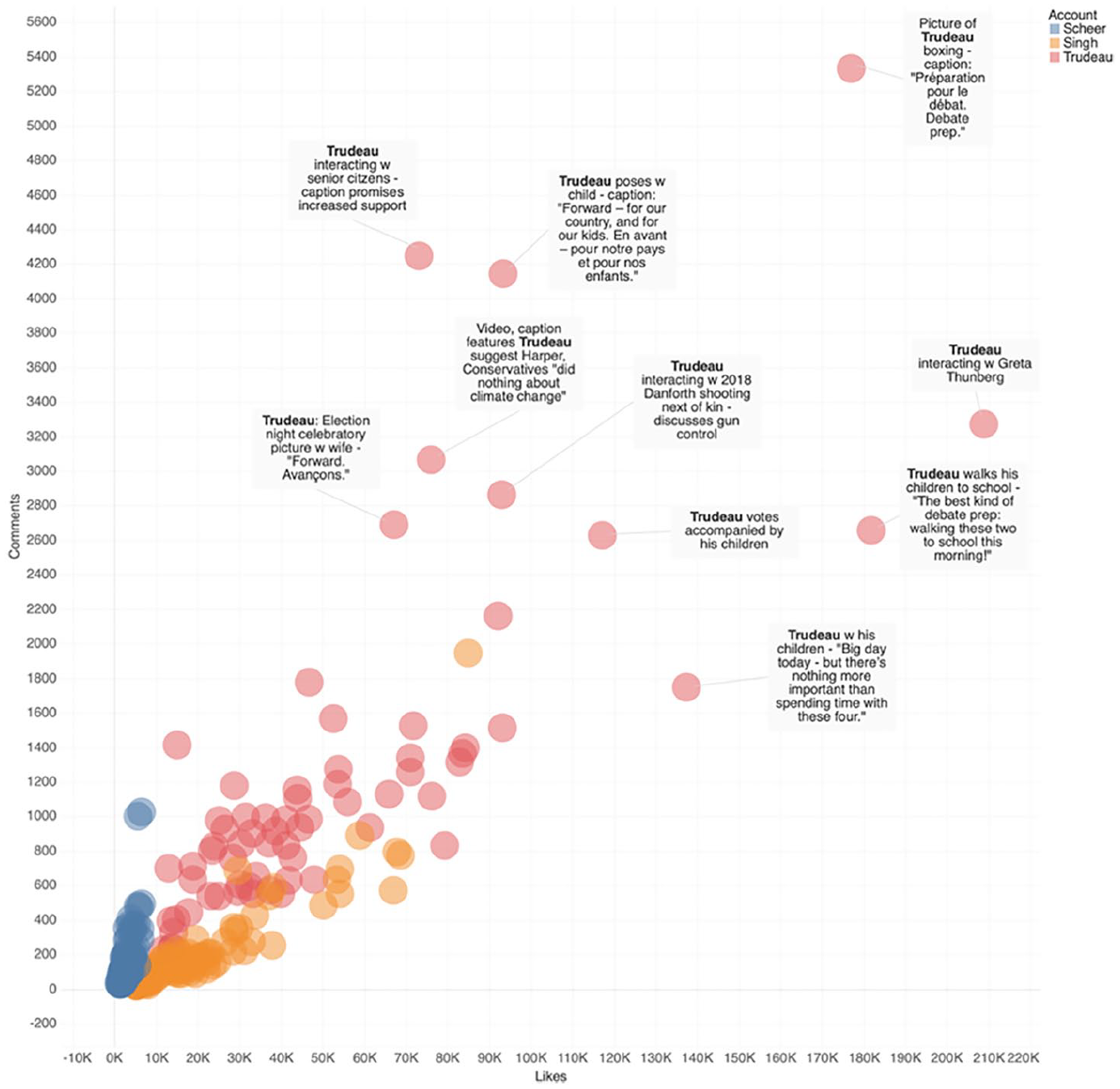
Instagram.
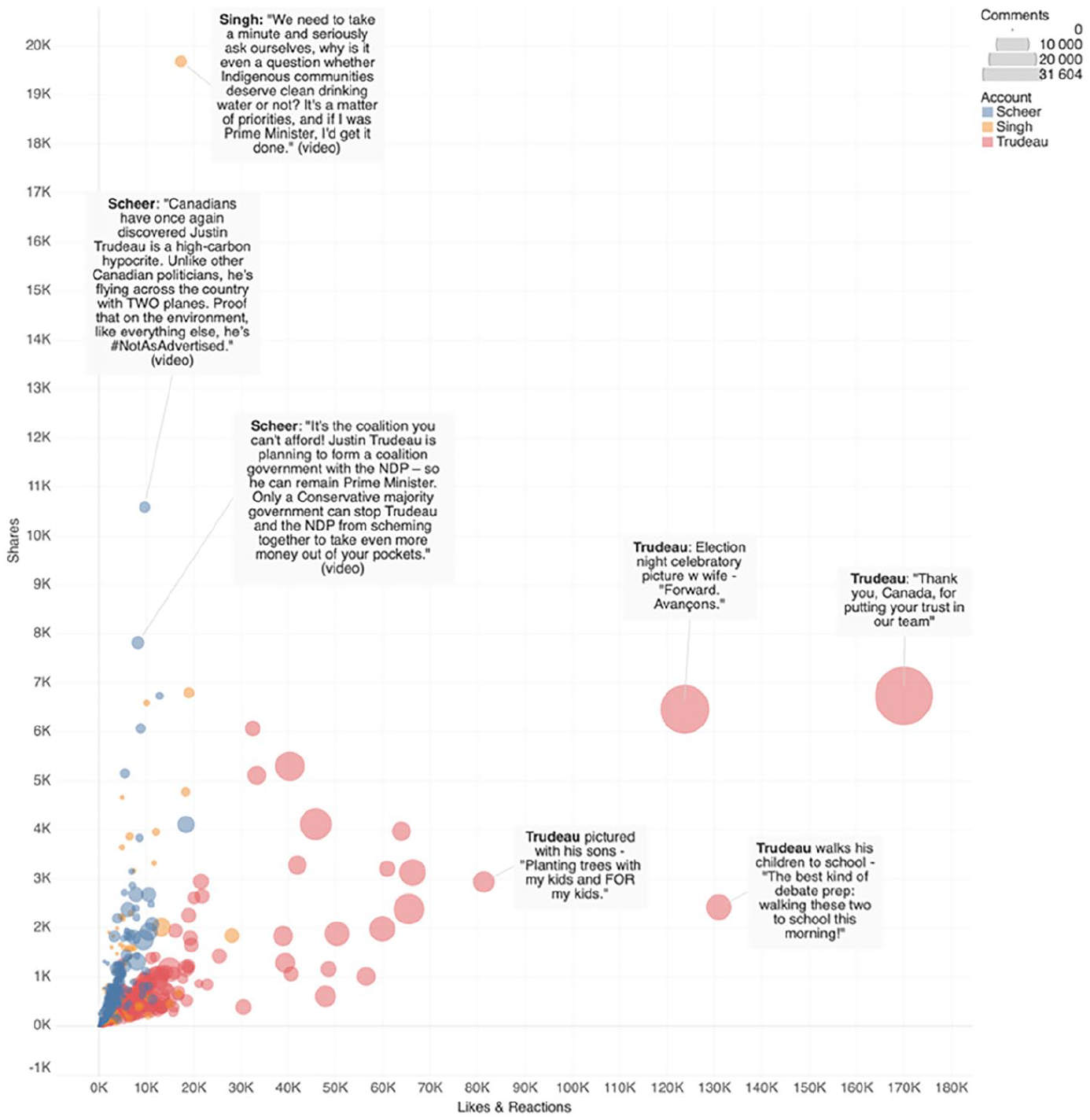
Facebook.
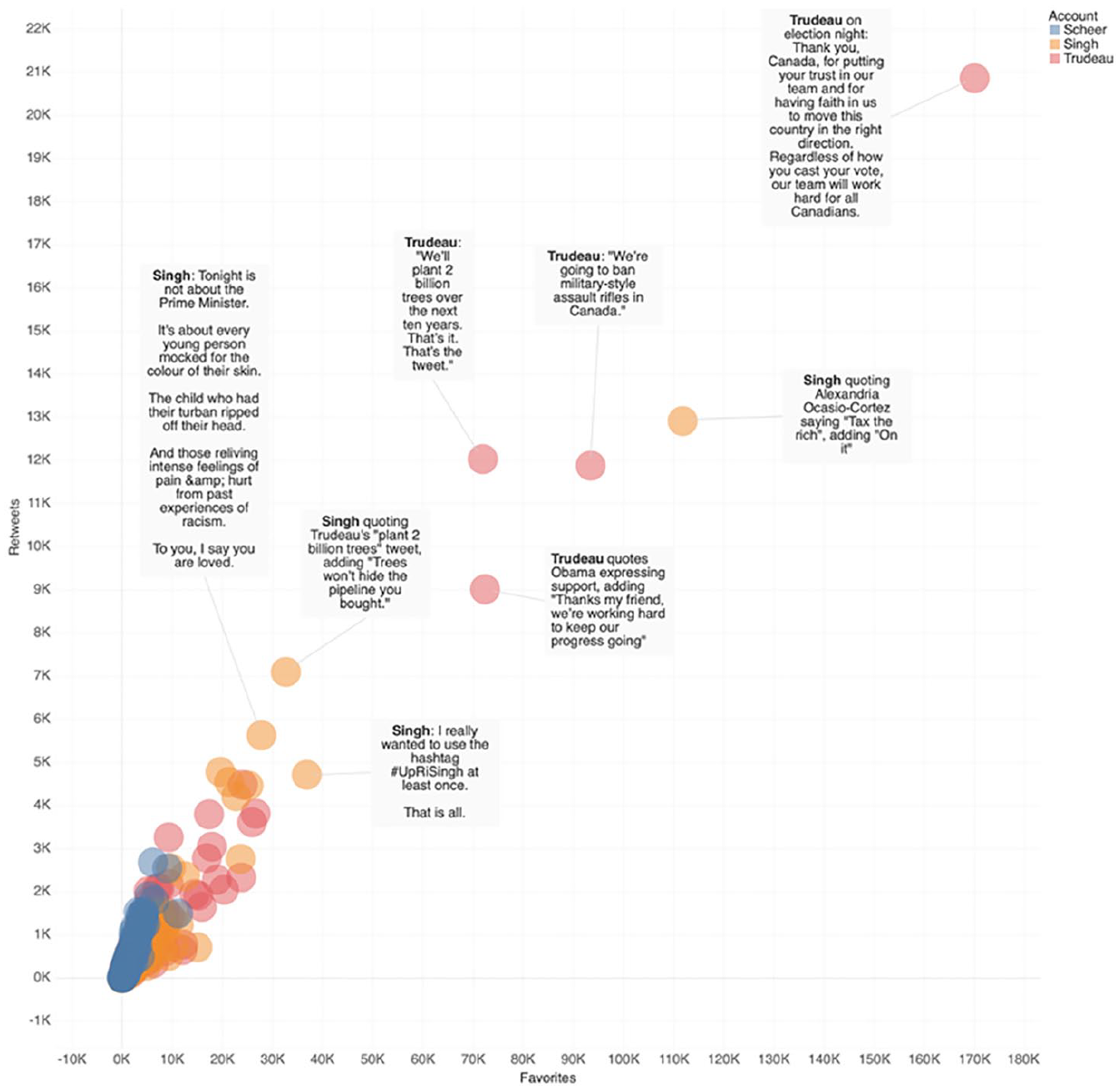
Twitter.
Trudeau posted “Forward. Avançons.” with a picture of himself and his wife. This identical post received approximately 19,000 favorites on Twitter, 67,000 likes on Instagram, and 99,000 likes plus 24,000 other reactions (love, haha, etc.) on Facebook. Engagement with this post is higher on Facebook compared with the other platforms. This post was among the popular posts on Instagram, but did not appear among the popular posts on Twitter.
Another post that appears across platforms reads “Planting trees with my kids and FOR my kids.” The posts received approximately 16,000 favorites on Twitter, 66,000 likes on Instagram, and 68,000 likes and 13,000 other reactions (love, haha, etc.) on Facebook. Similar to the Forward tweet, this tweet was short and did not generate a good deal of interaction on Twitter compared with the other platforms.
On Twitter, the most popular tweet was “Thank you, Canada, for putting your trust in our team and for having faith in us to move this country in the right direction. Regardless of how you cast your vote, our team will work hard for all Canadians.” This post appeared on Facebook as a bilingual post (133,000 likes and 36,500 reactions) and on Twitter in English (170,000 favorites), but did not appear on Instagram. Again, the post was made by Trudeau. The second-most popular post on Twitter was a post by Jagmeet Singh in response to US politician Alexandria Ocasio-Cortez. She posted to “Tax the rich” and he replied “On it.” The post was exclusive to Twitter, yielding 112,000 favorites for Singh. Trudeau’s tweet exchange with Obama also produced a high level of engagement (72,000). On Twitter, both Trudeau and Singh have popular tweets that reference high-profile American politicians, implying the campaigns are using this platform to create international connections and that these connections resonate with users (high engagement). On the whole, interactive tweets produce lower levels of engagement (Table 2); as such, user engagement depends on who is interacting with whom.
The Twitter bubble graph shows a conversation between Singh and Trudeau about environmental policy (see “planting trees” posts). Indeed, across all platforms, discussions of environmental policy are among the most popular posts. On Instagram, two popular posts reference climate change—one is attacking former PM Harper’s lack of action on climate change and the other is a picture with climate activist Greta Thunberg. We also see references to gun control on Instagram and Twitter. As such, while our regression results show lower engagement with policy tweets (overall), it matters what policy is being referenced. Environmental policy posts were popular for all three leaders.
As mentioned, existing research has rarely explored Instagram. How might Instagram be different from the other platforms? As mentioned, the post with Greta Thunberg is the most “liked” post (209,000 likes, 3000 comments) on Instagram but is much less popular on other platforms (26,000 favorites on Twitter, 51,000 likes plus 13,000 reactions on Facebook). One of the most popular posts on Instagram is Trudeau in a boxing stance, with a caption that references the upcoming leaders’ debate. The post also appears on Facebook, but with much lower levels of engagement (177,000 likes/5000 comments on Instagram versus Facebook’s 30,000 likes plus 9000 reactions/3000 comments). The popular Instagram posts seem distinctive in relation to interaction. Trudeau’s account has posts with children, Greta Thunberg, seniors, his wife, his wife and children, and the next of kin in the Danforth shooting. While the descriptive statistics do not show differences in engagement when tagging people on Instagram, a more nuanced approach suggests otherwise. Portrayals of interactions through pictures seem to encourage a high level of engagement among users when Trudeau posts to Instagram.
Discussion
Facebook and Twitter have been the focal points for research on political candidates’ social media use. Studies focused on either of these two platforms tend to concentrate on the likelihood of posting or frequency of posting specific content. In this study, we address two research gaps: examining Instagram in comparison with these other platforms and detailing user engagement with candidates’ posts featuring differing functions and content. We argue these research gaps are important as Instagram is very popular in Canada and globally—indeed, the platform features more than 1 billion monthly active users (Clement, 2019b). Our use of engagement statistics is suitable for identifying what content resonates with users and how this popularity may differ by platform. Higher levels of engagement extend the reach of messages beyond followers/fans to secondary networks, to media coverage, and to the coveted position of the trending section on various social media platforms (Bossetta, 2018; Keller and Kleinen-Von Königslöw, 2018).
These platforms have different affordances and audiences. Facebook is believed to be key platform for citizen-politician connections (Kelm et al., 2019), whereas Twitter is for journalist-candidate connections (Jungherr, 2016; Kreiss, 2016; Rauchfleisch and Metag, 2016). The adoption rates of these platforms reflect these distinct audiences: 69% of Canadians use Facebook, whereas only 25% use Twitter (Newman et al., 2020). Among Canadians, Instagram is more widely used than Twitter (35% vs 25%). The examples of popular posts suggests that personalized posts (posts with family members, posts in boxing poses, etc.) are more popular on Instagram and Facebook, compared with Twitter, particularly for Trudeau. On Twitter, posts with links to international actors seem to result in more engagement; this pattern was replicated for Trudeau and Singh. This content may appeal to the political elites (journalists, other politicians) who use this platform. Finally, these platforms offer different lengths of posts, with Twitter being the most restrictive. On Twitter, we can clearly see the impact of language (French vs English) on post engagement because there are few bilingual posts. French posts yield far lower levels of engagement, compared with English posts with similar content and function. This reflects the smaller French population in Canada, which reduces the audience size for these messages.
We find support for candidate differences in generating user engagement. Both NDP Singh and Liberal Trudeau had higher levels of engagement compared with Conservative Scheer. While Singh had higher engagement than Scheer, he posted half as much as the other candidates. The higher level of engagement does not reflect electoral results, as the Conservative party (Scheer) won more seats than the NDP party (Singh). Within the scholarship, the findings about whether established or new parties use social media more and yield more user engagement are conflicting (Quinlan et al., 2018; Xenos et al., 2017 vs Gerbaudo et al., 2019; Heiss et al., 2019; Jungherr, 2016; Larsson and Moe, 2014; Rauchfleisch and Metag, 2016; Yarchi and Samuel-Azran, 2018). In the Canadian context, ideology explains patterns of user engagement. The Conservative/right-wing party Leader Scheer produced the fewest engagements compared with center or left-wing parties.
Trudeau’s Instagram posts produced the highest levels of engagement. The content and function of posts did not have a strong influence on levels of engagement in the regression models. However, Figure 1 suggests a more nuanced approach to coding may yield some distinctive findings about interaction and Trudeau’s posts. We focus on the text attached to Instagram posts, whereas the images might offer further insights into which posts are popular (see, for example, Muñoz and Towner, 2017). However, the explained variance is extremely high (79%). As such, the image analysis might not offer much improvement to model fit. For the other two platforms, the model fit/explained variance is also quite high. While we test only two functions and two content types, these variables are important for explaining engagement statistics. The explained variance is approximately 60% for both Facebook and Twitter.
In terms of social media platforms and campaigns, our findings suggest different types of messages resonate in different platforms. In particular, while the relationship is small, we see attack posts yield more engagement on Twitter, suggesting this platform might be advantageous if a candidate wished to launch a negative campaign. Figure 3 shows that Twitter is important for these attacks, that is, Singh’s post about pipeline versus trees. However, Figure 2 shows Scheer was attacking Trudeau on Facebook, receiving a lot of shares. Scheer’s attack posts are distinctive for generating more engagement; for other candidates, attack posts decrease engagement (Table 4 in Appendix 2). Also, while social media offer an opportunity for candidates to connect with other candidates (same party), citizens, media, and other members of the community, we find that mentioning or tagging specific users results in lower levels of engagement. This is consistent across platforms, but much more pronounced in Twitter compared with the other platforms. However, the finding should have a caveat, because two popular tweets were linked to US political leaders. While tagging is associated with a general trend of lower engagement, tagging a high-profile (US) leader might produce more engagement. Also, in Instagram, we see that picture portrayals of interaction with different people are among the most popular posts. As such, the interaction results seem to depend on with whom one is interacting and on which platform. Unfortunately, our coding approach to interaction was unable to capture these nuances. Future research should consider these possibilities.
Finally, we code various policy types in trying to assess how different policy areas might perform in levels of engagement. In the end, the most consistent predictor of engagement is whether any policy was mentioned in the post. While social media offer candidates the opportunity to communicate their platform directly to voters, these posts do not receive a lot of engagement. Scheer and Trudeau were more likely than Singh to use social media to post about policies. Of the social media platforms, Facebook was distinctive in lower levels of engagement for policy posts. Perhaps the lower level of engagement reflects that candidates were not discussing policies that resonate with citizens. Posts about the environment were among the popular posts in all platforms.
In sum, across all three platforms, Liberal Leader Trudeau’s posts received the most engagement. As for content and function of tweets, these findings are specific to different platforms. Twitter data show attacks produced higher levels of engagement and we observe these negative interactions with our analysis of popular tweets. Twitter yielded fewer engagements when other users are tagged, but our visualization of user engagement suggests some important nuances about who is tagged or mentioned. We find differences in user engagement by platform, which suggests political leaders should tailor the content of their social media posts to the different platforms: personalized content on Facebook and Instagram, not Twitter. Yet, in our analysis of the 6 weeks leading up to the Canadian federal election, most of the content was cross-posted without changes to reflect the platform and/or what resonates on specific platforms.
Footnotes
Appendix 1
Coding scheme and exemplars.

| Scheer conservatives | Singh NDP | Trudeau liberals | |
|---|---|---|---|
| Attack | I will work to protect Canadians from abuses of power. Yesterday, in Justin Trudeau’s riding, I talked about how a new Conservative government will launch an inquiry into the SNC-Lavalin corruption scandal and introduce the No More Cover-Ups Act. | Here in Toronto, 4 years of the Trudeau Liberals haven’t made life any easier for people. And it’s clear to me that Parkdale—High Park is ready for someone that’s in it for them. | Andrew Scheer is against gay marriage, against a woman’s right to choose, against stronger gun control, and against fighting climate change. @JustinTrudeau #leadersdebate2019 #elxn43 #cdnpoli https://t.co/6I3DrLLJ9b |
| Interact | @DaviaultMathieu and I met with the Lavallée family and visited their dairy farm on Tuesday afternoon. Agriculture is one of the key drivers of Canada’s prosperity. I will work to help farmers like the great people at Belvallée Farm get ahead. https://t.co/5j8YSa1W7n | Chief @RudyTurtleNDP took me to the Grassy Narrows monument for the thousands of Indigenous kids who were victims of residential schools. The name of Chief Turtle’s mom, Sarah Turtle, is here. This is painful—and we must never forget this, as we move toward reconciliation. https://t.co/3CIuc2hwFF |
In Canada, anything is possible. You’re an inspiration, Bianca Vanessa Andreescu, and we’re all so proud of you. |
| Mention policy | Today, I spoke to new parents about my plan to help Canadians get ahead by making maternity benefits tax-free. Making maternity benefits tax-free will put $4,000 back in your pocket so you can focus on your newborn and not worry too much about your bottom line or bank balance. | Had a cuteness overload today surrounded by young families (and lots of cutie pie munchkins), talking about the bold steps we’ll take to make their lives easier. The Liberals have promised child care for 26 years—we’ll get it done with universal child care for all. | Thank you to the elders here at the Elders’ Qammaq for our important discussions about how climate change is affecting Northern communities. It’s with your wisdom & insights that we’ll tackle this together. https://t.co/77wpqfnqq3 |
NDP: New Democratic Party.
Appendix 2
OLS regression on user engagement with interaction effects.

| Facebook n = 938 | Instagram n = 258 | Twitter n = 1771 | ||||
|---|---|---|---|---|---|---|
| B | p | B | p | B | p | |
| Model 1: Baseline | ||||||
| Candidate | ||||||
| Post by Singh vs Scheer | 0.057 | .018 | 0.637 | <.001 | 0.082 | <.001 |
| Post by Trudeau vs Scheer | 0.444 | <.001 | 0.935 | <.001 | 0.286 | <.001 |
| Function | ||||||
| Attack post | 0.011 | .608 | 0.022 | .471 | 0.055 | <.001 |
| Interact/tag post | −0.054 | .011 | −0.043 | .176 | −0.137 | <.001 |
| Content | ||||||
| French post | −0.625 | <.001 | −0.067 | .025 | −0.717 | <.001 |
| Policy post | −0.077 | .001 | −0.047 | .122 | −0.039 | .013 |
| Model 2: Added to the above baseline model: Scheer × Attack | .096 | .002 | .068 | .120 | .085 | <.001 |
| Model 3: Added to the above baseline model: Trudeau × Attack | −.040 | .153 | −.020 | .503 | −.059 | .004 |
| Model 4: Added to the above baseline model: Singh × Attack | −.057 | .026 | −.051 | .216 | −.024 | .205 |
OLS: ordinary least squares.
Acknowledgements
This work was made possible (in part) by an award from the Digital Ecosystem Research Challenge, funded by the Government of Canada. The authors thank Joslin Jefferson, Kelsey Friesen, and Stephanie Belland for helping with the coding of social media posts for this project.
Funding
The author(s) received no financial support for the research, authorship, and/or publication of this article.
