




Abstract
Political satire is often consumed on online platforms (e.g. YouTube) and the effects of its consumption may be highly conditional on the user comments that are surrounding it. By manipulating the valence of comments (positive vs negative) and the focus of these comments (hedonic entertainment value vs eudaimonic entertainment value vs informative value), this pre-registered experiment investigates how user comments affect satire viewers’ hedonic entertainment experiences, their eudaimonic entertainment experiences, and their knowledge gain. Analyses showed that the valence of comments congruently affected viewers’ hedonic entertainment experiences, eudaimonic entertainment experiences, and subjective knowledge gain, but not their objective knowledge gain. In addition, the focus of user comments affected eudaimonic entertainment experiences and knowledge gain regardless of comments’ valence. This study’s findings advance our understanding of how viewers are affected when they consume media content that is surrounded by the comments of other viewers.
Keywords
People increasingly watch and share television shows via YouTube and other social media platforms (Gottfried and Shearer, 2017); political satire is a prominent example of this (Baym and Shah, 2011; Boukes et al., In press). On such online platforms, users are exposed not only to the selected media content, but also to the social context in which this is presented, consisting of user comments and statistics about the number of (dis)likes. Extant research shows that the user comments in particular influence viewers’ experiences of videos as well as their attitudes toward the topics discussed in them (e.g. Hsueh et al., 2015; Krämer et al., 2019; Möller et al., 2021; Winter et al., 2015, 2018). Hence, the shift from watching audio-visual content via social media rather than on television introduces a new, more social way of consuming video material. Recently, scholars emphasized the relevance of investigating the potential consequences that this social way of consuming media content may have (e.g. Raney and Ji, 2017; Walther, 2017).
Although research on this topic is emerging, two gaps in the literature still limit our understanding of the consequences that exposure to user comments may have. First, scholars have predominantly focused on the effects of comments’ valence, which refers to their positivity or negativity (i.e. Krämer et al., 2019; Möller et al., 2021; Waddell and Bailey, 2019; Waddell and Sundar, 2017; Winter et al., 2018). These studies found that media consumption leads audiences to feel more entertained when the message is accompanied by positive (compared to negative) comments. However, comments do not only vary in terms of valence; equally important is, arguably, that comments focus on different elements of a video. A comment can (positively or negatively) write about, for example, the informative value of a video, but another comment could write about its entertainment value. Currently, it is unknown how the focus of comments influences the experiences of media audiences, and how this moderates the effect of comment valence.
The second gap in the literature pertains to the range of potential effects that comments may have. Previous studies already investigated how social information affects users’ entertainment experiences and their evaluations of videos (e.g. Hsueh et al., 2015; Krämer et al., 2019; Waddell and Bailey, 2019; Waddell and Sundar, 2017; Winter et al., 2018). Yet, it remains unclear to what extent comments affect how much knowledge is gained from videos and whether comments can simultaneously influence multiple viewer responses. Because political satire may entertain as well as inform (Holbert et al., 2014; LaMarre and Grill, 2019), it is important that we learn more about how comments affect entertainment experiences as well as their knowledge gain. We address both research gaps in a pre-registered experiment.
Mixed value: satire as a source of entertainment and information
One of the reasons why people are drawn to political satire, is because they find it entertaining (Mattheiß et al., 2013; Young, 2013). Indeed, by discussing serious political themes using jokes and sarcasm (i.e. Cao, 2008), political satire shows are a rich source of entertainment. The jokes in political satire arguably elicit hedonic entertainment experiences (Boukes et al., 2015); although surprisingly, this is actually still a question open for future research (see recent call of Becker, 2020; and theoretical underpinning of Weinmann and Vorderer, 2018). Hedonic entertainment experiences refer to the enjoyment or pleasure that people experience when they consume media content that is mirth-inducing or simply funny (Bartsch and Hartmann, 2017; Oliver and Bartsch, 2010; Oliver and Raney, 2011; Waterman, 1993; Wirth et al., 2012).
In addition to enjoyment, political satire also has the potential to elicit eudaimonic entertainment experiences (Becker, 2020). Eudaimonic entertainment refers to appreciation that people experience when consuming media content that is inspiring or thought-provoking (Bartsch and Hartmann, 2017; Oliver and Bartsch, 2010; Oliver and Raney, 2011; Waterman, 1993; Wirth et al., 2012). Political satire has been coined as “the reinvention of political journalism” (Baym, 2005) that “represents a searching for truth” (p. 267). Funny jokes are combined with elements about serious political issues with an equal amount of substantive information to broadcast news (Fox et al., 2007; Haigh and Heresco, 2010; Kilby, 2018), which may eventually create an engaging societal message (Borum Chattoo and Feldman, 2020; Doona, 2020). Thus, eudaimonic entertainment experiences can also arise as the outcome of political satire consumption.
Viewers can experience both hedonic and eudaimonic entertainment simultaneously when consuming media content (Hall and Zwarun, 2012). Roth et al. (2014), for example, found that people often watch political entertainment talk shows because they want to experience enjoyment as well as reflect on thought-provoking themes. Besides eliciting enjoyment (hedonic entertainment experiences) and appreciation (eudaimonic entertainment experiences), political satire can also function as a source of information. Through its combination of jokes and serious discussions of political affairs, exposure to political satire is associated with increases in knowledge (Baek and Wojcieszak, 2009; Becker and Bode, 2018). Indeed, another motivation—besides that it is entertaining—for watching political satire is that people hope to learn from it (Mattheiß et al., 2013; Young, 2013).
While the literature thus demonstrated that political satire consumption may lead to entertainment and knowledge gain, scholars have paid less attention to how these experiences are shaped by the context in which satire is being consumed. Many people watch political satire videos via social media (Baym and Shah, 2011; Yang and Jiang, 2015), which embed these videos in a social context consisting of user comments and (dis)likes. Extant research investigated the potential consequences of this social environment; these studies found that user comments more so than statistics about likes or dislikes affected viewers when they watch online videos (Möller et al., 2021; Winter et al., 2015). However, the effects of user comments on viewers’ experiences of political satire videos, in particular, are still unknown.
The valence of user comments and outcomes of online satire consumption
Thus, research indicates that social information can influence how viewers experience and react to videos (i.e. Cameron and Geidner, 2014; Krämer et al., 2019; Möller et al., 2021; Waddell and Bailey, 2019; Waddell and Sundar, 2017; Walther et al., 2010). When individuals watch political satire videos online and are simultaneously exposed to comments about the video, their entertainment experiences may be influenced by those comments. Scholars state that media consumers’ entertainment experiences are the result of their affective responses to media content together with the cognitive appraisal of their own responses. Thus, users take on an active role in this process because their own motivation(s) to process content in a specific way influences their subsequent entertainment experience (Bartsch et al., 2008; Lewis et al., 2014; Vorderer, 2001; Vorderer et al., 2004).
In line with the literature discussed above, hedonic entertainment experiences are said to emerge when individuals quickly and intuitively process content that is funny (Lewis et al., 2014; Oliver and Bartsch, 2010). In contrast, eudaimonic entertainment experiences result from slower and deliberative processing of media content that has thought-provoking potential (Bartsch and Hartmann, 2017; Lewis et al., 2014; Oliver and Bartsch, 2010). Thus, not only the features of a media message influence audience experiences, but also the motivations with which people consume this content. These motivations may—consciously or unconsciously—be affected by the context in which a message is consumed.
Krämer et al. (2019) suggest that the valence of comments provides guidelines to viewers on how to interpret media content. This way, comments can indirectly impact entertainment experiences. Concretely, Krämer et al. (2019) found that negative comments restricted viewers’ feelings of elevation (considered to be part of eudaimonic entertainment experiences) in response to a video. Similarly, studies found that positive comments lead to more enjoyment, while negative comments lead to less video enjoyment (Möller et al., 2021; Waddell and Bailey, 2019; Waddell and Sundar, 2017; Winter et al., 2018). These findings suggest that the valence of comments impacts viewers’ entertainment experiences by strengthening or hampering how much enjoyment (i.e. hedonic entertainment) and appreciation (i.e. eudaimonic entertainment) viewers aim to derive from videos.
Previous studies on the effects of comments mostly focused either on viewers’ hedonic entertainment experiences of content that is funny but not particularly thought-provoking (e.g. comedy shows, see Waddell and Bailey, 2019), or focused on viewers’ eudaimonic entertainment experiences of thought-provoking videos that were not particularly funny (e.g. videos about the unity of human kind, see Krämer et al., 2019). Yet, whether the valence of comments may simultaneously affect viewers’ hedonic and eudaimonic entertainment experiences is still unknown; after all, these experiences seem not necessarily mutually exclusive. Given the potential of positive comments to evoke both hedonic entertainment experiences during comedy exposure (Waddell and Bailey, 2019) and eudaimonic entertainment experiences when consuming thought-provoking media content (Krämer et al., 2019)—together with the knowledge that the satire genre contains both content features— it seems likely that the valence of comments may affect both viewers’ hedonic and eudaimonic entertainment experiences. We test this with the following pre-registered hypotheses: 1
H1. Exposure to positive user comments accompanying a video increases video viewers’ hedonic entertainment experiences compared to exposure to negative user comments accompanying the video.
H2. Exposure to positive user comments accompanying a video increases video viewers’ eudaimonic entertainment experiences compared to exposure to negative user comments accompanying the video.
Similar to viewers’ entertainment experiences, the extent to which viewers gain knowledge when watching political satire is a function not only of the media content, but also of viewers’ own motivations to learn from it. According to Eveland’s (2001) cognitive mediation model of learning, surveillance-gratifications-seeking motivations influence how thoroughly people process content and hence, how much they learn from it. In line with this, Feldman (2013) found that viewers who approach political satire as a source of news invest more effort into thoroughly processing its content and indeed gain more knowledge than viewers who consider political satire to be solely a source of entertainment. The extent to which viewers approach political satire as a source of information, thus seems to determine how much knowledge they gain from it. Arguably, the user comments that are seen while consuming the content may partly determine this motivation.
Research on the effects of comments has, so far, focused on experiences of and responses to videos (e.g. Krämer et al., 2019; Möller et al., 2021; Waddell and Bailey, 2019; Waddell and Sundar, 2017; Walther et al., 2010), but not on how comments affect learning. Previous studies do provide hints, though, on how comments may influence knowledge uptake: As the valence of comments affects video viewers’ entertainment experiences (Krämer et al., 2019; Möller et al., 2021; Waddell and Bailey, 2019; Waddell and Sundar, 2017; Winter et al., 2018), arguably, positive comments will encourage the audience to pay more attention to media content, which should eventually result in relatively more knowledge gain (Eveland, 2001). In contrast, negative comments may discourage viewers to carefully process the message and therefore decrease knowledge acquisition.
To test this notion, we distinguish between subjective knowledge gain and objective knowledge gain (e.g. Oberle et al., 2020). Objective knowledge gain refers to the amount of facts that are remembered after video exposure, whereas subjective knowledge gain refers to the feeling of being informed (Mattheiß et al., 2013). Both are expected to increase when people are encouraged to pay more attention to the video as the outcome of exposure to positive comments. We test this notion through the following pre-registered hypothesis:
H3. Exposure to positive user comments accompanying a video increases video viewers’ (a) subjective knowledge gain and (b) objective knowledge gain compared to exposure to negative user comments accompanying the video.
The focus of user comments
Scholars suggest that reading evaluations of a story prior to reading this story itself influences the attention that people pay to the specific elements in the story as well as people’s subsequent enjoyment of the story (Shedlosky-Shoemaker et al., 2011). This notion is supported by Shedlosky-Shoemaker et al.’s (2011) finding that participants who were exposed to negative reviews about the plot of the story were also more likely to elaborate on the plot of the story themselves. But while extant research has investigated how the valence of comments affects viewers, it has not focused on the role of the specific focus in these comments. The valence of user comments refers to how positive or negative comments are regardless of their specific subject. For example, a comment indicating that someone had to laugh out loud while watching a video as well as a comment indicating that someone found the same video to be a great source of inspiration or information would all be categorized as positive comments; however, they each address a completely different element of the viewing experience. As with many genres, and political satire in particular, variation should be expected in what comments focus on.
Following the findings of Shedlosky-Shoemaker et al. (2011), we test the assumption that the focus of comments steers people’s attention to a specific element of a satire video. This way, the focus of comments should amplify the effect that comments’ valence has on viewers specific entertainment experiences or learning motivations (H1, H2, and H3). Concretely, when user comments explicitly discuss how much or how little hedonic entertainment other people experienced regarding a video, this may lead viewers to primarily process the video as a source of enjoyment; thereby, the focus of comments will strengthen the effect of comment valence on viewers’ enjoyment. Similarly, comments that focus on eudaimonic experiences in a negative or positive manner are expected to have a stronger effect on this specific entertainment experience than comments that focus on other experiences. Finally, comments that focus on whether or not people felt that they learned something from the video are expected to strengthen the effect that the valence of comments has on viewers’ knowledge gain.
Taken together, we expect that focus of comments acts as a contributory moderator (see Holbert and Park, 2020) of the effect that comment valence has on viewers’ hedonic entertainment experiences, their eudaimonic entertainment experiences, and their knowledge gain when watching political satire videos. Thus, when the focus of comments is congruent with the dependent variable, we expect the effect of comment valence to be strongest. Accordingly, we propose and test the following pre-registered hypotheses that are formulated in line with Holbert and Park’s (2020) templates for moderation hypotheses:
H4. Comment valence has a statistically significant and positive effect on viewers’ hedonic entertainment experiences both when comments focus on other viewers’ hedonic entertainment experiences and when comments do not focus on other viewers’ hedonic entertainment experiences, but the positive effect of comment valence on viewers’ hedonic entertainment experiences is stronger when comments do focus on other viewers’ hedonic entertainment experiences.
H5. Comment valence has a statistically significant and positive effect on viewers’ eudaimonic entertainment experiences both when comments focus on other viewers’ eudaimonic entertainment experiences and when comments do not focus on other viewers’ eudaimonic entertainment experiences, but the positive effect of comment valence on viewers’ eudaimonic entertainment experiences is stronger when comments do focus on other viewers’ eudaimonic entertainment experiences.
H6. Comment valence has a statistically significant and positive effect on viewers’ (a) subjective knowledge gain and (b) objective knowledge gain both when comments focus on other viewers’ knowledge gain and when comments do not focus on other viewers’ knowledge gain, but the positive effect of comment valence on viewers’ subjective/objective knowledge gain is stronger when comments do focus on other viewers’ knowledge gain.
Method
We tested our hypotheses through an online experiment with a 2 (comment valence: positive vs negative) × 3 (comment focus: hedonic entertainment value vs eudaimonic entertainment value vs informative value) between-subjects design with one control condition (i.e. exposure in a context without comments). Participants watched a political satire video that was embedded in a mimicked YouTube environment containing user comments and (dis)likes. Appendix 1 gives a detailed description of the full procedure. Ethical approval for this study was given by the Institutional Review Board of our university faculty prior to conducting the study (ID: 2020-YME-12363). The study was pre-registered via the Open Science Framework (see https://osf.io/5a92v/?view_only=1ee5f8a3885444ffb07d26e87d98a039). As the pre-registered hypotheses and analyses did not include explicit comparisons with the control condition, these are not presented in this article—however, comparisons with the control condition are made available in an online supplemental appendix (see https://osf.io/gw2px/?view_only=1ee5f8a3885444ffb07d26e87d98a039).
Participants
Participants were recruited by online panel company Dynata, which invited panel members to participate in our online experiment. To increase the sample validity, people were only allowed to participate if they (1) were using a desktop computer or a laptop (i.e. mobile devices have a screen that is too small to see all visuals used as stimulus material at the same time) and (2) used YouTube at least one time per year. At the start of the experiment, moreover, participants were shown a neutral music video embedded in a mimicked YouTube environment similar to the stimulus material used in the study to verify that all technical features worked properly. In addition, participants who failed an easy attention check (selecting “2” on a 7-point Likert-type scale) at the start of the study could not complete the study.
In total, 565 people completed the experiment (average response time: 28.95 minutes). Of those people, 31 participants did not complete the study within 1 hour, and 24 participants indicated to have experienced technical problems during the experiment. In line with our pre-registered criteria for excluding data, the data of these participants were excluded from the database prior to the analyses. This resulted in a final sample size of N = 510 of which 52% were woman and 47.6% were man (Mage = 36.40, SDage = 14.02).
Participants were randomly assigned to one of seven conditions, namely, the positive valence/hedonic focus condition (n = 75), the negative valence/hedonic focus condition (n = 75), the positive valence/informative focus condition (n = 70), the negative valence/eudaimonic focus condition (n = 76), the positive valence/informative focus condition (n = 71), the negative valence/informative focus condition (n = 70), and the control condition (n = 73). Randomization was successful on all demographic characteristics, namely on gender, χ2(12, N = 510) = 13.16, p = .357, education level, F(6, 503) = 0.62, p = .711, age, F(6, 503) = 0.42, p = .865, TV news consumption, F(6, 503) = 0.11, p = .995, and political satire consumption, F(6, 503) = 0.42, p = .864. 2
Stimulus materials
All participants watched the same 7 minutes and 36 seconds video of an episode from the Dutch political satire show Zondag met Lubach (translated: Sunday with Lubach), which is comparable to the American show Last Week Tonight with John Oliver (see Nieuwenhuis, 2018). The video discussed the conditions under which South-Asian laborers in the clothing industry have to work using jokes and sarcasm, which is likely to elicit hedonic entertainment experiences. Besides this topic generally, it specifically addressed ethical questions regarding the production of clothing, such as child labor, which is likely to elicit eudaimonic entertainment experiences. Moreover, the video presented information and facts about what companies, politicians, and lawmakers could do to ensure better work conditions for laborers in the clothing industry. This is likely to be unknown among viewers and could thus lead to knowledge gain.
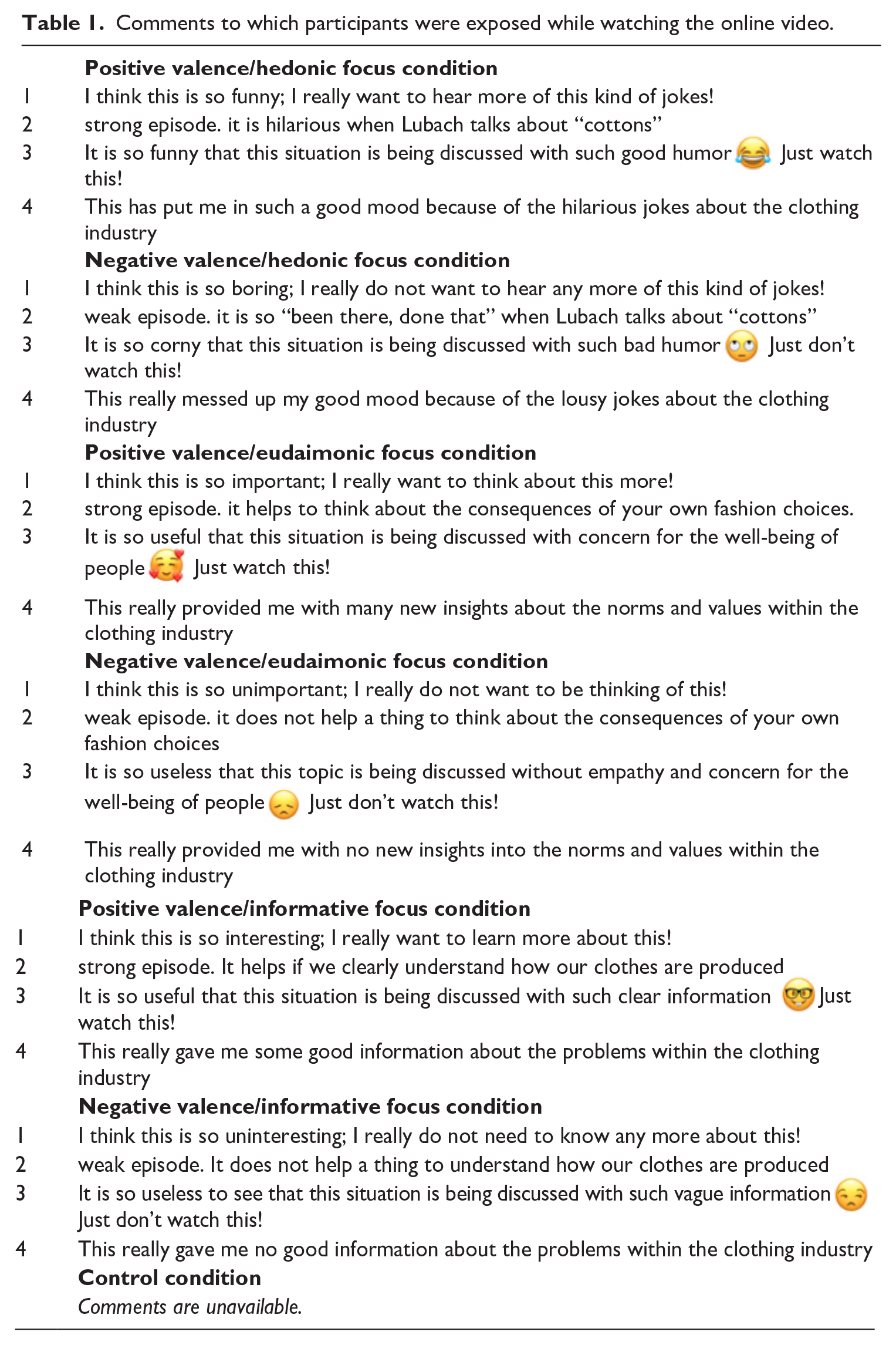
The video was presented to participants in a mimicked YouTube environment (see example in Figure 1). To ensure that participants watched the full video, the option to continue to the next part of the experiment only appeared after 7 minutes and 36 seconds had passed. The mimicked YouTube environment showed the video together with four comments (see Appendix 2 for an overview of the comments) and with the number of video likes and dislikes. Participants in the experimental conditions were exposed to either (a) four positively valenced comments and a count of 856 likes and 102 dislikes or (b) four negatively valenced comments together with a count of 102 video likes and 856 dislikes. In addition, the comments focused on (a) the hedonic entertainment value of the video by discussing the humor used in it, (b) its eudaimonic entertainment value by discussing whether the video was thought-provoking, or (c) its informative value by discussing whether or not people had learned something from the video.
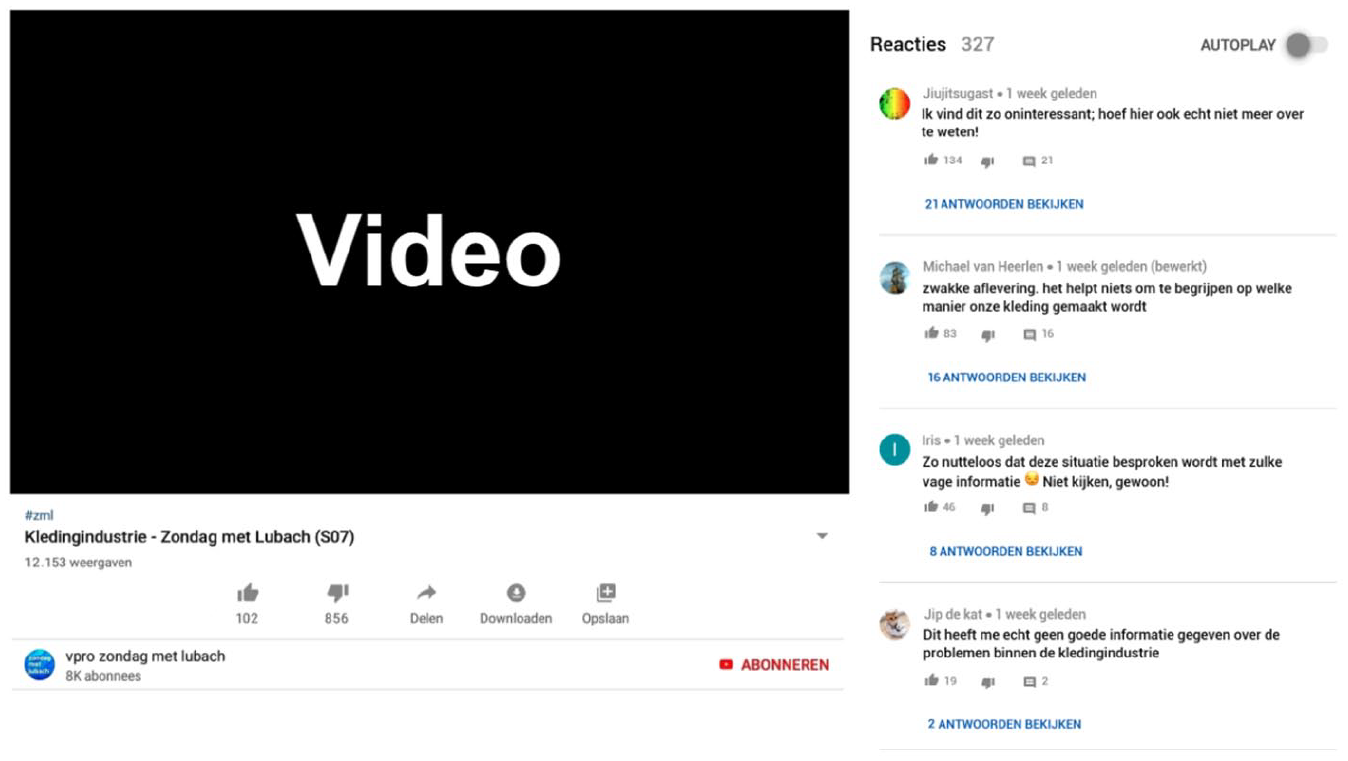
Screenshot of the video embedded in the mimicked YouTube environment presented to viewers in the negative valence/informative focus condition.
Manipulation checks
To verify the validity of our valence manipulation, participants in the experimental conditions were asked whether the comments were mostly very negatively (–3) or very positively (3). An analysis of variance (ANOVA) showed that participants exposed to the positive comments indeed perceived the comments to be more positive (M = 1.65, SD = 1.31) than participants exposed to negative comments (M = –1.80, SD = 1.28), F(1,435) = 773.54, p < .001,
Regarding the comment focus manipulation, participants were asked what was discussed in the comments: (a) the humor in the video, (b) whether the video was thought-provoking or led to valuable insights, or (c) whether others had learned something by watching the video. Indeed, the conditions to which people were randomly assigned strongly related to what type of comments participants perceived, χ2(4, N = 437) = 261.08, p < .001. A majority of those exposed to comments focusing on how much hedonic entertainment other viewers experienced thought that the comments mainly discussed humor in the video (82.67%). A majority of participants exposed to comments focusing on how much eudaimonic entertainment was experienced, instead, perceived the comments to focus on whether the video thought-provoking and/or led to valuable insights (64.38%), and another 27.40% believed that the comments dealt with learning from the video. This percentage varied significantly from those exposed to comments focusing on whether or not people learned something from the video: Of them, 43.97% thought that the comments were about whether or not people had learned something, whereas among them 48.94% had the impression that comments focused on whether the video was thought-provoking. Overall, participants, thus, correctly perceived the manipulations as we intended them and we deem this manipulation as successful.
Measurements
Unless indicated otherwise, we measured the variables described below on a 7-point scale ranging from −3 (strongly disagree) to 3 (strongly agree). For an overview of all items used for each pre-registered scale, please see Appendix 3.
Hedonic entertainment experience
Hedonic entertainment experience was measured by asking to what extent participants (dis)agreed with six items based on the works by Waterman (1993) and Wirth et al. (2012). Participants indicated the extent to which they thought the video was (1) pleasurable and led them (2) to feel entertained, (3) to have fun, (4) to feel satisfied, (5) to feel good, and (6) to feel happy while watching. A principal axis factor analysis with oblique rotation (direct oblimin) indicated that the items loaded on one factor (eigenvalue = 4.77) and explained 79.45% of the variance. Furthermore, a reliability analysis showed that the items formed a reliable scale (Cronbach’s α = .95). By averaging the scores on the six items, we created one hedonic entertainment experiences score for each participant (M = 0.57, SD = 1.42, skewness = –0.54, kurtosis = –0.22).
Eudaimonic entertainment experience
We measured eudaimonic entertainment experience by asking to what extent participants (dis)agreed with nine statements. These items were based on the Emotional Gratification Scale developed by Bartsch (2012) and on the work by Waterman (1993). Specifically, participants indicated to what extent they felt that the video (1) encouraged them to focus on things that are important; (2) inspired them to think about meaningful issues; (3) led to new insights; (4) made them think about themselves; (5) gave them a great feeling of being alive; (6) made them feel more intensely involved in the topic; (7) elicited the feeling that they know what they stand for; (8) will impact their choices; and (9) gave them a feeling of being connected to other people. A principal axis factor analysis with oblique rotation (direct oblimin) showed that the items loaded on one factor (eigenvalue = 5.85) explaining 64.99% of the variance. Moreover, a reliability analysis indicated that the items formed a reliable scale (Cronbach’s α = .93). We created one eudaimonic entertainment experiences score for each participant by averaging their scores on the items (M = 0.51, SD = 1.20, skewness = –0.65, kurtosis = 0.38).
Knowledge gain: subjective
We measured two dimensions of knowledge gain. First, subjective knowledge gain was measured by asking participants to indicate to what extent they (dis)agreed with six items based on the works by Hoffman and Young (2011) and Schneider et al. (2016). The items asked participants to what extent they felt that (1) they are able to discuss the topic with others; (2) they are well-informed by the video; (3) they can sum up the essential points of the video; (4) they have a pretty good understanding of the most important issues facing the clothing industry; (5) they are better informed about the clothing industry than most other people; and (6) the clothing industry is such a complicated topic that it is hard for people like them to understand it (reversed coded). The results of a principal axis factor analysis with oblique rotation (direct oblimin) indicated that the items loaded on two factors (eigenvalue of first factor = 3.12, eigenvalue of second factor = 1.03) that explained 52.03% and 17.20% of the variance, respectively. Further inspection of the results indicated that while five items loaded highest on the first factor, one item (i.e. “the clothing industry is such a complicated topic that it is hard for people like me to understand it”) did not load on any factor. Accordingly, this item was excluded from the scale. A reliability analysis with the five remaining items indicated that these formed a reliable scale (Cronbach’s α = .85). By creating an average of participants’ scores on these items, we created an overall score on participants’ subjective knowledge gain (M = 0.73, SD = 1.03, skewness = –0.34, kurtosis = 0.04).
Knowledge gain: objective
Second, we measured participants’ objective knowledge gain by asking them to select the correct answer to six multiple-choice questions about specific pieces of information that were provided in the video (see Appendix 3). Each question offered participants one option containing the correct answer, two options containing an incorrect answer and one option through which participants could indicate that they did not know the answer. The number of correct answers formed an overall objective knowledge gain score ranging from 0 (no question answered correctly) to 6 (all questions answered correctly) (M = 4.60, SD = 1.45, skewness = –1.01, kurtosis = 0.31). A reliability analyses indicated that together, the five items formed a reliable scale (Cronbach’s α = .61)
Results
Effect of the valence of comments
Hedonic entertainment experiences (H1)
The first hypothesis stated that exposure to positive comments (irrespective of comment focus) increases viewers’ hedonic entertainment experiences in response to a video compared to exposure to negative comments. An independent samples t-test showed that participants exposed to positive comments experienced more hedonic enjoyment in response to political satire (M = 1.00, SD = 1.25) than did participants who were exposed to negative comments (M = 0.10, SD = 1.48). This effect was significant, 95% confidence interval (CI) = [−1.15, −0.64], t(426.07) = –6.85, p < .001, Cohen’s d = .66. These results support H1 and demonstrate a strong effect of comment valence on hedonic entertainment experience.
Eudaimonic entertainment experiences (H2)
To assess the hypothesis that satire viewers exposed to positive comments experience more eudaimonic entertainment than viewers exposed to negative comments, another independent samples t-test was run: Viewers who saw positive comments indeed experienced more eudaimonic entertainment (M = 0.77, SD = 1.11) than those who saw negative comments (M = 0.19, SD = 1.22), 95% CI = [−0.79, −0.35], t(435) = –5.14, p < .001, Cohen’s d = .50. This finding supports H2: Eudaimonic entertainment was strongly affected by comment valence.
Knowledge gain (H3)
Subjective knowledge (H3a)
The third hypothesis predicted that positive comments would cause more knowledge gain compared to negative comments. To test this, we ran two independent samples t-tests: one for subjective knowledge gain (feeling of being informed) and one for objective knowledge gain (number of correct answers to the knowledge questions). We found that viewers exposed to positive comments had a higher subjective knowledge gain (M = 0.94, SD = .93) than viewers exposed to negative comments (M = 0.45, SD = 1.06), 95% CI = [−0.68, −0.31], t(435) = –5.19, p < .001, Cohen’s d = .49. Thus, H3a is supported.
Objective knowledge (H3b)
Regarding objective knowledge gain, an insignificant find was yielded. Although viewers who saw positive comments had a slightly higher objective knowledge gain (M = 4.62, SD = 1.41) than viewers who saw negative comments (M = 4.57, SD = 1.52), this difference was not significant, 95% CI = [–0.33, 0.22], t(435) = –0.39, p = .348 (one-tailed, following the directionality of the hypothesis), Cohen’s d = .03.
Based on these results, H3 was only partially supported: People’s feeling of being informed (subjective knowledge) strongly increased when they were exposed to the satire video and positive comments (H3a supported), but the number of correct answers to the multiple-choice questions remained unaffected by the valence of comments (H3b rejected).
How the focus of user comments does (not) moderate the valence effect
Hedonic entertainment experiences (H4)
H4 predicted that the focus of comments moderates the effect of comment valence on hedonic entertainment experiences, such that this effect is stronger if comments focus on other viewers’ hedonic entertainment experiences. To test this, we ran an ANOVA that included (a) the valence of comments and (b) the focus of comments as well as (c) the interaction term of both factors as independent variables. Hedonic entertainment experiences were included as dependent variable. In line with the results discussed above, we found that the valence of comments affected viewers’ hedonic entertainment experiences, F(1, 435) = 47.45, p < .001,
Eudaimonic entertainment experiences (H5)
The fifth hypothesis predicted an interaction effect of comment valence and focus on viewers’ eudaimonic entertainment experiences. We ran an ANOVA model similar to the model run for H4. Result showed that the valence of comments still affected viewers’ eudaimonic entertainment experiences, F(1,435) = 27.73, p < .001,
We ran a Fisher’s least significant differences (LSD) post hoc test to better understand how comment focus affected viewers’ eudaimonic entertainment experiences. Viewers who saw comments that focused on other viewers’ eudaimonic entertainment experiences experienced more eudaimonic entertainment in response to the video (M = 0.67, SD = 1.10) than viewers who were exposed to comments that focused on how much other viewers learned from the video (M = 0.35, SD = 1.25), p = .020. A similar difference was found when comparing exposure to comments that discussed how much eudaimonic entertainment other viewers experienced (M = 0.67, SD = 1.10) and exposure to comments that focused on the hedonic entertainment value of the video (M = 0.41, SD = 1.23), albeit not significant, p = .052. Thus, simply by focusing on the eudaimonic viewing experiences of others, comments can stimulate people to also experience this more strongly—irrespective of whether these comments were positive or negative. However, no interaction effect was found between the valence of comments and the focus of comments on viewers’ eudaimonic entertainment experiences, p = .210. Hence, H5 was not supported.
Subjective knowledge gain (H6a)
Finally, we ran two ANOVAs to test the conditional effect on knowledge gain (i.e. subjective and objective, respectively) of comment valence upon comment focus. The first ANOVA tested the effect on viewers’ subjective knowledge gain. Results showed again that the valence of comments affects viewers’ subjective knowledge gain, F(1, 435) = 28.07, p < .001,
In addition, the focus of comments affects viewers’ subjective knowledge gain, F(2, 434) = 4.49, p = .012,
Objective knowledge gain (H6b)
Second, we ran an ANOVA with viewers’ objective knowledge gain as dependent variable. The results showed that the valence of comments, again, did not affect viewers’ objective knowledge gain, p = .663. Moreover, there was no strong effect of the focus of comments on viewers’ objective knowledge gain, p = .063. An LSD post hoc test showed that there was no difference in the objective knowledge gain of video viewers who saw comments focusing on the informative value of the video and viewers who saw comments focusing on the hedonic entertainment value of the video, p = .461, or viewers who saw comments focusing on the eudaimonic entertainment value of the video, p = .119. However, viewers who were exposed to comments focusing on the eudaimonic entertainment value of the video obtained a higher objective knowledge gain (M = 4.82, SD = 1.34) than viewers who saw comments focusing on the hedonic entertainment value of the video (M = 4.42, SD = 1.60), p = .020. Finally, no interaction effect was found between the valence of comments and the focus of comments, p = .597. Overall, the results of the two ANOVAs do not support H6.
Discussion
Our findings contribute three new insights to the literature on the effects of user comments and online infotainment consumption. The first contribution is that the valence of comments can alter video viewers’ experiences in different ways at the same time. Extant research has already investigated how the valence of comments affects either video viewers’ hedonic entertainment experiences (Waddell and Bailey, 2019; Waddell and Sundar, 2017; Winter et al., 2018) or their eudaimonic entertainment experiences (Krämer et al., 2019). The present study shows that the valence of comments does not only affect these entertainment experiences simultaneously, but at the same time also influences how much viewers feel that they learned from the video (i.e. subjective knowledge).
Besides increasing hedonic and eudaimonic entertainment experiences, exposure to positive comments thus also led viewers to feel that they are better informed by the video compared with exposure to negative comments. Interestingly, similar effects are found in analyses with the control group: Exposure to negative comments caused less hedonic enjoyment, less eudaimonic enjoyment, and less subjective knowledge gain than exposure to no comments; however, no such difference was found when comparing the control condition in which no comments were shown to the positive condition in which viewers were shown comments with a positive valence. Thus, it seems that especially a negative valence of comments can diminish viewers’ experiences of videos as a source of fun, appreciation and learning at the same time. This suggests that a negativity bias occurs in the processing of user comments as was previously, for example, also found in the context of news consumption (Damstra and Boukes, 2021), entertainment (Möller et al., 2021), or human responses in general (Ito et al., 1998).
Yet, viewers’ actual knowledge gain from the video was unaffected by the valence of comments. Either this implies that positive comments did not further motivate viewers to pay extra attention to the video, but it could also have a methodological reason: Six multiple-choice knowledge questions may be a too crude measure to find sufficient variation between conditions to test this thoroughly. Future research could consider working with manually coded open-ended knowledge questions, to measure this in greater detail: For example, one could distinguish knowledge through recall (open-ended) and knowledge through recognition (closed-ended, see Shoemaker et al., 1989). Notwithstanding this insignificant result, the finding that the valence of comments affected subjective knowledge gain is of similar importance as objective knowledge, because this perceived knowledge gives citizens a sense of empowerment (Costera Meijer, 2003). Only after people have the idea that they understand a political topic, they may be confident enough to become politically engaged (Boukes, 2019).
Third, this article showed that not only the valence of user comments alters viewing experiences, but also the focus of comments. Surprisingly, the comment focus has an effect on viewers regardless of the comments’ valence. Hence, our expectation that comment focus only acts as a contributory moderator (see Holbert and Park, 2020 and H4, H5, and H6) of the valence effect seems not true. The valence of comments positively affects both hedonic and eudaimonic entertainment as well as subjective knowledge, but this effect is not stronger if the comments focus on that specific aspect of the video.
The focus of comments, however, plays a differential role depending on the specific outcome that is considered. Regarding hedonic entertainment experiences, we found that the focus of comments elicits no effect. However, the focus of comments did influence eudaimonic entertainment experiences: Exposure to comments that focused on how much eudaimonic entertainment other people experienced while watching the video also elicited more eudaimonic entertainment among subsequent viewers. This suggests that comments focusing on how thought-provoking others found a video can lead viewers to reflect more deeply on the themes addressed in the video and hence, also experience eudaimonic entertainment more strongly. Comments that focus on other viewers’ eudaimonic entertainment experiences also affected viewers’ objective knowledge gain. Such comments, arguably, motivate viewers to more carefully process the content of the video themselves, which leads them to learn more from the video. Thus, when it comes to viewers’ objective knowledge gain, a spillover effect of comments’ focus on the eudaimonic entertainment value of a video emerges.
Surprisingly, comments that focus on how much other people learned from a video lead viewers to feel that they learned less from the video. This may be because when viewers read comments discussing that other people learned a lot from a video (i.e. positive comments that focus on the informative value of the video), a process of social comparison emerges whereby viewers feel that they did not learn as much from the video as others did. When viewers read negative comments that focus on the video’s informative value, this may decrease their motivation to learn from the video as the comments indicate that it is not a good source of information. However, to fully understand the mechanisms through which viewers’ subjective knowledge gain is influenced by comments, more research on the mediating path (i.e. via motivation) is needed.
The findings discussed here do not only contribute to the scientific literature on the effects of comments, but they are also societally relevant for at least two reasons. First, they advance the understanding of what potential impact political satire has on its audience when it is accessed through social media (also see Boukes et al., In press): Viewers’ experiences and knowledge gain of political satire are not only dependent on the political satire itself, but also partly shaped by the social context in which political satire videos are embedded. Second, the findings of this study may make individuals more aware of the potential impact that comments may have on them. This may help them to make informed decisions on whether or not to read the comments, but also how to write their own user comments (or not to write these at all).
To test the pre-registered hypotheses, viewers were exposed to a satire clip that was selected for them by the researchers. This video contained elements that could potentially elicit different viewing experiences (enjoyment, appreciation, and learning). In real life, however, viewers select videos themselves and it is likely that not all videos speak to all kinds of viewing experiences. Hence, the effects of comments may be restrained to the genre that one watches; however, this question is still open for future research. Moreover, while this study examined the enjoyment, appreciation and knowledge uptake of political satire viewers across-the-board, individual people may be more or less susceptible to the influence that comments have depending on their personality traits. Waddell and Sundar (2017), for example, investigated the potential moderating role of viewers’ need for cognition, affiliation, and uniqueness. Although their results do not show an effect of these traits, Waddell and Sundar (2017) focused on viewers’ hedonic entertainment experiences; it is possible that these or other personality traits alter the effects that comments have on viewers’ eudaimonic entertainment experiences and/or knowledge gain. More research is needed to fully understand this.
Overall, this study’s findings emphasize that if we want to understand how online media consumption impacts viewers, we need to consider the social context in which this content is presented. This study builds upon recent insights that viewers’ entertainment experiences and their subsequent knowledge gain are not exclusively a result of the media content itself (Bartsch et al., 2008; Eveland, 2001; Feldman, 2013; Lewis et al., 2014; Vorderer, 2001; Vorderer et al., 2004). Clearly, they are also determined by the social context in which it is presented—and user comments are an important part of this. By systematically manipulating the characteristics of this social context, we can learn more about how viewers are influenced by it when watching online videos. In doing so, the present study took a first step toward understanding the consequences of political satire consumption in online environments.
Footnotes
Appendix 1
Appendix 2
Appendix 3
Comments to which participants were exposed while watching the online video.
|
|
|
| 1 | I think this is so funny; I really want to hear more of this kind of jokes! |
| 2 | strong episode. it is hilarious when Lubach talks about “cottons” |
| 3 | It is so funny that this situation is being discussed with such good humor Just watch this! |
| 4 | This has put me in such a good mood because of the hilarious jokes about the clothing industry |
|
|
|
| 1 | I think this is so boring; I really do not want to hear any more of this kind of jokes! |
| 2 | weak episode. it is so “been there, done that” when Lubach talks about “cottons” |
| 3 | It is so corny that this situation is being discussed with such bad humor Just don’t watch this! |
| 4 | This really messed up my good mood because of the lousy jokes about the clothing industry |
|
|
|
| 1 | I think this is so important; I really want to think about this more! |
| 2 | strong episode. it helps to think about the consequences of your own fashion choices. |
| 3 | It is so useful that this situation is being discussed with concern for the well-being of people Just watch this! |
| 4 | This really provided me with many new insights about the norms and values within the clothing industry |
|
|
|
| 1 | I think this is so unimportant; I really do not want to be thinking of this! |
| 2 | weak episode. it does not help a thing to think about the consequences of your own fashion choices |
| 3 | It is so useless that this topic is being discussed without empathy and concern for the well-being of people Just don’t watch this! |
| 4 | This really provided me with no new insights into the norms and values within the clothing industry |
|
|
|
| 1 | I think this is so interesting; I really want to learn more about this! |
| 2 | strong episode. It helps if we clearly understand how our clothes are produced |
| 3 | It is so useful that this situation is being discussed with such clear information Just watch this! |
| 4 | This really gave me some good information about the problems within the clothing industry |
|
|
|
| 1 | I think this is so uninteresting; I really do not need to know any more about this! |
| 2 | weak episode. It does not help a thing to understand how our clothes are produced |
| 3 | It is so useless to see that this situation is being discussed with such vague information Just don’t watch this! |
| 4 | This really gave me no good information about the problems within the clothing industry |
|
|
|
| Comments are unavailable. |
Funding
The author(s) disclosed receipt of the following financial support for the research, authorship, and/or publication of this article: This work was supported by the Netherlands Organisation for Scientific Research (NWO) with a VENI grant under project number: 016.Veni.195.123.
