




Abstract
In this article, we set out to explain different types of social uses of the Internet of Things (IoT) using forms of capital and Internet skills. We argue that the IoT platform entices different manners of social communication that are easily overlooked when focusing on the novelty of smart “things.” How people use the IoT socially is crucial in trying to understand how people create, maintain, or absolve social relations in a networked society. We find inversed effects for social capital, income and education on private use, and on sharing IoT data with a partner. Sharing with acquaintances and strangers is predicted by cultural activities. Sharing IoT data with acquaintances can especially be attributed to social relations that escape the immediate household. We conclude that varying figurations of capital and Internet skills predict how the IoT is used socially.
Keywords
Introduction
The increase of ubiquitous technologies used in everyday life known as the Internet of things (IoT) signifies a change for digitally mediated communication. The IoT platform is a network of ubiquitous everyday objects that contains sensors, information processing, and networking capabilities that allow them to communicate information about themselves and their users through the Internet (Li et al., 2015; Van Deursen and Mossberger, 2018; Whitmore et al., 2015). Through activity trackers, thermostats, home security, or other assistive devices connected to the Internet, digital information can (unwittingly) be distributed online and used socially. So far, IoT and the social use of the IoT have received little academic attention in the social sciences. We argue that the IoT, specifically its social use, can have a large impact on the advancement of the network society at two discrete levels: by propelling the information economy, which commodifies information as a separate resource that is dislocated from its services or production processes (Mandl et al., 2015; Rayport and Sviokla, 1999; Van Dijk, 2012).), and by network individualization where social structures are formed with the individual as the center of connectivity (Rainie and Wellman, 2012; Van Dijk, 2012).
Research on the social use of the IoT bequests theoretical positions on computer-mediated communication (CMC) that has been polarized since the 2000s. From one side, the core of social life and its structure would be weakened by CMC (Kraut et al., 1998; Nie, 2001). Although people can interact more easily when face-to-face interactions are substituted by the faster and less intensive CMC, emotions would be eroded from social life (Turkle, 2011). CMC would only facilitate the illusion of companionship, without the authenticity of everyday social life and its emotional experiences. A viable solution, nonetheless, to meet the demands of working life and social life combined. Similarly, in a digitized society that becomes more demanding of individual participation (Knijn and Hopman, 2015; Mossberger et al., 2007), people can bring the IoT into their lives for comfort or efficiency. The IoT carries great potential for individualizing services and everyday tasks, albeit algorithmically and with less human interference (Kulkarni and Sathe, 2014; Rayes and Salam, 2017; Van Deursen and Mossberger, 2018). Information collected by IoT devices, in effect, becomes dislocated from the actual services they provide and act more directly as a resource in an information-oriented economy. Especially in healthcare, the adoption of IoT devices and other assistive technologies has raised concerns about human detachment (Alaiad and Zhou, 2017) while catering to profitable health IT systems (Mandl et al., 2015). Here again, digital connectivity allows for a more efficient exchange of information but without the emotional responses of face-to-face interactions.
From the other side, however, existing social bonds become stronger when interactions with acquaintances carry over seamlessly to different social settings throughout the day by using CMC (Ling, 2008). According to this side, CMC supplements or enhances already existing social bonds (Katz and Rice, 2002; Ling, 2008; Van Dijk, 2012). Rather than weakening the structure of social life, CMC would create diverse social structures with the individual as the primary unit of connectivity (Baym, 2015; Lin, 2002; Rainie and Wellman, 2012; Van Dijk, 2012). In addition, the use of the IoT can become an incentive for people to initiate face-to-face interactions. Introducing new technologies has been observed to strengthen social bonds by becoming a mutual focus of attention for different people and by shaping their identity as a collective (Weenink et al., 2015), for example, by easing the interactions between medical professionals and their clients or with sporting activities.
Instead of choosing one side over the other, it is more important to gain an understanding of who might be more predisposed for exploitation by the information economy at the cost of eroding emotions out of social interaction, and of who, in using the IoT socially, might be enhancing social relations through network individualization. We expect the social use of the IoT to follow a pattern of consumption determined by sociocultural backgrounds. This is, to our knowledge, the first empirical study on the social use of the IoT via the collection and analysis of unique large-scale survey data on IoT users. In this survey-based research, sociocultural backgrounds are reflected in economic, social, and cultural forms of capital by Bourdieu (1986). A well-established three-dimensional framework that can provide insights into the differences between the structural dispositions and the social use of IoT devices. In addition to forms of capital, the social use of the IoT also engenders an Internet-skills framework specified to a sociocultural background of the Internet (Van Deursen et al., 2016). While Internet skills are not independent on forms of capital, they express a more fluid capital-enhancing pattern of consumption in relation to digital technologies. Thus, in the current contribution, two frameworks on sociocultural backgrounds are tested: the effects of who you are in terms of structural position in relation to capital and the effects of what you can do in terms of acquired Internet skills.
Based on a survey of the Dutch population, this research poses the question: Who uses the IoT socially? The social use of the IoT is categorized in terms of the private use of the IoT, sharing IoT data with strangers, with a partner, or with acquaintances. To define the who in this research, two frameworks on sociocultural backgrounds are tested in the subsequent research questions. First, how is the social use of IoT devices distributed among sociocultural backgrounds determined by the structural dispositions of capital? And second, how is the social use of IoT devices distributed among sociocultural backgrounds determined by Internet-related skills? By posing these questions, the research aims to contribute to the literature on CMC by adding different types of social uses and its dissemination in society. The research is positioned to gain an understanding of the how network society advances according to different societal groups and exacerbate digital inequalities.
Theory
Social communication of IoT data
The social interconnectivity of the IoT platform becomes easily overlooked when focusing on the novelty of smart “things.” However, the connectivity of the Internet to the IoT should not be neglected when trying to understand how people create, maintain, or absolve social bonds in a networked society. CMC has often been framed in terms of weak or latent ties, primarily based on (semi-)anonymous chatrooms and mailing lists (Haythornthwaite, 2002). However, we argue that the IoT also entices unique manners of social communication. Not only do devices communicate by the somewhat conscious allowance of their users by sharing data through the Internet autonomously, what is being communicated is often set by the parameters of the device, with little or no editing by the user. In addition, sharing with the IoT tends to be more continuous, as IoT-users can befriend, follow or use other subscription formats. We categorize the social use of the IoT in terms of private use or by using the IoT socially with strangers to define the asymmetrical relationship when (un)wittingly sharing data; using the IoT socially with a partner highlights the domestic setting, and using the IoT socially with acquaintances is used to describe reciprocal relationships.
First, private use is the baseline for the information economy regarding the datafication and, in effect, commodification of everyday activities. The IoT is situated between monitoring self-services and individualizing those services through algorithmic feedback; it invokes the simultaneous social processes of individualization and depersonalization. With Internet-connected heart-rate monitors and smart thermostats, for example, personal information becomes of value to the data-oriented information economy. Due to the “always online” characteristic required for many IoT devices to work properly, the private use of IoT devices often includes sharing data with companies, and data analytics wittingly and unwittingly to users. Either way, as a more efficient alternative for the mundane tasks of everyday life, the private use of the IoT is ideal for dislocating face-to-face interaction from the services substituted by IoT devices.
Second, using the IoT socially with strangers consists of interactions in the online domain where audiences are unknown or uncontrollable. These are interactions where users willingly communicate personal data without expectations of reciprocity or mutual acquaintanceship. For instance, health-monitoring devices can offer a great opportunity for personalized care (Mandl et al., 2015). As a substitution for face-to-face visits to an actual doctor, however, the IoT might impair the cognitive and affective functions of healthcare (Alaiad and Zhou, 2017). Similarly, users share personal information of favorite running routes, for instance, through mobile applications that thrive on user-generated content. Or, let utility companies adjust their boiler settings from a distance. Other—more intense—forms of CMC would be considered detractions from face-to-face interactions (Nie, 2001), but have been used to compensate for a lack of strong ties, especially among socially anxious individuals (Valkenburg and Peter, 2009; Weidman et al., 2012). Insofar using the IoT socially with strangers is in the extension of weak and latent ties, it would suggest a type of social use that compensates for human attachment in everyday activities.
Third, using the IoT socially with a partner mainly involves the coordination of tasks and activities; for instance, controlling robot vacuum cleaners and smart thermostats, monitoring the health status of a partner, or by scheduling exercise activities. Through IoT devices, the connectivity of individual networks can become closer and more continuous rather than place and time located. Haddon (2006) showed the domestic sphere to be crucial to the use of communication technologies. Assistive technologies have been integrated into emancipated domestic settings to compensate for the everyday tasks women usually performed at home (Fortunati, 2018). In other words, advancing processes of emancipation and network individualization are yoked together. While a household is not the center of connectivity, it remains an intensive node in the network because many computers or other digital technologies occupy physical space which, coincidentally, tends to be the home. Consequently, if households are without an Internet connection, individuals are sufficiently impaired in their use of CMC by costly and time-constraining alternative ways of access (Robinson, 2018). The IoT can ease the coordination of everyday tasks and activities in a time-efficient manner and mediate network individualization between partners.
Finally, the IoT can be used socially with others with whom individuals share feelings of mutual acquaintanceship, such as friends, family, or colleagues. For example, sharing IoT data for health- or sports-related activities might boost social support while also enriching the entertainment value of certain activities, such as tracking the bicycling routes of friends or colleagues. As such, using the IoT socially can strengthen social bonds and create a more individualized network based on shared activities. Even with more infrequent instances, the IoT can supplement social networks more easily, for example, in exchanging temporary digital keys or in comparing and discussing energy consumption with friends. In research on CMC, most of the positive effects have been on how the Internet supplements social networks by maintaining social bonds (Ellison et al., 2007; Valkenburg and Peter, 2007). While CMC interactions are generally less intense on an emotional level, the continuous flow of interaction throughout the day creates strong social bonds (Ling, 2008). Existing social bonds even become stronger to such a degree that prolifically users of CMC receive more help and social support from core network members than non-users (Boase et al., 2006). A similar strengthening type of use might be expected when the IoT is used socially with acquaintances.
Forms of capital as predictors for the social use of the IoT
In this article, we set out to explain different types of social use of the IoT. Our first set of expectations depart from the assumption that the social use of IoT devices would be dependent on the relative position of individuals within a social structure. An established method to reflect social structure is by relating individuals to the dispersion of different forms of capital. Capital, according to Bourdieu (1986), is accumulated labor which can be used to appropriate reified or living labor. Capital predominantly recurs in three forms: economic capital, which is most directly convertible to money; cultural capital that when institutionalized reflects qualifications in education, and when embodied reflects the cultivation of taste and patterns of consumption and is objectified in cultural goods; and social capital, by which mutual acquaintances and group memberships entitles individuals to credit on the basis of solidarity. Because it is time-costly to accumulate capital, including extensive periods of socialization with embodied cultural capital, its distribution has come to define social structure. Consequently, differing configurations of accumulated economic, cultural, or social forms of capital determine an individual’s position within a social structure (Bourdieu, 1984).
Starting with economic capital, Robinson (2018) explored the effects of income on CMC among adolescents using what she called the “identity curation game.” She found that adolescents without Internet at home are limited in social media use because their access time is primarily focused on activities such as schoolwork. These adolescents experience the high cost of Internet access, and using the Internet socially is also costly in terms of time allocation. On contrary, emancipated households desire assistive technologies, such as the IoT, to compensate for household tasks traditionally reserved for women in the domestic sphere (Fortunati, 2018; Haddon, 2006). Higher household incomes deriving from more than one fulltime wage-earner, in effect, would increase the usefulness of social IoT devices to coordinate domestic tasks effectively among partners. If the IoT were to mirror these effects of limiting social use for lower household incomes and increase social use for higher household incomes, we hypothesize the following:
H1. Economic capital contributes positively to using the IoT socially with (a) partners, (b) acquaintances, and (c) strangers.
The effects of cultural capital on the social use of the IoT can be explained by opposing a “need for necessity” (Bourdieu, 1984, 2000). The appreciation of necessity is often related to people with less cultural capital, whereas people with more cultural capital foster things without immediate use. This distinction in cultural appreciation is also reflected in cultural activities, such as going to the opera or ballet, which are more dislocated from society and its contemporary problems (Bourdieu, 1996). In relation to Internet use, Ignatow and Robinson (2017) have used skholè (as serious play) to describe how the culturally rich use the Internet for learning and exploration without the need for a direct use. Most of the IoT consists of functional devices with an added Internet connection to enhance their primary functions. The exploration of IoT devices beyond their functions is therefore limited compared to the Internet. This leads us to expect that skholé, as an effect of cultural capital, in relation to the IoT quickly becomes a social endeavor:
H2. Cultural capital contributes positively to using the IoT socially with (a) partners, (b) acquaintances, and (c) strangers.
Social capital is extensively used and contested in CMC research, albeit mostly as a dependent variable (e.g. Nie, 2001; Putnam, 1995; Quan-Haase and Wellman, 2004). However, social capital is also the accumulated sum of mutual acquaintances that due to its durability, becomes a structural resource embodied by one’s social network (Bourdieu and Wacquant, 1992). Social support, social contact, and forms of group membership are general indications of social capital (Bourdieu, 1986; Bourdieu and Wacquant, 1992; Dubos, 2017). Rainie and Wellman (2012) found that people who are more socially active are also more socially active online. Moreover, CMC is primarily used to maintain mutual feelings of acquaintanceship (Ellison et al., 2007; Ling, 2008). The IoT can be used to strengthen social bonds in a similar manner by engaging others online with sports, health, or domestic activities.
Alternatively, using the IoT socially with strangers can be used to compensate for a lack of social capital. For instance, Nowland et al. (2017) give an overview of the bidirectional relation between the Internet and loneliness. They show that CMC increases loneliness when used to withdrawal from face-to-face interactions, and lonely people use CMC to reach out to strangers online. Therefore, if loneliness predicts CMC with strangers, people with less social capital might also be more inclined to use the IoT socially with strangers.
H3. Social capital contributes positively to using the IoT socially with (a) partners, (b) acquaintances, and (c) strangers.
H4. Social capital contributes negatively to using the IoT socially with strangers.
Internet skills as predictors for the social use of the IoT
In addition to figurations of capital to measure the distribution of the IoT and its social use, people possess skills in the context of the Internet. We expect that the Internet and its related skills are strong sociocultural determinants for the social use of the IoT. Internet-related skills can be considered important assets specified to social contexts with newer technologies that make use of the Internet. Internet skills are not independent from different forms of capital because structural dispositions enhance the acquisition of skills and affect how skills are appreciated, for example, as important, fun, or unnecessary. However, the accumulation of capital is time-consuming by nature (especially in the case of cultural capital) due to its robust structural dispersion, whereas skills can be acquired more fluently. Therefore, we use acquired Internet skills to specify sociocultural backgrounds in relation to the Internet.
In response to the variety of emerging Internet-related skills, Van Deursen et al. (2016) developed the Internet Skills Scale (ISS) as a reliable measure of skills that are theoretically, empirically and cross-nationally consistent. The ISS measures operational skills, a set of basic technical skills for the Internet platform; information navigation skills, required for using technology for information needs; social skills, required for sharing content online and behavior appropriate to the content of different sites, including forms of social media; creative skills, required to change or create content online, including its design and understanding of creative licenses; and mobile skills, operational and navigational skills in using mobile devices. Acquired Internet skills can help individuals shift from the exploitation of information economy to the advantages of network individualization.
The ISS contains two medium-related skills: operational skills and mobile skills (Van Deursen et al., 2016). While operational skills are fundamental in relation to the Internet, the IoT would require less attention to the operational skills of its users apart from the initial set-up (Van Deursen and Mossberger, 2018). In fact, the IoT is in many ways designed with the explicit notion of working autonomously and unnoticeably, including sending and receiving data. Therefore, operational skills should not have an effect on using the IoT socially. Mobile phones, on the contrary, have become an axial medium for collecting and representing data, such as activity graphs, geolocation, or achieved goals aided by IoT devices. In contrast to computer-based Internet, mobile phones have diffused Internet access across socioeconomic status (Marler, 2018). Mobile skills are extensively used and acquired in adolescent social groups to maintain an updated and active reputation online, which is important to remaining socially active (Robinson, 2018). Consequently, acquired mobile skills facilitate civic and political socialization at an earlier age (Hargittai and Hsieh, 2010) and can help younger people transgress their family’s sociocultural position (Park, 2015). Therefore, we formulate the following hypothesis based on medium-related Internet skills:
H5. Operational skills do not contribute to using the IoT socially with (a) partners, (b) acquaintances, and (c) strangers.
H6. Mobile skills contribute positively to using the IoT socially with (a) partners, (b) acquaintances, and (c) strangers.
The remaining three content-related Internet skills in the ISS are information navigation skills, to guide users through the Internet information highway; social skills that sensitizes users to online social norms; and creative skills, to create content and understand how online contents is licensed. These combined skills affect the social use of the Internet, as users obtain a greater understanding of online content and their online privacy. As such, early research on the Internet shows that exposure to the online exchange of information diminishes privacy concerns (Bellman et al., 2004), especially as consumers and experiences increase. Similarly, Boyd and Hargittai (2010) found that young adults who spend more time on Facebook also have more confidence in Facebook’s privacy settings. Furthermore, social networking sites (SNS) bring together a complex variety of social norms and social circles, for example, colleagues, family and friends, which creates difficulties in online sharing (Hogan, 2010). This can act as a deterrent for users to share content online. Higher social skills, when people become better at managing their privacy, would also result in increased activity (Hargittai and Litt, 2013), for example, having multiple fake accounts on Instagram (“Finsta” accounts) while hardly posting on primary accounts (Carey et al., 2018). By extension, knowing what the IoT generates as data, what users can share online on safe platforms and who to share it with, would predict a positive effect in using the IoT socially. Therefore, based on content-related Internet skills, we hypothesize that
H7. Information navigation skills contribute positively to using the IoT socially with (a) partners, (b) acquaintances, and (c) strangers.
H8. Creative Internet skills contribute positively to using the IoT socially with (a) partner, (b) acquaintances, and (c) strangers.
H9. Social Internet skills contribute positively to using the IoT socially with (a) partner, (b) acquaintances, and (c) strangers.
As much as the IoT promises to be a next stage in Internet use (Rayes and Salam, 2017), it also promises an unequal diffusion of skills to operate IoT devices, manage the data generated by the IoT, and exploit its social functions. Whoever uses the IoT socially, therefore, is also expected to be familiar with skills specific to the IoT. To explore those skills, we adjusted the skills from the ISS to the IoT and predict that
H10. IoT skills contribute positively to using the IoT socially with (a) partners, (b) acquaintances, and (c) strangers.
Method
Sample
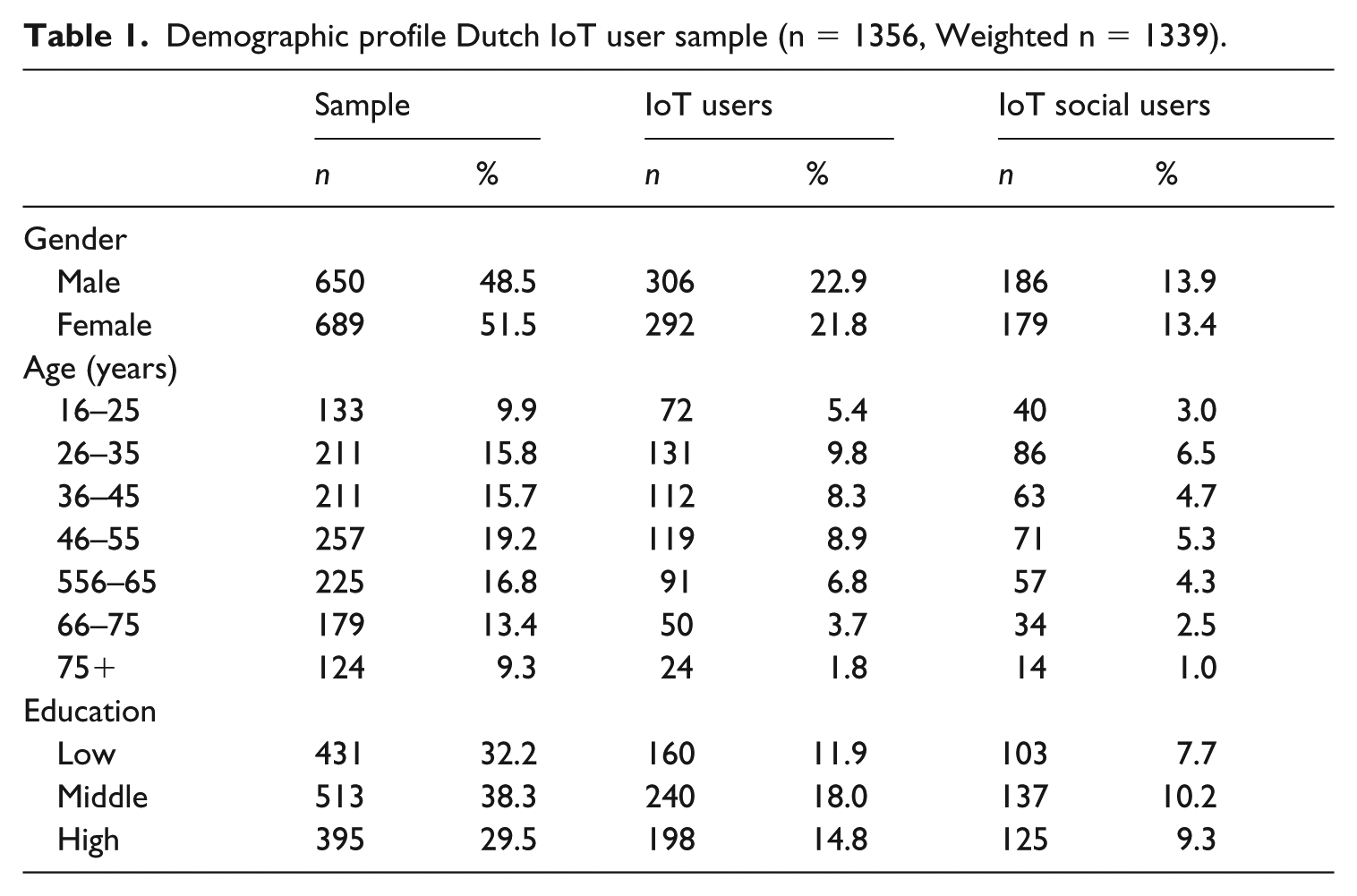
To test our hypotheses we collected novel survey data on IoT users that, to our best knowledge, no other research in the social sciences has collected on this topic. We conducted our survey in the last week of January and the first week of February 2018 in two parts among the same panel of respondents through a professional market research organization to obtain a representative sample of the Dutch population. The first part of the survey focused mainly on Internet use and the ISS (Van Deursen et al., 2016), whereas the second part focused explicitly on the IoT. Both parts contained questions of social determinants and forms of capital (Bennett et al., 2009), and each part of the survey was estimated to be completed within 20 minutes (variations relied largely on the amount of IoT devices respondents had). In total, 1359 respondents finished both surveys. A slight weight has been added to match the representativeness to the standards of Statistics Netherlands (CBS), a Dutch governmental statistics agency. Table 1 shows the demographic profile of the Dutch IoT user sample, including respondents using IoT devices and respondents using IoT devices socially.
Demographic profile Dutch IoT user sample (n = 1356, Weighted n = 1339).
Measures
To measure IoT use, respondents were asked whether they used one or more of 52 IoT devices available to consumers in 2017. Respondents were instructed to select only devices connected to the Internet, yet some still selected offline devices, such as non-smart toothbrushes, as IoT devices. Therefore, we verified IoT use with a question about how frequent their devices made an Internet connection. In a few cases, respondents sometimes reported their wearable device was not connected to the Internet, while they did use an app that required an Internet connection to control their device. In the case of wearable IoT devices, we controlled with frequent Internet and app connection. When respondents own IoT devices but not use them as such, for example, thermostats not connected to the Internet, it is not measured as IoT use.
Using IoT socially is measured by asking with whom the respondents shared the information data generated by their devices. Private use (n = 360) is measured when respondents do not wittingly share their IoT data with others. Using the IoT socially with a partner (n = 280) is measured by asking respondents if they shared IoT data with their partner (if any); sharing data with acquaintances (n = 171) is measured by asking respondents if they shared IoT data with people with whom they share mutual feelings acquaintanceship, that is, family, friends, acquaintances, colleagues, and social groups; and sharing IoT data with strangers (n = 82) is measured by asking respondents if they shared IoT data explicitly with strangers, on social media where the audiences are uncontrollable, or with specialists who are limited to asymmetrical social relations by professional guidelines.
We measured economic capital by employment status (n = 707) and yearly household income in three categories (<€30.000, €30.000–€60.000, and >€60.000). We measured cultural capital by its institutional state -the educational level (low, middle, and high)- and its objectified state -the frequency of cultural activities on a 5-point scale from never, yearly, quarterly, monthly to weekly. Following Bennett et al. (2009), cultural activities consist of visits to the theater, opera and ballet, art museums, historic museums, classic musical concerts, library, playing a classical instrument, or listening to classical music. A mean score for cultural activities was computed for eight items (Cronbach’s α = .77; M = 1.66; SD = 0.78).
We measured social capital by social support and social contact to represent mutual acquaintanceship and by group membership in political and community membership categories to distinguish between utilitarian complexity and engagement. For social support we used Sherbourne and Stewart (1991) measure for support availability, ranging from never (1), very occasionally (2), sometimes (3), usually (4), to always (5) (e.g. if respondents have someone they can trust, to have fun with, to help out when needed, or to get advice from). We computed a single sum scale with 12 items (α = .97; M = 3.75; SD = 1.07). For social contact (M = 3.17; SD = 1.47) we measured the sum score of five categories if respondents called or met with family and friends, or met with neighbors, in the last 2 weeks. Political membership (n = 222) was measured by belonging to either a political party, union, or environmental association. Community membership (n = 525) was measured by belonging to either a neighborhood association, voluntary work association, elderly association, scouting, sports club, or a school parent association. Because the accumulation of capital is a time intensive process, capital needs to be distinguishable in its consequence from age. Therefore, age has measured by year of birth with seven categories.
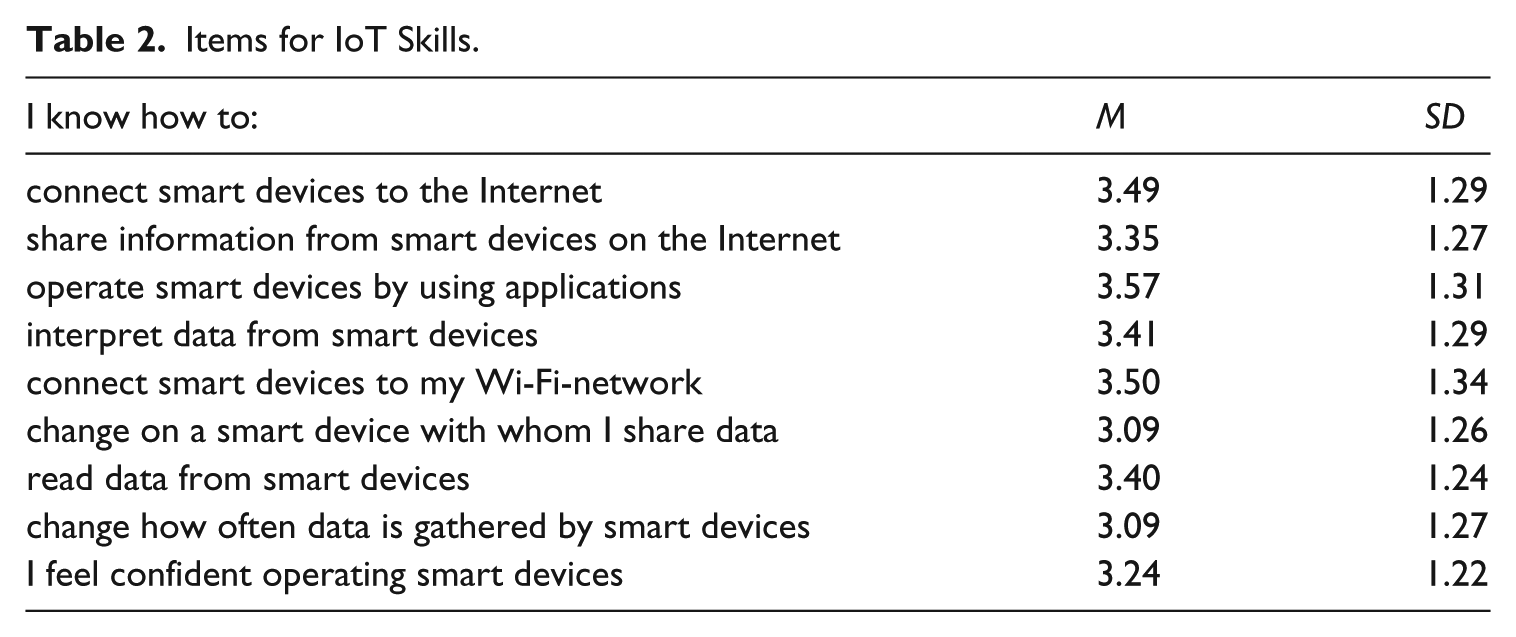
The ISS measures agreement on knowing how to do certain task on the Internet, ranging from not at all true (1), not very true (2), neither true nor untrue (3), mostly true (4), to very true (5) (Van Deursen et al., 2016). The ISS consists of questions like “I know how to bookmark a website,” “I know which apps are safe to download,” and “I can find websites I visited before.” We computed operational skills (α = .88; M = 4.36; SD = 0.98), information navigation skills (α = .84; M = 3.84; SD = 0.88), social skills (α = .82; M = 4.16; SD = 0.94), creative skills (α = .85; M = 2.91; SD = 1.10), and mobile skills (α = .88; M = 3.92; SD = 1.15). IoT skills are measured by adjusting 9 items from the ISS to fit the use of IoT devices (α = .96; M = 3.35; SD = 1.10) shown in Table 2.
Items for IoT Skills.
Data analysis
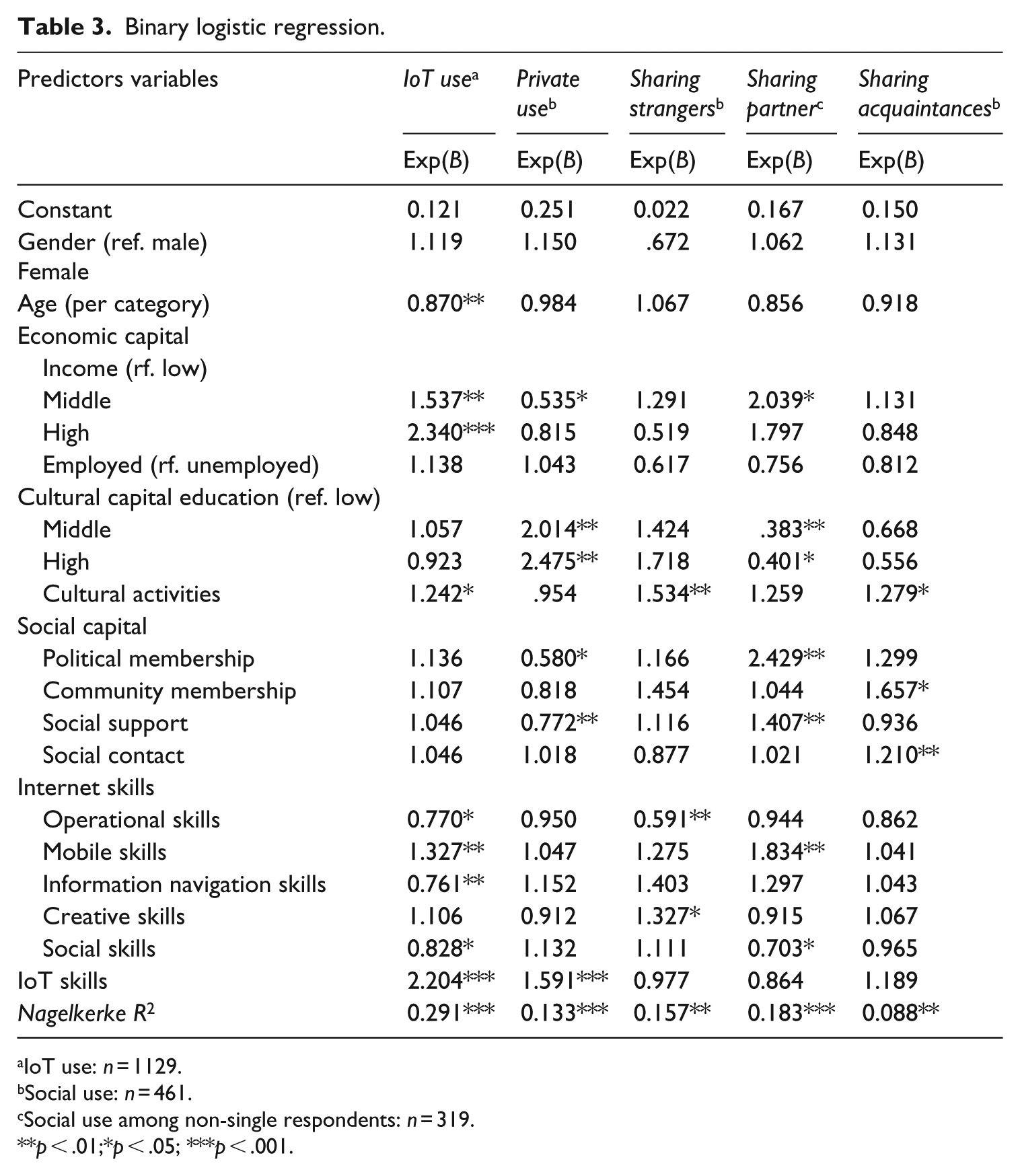
The result of four binary logistic regression analysis on IoT use, individual use, sharing IoT data with a partner, with acquaintances, and with strangers are shown in Table 3. The results are presented by the odd ratios of a capital model and a skills model. Gender and age are controlling variables.
Binary logistic regression.
IoT use: n = 1129.
Social use: n = 461.
Social use among non-single respondents: n = 319.
p < .01;*p < .05; ***p < .001.
Results
The odds ratio from the binary regressions shown in Table 3 shows that gender has no significant effect on IoT use or on its social use. Age has a significant effect on IoT use, but not on using the IoT socially. Therefore, we consider capital and skills as independent predictors for the social use of the IoT.
Capital
Economic capital has a large effect on IoT use when predicted by household income however, only middle-class income (compared to those with lower income levels) is significantly associated with private use and using the IoT socially with a partner. Respondents from middle-class income households are less likely to use IoT devices privately than lower household income classes. In contrast, sharing with a partner is positively predicted by middle-class-income households. Cultural capital is split between education and cultural activities. Education is not a significant predictor for IoT use in general, but does have a large effect on private use. Middle- and higher-educated IoT users are more likely to use the IoT privately than lower-educated users, while lower-educated users are more likely to share IoT data with their partner. Cultural activities positively predict IoT use and the social use of the IoT with acquaintances and strangers. Social capital has no significant effect on IoT use and a significant negative effect on private use by political group membership and social support. The inverse is true for sharing with a partner, where respondents are more likely to be associated with political groups and have more access to social support. Sharing with acquaintances is predicted by community membership and social contact.
Skills
Operational Internet skills have a significant and negative effect on IoT use and sharing IoT data with strangers. Mobile Internet skills and IoT skills, however, do have a positive effect on using the IoT, but in relation to social use, mobile skills are only significant predictors for sharing with a partner and IoT skills are only significant predictors for private use. Content-related skills are more diffused. Information navigation Internet skills are negative predictors for IoT use but have no effect on using the IoT socially. Creative Internet skills positively predict sharing IoT data with strangers. Finally, respondents with greater social Internet skills are less likely to use IoT devices and to share IoT data with their partner.
Hypothesis
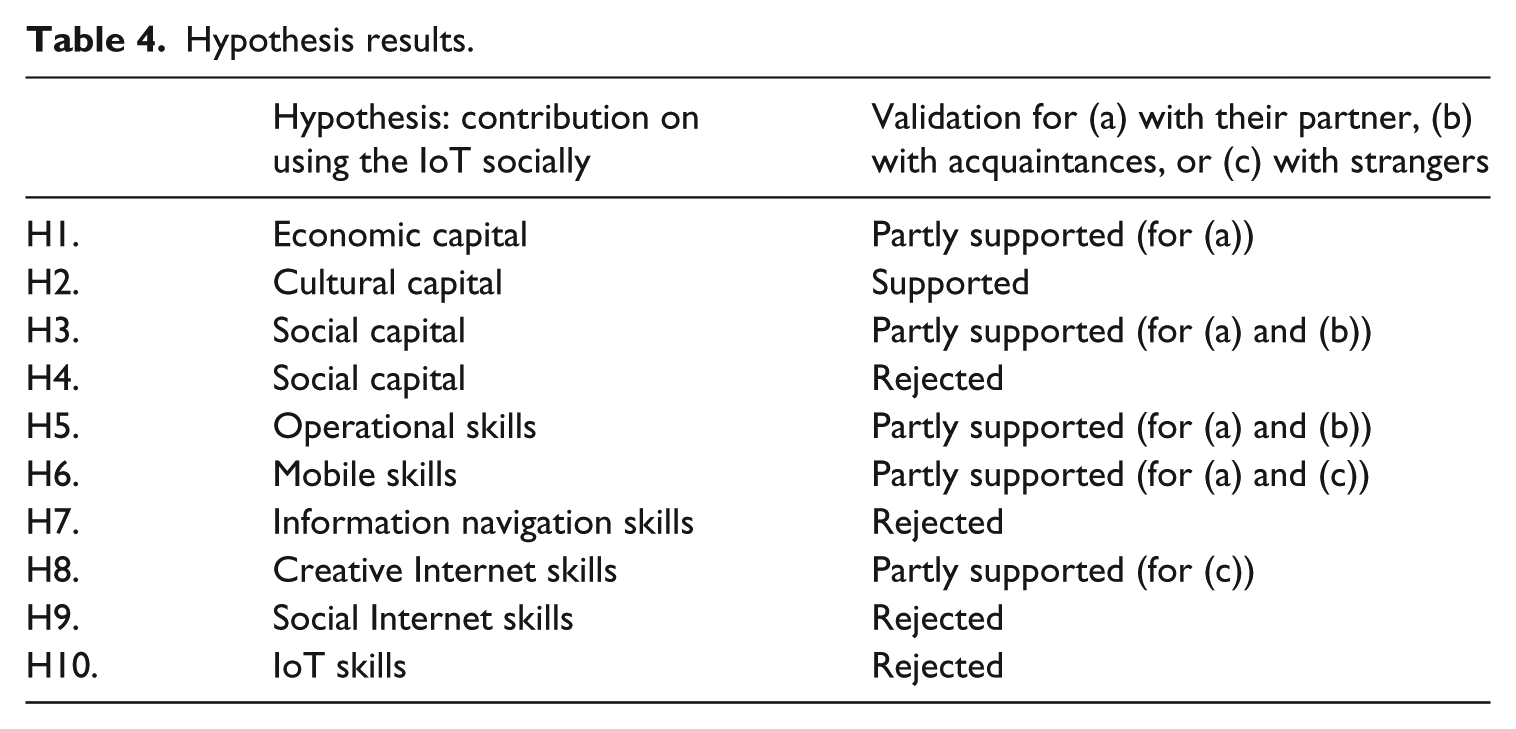
The tested hypotheses are summarized in Table 4. Based on the above model, we are able to reject H4, H7, H9, and H10: social capital does not have a negative effect on using the IoT socially, respondents with information navigation skills are not more likely to use the IoT socially, social Internet skills have a negative effect on the social use of the IoT, and IoT skills do not predict the social use of the IoT. H2 is supported, cultural capital predicts IoT social use, albeit separately for education and cultural activities. Other hypotheses are partly supported.
Hypothesis results.
Discussion
Main findings
While an innovate area of technology to advance the network society, the IoT system has been uncharted territory in the social sciences. The current contribution set out to study who uses the IoT socially and with whom, and to what extent the IoT inherits theoretical positions on CMC. Based on our result, we find that using the IoT platform can mainly be attributed to the more fluently acquired (operational, mobile, information navigation, social, and creative) Internet and IoT skills over forms of capital, aside from household income in economic capital. However, we find that the social use of the IoT platform is better attributed to the relatively stable forms of capital by Bourdieu (1986).
We found inversed effects on both private use and sharing IoT data with a partner for household income, education, political membership, and access to social support. This suggest that using the IoT privately or sharing IoT data with a partner is strongly dependent on variables that remain relatively stable over time and are related to household dynamics. Therefore, we encourage more research on how households differ in their contextual make-up and IoT use. More specifically, concerning our findings on access to social support, attention might be giving toward the availability of other household members that can qualitatively contribute to using the IoT.
The main differences between private use and sharing IoT data with a partner are attributed to IoT skills, mobile, and social Internet skills. Our research suggests that IoT skills might be contributing factor to using the IoT privately. We raised concerns that private IoT use could (unwittingly) advance processes of individualization and depersonalization that serve the information economy (Rayport and Sviokla, 1999; Van Dijk, 2012). Follow-up studies might address especially, if higher educated users and users prolific in IoT skills that use their IoT privately, are aware or impartial to those concerns. The sociocultural background of those users specifically might be suggestive for a greater awareness of the information economy in relation to data sharing. Mobile Internet skills are positively attributed to sharing IoT data with a partner, suggesting that partners are more likely to share IoT data when they are proficient in finding and installing relevant mobile applications for their IoT devices (Van Deursen et al., 2016). In addition, social Internet skills contribute negatively, suggesting that acquiring Internet skills to share data publicly online might be less of a priority when sharing IoT data with a partner. Insofar IoT sharing remains largely inside the households of their users, it dovetails with the suggestion that the IoT aids the coordination of task and activities in the domestic sphere (Fortunati, 2018; Haddon, 2006). Considering the everyday life applications of the IoT, our findings on social use suggests that future research might benefit from domestication frameworks of technology adoption (Bakardjieva, 2005; Silverstone and Haddon, 1996).
Sharing IoT data with acquaintances and with strangers are both predicted by cultural activities. Community membership and more social contact also contribute positively to sharing IoT data with acquaintances. This suggests that users who are more socially active outside of their immediate household are also more inclined to share IoT data outside their household. As such, it mirrors the hypothesis that users who are rich in social capital are also more prolific in the accumulation of social capital by strengthening and maintaining existing social bonds (Ellison et al., 2007; Ling, 2008; Valkenburg and Peter, 2009). However, based on our study, we cannot conclude that the IoT is used to establish reciprocal social bonds with strangers.
While we did not find Internet skills to be significant predictors for sharing IoT data with acquaintances, creative Internet skills contributed positively to sharing IoT data with strangers. Suggesting that knowing what is safe to download, understanding licenses that apply to content, and having experience with writing comments online, seem to diminish concerns related to sharing IoT data with strangers as well (Cf. Bellman et al., 2004; Hargittai and Litt, 2013). Simultaneously, IoT users with better operational skills are less inclined to share IoT data with strangers. This suggests that sharing with strangers can also be attributed to a lack of skills required to adjust Internet settings themselves after the initial setup (Van Deursen et al., 2016; Van Deursen and Mossberger, 2018).
Limitations
The IoT is in its early stages of development and integration. While our results show that the IoT parallels CMC in multiple aspects, we suggest that newer devices, further integration of the IoT into society and political intervention require an ongoing inquiry as to how the IoT is used socially and to determine its effects on society. The findings of this research can be extended, matched, and critiqued, for which we suggest four main points.
First, our contribution is based on a cross-sectional survey, and any indications of causality can be reversed. Our survey was only conducted among the Dutch population, one with high Internet access and relatively high income and educational levels. Cross-cultural research might help to establish to better define variable effects. In addition, our findings are expected to be stronger in countries where forms of capital are more diversely and unequally distributed, comparing to research on the digital divide (Wijetunga, 2014), but this begs for empirical enquiry.
Second, we aimed to measure the IoT as a whole by conceptualizing the IoT as a sum of IoT devices. On one hand, this limited the methods for analysis because using multiple devices per capita disqualifies mutual exclusiveness on categories of social use. It also raises questions about device-specific differences in social use that parallel the differences between Facebook and Google+ or Instagram and Snapchat, or between iPhone’s and BlackBerry’s in CMC research. On the contrary, the IoT platform promises to be more than the sum of IoT devices, for instance, by emphasizing its connectivity and novel interfaces, such as the use of virtual assistants by Google, Apple, and Amazon.
Third, forms of capital have invoked discussion about whether the content of different forms of capital is fixed or floating (Prieur and Savage, 2013). Bourdieu’s concept of culture is equally contested (see Lizardo, 2011 for an overview). Yet, all-encompassing conceptualizations of capital make the analysis almost tautological. Therefore, we limited capital to stable measures based on Bennett et al. (2009). We hope to inspire different conceptualizations of capital to research the effects of the IoT in society.
Fourth, we presumed a certain awareness of data-sharing among IoT users. This presumption can be overstated, especially between private use and sharing with strangers. We also used a large range of variation in sharing with acquaintances and colleagues. Qualitative research might provide a stronger understanding of subjective awareness and social distances in the social use of the IoT.
For future research, we suggest attention to be given to specific IoT skills, or lack thereof that produce the effect of individualization and depersonalization. In our measurement of Internet skills, the ISS, we found that they do not significantly attribute to using the IoT socially in a uniform manner. Qualitative research might better explain the social dynamics between the IoT and Internet skills, and make an insightful transition from Internet studies to IoT studies. Furthermore, we suggest more qualitative research to be directed to how skills emerge or are acquired in social context when Internet skills are not immediately transposable to the IoT. And, akin to frameworks of domestication of technology adoption (Bakardjieva, 2005; Silverstone and Haddon, 1996), how social use of the IoT affects social dynamics within a household with partners, children, parents, or a lack thereof. Finally, we approached the IoT system by comparing it to CMC literature however, the IoT might also compare well to research on social bots and robots in their use, especially concerning to what we described as private use.
Footnotes
Funding
The author(s) disclosed receipt of the following financial support for the research, authorship, and/or publication of this article: This work is part of the research programme ‘Any Thing for Anyone? An individual and Socio-contextual approach to the Internet-of-Things skill inequalities’ with project number 452-17-001, which is (partly) financed by the Netherlands Organisation for Scientific Research (NWO).
