




Abstract
This article examines the extent to which economic, cultural, social, and personal types of engagement with the Internet result in a variety of economic, cultural, social, and personal outcomes. Data from a representative survey of the Dutch population are analyzed to test whether engagement with a certain type of activity is related to “collateral” benefits in different domains of activities, independent from the socioeconomic or sociocultural characteristics of the person. The results show that what people do online and the skills they have affect outcomes in other domains and that this is independent of the characteristics of the person. This means that policy and interventions could potentially overcome digital inequalities in outcomes through skills training and providing opportunities to engage online in a broad variety of ways. A semiologic rather than an economistic approach is more likely to be effective in thinking about and tackling digital inequalities.
Introduction
Digital inclusion research is rooted in discourses around digital divides which refer to inequalities in the use of Information and Communication Technologies. The original conceptualization of a singular digital divide—labeled first-level digital divide—focused only on the binary of Internet access/non-access and attributed discrepancies to differences in economic capital; you either had the resources to get a connection to the Internet or you did not (Mehra et al., 2004; Newhagen and Bucy, 2005; Riggins and Dewan, 2005; Van Dijk, 2005). Connected individuals were automatically on the right side of the divide, having access to all the advantages the Internet had to offer. The focus in digital divide research subsequently shifted from physical access to other areas of digital exclusion, including skills and engagement, labeled the second-level digital divide (Hargittai, 2002). Strangely enough, research into the social effects of first- and second-level inequalities is scarce. Few scholars study who actually benefits from acquiring Internet skills and being online in relation to a broad range of Internet outcomes (e.g. Amichai-Hamburger et al., 2008; Stern et al., 2009; Van Deursen et al., 2017). Inequalities in these outcomes concern the third-level digital divide (Van Deursen and Helsper, 2015; Wei et al., 2011). There is concern that possession of Internet skills and Internet use do not necessarily lead to beneficial outcomes for all (e.g. Stern et al., 2009; Van Deursen et al., 2017; Van Dijk, 2005). While a link between skills, online activities, and outcomes is assumed, there is little empirical evidence showing how skills and use translate into specific outcomes. In addition, the implicit assumption is made that using the Internet for a particular activity automatically means that potential benefits associated with that activity are achieved. The current study pays particular attention to the way the Internet is used and how this affects the achievement of and satisfaction with economic, cultural, social, and personal outcomes. While previous studies assume that some Internet activities are more capital enhancing than others (e.g. Blank and Groselj, 2014; Hargittai and Hinnant, 2008; Van Deursen and Van Dijk, 2014), it is unclear whether specific activities indeed lead to just one particular outcome. The first research question is (1) To what extent do economic, cultural, social, and personal types of engagement with the Internet result in different economic, cultural, social, and personal outcomes? The second contribution of this study is an investigation of how typical socio-demographic characteristics in the digital divide literature relate to achieving outcomes and satisfaction with these outcomes. We are particularly interested in how Internet skills and activities affect these relations. The second research question is (2) To what extent do digital exclusion predictors still matter in relation to economic, cultural, social, and personal outcomes after accounting for Internet skills and different types of engagement? To answer both questions, we conducted a survey among a representative sample of the Dutch population.
Theory
Internet skills, uses, and outcomes
Internet skills form a key part of digital inclusion and are considered a multidimensional concept, spanning technical and content-related elements (e.g. Helsper and Eynon, 2013; Litt, 2013; Van Deursen and Van Dijk, 2010). Recently, Van Deursen et al. (2016) conceptualized, operationalized, and validated an Internet skills framework applicable to the general Internet user population. The framework is specifically designed to capture a range of Internet skills from basic to advanced levels and consists of operational skills (basic technical skills required to use the Internet), information navigation skills (the ability to find, select, and evaluate sources of information online), social skills (the ability to use online communication and interactions to understand and exchange meaning and acquire social capital), and content creation skills (needed to create different types of quality content and to publish or share this with others on the Internet). Those with lower levels of skills may be unable to access information and take advantage of the Internet.
The focus on inequalities in different types of use as a way to study digital divides has led to a plethora of different classifications (Blank and Groselj, 2014). The normative assumption of these classifications is that some Internet uses are more beneficial or advantageous for Internet users than others because they offer users more chances and resources in moving forward in their career, work, education, and societal position than others that are mainly consumptive or entertaining. Unfortunately, the many different classifications used by scholars cause a lack of comparability because often the classifications lack a theoretical justification (Van Deursen and Van Dijk, 2014). It would be more productive to use a classification which positions different Internet uses within the domains identified by the traditional social exclusion literature. Using this angle, Helsper (2012) proposed a classification of domains in which different people might benefit from going online. Her classification is derived from Bourdieu’s (1986) idea that individuals are exposed to a social space defined by institutions, norms, and specific conventions that shape the actions of individuals in a specific field and give them a status within it. Besides the economic resources (wealth, income etc.) traditionally considered when determining an individual’s position in the field, Bourdieu argues for the inclusion of social and cultural capitals as important for individual’s status and ability to allocate symbolic capital. Helsper (2012) adjusted the conceptualization of these domains to reflect recent empirical work and critiques of Bourdieuan approaches. She covered economic, cultural, social, and personal domains and considered these to be conceptually separate, although they are often strongly interrelated because of wider underlying power structures that concentrate (dis)advantage in certain groups. For example, those who lack resources in the personal domain (e.g. those who suffer poor health) are also likely to lack resources in the economic and social domains.
A clear distinction needs to be made between the possession of Internet skills, undertaking different kinds of activities online, and the tangible outcomes in different spheres of everyday life that result from this engagement. In previous research, skills have been assumed to automatically follow from undertaking different activities (Durndell and Haag, 2002). Furthermore, it is important to cover a wider range of outcomes to get a thorough understanding of the ways in which different people benefit in varied ways from going online and locate what the Internet’s most important contributions are. So far, it is not clear that skills and specific types of engagement result in actual beneficial outcomes. For example, insufficient skills might play a role in limiting efficiency in trying to undertake an online activity or when failing to turn this activity into a desired outcome.
Following Helsper’s (2012) classification of domains in which different people might use the Internet and benefit from it, we elaborate on the economic, cultural, social, and personal domains. Outcomes in the economic domain relate to capital and wealth and are often measured by indicators such as income, education, employment, or financial assets. Outcomes in the cultural domain relate to identity and belonging categories associated with certain beliefs and the interpretation of information and appropriate activities as learned through socialization (Maccoby, 2007). Outcomes in the social domain reflect attachment to networks that provide support (Portes, 1998). Informal networks build on common interests, activities, family, or other ties that join people together, operationalized by the quantity and the quality of one’s ties (Haythornthwaite, 2002; Kadushin, 2012; Lin, 2001). Although several scholars consider civic and political participation as separate domains (e.g. Bossert et al., 2007), Helsper (2012) includes these in the social domain because participation in political and civic organizations is an important element of Putnam’s (1995) original classification of social capital (Wuthnow, 1998). Operationalizations of formal social resources relate to group membership and having one’s voice heard in a wider community. This includes voting, advocacy group membership, power within the community, and the ability to influence unknown others in relation to interests that lie outside the personal sphere. Resources related to access and use of government services are classified as either economic (e.g. when they relate to benefits) or personal (e.g. when they relate to health or transport). Outcomes in the personal domain consist of individual characteristics with an emphasis on personality, aptitudes, and well-being. Personal resources have been operationalized as interests (e.g. hobbies, leisure), IQ, and psychological (e.g. confidence) and physical (e.g. health) well-being.
When considering economic, cultural, social, and personal outcomes, we should not only account for the achievement of a certain outcome. Achievement alone tells little about the actual quality of the outcome. For example, getting a degree through an online course (quantity) does not mean that you are satisfied that it was a good course that taught you something useful (quality). Thus, in the current contribution, outcomes are related to both quantity (achievement) and quality (satisfaction) of the outcome.
Inter-domain relations and collateral effects of uses on outcomes
The first hypothesis concerns the interrelation between economic, cultural, social, and personal outcomes. Bourdieu (1986) stated that one of the unique qualities of his forms of capital is that these are transferrable, suggesting that each type of capital can be converted to another. For example, social capital can be translated into economic capital when you find a more rewarding job through a personal connection. Social capital can be transformed into cultural capital when a friend introduces you to hardrock music. Bourdieu (1986) furthermore explained that economic capital is at the root of all the other types of capital by mediating between two opposing views: (1) economism, which suggests that every type of capital can be reduced to economic capital, and (2) semiologism, which reduces social exchanges to phenomena of communication. Economism underestimates the specific efficacy of the other capitals, while semiologism underestimates the influence of economic resources. Bourdieu also posed that when one possesses more economic capital, it is easier to obtain more cultural capital (e.g. children are more likely to learn foreign languages when their parents can afford language courses). Social and cultural capital can be derived from economic capital, but at the cost of significant efforts of transformation needed to produce the type of power effective in the field in question (Bourdieu, 1986). For example, there are some goods and services to which economic capital gives immediate access, while others can only be obtained over time via social capital (e.g. trust in others takes a time to establish). According to Bourdieu, the reproduction of capital results from the convertibility of the different types of capital.
Helsper (2012) argues that economic, cultural, social, and personal outcome domains interrelate. Her corresponding fields model differs in that the focus is not on structural societal categories, but on the resources that people have access to in their everyday lives. Which resource is emphasized or holds power in relation to a particular interaction depends on the context a person is navigating. Rather than looking at the social structure of the field in which resources are activated, the model assumes the individual as the locus of capital and the individual as embedded in different (sometimes overlapping) fields. A more fluid model of identity is adopted, and personality and psychological elements are incorporated alongside but conceptually separate from socio-demographic and social categories. It is not clear how the domains interrelate in digital societies and what the consequences of economic, cultural, social, and personal Internet uses are for economic, cultural, social, and personal outcomes. There is clear evidence that engagement with activities online in a particular domain relate to outcomes in that same domain offline (Van Deursen et al., 2017). However, capital theory reasons that certain capitals can facilitate the acquisition of others; therefore, we expect that uses of the Internet in one domain might also result in outcomes in another domain. We label positive outcomes in domains other than those related to the activity undertaken—“collateral benefits.” The first hypothesis is as follows:
H1. One type of Internet use leads to collateral benefits in other domains (e.g. social use of the Internet affects economic, cultural, and personal outcomes).
This article subsequently examines whether typical socio-demographic predictors of digital exclusion independently relate to Internet outcomes. We hypothesize that these demographics are decisive for gaining benefits from Internet use in a wide variety of domains. Typically accounted for are gender—men and women differ in what they do online (Van Deursen and Van Dijk, 2014; Zillien and Hargittai, 2009), age—younger people exhibit the highest frequencies of Internet use and the highest diversity of Internet use (Blank and Groselj, 2014; Pearce and Rice, 2013; Van Deursen and Van Dijk, 2014; Zillien and Hargittai, 2009), education—people with lower educational levels have lower levels of Internet skills (Hargittai, 2002) and use the Internet in ‘less beneficial’ ways (Hargittai and Hinnant, 2008; Van Deursen and Van Dijk, 2014), income—persons of higher income use the Internet more efficaciously, employ the Internet more productively and to greater economic advantage (DiMaggio et al., 2004), employment—those in employment are more digitally engaged and benefit more from technology in their everyday lives (Clayton and Macdonald, 2013), and disability—related to digital engagement because it hinders activities considered normal in daily life (Dobransky and Hargittai, 2016; Macdonald and Clayton, 2013; Vicente and Lopez, 2010). Also included is Internet experience—strongly related to Internet skills and Internet usage types (e.g. Büchi et al., 2016; Hargittai and Hinnant, 2008).
H2a. Predictors of digital exclusion based on inequalities in traditional capitals (e.g. gender [F/M], education, income, employment, disability, and Internet experience) relate negatively to the achievement of positive outcomes (the traditionally disadvantaged gain a narrower and lower quality set of Internet outcomes).
We expect that how skilled people are and what people do online could moderate the influence of these stable characteristics in such a way that initial inequalities in capitals could be overcome. This slightly optimistic idea is based on the hope that skills training and use of the same online resources can counter existing inequalities (implying also that simple access to these resources is not enough):
H2b. After taking into consideration Internet skills and uses of the Internet, the influence of traditional capital resources will become smaller in terms of the outcomes achieved.
Method
Sample
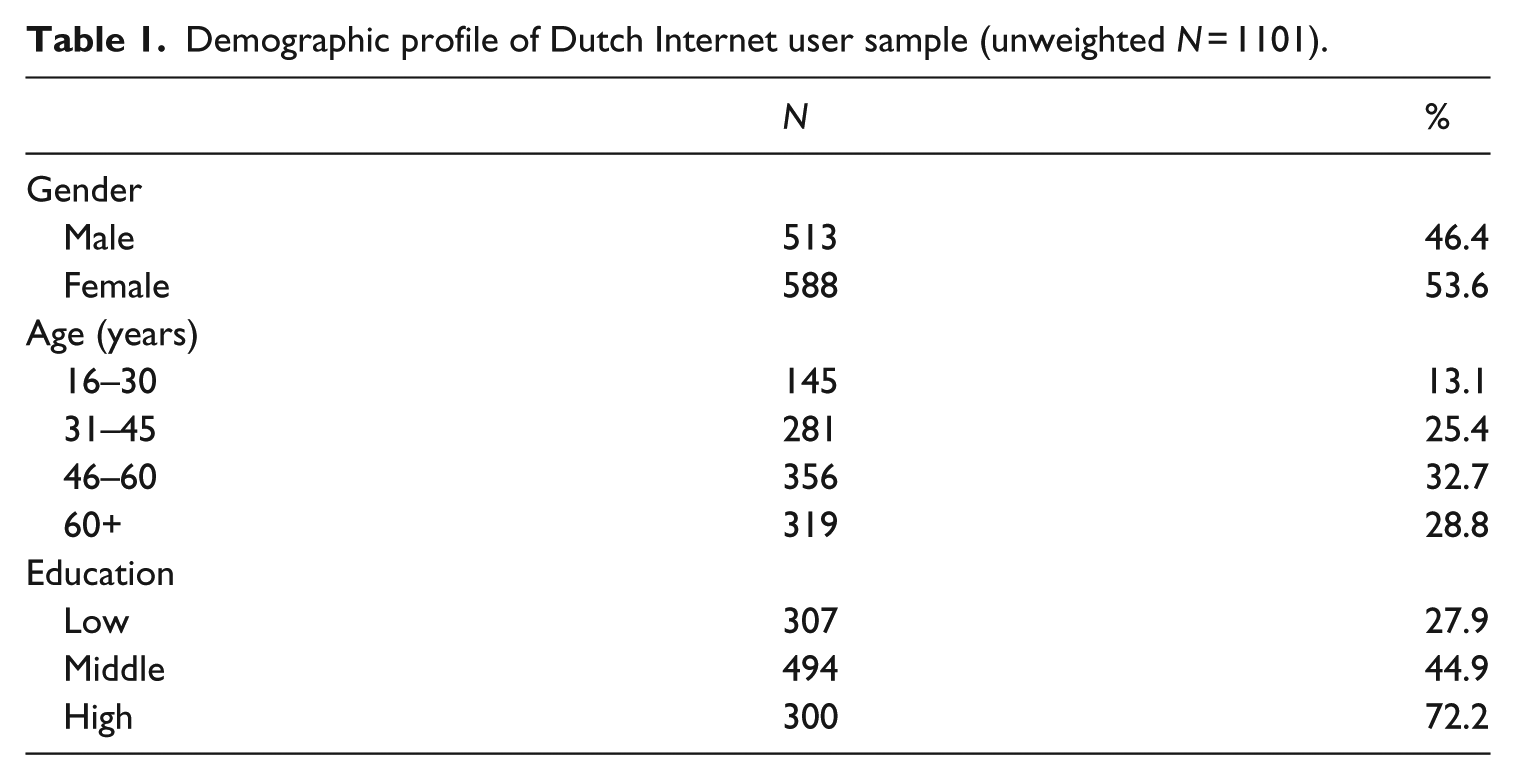
We conducted an online survey in the Netherlands over a period of 2 weeks in November 2014. A representative sample of the Dutch adult population was obtained through a professional market research organization with a panel over 108,000 people. Members receive a small monetary incentive for every survey they complete. Since the panel is a representative sample of the Dutch Internet user population, it contains beginners and advanced Internet users. Invitations were sent out in three waves to ensure that the final sample represented the Dutch population for gender, age, and education. In the Netherlands, 95% of the population uses the Internet (CBS Statistics Netherlands), making the user population very similar to the general population. In total, 1101 responses were obtained (response rate 27%). External aggregate data (i.e. the national population census) were used to estimate calibration weights based on age, gender, and education. Table 1 summarizes the demographic characteristics of the respondents. Numbers in the tables in the method section are unweighted and reflective of the actual sample; for the analyses, the weighted data are used.
Demographic profile of Dutch Internet user sample (unweighted N = 1101).
Measures
Pretesting of the survey was conducted in two rounds. In the first round, 30 cognitive interviews were conducted. Cognitive interviewing concerns systematically developing survey questions through investigations that intensively probe the thought processes of individuals who are presented with those inquiries (Willis, 2005). Questions that surfaced as problematic were evaluated and adjusted. The second round consisted of online survey pilot tests with the specific aim of testing for reliability and other characteristics of the constructed scales. The time required to complete the final survey was approximately 25 minutes.
Internet skills were measured using the Internet Skills Scale (Van Deursen et al., 2016). The psychometric properties of this 20-item instrument for operational, information navigation, social, and creation skills were proven to be satisfactorily reliable and valid across different socio-demographic and cultural contexts. Items were scored on a 5-point agreement scale and exhibited high internal consistency: Operational Skills (α = .84; M = 4.40; standard deviation [SD] = 0.85), Information Navigation Skills (α = .88; M = 3.57; SD = 1.11), Social Skills (α = .87; M = 4.30; SD = 0.88), and Creative Skills (α = .89; M = 3.00; SD = 1.24).
Internet usage types related to the economic, cultural, social, and personal domain were developed based on an extensive review of the literature and previous surveys (see Helsper et al., 2016). Our starting point was the mapping of specific types of uses onto the different resource domains. In the development of the items, we moved between use measures and outcome measures to make sure that activities could be mapped onto outcomes and outcomes onto activities. Economic types of uses are categorized as income (savings and earnings), employment (productivity/promotions/jobs), finance (investments and contracts), and education (grades/degrees). Cultural types of uses consisted of items measuring belonging (i.e. how the Internet facilitates an understanding of the self as part of a sociocultural group) and identity (uses specifically related to issues of gender, ethnic, generational, or religious identity). The uses in the social domain were based on political and civic participation and research into strong and weak or bridging and bonding ties. In the personal domain, we considered items concerning health, leisure, and self-actualization (e.g. discuss a topic of personal interest with others online). Respondents were asked for each of the four domains to indicate to what extent they use the Internet for various activities using a 5-point scale (“never” to “daily”) as an ordinal-level measure. We replicated the factor structure using confirmatory factor analysis (see Appendix 1).
We constructed separate Internet outcome achievement scales for economic, cultural, social, and personal domains based on the classified Internet usage types (see Helsper et al., 2015). We measured tangible outcomes in two ways, related to quantity (achievement) and quality (satisfaction) of the outcome. Quantity statements are measured using agreement scales, and the quality of the outcome is measured with satisfaction scales. We aimed to create measures asking about different tangible, that is, externally observable, outcomes in each of the four domains. In the development of the items, behavioral types of outcomes were given preference over attitudinal outcomes whenever possible. The outcomes questions in the questionnaire were formulated in such a way that they could only be the direct result of a specific online type of use. For example, using the Internet for job hunting could potentially result in the outcome of finding a better job, or online dating might result in finding a partner. The outcomes scales consist of items using a 5-point agreement scale as an ordinal-level measure. Tangible outcomes logically depend on whether or not a person has undertaken a particular use online. We added a zero to the outcome variables if respondents never engaged with a corresponding use, thus creating a 0–6 scale variable for each outcome (see Appendix 2).
Similar to the outcome achievement scale, we constructed Internet outcome satisfaction scales for economic, cultural, social, and personal domains (see Helsper et al., 2015). We aimed to create measures asking about satisfaction derived from achieving the tangible outcomes in each of the four domains. The satisfaction questions in the questionnaire were formulated in such a way that they could only be the direct result of achieving a certain outcome. The scales consist of items using a 5-point agreement scale as an ordinal-level measure. The questions about satisfaction depend on whether or not a person has achieved a certain outcome; thus, we needed to recode missing values to be able to calculate satisfaction averages over those who had achieved an outcome. We took three steps: first, missing values (including “don’t know” answers) were converted to value 0; second, count scores were created by counting the number of items which scored 1–5 (thus, if a person answers satisfaction for all items on a scale that has five items, then the score is 5); third, the scale average was computed by summing the converted items and dividing this by the count score, resulting in the average score for the items on the scale where the person answered between 1 and 5 (i.e. the average satisfaction of a field of outcomes for those outcomes that were achieved) (see Appendix 3).
To measure age, respondents were asked for their year of birth (M = 50.2; SD = 15.4). Gender was included as a dichotomous variable. To assess education, data regarding degrees earned were collected, which were used to create three groups: low (primary), middle (secondary), and high (tertiary) educational achievement. Employment was included as a dichotomous variable by asking people whether they have a part-time or full-time job (56%). Disability was included as a dichotomous variable by asking people whether they have a health issue or handicap that hinders them in their daily activities (21%). Internet experience was captured by the number of years that people had been using the Internet (M = 11.3; SD = 5.0).
Data analysis
For the first hypothesis, linear regression analyses were used to analyze which skills and uses significantly predict the achievement of the outcomes and the satisfaction with this achievement. To test H2a and H2b, hierarchical regression analysis was used to identify predictors of the achievement of outcomes and the satisfaction with this achievement. In the first step, we added the independent variables of gender, age, education, income, employment, disability, and Internet experience, and in the second step, we added Internet skills and uses.
Results
Uses and outcomes
Table 2 shows that for achievement of a specific outcome, the corresponding uses (a use in the same domain) have the strongest relationship. For example, for achieving economic outcomes, economic use is the strongest predictor. This is the case for both achievement and satisfaction. Table 2 also shows that economic uses relate to achieving social and cultural outcomes and negatively to satisfaction with cultural outcomes. Cultural uses are in addition related to social outcome achievement but negatively to satisfaction in this area. Social uses relate to achievement of all other outcomes and satisfaction with cultural outcomes. The type of use with the highest number of collateral benefits seems to be personal uses, which is related strongly to the achievement and satisfaction with social and cultural outcomes, followed by social uses of the Internet. Since all uses relate to the achievement of and satisfaction with outcomes in some other domains, H1 is supported. The results also suggest that to achieve an outcome, Internet uses are good predictors, but in order to feel satisfied with the achieved outcome, Internet skills matter more.
Regression analysis for Outcomes Achieved (A) and Satisfaction (S) by Internet skills and uses.
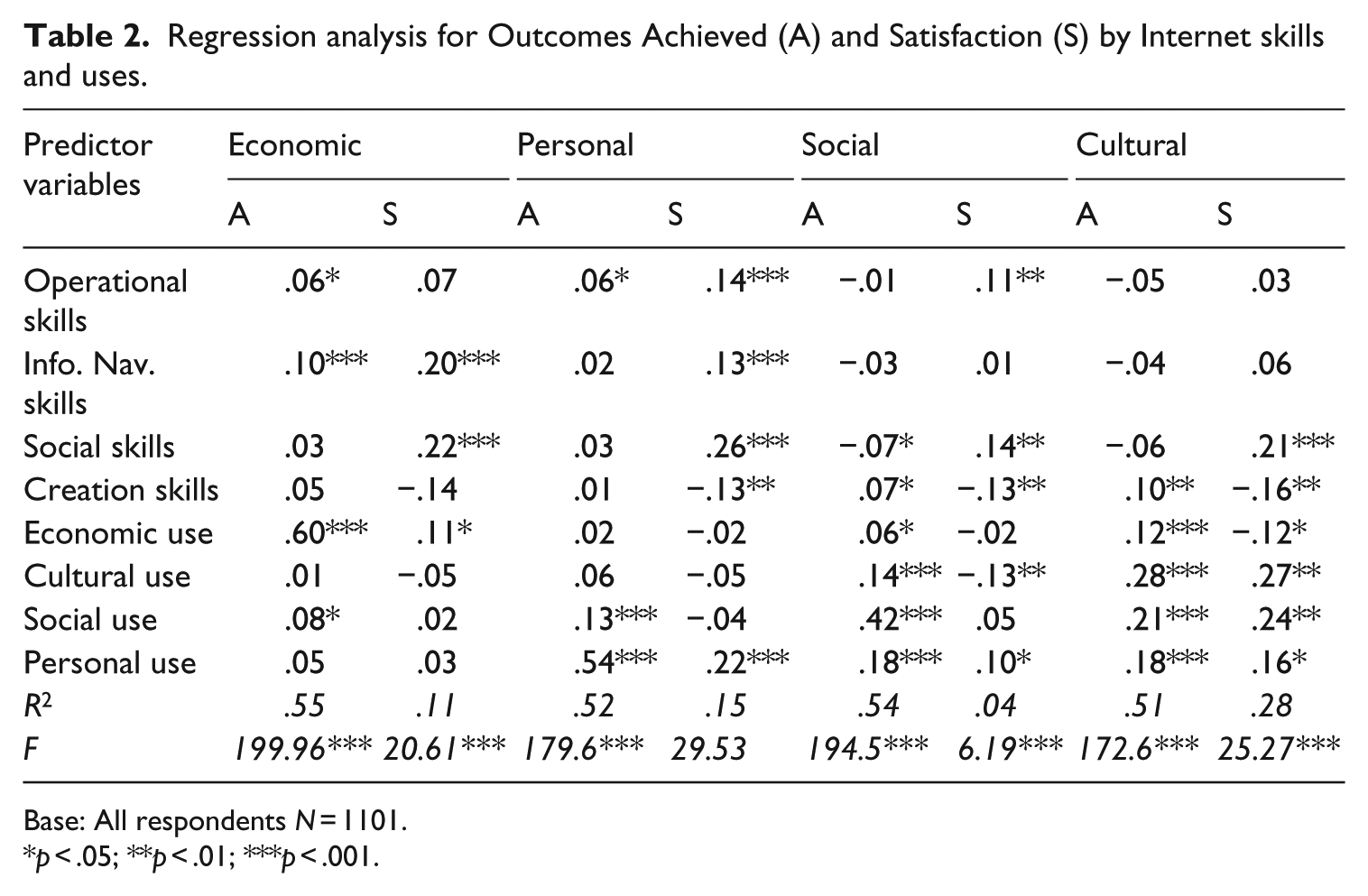
Base: All respondents N = 1101.
p < .05; **p < .01; ***p < .001.
Uses in relation to socio-demographics
Regression analysis shows that socio-demographics relate to achievement and satisfaction of the outcomes (see Model 1 in Table 3). Men are more likely to achieve economic and social outcomes as compared to women. Age is negatively related to the achievement of all four outcomes and to satisfaction with cultural outcomes. The relationship with age is positive for satisfaction with economic and social outcomes. Education has a relationship with achieving economic and personal outcomes and with the satisfaction of these outcomes. Income is positively related to the achievement of all outcomes but not to the satisfaction with any outcomes. Those employed are more likely to achieve economic outcomes but less likely to achieve cultural and social outcomes. The satisfaction with economic outcomes is also higher among those employed. Those with a disability are more likely to achieve cultural, social, and personal outcomes. They are also more satisfied with cultural outcomes. Finally, Internet experience related positively to achieving economic outcomes and negatively to cultural outcomes. Since characteristics of the individual are related to achievement of (gender, age, education, income, employment for economic outcomes, and Internet experience for economic outcomes) and satisfaction with some outcomes (age for cultural outcomes, education, employment), though not all, H2a is partly supported. As described above, there were a few relationships (e.g. with disability) where the direction was the reverse of that expected.
Hierarchical regression analysis summary for Outcomes Achieved (A) and Satisfaction (S).
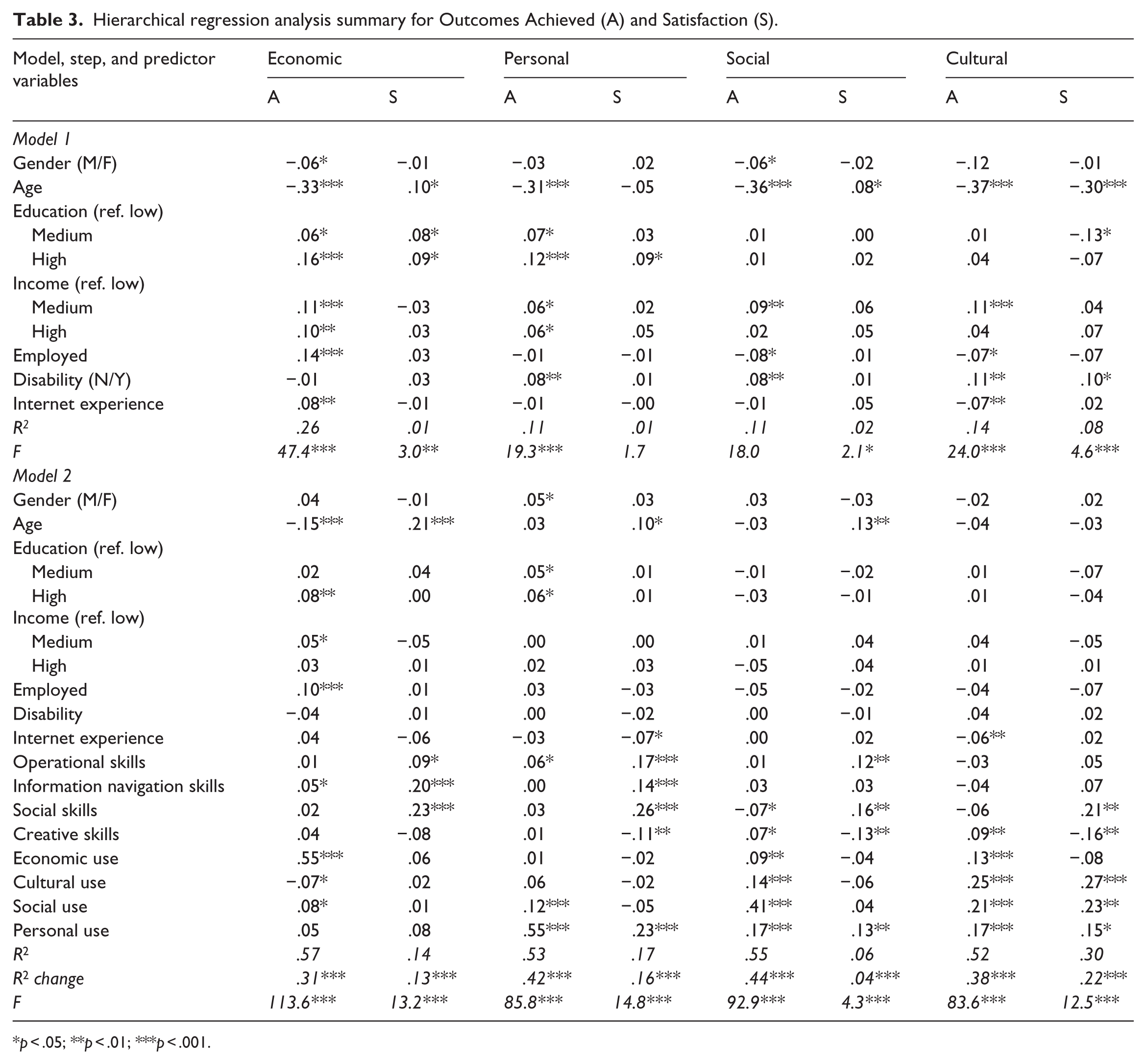
p < .05; **p < .01; ***p < .001.
Internet skills and uses were added as a second step in the regression (see Table 3). This significantly increased the variance explained and resulted in many of the relationships between outcomes and socio-demographics becoming insignificant. The only relationships that remain significant are those between age, education, and employment and the achievement of economic outcomes. Especially those with higher information navigation, social, and creative skills are more satisfied with the outcomes they have achieved. Use mostly relates to achievement rather than satisfaction.
Discussion
Main findings
This article focused on the extent to which economic, cultural, social, and personal types of engagement with the Internet result in “collateral benefits.” That is, whether use of the Internet for economic, cultural, social, or personal domain activities could lead to positive outcomes in domains other than the one the use was located in. In addition, it examined the extent to which digital divide predictors relate to these outcomes after accounting for Internet skills and types of engagement. The findings suggest that what people do online and the skills they have are more important than who they are when it comes to inequalities in outcomes of Internet use and that Internet uses in a particular domain can result in outcomes in another domain. Especially interesting is that personal and social uses of the Internet have the most collateral benefits. These types of Internet use are often assumed to be less capital enhancing (e.g. Blank and Groselj, 2014; Van Deursen and Van Dijk, 2014; Zillien and Hargittai, 2009). We found that the economic uses, often the focus of digital inclusion policies and interventions, are narrowly related to mainly economic outcomes. While Bourdieu (1986) might have seen economic capital as the underlying fuel to give people access to other resources, this study seems to suggest that economic digital capital is less important to give people access to other resources than the more popular uses of the Internet. In other words, digital inequalities research needs to adopt a semiologic rather than an economistic approach if it wants to explain how use might lead to the acquisition of different capitals. This conclusion is important for effective digital divide policy and intervention development. A shift in emphasis away from the more functional, practical normatively valued types of engagement is desirable. Instead, other more popular, less normatively valued activities to improve overall well-being should be a part of programs and policies interested in increasing overall well-being and participation in digital societies. If policy or research continues to focus very narrowly on specific outcomes, researchers and policy-makers can assume that engagement with related uses is the best way of achieving these.
However, even when taking a narrow approach to digital exclusion, softer communicative and creative and more technical information navigation Internet skills are fundamental in translating engagement into the achievement of high-quality outcomes. Other research has shown that there are considerable inequalities in these skills between different socio-demographic groups (Van Deursen et al., 2016, 2017). Information navigation skills have an impact on the more functional types of outcomes but fail to influence the more normatively valued and affective outcomes. In the latter, the softer social skills play a more important role. Interventions should carefully look at which skills individuals from different disadvantaged backgrounds are lacking and provide training in these to counter the amplification of existing inequalities. This study furthermore points out that there seems to be a trend that those with high levels of creative skills have a high quantity, but lower quality outcomes. This suggests that people are just producing content without knowing how to target it or without getting the result they would like in a variety of domains. The opposite occurs for social skills, where there is no effect or a negative effect on the quantity of social and cultural outcomes, but a positive effect on the quality of the outcomes achieved. Those with higher levels of social skills seem to aim at narrower ranges of relationships and engagements but with higher quality outcomes. Operational skills, the skills that are often central in interventions, are not directly related to achieving Internet outcomes. Other research suggests that they are the building blocks for other skills and should thus not be ignored (Van Deursen and Van Dijk, 2015). Nevertheless, the findings presented here suggest that operational skills are not sufficient and that potential headway in tackling inequalities can only be achieved if softer skills take center stage and programs are targeted at those groups that lack these in particular.
Limitations and the future research
Internet outcomes are often assumed to result from Internet use in digital divide research without being clearly theorized or operationalized as separate constructs. The goal of this article was to take a different approach and examine how different digital skills and type of Internet use translate into economic, cultural, social, and personal outcomes. This large-scale theory–guided empirical study employed measures of tangible outcomes based on self-report of how the Internet may be beneficial rather than objective measures such as gains in employment and academic achievement. This is unavoidable in cohort-based survey research. Nevertheless, future studies should validate outcome measures through observational and longitudinal research backed up by qualitative in-depth research around outcomes to validate these self-report measures.
Future research should also extend this study by incorporating other indicators theorized in conceptualizations of the first-, second-, and third-level digital divide. Especially, the inclusion of motivation and sophisticated access measures is needed. Using certain skills might be more difficult on one device than on another, and certain activities might be better suited for a particular device (e.g. doing content rich searches can be difficult on a smartphone) (Brown et al., 2011; Napoli and Obar, 2014). Personal preferences and motivations might be important in determining different types of engagement (Reisdorf and Groselj, 2017). For example, even if a person has the necessary skills to engage with political uses, if they are not interested in politics or do not see the Internet as the right place to engage with these issues, it is unlikely they will undertake related activities online. Similarly, strong motivations to engage with the Internet might override disadvantages in terms of access and skills in using the Internet and achieving beneficial outcomes.
Finally, we noted that in the Netherlands, 95% of the population uses the Internet. We do expect that our findings hold true for countries with a lower Internet penetration. We might even expect that the relationships between skills, capitals, and outcomes among Internet users are stronger in countries that have lower levels of Internet penetration because inequalities seem to play themselves out when being online rather than in having or not having physical access to the Internet. We expect that countries with lower levels of Internet penetration will show similar patterns once a larger section of the population goes online. Another characteristic of the Netherlands is that it is a country with low levels of traditional inequalities; thus, when more unequal countries, in the traditional sense, have the majority of their population online, we would expect these aspects to be even stronger there.
Footnotes
Appendix
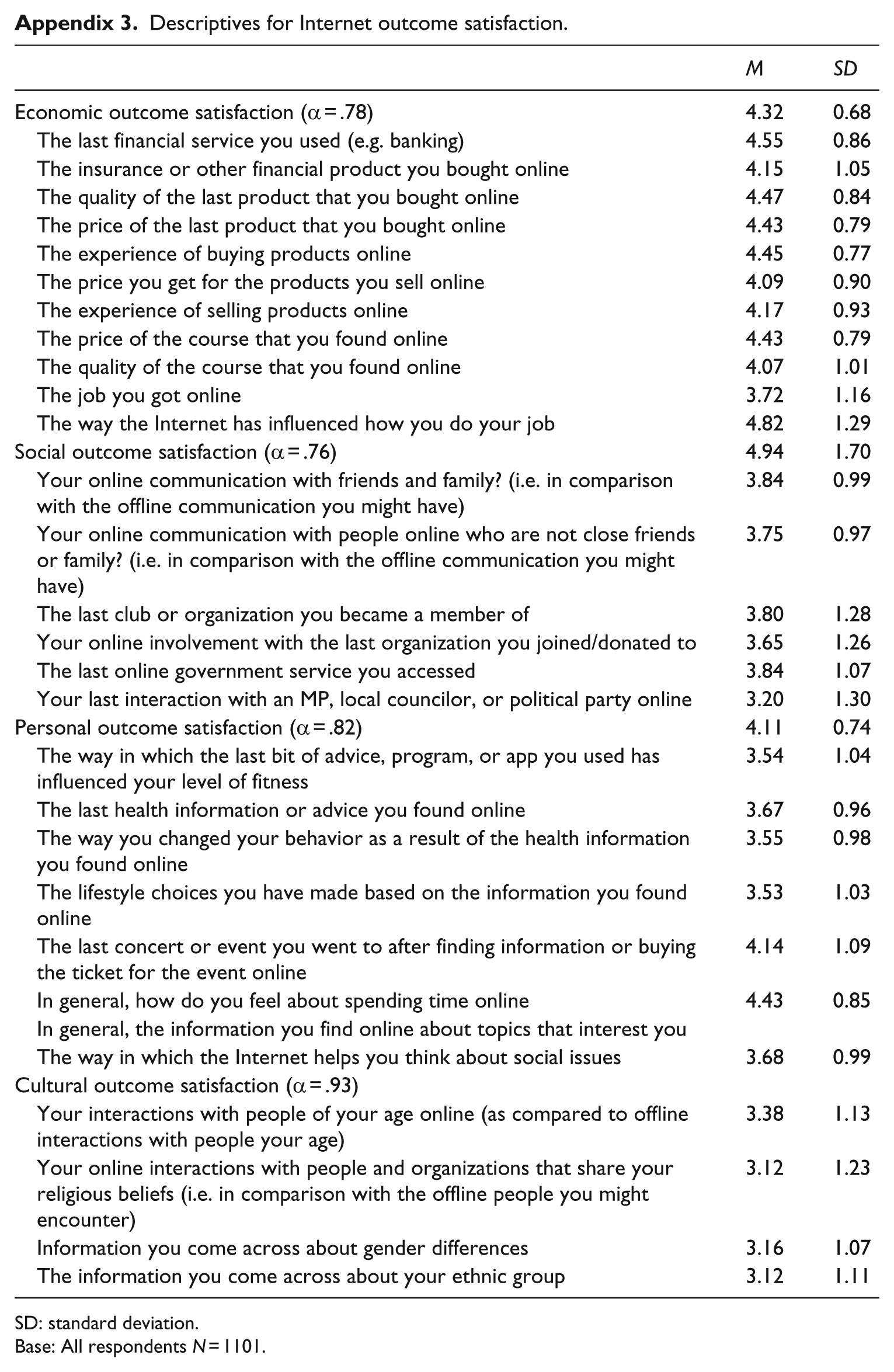
Descriptives for Internet outcome satisfaction.
| M | SD | |
|---|---|---|
| Economic outcome satisfaction (α = .78) | 4.32 | 0.68 |
| The last financial service you used (e.g. banking) | 4.55 | 0.86 |
| The insurance or other financial product you bought online | 4.15 | 1.05 |
| The quality of the last product that you bought online | 4.47 | 0.84 |
| The price of the last product that you bought online | 4.43 | 0.79 |
| The experience of buying products online | 4.45 | 0.77 |
| The price you get for the products you sell online | 4.09 | 0.90 |
| The experience of selling products online | 4.17 | 0.93 |
| The price of the course that you found online | 4.43 | 0.79 |
| The quality of the course that you found online | 4.07 | 1.01 |
| The job you got online | 3.72 | 1.16 |
| The way the Internet has influenced how you do your job | 4.82 | 1.29 |
| Social outcome satisfaction (α = .76) | 4.94 | 1.70 |
| Your online communication with friends and family? (i.e. in comparison with the offline communication you might have) | 3.84 | 0.99 |
| Your online communication with people online who are not close friends or family? (i.e. in comparison with the offline communication you might have) | 3.75 | 0.97 |
| The last club or organization you became a member of | 3.80 | 1.28 |
| Your online involvement with the last organization you joined/donated to | 3.65 | 1.26 |
| The last online government service you accessed | 3.84 | 1.07 |
| Your last interaction with an MP, local councilor, or political party online | 3.20 | 1.30 |
| Personal outcome satisfaction (α = .82) | 4.11 | 0.74 |
| The way in which the last bit of advice, program, or app you used has influenced your level of fitness | 3.54 | 1.04 |
| The last health information or advice you found online | 3.67 | 0.96 |
| The way you changed your behavior as a result of the health information you found online | 3.55 | 0.98 |
| The lifestyle choices you have made based on the information you found online | 3.53 | 1.03 |
| The last concert or event you went to after finding information or buying the ticket for the event online | 4.14 | 1.09 |
| In general, how do you feel about spending time online | 4.43 | 0.85 |
| In general, the information you find online about topics that interest you | ||
| The way in which the Internet helps you think about social issues | 3.68 | 0.99 |
| Cultural outcome satisfaction (α = .93) | ||
| Your interactions with people of your age online (as compared to offline interactions with people your age) | 3.38 | 1.13 |
| Your online interactions with people and organizations that share your religious beliefs (i.e. in comparison with the offline people you might encounter) | 3.12 | 1.23 |
| Information you come across about gender differences | 3.16 | 1.07 |
| The information you come across about your ethnic group | 3.12 | 1.11 |
SD: standard deviation.
Base: All respondents N = 1101.
Funding
The author(s) received no financial support for the research, authorship, and/or publication of this article.
Author biographies
 ). She is a visiting scholar at the USC Annenberg School for Communication and Journalism, NYU’s Steinhardt School, the Pontificia Universidad Catolica de Chile and Twente University.