




Abstract
Automated facial recognition, the use of dactyloscopic data and advanced forensic DNA analyses are becoming dominant technological surveillance means for ‘crimmigration’ control. ‘Crimmigration’ describes the increasing criminalisation of migration, based on a perceived ‘crisis’ of mass migration and its assumed negative impact on national stability and welfare, materialising in overlapping crime and migration control regimes. We analyse the policing of migration through biometric technologies as the reproduction of social practices of security against crime. By combining concepts of social practices and ethical regimes, we suggest that biometric ethical regimes are constituted by social practices working towards legitimising the use of biomaterials and biodata. This analytical synthesis supports us in exploring how biometric technologies deployed in the policing of crime circulate into the policing of migration and vice versa. First, technologies as materials (DNA, fingerprints, facial images, analysis kits, databases, etc.) are inscribed with assumptions about validating identity and suspicion, and are increasingly made accessible as data across policy domains. Second, forensic competence moves in abstracted forms of expertise independent of context and ethics of application, creating challenges for reliable and legitimate technology deployment. Third, biometric technologies, often portrayed as reliable, useful, accurate policing tools, travel from crime into migration control with meanings that construct generalised criminal suspicion of migrants. To evidence the complexity and difficulty of achieving accountability and responsibility for the ethical governance of biometric technologies in policing, we trace how the goals, risks, benefits and values of biometric technologies are framed, and how the legitimacy of their deployment in policing of migration is constructed and negotiated.
Introduction
In 2015/2016, European governments faced a significant increase in migration, in particular due to civil war and unrest in Syria, Afghanistan and North Africa. Germany and Sweden registered the highest share of immigration, with the former counting over 1.4 million asylum or refuge seekers. European societies became polarised publics, torn between a ‘welcome culture’ (e.g. Germany's then Chancellor Angela Merkel's ‘open door’ policy) and hostility. Influenced by a public discourse of moral panic and mistrust towards asylum and refuge seekers, sceptical publics viewed the development with rising concern about impacts on crime, employment and living standards. In this context of heightened attention, two criminal cases involving asylum seekers in Germany at the end of 2016 raised the stakes for migration control as a task shared by criminal justice. Maria Ladenburger was killed by Hussein Khavari in Freiburg/Breisgau on 16 October 2016, and Anis Amri drove a lorry into a busy Christmas market in Berlin on 19 December of the same year, eventually bringing about the deaths of 13 people. Although exceptional, both cases contributed to the articulation of a ‘crisis’ of control over migrants, specifically criminal migrants. Two types of biometric identification technologies – forensic DNA phenotyping (fDp) and dactyloscopy (or fingerprinting) – played a vital role in public debate about the investigations, and were portrayed as holding the potential to either prevent or avoid follow-up killings. fDp was discussed in the case of the murder of Maria Ladenburger in October 2016. fDp is seen as a means to infer the appearance of an unknown person (subject to the expectation that non-European asylum seekers look different from the general population of European states) and thus may help with decision-making processes in investigations that lack other intelligence. Dactyloscopy, especially the databasing of fingerprints and cross-border exchanges of such data between European Union (EU) Member States, was problematised as part of the investigation of the Amri case. In both cases, the European Asylum Dactyloscopy Database (Eurodac) was initially critiqued as failing in its attributed role as an asylum-tracking and early warning system, and yet later acquired the status of a key biometric tool for crime control of asylum seekers.
In this article, we analyse the policing of migration through biometric technologies and frame it as the reproduction of social practices of crime management. Crime management is a key logic of policing that emphasises the prevention, detection and prosecution of crime. Technological innovation and interventions, including the production and analysis of biometric data, are associated with enabling more effective and efficient law enforcement and criminal justice (Williams and Wienroth, 2017). A broad continuum of migrants engages borders, and their experiences of the border differ greatly: from work and leisure-related travel at one end of the spectrum, via looking for better life chances and fleeing catastrophes, to border crossing for criminal and terrorist purposes at the other, different migration rationales and patterns encounter diverse border practices and governance. We analyse migration control as closely linked to crime control within the context of the Global North's perception of, and response to, a ‘crisis’ of mass migration: media and policymakers have suggested that ‘refuge and terror are siblings’ (Süddeutsche Zeitung on 10 December 2015; Holzberg et al., 2018), implying that crime and migration are closely linked, especially when it comes to migration under refuge and asylum frameworks. The notion of crisis is perpetuated in public discourse in the Global North more generally, e.g. in terms of creating a ‘really hostile environment for illegal immigrants’ (then UK Home Secretary Theresa May in The Daily Telegraph newspaper on 25 May 2012), alimenting such policy interventions by creating ‘legal’ and ‘illegal’ types of migration, or even by positing migration as ‘invasion’ (then UK Home Secretary Suella Braverman in a speech to the House of Commons on 31 October 2022) by ‘bogus’ asylum seekers (UK Member of Parliament David Davis in the Daily Mail newspaper on 31 October 2022).
This is a contested discourse, in society at large, in the scholarly engagement with it and in the very practical context in which crime and migration control are operationalised and executed. The overall aim of this article is to inform the development of a reflexive, continuous and multi-perspectival governance discourse (Wienroth, 2020a) by understanding the social practices of biometric migration and crime control approaches. First, we consider the concept of ‘crimmigration’ (Stumpf, 2006) and the configuration and enactment of the ‘crimmigrant other’ (Franko, 2020) through biometric surveillance technologies. Second, we develop a theoretical framework for the analysis of biometric surveillance in the policing of migration by bringing together Shove et al.'s (2012) three core components of social practice with Radin and Kowal's (2015) concept of ethical regimes, to explore how biometric technologies deployed in the policing of crime circulate into the policing of migration and vice versa; and, importantly, how legitimacy for doing so is produced. Third, we return to the two exemplary public controversies on forensic DNA phenotyping and European biometric database systems (Eurodac being our starting point) to evidence how this form of construction of legitimacy builds on and manifests certain forms of the ‘crimmigrant other’. Therefore, we trace: (a) how goals, risks, benefits and values of biometric surveillance technologies are framed; and (b) the legitimacy of their deployment in policing of migration is constructed and negotiated. We conclude by discussing the complexity of achieving accountability and responsibility for the ethical governance of biometric technologies in policing.
Crimmigration and configuring the ‘crimmigrant other’
‘Crimmigration’ describes convergence of the previously distinct legal spheres of crime and migration control within the context of generalised criminal suspicion towards migrants (Aas, 2011; Stumpf, 2006). Furthermore, the progressive reduction of legal migration routes leads to an active criminalisation of diverse forms of migration, (re-)producing distinctions of legal and illegal border-crossings. For example, on 28 July 2022, the UK government made it a criminal offence for asylum seekers to enter the UK without a visa (sec. 40, Nationality & Borders Act 2022, https://www.legislation.gov.uk/ukpga/2022/36/section/40/enacted). Although some argue that the UK government is unlikely to prosecute large numbers of asylum seekers owing to practicality reasons (Right to Remain, 2022), this represents a further step in arguing for the rejection and deportation of asylum seekers on grounds of criminal law.
Crimmigration control can be understood as pulling together a regime of governance combining penal and military power with humanitarian rationalities (Franko, 2020). Franko emphasises the technicality of crimmigration control, studying the production of the concept of the ‘crimmigrant other’ not only as a central object of public discourse, but also as a distinct penal subject connecting migration and the logic of criminalisation and insecurity. The concept helps legitimise the use of force (Bosworth and Franko Aas, 2013; Franko, 2020). Erikson (1966) already argued that ‘othering’ produces understandings of what constitutes deviant behaviour, thus legitimising action towards the ‘other’. The reference to the ‘crimmigrant other’ contributes to legitimising and neutralising othering processes that underpin the legal exclusion of migrants by manifesting assumptions of blameworthiness. In societies with a generally humanitarian and inclusive self-perception, distinctions between ‘bad’ and ‘good’ migrants create rationales for social sorting leading to exclusion (Morrison, 2017). Processes of social construction, such as the production of the crimmigrant other, shape and (de)stabilise contemporary notions of belonging (Anderson, 2006; Franko, 2020) by delineating boundaries of what constitutes legitimate access to state services such as asylum or refuge. Franko argues that ‘bordered penality’, as applied in contemporary migration policies, enables challenging and denying membership by distinguishing ‘between good and bad mobility, victims and offenders, and deserving and non-deserving migrants’ (2020: 22). Exploring the construction of the ‘crimmigrant other’ via biometric technologies is of interest as different technologies circulate from one domain to the other.
Materials, meanings and competences in the legitimacy cycle
Anthony Giddens (1984) argued that human activities and social structures impact each other in a recursive way: the former are shaped by the latter, whereas the latter are reproduced in the former. Practices are the locus of the social, they are the means to understand and explain the organisation of society, of social order. By studying patterns of actions and of things, we come to understand social practice as performance and as entity (Shove et al., 2012). The location of practices in ‘timespace’ (Schatzki, 2010) links performances and entities to pasts, presents and futures of a social phenomenon, enabling the analysis of change, e.g. innovations in technologies as well as the ways they are used and governed (sociotechnical innovation). Materiality has become integral to the analysis of social practices: Reckwitz (2002: 208) notes that ‘“artefacts” or “things” … necessarily participate in social practices just as human beings do’. Similarly, Shove et al. (2012: 24–25) identify materials as one of three aspects of social practice: social practices emerge in the entanglement of competence, meaning and material. Their connections are results of ongoing work, temporal achievements that need to be renewed time and again (Figure 1).
Attending to materials, meanings and competences in our analysis of biometric technologies and ‘crimmigration’ as key elements in the policing of migration helps us illuminate biometric practices as enactment of ‘crimmigration’. Key drivers of social practice are the production and negotiation of legitimacy. Stakeholders constantly and implicitly redefine ethical issues in migration governance: defining the ‘problem’ and what constitute public goods – properties and services made available to members of a community based on specific criteria (Schmidt et al., 2012) – in addressing such ‘problems’; identifying which publics should be served by particular innovations; and what such innovations should look like. This is part of the negotiation of specific ‘ethical regimes’ that reflect particular moral economies (Radin & Kowal, 2015). Ethical regimes are situated governance arrangements that legitimise the use of biomaterial and data by imbuing these with ‘ethical value’, thus rendering them usable in ways deemed compatible with considerations of public goods. They consist of administrative infrastructures and artefacts (e.g. ethical review bodies, collection and analysis procedures, retention policies, access systems, approval forms) and of interpersonal relationships and shared values. The emphasis on interpersonal relationships (e.g. citizens and migrants, law-abiding citizens and criminals) and on shared values guides the path for our analytical work on the legitimacy arising from moral economies that are changeable over time and space. Although ethical regimes share common characteristics, their local as well as temporal integration varies. Radin and Kowal (2015: 751) argue that ‘bureaucratic structures of an ethical regime only make sense and produce “ethical” action within the moral economies in which they are deployed’. These moral economies are made up of specific arrangements of meanings, competences and materials. For us this means that the same biometric samples and data, as well as the technologies that enable their production and use, may be subject to different ethical regimes depending on the interpersonal relationships and values that guide their production and use. We are interested in the way in which the circulation of meaning, materials and competences contributes to the production and negotiation of the legitimacy of specific biometric technologies and data.
Expectations and promises are key drivers of legitimising material and discursive investment in technology (Morrison, 2012; Selin, 2007). The same applies to biometric technologies in the criminal and migration control contexts. Part of making material and meaningful amendments to current social organisation and practices in these contexts is the development of competence systems that promise to ensure ethical and legitimate uses of new and emerging technologies. Wienroth and Scully (2021) argue that such ‘promissory ethical regimes’ represent [D]eliberative governance frameworks, drawing on expectations, visions, and statements of intent in attempting to materialize practices, structures, and relationships toward a desirable future based on shared values. (p. 789)
And further, they argue: In a promissory context, ethical regimes anticipate the moral futures of a specific concern or material […]. The articulation of publics and public goods becomes part of the attempt to frame and structure an emerging field. By associating specific publics and public goods with values and norms, the promissory ethical regime prescribes a role for the technology in the trajectory toward a specific desirable future. These publics and goods then provide ethical rationales for the suggested promissory (i.e., future) governance of the emerging field of research. (p. 795)
In our analysis of biometric technologies and crimmigration we re-assemble Shove and colleagues' triangle of materials, meanings and competences in circulation around the production of legitimacy in promissory ethical regimes (Figure 2).
We offer an understanding of how social order emerges in social practices by exploring how biometric technologies deployed in the policing of crime circulate into the policing of migration and vice versa: (a) technologies as materials (audio-visual recordings, DNA, fingerprints, analysis kits, software, databases, etc.) are inscribed with assumptions about validating identity and suspicion; (b) forensic competence can move in abstracted forms of expertise independent of the context and ethics of application, creating challenges for the legitimacy of technology deployment; and (c) biometric technologies, often taken for granted as reliable, useful and accurate policing tools, travel from crime into migration with meanings that construct criminal suspicion of migrants.
The circulation of legitimacy in biometric technologies
In this section, we analyse biometric technologies and their meanings, materials and competences in two case studies. We pay particular attention to the social relationships that are reflected in the enactment and the entities of crimmigration. In the section ‘Legitimacy in circulation of drift and creep’ below we show how the negotiation and enactment of practices and relationships contribute to the development of ethical regimes that aim to legitimise the use of biometric technologies. Importantly, we show two different forms of constructing criminal suspicion against migrants.
Forensic DNA phenotyping
fDp draws from materials, competences and meanings in gene expression and population genetics, investigative policing practices, and related institutional and societal norms, values and practices. It derives much of its meaning from the notion that DNA provides necessary and informative intelligence and evidence that is reliable and clear (genetic essentialism and exceptionalism). Yet, although fDp benefits from the perception of established DNA profiling and databasing as a forensic ‘gold standard’, it is a yet emerging sociotechnical innovation. fDp as a trait-based analysis makes statements about the phenotype, the externally visible characteristics, or appearance, of an unknown person – including eye, hair and skin pigmentation, body morphology, biological age, etc. – based on an analysis of the frequency of specific biomarkers on the genome. The analysis attributes certain traits to the donor of a DNA trace, in contrast to comparing (matching) two DNA profiles. These attributing statements consist of sliding probability scales that indicate where the unknown person's characteristic lies, e.g. towards either the darker or the lighter spectrum of predefined pigmentation, or within a confidence interval of biological age estimation. The DNA-derived appearance traits of the unknown person would arguably need to be clearly and visibly different compared with local majority populations because otherwise the number of suspects remains too large to be helpful (for further discussion of fDp see Hopman and M’Charek, 2020; M’Charek et al., 2014; Wienroth, 2018, 2020b). On the basis of appearance, in concert with other characteristics and investigative intelligence, the next steps can then be prioritised on investigating specific population groups sharing identification characteristics indicated by fDp analysis, usually via dragnet of a specific population to gain a matchable profile to the one found at the crime scene. Even in those traits already well understood – mainly hair, eye and skin pigmentation – nuances remain nearly impossible to identify (e.g. grey and green eye colours) while the reliability of applications of fDp ‘in the field’, that is outside the academic research laboratory, remains contested. Further appearance traits are only partially understood (e.g. facial and body morphology, balding). An additional factor here is interpretation, i.e. the difficulty of generating distinct categories of traits such as pigmentation that can be used across individuals, scientific and policing institutions, and cultural borders. In policing practice, it may not be necessary to offer a strict chart because broad distinctions between light and dark skin or hair colour might often be sufficient for investigations. However, such perhaps unavoidable imprecision can lead to misidentification, impairing investigations by wasting time and resources. The technology, several scholars have argued, works by generating ‘racialised collectives’ (Wade, 2020) in a setting that utilises material traits through the meaning of cultural bias about specific populations among wider audiences of such information (e.g. publics asked for fDp-informed eyewitness information in an investigation) (Bartram et al., 2021, 2022; Skinner, 2020).
Although technically not (yet) feasible by quite some margin, facial images have been seen as integral to fDp legitimation, as a means to make a commercial product for police forces more attractive while rendering phenotyping probabilities more amenable to eye-witnessing practices (Wienroth, 2020b). Some fDp-based services assemble inferred traits into an image that broadly represents a stereotype-derived person sharing those traits. The facial image is also deployed as an element in affirming the power of the technology, essentially arguing for significant added value and thus legitimate use as a way of persuading decision-makers to make legal requisitions towards the adoption of such technology into policing practices (Kayser, 2015; Kayser and Schneider, 2009).
The technology's utility is based on providing intelligence as identifying information about unknown persons where no other data seem to be available – lack of eyewitnesses or other apparent leads – and investigations may otherwise come to a standstill. Vitally, fDp may implicitly complement policing DNA databasing by offering an alternative in cases where such databases do not provide the intelligence required to identify a person of interest. Proponents of fDp link the technology to eye-witnessing as a legally comparable yet more reliable – because it is probability-based – technology of investigation that is legitimate because it aims at analysing visible traits (Kayser and Schneider, 2009). This argument is bound to complex privacy and dignity concerns over the analysis of health-related traits. Although initial arguments emphasised visible characteristics as the aim of fDp, this perceived use is likely to change; for example, to expand the desire to identify health indicators (Bradbury et al., 2019). This links to and is enabled by scientific developments that challenge the distinction between coding and non-coding areas of the genome: DNA loci used to compare DNA profiles were previously considered to be non-informative, that is ‘junk’. They are now found to be involved in gene expression. This disappearance of the distinction between coding and non-coding areas matters greatly because the distinction was used to present a key point for legitimising using DNA in the criminal justice system. Furthermore, as ongoing research shows, fDp is increasingly linked to developments in forensic epigenomics aimed at inferring lifestyle traits such as substance consumption, exercise and diet, in themselves health-relevant information.
Table 1 provides a non-exhaustive list of examples of fDp-relevant materials, meanings and competences circulating around scientific reliability, usefulness to policing and commensurability with liberal–democratic notions of equality and justice. Materials entail core biological and built artefacts from which meanings are inferred, and into which meanings are projected, for their use in the policing of migration and borders. These meanings both operationally enable and legitimise the use of these materials. The corresponding competencies link materials and meanings to (accountable) frameworks of practice and process. For example, the biological material of DNA as the basis for using forensic genetics analyses is imbued with meanings of infallibility and usefulness vis-à-vis identification policing via a shared ‘genetic imaginary’ (Williams, 2010). These meanings are operationalised, e.g. in competencies of statistical modelling as a form of producing scientific reliability.
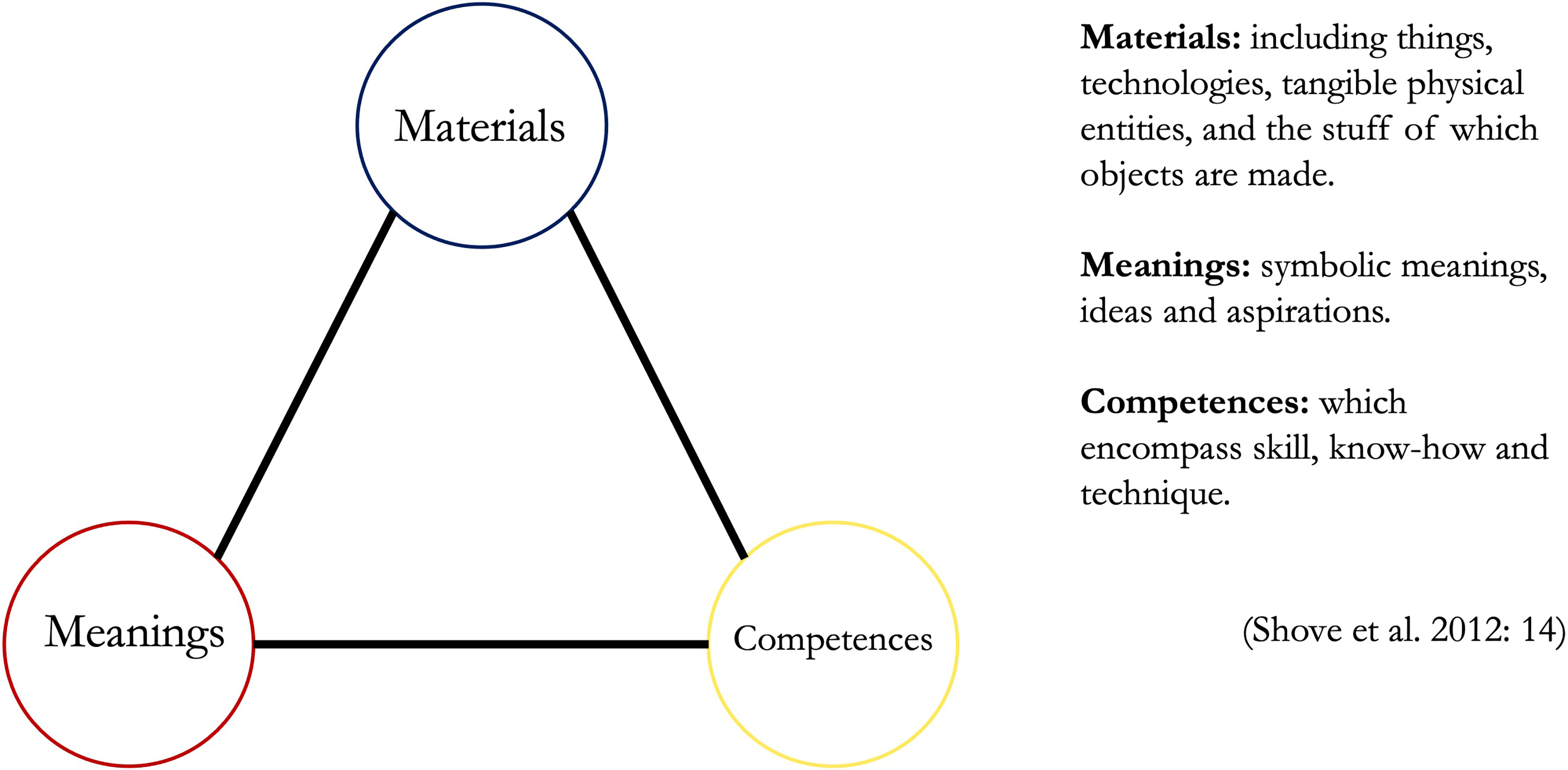
Constituencies of social practice (adapted from Shove et al., 2012, pp. 14, 25).
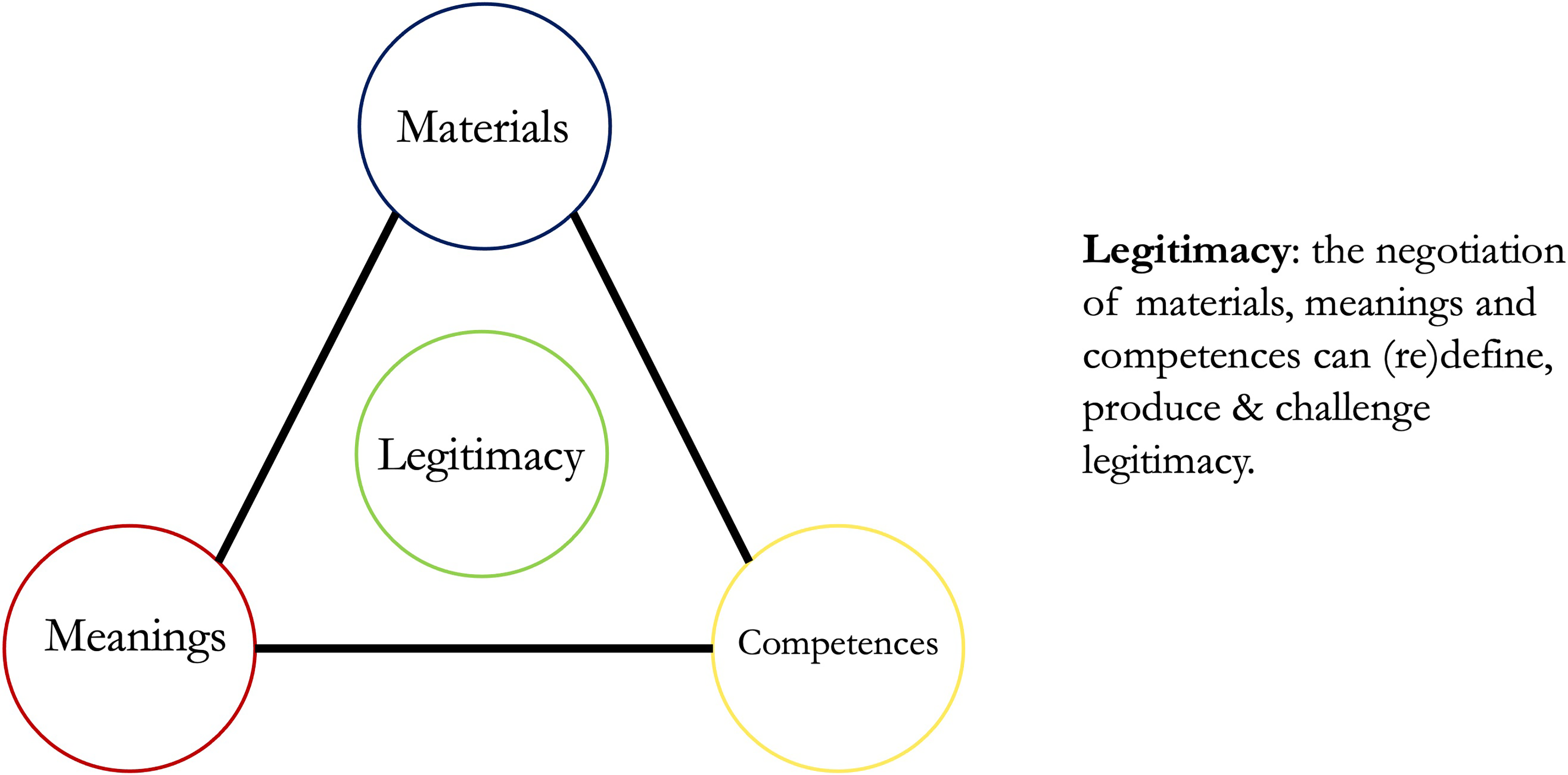
Social practices of producing legitimacy (adapted from Shove et al., 2012, pp. 14, 25).
Social practices of forensic DNA phenotyping (non-exhaustive list).
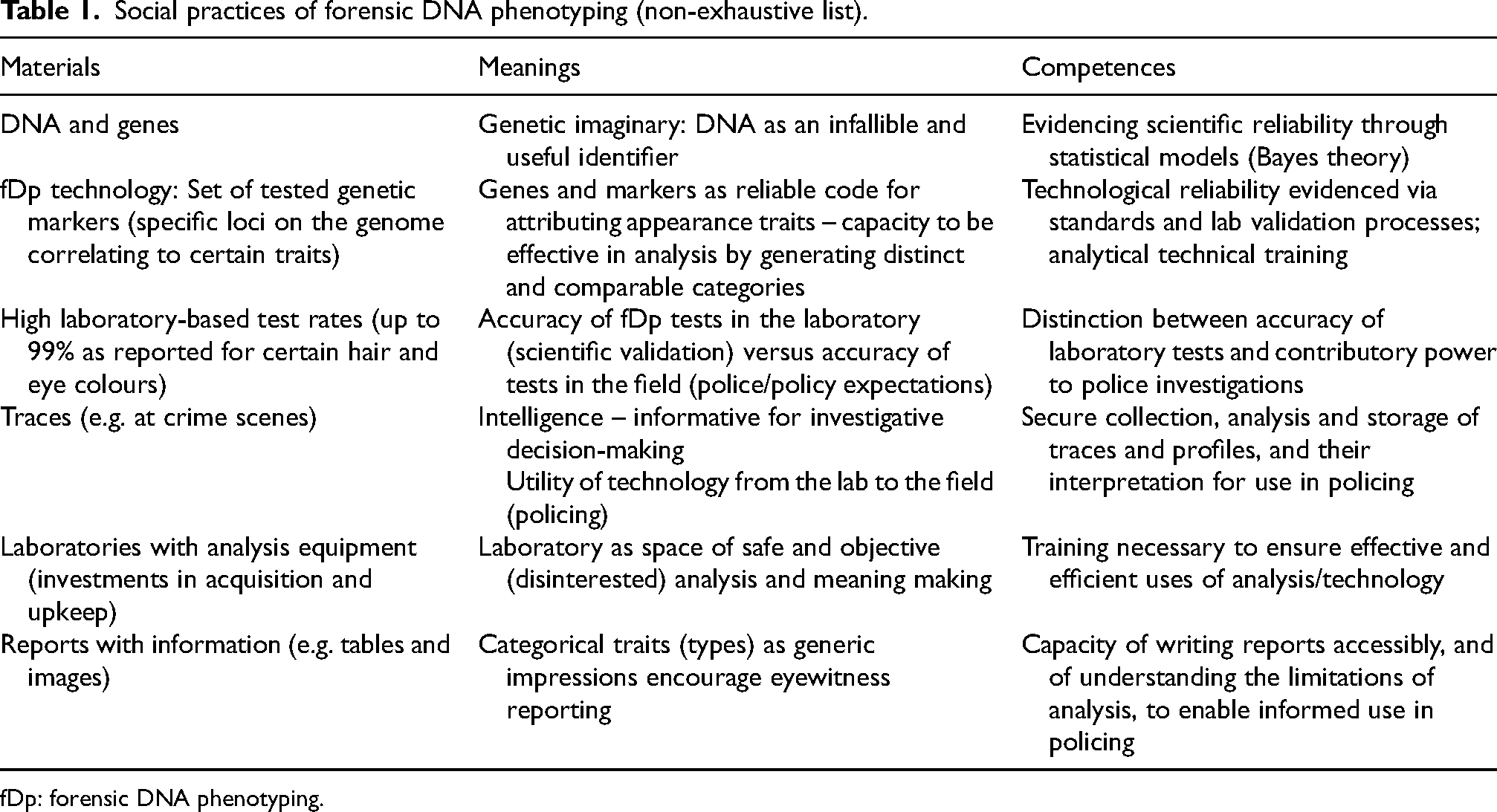
fDp: forensic DNA phenotyping.
Eurodac/shared biometric matching system
Eurodac draws from and enmeshes materials, competences and meanings of: (a) the biometric technology of dactyloscopy, i.e. the science of fingerprint identification; (b) digital technologies of databasing; but also more widely (c) IT systems and their security, migration and border management at national and EU level. All three are entangled with institutional and societal norms, values and practices. The evolution of Eurodac over time and its envisioned connection to the shared Biometric Matching System (sBMS), furthermore, add (d) the biometric technology of facial comparison and recognition, i.e. the identification via facial images.
Fingerprinting identification technologies have a long history and emerged in the context of their use in colonial India. William James Herschel was among the first Europeans who – in his work as a magistrate in colonial India in the 1850s and 1860s – required residents’ fingerprints when signing business documents. From its early emergence fingerprinting has been used in power hierarchical settings, in forms of stigmatising and othering certain population groups using the technology to make them eligible for business. First used for identification in the context of business transactions, then established for criminal identification, fingerprinting technologies moved into the migration context. They were established as reliable tools and nowadays tend to remain rather uncontested. Glouftsios and Casaglia (2022), referring to Simone Browne (2010) and her elaboration of Frantz Fanon's theory of ‘epidermalization’, speak of ‘epidermal politics’ to emphasise the violent and racialising effects of migration control regimes in the EU. The way migration control is embedded in biometric technologies together with data infrastructures, they ‘stigmatise’ and ‘other’ migrants with codes to enable their control. Fingerprint identification technologies render the body knowable (van der Ploeg, 1999). The body’s surfaces and characteristics are translated into digital codes to be ‘read’ by a machine, generating a readable body. This body, then, is the source to create a biometric identity through the creation of ‘data doubles’ (Lyon, 2007), which enable tracing a body and its mobility across time and space (Scheel, 2013). Contextualising these developments in postcolonial histories of EU Member States throws problematic shadows on the foundations of migration control regimes and the technologies they have once more normalised.
Fingerprinting together with storing and exchanging digitised fingerprint data of ‘asylum seekers’ and ‘irregular migrants’ is used to compare new entries (e.g. new applications) with existing database records. This function is deployed to assess a migrant's status to provide biometric evidence to assess asylum claims, and thus also to identify the EU Member State responsible for processing. Simultaneously, it provides the basis for rejecting claims and serves as evidence to justify deportation. Since Eurodac's establishment, various incremental changes have occurred concerning its relevant forensic and IT technologies. The Eurodac Recast Regulation 2016 (European Commission, 2016) has paved the way for the integration of additional biometric modalities. Eurodac has since moved towards combining dactyloscopic expertise with the forensic competences of facial comparison and recognition. The Regulation builds on the assumption that a more diverse yet integrated biometric identification system generates a more effective and efficient social sorting process of separating ‘legitimate’ asylum seekers from so-called ‘irregular migrants found illegally staying in the EU’ [European Union Agency for the Operational Management of Large-Scale IT Systems in the Area of Freedom, Security and Justice, consequently enabling more efficient deportations. Going beyond its asylum focus, the Regulation also authorises and defines conditions of access for law enforcement authorities to Eurodac, to investigate serious crimes and acts of terrorism. By technically and organisationally linking asylum and criminal suspicion of population groups already seen as problematic (e.g. via notions of ‘illegal’ migration), the ‘risky’ migrant is translated into a ‘threat’ to the ‘home populations’.
Aiming more technology at problems with the use of existing technology, in 2020, eu-LISA signed a framework contract for a new biometric matching system that aims to create a database of fingerprints and facial images of more than 400 million ‘third-country’ nationals by 2024 (EURACTIV, 2020). This emerging sBMS is meant to address ‘illegal migration’ and cross-border crime across the 26 European countries in the passport-free Schengen area. It is set to become one of the largest biometric systems globally. The sBMS represents efforts to integrate different biometric technologies and databases including Eurodac, the Visa Information System and the Schengen Information System. Because the centralised database architecture of Eurodac had already been set up by eu-LISA, the further necessary ‘formatting’ (Bellanova and Glouftsios, 2022: 456) towards sBMS – for example adding different types of biometric data, widening access for law enforcement, and enabling interoperability of databases for cross-validating identity records – becomes a matter of ‘management, re-organisation and re-purposing of datasets’ (Bellanova and Glouftsios, 2022: 454). The vision of a ‘digital transformation’, to enable greater data collection and uses, drives infrastructural experimentation (Trauttmansdorff and Felt, 2021: 644–647), moving identity management into a new digital space (Leese, 2022) that is hoped to be more reliable in the social sorting of asylum seekers. The digital ‘interoperability’ programme, Trauttmansdorff (2022) argues, is the latest attempt to manage risk and uncertainty arising from mobile identities by capturing and rendering them immutable. Terrorist attacks such as the case of Anis Amri are drawn on to foster the imaginary of the risky migrant posing likely threats of criminality. Promissory expectations of biometric technologies imagine a digital future of reliable, effective and – because it protects European citizens – morally sound policing of crime and migration. Existing safeguards for ‘data protection’ and ‘right to privacy’ are two concepts that limit the view on privacy without having the person in mind because a right to privacy includes consideration of the effects of a sociotechnical innovation (technology and its use and governance) on the life of an individual (Vavoula, 2022).
Table 2 provides a non-exhaustive list of Eurodac/sBMS-relevant materials, meanings and competences, vitally those circulating around aspects of the scientific reliability of the technology, its usefulness to policing, and its commensurability with liberal–democratic societies’ notions of equality and justice. As with Table 1, each row shows examples of linked materials, meanings and competencies. For example, biometric data sources such as fingerprints and facial images are collected, stored and analysed based on a series of standardised markers. They are imbued with a biometric imaginary: that such markers can help identify a specific person reliably and usefully, across time, space and context. Linked competencies focus on the ability to generate high-quality data that ensure reliability.
Social practices of Eurodac/shared Biometric Matching System (non-exhaustive list).
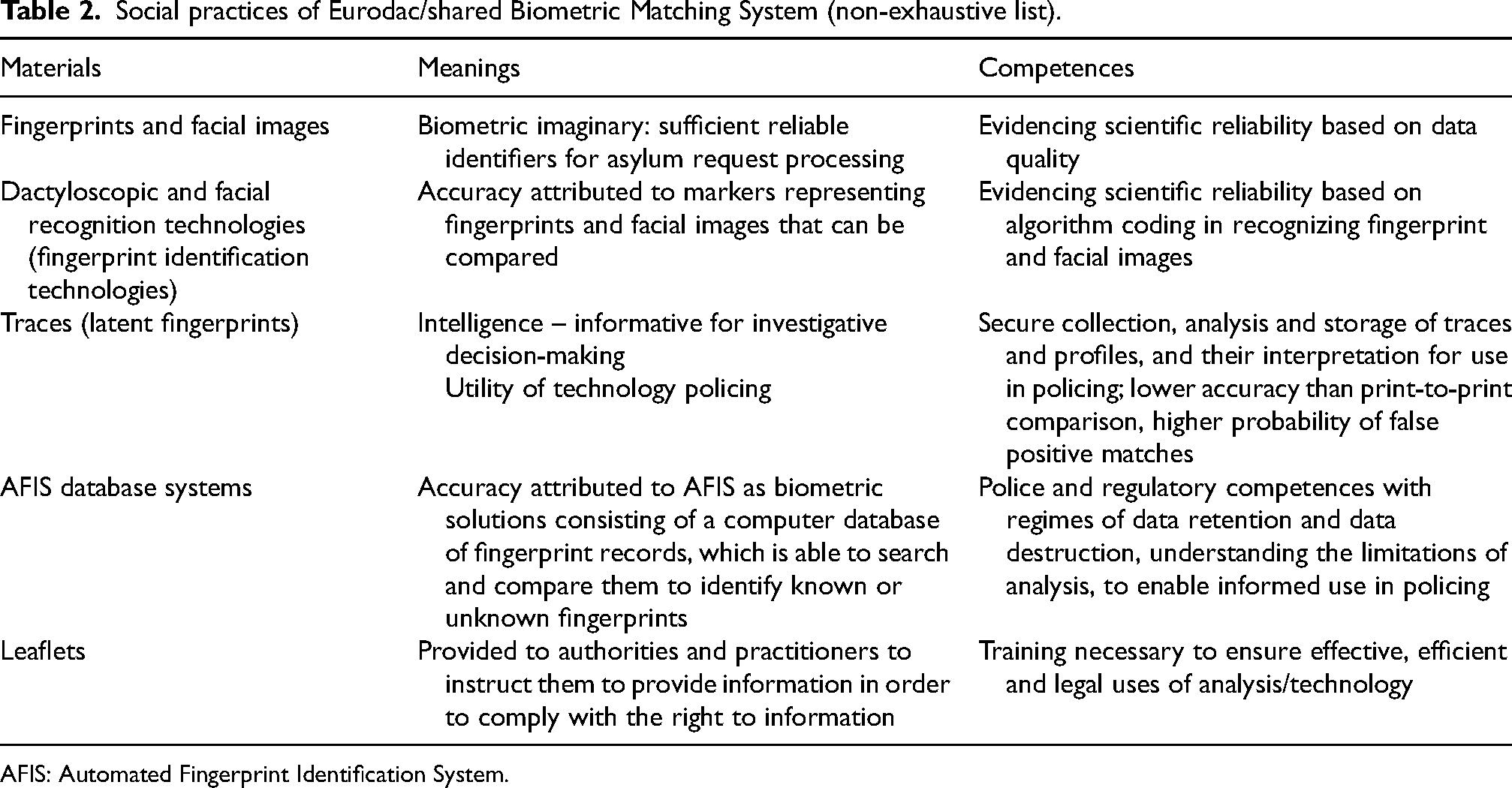
AFIS: Automated Fingerprint Identification System.
Biometric control: enacting the ‘crimmigrant other’
Crime cases, publicised and dramatised via media reporting, are often drawn on to negotiate the legitimacy of technologies for law enforcement purposes. They build on and help entrench moral panics, which impact as a form of moral obligation for societal acceptance of technology (Critcher, 2009). In this section, we demonstrate how technologies are, first, posited and, then, established as legitimate tools to (at least discursively) manage specific threats to established moral orders, in the process mobilising the ‘crimmigrant other’ as the cause of a ‘crisis’ of crime through migration.
A young German student, Maria Ladenburger, was raped and murdered in the city of Freiburg in the German state of Baden-Württemberg on 16 October 2016. After an intense period of police investigation and public speculation, Hussein Khavari was identified as the main suspect in this case, and later convicted of the sexual killing. This crime investigation turned out to become a showcase for the consideration of advancing with different biometric technologies and infrastructures at the intersection of law enforcement and migration management. It triggered the debate on legislating for the use of fDp in Germany – and later in Switzerland, Luxembourg and other European jurisdictions – as a forensic tool in law enforcement. Specifically, the Freiburg murder case received overwhelming media interest in the context of debating emerging forensic technologies aiming to use genetic markers to infer from a trace the externally visible characteristics and biogeographic ancestry of the donor (V Lipphardt, 2018). The case found such strong public resonance because a young female student, who volunteered for a refugee charity (thus, participating in the ‘welcome culture’ of German attitudes towards migration), was murdered in what many had considered to be a safe city. Local and regional police were under pressure to identify a perpetrator and prevent further killings, especially once a similar murder – that of Carolin Gruber – occurred just north of Freiburg on 10 November (initially attributed to Khavari, but later confessed to by Romanian lorry driver Catalin C.).
Freiburg is well known as a diverse city with many international visitors to the university and the region, which boasts sites of natural beauty such as the Black Forest and the Rhine valley. It lies close to the borders with France and Switzerland, and as such is part of a region that is subject to significant cross-border traffic. These aspects may seem irrelevant at first, but they do help to explain why some proponents of fDp from policy and policing (but not science) thought that the murder case in Freiburg would be an ideal candidate for using the technology: a ready flow of migration. An asylum seeker from Afghanistan turned out to be the perpetrator whose outward appearance was different from that of the German majority population, seemingly supporting the usefulness for fDp. Although many politicians and policymakers argued against blaming migration for such criminality, some quickly linked crime and migration and received significant media coverage: the chairman of the Deutsche Polizeigewerkschaft (German Police Union) Rainer Wendt said ‘this and many more victims would not be if our country had been prepared for the dangers always connected to mass immigration’ (translation by the authors, Bild Online, 4 December 2016). The same article claimed that the murder would not have taken place if the migrant had been denied entry to Germany, connecting migration and criminality. Unsurprisingly, the head of the far right political party Alternative für Deutschland (AfD) Jörg Meuthen concurred, reminding of the party's ‘warning of uncontrolled immigration of hundreds of thousands of young men from patriarchal Islamic cultures’ (translation by the authors, Die Welt, 5 December 2016). The Ladenburger case arguably enabled re-starting the German public debate on genetic technologies of attribution of externally visible characteristics and biogeographic ancestry which had laid dormant since investigative misinterpretations of related biogeographic ancestry testing during the hunt for the Phantom of Heilbronn between 2007 and 2009 (A Lipphardt, 2020).
Media attention in the Ladenburger case, and shortly after also the Gruber case, stretched over many weeks and predominantly represented views of an unsafe society subject to increased crime from higher than usual numbers of immigration, while law enforcement was prevented from using the latest forensic technologies (Weitz and Buchanan, 2017). Moralistic tones were struck by political, policing and scientific proponents that disallowing the unrestricted use of new biometric technologies in policing, in this case specifically fDp, would protect murderers and harm innocent families. The public debate, supported by citations of curiously high numbers of probabilities from laboratory-based scientific testing of these new technologies (up to 99.9%, confusing the ‘ideal’ case with feasibility in investigations, see Buchanan et al., 2018; Caliebe et al., 2018), fuelled overly optimistic public expectations around forensic genetic phenotyping – drawing on tropes of genetic exceptionalism and essentialism – suggesting that fDp provided an easily available solution to enhance public security (Weitz and Buchanan, 2017). Public debate was also informed by a discursive claim linking increased migration and (the often erroneous and un-evidenced perception of increased) crime rates (Feltes et al., 2018) where supporting the use of fDp morphed into a moral obligation to protect potential home population victims. The notion of a higher risk for migrants to be involved in criminal activity, especially serious violent crimes, is seemingly supported by some studies (Adamson, 2020 for migrants in Sweden), but countered by analyses that tend not to support the link (Bell and Machin, 2013 for the UK, Kayaoglu, 2022 for Syrian refugees in Turkey). Nonetheless, by 2019, the German Code on Criminal Procedure was amended to enable the use of fDp (StPO § 81e) (excluding biogeographic ancestry testing so far).
The public discourse centring on this crime and its migration link also contributed to ongoing discussions among European governments about improving and expanding collaborative biometric data infrastructures used for migration management, specifically to couple migration databases more closely to law enforcement purposes. The overarching aim of such negotiations has been to enable the swifter and surer identification of threats from ‘criminal migrants’. The link to eu-LISA, in particular to Eurodac, was made in the above-discussed 2016 Ladenburger case because the perpetrator's fingerprints were not only found in Freiburg, but also on record for an earlier conviction in Greece. Registered in Eurodac, and known to law enforcement authorities in Greece, the offender had seemingly evaded this control network. Eurodac enables cross-border checking of identification information, storing fingerprints and records of asylum seekers, with plans in place also to store facial images and enable facial recognition (European Commission, 2016). Initially developed for the purpose of managing asylum requests across Europe, and to assign responsibility for processing these to Member States, Eurodac has also been accessible to law enforcement authorities since 2013 (European Parliament and Council, 2013). The Ladenburger case caused significant controversy about the operational utility and effectiveness of the European migration control database system and its role in law enforcement (Statewatch, 2021).
In December 2016, Anis Amri killed 12 people by driving a lorry through a crowd of Christmas market revellers in Berlin. He was able to escape and was shot dead four days later by Italian police. This attack, especially so soon after the widely reported Ladenburger case, engendered further public debate of a crisis (out) of control, apparently fuelled by failures of international police collaboration. Critique focused on the lack of effective cross-border exploitation of existing digital identification databases accessible to migration and law enforcement authorities as part of assessing and mitigating the threat the offender posed (Deutscher Bundestag, 2021). A parliamentary enquiry was set up to investigate shortcomings in collaborations between law enforcement and security services (Deutscher Bundestag, 2021). The public debate around the attack and its investigation also contributed to building the case for legitimising expanding and intensifying transnational biometric data exchange mechanisms.
During the tenth anniversary celebration of the eu-LISA agency in October 2022, Lorenzo Rinaldi, Chair of the Eurodac Advisory Group, emphasised the relevance of this interoperability initiative and the integration of different biometric technologies: … the interoperability architecture will be extremely helpful in dealing with new potential crises because it addresses many of the issues that we encountered in the past where the existing systems were not conceived to deal with migration crises. (Rinaldi, 2022)
He continued to review the ‘migration crisis’ from 2015 ‘from a law enforcement point of view’ and pointed to the need to ‘detect … possible dangerous persons’: With the interoperability framework competent authorities will quickly collect and aggregate data from different systems. This will foster the evaluation of the status of the migrant, will help to assess their dangerousness, preventing cases such as the one of Anis Amri, and will avoid making different and multiple queries to different systems. Potentially in my opinion, switching from days and weeks to hours and minutes. […] In this scenario, the real game changer will be the great use of biometrics, as not only fingerprints, but also facial images, as biometrics, in my opinion, is the only key to perform an efficient identity management. (Rinaldi, 2022)
The public debates and proposed policy solutions following the Ladenburger murder and Amri's terrorist attack are emblematic of the circulation of biometric technologies (here, appearance and fingerprints) across the two domains of migration and crime control, configuring migrants as at particular risk of criminal activity into the ‘crimmigrant other’. They represent two key cases of how biometric control is enacted (in social practices). Wendt's and Meuthen's statements circulate crime into migration. Rinaldi's speech evidences the circulation of meanings attributed to technologies and the ‘risky’ migrant through a coupled articulation of: (a) a law enforcement perspective on migration management; (b) high expectations vis-à-vis the identifying power of biometric technologies; and (c) rare but high-profile cases. Automated facial recognition, the use of fingerprint data and advanced forensic DNA analyses are becoming dominant technological surveillance means for increasingly linked efforts to control migration and crime. Yet, they are distinct in the way of how they configure the migrant as a criminal (see next section).
Both technologies have entered the political lexicon and the public debate because they link crime and migration. This has occurred in part on the basis of panic caused by gruesome killings, where technology is described as a means to re-establish control; for example, by deploying biometric identification. Affective relationships are produced via mediatised, high-profile crime cases that produce empathy with victims as well as moral outrage about the ‘crimmigrant other’. Although support for victims and families is rightly to be welcomed, the accompanying generalisation and association of asylum and refuge seekers with criminal motives places biometric technologies into a highly unethical context. And yet, these debates help legitimise considering legislation for and the deployment of new technologies (such as fDp), or of expanding existing technologies (such as expanding the use of Eurodac and the linking of diverse existing databases via the sBMS).
This has led to the making of a ‘moral crisis’ not only in individual Member States, but also in the EU. Moral panics become political instruments that allow generalisation from single situations and individuals to wider populations and an entire sociopolitical domain; for example, associating all asylum and refuge seekers with individual perpetrators and as such producing an understanding of certain types of migration as threats to society (Mawby and Gisby, 2009). Meanwhile, both technologies get established as technological fixes, promised to be ‘real game changer’ solutions to typified problem situations. fDp explicitly addresses the lack of available data and offers a situation-dependent alternative to databasing based on technological reliability and the scientific soundness of its principles. Eurodac, and its integration into the sBMS, stresses the power of accessibility and shareability across repositories of digital biometric data, drawing from notions of effectiveness and efficiency presumably inherent to digital transformation and interoperability. The threat of the ‘crimmigrant other’ serves as the proportionate and legitimising reason to establish, circulate and manifest technologies across policy areas of migration and crime control. What we can identify here is a moral economy of a postulated crisis of control that normalises the othering of asylum and refuge seekers in terms of criminality, and legitimises the introduction and entrenchment of biometric technologies.
Legitimacy in circulation of drift and creep
While, arguably, a vanishingly small percentage of all migrants are involved in criminal acts defined by criminal law (serious crime and terrorism), there are now relatively large numbers of those who migrate via ‘irregular’ or ‘unofficial’ routes. Over the past three decades these routes have been made ‘illegal’. This process of criminalisation consists of increasing efforts to make unfeasible or close down official routes. Certain forms of migration, for example for work, holidays or study, by bona fide travellers, are considered legal and there are schemes in place even to enable easier crossing of borders (e.g. trusted traveller schemes, visa agreements, open borders). However, cross-border journeys for reasons of asylum and refuge are increasingly associated with cross-border crime owing to (a) above-mentioned criminalisation of irregular forms of migration (e.g. asylum fraud); and (b) association of these groups of migrants as ‘risky’ because they are assumed to be more likely to commit serious crimes and terrorism. Indeed, standardisation of the link between the latter forms of migration and criminal law is established discursively and in practice (Aas, 2011; Amelung, 2021, forthcoming; Franko, 2020). High-profile criminal investigations are drawn on to support such developments, as we have shown so far: production of the ‘crimmigrant other’ in high-profile crime cases contributes to the mobilisation of biometric technologies as opportunities of re-establishing control in situations of moral crisis that require urgent solution expressed in social practice. In this section, we attend to the production of legitimacy in/via the circulation of biometric technologies and expertise between the policing of crime and of migration. Two different versions of the ‘crimmigrant other’ get enacted here:
Drift. fDp is deployed to enable prioritising subsequent investigative steps by identifying phenotypical categories of criminal suspects; identification focuses on groups that share certain traits. Difference of migrants in culturally associated appearance from ‘home populations’ marks part of the ‘othering’ of migrant groups – specifically asylum and refuge seekers – even more effectively, and the use of fDp in association with criminal suspects among these groups seems to make use of ‘racialised collectives’ (Wade, 2020). Here, the ‘crimmigrant other’, as a generalised suspect serving as justification for the demand for technology, drifts from migration control into crime control, manifesting appearance-related otherness as criminal suspicion against migrants. Drift is a type of circulation of meaning, it refers to conceptual change. The inbuilt capacity of fDp to discriminate between different types of eye, hair, skin pigmentation, other appearance traits and even biogeographic ancestry, as a tool for criminal investigations becomes normalised more broadly in society and establishes the link of appearance-based sorting and criminal stigmatisation of migrants. Creep. The use of biometric materials creeps functionally from an investigative context of crime into the administration of migration. Once established there, the use of fingerprints and facial images in Eurodac, and the emerging sBMS as biometric databases infrastructure, follows the objective to identify the individual criminal suspect among generalised suspicion towards asylum and refuge seekers. The ‘crimmigrant other’ is co-constructed in layers and incrementally via a further level of function creep, starting as a means to organise asylum claims and responsibility across Member States, expanding then to addressing suspicions about asylum fraud and illegal migration, to, finally, encompassing the expected capacity to address suspicion of serious crime and terrorism. The function of digital data is to creep (Andrejevic and Gates, 2014) into ‘uncertain futures’ (Amoore, 2011: 24): that is, they are collected just in case, for data mining, accumulating data to have it at hand should it be needed (Morozov, 2013), but also to be able to discern [otherwise invisible] patterns and/or make correlations that are not intuitive. ‘Function creep’ is formatted into databases and their systemic integration via the sBMS to move beyond ‘data silos’ and to render data widely accessible for diverse actors and purposes. This circulates material – in this case identification data, inscribed with assumptions about validating identity and (reproducing) suspicion regarding asylum fraud and illegal migration – from migration management into the criminal justice system where it is used to detect and prosecute individuals.
Different forms of de facto standard-setting support the legitimising process of circulation. These standards are usually set by developers and users of technologies, and to some degree (at regulatory and legislative levels) by policymakers who are subject to public and political demands. De facto standards operate as a form of promissory normalisation, securing the entanglements of materials, meanings and competences of technology deployments. We provide some examples in Table 3, which should be read in conjunction with Tables 1 and 2.
De facto standards: normalising circulations (examples).
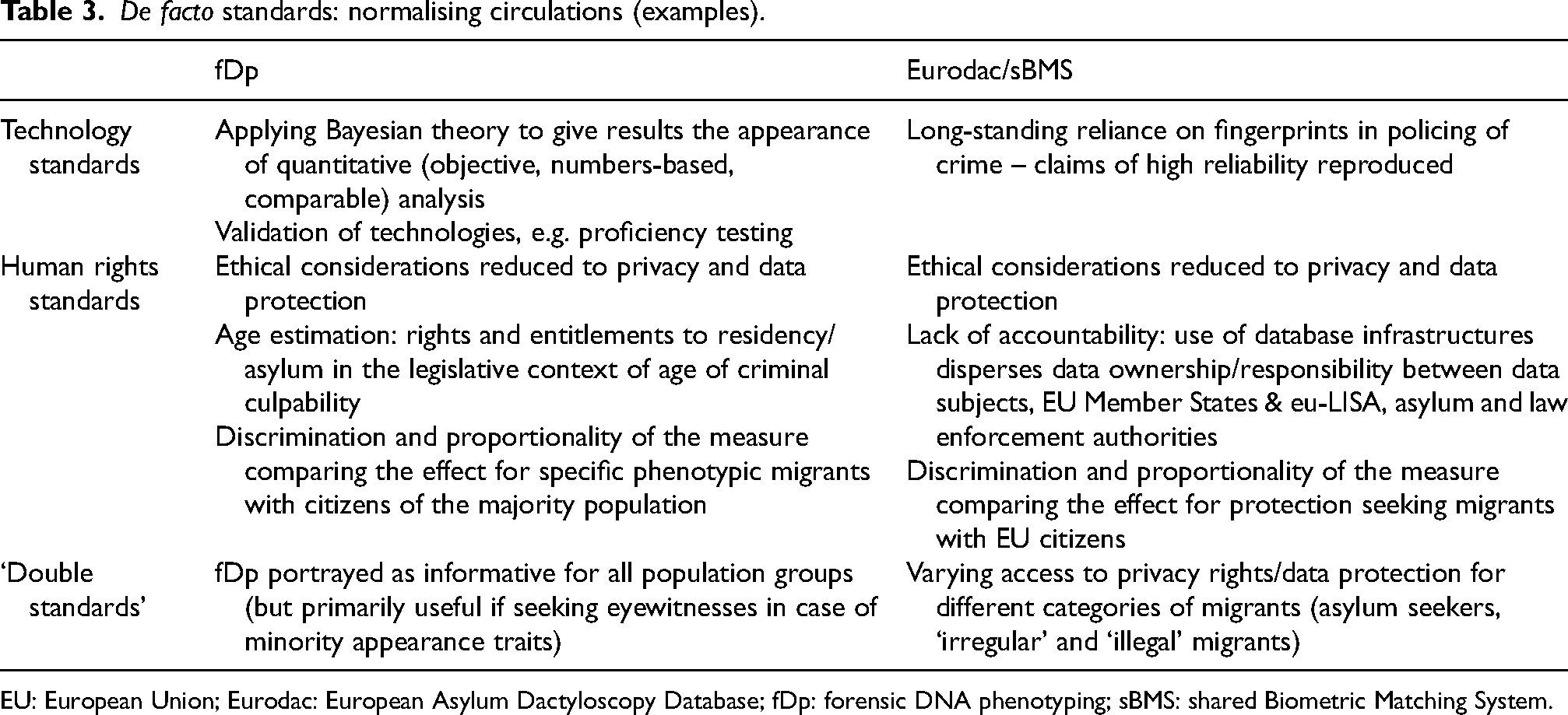
EU: European Union; Eurodac: European Asylum Dactyloscopy Database; fDp: forensic DNA phenotyping; sBMS: shared Biometric Matching System.
The issue with many of these standards is their affirmative nature: rather than providing objectively reliable standards, they draw from wider authoritative accounts that are then represented as sufficient to ensure safe and secure use of biometric technologies in the merged context of crime and migration. Indeed, certain shifts of meaning occur that undermine any standard-setting in practice; for example, arguing for the potential of technologies to exonerate minority groups from criminal suspicion not only constructs suspicion against migrants such as asylum and refuge seekers – that there is a justified need to invest materially and discursively into new technologies or the expansion of existing systems to increase capacities – but also suggests that having this technology is of value in the context of the identification of criminal migrants. We refer to technology standards, but also impacts and risks for human rights standards as well as ‘double standards’, to show that moral dilemmas are entangled with these technologies, rendering their promissory ethical regimes less stable.
Concluding remarks and lessons learnt
In this article, we have drawn on two high-profile criminal cases to discuss the negotiation of sociotechnical innovations – our examples being fDp and Eurodac/sBMS – in policing of crime and migration. We have discussed the social practices of building legitimacy for biometric technologies via the production of two types of ‘crimmigrant other’. A crucial element here is the framing of the problem that constitutes the demand for tech-solutionist responses. The ‘othering’ is enacted in public discourse on specific instances of overlaps between migration and criminality, drawing from cultural bias and racialised suspicion to generate a perception of threat to the security of publics-in-general, producing an antagonistic personal relationship between to-be-protected home populations and risky migrants. Both biometric technologies are presented as means to cope with this threat arising from the ‘crimmigrant other’, focusing on law enforcement competences and policing of migrants specifically. The availability of tools equalling a diminishing of threats represents a future-oriented promise and, combined with standard-setting, helps produce a promissory ethical regime based on notions of reliable and effective biometric technological interventions and the moral need to respond to and prevent threats to society. At the same time, two forensic technologies (fDp and fingerprinting) are reproduced as means of surveillance via their circulation between policing of crime and of migration: they drift conceptually, linking appearance-related otherness to criminal suspicion against migrants, and they creep functionally (a) from useful intelligence in criminal investigations to organisational means in the administrative ‘knowing’ of asylum claims; and (b) from asylum claims and responsibility across Member States, via suspicions about asylum fraud and illegal migration, to, suspicions of serious crime and terrorism.
Some of the lessons learnt for policing technologies include:
Meanings attributed to biometric technologies differ substantially depending on the relationship different actors such as technology designers, policymakers, police forces and affected people have with them. Therefore, a deeper understanding of the contexts and social practices (materials, meanings, competences) of technology development and use is fundamental to understanding their moral economies. These are vital to consider legitimacy for the ethical governance of technology adoption into policing practice. Understanding materials, meanings and competences of emerging biometric technologies is vital to understanding their capacities and limitations (‘ideal case’ in the laboratory versus policing practice). fDp and facial recognition technologies remain at early stages of capacity testing, use in policing and the negotiation of their legitimacy. Early investment may seem prudent but can lead to significant policing failures and miscarriages of justice. Their potential use should be considered carefully, especially if their deployment is based both on a few high-profile cases and on generalised suspicion against very specific groups (e.g. asylum and refuge seekers). In terms of regulatory lessons, it is important to reconsider appropriate safeguards to minimise technology risks. The installation of safeguards for data protection as privacy (Vavoula, 2022; chapter 4.4) derives from an arguably narrow understanding of privacy (see, for example, Williams and Wienroth, 2017, especially p. 155). In addition, once installed, safeguards are subject to a threat of undermining over time. Existing safeguards for fDp and Eurodac/sBMS build on a minimal account of providing safeguards to the subjects exposed to identification and surveillance technologies and databases, in particular in terms of possibilities to get transparency about the risks and to appeal to those technologies. They thereby build on a promissory (ethical) regime which is driven by rationalities serving law enforcement ‘needs’ to have maximum access to data (already made available for other purposes) in the name of the public good of security and justified by generalising the criminal suspicion against migrants as ‘crimmigrants’. A particular challenge derives from the circulation of biometric technologies from crime to migration control. Although technologies are relatively easily moved to a new application context – including assumptions about their reliability and utility – we would like to draw the attention of regulators and practitioners to limitations here, specifically to their application on individual subjects with vulnerabilities in particular need of protection. Refuge and asylum seekers, as persons already marginalised in terms of their access to social, economic and cultural rights, remain silenced regarding their experiences of biometric technologies. Furthermore, they are excluded from most citizenship rights (e.g. the rights of a suspect in the criminal justice context of using biometric data) and have scant access to legal and political resources to claim rights as data subjects. Therefore, we call for a more comprehensive understanding of the complexities of the circulations we have described. Biometric data and technologies must be subject to greater ethical governance and accountability than currently exercised. This recognition is particularly vital in the context of continued contestations around the utility, reliability, and effectiveness of biometric tools for law enforcement purposes. As such, contestation of their application per se can be seen as justified.
Navigating towards ambitious ethical codes of conduct in development, regulation, and use of biometric technologies preventing harm deriving from generalised suspicion against migrants is crucial because nothing less than the (il)legitimacy of migration control systems and (il)legitimacy of policing migration is at risk.
Footnotes
Declaration of conflicting interests
The author(s) declared no potential conflicts of interest with respect to the research, authorship, and/or publication of this article.
Funding
The author(s) disclosed receipt of the following financial support for the research, authorship, and/or publication of this article: This work was supported by the Fundação para a Ciência e a Tecnologia, (grant number FCT CEECIND/03611/2018/CP1541/CT0009).
