




Abstract
This work examines low-frequency ion-acoustic solitary structures in a weakly rotating, magnetized, collisional electron-positron-ion plasma. In this model, the electrons and positrons obey a q-nonextensive distribution, while ions are treated as a warm fluid subject to ion-neutral collisions and an externally applied periodic force. By employing the reductive perturbation technique, the governing fluid and Poisson equations are reduced to a forced damped Zakharov-Kuznetsov (FDZK) equation that consistently incorporates four key physical ingredients in a unified framework: nonextensive statistics, collisional dissipation, Coriolis effects due to plasma rotation, and external energy injection through a periodic source term. In the collisionless, force-free limit, an exact compressive solitary wave solution of the underlying Zakharov–Kuznetsov equation is obtained, and the corresponding pseudo-potential analysis clarifies the constraints on the existence region of ion-acoustic solitary waves and their polarity. For weak damping and finite periodic forcing, approximate time-dependent solitary solutions of the FDZK equation are constructed using energy-type conservation arguments, allowing the combined impact of dissipation and external driving on the soliton profile (amplitude, width, and speed) to be quantified. The impact of various related parameters on the dissipative soliton profiles is numerically investigated. These findings offer a physically transparent picture of how nonthermal statistics, rotation, and external excitations jointly shape nonlinear ion-acoustic dynamics in realistic space and laboratory plasmas, such as planetary and pulsar magnetospheres, the solar wind, and magnetized laboratory devices.
Keywords
1. Introduction
Research conducted in both space and laboratory environments has demonstrated that plasmas can generate a diverse range of nonlinear structures, shaped by the system’s specific conditions and configurations, with commonly observed perturbations including ion-acoustic waves (IAWs), dust acoustic waves, dust-ion acoustic waves, and electron acoustic waves. The behavior of IAWs, a fundamental plasma wave phenomenon, has been extensively studied for decades through both theoretical and experimental approaches, beginning with the theoretical prediction of ion-acoustic solitary waves (IASWs) by Washimi and Taniuti, 1 who modeled plasmas with cold ions and isothermal electrons, followed by the first experimental observation of these solitons by Ikezi et al. 2 Subsequent refinements to the theory were made to address discrepancies between experimental and theoretical results, incorporating factors such as finite ion temperature,3,4 trapped electron populations,5,6 and higher-order nonlinear effects. Solitary waves (SWs) are nonlinear, localized structures that arise from a balance between nonlinearity and dispersion, remaining a focal point of research due to their significant practical applications.7–9 IASWs, in particular, have been extensively investigated in plasma physics and complex plasmas,10–14 with both theoretical and experimental studies exploring their formation across diverse physical conditions. These waves have been examined in contexts ranging from laboratory15,16 to space plasmas,17–19 with various studies20–22 modeling them under different assumptions such as cold ions paired with non-adiabatic electrons described by vortex-like, 20 nonthermal (Cairns distribution), 22 bi-Maxwellian, 21 or nonextensive distributions23,24 to understand their properties and behavior better.
In recent years, significant interest has grown in nonextensive statistical mechanics, which generalizes traditional thermodynamics by accounting for deviations from the Boltzmann-Gibbs-Shannon entropy framework. This nonextensive extension, first introduced by Rényi 25 and later formalized by Tsallis, 26 provides a more versatile approach to describing statistical equilibrium in complex systems by incorporating an entropic index q. This parameter quantifies the level of nonextensivity where q = 1 recovers the classical Boltzmann-Gibbs extensive statistics, while values diverging from unity capture non-additive behaviors observed in models with memory effects, long-range interactions, or fractal structures. This formalism has proven particularly valuable in plasma physics, astrophysics, and other domains where traditional statistical mechanics fails to describe observed non-equilibrium phenomena. Tsallis’ non-additive entropy and its generalized statistics have proven effective in modeling nonextensive phenomena,27–32 offering an alternative to the Maxwellian distribution of Boltzmann-Gibbs statistics, which, while universally valid for macroscopic ergodic equilibrium systems, often fails to describe long-range interacting systems like plasmas and gravitational systems in non-equilibrium states. The entropic index q with q < 1 corresponds to super-extensive systems33,34 and q > 1 to sub-extensive systems. 35 Recent work by Verheest 36 further refines this framework, proposing that only the ranges 1/3 < q < 1 (super-extensive) and q > 1 (sub-extensive) can adequately explain nonextensive effects on nonlinear structures, providing critical constraints for applying Tsallis statistics to complex physical systems.
The swirling motions of magnetized conducting media like plasmas occur in geophysical systems, laboratory experiments, and cosmic environments, enabling studies of linear wave propagation that highlight the Coriolis force’s role37,38 in ionospheric dynamics, a phenomenon crucial for astrophysical processes such as sunspot formation, stellar evolution, and magnetized celestial body dynamics. When stars collapse into neutron stars, their dramatically reduced moment of inertia results in extreme rotational acceleration due to the conservation of angular momentum. Meanwhile, the stability of both linear and nonlinear plasma waves is heavily influenced by strong magnetic fields in astrophysical and geophysical contexts. This plasma rotation, driven by magnetic fields, significantly impacts phenomena in space plasmas and laboratory devices, 39 demonstrating its broad relevance across scales from experimental setups to cosmic structures.
The complex nonlinear dynamics of plasma particles necessitate specialized analytical approaches, such as perturbation techniques, with the reductive perturbation technique (RPT)1,40 being particularly effective for deriving the governing equations of nonlinear solitary waves, as evidenced by extensive research. This methodology builds upon foundational models such as the Korteweg-de Vries (KdV) equation, 41 the first theoretical framework for SWs, which was later extended to three dimensions by the Zakharov-Kuznetsov (ZK) equation. 42 Studies show that collisional interactions between plasma components dramatically modify solitary wave and shock wave dynamics.43–45 These waves may gradually dissipate due to the presence of dissipation in the plasma medium. Seminal numerical explorations of damped solitary wave dynamics in magnetized plasmas were conducted by Krapak and Morfill, 46 who examined energy dissipation mechanisms. Beyond interspecies collisions, the ion-acoustic solitary waves can dissipate if the ions become significantly hotter than the electrons, highlighting the influence of ion temperature.47,48 Since most practical systems are out of equilibrium, nearly all waves experience some degree of energy loss.
The influence of external periodic excitations on observable physical phenomena varies significantly across different contexts. Recent years have seen a growing interest in analyzing nonlinear solitary waves under such perturbations, although few studies have incorporated both damping and forcing parameters. Chatterjee et al. 49 explored dust-ion-acoustic solitary waves using the damped forced KdV (DFKdV) equation in superthermal plasmas with κ-distributed electrons, while Ali et al. 50 investigated electron acoustic solitary waves through the derivation of the forced KdV (FKdV) equation under similar plasma conditions, highlighting the significant role of external forces and damping in shaping wave dynamics. Chowdhury et al. 51 examined IASWs using a FKdV-like Schamel equation in superthermal plasmas with trapped electrons, while Paul et al. 52 analyzed the impact of dust-ion collisions on solutions of the damped Korteweg-de Vries-Burgers (KdVB) equation. Mandi et al. 53 further explored damping and periodic forcing effects through a damped forced modified KdV equation, followed by Paul et al. 54 who studied dust ion acoustic waves in nonextensive plasmas using a damped forced KdVB framework. Most recently, Ozah et al. 55 investigated relativistic IASWs by deriving the forced Zakharov-Kuznetsov (FZK) equation for κ-distributed electrons in superthermal plasmas, collectively advancing understanding of wave dynamics under external forcing and dissipation. A FZK equation has also been derived by El-Awady et al. 56 to investigate dust-ion-acoustic solitary waves in a magnetized dusty plasma subjected to an external periodic perturbation system. Parallel numerical studies by Adnan et al. 57 and Rakib and Sultana 58 have explored the characteristics of solitary structures in magnetized, non-rotating plasmas with non-Maxwellian distributions, providing a basis for understanding parametric influences on wave dispersion and nonlinearity. Moreover, El-Awady et al. 59 studied nonlinear characteristics of IASWs in a plasma system and obtained the forced damped ZK (FDZK) equation. Our present contribution distinguishes itself from this prior body of work in several key, synthesizing aspects. While earlier studies have examined forced KdV models or rotating magnetized plasmas in isolation, this work is, to our knowledge, the first to derive and solve a FDZK equation for a magneto-rotating, collisional electron-positron-ion (e-p-i) plasma. Specifically, we unify four critical physical elements that have not been combined in a single ZK-type model: (i) collisional damping (via ion-neutral collisions), (ii) external periodic forcing, (iii) Coriolis force effects due to finite plasma rotation, and (iv) a nonthermal electron-positron component described by a q-nonextensive distribution. This unified approach allows us to investigate the concurrent and competing influences of energy injection (forcing), energy dissipation (collisions), rotational stabilization, and nonthermal statistics on solitary wave morphology and stability. Consequently, our analytical solution and numerical analysis reveal new, nuanced regimes of wave behavior, such as the transition from coherent solitary waves to forced, modulated, and aperiodic structures that cannot be captured by models lacking one or more of these physical ingredients, thereby offering a more comprehensive framework for interpreting nonlinear wave dynamics in complex, realistic plasma environments. It is important to note that the study of dissipative ion-acoustic solitary structures in a magneto-rotating, collisional, non-Maxwellian e-p-i plasma is applicable to several realistic environments where such multi-component, magnetized, and rotating plasmas are observed. For instance, planetary magnetospheres, 60 pulsar magnetospheres, 61 solar wind and coronal plasmas, 62 as well as accretion disks around compact objects, are characterized by rapid rotation, strong magnetization, and collisional plasmas that support such nonlinear structures. 63 On Earth, the ionosphere and magnetosphere also host collisional plasmas with nonthermal electrons. 64 Moreover, laboratory devices such as tokamaks and stellarators 65 can reproduce magnetized, rotating plasma conditions with external periodic forcing, making them viable platforms for observing dissipative solitary waves.
Building upon previous research,49–55 we employed the RPT to derive the forced damped ZK (FDZK) equation for a magneto-rotating, collisional e-p-i plasma with isotropic ion pressure, while neglecting ionization and recombination effects from inelastic ion collisions. By incorporating a variable charge density source function into the Poisson equation, we obtained the FDZK equation, with the primary objective of determining its approximate analytical solitary wave solution under conditions where ion temperature, collision frequency, positron concentration, electron temperature, rotation frequency, and both the strength and frequency of the periodic force remain small. Additionally, we investigated how variations in the nonextensive parameter q influence the morphology and structural characteristics of these solitary waves, providing insights into their behavior under different plasma conditions.
This work is structured as follows: Section 2 presents the fluid model governing the plasma system, while Section 3 examines the nonlinear wave structure, with subsections 3.1 and 3.2 detailing pulse-soliton characteristics and numerical analyses of the effects of various physical parameters. Finally, a summary of the major findings along with the conclusion is provided in Section 4.
2. Fluid model
This manuscript investigates the behavior of IASWs in a weakly rotating, magnetized e-p-i plasma with q-nonextensive distribution subjected to an external periodic force. The ions are modeled as a fluid with charge z
i
e, mass m
i
, and velocity




The plasma model is completed using Poisson’s equation with source term55,66:

In the preceding equations (1)-(5), n
s
is the density number of particle normalized by its equilibrium value
The normalized q−nonextensive electron and positron are given by:


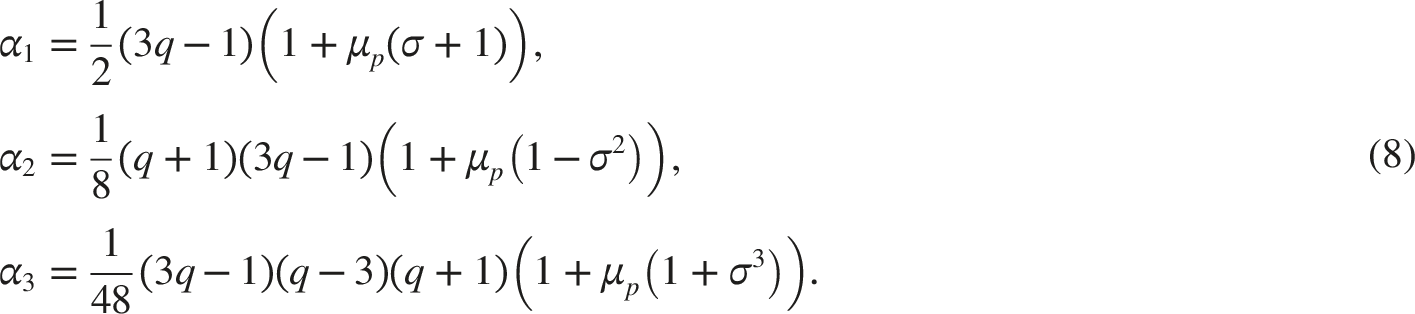
At the limit
3. Nonlinear wave structure
To analyze the nonlinear behavior of IASWs within this plasma system, we employ the RPT
1
to derive a FDZK equation. Following this approach, we introduce the following stretching transformations for the independent variables43,57:

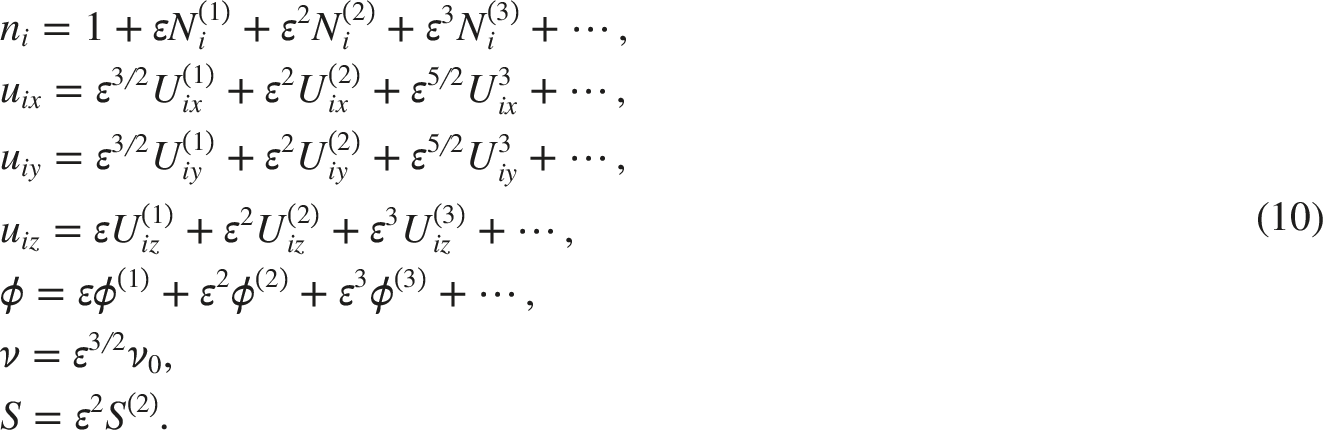
Inserting the above scaling ansatz into the evolution equations (1)-(4) and equation (7) and isolating the terms arising in lowest order
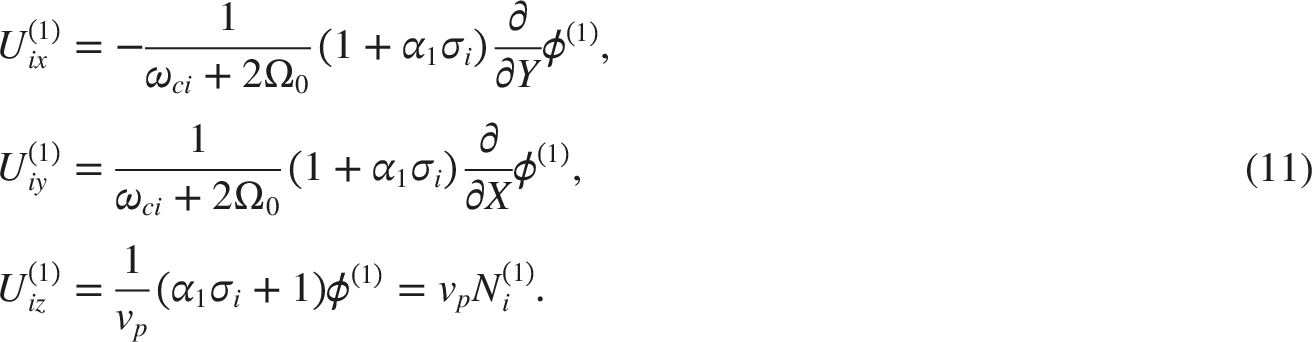
To lowest order

Uing the latter expression, one can derive the pulse propagation speed v
p
, Evolution of phase velocity v
p
versus q−index q: 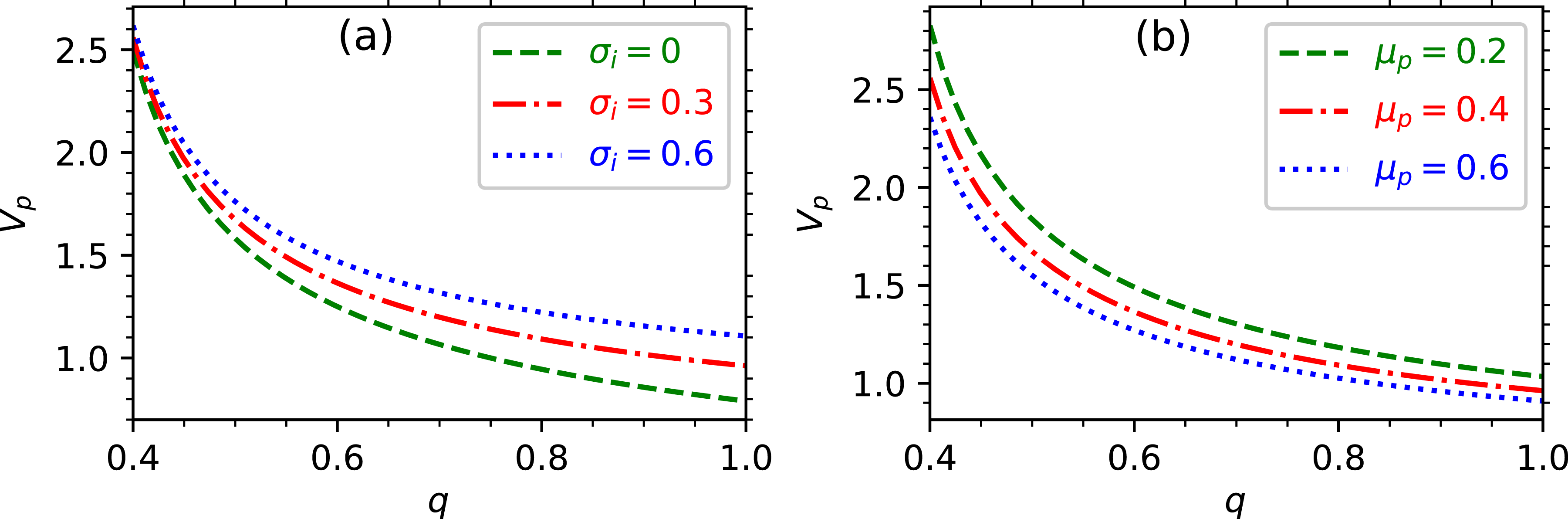

Our analysis reveals that the phase velocity of IAWs decreases monotonically with increasing q-index of the nonextensive distribution. Furthermore, the phase velocity exhibits a positive correlation with the ion-to-electron temperature ratio while showing an inverse dependence on positron concentration. Specifically, increasing positron density reduces the phase velocity, thereby stabilizing electrostatic perturbations, whereas higher ion temperatures enhance wave propagation by increasing phase velocity. The phase velocity decreases with the nonextensive parameter q because a harder nonthermal tail enhances screening, reducing the acoustic restoring force, while higher ion temperature σ
i
adds pressure support, increasing the phase speed. Notably, in Maxwellian plasmas
Collecting the next higher order


Similarly, the subsequent higher order


Solving equations (15)-(17) by using equations (11) and (14), the following nonlinear equation emerges:

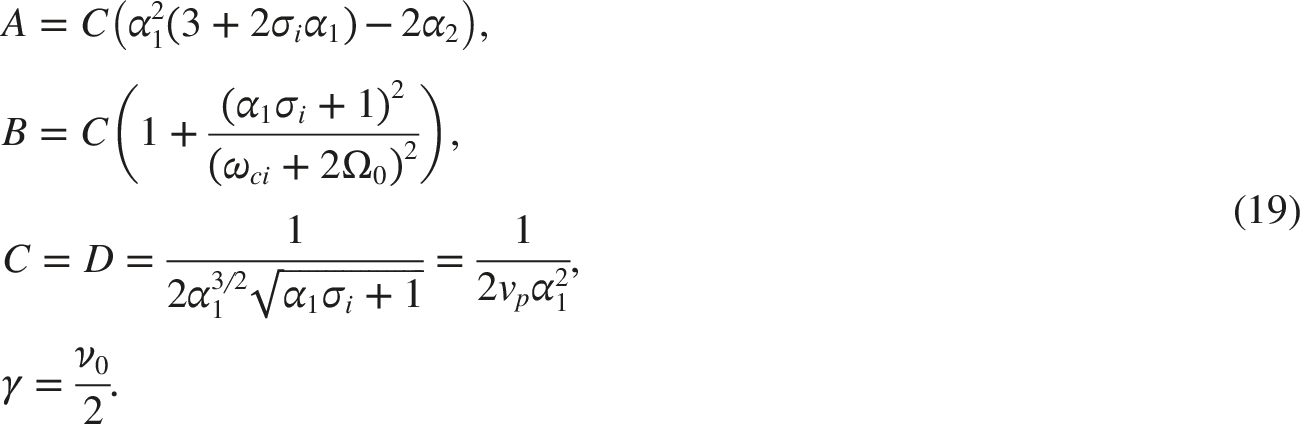
Equation (18) represents the FDZK equation, which governs the nonlinear dynamics of IAWs in a magnetized, rotating plasma with ion-neutral collisions. When we simplify the system by neglecting ion temperature effects
3.1. Pulse solution
To qualitatively model IAW propagation, we seek a solitary wave solution of the FDZK equation (18), which shares structural similarities with the KdV equation but represents a non-integrable system due to the presence of external periodic forcing and ion-neutral collisions (manifested through ∂
Z
E ≠ 0, where E is the system energy). To obtain an analytical solution, we simplify the problem by considering the collision-free (γ = 0) and force-free (D = 0) limit, introducing the transformed coordinate:


Taking account the independent variable defined in equation (20) into equation (21), the conserved energy density takes the form:


Figure 2 demonstrates the influence of the ion-to-electron temperature ratio σ
i
and positron concentration μ
p
on the pseudo-potential V(ϕ). The potential profile reveals a characteristic compressive solitary wave structure, manifested as a single potential well. Our analysis shows that increasing σ
i
induces a significant reduction in both the potential depth (Figure 2(a)) and the corresponding solitary wave amplitude. This inverse relationship between ion temperature and wave amplitude suggests that thermal effects in the ion population tend to suppress nonlinear wave structures in the plasma medium. Figure 2(b) demonstrates that the pseudo-potential V(ϕ) reaches its maximum depth at μ
p
= 0.6, indicating this positron concentration yields the tallest soliton structure. Our analysis reveals a critical potential value Variation of pseudo-potential V versus electrostatic potential ϕ(1) (2a) for several values of σ
i
with μ
p
= 0.6 and (2b) for several values of μ
p
with σ
i
= 0.3. The other fixed parameters are: q = 0.4, σ = 0.1, ω
ci
= 0.3, Ω
0
= 0.2, θ = 30° and v = 0.05.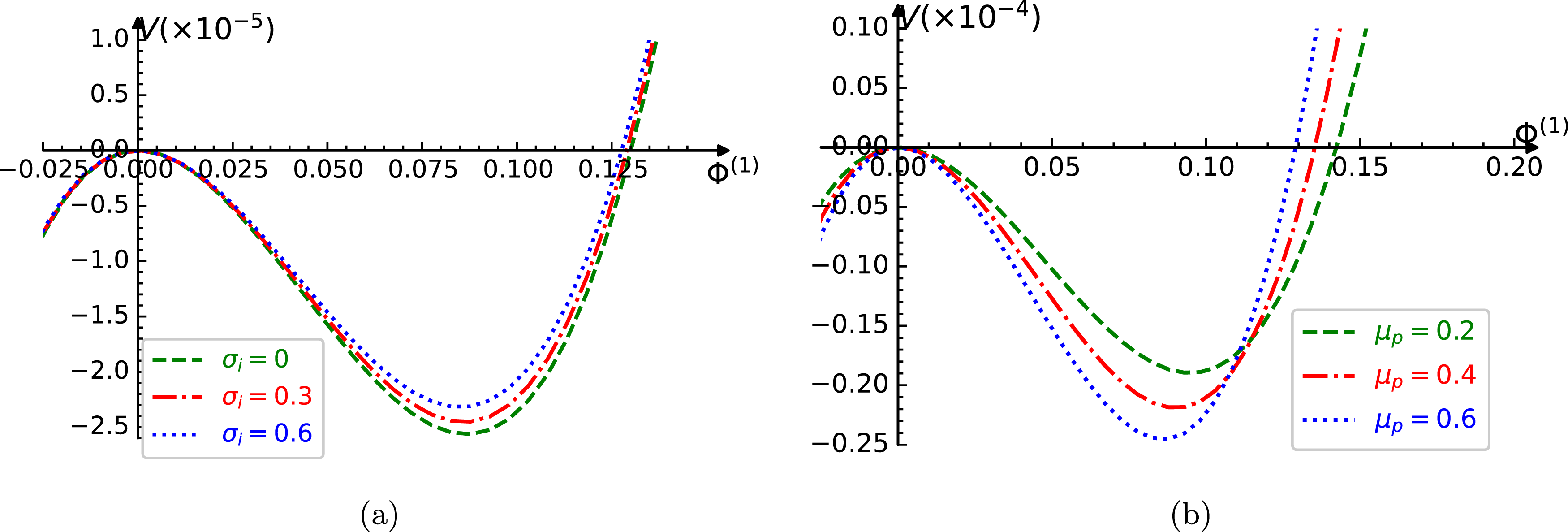


Assuming first the impact of collisions and the external force taken at null (S(2) = 0), equation (18) takes the following form:

The approximate solution of equation (26) is derived by applying the conservation of momentum,43,58,72 resulting in:

From equation (24), we derive the approximate solution of the damped ZK equation expressed by:



To incorporate the external periodic force in equation (18), we model the source term S(2) as a linear function of Z, given by


The main challenge now is to determine the expression of soliton speed time-dependent, which is denoted

Substituting equation (32) in equation (33), we get the following expression:

On the other hand, differentiation of equation (33) gives:

Using equation (31) to isolate

Combining equation (34) and equation (36) where we are replaced

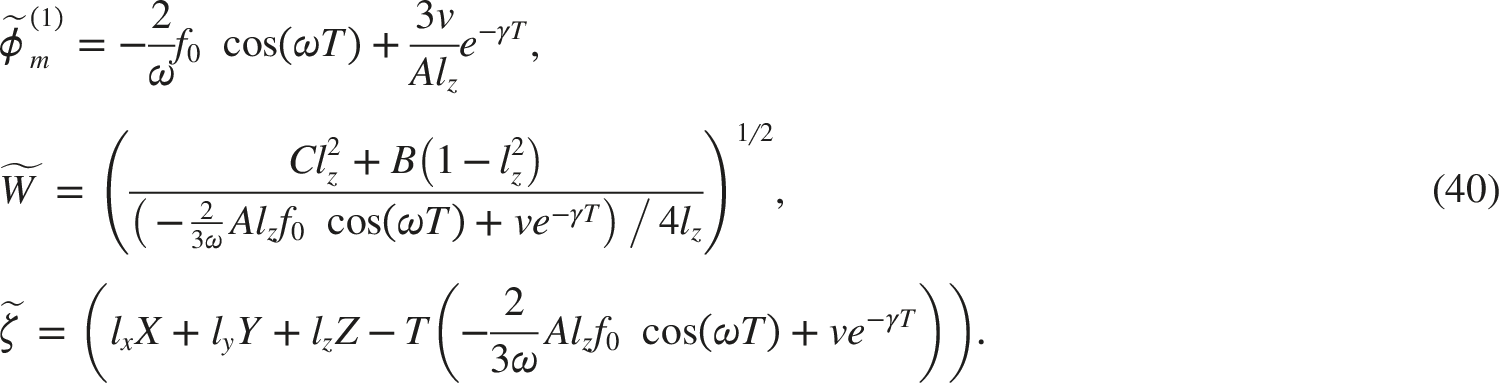
The integration of equation (37) gives the speed of IAWs time-dependent as:


3.2. Numerical analysis
We now numerically investigate the propagation characteristics of IASWs by systematically varying key plasma parameters, including the ion-to-electron temperature ratio σ i , the nonextensive distribution index q, the collision frequency γ, the external periodic force amplitude f0, and the plasma rotation frequency Ω0.
Figure 3 demonstrates the dependence of soliton amplitude on the nonextensive q-index for various values of σ
i
, f0 and ω. As shown in the different panels, IAWs decrease with increasing q-parameter due to enhanced dispersive effects that counteract nonlinear steepening. This behavior is also observed in panel 3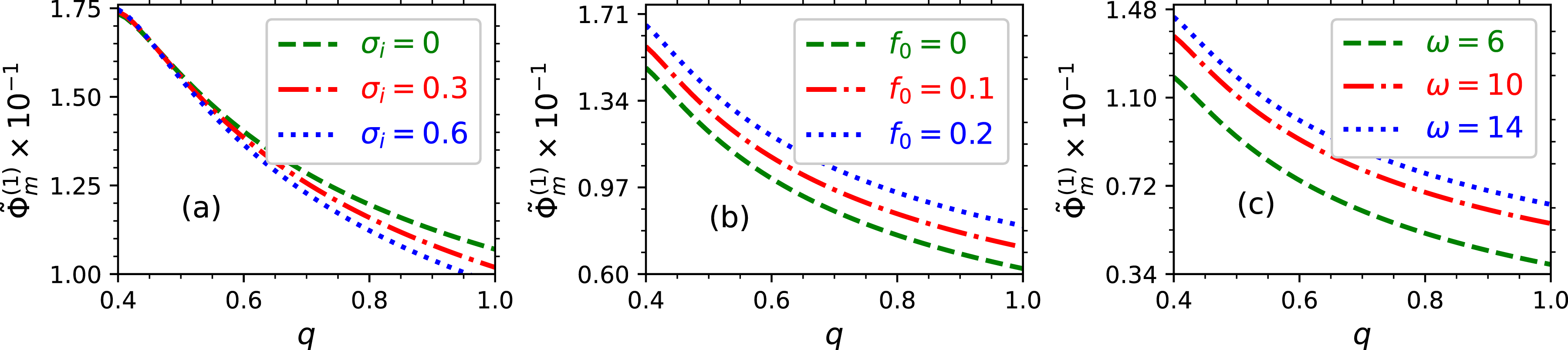
Figure 4 presents the dependence of soliton width 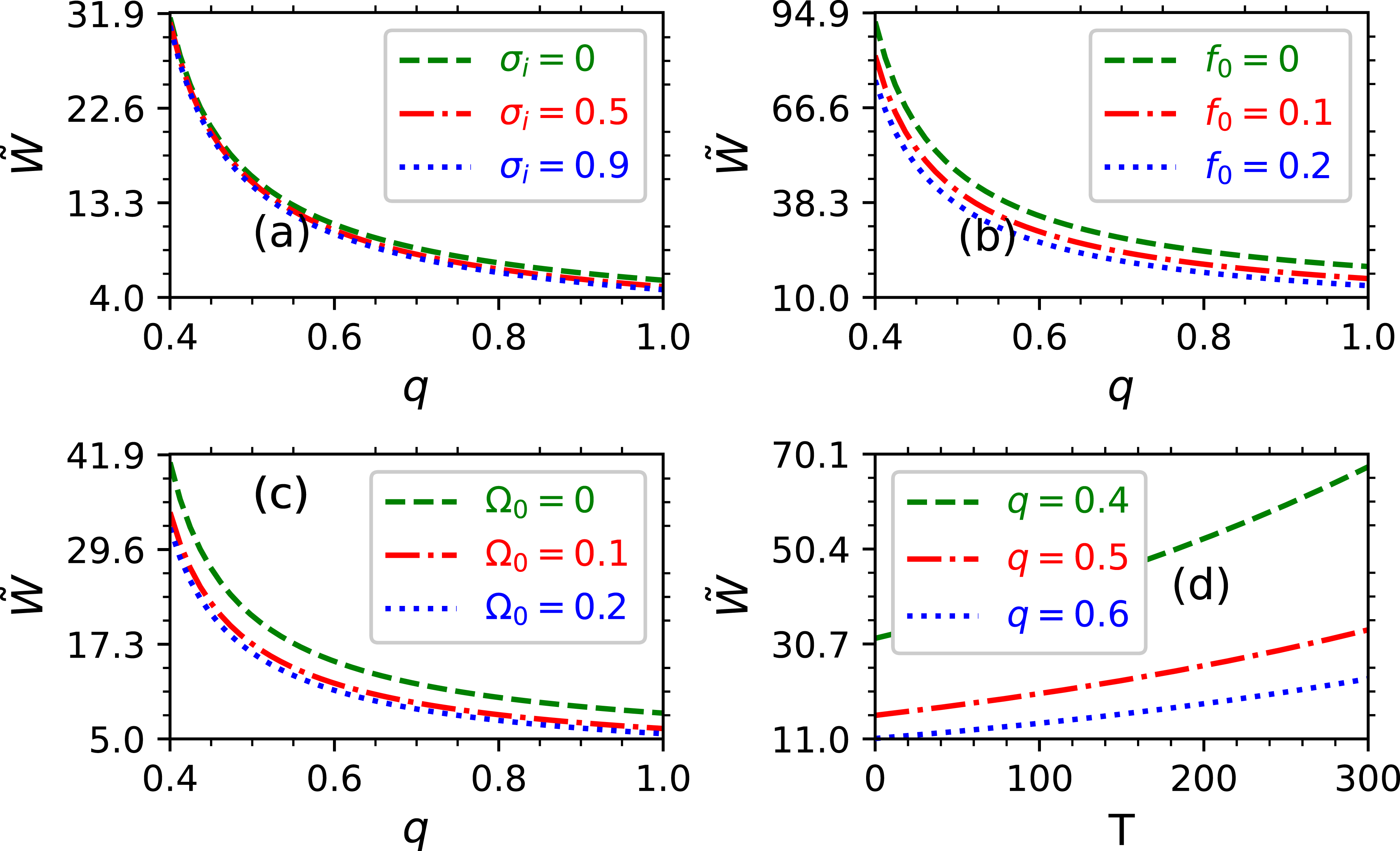
Figure 5 demonstrates how increasing the ion-neutral collision frequency γ affects the amplitude modulation of IASWs. The plots indicate that higher collision rates result in more rapid damping of wave oscillations, leading to a faster decay of the amplitude modulation envelope over time. It is observed that the wave maintains its periodic modulation pattern but with progressively diminishing intensity as γ increases, illustrating how collisional friction systematically dissipates wave energy. This confirms that ion-neutral collisions act as an effective damping mechanism in plasmas, gradually suppressing both the carrier wave and its modulations regardless of external forcing conditions. Time-series for different values of frequency collision γ. Along with σ
i
= 0.9, μ
p
= 0.6, σ = 0.3, ω = 15, θ = 30°, f
0
= 0.2, v = 0.05 and q = 0.5.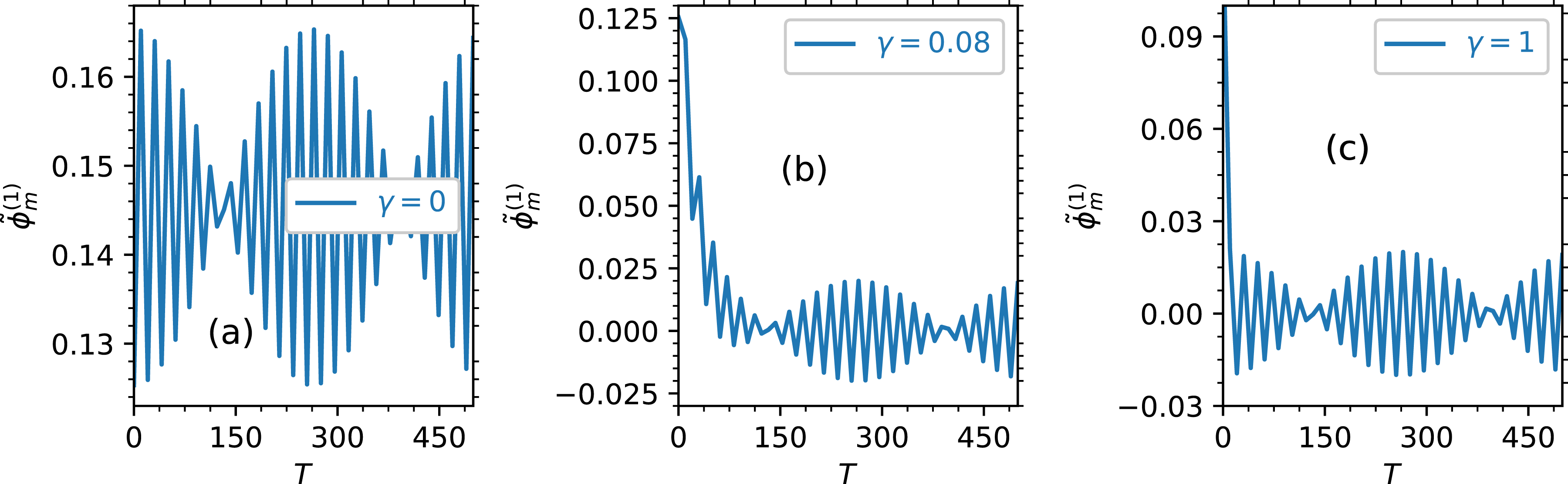
Figure 6 illustrates the time-series profiles Time-series for different values of external periodic force f
0
. Along with σ
i
= 0.9, μ
p
= 0.6, σ = 0.3, ω = 15, θ = 30°, γ = 0.01, v = 0.05 and q = 0.5. Time-series for different values of frequency of periodic force ω. Along with σ
i
= 0.3, μ
p
= 0.2, σ = 0.3, γ = 0.01, θ = 30°, f
0
= 0.2, v = 0.05 and q = 0.4. Time-series for different values of initial speed v and frequency of periodic force ω. Along with σ
i
= 0.3, μ
p
= 0.2, σ = 0.1, γ = 0.01, θ = 30°, f
0
= 0.2 and q = 0.6.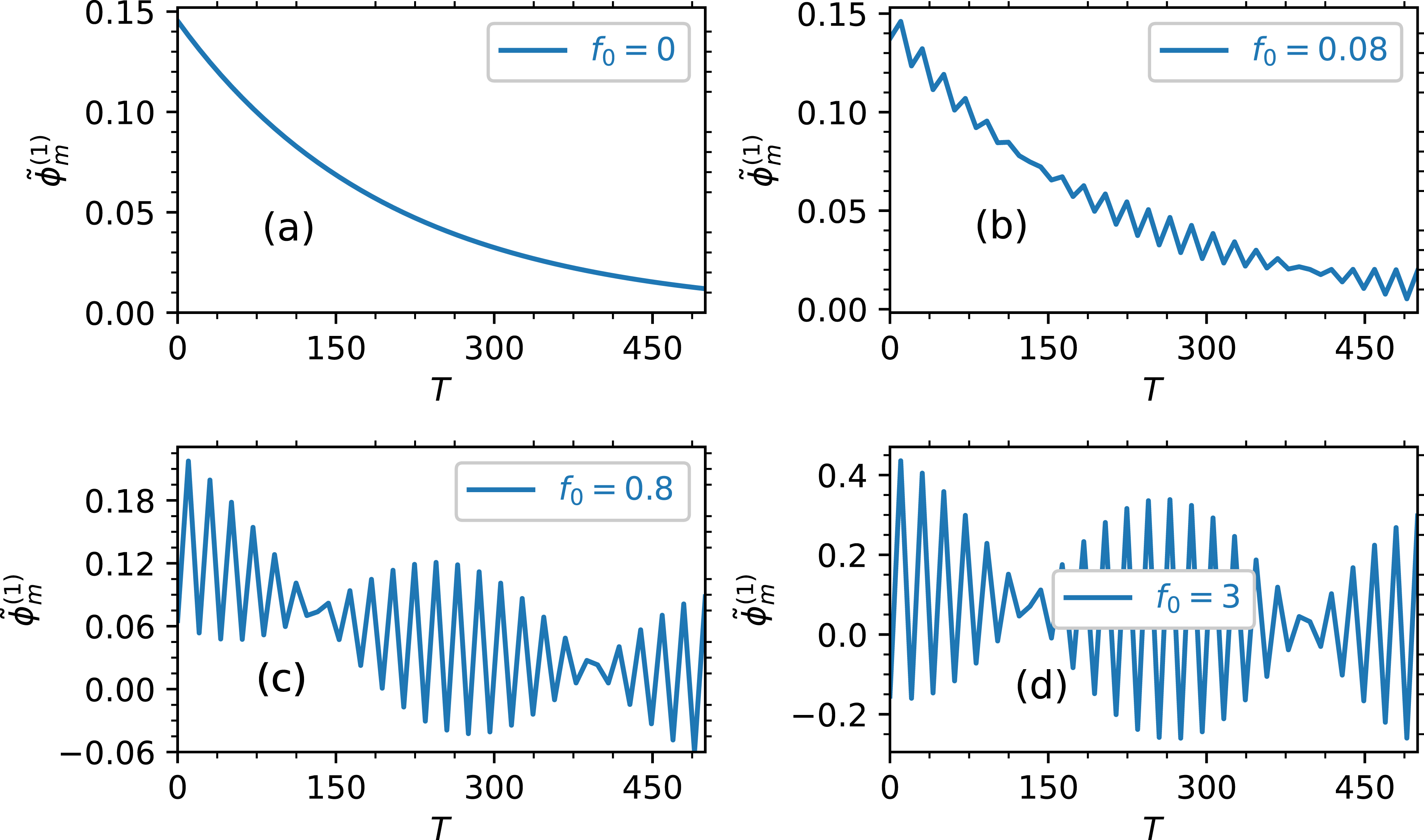
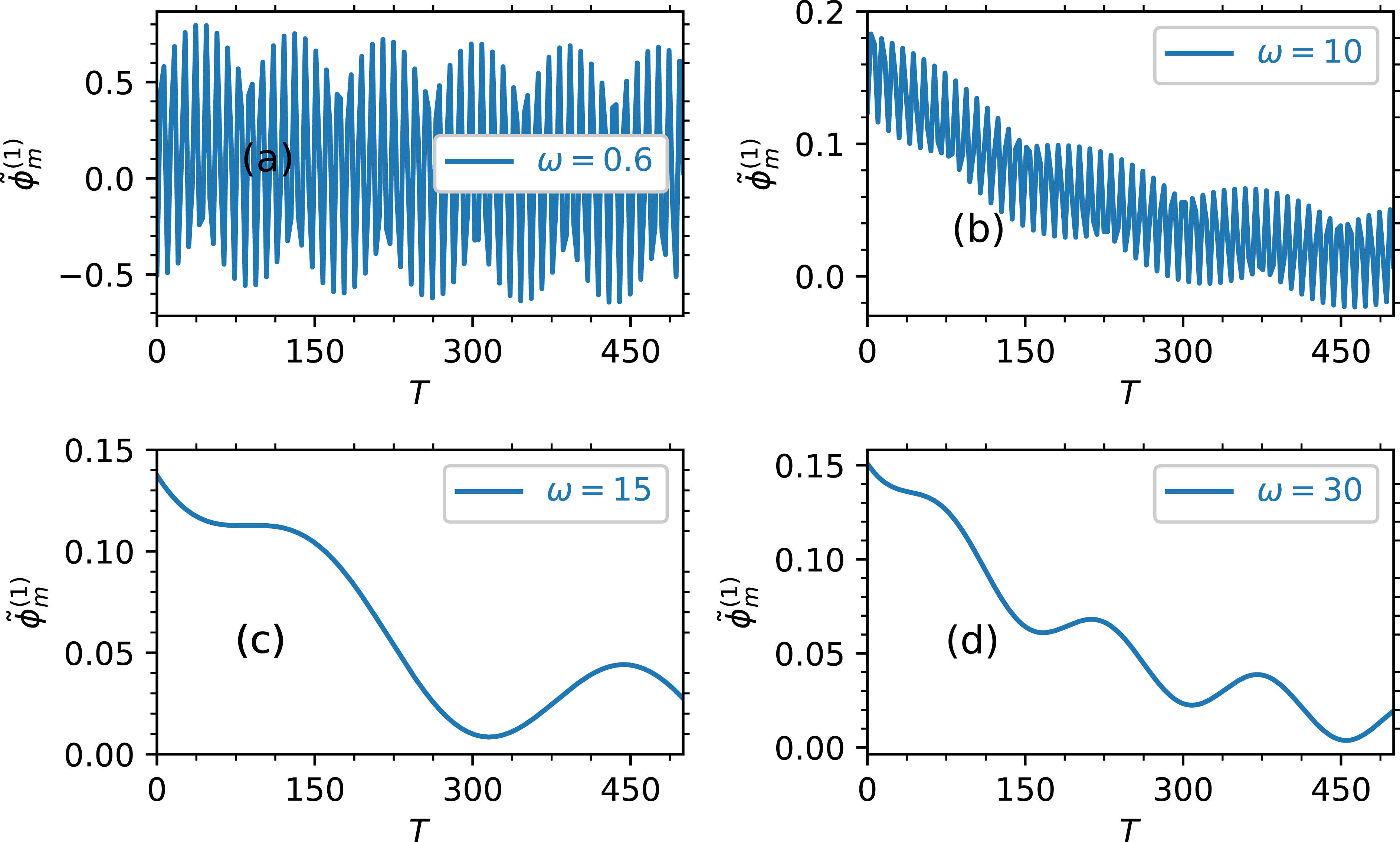

Figure 9 displays the variations of IAWs as a function of the space variable ζ for several values of the parameters σ
i
, f0, and q, where Figure 9 Evolution of soliton 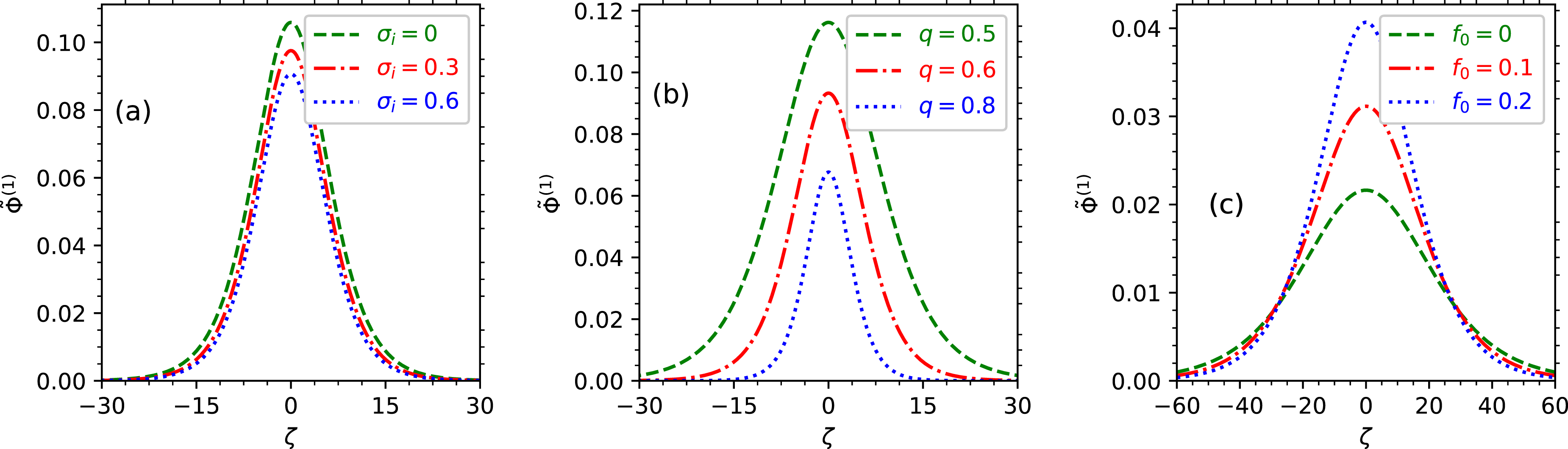
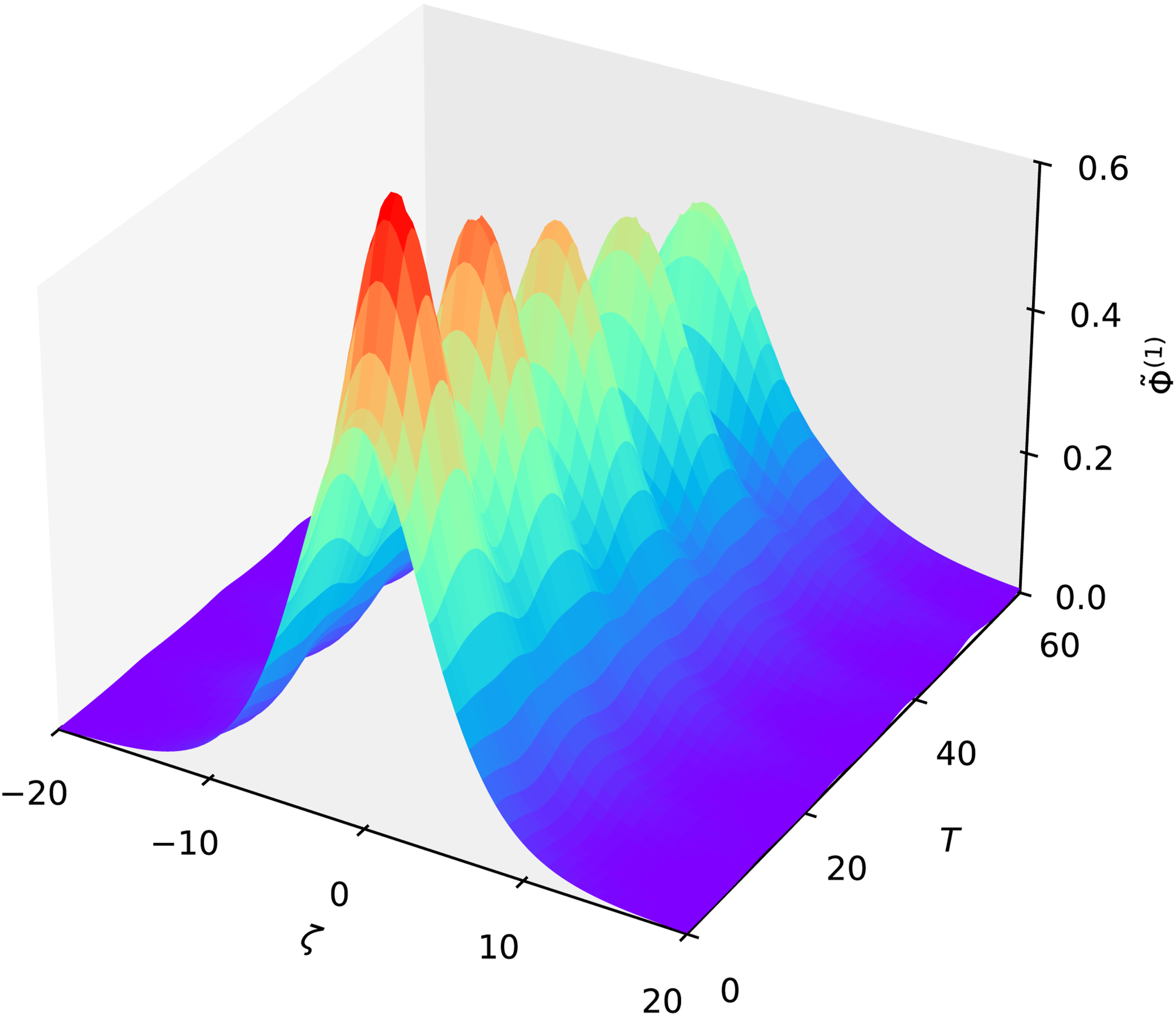
Figures 10 and 11 present 3D plots of soliton evolution concerning the space variable ζ and time variable T. Figure 10(a) demonstrates that the solitary wave propagates undistorted, preserving both its width and amplitude, indicating a stable electrostatic wave with constant energy due to a balance between dispersion and nonlinearity in the plasma. In contrast, Figure 10(b) reveals modified IAW behavior, as the wave spreads during propagation, signifying a highly dispersive medium where energy conservation is lost; here, the solitary waves exhibit decreasing amplitude and increasing width, a consequence of elastic collisions between ions and neutrals that induce energy dissipation and wave damping, ultimately leading to the formation of evanescent IASWs. Figure 11 demonstrates how an external periodic force (f0 = 0.04) modifies wave propagation in a collisional plasma (γ = 0.03). Unlike the stable soliton in Figure 10(a), this plot reveals periodic amplitude modulations along the time axis, where the wave oscillates between enhanced peaks and suppressed troughs due to constructive and destructive interference with the external force. The persistent but modulated structure shows that while collisions cause gradual damping, the periodic forcing simultaneously injects energy, creating a dynamic equilibrium where the wave neither fully collapses nor propagates undisturbed. This complex interaction produces rogue wave-like behavior, where localized amplitude spikes emerge unpredictably, offering crucial insights into energy localization phenomena in space and laboratory plasmas subject to external perturbations. 3D plot of electrostatic potential 3D plot of electrostatic potential 
4. Summary
In this investigation, we’ve studied the dynamical behavior of low-frequency ion-acoustic solitary waves in a slowly rotating magnetized plasma with collisions between ions and neutrals, and electrons/positrons following a q-nonextensive distribution. The setup includes warm ions and an external periodic force added through the Poisson equation. Using standard reductive perturbation, we derived a forced damped Zakharov-Kuznetsov (ZK) equation that ties together nonlinearity from steepening, dispersion from ion temperature and obliquity, damping from collisions, Coriolis tweaks due to rotation, and energy kicks from the periodic drive. In the absence of damping and forcing, the model reduces to the standard ZK equation, for which a closed-form compressive soliton solution and its associated Sagdeev pseudo-potential were obtained, thereby clarifying the role of key plasma parameters in determining the existence and polarity of the solitary structures. For the full forced-damped case with weak effects, perturbative solitons show collisions that eat away at the amplitude (exponential drop) and spread the width, countered by the drive, which sets up oscillations in amplitude whose details depend on the forcing strength f0 relative to the collision rate. From a numerical standpoint, the impact of various plasma parameters on wave propagation has been displayed in several graphs. The primary outcomes of this work are outlined below: 1. Numerical analysis reveals that phase velocity of the IAWs diminishes with increasing both q−nonextensive index and the positron concentration μ
p
(better screening), and climbs with the ion-to-electron temperature ratio σ
i
(stiffer restoring force), indicating that nonthermal tails and additional light species enhance screening while ion heating strengthens the restoring force for ion-acoustic oscillations. 2. The nonlinear and dispersive coefficients exhibit a complementary sensitivity to q−nonextensive index, the ion-to-electron temperature ratio σ
i
, and the rotation frequency: nonextensivity and rotation generally weaken dispersion, whereas higher ion temperature tends to enhance it, leading to narrower, more localized solitary profiles when nonlinearity and dispersion remain in balance. 3. The soliton width decreases with the enhancement of σ
i
, f
0
, Ω
0
, and q. 4. It was observed that the variation in the soliton amplitude results in amplitude modulation for specific values of the periodic force intensity f
0
and the damping coefficient γ. 5. The amplitude and width of soliton decrease as the ion-electron temperature σ
i
and nonextensive index q increase but as for increases, the width decreases while the amplitude increases. 6. The collisions between ions and neutrals have effects on damping the propagation of IAWs. 7. The amplitude modulation vanishes, and the aperiodic oscillation of the solitons appears and decays strictly as the frequency of the periodic force and constant speed increase.
It is revealed that the q−nonextensive force potential f
0
, ion temperature σ
i
, frequency rotation Ω
0
, damped coefficient γ, frequency of periodic force ω and time parameter T affect significantly the nonlinear features
5. Future work
Given the central role of the FDZK model in the present study and the rapidly growing interest in fractional models for wave propagation and transport, several natural directions emerge for future work. A first avenue is to generalize the present magneto-rotating, collisional, nonextensive electron-positron-ion plasma model to its fractional counterpart by introducing memory effects either through Caputo-type time-fractional derivatives, space-fractional operators, or fully space-time fractional forms in the governing equations. In such extensions, the resulting fractional forced damped ZK equation could be tackled using advanced analytical–numerical approaches, with the Tantawy technique73–79 playing a central role in constructing highly accurate and stable approximations of fractional solitary and cnoidal-wave solutions. Recent work has already established the effectiveness of the Tantawy technique for families of fractional Burgers and KdVB equations, as well as for fractional KdV-type ion-acoustic models, which strongly suggests that the same framework can be adapted to investigate fractional FDZK dynamics in rotating, nonextensive plasmas.
Another promising line of research is to extend the present configuration to include additional physical effects that are known to be important in space and laboratory plasmas but were neglected here for tractability. Examples include pressure anisotropy, relativistic degeneracy, and strong coupling effects in dense astrophysical settings, multi-temperature ion populations, or more realistic collision operators that go beyond simple linear damping. Coupling the FDZK or fractional FDZK framework to stochastic forcing or random fluctuations would also be valuable for mimicking turbulent environments and for studying how noise interacts with nonlinearity, dispersion, and fractional memory to shape the statistics of extreme events. In this context, the Tantawy technique could be adapted to treat inhomogeneous or stochastic fractional wave equations, building on recent progress where the method has been successfully applied to a range of fractional Burgers-type, Fokker–Planck-type, and diffusion models with plasma-physics applications.
From a more phenomenological perspective, it would be highly instructive to use the present model as a baseline for interpreting observations and numerical data from specific space and laboratory systems. For instance, one may seek to map particular ranges of the nonextensive index q, rotation frequency, and collisionality to measured conditions in planetary magnetospheres, pulsar environments, or strongly driven laboratory plasmas, and then use the FDZK and fFDZK predictions to identify regimes where compressive ion-acoustic solitary waves, modulated structures, or rogue-wave-like events are expected. This program would naturally benefit from combining the Tantawy technique with data assimilation or inverse methods, where fractional parameters and nonextensive indices are inferred from experimental time series or spacecraft observations by fitting the model’s solitary or modulated solutions to the measured waveforms.
Footnotes
Acknowledgement
The authors extend their appreciation to the Deanship of Scientific Research and Libraries in Princess Nourah bint Abdulrahman University for funding this research work through the Research Group project, Grant No. (RG-1445-0005).

Author contributions
Each author contributed equally to the research and writing process, and all have reviewed and consented to the final version of this manuscript.
Funding
The authors disclosed receipt of the following financial support for the research, authorship, and/or publication of this article: The authors extend their appreciation to the Deanship of Scientific Research and Libraries in Princess Nourah bint Abdulrahman University for funding this research work through the Research Group project, Grant No. (RG-1445-0005).
Declaration of conflicting interests
All authors certify they have no affiliations with or involvement in any organization or entity with financial or non-financial interest in this study.
Data Availability Statement
As a purely analytical investigation, this research did not involve the creation or analysis of new datasets.
AI tools declaration
The authors confirm that no artificial intelligence tools were employed in the development of this article.