




Abstract
A rotating magnetized electron-positron-ion (e-p-i) plasma where ions collide with atoms or molecules is considered to investigate the impact of Coriolis force, dissipation, and ion temperature on the occurrence and oblique propagation of ion-acoustic solitary waves (IASWs). The densities of positrons and electrons are modeled by the q-nonextensive distribution. From the linear study, the dispersion relation is established. We found that the frequency of waves following the parallel component is unaffected by the magnetic field and the plasma rotation frequency. Only the transverse component depends on them. For short wavelengths, the Coriolis force and the temperature of ions significantly impact the wave frequency. Based on the reductive perturbation technique, the planar damped Korteweg-de Vries (Kdv) and planar damped modified KdV (mKdV) equations were derived, and localized solutions for these equations were obtained. For a particular value of the nonextensive index q, the KdV equation becomes invalid for describing the dynamics of IASWs. Below (above) this critical value, rarefactive (compressive) waves exist. The numerical analysis shows that the Coriolis force, the nonextensive parameter, the propagation angle, the ion temperature, and the collision frequency considerably influence the dispersion and the wave profile. In particular, the analysis reveals that the collision effect strongly attenuates the amplitude of waves. The widths of IASWs decrease with the Coriolis force and ion temperature. The increase in the temperature of the ions leads to an increase (a decrease) in the wave amplitude in the planar KdV (mKdV) equation. The current investigations may help understand localized electrostatic structures in space and the phenomena observed in rotating plasmas in astrophysical and terrestrial environments.
Keywords
Introduction
Electron-positron-ion (e-p-i) plasmas are ubiquitous in astronomical environments such as magnetospheric pulsar regions. 1 This type of plasma can also be created artificially in particle accelerators 2 or in the laboratory through electrical discharges. 3 In addition, these plasmas find numerous applications in particle physics, 4 nuclear fusion, 5 and plasma electronics. 6 In recent years, several researchers have studied linear and nonlinear characteristics of IAWs in many plasma systems.7–16
Many plasma environments such as fusion, astrophysics, and laboratory plasmas contain very high energy particles whose velocity distribution does not obey the Maxwell–Boltzmann law.17–21 The modification of this velocity distribution function can be caused by nonlinear interactions between particles, the presence of intense electromagnetic fields and transport phenomena such as diffusion and convection. To model superthermal particles in most space observations, the Tsallis distribution has been widely used recently.22,23 This distribution is characterized by the non-extensitivity parameter q, which describes the deviation of the particle distribution function from the Maxwell–Boltzmann distribution. This distribution made it possible to investigate the nonlinear dynamics of solitary waves in different plasma environments with superthermal particles.24–28 In recent years, the study of nonextensive plasma has stimulated great interest among a large number of researchers in plasma physics because of its incredible relevance in astrophysical and cosmological scenarios such as supernovae, 29 neutrons stars, 30 quarks, and gluons. 31
A strong magnetic field plays a crucial role in stabilizing waves in astrophysical and geophysical plasmas. It has been shown that the Coriolis force that appears in rotating systems can contribute to generating magnetic fields in plasma, particularly in space plasmas and laboratory plasmas. 32 The influence of Coriolis force on wave propagation has been the subject of several studies in plasmas subjected to magnetic or non-magnetic fields.33,34 Both theoretical and experimental research reveals that the effects of the Coriolis force on plasmas are essential for understanding phenomena in astrophysical environments. 35 Because of its numerous effects on the rotation of plasmas, studying wave dynamics in the presence of the Coriolis force has aroused considerable interest among researchers.
The linear and nonlinear dynamics of obliquely propagating IAWs in a magneto-rotating plasma were studied. 36 In 2012, El-Tantawy et al. 37 carried out a study on the presence of nonlinear structures in a magnetized plasma with nonextensive parameters and showed the existence of subsonic and supersonic electrostatic waves. The nonplanar effect of ion-acoustic solitons (IAS) described by the Korteweg-de Vries (KdV) and modified KdV (mKdV) equations in multicomponent plasma with nonextensive parameters has been investigated in Ref. 38. The KdV equation was also derived for IAS with negative ions in the presence of nonextensive parameters. 39 Ferdousi et al. 40 investigated IAS in a plasma system with nonextensive parameters by modeling them by the KdV, mKdV, and Gardner equations. In 2015, Ferdousi et al. 24 investigated the oblique propagation of ion-acoustic solitary waves (IASWs) in a multicomponent magnetized plasma where electrons and positrons are introduced by using the Tsallis distribution. They displayed that the extensiveness of electrons and positrons and the oblique external magnetic field modify the characteristics of solitary waves. In 2019, Farooq et al. 41 investigated the dissipative IASWs in collisional, magneto-rotating, nonthermal multicomponent plasma with a combination of two nonthermal distributions (Cairn’s and Kappa). This study showed that waves’ amplitude (width) decreases (increases) with time due to the energy dissipation of solitary waves. They also showed that the effect of plasma rotation frequency on the localized wave structures makes them sharper. In 2021, Hassan and Sultana 42 studied the impact of dissipation and ion temperature on damped dust IAS in collisional magnetized nonthermal plasmas. They revealed that, under the effect of ion temperature, the amplitude (width) of the nonlinear waves decreases (increases). In all these studies, the combined effect of collision, ion temperature, and plasma rotation frequency was not considered. This motivates us to consider a colliding plasma model with nonthermal distributions of particles in the presence of an external magnetic field and under the influence of the Coriolis force. Therefore, we aim to study the impact of the Coriolis force, ion temperature, collision frequency, and nonextensive parameters on the occurrence and propagation of IAWs in the plasma system. The main challenge of the present study lies in reconciling the complex interplay of nonextensive statistics, collisions, rotation, and magnetic fields while maintaining analytical and numerical tractability. This requires the simultaneous consideration of nonextensive particle distributions that alter wave properties, ion-neutral collisions introducing dissipation that competes with nonlinearity and dispersion, and rotational and magnetic forces that break symmetry and complicate wave dynamics. This study has significant applications across laboratory, space, and astrophysical plasmas. IASWs observed in Earth’s ionosphere, solar wind, and pulsar magnetospheres can be analyzed using this model to interpret electrostatic turbulence, collisional damping, and non-thermal particle distributions (via the q-parameter), particularly in oblique propagation scenarios. Moreover, rotating plasma devices (e.g., Q-machines) can test soliton damping and nonextensive effects, with applications in fusion turbulence control and plasma thrusters.
The rest of this research work is planned as follows: we introduce the plasma model and its basic equations. We study the linear regime and discuss the dispersion relation. Subsequently, we study the nonlinear structure of the wave by deriving the KdV and mKdV equations by the reductive perturbation method (RPM) and discuss the solutions in detail. Finally, we summarize our results and present the main conclusions.
Plasma model and basic equations
The propagation of IAWs in a three-component plasma model is considered which has electrons, positrons and positive ions of charge z
i
e, mass m
i
and velocity



The number densities of electrons and positrons are described by the q-nonextensive distribution
22


In this plasma model, we will normalize the spaces variables by the Debye length
Taking into account the scaled quantities and using the Taylor series expansion of equations (4) and (5), equations (1)–(3) become





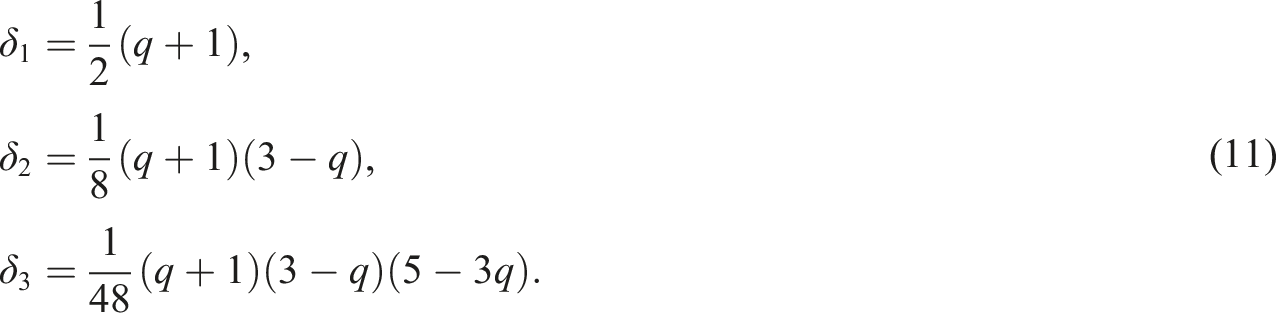
As mentioned above, when q → 1 the particles distribution will tend towards the Maxwell–Boltzmann distribution. To investigate the occurrence and oblique propagation of IASWs in this plasma model in the following sections, we will consider the case where −1 < q < 1 of nonthermal plasma (superextensive).
Linear wave structure
The linear characteristics of the plasma are studied by assuming that the perturbed quantities are sinusoidal functions


Parallel component
Following the parallel component, we consider k⊥ = 0 in equation (12) and we acquire




We now plot in Figure 1 the real part of wave frequency ω against k for different values of q and σ
i
. It is observed that the pulsation of IAWs is low in Maxwellian plasma compared to nonextensive plasma, that is, the pulsation is high for the superextensive plasma −1 < q < 1 and becomes small for thermal or Maxwellian distribution q → 1. Figure 1(a) also shows that for low frequencies, the pulsation increases as the wavenumber increases and decreases as the nonextensive index increases. The phase velocity of the IAWs regresses with the nonextensive parameter q. For low frequencies, Figure 1(b) shows that the pulsation increases as the ion temperature increases and also increases with k, implying that the phase velocity progresses with the ion temperature. For small wavenumber, the ion temperature ratio does not affect waves in plasma. Evolution of the real part of the wave frequency ω
r
as a function of the wavenumber k for different cases of the nonextensive index q where σ
i
= 0.002 (a), and ion temperature σ
i
where q = 0.4 (b). The other parameters used are μ
e
= 0.8, μ
p
= 0.3, ν = 0.02, and σ = 0.2.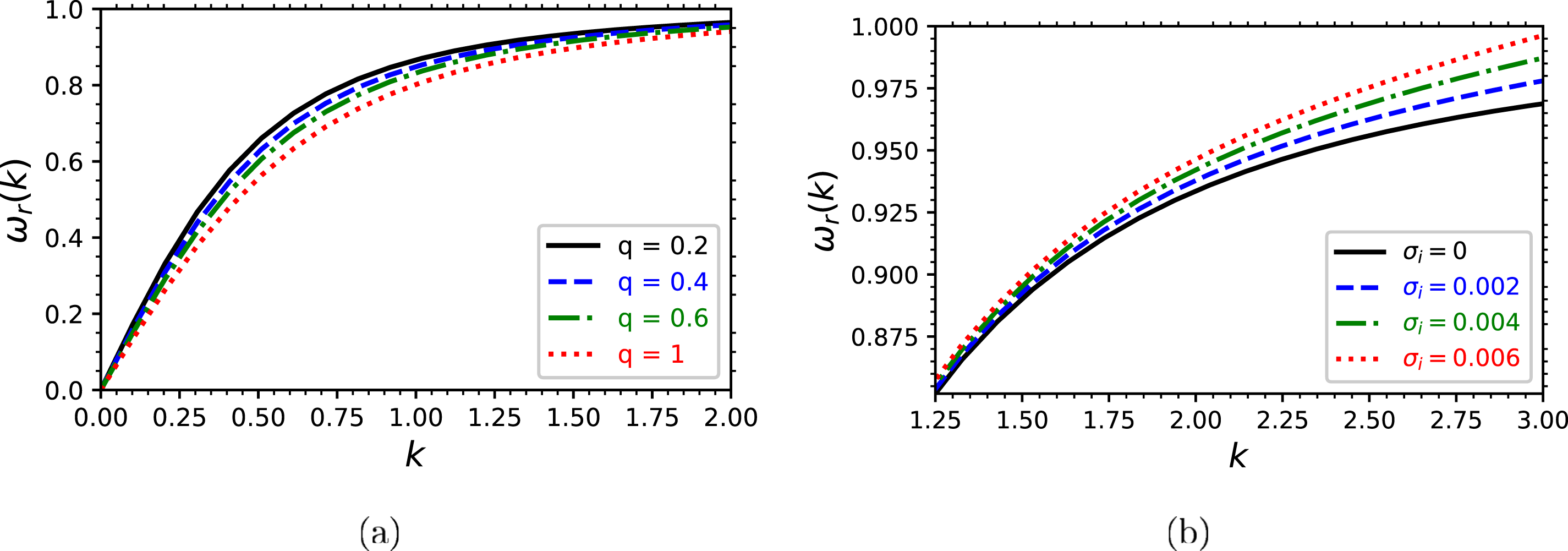
The imaginary part ω
i
of the frequency is obtained in Figure 2. It is clear that the nonextensive index q and ion temperature σ
i
have no impact on the imaginary part of the wave frequency, as can be seen in Figure 2(a). Wave frequency decreases as the wavenumber increases. Whereas Figure 2(b) shows that wave frequency increases when a collision frequency increases. The imaginary frequency part has two linear parts where k⩽0.1 refers to the transient regime and k⩾0.1 to the steady state regime. In the steady state regime, the wave frequency is constant. The transient regime in Figure 2 Evolution of the imaginary part of the wave frequency ω
i
as a function of the wavenumber k for different cases of the nonextensive index q where ν = 0.02 (a), collision frequency ν where q = 0.4 (b). The other parameters used are μ
e
= 0.5, μ
p
= 0.3, σ
i
= 0.002, and σ = 0.2.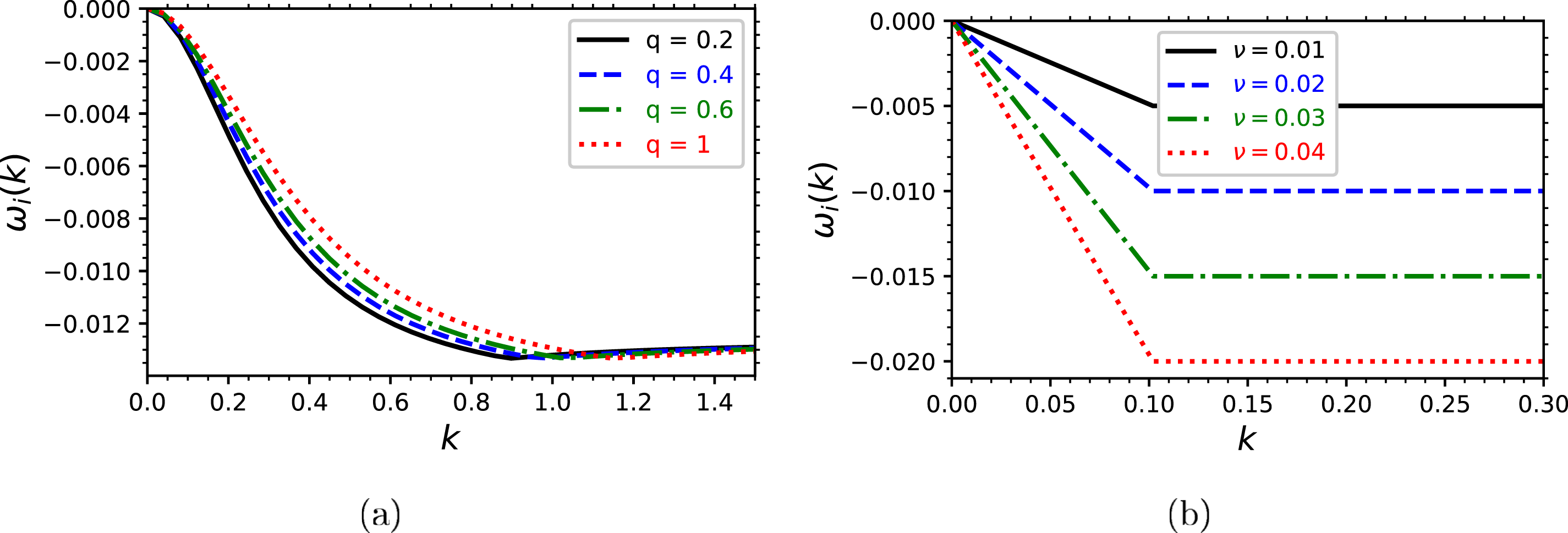
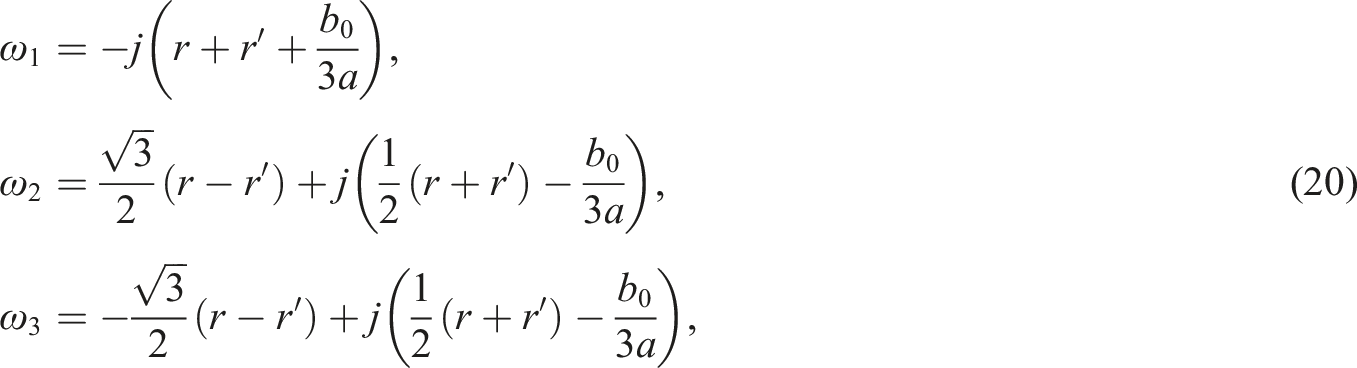
Perpendicular component
The perpendicular component of the wave dispersion relation is studied by considering k → 1. Thus equation (12) reduces to the following form


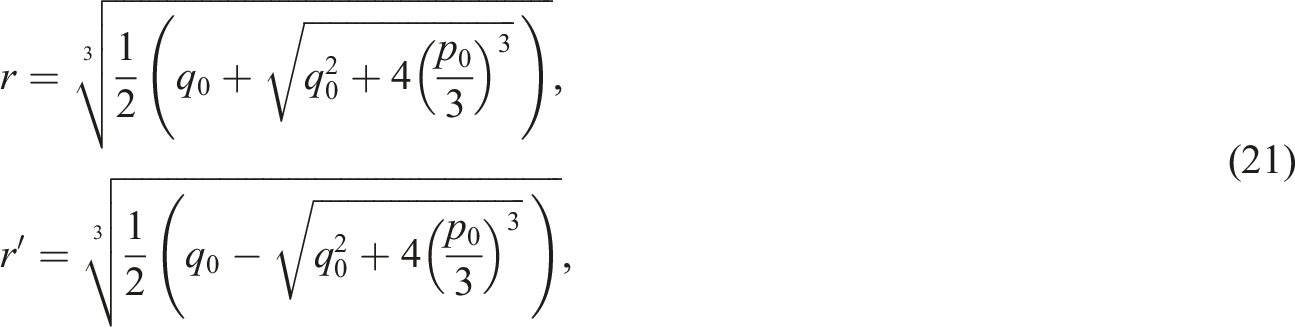
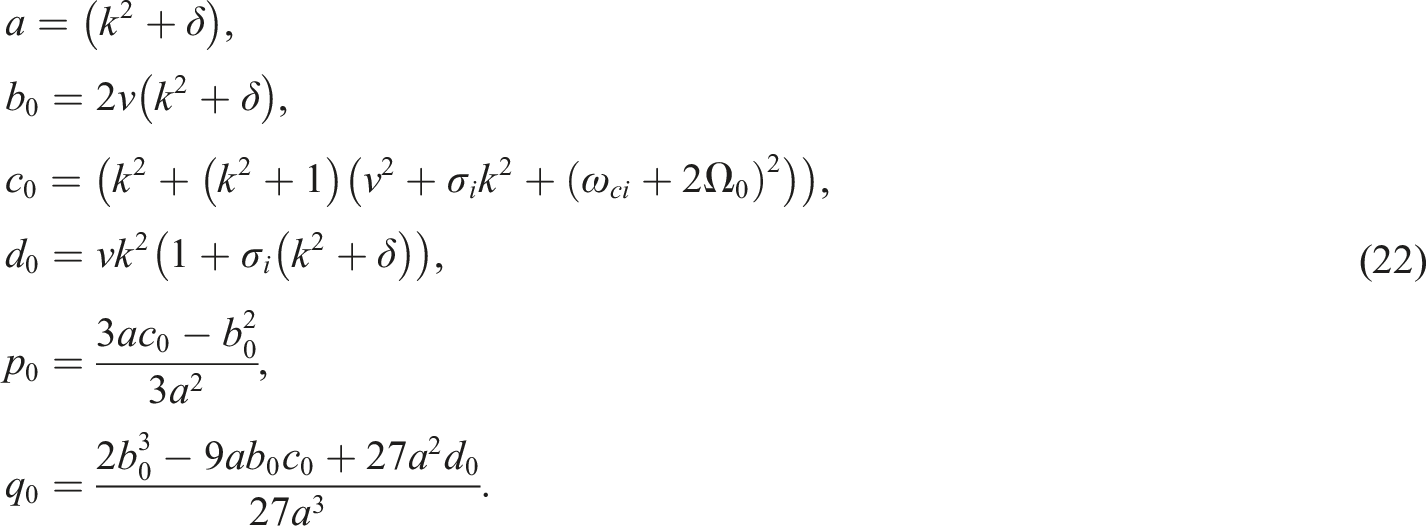


Now the real ω
r
and imaginary ω
i
parts of the frequency are plotted in Figures 3–5. Figure 3(a) shows that the wave frequency increases with increasing wavenumber k and decreases when the nonextensive index increases. For k → 0, the wave frequency is not null. Figure 3(b) shows that ω
i
decreases rapidly with k as the wavenumber increases and is always negative. Dissipation effects can justify this rapid decline. On the other hand, this dissipation is more pronounced when the nonextensive parameter q increases. The imaginary part of wave frequency has two operating regimes: a transient regime for high wavelengths k < 1 and a steady state regime for low wavelengths k > 1 where wave frequency stays constant. Evolution of the real part ω
r
(a) and the imaginary part ω
i
(b) of the wave frequency versus the wavenumber k for different cases of the nonextensive index q. The other parameters used are μ
e
= 0.5, μ
p
= 0.2, σ = 0.6, σ
i
= 0.006, ω
ci
= 0.2, ν = 0.02, and Ω0 = 0.05. Evolution of the real part ω
r
(a) and the imaginary part ω
i
(b) of the wave frequency versus the wavenumber k for different cases of plasma rotation frequency Ω0. The other fixed parameters are μ
e
= 0.5, μ
p
= 0.2, σ = 0.6, q = 0.4, ω
ci
= 0.1, ν = 0.02, and σ
i
= 0.02. Evolution of the real part ω
r
(a) and the imaginary part ω
i
of the wave frequency versus the wavenumber k for different cases of the collision frequency ν. The other parameters used are μ
e
= 0.5, μ
p
= 0.2, σ = 0.1, q = 0.4, ω
ci
= 0.5, Ω0 = 0.05, and σ
i
= 0.005.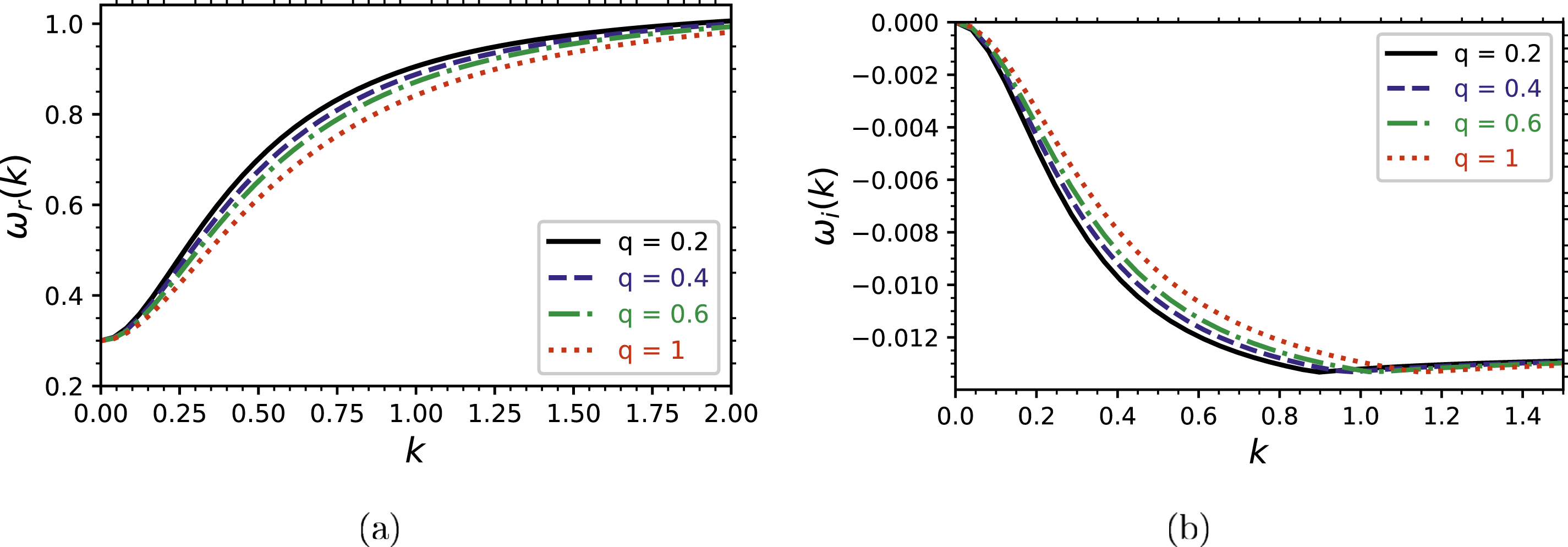
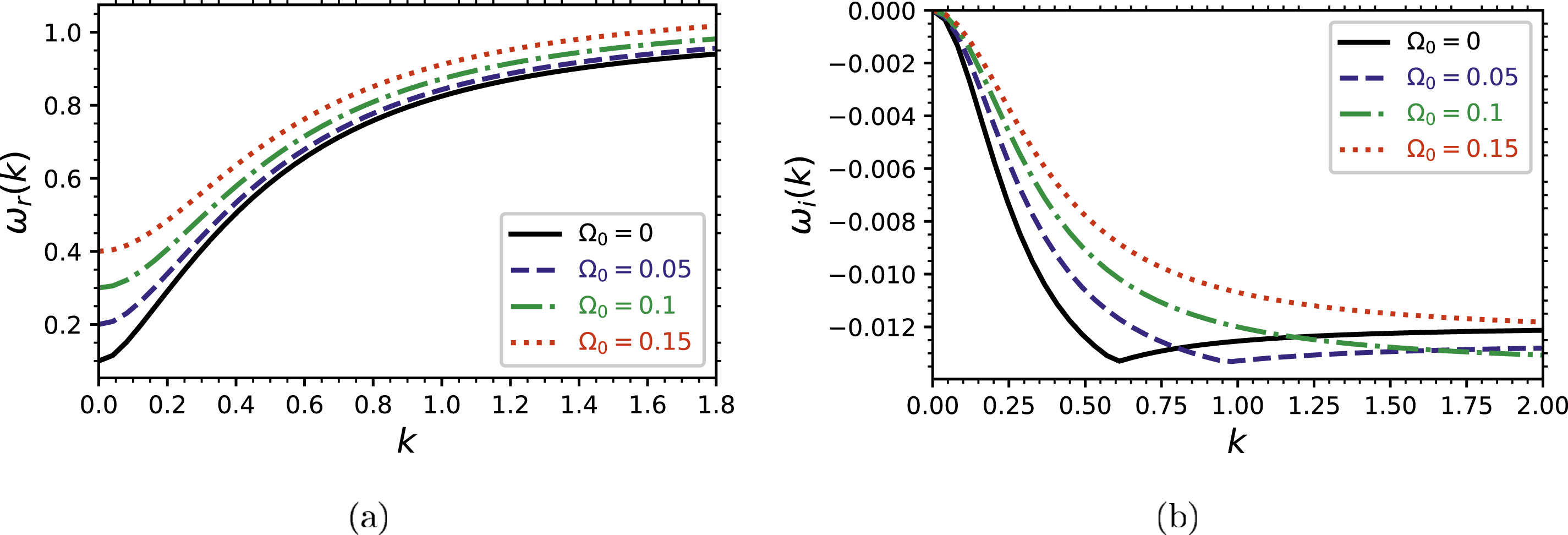
The Coriolis force and external magnetic field strength strongly influence the perpendicular component of wave frequency. Figure 4(a) depicts that the real part of the wave oscillation frequency increases rapidly when the plasma rotation frequency grows. This rapid growth can be justified by the superposition of three motions in this plasma model (oscillatory motion of the waves, cyclotron motion of the ions around magnetic field lines, and the rotational motion of the plasma). Moreover, for k = 0, we have a non-zero frequency (ω r ≠ 0), and the waves appearing in this plane are called cyclotron ion electrostatic waves. Low wavenumbers correspond to the transient regime where the oscillation frequency undergoes variations. The high wavenumbers constitute the steady state where the frequency varies very little or is even constant. Increasing Ω0 increases the frequency of wave oscillation in our plasma model. Concerning the imaginary term of the wave frequency, it remains negative and decreases with the wavenumber k as shown in Figure 4(b). We can also see in Figure 4(b) the transient regime where the frequency wave decreases quickly and the steady state where the frequency wave stays constant for the highest value of k. The damping effect decreases as the plasma rotation frequency increases. Thus, the plasma must be rotated in collisional plasmas to reduce the damping effects.
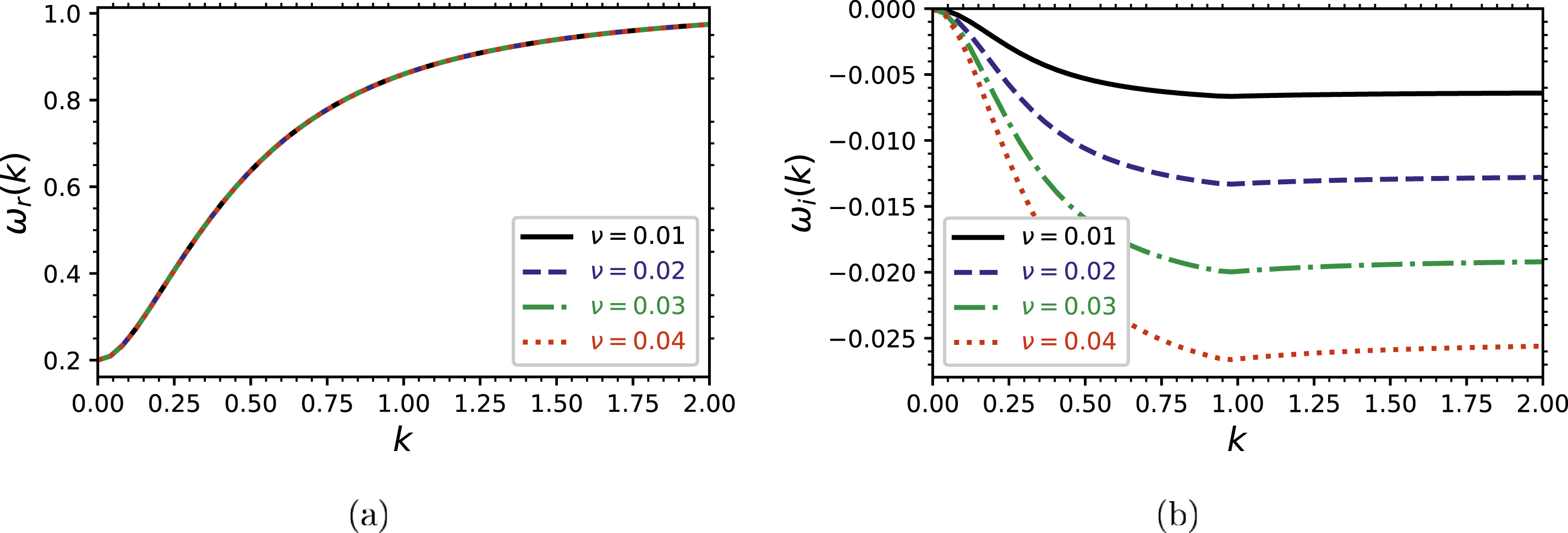
Figure 5 represents the variation of ω
r
as a function of the wavenumber k for different cases of the collision frequency ν. The real part of the frequency of electrostatic wave oscillation increases with the wavenumber k as shown in Figure 5(a). We can also see that the collision frequency does not impact the electrostatic wave oscillation in this plasma model. On the other hand, the imaginary part is negative and decreases with the wavenumber k as shown in Figure 5(b). We observe two operating regimes, namely the transient regime for low wavenumbers
Nonlinear evolution equations
Planar dissipative KdV solitons
We will focus on reducing the basic equations models (6)–(10) to a single nonlinear equation modeling the nonlinear dynamics of colliding IAWs in magneto-rotating plasma. The general method used to reduce these equations is the RPM, which is typically used to investigate weakly nonlinear amplitude waves.43,44 To do this, we express the stretched variables as

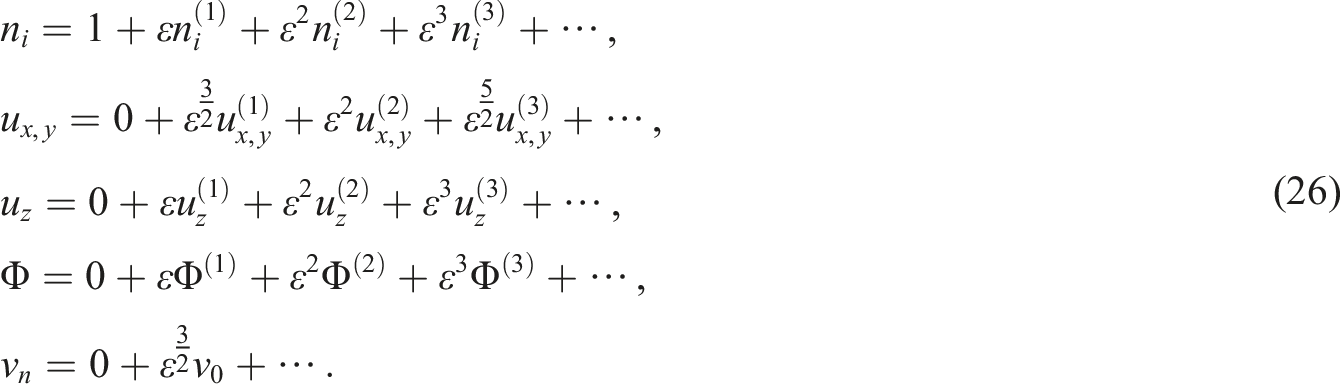
Using equations (25) and (26) into equations (6)–(10), we construct a set of equations for different powers ɛ. We obtain the following first order quantities
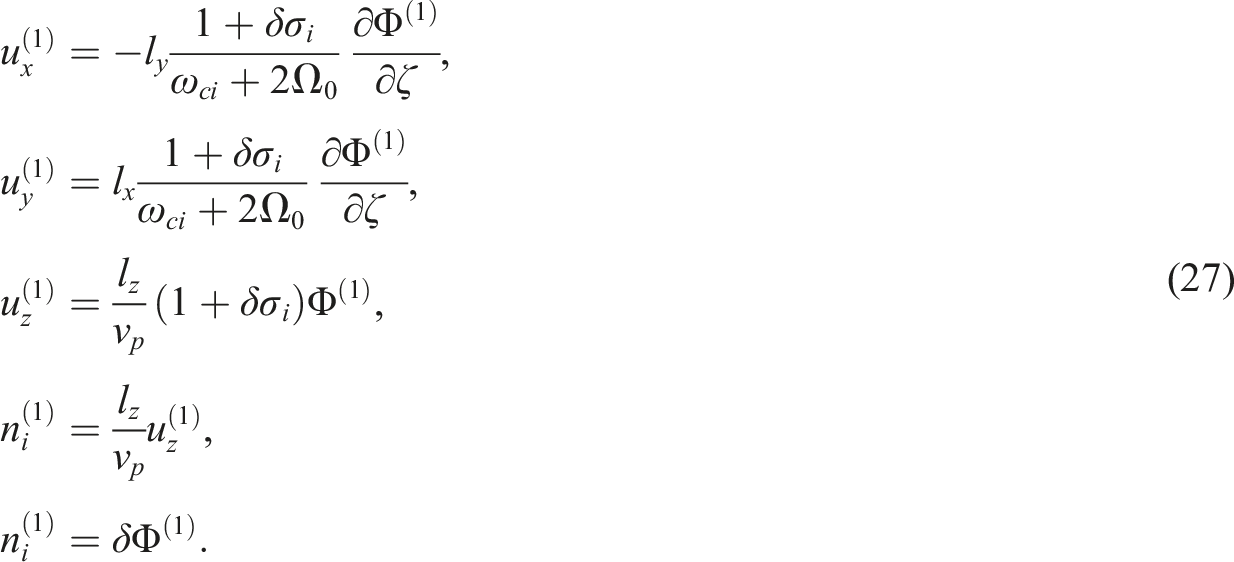
Combining Eqs.

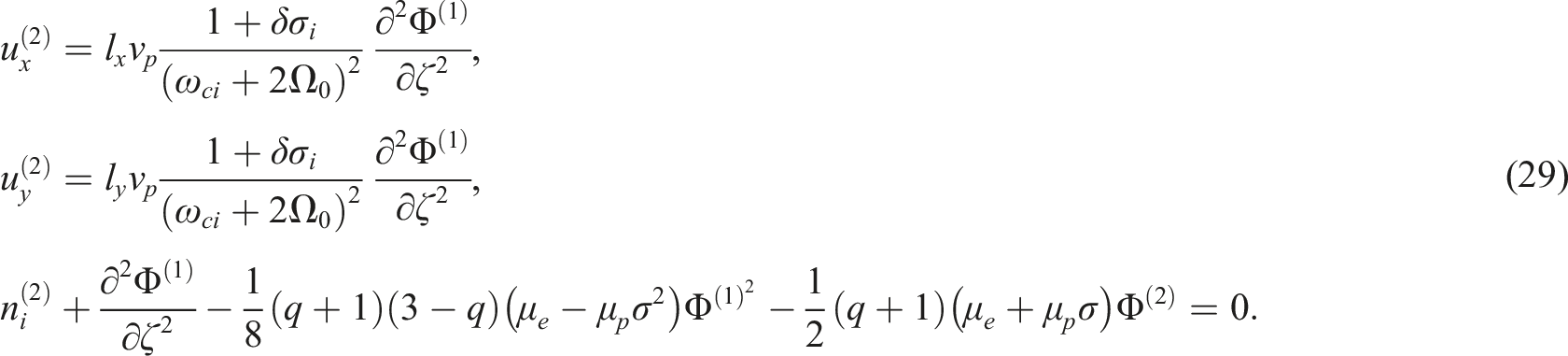
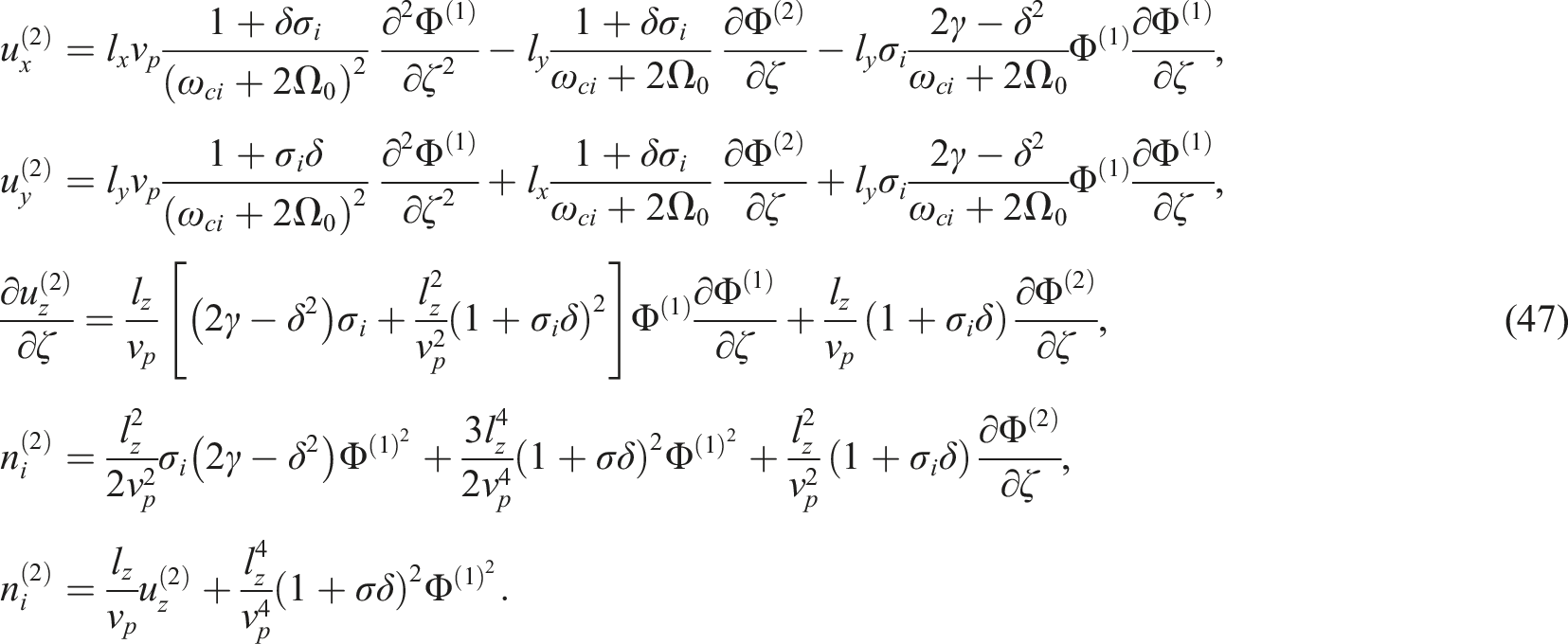
By continuing the approximation to the second order of ɛ, we have the following relations
At the third order of ɛ, using equations (27)–(29) into continuity equation and z-component of momentum equation, and then combining these two equations, we derive the following nonlinear equation

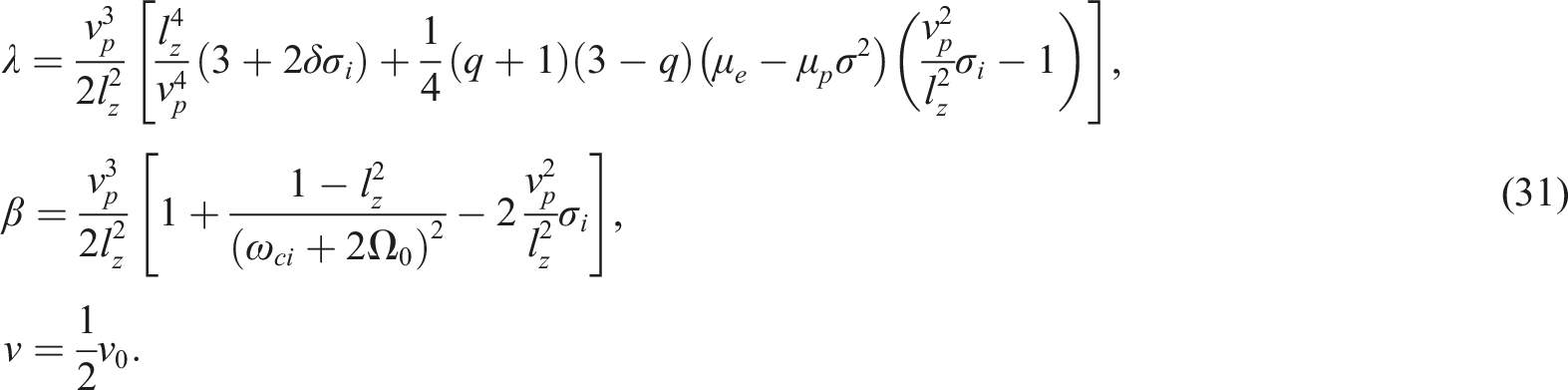
The relation (30) is the well-known planar damped KdV (dKdV) equation. This equation describes the nonlinear dynamics of IASWs in magneto-rotating plasma where ions collide with neutral atoms. The expression (31) defines, respectively, the nonlinear coefficient λ, the dispersion coefficient β, and the dissipation coefficient ν of IASWs in plasma. By neglecting ion temperature
In the absence of collision between ions and neutrals

The relation (32) defines the KdV equation in non-colliding plasma and represents a fully integrable system where the energy of the IASWs is conserved




After substituting v
p
and δ by their expression, we obtain the following equation




Figure 6 shows that for values of q < q
c
, rarefactive waves are formed (negative polarity), and for values of the parameter q > q
c
, compressive waves are formed (positive polarity). We also note that the value of q
c
for which the nonlinear coefficient is zero increases for increasing values of σ
i
. Increasing the temperature of ions in the plasma reduces the nonlinear effect, favoring the formation of rarefactive waves. Variation of the sign of the nonlinear coefficient λ versus q across various values of the ion temperature σ
i
with fixed plasma parameters μ
e
= 0.5, σ = 0.1, μ
p
= 0.2, and θ = 30°.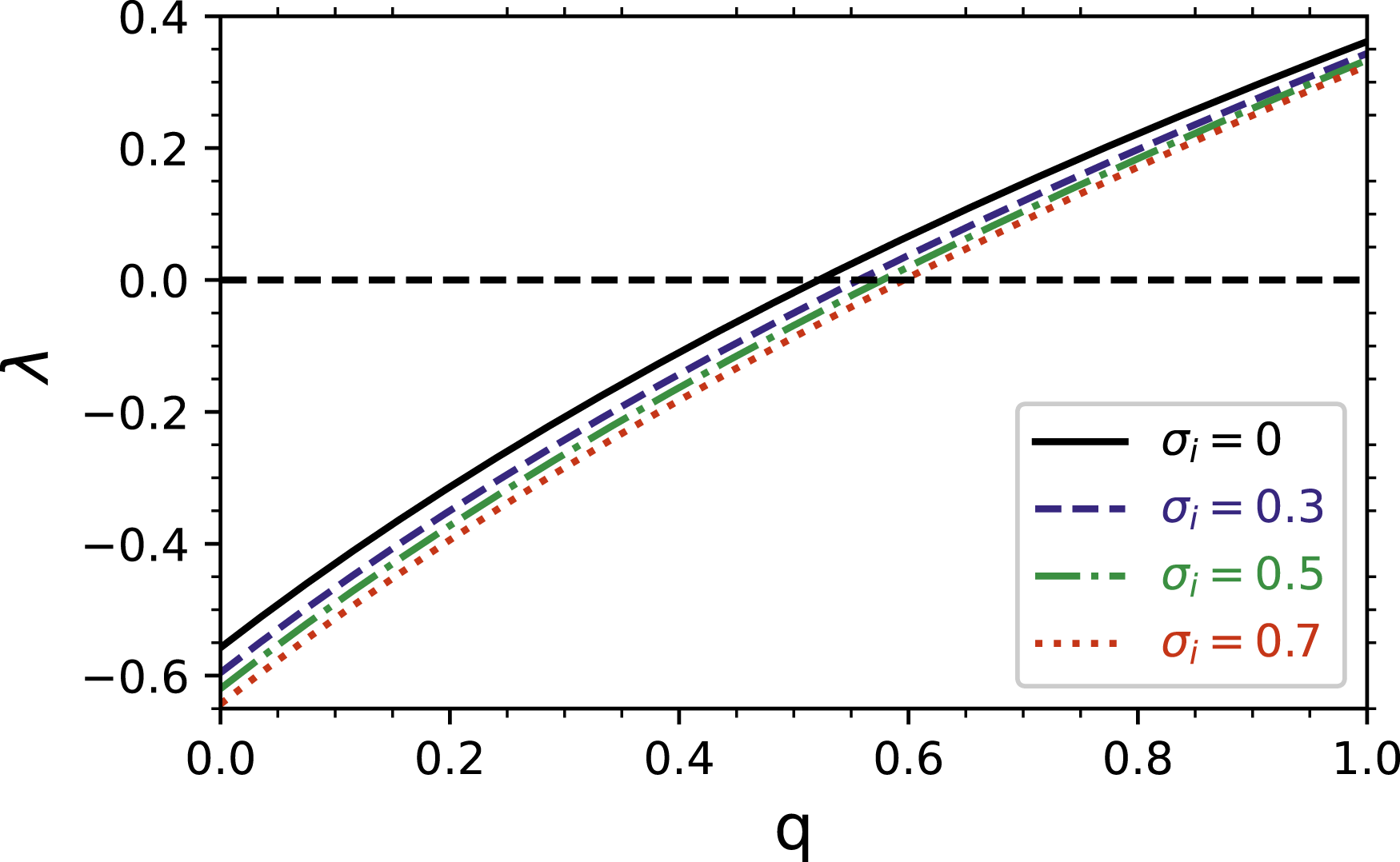
Furthermore, considering the existence of ion-neutral collisions, the solitons’ energy is no longer conserved with time. There is energy dissipation, that is, energy variation gives ∂E/∂τ = −2ν0E, such that





Figure 7 shows that the amplitude of the IASWs decreases with time. This means that the energy of IASWs dissipates over time. Increasing the ion temperature leads to an increase in the amplitude of the soliton. On the other hand, the superextensivity of electrons and positrons decreases the amplitude of IASWs, as shown in Figure 7(b). Variation of amplitude for positive KdV soliton with time across various values of σ
i
(a) and q (b). The other parameters used are: μ
e
= 0.5, μ
p
= 0.2, σ = 0.1, q = 0.7, ν = 1, θ = 30°, U0 = 0.05, Ω0 = 0.5, and ω
ci
= 0.5.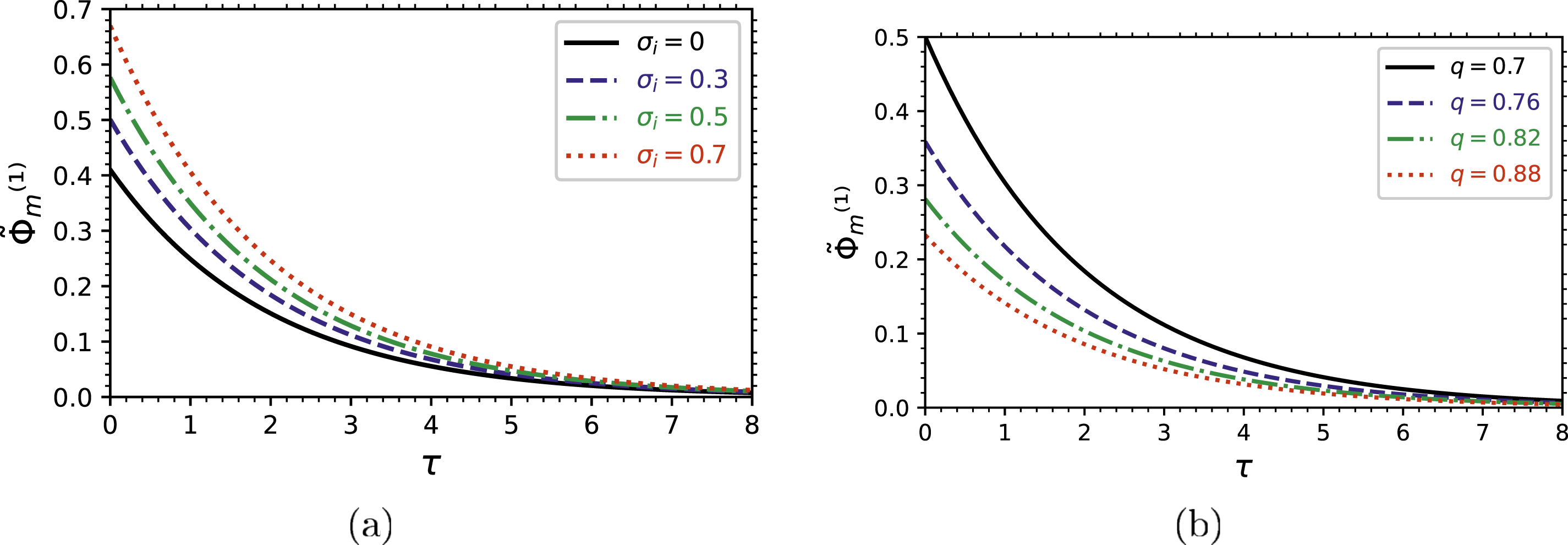
In Figure 8, we see how the width of the IASWs grows with time and decreases with increasing ion temperature σ
i
and rotational frequency Ω0. The rotational effect and the magnetic field modified the properties of dispersion. When the axis of the magnetic field and the rotation frequency are aligned, the magnetic effect multiplies, confirming the presence of particles around the field lines, and the dispersion effects become low. This then reduces the width of the soliton. The decreasing (increasing) of soliton amplitude (width) with time is physically due to the existence of an ion-neutral collision characterized by the exponential term in equations (44) and (45). Evolution of the width of the solitary wave with time across various values of σ
i
(a) and Ω0 (b). The other plasma parameters used are: μ
e
= 0.5, μ
p
= 0.2, σ = 0.1, q = 0.7, ν = 1, θ = 30°, U0 = 0.05, Ω0 = 0.5, and ω
ci
= 0.5.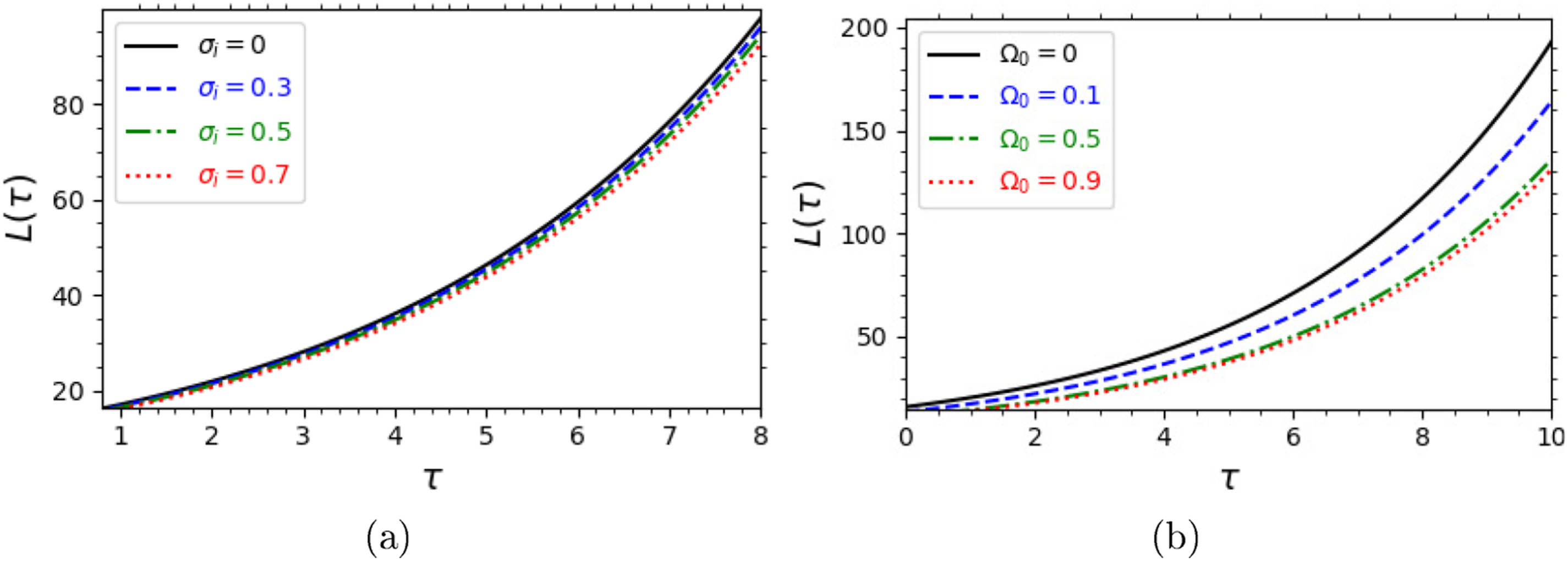
Figure 9(a) shows that the amplitude and width of the IASWs remain constant with time. Since The 3D plot showing the variation of electrostatic potential Φ(1) with space ξ and time τ for (a): ν = 0, σ
i
= 0, (b): ν = 0.2, σ
i
= 0, and (c): ν = 0.2, σ
i
= 0.3 with fixed parameters σ = 0.5, μ
e
= 0.6, μ
p
= 0.2, θ = 5°, q = 0.7, U0 = 0.08, ω
ci
= 0.5, and Ω0 = 0.1.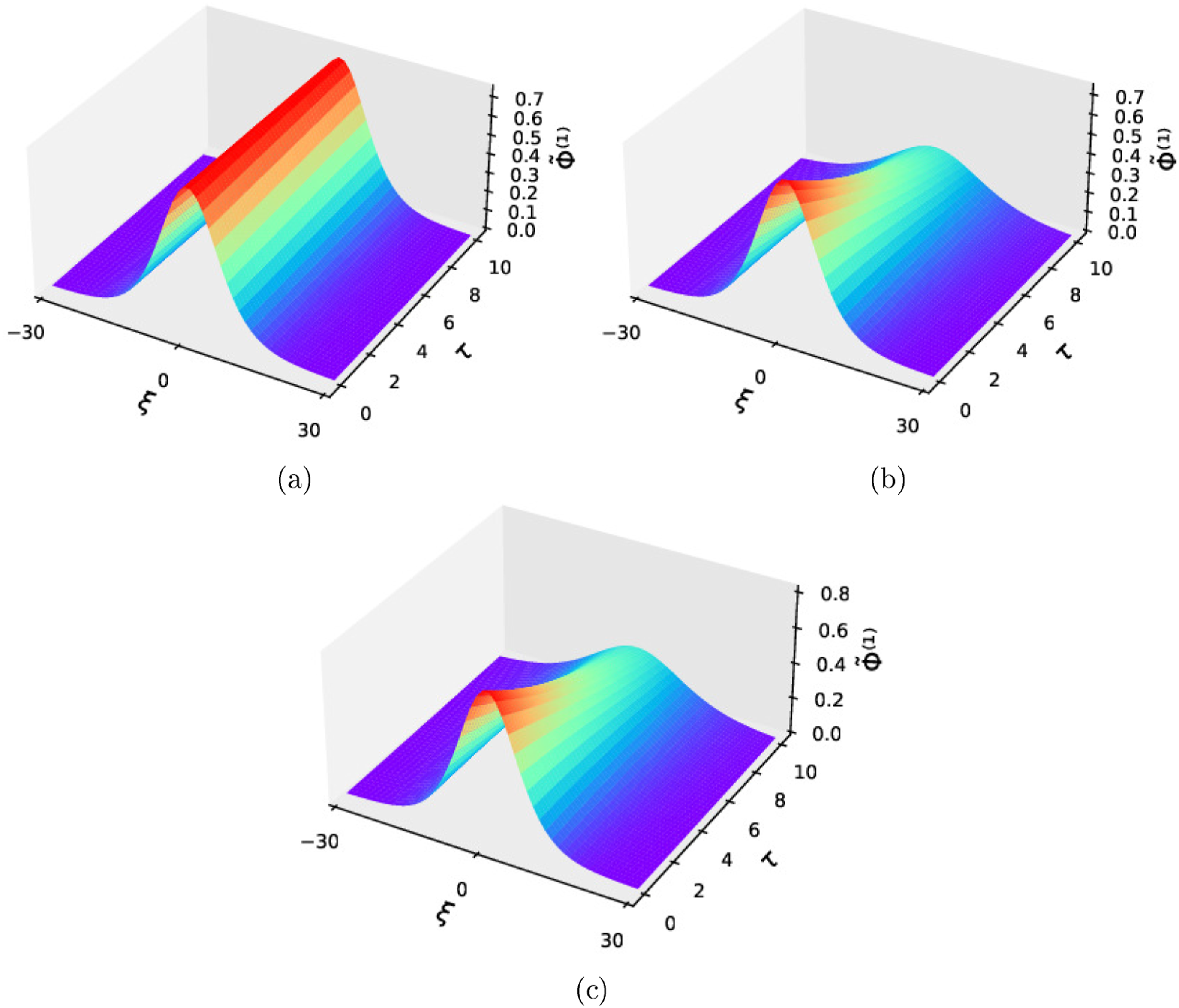
The graph of Figure 10 shows the 3D plot presenting the electrostatic potential variation with ξ and the effect on ion-neutral collisions ν. It is shown that for greater ion-neutral collisions, amplitude attenuates rapidly with time, leading to the dissipation of soliton energy in the magnetized plasma. The amplitude of the IASWs decreases sharply as the collision frequency grows. Thus, the collisions have the effect of dissipating the system’s energy. The 3D plot revealing the variation of electrostatic potential with ξ and the effect on ion-neutral collisions ν where fixed parameters are τ = 2, μ
e
= 0.5, U0 = 0.2, σ
i
= 0.3, σ = 0.5, ω
ci
= 0.5, θ = 5°, Ω0 = 0.1, μ
p
= 0.2, and q = 0.7.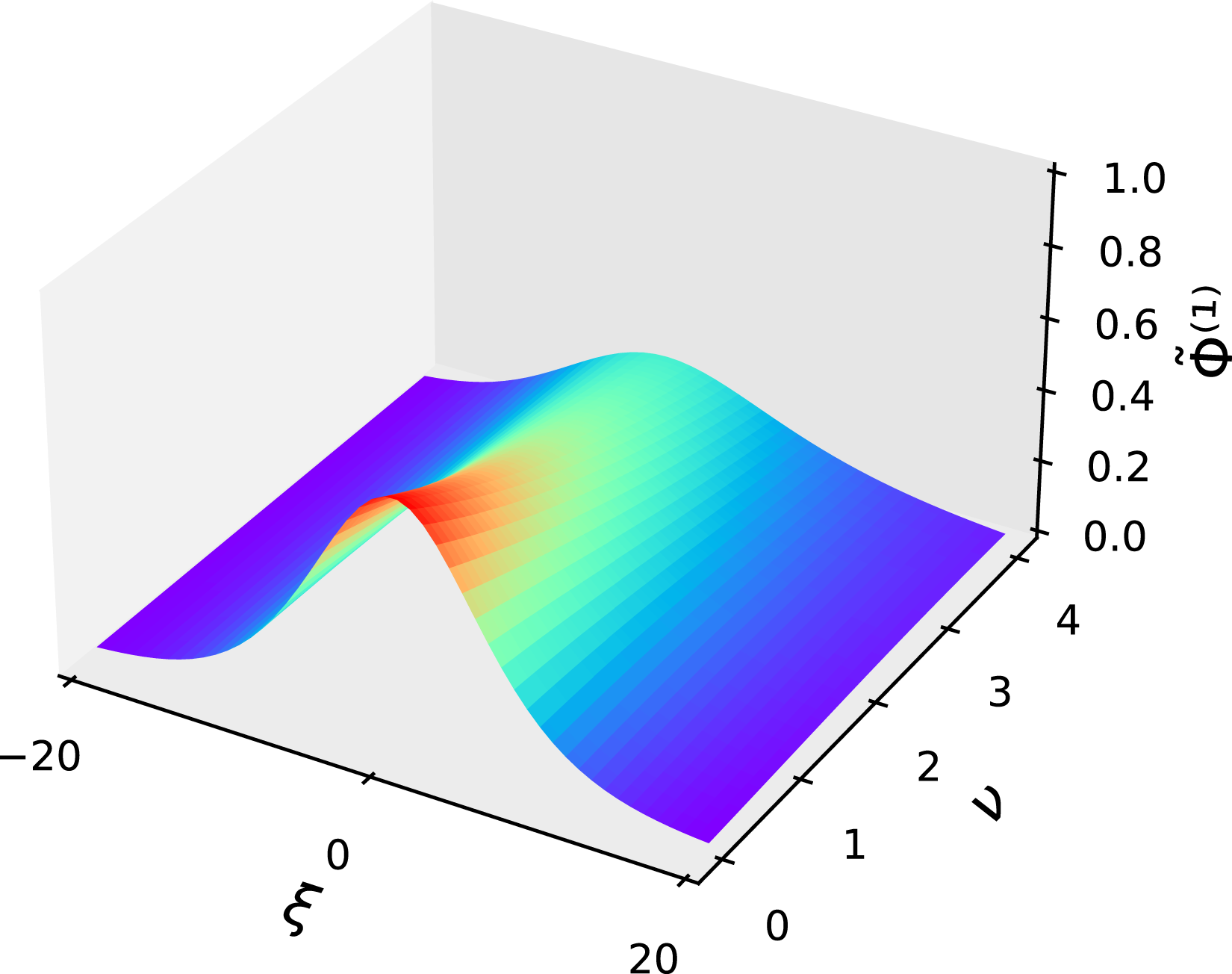
Planar dissipative mKdV solitons
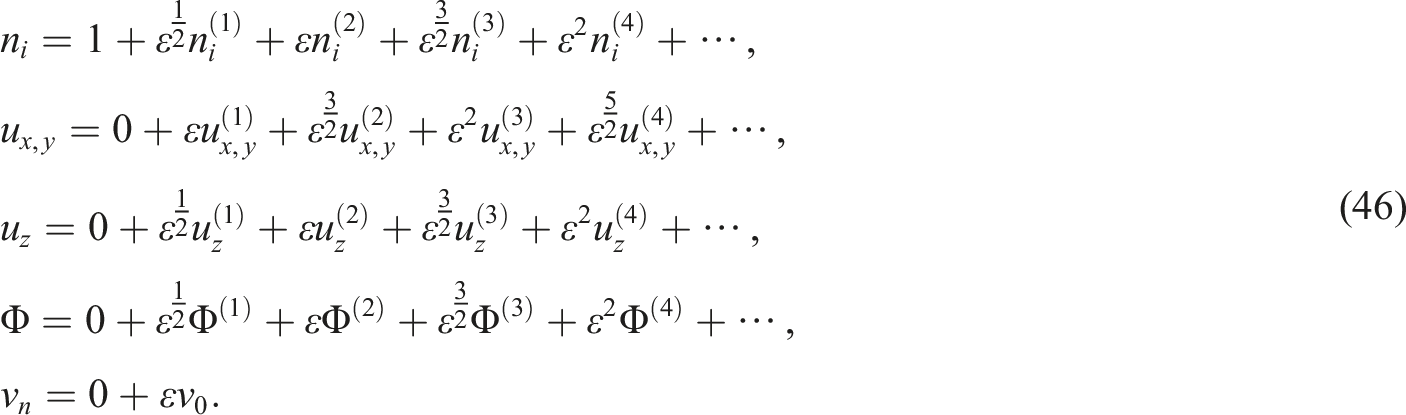
We have determined the critical value of the q-nonextensive parameter for which the nonlinearity is zero, leading to the invalidity of the KdV equation for describing the dynamics of IASWs. We will now derive a modified form of the KdV equation, which still uses the RPM. We will use the independent variables defined in equation (25) and reduce equations (6)–(10) to a single nonlinear equation. We will develop the following perturbed quantities in a power series of ɛ around their equilibrium value



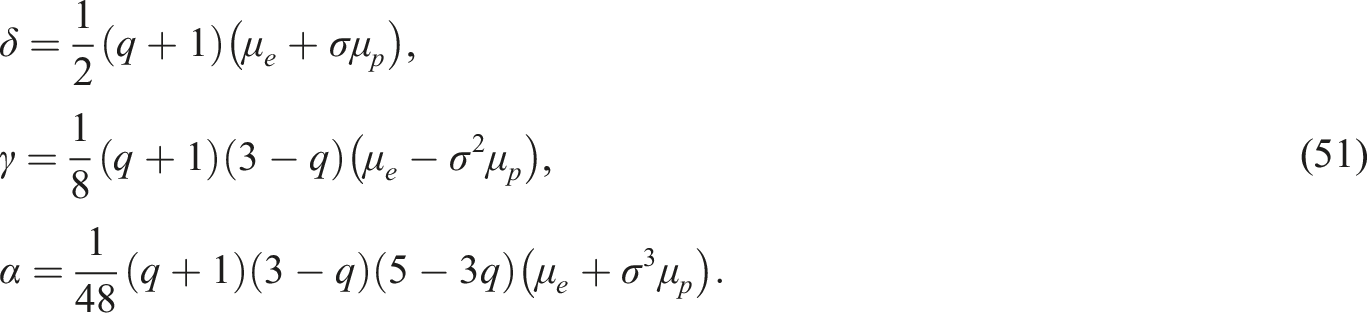

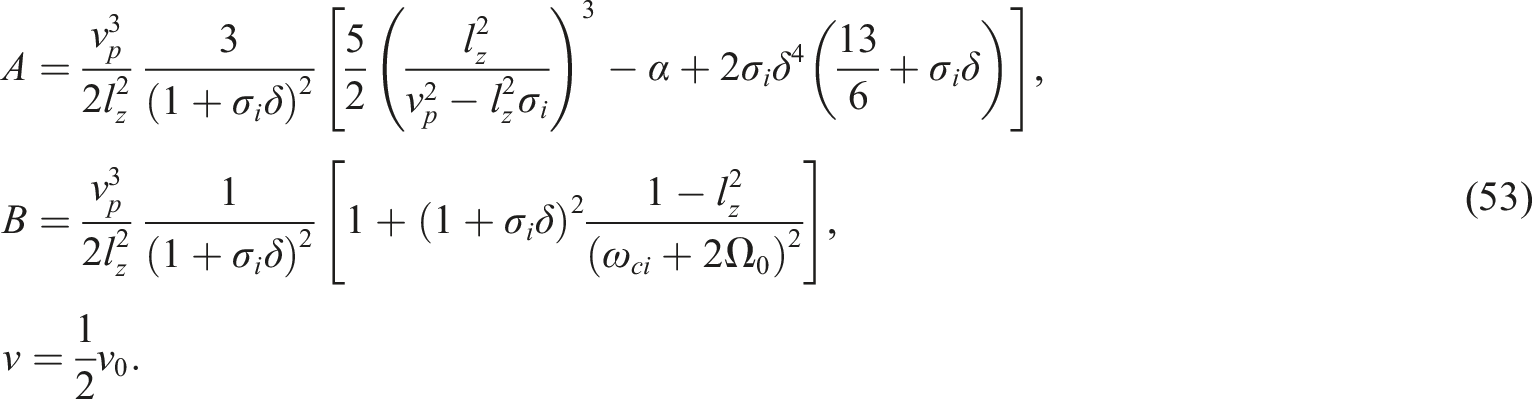
Neglecting σ
i
, ν, and Ω0 in expressions (52) and (53), we obtain the same expressions given in equations (31)–(34) in Ref. 224. Ignoring only the ion-neutral collisions


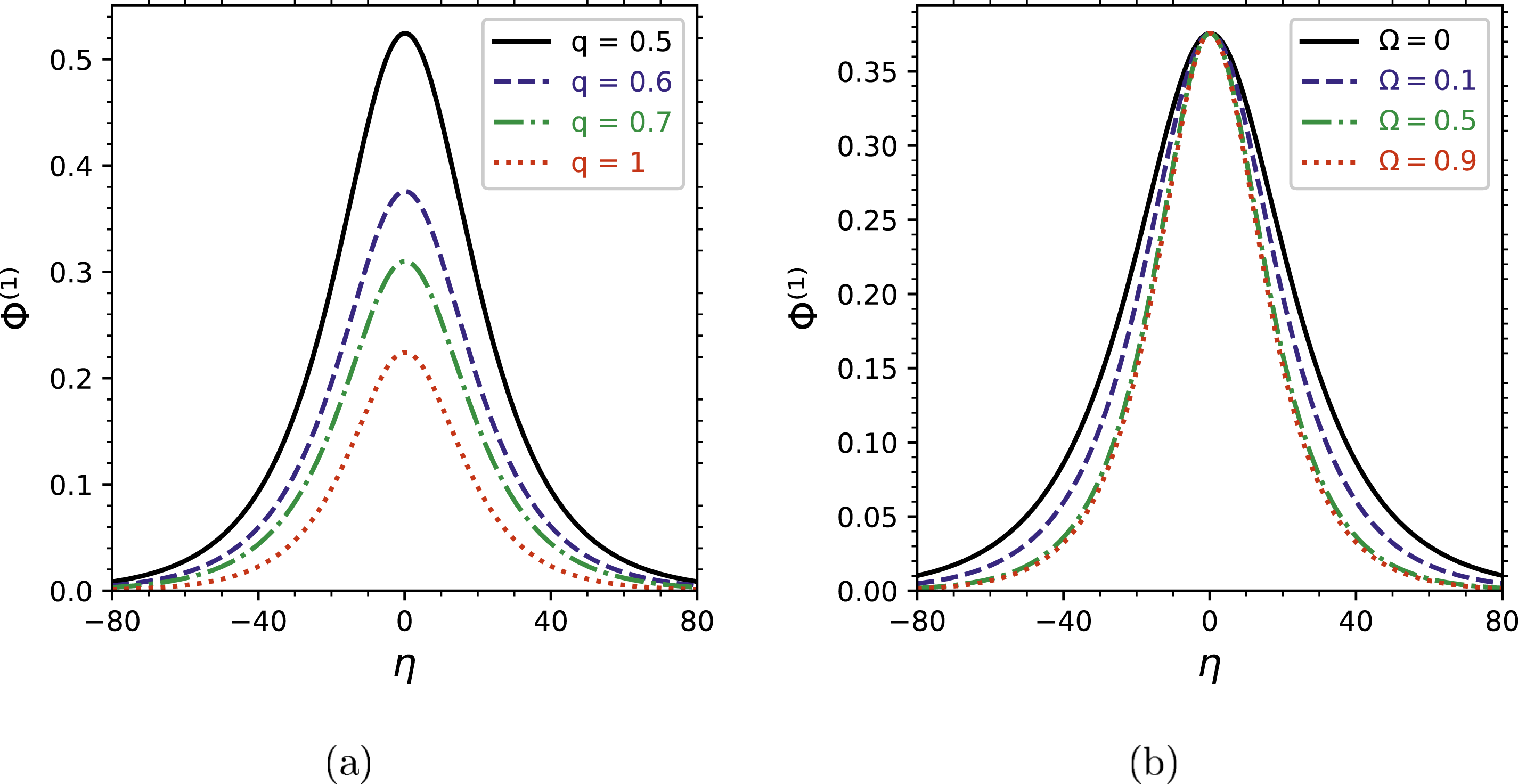
Figures 11 and 12 give the evolution of the amplitude of mKdV soliton with the independent variable η in the absence of the dissipating term Evolution of mKdV electrostatic potential with the variable η across various values of the ion temperature σ
i
(a) and the oblique angle θ (b). The other parameters used are: σ = 0.1, μ
e
= 0.5, μ
p
= 0.2, θ = 30°, ω
ci
= 0.5, σ
i
= 0.5, Ω0 = 0.1, q = 0.6, and u0 = 0.01. Evolution of mKdV electrostatic potential with the variable η for different values of the nonextensive index q (a) and the rotational frequency Ω0 (b). The other parameters used are: σ = 0.1, μ
e
= 0.5, μ
p
= 0.2, θ = 30°, ω
ci
= 0.5, σ
i
= 0.5, Ω0 = 0.1, q = 0.6, and u0 = 0.05.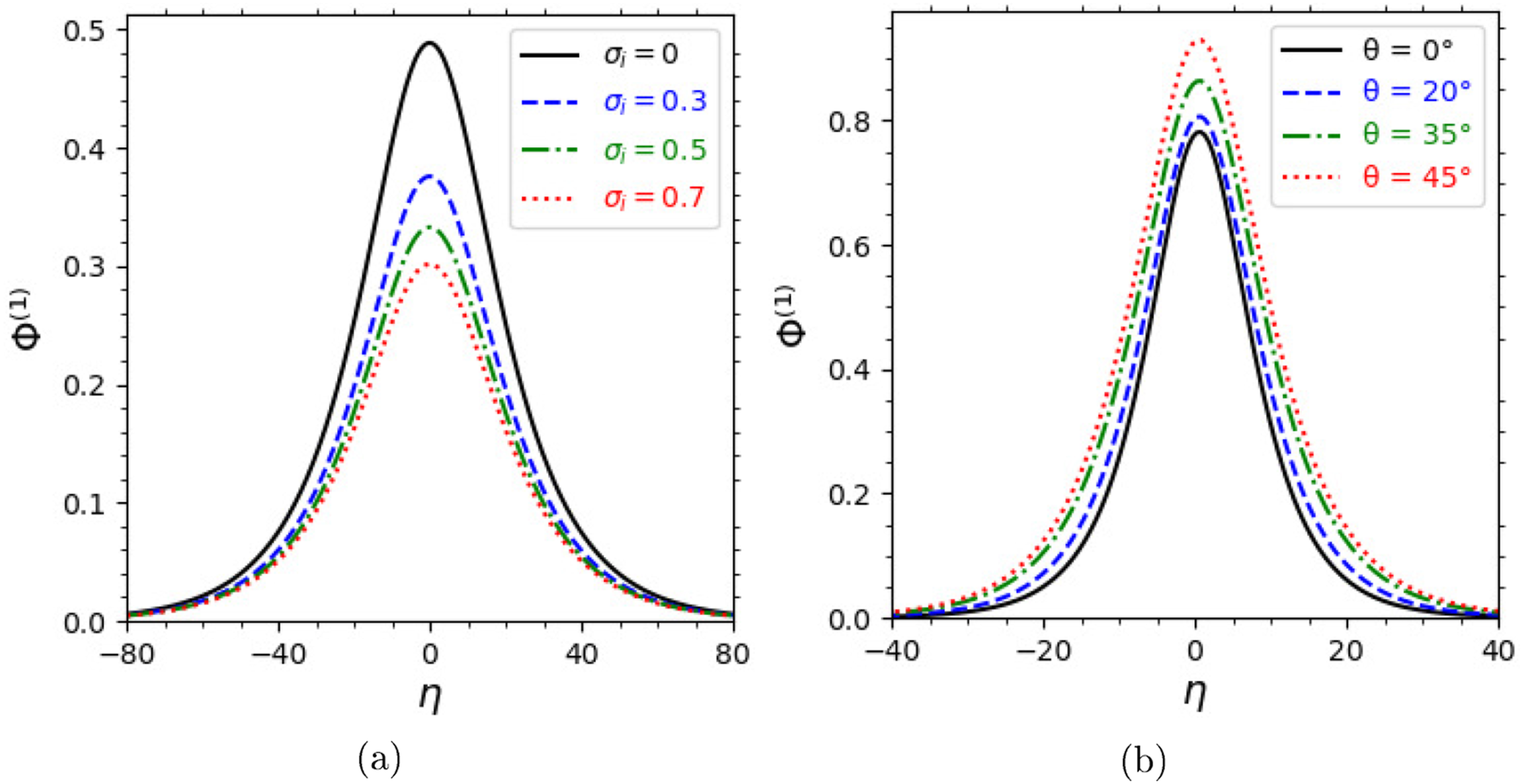
Considering the existence of ion-neutral collisions, it is not possible analytically to find an exact solution to equation (52). By following the same procedure as in Refs. 41,42,45, the approximate solution of the mKdV equation with the damping term is given by

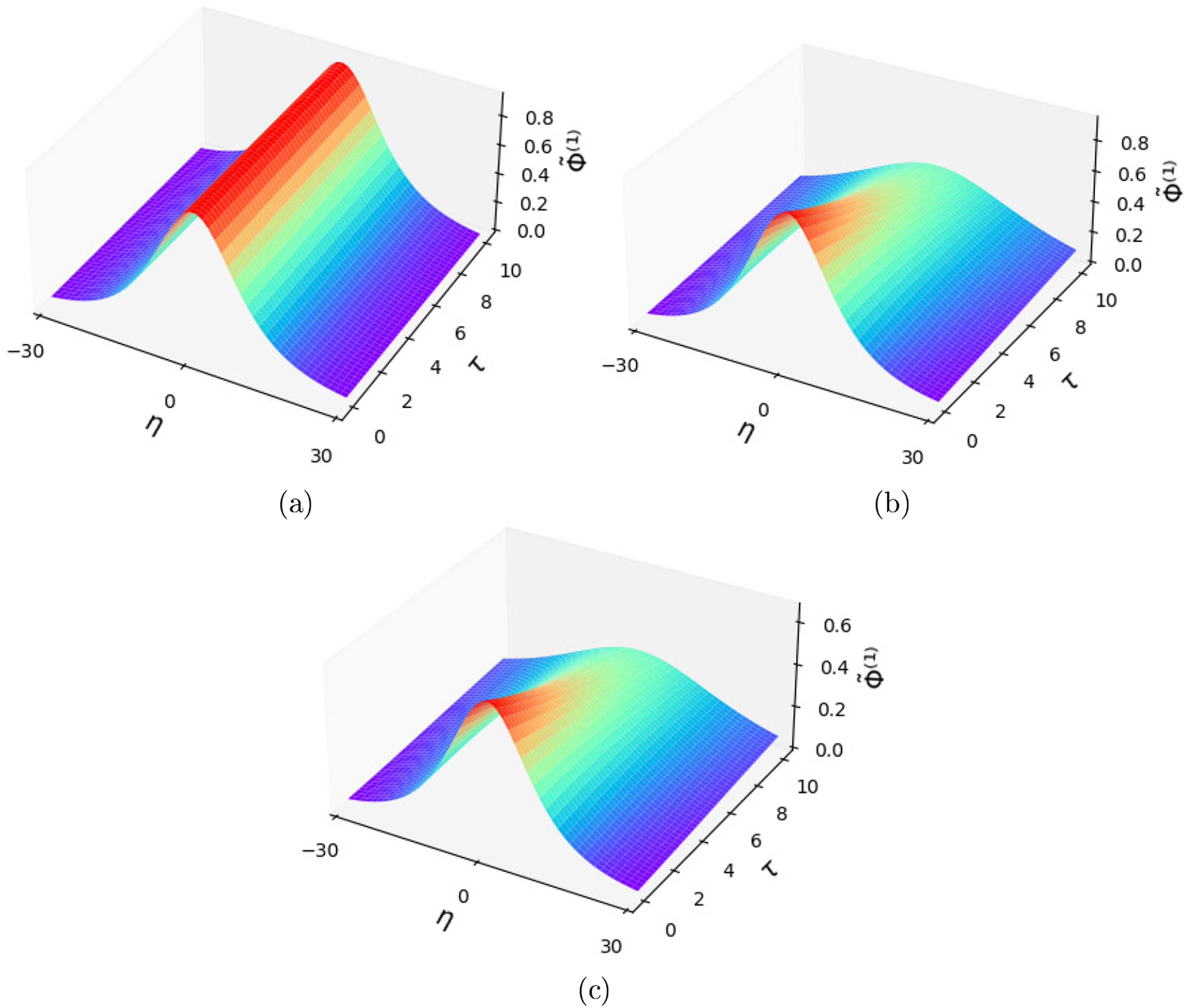
We can see from Figure 13 that the amplitude of IASWs shrinks with time. This amplitude decreases when the ion’s temperature increases. The ion-neutral collision dissipates the energy of the IASWs. The ion temperature further stabilizes the mKdV soliton in the plasma fluid as predicted in Figure 11(a). Figure 14(a) shows the electrostatic potential variation with time and space, where the effects of collisions and ion temperature were ignored. It is observed that the amplitude and width of the soliton remain constant with time during the propagation of the soliton. In this case, the energy of the solitary wave is conserved during propagation. Figure 14(b) shows how the collision affects the characteristics of the soliton propagating in the plasma. It is observed that the amplitude of the soliton is no longer constant and decreases abruptly as it widens with the transmutation of time. The energy of a wave decreases exponentially with time. Thus, wave energy dissipation is due to the collision effect between plasma particles. The combination of the collision effect and the ion temperature considerably influences the amplitude and width of the soliton compared to when the collision effect alone is considered. Figure 14(c) shows a depression tendency in the amplitude following the impact of the ion temperature. Evolution of amplitude of mKdV soliton with time across various values of the ion temperature σ
i
. The other parameters used are: σ = 0.1, μ
e
= 0.5, μ
p
= 0.2, θ = 30°, ω
ci
= 0.5, σ
i
= 0.5, Ω0 = 0.1, q = 0.6, and u0 = 0.05. The 3D plot showing the variation of the electrostatic potential with space η and time τ where (a): ν = 0, σ
i
= 0, (b): ν = 0.15, σ
i
= 0, and (c): ν = 0.15, σ
i
= 0.4, with u0 = 0.04.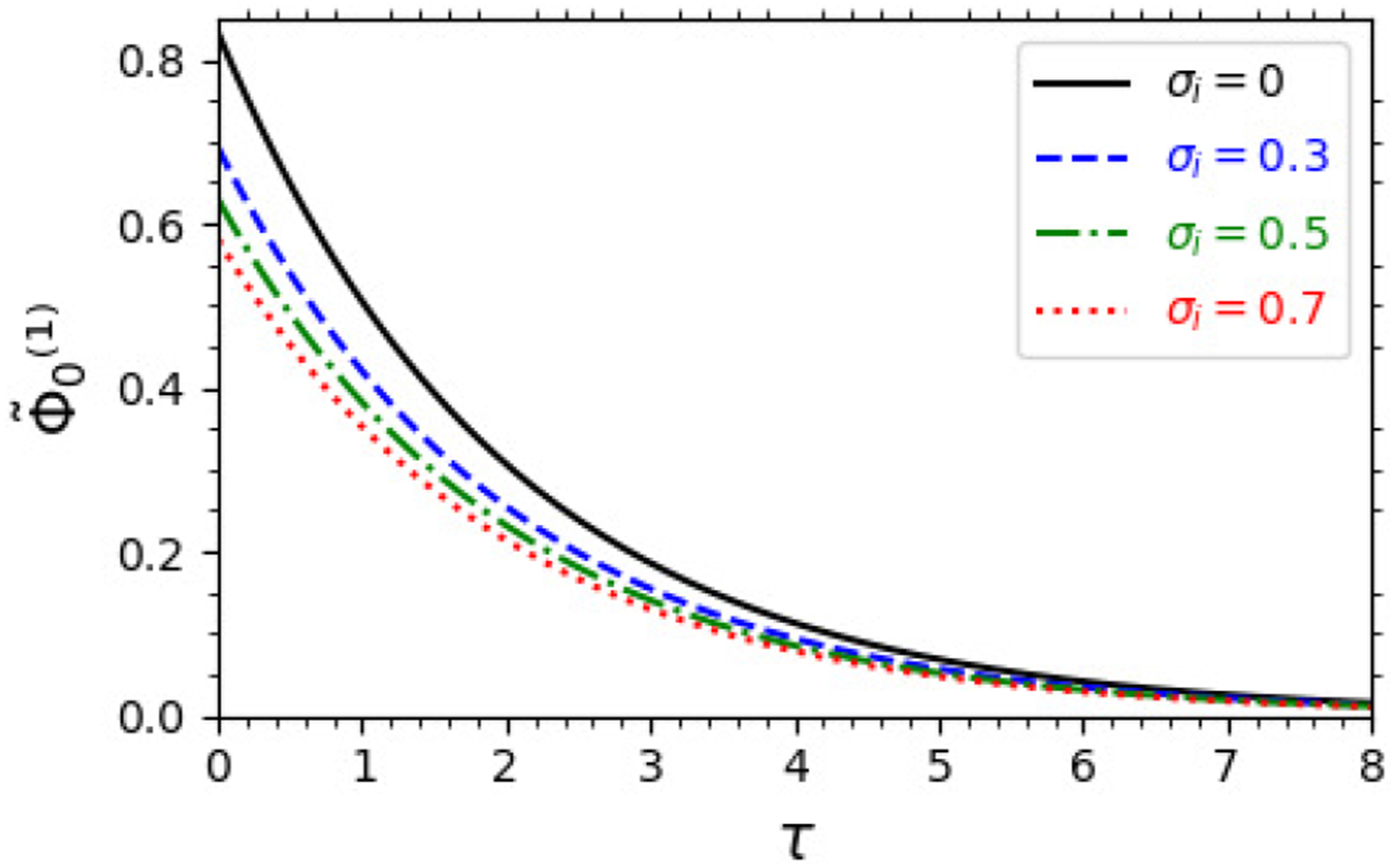
Discussion and conclusion
In this research work, we have investigated analytically and numerically the characteristics of IASWs in a three-component e-p-i collisional magneto-rotational plasma where ions collide with neutral atoms or molecules. We have also studied the effects of dissipation, plasma rotation, and ion temperature on the occurrence and propagation of IASWs. The dispersion equation was obtained by analyzing the propagation of traveling plane waves in the plasma model. We used the RPM to transform the governing equations of the plasma model to the nonlinear KdV and mKdV equations. These equations describe the occurrence and dynamics of IASWs with wave profiles evolving over time (amplitude and width). We specify that all the plasma parameters used in the figures in this paper are generally used in laboratory plasmas and space plasmas.24–26,41,42
The influences of other plasma parameters such as the oblique angle θ, the electron–positron temperature ratio σ, the electron density μ
e
, the positrons density μ
p
, and the nonextensive parameter q have been studied and some results from our work are as follows: (1) In the linear regime and at low frequencies, wave propagation along the magnetic field axis (parallel component) is not influenced by the plasma rotation frequency (Coriolis effect) or the static magnetic field strength. The pulsation of oscillations increases with the wave number and decreases when the nonextensive index rises. The influence of ion-electron temperature σ
i
further excites the ion waves. At the same time, the nonextensivity of the particles leads to a de-excitation of the ion waves. Depending on the component transverse to the magnetic field, in addition to the nonextensive index q and the ion temperature σ
i
, wave propagation along the perpendicular component depends on the Coriolis effect and the magnetic field strength. These two components profoundly modify the propagation of waves (called electrostatic waves) in the plasma. (2) The imaginary term of wave frequency is negative and is responsible for damping the wave oscillations in the plasma and dissipating the wave energy. Ions oscillation has two operating regimes: a transient regime for high wavelengths and a steady state regime for low wavelengths. (3) We have shown that the amplitude of IASWs of the KdV soliton is independent of the rotational frequency and magnetic field, except for their width. (4) We determined the critical value of the nonextensive index for which the amplitude of the IASWs becomes infinite (i.e., the plasma loses its nonlinear properties) and found q = 0.56 for the fixed plasma parameters σ = 0.1, μ
e
= 0.5, μ
p
= 0.2, and σ
i
= 0.3. This value increases with the ion’s temperature. (5) We have shown that for values of q < q
c
(q > q
c
) rarefactive (compressive) waves are formed. (6) The impact of ion temperature is to increase (decrease) the amplitude (width) of KdV soliton. Thus, the enhancement in ion temperature causes a reduction in the nonlinear and dispersive properties of the plasma. (7) Coriolis force does not affect the amplitude of IASWs. However, it does modify the width of the soliton. Increasing the Coriolis force results in a reduction in soliton width, making the plasma less dispersive. (8) Collision effect in plasma leads amplitude (width) of soliton to decay (growth) exponentially with time. These collisions cause the soliton energy to dissipate in the structure. This result is in agreement with that of Farooq et al.
41
(9) Increasing the plasma’s ion temperature and rotation frequency impacts the propagation of solitary waves by reducing their width with evolving time. (10) The combination of collision effects and ion temperature has a more significant influence on the wave profile than when considering the collision effect alone, as shown in Figures 9 and 14. (11) The mKdV equation generates compressive waves only. This observation is analogous to the result of Ferdousi et al.
24
(12) Amplitude of mKdV soliton decreases when the ions temperature increases. The same observation was made when the nonextensivity of electrons and positrons increased. (13) The mKdV soliton would be more stable in a Maxwellian distribution plasma than in superextensive plasmas. (14) The effect of ion-neutral collisions on mKdV solitons causes an attenuation of the soliton amplitude and a widening of soliton width with time.
In summary, our work has focused on investigating the effects of ion temperature, Coriolis force, nonextensive parameter, and dissipation on colliding IASWs in a three-component magneto-rotating plasma. The ion’s temperature and the collision between ions and neutrals play a significant role. Plasma rotation under the influence of the Coriolis force affects the width of IASWs. The plasma parameters used in this work are those generally used in space and laboratory plasmas.24–26,39,41 Our results could contribute to understanding the propagation of electrostatic structures in astrophysical and cosmological plasmas where magneto-rotating plasmas with a nonextensive distribution of electrons and positrons can exist.
Future work
Fractional calculus has recently achieved significant appeal owing to its efficacy in modeling various natural phenomena and elucidating ambiguities in their behavior, which classical integer calculus could not address.46–49 Building upon the recent endeavors of the Tantawy research team in modeling numerous nonlinear phenomena that appear and propagate within various plasma models and other physical systems,50–54 we will employ the Tantawy technique alongside other effective methods to analyze both time fractional damped KdV and damped mKdV equations. This investigation aims to elucidate the impact of fractionality on the behavior of the fractional nonlinear dissipative ion-acoustic structures examined in the current model.
Furthermore, there are also some physical effects that, if taken into account, make the evolutionary wave equations non-integrable, such as the effect of the curvature.55–61 This is also one of our future objectives, in addition to considering the effect of the fractionality, besides the impact of the curvature, and trying to derive some accurate analytical approximations to model and understand the dynamics of nonlinear structures that arise and propagate in the current plasma model.
Footnotes

Authors Contributions
All authors contributed equally and approved the final version of the current manuscript.
Acknowledgments
The authors disclosed receipt of the following financial support for the research, authorship, and/or publication of this article: The authors express their gratitude to Princess Nourah bint Abdulrahman University Researchers Supporting Project Number (PNURSP2025R17), Princess Nourah bint Abdulrahman University, Riyadh, Saudi Arabia. This study is supported via funding from Prince sattam bin Abdulaziz University project number (PSAU/2025/R/1446).
Declaration of conflicting interests
The authors declare that they have no conflicts of interest.
Data Availability Statement
Data sharing does not apply to this article as no data sets were generated or analyzed during the current study.